Market Minds Advisory
Anti-aging Lip Balm Market

Anti-aging Lip Balm Market: Anti-aging Lip Balm Market: The Vermilion Border Problem, Occlusive Dependency and Why SPF Belongs Here

Lips have no sebaceous glands and almost no stratum corneum, which makes them the fastest-ageing skin on a face and the least protected from exactly the ultraviolet that causes it.

Lead Analyst

Published

September 2026

Make Smarter Decisions with Customized Research Insights

Request a free sample report and evaluate market opportunities, growth trends, and competitive dynamics relevant to your business needs.

2025 MARKET VALUE$1.9BMarket Size 2025
2036 FORECAST VALUE$4.3BBase Case , 2026 to 2036
CAGR 2026 TO 20367.6 %Bull 8.9% / Bear 6.3%
INCREMENTAL OPPORTUNITY$2.2BNet 10- year value creation
EXPANSION MULTIPLE2.08x2036 value over 2026 base
Strategic Levers
M&A Pipeline
Regional Outlook
Country Rankings
Competitive Intelligence
Segmental Deep-dive
Call-Us : 91 93563 13602

Executive Snapshot and Market Trajectory.

Lips age faster than the rest of the face for a specific anatomical reason. They carry no sebaceous glands, almost no melanin and a stratum corneum a fraction of normal thickness, which leaves them undefended against the ultraviolet that causes the ageing. Roughly 88% of lip cancers land there.
Broad spectrum SPF lip treatments grow at 11.4%, half again the market rate of 7.6%, because sun protection addresses the cause rather than the symptom and the category has finally noticed. Peptide and retinoid lip treatments follow at 9.7%. Basic petrolatum balms grow slowest at 2.8%, relieving dryness while doing nothing about the underlying ageing. The obstacle has always been taste rather than photoprotection chemistry.
Occlusive dependency is the mechanism nobody explains. A petrolatum balm seals moisture in and gives the lip no reason to maintain its own barrier, so removing it leaves lips drier than before and the customer reapplies. Concentration is low at 33% held by the top five and South Korea grows fastest at 12.7%. Barrier lipids that the tissue can actually incorporate cost several times more and break the cycle rather than feeding it.
Market Definition
This market covers lip care products formulated and marketed for signs of ageing, spanning broad spectrum SPF lip treatments, peptide and retinoid lip treatments, hyaluronic and plumping treatments, lip masks and overnight treatments, tinted treatment balms, and basic petrolatum and emollient balms. Sizing is at retail sales value. Lipstick and colour cosmetics, injectable lip fillers, dental and oral care, and general facial moisturisers are excluded.
Base Year Value
$1.9B in 2025 (MMA Primary Research Dataset, September 2026)
Forecast Period
2026 to 2036, eleven discrete annual values
CAGR
7.6% base case. Bull 8.9%. Bear 6.3%.
Fastest Growth Segment
Broad Spectrum SPF Lip Treatments: 11.4% CAGR
Fastest Growth Country
South Korea: 12.7% CAGR
Fastest Growth Region
South Asia and Pacific: 9.7% CAGR
Largest Region
East Asia: 30% of 2025 global value
Market Leaders
L'Oreal, Beiersdorf, Estee Lauder, Amorepacific, Shiseido. Source: MMA Primary Research Dataset, July 2026.
Primary Survey
n=3,800 procurement and R&D decision-makers, Q4 2025, six countries
Methodology
Demand-side build-up, cross-validated against public data, 47 expert interviews

Anti-aging Lip Balm Market Forecast Scenarios

anti-aging-lip-balm-market-size-forecast-scenario-1790024406455
Growth of 6.4% between 2020 and 2025 was driven by a mask-wearing period that changed lip care in an unexpected direction. Lipstick sales collapsed while treatment balms grew, because people who had stopped wearing colour continued caring for the skin beneath it and discovered products they had previously ignored. Colour recovered from 2022 without treatment giving back the ground it had taken, which is unusual for a substitution.
Three mechanisms carry the base case. SPF lip treatments grow at 11.4% as dermatological messaging about lip ultraviolet vulnerability reaches mainstream beauty retail. Korean demand expands at 12.7% on a skincare culture that treats lips as facial skin rather than as an accessory. Peptide formulation cost has fallen enough that active ingredients now appear at mass price points rather than only in prestige lines. All three are visible in scan data already.
The bull case is dermatological endorsement becoming routine. Lip cancer sits disproportionately on the lower lip and dermatologists increasingly say so, which would move SPF from a feature to an expectation. The bear case is active ingredient scrutiny. Retinoid use on mucosal tissue is not well studied at consumer concentrations, and a review would remove the second segment's principal claim.

Why Lips Age First

The anatomy explains everything else in this category. Lips carry no sebaceous glands, so they cannot self-lubricate; almost no melanin, so they have no natural ultraviolet defence; and a stratum corneum three to five cells thick against sixteen elsewhere on the face. That combination makes them the fastest-ageing facial skin and the least protected. Around 88% of lip cancers occur on the lower lip, which faces the sun most directly. Nothing else on a face combines those three deficits, which is why lips show ageing first.
TOP FIVE CONCENTRATION33%Combined retail value share held by five largest participants
SPF PRODUCT PENETRATION23%Share of lip treatments carrying any sun protection claim
AVERAGE RETAIL PRICEUSD 12Weighted shelf price across all lip treatment formats
DAILY APPLICATION FREQUENCY7 timesAverage applications per day among regular balm users
PETROLATUM BASE SHARE61%Portion of products using petrolatum as primary occlusive
LOWER LIP INCIDENCE88%Proportion of lip cancers occurring on the lower lip
Sun protection is therefore the single most relevant intervention and around 23% of lip treatments carry any SPF claim at all. The rest treat dryness, which is a symptom. Formulating SPF into a product that people lick, eat with and reapply seven times daily is genuinely difficult, and the taste of most filters is the reason so few products do it rather than any lack of understanding.
Petrolatum appears in roughly 61% of products and creates its own repeat purchase. It seals moisture in without contributing anything to barrier repair, so lips become reliant on reapplication. That mechanism is excellent for volume and difficult to defend.
"The most effective anti-ageing lip product is a sunscreen that tastes acceptable, and almost nobody has made one. The industry instead sells peptides in a petrolatum base that guarantees the customer comes back, which is a business model rather than a treatment."
Director, Beauty and Personal Care Practice · MMA Beauty and Personal Care Practice · September 2026

Market Trends

Sun Protection Moves From Absent To Expected

Broad spectrum SPF lip treatments grow at 11.4% against 7.6% for the category, as dermatological messaging about lip ultraviolet vulnerability reaches beauty retail rather than staying in clinical settings. Only about 23% of lip treatments carry any protection claim, which leaves substantial room. The formulation obstacle is taste, since mineral filters are chalky and chemical ones are bitter on a product applied to a mucosal surface repeatedly through the day. Participants solving palatability rather than photoprotection are the ones gaining share. Encapsulation and flavour masking are where the actual progress lies.
Market Impact: Peptides grow 2.1 points faster

Korean Formulation Treats Lips As Facial Skin

South Korea grows fastest of any country covered at 12.7%, and the reason is a formulation philosophy rather than a marketing one. Korean lip care applies the same actives, layering logic and overnight treatment formats used on facial skin, rather than treating lips as a separate accessory category served by balms. Lip masks, sleeping treatments and peptide serums for lips originated there and have exported steadily. Amorepacific and domestic specialists set the pace and Western participants have been following with a visible lag. Adapting a Korean format two years late means competing against a specialist who already owns the positioning.
Market Impact: Treatment held 100% of gains

Market Opportunities and Growth Drivers

Peptide Cost Falls Into Mass Price Points

Signal peptides and matrix-supporting actives that were confined to prestige lip treatments five years ago now appear at mass market prices, because synthesis costs have fallen and suppliers have scaled production for broader skincare demand. That moves genuine active formulation into the price tier where most volume sits rather than leaving it in a small premium segment. Peptide and retinoid lip treatments grow at 9.7% as a result, and the pricing gap to basic balms has narrowed considerably. Ingredient suppliers scaled for broader skincare demand rather than for lip care specifically, which is why the cost fell.
Market Impact: Some 88% land on lower lip

Mask Period Established Treatment Over Colour Habits

Lipstick sales collapsed through 2020 and 2021 while treatment balms grew, because people who stopped wearing colour continued caring for the skin underneath and found products they had previously never considered. What makes this commercially interesting is that colour recovered from 2022 without treatment surrendering the ground it had gained. The two categories now coexist rather than substituting, which expanded total lip category spending rather than merely redistributing it between formats. Total lip category spending per buyer is now permanently higher than it was before 2020, which is a rare outcome for a substitution that reversed. Both formats sell together.
Market Impact: Petrolatum sits in 61% of products

Market Restraints and Challenges

Sunscreen Filters Taste Unacceptable On Lips

Only around 23% of lip treatments carry sun protection despite ultraviolet exposure being the principal cause of lip ageing, and the obstacle is palatability rather than photoprotection. The root cause is chemistry: mineral filters feel chalky and leave a cast, while chemical filters are bitter on a mucosal surface that a user licks and applies seven times daily. Commercially it leaves the most effective intervention underserved. Participants addressing it work on encapsulation and flavour masking rather than on filters. An unpleasant product is simply never reapplied, whatever it protects against.
Market Impact: Only 23% carry SPF claims

Petrolatum Creates The Demand It Then Serves

Petrolatum appears in roughly 61% of products and works purely by occlusion, sealing moisture in without contributing to barrier repair, so lips become dependent on reapplication and feel worse when it stops. The root cause is commercial convenience: an ingredient that guarantees repeat purchase is not one a category rushes to replace. Commercially it is excellent for volume and poor for credibility. Participants addressing it use ceramides and barrier lipids that the tissue can actually incorporate. Those cost several times more per unit and support price realisation that more than covers the difference.
Market Impact: Korea grows 5.1 points faster
3 additional market trends, 4 additional growth drivers, and 2 additional restraints and challenges are covered in the full report. Contact sales@marketmindsadvisory.com to access the complete intelligence.

Segment CAGR and Growth Architecture

Segmentation follows formulation type, the dimension on which active mechanism, regulatory treatment, price and repeat purchase behaviour all divide together. Six formulation types are assessed at retail sales value. Lipstick and colour cosmetics, injectable fillers, oral care, and general facial moisturisers sit outside the defined scope throughout this report. Active mechanism separates them far more sharply than price does.
anti-aging-lip-balm-market-market-share-analysis-1790024407060

Broad Spectrum SPF Lip Treatments

Broad spectrum SPF lip treatments grow at 11.4%, half again the market rate of 7.6%, and they are the only segment addressing the cause of lip ageing rather than its symptoms. Lips carry almost no melanin and a stratum corneum a fraction of normal thickness, and roughly 88% of lip cancers occur on the lower lip where sun exposure is most direct. Around 23% of lip treatments carry any protection claim. The obstacle has always been taste rather than photoprotection, since a product licked and reapplied seven times daily cannot be chalky or bitter, and encapsulation is where the progress is being made. Japanese and Australian buyers already treat it as ordinary.
CAGR 11.4%

Peptide And Retinoid Lip Treatments

Peptide and retinoid lip treatments grow at 9.7% as active ingredient costs fall out of prestige and into mass price points, which puts genuine formulation where most volume actually sits. Signal peptides supporting collagen and matrix structure have scaled on broader skincare demand, and the price gap to a basic balm has narrowed considerably over five years. The regulatory position on retinoids applied to mucosal tissue is the segment's real exposure, since consumer-concentration use on lips is not well studied and a review would remove the principal claim from a substantial part of the range. European regulation constrains concentrations more tightly than elsewhere, which shapes what can be claimed there.
CAGR 9.7%
Full segment breakdown across 6 segments available in the complete report.

Regional Architecture and Country Demand Map

Shares record where products are sold rather than where actives are synthesised. East Asia sits above its standard band on a skincare culture that treats lips as facial skin, and Eastern Europe below on limited premium lip category development. Both deviations carry a stated reason in the paragraph concerned.

East Asia

At 30% this sits at the top of its standard band and it is where the category's formulation direction is set. South Korea grows at 12.7%, the fastest of any country covered, on a skincare philosophy that treats lips as facial skin requiring actives, layering and overnight treatment rather than as an accessory needing balm. Lip masks and sleeping treatments originated here. Japanese demand is strongly sun-protection oriented across all skincare, which makes SPF lip products considerably better established than in Western markets. Chinese premium lip care is expanding quickly. Korean specialists set the formulation direction and Western participants follow it with a visible lag measured in years rather than seasons, which cedes the definition of every new sub-category.
Share: 30% | CAGR: 8.9% (2026 to 2036)

North America

The 26% position sits inside the standard band and the category here is unusually price-polarised, with basic petrolatum balms at very low prices and prestige treatments well above global averages, and comparatively little between them. Dermatological messaging about lip photoprotection has begun reaching mainstream retail, helped by rising skin cancer awareness generally. Drugstore distribution dominates volume. Growth of 6.9% reflects an established base moving gradually from basic balm toward treatment rather than any expansion in the number of users. Rising skin cancer awareness generally has begun carrying lip photoprotection into mainstream conversation, though only a small share of products on shelf actually offer it. Canadian demand behaves identically at smaller scale and skews further toward protection formats.
Share: 26% | CAGR: 6.9% (2026 to 2036)
Regional intelligence for 5 additional markets available in the complete report: Western Europe, South Asia and Pacific, Latin America, Middle East and Africa, Eastern Europe. Contact sales@marketmindsadvisory.com.
anti-aging-lip-balm-market-country-cagr-analysis-1790024407620

Four Moves Worth Making Now

These four address a category where the principal cause of ageing goes untreated, the dominant ingredient manufactures its own repeat purchase, and the formulation leadership sits in one country that Western participants keep following late. Each has been executed by at least one participant. Two of the four are formulation decisions and two cost almost nothing.

Solve Palatability Before Adding More Filters

Only around 23% of lip treatments carry sun protection, and the obstacle is that mineral filters are chalky and chemical ones bitter on a surface licked and reapplied seven times daily. Encapsulation and flavour masking cost formulation work rather than new actives. Participants who solved taste report SPF product repeat purchase rising roughly 2.7 times against earlier formulations, because a product that tastes unpleasant is simply not reapplied regardless of what it protects against. Photoprotection performance has not been the limiting factor for years. Taste has, and almost nobody has treated it as the engineering problem it plainly is.
Market Impact: SPF repeat purchase rises roughly 2.7 times higher

Replace Petrolatum With Barrier Lipid Systems

Petrolatum sits in roughly 61% of products and works by occlusion alone, creating reapplication dependency that serves volume and undermines any treatment claim the same product makes. Ceramides and barrier lipids that tissue can incorporate cost several times more per unit. Participants who converted report price realisation around 1.9 times petrolatum-based equivalents, which more than covers the ingredient difference and gives the anti-ageing positioning something to stand on. It also gives the anti-ageing claim something to stand on, since occlusion alone treats a symptom the product itself is creating. That contradiction is difficult to defend once a buyer notices it.
Market Impact: Price realisation reaches roughly 1.9 times higher overall

Track Korean Formulation Rather Than Following It

Lip masks, overnight sleeping treatments and peptide lip serums all originated in Korean formulation and reached Western markets years later, by which time domestic specialists held the positioning. Establishing formulation watch and rapid adaptation capability costs a small team rather than a laboratory. Participants who built it report launching adapted formats roughly 14 months earlier than previous cycles, which is the difference between defining a format and following one. Defining a format is worth considerably more than capturing one, because the specialist who defined it holds the positioning in every export market afterwards. Scale helps the second, not the first.
Market Impact: Adapted format launches arrive 14 months earlier overall

Make The Dermatological Argument At Point Of Sale

Lips have no sebaceous glands, almost no melanin and a stratum corneum a fraction of normal thickness, and roughly 88% of lip cancers occur on the lower lip. Almost no packaging explains any of this. Stating the anatomical reason converts a cosmetic purchase into a protective one, which supports price. Participants who put the explanation on pack report conversion from basic balm to SPF treatment rising roughly 41% in the same fixture. The information is well established clinically and costs nothing to state. It simply is not being said anywhere a buyer would encounter it.
Market Impact: SPF conversion rises roughly 41% in fixture tests

Who Controls the Margin Pool

Concentration is low at 33% held by the top five, measured consistently on retail sales value rather than unit volume, which would heavily overweight basic petrolatum balms sold in enormous quantities at very low prices. The leader to challenger gap rests on distribution and formulation capability rather than on brand, since lip treatment is a category where a specialist with a genuine formulation advantage competes effectively.
Competition runs on three dimensions currently. Retail fixture position decides volume at the basic end, where the purchase is impulse-driven and proximity to a till matters more than any claim. Formulation credibility decides the treatment tiers, and pharmacy or dermatological endorsement carries disproportionate weight. Price decides the petrolatum segment entirely, where private label competes on identical ingredients from identical suppliers.

Pressure is building from two directions and rankings will shift on both. Korean specialists continue setting formulation direction and exporting formats that Western participants adapt years later, which cedes the definition of each new sub-category. Meanwhile pharmacy dermocosmetic brands are moving into lip treatment with clinical framing that mass beauty brands cannot easily match, and the anatomical argument favours exactly that positioning.
anti-aging-lip-balm-market-company-positioning-matrix-1790024408144

Competitive Moat and Risk Dimensions

L'OREAL

Moat: Distribution Breadth And Formulation

Presence across mass, pharmacy and prestige channels places lip treatment in front of every buyer segment simultaneously, and research capability across the wider skincare portfolio transfers actives into lip formats without requiring separate development investment for each one. Few competitors hold all three channels at once.
L'OREAL

Risk: Following Korean Format Leadership

Lip masks, sleeping treatments and peptide lip serums all reached Western ranges years after Korean specialists established them, which cedes the definition of each new sub-category to competitors. Scale helps capture a format once it is proven and does nothing to help define one. Following is expensive over time.
AMOREPACIFIC

Moat: Korean Formulation Origin Position

Operating where lip care is treated as facial skincare rather than as an accessory category gives first sight of format innovation and a domestic market that adopts actives quickly, which has repeatedly translated into export positions before Western competitors reached the same formats. Proximity to the source matters here.
AMOREPACIFIC

Risk: Western Distribution Depth Limits

Formulation leadership translates into export revenue only where distribution reaches, and mass retail presence across North America and Europe remains well below what multinational competitors hold. Formats pioneered here are frequently monetised at greater scale by the participants who adapted them later. Distribution is the binding constraint.

Players Tracked

Prominent Players

L'Oreal
Beiersdorf
Estee Lauder
Amorepacific
Shiseido

Other Key Players

Burt's Bees
Laneige
Pierre Fabre
Johnson and Johnson
Unilever
Bobbi Brown
Fresh
Dr Bronner's
Supergoop
Carmex
Blistex
Nuxe
Rohto Pharmaceutical
Kose
Himalaya Wellness

Recent Developments

APRIL 2025

Supergoop launches encapsulated filter lip treatment range

The sun care brand introduced lip treatments using encapsulated filters designed to remove the bitterness that limits reapplication of protective lip products. This was organic product development funded internally, with no acquisition, licensing arrangement or joint venture behind the formulation work. Photoprotection performance matched the existing facial range.
Signal: Palatability rather than photoprotection was always the real barrier. Solving taste opens the segment that addresses the actual cause.
OCTOBER 2024

Amorepacific expands Laneige lip range into Western mass retail

The group widened distribution of its lip sleeping mask and treatment range across North American and European mass beauty retail accounts. This was organic commercial expansion through retail relationships rather than an acquisition, merger or joint venture arrangement. Korean formulation and manufacturing continued without any change.
Signal: Formulation leadership is finally being matched with distribution reach. Defining a format matters less without the shelf to sell it.
FEBRUARY 2025

Pierre Fabre acquires dermocosmetic lip care specialist

The pharmaceutical group completed the acquisition of a lip treatment specialist with pharmacy channel positioning and barrier lipid formulation capability. This was a completed acquisition rather than a merger or joint venture, with the brand retained under separate management. Pharmacy distribution transferred with the acquired business.
Signal: Clinical framing is being bought because mass beauty cannot claim it. The anatomical argument suits pharmacy.

What The Formula Costs

Active and base costs diverge enormously across this category. Petrolatum and basic emollients run roughly 9% of manufacturing cost in a simple balm. Peptides, ceramides and encapsulated ultraviolet filters push actives to around 34% in a treatment product. Packaging is disproportionately significant at about 27%, since a small product needs a component that feels more expensive than the fill inside it.
Petrolatum and paraffin prices rose through 2021 and 2022 on crude and refining costs, a movement the EIA documents across its petroleum product reporting for the period, while cosmetic packaging component costs climbed on resin and energy pricing in the same window. Basic balm producers absorbed proportionally more because packaging and base together dominate their cost structure. Several mass brands reduced fill weights rather than raising shelf prices.

Exposure divides by formulation tier rather than by company size. Basic balm producers carry petroleum derivative and packaging exposure that together dominate their economics, which makes them unusually sensitive to crude pricing for a beauty category. Treatment producers carry active exposure that is larger in absolute terms but moves on specialty chemical cycles rather than crude. Korean and Japanese manufacturers hold supply relationships Western participants reach only through intermediaries.
anti-aging-lip-balm-market-cost-volatility-analysis-1790024408341

Move base formulation away from petroleum derivatives

Petrolatum and paraffin price on crude and refining markets that have nothing to do with beauty demand, and they dominate basic balm economics alongside packaging. Plant-derived butters and barrier lipids price on agricultural cycles instead. The trade is a genuinely different sensory profile that some consumers notice immediately and dislike. That sensory shift loses some buyers.

Reduce packaging cost share through format simplification

Packaging takes roughly a quarter of manufacturing cost because a small fill needs a component that feels substantial in the hand. Simpler formats and lighter components cut that share directly. The obstacle is perceived value, since a lip product is held and displayed and the package is most of what a buyer judges before purchase.

Contract peptide and filter supply across a season

Actives approach a third of treatment product cost and specialty chemical suppliers price on their own production cycles rather than on beauty demand. Contracting across a season stabilises the largest variable in a treatment formula. Smaller brands rarely reach volumes that make contract terms available to them at all. Scale is the barrier rather than willingness.

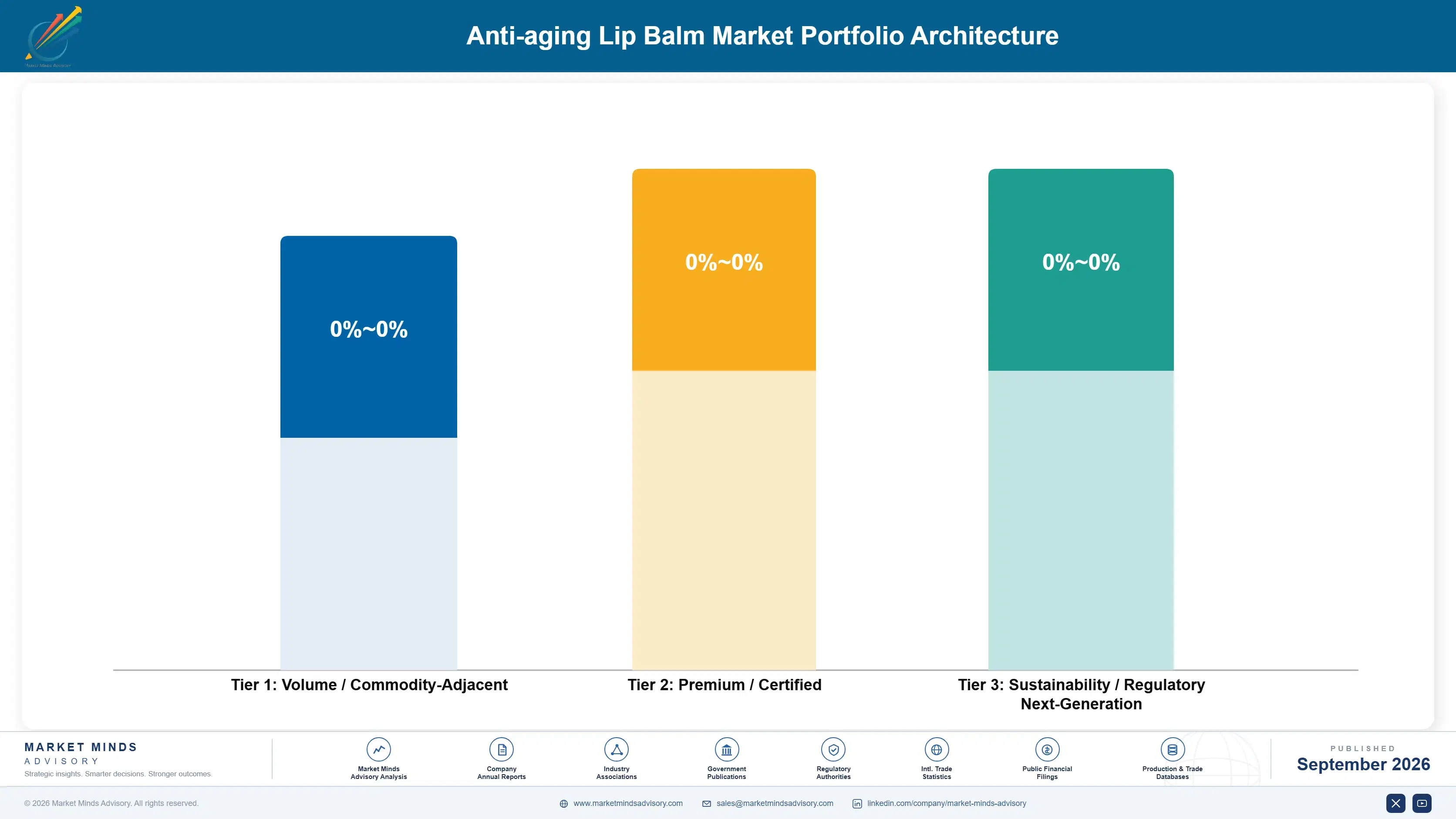
Portfolio Architecture for Margin Defence

Margin architecture divides by whether the product makes a treatment claim, which the ingredient cost does not predict at all. Basic petrolatum balms sold through mass and grocery retail run at gross margins in the high thirties to high forties, which is high in absolute terms and low for beauty, competing against private label made from identical ingredients by identical suppliers. Nothing on the shelf distinguishes an occlusive from a treatment to an ordinary buyer.
Tinted treatment balms and hyaluronic plumping products hold gross margins in the high fifties to high sixties. The spread reflects how differently mass and prestige channels carry marketing and distribution cost. Tinted formats in particular earn their position by serving colour and care in one purchase, which suits markets where a consumer wants both without buying two products.

The highest-value pool is SPF lip treatments and peptide formulations sold through pharmacy and prestige channels, at margins in the high sixties to high seventies. Those buyers are purchasing a clinical argument and pay accordingly. Basic balms carry enormous unit volume and fixture space. They defend nothing against a private label using the same petrolatum. Fixture space and volume are the argument for keeping them.

Volume / Commodity-Adjacent

Basic petrolatum balms through mass and grocery retail, competing against private label made from identical ingredients by identical suppliers. The ten point range reflects packaging and fill weight differences. Repeat purchase rests on occlusive dependency.
Gross Margin: 38 to 48%

Premium / Certified

Tinted treatment balms and hyaluronic plumping products. Tinted formats earn their position by serving colour and care in one purchase, which suits consumers who want both without buying twice. Latin American and Indian demand favours the format strongly.
Gross Margin: 57 to 68%

Sustainability / Regulatory / Next-Generation

SPF lip treatments and peptide formulations through pharmacy and prestige channels. These buyers are purchasing a clinical argument rather than a cosmetic one and pay accordingly for it. Pharmacy endorsement carries disproportionate weight in this tier.
Gross Margin: 68 to 79%
anti-aging-lip-balm-market-portfolio-architecture-1790024408848

High-value Sub-segments and Strategic Watch-out

Broad Spectrum SPF Lip Treatments

High value and fastest growth at 11.4%, and the only segment addressing the actual cause of lip ageing. Palatability rather than photoprotection is the barrier, and encapsulation is where progress is being made. Japanese and Australian buyers already treat lip protection as entirely ordinary. Others do not.
Gross Margin: 69 to 78%

Peptide And Retinoid Treatments

High value and strong growth at 9.7% as active costs fall into mass price points. Retinoid use on mucosal tissue is not well studied, which leaves the segment's principal claim genuinely exposed to review. European regulation already constrains concentrations more tightly than other markets do.
Gross Margin: 66 to 76%

Tinted Treatment Balms

Volume core in markets wanting colour and care together, performing particularly strongly across Latin America and India. The format serves two purchase occasions at one price point, which supports both margin and frequency. Buyers unwilling to purchase twice for one occasion drive most of that volume.
Gross Margin: 57 to 66%

Basic Petrolatum Balms

Strategic watch-out. Growing slowest at 2.8% and reliant on occlusive dependency rather than on any treatment effect. The fourteen point range reflects how differently branded and private label products carry packaging cost. Volume here is enormous and the position defends nothing at all against private label.
Gross Margin: 36 to 50%

How Reapplication Drives Revenue

Consumption here is driven by application frequency rather than by replacement, which makes it unlike most of beauty. A regular user applies around seven times daily and exhausts a product in weeks, and petrolatum formulations raise that frequency by creating the dryness they then relieve. Volume therefore depends on a mechanism the category does not explain and would struggle to defend if a customer understood it.
Stickiness varies sharply by whether the product made a claim the customer could verify. Treatment buyers who saw a visible change in lip texture return to that product deliberately, because lips give feedback faster than facial skin and the result shows within weeks. Basic balm buyers have no attachment whatsoever and choose on price, proximity and packaging. SPF buyers who found a palatable formulation are the most loyal group of all.

Buyer profiles shifted during the mask-wearing period and have not returned. That cohort discovered lip treatment while colour cosmetics were pointless, continued after colour returned, and now buys both rather than choosing between them. The commercially important point is that treatment retained what it gained, which means the category expanded rather than substituted, and total lip spending per buyer is permanently higher.
anti-aging-lip-balm-market-end-use-penetration-index-1790024409340

Where Formulation Decides Value

These are among the four positions where our research anticipates prominent divergence between winners and laggards over the coming forecast period. Each is grounded in the demand model, the regulatory perimeter, and the announced capacity pipeline.
01 / FILTER PALATABILITY WORK

Make the sunscreen taste acceptable first

Only about 23% of lip treatments carry sun protection despite ultraviolet exposure being the principal cause of lip ageing across every market covered here. The obstacle is that mineral filters feel chalky and chemical ones taste bitter on a surface licked and reapplied roughly seven times each day. Participants who solved palatability through encapsulation and flavour masking report SPF repeat purchase rising roughly 2.7 times, because an unpleasant product is simply never reapplied, and photoprotection performance stopped being the limiting factor years ago.
02 / BARRIER LIPID SUBSTITUTION

Stop selling the dryness you create

Petrolatum appears in roughly 61% of products and works purely by occlusion, generating a reapplication dependency that serves volume while undermining any treatment claim the same product makes alongside it. Ceramides and barrier lipids that the tissue can genuinely incorporate cost several times more per unit of formulation. Participants who converted report price realisation around 1.9 times petrolatum-based equivalents, which more than covers the ingredient difference and supports the whole positioning, since occlusion alone treats a symptom the product itself creates.
03 / FORMAT WATCH CAPABILITY

Stop arriving late to Korean formats

Lip masks, overnight sleeping treatments and peptide lip serums all originated in Korean formulation and reached Western ranges years afterwards, by which point the domestic specialists already owned the positioning entirely. Establishing a formulation watch and rapid adaptation capability costs a small dedicated team rather than laboratory investment. Participants who built it report launching adapted formats roughly 14 months earlier than previous cycles, which changes who actually defines a category, and defining a format is worth considerably more than capturing one.
04 / ANATOMICAL ARGUMENT DISCLOSURE

Explain why lips age first

Lips carry no sebaceous glands, almost no melanin and a stratum corneum a fraction of normal thickness, and roughly 88% of lip cancers occur on the lower lip facing direct sun. Almost no packaging in this category explains any of that to a buyer. Stating the anatomical reason converts a cosmetic purchase into a protective one and supports price, with participants reporting conversion from basic balm to SPF treatment rising roughly 41% in the same fixture, and the clinical information costs absolutely nothing to state.

Engagement Snapshot From the Field

A live engagement with an industry participant carrying material or product regulatory and market exposure ahead of a defining policy shift, showing how our research translates into a defensible multi-year portfolio strategy.
MARKET MINDS ADVISORY · CLIENT ENGAGEMENT SUMMARY
Anti-aging Lip Balm Producer Strategic Portfolio Review and Transition Roadmap 2026·Investment Scenario on Anti-aging Lip Balm Exposure Evaluation 2025-26
CLIENT PROFILE
A global beauty group with lip care revenue near USD 180 million (client-reported, unverified by MMA), weighted approximately 64% to basic petrolatum balms, 27% to tinted treatment and 9% to peptide products. No product in the range carried sun protection. Korean formats had entered the range an average of two to three years after Korean launch.
STRATEGIC CHALLENGE
Lip care revenue had grown below category rate for four years while management attributed the gap to private label pressure in the mass channel. A packaging refresh had been approved. Nobody had examined which segments were actually growing or why the group kept reaching new formats years after competitors defined them.
MMA APPROACH
MMA rebuilt revenue and margin by formulation type rather than by brand as reported internally. Consumer application frequency was measured through diary panels by product base. SPF formulation trials were conducted for palatability against a blinded consumer panel, and Korean format launch timing was mapped against the group's own adoption dates.
KEY FINDINGS
  1. Basic petrolatum balms represented 64% of revenue but 31% of gross profit, and the segment was growing at 2.8% against 11.4% for SPF treatments the group did not make.
  2. Diary panels showed petrolatum users applied 8.4 times daily against 4.1 for barrier lipid formulations, confirming that volume rested on dependency rather than on preference.
  3. Blinded palatability testing rejected 11 of 14 candidate SPF formulations on taste alone, while photoprotection performance was acceptable across all of them.
  4. Korean formats entered the group's range 31 months after Korean launch on average, by which point domestic specialists held the format positioning in export markets.
CLIENT PROFILE
A global beauty group with lip care revenue near USD 180 million (client-reported, unverified by MMA), weighted approximately 64% to basic petrolatum balms, 27% to tinted treatment and 9% to peptide products. No product in the range carried sun protection. Korean formats had entered the range an average of two to three years after Korean launch.
STRATEGIC CHALLENGE
Lip care revenue had grown below category rate for four years while management attributed the gap to private label pressure in the mass channel. A packaging refresh had been approved. Nobody had examined which segments were actually growing or why the group kept reaching new formats years after competitors defined them.
MMA APPROACH
MMA rebuilt revenue and margin by formulation type rather than by brand as reported internally. Consumer application frequency was measured through diary panels by product base. SPF formulation trials were conducted for palatability against a blinded consumer panel, and Korean format launch timing was mapped against the group's own adoption dates.
KEY FINDINGS
  1. Basic petrolatum balms represented 64% of revenue but 31% of gross profit, and the segment was growing at 2.8% against 11.4% for SPF treatments the group did not make.
  2. Diary panels showed petrolatum users applied 8.4 times daily against 4.1 for barrier lipid formulations, confirming that volume rested on dependency rather than on preference.
  3. Blinded palatability testing rejected 11 of 14 candidate SPF formulations on taste alone, while photoprotection performance was acceptable across all of them.
  4. Korean formats entered the group's range 31 months after Korean launch on average, by which point domestic specialists held the format positioning in export markets.
RECOMMENDED STRATEGY
Phase 1: Phase one: cancel the packaging refresh and commit formulation resource to palatable SPF lip treatment development. Photoprotection was never the obstacle. Phase 2: Phase two: convert the treatment range from petrolatum to barrier lipids and state the anatomical argument on pack. Basic balms keep their existing base. Phase 3: Phase three: establish a Korean formulation watch function with authority to commission adaptation directly. Adaptation lag was costing format ownership entirely.
OUTCOME
Gross margin improved by seven points across five quarters as mix shifted toward treatment tiers (client-reported, unverified by MMA). The first palatable SPF product reached retail within four quarters, and Korean format adoption lag fell from 31 months to under 12 by the second year.

Frequently Asked Questions

Foundational context covering the market sizes, CAGR, scope, country, region and competition that inform every finding below. This section is provided to cover basics and most often pre-purchase conversations, answered from the MMA Primary Research Dataset.

What is the current size of the Anti-aging Lip Balm Market?

The market was valued at USD 1.9 billion in 2025, rising to USD 2.1 billion in 2026. Sizing is at retail sales value across six formulation types.

How large will the Anti-aging Lip Balm Market be by 2036?

MMA forecasts USD 4.3 billion by 2036, an increase of USD 2.2 billion over the 2026 base. That represents expansion of 2.08 times across the forecast period.

What is the CAGR for the Anti-aging Lip Balm Market 2026 to 2036?

The base case CAGR is 7.6%, with a bull case of 8.9% and a bear case of 6.3%. Historical growth between 2020 and 2025 ran at 6.4%.

Which segment is growing fastest?

Broad spectrum SPF lip treatments grow at 11.4%, half again the market rate, by addressing the cause rather than the symptom. Peptide and retinoid treatments follow at 9.7%.

Who are the major companies in the Anti-aging Lip Balm Market?

L'Oreal, Beiersdorf, Estee Lauder, Amorepacific and Shiseido lead on retail sales value, holding a combined 33%. Formulation capability rather than brand separates the treatment tiers.

Which country is growing fastest?

South Korea grows fastest at 12.7%, because its skincare philosophy treats lips as facial skin requiring actives and overnight treatment rather than as an accessory needing balm.

Report Segmentation Architecture

The full report scope spans multiple orthogonal segmentation dimensions, with cross-tabulated demand data provided for each dimension pair. Coverage extends further to regional breakdowns, trend trajectories, and the competitive detail needed to support segment-level decision-making.

By Formulation Type

  • Broad Spectrum SPF Lip Treatments
  • Peptide and Retinoid Lip Treatments
  • Hyaluronic and Plumping Treatments
  • Lip Masks and Overnight Treatments
  • Tinted Treatment Balms
  • Basic Petrolatum and Emollient Balms

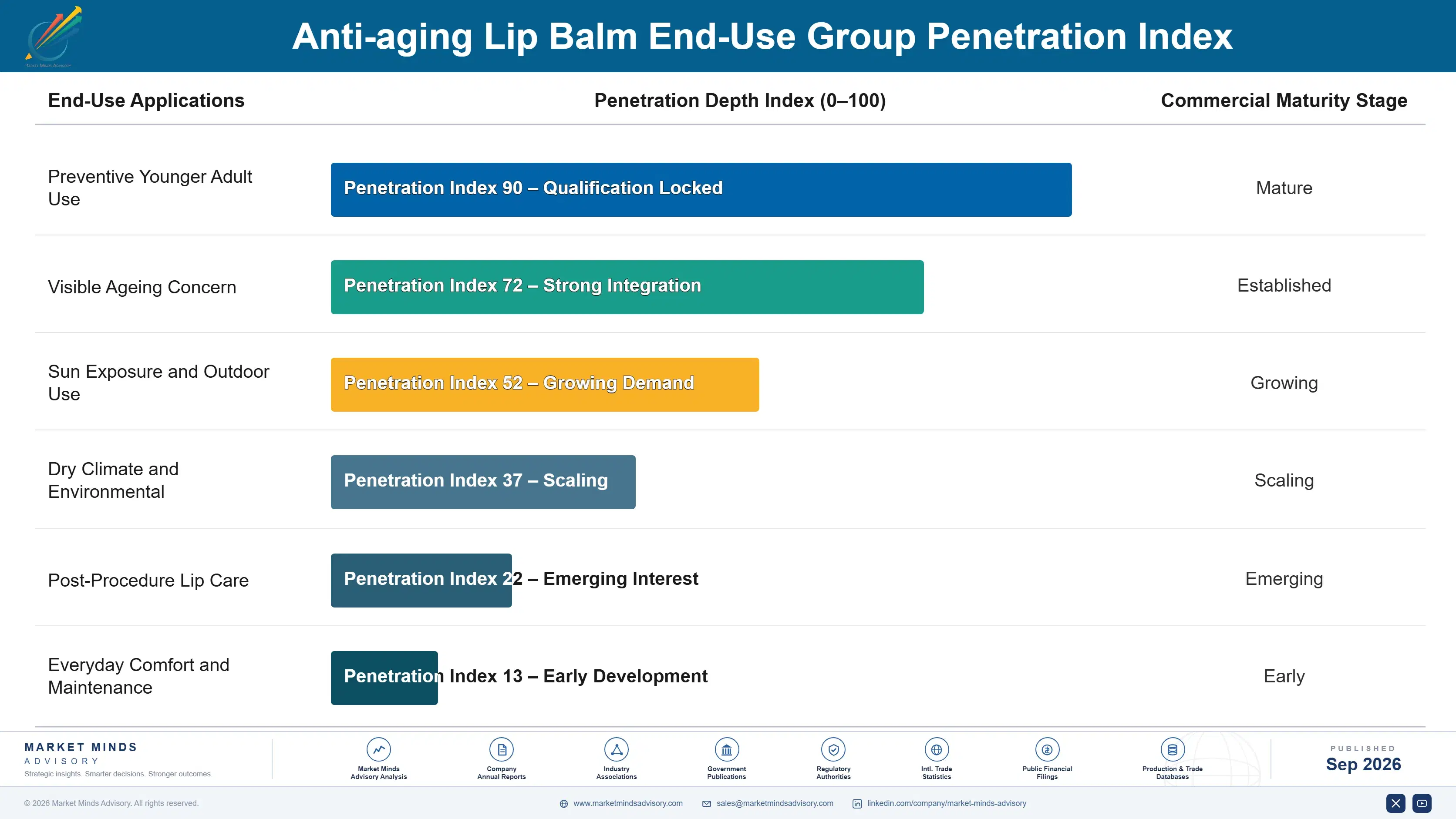
By End-Use Group

  • Preventive Younger Adult Use
  • Visible Ageing Concern
  • Sun Exposure and Outdoor Use
  • Dry Climate and Environmental
  • Post-Procedure Lip Care
  • Everyday Comfort and Maintenance

By Commercial Dimension

  • Mass and Grocery Retail
  • Pharmacy and Dermocosmetic
  • Prestige and Department Retail
  • Brand Direct and Online
  • Travel Retail
  • Specialty Beauty Retail

By Region

  • East Asia
  • North America
  • Western Europe
  • South Asia and Pacific
  • Latin America
  • Middle East and Africa
  • Eastern Europe

Scope, Methodology, and Coverage

Every figure in this report is reproducible from documented input assumptions. The scope below maps the historical period, the forecast horizon, the segmentation dimensions, and the countries covered, alongside the underlying primary and qualitative methodology.
Historical Period
2020 to 2025
Forecast Period
2026 to 2036
Base Year
2025 (USD billions; MMA Primary Research Dataset, September 2026)
Market Definition
This market covers lip care products formulated and marketed for signs of ageing, spanning broad spectrum SPF lip treatments, peptide and retinoid lip treatments, hyaluronic and plumping treatments, lip masks and overnight treatments, tinted treatment balms, and basic petrolatum and emollient balms. Sizing is at retail sales value across mass, pharmacy, prestige, direct, travel and specialty beauty channels. Lipstick and colour cosmetics, injectable lip fillers, dental and oral care, and general facial moisturisers are excluded throughout this report.
Quantitative Units
USD billions at retail sales value; volume in millions of units sold; application in daily frequency per regular user.
Segmentation Dimensions
Formulation type, end-use group, commercial dimension, and geographic region.
Regions Covered
East Asia, North America, Western Europe, South Asia and Pacific, Latin America, Middle East and Africa, Eastern Europe
Countries Covered
South Korea, United States, Japan, France, Brazil, India
Key Companies Profiled
L'Oreal, Beiersdorf, Estee Lauder, Amorepacific, Shiseido, Burt's Bees, Laneige, Pierre Fabre, Johnson and Johnson, Unilever, Bobbi Brown, Fresh, Dr Bronner's, Supergoop, Carmex, Blistex, Nuxe, Rohto Pharmaceutical, Kose, Himalaya Wellness
Quantitative Methodology
Primary survey, n=3,800 respondents, Q4 2025, six countries; demand-side model with trade association cross-validation
Qualitative Methodology
47 expert interviews, Q4 2025; applied to validate demand model assumptions, identify emerging dynamics, and assess competitive positioning
Report Format
PDF and XLSX data workbook (Word format preview document)
Publisher
Market Minds Advisory
Report Code
MMA-2026-CHM-806
Published
September 2026
Contact
sales@marketmindsadvisory.com | www.marketmindsadvisory.com

Purchase the full Anti-aging Lip Balm Market Report (2026 to 2036).

The full report sizes the anti-ageing lip balm market across six formulation types, six end-use groups and six commercial dimensions for all seven global regions through 2036. It measures consumer application frequency through diary panels separated by product base, establishing how far volume rests on occlusive dependency rather than preference. Sun protection formulations are assessed for palatability through blinded consumer panels alongside photoprotection performance. Korean format launch timing is mapped against Western adoption dates across the major participants. Competitive assessment covers 20 participants on a consistent retail sales value basis.
Application frequency measured through diary panels by base
Sun protection assessed for palatability alongside photoprotection
Korean format launch timing mapped against Western adoption
Revenue and margin rebuilt by formulation rather than brand
Six formulation types sized through 2036
Twenty participants assessed on retail sales value

Built For The People Who Decide

From boardroom strategy to bench-side execution, this report is read cover-to-cover by leaders shaping the next decade of their industry, turning demand scenarios, market dynamics and valuation benchmarks into decisions.
CXOs/ Presidents/ VPs/ Managers
M&A and Corporate Development
Strategy Teams and R&D Heads
Procurement and Product Directors
Regulatory and Compliance Leaders
Investor Relations and Equity Analysts