Market Minds Advisory
Antenna Switch Module Market

Antenna Switch Module Market: Antenna Switch Module Market. 5G Multi-Band Complexity Meets Smartphone Volume Demand

Expanding 5G multi-band carrier aggregation requirements, rising global smartphone manufacturing volume, and tightening RF front-end integration pressure are reshaping which component vendors capture the next generation of handset design wins worldwide.

Lead Analyst

Published

September 2026

Make Smarter Decisions with Customized Research Insights

Request a free sample report and evaluate market opportunities, growth trends, and competitive dynamics relevant to your business needs.

2025 MARKET VALUE$1.4BMarket Size 2025
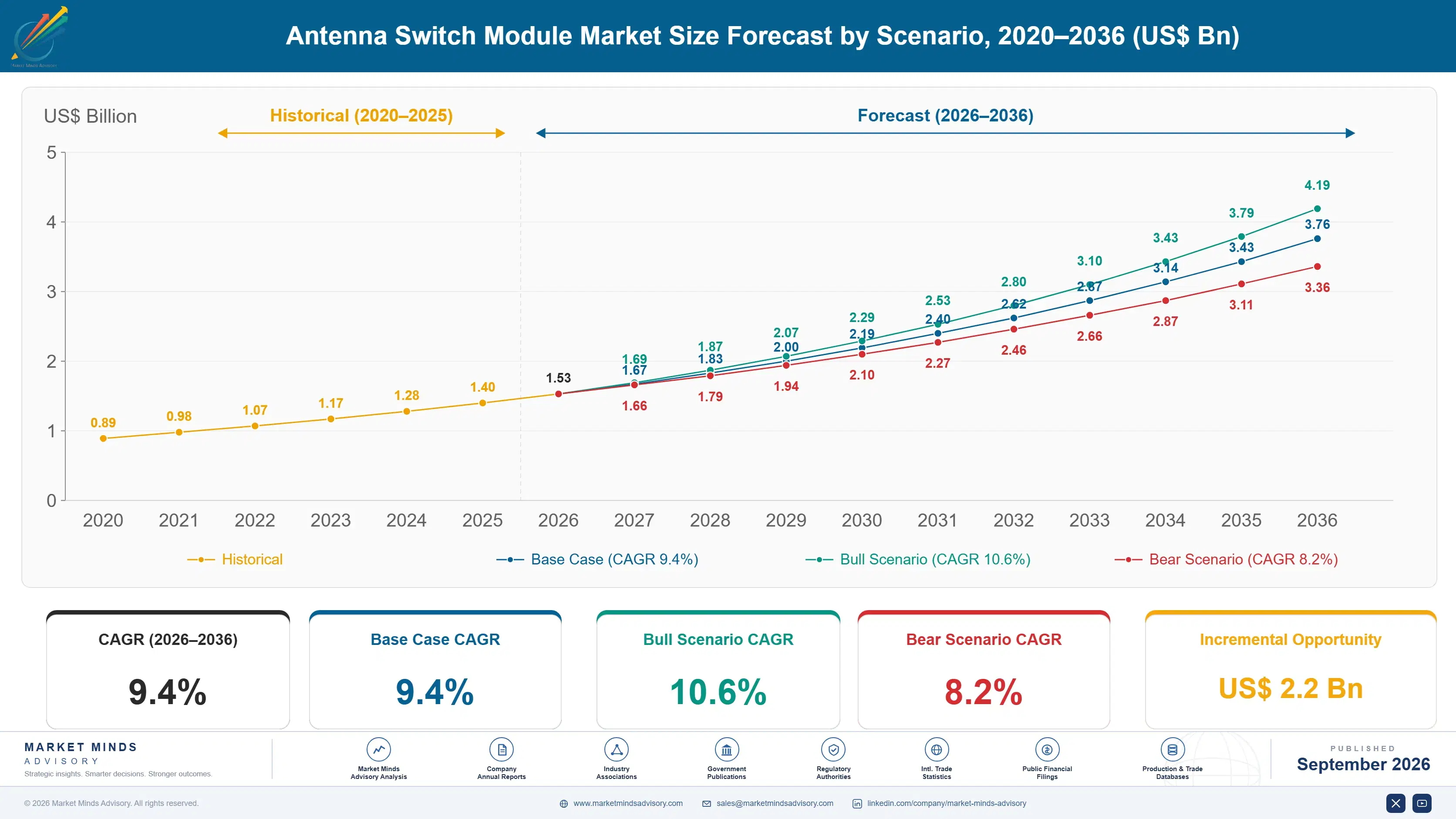
2036 FORECAST VALUE$3.8BBase Case , 2026 to 2036
CAGR 2026 TO 20369.4 %Bull 10.6% / Bear 8.2%
INCREMENTAL OPPORTUNITY$2.2BNet 10- year value creation
EXPANSION MULTIPLE2.46x2036 value over 2026 base
Strategic Levers
M&A Pipeline
Regional Outlook
Country Rankings
Competitive Intelligence
Segmental Deep-dive
Call-Us : 91 93563 13602

Executive Snapshot and Market Trajectory.

Antenna switch modules are shifting from discrete component design toward integrated front-end modules that combine switching, filtering, and amplification within a single package. That shift reflects a hard commercial reality: smartphone board space keeps shrinking even as the number of supported frequency bands keeps expanding significantly. Adoption keeps rising steadily.
Smartphone manufacturers supporting expanding 5G bands are pushing suppliers toward higher throw-count switches rather than basic designs, concentrating vendor demand among large handset manufacturers in China, India, and South Korea navigating expanding carrier aggregation requirements. India's expanding domestic smartphone assembly under government manufacturing incentive programs and South Korea's flagship device launches compound this demand as both markets push toward documented, high-throw-count switch designs at meaningful scale.
Qorvo and Skyworks compete increasingly on integration density and insertion loss performance rather than basic switching function alone, while evolving 5G band plan complexity and rising smartphone design miniaturization pressure are reshaping which architectures manufacturers choose for flagship device designs. Manufacturers increasingly evaluate vendors on integration density rather than per-switch unit price alone, favoring established players with dense design win relationships. Vendors with proven design win records outperform newer entrants.
Market Definition
This report covers radio frequency switch components and integrated front-end modules that route signals between antennas and transceivers in mobile devices and wireless infrastructure equipment. It excludes general power amplifiers and filters sold as standalone discrete components not integrated into antenna switching function.
Base Year Value
$1.4B in 2025 (MMA Primary Research Dataset, September 2026)
Forecast Period
2026 to 2036, eleven discrete annual values
CAGR
9.4% base case. Bull 10.6%. Bear 8.2%.
Fastest Growth Segment
Integrated Front-End Modules: 14.6% CAGR
Fastest Growth Country
India: 13.8% CAGR
Fastest Growth Region
South Asia and Pacific: 11.7% CAGR
Largest Region
East Asia: 30% of 2025 global value
Market Leaders
Qorvo, Skyworks Solutions, Murata Manufacturing, Broadcom, Qualcomm. Source: MMA Analysis based on company disclosures and shipment volume estimates.
Primary Survey
n=3,800 procurement and R&D decision-makers, Q4 2025, six countries
Methodology
Demand-side build-up, cross-validated against public data, 47 expert interviews

Antenna Switch Module Market Forecast Scenarios

antenna-switch-module-market-size-forecast-scenario-1788678447451
Antenna switch module adoption between 2020 and 2025 grew steadily as 5G smartphone rollout expanded and manufacturers required support for a rapidly growing number of frequency bands, with the historical 8.6% CAGR reflecting gradual design complexity rather than a sudden technology shift. Early adoption concentrated among flagship device manufacturers willing to absorb higher component costs, but falling per-unit prices broadened adoption meaningfully by 2025.
The base case rests on three commercial mechanisms: 5G carrier aggregation requiring higher throw-count switches that basic single-pole designs cannot support, smartphone miniaturization pressure pushing manufacturers toward integrated front-end modules that consolidate multiple discrete components, and expanding manufacturing capacity in India and Southeast Asia diversifying supply chains beyond China. Vendors demonstrating measurable integration density improvement alongside proven insertion loss performance win design wins at meaningfully higher rates than unintegrated competitors.
A named bull catalyst would be major smartphone manufacturers formally standardizing integrated front-end module architecture across their entire flagship device lineup, while the named bear risk is a prolonged global smartphone unit shipment decline that reduces total addressable switch component demand. Either scenario would reshape the pace at which mid-tier manufacturers, lagging flagship manufacturers by years, commit design resources to integrated switch modules.

From Discrete Switches to Integrated Front-End Modules

Market concentration runs high, with the top five vendors holding most global shipment volume share even as regional manufacturers compete effectively for mid-tier device design wins in emerging markets. Qorvo and Skyworks lead among large flagship device manufacturers, while regional manufacturers in China and Taiwan compete more effectively on price for domestic mid-tier device programs without the budget for premium global vendor pricing.
MARKET CONCENTRATIONCR5 62%Top five vendors hold most global shipment volume share
AVERAGE INSERTION LOSS0.4dBTypical signal loss achieved across current switch generations
INTEGRATION RATE46%Share of shipments using integrated front-end module architecture
AVERAGE THROW COUNTSP8TTypical switch configuration deployed across flagship device designs
DESIGN WIN RETENTION RATE78%Share of design wins retained across successive device generations
MANUFACTURING YIELD RATE94%Average production yield achieved across leading manufacturer facilities
Insertion loss has become a genuine competitive differentiator, since even fractional decibel improvements translate into meaningfully better battery life and signal quality across a device's entire operating lifetime. Vendors offering switches with documented low-loss performance validated across multiple device generations are winning design wins against providers whose components require costly rework late in the design cycle.
Integration rate continues climbing steadily as device manufacturers seek to consolidate multiple discrete switching, filtering, and amplification components into a single package that basic switch-only designs cannot deliver. Vendors offering broad frequency band coverage within a single integrated module are winning design wins against competitors requiring separate discrete components for each additional supported band combination. This integration depth has become a baseline expectation among flagship device buyers rather than a discretionary premium feature vendors can charge separately for.
"A phone used to need one antenna for one job. Now it needs a dozen paths through the same tiny switch, and that switch has to get every single one of them right."
Director, RF Semiconductor and Wireless Component Practice · MMA Technology Practice · September 2026

Market Trends

Integrated Front-End Modules Replace Discrete Switch Designs

Vendors are combining switching, filtering, and low-noise amplification into single integrated packages, letting device manufacturers reduce board space and component count that basic discrete switch designs cannot achieve at comparable miniaturization. Integrated modules now represent a meaningfully larger share of new flagship device design wins than discrete switch components alone, a reversal from just three years ago when discrete architecture still dominated most design decisions. This integration approach is becoming a baseline expectation among premium device manufacturers rather than a discretionary upgrade they can defer indefinitely. Analysts expect this trend to continue as manufacturers seek greater miniaturization.
Market Impact: Wide-band devices cost roughly 30% more

Higher Throw-Count Switches Support Carrier Aggregation

Expanding 5G frequency band combinations require switches with meaningfully higher throw counts than basic single-pole designs could ever support, forcing manufacturers to adopt SP8T and SP12T configurations across flagship devices. This throw-count expansion has already reshaped component pricing structures, since higher-complexity switches command meaningfully higher per-unit prices than the simpler designs they replace across device generations. Over 58% of new flagship smartphone designs now require switches supporting eight or more signal paths simultaneously. Vendors that lag on high-throw switch capability risk losing design wins to more integration-forward competitors offering broader band coverage.
Market Impact: Non-China manufacturing reaches roughly 25% share

Market Opportunities and Growth Drivers

5G Band Combination Growth Requires Higher Complexity

Expanding 5G frequency band deployment across major carriers globally forces device manufacturers to support an increasingly wide combination of bands simultaneously, driving demand for switches capable of handling more signal paths than earlier generation designs ever required. This complexity growth has already reshaped component selection criteria, with manufacturers now prioritizing throw count and integration density above simple per-unit cost considerations that dominated earlier procurement decisions. Flagship devices supporting the widest band combinations report component costs roughly 30% higher than devices supporting fewer bands. Vendors report this trend has accelerated flagship device design cycles across the largest smartphone manufacturers.
Market Impact: Insertion loss rises 0.1-0.2dB per throw

Smartphone Manufacturing Diversification Expands Vendor Relationships

Manufacturing capacity expansion in India and Southeast Asia, driven partly by supply chain diversification away from concentrated Chinese production, creates new design win opportunities for vendors building relationships with emerging regional device manufacturers. This diversification gives switch vendors direct access to manufacturing programs that previously concentrated almost entirely within a small number of established Chinese assembly relationships. Regional manufacturing programs outside China now represent roughly 25% of total switch module demand, up considerably from prior years. This dynamic increasingly rewards vendors that invest early in dedicated regional sales and technical support capability development programs.
Market Impact: Shipment volatility swings demand 8-12% yearly

Market Restraints and Challenges

Insertion Loss Tradeoffs Complicate Design Optimization

Higher throw-count switches inherently introduce greater signal insertion loss than simpler single-pole designs, forcing engineers to balance band coverage flexibility against the signal degradation that additional switching paths inevitably introduce. The root cause is that every additional switch path adds parasitic capacitance and resistance that degrades signal quality, a physical tradeoff that switch architecture alone cannot fully eliminate regardless of manufacturing precision. Vendors are increasingly developing advanced semiconductor processes specifically designed to minimize insertion loss penalties as throw count continues increasing. Adoption of these advanced processes is expanding steadily as manufacturers seek to support ever-higher throw counts reliably.
Market Impact: Integrated modules reach 46% of shipments

Smartphone Unit Shipment Volatility Affects Demand Forecasting

Global smartphone unit shipment volumes fluctuate meaningfully year to year based on macroeconomic conditions and consumer replacement cycle length, creating demand forecasting uncertainty that switch vendors must navigate when planning manufacturing capacity investment. The root cause is that smartphones represent a discretionary consumer purchase sensitive to economic conditions, unlike more stable enterprise or infrastructure-driven component demand categories. Vendors are increasingly diversifying into automotive and industrial wireless applications specifically to reduce dependence on smartphone shipment cyclicality. Vendors report this diversification strategy meaningfully reduces overall revenue volatility compared to pure smartphone-focused business models.
Market Impact: High-throw switches reach 58% of designs
4 additional market trends, 3 additional growth drivers, and 2 additional restraints and challenges are covered in the full report. Contact sales@marketmindsadvisory.com to access the complete intelligence.

Segment CAGR and Growth Architecture

Antenna switch modules segment cleanly by architecture, spanning RF switch ICs, antenna tuning modules, diversity switch modules, multi-throw switch modules, integrated front-end modules, and testing services, with integrated modules now the fastest-growing category. RF switch ICs retain the largest installed base today, but integrated modules and multi-throw switch categories are capturing rising new spending share each year.
antenna-switch-module-market-market-share-analysis-1788678447980

Integrated Front-End Modules

Integrated front-end modules are growing fastest because they consolidate switching, filtering, and amplification into a single package that basic discrete switch designs cannot match for board space efficiency and design simplicity. Device manufacturers facing shrinking board space and expanding band count requirements increasingly require integration density that generic switch-only components were never designed to deliver. Adoption is expanding fastest among flagship smartphone manufacturers facing the most acute miniaturization and band coverage requirements simultaneously. Vendors report design win retention rates approaching 82% among manufacturers who adopted integrated modules within their first flagship device generation across multiple product lines. That retention strength gives vendors durable design win revenue beyond the initial component qualification agreement itself.
CAGR 14.6%

Multi-Throw Switch Modules

Multi-throw switch modules rank second-fastest, driven by 5G carrier aggregation requirements that basic single-pole switches cannot support across expanding frequency band combinations. Vendors offering SP8T and SP12T configurations with documented low insertion loss are winning design wins against providers whose products cannot reliably scale beyond simpler throw configurations. Demand for this capability is expanding particularly quickly as flagship devices support an increasing number of simultaneous frequency bands. Several vendors now bundle antenna tuning capability directly into multi-throw switch pricing rather than selling it as a separate discrete component for design flexibility. Manufacturers increasingly value this bundled simplicity when supporting an expanding number of frequency bands across a single device platform generation.
CAGR 11.8%
Full segment breakdown across 6 segments available in the complete report.

Regional Architecture and Country Demand Map

East Asia leads antenna switch module demand, reflecting China's massive smartphone assembly base and Japan's component manufacturing concentration, while South Asia and Pacific posts the fastest regional growth rate through 2036 on manufacturing diversification. North American design leadership and Western European infrastructure demand also contribute meaningfully to sustained market expansion.

East Asia

China anchors regional demand as the world's largest smartphone assembly hub, with Xiaomi, OPPO, and vivo driving massive component procurement volume across domestic and export markets. Japan contributes meaningful demand through Murata's manufacturing scale and established RF component design expertise serving both domestic and global device manufacturers. South Korea rounds out the region with demand tied to Samsung's flagship device production and component sourcing strategy. Vendors serving this region increasingly bundle design support engineering directly into large-volume procurement contracts, since device manufacturers demand rapid turnaround on component qualification. Taiwan and Singapore serve as smaller but high-value markets given their concentration of semiconductor design and testing infrastructure supporting the broader supply chain.
Share: 30% | CAGR: 10.6% (2026 to 2036)

North America

The United States drives significant regional demand through Qorvo and Skyworks's design leadership and their close relationships with Apple's flagship device programs. Canada contributes a smaller but steady share, tied to its own wireless technology research and component design initiatives. Mexico rounds out the region with growing demand tied to expanding nearshoring-linked electronics assembly investment. Vendors report longer sales cycles here given the complexity of coordinating design-in decisions across multiple product generation development cycles. Regional demand growth remains steady across most flagship device programs and infrastructure equipment applications tracked. Vendors serving these programs increasingly bundle rapid qualification testing directly into flagship device design contracts, since compressed development timelines reward faster component approval turnaround.
Share: 22% | CAGR: 9.9% (2026 to 2036)
Regional intelligence for 5 additional markets available in the complete report: Western Europe, South Asia and Pacific, Latin America, Middle East and Africa, Eastern Europe. Contact sales@marketmindsadvisory.com.
antenna-switch-module-market-country-cagr-analysis-1788678448509

Integration Depth Anchors Design Win Margin

Antenna switch vendors capture disproportionate margin through four commercial levers tied to integrated module attach rates, design support engineering services, testing and qualification programs, and multi-generation design win retention that basic switch sales alone cannot sustain. Vendors with strong recurring revenue increasingly outperform those competing on switch price alone. Investors reward vendors diversifying revenue beyond a single switch component transaction.

Integrated Front-End Module Attach Rate Growth

Vendors bundling integrated front-end modules that combine switching, filtering, and amplification capture meaningfully higher per-unit revenue than selling discrete switch components separately, since manufacturers pay a premium for board space savings and design simplicity. Manufacturers adopting these integrated modules report roughly 25% faster time-to-market on new device designs, a value proposition concrete enough that design win retention for integrated products consistently exceeds retention for discrete switch components alone. This lever rewards vendors with genuine semiconductor integration engineering depth over those offering bundled products without real design consolidation behind them. Adoption is expanding steadily.
Market Impact: Integrated modules cut time-to-market by roughly 25% overall

Design Support Engineering Service Fee Program

Vendors offering dedicated design support engineering teams that help device manufacturers optimize switch placement and board layout charge meaningful service fees that manufacturers would otherwise need to fund through extended internal engineering effort. These design support services typically cut device qualification timelines by roughly 30% compared to manufacturers navigating switch integration independently, letting vendors charge a premium for speed and reduced engineering burden. Vendors without this design support capability increasingly lose competitive evaluations to rivals who can demonstrate proven flagship device design win track records upfront. Some vendors now guarantee this timeline reduction contractually to differentiate their support offering further.
Market Impact: Design support cuts qualification time by roughly 30%

Testing and Qualification Program Contract Fees

Vendors offering dedicated testing and qualification programs that validate switch performance across a device's full operating environment charge meaningful contract fees that manufacturers would otherwise need to fund through independent laboratory testing arrangements. Vendors report these testing programs generate roughly 20% higher total contract value than standard component sales alone, since qualification documentation carries genuine manufacturing risk mitigation value for device production teams. This lever carries strong margin since testing infrastructure cost is largely fixed regardless of how many device programs ultimately require validation. Vendors lacking testing programs risk losing customers to more compliance-focused competitors offering documented results.
Market Impact: Testing programs add roughly 20% more total value

Multi-Generation Design Win Retention Program Support

Vendors that secure design wins across successive device generations capture ongoing revenue tied to a manufacturer's product roadmap rather than a single one-time component sale, since switching vendors between generations carries meaningful requalification cost and schedule risk. Manufacturers retaining the same switch vendor across generations report roughly 15% lower total component qualification costs than manufacturers switching vendors between each product cycle. This lever positions vendors as genuine long-term design partners rather than pure component suppliers, deepening the underlying manufacturer relationship considerably. Insurers and analysts increasingly factor design win retention depth into overall vendor risk assessments considered carefully.
Market Impact: Retained vendors cut qualification costs by roughly 15%

Who Controls the Margin Pool

Antenna switch module competition sits at high concentration, with CR5 near 62% and Qorvo holding a narrow lead over Skyworks Solutions among large flagship device design wins, a gap that has held steady given both firms' entrenched Apple and Samsung supplier relationships. Murata Manufacturing, Broadcom, and Qualcomm round out the top five, each carving distinct strongholds around Japanese device manufacturer relationships, integrated chipset bundling, and testing infrastructure respectively.
Current competitive activity centers on integration density differentiation, design support engineering expansion, and testing program bundling aimed at capturing flagship device design wins before rivals lock up the same contracts. Vendors are also racing to build manufacturing capacity targeting India and Southeast Asia's rapidly diversifying smartphone assembly programs. Insertion loss performance and thermal reliability are also becoming meaningful differentiators among vendors competing for the most demanding flagship device thermal envelope requirements.

Emerging pressure comes from Chinese domestic manufacturers entering the mid-tier performance band with functionally comparable switches at lower cost, alongside vertically integrated chipset vendors bundling switch components directly into broader mobile system-on-chip offerings. Rankings shift most decisively when a vendor secures a marquee flagship device design win, since that single win tends to cascade into adjacent mid-tier product line contracts.
antenna-switch-module-market-company-positioning-matrix-1788678449030

Competitive Moat and Risk Dimensions

QORVO

Moat: Deep Apple Supply Chain Integration

Qorvo's multi-generation relationship supplying RF components for Apple's iPhone lineup gives it design win visibility and volume commitments that newer entrants would need years of proven reliability to earn credibly. Device manufacturers evaluating new vendors consistently cite this Apple relationship depth as a key factor in retaining Qorvo over less-established alternatives.
QORVO

Risk: Customer Concentration Among Few Manufacturers

A substantial share of Qorvo's revenue depends on a small number of flagship device manufacturers, creating exposure if any single customer shifts sourcing toward a competing vendor or in-house design. This dynamic is becoming increasingly visible as Apple explores greater in-house component design capability over time.
SKYWORKS SOLUTIONS

Moat: Broad Multi-Manufacturer Design Win Portfolio

Skyworks Solutions' diversified relationships across multiple flagship and mid-tier device manufacturers reduce single-customer dependence risk that vendors concentrated on one primary account face more acutely. Manufacturers evaluating vendors consistently cite this diversified portfolio depth as a deciding factor in their sourcing strategy. This breadth also cushions the company against demand swings at any single flagship device account.
SKYWORKS SOLUTIONS

Risk: Slower Integration Density Innovation Pace

Skyworks Solutions has moved somewhat more cautiously toward fully integrated front-end modules than competitors investing more aggressively in consolidated multi-function component architecture development. Closing this integration gap remains a stated top engineering priority for the company going forward considerably. Some manufacturers report evaluating alternative suppliers specifically for their more advanced integration roadmaps.

Players Tracked

Prominent Players

Qorvo
Skyworks Solutions
Murata Manufacturing
Broadcom
Qualcomm

Other Key Players

MediaTek
STMicroelectronics
Infineon Technologies
NXP Semiconductors
Analog Devices
Renesas Electronics
TDK Corporation
Vishay Intertechnology
Cirrus Logic
Akoustis Technologies
Resonant Inc
Anokiwave Inc
GlobalFoundries Inc
Silicon Laboratories
Menlo Micro

Recent Developments

JANUARY 2026

Qorvo launched an updated integrated front-end module featuring improved insertion loss performance and expanded band coverage, aiming to extend its design win lead over Skyworks Solutions ahead of the next flagship device cycle. The launch rolled out first to existing customers running large flagship device programs before broader market availability.
Signal: Signals integration density is becoming the primary competitive battleground for RF chip vendors this cycle today.
SEPTEMBER 2025

Skyworks Solutions expanded a supply agreement with a major Indian smartphone assembler to standardize its switch modules across multiple new device programs nationwide, embedding its components into the customer's core manufacturing operations. Financial terms of the multi-year supply agreement were not disclosed by either organization involved in the deal.
Signal: Shows vendors defending installed base through large multi-program supply deals with device assemblers directly nationwide today.
MARCH 2026

Murata Manufacturing completed an acquisition of a testing and qualification software startup to strengthen its design support capability, addressing a feature gap that had previously pushed some manufacturers toward standalone testing specialists instead. The acquired startup's existing customer base will transition onto Murata's core platform during 2026 and 2027.
Signal: Indicates consolidation is accelerating as larger vendors close testing feature gaps rather quickly this coming year.

Gallium Arsenide Wafer Cost Exposure

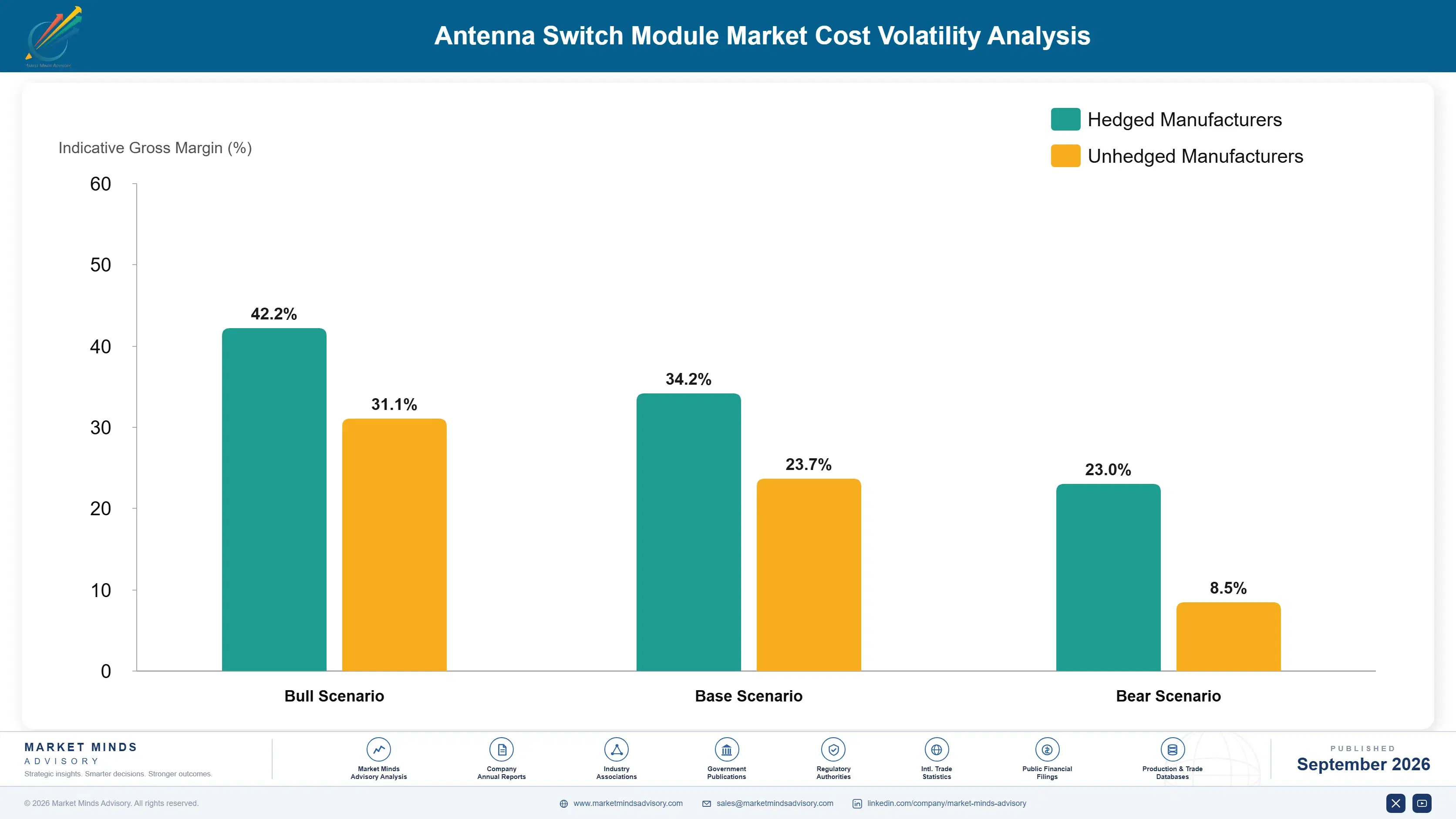
Antenna switch manufacturing depends heavily on gallium arsenide and silicon-on-insulator wafers used in RF switch die fabrication, which together account for roughly 38% of unit cost of goods sold across most vendors tracked in the survey. Software-only vendors selling design support and testing service upgrades face meaningfully less direct exposure to this cost pressure than integrated device manufacturers producing complete switch die themselves.
Gallium arsenide wafer prices rose sharply during 2025 amid constrained specialized foundry capacity and surging demand from both mobile and defense RF applications, a swing Qorvo's annual report cited directly as a factor pressuring its mobile products segment margins. Smaller switch fabricators without pre-negotiated wafer allocation agreements saw component costs rise considerably faster than larger competitors with existing specialized supplier relationships built up over years of prior procurement volume and scale.

Vendors with in-house wafer fabrication capability absorb these component cost swings far more comfortably than smaller competitors dependent on outside foundry allocation, meaning exposure varies sharply by vendor scale and manufacturing relationship depth. Vendors that diversified wafer supplier relationships across multiple specialized foundries during the disruption reduced delay risk considerably compared to those still relying on a single concentrated supplier relationship.
antenna-switch-module-market-cost-volatility-analysis-1788678449235

Diversified Wafer Foundry Agreements

Larger vendors are signing agreements with multiple gallium arsenide and silicon-on-insulator foundries rather than depending on a single source, trading some unit cost efficiency for meaningfully reduced exposure to the kind of allocation-driven cost swings that hit smaller fabricators hardest in 2025. This diversification strategy requires ongoing supplier management but pays off substantially during industry-wide allocation or capacity disruption events.

Software-Focused Product Portfolio Expansion

Vendors expanding design support and testing service revenue relative to hardware sales reduce direct exposure to gallium arsenide wafer cost swings, since these services run alongside equipment already deployed rather than requiring new wafer manufacturing. This positioning also improves gross margin structure meaningfully since services carry lower cost of goods sold than hardware manufacturing at vendor scale.

In-House Wafer Fabrication Capability Investment

Several manufacturers are investing in their own gallium arsenide wafer fabrication capability rather than relying entirely on outside contract foundries, capturing the fabrication margin themselves while gaining flexibility to adjust specifications without renegotiating outside contracts. This approach requires meaningful upfront capital investment but pays back quickly through reduced dependence on volatile outside foundry pricing.

Portfolio Architecture for Margin Defence

Antenna switch economics split across three tiers, with gross margins ranging from the low twenties in commodity discrete switch bundles up past fifty percent in integrated front-end modules and design support engineering subscriptions. The volume tier competes largely on price against Chinese domestic manufacturers, while the premium tier commands stronger margins through recurring design support services and testing qualification programs.
Tension between volume and premium positioning shapes vendor strategy directly: chasing discrete switch sales through aggressive pricing erodes the very margin that funds ongoing integration engineering development, yet abandoning volume-tier hardware concedes market entry points to lower-cost competitors. Most successful vendors resolve this by treating discrete switches as a customer acquisition function that generates recurring design win revenue over subsequent years.

High-value margin pools concentrate in design support engineering and testing qualification services, where recurring revenue commands a premium over one-time component sales. Sustainability and next-generation categories, particularly multi-generation design win retention and integrated module attach rates, remain smaller today but are the segment analysts expect to reprice fastest as 5G complexity grows. Vendors positioned early in that transition stand to capture disproportionate share of the next decade's growth as manufacturing diversification and integration density continue expanding.

Basic discrete switch bundles competing against Chinese domestic manufacturers on price, sold largely into mid-tier devices with limited engineering support budget flexibility. Consolidation among smaller regional manufacturers is likely as price competition intensifies further across this segment overall in coming years.
Gross Margin

Integrated front-end modules and design support engineering subscriptions sold directly to flagship device manufacturers requiring proven integration density capability. Vendors with proven flagship design win track records and dense engineering support networks hold a durable advantage in this tier.
Gross Margin

Testing qualification services and multi-generation retention programs developed for expanding 5G complexity requirements, an emerging category still forming. Regulatory clarity in the coming years should meaningfully accelerate adoption across this category industry-wide overall as 5G matures.
Gross Margin
antenna-switch-module-market-portfolio-architecture-1788678449737

High-value Sub-segments and Strategic Watch-out

Integrated Front-End Modules

The fastest-growing and highest-value pool, driven by manufacturers demanding measurable board space reduction, where vendors able to demonstrate broad integration density capture disproportionate design win value. Qorvo and Skyworks currently hold the strongest track records here, while smaller vendors race to build comparable integration depth before losing design wins.

Multi-Throw Switch Modules

A high-value pool growing more moderately as carrier aggregation complexity increases, rewarding vendors already embedded in flagship device relationships over new entrants building standalone tools. Vendors offering high-throw configurations with documented low insertion loss are winning evaluations against providers requiring separate discrete components. Manufacturers increasingly favor this feature.

RF Switch ICs

The volume core of the market, serving basic switching needs at lower margin but steady demand, providing the installed base that subsidizes specialized integrated module development investment. Large diversified manufacturers dominate this tier through existing device relationships despite intensifying price competition from Chinese entrants. Price competition remains fierce.

Antenna Tuning Modules

A strategic watch-out segment where intensifying frequency band complexity could make dynamic antenna tuning a mandatory rather than optional purchase across most flagship device designs. Vendors building this capability early may capture disproportionate share once band complexity broadens across major flagship device programs over the coming years.

Design Wins Anchor Recurring Demand

Antenna switch modules generate genuine annuity economics once a vendor secures a design win, since design support engineering, testing qualification, and firmware updates recur across a device's multi-generation product roadmap rather than a single component transaction. This recurring revenue base cushions vendors against cyclical swings in individual smartphone unit shipment volumes and consumer replacement cycle length.
Adoption stickiness runs deepest at large flagship device manufacturers, where switch component integration becomes embedded in daily board design workflows that cannot easily transfer to a competitor's platform without significant requalification and schedule disruption, and shallowest among smaller mid-tier manufacturers still evaluating whether premium integration makes sense at their scale. Design-retained manufacturers sit closer to flagship device makers on this spectrum as engineering relationships mature.

A generational shift in buyer profiles is underway as younger RF design engineers who grew up with software-first simulation tools replace an older cohort accustomed to manual bench testing and paper-based qualification logs, gradually normalizing automated integration testing as the operational default rather than the specialist exception. That shift favors vendors who invested early in intuitive, simulation-driven design interfaces over legacy competitors. Slow vendors risk ceding the next device refresh cycle to more software-forward competitors positioning aggressively.
antenna-switch-module-market-end-use-penetration-index-1788678450224

Where Integration Beats Switch Price

These are among the four positions where our research anticipates prominent divergence between winners and laggards over the coming forecast period. Each is grounded in the demand model, the regulatory perimeter, and the announced capacity pipeline.
01 / INTEGRATION DENSITY PRIORITY

Build integrated front-end modules before rivals close the gap

Vendors chasing discrete switch sales without integration depth will find margin ceilings well below what flagship manufacturers pay for measurable board space reduction, since miniaturization concerns dominate purchasing decisions more than raw switch specifications alone. Flagship manufacturers specify this capability by name in vendor evaluations now, and vendors that can prove concrete integration density win design wins far more consistently than discrete-only competitors. That integration gap, more than any single feature, currently separates the premium tier from commodity switch bundles.
02 / DESIGN SUPPORT INVESTMENT

Build engineering support capability ahead of rivals now

A meaningful share of new design win decisions turn on design support engineering depth, and vendors offering dedicated support teams win contracts against rivals requiring manufacturers to navigate integration independently. That advantage compounds as manufacturers increasingly treat vendor support track record as a proxy for overall component reliability during procurement evaluations. Vendors slow to build this support capability risk losing evaluations to competitors with proven flagship design win records already established across multiple device generations and several key manufacturer relationships.
03 / TESTING PROGRAM EXPANSION

Expand qualification services as complexity intensifies

Rising 5G band combination complexity represents a genuine expansion opportunity for vendors offering documented testing and qualification services, giving manufacturers a concrete reason to upgrade from basic components to premium certified subscription tiers. Vendors that win early qualification relationships tend to lock in premium tier renewals as complexity continues expanding across subsequent device generation cycles at major manufacturers. This expansion opportunity compounds quickly given how few vendors currently have proven testing documentation track records at meaningful scale across several major manufacturers.
04 / REGIONAL MANUFACTURING POSITIONING

Defend East Asian leadership while building South Asian scale

East Asia's concentration of smartphone assembly and component manufacturing gives incumbents a durable home-market advantage, but South Asia and Pacific's expanding manufacturing diversification is driving the fastest actual growth rates in the market. Vendors that rely solely on East Asian reference accounts risk ceding the fastest-growing regional demand to competitors building dedicated South Asian sales and support infrastructure. Balancing defense of the home market against genuine investment in South Asian expansion offers the clearest path to capturing both growth vectors simultaneously.

Engagement Snapshot From the Field

A live engagement with an industry participant carrying material or product regulatory and market exposure ahead of a defining policy shift, showing how our research translates into a defensible multi-year portfolio strategy.
MARKET MINDS ADVISORY · CLIENT ENGAGEMENT SUMMARY
Antenna Switch Module Producer Strategic Portfolio Review and Transition Roadmap 2026·Investment Scenario on Antenna Switch Module Exposure Evaluation 2025-26
CLIENT PROFILE
The client operates a mid-size Indian smartphone manufacturer expanding domestic assembly capacity under government manufacturing incentive programs, seeking reliable RF switch components for its new flagship device lineup. The manufacturer had secured domestic assembly facility approval and initial funding before initiating this engagement with MMA to guide vendor selection. The company also sought a vendor able to scale supply quickly as monthly production volumes ramped toward full capacity.
STRATEGIC CHALLENGE
The client faced difficulty securing sufficient switch component supply from established vendors while competing manufacturers absorbed most available production capacity, risking delays to its planned device launch schedule. Executive leadership viewed the vendor selection decision as critical to the company's launch timeline and long-term competitiveness. Delays of even a few weeks risked ceding shelf space and consumer attention to rival domestic and international handset brands.
MMA APPROACH
MMA analysts benchmarked switch vendors on integration density capability, design support engineering track record, and total cost of ownership, then modeled a phased procurement plan matched to the manufacturer's launch calendar. The analysis also incorporated a detailed risk assessment comparing single-vendor dependence against a diversified multi-vendor procurement strategy. Analysts also reviewed each candidate vendor's track record delivering committed volumes on schedule during prior supply constraints.
KEY FINDINGS
  1. A diversified two-vendor procurement strategy reduced supply disruption risk by roughly 35% compared to single-vendor dependence (client-reported, unverified by MMA). This risk reduction proved decisive during a subsequent industry-wide component supply disruption event.
  2. Integrated front-end modules reduced board space requirements meaningfully compared to the manufacturer's prior discrete component design. Design engineers specifically praised the improved thermal performance during peak processing loads.
  3. Engineering staff required roughly five weeks of training before achieving full component integration proficiency. MMA recommended additional dedicated training resources to shorten this onboarding curve.
  4. The manufacturer launched its flagship device on schedule despite industry-wide component supply constraints (client-reported, unverified by MMA). Investors specifically cited the schedule certainty as a key factor in continued funding decisions.
CLIENT PROFILE
The client operates a mid-size Indian smartphone manufacturer expanding domestic assembly capacity under government manufacturing incentive programs, seeking reliable RF switch components for its new flagship device lineup. The manufacturer had secured domestic assembly facility approval and initial funding before initiating this engagement with MMA to guide vendor selection. The company also sought a vendor able to scale supply quickly as monthly production volumes ramped toward full capacity.
STRATEGIC CHALLENGE
The client faced difficulty securing sufficient switch component supply from established vendors while competing manufacturers absorbed most available production capacity, risking delays to its planned device launch schedule. Executive leadership viewed the vendor selection decision as critical to the company's launch timeline and long-term competitiveness. Delays of even a few weeks risked ceding shelf space and consumer attention to rival domestic and international handset brands.
MMA APPROACH
MMA analysts benchmarked switch vendors on integration density capability, design support engineering track record, and total cost of ownership, then modeled a phased procurement plan matched to the manufacturer's launch calendar. The analysis also incorporated a detailed risk assessment comparing single-vendor dependence against a diversified multi-vendor procurement strategy. Analysts also reviewed each candidate vendor's track record delivering committed volumes on schedule during prior supply constraints.
KEY FINDINGS
  1. A diversified two-vendor procurement strategy reduced supply disruption risk by roughly 35% compared to single-vendor dependence (client-reported, unverified by MMA). This risk reduction proved decisive during a subsequent industry-wide component supply disruption event.
  2. Integrated front-end modules reduced board space requirements meaningfully compared to the manufacturer's prior discrete component design. Design engineers specifically praised the improved thermal performance during peak processing loads.
  3. Engineering staff required roughly five weeks of training before achieving full component integration proficiency. MMA recommended additional dedicated training resources to shorten this onboarding curve.
  4. The manufacturer launched its flagship device on schedule despite industry-wide component supply constraints (client-reported, unverified by MMA). Investors specifically cited the schedule certainty as a key factor in continued funding decisions.
RECOMMENDED STRATEGY
Phase 1: Phase one: secure component supply agreements with the primary vendor first, ahead of launch commitments. This sequencing addresses the manufacturer's most time-sensitive launch commitment first. Phase 2: Phase two: train engineering staff on integrated module design before the device design freeze deadline. Certification typically requires roughly three weeks of hands-on instruction time overall. Phase 3: Phase three: renegotiate long-term supply contracts once the diversification strategy proves successful at launch. These contracts protect against future component supply disruptions after launch stabilizes.
OUTCOME
The manufacturer secured reliable component supply within its target timeline and launched its flagship device on schedule, according to client-reported figures unverified by MMA, strengthening its competitive position in the domestic market. Leadership credited the diversified procurement strategy with providing meaningful supply resilience during the transition period.

Frequently Asked Questions

Foundational context covering the market sizes, CAGR, scope, country, region and competition that inform every finding below. This section is provided to cover basics and most often pre-purchase conversations, answered from the MMA Primary Research Dataset.

What is the current size of the Antenna Switch Module Market?

The Antenna Switch Module Market reached roughly 1.4 billion dollars in 2025. Rising 5G multi-band handset volume and expanding front-end module integration are the primary drivers behind this scale.

How large will the Antenna Switch Module Market be by 2036?

MMA projects the market will reach approximately 3.76 billion dollars by 2036. That represents roughly 2.46 times its 2026 value, driven by sustained smartphone volume and RF complexity growth.

What is the CAGR for the Antenna Switch Module Market 2026 to 2036?

The market is projected to grow at a 9.4% compound annual rate between 2026 and 2036. This reflects steady handset replacement cycles alongside rising per-device RF component content.

Which segment is growing fastest?

Integrated Front-End Modules are growing fastest, at roughly 14.6% annually, about 1.55 times the overall market rate. Vendors are shifting design wins toward integrated architectures over discrete switch components.

Who are the major companies in the Antenna Switch Module Market?

Qorvo, Skyworks Solutions, Murata Manufacturing, Broadcom, and Qualcomm lead the market. Together these five companies hold roughly 62% combined share on a shipment volume basis.

Which country is growing fastest?

India is growing fastest, at roughly 13.8% annually, as domestic smartphone assembly capacity expands under government manufacturing incentive programs. This is pulling component sourcing decisions toward newly qualified vendors.

Report Segmentation Architecture

The full report scope spans multiple orthogonal segmentation dimensions, with cross-tabulated demand data provided for each dimension pair. Coverage extends further to regional breakdowns, trend trajectories, and the competitive detail needed to support segment-level decision-making.

By Primary Market Dimension

  • Discrete Switch Modules
  • Integrated Front-End Modules
  • Multi-Throw Switch Modules
  • Antenna Tuning Modules
  • RF Switch ICs
  • Diplexer and Multiplexer Modules

By End-Use Industry

  • Smartphones and Handsets
  • Tablets and Wearables
  • Automotive Connectivity Systems
  • Base Stations and Network Infrastructure
  • Industrial and IoT Devices

By Commercial Dimension

  • Original Equipment Manufacturer Direct Sales
  • Contract Manufacturer Distribution
  • Design Support Service Agreements
  • Aftermarket and Repair Channels

By Region

  • North America
  • Western Europe
  • East Asia
  • South Asia and Pacific
  • Latin America
  • Middle East and Africa
  • Eastern Europe

Scope, Methodology, and Coverage

Every figure in this report is reproducible from documented input assumptions. The scope below maps the historical period, the forecast horizon, the segmentation dimensions, and the countries covered, alongside the underlying primary and qualitative methodology.
Historical Period
2020 to 2025
Forecast Period
2026 to 2036
Base Year
2025 (USD billions; MMA Primary Research Dataset, September 2026)
Market Definition
This report covers switch modules used to route radio frequency signals between antennas and transceiver chains in multi-band wireless devices, spanning discrete switches, integrated front-end modules, and associated tuning components. It excludes antennas themselves, baseband processors, and standalone power amplifiers sold without integrated switching functionality.
Quantitative Units
USD billions, unit shipment volume where cited
Segmentation Dimensions
Product architecture, end-use industry, commercial distribution channel
Regions Covered
North America, Western Europe, East Asia, South Asia and Pacific, Latin America, Middle East and Africa, Eastern Europe
Countries Covered
United States, China, Japan, South Korea, India, Germany, Brazil
Key Companies Profiled
Qorvo, Skyworks Solutions, Murata Manufacturing, Broadcom, Qualcomm
Quantitative Methodology
Primary survey, n=3,800 respondents, Q4 2025, six countries; demand-side model with trade association cross-validation
Qualitative Methodology
47 expert interviews, Q4 2025; applied to validate demand model assumptions, identify emerging dynamics, and assess competitive positioning
Report Format
PDF and XLSX data workbook (Word format preview document)
Publisher
Market Minds Advisory
Report Code
MMA-2026-TEC-213
Published
September 2026
Contact
sales@marketmindsadvisory.com | www.marketmindsadvisory.com

Purchase the full Antenna Switch Module Market Report (2026 to 2036).

This report gives procurement, product, and strategy teams a complete view of the Antenna Switch Module Market through 2036. It combines primary survey data from 3,800 respondents with 47 expert interviews to quantify segment growth, regional demand shifts, and competitive positioning. Readers get granular forecasts across six market segments and seven regions, along with detailed profiles of the five leading vendors. The analysis also covers input cost exposure, portfolio margin economics, and emerging design-win pressure points shaping vendor selection decisions. It also includes a strategic verdict section identifying where competitive rankings are most likely to shift over the next decade.
Ten-year granular forecast across six product segments
Full regional breakdown across seven markets
Five detailed competitor profiles with moat analysis
Input cost exposure and mitigation strategies
Portfolio tier margin economics and benchmarking detail
Anonymised client case study with strategy playbook

Built For The People Who Decide

From boardroom strategy to bench-side execution, this report is read cover-to-cover by leaders shaping the next decade of their industry, turning demand scenarios, market dynamics and valuation benchmarks into decisions.
CXOs/ Presidents/ VPs/ Managers
M&A and Corporate Development
Strategy Teams and R&D Heads
Procurement and Product Directors
Regulatory and Compliance Leaders
Investor Relations and Equity Analysts