Market Minds Advisory
Antarctic Krill Fisheries Market

Antarctic Krill Fisheries Market: CCAMLR Quota Constraints, Nutraceutical Premiumization, and Processing Yield Through 2036

Omega-3 supplement brands chasing krill oil's superior bioavailability, salmon aquaculture feed reformulation, and CCAMLR quota constraints on Southern Ocean harvest volume are reshaping how processors price and allocate Antarctic krill supply through 2036.

Lead Analyst

Lisa Gevelber

Published

September 2026

Make Smarter Decisions with Customized Research Insights

Request a free sample report and evaluate market opportunities, growth trends, and competitive dynamics relevant to your business needs.

2025 MARKET VALUE$2.4BMarket Size 2025
2036 FORECAST VALUE$6.3BBase Case , 2026 to 2036
CAGR 2026 TO 20369.2 %Bull 10.4% / Bear 8.0%
INCREMENTAL OPPORTUNITY$3.7BNet 10- year value creation
EXPANSION MULTIPLE2.41x2036 value over 2026 base
Strategic Levers
M&A Pipeline
Regional Outlook
Country Rankings
Competitive Intelligence
Segmental Deep-dive
Call-Us : 91 93563 13602

Executive Snapshot and Market Trajectory

Antarctic krill has quietly become a premium omega-3 source rather than a niche fishmeal substitute, as supplement brands market its phospholipid-bound form as more bioavailable than fish oil and aquaculture feed formulators specify it by name for salmon pigmentation, palatability, and growth performance across major producing and consuming regions worldwide.
Demand concentrates around human nutraceutical omega-3 supplements commanding premium retail pricing well above standard fish oil capsules across most Western markets, and around salmon aquaculture feed additives that improve growth rates and flesh coloration meaningfully across major producing regions, with harvest activity concentrated among a small number of quota-holding fleets operating in CCAMLR-regulated Southern Ocean waters near the Antarctic Peninsula each austral summer season.
Supply sits fundamentally capped by international quota limits designed specifically to protect the fragile Antarctic environment, not by vessel capacity or processing constraints, so buyers compete hard for allocation from a small number of licensed harvesters rather than simply ordering more from an elastic supply base whenever demand rises, a dynamic almost no other marine ingredient category shares at anything close to this scale today, year after year, regardless of price.
Market Definition
The Antarctic krill fisheries market covers the commercial harvesting, processing, and sale of Euphausia superba and its derived products, including krill meal, krill oil, and phospholipid concentrate, used across aquaculture feed, human nutraceutical, pet food, pharmaceutical, cosmetic, and bait applications. It excludes other crustacean fisheries and non-Antarctic krill species harvested outside CCAMLR-regulated Southern Ocean waters.
Base Year Value
$2.4B in 2025 (MMA Primary Research Dataset, August 2026)
Forecast Period
2026 to 2036, eleven discrete annual values
CAGR
9.2% base case. Bull 10.4%. Bear 8.0%.
Fastest Growth Segment
Human Nutraceutical and Omega-3 Supplement Applications: 11.5% CAGR
Fastest Growth Country
China: 10.8% CAGR
Fastest Growth Region
South Asia and Pacific: 11.2% CAGR
Largest Region
East Asia: 27% of 2025 global value
Market Leaders
Aker BioMarine ASA, Rimfrost AS, China National Fisheries Corporation, Insung Corporation, Dongwon Industries Co Ltd. Source: MMA Analysis based on company annual reports and disclosed harvested volume.
Primary Survey
n=3,800 procurement and R&D decision-makers, Q4 2025, six countries
Methodology
Demand-side build-up, cross-validated against public data, 47 expert interviews

Antarctic Krill Fisheries Market Forecast Scenarios

antarctic-krill-fisheries-market-size-forecast-scenario-1787461606932
Between 2020 and 2025, Antarctic krill demand grew steadily as omega-3 supplement brands expanded krill oil product lines and salmon aquaculture feed formulators increased inclusion rates for pigmentation benefits. Harvest volumes stayed near CCAMLR-set trigger levels for most of the period, delivering a historical CAGR near 8.4 percent despite the hard quota ceiling constraining supply expansion.
MMA's base case projects 9.2 percent CAGR through 2036, anchored in three commercial mechanisms: continued premiumization of omega-3 supplements toward krill oil's superior phospholipid-bound bioavailability, expanding salmon aquaculture production requiring more feed additive volume per tonne of farmed fish, and steady processing yield improvements extracting more usable oil and meal per tonne of harvested krill. CCAMLR quota policy, not vessel investment, remains the binding constraint on how fast this trajectory can actually play out.
The bull case rests on CCAMLR raising the harvest trigger level following updated stock assessments, releasing meaningfully more supply than currently modeled. The bear case centers on environmental advocacy pressure or a stricter precautionary quota reduction limiting harvest below current levels, or a credible algae-based omega-3 alternative displacing krill oil in supplement formulations faster than expected.

A Quota Ceiling, Not a Supply Ceiling

Antarctic krill occupies a strange commercial position: a wild-caught marine resource whose harvest ceiling is set by international treaty rather than by biological abundance, since krill populations remain vastly larger than the quota anyone is permitted to catch in any given season. That gap between abundance and permitted harvest defines nearly every commercial decision in this fishery.
MARKET CONCENTRATION (CR5)68%Top five harvesters hold dominant combined quota allocation globally
AVERAGE SELLING PRICE$45,000/tonne (krill oil)Krill oil commands steep premium over standard fish oil
TOP HARVESTING COUNTRY SHARENorway, 42%Single nation's fleet lands well over a third of catch
QUOTA UTILIZATION RATE91%Fleets harvest close to the full annual trigger level
TRADE INTENSIVENESS72%Majority of processed krill products cross international borders yearly
INPUT COST SHARE48%Vessel fuel and operating costs dominate total harvesting expense
That regulatory ceiling shapes competitive dynamics unlike almost any other fishery in the world. Quota allocation, negotiated through CCAMLR member states, functions as the real barrier to entry, not vessel capital or processing technology, meaning new entrants face a lengthy treaty negotiation process rather than a simple capital investment decision to start harvesting. Existing quota holders therefore guard their allocation as a scarce, durable asset rather than a routine annual permit renewal.
Processing has shifted toward maximizing value per tonne harvested rather than simply catching more, since supply cannot expand to meet rising demand no matter how much capital a company deploys. Fleets increasingly process krill into higher-margin oil and phospholipid concentrate onboard specialized factory vessels rather than landing whole krill or basic meal for shore-based processing, capturing more value from every single tonne of quota used.
"Nobody is running out of krill. What's running out is the amount anyone is legally allowed to catch, and that distinction is worth more to the harvesters who already hold quota than any efficiency gain could ever be."
Director, Marine Ingredients Practice · MMA Agriculture and Marine Resources Practice · August 2026

Market Trends

CCAMLR Quota Subdivision Reshapes Fleet Harvesting Strategy

The Commission for the Conservation of Antarctic Marine Living Resources has moved toward subdividing the overall krill catch limit across smaller management areas rather than allowing fleets to harvest freely across the entire Southern Ocean fishing zone, aiming to prevent localized depletion near penguin and seal foraging grounds. This subdivision forces fleets to plan harvesting routes around area-specific sub-limits rather than simply fishing wherever krill schools concentrate most densely, adding logistical complexity that favors larger, better-resourced fleets over smaller operators. Vessels with established historical catch data in specific areas increasingly command a planning advantage over newer entrants.
Market Impact: Adds 16 percent to supplement-grade demand
Salmon Aquaculture Sustainability Certification Favors Krill Meal

Major salmon aquaculture certification schemes increasingly favor krill meal over conventional fishmeal in feed formulations, citing krill's Marine Stewardship Council certified fishery status as a differentiator against fishmeal sourced from less rigorously managed forage fish stocks. Norwegian and Chilean salmon producers seeking premium retail positioning have expanded krill meal inclusion rates specifically to support sustainability marketing claims on packaging, even at a meaningful cost premium over conventional fishmeal alternatives. This certification-driven demand has proven more durable than early adopters anticipated, since retailers now routinely audit feed sourcing as part of broader sustainability compliance programs.
Market Impact: Lifts usable yield by 9 percent

Market Opportunities and Growth Drivers

Omega-3 Bioavailability Research Drives Premium Supplement Positioning

Published research comparing krill oil's phospholipid-bound omega-3 fatty acids against conventional triglyceride-form fish oil has given supplement brands genuine scientific substantiation for premium pricing claims, rather than marketing positioning alone. Consumer awareness of this bioavailability distinction has grown steadily as major supplement brands invest in educational marketing campaigns explaining the difference to health-conscious buyers willing to pay more for a superior absorption profile. This substantiated premium has proven more durable than typical supplement marketing trends, since it rests on peer-reviewed comparative research rather than unverified wellness claims that regulators might eventually challenge.
Market Impact: Caps harvest near 620,000 tonnes annually

Krill Processing Yield Improvements Expand Usable Output

Onboard processing technology improvements have let harvesting vessels extract meaningfully more usable oil, meal, and phospholipid concentrate from each tonne of krill landed, effectively expanding commercial output without requiring any increase in the quota itself. Fleets investing in newer factory vessel processing equipment capture more total value per tonne of allocated catch than competitors still relying on older extraction methods that leave more usable material as waste. This yield improvement has become one of the few remaining levers for growing revenue within a hard quota ceiling that shows no signs of near-term expansion.
Market Impact: Cuts harvesting margins by 6 points

Market Restraints and Challenges

CCAMLR Precautionary Quota Ceiling Hard Caps Supply

CCAMLR sets the overall Antarctic krill catch limit using a precautionary approach designed to protect penguins, seals, and whales that depend on krill as a primary food source, meaning the quota ceiling reflects environmental protection goals rather than sustainable harvest capacity alone. The root cause is deliberate conservative management by treaty member states wary of repeating historical overfishing patterns seen in other Southern Ocean fisheries decades ago. Processors are responding by maximizing extraction yield and product value per tonne harvested rather than lobbying for quota increases that member states have shown little appetite to approve quickly.
Market Impact: Cuts flexible area by 30 percent

Vessel Fuel Cost Volatility Squeezes Harvesting Margins

Krill harvesting vessels operate in remote Southern Ocean waters far from refueling infrastructure, making fuel one of the largest and most volatile operating costs in the entire value chain, tracking global bunker fuel pricing rather than any krill-specific market dynamic. The root cause is the sheer distance factory vessels must travel to reach productive fishing grounds and return processed product to port, a logistics burden few other fisheries share at this scale. Some fleets are responding by extending voyage duration to spread fixed fuel costs across larger catch volumes, though that raises its own crew costs.
Market Impact: Adds 11 percent to aquafeed-grade demand
2 additional market trends, 3 additional growth drivers, and 4 additional restraints and challenges are covered in the full report. Contact sales@marketmindsadvisory.com to access the complete intelligence.

Segment CAGR and Growth Architecture

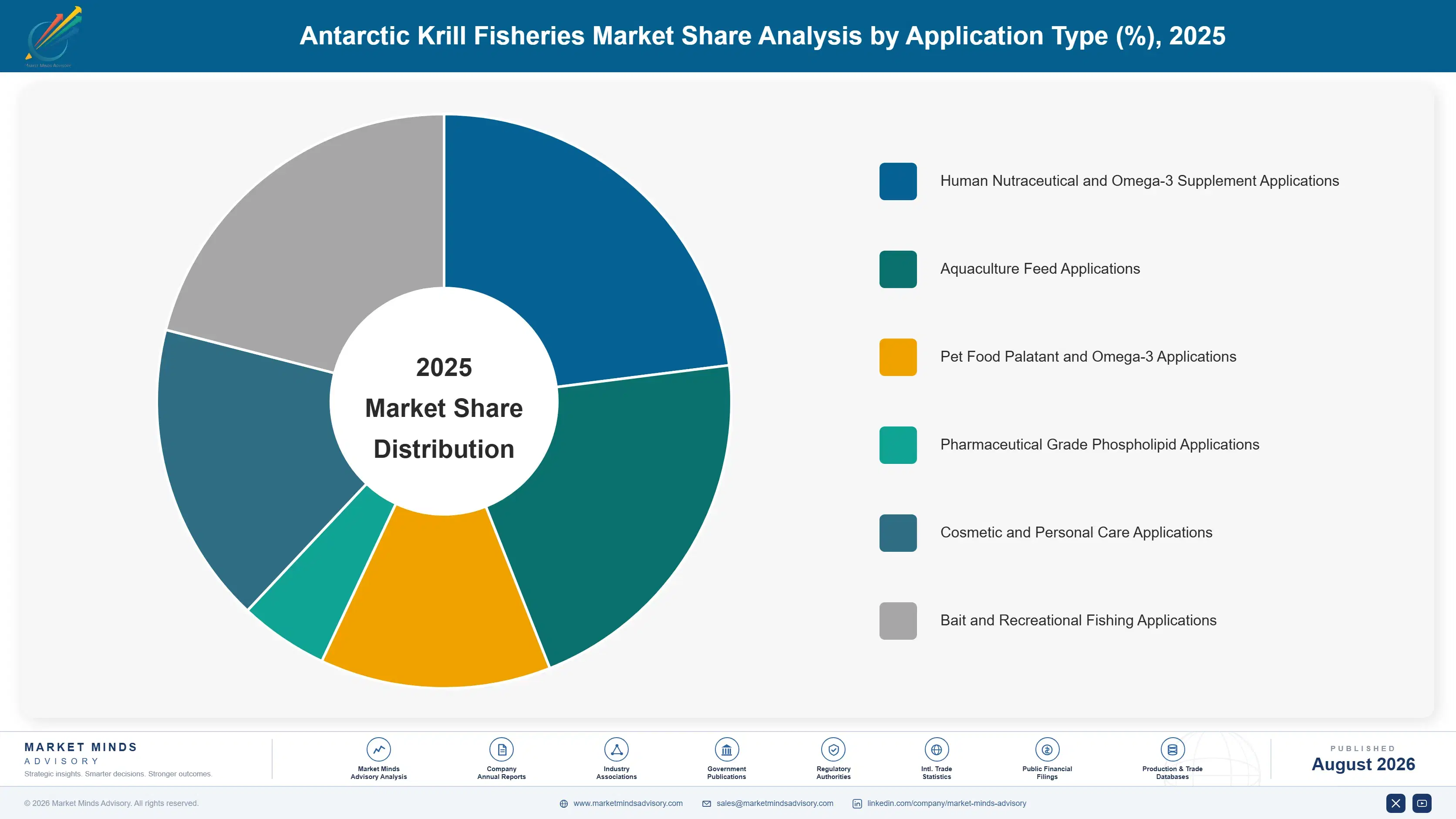
MMA segments the Antarctic krill market by end-use application rather than by product form or processing method used across the broader industry, since nutraceutical, aquaculture feed, pet food, pharmaceutical, cosmetic, and bait buyers each purchase against distinct purity, phospholipid content, and processing specifications that determine which harvesters can supply each specific category at all.
antarctic-krill-fisheries-market-market-share-analysis-1787461607468

Human Nutraceutical and Omega-3 Supplement Applications

Human nutraceutical and omega-3 supplement applications form the fastest-growing segment, expanding at 11.5 percent annually as consumer awareness of krill oil's phospholipid-bound bioavailability advantage over conventional fish oil continues building through both scientific publication and direct-to-consumer marketing campaigns across major global retail channels. Suppliers into this segment must maintain pharmaceutical-grade extraction standards and consistent phospholipid content across batches, a bar that has kept the segment concentrated among vertically integrated harvesters with dedicated onboard processing capability rather than commodity meal producers. Pricing for supplement-grade oil carries a substantial premium over aquaculture-grade meal, reflecting both the processing sophistication required and the retail positioning supplement brands have successfully established with health-conscious consumers worldwide.
CAGR 11.5%

Aquaculture Feed Applications

Aquaculture feed applications rank second at 9.8 percent CAGR, driven by expanding global salmon farming production and growing formulator preference for krill meal's pigmentation and palatability benefits over conventional fishmeal alternatives available on the broader ingredient market today and going forward. Norwegian and Chilean salmon producers increasingly specify krill meal inclusion rates directly in feed formulations to support sustainability certification claims and premium retail positioning for farmed salmon products sold internationally across major grocery chains. This segment represents the largest absolute volume within the broader krill market, even though its per-tonne pricing sits well below nutraceutical-grade oil, since aquaculture feed formulators buy on a cost-per-nutritional-benefit basis rather than paying supplement-level premiums.
CAGR 9.8%
Full segment breakdown across 6 segments available in the complete report.

Regional Architecture and Country Demand Map

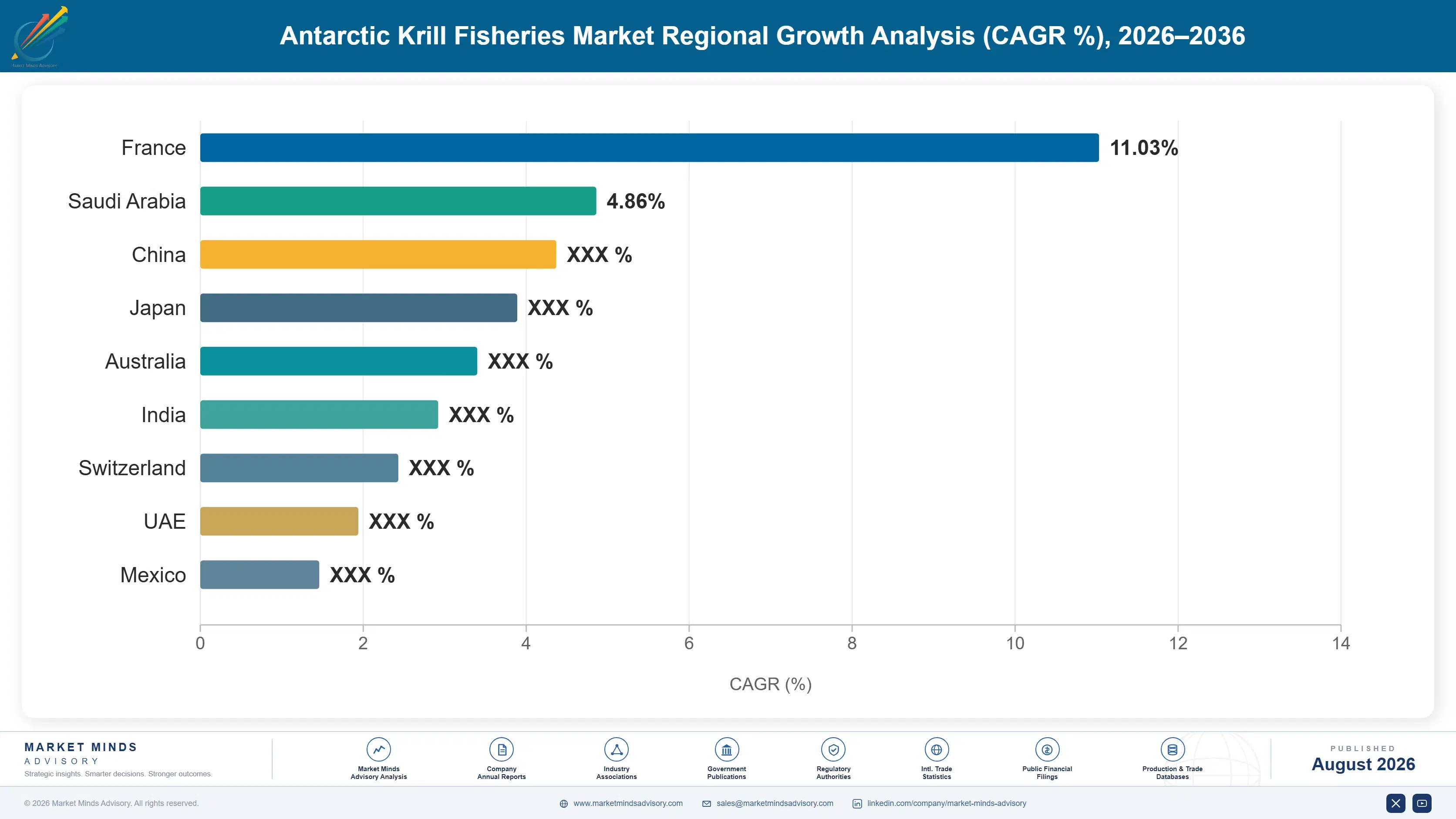
Antarctic krill demand spreads unevenly across all seven MMA-tracked regions, weighted toward East Asia's expanding aquaculture feed and nutraceutical manufacturing base, while Western Europe hosts the Norwegian harvesting fleets and processing infrastructure that supply a disproportionate share of global product regardless of final destination market.

East Asia

China's rapidly expanding aquaculture sector, the largest in the world by farmed volume, has pulled substantial krill meal demand into feed formulations for both fish and shrimp farming operations across its extensive coastal aquaculture facilities and numerous inland fish farms nationwide and beyond. China also operates one of the largest krill harvesting fleets in the Southern Ocean, giving it direct supply access that many consuming nations lack entirely. Japan and South Korea add steady nutraceutical demand, building on a long regional tradition of marine-derived supplement consumption predating the current krill oil trend by decades. Regional processing capacity has expanded specifically to serve both domestic aquaculture feed and export nutraceutical customers simultaneously.
Share: 27% | CAGR: 10.3% (2026 to 2036)

North America

Omega-3 supplement brands concentrated in the United States drive a disproportionate share of premium krill oil demand, since direct-to-consumer marketing campaigns explaining phospholipid bioavailability advantages have built genuine category awareness well beyond early adopter wellness consumers into the mainstream shopper base nationwide. Major supplement retailers now stock multiple competing krill oil brands nationwide, reflecting the category's maturation from a niche specialty product into a mainstream fish oil alternative sold across grocery and pharmacy channels. Aquaculture feed demand remains comparatively modest, since domestic salmon farming volume trails Norway and Chile substantially in absolute terms. Canada adds smaller but steady nutraceutical demand tracking similar wellness consumer trends across its retail supplement sector.
Share: 24% | CAGR: 8.6% (2026 to 2036)
Regional intelligence for 5 additional markets available in the complete report: Western Europe, South Asia and Pacific, Latin America, Middle East and Africa, Eastern Europe. Contact sales@marketmindsadvisory.com.
antarctic-krill-fisheries-market-country-cagr-analysis-1787461608048

Where Margin Grows Within a Fixed Quota

Harvesters capture the widest margins by extracting more value from every tonne of fixed quota rather than by seeking more catch, since onboard processing yield, phospholipid extraction technology, sustainability certification, and long-term feed offtake contracts each defend pricing power far more durably than simply operating additional vessels within a hard, treaty-imposed annual harvest ceiling.

Onboard Processing Yield Optimization Within Fixed Quota

Harvesters that invest in advanced onboard processing equipment extract meaningfully more usable oil, meal, and phospholipid concentrate from each tonne of krill landed, effectively growing revenue without requiring any additional quota allocation from CCAMLR. This yield improvement, often exceeding 9 percent over older extraction methods, directly expands the total value captured from an allocation that cannot itself grow larger regardless of demand. Fleets that delay this investment leave value on the table with every single voyage, since the underlying catch limit will not increase to compensate for less efficient processing choices.
Market Impact: Expands usable output value by over 9 percent

Phospholipid Extraction Technology For Supplement Premium

Harvesters that invest in advanced phospholipid extraction technology can redirect output from lower-margin aquaculture meal sales into premium nutraceutical-grade oil that commands pricing often exceeding 60 percent above standard krill meal on a per-tonne basis. This extraction technology requires significant capital investment in onboard or shore-based processing equipment, but harvesters who complete it capture supplement brand contracts that pure meal producers cannot access regardless of their harvest volume or vessel capacity. The resulting product mix shift toward oil has become the single most important margin lever available within a fixed quota ceiling.
Market Impact: Commands a premium above 60 percent per tonne

Multi Year Offtake Contracts With Salmon Feed Producers

Harvesters that sign multi-year offtake agreements directly with salmon aquaculture feed producers secure guaranteed volume commitments that smooth the season-to-season demand volatility affecting spot-market meal sales considerably more than ad hoc arrangements ever could. These agreements typically run 3 to 5 years and lock in pricing within a formula tied to a fishmeal benchmark index, giving both parties predictable planning even as underlying commodity prices fluctuate significantly from quarter to quarter. Harvesters with these contracts in place have weathered recent demand softness in the spot nutraceutical market considerably better than competitors relying entirely on shorter-term sales relationships.
Market Impact: Secures guaranteed volume across 3 to 4 year terms

Marine Stewardship Council Certification For Premium Positioning

Harvesters holding Marine Stewardship Council certified fishery status can charge a documented premium to salmon feed producers and supplement brands seeking sustainability credentials for their own retail marketing claims and packaging. This certification requires ongoing compliance monitoring and periodic third-party audits roughly every 2 years that smaller or newer entrants sometimes find costly to maintain relative to their harvest volume and total revenue. Certified harvesters increasingly find that major retailers now require this credential as a baseline qualification for shelf placement, effectively locking out uncertified competitors from premium retail channels entirely regardless of product quality.
Market Impact: Commands a premium of roughly 15 percent per tonne

Who Controls the Margin Pool

Ranked by estimated annual harvested volume, the top five krill fishing companies together hold a CR5 near 68 percent, a highly concentrated field reflecting the capital intensity of factory vessel operations and the practical barriers to entering a CCAMLR-regulated fishery. The gap between the dominant harvester and mid-tier competitors is substantial, since vessel and quota access advantages compound over decades of established Southern Ocean operating history.
Competitive activity currently plays out along three dimensions: onboard processing sophistication, since harvesters with advanced phospholipid extraction technology capture premium nutraceutical contracts unavailable to meal-only competitors; sustainability certification status, as Marine Stewardship Council credentials increasingly gate access to premium retail and feed contracts; and quota management area positioning, which determines how efficiently a fleet can operate under CCAMLR's subdivided catch limit system.

Emerging pressure comes from Chinese state-supported fleets expanding harvesting capacity and processing sophistication to compete directly with the historically dominant Norwegian operators on both meal and premium oil products. Rankings could shift within a decade if Chinese processors close the extraction technology gap fast enough to win nutraceutical contracts currently reserved for established Norwegian suppliers with longer certification track records and deeper customer relationships.
antarctic-krill-fisheries-market-company-positioning-matrix-1787461608569

Competitive Moat and Risk Dimensions

AKER BIOMARINE ASA

Moat: Vertically Integrated Processing Capability

Aker BioMarine operates the fishery's most advanced onboard and shore-based processing infrastructure, letting it extract premium phospholipid oil, meal, and specialty ingredients from the same harvested tonnage rather than selling raw catch to third-party processors. That vertical integration, combined with decades of accumulated quota and operating history, gives it customer relationships and margin capture that smaller harvesters cannot replicate quickly.
AKER BIOMARINE ASA

Risk: Single Fishery Revenue Concentration

Heavy reliance on a single fishery exposes the company more than diversified marine ingredient competitors to any CCAMLR quota reduction, environmental advocacy campaign, or Southern Ocean operating disruption. A significant quota cut would directly compress revenue with no comparable alternative resource to shift harvesting capacity toward.
CHINA NATIONAL FISHERIES CORPORATION

Moat: State Backed Fleet Scale Advantage

China National Fisheries Corporation benefits from state-supported fleet investment and direct distribution access into China's massive domestic aquaculture feed market, giving it a captive customer base that foreign competitors must compete for through arm's-length trading relationships instead. That built-in demand channel provides volume certainty that purely export-focused harvesters lack.
CHINA NATIONAL FISHERIES CORPORATION

Risk: Limited Premium Nutraceutical Positioning

The company's processing capability remains weighted toward meal and basic oil rather than the pharmaceutical-grade phospholipid extraction that commands premium nutraceutical pricing, leaving it more dependent on lower-margin aquaculture feed sales than competitors with deeper extraction technology investment and more established supplement brand relationships already built over many years.

Players Tracked

Prominent Players

Aker BioMarine ASA
Rimfrost AS
China National Fisheries Corporation
Insung Corporation
Dongwon Industries Co Ltd

Other Key Players

Nippon Suisan Kaisha Ltd
Pesca Chile SA
Sunwoo Corporation
Olympic Seafood AS
Neptune Wellness Solutions Inc
Enzymotec Ltd
Croda International Plc
BASF SE
DSM-Firmenich AG
Golden Omega SA
Epax Norway AS
KRILL.NO AS
Qingdao Kangjing Marine Biotechnology Co Ltd
Rossfjord AS
Marine Ingredients AS

Recent Developments

FEBRUARY 2026

Aker BioMarine Commissions New Factory Vessel Upgrade

Aker BioMarine completed a major processing upgrade aboard one of its Southern Ocean factory vessels, adding phospholipid extraction capacity aimed at increasing premium nutraceutical-grade oil output without requiring any additional CCAMLR quota allocation for the upcoming harvesting season and beyond into several future years ahead.
Signal: Signals continued investment in yield optimization as the primary growth lever within a fixed, treaty-limited harvest ceiling.
SEPTEMBER 2025

CCAMLR Advances Management Area Subdivision Proposal

CCAMLR member states advanced a proposal further subdividing the overall krill catch limit across smaller Southern Ocean management areas, aiming specifically to reduce localized environmental pressure near penguin, seal, and whale foraging grounds during peak harvesting periods each season across the entire regulated Southern Ocean fishery.
Signal: Indicates continued regulatory tightening around harvest area flexibility rather than any near-term overall fishery quota increase.
MAY 2025

China National Fisheries Expands Krill Meal Distribution

China National Fisheries Corporation expanded its domestic krill meal distribution network to serve additional aquaculture feed manufacturers across China's growing coastal farming regions, deepening its already quite substantial captive customer base within the world's single largest aquaculture production market measured by total annual farmed volume.
Signal: Reflects continued state-supported fleet strategy prioritizing domestic aquaculture feed distribution over export-focused premium nutraceutical positioning and branding.

Fuel And Vessel Costs Drive Economics

Vessel fuel and at-sea operating costs, including crew, provisioning, and maintenance for factory vessels operating far from port infrastructure, account for roughly 48 percent of krill harvesting's cash cost of production. Most fleets purchase bunker fuel through global maritime suppliers rather than fixed contracts, leaving cost exposure tied closely to broader oil price cycles rather than krill-specific market dynamics.
Aker BioMarine's 2024 annual report noted that bunker fuel costs rose meaningfully during a period of broader maritime fuel price volatility, pushing vessel operating costs up by more than 14 percent within a single harvesting season. Harvesters without fuel hedging arrangements absorbed most of that increase directly, while those with longer-dated fuel purchase agreements maintained more stable per-tonne harvesting costs across the same volatile period.

Harvesters without fuel hedging or scale advantages face a persistent cost disadvantage against larger, better-capitalized fleets, since fuel price spikes hit smaller operators proportionally harder relative to their total harvest revenue. This falls hardest on newer entrants without established fuel purchasing relationships, while dominant harvesters with long-term supplier contracts and larger fleet scale maintain comparatively stable operating costs through volatile fuel markets.
antarctic-krill-fisheries-market-cost-volatility-analysis-1787461608767

Long-Dated Fuel Purchase Agreements With Suppliers

Harvesters are increasingly negotiating longer-dated fuel purchase agreements directly with maritime suppliers rather than buying bunker fuel on the spot market before each voyage. These agreements typically fix a formula-based price tied to a benchmark maritime fuel index, smoothing season-to-season cost swings and giving harvesters a defensible basis for offering customers more stable annual pricing terms.

Voyage Route Optimization To Reduce Fuel Burn

Optimizing vessel routes between fishing grounds, processing zones, and port destinations reduces total fuel consumption per tonne of krill harvested, directly offsetting some fuel price volatility through efficiency rather than hedging alone. This optimization requires investment in routing software and crew training, but it delivers savings regardless of which direction fuel prices move next season.

Fleet Scale Consolidation To Spread Fixed Costs

Larger fleets spread fixed vessel maintenance and provisioning costs across more harvested tonnage, achieving meaningfully lower per-tonne operating costs than smaller competitors operating fewer vessels. This scale advantage has encouraged consolidation among smaller harvesters unable to match larger operators cost structure, particularly during periods of elevated fuel pricing that squeeze thinner operating margins across the fleet.

Portfolio Architecture for Margin Defence

Antarctic krill's portfolio splits into three margin tiers that track processing sophistication rather than harvest volume alone, since the quota ceiling caps total tonnage identically for every product form. Aquaculture-grade meal competes largely on cost-per-nutritional-benefit against conventional fishmeal, while certified supplement-grade oil earns a durable premium, and a smaller pharmaceutical-grade phospholipid tier commands the highest margins of all within the entire fishery.
The tension between volume and premium tiers plays out directly in processing investment decisions, since building phospholipid extraction capability sacrifices some meal-tonnage throughput for a considerably higher, more durable margin per tonne of quota used each season. Harvesters that hesitate to build that processing capability risk ceding the fastest-growing, highest-margin nutraceutical segment to competitors willing to invest in extraction technology first.

High-value margin pools concentrate almost entirely in nutraceutical-grade oil and pharmaceutical phospholipid concentrate, where processing sophistication and certification barriers keep casual entrants out far longer than in any other tier of the fishery. Aquaculture feed grade sits in between, commanding a moderate premium tied to sustainability certification rather than processing difficulty, while basic meal remains firmly commodity-priced regardless of harvester scale or flag state.

Volume / Commodity-Adjacent Tier

Aquaculture-grade krill meal sold into salmon and shrimp feed formulations across major producing regions worldwide, priced largely on cost-per-nutritional-benefit against conventional fishmeal alternatives with minimal certification differentiation between qualified harvesters.
Gross Margin: 14%-22%

Premium / Certified Tier

Marine Stewardship Council certified krill oil serving nutraceutical supplement brands worldwide, carrying documented sustainability credentials and consistent phospholipid content that commands a durable price premium over uncertified meal grade across most retail channels.
Gross Margin: 34%-45%

Sustainability / Regulatory / Next-Generation Tier

Pharmaceutical-grade phospholipid concentrate meeting the most demanding purity and consistency standards required by clinical and pharmaceutical customers, priced at a significant premium reflecting the specialized extraction technology and quality control investment required to produce it.
Gross Margin: 42%-55%
antarctic-krill-fisheries-market-portfolio-architecture-1787461609271

High-value Sub-segments and Strategic Watch-out

Human Nutraceutical and Omega-3 Supplement Applications

Human nutraceutical and omega-3 supplement applications combine the fastest segment CAGR at 11.5 percent with the highest achievable margin found anywhere in the entire global krill fishery, protected by phospholipid extraction barriers that take years and significant capital investment to replicate at meaningful commercial scale.
Gross Margin: 36%-46%

Aquaculture Feed Applications

Aquaculture feed applications grow at 9.8 percent and represent the largest absolute volume within the entire global krill fishery today, tied to sustainability certification requirements that increasingly gate which harvesters can supply major salmon feed producers seeking premium retail positioning and strong marketing claims worldwide.
Gross Margin: 16%-24%

Krill Meal for General Aquafeed

Krill meal for general aquafeed remains the volume anchor of the entire global fishery, growing near the overall market average each year with thinner margins tied closely to conventional fishmeal benchmark pricing and broader competitive dynamics across the wider industry each harvesting season of the year.
Gross Margin: 14%-20%

Bait and Recreational Fishing Applications

Bait and recreational fishing applications warrant a strategic watch, since persistently slow growth and thin margins leave this small niche segment quite vulnerable to substitution by cheaper conventional bait products if buyers ever fully standardize further on lower-cost alternatives across the much broader global market.
Gross Margin: 8%-13%

Why Quota Access Behaves Like Annuity

Once a salmon feed producer or supplement brand qualifies a krill supplier through its formulation and testing process, that relationship behaves more like an annuity than a transactional purchase, since the supplier's quota cannot expand to serve a growing list of alternate customers even if a competitor tried to poach the relationship. Buyers tolerate modest price increases from an incumbent supplier rather than compete for scarce allocation elsewhere.
Stickiness varies by end-use vertical. Nutraceutical brands rarely switch suppliers once phospholipid content and purity specifications clear internal formulation testing, since requalifying an alternate source risks disrupting a finished product formula. Aquaculture feed buyers switch somewhat more readily when pricing shifts meaningfully, though certification requirements limit how freely they can move. Bait and recreational fishing buyers show the least stickiness, since specifications are minimal and price dominates purchasing decisions.

A generational shift is also underway among buyers themselves. Younger procurement teams at supplement brands and feed companies increasingly demand Marine Stewardship Council certification and environmental impact documentation alongside traditional price and quality metrics, favoring harvesters who can demonstrate rigorous sustainability credentials. This shift is gradual rather than abrupt, but it is steering volume toward certified harvesters investing early in transparent sustainability reporting.
antarctic-krill-fisheries-market-end-use-penetration-index-1787461609766

Where MMA Sees the Advantage

These are among the four positions where our research anticipates prominent divergence between winners and laggards over the coming forecast period. Each is grounded in the demand model, the regulatory perimeter, and the announced capacity pipeline.
01 / ONBOARD PROCESSING INVESTMENT PRIORITY

Invest in phospholipid extraction technology before the quota ceiling forces the issue

The CCAMLR harvest quota is fixed regardless of how much capital any single harvester deploys each season, meaning processing yield improvement is one of the only remaining levers for meaningful revenue growth within the entire fishery. Harvesters who invest in advanced phospholipid extraction technology now capture premium nutraceutical pricing on the same tonnage that competitors still process into basic meal at a fraction of the value. Waiting risks ceding this margin advantage permanently to competitors already deploying that capital today.
02 / SUSTAINABILITY CERTIFICATION STRATEGY

Secure Marine Stewardship Council certification before it becomes a baseline requirement

Major retailers and salmon feed producers increasingly treat Marine Stewardship Council certification as a baseline qualification for shelf placement and contract eligibility, not a differentiating marketing feature it once represented. Harvesters who secure and maintain this certification now retain access to premium retail and feed channels that will likely become closed to uncertified competitors within the next several years as the requirement spreads further. Delaying this investment risks losing access to premium channels entirely once certification becomes a universal industry baseline requirement.
03 / FEED OFFTAKE CONTRACT STRATEGY

Lock in multi-year salmon feed offtake contracts before spot demand softens

Aquaculture feed represents the largest absolute volume in the fishery, but spot-market meal pricing has proven more volatile than harvesters would prefer given the fixed cost base of running a Southern Ocean fleet each season. Harvesters who secure multi-year offtake agreements directly with salmon feed producers now lock in guaranteed volume and formula-based pricing that smooths the demand volatility spot-market sellers absorb directly. Competitors who rely entirely on spot sales remain exposed to demand softness that contracted harvesters avoid almost entirely.
04 / VESSEL FUEL HEDGING STRATEGY

Hedge fuel costs before the next maritime fuel price spike hits margins

Fuel and vessel operating costs account for 48 percent of harvesting cash cost, and recent volatility has already pushed operating expenses up more than 14 percent within a single season for unhedged fleets across the industry. Harvesters who negotiate longer-dated fuel purchase agreements now insulate a meaningful share of their cost base from the next price spike, protecting margins that smaller, unhedged competitors cannot defend as effectively. Delaying this hedging leaves harvesters fully exposed to whatever the maritime fuel market does next.

Engagement Snapshot From the Field

A live engagement with an industry participant carrying material or product regulatory and market exposure ahead of a defining policy shift, showing how our research translates into a defensible multi-year portfolio strategy.
MARKET MINDS ADVISORY · CLIENT ENGAGEMENT SUMMARY
Antarctic Krill Fisheries Producer Strategic Portfolio Review and Transition Roadmap 2026·Investment Scenario on Antarctic Krill Fisheries Exposure Evaluation 2025-26
CLIENT PROFILE
The client, a mid-size North American nutraceutical brand selling krill oil omega-3 supplements through major retail and direct-to-consumer e-commerce channels nationwide, generated approximately 88 million US dollars in annual revenue (client-reported, unverified by MMA) and had long purchased krill oil entirely on the spot market from multiple independent brokers for well over four consecutive years.
STRATEGIC CHALLENGE
Facing volatile spot pricing tied to seasonal harvest variation and growing competitive pressure from larger brands with locked-in supply contracts, the client needed to secure multi-year supply at more predictable pricing within nine months, without compromising its existing Marine Stewardship Council certified sourcing claims on retail packaging and marketing materials.
MMA APPROACH
MMA benchmarked offtake terms across three major krill harvesters, assessing certification status, phospholipid content consistency, and pricing formula structure. The team modeled multi-year contract scenarios against the client's historical spot purchasing costs, and facilitated direct negotiations between the client's procurement team and two shortlisted harvester partners meeting the certification criteria.
KEY FINDINGS
  1. Spot-market purchasing had exposed the client to a documented 24 percent price swing across the prior two consecutive harvesting seasons alone, per internal analysis.
  2. Two of the three benchmarked harvesters offered multi-year offtake terms with formula-based pricing tied to a fishmeal benchmark index directly, per contract terms reviewed.
  3. Locking in a three-year contract would reduce projected input cost volatility by an estimated 18 percentage points annually going forward, per modeling.
  4. Both shortlisted harvesters maintained Marine Stewardship Council certification, preserving the client's existing sustainability marketing claims without any disruption whatsoever to current packaging.
CLIENT PROFILE
The client, a mid-size North American nutraceutical brand selling krill oil omega-3 supplements through major retail and direct-to-consumer e-commerce channels nationwide, generated approximately 88 million US dollars in annual revenue (client-reported, unverified by MMA) and had long purchased krill oil entirely on the spot market from multiple independent brokers for well over four consecutive years.
STRATEGIC CHALLENGE
Facing volatile spot pricing tied to seasonal harvest variation and growing competitive pressure from larger brands with locked-in supply contracts, the client needed to secure multi-year supply at more predictable pricing within nine months, without compromising its existing Marine Stewardship Council certified sourcing claims on retail packaging and marketing materials.
MMA APPROACH
MMA benchmarked offtake terms across three major krill harvesters, assessing certification status, phospholipid content consistency, and pricing formula structure. The team modeled multi-year contract scenarios against the client's historical spot purchasing costs, and facilitated direct negotiations between the client's procurement team and two shortlisted harvester partners meeting the certification criteria.
KEY FINDINGS
  1. Spot-market purchasing had exposed the client to a documented 24 percent price swing across the prior two consecutive harvesting seasons alone, per internal analysis.
  2. Two of the three benchmarked harvesters offered multi-year offtake terms with formula-based pricing tied to a fishmeal benchmark index directly, per contract terms reviewed.
  3. Locking in a three-year contract would reduce projected input cost volatility by an estimated 18 percentage points annually going forward, per modeling.
  4. Both shortlisted harvesters maintained Marine Stewardship Council certification, preserving the client's existing sustainability marketing claims without any disruption whatsoever to current packaging.
RECOMMENDED STRATEGY
Phase 1: Phase 1 (Months 1 to 3): Complete harvester benchmarking and shortlist two certified candidates offering multi-year offtake contract terms and pricing. Phase 2: Phase 2 (Months 4 to 6): Negotiate final contract terms and pricing formula structure directly with the top-ranked harvester candidate identified. Phase 3: Phase 3 (Months 7 to 9): Finalize the multi-year supply agreement and fully transition remaining volume away from spot-market purchasing.
OUTCOME
The client signed a three-year offtake agreement within eight months, securing predictable pricing and maintaining its certified sourcing claims across all product lines. Reported input cost volatility fell by approximately 20 percent (client-reported, unverified by MMA) across the following two purchasing cycles, improving margin forecasting accuracy.

Frequently Asked Questions

Foundational context covering the market sizes, CAGR, scope, country, region and competition that inform every finding below. This section is provided to cover basics and most often pre-purchase conversations, answered from the MMA Primary Research Dataset.

What is the current size of the Antarctic Krill Fisheries Market?

MMA estimates the global Antarctic krill fisheries market at 2.4 billion US dollars in 2025, spanning nutraceutical, aquaculture feed, pet food, pharmaceutical, cosmetic, and bait applications across all major harvesting and consuming regions.

How large will the Antarctic Krill Fisheries Market be by 2036?

MMA projects the market to reach approximately 6.32 billion US dollars by 2036, up from 2.62 billion in 2026, as nutraceutical demand continues expanding faster than aquaculture feed volume.

What is the CAGR for the Antarctic Krill Fisheries Market 2026 to 2036?

The base case CAGR is 9.2 percent for 2026 to 2036. Bull and bear scenarios range between 10.4 percent and 8.0 percent depending on CCAMLR quota policy outcomes.

Which segment is growing fastest?

Human nutraceutical and omega-3 supplement applications form the fastest-growing segment at 11.5 percent CAGR, roughly 1.25 times the overall market rate, driven by bioavailability-driven premiumization.

Who are the major companies in the Antarctic Krill Fisheries Market?

Leading harvesters include Aker BioMarine ASA, Rimfrost AS, China National Fisheries Corporation, Insung Corporation, and Dongwon Industries Co Ltd, together holding an estimated CR5 near 68 percent.

Which country is growing fastest?

China is the fastest-growing country market at approximately 10.8 percent CAGR, supported by expanding aquaculture feed demand and a rapidly growing domestic krill harvesting fleet each season.

Report Segmentation Architecture

The full report scope spans multiple orthogonal segmentation dimensions, with cross-tabulated demand data provided for each dimension pair. Coverage extends further to regional breakdowns, trend trajectories, and the competitive detail needed to support segment-level decision-making.

By Application Type

  • Human Nutraceutical and Omega-3 Supplement Applications
  • Aquaculture Feed Applications
  • Pet Food Palatant and Omega-3 Applications
  • Pharmaceutical Grade Phospholipid Applications
  • Cosmetic and Personal Care Applications
  • Bait and Recreational Fishing Applications

By End-Use Industry

  • Nutraceuticals and Dietary Supplements
  • Aquaculture and Animal Feed
  • Pet Food and Animal Nutrition
  • Pharmaceutical Manufacturing
  • Cosmetics and Personal Care

By Commercial Dimension

  • Direct Harvester Sales
  • Distributor and Trader Sales
  • Multi-Year Offtake Contract Supply
  • Retail Consumer Packaged Sales

By Region

  • North America
  • Western Europe
  • East Asia
  • South Asia and Pacific
  • Latin America
  • Middle East and Africa
  • Eastern Europe

Scope, Methodology, and Coverage

Every figure in this report is reproducible from documented input assumptions. The scope below maps the historical period, the forecast horizon, the segmentation dimensions, and the countries covered, alongside the underlying primary and qualitative methodology.
Historical Period
2020 to 2025
Forecast Period
2026 to 2036
Base Year
2025 (USD billions; MMA Primary Research Dataset, August 2026)
Market Definition
The Antarctic krill fisheries market covers the commercial harvesting, processing, and sale of Euphausia superba and its derived products, including krill meal, krill oil, and phospholipid concentrate, used across aquaculture feed, human nutraceutical, pet food, pharmaceutical, cosmetic, and bait applications. It excludes other crustacean fisheries and non-Antarctic krill species harvested outside CCAMLR-regulated Southern Ocean waters.
Quantitative Units
USD billions (current prices); metric tonnes for volume-based segment analysis
Segmentation Dimensions
By Application Type; By End-Use Industry; By Commercial Dimension; By Region
Regions Covered
North America, Western Europe, East Asia, South Asia and Pacific, Latin America, Middle East and Africa, Eastern Europe
Countries Covered
USA, China, Germany, France, UK, Japan, South Korea, India, Australia, Canada, Brazil, Mexico, Indonesia, Vietnam, Thailand, Malaysia, UAE, Saudi Arabia, South Africa, Nigeria, Turkey, Poland, Netherlands, Italy, Spain, Sweden, Switzerland, Argentina, Colombia, Singapore, and additional markets relevant to this sector
Key Companies Profiled
Aker BioMarine ASA, Rimfrost AS, China National Fisheries Corporation, Insung Corporation, Dongwon Industries Co Ltd, Nippon Suisan Kaisha Ltd, Pesca Chile SA, Sunwoo Corporation, Olympic Seafood AS, Neptune Wellness Solutions Inc, Enzymotec Ltd, Croda International Plc, BASF SE, DSM-Firmenich AG, Golden Omega SA, Epax Norway AS, KRILL.NO AS, Qingdao Kangjing Marine Biotechnology Co Ltd, Rossfjord AS, Marine Ingredients AS
Quantitative Methodology
Primary survey, n=3,800 respondents, Q4 2025, six countries; demand-side model with trade association cross-validation
Qualitative Methodology
47 expert interviews, Q4 2025; applied to validate demand model assumptions, identify emerging dynamics, and assess competitive positioning
Report Format
PDF and XLSX data workbook (Word format preview document)
Publisher
Market Minds Advisory
Report Code
MMA-2026-AGR-105
Published
August 2026
Contact
sales@marketmindsadvisory.com | www.marketmindsadvisory.com

Purchase the full Antarctic Krill Fisheries Market Report (2026 to 2036).

This report gives procurement, product development, and investment teams a full commercial picture of the global Antarctic krill fisheries market through 2036. It covers segmentation by end-use application, all seven regional markets with detailed demand mechanisms, and a competitive assessment of twenty harvesters and processors evaluated on estimated harvested volume. Readers get quantified trend, driver, and restraint analysis, vessel fuel cost exposure modeling, and portfolio margin architecture across three pricing tiers. A dedicated revenue lever framework and anonymized case study translate the analysis into specific, actionable sourcing decisions.
Twenty-company competitive benchmarking on harvested volume basis
Seven-region demand architecture with quantified growth mechanisms
Segment-level CAGR modeling across six MECE application categories
Vessel fuel cost exposure and hedging mitigation playbook
Three-tier portfolio margin architecture and pricing analysis
Anonymized client case study with recommended contracting strategy

Built For The People Who Decide

From boardroom strategy to bench-side execution, this report is read cover-to-cover by leaders shaping the next decade of their industry, turning demand scenarios, market dynamics and valuation benchmarks into decisions.
CXOs/ Presidents/ VPs/ Managers
M&A and Corporate Development
Strategy Teams and R&D Heads
Procurement and Product Directors
Regulatory and Compliance Leaders
Investor Relations and Equity Analysts