

Market Minds Advisory
Anise Extract Market

Anise Extract Market: Star Anise Supply Concentration Meets Pharmaceutical Precursor Demand

China's near-total grip on star anise production is colliding with rising pharmaceutical demand for shikimic acid, the antiviral precursor extracted from the same pods flavor buyers need, forcing both industries to compete for one harvest.

Lead Analyst

Lisa Gevelber

Published

September 2026

Make Smarter Decisions with Customized Research Insights

Request a free sample report and evaluate market opportunities, growth trends, and competitive dynamics relevant to your business needs.

2025 MARKET VALUE$0.7BMarket Size 2025
2036 FORECAST VALUE$1.3BBase Case , 2026 to 2036
CAGR 2026 TO 20366.5 %Bull 7.8% / Bear 5.2%
INCREMENTAL OPPORTUNITY$0.6BNet 10- year value creation
EXPANSION MULTIPLE1.86x2036 value over 2026 base
Strategic Levers
M&A Pipeline
Regional Outlook
Country Rankings
Competitive Intelligence
Segmental Deep-dive
Call-Us : 91 93563 13602

Executive Snapshot and Market Trajectory

Anise extract sits inside an unusually narrow supply chain: nearly every commercially traded pod comes from a handful of Chinese provinces, and buyers across food, beverage, and pharmaceutical manufacturing draw from that same harvest simultaneously each year, regardless of end use, contract size, or order timing.
Pharmaceutical demand for shikimic acid, the antiviral precursor extracted from star anise, has pulled meaningfully ahead of traditional flavor and fragrance volume as governments rebuild antiviral stockpiles following recent pandemic preparedness reviews across multiple health ministries worldwide. Standardized anethole extract, the concentrated flavor compound prized by beverage and confectionery formulators, is expanding fastest of any traditional segment as buyers move away from whole-spice sourcing toward guaranteed potency ingredients carrying documented technical specification.
A fragmented base of Indian and Chinese processors controls most standardized extract supply, so harvest-year contracting, not brand reach, decides who gets allocation when a poor season strikes across the wider category and every buyer segment within it. Pharmaceutical stockpiling policy is colliding with flavor industry demand to reshape who actually secures reliable pod supply each year going forward from here, across every processing tier and country.
Market Definition
The anise extract market covers extracted, distilled, and standardized ingredients derived from star anise and green anise seed, sold as flavor, fragrance, and pharmaceutical precursor ingredients across food, beverage, and drug manufacturing. It excludes whole dried anise spice sold for direct culinary retail, and excludes finished pharmaceutical products containing shikimic acid derivatives.
Base Year Value
$0.7B in 2025 (MMA Primary Research Dataset, August 2026)
Forecast Period
2026 to 2036, eleven discrete annual values
CAGR
6.5% base case. Bull 7.8%. Bear 5.2%.
Fastest Growth Segment
Shikimic Acid Extract: 11.2% CAGR
Fastest Growth Country
China: 8.5% CAGR
Fastest Growth Region
South Asia and Pacific: 8.5% CAGR
Largest Region
East Asia: 28% of 2025 global value
Market Leaders
Synthite Industries, Kancor Ingredients, AVT Natural Products, Plant Lipids, Jiangxi Global Natural Spice. Source: MMA Analysis based on company annual reports.
Primary Survey
n=3,800 procurement and R&D decision-makers, Q4 2025, six countries
Methodology
Demand-side build-up, cross-validated against public data, 47 expert interviews

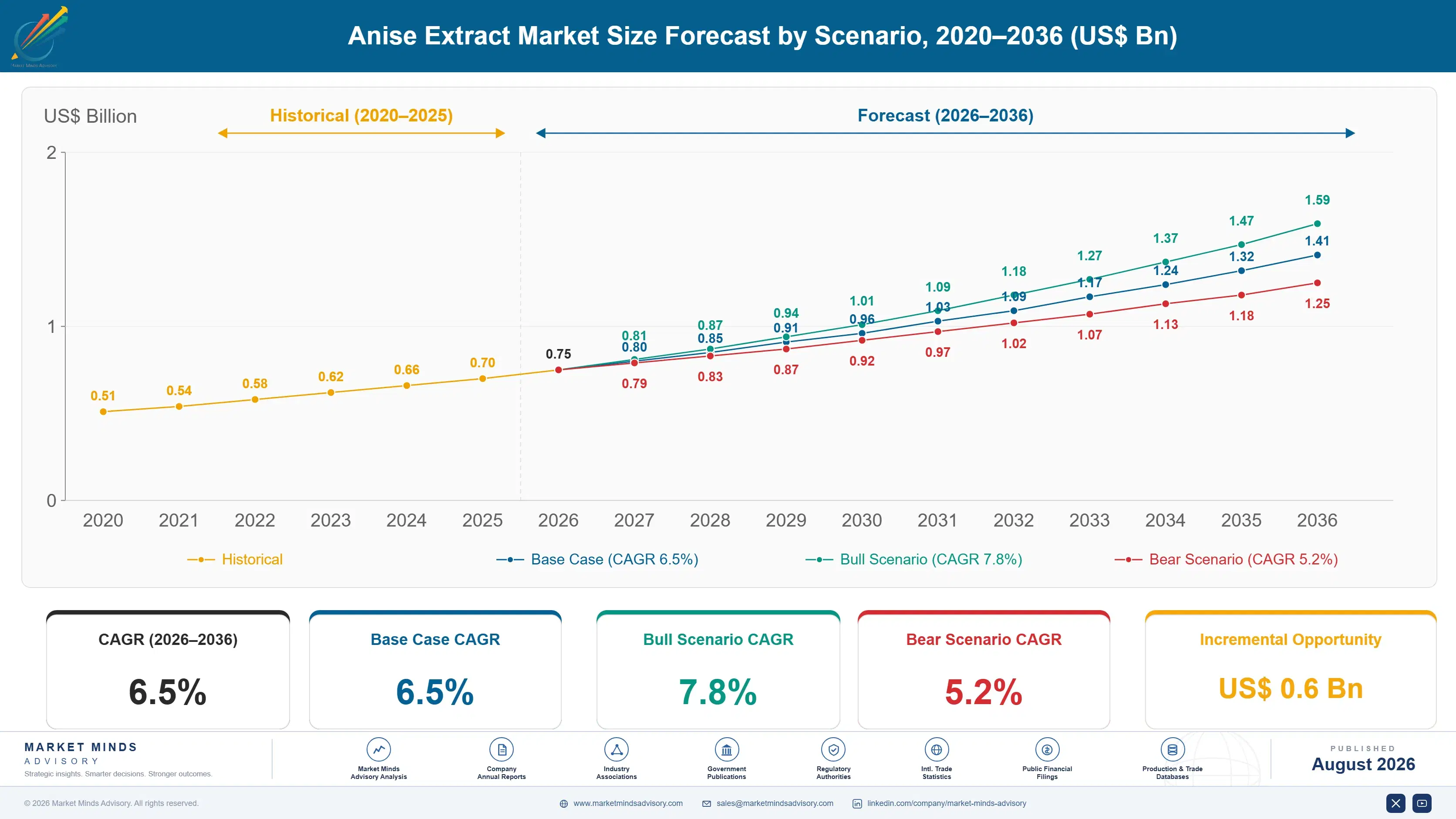
Anise Extract Market Forecast Scenarios

anise-extract-market-size-forecast-scenario-1787463251629
Anise extract volumes grew unevenly between 2020 and 2025, constrained less by flavor demand than by pharmaceutical shikimic acid stockpiling cycles that periodically absorbed a large share of available pod supply across several consecutive harvest seasons. Traditional flavor and fragrance buyers adapted by signing longer-term contracts to secure priority allocation ahead of any pharmaceutical procurement surge.
The base case assumes continued pharmaceutical stockpiling demand for shikimic acid, expanding standardized anethole extract adoption among beverage and confectionery formulators, and steady processing capacity investment by the leading Indian and Chinese extractors working in parallel across multiple product grades. These three mechanisms lift supply in step with demand without requiring Chinese star anise acreage to expand significantly, since yield and extraction efficiency gains are doing most of the work instead across the category.
A bull case builds on a major public health authority placing a large multi-year shikimic acid procurement order that pulls forward processing capacity investment industry-wide well ahead of schedule and across every major processor. The bear risk is a poor Chinese star anise harvest that forces pharmaceutical and flavor buyers into direct competition for the same constrained pod supply base.

One Harvest Serving Two Unrelated Industries

Anise extract occupies an unusual position among botanical flavor ingredients: its supply chain serves two commercially unrelated buyer groups drawing from the identical harvest, flavor and fragrance formulators who value aromatic complexity, and pharmaceutical manufacturers who value shikimic acid content specifically, a molecule the plant happens to concentrate naturally far more than most other botanical sources available to industry today across every major growing region.
PROCESSOR CONCENTRATION5 firms, 34%share of standardized extract revenue held by leaders
AVERAGE SELLING PRICE$26/kgdelivered basis price for standardized flavor-grade extract today
TOP PRODUCING COUNTRY SHAREChina, 78%share of global star anise pod production harvested annually
CAPACITY UTILISATION71%average utilisation across dedicated distillation and standardization lines
TRADE INTENSITY58% cross-bordershare of finished extract volume traded across borders
FEEDSTOCK COST SHARE44% of COGSshare of production cost attributable to raw pod input
Commercially, certified standardized extract supply concentrates among a handful of Indian and Chinese processors with distillation and standardization lines built specifically for consistent anethole or shikimic acid content. Buyers increasingly sign multi-year offtake agreements directly with processors to secure harvest-year volume ahead of each season, rather than buying spot-market extract after allocation is already exhausted by larger, earlier-committed pharmaceutical and flavor accounts operating across multiple countries.
Over the next decade, shikimic acid extraction for pharmaceutical stockpiling will likely grow faster than traditional flavor-grade extract, as public health authorities continue treating antiviral precursor supply as a strategic reserve category worth securing well ahead of any actual outbreak, regardless of near-term flavor industry demand or prevailing pod prices in a given harvest season.
"A hospital stockpile order and a soda company's flavor contract are drawing from the exact same sack of pods. Almost nobody outside the category realizes that."
Director, Botanical and Specialty Flavor Ingredients Practice · MMA Specialty Flavor and Botanical Ingredients Practice · August 2026

Market Trends

Pandemic preparedness reviews drive shikimic acid stockpiling

National public health authorities across North America, Western Europe, and East Asia have expanded antiviral stockpile targets since 2023 following pandemic preparedness reviews that flagged prior shortages of oseltamivir and related antiviral compounds derived from shikimic acid. Procurement agencies increasingly place multi-year forward orders directly with processors capable of guaranteeing shikimic acid content and traceable sourcing back to specific growing regions. This stockpiling pattern now periodically absorbs a meaningful share of total star anise harvest in years when public health orders coincide with strong flavor demand, creating allocation tension that did not exist a decade ago.
Market Impact: Adds $28 million in demand

Standardized anethole specification replaces whole-spice sourcing

Beverage and confectionery manufacturers have increasingly shifted purchasing from whole dried star anise toward standardized anethole extract carrying guaranteed potency specifications since 2023, seeking formulation consistency that whole-spice sourcing cannot reliably deliver batch to batch. This shift favors processors with distillation and standardization infrastructure over traders selling unprocessed spice, concentrating margin among a smaller group of capable suppliers across the category. Buyers report reformulation projects moving measurably faster once a standardized extract specification replaces variable whole-spice sourcing, since quality control testing becomes considerably simpler to manage across multiple production sites and shifts.
Market Impact: Adds 8% nutraceutical channel growth yearly

Market Opportunities and Growth Drivers

Beverage industry reformulation expands anethole extract demand

Global beverage manufacturers, particularly in the anise-flavored spirits and functional beverage categories, have expanded standardized anethole extract adoption since 2023 as formulators seek consistent flavor delivery across large production runs spanning multiple countries. Traditional anise-flavored spirits including ouzo, sambuca, and pastis represent an established demand base, while newer functional beverage launches carrying digestive health positioning have added a new growth channel drawing on anise's traditional carminative reputation. Processors able to guarantee consistent anethole content across production batches are capturing this expanding demand fastest, since large beverage manufacturers increasingly specify potency ranges directly in purchase contracts.
Market Impact: Concentrates 78% of supply

Traditional medicine and nutraceutical use expands in Asia

Anise extract has long featured in traditional Chinese and Ayurvedic medicine formulations, and this established use case has expanded into modern nutraceutical and digestive health supplement categories across China and India since 2023. Rising middle-class disposable income across both countries has expanded the addressable population able to afford branded nutraceutical products beyond traditional home remedy preparation. Domestic Indian and Chinese processors serving this channel increasingly supply standardized extract carrying documented active compound content rather than crude extract, capturing the growing preference for verified potency over traditional preparation methods passed down for generations.
Market Impact: Adds 4-6 month lead times

Market Restraints and Challenges

Chinese growing region concentration creates a single point of failure

Star anise cultivation concentrates almost entirely in a handful of provinces in southern China, giving the category unusually little geographic diversification compared with most other botanical flavor ingredients sourced from multiple countries. The root cause is that star anise trees require specific subtropical growing conditions that few regions outside southern China can reliably replicate at commercial scale. The commercial impact is a persistent single point of failure risk, where a regional weather event could disrupt supply for the entire category at once. Processors mitigate this by qualifying secondary growing trials in Vietnam, though none has reached meaningful commercial scale.
Market Impact: Adds 10% annual pharmaceutical-grade volume

Pharmaceutical and flavor demand compete for the same harvest

Pharmaceutical shikimic acid extraction and traditional flavor-grade processing draw from the identical star anise harvest, meaning a strong stockpiling year for public health procurement directly reduces pod availability for flavor and fragrance formulators. The root cause is that no meaningful cultivation distinction exists between pods grown for pharmaceutical extraction versus flavor processing, so allocation happens entirely through contract priority and price competition. The commercial impact falls hardest on smaller flavor houses without long-term supply agreements, who face allocation rationing during any coinciding procurement surge. Processors mitigate this by diversifying into other anise-family botanicals as a partial substitute during shortfall years.
Market Impact: Lifts standardized extract demand 7 points
3 additional market trends, 4 additional growth drivers, and 3 additional restraints and challenges are covered in the full report. Contact sales@marketmindsadvisory.com to access the complete intelligence.

Segment CAGR and Growth Architecture

Segmentation follows extraction and processing technology, since the method used to process star anise pods determines shikimic acid retention, flavor intensity, and which end-use category a given batch can serve, far more than any downstream application label attached to it later, whether pharmaceutical, culinary, or nutraceutical in nature, since the underlying pod is identical either way.
anise-extract-market-market-share-analysis-1787463252209

Shikimic Acid Extract

Shikimic acid extract isolates and concentrates the pharmaceutical precursor compound to a guaranteed potency, serving antiviral drug manufacturers and national stockpiling programs that require documented purity for regulatory approval rather than crude botanical extract. Extraction requires specialized purification equipment that only a handful of processors operate at commercial pharmaceutical-grade scale, which keeps margins well above flavor-grade extract across the category. Demand is growing at roughly 1.72 times the category average, driven by expanding public health stockpiling programs across North America, Western Europe, and East Asia. Buyers increasingly specify shikimic acid content and traceable sourcing directly in procurement contracts rather than accepting generic star anise extract, pushing processors without pharmaceutical-grade purification capability out of this fastest-growing slice of demand.
CAGR 11.2%

Standardized Anethole Extract

Standardized anethole extract concentrates the primary flavor compound to a guaranteed potency, serving beverage and confectionery formulators who require consistent flavor delivery across large production runs rather than the batch-to-batch variation whole-spice sourcing carries from harvest to harvest. This segment trails shikimic acid extract on growth but comfortably outpaces crude flavor-grade processing, supported by reformulation projects that increasingly specify potency ranges directly in purchase contracts rather than accepting generic extract. Manufacturers position standardized anethole extract as the preferred ingredient for large-scale beverage production where formulation consistency matters more than the traditional whole-spice story, and processors able to guarantee this consistency are capturing premium pricing that inconsistent regional suppliers cannot reliably match across multiple consecutive harvest seasons.
CAGR 8.9%
Full segment breakdown across 6 segments available in the complete report.

Regional Architecture and Country Demand Map

East Asia's dominance of global star anise cultivation and processing has made it the largest buying and supplying region for anise extract, ahead of North America's pharmaceutical stockpiling demand, with South Asia and Pacific growing fastest off a considerably smaller processing base as nutraceutical demand keeps rising.

East Asia

China anchors both cultivation and processing for the entire category, hosting nearly all commercially significant star anise growing regions along with the largest concentration of distillation and standardization capacity anywhere in the world today. Domestic pharmaceutical manufacturers increasingly compete directly with export-oriented flavor processors for the same harvest, a tension that has intensified as China's own antiviral stockpiling programs have expanded since 2023 across multiple provincial health authorities and national reserve agencies. Japanese and South Korean flavor houses add smaller but technically sophisticated demand, particularly for standardized extract carrying documented potency specifications used in premium confectionery and beverage formulation across the wider region, from Tokyo to Seoul and beyond into smaller markets.
Share: 28% | CAGR: 7.5% (2026 to 2036)

North America

United States demand centers heavily on pharmaceutical shikimic acid procurement, with federal and state public health agencies placing multi-year forward orders directly with certified processors to rebuild antiviral stockpiles following recent pandemic preparedness reviews across several federal agencies and coordinated state programs. Flavor and beverage manufacturers add a smaller but steady demand base, concentrated in anise-flavored spirits and functional digestive health beverage categories gaining shelf space nationwide each year across most major retail chains. Canadian demand tracks closely behind the United States, and both markets rely almost entirely on imported extract from Chinese and Indian processors, since no meaningful domestic star anise cultivation exists anywhere in the region at any commercial scale.
Share: 22% | CAGR: 7.6% (2026 to 2036)
Regional intelligence for 5 additional markets available in the complete report: Western Europe, South Asia and Pacific, Latin America, Middle East and Africa, Eastern Europe. Contact sales@marketmindsadvisory.com.
anise-extract-market-country-cagr-analysis-1787463252718

Where Anise Extract Margins Concentrate

Margin in this category sits with pharmaceutical-grade purification capability and harvest-year contracting rather than raw pod ownership, so processors capture the most value by securing dedicated allocation and moving customers toward standardized, specification-guaranteed extract grades well ahead of anticipated pharmaceutical stockpiling demand each coming harvest season across every major market this report tracks closely.

Pharmaceutical-Grade Purity Guarantee as a Pricing Gate

Processors able to guarantee shikimic acid content on a technical data sheet, rather than sell generic star anise extract, capture roughly 50% higher per-kilogram pricing from pharmaceutical customers who require documented purity for regulatory approval. Achieving this consistently requires specialized purification equipment and quality documentation that most flavor-grade processors have not invested in building out across their existing production lines. Buyers increasingly write shikimic acid percentage minimums directly into procurement contracts, which is steadily excluding non-pharmaceutical-grade suppliers from the fastest-growing and highest-margin slice of category demand across every major stockpiling program worldwide.
Market Impact: Commands a 50% premium over flavor grade today

Multi-Year Harvest Allocation Agreements With Growers

Signing multi-year harvest allocation agreements directly with Chinese growing cooperatives, priced above standard spot market rates, lets processors secure dedicated pod supply without competing for allocation each season against pharmaceutical stockpiling orders placed on short notice. This approach adds meaningful upfront cost, roughly 10% above typical spot pricing, but removes the allocation risk otherwise imposed when public health procurement and flavor demand coincide in the same harvest year across the wider supply chain. Processors without dedicated allocation agreements remain fully exposed to this risk regardless of how strong their existing customer relationships already are.
Market Impact: Removes allocation risk across full 3-year contract terms

Standardized Anethole Supply for Beverage Manufacturers

Supplying standardized anethole extract at guaranteed potency to beverage and confectionery manufacturers practicing large-scale reformulation captures a considerably larger and more stable channel than crude flavor-grade extract sales alone can provide across the category. This channel now represents a meaningful and expanding share of total category demand, estimated at roughly 7 percentage points of incremental annual growth concentrated specifically in standardized formulation. The tradeoff is thinner per-kilogram margin than pharmaceutical-grade sales, offset by considerably larger contracted volume commitments that smooth production planning across a processor's full annual calendar and staffing schedule.
Market Impact: Adds 7 points of incremental annual growth overall

Secondary Growing Region Qualification Outside China

Diversifying into secondary anise-family botanicals and qualifying growing trials outside China, particularly in Vietnam, reduces single-country supply risk that currently concentrates roughly 78% of global pod production in one nation alone. Processors that secure early access to alternative growing regions gain a meaningful head start should a Chinese harvest disruption ever force pharmaceutical and flavor buyers into direct competition for constrained supply. Development timelines run several years before alternative regions reach commercial scale, so early movers investing now stand to capture disproportionate advantage well before competitors ever manage to catch up.
Market Impact: Cuts single-country supply concentration by roughly 15% overall

Who Controls the Margin Pool

The top five processors hold roughly 34% of standardized extract revenue, a fragmented concentration reflecting the category's regional processor base, leaving considerable room for smaller Indian and Chinese suppliers to compete on price in less specification-sensitive flavor-grade channels across smaller emerging markets worldwide today and into the future.
Current competitive activity centers on three moves: building pharmaceutical-grade purification capability to capture shikimic acid pricing, signing multi-year harvest allocation agreements to secure pod supply ahead of stockpiling surges, and supplying standardized anethole extract to beverage manufacturers practicing large-scale reformulation across multiple product lines and markets simultaneously. Smaller players without purification capability increasingly position around traditional flavor-grade positioning instead of competing directly for pharmaceutical business against the largest processors.

Emerging pressure comes from Vietnamese growing trials aimed at diversifying supply beyond China's near-total production concentration, though none has reached meaningful commercial scale yet despite several years of patient development work. Whichever processor first proves it can scale pharmaceutical-grade purification as reliably as flavor-grade extraction stands to capture disproportionate share as public health stockpiling programs keep expanding across multiple countries and continents this decade, reshaping category rankings considerably.
anise-extract-market-company-positioning-matrix-1787463253232

Competitive Moat and Risk Dimensions

SYNTHITE INDUSTRIES LTD.

Moat: Broadest spice extraction portfolio

Synthite operates extraction infrastructure across dozens of spice and botanical categories, letting it qualify anise-specific purification capability through existing distillation expertise rather than building entirely new capacity from scratch, considerably shortening its path to pharmaceutical-grade certification relative to newer, narrower competitors entering the category for the first time.
SYNTHITE INDUSTRIES LTD.

Risk: Limited direct grower relationships

Because Synthite sources much of its raw pod supply through Chinese trading intermediaries rather than direct grower contracts, it faces greater allocation risk during harvest shortfalls than competitors with dedicated cooperative agreements already established closer to the source and the original growers themselves each season.
KANCOR INGREDIENTS LIMITED

Moat: Established pharmaceutical customer relationships

Kancor's existing relationships with pharmaceutical manufacturers, built through its broader botanical extract business, give it a trusted position for shikimic acid supply negotiations that newer entrants would need years of relationship-building to replicate at comparable scale, trust level, and documented regulatory reliability across multiple jurisdictions.
KANCOR INGREDIENTS LIMITED

Risk: Smaller scale than global majors

Kancor's processing capacity remains smaller than the largest diversified flavor houses, which could limit its ability to fulfill a very large simultaneous stockpiling order without turning away existing flavor-grade customers during the same tight harvest season each year without exception or any meaningful advance warning.

Players Tracked

Prominent Players

Synthite Industries Ltd.
Kancor Ingredients Limited
AVT Natural Products Limited
Plant Lipids Private Limited
Jiangxi Global Natural Spice Co., Ltd.

Other Key Players

Akay Flavours and Aromatics Pvt. Ltd.
Mane SA
Robertet SA
Xi'an Sost Biotech Co., Ltd.
HuNan Nutramax Inc.
Doehler Group
Sensient Technologies Corporation
Vidya Herbs Pvt. Ltd.
Symrise AG
Foodchem International Corporation
Shaanxi Fuheng (FH) Biotechnology Co., Ltd.
Hunan Huakang Pharmaceutical Co., Ltd.
Kalsec Inc.
Vitiva d.d.
Naturex

Recent Developments

JULY 2025

Jiangxi Global Natural Spice Expands Star Anise Distillation Capacity

Jiangxi Global Natural Spice commissioned an additional steam distillation line dedicated to star anise essential oil and shikimic acid precursor production, adding capacity aimed at both flavor and pharmaceutical customers across several countries. The expansion followed two years of allocation constraints during periods of strong stockpiling demand.
Signal: Signals leading processors are investing ahead of demand rather than rationing existing capacity across their accounts
NOVEMBER 2025

Synthite Industries Signs Multi-Year Harvest Allocation Agreement

Synthite Industries signed a multi-year harvest allocation agreement with a cooperative of Chinese star anise growers, securing dedicated pod supply ahead of anticipated pharmaceutical stockpiling demand growth across multiple markets and buyer segments. The agreement includes technical assistance for growers improving yield and harvest timing consistency each season.
Signal: Confirms dedicated grower contracts, not spot buying, now decide who secures reliable pod supply each season
MARCH 2026

Kancor Ingredients Expands Standardized Anethole Production Line

Kancor Ingredients commissioned a new standardized anethole extraction line carrying guaranteed potency specifications, targeting beverage and confectionery manufacturers seeking consistent flavor delivery across large production runs worldwide and multiple product categories. The launch includes updated technical documentation for reformulation customers switching away from whole-spice sourcing entirely.
Signal: Points to specification-guaranteed extract becoming the competitive standard rather than a rare premium niche offering now

Pod Feedstock and Harvest Cost Exposure

Raw star anise pods account for roughly 44% of production cost for standardized extract, with distillation and purification energy a further 19%, making the category sensitive to both harvest quality and regional energy costs simultaneously. Pod supply concentrates almost entirely in southern China, so regional harvest conditions drive cost more than any global commodity benchmark ever could.
A below-average 2024 harvest across several southern Chinese growing provinces, linked to weather conditions documented in China's Ministry of Agriculture monitoring reports, pushed spot pod prices sharply higher through early 2025 across nearly every buyer segment. Processors with multi-year grower contracts absorbed the increase with only modest cost impact, while spot-market buyers faced considerably steeper sourcing premiums through the following several quarters of that same year.

The competitive disadvantage falls hardest on processors without dedicated grower relationships or multi-year allocation agreements, since they compete directly against pharmaceutical stockpiling orders for the same constrained pod supply during any tight harvest year. Exposure also varies by customer type: pharmaceutical buyers with government backing can typically outbid flavor-grade customers during allocation shortfalls, leaving smaller flavor houses most exposed to sudden cost spikes.
anise-extract-market-cost-volatility-analysis-1787463253432

Multi-Year Grower Allocation Agreements

Locking pod supply under multi-year agreements with Chinese growing cooperatives shields processors from spot market spikes during poor harvests, at the modest cost of somewhat higher average pricing in strong harvest years when spot pods would otherwise have been considerably cheaper to buy on the open market from independent traders operating outside contract terms.

Secondary Growing Region Trials in Vietnam

Qualifying supplementary pod supply from Vietnamese growing trials, though still commercially limited, offers a partial hedge against China's near-total production concentration, reducing the severity of any single-country disruption over the coming years as these trials gradually mature toward meaningful commercial scale and dependable yield reliability across multiple future harvest seasons still ahead for the wider industry to benefit from.

Secondary Botanical Substitution During Shortfalls

Diversifying into other anise-family botanicals as a partial flavor-grade substitute during pod shortfall years reduces reliance on star anise specifically for lower-specification applications, freeing constrained pod supply for pharmaceutical and premium flavor customers who cannot substitute as readily during a tight harvest season overall each and every single year without exception at all in practice.

Portfolio Architecture for Margin Defence

Three tiers separate this market clearly: crude flavor-grade extract sold mainly on price, standardized anethole extract carrying a moderate potency-guarantee premium, and pharmaceutical-grade shikimic acid sold against documented purity specifications for regulatory approval and stockpiling programs alike. Gross margin widens sharply moving from the first tier through the third, roughly tripling along the way across the category as a whole, rewarding early purification investment.
Volume still sits predominantly in the crude flavor-grade tier, where thin margins reward scale and reliable delivery rather than technical differentiation of any real kind whatsoever across most customer accounts. Premium tiers carry a familiar tension: chasing volume growth in crude extract sales risks diluting the purity reputation that earns pharmaceutical-grade pricing from stockpiling programs and regulated drug manufacturers who pay specifically for documented batch-to-batch consistency rather than price alone.

High-value margin pools concentrate in pharmaceutical-grade shikimic acid sold to stockpiling programs and standardized anethole sold to beverage formulators, while crude flavor-grade extract remains fundamentally a scale business best suited to processors with the lowest pod feedstock cost position available across the wider supply chain, rather than niche regional specialists lacking that scale.

Volume / Commodity-Adjacent Tier

Crude flavor-grade star anise extract sold into general food and beverage formulation worldwide, priced mainly on pod feedstock cost and processing scale rather than any documented potency specification at all times.
Gross Margin: 16-22%

Premium / Certified Tier

Standardized anethole extract carrying guaranteed potency specifications serving beverage and confectionery brands willing to pay a documented consistency premium over crude flavor-grade material sold at scale worldwide to bulk buyers.
Gross Margin: 28-36%

Sustainability / Regulatory / Next-Generation Tier

Pharmaceutical-grade shikimic acid extract sold against documented purity specifications for antiviral drug manufacturing and national stockpiling programs requiring strict regulatory approval and full traceability documentation across every single production batch.
Gross Margin: 42-50%
anise-extract-market-portfolio-architecture-1787463253940

High-value Sub-segments and Strategic Watch-out

Pharmaceutical-Grade Shikimic Acid Extract

This segment combines the fastest unit growth in the category with the widest margin, as pharmaceutical stockpiling programs pay a real premium for documented shikimic acid purity. Processors with specialized purification capability are best positioned, though expanding capacity requires multi-year regulatory qualification investment across several jurisdictions.
Gross Margin: 44-50%

Standardized Anethole Extract

Standardized anethole extract sold to beverage and confectionery formulators delivers strong volume growth and healthy stable margin, rewarding processors who invest in potency consistency over those relying on crude flavor-grade extract sales exclusively for their entire revenue base each and every single calendar year without fail.
Gross Margin: 28-36%

Crude Flavor-Grade Extract for Bulk Formulation

The volume core of the category, sold mainly on price and delivery reliability into bulk food and beverage manufacturing, where pod feedstock cost efficiency determines which processor ultimately wins repeat business from large-volume buyers each contract renewal cycle each and every year without any exception at all.
Gross Margin: 16-20%

China Production Concentration Limiting Diversification

China's near-total production concentration remains a genuine watch-out for the entire category, since a poor harvest or regional disruption could simultaneously constrain pharmaceutical and flavor-grade supply faster than secondary growing regions can realistically scale to compensate within a single harvest season or perhaps even two consecutive ones.
Gross Margin: unproven

How Anise Extract Demand Repeats

Pharmaceutical stockpiling contracts function closer to annuities than one-off purchase orders, since public health agencies rarely re-qualify a new shikimic acid supplier mid-program, given the considerable regulatory cost and time required to re-run purity and documentation review from the start each time a switch is even seriously considered by procurement staff managing a live contract. Once qualified, a supplier tends to hold that position across several renewal cycles running.
Adoption runs deepest in pharmaceutical-grade and standardized flavor extract, where reformulation is driven by binding regulatory or potency specifications rather than discretionary brand preference, and shallowest in crude flavor-grade categories, where price competition can shift share more easily between comparable products at any given time of year without much brand loyalty at stake. Nutraceutical demand sits somewhere in between, adopting selectively based on the specific health claim involved.

A generational shift is visible in procurement behavior itself: younger regulatory affairs teams at both pharmaceutical and flavor companies increasingly treat documented traceability as a default requirement rather than a marketing add-on, changing how new supply contracts get evaluated and approved internally across the organization. This shift is accelerating decision timelines that once took considerably longer to complete.
anise-extract-market-end-use-penetration-index-1787463254435

Where Anise Extract Bets Should Go

These are among the four positions where our research anticipates prominent divergence between winners and laggards over the coming forecast period. Each is grounded in the demand model, the regulatory perimeter, and the announced capacity pipeline.
01 / PURIFICATION CAPACITY INVESTMENT

Build pharmaceutical-grade purity capability before rivals close the gap

Pharmaceutical-grade shikimic acid commands roughly 50% higher pricing than crude flavor-grade extract, yet only a handful of processors currently operate the specialized purification equipment this requires at commercial scale. Buyers increasingly write shikimic acid percentage minimums directly into procurement contracts, closing out non-pharmaceutical-grade suppliers from the fastest-growing demand segment entirely across every major stockpiling program this report tracks in detail. Processors that build this capability now capture durable pricing power competitors cannot easily replicate within a normal multi-year investment cycle.
02 / HARVEST ALLOCATION STRATEGY

Lock multi-year pod supply ahead of the next stockpiling surge

Pod supply concentrates almost entirely in southern China, and allocation during a poor harvest goes to contracted buyers first every single season without exception across the entire category. Processors without direct grower relationships are left buying pods on the spot market precisely when pharmaceutical stockpiling demand spikes hardest and prices compress margins fastest. Securing multi-year harvest allocation agreements now, even at a premium over prevailing spot pricing, removes the single largest supply risk facing this category through the full forecast period.
03 / STANDARDIZED EXTRACT GROWTH

Expand standardized anethole supply to beverage manufacturers directly

Beverage and confectionery manufacturers practicing large-scale reformulation represent a channel considerably larger in volume than pharmaceutical-grade sales alone, and this standardized demand is expanding faster than crude flavor-grade processing tracked anywhere in this report. Processors who invest in guaranteed anethole potency capture a disproportionate share of this channel, which now represents a meaningful and steadily growing part of total category demand overall each year. The tradeoff is thinner per-unit margin than pharmaceutical-grade sales, offset by considerably larger contracted volume commitments.
04 / SUPPLY DIVERSIFICATION RESEARCH

Fund Vietnamese growing trials to reduce single-country dependence

China's near-total production concentration currently leaves the entire category exposed to a single point of failure that no other major botanical flavor ingredient carries at comparable severity today. Vietnamese growing trials could close this gap over time, and whichever processor first proves reliable commercial-scale production outside China gains a meaningful head start before rivals can replicate the underlying agronomic work. Early investment in secondary region qualification offers a faster path to reduced risk than waiting for a disruption to force the issue.

Engagement Snapshot From the Field

A live engagement with an industry participant carrying material or product regulatory and market exposure ahead of a defining policy shift, showing how our research translates into a defensible multi-year portfolio strategy.
MARKET MINDS ADVISORY · CLIENT ENGAGEMENT SUMMARY
Anise Extract Producer Strategic Portfolio Review and Transition Roadmap 2026·Investment Scenario on Anise Extract Exposure Evaluation 2025-26
CLIENT PROFILE
The client is a mid-sized beverage flavor house based in France generating approximately $95 million in annual revenue (client-reported, unverified by MMA), producing anise-flavored spirit formulations for pastis and related aperitif brands sold through retail and hospitality channels across Western Europe. The company had sourced crude flavor-grade extract opportunistically from multiple spot-market suppliers and faced recurring batch-to-batch flavor inconsistency.
STRATEGIC CHALLENGE
The client needed a single reliable standardized anethole extract supplier offering consistent potency within six months, to support a planned product line expansion, but its existing spot-market sourcing approach produced batch variation that triggered repeated distributor complaints about flavor consistency across production runs and retail shelf sets found across the country.
MMA APPROACH
MMA mapped the standardized anethole extract supplier landscape across India and China, evaluated four processors against potency consistency and delivery lead time, and modeled a dedicated supply contract structure balancing price against the client's need for predictable delivery ahead of its planned expansion into new European retail and hospitality markets.
KEY FINDINGS
  1. The client's spot-market sourcing approach produced anethole potency variation of nearly 25% batch to batch, driving most of the distributor complaints received during the last full year.
  2. Two of the four evaluated processors offered specification-guaranteed extract with documented potency content within the client's exact required target range measured consistently.
  3. A dedicated three-year supply contract priced only 9% above the client's prior blended average sourcing cost across all suppliers combined previously each year.
  4. Switching suppliers required re-running flavor matching and stability testing, adding roughly seven weeks to the original expansion project timeline the client had planned.
CLIENT PROFILE
The client is a mid-sized beverage flavor house based in France generating approximately $95 million in annual revenue (client-reported, unverified by MMA), producing anise-flavored spirit formulations for pastis and related aperitif brands sold through retail and hospitality channels across Western Europe. The company had sourced crude flavor-grade extract opportunistically from multiple spot-market suppliers and faced recurring batch-to-batch flavor inconsistency.
STRATEGIC CHALLENGE
The client needed a single reliable standardized anethole extract supplier offering consistent potency within six months, to support a planned product line expansion, but its existing spot-market sourcing approach produced batch variation that triggered repeated distributor complaints about flavor consistency across production runs and retail shelf sets found across the country.
MMA APPROACH
MMA mapped the standardized anethole extract supplier landscape across India and China, evaluated four processors against potency consistency and delivery lead time, and modeled a dedicated supply contract structure balancing price against the client's need for predictable delivery ahead of its planned expansion into new European retail and hospitality markets.
KEY FINDINGS
  1. The client's spot-market sourcing approach produced anethole potency variation of nearly 25% batch to batch, driving most of the distributor complaints received during the last full year.
  2. Two of the four evaluated processors offered specification-guaranteed extract with documented potency content within the client's exact required target range measured consistently.
  3. A dedicated three-year supply contract priced only 9% above the client's prior blended average sourcing cost across all suppliers combined previously each year.
  4. Switching suppliers required re-running flavor matching and stability testing, adding roughly seven weeks to the original expansion project timeline the client had planned.
RECOMMENDED STRATEGY
Phase 1: Phase 1 (Months 1-2): Qualify two standardized extract processors in parallel against potency consistency metrics closely and quite thoroughly indeed. Phase 2: Phase 2 (Months 3-4): Negotiate a three-year dedicated supply contract with the selected processor well ahead of the coming harvest season. Phase 3: Phase 3 (Months 5-6): Run flavor matching and stability validation while transitioning production fully onto the new certified supply source.
OUTCOME
The client launched its expanded product line on schedule with anethole potency validated within a two-percentage-point range across every batch, and reported distributor flavor complaints fell by roughly 55% over the following two quarters (client-reported, unverified by MMA), crediting the dedicated supply contract directly for the improvement in consistency.

Frequently Asked Questions

Foundational context covering the market sizes, CAGR, scope, country, region and competition that inform every finding below. This section is provided to cover basics and most often pre-purchase conversations, answered from the MMA Primary Research Dataset.

What is the current size of the Anise Extract Market?

The global anise extract market is valued at approximately $0.7 billion in 2026. This covers extracted, distilled, and standardized ingredients derived from star anise sold across flavor and pharmaceutical applications.

How large will the Anise Extract Market be by 2036?

MMA projects the market will reach approximately $1.3 billion by 2036. Growth is driven primarily by pharmaceutical shikimic acid stockpiling and expanding standardized anethole extract adoption.

What is the CAGR for the Anise Extract Market 2026 to 2036?

The market is forecast to grow at a compound annual rate of 6.5% between 2026 and 2036. Bull and bear scenarios range from 7.8% down to 5.2% depending on stockpiling and harvest outcomes.

Which segment is growing fastest?

Shikimic acid extract is growing fastest, at roughly 1.72 times the category average rate. Pharmaceutical stockpiling programs are driving this segment as antiviral preparedness reviews continue expanding.

Who are the major companies in the Anise Extract Market?

Leading suppliers include Synthite Industries, Kancor Ingredients, AVT Natural Products, Plant Lipids, and Jiangxi Global Natural Spice. Together the top five processors hold roughly 34% of standardized extract revenue.

Which country is growing fastest?

China is the fastest-growing country market, expanding at approximately 8.5% annually. Domestic pharmaceutical stockpiling and export-oriented processing capacity are the primary drivers of this growth.

Report Segmentation Architecture

The full report scope spans multiple orthogonal segmentation dimensions, with cross-tabulated demand data provided for each dimension pair. Coverage extends further to regional breakdowns, trend trajectories, and the competitive detail needed to support segment-level decision-making.

By Processing Technology

  • Steam-Distilled Essential Oil
  • Solvent-Extracted Oleoresin
  • CO2 Supercritical Extract
  • Standardized Anethole Extract
  • Shikimic Acid Extract
  • Whole Spice Ground Powder

By End-Use Industry

  • Food and Beverage
  • Pharmaceuticals
  • Fragrance and Personal Care
  • Nutraceuticals and Traditional Medicine

By Commercial Dimension

  • Direct Formulation Contracts
  • Government and Institutional Procurement
  • Ingredient Distributors
  • Private Label

By Region

  • North America
  • Western Europe
  • East Asia
  • South Asia and Pacific
  • Latin America
  • Middle East and Africa
  • Eastern Europe

Scope, Methodology, and Coverage

Every figure in this report is reproducible from documented input assumptions. The scope below maps the historical period, the forecast horizon, the segmentation dimensions, and the countries covered, alongside the underlying primary and qualitative methodology.
Historical Period
2020 to 2025
Forecast Period
2026 to 2036
Base Year
2025 (USD billions; MMA Primary Research Dataset, August 2026)
Market Definition
The anise extract market covers extracted, distilled, and standardized ingredients derived from star anise and green anise seed, sold as flavor, fragrance, and pharmaceutical precursor ingredients across food, beverage, and drug manufacturing. It excludes whole dried anise spice sold for direct culinary retail, and excludes finished pharmaceutical products containing shikimic acid derivatives.
Quantitative Units
USD billions (current prices); metric tons of finished extract
Segmentation Dimensions
By Processing Technology; By End-Use Industry; By Commercial Dimension; By Region
Regions Covered
North America, Western Europe, East Asia, South Asia and Pacific, Latin America, Middle East and Africa, Eastern Europe
Countries Covered
USA, China, Germany, France, UK, Japan, South Korea, India, Australia, Canada, Brazil, Mexico, Indonesia, Vietnam, Thailand, Malaysia, UAE, Saudi Arabia, South Africa, Nigeria, Turkey, Poland, Netherlands, Italy, Spain, Sweden, Switzerland, Argentina, Colombia, Singapore, and additional markets relevant to this sector
Key Companies Profiled
Synthite Industries Ltd., Kancor Ingredients Limited, AVT Natural Products Limited, Plant Lipids Private Limited, Jiangxi Global Natural Spice Co., Ltd., Akay Flavours and Aromatics Pvt. Ltd., Mane SA, Robertet SA, Xi'an Sost Biotech Co., Ltd., HuNan Nutramax Inc., Doehler Group, Sensient Technologies Corporation, Vidya Herbs Pvt. Ltd., Symrise AG, Foodchem International Corporation, Shaanxi Fuheng (FH) Biotechnology Co., Ltd., Hunan Huakang Pharmaceutical Co., Ltd., Kalsec Inc., Vitiva d.d., Naturex
Quantitative Methodology
Primary survey, n=3,800 respondents, Q4 2025, six countries; demand-side model with trade association cross-validation
Qualitative Methodology
47 expert interviews, Q4 2025; applied to validate demand model assumptions, identify emerging dynamics, and assess competitive positioning
Report Format
PDF and XLSX data workbook (Word format preview document)
Publisher
Market Minds Advisory
Report Code
MMA-2026-AGR-405
Published
August 2026
Contact
sales@marketmindsadvisory.com | www.marketmindsadvisory.com

Purchase the full Anise Extract Market Report (2026 to 2036).

The full report delivers a complete analysis of the anise extract market across all seven regions and six processing-technology segments. It includes detailed competitive profiles of twenty companies alongside proprietary MMA survey data drawn from 3,800 respondents and 47 expert interviews conducted during the fourth quarter of 2025. Ten-year forecast models are built under base, bull, and bear scenarios, with full regional share and growth breakdowns included throughout. A standalone section analyzes pod feedstock cost exposure and margin architecture across three distinct product tiers. Buyers also receive segment-level CAGR detail extending well beyond the two segments highlighted in this summary.
Full seven-region market sizing and forecast tables
Complete six-segment processing technology breakdown detail
Twenty-company competitive profiles and moat analysis
Primary survey data collected across six countries
Pod feedstock and harvest cost exposure modeling
Portfolio tier margin benchmarking by segment type

Built For The People Who Decide

From boardroom strategy to bench-side execution, this report is read cover-to-cover by leaders shaping the next decade of their industry, turning demand scenarios, market dynamics and valuation benchmarks into decisions.
CXOs/ Presidents/ VPs/ Managers
M&A and Corporate Development
Strategy Teams and R&D Heads
Procurement and Product Directors
Regulatory and Compliance Leaders
Investor Relations and Equity Analysts