Market Minds Advisory
Animal Intestinal Health Market

Animal Intestinal Health Market: Beyond The Antibiotic Ban: How Gut Health Became A Formulation Discipline

Animal intestinal health additives move from a niche antibiotic-growth-promoter replacement into a core feed formulation category, as postbiotic and phytogenic technologies mature and livestock producers navigate a regulatory shift away from routine in-feed antibiotic use.

Lead Analyst

Lisa Gevelber

Published

September 2026

Make Smarter Decisions with Customized Research Insights

Request a free sample report and evaluate market opportunities, growth trends, and competitive dynamics relevant to your business needs.

2025 MARKET VALUE$5.8BMarket Size 2025
2036 FORECAST VALUE$14.4BBase Case , 2026 to 2036
CAGR 2026 TO 20368.6 %Bull 9.8% / Bear 7.4%
INCREMENTAL OPPORTUNITY$8.1BNet 10- year value creation
EXPANSION MULTIPLE2.28x2036 value over 2026 base
Strategic Levers
M&A Pipeline
Regional Outlook
Country Rankings
Competitive Intelligence
Segmental Deep-dive
Call-Us : 91 93563 13602

Executive Snapshot and Market Trajectory

Animal intestinal health additives have moved from a niche antibiotic-growth-promoter replacement into a core feed formulation category, as postbiotic and phytogenic technologies mature and livestock producers across every major producing region navigate a multi-decade regulatory shift away from routine in-feed antibiotic use toward documented, trial-backed gut-health alternatives.
The market stands at USD 5.8 billion in 2025 and reaches USD 14.38 billion by 2036 at an 8.6% CAGR. Postbiotics grow fastest at 13.5%, about 1.57 times the overall rate, as fermentation-derived metabolites deliver gut-health benefits without live-organism handling constraints. East Asia holds 32% of value on China's massive livestock population and rapid post-African-Swine-Fever gut-health additive adoption, while Western Europe holds the longest regulatory track record of any region worldwide.
Concentration sits at a moderate 34%, split among diversified nutrition majors and specialist probiotic or phytogenic houses that rarely compete across every category or every species. Producers increasingly specify additives by documented mode of action, microbiome modulation, pathogen exclusion, or gut barrier support, rather than treating gut health as one generic category. Poultry and swine adoption runs well ahead of ruminant and aquaculture uptake across the industry.
Market Definition
The animal intestinal health market covers feed additives formulated to support livestock and companion animal gut microbiome balance, pathogen exclusion, and digestive function, including probiotics, prebiotics, postbiotics, organic acids, phytogenics, and enzymes. It excludes therapeutic veterinary pharmaceuticals, in-feed antibiotics, and finished compound feed beyond the additive ingredient itself.
Base Year Value
$5.8B in 2025 (MMA Primary Research Dataset, August 2026)
Forecast Period
2026 to 2036, eleven discrete annual values
CAGR
8.6% base case. Bull 9.8%. Bear 7.4%.
Fastest Growth Segment
Postbiotics: 13.5% CAGR
Fastest Growth Country
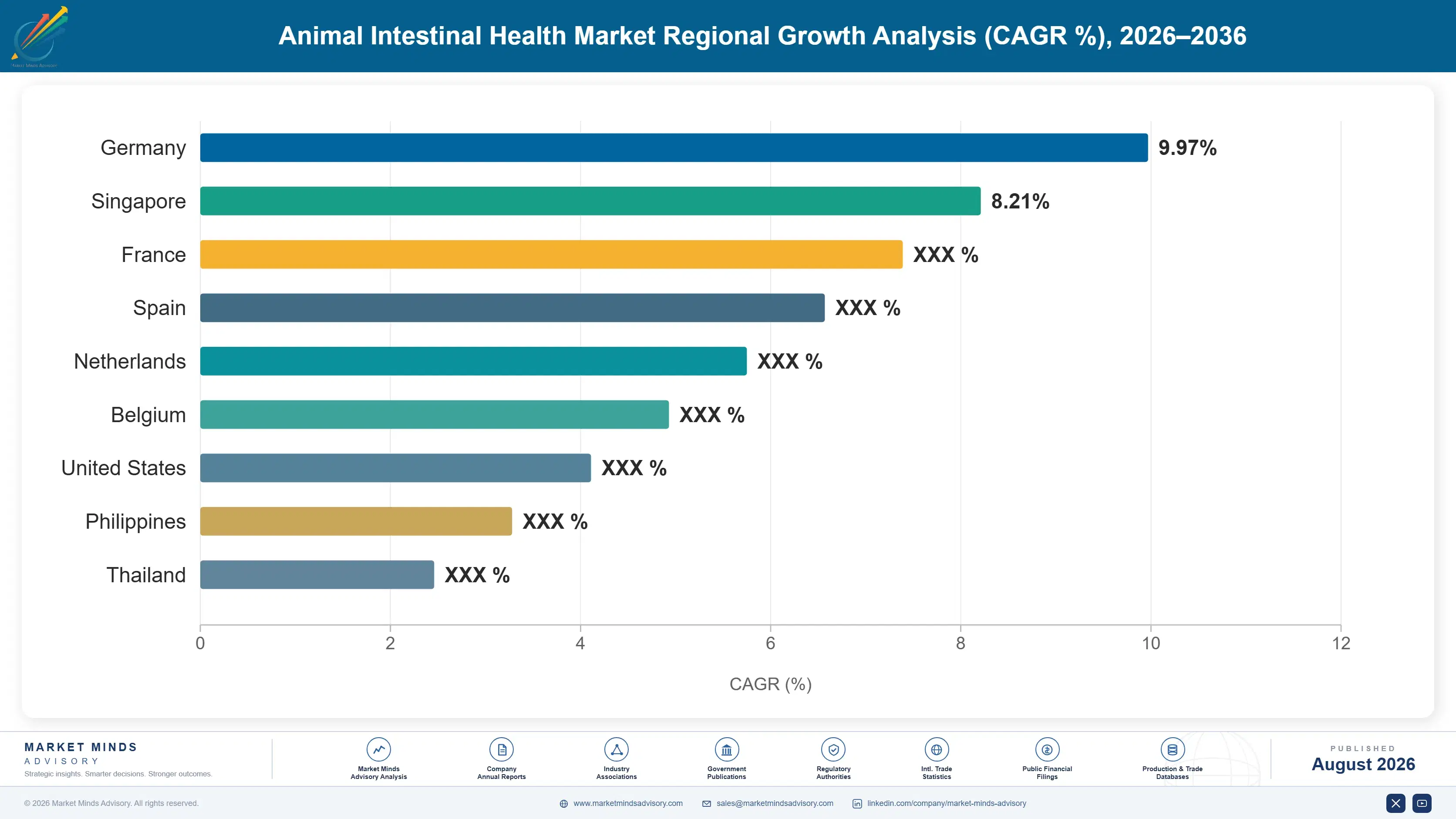
Brazil: 13.8% CAGR
Fastest Growth Region
South Asia and Pacific: 10.6% CAGR
Largest Region
East Asia: 32% of 2025 global value
Market Leaders
DSM-Firmenich, Cargill, Novonesis, Evonik, Alltech. Source: MMA Analysis based on company annual reports.
Primary Survey
n=3,800 procurement and R&D decision-makers, Q4 2025, six countries
Methodology
Demand-side build-up, cross-validated against public data, 47 expert interviews

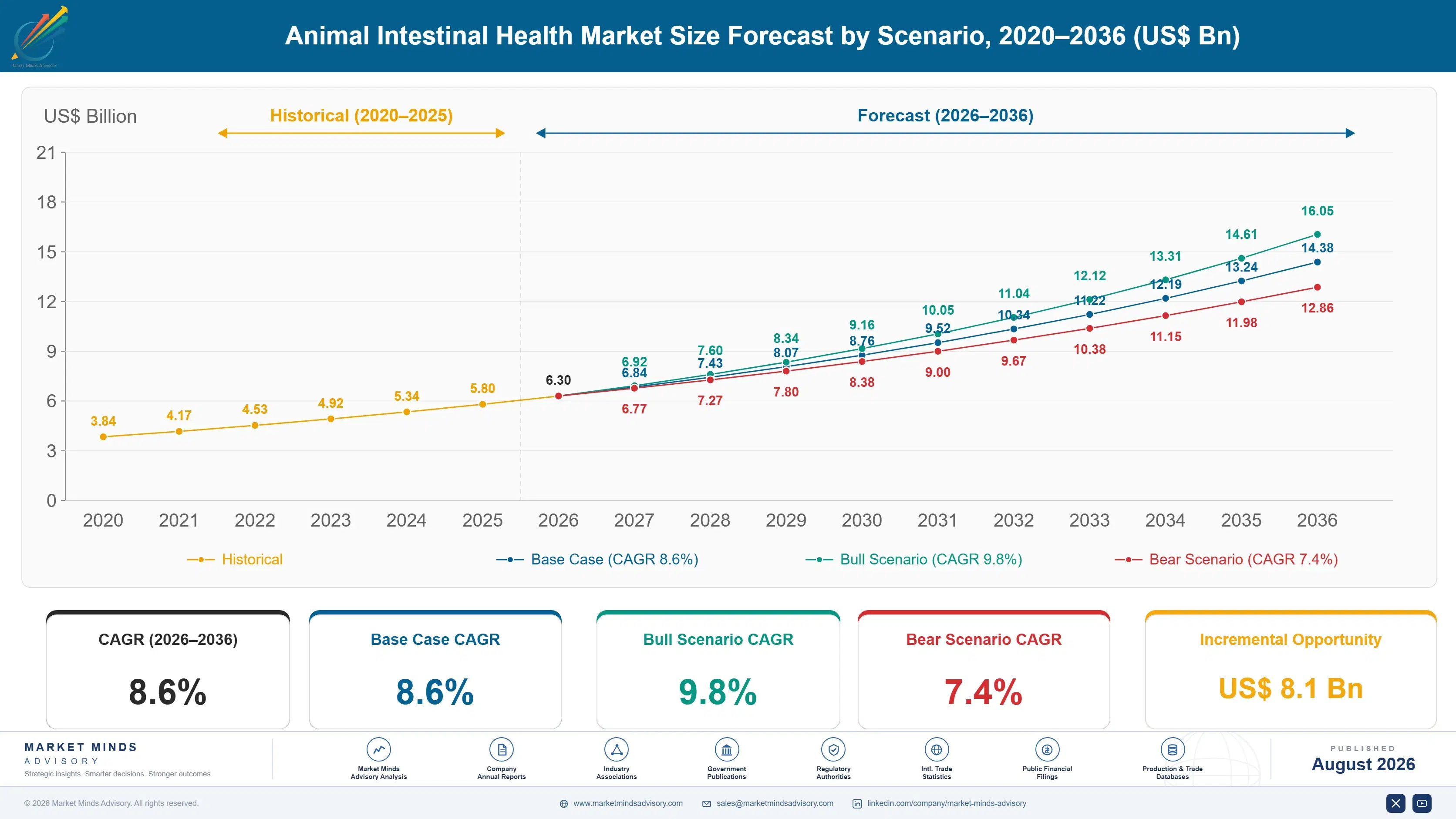
Animal Intestinal Health Market Forecast Scenarios

animal-intestinal-health-market-trends-size-forecast-scenario-1787463129601
Animal intestinal health additives compounded near 7.7% from 2020 to 2025, a period accelerated by China's 2020 in-feed antibiotic ban and the pig industry's gut-health-focused recovery from African Swine Fever. European Union AGP restrictions, in place since 2006, had already established the regulatory template other regions began following at an increasing pace through the period.
Three mechanisms carry the base case to 8.6%. First, livestock producers are substituting gut-health additives for in-feed antibiotics as additional countries adopt AGP restrictions, a swap increasingly mandated rather than optional. Second, postbiotic and phytogenic technologies are maturing commercially, delivering documented efficacy that broadens additive adoption beyond early-mover premium producers. Third, poultry and swine integrators facing export market compliance requirements are specifying gut-health additives to meet antibiotic-residue standards in destination markets, a driver requiring no new farm-level infrastructure.
The bull case at 9.8% assumes additional major livestock-producing countries adopt AGP restrictions faster than expected, accelerating additive substitution across previously unregulated markets and pulling investment forward. The bear case at 7.4% assumes regulatory adoption slows and cost-sensitive producers in price-competitive commodity markets delay additive adoption until compliance becomes mandatory rather than optional, holding back category-wide growth considerably.

Why Gut Health Became A Feed Formulation Discipline

Three forces converge on animal intestinal health today. Regulators want livestock production without routine antibiotic use, since resistance concerns have made the practice increasingly indefensible politically across nearly every jurisdiction. Producers want measurable performance, since a gut-health additive that does not support feed conversion or mortality reduction earns no repeat purchase. And export markets want documented antibiotic-residue compliance, which increasingly gates market access entirely regardless of domestic regulation.
MARKET CONCENTRATIONCR5: 34%Diversified nutrition majors compete directly with specialist houses
AVERAGE COST PER TONNEUSD 3 to 12 per tonneAdditive inclusion rate varies considerably by product category
TOP PRODUCING COUNTRY SHAREChina: ~26% of global consumptionMassive livestock population drives outsized additive demand volume
PRODUCTION CAPACITY UTILISATION70% to 82%Fermentation and extraction lines run near seasonal capacity
FEEDSTOCK SHARE OF COGS30% to 45%Fermentation substrate and botanical inputs dominate production cost
SPECIES ADOPTION GAPPoultry: 65%, Ruminant: 25%Monogastric species adopt gut health additives far faster
The commercial character splits by species and technology maturity. Poultry and swine, with shorter production cycles and tighter margin sensitivity, adopted gut-health additives earliest and now specify them with real formulation sophistication. Ruminant and aquaculture adoption lags considerably, constrained by different gut physiology and less mature efficacy data specific to those species. Probiotic and organic acid technologies are commercially mature; postbiotics remain earlier-stage but growing quickly across nearly every major market.
The next decade turns on whether postbiotic and phytogenic technologies achieve the efficacy documentation and cost parity that probiotics and organic acids already reached over many years. Regulatory adoption in the largest remaining unregulated livestock markets, particularly in parts of Latin America and South Asia, is the other major swing factor determining category growth.
"For years this category sold on a negative, what you're not using anymore. Now the good products sell on a positive, a documented feed conversion number, and that's a completely different sales conversation with completely different winners."
Director, Animal Nutrition and Feed Additives Practice · MMA Agriculture / Animal Nutrition and Gut Health Feed Additives Practice · August 2026

Market Trends

Postbiotic Technology Matures Into Commercial Gut Health Category

Postbiotics, fermentation-derived metabolites and inactivated microbial biomass that deliver gut-health benefits without requiring live-organism viability through feed processing and storage, have moved from research interest into genuine commercial adoption over the past several years. The technology solves a real practical problem probiotics never fully resolved: live microorganisms can lose viability during feed pelleting's heat exposure, while postbiotic metabolites survive processing intact. DSM-Firmenich and Novonesis have both expanded postbiotic product lines specifically targeting swine and poultry gut-health formulations, positioning the technology as a more processing-resilient alternative rather than a simple probiotic replacement in every application.
Market Impact: Adds compliance-driven demand across 60+ countries
China's 2020 Antibiotic Ban Reshapes Regional Additive Demand

China's Ministry of Agriculture banned in-feed antibiotic growth promoters starting January 2020, a policy shift affecting the world's largest livestock population and creating the single largest regional demand event in the category's history. The timing coincided with the pig industry's recovery from African Swine Fever, compounding gut-health additive demand as producers rebuilt herds under simultaneously tighter regulation. Chinese integrators adopted organic acids and probiotics fastest, given their established efficacy record and lower cost relative to newer postbiotic and phytogenic technologies still building local commercial track records. Domestic Chinese additive manufacturing capacity expanded considerably to meet this demand.
Market Impact: Affects 40% of poultry export trade

Market Opportunities and Growth Drivers

AGP Restrictions Expand Into Additional Major Livestock Markets

The European Union's 2006 antibiotic growth promoter ban established the regulatory template, but China's 2020 restriction and gradually tightening United States veterinary feed directive rules have extended similar pressure to a majority of global livestock production over the past two decades. Each new jurisdiction adopting restrictions converts additive use from a voluntary premium positioning choice into a compliance requirement, a shift that reliably accelerates adoption curves regardless of prior producer skepticism. Cargill and Alltech have both expanded regional sales and technical support teams specifically to serve producers navigating new compliance requirements for the first time in newly regulated markets.
Market Impact: Cuts adoption speed 20% to 30%

Export Market Compliance Drives Additive Adoption Regardless Of Domestic Rules

Poultry and pork integrators selling into the European Union, United States, or other markets with antibiotic-residue import standards must comply with destination-market rules regardless of what domestic regulation in their home country actually requires. Brazilian and Thai poultry exporters, among the world's largest, adopted gut-health additive programmes specifically to maintain access to premium export markets that would otherwise reject shipments on residue testing grounds. This export-compliance driver operates independently of domestic AGP policy, meaning it can push adoption in countries whose own regulators have not yet restricted antibiotic use at all domestically.
Market Impact: Adoption lags 3 to 5 years

Market Restraints and Challenges

Efficacy Documentation Still Varies Considerably By Technology

Probiotic and organic acid efficacy is well documented across decades of independent trial data, but postbiotic and some phytogenic products still carry thinner, often supplier-generated efficacy evidence that skeptical producers and nutritionists reasonably discount. The root cause is that these newer technologies simply have not accumulated the trial volume older categories built up over decades of commercial use. The impact falls hardest on smaller specialist suppliers without the resources to fund the independent, peer-reviewed trials that build genuine nutritionist trust. Some suppliers are responding by funding independent university trials and publishing results regardless of outcome, rather than only favorable studies.
Market Impact: Postbiotic demand grows 13.5% annually

Commodity Producers Delay Adoption Until Compliance Is Mandatory

Cost-sensitive commodity livestock producers in price-competitive markets often delay gut-health additive adoption until regulation makes in-feed antibiotics unavailable rather than adopting proactively for performance benefits alone. The root cause is straightforward margin economics: additive cost adds directly to feed cost in a market where producers compete almost entirely on price, leaving little room for a voluntary premium investment without regulatory compulsion. The impact is that adoption in unregulated markets lags considerably behind what documented performance benefits alone would predict. Suppliers are responding by developing lower-cost formulations specifically targeted at price-sensitive commodity segments rather than premium positioning alone.
Market Impact: China represents 26% of global demand
3 additional market trends, 4 additional growth drivers, and 2 additional restraints and challenges are covered in the full report. Contact sales@marketmindsadvisory.com to access the complete intelligence.

Segment CAGR and Growth Architecture

Segmentation follows additive technology, the single classification logic separating how each product modulates gut function and how it is manufactured. Probiotics, prebiotics, postbiotics, organic acids, phytogenics, and enzymes each carry distinct manufacturing processes, modes of action, and regulatory pathways. Species and distribution channel sit separately within the framework rather than folded into this hierarchy.
animal-intestinal-health-market-trends-market-share-analysis-1787463130150

Postbiotics

Postbiotics grow fastest at 13.5%, about 1.57 times the overall 8.6% rate, as fermentation-derived metabolites and inactivated microbial biomass deliver documented gut-health benefits without the live-organism viability constraints that limit probiotics through feed pelleting and storage. The technology solves a genuine practical problem: probiotic viability can degrade considerably during high-heat feed processing, while postbiotic metabolites survive intact. DSM-Firmenich and Novonesis both lead commercial postbiotic development, targeting swine and poultry formulations where processing robustness matters most. The segment remains smaller in absolute volume than established probiotic and organic acid categories, but growth reflects genuine technology maturation rather than a temporary demand spike, as efficacy documentation accumulates and nutritionist confidence builds steadily across major markets.
CAGR 13.5%

Essential Oils and Phytogenics

Essential oils and phytogenic feed additives grow second-fastest at 11.2%, roughly 1.30 times the overall rate, as producers seek natural, clean-label alternatives that align with consumer demand for reduced synthetic input use across the livestock supply chain. Kemin Industries and other phytogenic specialists have expanded botanical extraction and standardization capacity to meet this demand, addressing the historical inconsistency problem that limited phytogenic adoption previously, since botanical potency varies considerably by growing season and source. The category benefits from consumer-facing marketing value beyond pure gut-health function, since natural-origin claims resonate with retail buyers further down the supply chain. Standardization and quality consistency remain the primary technical constraints limiting faster adoption across price-sensitive commodity production segments.
CAGR 11.2%
Full segment breakdown across 6 segments available in the complete report.

Regional Architecture and Country Demand Map

East Asia leads on China's massive livestock population and post-African-Swine-Fever gut-health additive adoption, while Western Europe holds the longest regulatory track record of any region worldwide. North America follows a gradual regulatory tightening path distinct from China's abrupt 2020 restriction, and export-driven Latin America grows steadily behind it.

North America

United States veterinary feed directive rules, tightening gradually rather than through a single sweeping ban, give North America 24% of value, within the 22 to 32% band, reflecting a market transitioning steadily rather than through the abrupt regulatory shift China experienced in 2020. Cargill and Alltech both operate substantial domestic manufacturing and technical support infrastructure serving poultry and swine integrators directly across the country, including major processing hubs. Canadian producers follow a broadly similar regulatory trajectory, generally lagging United States adoption timelines modestly but consistently over time. Growth of 9.1% reflects continued gradual regulatory tightening alongside genuine producer-driven adoption for documented performance benefits independent of any compliance requirement whatsoever, regulatory or otherwise.
Share: 24% | CAGR: 9.1% (2026 to 2036)

Western Europe

The European Union's 2006 antibiotic growth promoter ban, the earliest and longest-running major restriction anywhere, gives Western Europe 20% of value, within the 18 to 26% band, reflecting a market that reached additive adoption maturity years before most other regions began the transition at all. DSM-Firmenich and Evonik both operate substantial European research and manufacturing infrastructure built around this early regulatory head start. German and French producers favor well-established probiotic and organic acid technologies with the deepest available efficacy documentation. Growth of 7.3%, the slowest of the seven regions, reflects a market where the initial regulatory-driven adoption wave completed long ago, leaving only incremental technology upgrade cycles to drive further growth.
Share: 20% | CAGR: 7.3% (2026 to 2036)
Regional intelligence for 5 additional markets available in the complete report: East Asia, South Asia and Pacific, Latin America, Middle East and Africa, Eastern Europe. Contact sales@marketmindsadvisory.com.
animal-intestinal-health-market-trends-country-cagr-analysis-1787463130697

Where Gut Health Suppliers Actually Capture Value

Selling gut-health additives as an undifferentiated antibiotic replacement leaves considerable value on the table, since documented performance data, export-compliance positioning, and multi-technology formulation all command real pricing power beyond commodity additive economics entirely and consistently. The four moves below focus on efficacy documentation, export-compliance positioning, postbiotic technology investment, and blended-formulation development for busy formulators.

Fund Independent Efficacy Trials Rather Than Supplier-Only Data

Nutritionists and producers increasingly discount supplier-generated efficacy claims in favor of independent, peer-reviewed trial data, particularly for newer postbiotic and phytogenic technologies still building commercial trust. Suppliers funding independent university trials, and publishing results regardless of outcome, build the credibility that converts skeptical nutritionists into repeat customers, often commanding 15% to 25% pricing premiums over suppliers relying solely on internal data. DSM-Firmenich and Evonik both maintain substantial independent trial funding programmes specifically for this purpose. The investment takes years to pay off but builds a durable trust advantage competitors cannot quickly replicate.
Market Impact: Commands a genuine 15% to 25% documented-efficacy premium

Position Products For Export-Market Compliance Specifically

Poultry and pork integrators selling into export markets with antibiotic-residue standards need documented compliance support beyond a generic gut-health product, including testing protocols and residue-monitoring guidance suppliers with export-market experience can provide directly. Cargill and Novus International both built dedicated export-compliance technical support teams serving Brazilian and Southeast Asian integrators specifically, covering roughly 40% of relevant export volume. This positioning captures demand independent of domestic regulation, since export-compliance adoption happens even in countries whose own regulators have not restricted antibiotic use domestically at all. Suppliers without this capability compete purely on commodity additive pricing regardless of genuine underlying product quality.
Market Impact: Captures demand across roughly 40% of export volume

Invest In Postbiotic Manufacturing Capacity Ahead Of Demand

Postbiotic demand is growing at 13.5% annually, nearly twice the overall category rate, and suppliers with fermentation capacity already built capture this demand surge while competitors scramble to expand capacity behind rising orders. DSM-Firmenich and Novonesis both expanded postbiotic manufacturing capacity ahead of broad commercial demand materializing, positioning themselves to serve early-adopter integrators immediately rather than after a capacity buildout delay measured in years. The capital investment carries genuine risk if postbiotic adoption slows, but suppliers who timed capacity correctly are capturing meaningfully outsized share of this fast-growing segment specifically and durably.
Market Impact: Captures an outsized share of 13.5% segment growth

Develop Blended Multi-Technology Formulations For Formulators

No single additive technology addresses every gut-health mechanism simultaneously, which creates a genuine opening for suppliers who formulate blended products combining probiotics, organic acids, and phytogenics to address multiple modes of action in one product. These blends command a meaningful premium over single-technology additives, since they save the nutritionist from combining several separate products manually, often adding 20% to 30% to formulation value. Alltech and Kemin Industries both offer extensively developed blended product lines targeting this formulation-simplification demand directly. Suppliers with cross-technology manufacturing capability, rather than single-category specialists, are best positioned to develop and sell these blends.
Market Impact: Adds a genuine 20% to 30% blended-formulation premium

Who Controls the Margin Pool

Concentration sits at a moderate 34%, split among diversified animal nutrition majors offering full-line gut-health portfolios and specialist probiotic, postbiotic, or phytogenic houses competing on deep technology focus rather than breadth alone. All participants are assessed on one basis: attributable gut-health additive revenue across probiotics, prebiotics, postbiotics, organic acids, phytogenics, and enzymes.
Competition runs along three lines. First, efficacy documentation depth, since independent trial data increasingly separates trusted suppliers from those relying on internal claims alone entirely. Second, export-compliance technical support, where suppliers serving integrators selling into regulated export markets capture demand independent of domestic policy. Third, formulation breadth, as blended multi-technology products increasingly compete against single-category additives sold separately by smaller rivals.

Pressure is building from two directions. Specialist postbiotic and phytogenic houses are moving upmarket with genuinely novel technology that diversified majors have been slower to commercialize at comparable depth. Meanwhile diversified nutrition majors are acquiring or partnering with specialist technology houses to fill portfolio gaps rather than building novel capability internally from scratch. Rankings should favor participants holding both efficacy documentation depth and export-compliance positioning over those competing purely on commodity additive pricing alone.
animal-intestinal-health-market-trends-company-positioning-matrix-1787463131240

Competitive Moat and Risk Dimensions

DSM-FIRMENICH

Moat: Broadest independent trial documentation

DSM-Firmenich maintains one of the most extensive independent efficacy trial programmes in animal nutrition, spanning probiotic, postbiotic, and enzyme technologies across multiple species. That documentation depth gives it a credibility advantage with skeptical nutritionists that smaller specialist suppliers relying on internal data alone cannot easily replicate.
DSM-FIRMENICH

Risk: Complex post-merger portfolio integration

The 2023 merger integrating DSM and Firmenich created a sprawling combined portfolio spanning nutrition, fragrance, and animal health, and gut-health-specific investment must compete internally against many other business lines for capital and management attention across the combined group's much wider strategic priorities and competing capital demands.
NOVONESIS

Moat: Fermentation and enzyme manufacturing scale

Novonesis, formed from the Novozymes and Chr. Hansen merger, combines deep enzyme manufacturing scale with probiotic and postbiotic fermentation expertise, giving it cross-technology capability few pure-play competitors can match at comparable production volume, comparable global reach, or comparable technical and regulatory depth across formulation categories.
NOVONESIS

Risk: Recent merger integration still underway

Novonesis completed its formative merger in January 2024, and integrating two previously independent commercial and technical organizations takes considerable time, potentially slowing decision-making and go-to-market execution relative to more established single-entity competitors during this ongoing transition period specifically, across several key business functions and regional teams.

Players Tracked

Prominent Players

DSM-Firmenich
Cargill
Novonesis
Evonik
Alltech

Other Key Players

ADM
Kemin Industries
Lallemand Animal Nutrition
BASF
IFF
Novus International
Balchem
Nutreco
Adisseo
Phibro Animal Health
Zinpro
Kerry Group
Elanco Animal Health
Huvepharma
AB Vista

Recent Developments

MARCH 2024

Novonesis expands direct-fed microbial production capacity

Novonesis announced an organic expansion of its direct-fed microbial fermentation capacity, adding output to serve growing swine and poultry gut-health additive demand across Asian and North American markets simultaneously. This was an organic capacity expansion funded from existing operations, not an acquisition or joint venture.
Signal: Capacity investment shortly after the formative merger signals the combined company prioritizing gut-health additive growth specifically.
SEPTEMBER 2023

Kemin Industries expands phytogenic feed additive capacity in Asia

Kemin Industries announced expanded botanical extraction and standardization capacity at its Asian manufacturing facilities, adding output to serve growing regional demand for natural, clean-label gut-health additives across multiple species. This was an organic capacity expansion funded from existing operations, not an acquisition or joint venture.
Signal: Regional capacity investment confirms phytogenic demand growth is concentrated significantly in Asian livestock markets right now.
JANUARY 2024

DSM-Firmenich expands postbiotic gut health product line

DSM-Firmenich announced an expanded postbiotic product line targeting swine and poultry gut-health formulations, building on existing fermentation and probiotic manufacturing infrastructure already in place across several major facilities globally. This was an organic product line expansion within existing operations, not an acquisition or joint venture.
Signal: A diversified nutrition major expanding postbiotic offerings confirms the technology has moved past early-stage commercial validation.

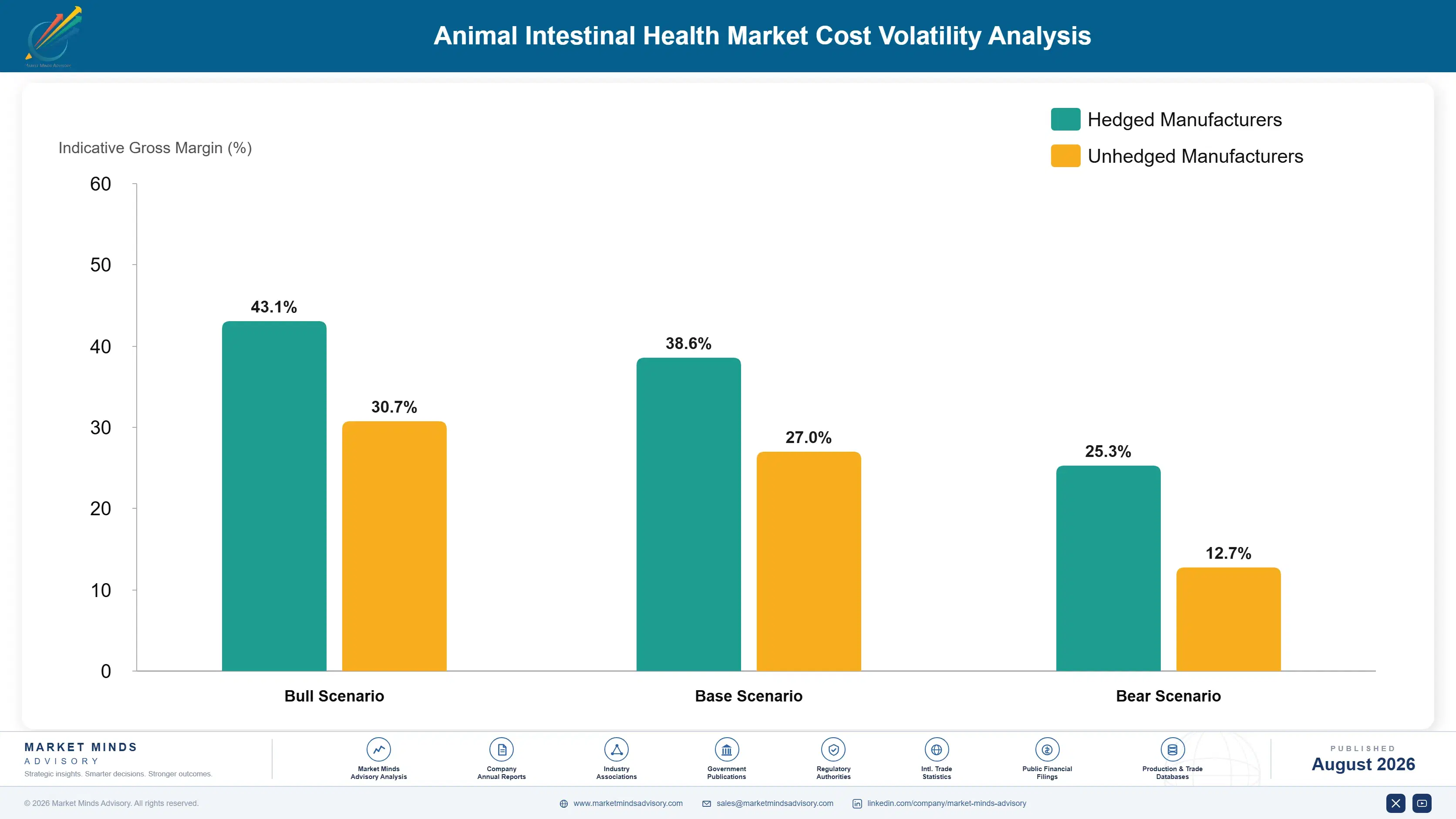
Fermentation Substrate And Botanical Input Exposure

Fermentation substrate for probiotic and postbiotic production, and botanical raw material for phytogenic extraction, together run 30% to 45% of cost of goods sold, sourced from agricultural commodity markets and specialized botanical growing regions respectively. Processing and quality-control cost adds a further 15% to 25%, reflecting the analytical testing intensity gut-health additives require relative to bulk agricultural commodities generally.
Global grain and agricultural commodity prices spiked sharply through 2022 following the disruption of Ukrainian and Russian export volume, raising fermentation substrate cost for probiotic and postbiotic manufacturers considerably during the period. Novonesis's 2022 Annual Report documented meaningfully higher raw material cost passing through to fermentation-based product lines, compressing margins for producers unable to reprice supply contracts quickly enough. Botanical extraction costs for phytogenic additives proved comparatively more stable, since growing regions were more geographically diversified than grain-dependent fermentation substrate.

Exposure separates producers by substrate diversification and contract structure rather than by scale alone. Producers with fermentation substrate flexibility, able to shift between grain sources, absorbed the 2022 spike better than those locked into single-grain processes. Phytogenic producers sourcing botanicals across geographically diversified growing regions held a meaningful cost advantage over those dependent on any single concentrated source region.
animal-intestinal-health-market-trends-cost-volatility-analysis-1787463131447

Diversify fermentation substrate across multiple grain sources

Producers locked into single-grain fermentation processes carried the full weight of the 2022 grain price spike, while competitors with substrate flexibility absorbed the shock considerably better across their production lines. Building fermentation processes able to shift between multiple grain sources protects margin against any single commodity market disruption, though it requires genuine process engineering investment upfront and ongoing.

Contract botanical raw material across diversified growing regions

Phytogenic producers dependent on a single concentrated botanical growing region carry meaningful supply and price risk if that region faces a poor harvest or trade disruption of any kind. Sourcing key botanicals across multiple geographically diversified growing regions simultaneously spreads this risk considerably, converting a concentrated exposure into a more manageable, diversified one over time.

Lock fermentation substrate on multi-year supply agreements

Spot-market grain purchasing exposed several fermentation-based producers to the sharpest of the 2022 price spike, while competitors holding multi-year supply agreements absorbed the shock more gradually across their entire contract term and budget cycle. Locking substrate pricing ahead of need converts an unpredictable cost line into a plannable one across production budget cycles and longer-term planning horizons.

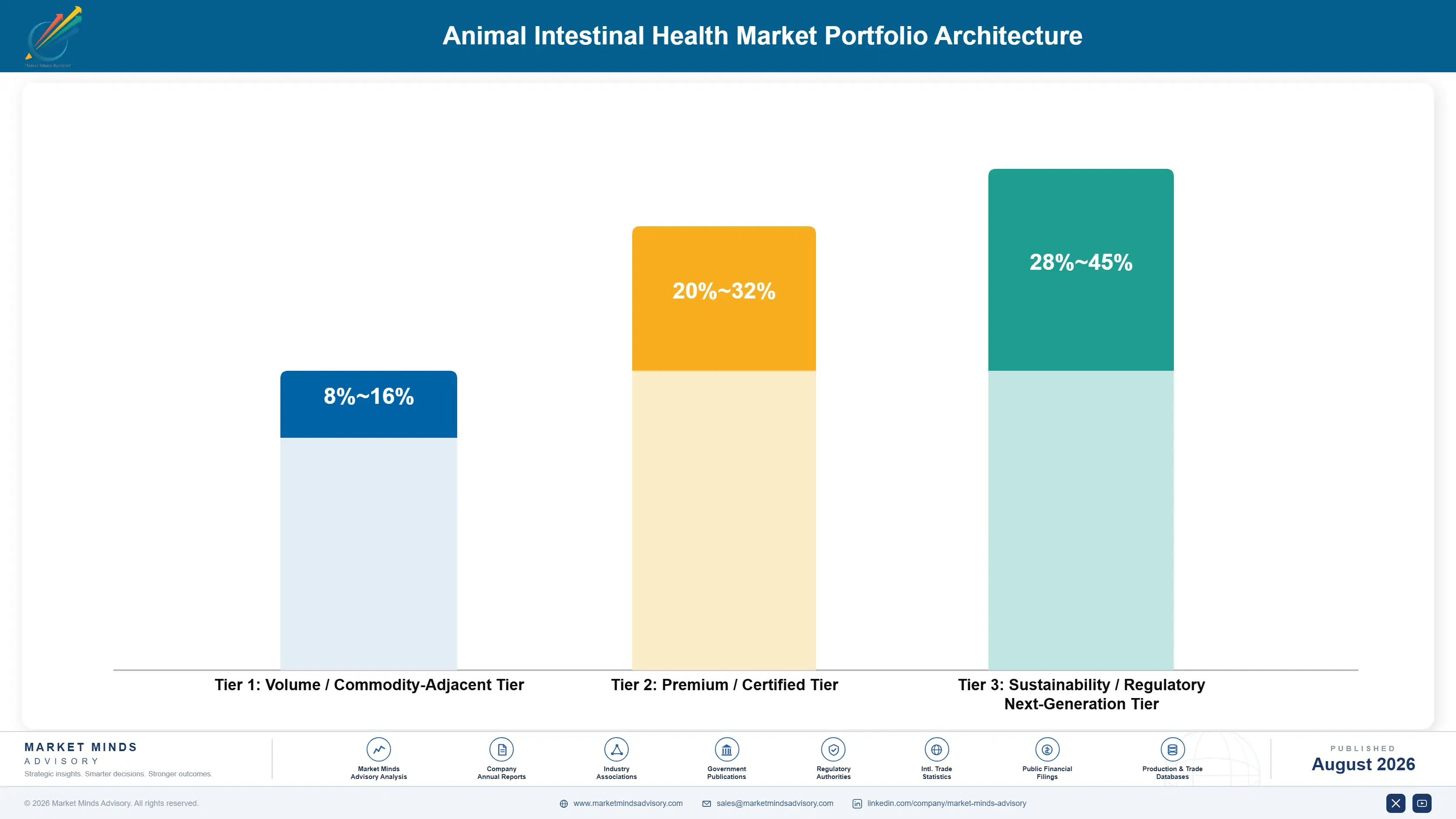
Portfolio Architecture for Margin Defence

The portfolio splits into three tiers by technology maturity and documentation depth. Commodity organic acids and basic probiotics sold into price-competitive channels compete largely on cost per tonne of feed. Documented, trial-backed probiotic and phytogenic products sold to sophisticated integrators earn considerably more, since efficacy data carries real value. Postbiotic and blended multi-technology formulations sit at the top, priced against innovation and formulation-simplification value rather than commodity additive benchmarks.
The tension runs between volume that keeps fermentation and extraction lines running and margin that rewards documentation and technology investment. Commodity additive sales fund plant utilization but earn thin margins under intense price competition from regional generic suppliers. Documented and postbiotic volume carries the returns but depends on trial infrastructure and technical support relationships smaller suppliers often lack. Producers weighting entirely toward commodity channels carry real exposure to price competition with little differentiation to defend against it.

High-value pools concentrate wherever a buyer needs a documented attribute: independent efficacy data for sophisticated integrators, export-compliance support for international sellers, or blended-formulation simplicity for time-constrained nutritionists. Commodity additives sold into undifferentiated price-competitive channels generally earn the thinnest margin across the category.

Volume / Commodity-Adjacent Tier

Commodity organic acids and basic probiotics sold into price-competitive feed channels, priced against cost per tonne of finished feed. Margins stay thin because buyers treat these largely as interchangeable commodity inputs.
Gross Margin: 8-16%

Premium / Certified Tier

Documented, trial-backed probiotic and phytogenic products sold to sophisticated integrators, commanding a real premium because buyers pay for independent efficacy data rather than generic claims alone, at meaningful volume across major markets.
Gross Margin: 20-32%

Sustainability / Regulatory / Next-Generation Tier

Postbiotic and blended multi-technology formulations sold to premium integrators, priced against innovation and formulation-simplification value given the R&D investment required to develop and commercially validate this premium grade at scale.
Gross Margin: 28-45%
animal-intestinal-health-market-trends-portfolio-architecture-1787463131991

High-value Sub-segments and Strategic Watch-out

Postbiotics

High value and the fastest growth at 13.5%, converting fermentation technology into a processing-resilient gut-health category serving multiple species across major markets worldwide today. DSM-Firmenich and Novonesis both lead commercial development, targeting swine and poultry formulations where processing resilience matters most today and going forward.
Gross Margin: 28-45%

Essential Oils and Phytogenics

High value with strong growth at 11.2%, serving producers seeking natural, clean-label alternatives amid rising consumer scrutiny of synthetic feed inputs across major retail markets worldwide today. Kemin Industries leads dedicated botanical extraction capacity addressing historical standardization inconsistency directly, consistently, and at meaningful commercial scale.
Gross Margin: 22-36%

Organic Acids and Acidifiers

The volume core at 6.4% growth, the slowest of the six segments, built on decades of established, well-documented efficacy and low relative cost per tonne of feed across every species and region worldwide. Growth now tracks broader livestock production expansion rather than outpacing it meaningfully.
Gross Margin: 8-16%

Enzymes

The strategic watch-out at 7.2% growth, constrained by increasing commoditization as manufacturing capacity has scaled considerably faster than differentiated demand, compressing margins even as underlying volume continues to expand steadily across major markets, species categories, distribution channels, and geographies worldwide today and well into the future.
Gross Margin: 10-20%

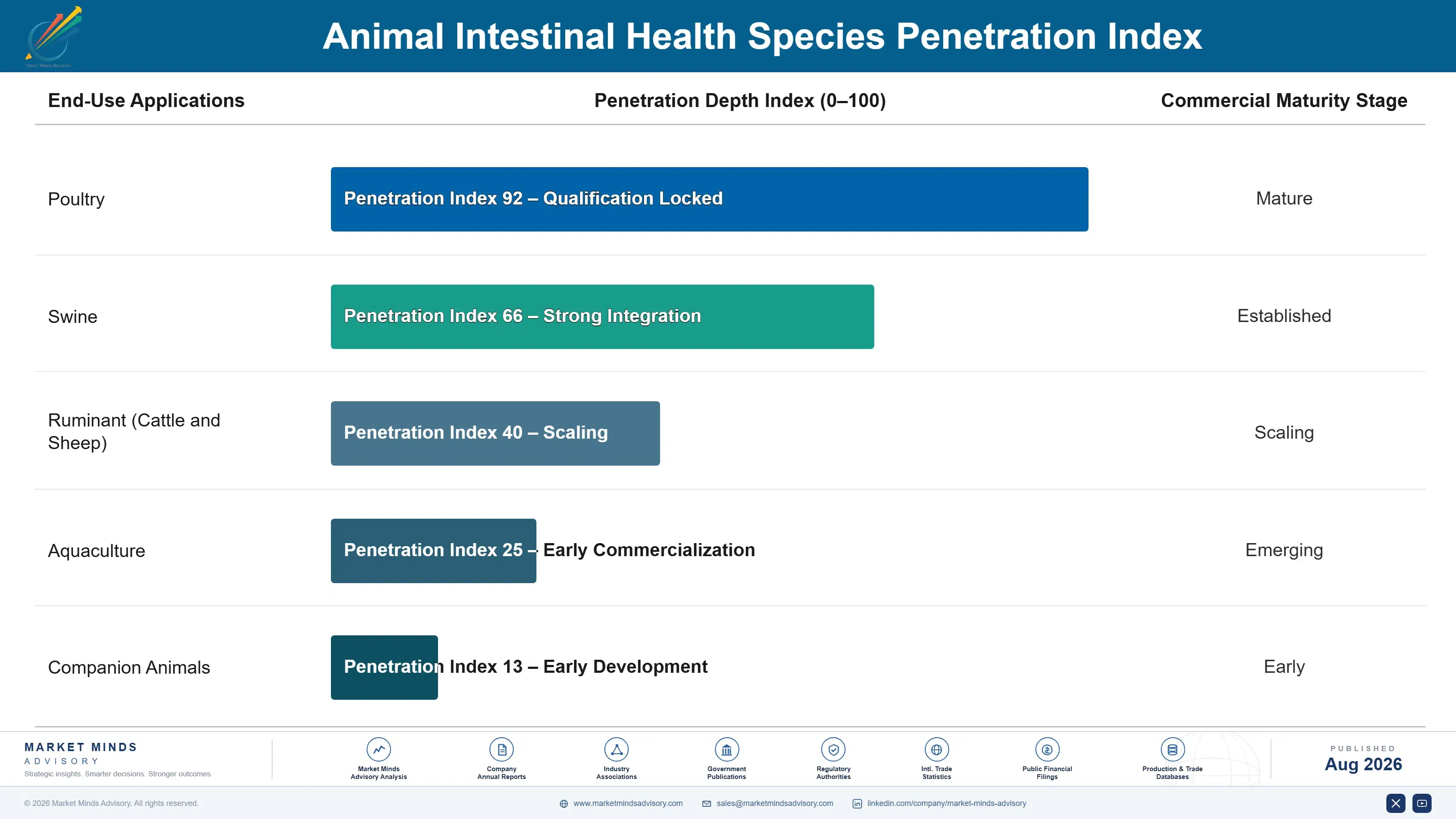
Why Gut Health Programmes Stay Sticky

An integrator that validates a gut-health additive programme around documented feed conversion and mortality reduction data rarely reverts to a plain antibiotic-free baseline afterward, since doing so means giving up a measured performance benefit with real economic value already captured. That switching cost behaves like an annuity for incumbent suppliers, converting a single successful trial validation into years of recurring additive revenue rather than a one-time transaction competitors can easily contest.
Adoption depth varies considerably by species. Poultry and swine adopted deepest and earliest, given shorter production cycles that let integrators measure additive impact quickly and iterate formulations accordingly. Ruminant adoption follows a slower, more conservative pattern tied to different gut physiology and less mature species-specific efficacy data. Aquaculture remains earliest-stage, with documented efficacy still accumulating across the sector's diverse species and production systems worldwide.

Buyer profiles have shifted from veterinarians managing antibiotic prescriptions toward feed formulators and procurement specialists who specify gut-health additives as a standard formulation input rather than an occasional intervention. Younger nutritionists increasingly expect independent trial documentation as a baseline requirement, raising the evidentiary bar suppliers must clear before earning genuine formulation consideration at all.
animal-intestinal-health-market-trends-end-use-penetration-index-1787463132521

Our Call On Animal Intestinal Health

These are among the four positions where our research anticipates prominent divergence between winners and laggards over the coming forecast period. Each is grounded in the demand model, the regulatory perimeter, and the announced capacity pipeline.
01 / REGULATION SETS THE BASELINE

AGP restrictions convert additive use from choice to requirement

Each new jurisdiction adopting antibiotic growth promoter restrictions converts gut-health additive use from a voluntary premium positioning choice into a compliance requirement, a shift that reliably accelerates adoption regardless of prior producer skepticism about cost or efficacy. China's 2020 restriction created the single largest regional demand event in the category's history, and additional major markets will likely follow a similar regulatory trajectory over time. Suppliers should track regulatory timelines across remaining unregulated major livestock markets as the primary leading indicator for future demand.
02 / POSTBIOTICS SOLVE REAL PROBLEM

Processing robustness, not marketing, explains postbiotic growth

Postbiotic metabolites survive high-heat feed pelleting intact, solving a genuine practical problem that live probiotic organisms never fully resolved across decades of commercial use in heavily processed feed formats worldwide. DSM-Firmenich and Novonesis both lead commercial postbiotic development, positioning the technology as processing-resilient rather than merely a probiotic replacement in every application across every species. Suppliers without postbiotic capability should evaluate this technology now, before competitors capture the early-adopter integrator relationships likely to prove durable and difficult to dislodge later on.
03 / EXPORT COMPLIANCE DRIVES ADOPTION

Destination-market rules matter more than domestic regulation alone

Poultry and pork integrators selling into regulated export markets must comply with destination antibiotic-residue standards regardless of what their home country's own regulators actually require domestically at any given time or season. Brazilian and Thai exporters adopted gut-health programmes specifically to maintain market access, demonstrating that export-compliance adoption operates independently of domestic policy timelines entirely and reliably. Suppliers should build export-compliance technical support capability now, since this driver will keep expanding as global protein trade continues growing steadily across every major destination market and region.
04 / DOCUMENTATION DEPTH WINS TRUST

Independent trial data, not internal claims, builds lasting credibility

Nutritionists and producers increasingly discount supplier-generated efficacy claims in favor of independent, peer-reviewed trial data, particularly for newer postbiotic and phytogenic technologies still establishing commercial credibility across major markets today and going forward. Suppliers funding independent university trials and publishing results regardless of outcome build the trust that converts skeptical nutritionists into durable, repeat customers over many years of engagement. Suppliers relying solely on internal efficacy data should treat independent trial investment as an urgent near-term priority, not an eventual nice-to-have.

Engagement Snapshot From the Field

A live engagement with an industry participant carrying material or product regulatory and market exposure ahead of a defining policy shift, showing how our research translates into a defensible multi-year portfolio strategy.
MARKET MINDS ADVISORY · CLIENT ENGAGEMENT SUMMARY
Animal Intestinal Health Producer Strategic Portfolio Review and Transition Roadmap 2026·Investment Scenario on Animal Intestinal Health Exposure Evaluation 2025-26
CLIENT PROFILE
A Brazilian poultry integrator exporting to European Union and Middle Eastern markets engaged MMA while facing tightening destination-market antibiotic-residue testing requirements. The client reported annual revenue near USD 620 million and had relied primarily on organic acids for gut health, with leadership uncertain whether current additive programmes would satisfy upcoming stricter European Union residue standards (client-reported, unverified by MMA).
STRATEGIC CHALLENGE
Management could not determine whether existing organic acid and basic probiotic programmes provided sufficient documented protection against residue testing failure, or whether the company needed to invest in a more comprehensive, independently validated gut-health programme before the new European Union standards took effect the following year across all export lines.
MMA APPROACH
MMA benchmarked the client's existing additive programme against European Union residue testing requirements and against gut-health programmes used by three peer exporters already meeting the tightened standards successfully at scale. We assessed which additional technologies, postbiotics, phytogenics, or enhanced probiotic strains, would most cost-effectively close any documented performance gap identified during the review.
KEY FINDINGS
  1. The existing organic acid programme alone carried meaningful residue testing failure risk under the new standards, based on peer exporter benchmark data (client-reported, unverified by MMA).
  2. Adding a documented postbiotic component to the existing programme closed the identified gap at a cost increase of roughly 12% per tonne of feed.
  3. Two of three peer exporters benchmarked had already adopted comparable blended programmes successfully, validating the recommended approach directly (client-reported, unverified by MMA).
  4. Independent trial documentation, not the additive technology itself, was what ultimately satisfied European Union auditor requirements during the compliance review process specifically.
CLIENT PROFILE
A Brazilian poultry integrator exporting to European Union and Middle Eastern markets engaged MMA while facing tightening destination-market antibiotic-residue testing requirements. The client reported annual revenue near USD 620 million and had relied primarily on organic acids for gut health, with leadership uncertain whether current additive programmes would satisfy upcoming stricter European Union residue standards (client-reported, unverified by MMA).
STRATEGIC CHALLENGE
Management could not determine whether existing organic acid and basic probiotic programmes provided sufficient documented protection against residue testing failure, or whether the company needed to invest in a more comprehensive, independently validated gut-health programme before the new European Union standards took effect the following year across all export lines.
MMA APPROACH
MMA benchmarked the client's existing additive programme against European Union residue testing requirements and against gut-health programmes used by three peer exporters already meeting the tightened standards successfully at scale. We assessed which additional technologies, postbiotics, phytogenics, or enhanced probiotic strains, would most cost-effectively close any documented performance gap identified during the review.
KEY FINDINGS
  1. The existing organic acid programme alone carried meaningful residue testing failure risk under the new standards, based on peer exporter benchmark data (client-reported, unverified by MMA).
  2. Adding a documented postbiotic component to the existing programme closed the identified gap at a cost increase of roughly 12% per tonne of feed.
  3. Two of three peer exporters benchmarked had already adopted comparable blended programmes successfully, validating the recommended approach directly (client-reported, unverified by MMA).
  4. Independent trial documentation, not the additive technology itself, was what ultimately satisfied European Union auditor requirements during the compliance review process specifically.
RECOMMENDED STRATEGY
Phase 1: Phase 1 (0 to 4 months): Add a documented postbiotic component to the existing organic acid and probiotic programme across all export-destined production. Phase 2: Phase 2 (4 to 10 months): Compile independent trial documentation supporting the enhanced programme ahead of the new European Union standard taking effect. Phase 3: Phase 3 (10 to 18 months): Extend the enhanced programme across domestic-market production once export-compliance validation completes successfully across all lines.
OUTCOME
The enhanced programme passed European Union residue testing under the new standards without incident following implementation. Feed cost rose by the modeled 12% per tonne, and the client reported maintaining full European Union export access worth an estimated USD 180 million annually that stricter enforcement had put at genuine risk (client-reported, unverified by MMA).

Frequently Asked Questions

Foundational context covering the market sizes, CAGR, scope, country, region and competition that inform every finding below. This section is provided to cover basics and most often pre-purchase conversations, answered from the MMA Primary Research Dataset.

What is the current size of the Animal Intestinal Health Market?

The animal intestinal health market reached USD 5.8 billion in 2025. Growth is driven by antibiotic growth promoter restrictions, postbiotic technology maturation, and export-market antibiotic-residue compliance requirements.

How large will the Animal Intestinal Health Market be by 2036?

The market is projected to reach USD 14.38 billion by 2036, an increase of USD 8.08 billion over the 2026 base as regulatory adoption and technology maturation both continue expanding.

What is the CAGR for the Animal Intestinal Health Market 2026 to 2036?

The market is projected to grow at an 8.6% CAGR between 2026 and 2036, with a bull case of 9.8% and a bear case of 7.4% depending on regulatory adoption pace.

Which segment is growing fastest?

Postbiotics grow fastest at a 13.5% CAGR, about 1.57 times the overall market rate, as fermentation-derived metabolites deliver gut-health benefits without the processing-viability constraints that limit live probiotics.

Who are the major companies in the Animal Intestinal Health Market?

Leading suppliers include DSM-Firmenich, Cargill, Novonesis, Evonik, and Alltech, assessed on attributable gut-health additive revenue across probiotics, postbiotics, organic acids, and phytogenics sold across every region.

Which country is growing fastest?

Brazil grows fastest among tracked countries as poultry and pork exporters adopt gut-health additive programmes specifically to maintain compliance with tightening European Union and Middle Eastern export market standards over time.

Report Segmentation Architecture

The full report scope spans multiple orthogonal segmentation dimensions, with cross-tabulated demand data provided for each dimension pair. Coverage extends further to regional breakdowns, trend trajectories, and the competitive detail needed to support segment-level decision-making.

By Additive Technology

  • Probiotics (Direct-Fed Microbials)
  • Prebiotics
  • Postbiotics
  • Organic Acids and Acidifiers
  • Essential Oils and Phytogenics
  • Enzymes

By Species

  • Poultry
  • Swine
  • Ruminant (Cattle and Sheep)
  • Aquaculture
  • Companion Animals

By Distribution Channel

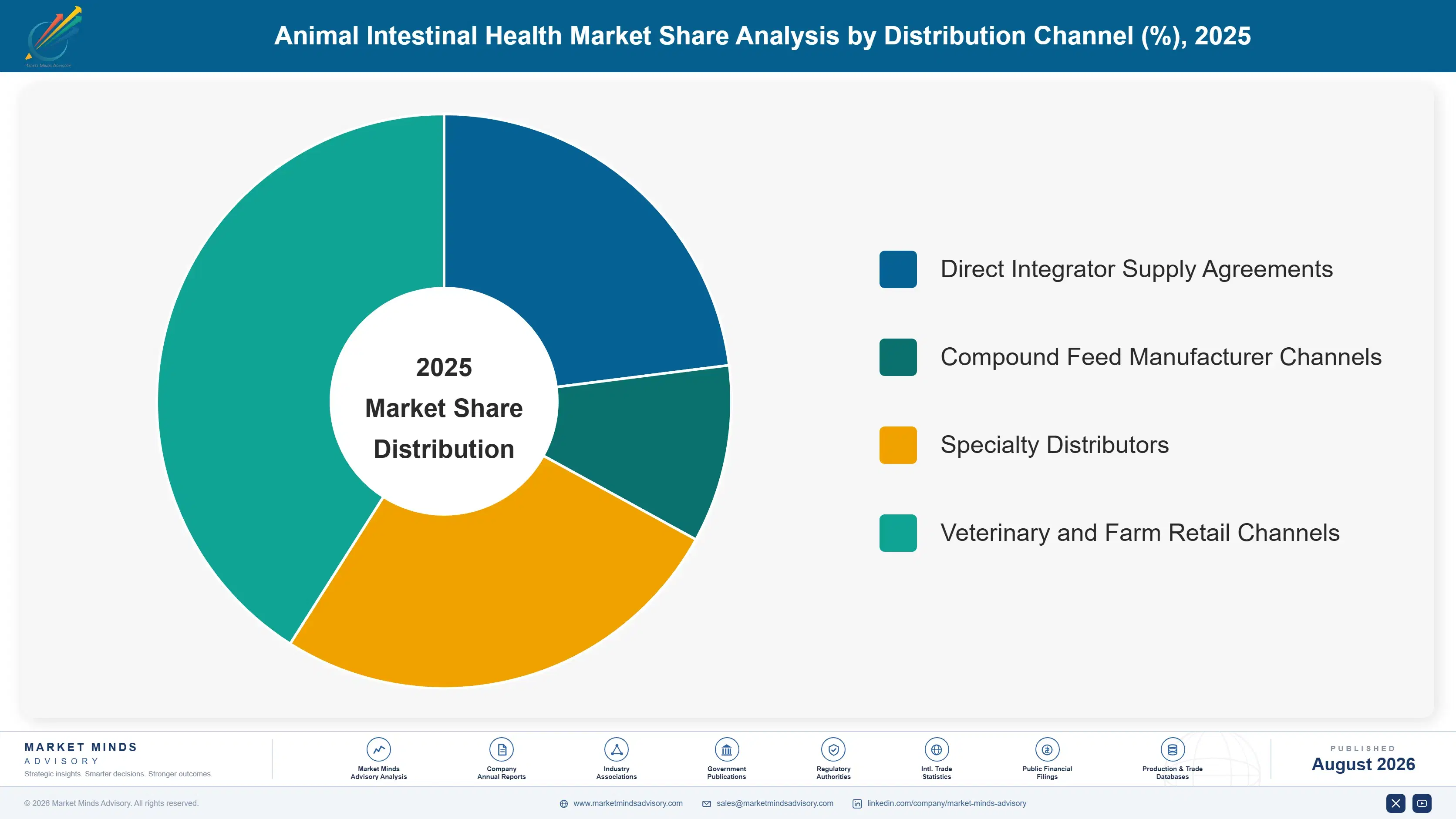
  • Direct Integrator Supply Agreements
  • Compound Feed Manufacturer Channels
  • Specialty Distributors
  • Veterinary and Farm Retail Channels

By Region

  • North America
  • Western Europe
  • East Asia
  • South Asia and Pacific
  • Latin America
  • Middle East and Africa
  • Eastern Europe

Scope, Methodology, and Coverage

Every figure in this report is reproducible from documented input assumptions. The scope below maps the historical period, the forecast horizon, the segmentation dimensions, and the countries covered, alongside the underlying primary and qualitative methodology.
Historical Period
2020 to 2025
Forecast Period
2026 to 2036
Base Year
2025 (USD billions; MMA Primary Research Dataset, August 2026)
Market Definition
The animal intestinal health market comprises feed additives formulated to support livestock and companion animal gut microbiome balance, pathogen exclusion, and digestive function, including probiotics, prebiotics, postbiotics, organic acids, phytogenics, and enzymes, valued at the point of sale. It excludes therapeutic veterinary pharmaceuticals, in-feed antibiotics, and finished compound feed beyond the additive ingredient itself.
Quantitative Units
USD billions (current prices); additive volume in metric tonnes where applicable
Segmentation Dimensions
By Additive Technology; By Species; By Distribution Channel; By Region
Regions Covered
North America, Western Europe, East Asia, South Asia and Pacific, Latin America, Middle East and Africa, Eastern Europe
Countries Covered
USA, China, Germany, France, UK, Japan, South Korea, India, Australia, Canada, Brazil, Mexico, Indonesia, Vietnam, Thailand, Malaysia, UAE, Saudi Arabia, South Africa, Nigeria, Turkey, Poland, Netherlands, Italy, Spain, Sweden, Switzerland, Argentina, Colombia, Singapore, and additional markets relevant to this sector
Key Companies Profiled
DSM-Firmenich, Cargill, Novonesis, Evonik, Alltech, ADM, Kemin Industries, Lallemand Animal Nutrition, BASF, IFF, Novus International, Balchem, Nutreco, Adisseo, Phibro Animal Health, Zinpro, Kerry Group, Elanco Animal Health, Huvepharma, AB Vista
Quantitative Methodology
Primary survey, n=3,800 respondents, Q4 2025, six countries; demand-side model with trade association cross-validation
Qualitative Methodology
47 expert interviews, Q4 2025; applied to validate demand model assumptions, identify emerging dynamics, and assess competitive positioning
Report Format
PDF and XLSX data workbook (Word format preview document)
Publisher
Market Minds Advisory
Report Code
MMA-2026-AGR-107
Published
August 2026
Contact
sales@marketmindsadvisory.com | www.marketmindsadvisory.com

Purchase the full Animal Intestinal Health Market Report (2026 to 2036).

The full MMA Animal Intestinal Health report sizes the market across six additive technologies, five species categories, four distribution channels, and seven regions through 2036. It profiles 20 participants on a consistent basis of attributable gut-health additive revenue, scoring each on efficacy documentation depth, export-compliance technical support, and formulation breadth. Scenario models quantify how AGP regulatory adoption, postbiotic technology maturation, and export-market compliance requirements move both volume and achievable price. The report also includes a regulatory adoption timeline tracker across major livestock-producing countries, an independent efficacy documentation gap assessment, and a blended-formulation opportunity model for procurement and product development teams.
Six-technology and four-channel market sizing to 2036
Twenty-participant benchmark on attributable gut-health additive revenue
Regulatory adoption timeline tracker across major livestock markets
Independent efficacy documentation gap assessment by supplier
Export-compliance positioning and technical support benchmark
Blended multi-technology formulation opportunity model for teams

Built For The People Who Decide

From boardroom strategy to bench-side execution, this report is read cover-to-cover by leaders shaping the next decade of their industry, turning demand scenarios, market dynamics and valuation benchmarks into decisions.
CXOs/ Presidents/ VPs/ Managers
M&A and Corporate Development
Strategy Teams and R&D Heads
Procurement and Product Directors
Regulatory and Compliance Leaders
Investor Relations and Equity Analysts