Market Minds Advisory
Animal Growth Promoter Market

Animal Growth Promoter Market: Antibiotic Withdrawal, Microbial Replacement, and the Feed Conversion Gap Nobody Has Fully Closed

China removed antibiotic growth promoters from feed in 2020 and Europe did so in 2006, which turned a cheap chemical category into an expensive biological one that still underperforms what it replaced.

Lead Analyst

Lisa Gevelber

Published

September 2026

Make Smarter Decisions with Customized Research Insights

Request a free sample report and evaluate market opportunities, growth trends, and competitive dynamics relevant to your business needs.

2025 MARKET VALUE$10.6BMarket Size 2025
2036 FORECAST VALUE$23.7BBase Case , 2026 to 2036
CAGR 2026 TO 20367.6 %Bull 8.9% / Bear 6.3%
INCREMENTAL OPPORTUNITY$12.3BNet 10- year value creation
EXPANSION MULTIPLE2.08x2036 value over 2026 base
Strategic Levers
M&A Pipeline
Regional Outlook
Country Rankings
Competitive Intelligence
Segmental Deep-dive
Call-Us : 91 93563 13602

Executive Snapshot and Market Trajectory

Regulators did this market an enormous commercial favour by banning its cheapest product. Antibiotic growth promoters cost pennies per tonne of feed and worked reliably; the microbial, botanical, and acid-based replacements cost several times more, work less consistently, and require technical support to deploy correctly. That is now the market.
Commercial power has moved to suppliers who can demonstrate performance in commercial houses rather than in pen trials. China's July 2020 removal of antibiotic growth promoters from feed was the single largest demand event this category has seen, converting the world's biggest livestock producer to alternatives almost overnight. Probiotics and direct-fed microbials grow fastest at 11.4%, roughly 1.50 times the market. East Asia holds 30% of value.
The top five hold roughly 41% of supply, and the barrier is now fermentation capacity and field evidence rather than molecule access. Regulation continues to fragment the market geographically: ractopamine is permitted in the United States and prohibited across the European Union, China, and Russia, while hormonal implants remain legal in American cattle production and banned in Europe since 1988. Those divergences shape trade as much as they shape formulation. Neither divergence is narrowing much.
Market Definition
This report covers additives and veterinary agents administered to food-producing animals to improve weight gain and feed conversion efficiency, spanning antibiotic growth promoters, probiotics and direct-fed microbials, prebiotics and oligosaccharides, organic acids and acidifiers, phytogenics and essential oils, and hormonal implants and beta-agonists. Value is measured at product level as sold to feed mills, integrators, and veterinary channels. Therapeutic antimicrobials, vaccines, vitamins, minerals, amino acids, and feed enzymes fall outside scope.
Base Year Value
$10.6B in 2025 (MMA Primary Research Dataset, August 2026)
Forecast Period
2026 to 2036, eleven discrete annual values
CAGR
7.6% base case. Bull 8.9%. Bear 6.3%.
Fastest Growth Segment
Probiotics and Direct-Fed Microbials: 11.4% CAGR
Fastest Growth Country
Vietnam: 10.4% CAGR
Fastest Growth Region
South Asia and Pacific: 9.7% CAGR
Largest Region
East Asia: 30% of 2025 global value
Market Leaders
Elanco Animal Health, Zoetis, Phibro Animal Health, dsm-firmenich, Novonesis. Source: MMA Analysis based on company annual reports.
Primary Survey
n=3,800 procurement and R&D decision-makers, Q4 2025, six countries
Methodology
Demand-side build-up, cross-validated against public data, 47 expert interviews

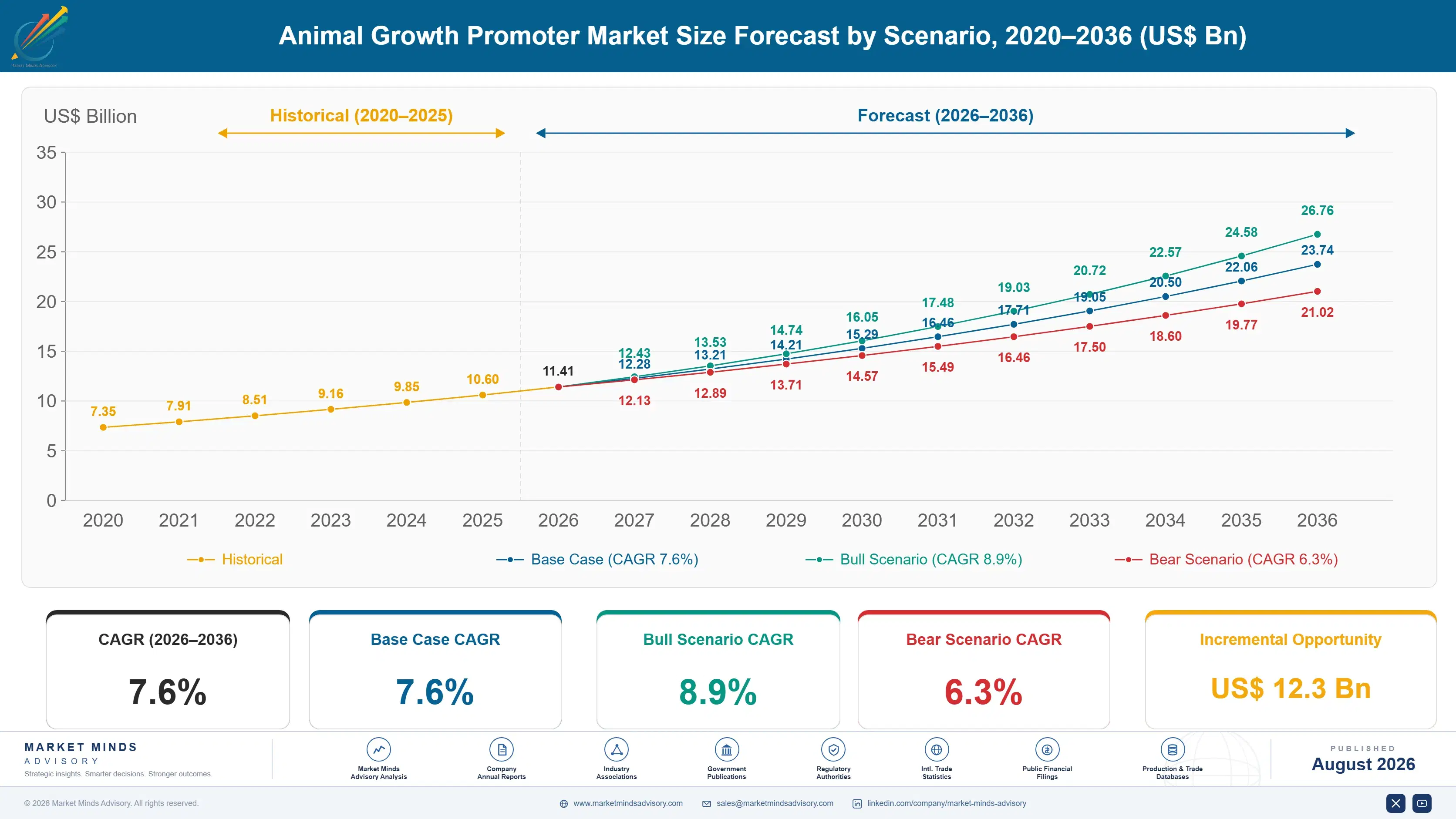
Animal Growth Promoter Market Forecast Scenarios

animal-growth-promoter-market-trends-size-forecast-scenario-1787462362113
The 2020 to 2025 period was reshaped by a single regulatory decision. China's Ministry of Agriculture and Rural Affairs removed antibiotic growth promoters from commercial feed in July 2020, and the world's largest livestock producer switched to alternatives within a season, pulling probiotic, acid, and botanical demand upward sharply. The 6.4% historical growth understates the mix change, because expensive replacements displaced cheap incumbents at similar tonnage.
The 7.6% base case rests on three mechanisms. Antibiotic restriction keeps spreading through India, Brazil, Southeast Asia, and the Gulf, and each new prohibition converts a low-value category into a high-value one at a stroke. Producer economics keep favouring feed conversion improvement as grain costs stay elevated, which sustains willingness to pay for products that deliver measurable gain. And combination programmes pairing microbials with acids and botanicals keep raising spend per tonne of feed above single-additive levels.
The 8.9% bull case assumes postbiotic and precision microbial products close the performance gap against withdrawn antibiotics, justifying materially higher pricing. The 6.3% bear case reflects producer margin compression that pushes integrators back toward minimum viable dosing, alongside American retreat from strict antibiotic-free poultry commitments already visible since 2023. Producer margin cycles will decide between them.

Why Bans Created a Better Market

Three forces govern this market, and regulation is the loudest of them. Antimicrobial resistance policy has removed antibiotic growth promoters across Europe, China, and a widening list of countries, converting a cheap chemical category into an expensive biological one. Producer economics then decide how much of the replacement actually gets dosed, because feed conversion gain has to exceed additive cost. And veterinary practice determines whether the product works at all.
TOP-FIVE CONCENTRATION41%Share of global growth promoter supply held collectively
AVERAGE SELLING PRICE$4.85/kgBlended price across microbial, botanical, and chemical classes
ANTIBIOTIC CLASS SHARE17%Remaining portion of demand met by antimicrobial agents
FEED CONVERSION GAIN4.2%Typical efficiency improvement across correctly dosed broiler diets
REGULATORY RESTRICTION COVERAGE68%Share of global livestock under antibiotic promoter prohibition
TRADE INTENSITY39%Portion of product crossing a border before final use
That produces a commercial character closer to animal health than to feed ingredients. Microbials, botanicals, and acids behave inconsistently across house conditions, water quality, and challenge pressure, so field results vary in ways an antibiotic never did. Suppliers who can show performance in commercial houses rather than in controlled pen trials win programmes; those quoting laboratory efficacy get sampled and dropped. Technical service capability is therefore the asset, and it is expensive to maintain.
The next decade tests whether the performance gap closes. No current alternative matches what antibiotic growth promoters delivered at scale, which is why combination programmes have become normal. Postbiotics, precision-selected strains, and bacteriophage approaches all aim at that gap. Whoever closes it credibly takes pricing that the present generation of products cannot sustain.
"The industry keeps describing alternatives as replacements for antibiotic growth promoters. They are not replacements, they are compromises, and everybody dosing them in a commercial house already knows the difference."
Director, Animal Health and Nutrition Practice · MMA Animal Health / Feed Additives Practice · August 2026

Market Trends

Combination Programmes Displace Single-Additive Dosing Strategies

Nutritionists have concluded that no single alternative reproduces what an antibiotic growth promoter delivered, so commercial programmes now stack a direct-fed microbial with an organic acid blend and often a phytogenic as well, each addressing a different part of gut condition. Spend per tonne of feed rises accordingly, frequently to three or four times the cost of the withdrawn antibiotic. Integrators accept it because the alternative is measurable performance loss across a whole flock cycle. Suppliers able to sell a validated combination rather than a component capture the whole programme value.
Market Impact: Covers 68% of global livestock
Postbiotic and Precision Strain Products Target the Performance Gap

Postbiotics, meaning inactivated microbial cells and their fermentation metabolites, sidestep the viability and stability problems that limit live probiotic performance through pelleting and storage. Precision strain selection, matching specific Bacillus and Lactobacillus isolates to species, age, and challenge profile, is producing more consistent field results than the broad-spectrum products that dominated early alternative adoption. Both approaches command clear pricing premiums where efficacy data holds up. Neither has yet matched what antibiotic promoters delivered at commercial scale, which keeps the technical contest genuinely open. Integrators are watching both closely without yet committing serious volume to either.
Market Impact: Delivers 4.2% conversion improvement

Market Opportunities and Growth Drivers

Antibiotic Prohibition Keeps Converting Low-Value Demand Upward

The European Union removed antibiotic growth promoters under Regulation 1831/2003 with effect from 2006, American Guidance for Industry number 213 withdrew growth promotion claims from medically important antimicrobials in 2017, and China's Ministry of Agriculture and Rural Affairs prohibited them in commercial feed from July 2020. India, Brazil, Vietnam, and several Gulf states have followed with partial restrictions. Each prohibition replaces a product costing pennies per tonne with alternatives costing several dollars, which is why market value grows considerably faster than livestock numbers do. Livestock numbers matter far less to this market than legislative calendars do.
Market Impact: Varies results by 40%

Elevated Grain Costs Sustain Willingness to Pay for Efficiency

Feed accounts for the majority of production cost in poultry, swine, and aquaculture, so anything improving feed conversion pays for itself quickly when grain prices sit above historical averages. A 4.2% conversion improvement across a broiler flock covers additive cost several times over at prevailing corn and soybean meal values. That arithmetic has held since 2021 and keeps integrators willing to fund programmes their procurement teams would otherwise question. It also rewards suppliers who can quantify gain in commercial conditions rather than asserting it from trial data. Procurement scepticism falls sharply when the arithmetic is shown properly.
Market Impact: Cuts dosing 25% in downturns

Market Restraints and Challenges

Field Performance Varies in Ways Antibiotics Never Did

Microbials, botanicals, and acids deliver results that swing with house conditions, water quality, diet composition, and disease challenge, so an additive performing well on one farm can disappoint on the next. The root cause is biological: these products modulate gut populations rather than suppressing pathogens directly, and the starting population differs everywhere. Commercially this makes procurement sceptical and lengthens qualification considerably. Suppliers respond by investing in commercial house trials rather than pen studies, by offering performance guarantees, and by building technical service teams that adjust dosing to local conditions. None of those responses fully removes the underlying variability.
Market Impact: Raises spend 3 to 4x

Producer Margin Pressure Pushes Programmes Toward Minimum Dosing

When broiler or hog margins compress, additive programmes are among the first line items integrators reduce, because the loss appears gradually across a cycle rather than immediately. The root cause is that feed conversion gain is statistical while additive cost is certain, and procurement teams weight certainty. American retreat from strict antibiotic-free poultry commitments since 2023, with several large processors reintroducing ionophores, shows how quickly positions reverse under cost pressure. Suppliers counter with outcome-linked pricing, with programme-level rather than product-level contracting, and with documented cost-per-point-of-conversion arguments. Winning that argument requires data most suppliers do not hold.
Market Impact: Commands 35% pricing premium
3 additional market trends, 2 additional growth drivers, and 4 additional restraints and challenges are covered in the full report. Contact sales@marketmindsadvisory.com to access the complete intelligence.

Segment CAGR and Growth Architecture

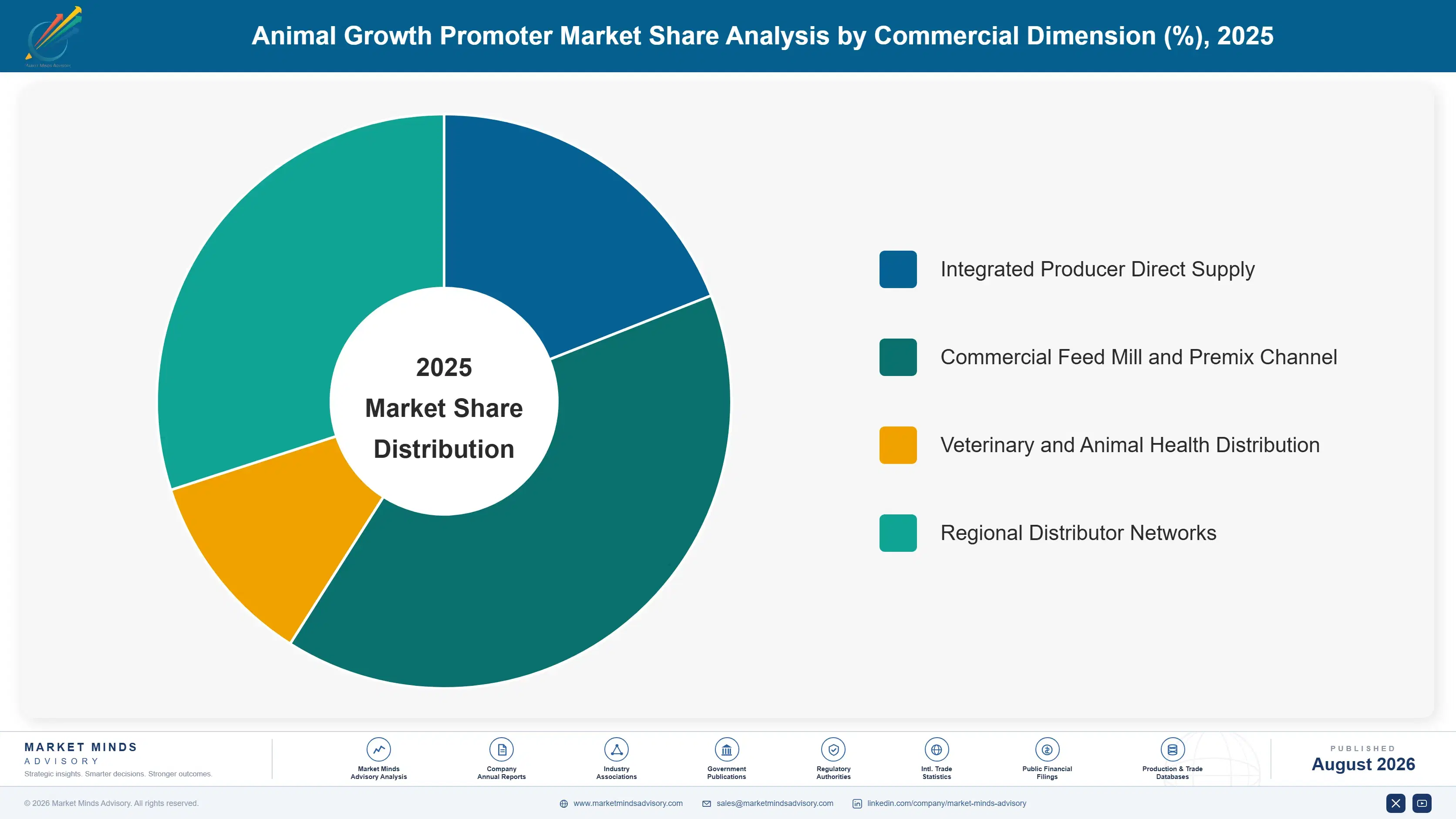
Segmentation follows agent class, the single logic that determines regulatory status, mode of action, and the evidence a buyer requires before use. Class decides where a product may legally be sold, how it survives pelleting, and which part of performance it addresses. Species, production stage, and channel structures appear separately in the framework as commercial dimensions rather than parallel segments.
animal-growth-promoter-market-trends-market-share-analysis-1787462362651

Probiotics and Direct-Fed Microbials

Growth of 11.4%, roughly 1.50 times the market, comes directly from antibiotic withdrawal rather than from any breakthrough in microbiology. Bacillus, Lactobacillus, Enterococcus, and yeast-based products now anchor most alternative programmes across poultry and swine, and Chinese adoption since the July 2020 prohibition transformed segment volume within two seasons. The technical constraints are real: live organisms must survive pelleting at elevated temperature, remain viable through storage, and then colonise a gut whose existing population differs on every farm. Spore-forming Bacillus strains tolerate processing best, which is why they dominate commercial supply despite other genera performing better under laboratory conditions and controlled challenge. Viability at the point of consumption, not at the point of manufacture, is what actually matters.
CAGR 11.4%

Phytogenics and Essential Oils

Carvacrol, thymol, cinnamaldehyde, capsaicin, and saponin-based products act on gut integrity, feed intake, and inflammatory response through mechanisms distinct from microbial products, which is exactly why nutritionists stack them alongside rather than instead of probiotics. Growth of 10.7% reflects that complementary positioning more than any standalone case. Encapsulation matters enormously here, since volatile compounds released in the crop rather than the intestine deliver nothing, and formulation capability separates credible suppliers from resellers of botanical extract. Raw material supply is agricultural and therefore variable, with oregano, thyme, and cinnamon pricing moving on harvest outcomes that no supplier controls. Suppliers who blend and encapsulate in-house therefore hold a clearer position than those buying finished actives.
CAGR 10.7%
Full segment breakdown across 6 segments available in the complete report.

Regional Architecture and Country Demand Map

East Asia holds the largest share at 30%, driven by Chinese livestock scale and the July 2020 antibiotic prohibition that converted demand upward overnight. South Asia and Pacific grows fastest as Indian and Vietnamese restrictions tighten, while North America retains substantial hormonal and ionophore demand.

North America

This is the most permissive major regulatory environment remaining, and that shapes the whole demand structure. Hormonal implants using trenbolone and estradiol remain legal and near-universal in American feedlot cattle, ractopamine is permitted in swine and cattle production, and ionophores continue in poultry because they are not medically important antimicrobials. Guidance for Industry number 213 removed growth promotion claims from medically important antibiotics in 2017 without touching those categories. Retail-driven antibiotic-free poultry programmes expanded rapidly through the late 2010s, then several large processors reversed course from 2023 under cost pressure. Regional growth of 6.9% reflects a mature market with unusually wide product access. Access breadth here has no equivalent in any other major region.
Share: 24% | CAGR: 6.9% (2026 to 2036)

Western Europe

Europe removed antibiotic growth promoters in 2006 under Regulation 1831/2003 and banned hormonal implants back in 1988, so this region has run on alternatives longer than anywhere else and its practice sets the template others follow. Nutritionists here have two decades of commercial experience with microbials, acids, and botanicals, and combination programmes are standard rather than novel. Danish, Dutch, and German swine production supplies much of the applied evidence base the rest of the world cites. Growth of 6.0% is the slowest of any region, reflecting saturation rather than weakness, and herd contraction under nitrogen and emissions constraints caps volume further. European practice is effectively the reference case everyone else is copying.
Share: 18% | CAGR: 6.0% (2026 to 2036)
Regional intelligence for 5 additional markets available in the complete report: East Asia, South Asia and Pacific, Latin America, Middle East and Africa, Eastern Europe. Contact sales@marketmindsadvisory.com.
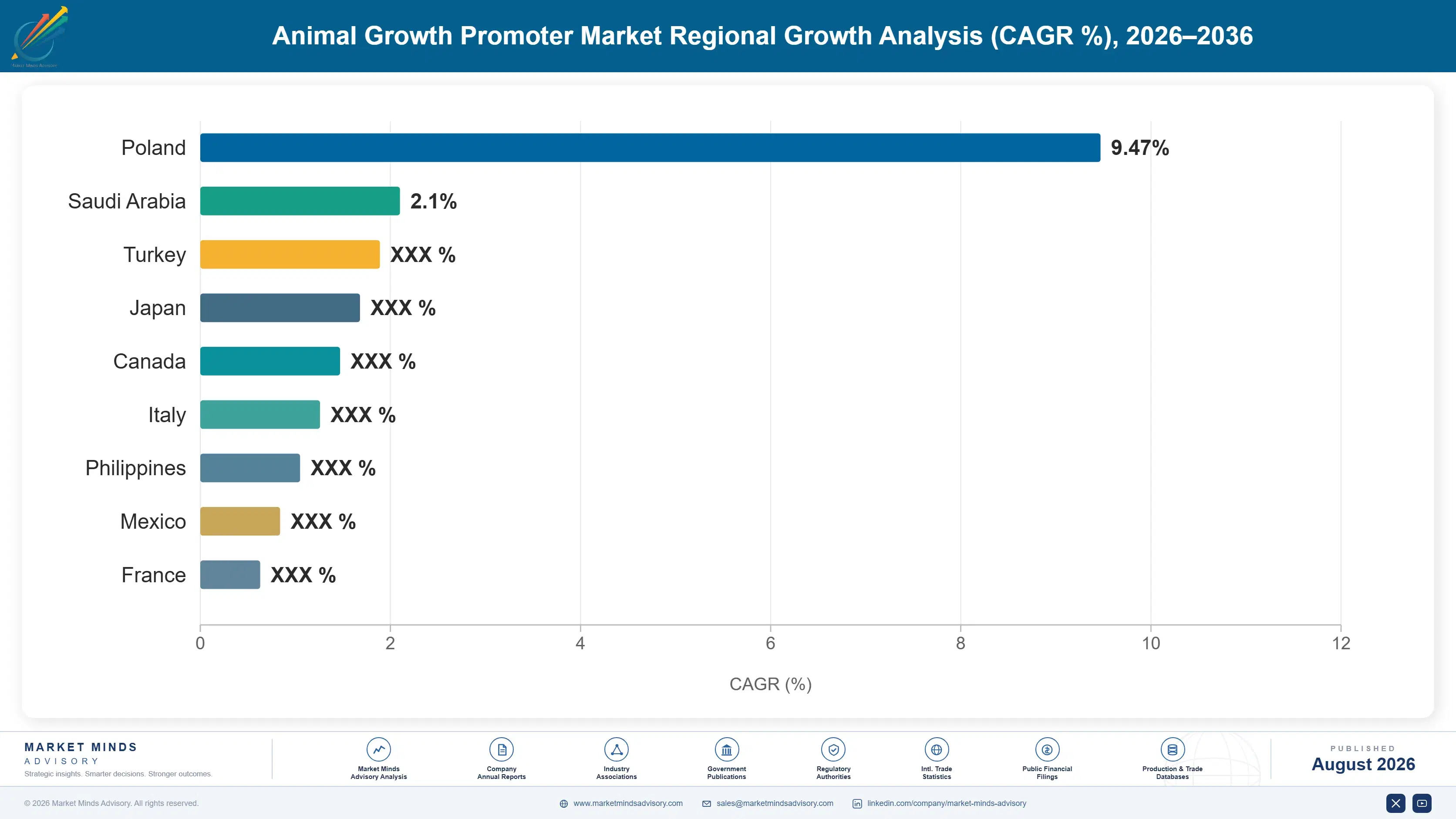
animal-growth-promoter-market-trends-country-cagr-analysis-1787462363156

Where Growth Promoter Margin Actually Sits

Selling a probiotic against twenty other probiotics on colony forming units per gram is a losing position. The four moves below shift revenue toward things a competitor cannot copy from a specification sheet: commercial house evidence, validated combination programmes, outcome-linked contracting, and regulatory positions in markets where restriction has only just arrived. None of the four requires new molecules.

Generate Evidence in Commercial Houses, Not Research Pens

Pen trial data persuades nobody who has watched an additive underperform on a real farm, and every experienced nutritionist has. Running structured commercial house trials across varied conditions costs roughly $900,000 per species programme and produces evidence competitors quoting laboratory efficacy cannot answer. It also generates the dosing adjustments that make the product actually work in the field. Suppliers with commercial datasets close programmes at 20% to 30% better pricing than those presenting controlled trial results, because the buyer is purchasing predictability rather than potential. Sceptical nutritionists respond to almost nothing else these days.
Market Impact: Closes at 20 to 30% better pricing levels

Sell Validated Combination Programmes Instead of Single Additives

No single alternative reproduces what antibiotic growth promoters delivered, so nutritionists stack microbials, acids, and botanicals anyway. A supplier providing the validated combination captures 3 to 4 times the spend per tonne of feed that a single component earns, and becomes far harder to displace because unpicking a working programme risks the whole flock outcome. Development requires interaction testing rather than new molecules, so cost is modest against the return. It also moves the conversation from unit price toward cost per point of feed conversion. A typical broiler programme now carries 3 to 4 components rather than one.
Market Impact: Captures 3 to 4x the per-tonne programme spend

Contract on Feed Conversion Outcomes Rather Than Product Volume

Integrators cut additive dosing first when margins compress, because gain is statistical while cost is certain. Outcome-linked contracts, pricing against measured feed conversion improvement with a floor and a shared upside, remove that reflex by putting the supplier's money behind the claim. Programmes structured this way show retention roughly 40% higher through producer downturns than volume-priced equivalents. The structure also filters suppliers, since only those confident in field performance will offer it, which is precisely the signal a sceptical procurement team responds to. Procurement teams notice quickly which suppliers decline to offer the structure.
Market Impact: Lifts programme retention 40% through producer margin downturns

Position Early in Markets Where Restriction Is Arriving

Every new antibiotic prohibition converts a category costing pennies per tonne into one costing several dollars, and the suppliers holding registrations and integrator relationships when the rule lands capture that conversion. India, Vietnam, Brazil, and several Gulf states are all tightening. Registration and technical positioning costs perhaps $1.4 million per major market and takes two years, which means the work has to start before the regulation is final. Those arriving after the ban compete on price into programmes already established by somebody else. Regulatory affairs capacity, not commercial appetite, is usually the constraint.
Market Impact: Converts each market to roughly 8x prior value

Who Controls the Margin Pool

The top five hold roughly 41% of supply, measured consistently as growth promoter product revenue at supplier level. Elanco, Zoetis, and Phibro bring veterinary channel access and regulatory capability, while dsm-firmenich and Novonesis bring fermentation scale and microbial strain libraries. The gap to challengers is field evidence and technical service reach rather than product access, since strains and botanical actives are widely available.
Competition runs along three lines. Strain and formulation development is the first, focused on stability through pelleting and on precision matching to species and challenge. Commercial evidence generation is the second, where the cost of running trials across real production conditions excludes smaller suppliers effectively. The third is registration capability, which decides who can sell into markets as restriction regimes change and new approvals become necessary.

Two pressures will reshape positions. Chinese fermentation producers scaled rapidly after the 2020 prohibition and now compete on delivered cost across Asia and increasingly Latin America. Meanwhile integrators are consolidating supplier lists toward programme providers rather than component vendors. The exposed position is a mid-sized supplier selling single additives on activity specification, with no commercial dataset and no combination programme to defend the account with.
animal-growth-promoter-market-trends-company-positioning-matrix-1787462363681

Competitive Moat and Risk Dimensions

ELANCO ANIMAL HEALTH

Moat: Veterinary Channel and Registrations

Elanco holds product registrations across dozens of jurisdictions and reaches producers through veterinary relationships built for therapeutic products, which gives it distribution and regulatory capability that feed additive specialists cannot assemble quickly. When restriction regimes change, the company can move approved products into the gap faster than competitors can register alternatives. That capability compounds with every regulatory shift.
ELANCO ANIMAL HEALTH

Risk: Legacy Antibiotic Portfolio Exposure

A meaningful part of the historical business sits in antimicrobial products facing continued restriction, and each new prohibition removes revenue the alternatives business must replace. Ionophores remain permitted but attract periodic scrutiny. Rebuilding equivalent scale in microbials and botanicals requires competing against fermentation specialists whose cost position in strain production is considerably stronger.
NOVONESIS

Moat: Fermentation Scale and Strain Library

The company operates submerged fermentation capacity and a strain collection built over decades, producing microbial biomass at unit costs standalone competitors cannot approach. Strain improvement compounds, since each generation informs the next selection round. That cost position funds the commercial trial programmes and technical service teams that actually win integrator business, which is where the real contest happens.
NOVONESIS

Risk: Limited Veterinary Channel Access

Selling through feed mills and nutritionists rather than through veterinary relationships limits reach into producers who take direction from their vet rather than their feed supplier. As programmes become more clinical in framing, that channel gap matters more. Partnerships fill it partially but divide the customer relationship and the margin at the same time.

Players Tracked

Prominent Players

Elanco Animal Health
Zoetis
Phibro Animal Health
dsm-firmenich
Novonesis

Other Key Players

Cargill
Alltech
Kemin Industries
Adisseo
Evonik Industries
Lallemand Animal Nutrition
Archer Daniels Midland
Huvepharma
Anpario plc
Impextraco
Nutreco
Virbac
Novus International
Boehringer Ingelheim
Ceva Sante Animale

Recent Developments

FEBRUARY 2025

Chinese fermentation producers expand direct-fed microbial export capacity

Several Chinese fermentation producers extended direct-fed microbial manufacturing capacity aimed at export markets across Southeast Asia and Latin America, following domestic scale built after the 2020 antibiotic prohibition. The additional supply pressured delivered pricing on standard Bacillus products through the following quarters across several regional tenders.
Signal: Chinese fermentation scale built originally for domestic substitution is now competing internationally on delivered cost alone.
AUGUST 2024

American poultry processors continue reversing antibiotic-free commitments

Further large American poultry processors reintroduced ionophores into production programmes after earlier commitments to remove all antibiotics, citing bird welfare outcomes and cost pressure. The reversals reduced demand for the most intensive alternative programmes while leaving medically important antimicrobial restrictions untouched under existing federal guidance.
Signal: Antibiotic-free retail commitments proved considerably less durable than suppliers building capacity around them had originally assumed.
JUNE 2025

dsm-firmenich extends eubiotic and postbiotic product range

dsm-firmenich broadened its eubiotic portfolio with postbiotic and precision strain products aimed at closing the performance gap left by withdrawn antibiotic growth promoters. The range is supported by commercial house trial data across broiler and swine production rather than by controlled pen studies alone, addressing a recurring nutritionist objection.
Signal: Commercial trial evidence, rather than laboratory efficacy, is becoming the working currency in alternative additive selling.

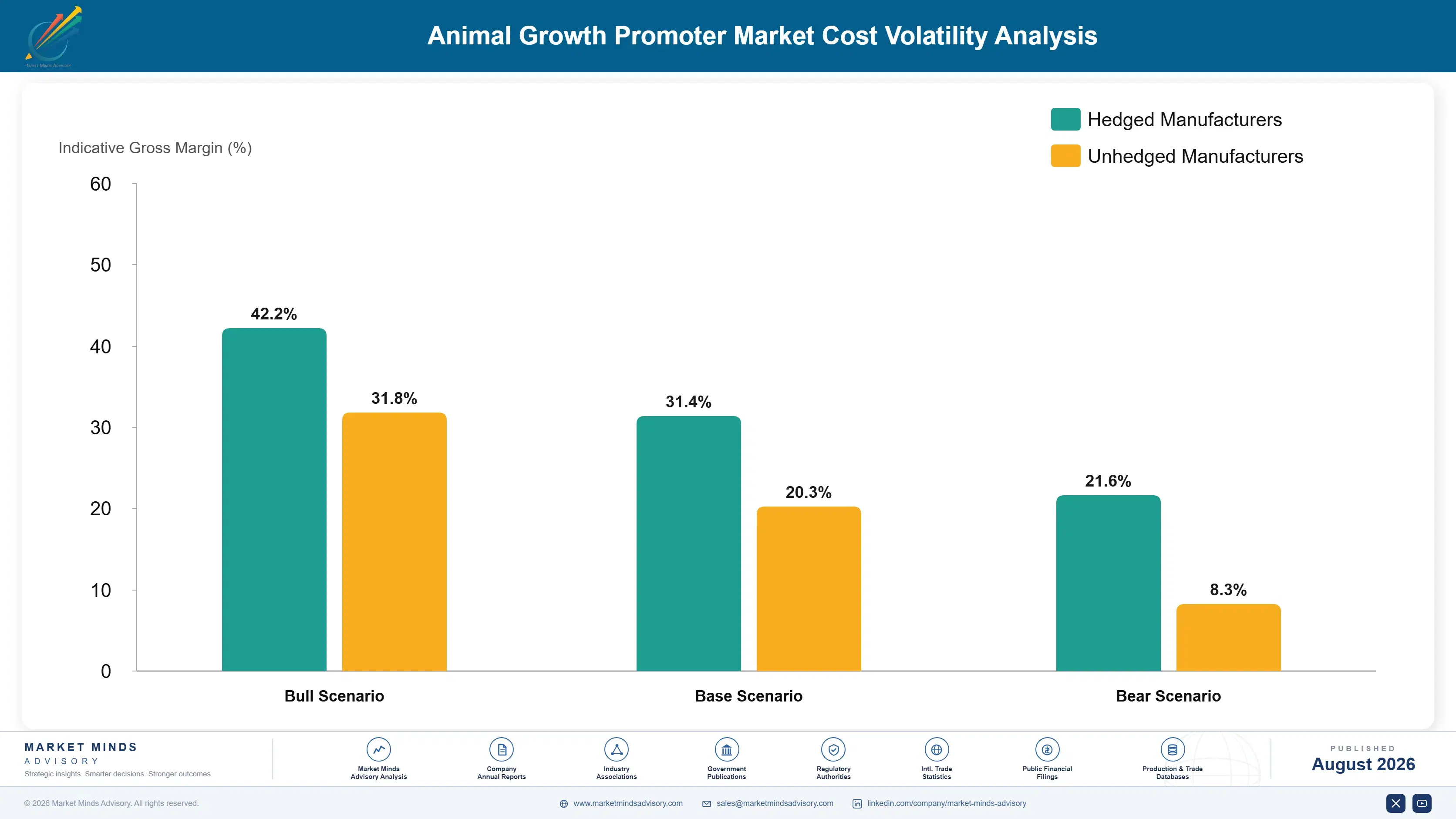
Fermentation Substrate, Botanicals, and Energy

Fermentation substrate, mainly glucose syrup and corn steep liquor, accounts for roughly 26% of cost for microbial products, sourced from starch processors in the United States, China, and Europe. Botanical raw materials contribute around 19% for phytogenic lines, with oregano, thyme, and cinnamon oils bought on agricultural markets. Energy for fermentation, sterilisation, and drying takes 21%, and carriers, encapsulation, and testing absorb the rest.
European industrial energy prices rose steeply through 2022 and 2023 according to IEA reporting, which hit fermentation hard because sterilisation and drying loads cannot be reduced without compromising viability. Corn and glucose syrup pricing moved sharply under Black Sea disruption, inflating substrate alongside energy. Evonik and Novonesis both referenced input cost pressure across their reporting in that period, and several smaller European microbial producers reduced output rather than run negative.

Exposure divides on plant location and format rather than on company size. Liquid and paste formats skip spray drying and carry lower energy intensity, which advantages suppliers whose customers apply post-pelleting. Encapsulated phytogenics carry the heaviest processing load. Chinese producers, on cheaper power and beside substrate supply, held delivered cost advantage and built the export positions now visible across Asian and Latin American tenders.
animal-growth-promoter-market-trends-cost-volatility-analysis-1787462363879

Site fermentation against long-term energy and substrate proximity

Microbial production economics are dominated by power and starch-derived substrate, so plant location determines competitiveness for decades rather than seasons. Proximity to corn wet milling and to cheap baseload electricity outweighs proximity to customers, because concentrated product ships cheaply. Several European producers learned that expensively after 2022 and have shifted volume toward Asian and American assets since.

Contract botanical actives across multiple growing origins annually

Oregano, thyme, and cinnamon oil pricing follows harvest outcomes in Turkey, Spain, Indonesia, and Sri Lanka, and those seasons rarely fail together. Contracting across origins rather than buying spot from whichever supplier quotes lowest keeps the blended input inside a manageable band. Phytogenic formulators without multi-origin cover have repeatedly been forced into mid-year price increases.

Shift format mix toward liquid application where mills permit

Liquid and paste microbial formats avoid spray drying and granulation, removing the most energy-intensive steps while delivering better viability to the animal. Where customer mills apply post-pelleting, liquid formats cost less to produce and perform better, which is an unusually aligned commercial position. Encouraging that equipment adoption improves supplier margin and customer outcome together.

Portfolio Architecture for Margin Defence

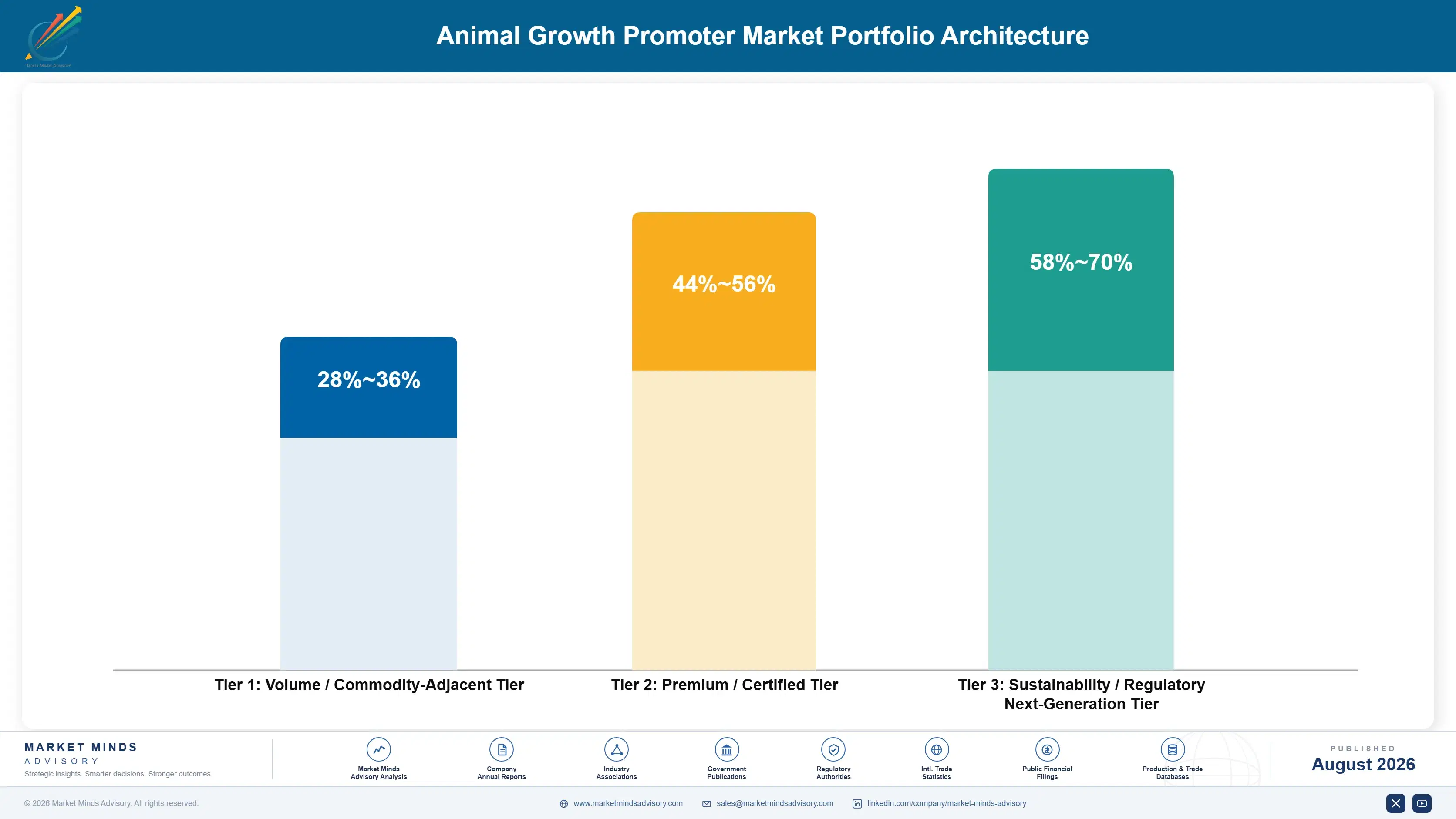
Three tiers separate on evidence rather than on active ingredient. Standard single-strain microbials and commodity acid blends sold on specification earn 28% to 36%, competing against Chinese fermentation output on delivered cost. Species-validated products carrying commercial house performance data earn 44% to 56%, because the buyer is purchasing predictability. Validated combination programmes and postbiotic products earn most of all, and that gap has widened since the 2020 Chinese prohibition.
The tension is between tonnage and evidence investment. Standard products keep fermentation assets loaded and generate the cash that funds trial programmes, yet defending them against Chinese delivered cost consumes commercial attention worth considerably more elsewhere. Several multinationals have quietly conceded commodity Bacillus in Asian tenders while holding programme and postbiotic positions. That reads as retreat and is closer to deliberate portfolio discipline.

High-value pools sit where the buyer cannot verify performance independently. Combination programme design, postbiotic products, and outcome-linked supply all require evidence an integrator cannot generate alone, which is exactly why those positions resist the price comparison that commodity microbials invite every year. That is why programme positions hold pricing while commodity microbials get retendered every single year without fail.

Volume / Commodity-Adjacent Tier

Standard single-strain microbials, commodity organic acid blends, and generic botanical extracts sold on declared specification. Competes against Chinese fermentation output. The wide range reflects large differences in plant energy cost and fermentation scale between producers.
Gross Margin: 28%-36%

Premium / Certified Tier

Species-validated products supported by commercial house trial data and encapsulated phytogenic formulations with documented release profiles. Buyers pay for predictability under real conditions. Range width separates single-species evidence from multi-region validated supply within this tier.
Gross Margin: 44%-56%

Sustainability / Regulatory / Next-Generation Tier

Validated combination programmes, postbiotics, precision strain products, and outcome-linked supply arrangements. Evidence ownership and programme-level switching cost, rather than production economics, sustain the margin structure across this tier. Displacement risks the whole flock outcome.
Gross Margin: 58%-70%
animal-growth-promoter-market-trends-portfolio-architecture-1787462364393

High-value Sub-segments and Strategic Watch-out

Validated Combination Programmes

Highest value in the market, capturing three to four times the per-tonne spend a single additive earns. Displacing one requires unpicking a working programme and risking a flock outcome, which integrators avoid. Interaction testing rather than new molecules is the development requirement. Nobody unpicks a working stack.
Gross Margin: 60%-70%

Postbiotic and Precision Strain Products

High value with strong growth, sidestepping the viability and stability problems that limit live probiotics through pelleting. Commands a 35% pricing premium where efficacy data holds. Range width separates early commercial products from those with multi-species field validation completed. Neither has yet matched withdrawn antibiotics at scale.
Gross Margin: 52%-64%

Standard Direct-Fed Microbials

The volume core, protected by antibiotic prohibition but fully exposed to Chinese delivered cost on the product itself. It keeps fermentation assets loaded and funds the evidence programmes elsewhere, which is the honest commercial reason to retain the position. Expect no pricing power to return here.
Gross Margin: 26%-34%

Antibiotic Growth Promoters and Ionophores

The strategic watch-out. Permitted in fewer jurisdictions every year, and American antibiotic-free reversals since 2023 offer only temporary relief rather than a durable trend. Harvest the cash, keep registrations current, and size no capital plan against it. Registrations cost little to maintain and options are worth keeping.
Gross Margin: 34%-48%

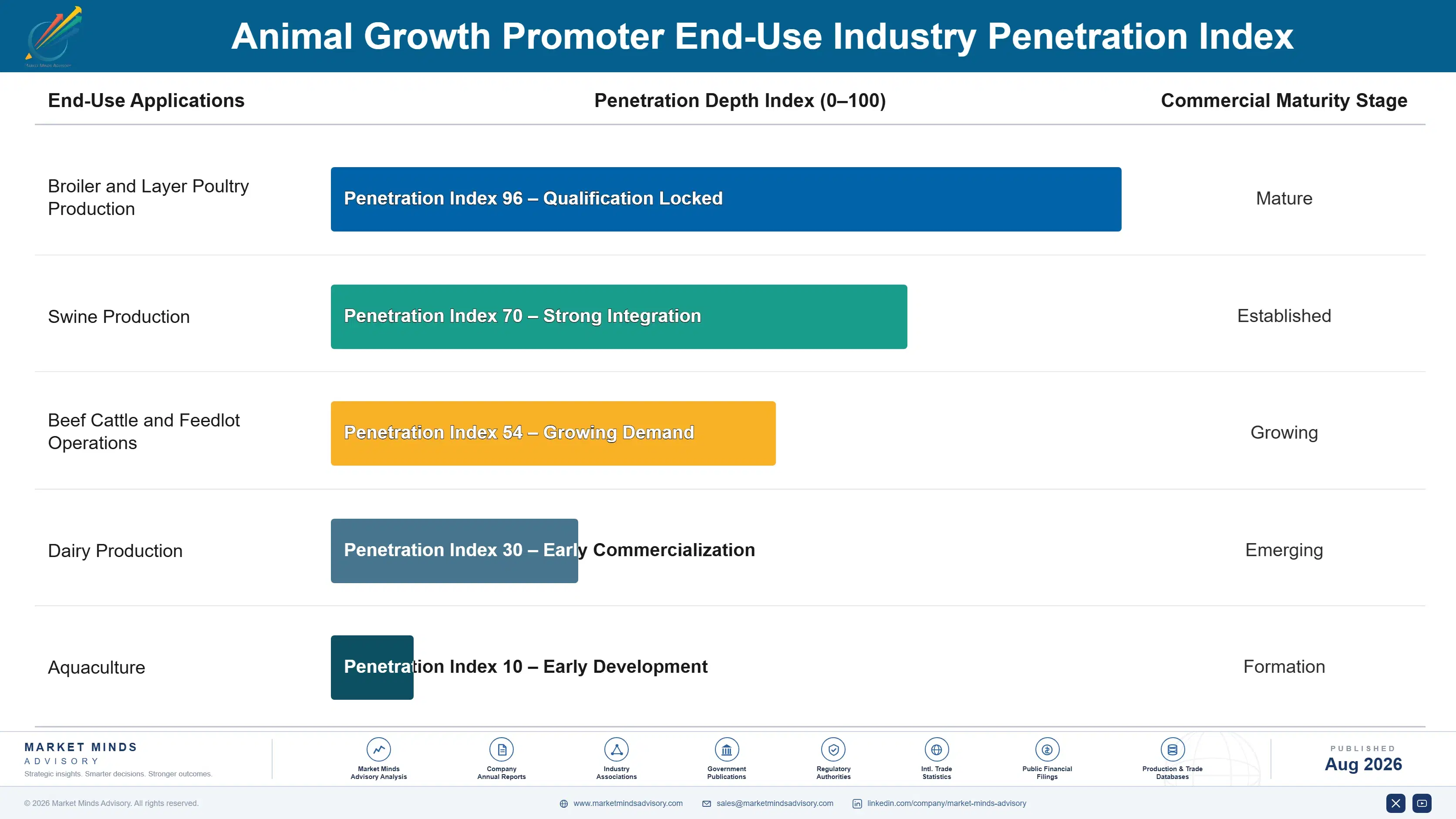
Why Integrator Programmes Rarely Change

Growth promoter revenue behaves as an annuity once a programme is written into an integrator's standard diet. Nutritionists validate an additive across trial flocks, then across commercial production, then against a full year of performance data covering seasonal variation, and having completed that work they leave it alone. Typical programme tenure runs five to eight years, and the trial investment behind the original win, largely funded by the supplier, is what buys that period of steady monthly volume.
Stickiness varies considerably by position. Validated combination programmes are the most durable, because changing one component means revalidating interactions across the whole stack and risking a measurable flock outcome. Species-specific products with commercial evidence come next, protected by the trial work the integrator would have to repeat. Standard single-strain microbials are the least sticky of all, retendered annually on colony forming units per gram and delivered price with almost no attachment to the incumbent.

Buyer profiles have shifted noticeably. Veterinarians and sustainability leads now sit alongside nutritionists and procurement, and questions about antimicrobial stewardship and residue status arrive before pricing does. Stewardship documentation is now a supply requirement in export-oriented production rather than a courtesy.
animal-growth-promoter-market-trends-end-use-penetration-index-1787462364896

Where Growth Promoter Capital Belongs

These are among the four positions where our research anticipates prominent divergence between winners and laggards over the coming forecast period. Each is grounded in the demand model, the regulatory perimeter, and the announced capacity pipeline.
01 / COMMERCIAL EVIDENCE GENERATION

Fund field trials in real houses, not research pens

Pen trial data convinces nobody who has watched an additive underperform on an actual farm, and every experienced nutritionist has watched exactly that happen more than once in their career. Structured commercial house trials across varied conditions cost roughly $900,000 for each species programme and produce evidence that competitors quoting laboratory efficacy simply cannot answer in a tender. Suppliers holding commercial datasets close programmes at 20% to 30% better pricing, because the integrator is buying predictability rather than merely buying potential.
02 / COMBINATION PROGRAMME OWNERSHIP

Sell the whole stack, because nutritionists are stacking anyway

No single alternative reproduces what antibiotic growth promoters delivered, so commercial programmes already combine a microbial, an acid blend, and frequently a phytogenic, whatever any individual supplier might prefer to sell. Providing the validated combination captures three to four times the per-tonne spend a component earns, and makes displacement far harder because unpicking a working stack risks the entire flock outcome. Development needs interaction testing rather than new molecules, so the cost is modest against what the position returns over time.
03 / OUTCOME-LINKED SUPPLY CONTRACTING

Put money behind the claim and stop losing dosing in downturns

Integrators cut additive dosing first whenever their margins compress, because feed conversion gain is statistical while additive cost arrives as an entirely certain invoice every single month. Supply contracts priced against measured feed conversion improvement, with a defined floor and shared upside, remove that reflex and show programme retention roughly 40% higher through producer downturns than volume-priced arrangements do. The structure also filters the market, since only those suppliers genuinely confident in their own field performance will offer it at all.
04 / PRE-RESTRICTION MARKET ENTRY

Register and position before the prohibition actually lands

Each new antibiotic prohibition converts a category costing pennies per tonne into one costing several dollars, and whoever holds registrations and integrator relationships when the rule takes effect captures that value conversion outright and largely uncontested. India, Vietnam, Brazil, and several Gulf states are all tightening their restrictions right now. Registration and technical positioning costs around $1.4 million per major market across two years, which means starting the work before the regulation is final rather than after it has been announced.

Engagement Snapshot From the Field

A live engagement with an industry participant carrying material or product regulatory and market exposure ahead of a defining policy shift, showing how our research translates into a defensible multi-year portfolio strategy.
MARKET MINDS ADVISORY · CLIENT ENGAGEMENT SUMMARY
Animal Growth Promoter Producer Strategic Portfolio Review and Transition Roadmap 2026·Investment Scenario on Animal Growth Promoter Exposure Evaluation 2025-26
CLIENT PROFILE
A Southeast Asian vertically integrated poultry producer operating six feed mills and processing capacity serving domestic retail and export customers, with annual revenue near USD 720 million (client-reported, unverified by MMA). The group had removed antibiotic growth promoters ahead of national requirements and assembled an alternative programme piecemeal from four suppliers, with no consolidated view of what each component contributed to performance.
STRATEGIC CHALLENGE
Feed conversion had deteriorated by roughly 5% since antibiotic removal and had not recovered despite additive spend rising to more than three times the previous level. Export customers were tightening residue and stewardship requirements, one mill showed persistently worse results than the others, and management could not establish whether the problem was the programme, the mills, or the birds.
MMA APPROACH
MMA ran a component attribution analysis across all six mills, isolating additive contribution from diet, genetics, and house condition variables using two years of flock performance records. Supplier evidence was assessed on commercial house data rather than pen trials. Combination interactions were reviewed against published and supplier-held datasets, with findings tested through 47 expert interviews during Q4 2025.
KEY FINDINGS
  1. Two of the four additive components showed no measurable contribution to feed conversion once diet and house condition variables were correctly controlled for across mills.
  2. The underperforming mill was pelleting at a temperature that destroyed most live probiotic viability, a problem no supplier had raised during three years of supply.
  3. Only one incumbent supplier held commercial house trial data; the other three presented pen study results generated under conditions unlike the client's operation.
  4. Consolidating to a single validated combination programme would cut total additive spend by an estimated 22% while improving expected conversion performance across all six mills.
CLIENT PROFILE
A Southeast Asian vertically integrated poultry producer operating six feed mills and processing capacity serving domestic retail and export customers, with annual revenue near USD 720 million (client-reported, unverified by MMA). The group had removed antibiotic growth promoters ahead of national requirements and assembled an alternative programme piecemeal from four suppliers, with no consolidated view of what each component contributed to performance.
STRATEGIC CHALLENGE
Feed conversion had deteriorated by roughly 5% since antibiotic removal and had not recovered despite additive spend rising to more than three times the previous level. Export customers were tightening residue and stewardship requirements, one mill showed persistently worse results than the others, and management could not establish whether the problem was the programme, the mills, or the birds.
MMA APPROACH
MMA ran a component attribution analysis across all six mills, isolating additive contribution from diet, genetics, and house condition variables using two years of flock performance records. Supplier evidence was assessed on commercial house data rather than pen trials. Combination interactions were reviewed against published and supplier-held datasets, with findings tested through 47 expert interviews during Q4 2025.
KEY FINDINGS
  1. Two of the four additive components showed no measurable contribution to feed conversion once diet and house condition variables were correctly controlled for across mills.
  2. The underperforming mill was pelleting at a temperature that destroyed most live probiotic viability, a problem no supplier had raised during three years of supply.
  3. Only one incumbent supplier held commercial house trial data; the other three presented pen study results generated under conditions unlike the client's operation.
  4. Consolidating to a single validated combination programme would cut total additive spend by an estimated 22% while improving expected conversion performance across all six mills.
RECOMMENDED STRATEGY
Phase 1: Phase 1 (months one to four): remove the two non-contributing components and correct pelleting temperature at the underperforming mill immediately. Phase 2: Phase 2 (months five to fourteen): consolidate supply to a single validated combination programme under an outcome-linked contract with defined performance floors. Phase 3: Phase 3 (months fifteen to twenty-four): trial postbiotic substitution on two mills and extend stewardship documentation for export customer requirements.
OUTCOME
The integrator cut additive spend by 24% and recovered roughly 3.1 percentage points of feed conversion within eleven months (client-reported, unverified by MMA). Two supplier relationships were retired. The outcome-linked contract has since been extended, and postbiotic trials are running at two mills. Both trials report early positive results.

Frequently Asked Questions

Foundational context covering the market sizes, CAGR, scope, country, region and competition that inform every finding below. This section is provided to cover basics and most often pre-purchase conversations, answered from the MMA Primary Research Dataset.

What is the current size of the Animal Growth Promoter Market?

The market was valued at USD 10.6 billion in 2025, rising to an estimated USD 11.4 billion in 2026. East Asia holds the largest regional share at 30% of global value.

How large will the Animal Growth Promoter Market be by 2036?

MMA forecasts USD 23.7 billion by 2036 under the base case, an expansion multiple of 2.08 times the 2026 level. Incremental value creation across the period reaches USD 12.3 billion.

What is the CAGR for the Animal Growth Promoter Market 2026 to 2036?

The base case CAGR is 7.6%, with a bull case of 8.9% and a bear case of 6.3%. Historical growth between 2020 and 2025 ran at 6.4%, understating the mix change considerably.

Which segment is growing fastest?

Probiotics and direct-fed microbials, at 11.4%, roughly 1.50 times the overall market rate. Growth follows antibiotic withdrawal directly rather than any breakthrough in microbiology or product design.

Who are the major companies in the Animal Growth Promoter Market?

Elanco Animal Health, Zoetis, Phibro Animal Health, dsm-firmenich, and Novonesis lead, holding roughly 41% of supply between them. Kemin, Alltech, and Huvepharma follow with growing positions.

Which country is growing fastest?

Vietnam, at 10.4%, driven by tightening restrictions alongside rapid commercial poultry and swine expansion. Export market requirements constrain antibiotic use more tightly than domestic rules do.

Report Segmentation Architecture

The full report scope spans multiple orthogonal segmentation dimensions, with cross-tabulated demand data provided for each dimension pair. Coverage extends further to regional breakdowns, trend trajectories, and the competitive detail needed to support segment-level decision-making.

By Agent Class

  • Antibiotic Growth Promoters
  • Probiotics and Direct-Fed Microbials
  • Prebiotics and Oligosaccharides
  • Organic Acids and Acidifiers
  • Phytogenics and Essential Oils
  • Hormonal Implants and Beta-Agonists

By End-Use Industry

  • Broiler and Layer Poultry Production
  • Swine Production
  • Beef Cattle and Feedlot Operations
  • Dairy Production
  • Aquaculture

By Commercial Dimension

  • Integrated Producer Direct Supply
  • Commercial Feed Mill and Premix Channel
  • Veterinary and Animal Health Distribution
  • Regional Distributor Networks

By Region

  • North America
  • Western Europe
  • East Asia
  • South Asia and Pacific
  • Latin America
  • Middle East and Africa
  • Eastern Europe

Scope, Methodology, and Coverage

Every figure in this report is reproducible from documented input assumptions. The scope below maps the historical period, the forecast horizon, the segmentation dimensions, and the countries covered, alongside the underlying primary and qualitative methodology.
Historical Period
2020 to 2025
Forecast Period
2026 to 2036
Base Year
2025 (USD billions; MMA Primary Research Dataset, August 2026)
Market Definition
The market comprises additives and veterinary agents administered to food-producing animals to improve weight gain and feed conversion efficiency, covering antibiotic growth promoters, probiotics and direct-fed microbials, prebiotics and oligosaccharides, organic acids and acidifiers, phytogenics and essential oils, and hormonal implants and beta-agonists. Value is measured at product level as sold to feed mills, integrators, premix operators, and veterinary channels. Therapeutic antimicrobials, vaccines, vitamins, minerals, amino acids, and feed enzymes fall outside scope.
Quantitative Units
USD billions (current prices); tonnes of product; USD per kilogram average selling price
Segmentation Dimensions
By Agent Class; By End-Use Industry; By Commercial Dimension; By Region
Regions Covered
North America, Western Europe, East Asia, South Asia and Pacific, Latin America, Middle East and Africa, Eastern Europe
Countries Covered
USA, China, Germany, France, UK, Japan, South Korea, India, Australia, Canada, Brazil, Mexico, Indonesia, Vietnam, Thailand, Malaysia, UAE, Saudi Arabia, South Africa, Nigeria, Turkey, Poland, Netherlands, Italy, Spain, Sweden, Switzerland, Argentina, Colombia, Singapore, and additional markets relevant to this sector
Key Companies Profiled
Elanco Animal Health, Zoetis, Phibro Animal Health, dsm-firmenich, Novonesis, Cargill, Alltech, Kemin Industries, Adisseo, Evonik Industries, Lallemand Animal Nutrition, Archer Daniels Midland, Huvepharma, Anpario plc, Impextraco, Nutreco, Virbac, Novus International, Boehringer Ingelheim, Ceva Sante Animale
Quantitative Methodology
Primary survey, n=3,800 respondents, Q4 2025, six countries; demand-side model with trade association cross-validation
Qualitative Methodology
47 expert interviews, Q4 2025; applied to validate demand model assumptions, identify emerging dynamics, and assess competitive positioning
Report Format
PDF and XLSX data workbook (Word format preview document)
Publisher
Market Minds Advisory
Report Code
MMA-2026-AGR-174
Published
August 2026
Contact
sales@marketmindsadvisory.com | www.marketmindsadvisory.com

Purchase the full Animal Growth Promoter Market Report (2026 to 2036).

The full report sizes animal growth promoter demand across six agent classes and seven regions with 2026 to 2036 forecasts under base, bull, and bear cases. It maps antibiotic restriction regimes country by country and quantifies the value conversion each prohibition produces, which volume forecasts built on livestock numbers alone entirely miss. Competitive profiles cover twenty suppliers assessed consistently on growth promoter revenue, fermentation capacity, and commercial evidence depth. Programme analysis compares combination stacking economics against single-additive dosing by species. Commercial guidance addresses evidence generation, programme ownership, outcome contracting, and pre-restriction market entry.
Six agent classes sized and forecast separately
Antibiotic restriction regimes mapped across major producing countries
Twenty supplier profiles on consistent revenue basis
Combination programme economics compared against single-additive dosing
Commercial house evidence positions assessed for each leading supplier
Pre-restriction registration timelines and cost benchmarks provided

Built For The People Who Decide

From boardroom strategy to bench-side execution, this report is read cover-to-cover by leaders shaping the next decade of their industry, turning demand scenarios, market dynamics and valuation benchmarks into decisions.
CXOs/ Presidents/ VPs/ Managers
M&A and Corporate Development
Strategy Teams and R&D Heads
Procurement and Product Directors
Regulatory and Compliance Leaders
Investor Relations and Equity Analysts