Market Minds Advisory
Animal Feed Probiotics Market

Animal Feed Probiotics Market: Strain Dossiers as Moats, Pelleting Survival, and Why Genus Claims Sell Nothing

Probiotic efficacy is strain-specific rather than genus-wide, which means the regulatory dossier behind a single deposited organism is worth considerably more than any fermentation plant a competitor could ever build.

Lead Analyst

Lisa Gevelber

Published

September 2026

Make Smarter Decisions with Customized Research Insights

Request a free sample report and evaluate market opportunities, growth trends, and competitive dynamics relevant to your business needs.

2025 MARKET VALUE$5.8BMarket Size 2025
2036 FORECAST VALUE$14.5BBase Case , 2026 to 2036
CAGR 2026 TO 20368.7 %Bull 10.0% / Bear 7.4%
INCREMENTAL OPPORTUNITY$8.2BNet 10- year value creation
EXPANSION MULTIPLE2.30x2036 value over 2026 base
Strategic Levers
M&A Pipeline
Regional Outlook
Country Rankings
Competitive Intelligence
Segmental Deep-dive
Call-Us : 91 93563 13602

Executive Snapshot and Market Trajectory

The valuable asset in this market is a deposited organism with a regulatory file attached to it. Efficacy is strain-specific rather than a class effect, so a competitor selling the same genus at the same cell count is not selling a comparable product. The dossier is the product.
Commercial power sits with holders of authorised strains rather than with owners of fermentation capacity. European authorisation under Regulation 1831/2003 requires a species and strain-specific dossier taking around 38 months, and only 112 strains currently hold clearance across all target species. Novel and next-generation strains grow fastest at 14.2%, roughly 1.63 times the market, from a small base. East Asia holds 30% of value.
The top five hold roughly 38% of supply, and the barrier is regulatory and evidential rather than industrial, since fermentation itself is widely available. The dominant technical constraint is pelleting: feed is conditioned above 80 degrees Celsius, which kills most vegetative organisms, and that single fact explains why spore-forming Bacillus strains hold the largest share despite other genera performing better in laboratory challenge work. Spores win because they survive, not because they work best.
Market Definition
This report covers live and inactivated microbial preparations supplied for inclusion in animal feed, drinking water, and silage, segmented by dominant organism across Bacillus, lactic acid bacteria, yeast, Enterococcus, Bifidobacterium and Propionibacterium, and novel and next-generation strains. Value is measured at product level as sold to feed mills, premix operators, integrators, and farms. Feed enzymes, prebiotics and oligosaccharides, organic acids, phytogenics, and human or companion animal probiotics fall outside scope.
Base Year Value
$5.8B in 2025 (MMA Primary Research Dataset, August 2026)
Forecast Period
2026 to 2036, eleven discrete annual values
CAGR
8.7% base case. Bull 10.0%. Bear 7.4%.
Fastest Growth Segment
Novel and Next-Generation Strains: 14.2% CAGR
Fastest Growth Country
Vietnam: 11.6% CAGR
Fastest Growth Region
South Asia and Pacific: 10.8% CAGR
Largest Region
East Asia: 30% of 2025 global value
Market Leaders
Novonesis, Lallemand Animal Nutrition, dsm-firmenich, Alltech, Kemin Industries. Source: MMA Analysis based on company annual reports.
Primary Survey
n=3,800 procurement and R&D decision-makers, Q4 2025, six countries
Methodology
Demand-side build-up, cross-validated against public data, 47 expert interviews

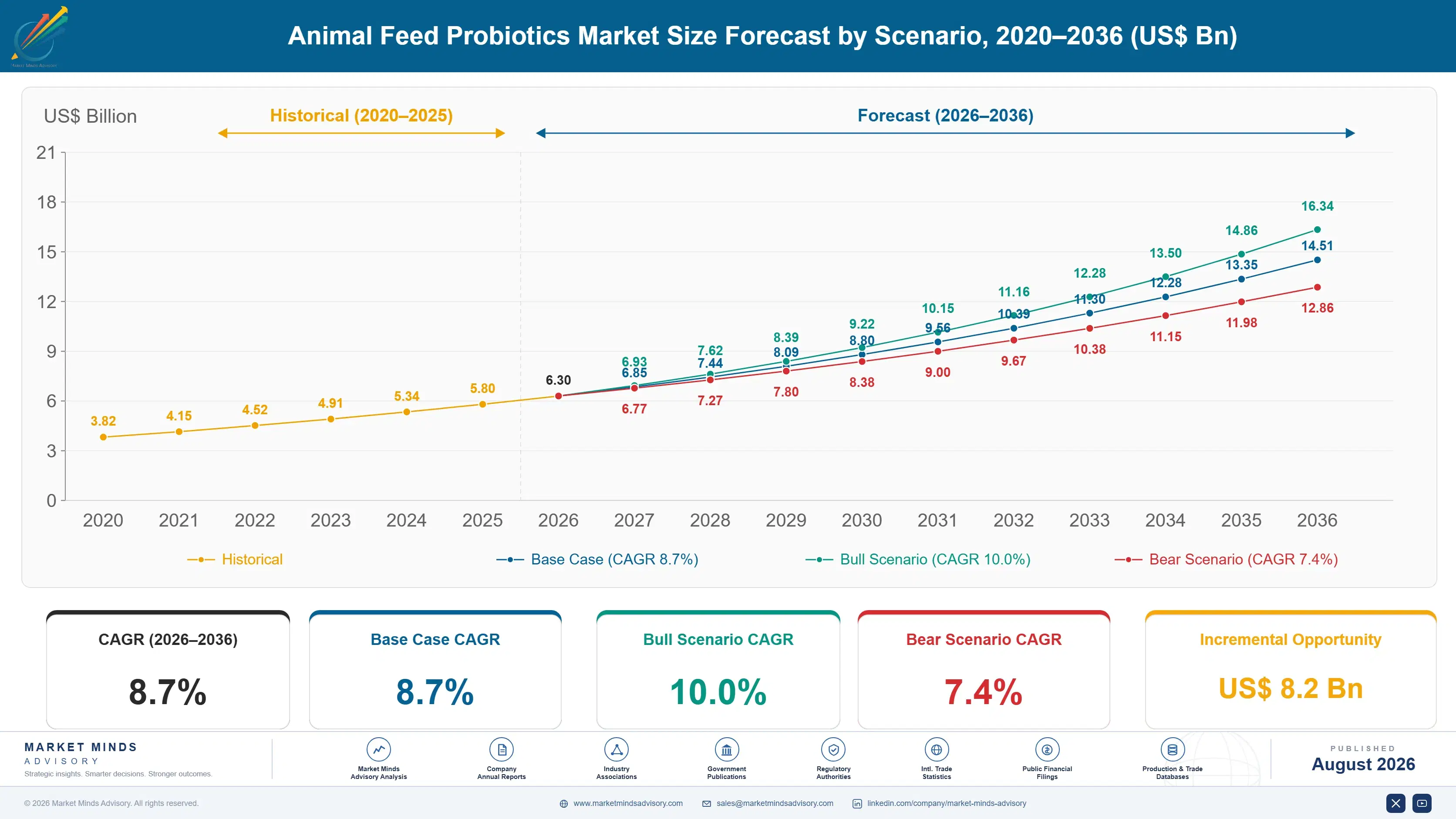
Animal Feed Probiotics Market Forecast Scenarios

animal-feed-probiotics-market-trends-size-forecast-scenario-1787462323156
The 2020 to 2025 period was dominated by one regulatory decision and its consequences. China removed antibiotic growth promoters from commercial feed in July 2020, and the world's largest livestock producer moved onto microbial alternatives within a season, pulling demand faster than authorised supply could follow. Chinese fermentation capacity scaled quickly to fill it. The 7.5% historical growth understates the disruption, because volume and pricing moved in opposite directions.
The 8.7% base case rests on three mechanisms. Antibiotic restriction keeps spreading through India, Brazil, Vietnam, and the Gulf, and every prohibition converts a category that cost pennies per tonne into one costing dollars. Strain-specific evidence keeps deepening, which lets suppliers defend pricing against genus-level substitution that would otherwise commoditise the category. And silage inoculant and dairy direct-fed microbial demand keeps growing steadily, insulated from monogastric cycles that drive most of the rest.
The 10.0% bull case assumes next-generation strains and postbiotic preparations close the performance gap left by withdrawn antibiotics, justifying materially higher inclusion and pricing. The 7.4% bear case reflects producer margin compression pushing integrators toward the cheapest authorised strain available, which would reward fermentation cost rather than evidence. Procurement discipline will decide which of those cases arrives.

Why Strain Dossiers Are the Asset

Three forces govern this market. Regulatory authorisation comes first, since a strain without clearance cannot be sold there at any price, and dossiers take years to assemble. Pelleting survival comes second, because feed conditioned above 80 degrees kills most vegetative organisms before they reach an animal. And evidence comes third, since genus and cell count predict very little about field performance.
TOP-FIVE CONCENTRATION38%Share of global feed probiotic supply held collectively
AVERAGE SELLING PRICE$24.60/kgBlended price across strain classes and carrier formats
PELLETING SURVIVAL RATE78%Viable cells retained through commercial conditioning and pelleting
AUTHORISED STRAIN COUNT112Distinct microbial strains cleared under European feed rules
DOSSIER APPROVAL TIMELINE38 monthsTypical duration from submission to European authorisation decision
TRADE INTENSITY44%Share of product crossing a border before final use
That produces commercial behaviour closer to pharmaceutical licensing than to feed ingredient supply. A supplier holding an authorised strain with genuine trial data has a position competitors cannot enter by building a fermenter, because the fermenter was never the barrier. Companies that acquired strain portfolios rather than capacity understood this earlier than most. Where a customer is genuinely choosing on colony forming units per gram, the supplier has already lost the argument that matters.
The next decade turns on whether evidence discipline holds. Procurement teams under margin pressure keep treating probiotics as a commodity defined by genus and count, and suppliers who allow it watch pricing collapse toward fermentation cost. The category's value depends on nutritionists buying strain-specific performance rather than microbial mass, and on regulators requiring strain-level authorisation that makes substitution legally difficult.
"A quotation comparing two Bacillus subtilis products on cell count is comparing two things that have nothing in common except a name. Buyers who understand that pay properly; buyers who do not eventually find out why."
Director, Feed Microbials and Gut Health Practice · MMA Animal Nutrition / Feed Microbials Practice · August 2026

Market Trends

Whole Genome Screening Raises the Authorisation Barrier Considerably

European authorities now expect whole genome sequencing for feed microbial strains, screening for antimicrobial resistance determinants, toxin genes, and mobile genetic elements before a strain can be cleared for use. That requirement has removed several legacy organisms from the market and made new submissions substantially more demanding to assemble. Established holders benefit twice over, since their portfolios are already cleared while new entrants face a slower and costlier route. The screening also gives credible suppliers a genuine safety argument that competitors selling unassessed strains in permissive jurisdictions cannot make. Renewal cycles now carry genuine risk for legacy portfolios.
Market Impact: Converts markets worth 8x value
Postbiotic Preparations Sidestep the Viability Problem Entirely

Inactivated cells and their fermentation metabolites deliver measurable gut and immune effects without needing to survive pelleting, storage, or gastric transit, which removes the single largest technical constraint on the live probiotic category. Manufacturers can therefore apply higher conditioning temperatures and hold longer shelf lives without protective coating systems. Regulatory classification differs by jurisdiction and remains unsettled in several markets, which complicates commercialisation. Suppliers are positioning postbiotics alongside live products rather than as replacements, because nutritionists remain unconvinced that the mechanisms are fully equivalent in practice. Live and inactivated products now sit side by side commercially.
Market Impact: Cuts dry matter loss 6%

Market Opportunities and Growth Drivers

Antibiotic Restriction Converts Cheap Categories Into Expensive Ones

China prohibited antibiotic growth promoters in commercial feed from July 2020, the European Union did so in 2006 under Regulation 1831/2003, and India, Brazil, Vietnam, and several Gulf states have introduced partial restrictions since. Each prohibition replaces a product costing pennies per tonne of feed with microbial alternatives costing several dollars, which is why this market grows considerably faster than livestock numbers do. Suppliers holding authorised strains when a prohibition lands capture that conversion, while those arriving afterwards compete on price into programmes already established. Timing the registration matters more than the product itself often does.
Market Impact: Destroys 22% of applied cells

Silage Inoculants Grow Independently of Monogastric Cycles

Lactobacillus buchneri and plantarum inoculants applied at ensiling improve fermentation quality, reduce dry matter loss, and extend aerobic stability at the feed-out face, and dairy and beef producers buy them on forage economics rather than on gut health arguments. The demand cycle follows forage harvest and herd size rather than poultry or swine margins, which gives suppliers useful counter-cyclical balance. Adoption keeps rising as producers quantify dry matter losses they previously accepted. Application equipment and dosing accuracy matter as much as strain selection in delivering the claimed result. Nothing in monogastric demand behaves anything like this predictably.
Market Impact: Cuts realised pricing 30%

Market Restraints and Challenges

Pelleting Temperatures Destroy Most Vegetative Organisms Outright

Commercial feed conditioning runs above 80 degrees Celsius under steam and pressure, and most lactic acid bacteria and yeast lose the majority of viability within seconds of exposure. The root cause is that conditioning exists to improve pellet quality and reduce pathogen load, so temperatures cannot simply be lowered without losing both. Spore-forming Bacillus strains survive because sporulation is a biological defence against exactly these conditions. Responses include protective coating and microencapsulation, post-pellet liquid application through vacuum coaters, and reformulating toward postbiotic preparations that carry no viability requirement. None of those responses is free, and mills notice.
Market Impact: Extends approval to 38 months

Genus-Level Procurement Erodes Strain-Specific Pricing Power

Procurement teams under margin pressure increasingly tender probiotics on genus and colony forming units per gram, treating a documented strain and an unassessed one as interchangeable line items. The root cause is that the difference is invisible on a specification sheet and only appears in flock or herd performance months later. Commercially this pushes pricing toward fermentation cost and rewards producers who invested in capacity rather than evidence. Suppliers counter by publishing strain-specific field data, by contracting on measured outcomes, and by declining tenders written on genus alone. Losing such a tender costs less than winning it badly.
Market Impact: Removes 22% viability loss
3 additional market trends, 2 additional growth drivers, and 4 additional restraints and challenges are covered in the full report. Contact sales@marketmindsadvisory.com to access the complete intelligence.

Segment CAGR and Growth Architecture

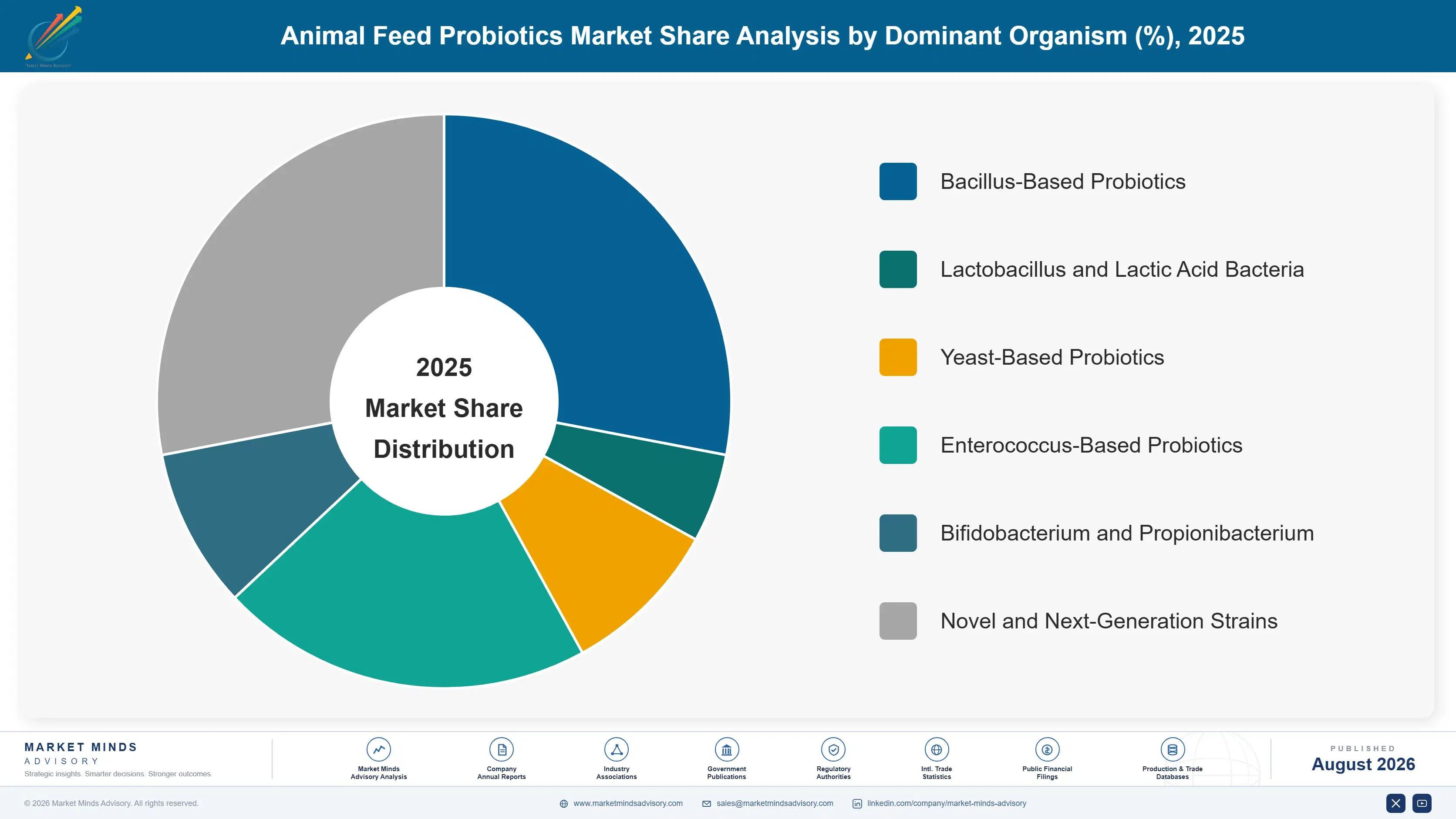
Segmentation follows dominant organism, the single biological logic that determines pelleting survival, regulatory pathway, mode of action, and which production problem the product addresses. Organism decides whether a strain can reach the animal alive and what evidence a regulator will demand. Target species, application method, and channel structure appear separately in the framework as commercial dimensions.
animal-feed-probiotics-market-trends-market-share-analysis-1787462323691

Novel and Next-Generation Strains

This segment covers organisms outside the established genera, including Clostridium butyricum, Megasphaera elsdenii, Akkermansia, and strains selected through microbiome sequencing rather than from historical culture collections. Growth of 14.2%, roughly 1.63 times the market, comes off a small base and reflects a genuine search for mechanisms the incumbent organisms do not provide. Clostridium butyricum has commercial traction in Asian poultry and swine production, and Megasphaera addresses rumen acidosis in ways lactic acid bacteria cannot. The obstacle is regulatory: novel organisms face the fullest authorisation burden including whole genome screening, and several promising candidates remain confined to permissive jurisdictions while European dossiers work through assessment. European assessment timelines will decide how quickly this segment scales.
CAGR 14.2%

Bacillus-Based Probiotics

Bacillus dominates commercial supply for one unglamorous reason: spores survive pelleting when almost nothing else does. Conditioning above 80 degrees Celsius destroys most vegetative organisms, and sporulation evolved precisely as a defence against heat and desiccation, which makes Bacillus subtilis, licheniformis, and amyloliquefaciens the default choice for any mill unwilling to install post-pellet application equipment. Growth of 9.4% tracks antibiotic replacement demand directly. Laboratory challenge work frequently favours other genera, and that gap between in vitro performance and delivered viability is the central commercial irony of the category. Strain differentiation within Bacillus is substantial but poorly understood by procurement teams buying on cell count. That misunderstanding is the segment's principal commercial vulnerability.
CAGR 9.4%
Full segment breakdown across 6 segments available in the complete report.

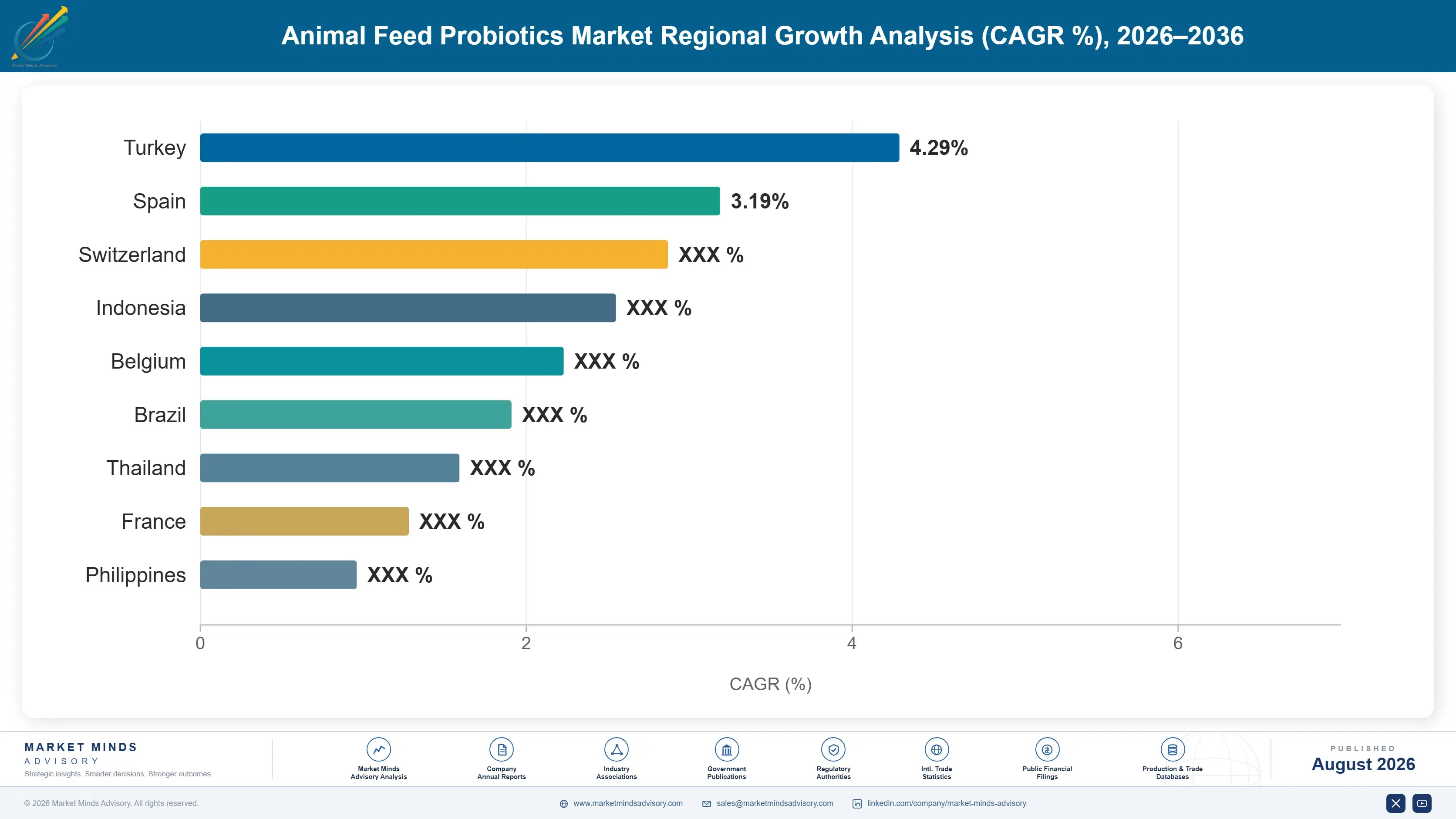
Regional Architecture and Country Demand Map

East Asia holds the largest share at 30%, driven by the Chinese antibiotic prohibition that converted the world's biggest livestock market to microbial alternatives within one season. South Asia and Pacific grows fastest, while Western Europe sets the regulatory standard others follow. Latin America follows export requirements.

North America

Regulatory treatment here differs sharply from Europe and shapes the whole competitive structure. Direct-fed microbials are handled through an ingredient definition process rather than through strain-specific authorisation, which lowers the barrier to market entry considerably and puts more weight on commercial evidence than on regulatory clearance. Poultry integrators across Georgia, Arkansas, and Alabama buy on documented flock performance, and several large processors reversed strict antibiotic-free commitments from 2023, softening demand for the most intensive programmes. Dairy direct-fed microbials and silage inoculants form a substantial and stable base across the Midwest. Regional growth of 8.0% reflects a mature market with unusually open access. Evidence, not authorisation, decides who wins accounts in this region.
Share: 23% | CAGR: 8.0% (2026 to 2036)

Western Europe

Europe operates the strictest feed microbial regime anywhere and consequently sets the standard the rest of the world eventually copies. Authorisation under Regulation 1831/2003 requires species and strain-specific dossiers, whole genome screening for resistance determinants, and periodic renewal, with only 112 strains currently cleared across all target species. That regime protects incumbents and slows entry, which suits established holders. Antibiotic growth promoters were removed here in 2006, so alternative practice is two decades deep and combination programmes are routine rather than novel. Danish, Dutch, and German swine production generates much of the applied evidence others cite. Growth of 7.1% reflects saturation rather than weakness. Renewal obligations catch out suppliers who stopped investing.
Share: 19% | CAGR: 7.1% (2026 to 2036)
Regional intelligence for 5 additional markets available in the complete report: East Asia, South Asia and Pacific, Latin America, Middle East and Africa, Eastern Europe. Contact sales@marketmindsadvisory.com.
animal-feed-probiotics-market-trends-country-cagr-analysis-1787462324214

Where Feed Probiotic Margin Actually Sits

Selling colony forming units per gram against a Chinese fermentation producer is a position that ends one way. The four moves below shift revenue toward things a competitor cannot replicate by building capacity: authorised strain portfolios, delivered viability evidence, silage and ruminant positions insulated from monogastric cycles, and outcome contracting that filters buyers by seriousness.

Acquire Authorised Strains Rather Than Fermentation Capacity

A European authorisation dossier takes around 38 months and costs roughly $2.8 million per strain and species combination, which is why only 112 strains hold clearance across all target species. Buying or licensing cleared strains delivers market access that no amount of fermentation investment provides, and the portfolio compounds because each additional species extension leverages existing safety data. Companies that acquired strain portfolios rather than plants during the past decade now hold positions competitors cannot enter, whatever capacity they build or however cheaply they run it. Regulatory affairs capacity, not capital, is usually the binding constraint.
Market Impact: Secures market access worth roughly 38 months each

Publish Delivered Viability, Not Manufactured Cell Count

Every supplier quotes colony forming units at manufacture, and every experienced nutritionist knows that number bears limited relation to what survives conditioning at 85 degrees and six months of storage. Publishing verified delivered viability across common mill configurations costs perhaps $400,000 and reframes the comparison entirely, since competitors quoting manufacture figures cannot answer it. Suppliers who did this report closing at 18% to 25% better pricing, because the conversation shifts from price per kilogram toward viable cells actually reaching the animal. Honest numbers turn out to be commercially useful, which surprises people.
Market Impact: Closes at 18 to 25% better pricing levels

Build Silage and Ruminant Positions Outside Monogastric Cycles

Silage inoculants and dairy direct-fed microbials follow forage harvest and herd size rather than poultry and swine margins, which gives a supplier genuinely counter-cyclical revenue when broiler economics turn against additive spend. Producers buy on dry matter loss reduction of around 6% and on aerobic stability, both of which they can measure at the feed-out face themselves. Application equipment and dosing accuracy matter as much as strain choice, so suppliers providing both capture more of the value than those shipping product alone. Forage economics are visible to a farmer without any supplier involvement.
Market Impact: Cuts forage dry matter losses by roughly 6%

Decline Tenders Written on Genus and Cell Count

Every tender specifying only genus and colony forming units invites comparison against unassessed strains from producers who invested in capacity rather than evidence, and participating in those tenders trains customers to believe the products are equivalent. Declining them costs volume in the short term and protects pricing across the remaining book. Suppliers who hold the line report realised pricing roughly 30% above those who compete on genus terms, and procurement teams generally rewrite specifications once performance differences appear in production data. Two or three production cycles usually settle the argument for good.
Market Impact: Protects realised pricing roughly 30% above genus tenders

Who Controls the Margin Pool

The top five hold roughly 38% of supply, measured consistently as feed probiotic product revenue at supplier level. Novonesis, Lallemand, and dsm-firmenich hold the deepest authorised strain portfolios, while Alltech and Kemin compete through species-specific evidence and technical service reach. Concentration reflects regulatory and evidential barriers rather than manufacturing scale, since fermentation capacity itself is widely available and increasingly cheap.
Competition runs along three lines. Strain portfolio depth is the first, since authorisation determines where a product may legally be sold and dossiers take years to assemble. Delivered viability engineering is the second, covering sporulation selection, protective coating, and post-pellet application systems. The third is field evidence, particularly species and production-system specific data that lets a supplier resist tenders written on genus and cell count alone.

Two pressures will reshape positions. Chinese fermentation producers scaled rapidly after the 2020 prohibition and now export standard Bacillus at delivered costs multinationals cannot match, compressing the commodity tier. Meanwhile novel organisms and postbiotic preparations are opening technical contests that established authorisation portfolios do not automatically win. The exposed position is a mid-sized supplier holding a few legacy strains, selling on cell count, without novel candidates in the regulatory pipeline.
animal-feed-probiotics-market-trends-company-positioning-matrix-1787462324728

Competitive Moat and Risk Dimensions

NOVONESIS

Moat: Strain Library and Regulatory Portfolio

The company holds one of the deepest collections of authorised feed microbial strains alongside decades of strain development capability, which lets it extend into new species and jurisdictions using safety data already assembled. That regulatory position is worth more than fermentation scale, because a competitor builds a plant far faster than a dossier. Each additional authorisation compounds the advantage further.
NOVONESIS

Risk: Commodity Tier Cost Exposure

Standard Bacillus products face Chinese fermentation producers competing on delivered cost across Asian and increasingly Latin American markets, and that tier represents meaningful volume. Defending it consumes commercial attention better spent on novel strains and evidence programmes. Where procurement tenders on genus and cell count, regulatory depth earns nothing and the price comparison proceeds regardless.
LALLEMAND ANIMAL NUTRITION

Moat: Silage and Ruminant Specialisation

Lallemand built unusually deep positions in silage inoculants and ruminant direct-fed microbials, categories driven by forage economics and herd size rather than by monogastric margin cycles. That gives genuinely counter-cyclical revenue when poultry and swine producers cut additive spend. The application and dosing equipment supplied alongside product also embeds the company in on-farm practice competitors cannot easily displace.
LALLEMAND ANIMAL NUTRITION

Risk: Limited Monogastric Scale

The strongest positions sit in ruminant and forage applications while the largest growth pool is monogastric demand created by antibiotic prohibition across Asia. Competing there means facing suppliers with deeper poultry and swine trial datasets and broader integrator relationships. Building equivalent evidence takes years of commercial trials that the ruminant business does not generate as a by-product.

Players Tracked

Prominent Players

Novonesis
Lallemand Animal Nutrition
dsm-firmenich
Alltech
Kemin Industries

Other Key Players

Evonik Industries
Adisseo
Cargill
Archer Daniels Midland
Land O'Lakes
Asahi Biocycle
Bioproton
Provita Supplements
Lactosan
Vland Biotech
Sunson Industry Group
Huvepharma
Biochem Zusatzstoffe
Nutreco
Phileo by Lesaffre

Recent Developments

FEBRUARY 2025

European authorities tighten genome screening expectations for feed strains

European feed additive assessment continued raising expectations on whole genome sequencing for microbial strains, focusing on antimicrobial resistance determinants and mobile genetic elements. Several legacy organisms were withdrawn or not renewed, while new submissions faced longer assessment as applicants assembled the additional molecular characterisation now required.
Signal: Regulatory tightening now protects incumbent strain holders far more effectively than any patent position could achieve.
SEPTEMBER 2024

Chinese producers expand Bacillus export capacity across Asian markets

Chinese fermentation producers extended Bacillus manufacturing capacity aimed at export into Southeast Asian and Latin American feed markets, building on scale established after the 2020 domestic antibiotic prohibition. Delivered pricing on standard spore products softened across several regional tenders during the following quarters as a result.
Signal: Commodity Bacillus pricing is now set in China regardless of where the product is eventually consumed.
JUNE 2025

Lallemand extends silage inoculant range and application support

Lallemand broadened its silage inoculant portfolio alongside application equipment and dosing support for dairy and beef producers, targeting dry matter loss reduction and aerobic stability at the feed-out face. The offering pairs strain supply with the equipment accuracy that determines whether claimed results are actually achieved on farm.
Signal: Selling application accuracy alongside strains captures value that shipping the product alone consistently leaves behind on farm.

Fermentation Substrate, Drying, and Carriers

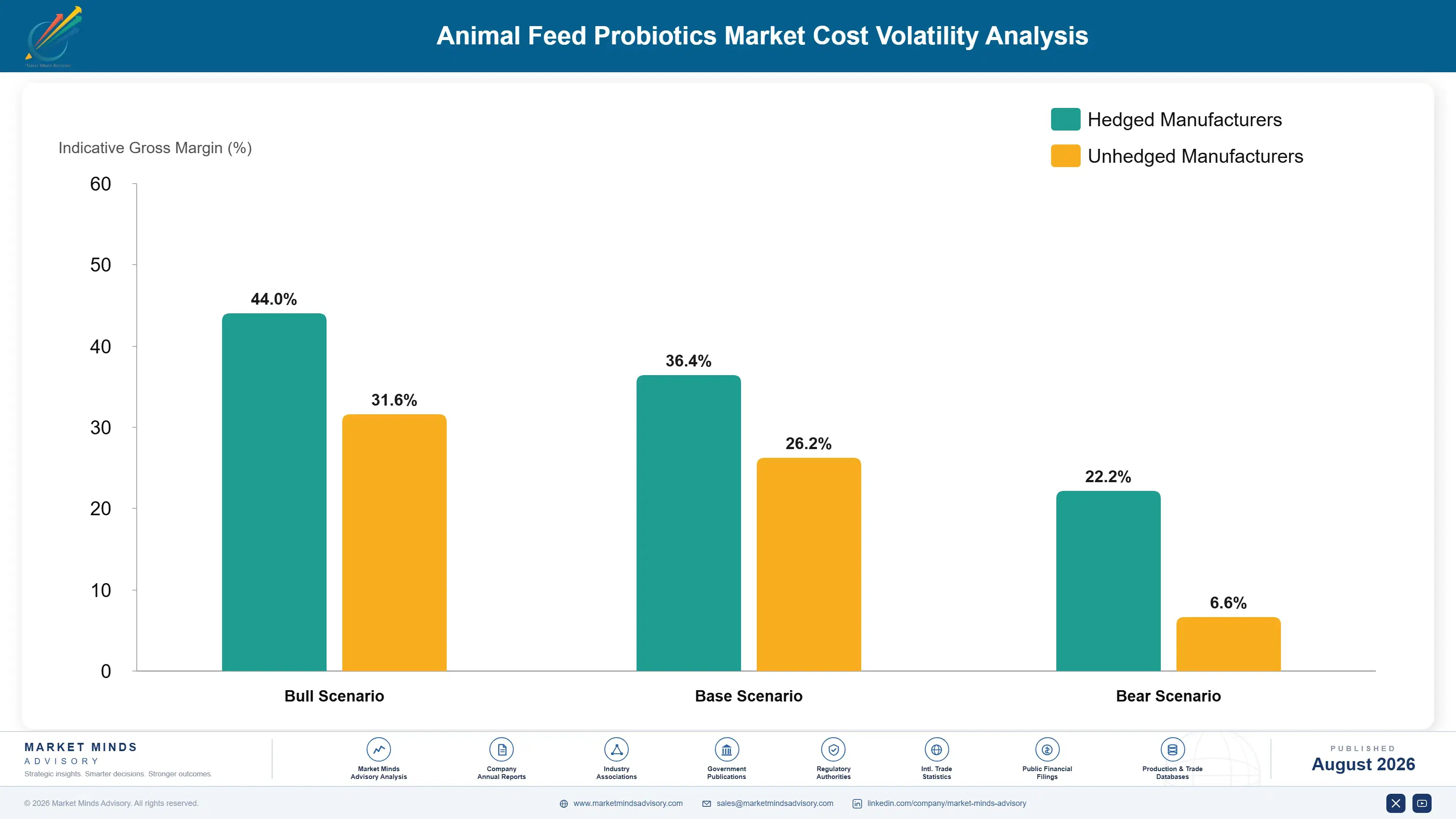
Fermentation substrate, principally glucose syrup and corn steep liquor, accounts for roughly 29% of cost, sourced from starch processors in the United States, China, and Europe. Energy for fermentation, sterilisation, and drying takes a further 23%, since freeze and spray drying both carry heavy loads. Carriers, protective coating, packaging, and routine viability testing absorb most of the remaining balance.
European industrial energy prices rose steeply through 2022 and 2023 according to IEA reporting, and microbial producers felt it acutely because sterilisation and drying cannot be reduced without compromising viability. Corn and glucose syrup pricing moved sharply through the same window under Black Sea disruption, so substrate and energy inflated together. Novonesis predecessor entities and Evonik both referenced input cost pressure in the period, and several smaller European producers reduced output rather than run negative.

Exposure divides on plant location and product format rather than on company size. Liquid and paste formats skip drying and carry lower energy intensity, advantaging suppliers whose customers apply post-pelleting or through water. Freeze-dried and coated spore products carry the heaviest processing load. Chinese producers, on cheaper power beside substrate supply, held delivered cost advantage and built the export positions now visible across Asian tenders.
animal-feed-probiotics-market-trends-cost-volatility-analysis-1787462324925

Site fermentation against long-term energy and substrate proximity

Microbial production economics are dominated by power and starch-derived substrate, so plant location decides competitiveness for decades rather than seasons. Proximity to corn wet milling and cheap baseload electricity outweighs proximity to customers, since concentrated product ships cheaply. Several European producers learned that expensively after 2022 and have since shifted volume toward Asian and American assets.

Shift format mix toward liquid and water-soluble application

Liquid and paste formats avoid freeze and spray drying, removing the heaviest energy steps while delivering better viability to the animal. Where customers apply post-pelleting or through drinking water lines, liquid formats cost less to produce and perform better simultaneously. Encouraging that application shift improves supplier margin and customer outcome at the same time, which is unusually aligned.

Contract substrate aggregate volume across fermentation product lines

Glucose syrup and corn steep liquor pricing follows grain markets, and producers running several fermentation lines can contract combined annual volume rather than negotiating product by product. Starch processors price committed tonnage materially better than spot purchasing. The approach also smooths exposure when one product line runs soft, which happens whenever producer margins compress and dosing rates fall.

Portfolio Architecture for Margin Defence

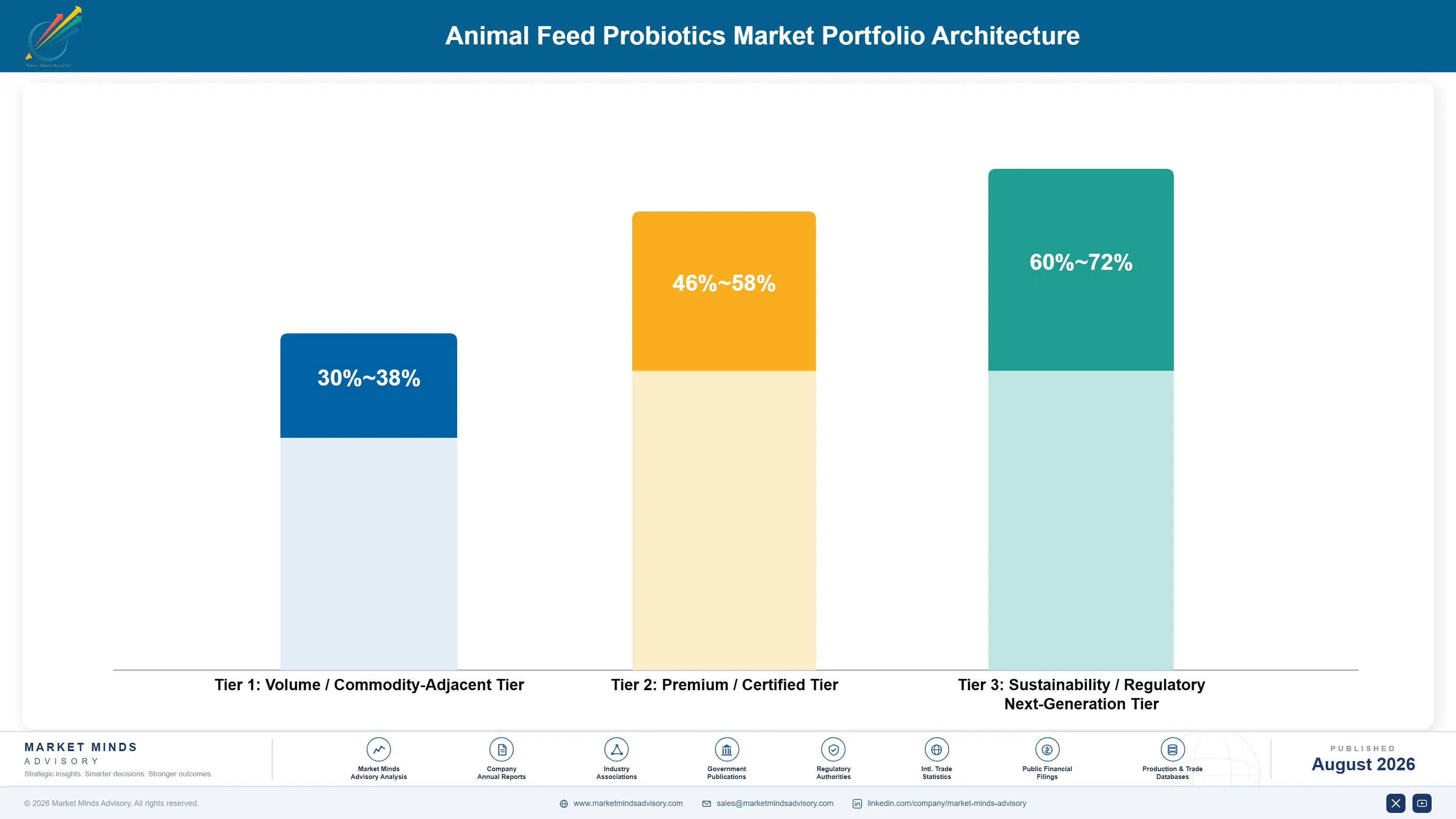
Three tiers separate on regulatory and evidential position rather than on organism. Standard Bacillus and yeast products sold on genus and cell count earn 30% to 38%, competing against Chinese fermentation output on delivered cost alone. Authorised strains carrying species-specific field evidence earn 46% to 58%, because the nutritionist is buying documented performance rather than microbial mass. Novel organisms and postbiotic preparations earn most of all, and that gap keeps widening as commodity pricing falls.
The tension is that commodity volume funds the dossiers. Standard products keep fermentation assets loaded and generate the cash that pays for authorisation submissions costing around $2.8 million per strain and species combination, yet defending them against Chinese delivered cost consumes commercial attention worth far more elsewhere. Several suppliers have quietly conceded commodity Bacillus in Asian tenders while holding evidence-backed and novel positions, which looks like retreat and is closer to portfolio discipline.

High-value pools sit where the buyer cannot verify the difference independently. Strain-specific performance, novel mechanisms, and silage results measured at the feed-out face all require evidence or application support that an integrator cannot generate alone, which is exactly why those positions resist genus-level price comparison.

Volume / Commodity-Adjacent Tier

Standard Bacillus spore products and commodity yeast preparations sold on declared genus and colony forming units into price-led tenders. Competes against Chinese fermentation output. The wide range reflects large differences in plant energy cost and fermentation scale.
Gross Margin: 30%-38%

Premium / Certified Tier

Authorised strains supported by species-specific commercial trial data, delivered viability documentation, and full regulatory dossiers. Nutritionists pay for documented performance. Range width separates single-species evidence from multi-species validated portfolios within this tier.
Gross Margin: 46%-58%

Sustainability / Regulatory / Next-Generation Tier

Novel organisms, postbiotic preparations, and outcome-contracted supply arrangements addressing mechanisms incumbent genera do not provide. Regulatory position and evidence ownership, rather than production economics, sustain the margin structure across this tier.
Gross Margin: 60%-72%
animal-feed-probiotics-market-trends-portfolio-architecture-1787462325428

High-value Sub-segments and Strategic Watch-out

Novel and Next-Generation Strains

Highest value and fastest growth at 14.2%, addressing mechanisms that Bacillus and lactic acid bacteria do not provide. Regulatory burden is the barrier rather than the science. Early authorisation holders will face little competition for several years afterwards. Regulatory timelines set the pace, not the science.
Gross Margin: 62%-72%

Silage and Ruminant Direct-Fed Microbials

High value with steady growth, driven by forage economics and herd size rather than by monogastric margin cycles. Producers measure dry matter loss themselves at the feed-out face. Application equipment supply captures value that shipping product alone leaves behind. Cycles here do not follow broiler margins.
Gross Margin: 48%-58%

Standard Bacillus Spore Products

The volume core, protected by antibiotic prohibition but fully exposed to Chinese delivered cost on the product itself. It loads fermentation assets and funds the authorisation dossiers, which is the honest commercial reason to retain the position. Fund the dossiers with it and expect nothing else.
Gross Margin: 28%-36%

Vegetative Lactic Acid Bacteria for Pelleted Feed

The strategic watch-out. Conditioning above 80 degrees destroys most viability before the animal receives anything, and protective coating adds cost without fully solving it. Redirect these strains toward water application, silage, or postbiotic formats instead. Protective coating adds cost without ever solving the underlying problem properly.
Gross Margin: 32%-44%

Why Approved Strains Rarely Change

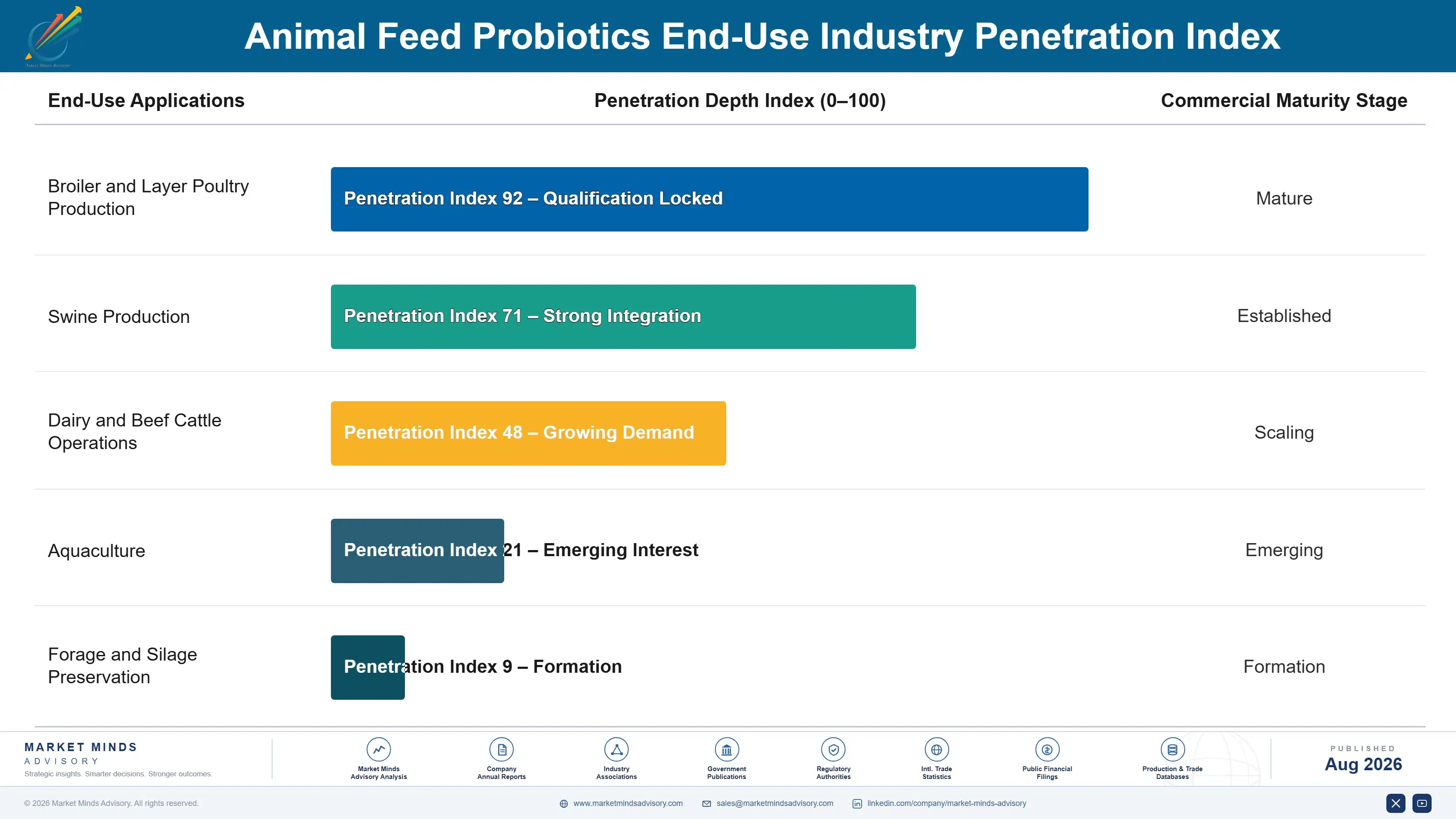
Probiotic revenue behaves as an annuity once a strain enters an integrator's standard programme. Nutritionists validate an organism across trial flocks, then commercial production, then a full year covering seasonal variation, and having done that work they leave it alone unless something forces reconsideration. Typical programme tenure runs five to eight years, and the trial investment behind the original win, largely funded by the supplier, is what buys that period of steady monthly volume without renegotiation.
Stickiness varies considerably by position. Strains authorised in the customer's jurisdiction and validated in their own production system are the most durable, since substitution requires both regulatory equivalence and fresh trial work nobody wants to fund. Silage and ruminant positions come next, protected by application equipment and on-farm routine. Standard Bacillus sold on cell count is the least sticky of all, retendered annually on genus and delivered price with essentially no attachment to the incumbent supplier.

Buyer profiles have shifted noticeably. Veterinarians and quality teams now attend supplier reviews alongside nutritionists, and questions about antimicrobial resistance gene screening and strain deposit documentation arrive before pricing does. Deposit numbers and authorisation references are now routinely written into supply specifications.
animal-feed-probiotics-market-trends-end-use-penetration-index-1787462325925

Where Probiotic Capital Should Go

These are among the four positions where our research anticipates prominent divergence between winners and laggards over the coming forecast period. Each is grounded in the demand model, the regulatory perimeter, and the announced capacity pipeline.
01 / STRAIN PORTFOLIO ACQUISITION

Buy authorised strains, not another fermentation plant

A European dossier takes around 38 months and roughly $2.8 million per strain and species combination, which is exactly why only 112 strains currently hold clearance across all target species in the bloc. Acquiring or licensing cleared organisms delivers market access that no amount of fermentation investment ever provides, and each additional species extension leverages safety data already assembled. Companies that bought strain portfolios rather than capacity over the past decade now hold positions competitors cannot enter at any price.
02 / DELIVERED VIABILITY TRANSPARENCY

Publish what survives the pellet mill, not what leaves yours

Almost every supplier quotes colony forming units at the point of manufacture and every experienced nutritionist knows that figure bears limited relation to what survives conditioning at 85 degrees followed by six months of warehouse storage. Publishing verified delivered viability across common mill configurations costs perhaps $400,000 and reframes the comparison entirely, because competitors quoting manufacture figures have no credible answer available at all. Suppliers who have done this report closing at 18% to 25% better pricing on exactly the same underlying product.
03 / COUNTER-CYCLICAL RUMINANT POSITION

Build silage and dairy revenue outside monogastric margin cycles

Silage inoculants and ruminant direct-fed microbials follow forage harvest and herd size rather than broiler and hog margins, which supplies genuinely counter-cyclical revenue precisely when poultry producers are cutting their additive spend hardest of all. Producers buy on dry matter loss reduction around 6% and aerobic stability, both of which are measurable at the feed-out face without any supplier involvement. Application equipment and dosing accuracy determine whether claimed results appear, so suppliers providing both capture materially more of the value that is created.
04 / GENUS TENDER DISCIPLINE

Refuse tenders that treat documented strains as interchangeable

Every tender specifying only genus and colony forming units invites direct comparison against unassessed organisms from producers who invested in capacity rather than in evidence, and bidding into them teaches customers that the products are equivalent when they demonstrably are not at all. Declining costs volume immediately and protects realised pricing roughly 30% higher across the remaining book. Procurement teams generally rewrite specifications once performance differences show up in production data, which they reliably do within two or three production cycles.

Engagement Snapshot From the Field

A live engagement with an industry participant carrying material or product regulatory and market exposure ahead of a defining policy shift, showing how our research translates into a defensible multi-year portfolio strategy.
MARKET MINDS ADVISORY · CLIENT ENGAGEMENT SUMMARY
Animal Feed Probiotics Producer Strategic Portfolio Review and Transition Roadmap 2026·Investment Scenario on Animal Feed Probiotics Exposure Evaluation 2025-26
CLIENT PROFILE
A European feed microbial producer operating two fermentation plants and supplying Bacillus and lactic acid bacteria products across fourteen countries, with annual revenue near EUR 96 million (client-reported, unverified by MMA). Around 71% of volume was standard Bacillus sold into poultry and swine feed tenders written on genus and colony forming units, with a small silage inoculant business and no novel strain candidates in regulatory assessment.
STRATEGIC CHALLENGE
Realised pricing on standard Bacillus had fallen 27% across three years as Chinese exporters entered European and Middle Eastern tenders, energy costs at both plants had risen sharply, and two of five authorised strains were approaching renewal with genome screening requirements the company had not yet addressed. Management was considering a third fermentation plant to compete on scale.
MMA APPROACH
MMA rebuilt margin by product, customer, and tender type, separating volume won on evidence from volume won on price. Chinese delivered cost was benchmarked against internal production economics under three energy scenarios. Strain renewal requirements were assessed alongside the cost and timeline of licensing novel organisms, and silage expansion was sized, with findings tested through 47 expert interviews during Q4 2025.
KEY FINDINGS
  1. No achievable plant scale closed the delivered cost gap against Chinese Bacillus, because the difference was electricity tariff and substrate proximity rather than fermentation efficiency.
  2. Volume won on documented strain evidence carried gross margin of 51% against 29% for genus-based tenders, yet represented only 22% of total tonnage across the book.
  3. Both strains approaching renewal required additional genome characterisation costing an estimated EUR 1.4 million combined, well below the value of the authorisations they protected.
  4. The silage business generated the group's highest margins and its most stable volume, yet received under 5% of commercial resource and no dedicated technical support at all.
CLIENT PROFILE
A European feed microbial producer operating two fermentation plants and supplying Bacillus and lactic acid bacteria products across fourteen countries, with annual revenue near EUR 96 million (client-reported, unverified by MMA). Around 71% of volume was standard Bacillus sold into poultry and swine feed tenders written on genus and colony forming units, with a small silage inoculant business and no novel strain candidates in regulatory assessment.
STRATEGIC CHALLENGE
Realised pricing on standard Bacillus had fallen 27% across three years as Chinese exporters entered European and Middle Eastern tenders, energy costs at both plants had risen sharply, and two of five authorised strains were approaching renewal with genome screening requirements the company had not yet addressed. Management was considering a third fermentation plant to compete on scale.
MMA APPROACH
MMA rebuilt margin by product, customer, and tender type, separating volume won on evidence from volume won on price. Chinese delivered cost was benchmarked against internal production economics under three energy scenarios. Strain renewal requirements were assessed alongside the cost and timeline of licensing novel organisms, and silage expansion was sized, with findings tested through 47 expert interviews during Q4 2025.
KEY FINDINGS
  1. No achievable plant scale closed the delivered cost gap against Chinese Bacillus, because the difference was electricity tariff and substrate proximity rather than fermentation efficiency.
  2. Volume won on documented strain evidence carried gross margin of 51% against 29% for genus-based tenders, yet represented only 22% of total tonnage across the book.
  3. Both strains approaching renewal required additional genome characterisation costing an estimated EUR 1.4 million combined, well below the value of the authorisations they protected.
  4. The silage business generated the group's highest margins and its most stable volume, yet received under 5% of commercial resource and no dedicated technical support at all.
RECOMMENDED STRATEGY
Phase 1: Phase 1 (months one to five): withdraw from genus-based tenders in three markets and complete genome characterisation for both renewing strains immediately. Phase 2: Phase 2 (months six to sixteen): redirect commercial resource toward silage and evidence-backed monogastric volume, and license one novel organism for European assessment. Phase 3: Phase 3 (months seventeen to thirty): publish delivered viability data across common mill configurations and reprice the evidence-backed portfolio accordingly.
OUTCOME
The producer withdrew from three markets and reported blended gross margin improving from 33% to 44% within fifteen months on 14% lower volume (client-reported, unverified by MMA). Both strain renewals completed. The silage business grew 31% with dedicated resource, and the novel strain dossier was submitted.

Frequently Asked Questions

Foundational context covering the market sizes, CAGR, scope, country, region and competition that inform every finding below. This section is provided to cover basics and most often pre-purchase conversations, answered from the MMA Primary Research Dataset.

What is the current size of the Animal Feed Probiotics Market?

The market was valued at USD 5.8 billion in 2025, rising to an estimated USD 6.3 billion in 2026. East Asia holds the largest regional share at 30% of global value.

How large will the Animal Feed Probiotics Market be by 2036?

MMA forecasts USD 14.5 billion by 2036 under the base case, an expansion multiple of 2.30 times the 2026 level. Incremental value creation across the period reaches USD 8.2 billion.

What is the CAGR for the Animal Feed Probiotics Market 2026 to 2036?

The base case CAGR is 8.7%, with a bull case of 10.0% and a bear case of 7.4%. Historical growth between 2020 and 2025 ran at 7.5% following the Chinese antibiotic prohibition.

Which segment is growing fastest?

Novel and next-generation strains, at 14.2%, roughly 1.63 times the overall market rate. They address mechanisms that established genera do not provide, though regulatory burden constrains rollout.

Who are the major companies in the Animal Feed Probiotics Market?

Novonesis, Lallemand Animal Nutrition, dsm-firmenich, Alltech, and Kemin Industries lead, holding roughly 38% of supply between them. Vland Biotech and Sunson follow with Asian positions.

Which country is growing fastest?

Vietnam, at 11.6%, driven by tightening antibiotic restrictions alongside rapid commercial poultry and swine expansion. Export market requirements constrain antibiotic use more tightly than domestic rules.

Report Segmentation Architecture

The full report scope spans multiple orthogonal segmentation dimensions, with cross-tabulated demand data provided for each dimension pair. Coverage extends further to regional breakdowns, trend trajectories, and the competitive detail needed to support segment-level decision-making.

By Dominant Organism

  • Bacillus-Based Probiotics
  • Lactobacillus and Lactic Acid Bacteria
  • Yeast-Based Probiotics
  • Enterococcus-Based Probiotics
  • Bifidobacterium and Propionibacterium
  • Novel and Next-Generation Strains

By End-Use Industry

  • Broiler and Layer Poultry Production
  • Swine Production
  • Dairy and Beef Cattle Operations
  • Aquaculture
  • Forage and Silage Preservation

By Commercial Dimension

  • Integrated Producer Direct Supply
  • Feed Mill and Premix Channel
  • Veterinary and Distributor Networks
  • On-Farm and Water Application Sales

By Region

  • North America
  • Western Europe
  • East Asia
  • South Asia and Pacific
  • Latin America
  • Middle East and Africa
  • Eastern Europe

Scope, Methodology, and Coverage

Every figure in this report is reproducible from documented input assumptions. The scope below maps the historical period, the forecast horizon, the segmentation dimensions, and the countries covered, alongside the underlying primary and qualitative methodology.
Historical Period
2020 to 2025
Forecast Period
2026 to 2036
Base Year
2025 (USD billions; MMA Primary Research Dataset, August 2026)
Market Definition
The market comprises live and inactivated microbial preparations supplied for inclusion in animal feed, drinking water, and forage preservation, covering Bacillus, lactic acid bacteria, yeast, Enterococcus, Bifidobacterium and Propionibacterium, and novel and next-generation strains. Value is measured at product level as sold to feed mills, premix operators, integrators, distributors, and farms. Feed enzymes, prebiotics and oligosaccharides, organic acids, phytogenics, and probiotics formulated for human or companion animal consumption fall outside scope.
Quantitative Units
USD billions (current prices); tonnes of product; USD per kilogram average selling price
Segmentation Dimensions
By Dominant Organism; By End-Use Industry; By Commercial Dimension; By Region
Regions Covered
North America, Western Europe, East Asia, South Asia and Pacific, Latin America, Middle East and Africa, Eastern Europe
Countries Covered
USA, China, Germany, France, UK, Japan, South Korea, India, Australia, Canada, Brazil, Mexico, Indonesia, Vietnam, Thailand, Malaysia, UAE, Saudi Arabia, South Africa, Nigeria, Turkey, Poland, Netherlands, Italy, Spain, Sweden, Switzerland, Argentina, Colombia, Singapore, and additional markets relevant to this sector
Key Companies Profiled
Novonesis, Lallemand Animal Nutrition, dsm-firmenich, Alltech, Kemin Industries, Evonik Industries, Adisseo, Cargill, Archer Daniels Midland, Land O'Lakes, Asahi Biocycle, Bioproton, Provita Supplements, Lactosan, Vland Biotech, Sunson Industry Group, Huvepharma, Biochem Zusatzstoffe, Nutreco, Phileo by Lesaffre
Quantitative Methodology
Primary survey, n=3,800 respondents, Q4 2025, six countries; demand-side model with trade association cross-validation
Qualitative Methodology
47 expert interviews, Q4 2025; applied to validate demand model assumptions, identify emerging dynamics, and assess competitive positioning
Report Format
PDF and XLSX data workbook (Word format preview document)
Publisher
Market Minds Advisory
Report Code
MMA-2026-AGR-158
Published
August 2026
Contact
sales@marketmindsadvisory.com | www.marketmindsadvisory.com

Purchase the full Animal Feed Probiotics Market Report (2026 to 2036).

The full report sizes feed probiotic demand across six organism groups and seven regions with 2026 to 2036 forecasts under base, bull, and bear cases. It maps strain authorisation status by jurisdiction and quantifies how regulatory position rather than fermentation capacity determines addressable market. Competitive profiles cover twenty suppliers assessed consistently on feed probiotic revenue, authorised strain portfolio, and evidence depth. Viability modelling traces delivered cell counts across common conditioning and pelleting configurations. Commercial guidance addresses strain acquisition, viability transparency, counter-cyclical ruminant positioning, and tender discipline against genus-level procurement.
Six organism groups sized and forecast separately
Strain authorisation status mapped across major jurisdictions
Twenty supplier profiles on consistent revenue basis
Delivered viability modelled across common pelleting configurations
Dossier cost and timeline benchmarks for new authorisations
Silage and ruminant demand tracked separately from monogastric cycles

Built For The People Who Decide

From boardroom strategy to bench-side execution, this report is read cover-to-cover by leaders shaping the next decade of their industry, turning demand scenarios, market dynamics and valuation benchmarks into decisions.
CXOs/ Presidents/ VPs/ Managers
M&A and Corporate Development
Strategy Teams and R&D Heads
Procurement and Product Directors
Regulatory and Compliance Leaders
Investor Relations and Equity Analysts