Market Minds Advisory
Animal Feed Antibiotics Market

Animal Feed Antibiotics Market: Growth Promotion Bans Meet Therapeutic Demand Resilience

Growth-promotion bans across the European Union and United States have pushed the market toward therapeutic use, while ionophore antibiotics exempt from those restrictions are quietly absorbing volume that medically important antibiotic classes are losing.

Lead Analyst

Lisa Gevelber

Published

September 2026

Make Smarter Decisions with Customized Research Insights

Request a free sample report and evaluate market opportunities, growth trends, and competitive dynamics relevant to your business needs.

2025 MARKET VALUE$4.6BMarket Size 2025
2036 FORECAST VALUE$6.6BBase Case , 2026 to 2036
CAGR 2026 TO 20363.3 %Bull 4.5% / Bear 2.1%
INCREMENTAL OPPORTUNITY$1.8BNet 10- year value creation
EXPANSION MULTIPLE1.38x2036 value over 2026 base
Strategic Levers
M&A Pipeline
Regional Outlook
Country Rankings
Competitive Intelligence
Segmental Deep-dive
Call-Us : 91 93563 13602

Executive Snapshot and Market Trajectory

Regulators keep narrowing where growth-promotion antibiotics are legal, and producers keep finding workarounds that preserve most of the underlying feed additive volume. Ionophores, exempt from human-medicine-related restrictions, are becoming the default substitute wherever tetracyclines and penicillins get phased out of routine livestock feed programs.
China's enormous hog and poultry population makes it the single largest consumption market, and domestic regulatory tightening is proceeding more slowly than in the European Union or United States, where growth-promotion use is fully banned. Latin America, led by Brazil, is growing fastest among established markets as production scales to meet global protein export demand. Polypeptide and ionophore antibiotics are the fastest-growing class because they sidestep the medically-important-antibiotic restrictions driving decline elsewhere in the category.
Competitive concentration is moderate, with the top five suppliers holding under forty percent of global capacity while regional Chinese and Indian producers compete on price for commodity API and formulated feed products. Zoetis and Elanco Animal Health lead on branded, veterinarian-relationship-driven therapeutic products, while Huvepharma and Phibro Animal Health compete on price across broader antibiotic classes. Regulatory divergence between markets is the single biggest factor shaping where producers invest new capacity.
Market Definition
The animal feed antibiotics market covers antibacterial compounds, including tetracyclines, penicillins, macrolides, aminoglycosides, sulfonamides, and ionophores, administered through feed or water for growth promotion, disease prevention, and therapeutic treatment in livestock, poultry, and aquaculture. It excludes antibiotics formulated exclusively for companion animal or human pharmaceutical use, and excludes non-antibiotic feed additives such as probiotics or enzymes.
Base Year Value
$4.6B in 2025 (MMA Primary Research Dataset, August 2026)
Forecast Period
2026 to 2036, eleven discrete annual values
CAGR
3.3% base case. Bull 4.5%. Bear 2.1%.
Fastest Growth Segment
Polypeptide and Ionophore Antibiotics: 5.8% CAGR
Fastest Growth Country
China: 4.9% CAGR
Fastest Growth Region
South Asia and Pacific: 5.4% CAGR
Largest Region
East Asia: 29% of 2025 global value
Market Leaders
Zoetis, Elanco Animal Health, Huvepharma, Phibro Animal Health, and Boehringer Ingelheim Animal Health lead global supply. Source: MMA Analysis based on company annual reports.
Primary Survey
n=3,800 procurement and R&D decision-makers, Q4 2025, six countries
Methodology
Demand-side build-up, cross-validated against public data, 47 expert interviews

Animal Feed Antibiotics Market Forecast Scenarios

animal-feed-antibiotics-market-trends-size-forecast-scenario-1787462578946
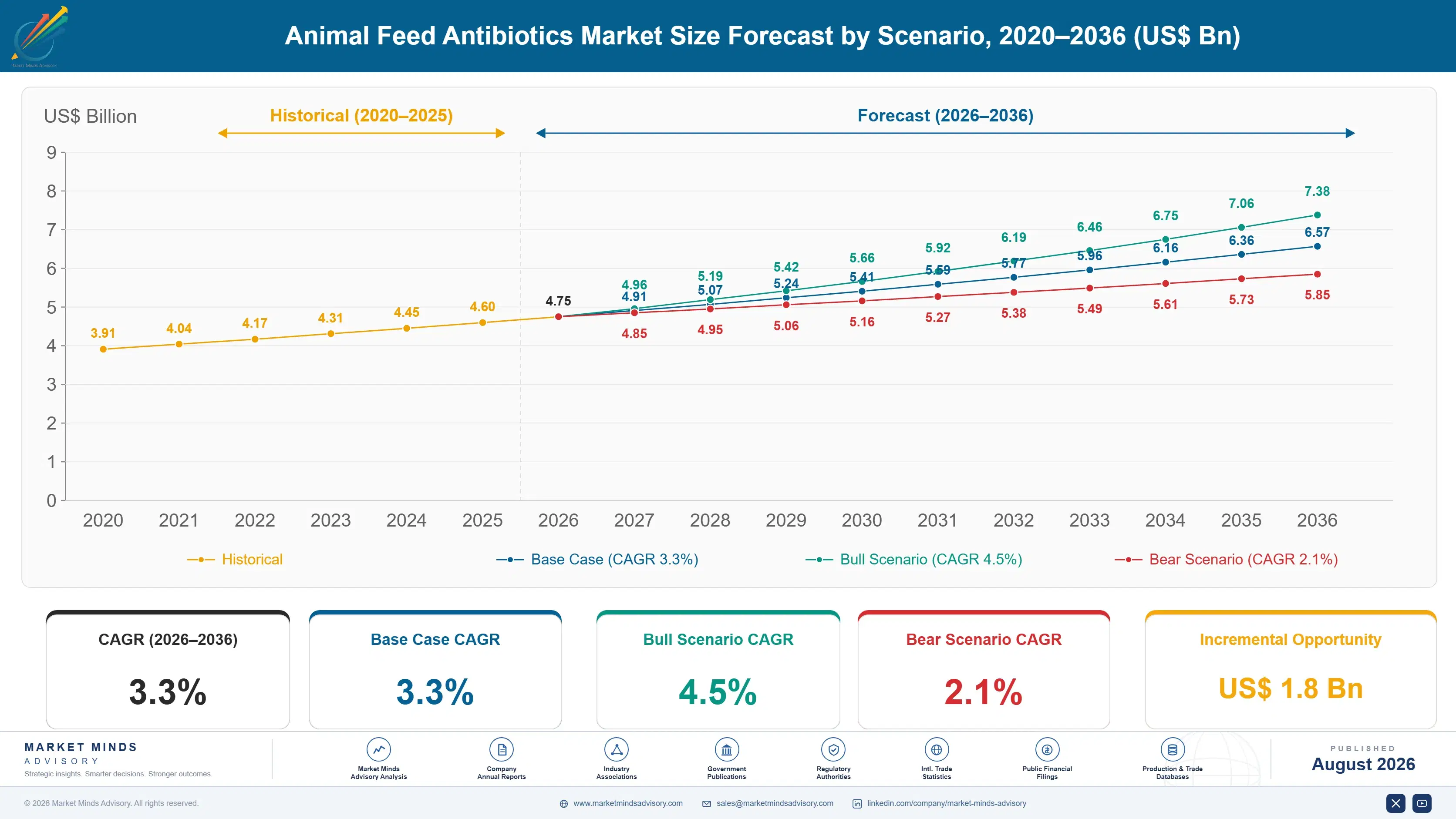
Between 2020 and 2025, animal feed antibiotic demand grew at an estimated 2.6% annually as growth-promotion bans across additional jurisdictions offset rising therapeutic and metaphylactic use tied to expanding livestock and aquaculture production in Asia and Latin America. Huvepharma and Phibro Animal Health both expanded ionophore and therapeutic antibiotic production through the period, while producers of medically important antibiotic classes faced declining volume in fully-banned markets.
MMA's base case projects 3.3% annual growth to 2036 on three mechanisms: continued livestock and aquaculture production expansion across China, India, and Brazil sustaining therapeutic and metaphylactic antibiotic demand even as growth-promotion use declines, growing substitution toward ionophore and polypeptide classes exempt from medically-important-antibiotic restrictions, and rising disease pressure in intensively farmed poultry and swine operations requiring continued therapeutic treatment. Aquaculture producers are adding a fourth growth channel through expanding fish and shrimp farming volume.
A bull catalyst comes from a major disease outbreak, similar to past African swine fever episodes, that could increase therapeutic antibiotic demand within a single year across affected livestock populations. The bear risk is regulatory contagion: additional major markets following the European Union and United States toward growth-promotion bans could compress medically-important-antibiotic volume faster than ionophore substitution can offset.

Regulatory Divergence Reshapes Global Antibiotic Demand

Animal feed antibiotics face a strange market dynamic: regulatory pressure is shrinking where they can legally be used for growth promotion, even as global livestock and aquaculture production keeps expanding and generating more disease pressure that requires therapeutic treatment. That tension between shrinking legal use cases and growing underlying animal populations defines nearly every strategic decision producers make today. That tension increasingly determines which suppliers gain share regardless of the specific regulatory jurisdiction involved.
MARKET CONCENTRATION38%Top five suppliers hold under forty percent of total
AVERAGE SELLING PRICE$14.80/kgIonophore and polypeptide classes see the steadiest demand
TOP PRODUCING COUNTRYChinaLargest livestock population driving total feed antibiotic consumption
CAPACITY UTILIZATION71%Production lines track seasonal livestock disease treatment cycles closely
FEEDSTOCK COST SHARE33% of COGSActive pharmaceutical ingredient synthesis dominates total production costs
TRADE INTENSITY44% exportedNearly half of formulated product volume crosses borders internationally
Commercially, the market increasingly splits along regulatory lines rather than geography alone. Markets with comprehensive growth-promotion bans, like the European Union and United States, now generate demand almost entirely from therapeutic and metaphylactic treatment, while markets without such bans, particularly China, still use antibiotics across the full range of growth-promotion, prevention, and treatment applications simultaneously. That regulatory bifurcation is reshaping how global suppliers allocate manufacturing and sales investment.
Over the next decade, expect ionophore and polypeptide antibiotic classes, largely exempt from medically-important-antibiotic restrictions, to keep gaining share as producers substitute away from tetracyclines and penicillins facing tightening regulation in more markets. Suppliers with strong ionophore and therapeutic antibiotic portfolios are best positioned regardless of how quickly additional markets adopt growth-promotion restrictions.
"Everyone keeps waiting for this market to shrink because of the bans, but it just keeps finding new legal ways to sell essentially the same volume. Ionophores are basically the industry's escape hatch."
Director, Animal Health and Feed Additives Practice · MMA Animal Health and Feed Additives Practice · August 2026

Market Trends

Ionophore Substitution Accelerates as Bans Expand

Livestock producers facing growth-promotion restrictions on medically important antibiotic classes are substituting toward ionophores and polypeptide antibiotics, which remain largely exempt from human-medicine-related regulatory restrictions in most jurisdictions. Huvepharma and Phibro Animal Health have both expanded ionophore production capacity over the past two years specifically to serve this substitution demand across poultry and cattle feed programs. At least a dozen major poultry integrators in markets with tightening tetracycline and penicillin restrictions have shifted flagship feed programs toward ionophore-based formulations since 2023, and veterinary nutritionists report these substitutions largely preserve feed conversion efficiency gains previously attributed to banned growth-promotion classes.
Market Impact: Sustains 3%+ annual volume despite bans
African Swine Fever Recovery Drives Therapeutic Demand

Ongoing recovery from African swine fever outbreaks across major Asian hog-producing regions continues driving elevated therapeutic and metaphylactic antibiotic demand as producers rebuild herds and manage disease pressure in newly restocked, often higher-density farming operations. China's hog herd rebuilding has been a particularly significant driver, with therapeutic antibiotic volume tied to disease management running well above pre-outbreak baseline levels in several provinces. Veterinary health authorities report elevated disease surveillance and treatment protocols will likely persist for several more years as herd immunity and biosecurity practices continue maturing across rebuilt farming operations.
Market Impact: Grows faster for 3 straight years

Market Opportunities and Growth Drivers

Livestock Production Growth Sustains Underlying Volume

Global livestock and aquaculture production continues expanding steadily, particularly across China, India, and Brazil, sustaining underlying demand for therapeutic and metaphylactic antibiotic treatment regardless of growth-promotion regulatory status in any single market. Brazil's export-oriented poultry and cattle sector has expanded production capacity substantially over the past several years specifically to meet growing global protein export demand, driving corresponding growth in therapeutic antibiotic consumption tied to larger-scale, higher-density farming operations. Industry analysts report this underlying production growth provides a stable volume floor for the category even as growth-promotion use continues declining in regulated markets specifically.
Market Impact: Eliminated growth-promotion use by 2017

Regulatory Exemptions Favor Ionophore Antibiotic Classes

Most major regulatory frameworks restricting medically important antibiotic use in livestock feed specifically exempt ionophores and certain polypeptide classes, since these compounds have no equivalent use in human medicine and therefore carry no antimicrobial resistance transfer risk to human pathogens. This regulatory carve-out is driving sustained producer investment in ionophore production capacity as a compliant substitute for restricted classes across poultry, cattle, and swine feed programs globally. Huvepharma reports ionophore antibiotic sales have grown considerably faster than its overall antibiotic portfolio for three consecutive years, reflecting this regulatory-driven substitution trend directly.
Market Impact: Risks losing 20%+ of metaphylactic volume

Market Restraints and Challenges

Expanding Growth-Promotion Bans Shrink Addressable Volume

Growth-promotion antibiotic bans have expanded from the European Union's 2006 restriction to cover the United States, and the root cause is mounting evidence linking routine growth promotion to antimicrobial resistance in human pathogens. The US Veterinary Feed Directive, fully implemented in 2017, eliminated growth-promotion use of medically important antibiotics across the domestic livestock industry in a transition. This has shrunk the addressable market for restricted classes in the largest historical consumption markets, forcing producers to rebuild volume through therapeutic use and ionophore substitution. Producers are mitigating this by shifting capacity toward ionophore classes and therapeutic formulations exempt from these restrictions.
Market Impact: Shifts 12+ major poultry integrator programs

Antimicrobial Resistance Concerns Pressure Therapeutic Use

Even therapeutic and metaphylactic antibiotic use, exempt from growth-promotion bans, faces scrutiny from public health authorities concerned about resistance development, since therapeutic use in large, densely housed livestock populations can contribute to resistance even when growth promotion is not the purpose. Public health groups have called for tighter metaphylactic restrictions, which treat entire herds preventively rather than individual sick animals, arguing this functions like growth promotion. If restrictions expand, producers could lose a portion of currently compliant therapeutic volume within a few years. Producers are mitigating this by investing in diagnostics that allow targeted, individual-animal treatment rather than herd-wide dosing.
Market Impact: Sustains demand 15%+ above pre-outbreak baseline
3 additional market trends, 3 additional growth drivers, and 3 additional restraints and challenges are covered in the full report. Contact sales@marketmindsadvisory.com to access the complete intelligence.

Segment CAGR and Growth Architecture

Animal feed antibiotics are segmented by antibiotic class, the classification that determines regulatory exposure, resistance profile, and target application: tetracyclines, penicillins, macrolides, aminoglycosides, sulfonamides, and polypeptide and ionophore antibiotics each face distinct regulatory treatment and serve different livestock, poultry, and aquaculture applications, avoiding the overlap a species-based split would create, a distinction regulators increasingly enforce directly.
animal-feed-antibiotics-market-trends-market-share-analysis-1787462579509

Polypeptide and Ionophore Antibiotics

Polypeptide and ionophore antibiotics, including bacitracin and monensin, are the fastest-growing segment because most major regulatory frameworks exempt them from medically-important-antibiotic restrictions, since they have no equivalent use in human medicine and carry no meaningful antimicrobial resistance transfer risk to human pathogens. Huvepharma and Phibro Animal Health both dominate this segment through established ionophore manufacturing capacity built specifically to serve substitution demand as producers move away from restricted tetracycline and penicillin classes. Poultry integrators increasingly specify ionophore-based feed programs by name in response to tightening restrictions on medically important classes, reflecting recognition of ionophores as the primary compliant substitute available. Production economics remain favorable, since ionophore manufacturing does not carry the same regulatory compliance cost burden as restricted antibiotic classes.
CAGR 5.8%

Macrolides

Macrolide antibiotics, used primarily for respiratory disease treatment in cattle and swine, are growing faster than most other medically important antibiotic classes because therapeutic and metaphylactic use, unlike growth promotion, remains broadly permitted even in the most heavily regulated markets. Zoetis and Elanco Animal Health both maintain significant macrolide antibiotic portfolios supported by strong veterinarian relationships and established therapeutic treatment protocols across major livestock markets. Rising respiratory disease pressure in intensively farmed, higher-density cattle and swine operations is sustaining macrolide demand growth even as growth-promotion antibiotic classes decline in the same markets. Branded macrolide products command meaningful price premiums over generic alternatives, reflecting veterinarian prescribing relationships built over years of clinical use.
CAGR 3.6%
Full segment breakdown across 6 segments available in the complete report.

Regional Architecture and Country Demand Map

East Asia leads global animal feed antibiotic demand, driven by China's enormous livestock population and comparatively slower regulatory tightening, while North America and Western Europe generate demand almost entirely from therapeutic use following comprehensive growth-promotion bans already fully implemented as regional livestock production keeps expanding.

North America

The United States generates virtually all of its animal feed antibiotic demand from therapeutic and metaphylactic treatment following the Veterinary Feed Directive's 2017 elimination of growth-promotion use for medically important antibiotic classes. Ionophore antibiotics, exempt from that restriction, remain widely used across poultry and cattle feed programs for both growth efficiency and coccidiosis prevention. Canadian livestock producers have followed similar regulatory restrictions, generating a comparable therapeutic-use-dominated demand profile. Mexico's growing poultry and swine sector maintains less restrictive regulations than its northern neighbors, sustaining modest growth-promotion antibiotic use alongside expanding therapeutic demand. Growing consumer and retailer scrutiny over antibiotic use disclosure is also pushing US producers toward more transparent supply chain documentation practices.
Share: 27% | CAGR: 2.0% (2026 to 2036)

Western Europe

The European Union's 2006 growth-promotion antibiotic ban, the earliest and most comprehensive globally, means the region generates demand almost entirely from therapeutic and metaphylactic treatment, with per-animal antibiotic use among the lowest globally as a result. Germany and France anchor regional consumption through large-scale pig and poultry production requiring ongoing disease management. The United Kingdom maintains regulatory alignment with EU-era restrictions despite Brexit, sustaining a similarly therapeutic-focused demand profile. Growth here trails every other region because the market has already fully transitioned away from growth-promotion use and faces additional pressure to further restrict metaphylactic treatment. Scandinavian countries maintain some of the lowest per-animal antibiotic use rates globally, reflecting decades of proactive disease prevention investment.
Share: 19% | CAGR: 1.6% (2026 to 2036)
Regional intelligence for 5 additional markets available in the complete report: East Asia, South Asia and Pacific, Latin America, Middle East and Africa, Eastern Europe. Contact sales@marketmindsadvisory.com.
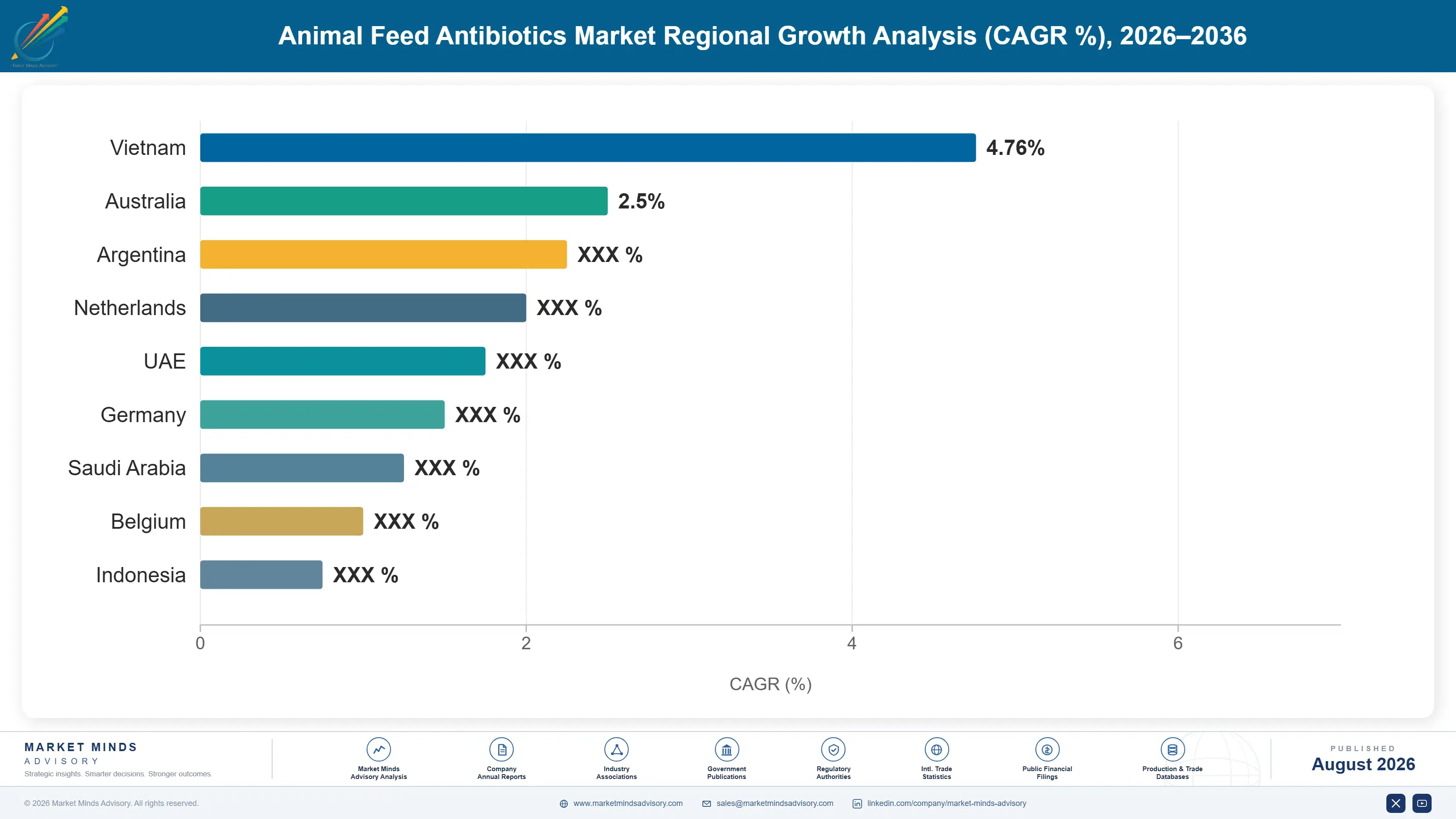
animal-feed-antibiotics-market-trends-country-cagr-analysis-1787462580076

Where Feed Antibiotic Suppliers Can Capture Margin

Margin capture in animal feed antibiotics increasingly depends on ionophore and therapeutic portfolio strength rather than exposure to declining growth-promotion volume. Suppliers that can offer veterinarian-relationship-driven therapeutic products, or diagnostic-supported targeted treatment alternatives to metaphylactic dosing, are commanding meaningfully better positioning than producers concentrated in restricted antibiotic classes. That shift rewards diversified, compliance-ready suppliers over single-class specialists.

Ionophore Portfolio Expansion for Regulatory Compliance

Suppliers that expand ionophore and polypeptide antibiotic production capacity, exempt from medically-important-antibiotic restrictions in most jurisdictions, are capturing substitution volume as producers move away from restricted tetracycline and penicillin classes. Huvepharma's ionophore production expansion, completed in 2023, reportedly captured a meaningful share of substitution demand from poultry integrators exiting restricted growth-promotion classes across multiple markets. Producers without established ionophore manufacturing capability are increasingly losing formulation slots to competitors that can offer a compliant substitute alongside their existing therapeutic antibiotic portfolio, even when historical customer relationships otherwise favor incumbent suppliers across multiple product lines.
Market Impact: Captures meaningful substitution share following the 2023 expansion

Building Veterinarian-Relationship-Driven Therapeutic Antibiotic Brand Positioning

Building branded therapeutic antibiotic products backed by strong veterinarian relationships and clinical treatment protocols lets suppliers command premium pricing that generic API-based competitors cannot match. Zoetis and Elanco Animal Health both maintain veterinarian-facing sales and technical support teams that reportedly command a 2 to 3 times price premium per unit over generic equivalent therapeutic antibiotics from comparable API sources. Building this positioning requires sustained investment in veterinarian relationships and clinical support infrastructure over multiple years, a barrier that has kept this higher-margin segment concentrated among established branded animal health suppliers.
Market Impact: Commands a 2 to 3 times price premium

Developing Diagnostic-Supported Targeted Individual-Animal Treatment Options

Suppliers that pair antibiotic products with diagnostic tools enabling targeted, individual-animal treatment rather than herd-wide metaphylactic dosing are positioning ahead of expected regulatory tightening on preventive antibiotic use. This diagnostic-supported approach typically reduces total antibiotic volume per animal by 20 to 30 percent compared with metaphylactic dosing, but the higher-precision positioning commands premium pricing from producers seeking to preempt future metaphylactic use restrictions. At least a handful of major suppliers have launched diagnostic-antibiotic bundled offerings since 2024, targeting producers in markets where metaphylactic restriction discussion is most advanced. Suppliers investing early are securing preferential positioning with forward-looking producers.
Market Impact: Cuts antibiotic volume 20 to 30 percent per animal

Bundled Regulatory Compliance and Formulation Support

Bundling regulatory compliance documentation and reformulation support alongside the physical antibiotic sale helps smaller livestock producers navigate the growing patchwork of market-specific growth-promotion and metaphylactic use restrictions. Suppliers offering this bundled service report shortened customer compliance transition timelines by several weeks on average, since producers avoid commissioning duplicate regulatory research their antibiotic supplier has already conducted. This service layer also raises effective per-unit pricing by an estimated 8 to 12 percent, since smaller producers otherwise face compliance consulting costs running into significant sums if sourced independently. Smaller producers report this bundled support alone often justifies switching suppliers entirely.
Market Impact: Raises effective pricing by 8 to 12 percent

Who Controls the Margin Pool

Five suppliers hold under forty percent of global animal feed antibiotic capacity on a production-volume basis, reflecting a market where regional Chinese and Indian API producers compete hard on price against branded, veterinarian-relationship-driven Western suppliers. The gap between branded therapeutic product suppliers and generic API producers is wide on price and margin, even though both increasingly compete for the same substitution-driven ionophore volume.
Current competitive activity centers on three fronts: ionophore portfolio expansion to capture substitution volume from restricted classes, veterinarian-relationship branding to defend premium therapeutic pricing, and diagnostic-supported treatment alternatives to preempt further metaphylactic use restrictions. Huvepharma and Zoetis have both continued investing in these areas specifically to defend positioning against both regulatory pressure and generic competition simultaneously.

Emerging pressure is coming from regulatory contagion itself, which could reshape rankings faster than any competitive move: if additional major markets follow the European Union and United States toward comprehensive growth-promotion bans, producers concentrated in restricted classes could lose volume faster than ionophore substitution can offset. Rankings could also shift if Chinese or Indian API producers successfully build the veterinarian-relationship branding that currently protects Western suppliers' premium therapeutic pricing.
animal-feed-antibiotics-market-trends-company-positioning-matrix-1787462580687

Competitive Moat and Risk Dimensions

ZOETIS

Moat: Deep Veterinarian Relationship Network

Zoetis maintains one of the industry's most extensive veterinarian-facing sales and technical support networks, built over decades of direct clinical relationships across major livestock markets. That network lets Zoetis command premium pricing on branded therapeutic antibiotics and secure prescribing relationships that generic API-based competitors, regardless of price, cannot easily replicate or displace.
ZOETIS

Risk: Limited Exposure to Fast-Growing Ionophores

Zoetis' therapeutic antibiotic portfolio is weighted more heavily toward branded medically important classes than toward the faster-growing ionophore and polypeptide segment where Huvepharma and Phibro Animal Health hold stronger positions. As substitution volume continues shifting toward ionophores, Zoetis could see slower category growth than ionophore-focused competitors.
HUVEPHARMA

Moat: Leading Ionophore Manufacturing Scale

Huvepharma operates among the largest ionophore antibiotic manufacturing capacity globally, positioning it to capture substitution volume as producers move away from restricted tetracycline and penicillin classes across multiple regulated markets. That scale advantage lets Huvepharma serve both established therapeutic customers and fast-growing ionophore substitution demand simultaneously.
HUVEPHARMA

Risk: Weaker Veterinarian Brand Recognition

Huvepharma has less direct veterinarian-facing brand recognition than Zoetis or Elanco Animal Health in premium therapeutic antibiotic categories, limiting its ability to command the same pricing premium on branded products. The company relies more heavily on distributor relationships and price competitiveness to win volume in markets where branded relationships otherwise determine purchasing decisions.

Players Tracked

Prominent Players

Zoetis
Elanco Animal Health
Huvepharma
Phibro Animal Health
Boehringer Ingelheim Animal Health

Other Key Players

Merck Animal Health
Virbac
Ceva Sante Animale
Alltech
Vetoquinol
Bimeda
Zagro
Kemin Industries
ADM Animal Nutrition
Cargill Animal Nutrition
China Animal Husbandry Group
North China Pharmaceutical
Zhejiang Guobang Pharmaceutical
Provimi
Nutreco

Recent Developments

JUNE 2023

Huvepharma Completes Ionophore Production Expansion

Huvepharma completed a significant expansion of its ionophore antibiotic production capacity in June 2023, positioning the company to capture substitution demand as poultry and cattle producers across multiple regulated markets shift away from restricted tetracycline and penicillin growth-promotion classes toward compliant ionophore-based feed programs industry-wide.
Signal: Signals established suppliers are proactively repositioning capacity ahead of expected regulatory tightening in additional markets elsewhere.
OCTOBER 2024

Diagnostic-Antibiotic Bundled Offerings Launch

Several major animal health suppliers launched diagnostic-supported, targeted antibiotic treatment bundles in October 2024, aimed at producers in markets where regulatory discussion of metaphylactic use restrictions is most advanced, enabling more precise individual-animal treatment rather than herd-wide preventive dosing. Suppliers describe this as a proactive compliance strategy.
Signal: Signals suppliers are preempting metaphylactic use restrictions rather than waiting for formal regulatory action to force adaptation.
APRIL 2024

China Tightens Veterinary Antibiotic Use Reporting Requirements

China's Ministry of Agriculture and Rural Affairs tightened veterinary antibiotic use reporting and tracking requirements in April 2024, signaling gradual movement toward more comprehensive regulatory oversight consistent with the direction Western markets have already taken over the preceding two decades. Analysts view this as an early signal of gradual convergence.
Signal: Signals China's regulatory trajectory is converging gradually with Western restriction patterns, though still years behind full implementation.

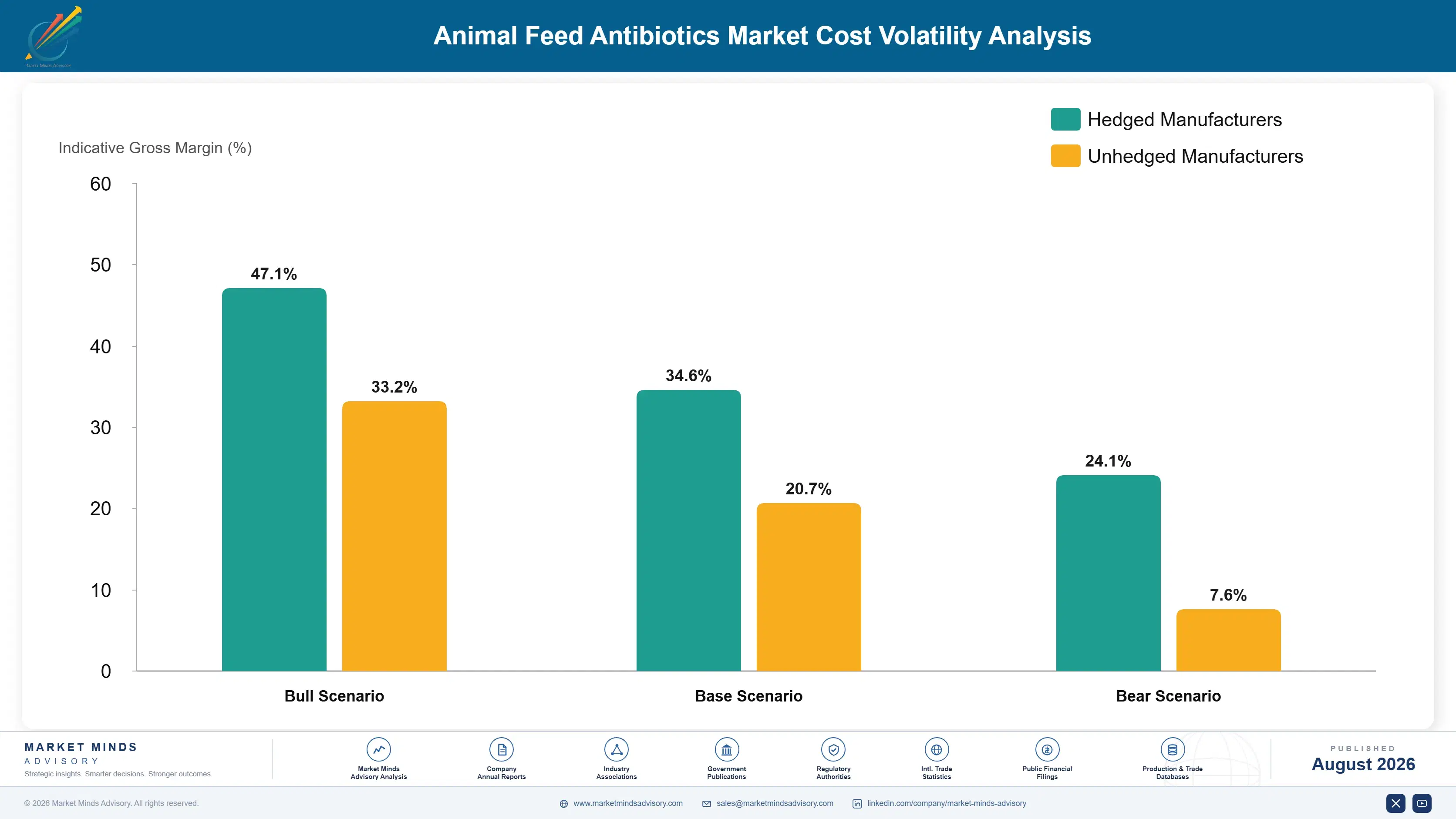
API Synthesis and Compliance Cost Exposure

Active pharmaceutical ingredient synthesis, sourced predominantly from Chinese and Indian chemical manufacturing, accounts for roughly thirty-three percent of total production cost across the industry. Regulatory compliance costs, including residue testing, documentation, and market-specific approval processes, add a second significant and growing cost layer that varies considerably depending on how many distinct regulatory jurisdictions a supplier's products must satisfy simultaneously.
Chinese API pricing rose meaningfully during 2022 and 2023 as environmental compliance enforcement forced several Chinese chemical manufacturers to curtail or upgrade production capacity, according to industry trade reporting and processor disclosures, tightening available API supply for formulators worldwide. Producers without diversified API sourcing faced the steepest cost increases, since qualifying alternative API suppliers requires regulatory revalidation that can take many months to complete across multiple jurisdictions.

Smaller formulators relying on a single Chinese API supplier carry meaningfully more cost and supply-consistency exposure than larger, vertically integrated suppliers like Zoetis or Elanco Animal Health that maintain diversified sourcing and, in some cases, integrated API production. Branded therapeutic antibiotic suppliers also face outsized reputational exposure if API shortages force supply disruptions that damage veterinarian and producer trust built over years.
animal-feed-antibiotics-market-trends-cost-volatility-analysis-1787462580902

Diversify API Sourcing Across Countries

Larger suppliers are qualifying API supply from multiple Chinese and Indian manufacturers simultaneously rather than relying on a single source, reducing the odds that one manufacturer's environmental compliance disruption cuts total feedstock availability. This diversification adds procurement complexity but has measurably reduced supply volatility for suppliers that implemented it before the 2022 to 2023 price increases.

Invest in Regulatory Revalidation Infrastructure

Suppliers are building dedicated regulatory affairs teams capable of revalidating alternative API sources faster across multiple jurisdictions, reducing the time required to qualify backup suppliers when primary sources face disruption. This capability requires sustained investment but has meaningfully shortened supply disruption recovery timelines for suppliers that built it proactively across most major supplying jurisdictions.

Pursue Selective Backward API Integration

Several larger suppliers are pursuing selective backward integration into API production for their highest-volume antibiotic classes, reducing dependence on external Chinese and Indian manufacturers for critical inputs. This approach requires significant capital investment but provides meaningful cost and supply certainty for suppliers with sufficient scale to justify the investment particularly for high-volume antibiotic classes.

Portfolio Architecture for Margin Defence

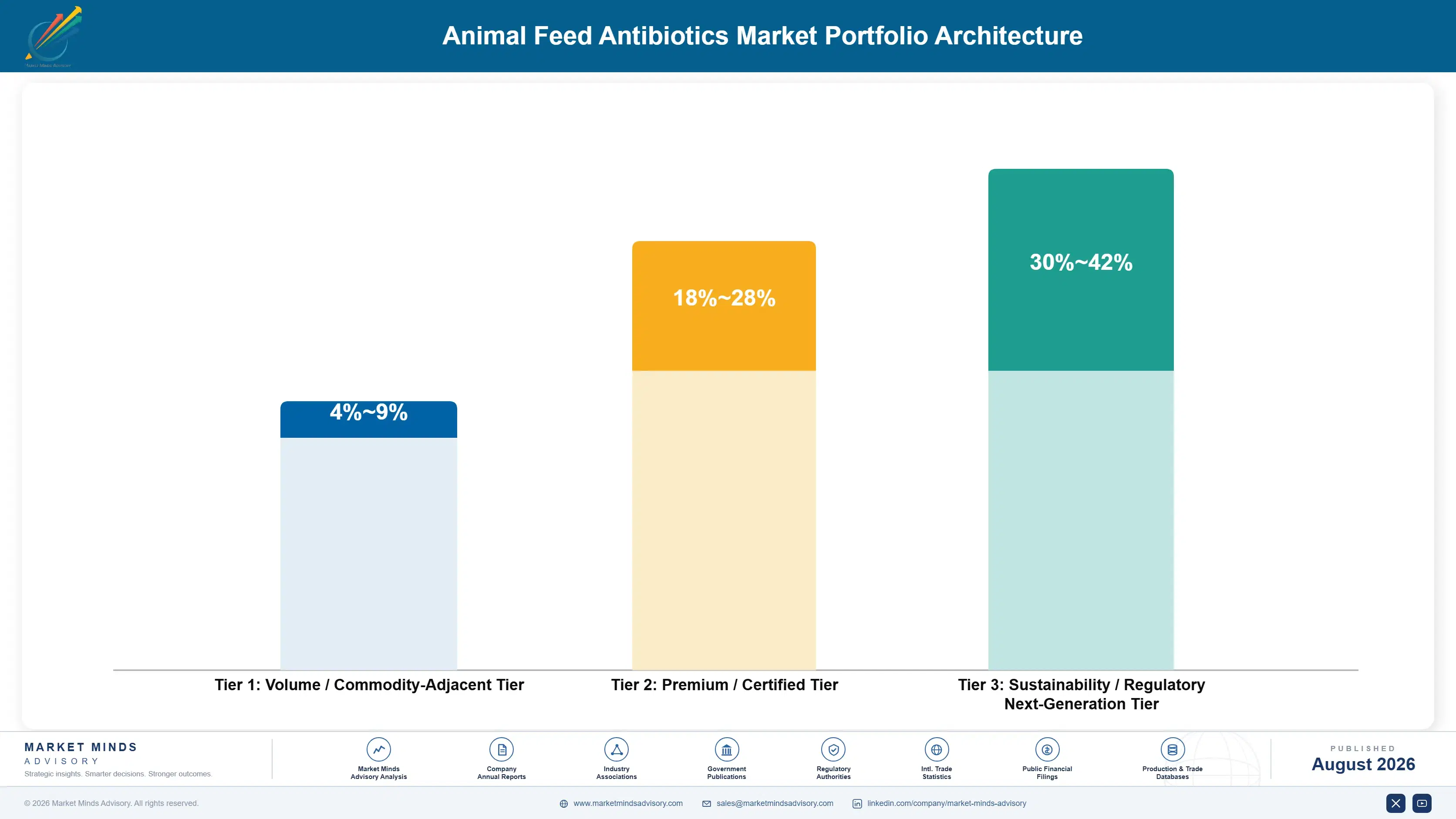
Feed antibiotic suppliers operate a three-tier portfolio spanning commodity generic API-based antibiotics sold largely on cost per unit, branded therapeutic and ionophore products commanding premium pricing through veterinarian relationships and regulatory compliance positioning, and diagnostic-supported targeted treatment systems positioned for the highest-margin accounts preempting future metaphylactic restrictions. Gross margins vary sharply across these tiers, from thin single digits on commodity generic antibiotics to well above thirty-five percent on branded therapeutic and diagnostic-supported systems.
The volume versus premium tension is intensifying as more suppliers chase branded and ionophore margins, but commodity generic antibiotics still represent meaningful shipped volume and remain important for covering fixed production costs across the industry's large, price-sensitive regional customer base. Suppliers that abandon commodity volume too quickly in pursuit of premium accounts risk losing scale advantages built over years of manufacturing investment.

High-value margin pools concentrate specifically in branded therapeutic products sold through veterinarian relationships, and in ionophore antibiotics capturing substitution volume from restricted classes across multiple regulated markets. Commodity generic antibiotics remain the volume anchor but carry the thinnest margins, squeezed further by Chinese and Indian producers competing on price across nearly every commodity account.

Volume / Commodity-Adjacent Tier

Commodity generic antibiotics sold primarily on cost per unit into price-sensitive regional livestock markets, competing mainly on cost against Chinese and Indian API-based producers where regulatory documentation requirements are less demanding.
Gross Margin: 4-9%

Premium / Certified Tier

Branded therapeutic and ionophore antibiotics sold through veterinarian relationships into markets facing growing regulatory restriction on medically important classes, commanding premium pricing on clinical support and compliance positioning Pricing reflects clinical relationship value rather than raw material cost alone.
Gross Margin: 18-28%

Sustainability / Regulatory / Next-Generation Tier

Diagnostic-supported targeted treatment systems positioned for producers in markets facing advanced metaphylactic use restriction discussion, paying the category's highest per-unit prices for precision treatment capability Capital and diagnostic technology investment keep this tier concentrated among larger, better-resourced suppliers.
Gross Margin: 30-42%
animal-feed-antibiotics-market-trends-portfolio-architecture-1787462581529

High-value Sub-segments and Strategic Watch-out

Branded Ionophore Substitution Products

Branded ionophore antibiotics capturing substitution volume from restricted tetracycline and penicillin classes are seeing the strongest margin expansion in the category, as producers in tightening regulatory markets specify compliant ionophore-based feed programs by name to preempt further restriction. Established leaders continue expanding capacity to defend this position.
Gross Margin: 18-28%

Diagnostic-Supported Precision Treatment

Diagnostic-antibiotic bundled offerings enabling targeted, individual-animal treatment are gaining traction among producers in markets where metaphylactic use restriction discussion is most advanced, though this segment remains concentrated among a small number of technically capable suppliers. Adoption should broaden as more suppliers develop comparable diagnostic-antibiotic bundles over time.
Gross Margin: 30-42%

Commodity Generic API Antibiotics

Standard generic antibiotics sold into price-sensitive regional livestock markets remain the category's volume core, anchored by established distributor relationships but facing intense price competition from Chinese and Indian producers across most regional markets. Most incumbents defend this tier through distributor scale and price rather than clinical differentiation.
Gross Margin: 4-9%

Fully-Restricted Growth-Promotion Classes

Medically important antibiotic classes still sold for growth-promotion use in markets without comprehensive bans face rising regulatory risk as more jurisdictions follow the European Union and United States, making this a segment producers should actively diversify away from. Export markets are pressuring producers to exit this segment.
Gross Margin: 3-7%

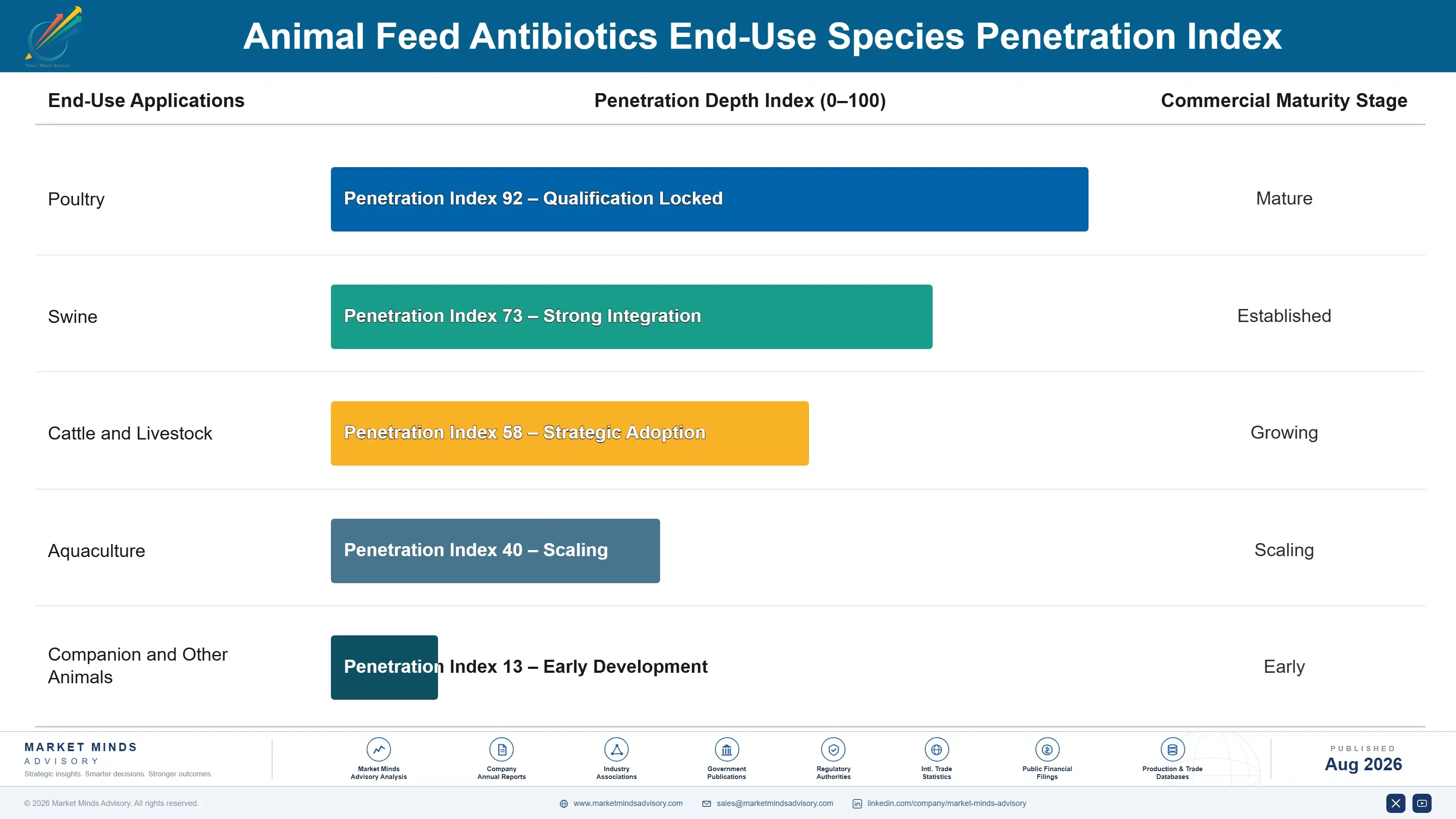
Feed Antibiotics' Regulatory-Driven Demand Shift

Animal feed antibiotics behave less like a traditional annuity ingredient and more like a category constantly redistributing volume across regulatory lines, since growth-promotion restrictions in one market simply shift demand toward compliant classes or export markets rather than eliminating underlying livestock disease pressure. That redistribution gives suppliers with diversified, multi-class portfolios more durable revenue than those concentrated in classes facing the most active regulatory scrutiny. That redistribution logic has already played out once in Western markets and is now beginning to repeat elsewhere.
Adoption depth varies sharply by market regulatory maturity. Producers in markets with comprehensive growth-promotion bans have already fully transitioned to therapeutic and ionophore-based programs, while producers in less-restricted markets like China still use the full range of antibiotic classes and will transition only as domestic regulation tightens further over time.

Generational and regulatory shifts are visible mainly in how younger veterinary professionals and producers in tightening markets approach preventive antibiotic use, increasingly favoring diagnostic-supported, targeted treatment over herd-wide metaphylactic dosing, while legacy producers in less-restricted markets remain anchored to broader antibiotic use patterns that have not yet faced comparable regulatory or professional pressure to change.
animal-feed-antibiotics-market-trends-end-use-penetration-index-1787462582284

Where Feed Antibiotic Value Concentrates

These are among the four positions where our research anticipates prominent divergence between winners and laggards over the coming forecast period. Each is grounded in the demand model, the regulatory perimeter, and the announced capacity pipeline.
01 / IONOPHORE PORTFOLIO INVESTMENT

Expand ionophore capacity ahead of continued substitution demand

Ionophore and polypeptide antibiotics remain largely exempt from the medically-important-antibiotic restrictions driving decline in tetracycline and penicillin volume, and that regulatory carve-out is unlikely to close given the compounds' limited relevance to human medicine. Huvepharma's ionophore production expansion has already captured meaningful substitution demand from poultry integrators exiting restricted classes, demonstrating clear commercial value in this positioning. MMA recommends suppliers without established ionophore manufacturing capability invest in it now, before substitution demand consolidates around already-scaled competitors with entrenched customer relationships.
02 / VETERINARIAN BRANDING INVESTMENT

Build branded therapeutic positioning ahead of generic competition

Branded therapeutic antibiotics backed by veterinarian relationships command a meaningful multiple of generic API-based pricing, and that premium is sustained by clinical relationships competitors cannot easily replicate quickly. As Chinese and Indian API producers continue improving manufacturing quality and cost competitiveness, suppliers without differentiated veterinarian relationships risk being pushed toward commodity pricing over time. MMA recommends suppliers with sufficient resources invest in veterinarian-facing technical support now, before generic competition narrows the pricing gap further and defend margin more effectively as generic competition intensifies over time.
03 / DIAGNOSTIC TREATMENT DEVELOPMENT

Develop diagnostic-antibiotic bundles ahead of metaphylactic restriction

Metaphylactic antibiotic use faces growing regulatory scrutiny even in markets that have not yet restricted it, and diagnostic-supported targeted treatment offers a credible compliance pathway that preserves therapeutic revenue under tighter future restrictions. Suppliers that develop this capability now are positioning ahead of competitors that will need to react once formal restrictions arrive rather than before. MMA recommends suppliers with diagnostic technology capability invest in bundled offerings now, while first-mover positioning remains available in this still-developing segment and well ahead of any formal deadline.
04 / REGULATORY TRAJECTORY MONITORING

Monitor Chinese regulatory tightening for early positioning signals

China's gradual regulatory tightening on veterinary antibiotic use, while still years behind Western restriction levels, is moving in the same direction that eventually reshaped demand patterns in the European Union and United States. Suppliers that position ionophore and therapeutic portfolio strength ahead of eventual Chinese restriction will be better positioned than those that wait for formal regulatory action to force adaptation. MMA recommends suppliers with significant Chinese market exposure begin portfolio rebalancing now, given how quickly regulatory transitions have historically compressed adjustment timelines elsewhere.

Engagement Snapshot From the Field

A live engagement with an industry participant carrying material or product regulatory and market exposure ahead of a defining policy shift, showing how our research translates into a defensible multi-year portfolio strategy.
MARKET MINDS ADVISORY · CLIENT ENGAGEMENT SUMMARY
Animal Feed Antibiotics Producer Strategic Portfolio Review and Transition Roadmap 2026·Investment Scenario on Animal Feed Antibiotics Exposure Evaluation 2025-26
CLIENT PROFILE
The client is a large Southeast Asian poultry integrator generating an estimated four hundred million dollars in annual revenue (client-reported, unverified by MMA), operating vertically integrated broiler production across multiple countries. The client had relied on a legacy growth-promotion antibiotic feed program for over a decade when a major export market tightened residue testing requirements that its existing formulation could not reliably satisfy.
STRATEGIC CHALLENGE
The client's largest export market announced stricter antibiotic residue testing requirements taking effect within twelve months, threatening continued market access unless the client transitioned away from its legacy growth-promotion feed program. The client needed a compliant alternative that maintained feed conversion efficiency without disrupting its existing production economics significantly without disrupting broader operational continuity.
MMA APPROACH
MMA conducted a structured evaluation of ionophore-based feed program alternatives from three suppliers, benchmarking feed conversion efficiency data, residue compliance documentation, and pricing against the client's existing formulation and export market timeline. The engagement included direct supplier facility assessments and independent feed trial data review to validate performance claims before committing to a full transition.
KEY FINDINGS
  1. The client's legacy growth-promotion formulation would not meet the export market's new residue testing threshold under any dosing adjustment the incumbent supplier could offer.
  2. Switching to an ionophore-based feed program maintained feed conversion efficiency within two percent of the legacy formulation while meeting new residue compliance requirements.
  3. One of the three evaluated suppliers could not provide independent feed trial data supporting claimed feed conversion efficiency parity with the legacy growth-promotion program.
  4. The client's successful transition preserved access to its largest export market, avoiding significant revenue exposure from potential market closure (client-reported, unverified by MMA).
CLIENT PROFILE
The client is a large Southeast Asian poultry integrator generating an estimated four hundred million dollars in annual revenue (client-reported, unverified by MMA), operating vertically integrated broiler production across multiple countries. The client had relied on a legacy growth-promotion antibiotic feed program for over a decade when a major export market tightened residue testing requirements that its existing formulation could not reliably satisfy.
STRATEGIC CHALLENGE
The client's largest export market announced stricter antibiotic residue testing requirements taking effect within twelve months, threatening continued market access unless the client transitioned away from its legacy growth-promotion feed program. The client needed a compliant alternative that maintained feed conversion efficiency without disrupting its existing production economics significantly without disrupting broader operational continuity.
MMA APPROACH
MMA conducted a structured evaluation of ionophore-based feed program alternatives from three suppliers, benchmarking feed conversion efficiency data, residue compliance documentation, and pricing against the client's existing formulation and export market timeline. The engagement included direct supplier facility assessments and independent feed trial data review to validate performance claims before committing to a full transition.
KEY FINDINGS
  1. The client's legacy growth-promotion formulation would not meet the export market's new residue testing threshold under any dosing adjustment the incumbent supplier could offer.
  2. Switching to an ionophore-based feed program maintained feed conversion efficiency within two percent of the legacy formulation while meeting new residue compliance requirements.
  3. One of the three evaluated suppliers could not provide independent feed trial data supporting claimed feed conversion efficiency parity with the legacy growth-promotion program.
  4. The client's successful transition preserved access to its largest export market, avoiding significant revenue exposure from potential market closure (client-reported, unverified by MMA).
RECOMMENDED STRATEGY
Phase 1: Phase 1 (Weeks 1 to 4): Benchmark three ionophore-based feed program suppliers against efficiency data and compliance documentation within the compliance deadline. Phase 2: Phase 2 (Weeks 5 to 8): Conduct independent feed trials with the top two suppliers to validate performance and compliance claims. Phase 3: Phase 3 (Weeks 9 to 12): Finalize supplier transition, implement the new feed program, and confirm export market compliance ahead of the deadline.
OUTCOME
The client successfully transitioned to a compliant ionophore-based feed program ahead of the export market deadline, preserving continued access to its largest market (client-reported, unverified by MMA). The transition also positioned the client favorably ahead of similar residue testing requirements subsequently adopted by additional export markets.

Frequently Asked Questions

Foundational context covering the market sizes, CAGR, scope, country, region and competition that inform every finding below. This section is provided to cover basics and most often pre-purchase conversations, answered from the MMA Primary Research Dataset.

What is the current size of the Animal Feed Antibiotics Market?

The global animal feed antibiotics market is valued at approximately $4.60 billion in 2025. Growth reflects expanding livestock production offsetting continued growth-promotion regulatory restrictions across key markets.

How large will the Animal Feed Antibiotics Market be by 2036?

MMA projects the market will reach approximately $6.58 billion by 2036, roughly 1.4 times its 2026 base value. Ionophore and polypeptide antibiotics will account for a growing share of that expansion.

What is the CAGR for the Animal Feed Antibiotics Market 2026 to 2036?

The market is expected to grow at a compound annual growth rate of 3.3% between 2026 and 2036. Bull and bear scenarios range from 2.1% to 4.5% depending on regulatory and disease conditions.

Which segment is growing fastest?

Polypeptide and ionophore antibiotics are the fastest-growing segment, expanding at roughly 5.8% annually, about 1.8 times the overall market rate. Regulatory exemptions are the primary driver.

Who are the major companies in the Animal Feed Antibiotics Market?

Zoetis, Elanco Animal Health, Huvepharma, Phibro Animal Health, and Boehringer Ingelheim Animal Health lead global supply. The top five suppliers together hold under forty percent of global capacity.

Which country is growing fastest?

China is growing fastest, driven by its enormous livestock population and comparatively gradual regulatory tightening relative to Western markets. Hog herd rebuilding is reinforcing this growth.

Report Segmentation Architecture

The full report scope spans multiple orthogonal segmentation dimensions, with cross-tabulated demand data provided for each dimension pair. Coverage extends further to regional breakdowns, trend trajectories, and the competitive detail needed to support segment-level decision-making.

By Antibiotic Class

  • Tetracyclines
  • Penicillins
  • Macrolides
  • Aminoglycosides
  • Sulfonamides
  • Polypeptide and Ionophore Antibiotics

By End-Use Species

  • Poultry
  • Swine
  • Cattle and Livestock
  • Aquaculture
  • Companion and Other Animals

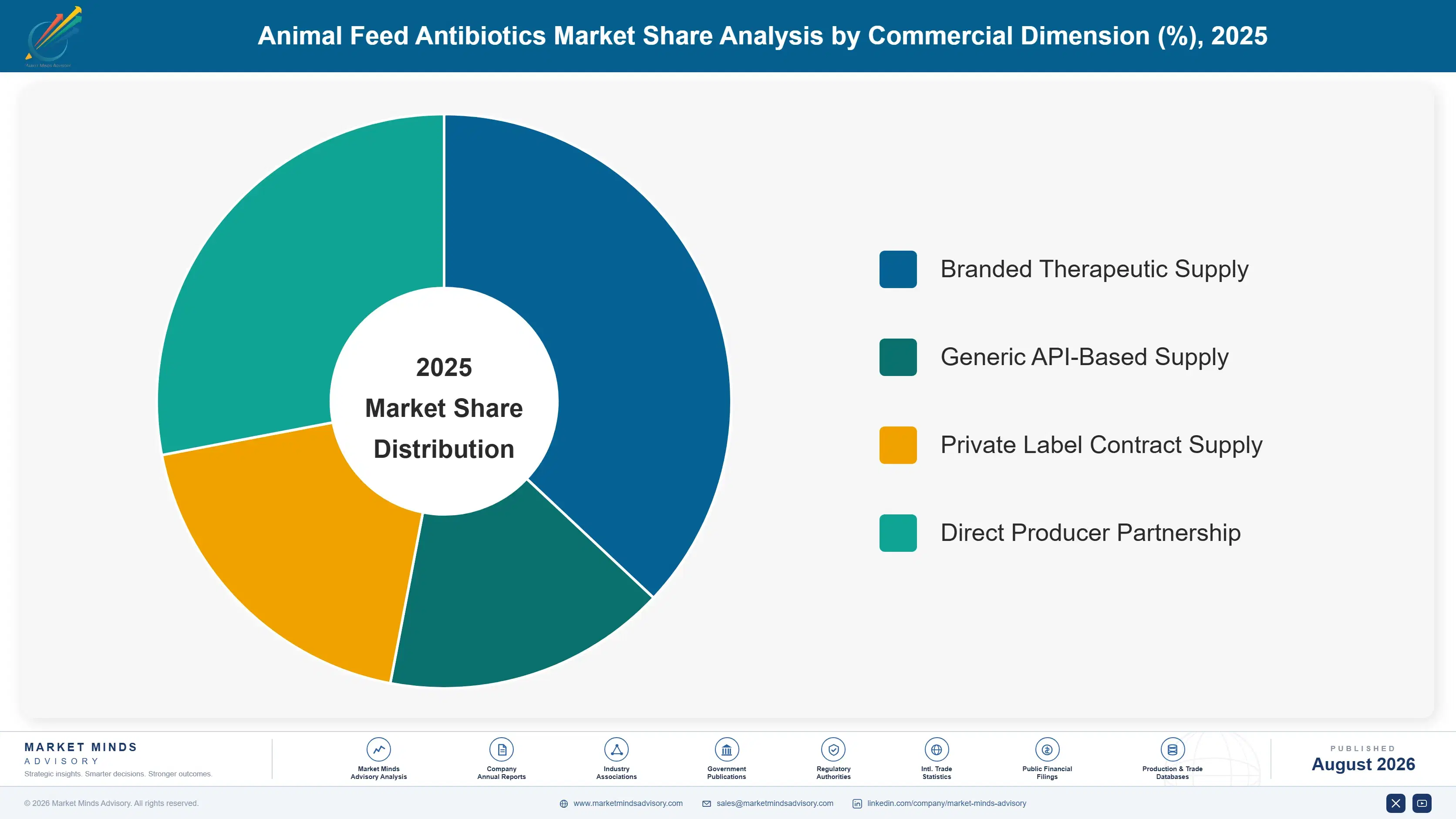
By Commercial Dimension

  • Branded Therapeutic Supply
  • Generic API-Based Supply
  • Private Label Contract Supply
  • Direct Producer Partnership

By Region

  • North America
  • Western Europe
  • East Asia
  • South Asia and Pacific
  • Latin America
  • Middle East and Africa
  • Eastern Europe

Scope, Methodology, and Coverage

Every figure in this report is reproducible from documented input assumptions. The scope below maps the historical period, the forecast horizon, the segmentation dimensions, and the countries covered, alongside the underlying primary and qualitative methodology.
Historical Period
2020 to 2025
Forecast Period
2026 to 2036
Base Year
2025 (USD billions; MMA Primary Research Dataset, August 2026)
Market Definition
The animal feed antibiotics market covers antibacterial compounds, including tetracyclines, penicillins, macrolides, aminoglycosides, sulfonamides, and ionophores, administered through feed or water for growth promotion, disease prevention, and therapeutic treatment in livestock, poultry, and aquaculture. It excludes antibiotics formulated exclusively for companion animal or human pharmaceutical use, and excludes non-antibiotic feed additives such as probiotics or enzymes.
Quantitative Units
USD billions (current prices); metric tons of active antibiotic compound where applicable
Segmentation Dimensions
By Antibiotic Class; By End-Use Species; By Commercial Dimension; By Region
Regions Covered
North America, Western Europe, East Asia, South Asia and Pacific, Latin America, Middle East and Africa, Eastern Europe
Countries Covered
USA, China, Germany, France, UK, Japan, South Korea, India, Australia, Canada, Brazil, Mexico, Indonesia, Vietnam, Thailand, Malaysia, UAE, Saudi Arabia, South Africa, Nigeria, Turkey, Poland, Netherlands, Italy, Spain, Sweden, Switzerland, Argentina, Colombia, Singapore, and additional markets relevant to this sector
Key Companies Profiled
Zoetis, Elanco Animal Health, Huvepharma, Phibro Animal Health, Boehringer Ingelheim Animal Health, Merck Animal Health, Virbac, Ceva Sante Animale, Alltech, Vetoquinol, Bimeda, Zagro, Kemin Industries, ADM Animal Nutrition, Cargill Animal Nutrition, China Animal Husbandry Group, North China Pharmaceutical, Zhejiang Guobang Pharmaceutical, Provimi, Nutreco
Quantitative Methodology
Primary survey, n=3,800 respondents, Q4 2025, six countries; demand-side model with trade association cross-validation
Qualitative Methodology
47 expert interviews, Q4 2025; applied to validate demand model assumptions, identify emerging dynamics, and assess competitive positioning
Report Format
PDF and XLSX data workbook (Word format preview document)
Publisher
Market Minds Advisory
Report Code
MMA-2026-AGR-106
Published
August 2026
Contact
sales@marketmindsadvisory.com | www.marketmindsadvisory.com

Purchase the full Animal Feed Antibiotics Market Report (2026 to 2036).

This report delivers a complete assessment of the global animal feed antibiotics market across all major antibiotic classes, end-use species, and geographic regions through 2036. It includes detailed competitive profiling of twenty companies, segmentation analysis distinguishing tetracyclines, penicillins, macrolides, aminoglycosides, sulfonamides, and polypeptide and ionophore classes, and regional demand modeling across all seven MMA-covered geographies. Buyers will find quantified forecasts for market size, segment growth rates, and regional CAGR alongside qualitative analysis of regulatory divergence, ionophore substitution trends, and API supply cost exposure. A dedicated revenue lever framework identifies four specific commercial actions suppliers can take to capture margin as regulatory pressure reshapes demand.
Twenty-company competitive profiling with moat and risk analysis
Seven-region demand model with justified share and CAGR bands
Antibiotic-class segmentation across six MECE categories
Quantified revenue lever framework for margin capture strategies
API supply and regulatory compliance cost exposure analysis
Anonymized case study on ionophore feed program transition

Built For The People Who Decide

From boardroom strategy to bench-side execution, this report is read cover-to-cover by leaders shaping the next decade of their industry, turning demand scenarios, market dynamics and valuation benchmarks into decisions.
CXOs/ Presidents/ VPs/ Managers
M&A and Corporate Development
Strategy Teams and R&D Heads
Procurement and Product Directors
Regulatory and Compliance Leaders
Investor Relations and Equity Analysts