Market Minds Advisory
Anhydrous Milk Fat Market

Anhydrous Milk Fat Market: Recombined Dairy, Bakery, and Infant Formula Ingredient Demand Through 2036

Anhydrous milk fat's supply map runs through two dominant milksheds rather than one: New Zealand's export-built processing scale and India's sheer domestic milk volume together set global pricing more than any buyer category could.

Lead Analyst

Lisa Gevelber

Published

September 2026

Make Smarter Decisions with Customized Research Insights

Request a free sample report and evaluate market opportunities, growth trends, and competitive dynamics relevant to your business needs.

2025 MARKET VALUE$4.2BMarket Size 2025
2036 FORECAST VALUE$6.6BBase Case , 2026 to 2036
CAGR 2026 TO 20364.2 %Bull 5.3% / Bear 3.1%
INCREMENTAL OPPORTUNITY$2.2BNet 10- year value creation
EXPANSION MULTIPLE1.51x2036 value over 2026 base
Strategic Levers
M&A Pipeline
Regional Outlook
Country Rankings
Competitive Intelligence
Segmental Deep-dive
Call-Us : 91 93563 13602

Executive Snapshot and Market Trajectory

Anhydrous milk fat has settled into a durable commodity role: recombined dairy manufacturers across Asia and the Middle East depend on it to rebuild fresh-equivalent milk, butter, and cheese from imported powder, and that dependence gives two milk-surplus regions outsized pricing influence over the entire category.
Infant formula and nutritional product demand is now the fastest-growing application, expanding at roughly 6.8% annually as Asian formula manufacturers specify higher milk-fat inclusion for closer compositional matching to human milk, well over 60% faster than the wider market's pace. South Asia and Pacific anchors close to three in ten dollars of global value through India's enormous milk pool and New Zealand's export processing base, while Middle Eastern recombining plants pull import volume higher.
Competitive intensity concentrates around a handful of large dairy cooperatives who control both raw milk collection and export processing capacity, even as regional recombiners compete downstream on blending and packaging rather than raw fat sourcing. Global butterfat pricing, set largely by New Zealand auction volumes, increasingly determines margin across the category, while infant formula-grade purity requirements shape which suppliers win long-term nutritional contracts.
Market Definition
The anhydrous milk fat market covers commercial production and sale of milk fat processed to remove nearly all moisture and non-fat solids, sold as anhydrous milk fat, anhydrous butteroil, or ghee-adjacent culinary fat for recombining, bakery, confectionery, and nutritional applications. It excludes fresh butter, cream, and finished consumer dairy products, which the industry classifies as separate downstream categories.
Base Year Value
$4.2B in 2025 (MMA Primary Research Dataset, August 2026)
Forecast Period
2026 to 2036, eleven discrete annual values
CAGR
4.2% base case. Bull 5.3%. Bear 3.1%.
Fastest Growth Segment
Infant Formula and Nutritional Products: 6.8% CAGR
Fastest Growth Country
India: 8.5% CAGR
Fastest Growth Region
South Asia and Pacific: 6.5% CAGR
Largest Region
South Asia and Pacific: 28% of 2025 global value
Market Leaders
Fonterra Co-operative Group Limited, Arla Foods amba, Lactalis Group, FrieslandCampina, Amul (Gujarat Cooperative Milk Marketing Federation). Source: MMA Analysis based on company annual reports.
Primary Survey
n=3,800 procurement and R&D decision-makers, Q4 2025, six countries
Methodology
Demand-side build-up, cross-validated against public data, 47 expert interviews

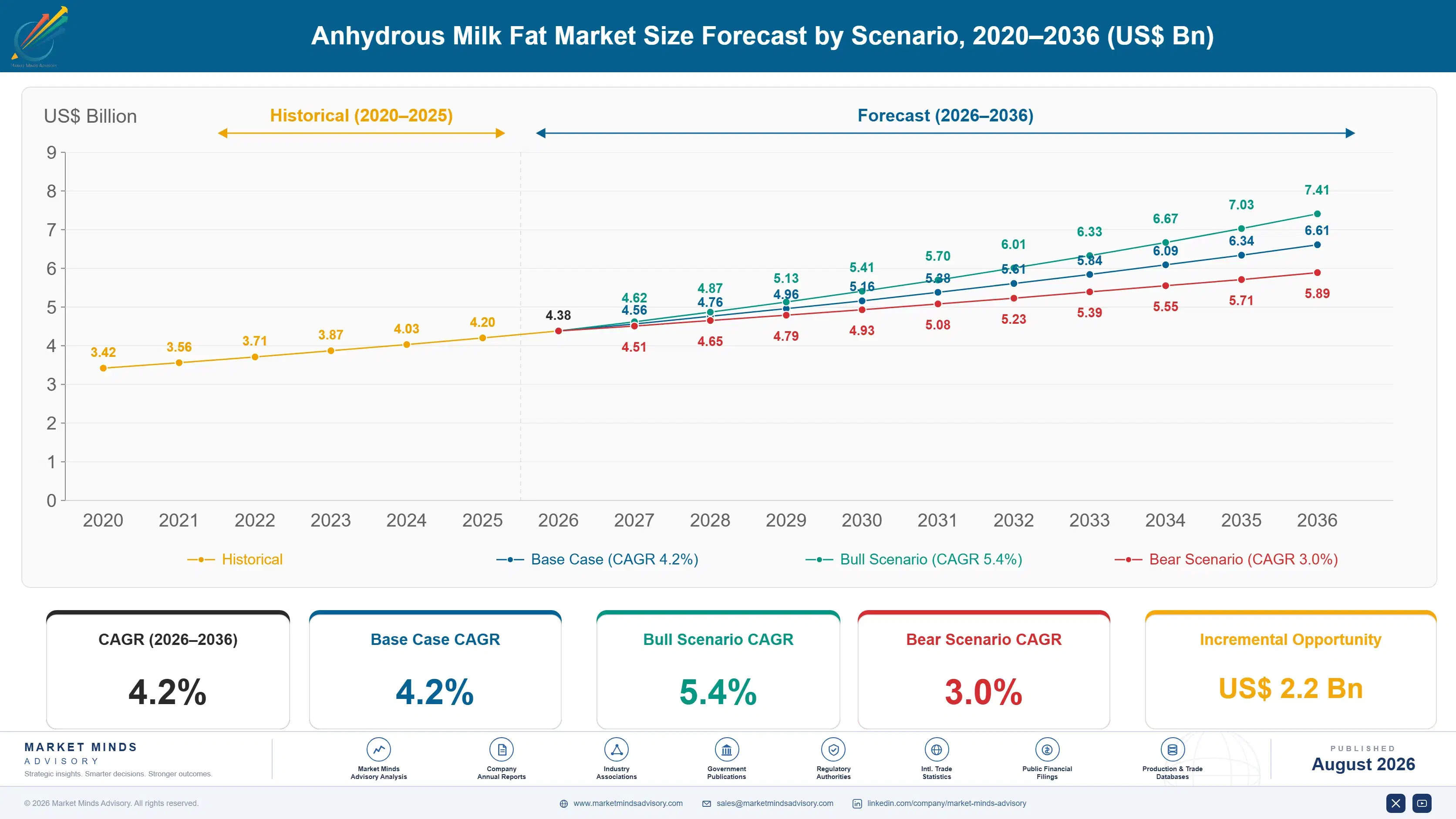
Anhydrous Milk Fat Market Forecast Scenarios

anhydrous-milk-fat-market-2024-2034-trends-size-forecast-scenario-1787462839039
Anhydrous milk fat volumes grew steadily between 2020 and 2025 as Chinese import demand expanded, though European butterfat supply fluctuated with cream and butter pricing cycles that periodically tightened available AMF volume for export across several consecutive seasons, disrupting buyer planning considerably each time this occurred across the wider supply chain and forcing several reformulation delays.
The base case assumes continued Chinese import growth for infant formula and reconstituted dairy manufacturing, expanding fractionated fat adoption among bakery and confectionery formulators, and steady capacity investment by the leading New Zealand and European cooperatives working in parallel across multiple product grades and export destinations. These three mechanisms lift supply in step with demand without requiring a major shift in underlying milk production volume across the main exporting regions this report tracks in detail.
A bull case builds on a major Chinese dairy manufacturer signing a large multi-year AMF offtake agreement that pulls forward processing capacity investment industry-wide well ahead of schedule. The bear risk is a poor European milk season that forces AMF buyers into direct competition with butter and cream markets for the same constrained cream supply.

The Commodity Fat Behind Recombined Dairy Everywhere

Anhydrous milk fat's commercial role is fundamentally logistical: it lets milk-deficit regions rebuild dairy products from imported fat and powder rather than depending on fresh local supply that many simply do not have. New Zealand's export-scale processing infrastructure and India's enormous domestic milk pool between them account for close to three in ten dollars of global value, giving both milksheds outsized influence over benchmark pricing that recombiners worldwide reference directly.
MARKET CONCENTRATIONCR5: 52%Top five dairy cooperatives hold over half of sales
AVERAGE SELLING PRICEUSD 5,400 per metric tonnePricing tracks global butterfat auction benchmarks quite closely
TOP PRODUCING REGIONSouth Asia and Pacific: 28% of global supplyIndian domestic volume and New Zealand exports anchor scale
EXPORT TRADE INTENSITY46% of output crosses a borderCross border trade links surplus milksheds to deficit regions
RAW MILK COST SHARE58% to 68% of COGSFarm-gate milk pricing drives most margin volatility directly
INFANT FORMULA GRADE PREMIUM15% to 25% over industrial gradeNutritional purity standards command meaningfully higher retail pricing
Buyers split by application sophistication and purity requirement. Recombined dairy and bakery buyers purchase largely on delivered cost and standard industrial-grade specification, competing almost entirely on price against a fairly interchangeable commodity. Infant formula manufacturers instead require documented purity, traceability, and compositional consistency that only a narrower set of qualified suppliers can reliably provide across successive production batches and years.
Over the next decade, infant formula-grade demand should keep pulling value toward higher-margin, purity-certified supply, while recombined dairy volume keeps growing steadily across import-dependent Middle Eastern and Southeast Asian markets. New Zealand's seasonal milk collection variability, not underlying demand growth, increasingly looks like the primary source of year-to-year pricing volatility across the entire category.
"Nobody drinking recombined milk in Riyadh or Jakarta thinks about a dry summer on New Zealand's North Island. But that dry summer is exactly what moves the price they pay."
Director, Dairy Ingredients and Commodity Fats Practice · MMA Dairy and Food Ingredients Practice · August 2026

Market Trends

Infant Formula Reformulation Lifts Milk-Fat Inclusion Rates

Major infant formula manufacturers across China, Southeast Asia, and increasingly India have reformulated products to increase milk-fat content specifically, seeking closer compositional matching to human milk fat globule structure than vegetable oil blends previously achieved. This reformulation trend has directly lifted demand from nutritional manufacturers who previously relied more heavily on blended vegetable fat systems for cost reasons. Suppliers serving this segment must meet documented purity and traceability standards considerably stricter than industrial-grade recombining applications require, narrowing the qualified supplier base to established dairy cooperatives with proven nutritional-grade processing capability and regulatory track records.
Market Impact: Indian domestic demand grows 7.2% annually
Middle Eastern Recombining Capacity Keeps Expanding

Saudi Arabia, the United Arab Emirates, and other Gulf markets continue expanding recombined dairy processing capacity to serve growing urban populations with limited domestic fresh milk production capability given regional climate and water constraints. Regional recombiners increasingly import anhydrous milk fat alongside skim milk powder to reconstitute fresh-equivalent milk, yogurt, and cheese products at a fraction of the cost that domestic fresh dairy farming would require in the region. Several major Gulf food manufacturers have announced additional recombining capacity investment through 2027, tied directly to continued urban population growth and food security policy priorities across the region's largest importing countries.
Market Impact: Recombined dairy volume grows 4.8% yearly

Market Opportunities and Growth Drivers

Rising Indian Domestic Dairy Fat Consumption

India's rising household incomes and continued urbanization keep lifting domestic consumption of ghee, bakery products, and confectionery items that rely on milk fat as a primary ingredient, adding volume that global export statistics understate given how much stays within India's own enormous domestic market. India already produces more milk than any other country by a wide margin, and a rising share of that output moves toward higher-value fat-based products rather than liquid milk sales alone. That combination gives Indian domestic demand a durability that trade-dependent regional demand elsewhere simply does not share.
Market Impact: Poor NZ seasons move pricing 18%

Recombined Dairy Expansion Across Import-Dependent Regions

Urban population growth across the Middle East and Southeast Asia continues outpacing what domestic fresh milk production in those regions can realistically support, sustaining steady, decade-long demand for imported anhydrous milk fat and milk powder used in recombined dairy manufacturing. Recombining remains meaningfully cheaper than developing domestic fresh dairy farming infrastructure in water-constrained or land-constrained regions, giving import-dependent recombined dairy a durable cost advantage that is unlikely to reverse within the current forecast horizon. Several Southeast Asian food manufacturers have expanded recombining capacity specifically to serve growing middle-class dairy consumption across the region's largest cities.
Market Impact: Substitution limits bakery volume 12%

Market Restraints and Challenges

New Zealand Seasonal Supply Concentration Creates Volatility

New Zealand's outsized role in global export supply exposes the entire category to seasonal milk collection variability and periodic drought risk concentrated in a single exporting country rather than diversified across surplus milksheds. The underlying cause is that New Zealand's pasture-based dairy model, while cost-efficient, depends heavily on seasonal rainfall that can vary meaningfully year to year with limited domestic buffering. A poor New Zealand season can move global benchmark pricing meaningfully within a single auction cycle, an exposure recombiners cannot avoid without accepting higher-cost alternatives. Some buyers are responding by diversifying import contracts toward European and Indian supply as a hedge.
Market Impact: Infant formula demand grows 6.8% annually

Vegetable Fat Blend Substitution Pressures Volume Growth

Bakery and confectionery manufacturers facing cost pressure increasingly substitute lower-cost vegetable oil and fat blends for anhydrous milk fat in applications where flavor differentiation matters less than delivered ingredient cost. The underlying cause is that vegetable fat alternatives carry meaningfully lower and more stable input cost than milk fat, which tracks volatile global dairy pricing rather than predictable vegetable oil markets. That pressure caps volume growth in cost-sensitive commodity bakery applications, even as premium bakery and infant formula segments keep favoring genuine milk fat. Producers are responding by emphasizing dairy-authentic labeling claims that vegetable substitutes cannot replicate.
Market Impact: Gulf recombining demand grows 5.4% yearly
3 additional market trends, 3 additional growth drivers, and 3 additional restraints and challenges are covered in the full report. Contact sales@marketmindsadvisory.com to access the complete intelligence.

Segment CAGR and Growth Architecture

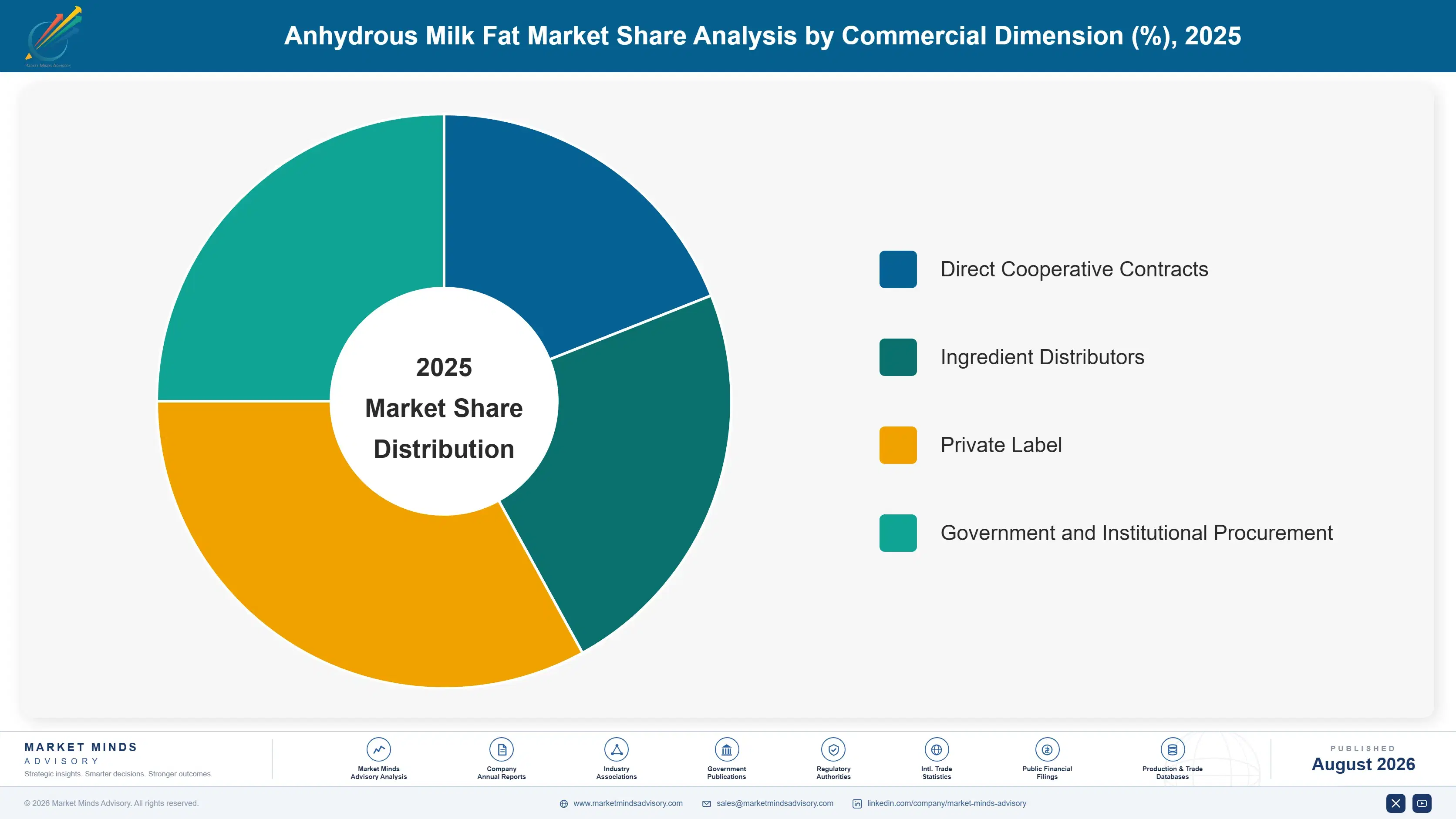
Segmentation follows end-use application, a single commercial logic tying each buyer group to distinct purity requirements, certification needs, and price sensitivity. Recombined dairy, bakery, infant formula, chocolate, ghee and culinary, and industrial applications each specify anhydrous milk fat differently, keeping upstream processing economics and downstream commercial dynamics from blurring together across every buyer category.
anhydrous-milk-fat-market-2024-2034-trends-market-share-analysis-1787462839573

Infant Formula and Nutritional Products

Infant formula and nutritional product demand is growing at 6.8% annually, well over 60% faster than the wider market's 4.2% pace, as manufacturers across China, Southeast Asia, and India reformulate toward higher milk-fat inclusion for closer compositional matching to human milk fat globule structure. Buyers require documented purity, traceability, and compositional consistency considerably stricter than industrial-grade recombining applications demand, narrowing the qualified supplier base to established dairy cooperatives with proven nutritional-grade processing capability. Retail pricing for infant formula-grade fat runs 15% to 25% above industrial-grade equivalents, reflecting processing investment and the quality assurance infrastructure manufacturers require. Fonterra and FrieslandCampina have both prioritized capital investment here, recognizing it as best positioned to capture both premium pricing and durable long-term contracts.
CAGR 6.8%

Ghee and Culinary Fat Applications

Ghee and culinary fat applications grow at 5.8% annually, anchored overwhelmingly by South Asian, and particularly Indian, demand for clarified butterfat used in cooking, religious ritual, and traditional food preparation across hundreds of millions of households. This segment benefits from a demand base considerably more culturally embedded and durable than trend-dependent Western dairy applications, since ghee consumption reflects generations of established culinary and religious tradition rather than shifting marketing trends. Rising Indian household incomes continue lifting per-capita ghee consumption steadily, even as export demand from South Asian diaspora communities adds a smaller but growing revenue stream. Domestic Indian cooperatives including Amul dominate this segment given deep distribution relationships built over decades.
CAGR 5.8%
Full segment breakdown across 6 segments available in the complete report.

Regional Architecture and Country Demand Map

Anhydrous milk fat production concentrates in South Asia and Pacific, where India's enormous domestic milk pool and New Zealand's export-scale processing infrastructure together anchor global supply. Middle East and Africa carries disproportionate import demand relative to production share, pulling recombining volume from surplus milksheds steadily higher each year.

North America

United States demand anchors North American anhydrous milk fat consumption, split between bakery and confectionery manufacturers using it for flavor and texture and a smaller nutritional segment serving infant formula manufacturers seeking domestic supply alternatives to imported product. Land O'Lakes and Dairy Farmers of America both maintain substantial domestic processing capacity serving these customers alongside limited export volume toward Latin American recombining markets. Canada follows a similar consumption pattern at smaller scale, with comparable bakery and confectionery demand trends. Growth here tracks close to the global average, reflecting a mature, diversified buyer base rather than any single dominant end-use application driving regional expansion, with steady underlying demand from established food manufacturing customers.
Share: 22% | CAGR: 4.5% (2026 to 2036)

Western Europe

Western Europe's anhydrous milk fat demand centers on Germany, France, and the Netherlands, where established dairy cooperatives including Arla Foods and FrieslandCampina built substantial export processing infrastructure serving both domestic bakery manufacturers and Middle Eastern recombining customers for decades. European Union dairy policy and farm-gate milk pricing regulation shape regional production economics meaningfully, giving European supply a different cost structure than New Zealand's pasture-based model. Growth trails most other regions as the region's dairy processing industry is already mature, with domestic demand growth constrained by stable population trends even as export volume toward import-dependent regions continues providing a steady underlying revenue base for established processors regionwide, particularly those with strong Middle Eastern export relationships already in place.
Share: 18% | CAGR: 2.5% (2026 to 2036)
Regional intelligence for 5 additional markets available in the complete report: East Asia, South Asia and Pacific, Latin America, Middle East and Africa, Eastern Europe. Contact sales@marketmindsadvisory.com.
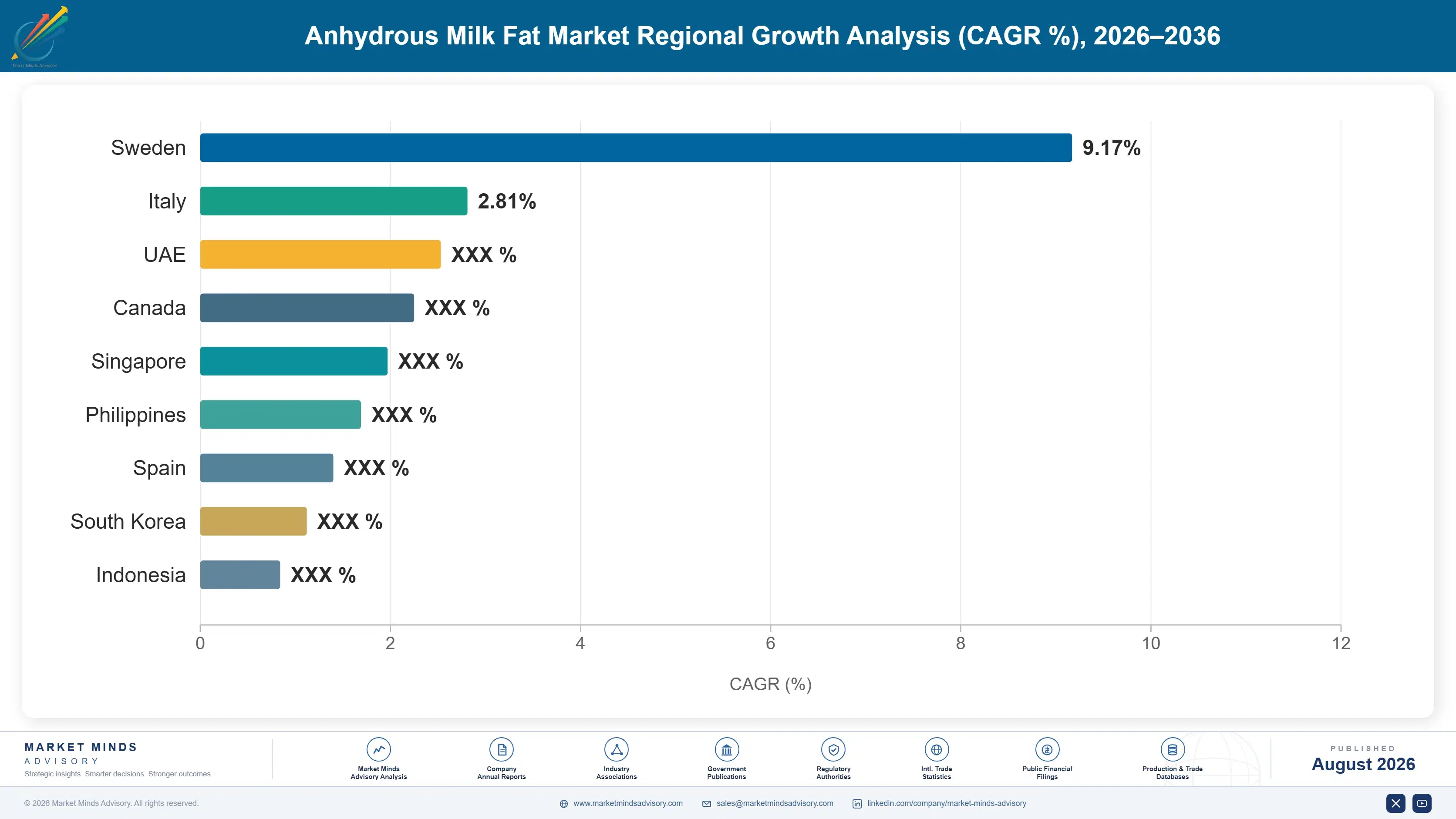
anhydrous-milk-fat-market-2024-2034-trends-country-cagr-analysis-1787462840078

Where Dairy Cooperatives Can Capture Margin

Margin defense in anhydrous milk fat increasingly depends on moving beyond commodity industrial-grade pricing toward positioning that lets a cooperative charge for nutritional-grade purity, supply security through seasonal volatility, or diversified sourcing away from any single milkshed. The four moves below target the fastest-growing buyer segments most willing to pay well above commodity pricing.

Build Nutritional-Grade Purity Certification Ahead of Demand

Infant formula-grade anhydrous milk fat commands retail pricing running 15% to 25% above industrial-grade equivalents, and demand from Asian nutritional manufacturers has grown considerably faster than the industry's qualified nutritional-grade processing capacity currently available. Cooperatives that invest in purity certification and traceability documentation now capture premium contracts before competitors establish comparable regulatory credibility, since infant formula manufacturers increasingly treat documented compositional consistency as a baseline sourcing requirement. The certification investment requires meaningful testing infrastructure and regulatory navigation across multiple export markets, but the margin uplift over industrial-grade pricing more than justifies the cost for most established cooperatives.
Market Impact: Nutritional-grade certification typically adds a 15% to 25% premium

Diversify Export Supply Beyond New Zealand Concentration

New Zealand's outsized share of global export supply exposes every downstream recombiner and formula manufacturer to concentrated seasonal weather risk that can move benchmark pricing by 18% or more within a single poor collection cycle. Cooperatives that build diversified sourcing relationships across European and Indian supply alongside traditional New Zealand contracts now offer buyers supply security that single-source competitors cannot match during the next drought-affected season. The diversification investment requires multi-year supplier relationship development across several exporting countries, but the supply reliability it provides justifies the cost for cooperatives serving contract-sensitive nutritional and recombining customers.
Market Impact: Diversified sourcing typically reduces price risk by 18%

Secure Long-Term Middle Eastern Recombining Contracts

Gulf recombining manufacturers increasingly prefer multi-year supply commitments over spot purchasing, since supply disruption during periods of tight global dairy fat availability carries genuine food security and production continuity risk for import-dependent regional food manufacturers. Cooperatives that secure these contracts now lock in roughly 20% more committed volume before competitors capture the same customers, since recombiners rarely switch suppliers once a formulation and supply relationship has been validated across successive production cycles. The contracting investment requires meaningful sales and logistics coordination capacity, but the multi-year revenue visibility it provides justifies the cost for most large-scale exporting cooperatives.
Market Impact: Long-term contracts typically lock in 20% more volume

Expand Indian Domestic Processing Capacity Now

India's domestic dairy fat consumption carries growth running roughly 7.2% annually, meaningfully higher than most export-dependent regional demand, giving cooperatives with local processing presence a durability that export-focused strategies alone cannot match given the sheer scale of India's population and rising per-capita consumption. Cooperatives that build domestic processing and distribution capacity now in India capture volume growth before competitors establish comparable local infrastructure and regulatory relationships within the country's fragmented but consolidating dairy sector. The investment requires meaningful capital and navigation of India's cooperative-dominated dairy structure, but the volume growth available domestically exceeds most comparable export opportunities currently.
Market Impact: Indian domestic capacity typically captures roughly 7.2% growth

Who Controls the Margin Pool

Competitive concentration sits at a moderately high CR5 of 52%, reflecting a market dominated by large diversified dairy cooperatives that control both raw milk collection and export-scale processing capacity across major surplus milksheds. The gap between category leaders and mid-tier challengers remains considerable, built on decades of farmer cooperative relationships and processing infrastructure investment that newer entrants cannot easily replicate.
Competitive activity currently runs along three lines. Large export cooperatives compete on processing scale and certification breadth, applying farmer milk collection networks smaller competitors cannot replicate. Regional domestic processors compete on proximity and cost for industrial-grade recombining and bakery applications. Distributors compete on logistics and supply diversification, since access to multiple milksheds determines who wins nutritional and recombining accounts.

Pressure is building from two directions. Asian and Middle Eastern buyers are increasingly contracting directly with export cooperatives, bypassing traditional trading intermediaries that once controlled most import volume into deficit regions. Meanwhile nutritional-grade certification investment is becoming a genuine competitive differentiator, rewarding cooperatives willing to fund purity and traceability infrastructure over those competing purely on commodity industrial-grade pricing. Rankings over the next five years will favor whoever combines diversified milkshed sourcing with credible nutritional-grade processing capability.
anhydrous-milk-fat-market-2024-2034-trends-company-positioning-matrix-1787462840596

Competitive Moat and Risk Dimensions

FONTERRA CO-OPERATIVE GROUP LIMITED

Moat: Dominant New Zealand export infrastructure

Fonterra's farmer cooperative structure gives it access to a substantial share of New Zealand's milk collection alongside export-scale processing and global distribution infrastructure that newer entrants, domestic or international, cannot replicate on any reasonable timeline, giving it pricing influence over global benchmark auctions that few competitors can match.
FONTERRA CO-OPERATIVE GROUP LIMITED

Risk: Concentrated New Zealand weather exposure

Fonterra's supply base remains heavily concentrated in New Zealand's pasture-based dairy farming system, exposing the company directly to seasonal rainfall variability and periodic drought conditions that can move its own collection volume and global benchmark pricing simultaneously within a single difficult season for farmers.
AMUL (GUJARAT COOPERATIVE MILK MARKETING FEDERATION)

Moat: Unmatched Indian domestic distribution scale

Amul's decades-old cooperative distribution network across India gives it domestic market access and farmer relationships that international entrants cannot replicate quickly, letting it dominate ghee and domestic dairy fat applications across hundreds of millions of Indian households with deep, multi-generational brand trust built over decades.
AMUL (GUJARAT COOPERATIVE MILK MARKETING FEDERATION)

Risk: Limited export processing infrastructure

Amul's business remains concentrated almost entirely within India's domestic market, meaning the cooperative captures comparatively little of the export-driven nutritional and recombining demand growth that international cooperatives like Fonterra and Arla Foods have built their entire global export businesses around over recent decades.

Players Tracked

Prominent Players

Fonterra Co-operative Group Limited
Arla Foods amba
Lactalis Group
FrieslandCampina
Amul (Gujarat Cooperative Milk Marketing Federation)

Other Key Players

Saputo Inc
Glanbia plc
Danone SA
Bel Group
Sodiaal Union
DMK Deutsches Milchkontor GmbH
Savencia Fromage & Dairy
Mother Dairy Fruit & Vegetable Pvt Ltd
Schreiber Foods Inc
Land O'Lakes Inc
Dairy Farmers of America Inc
Murray Goulburn Co-operative
Meiji Holdings Co Ltd
Yili Group
China Mengniu Dairy Company Limited

Recent Developments

MARCH 2024

Fonterra expands nutritional-grade processing capacity in New Zealand

Fonterra commissioned expanded nutritional-grade anhydrous milk fat processing capacity at an existing New Zealand facility, responding to sustained infant formula manufacturer demand for documented purity and traceability nationwide. The investment was an organic capacity expansion, not a joint venture or acquisition of any competing processor.
Signal: Signals the largest global exporter prioritizing premium nutritional-grade capacity over industrial-grade volume expansion alone this cycle.
SEPTEMBER 2024

Amul announces domestic ghee processing capacity expansion

Amul announced expanded domestic ghee and clarified butterfat processing capacity across several Indian states, responding to rising household consumption and growing export demand from South Asian diaspora communities. The expansion was an organic capacity investment, not a joint venture or acquisition of any regional dairy cooperative.
Signal: Signals Indian domestic cooperatives scaling ahead of consumption growth that global trade statistics consistently understate today.
JANUARY 2025

Arla Foods acquires minority stake in Middle Eastern recombining distributor

Arla Foods acquired a minority equity stake in a Middle Eastern recombined dairy distribution company to strengthen direct customer relationships ahead of anticipated Gulf recombining capacity expansion across the region. The transaction was a minority equity investment, not a full acquisition, merger, or joint venture arrangement.
Signal: Signals European cooperatives building direct downstream relationships rather than relying entirely on independent trading intermediaries alone.

Farm-Gate Milk Pricing Sets The Margin Floor

Raw milk accounts for 58% to 68% of production cost for anhydrous milk fat, sourced from farmer cooperative milk collection networks whose pricing tracks global dairy commodity benchmarks and regional feed and energy costs rather than any anhydrous milk fat-specific supply and demand dynamic. Processing costs including separation, dehydration, and purity testing add a further meaningful share, varying considerably depending on whether a cooperative targets industrial-grade or nutritional-grade certified output.
The 2022 to 2023 global dairy price surge illustrated raw milk exposure directly. Global dairy trade data recorded farm-gate milk prices reaching multi-year highs through that period as feed costs and energy prices rose sharply following broader commodity disruption. Cooperatives without hedged forward contracts or diversified milkshed sourcing absorbed significant cost increases, passing some of that cost through to recombining and bakery customers who had few alternative low-cost supply sources to switch toward given the category's concentrated supply base.

Exposure falls hardest on smaller regional processors without long-term farmer supply contracts or milkshed diversification, who must source raw milk closer to prevailing spot farm-gate pricing and absorb whatever margin compression results from feed and energy cost swings. Larger diversified cooperatives with established farmer relationships and geographic sourcing diversification smooth that volatility considerably better than smaller, single-region-dependent competitors.
anhydrous-milk-fat-market-2024-2034-trends-cost-volatility-analysis-1787462840793

Lock Multi-Year Farmer Supply Agreements

Cooperatives negotiating multi-year milk supply agreements directly with member farmers convert volatile seasonal spot pricing into a more planned input cost structure, protecting downstream customer pricing that recombiners and bakery manufacturers resist adjusting frequently. This favors larger established cooperatives with existing farmer relationships, but smaller processors can access similar terms through regional milk pooling arrangements rather than negotiating individually.

Diversify Milkshed Sourcing Across Exporting Regions

Cooperatives reduce single-region weather and feed cost exposure by sourcing across New Zealand, European, and Indian milksheds rather than depending entirely on any single exporting country for the majority of processed volume. That diversification smooths input availability across different weather patterns and feed cost cycles, though it adds supplier qualification complexity across each additional sourcing region incorporated into the network.

Hedge Farm-Gate Pricing Through Forward Contracts

Cooperatives serving contract-sensitive nutritional and recombining customers increasingly use forward pricing agreements and dairy commodity hedging instruments to lock in raw milk cost ahead of seasonal collection cycles, reducing exposure to any single poor season disrupting customer supply commitments. This hedging strategy requires meaningful financial market expertise, but protects customer relationships that would otherwise face pricing disruption.

Portfolio Architecture for Margin Defence

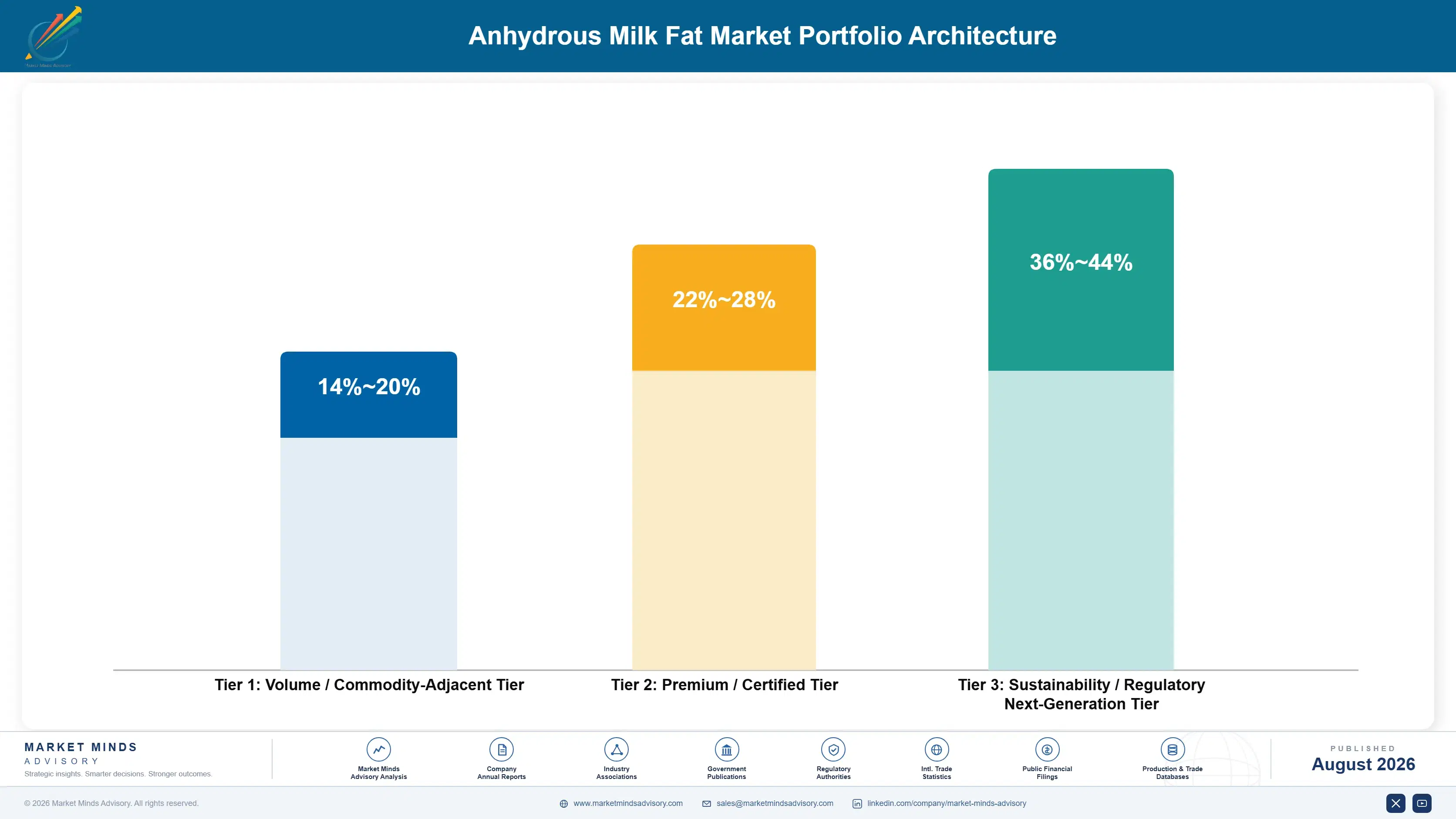
Anhydrous milk fat's portfolio splits into three tiers with meaningfully different margin economics. Volume industrial-grade fat, sold through commodity recombining and bakery channels on price and delivered volume, competes on cost and earns steady but thin margins. Certified nutritional-grade and specialty ghee-adjacent formulations earn substantially more, since documented purity and traditional culinary positioning create switching costs commodity industrial-grade competitors cannot replicate quickly.
The tension for cooperatives is capital allocation between two economics. Volume industrial-grade production generates dependable cash flow that funds farmer payments and operations, while nutritional-grade capacity requires meaningful certification and testing investment before generating comparable returns at much higher margin. Cooperatives leaning entirely on volume risk losing share to faster-growing nutritional-grade competitors, while those chasing certification too aggressively risk underutilized premium capacity if Asian infant formula reformulation demand growth proves slower than currently projected.

High-value margin pools concentrate in nutritional-grade certified fat and traditional ghee applications carrying genuine documentation or cultural differentiation that industrial-grade commodity fat cannot match. Frontier opportunity sits in combining diversified milkshed sourcing with credible nutritional-grade certification, letting cooperatives capture premium pricing from Asian formula manufacturers while retaining steady industrial-grade revenue simultaneously.

Volume / Commodity-Adjacent Tier

Industrial-grade anhydrous milk fat sold through commodity recombining and bakery channels on price and delivered volume, priced close to global benchmark auction levels with minimal differentiation between competing exporting cooperatives.
Gross Margin: 8-15%

Premium / Certified Tier

Nutritional-grade certified fat and documented traditional ghee formulations carrying purity and traceability documentation that commands sustained premiums over industrial-grade equivalents across infant formula and premium culinary buyers worldwide today.
Gross Margin: 25-38%

Sustainability / Regulatory / Next-Generation Tier

Emerging diversified-sourcing and traceability-verified supply chains designed to reduce reliance on any single milkshed, positioned ahead of tightening nutritional manufacturer sourcing transparency requirements, though scale-up economics remain largely unproven today.
Gross Margin: 15-28%
anhydrous-milk-fat-market-2024-2034-trends-portfolio-architecture-1787462841298

High-value Sub-segments and Strategic Watch-out

Infant Formula and Nutritional Products

Nutritional demand grows fastest at 6.8% annually and already commands documented premiums of 15% to 25% over industrial-grade pricing. Major exporting cooperatives investing in purity certification and testing infrastructure both continue expanding capacity, and growing Asian reformulation demand should keep margin strong through the forecast period ahead.
Gross Margin: 25-38%

Ghee and Culinary Fat Applications

Ghee demand grows at a healthy 5.8% annually, anchored by deep Indian cultural and religious tradition, though the segment remains concentrated among domestic Indian cooperatives with limited export infrastructure relative to global nutritional-grade suppliers competing internationally at scale across every export market.
Gross Margin: 18-28%

Recombined Dairy Applications

Recombined dairy remains a large volume category anchored by decades of import dependency across Gulf and Southeast Asian markets facing genuine domestic supply constraints. Margins stay steady but modest, competing on delivered cost and logistics reliability rather than differentiation, but the segment anchors baseline category revenue globally today.
Gross Margin: 8-15%

Bakery and Confectionery Applications

Bakery and confectionery demand faces gradual substitution pressure as cost-sensitive manufacturers shift toward lower-cost vegetable oil and fat blends in applications where flavor differentiation matters less to end consumers. Producers concentrated purely in this segment risk volume erosion absent diversification into nutritional or ghee-adjacent premium formats entirely.
Gross Margin: 10-18%

Why Milk Fat Contracts Run Long

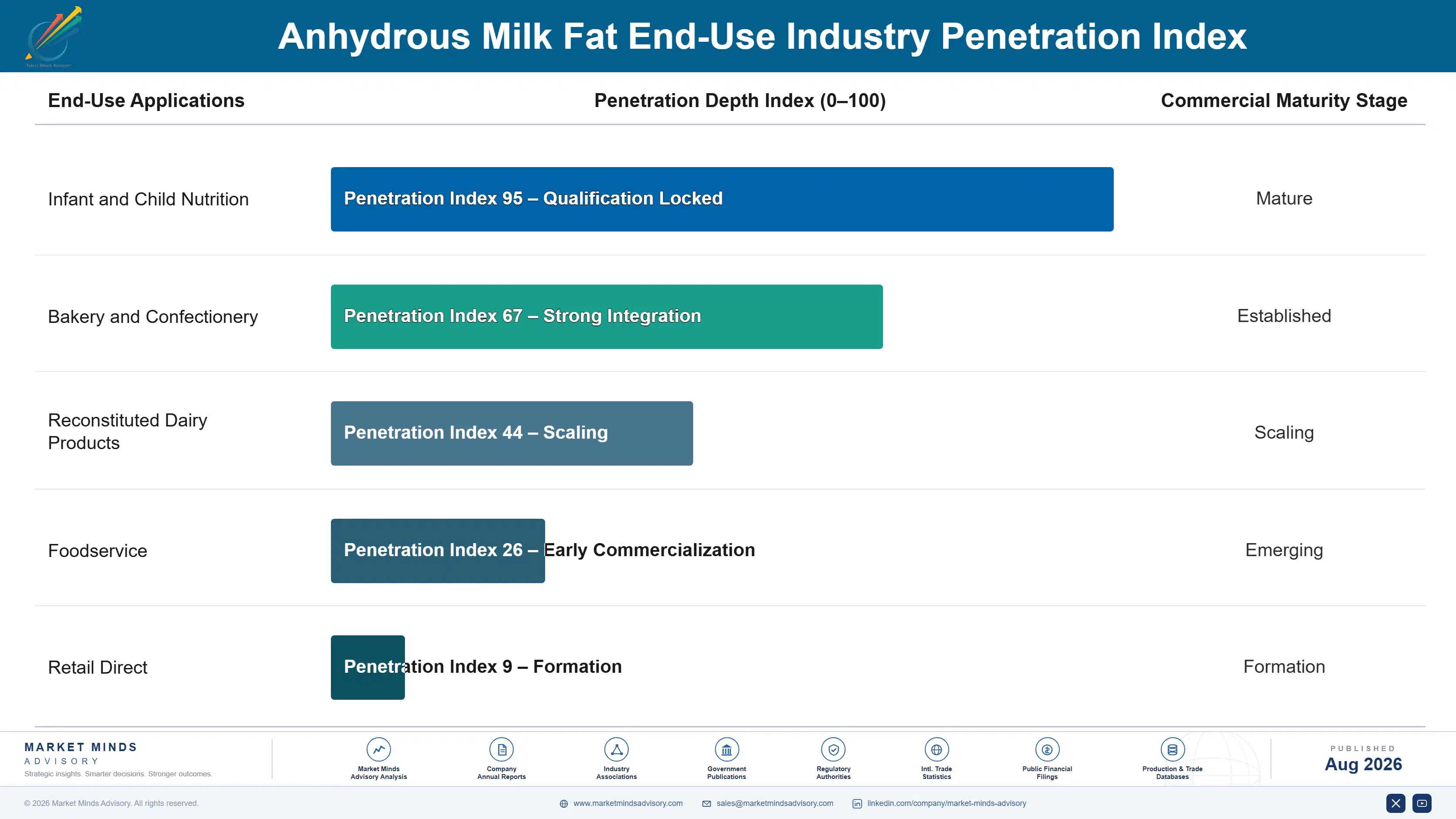
Anhydrous milk fat demand behaves like an annuity within nutritional and large-scale recombining relationships, since manufacturers qualify a supplier through extended formulation validation and regulatory documentation, then reorder against that qualified source repeatedly rather than re-tendering routinely given the compliance and production continuity risk of switching mid-relationship. Smaller bakery and confectionery buyers behave more transactionally, switching more readily on price since specification requirements are considerably looser.
Stickiness varies sharply by buyer scale and application sophistication. Infant formula manufacturers and large recombining operations rarely switch suppliers once qualified, given the regulatory documentation and formulation validation cost involved in establishing a new supply relationship under strict compositional requirements. Domestic ghee cooperatives serving culturally embedded consumption patterns show similarly strong loyalty. Smaller, less sophisticated bakery buyers remain the least sticky segment, switching between suppliers more readily as commodity pricing shifts season to season.

Buyer profiles are shifting generationally within nutritional manufacturing specifically. Younger formulation scientists and procurement teams increasingly treat documented compositional consistency and traceability as standing requirements rather than negotiable preferences, a shift that favors cooperatives who invested early in nutritional-grade certification infrastructure over those still competing purely on commodity industrial-grade pricing.
anhydrous-milk-fat-market-2024-2034-trends-end-use-penetration-index-1787462841789

Where Dairy Cooperatives Should Bet

These are among the four positions where our research anticipates prominent divergence between winners and laggards over the coming forecast period. Each is grounded in the demand model, the regulatory perimeter, and the announced capacity pipeline.
01 / NUTRITIONAL GRADE INVESTMENT

Build certified purity capacity before Asian reformulation demand outpaces supply

Infant formula and nutritional product demand is growing well over 60% faster than the wider market's pace, and already commands documented premiums of 15% to 25% above industrial-grade pricing, yet most cooperatives still lack dedicated nutritional-grade processing capacity at meaningful scale. Cooperatives that invest now in purity certification and traceability infrastructure position ahead of continuing Asian infant formula reformulation demand across every major national market. Waiting risks ceding the category's fastest-growing and highest-margin segment permanently to competitors currently building that certification capability.
02 / MILKSHED DIVERSIFICATION PRIORITY

Diversify export sourcing before the next New Zealand drought season

New Zealand's outsized share of global export supply exposes every processor and downstream buyer to concentrated seasonal weather risk that has already moved benchmark pricing by 18% or more within a single poor collection cycle. Cooperatives that build diversified sourcing across European and Indian milksheds now offer supply security that single-source competitors relying purely on New Zealand cannot match during the next drought-affected season. Every cooperative without a diversification plan today carries uncompensated risk that will resurface at the next weather disruption.
03 / INDIAN DOMESTIC EXPANSION

Build Indian processing presence before consumption growth outpaces capacity

India's domestic dairy fat consumption carries meaningfully higher growth than most export-dependent regional demand, and global trade statistics understate its true scale given how much stays within the country's own enormous domestic market entirely. Cooperatives that build domestic processing and distribution capacity now in India capture volume growth before competitors establish comparable local infrastructure within the country's fragmented but consolidating dairy sector. Every cooperative relying purely on export markets risks missing the category's largest underlying demand pool by a wide margin.
04 / LONG-TERM CONTRACT PRIORITY

Lock Middle Eastern recombiners into multi-year supply agreements now

Gulf recombining manufacturers increasingly prefer multi-year supply commitments over spot purchasing, since supply disruption during periods of tight global dairy fat availability carries genuine food security risk that import-dependent regional food manufacturers cannot comfortably absorb without disruption. Cooperatives that secure these contracts now lock in demand and pricing before competitors capture the same customers, since recombiners rarely switch suppliers once a formulation relationship has been validated. Every cooperative relying purely on spot sales risks missing the category's most durable and valuable revenue opportunity entirely.

Engagement Snapshot From the Field

A live engagement with an industry participant carrying material or product regulatory and market exposure ahead of a defining policy shift, showing how our research translates into a defensible multi-year portfolio strategy.
MARKET MINDS ADVISORY · CLIENT ENGAGEMENT SUMMARY
Anhydrous Milk Fat Producer Strategic Portfolio Review and Transition Roadmap 2026·Investment Scenario on Anhydrous Milk Fat Exposure Evaluation 2025-26
CLIENT PROFILE
A mid-sized Gulf recombined dairy manufacturer producing reconstituted milk, yogurt, and cheese products for regional retail approached MMA while evaluating whether to diversify anhydrous milk fat sourcing beyond its historical New Zealand-concentrated supplier base. The client reported annual production revenue near USD 210 million, with anhydrous milk fat accounting for roughly 25% of total input cost and recent disruption tied to a poor New Zealand season (client-reported, unverified by MMA).
STRATEGIC CHALLENGE
Management faced a sourcing decision between continuing to concentrate purchasing with established New Zealand suppliers offering the most competitive baseline pricing or diversifying toward European and Indian sourcing at a modest premium to improve supply security. The commercial team worried diversification would raise average cost meaningfully, while operations worried continued concentration left the company exposed to another seasonal disruption.
MMA APPROACH
MMA benchmarked historical New Zealand supply volatility against comparable European and Indian sourcing reliability, modeled total delivered cost under several diversification scenarios, and assessed the client's production continuity risk exposure under a repeat of the recent seasonal disruption. We also evaluated forward contracting and hedging instruments available to smooth pricing volatility regardless of sourcing geography chosen.
KEY FINDINGS
  1. Diversifying roughly a third of purchasing volume toward European suppliers reduced projected supply disruption risk substantially while adding only a modest premium to average delivered cost.
  2. Full diversification away from New Zealand sourcing eliminated the cost advantage that made New Zealand supply attractive in the first place, without proportionally improving supply security further.
  3. Forward contracting with existing New Zealand suppliers captured a meaningful share of the same risk reduction benefit at lower cost than full geographic diversification (client-reported, unverified by MMA).
  4. A combined approach using partial diversification alongside forward contracting on remaining New Zealand volume balanced cost and supply security most effectively overall.
CLIENT PROFILE
A mid-sized Gulf recombined dairy manufacturer producing reconstituted milk, yogurt, and cheese products for regional retail approached MMA while evaluating whether to diversify anhydrous milk fat sourcing beyond its historical New Zealand-concentrated supplier base. The client reported annual production revenue near USD 210 million, with anhydrous milk fat accounting for roughly 25% of total input cost and recent disruption tied to a poor New Zealand season (client-reported, unverified by MMA).
STRATEGIC CHALLENGE
Management faced a sourcing decision between continuing to concentrate purchasing with established New Zealand suppliers offering the most competitive baseline pricing or diversifying toward European and Indian sourcing at a modest premium to improve supply security. The commercial team worried diversification would raise average cost meaningfully, while operations worried continued concentration left the company exposed to another seasonal disruption.
MMA APPROACH
MMA benchmarked historical New Zealand supply volatility against comparable European and Indian sourcing reliability, modeled total delivered cost under several diversification scenarios, and assessed the client's production continuity risk exposure under a repeat of the recent seasonal disruption. We also evaluated forward contracting and hedging instruments available to smooth pricing volatility regardless of sourcing geography chosen.
KEY FINDINGS
  1. Diversifying roughly a third of purchasing volume toward European suppliers reduced projected supply disruption risk substantially while adding only a modest premium to average delivered cost.
  2. Full diversification away from New Zealand sourcing eliminated the cost advantage that made New Zealand supply attractive in the first place, without proportionally improving supply security further.
  3. Forward contracting with existing New Zealand suppliers captured a meaningful share of the same risk reduction benefit at lower cost than full geographic diversification (client-reported, unverified by MMA).
  4. A combined approach using partial diversification alongside forward contracting on remaining New Zealand volume balanced cost and supply security most effectively overall.
RECOMMENDED STRATEGY
Phase 1: Phase 1 (0 to 6 months): Diversify roughly a third of purchasing volume toward qualified European suppliers to establish an alternative supply relationship. Phase 2: Phase 2 (6 to 18 months): Negotiate forward pricing contracts with existing New Zealand suppliers to reduce spot pricing exposure on remaining volume. Phase 3: Phase 3 (18 to 36 months): Reassess the diversification ratio annually based on realized New Zealand seasonal variability and delivered cost performance.
OUTCOME
The client diversified a third of its sourcing toward European suppliers and secured forward contracts on remaining New Zealand volume, reducing realized supply disruption risk meaningfully during a subsequent below-average collection season. The client reported the modest cost premium was justified by the production continuity it preserved (client-reported, unverified by MMA).

Frequently Asked Questions

Foundational context covering the market sizes, CAGR, scope, country, region and competition that inform every finding below. This section is provided to cover basics and most often pre-purchase conversations, answered from the MMA Primary Research Dataset.

What is the current size of the Anhydrous Milk Fat Market?

The global anhydrous milk fat market reached USD 4.38 billion in 2025, based on MMA Primary Research Dataset findings. Growth increasingly reflects Asian infant formula demand alongside established recombined dairy volume.

How large will the Anhydrous Milk Fat Market be by 2036?

MMA's base case projects the market reaching USD 6.61 billion by 2036, an incremental opportunity of roughly USD 2.23 billion over the 2026 to 2036 forecast period.

What is the CAGR for the Anhydrous Milk Fat Market 2026 to 2036?

The base case CAGR is 4.2%, with a bull case of 5.3% and a bear case of 3.1% depending on infant formula reformulation pace and vegetable fat substitution trends.

Which segment is growing fastest?

Infant formula and nutritional products lead at a 6.8% CAGR, well over 60% faster than the overall market rate, as Asian formula manufacturers increase milk-fat inclusion rates further.

Who are the major companies in the Anhydrous Milk Fat Market?

Leading participants include Fonterra Co-operative Group Limited, Arla Foods amba, Lactalis Group, FrieslandCampina, and Amul, assessed on processing scale and certification breadth.

Which country is growing fastest?

India leads country-level growth, driven by its position as the world's largest milk producer and rising domestic consumption of ghee, bakery, and confectionery fat applications nationwide.

Report Segmentation Architecture

The full report scope spans multiple orthogonal segmentation dimensions, with cross-tabulated demand data provided for each dimension pair. Coverage extends further to regional breakdowns, trend trajectories, and the competitive detail needed to support segment-level decision-making.

By Application

  • Recombined and Reconstituted Dairy Products
  • Bakery and Confectionery Applications
  • Infant Formula and Nutritional Products
  • Chocolate and Compound Coating Applications
  • Ghee and Culinary Fat Applications
  • Industrial and Food Service Applications

By End-Use Industry

  • Dairy and Recombined Product Manufacturing
  • Bakery and Confectionery Manufacturing
  • Infant Nutrition Manufacturing
  • Food Service and Hospitality
  • Household and Culinary Retail

By Commercial Dimension

  • Direct Cooperative Contract Supply
  • Trading and Distribution Intermediaries
  • Spot Market Purchasing
  • Certified Nutritional-Grade Supply Agreements

By Region

  • North America
  • Western Europe
  • East Asia
  • South Asia and Pacific
  • Latin America
  • Middle East and Africa
  • Eastern Europe

Scope, Methodology, and Coverage

Every figure in this report is reproducible from documented input assumptions. The scope below maps the historical period, the forecast horizon, the segmentation dimensions, and the countries covered, alongside the underlying primary and qualitative methodology.
Historical Period
2020 to 2025
Forecast Period
2026 to 2036
Base Year
2025 (USD billions; MMA Primary Research Dataset, August 2026)
Market Definition
The anhydrous milk fat market covers commercial production and sale of milk fat processed to remove nearly all moisture and non-fat solids, sold as anhydrous milk fat, anhydrous butteroil, or ghee-adjacent culinary fat for recombining, bakery, confectionery, and nutritional applications. It excludes fresh butter, cream, and finished consumer dairy products, which the industry classifies as separate downstream categories.
Quantitative Units
USD billions (current prices); metric tonnes of anhydrous milk fat production and trade volume where applicable
Segmentation Dimensions
By Application; By End-Use Industry; By Commercial Dimension; By Region
Regions Covered
North America, Western Europe, East Asia, South Asia and Pacific, Latin America, Middle East and Africa, Eastern Europe
Countries Covered
USA, China, Germany, France, UK, Japan, South Korea, India, Australia, Canada, Brazil, Mexico, Indonesia, Vietnam, Thailand, Malaysia, UAE, Saudi Arabia, South Africa, Nigeria, Turkey, Poland, Netherlands, Italy, Spain, Sweden, Switzerland, Argentina, Colombia, Singapore, and additional markets relevant to this sector
Key Companies Profiled
Fonterra Co-operative Group Limited, Arla Foods amba, Lactalis Group, FrieslandCampina, Amul (Gujarat Cooperative Milk Marketing Federation), Saputo Inc, Glanbia plc, Danone SA, Bel Group, Sodiaal Union, DMK Deutsches Milchkontor GmbH, Savencia Fromage & Dairy, Mother Dairy Fruit & Vegetable Pvt Ltd, Schreiber Foods Inc, Land O'Lakes Inc, Dairy Farmers of America Inc, Murray Goulburn Co-operative, Meiji Holdings Co Ltd, Yili Group, China Mengniu Dairy Company Limited
Quantitative Methodology
Primary survey, n=3,800 respondents, Q4 2025, six countries; demand-side model with trade association cross-validation
Qualitative Methodology
47 expert interviews, Q4 2025; applied to validate demand model assumptions, identify emerging dynamics, and assess competitive positioning
Report Format
PDF and XLSX data workbook (Word format preview document)
Publisher
Market Minds Advisory
Report Code
MMA-2026-AGR-107
Published
August 2026
Contact
sales@marketmindsadvisory.com | www.marketmindsadvisory.com

Purchase the full Anhydrous Milk Fat Market Report (2026 to 2036).

The full MMA Anhydrous Milk Fat report sizes the market across six application segments, five end-use industries, four commercial supply models, and seven regions through 2036. It profiles twenty participants on a consistent basis of processing scale and certification breadth across industrial, nutritional, and ghee-adjacent formats, scoring each on milkshed diversification, nutritional-grade certification, and recombining customer relationships. Scenario models quantify how New Zealand seasonal supply variability, Asian infant formula reformulation, and Indian domestic consumption growth move both category volume and realizable pricing. The report also includes farm-gate milk cost modeling, a nutritional-grade certification benchmark, and Indian domestic demand assessment built for ingredient, dairy, and investment strategy teams.
Six-application demand model with certification-adjusted pricing
Farm-gate milk cost and seasonal volatility scenario modeling
Nutritional-grade certification pathway and readiness benchmarking
Twenty-company competitive profiling on consistent processing basis
Seven-region demand map with country-level growth detail
Indian domestic consumption and export capacity assessment

Built For The People Who Decide

From boardroom strategy to bench-side execution, this report is read cover-to-cover by leaders shaping the next decade of their industry, turning demand scenarios, market dynamics and valuation benchmarks into decisions.
CXOs/ Presidents/ VPs/ Managers
M&A and Corporate Development
Strategy Teams and R&D Heads
Procurement and Product Directors
Regulatory and Compliance Leaders
Investor Relations and Equity Analysts