

Market Minds Advisory
Anesthesia Ultrasound Systems Market

Anesthesia Ultrasound Systems Market: AI-Guided Needle Tracking Enters Clinical Mainstream

Regional anesthesia adoption accelerates as hospitals prioritize opioid-sparing nerve block protocols, AI-guided needle tracking systems near broader commercial rollout, and manufacturers without portable point-of-care platforms lose ambulatory surgery center contracts outright.

Lead Analyst

Alice Ballenger

Published

September 2026

Make Smarter Decisions with Customized Research Insights

Request a free sample report and evaluate market opportunities, growth trends, and competitive dynamics relevant to your business needs.

2025 MARKET VALUE$1.9BMarket Size 2025
2036 FORECAST VALUE$4.6BBase Case , 2026 to 2036
CAGR 2026 TO 20368.4 %Bull 9.7% / Bear 7.0%
INCREMENTAL OPPORTUNITY$2.5BNet 10- year value creation
EXPANSION MULTIPLE2.24x2036 value over 2026 base
Strategic Levers
M&A Pipeline
Regional Outlook
Country Rankings
Competitive Intelligence
Segmental Deep-dive
Call-Us : 91 93563 13602

Executive Snapshot and Market Trajectory

Hospital anesthesiology departments increasingly treat AI-guided needle tracking accuracy as the deciding purchasing factor rather than image resolution alone, since documented nerve block precision data now determines which ultrasound platforms actually qualify for opioid-sparing regional anesthesia protocols across most major hospital systems simultaneously and without costly retraining delay.
AI-guided needle tracking systems lead growth at 14.5%, roughly 1.73 times the overall rate, as automated nerve identification expands faster than conventional freehand ultrasound guidance alone can satisfy across every regional anesthesia procedure and surgical care setting. North America now holds the largest regional share at 29%, driven by concentrated opioid-sparing anesthesia protocol adoption and the world's most established ambulatory surgery center infrastructure across the country's leading hospital systems and their affiliated surgical networks entirely.
Competitive intensity stays moderate at 48% held by five participants, since imaging platform engineering complexity and clinical validation requirements fragment share less than most other medical device categories, concentrating supply around a handful of established imaging manufacturers rather than dozens of niche device developers competing broadly across the wider point-of-care ultrasound landscape and its many surgical specialties. Buyers increasingly select platforms on workflow integration rather than image quality alone.
Market Definition
This report covers ultrasound imaging systems used for regional anesthesia and nerve block guidance, spanning portable, cart-based, AI-guided tracking, transducer, vascular access, and simulation systems. It excludes diagnostic radiology and non-anesthesia point-of-care ultrasound applications.
Base Year Value
$1.9B in 2025 (MMA Primary Research Dataset, August 2026)
Forecast Period
2026 to 2036, eleven discrete annual values
CAGR
8.4% base case. Bull 9.7%. Bear 7.0%.
Fastest Growth Segment
AI-Guided Needle Tracking Systems: 14.5% CAGR
Fastest Growth Country
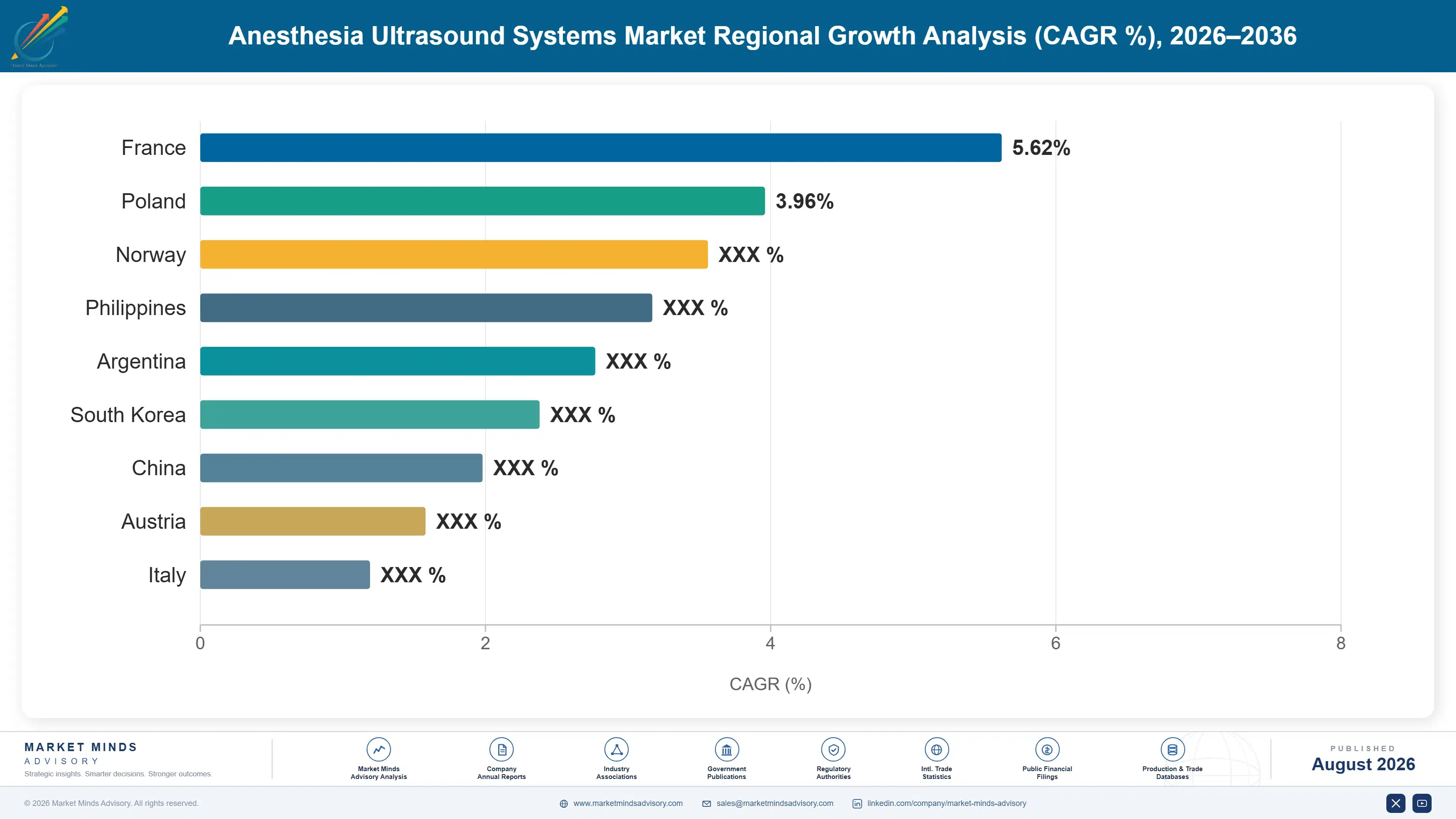
China: 10.5% CAGR
Fastest Growth Region
South Asia and Pacific: 10.2% CAGR
Largest Region
North America: 29% of 2025 global value
Market Leaders
GE HealthCare, Philips, FUJIFILM (SonoSite), Canon Medical Systems, Mindray. Source: MMA Analysis, July 2026.
Primary Survey
n=3,800 procurement and R&D decision-makers, Q4 2025, six countries
Methodology
Demand-side build-up, cross-validated against public data, 47 expert interviews

Anesthesia Ultrasound Systems Market Forecast Scenarios

anesthesia-ultrasound-systems-market-size-size-forecast-scenario-1787303540284
Between 2020 and 2025 the market grew at an estimated 7.2% annually, as post-pandemic surgical volume recovery and expanding opioid-sparing anesthesia protocol adoption pushed hospitals toward expanded ultrasound-guided nerve block procurement faster than the industry's typical multi-year capital equipment cycle would otherwise dictate across most major hospital systems worldwide, a pace that held steady even through supply chain disruption.
Three mechanisms carry the base case to 8.4%. First, opioid-sparing anesthesia protocols keep expanding globally, and every new regional anesthesia program requires certified ultrasound guidance equipment for nerve block procedures across most surgical specialties. Second, ambulatory surgery center volume keeps expanding as procedures shift away from traditional hospital settings toward outpatient facilities. Third, AI-guided needle tracking technology keeps maturing as clinical validation data accumulates, reducing adoption uncertainty for hospital purchasing committees.
The bull case at 9.7% assumes accelerating AI-guided technology adoption and ambulatory surgery center expansion across additional major markets pulls forward equipment procurement faster than currently planned by most hospital systems. The bear case at 7.0% assumes budget-constrained hospital capital programs delay planned equipment upgrades, slowing the pace of new anesthesia ultrasound demand growth across affected surgical departments and their broader capital budgets.

AI-Guided Tracking Reshapes Anesthesiology Purchasing

Anesthesia ultrasound systems occupy an unusual position within point-of-care imaging: the underlying imaging technology is mature and widely commoditized, yet AI-guided needle tracking is genuinely transforming clinical workflow in ways conventional freehand ultrasound cannot match. Hospital purchasing committees now request documented tracking accuracy and workflow integration data alongside traditional image quality specifications, and manufacturers without AI-guided platforms risk losing pre
MARKET CONCENTRATION48%Top five manufacturers hold roughly half global equipment share
AVERAGE UNIT PRICE$42,000/systemReflects fully equipped anesthesia ultrasound platform pricing typically observed
TOP PRODUCING COUNTRY SHARE29%One country dominates global anesthesia ultrasound purchasing volume substantially
EQUIPMENT REPLACEMENT CYCLE6 to 8 yearsTypical interval before hospital systems upgrade imaging platforms
AI-GUIDED ADOPTION RATE22% of unitsAutomated tracking systems increasingly displace conventional freehand guidance equipment
COMPONENT COST SHARE32-40% of COGSSpecialty transducer and processing components weigh heavily on costs
Demand now splits along two distinct tracks. Traditional hospital anesthesiology departments still prioritize proven reliability and service network depth above nearly everything else, while ambulatory surgery centers increasingly weigh portability and workflow speed alongside accuracy. These tracks are starting to command genuinely different premiums, since AI-guided tracking adds real cost that only high-volume regional anesthesia programs consistently justify.
Supply discipline remains tight because AI-guided tracking platform validation takes years of clinical trial and regulatory work, while opioid-sparing anesthesia adoption keeps accelerating faster than validated equipment supply can expand. That gap keeps procurement timelines elevated and rewards manufacturers who invested in AI tracking research early. Ambulatory surgery center growth is reshaping purchasing patterns faster than most participants expected, pushing established hospital-focused manufacturers toward portable platform development.
"Workflow integration, not raw image resolution, is what actually wins hospital purchasing committees today. Manufacturers without a credible AI-guided tracking roadmap are increasingly bidding for a shrinking share of anesthesiology budgets."
Director, Medical Imaging and Anesthesiology Devices Practice · MMA Medical Devi

Market Trends

AI-Guided Needle Tracking Enters Clinical Mainstream

Manufacturers are increasingly integrating artificial intelligence algorithms directly into anesthesia ultrasound platforms to automatically identify nerve structures and guide needle placement, since automated tracking reduces the steep learning curve that historically limited regional anesthesia adoption among less experienced practitioners. This shift accelerated after several major manufacturers reported clinical validation data demonstrating meaningfully improved first-pass block success rates compared with freehand technique alone. Manufacturers lacking AI-guided tracking capability are being excluded from major hospital system procurement consideration even when their base imaging quality is comparable, since purchasing committees increasingly treat automated guidance as a genuine clinical safety improvement.
Market Impact: Opioid-sparing protocols cut usage

Ambulatory Surgery Center Growth Drives Portable Demand

Ambulatory surgery centers are increasingly performing procedures that traditionally required inpatient hospital settings, driving demand for portable anesthesia ultrasound systems that fit compact outpatient facility footprints and support rapid room turnover between cases. This trend directly benefits manufacturers with established portable platform lines, forcing hospital-focused competitors without compact form factors to lean harder on retrofit accessories that outpatient facilities increasingly view as suboptimal compromises. Roughly forty percent of regional anesthesia procedures now occur in ambulatory settings, a share that keeps expanding each year as reimbursement policy continues favoring lower-cost outpatient surgical delivery.
Market Impact: Training programs require 80% compe

Market Opportunities and Growth Drivers

Opioid-Sparing Protocol Adoption Sustains Baseline Demand

Hospital systems keep expanding opioid-sparing anesthesia protocols across most major surgical specialties, and each new regional anesthesia program requires certified ultrasound guidance equipment regardless of hospital size or surgical volume served nationwide. Health systems are locking in multi-year equipment supply agreements well ahead of program launch, since ultrasound platform evaluation and staff training take six to twelve months and cannot be rushed once program timelines are set. Hospitals targeting opioid reduction initiatives continue specifying ultrasound-guided regional anesthesia precisely because clinical outcomes and reduced opioid exposure justify the incremental equipment investment.
Market Impact: AI-guided systems cost $50,000 or m

Anesthesiologist Training Programs Sustain Adoption Growth

Medical residency and fellowship programs are increasingly incorporating ultrasound-guided regional anesthesia as a core curriculum component, producing a growing pipeline of anesthesiologists comfortable with and expecting access to this equipment upon entering clinical practice. This training pipeline effect is sustaining equipment demand independent of near-term reimbursement or protocol changes, since newly trained physicians simply expect ultrasound guidance as standard practice rather than an optional add-on capability. This driver is particularly pronounced across academic medical centers, where training program requirements directly drive institutional equipment procurement decisions well ahead of broader adoption curves elsewhere.
Market Impact: Proficiency training takes 6-12 mon

Market Restraints and Challenges

High Equipment Cost Limits Smaller Facility Access

Fully equipped anesthesia ultrasound systems with AI-guided tracking capability often exceed fifty thousand dollars per unit, making comprehensive equipment upgrades financially challenging for smaller community hospitals and rural surgical facilities operating on constrained capital budgets. The root cause is engineering complexity: AI-guided tracking requires substantial processing hardware and validated software licensing that adds meaningful cost beyond conventional ultrasound imaging alone. That cost pressures smaller facilities toward older equipment or forgoing regional anesthesia programs entirely. Manufacturers are responding by developing tiered pricing structures and equipment leasing programs to expand access among budget-constrained facilities.
Market Impact: AI-guided systems cover 22% of unit

Clinician Training Gap Limits Adoption Pace

Ultrasound-guided regional anesthesia requires substantial hands-on training before practitioners achieve consistent proficiency, and many practicing anesthesiologists trained before this technology became standard curriculum lack structured opportunities to develop this skill set fully. The root cause is generational: physicians trained decades ago learned different techniques, and retraining an experienced clinical workforce takes considerably longer than training new residents from the outset. This training gap slows equipment adoption even at facilities that have already purchased ultrasound systems. Manufacturers are responding by expanding clinical education programs and simulation-based training partnerships with hospital systems.
Market Impact: 40% of procedures occur ambulatory
3 additional market trends, 4 additional growth drivers, and 3 additional restraints and challenges are covered in the full report. Contact sales@marketmindsadvisory.com to access the complete intelligence.

Segment CAGR and Growth Architecture

Anesthesia ultrasound segmentation follows equipment type rather than clinical application alone, since the same hospital purchasing pool evaluates distinct platforms across most procurement decisions available today worldwide and across every surgical setting. Six segments span portable, cart-based, AI-guided tracking, transducer, vascular access, and simulation systems, each carrying a distinct engineering complexity and purchasing pattern.
anesthesia-ultrasound-systems-market-size-market-share-analysis-1787303540821

AI-Guided Needle Tracking Systems

AI-guided needle tracking systems are growing fastest overall as hospital purchasing committees increasingly specify automated nerve identification capability that conventional freehand ultrasound guidance cannot match on consistency across practitioners with varying experience levels and training backgrounds nationwide. Academic medical centers and high-volume regional anesthesia programs are driving most of this growth, since AI-guided platforms benefit disproportionately from clinical validation data demonstrating improved first-pass success rates that justify the incremental equipment cost. Manufacturers with proven AI-guided tracking regulatory clearances are capturing disproportionate share of new hospital procurement contracts as purchasing committees increasingly specify this technology explicitly in equipment requirements, particularly across leading academic anesthesiology departments in the United States and Europe.
CAGR 14.5%

Portable and Handheld Ultrasound Systems

Portable and handheld ultrasound systems grow second-fastest overall today, favored for their compact form factor that fits ambulatory surgery center space constraints and supports rapid room turnover between procedures that cart-based systems cannot match at comparable cost, convenience, or overall clinical efficiency. Ambulatory surgery centers worldwide increasingly specify portable systems as standard equipment given their facility footprint constraints, since these venues typically lack the dedicated equipment storage space traditional hospital anesthesiology departments maintain across their surgical suites. Manufacturers offering fully validated portable platforms with wireless connectivity are capturing meaningful share from cart-based specialists, since ambulatory surgery center customers increasingly prefer equipment that integrates smoothly into compact, high-turnover clinical workflows and staffing models.
CAGR 11.2%
Full segment breakdown across 6 segments available in the complete report.

Regional Architecture and Country Demand Map

North America commands the largest share on concentrated opioid-sparing anesthesia protocol adoption and the world's most established ambulatory surgery center infrastructure, followed by East Asia and Western Europe on expanding hospital modernization and established clinical training systems respectively across their major and rapidly evolving healthcare markets.

North America

North American demand is anchored by concentrated opioid-sparing anesthesia protocol adoption and the world's most established ambulatory surgery center infrastructure, giving the region genuine purchasing leadership that other regions have not yet replicated at comparable scale, training depth, or clinical trial access today or in the near term. The United States dominates regional equipment volume, where major hospital systems increasingly deploy AI-guided tracking platforms supported by expanding residency training requirements. Canada's smaller hospital sector follows comparable procurement patterns at smaller absolute scale, anchored by its own provincial healthcare framework. Growth of 9.2% outpaces the global rate as opioid reduction initiatives and ambulatory surgery center expansion compound across an already substantial installed equipment base.
Share: 29% | CAGR: 9.2% (2026 to 2036)

Western Europe

Germany and the United Kingdom anchor most of Western Europe's demand, where established national health system procurement frameworks support broad anesthesia ultrasound adoption ahead of many other mature markets globally and across the wider continent's regulatory and reimbursement landscape, systems, institutions, specialist training networks, and hospital purchasing groups. The European Union's medical device regulation is shaping which manufacturers actually capture procurement share across the bloc's stringent certification systems and member states. France's concentrated academic anesthesiology infrastructure sustains steady demand tied to established training program relationships built over multiple decades. Growth of 6.8% trails the global average because the region's mature equipment base has already captured most feasible near-term procurement volume growth.
Share: 21% | CAGR: 6.8% (2026 to 2036)
Regional intelligence for 5 additional markets available in the complete report: East Asia, South Asia and Pacific, Latin America, Middle East and Africa, Eastern Europe. Contact sales@marketmindsadvisory.com.
anesthesia-ultrasound-systems-market-size-country-cagr-analysis-1787303541345

Where Ultrasound Manufacturers Can Defend Margin

Anesthesia ultrasound manufacturers capture margin unevenly across equipment categories, and the biggest opportunities sit in AI-guided technology leadership, ambulatory surgery center positioning, and clinical training partnership rather than volume expansion alone. Four commercial levers stand out as genuinely actionable across most manufacturer types, regardless of whether the underlying platform serves hospital or ambulatory surgery center customers.

Lead AI-Guided Tracking Technology Development Now

Manufacturers who develop proven AI-guided needle tracking capability capture premium pricing of 20% to 30% over competitors offering only conventional freehand ultrasound guidance, since hospital purchasing committees increasingly treat automated tracking as a genuine clinical safety improvement rather than optional convenience across most major hospital and ambulatory markets. This advantage compounds as clinical validation data accumulates, since purchasing committees increasingly favor platforms with proven outcomes data over unvalidated alternatives. Manufacturers who have built this technology over multiple product generations cannot be quickly replicated by competitors starting AI development from scratch.
Market Impact: AI-guided tracking commands a 20 to

Build Dedicated Ambulatory Surgery Center Product Lines

Manufacturers who develop dedicated portable product lines specifically for ambulatory surgery center facility constraints capture share from hospital-focused competitors offering retrofit accessories that outpatient facilities view as suboptimal compromises across their compact clinical footprints and workflows. This positioning can add 25% to 35% incremental volume compared with manufacturers relying solely on cart-based hospital platforms, since ambulatory surgery center growth is outpacing traditional hospital equipment procurement across most major healthcare markets, reimbursement systems, and surgical specialties. Manufacturers who delay dedicated ambulatory product development risk permanently ceding this fast-growing channel to portable-first competitors.
Market Impact: Dedicated ambulatory products add 2

Establish Clinical Training and Education Partnerships

Manufacturers who invest in clinical training partnerships with academic medical centers and residency programs capture prescriber loyalty that competitors offering equipment alone cannot match, since training relationships build brand familiarity before purchasing decisions occur across most major academic medical institutions, teaching hospitals, and fellowship training programs. This lever can lift equipment preference by 15% to 25% among newly trained anesthesiologists who learned on a specific manufacturer's platform during residency and fellowship training. This lever rewards manufacturers who invest early in academic relationships over those competing purely on equipment specifications alone.
Market Impact: Training partnerships lift equipmen

Expand Tiered Pricing to Reach Budget-Constrained Facilities

Manufacturers who develop tiered pricing structures and equipment leasing programs capture volume from budget-constrained community hospitals and rural facilities that competitors offering only premium-tier equipment leave unaddressed entirely across most cost-sensitive healthcare markets, geographies, and payer reimbursement environments. This expansion can add 20% to 30% incremental facility volume compared with manufacturers offering only premium AI-guided platforms without accessible entry-tier options for smaller institutions and rural providers. This lever is particularly attractive for manufacturers seeking to build long-term relationships with facilities that may eventually upgrade to premium tiers as budgets allow.
Market Impact: Tiered pricing expands facility vol

Who Controls the Margin Pool

Concentration stays moderate at forty-eight percent held by five participants, evaluated on anesthesia ultrasound equipment revenue specifically. GE HealthCare and Philips lead decisively on established hospital relationships and imaging platform breadth, while FUJIFILM, Canon Medical Systems, and Mindray compete across different regional strongholds and price tiers, leaving a meaningful gap between the top two.
Current competitive activity centers on three dimensions. Manufacturers are racing to develop AI-guided needle tracking capability, since automated nerve identification increasingly determines hospital purchasing committee preference. Ambulatory surgery center positioning has become a genuine differentiator, with several manufacturers investing heavily in portable platform development to capture the fastest-growing procurement channel. And clinical training partnership depth is the third, as manufacturers build academic relationships to shape prescriber preference before purchasing decisions occur.

Emerging pressure comes from Chinese domestic manufacturers, who are scaling engineering capability fast enough to challenge established Western imaging companies for share in price-sensitive markets within the next several years. Rankings could shift if a major Chinese manufacturer secures AI-guided tracking regulatory clearance, combining cost competitiveness with technology parity that pure Western imaging incumbents currently charge premium pricing for. Portable-only specialists riding the ambulatory surgery center wave also stand to gain incremental share.
anesthesia-ultrasound-systems-market-size-company-positioning-matrix-1787303541868

Competitive Moat and Risk Dimensions

GE HEALTHCARE TECHNOLOGIES INC.

Moat: Broadest Hospital Relationship Network

GE HealthCare maintains the broadest hospital procurement relationships of any anesthesia ultrasound manufacturer, built over decades of imaging equipment sales across multiple clinical departments, giving it cross-selling advantages and purchasing trust that newer entrants cannot quickly replicate. This relationship depth lets the company introduce new AI-guided platforms and secure adoption faster than competitors building hospital trust from scratch.
GE HEALTHCARE TECHNOLOGIES INC.

Risk: Facing Nimble Portable-First Competitors

GE HealthCare's hospital-focused legacy business model faces competitive pressure from nimbler manufacturers who designed portable platforms specifically for ambulatory surgery centers from the outset, rather than retrofitting hospital-focused equipment. The company must continue investing in dedicated portable product lines to defend its position against competitors built for this fast-growing channel.
KONINKLIJKE PHILIPS N.V.

Moat: Deepest Global Imaging Commercial Reach

Philips's global commercial infrastructure across medical imaging markets gives it distribution and hospital procurement reach that smaller specialized competitors cannot match, letting it launch new anesthesia ultrasound platforms across dozens of markets simultaneously. This scale also lets the company absorb pricing pressure in any single market that would meaningfully threaten smaller, less diversified competitors.
KONINKLIJKE PHILIPS N.V.

Risk: Slower AI Technology Rollout Pace

Philips has moved more deliberately than some smaller, more focused competitors into AI-guided needle tracking technology, leaving it comparatively exposed as hospital purchasing committees increasingly specify this capability over conventional freehand guidance. Closing this gap requires meaningful engineering investment that competitors with earlier AI commitments have already substantially completed.

Players Tracked

Prominent Players

GE HealthCare Technologies Inc.
Koninklijke Philips N.V.
FUJIFILM Holdings Corporation (SonoSite)
Canon Medical Systems Corporation
Mindray Medical International Limited

Other Key Players

Siemens Healthineers AG
Samsung Medison Co., Ltd.
Chison Medical Technologies Co., Ltd.
Esaote S.p.A.
Clarius Mobile Health Corp.
Butterfly Network, Inc.
EchoNous, Inc.
Exo Imaging, Inc.
Konica Minolta, Inc.
Hologic, Inc.
Shenzhen Well.D Medical Electronics Co., Ltd.
Sonic Incytes Medical Corp.
Vave Health, Inc.
Interson Corporation
Analogic Corporation

Recent Developments

FEBRUARY 2026

GE HealthCare Launches AI-Guided Needle Tracking Platform

GE HealthCare launched a new AI-guided needle tracking platform specifically engineered for regional anesthesia nerve block procedures, expanding its certified product portfolio ahead of broader hospital adoption. This was a product launch milestone, not a corporate transaction, extending GE HealthCare's AI-guided roadmap significantly across its anesthesia franchise.
Signal: Shows leading manufacturers continuing to
OCTOBER 2025

Philips Acquires Ambulatory Surgery Center Ultrasound Developer

Philips completed the acquisition of a specialty portable ultrasound technology developer focused on ambulatory surgery center applications, for an undisclosed sum. The acquisition was a full corporate purchase, not a licensing arrangement or joint venture, giving Philips direct ownership of the underlying portable platform technology and intellectual property.
Signal: Indicates manufacturers increasingly prefe
MAY 2026

Mindray Signs Southeast Asian Hospital Distribution Agreement

Mindray signed a multi-year distribution agreement with a major Southeast Asian hospital network to expand access to its anesthesia ultrasound platforms across several countries and healthcare systems. The arrangement was a distribution agreement, not an acquisition or merger, extending Mindray's Southeast Asian commercial footprint meaningfully.
Signal: Signals anesthesia equipment manufacturers

Transducer Components Set the Cost Floor

Specialty transducer and signal processing components typically account for roughly 32% to 40% of anesthesia ultrasound production cost, sourced primarily from specialized electronics suppliers in Japan, Taiwan, and the United States across regulated facilities. AI processing hardware and software licensing add a further meaningful share, reflecting the computational demands automated needle tracking requires for real-time clinical performance.
Specialty semiconductor component pricing rose meaningfully through 2024 as medical imaging demand competed directly with broader consumer electronics manufacturing for the same limited specialized chip capacity, according to industry reporting. GE HealthCare's 2024 annual report disclosed higher component costs attributable to semiconductor and processing hardware intermediate inflation, noting that costs rose meaningfully faster than the company could pass through to hospital customers without meaningful margin compression across its ultrasound segment specifically.

Manufacturers with long-term component supply agreements absorb cost volatility far more easily than those reliant on spot-market purchases, since contracted pricing locks in predictable input costs regardless of market tightness. Larger diversified imaging companies with broader electronics sourcing relationships also carry lower effective exposure than smaller specialized manufacturers, widening the competitive gap. Smaller portable-only manufacturers lacking either advantage face the sharpest margin compression during volatile periods.
anesthesia-ultrasound-systems-market-size-cost-volatility-analysis-1787303542063

Lock Component Pricing Through Long-Term Contracts

Specialty semiconductor and transducer components are the largest single volatile input across most anesthesia ultrasound production and increasingly competed for by broader medical and consumer electronics demand across multiple sectors. Long-term supply agreements with fixed or collared pricing, common practice among larger diversified manufacturers, smooth quarter-to-quarter volatility and let commercial teams quote hospital contracts with genuine confidence.

Diversify Component Sourcing Across Suppliers

Reliance on a single component supplier concentrates both price and availability risk unnecessarily across an entire product line and broader hospital customer base. Qualifying secondary sourcing partners across multiple countries, even at modestly higher unit cost, protects continuity when any single supplier faces production disruption or a sudden demand spike from competing electronics sectors.

Standardize Component Specifications Across Platforms

Using standardized component specifications across multiple product platforms rather than custom sourcing for each project reduces both procurement complexity and per-unit component cost through larger consolidated purchasing volume. This standardization, common practice among larger manufacturers, also shortens lead times since standardized component stock can be procured well ahead of specific project requirements actually materializing.

Portfolio Architecture for Margin Defence

The anesthesia ultrasound portfolio splits into three tiers with meaningful margin separation tied to technology sophistication and clinical validation depth. Volume tier products carry standard cart-based and conventional freehand ultrasound systems for routine hospital applications, competing largely on price against a crowded field of regional manufacturers. Premium certified products carry AI-guided needle tracking systems backed by proven clinical validation. Sustainability products, includ
The tension between volume and premium runs through nearly every manufacturer's product roadmap. Volume products fund the manufacturing scale premium products eventually depend on, yet volume margins keep compressing as Chinese manufacturers scale aggressively on conventional imaging equipment. Manufacturers that under-invest in AI-guided technology breadth risk commoditization within their own category, while those chasing premium exclusively struggle to fund the production base needed to serve routine hospital demand.

High-value margin pools concentrate specifically in AI-guided tracking and portable systems where technology depth and clinical validation carry the largest commercial stakes, and where workflow integration commands genuine pricing power. Conventional cart-based equipment generates steadier volume but thinner margin, since that segment competes against a wider set of lower-cost regional manufacturers with adequate but unremarkable technology differentiation.

Volume / Commodity-Adjacent

Standard cart-based and conventional freehand ultrasound systems for routine hospital applications, competing largely on price against a crowded field of regional manufacturers offering broadly comparable imaging coverage and delivery terms.
Gross Margin: 16-24%

Premium / Certified

AI-guided needle tracking systems backed by proven clinical validation and formal hospital qualification, commanding meaningful pricing premiums over conventional equivalents across major academic medical centers, accounts, and specialty surgical networks.
Gross Margin: 28-38%

Sustainability / Regulatory / Next-Generation

Next-generation portable and integrated workflow platforms still scaling across ambulatory and hospital applications, targeting efficiency and accuracy outcomes conventional cart-based systems simply cannot achieve for demanding modern clinical care environments.
Gross Margin: 30-42%
anesthesia-ultrasound-systems-market-size-portfolio-architecture-1787303542565

Anesthesia Equipment's Multi-Year Service Economics

Anesthesia ultrasound demand carries genuine annuity-like characteristics once a manufacturer wins an original hospital equipment order, since the equipment's multi-year service life generates recurring maintenance, software licensing, and consumable revenue that extends well beyond the initial sale value. A single original equipment win typically locks in six to eight years of predictable service relationship, giving qualified manufacturers revenue visibility that pure equipment sellers competi
Adoption depth varies sharply by clinical setting. Academic medical centers show deep, sticky relationships once AI-guided equipment is qualified into residency training curricula, since switching platforms mid-program disrupts established teaching workflows. Ambulatory surgery centers show shallower loyalty, since portable equipment from multiple qualified manufacturers competes more directly on price and delivery timeline for these less institutionally entrenched purchasing decisions.

Buyer profiles are shifting generationally as hospital value analysis committees and biomedical engineering directors gain real influence over procurement decisions once handled purely by individual anesthesiologist preference alone. This newer buyer cohort weighs total cost of ownership and workflow integration data alongside clinical outcomes, fundamentally reshaping which manufacturers even reach the final vendor shortlist for major hospital system contracts.
anesthesia-ultrasound-systems-market-size-end-use-penetration-index-1787303543059

Where Ultrasound Strategy Should Focus Next

These are among the four positions where our research anticipates prominent divergence between winners and laggards over the coming forecast period. Each is grounded in the demand model, the regulatory perimeter, and the announced capacity pipeline.
01 / AI-GUIDED TECHNOLOGY INVESTMENT

Develop AI-guided tracking before purchasing committees lock in standards

Hospital purchasing committees increasingly treat AI-guided needle tracking as a genuine clinical safety improvement rather than optional convenience, and manufacturers lacking this capability are already being excluded from serious procurement consideration regardless of underlying image quality. AI investment commands a 20 to 30 percent pricing premium while widening the gap against conventional freehand competitors, and delay risks permanent exclusion from the fastest-growing procurement category. The window for building credible AI validation data is narrowing as competitors accelerate their own programs.
02 / AMBULATORY PRODUCT LINE DEVELOPMENT

Build dedicated portable products before the channel shifts permanently

Ambulatory surgery center growth is outpacing traditional hospital equipment procurement, and manufacturers relying on retrofit accessories rather than dedicated portable platforms are ceding this fast-growing channel to portable-first competitors across most major healthcare markets and geographies. Dedicated ambulatory product investment can add 25 to 35 percent incremental volume while capturing customers before they establish loyalty to competing platforms and service relationships. Manufacturers who delay entry into this channel risk permanently losing ground to competitors already building ambulatory-specific commercial relationships and distribution networks.
03 / ACADEMIC TRAINING PARTNERSHIP STRATEGY

Clinical training partnerships shape prescriber preference before purchasing

Newly trained anesthesiologists carry strong platform preferences from residency into their independent clinical practice, and manufacturers who invest in academic training partnerships capture prescriber loyalty that competitors offering equipment alone cannot replicate across most major teaching institutions. Training investment can lift equipment preference by 15 to 25 percent among physicians who learned on a specific platform during their formative training years and fellowship programs. Manufacturers who delay building these academic relationships risk losing an entire generation of prescriber preference to earlier-moving competitors.
04 / TIERED PRICING ACCESS STRATEGY

Tiered pricing captures budget-constrained facilities competitors ignore

Budget-constrained community hospitals and rural facilities remain largely unaddressed by manufacturers offering only premium-tier AI-guided equipment, and those who develop accessible entry-tier options capture volume that premium-only competitors leave entirely on the table across most cost-sensitive healthcare markets and geographies. Tiered pricing expansion can add 20 to 30 percent incremental facility volume while building long-term relationships with facilities likely to upgrade as budgets eventually allow and expand. Manufacturers who ignore this underserved segment forfeit meaningful volume to more accessible competitors permanently.

Engagement Snapshot From the Field

A live engagement with an industry participant carrying material or product regulatory and market exposure ahead of a defining policy shift, showing how our research translates into a defensible multi-year portfolio strategy.
MARKET MINDS ADVISORY · CLIENT ENGAGEMENT SUMMARY
Anesthesia Ultrasound Systems Producer Strategic Portfolio Review and Transition Roadmap 2026·Investment Scenario on Anesthesia Ultrasound Systems Exposure Evaluation 2025-26
CLIENT PROFILE
The client is a regional ambulatory surgery center network operating nine outpatient facilities across a major metropolitan area, performing a substantial volume of orthopedic and general surgical procedures under regional anesthesia. The network generated approximately 180 million dollars in annual revenue (client-reported, unverified by MMA) and faced pressure to modernize its aging ultrasound equipment fleet ahead of planned facility expansion.
STRATEGIC CHALLENGE
The client's existing equipment fleet relied on older cart-based ultrasound systems poorly suited to its compact facility footprints, creating workflow inefficiencies and limiting room turnover speed during peak surgical hours. Leadership needed to determine whether to invest in portable AI-guided systems or continue with conventional equipment, and which vendor could deliver within its facility expansion timeline.
MMA APPROACH
MMA conducted an equipment modernization assessment across five anesthesia ultrasound vendors, evaluating portability, AI-guided tracking accuracy, and total cost of ownership against the network's procedural volume and facility constraints. The engagement modeled workflow efficiency gains across several equipment scenarios rather than upfront purchase price alone, incorporating room turnover time explicitly.
KEY FINDINGS
  1. Switching to portable AI-guided systems could reduce average room turnover time by roughly 18 percent across the network's highest-volume orthopedic procedure rooms.
  2. Two of five candidate vendors lacked sufficient AI-guided tracking validation data for the network's preferred procedure mix, narrowing realistic options considerably ahead of the deadline.
  3. The leading vendor's compact form factor eliminated a costly facility layout redesign the network's initial modernization plan would have otherwise required entirely.
  4. A phased rollout prioritizing the three highest-volume facilities first reduced the network's capital risk considerably compared with simultaneous fleet-wide replacement across all nine sites.
CLIENT PROFILE
The client is a regional ambulatory surgery center network operating nine outpatient facilities across a major metropolitan area, performing a substantial volume of orthopedic and general surgical procedures under regional anesthesia. The network generated approximately 180 million dollars in annual revenue (client-reported, unverified by MMA) and faced pressure to modernize its aging ultrasound equipment fleet ahead of planned facility expansion.
STRATEGIC CHALLENGE
The client's existing equipment fleet relied on older cart-based ultrasound systems poorly suited to its compact facility footprints, creating workflow inefficiencies and limiting room turnover speed during peak surgical hours. Leadership needed to determine whether to invest in portable AI-guided systems or continue with conventional equipment, and which vendor could deliver within its facility expansion timeline.
MMA APPROACH
MMA conducted an equipment modernization assessment across five anesthesia ultrasound vendors, evaluating portability, AI-guided tracking accuracy, and total cost of ownership against the network's procedural volume and facility constraints. The engagement modeled workflow efficiency gains across several equipment scenarios rather than upfront purchase price alone, incorporating room turnover time explicitly.
KEY FINDINGS
  1. Switching to portable AI-guided systems could reduce average room turnover time by roughly 18 percent across the network's highest-volume orthopedic procedure rooms.
  2. Two of five candidate vendors lacked sufficient AI-guided tracking validation data for the network's preferred procedure mix, narrowing realistic options considerably ahead of the deadline.
  3. The leading vendor's compact form factor eliminated a costly facility layout redesign the network's initial modernization plan would have otherwise required entirely.
  4. A phased rollout prioritizing the three highest-volume facilities first reduced the network's capital risk considerably compared with simultaneous fleet-wide replacement across all nine sites.
RECOMMENDED STRATEGY
Phase 1: Phase 1 (Months 1-2): Complete the vendor evaluation and finalize the portable AI-guided system selection against key clinical workflow requirements. Phase 2: Phase 2 (Months 3-8): Deploy the new equipment across the three highest-volume facilities, carefully validating workflow improvements before wider rollout. Phase 3: Phase 3 (Months 9-14): Complete fleet-wide equipment replacement across all remaining facilities and formalize ongoing vendor service and support agreements.
OUTCOME
The network completed its equipment modernization across all nine facilities ahead of its planned expansion timeline, achieving meaningful room turnover improvement without workflow disruption. The client reported (client-reported, unverified by MMA) that the phased rollout approach and compact form factor proved particularly valuable during the transition, avoiding significant facility redesign costs.

Frequently Asked Questions

Foundational context covering the market sizes, CAGR, scope, country, region and competition that inform every finding below. This section is provided to cover basics and most often pre-purchase conversations, answered from the MMA Primary Research Dataset.

What is the current size of the Anesthesia Ultrasound Systems Market?

The global anesthesia ultrasound systems market is valued at $1.9 billion in 2025. Growth is driven primarily by AI-guided tracking adoption and ambulatory surgery center expansion.

How large will the Anesthesia Ultrasound Systems Market be by 2036?

MMA projects the market will reach approximately $4.61 billion by 2036. This represents a 2.24 times expansion over the ten-year forecast period beginning in 2026.

What is the CAGR for the Anesthesia Ultrasound Systems Market 2026 to 2036?

The base case CAGR is 8.4%, with a bull case of 9.7% and a bear case of 7.0%. AI-guided and portable segments grow meaningfully faster than this average.

Which segment is growing fastest?

AI-guided needle tracking systems lead at 14.5% CAGR, roughly 1.73 times the overall market rate. Automated nerve identification demand drives this fast, accelerating growth pace.

Who are the major companies in the Anesthesia Ultrasound Systems Market?

Leading participants include GE HealthCare, Philips, FUJIFILM, Canon Medical Systems, and Mindray. Together these five leading industry participants hold roughly forty-eight percent of the market.

Which country is growing fastest?

China leads regional growth at 10.5% CAGR, driven by rapidly expanding hospital modernization investment and rising surgical volume across its entire national healthcare system nationwide.

Report Segmentation Architecture

The full report scope spans multiple orthogonal segmentation dimensions, with cross-tabulated demand data provided for each dimension pair. Coverage extends further to regional breakdowns, trend trajectories, and the competitive detail needed to support segment-level decision-making.

By Primary Market Dimension

  • Portable and Handheld Ultrasound Systems
  • Cart-Based Ultrasound Systems
  • AI-Guided Needle Tracking Systems
  • Nerve Block Transducers and Probes
  • Ultrasound-Guided Vascular Access Systems
  • Simulation and Training Systems

By End-Use Industry

  • Hospital Anesthesiology Departments
  • Ambulatory Surgery Centers
  • Academic and Teaching Hospitals
  • Pain Management Clinics
  • Emergency and Critical Care Units

By Commercial Dimension

  • Direct Manufacturer Contract Sales
  • Distributor and Dealer Sales
  • Equipment Leasing Agreements
  • Service and Maintenance Contracts

By Region

  • North America
  • Western Europe
  • East Asia
  • South Asia and Pacific
  • Latin America
  • Middle East and Africa
  • Eastern Europe

Scope, Methodology, and Coverage

Every figure in this report is reproducible from documented input assumptions. The scope below maps the historical period, the forecast horizon, the segmentation dimensions, and the countries covered, alongside the underlying primary and qualitative methodology.
Historical Period
2020 to 2025
Forecast Period
2026 to 2036
Base Year
2025 (USD billions; MMA Primary Research Dataset, August 2026)
Market Definition
This report covers ultrasound imaging systems used for regional anesthesia and nerve block guidance, spanning portable, cart-based, AI-guided tracking, transducer, vascular access, and simulation systems. It excludes diagnostic radiology and non-anesthesia point-of-care ultrasound applications.
Quantitative Units
USD billions (current prices); unit shipment volume where applicable
Segmentation Dimensions
By Primary Market Dimension; By End-Use Industry; By Commercial Dimension; By Region
Regions Covered
North America, Western Europe, East Asia, South Asia and Pacific, Latin America, Middle East and Africa, Eastern Europe
Countries Covered
USA, China, Germany, France, UK, Japan, South Korea, India, Australia, Canada, Brazil, Mexico, Indonesia, Vietnam, Thailand, Malaysia, UAE, Saudi Arabia, South Africa, Nigeria, Turkey, Poland, Netherlands, Italy, Spain, Sweden, Switzerland, Argentina, Colombia, Singapore, and additional markets relevant to this sector
Key Companies Profiled
GE HealthCare Technologies Inc., Koninklijke Philips N.V., FUJIFILM Holdings Corporation (SonoSite), Canon Medical Systems Corporation, Mindray Medical International Limited, Siemens Healthineers AG, Samsung Medison Co., Ltd., Chison Medical Technologies Co., Ltd., Esaote S.p.A., Clarius Mobile Health Corp., Butterfly Network, Inc., EchoNous, Inc., Exo Imaging, Inc., Konica Minolta, Inc., Hologic, Inc., Shenzhen Well.D Medical Electronics Co., Ltd., Sonic Incytes Medical Corp., Vave Health, Inc., Interson Corporation, Analogic Corporation
Quantitative Methodology
Primary survey, n=3,800 respondents, Q4 2025, six countries; demand-side model with trade association cross-validation
Qualitative Methodology
47 expert interviews, Q4 2025; applied to validate demand model assumptions, identify emerging dynamics, and assess competitive positioning
Report Format
PDF and XLSX data workbook (Word format preview document)
Publisher
Market Minds Advisory
Report Code
MMA-2026-MED-505
Published
August 2026
Contact
sales@marketmindsadvisory.com | www.marketmindsadvisory.com

Purchase the full Anesthesia Ultrasound Systems Market Report (2026 to 2036).

The full Anesthesia Ultrasound Systems Market report delivers comprehensive analysis across all seven MMA-covered regions. It provides complete segment-level sizing and forecasts through 2036, plus detailed competitive profiling of twenty leading global manufacturers across the portable, cart-based, and AI-guided value chain. The report includes proprietary MMA primary survey data drawn from 3,800 respondents and forty-seven expert interviews conducted in the fourth quarter of 2025. It also delivers detailed input cost analysis, revenue lever assessment, and portfolio tier economics. Buyers receive full data tables, editable charts, and a structured executive briefing deck.
Full seven-region market sizing and forecast tables
Twenty-company competitive profiling and benchmarking analysis
Editable data tables and full chart package
Segment-level CAGR and value breakdowns detailed
Component cost structure and volatility analysis
Executive-ready briefing deck for board presentations

Built For The People Who Decide

From boardroom strategy to bench-side execution, this report is read cover-to-cover by leaders shaping the next decade of their industry, turning demand scenarios, market dynamics and valuation benchmarks into decisions.
CXOs/ Presidents/ VPs/ Managers
M&A and Corporate Development
Strategy Teams and R&D Heads
Procurement and Product Directors
Regulatory and Compliance Leaders
Investor Relations and Equity Analysts