Market Minds Advisory
Ammonium Sulfate Food Grade Market

Ammonium Sulfate Food Grade Market: By-Product Economics Meet Biopharma-Grade Purity Demand

Food-grade ammonium sulfate producers face a widening split between baking-industry volume priced against fertilizer-grade benchmarks and pharmaceutical-purity supply commanding premiums, as biopharma protein purification demand reshapes which grades actually capture margin.

Lead Analyst

Lisa Gevelber

Published

September 2026

Make Smarter Decisions with Customized Research Insights

Request a free sample report and evaluate market opportunities, growth trends, and competitive dynamics relevant to your business needs.

2025 MARKET VALUE$1.8BMarket Size 2025
2036 FORECAST VALUE$3.5BBase Case , 2026 to 2036
CAGR 2026 TO 20366.2 %Bull 7.5% / Bear 4.9%
INCREMENTAL OPPORTUNITY$1.6BNet 10- year value creation
EXPANSION MULTIPLE1.84x2036 value over 2026 base
Strategic Levers
M&A Pipeline
Regional Outlook
Country Rankings
Competitive Intelligence
Segmental Deep-dive
Call-Us : 91 93563 13602

Executive Snapshot and Market Trajectory

Food-grade ammonium sulfate remains largely a by-product of caprolactam and nylon production, but demand from biopharmaceutical protein purification and fermentation nutrient applications is pulling a growing share of output toward specifications the baking industry never required for standard commercial use across most of its history.
Growth concentrates in ultra-high-purity grades used for monoclonal antibody precipitation and in fermentation nutrient grade feeding the broader biotech manufacturing boom, well beyond the category's traditional yeast nutrient and dough conditioner base. North America and East Asia together account for the largest production and purification capacity, while India's expanding biosimilar manufacturing base is pulling demand faster than any other country tracked as domestic production scales toward self-sufficiency.
Competitive character splits between integrated chemical giants like BASF that produce ammonium sulfate as a caprolactam co-product and dedicated food-grade specialists like AdvanSix that certify output specifically for food and pharmaceutical customers. Regulatory pressure around pharmacopoeia-grade certification and traceability is rising steadily, pushing suppliers toward dedicated purification capacity that smaller regional producers increasingly cannot match without losing volume elsewhere in their broader chemical operations across multiple product lines, regions, and customer segments each fiscal year.
Market Definition
This report covers food-grade and pharmaceutical-grade ammonium sulfate used as a dough conditioner, yeast nutrient, food acidulant (E517), fermentation nutrient, and protein precipitation reagent. It excludes agricultural and fertilizer-grade ammonium sulfate, and industrial-grade material used in non-food, non-pharmaceutical applications.
Base Year Value
$1.8B in 2025 (MMA Primary Research Dataset, August 2026)
Forecast Period
2026 to 2036, eleven discrete annual values
CAGR
6.2% base case. Bull 7.5%. Bear 4.9%.
Fastest Growth Segment
Pharmaceutical Ultra-High-Purity Grade: 11.2% CAGR
Fastest Growth Country
India: 9.8% CAGR
Fastest Growth Region
South Asia and Pacific: 8.3% CAGR
Largest Region
North America: 27% of 2025 global value
Market Leaders
BASF SE, AdvanSix Inc., LANXESS AG, Fibrant, Sinopec (China Petroleum and Chemical Corporation). Source: MMA Analysis based on company annual reports.
Primary Survey
n=3,800 procurement and R&D decision-makers, Q4 2025, six countries
Methodology
Demand-side build-up, cross-validated against public data, 47 expert interviews

Ammonium Sulfate Food Grade Market Forecast Scenarios

ammonium-sulfate-food-grade-market-size-forecast-scenario-1787462091044
Food-grade ammonium sulfate demand grew steadily between 2020 and 2025 as baking industry volume held stable and biopharma purification demand began accelerating from a small base. A historical CAGR of 5.0% reflects that steady build, with ultra-high-purity pharmaceutical grade gaining share fastest as biologics manufacturing capacity expanded across multiple regions simultaneously, well ahead of most producers' original capacity planning assumptions.
The base case assumes 6.2% annual growth through 2036, anchored by three mechanisms: expanding monoclonal antibody and biologics manufacturing capacity requiring protein precipitation reagents, rising fermentation nutrient demand tied to the broader biotech and precision fermentation industry, and steady baking industry volume across mature Western markets. Together these push producers to serve both a stable commodity base and an increasingly demanding pharmaceutical-grade tier simultaneously, without letting either segment starve the other of needed capacity.
A bull scenario assumes biologics manufacturing capacity expansion accelerates faster than expected across multiple regions, pushing growth toward 7.5%. The bear case turns on caprolactam production declines reducing by-product ammonium sulfate supply, tightening availability and compressing margins, dragging growth down toward roughly 4.9% across the most exposed producers lacking diversified feedstock and co-product sourcing relationships.

By-Product Economics and the Purity Premium

Food-grade ammonium sulfate sits downstream of an unusual supply relationship, since most global output originates as a co-product of caprolactam and nylon manufacturing rather than dedicated production planned around food or pharmaceutical demand. This means food-grade supply tracks nylon industry economics as much as bakery or biopharma demand itself, a dynamic that sets the category apart from most standalone specialty chemical inputs sourced through dedicated, purpose-built production.
MARKET CONCENTRATION (CR5)42%Integrated chemical producers hold meaningful combined market scale
AVERAGE FOOD-GRADE PRICE$310 per tonneStandard food-grade pricing benchmarked across major producing regions worldwide
TOP PRODUCING COUNTRY SHAREUnited States, 22%Largest single national base for food-grade production capacity
PHARMACEUTICAL GRADE PENETRATION18% of revenueUltra-high-purity grade captures rising share of total revenue
BY-PRODUCT SUPPLY SHARE71% of volumeCaprolactam co-production supplies most global output volume overall
KEY INPUT COST SHARE48% of COGSAmmonia and sulfuric acid feedstock dominate total production cost
Commercially, the category splits between standard food-grade material sold on tight tonnage contracts to bakery and beverage manufacturers, and a smaller but rapidly growing pharmaceutical-grade tier serving biologics purification. Producers with dedicated purification capacity, AdvanSix among them, capture disproportionate margin even where their overall tonnage share stays flat against integrated co-product giants like BASF year after year.
Over the next decade, capacity additions concentrate around dedicated purification lines serving biopharma customers rather than new caprolactam capacity, since nylon demand alone does not justify new by-product volume at the pace pharmaceutical purity demand is growing. Rising pharmacopoeia certification requirements will keep separating credible dedicated suppliers from co-product producers treating food grade as a secondary revenue stream rather than a genuine strategic priority.
"Ammonium sulfate spent decades as nylon's afterthought. Now the biopharma industry is paying producers to treat that afterthought like a precision product."
Director, Specialty and Fine Chemicals Practice · MMA Specialty & Food-Grade Chemicals Practice · August 2026

Market Trends

Biologics Purification Pulling Ultra-High-Purity Reagent Demand Higher

Monoclonal antibody and broader biologics manufacturing increasingly relies on ammonium sulfate precipitation as a standard downstream purification step, pulling demand for pharmacopoeia-grade material with impurity specifications far tighter than food-grade requirements. Producers including AdvanSix have invested in dedicated purification lines separate from standard food-grade output, since pharmaceutical customers require documentation and consistency that commodity-grade production cannot reliably deliver. This demand is concentrated among a small number of qualified suppliers, since biopharma manufacturers rarely switch reagent suppliers once a purification process has been validated against a specific source and documented specification.
Market Impact: Adds 5-7% biologics-driven demand

Fermentation Nutrient Demand From Precision Fermentation

The broader precision fermentation and industrial biotechnology industry increasingly uses ammonium sulfate as a nitrogen and sulfur source feeding microbial growth media, a demand source that barely existed at meaningful scale a decade ago. Suppliers serving this segment must meet consistency and trace metal specifications distinct from both food-grade and pharmaceutical-grade requirements, creating a genuinely separate qualification pathway. This trend is pulling ammonium sulfate demand into an entirely new customer base of biotechnology manufacturers who had no prior relationship with traditional chemical producers, forcing suppliers to build unfamiliar sales and technical support capability.
Market Impact: Adds 9.8% India demand growth

Market Opportunities and Growth Drivers

Expanding Global Biologics Manufacturing Capacity Worldwide

Biopharmaceutical manufacturers across North America, Western Europe, and increasingly India and China continue expanding monoclonal antibody and recombinant protein production capacity, each new facility requiring qualified ammonium sulfate supply for downstream protein precipitation steps. AdvanSix and similar dedicated producers have expanded pharmaceutical-grade purification capacity to meet this rising qualified customer base, since capacity commissioning and customer validation together take considerable time. This driver is measurable in pharmaceutical-grade revenue growth consistently outpacing standard food-grade volume growth across every major producing region tracked in this report, a gap that continues widening each successive year.
Market Impact: Raises supply volatility 12-18% annually

India's Rapidly Expanding Biosimilar Manufacturing Base

India's rapidly growing biosimilar and generic biologics manufacturing industry is pulling new ammonium sulfate demand domestically rather than relying entirely on imported pharmaceutical-grade material from Western or East Asian suppliers. Government pharmaceutical manufacturing incentive programs are supporting new biologics production capacity, indirectly expanding demand for qualified purification reagents including ammonium sulfate across multiple manufacturing hubs. International suppliers have expanded distribution relationships with Indian manufacturers to capture this demand ahead of domestic purification capacity fully maturing, positioning themselves before local producers close the qualification gap entirely across the country's leading pharmaceutical manufacturing hubs.
Market Impact: Adds 10-15% compliance cost burden

Market Restraints and Challenges

Caprolactam Co-Product Volume Dependence Risk Factor

Most global food-grade ammonium sulfate supply originates as a by-product of caprolactam and nylon manufacturing, meaning food-grade availability tracks an entirely separate industry's production decisions rather than food or pharmaceutical demand directly. The root cause is that dedicated ammonium sulfate production without the caprolactam co-product economics rarely justifies standalone investment at current pricing. The commercial impact shows up as supply tightness whenever nylon demand softens and producers reduce caprolactam output, indirectly constraining food-grade availability. Larger suppliers are mitigating exposure by building dedicated purification capacity that can process ammonium sulfate from multiple co-product and synthetic sources.
Market Impact: Adds 11.2% pharmaceutical grade growth

Pharmacopoeia Certification Cost Burden Keeps Rising

Pharmaceutical-grade customers increasingly require formal pharmacopoeia certification and full batch documentation before qualifying a supplier, a compliance burden standard food-grade producers were never built to carry. The root cause is that biopharma manufacturers face their own regulatory scrutiny requiring verified reagent sourcing, pushing certification requirements down through their entire supply chain. The commercial impact falls hardest on smaller regional producers without dedicated quality systems, who face meaningful capital investment to qualify for pharmaceutical contracts at all. Larger suppliers are mitigating exposure by building dedicated pharmaceutical-grade production lines separate from standard food-grade operations.
Market Impact: Adds 8.5% fermentation nutrient growth
3 additional market trends, 2 additional growth drivers, and 4 additional restraints and challenges are covered in the full report. Contact sales@marketmindsadvisory.com to access the complete intelligence.

Segment CAGR and Growth Architecture

MMA segments the food-grade ammonium sulfate market by purity and application grade rather than by end-use industry, since purification requirements, not the buyer's sector, determine cost structure and margin more than any single downstream application across baking, beverage, or pharmaceutical uses today. This lens separates commodity co-product material from dedicated purification tiers competing for the same underlying feedstock.
ammonium-sulfate-food-grade-market-market-share-analysis-1787462091581

Pharmaceutical Ultra-High-Purity Grade

Pharmaceutical ultra-high-purity grade is the fastest-growing segment, pulled by monoclonal antibody and broader biologics manufacturing that relies on ammonium sulfate precipitation as a standard downstream purification step. Producers including AdvanSix have invested in dedicated purification lines separate from standard food-grade output, since pharmaceutical customers require documentation and batch consistency that commodity production cannot reliably deliver at scale. This segment commands the strongest price premium in the category, since biopharma manufacturers rarely switch reagent suppliers once a purification process has been validated against a specific source and specification. Demand concentrates in North America and Western Europe, where biologics manufacturing capacity is most developed, though India and China are adopting the grade quickly as domestic biosimilar production scales.
CAGR 11.2%

Fermentation Nutrient Grade

Fermentation nutrient grade is the second-fastest segment, driven by the broader precision fermentation and industrial biotechnology industry using ammonium sulfate as a nitrogen and sulfur source in microbial growth media. Suppliers serving this segment must meet consistency and trace metal specifications distinct from both food-grade and pharmaceutical-grade requirements, creating a genuinely separate qualification pathway that took years for early movers to establish. This segment commands meaningful margin over standard food-grade material, since biotechnology manufacturers value supply consistency more than they resist paying a specification-driven premium. Growth concentrates in North America and East Asia, where precision fermentation manufacturing capacity is scaling fastest across the industry, pulling supplier investment toward this specific customer base ahead of broader market recognition.
CAGR 8.5%
Full segment breakdown across 6 segments available in the complete report.

Regional Architecture and Country Demand Map

Food-grade ammonium sulfate production and purification capacity concentrates across North America and East Asia's chemical and biopharma manufacturing bases, while India's expanding biosimilar industry is pulling demand faster than any other country tracked in this analysis across the entire ten-year forecast period that lies directly ahead.

North America

AdvanSix anchors the largest food-grade ammonium sulfate base in the region, built on dedicated caprolactam co-production and purification infrastructure at its Hopewell, Virginia facility serving both bakery and pharmaceutical customers. The United States hosts the deepest bench of biologics manufacturing capacity anywhere, giving domestic pharmaceutical-grade producers a natural customer base they can serve without the logistics complexity of cross-border pharmaceutical shipment. Pharmaceutical grade penetration runs highest here of any region, tracking the concentration of monoclonal antibody manufacturing across major biotech hubs. Canada contributes a smaller but meaningful food-grade processing base, closely integrated with United States supply chains through cross-border trade and shared regulatory frameworks across both countries, easing customer qualification for producers operating on either side of the border.
Share: 27% | CAGR: 6.7% (2026 to 2036)

Western Europe

BASF and LANXESS anchor established caprolactam co-production infrastructure across Germany, supplying both the region's mature bakery industry and a growing pharmaceutical-grade tier serving European biologics manufacturers. Fibrant's Netherlands-based production adds further regional capacity tied to nylon manufacturing economics rather than dedicated food-grade investment. The region's strict pharmacopoeia certification requirements have pushed producers toward documentation capability as a genuine competitive requirement rather than a background cost. Growth trails North America and East Asia since the region's bakery demand is already mature, leaving pharmaceutical-grade expansion as the primary source of incremental volume across nearly every national market tracked here, from Germany's established chemical hubs to smaller specialty producers elsewhere across the continent.
Share: 22% | CAGR: 4.5% (2026 to 2036)
Regional intelligence for 5 additional markets available in the complete report: East Asia, South Asia and Pacific, Latin America, Middle East and Africa, Eastern Europe. Contact sales@marketmindsadvisory.com.
ammonium-sulfate-food-grade-market-country-cagr-analysis-1787462092097

Purity Tier Capture and Certification Value

Food-grade ammonium sulfate producers extract more value from existing caprolactam co-product volume by moving into pharmaceutical and fermentation-grade purification rather than competing purely on standard food-grade tonnage. The levers below concentrate on capturing pharmaceutical purity premium, fermentation nutrient margin, and certification value that co-product-only competitors cannot easily replicate without dedicated capital investment of their own.

Dedicated Purification Capacity for Pharmaceutical Contracts

Producers that built dedicated pharmaceutical-grade purification lines separate from standard food-grade output are capturing biologics manufacturer contracts worth roughly 35 to 45% more per tonne than standard food-grade material, since pharmaceutical customers pay for documented consistency that commodity production cannot reliably deliver. This capacity requires meaningful capital investment and typically takes 2 to 3 years to fully commission and validate with pharmaceutical customers, but it lets producers serve a buyer base food-grade-only competitors cannot reach. Producers without dedicated purification capacity increasingly lose pharmaceutical contracts entirely to established competitors already validated against those customers' manufacturing processes.
Market Impact: Adds a 35 to 45% pharmaceutical price premium overall

Fermentation Nutrient Qualification for Biotech Customers

Producers that built fermentation nutrient qualification, meeting trace metal and consistency specifications distinct from food-grade requirements, are winning biotechnology manufacturer contracts that standard producers cannot fulfill without requalifying their entire production process from the ground up. These contracts generate roughly 20 to 28% higher margin than standard food-grade tonnage, since biotechnology manufacturers value supply consistency enough to pay a specification-driven premium rather than shop purely on price. Producers without fermentation-grade qualification increasingly lose this growing customer base entirely to better-positioned competitors already serving precision fermentation demand across multiple biotechnology hubs.
Market Impact: Adds 20 to 28% fermentation nutrient margin overall

Multi-Source Supply Diversification Beyond Single Caprolactam Sites

Producers that diversify sourcing across multiple caprolactam co-production sites and synthetic production routes rather than depending on a single facility reduce their exposure to sudden supply tightness when nylon demand softens at any one location. Building this diversified sourcing base typically takes 3 to 4 years of facility qualification across multiple production sites, but it lets a producer maintain supply continuity for pharmaceutical customers when any single facility faces disruption. Producers without diversified sourcing risk losing pharmaceutical contracts during supply disruptions, since validated customers cannot easily requalify a replacement source quickly.
Market Impact: Cuts supply disruption risk by roughly 30% overall

Pharmacopoeia Certification for Premium Contract Access

Producers that invest in formal pharmacopoeia certification and full batch documentation win preferential access to biopharma customers who increasingly require verified, certified reagent sourcing before qualifying a new supplier for validated manufacturing processes. This certification investment requires meaningful upfront cost and typically takes 2 years to fully implement across a producer's quality systems, but it pays back through access to premium contracts uncertified competitors cannot win. Producers without certification remain confined to commodity-tier food-grade contracts regardless of their underlying product purity, since documentation rather than raw quality increasingly determines contract eligibility today.
Market Impact: Wins 15 to 22% more premium contracts overall

Who Controls the Margin Pool

CR5 in food-grade ammonium sulfate sits near 42%, reflecting meaningful concentration among integrated chemical giants whose caprolactam co-production gives them inherent scale advantages. BASF leads through integrated chemical production scale, with AdvanSix close behind through its dedicated food-grade certification focus, while the gap to smaller regional producers remains wide enough that pharmaceutical certification requirements continue raising the capital bar to compete meaningfully.
Current competitive activity centers on three fronts: dedicated pharmaceutical-grade purification capacity investment to capture biologics manufacturer contracts, fermentation nutrient qualification to serve the growing biotechnology customer base, and pharmacopoeia certification investment to meet rising documentation requirements. Larger producers with purification and certification capability are moving fastest on all three, while smaller regional producers without capital access risk losing both pharmaceutical and fermentation-grade contracts to better-resourced competitors already serving these customers.

Emerging pressure comes from Indian and Chinese producers scaling pharmaceutical-grade purification capacity fast enough to reduce their historical dependence on Western and Japanese imports for domestic biosimilar manufacturing. Sinopec's substantial caprolactam co-production scale in China could eventually challenge established Western pharmaceutical-grade suppliers on cost if certification and documentation standards continue converging with global expectations across every major producing region.
ammonium-sulfate-food-grade-market-company-positioning-matrix-1787462092626

Competitive Moat and Risk Dimensions

BASF SE

Moat: Integrated Chemical Production Scale

BASF's integrated caprolactam and broader chemical production scale gives it ammonium sulfate co-product volume that dedicated producers cannot match at comparable cost, letting it compete aggressively on standard food-grade tonnage. This scale also funds pharmaceutical-grade purification investment that smaller integrated competitors cannot easily justify given their comparatively limited co-product volume.
BASF SE

Risk: Caprolactam By-Product Dependence

BASF's ammonium sulfate output remains tied to caprolactam and nylon production decisions driven by textile and industrial demand entirely separate from food or pharmaceutical markets, meaning ammonium sulfate supply can tighten or loosen for reasons unrelated to its own end markets. Managing this exposure requires production planning flexibility that pure ammonium sulfate producers do not need to build.
ADVANSIX INC.

Moat: Dedicated Food-Grade Certification Focus

AdvanSix's dedicated focus on food and pharmaceutical-grade certification, rather than treating ammonium sulfate as a secondary co-product revenue stream, lets it invest specifically in purification and documentation capability that integrated competitors deprioritize. This focus has secured meaningful pharmaceutical customer relationships ahead of less specialized competitors.
ADVANSIX INC.

Risk: Single-Facility Concentration Risk

AdvanSix's food and pharmaceutical-grade production concentrates heavily at its Hopewell, Virginia facility, leaving it more exposed to a single-site disruption than globally diversified competitors like BASF or Sinopec with production spread across multiple countries. Expanding to a second dedicated site requires significant capital investment and multi-year customer requalification.

Players Tracked

Prominent Players

BASF SE
AdvanSix Inc.
LANXESS AG
Fibrant
Sinopec (China Petroleum and Chemical Corporation)

Other Key Players

Evonik Industries AG
Sumitomo Chemical Co., Ltd.
DOMO Chemicals
Nutrien Ltd.
CF Industries Holdings
Ma'aden (Saudi Arabian Mining Company)
Yara International
Merck KGaA
Thermo Fisher Scientific
Spectrum Chemical Manufacturing Corp.
Univar Solutions
Shandong Hualu-Hengsheng Chemical
Gujarat State Fertilizers and Chemicals Ltd.
Rashtriya Chemicals and Fertilizers Limited
PVS Chemicals Inc.

Recent Developments

APRIL 2025

AdvanSix Awarded Grant to Expand Granular Ammonium Sulfate Production

AdvanSix received a government grant to expand granular ammonium sulfate production capacity at its Hopewell, Virginia facility by approximately 200,000 tonnes annually under its sustainability-focused capacity initiative. The expansion adds dedicated capacity serving both agricultural and food-grade customer segments across North America and select export markets.
Signal: Confirms dedicated food-grade producers are securing public investment to expand capacity ahead of anticipated demand growth nationwide.
AUGUST 2025

BASF Expands Pharmaceutical-Grade Purification Line in Germany

BASF completed an expansion of dedicated pharmaceutical-grade ammonium sulfate purification capacity at one of its German production sites, adding equipment separate from standard food-grade caprolactam co-product lines. The expansion supports rising demand from European biologics manufacturers requiring certified, documented reagent supply chains across the continent.
Signal: Signals integrated chemical giants are treating pharmaceutical-grade purification as a genuine standalone strategic priority now industry-wide.
DECEMBER 2025

Fibrant Achieves Pharmacopoeia Certification for European Facility

Fibrant completed pharmacopoeia certification for its Netherlands production facility, qualifying it to supply pharmaceutical-grade ammonium sulfate to European biologics manufacturers under formal documentation requirements set by regulators across the region. The certification followed an extensive multi-year quality systems investment program across the entire facility and its supporting laboratories.
Signal: Confirms formal certification is becoming a genuine prerequisite for competing in premium pharmaceutical-grade contracts across Europe.

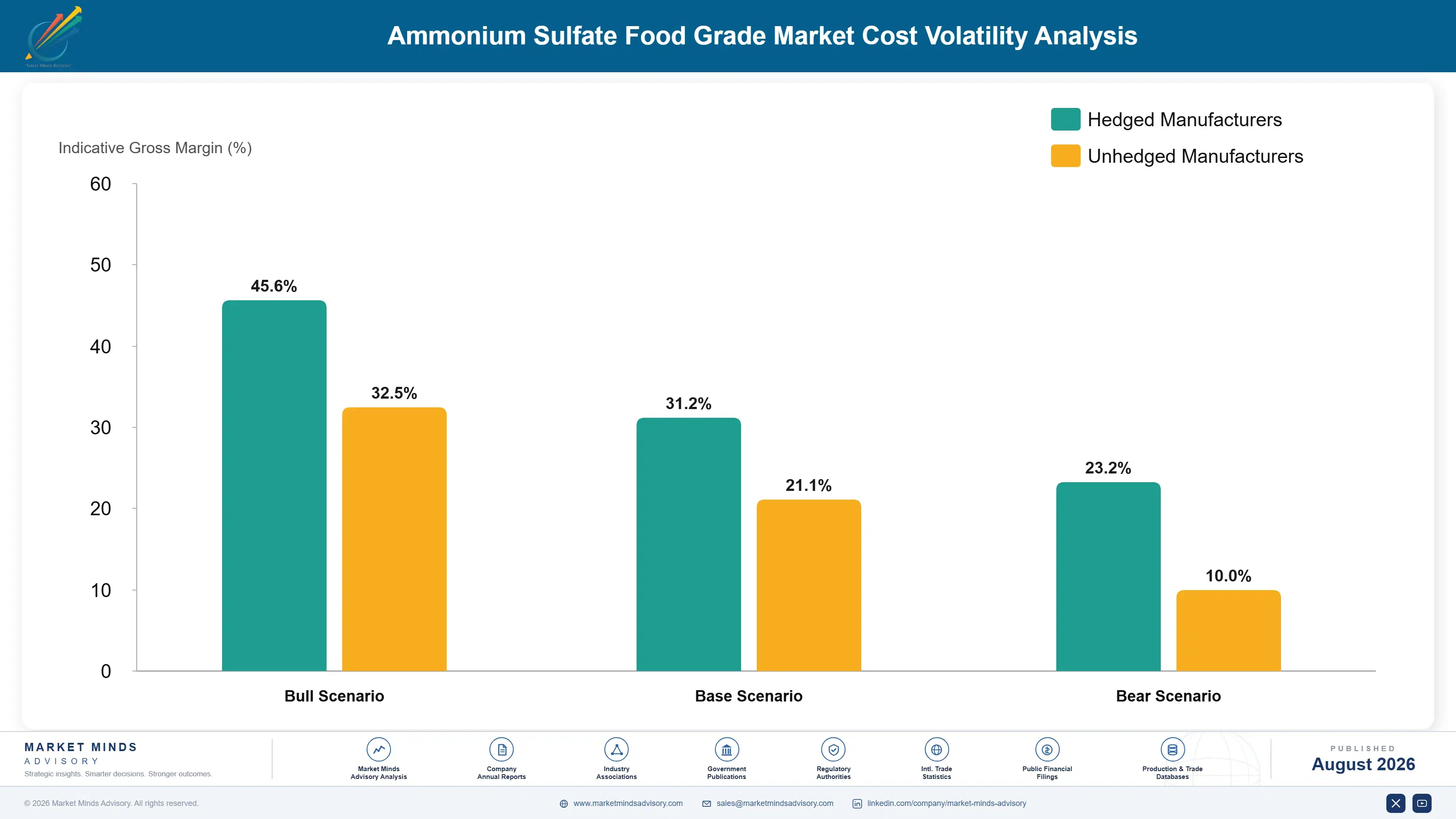
Ammonia and Sulfuric Acid Feedstock Exposure

Ammonia and sulfuric acid feedstock account for roughly 48% of processor cost of goods sold, though most global supply enters production economics indirectly as a caprolactam co-product rather than through dedicated feedstock purchasing for ammonium sulfate alone. This exposure sits meaningfully higher than in more mechanized specialty chemical categories, given how tightly linked ammonium sulfate supply is to an entirely separate industry's production decisions.
Global ammonia prices rose sharply following natural gas price volatility across 2022 and 2023, with the IEA's industrial energy market reports documenting sustained cost pressure across major ammonia-producing regions through 2024. Producers without integrated ammonia production or long-term supply contracts absorbed meaningfully higher per-tonne feedstock costs than competitors with captive ammonia production or hedged supply agreements already established well ahead of the volatility across their broader operations.

Exposure varies by producer type: integrated chemical giants with captive ammonia and sulfuric acid production absorb volatility more evenly than smaller producers dependent on merchant feedstock purchasing. Pharmaceutical-grade producers with dedicated purification capacity face additional processing cost layers that standard food-grade-only producers do not carry, widening the margin gap between the two producer types during periods of sustained feedstock inflation.
ammonium-sulfate-food-grade-market-cost-volatility-analysis-1787462092825

Captive Ammonia and Sulfuric Acid Production

Larger integrated producers increasingly maintain captive ammonia and sulfuric acid production rather than depending on merchant feedstock purchasing, reducing exposure to natural gas price volatility that drives ammonia cost swings sharply. This integration requires substantial upfront capital but meaningfully smooths input cost volatility across consecutive years of energy market cycles and feedstock price swings.

Multi-Year Feedstock Supply Agreements

Producers are increasingly locking in multi-year ammonia and sulfuric acid supply agreements ahead of anticipated volatility, trading some pricing flexibility for predictable per-tonne production cost. Smaller producers without the volume commitments to negotiate multi-year terms remain more exposed to spot feedstock price spikes during periods of energy market tightness each production cycle they face.

Multi-Source Caprolactam Co-Product Sourcing

Some producers increasingly source ammonium sulfate co-product from multiple caprolactam production sites rather than a single facility, reducing exposure to localized nylon production shifts that can constrain by-product availability. This diversification requires supplier relationship investment but smooths supply and cost volatility across multiple co-production sources and geographic regions over time each production cycle observed.

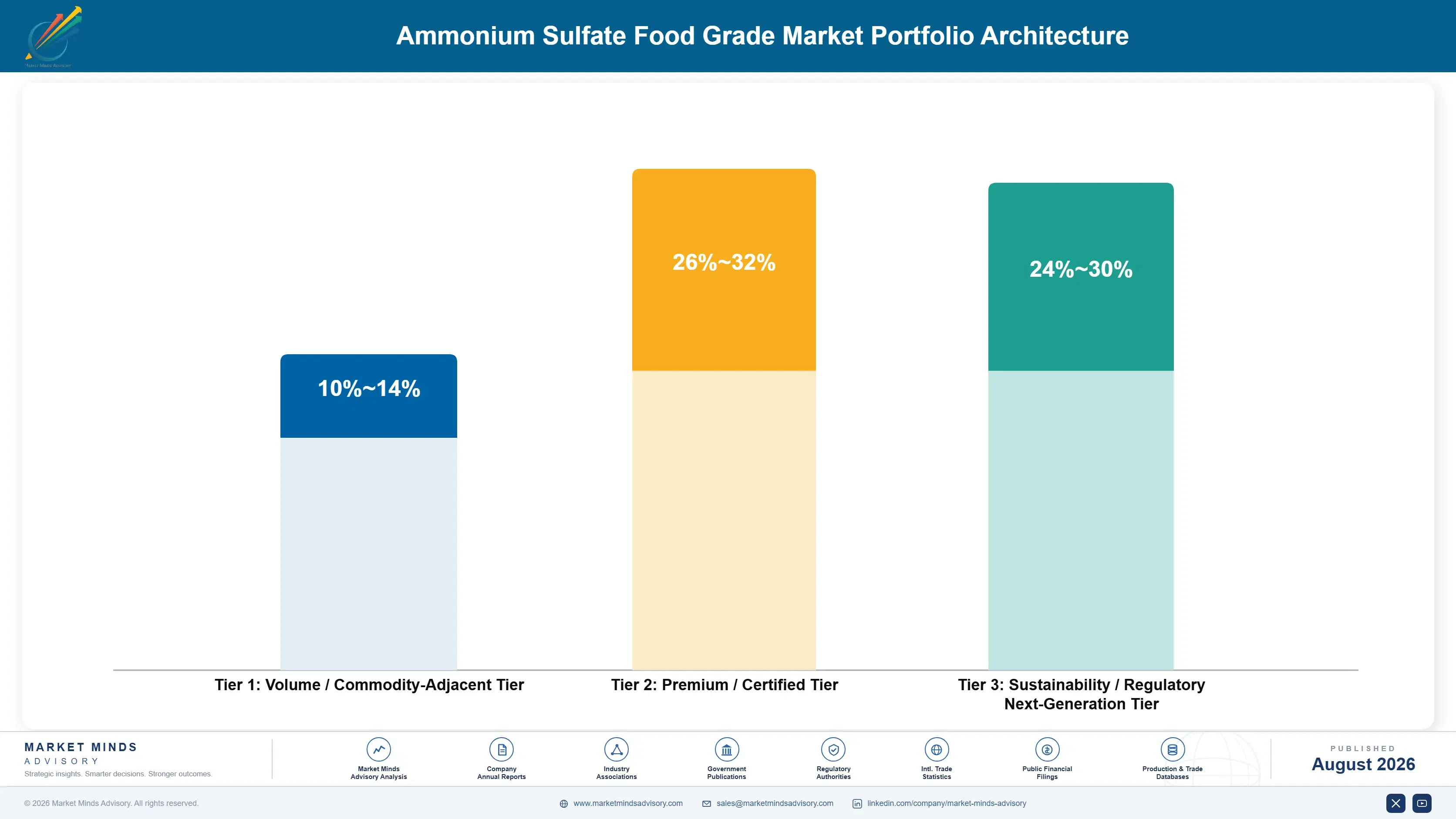
Portfolio Architecture for Margin Defence

Food-grade ammonium sulfate portfolios split across three tiers with different margin economics: a volume tier built on standard food-grade material sold to bakery and beverage manufacturers, a premium tier built on pharmaceutical-grade and fermentation nutrient purification, and an emerging next-generation tier tied to fully documented, traceable sourcing that biopharma customers are only beginning to pay a defined premium for consistently across every major contract.
The tension between volume and premium runs deep in how producers allocate limited purification capacity: every tonne dedicated to pharmaceutical-grade output is a tonne unavailable for standard food-grade volume that still generates the bulk of category revenue today. Get the mix wrong and a producer either misses premium pharmaceutical contracts or overinvests in purification capacity that outpaces actual biopharma demand for it right now across the wider category.

High-value margin pools concentrate overwhelmingly in pharmaceutical-grade and fermentation nutrient material sold to biopharma and biotechnology customers, not in standard food-grade tonnage alone. Producers that built purification and certification capability early, AdvanSix among them, now capture a share of total category profit well above their share of total tonnage sold each year across their combined product lines.

Volume / Commodity-Adjacent Tier

Standard food-grade ammonium sulfate sold on tight tonnage contracts to bakery and beverage manufacturers, priced close to co-product benchmarks with thin processing margin above feedstock cost across most accounts and contract renewal cycles.
Gross Margin: 10-14%

Premium / Certified Tier

Pharmaceutical-grade and fermentation nutrient ammonium sulfate sold to biopharma and biotechnology customers, commanding meaningful price premiums through purification, documentation, and consistency capability that co-product-only producers cannot easily replicate at comparable cost.
Gross Margin: 26-32%

Sustainability / Regulatory / Next-Generation Tier

Fully traceable, pharmacopoeia-certified ammonium sulfate aimed at biopharma customers with public quality and supply chain transparency commitments, still a small volume tier but growing as documentation expectations continue to rise.
Gross Margin: 24-30%
ammonium-sulfate-food-grade-market-portfolio-architecture-1787462093332

High-value Sub-segments and Strategic Watch-out

Pharmaceutical Ultra-High-Purity Grade (High-Value, High-Growth)

Pharmaceutical grade combines the fastest unit growth in the category with meaningfully above-average margins, making it the single most attractive segment for producers with dedicated purification capacity already in place. Demand continues to outpace available certified capacity across North America and Western Europe combined each year.
Gross Margin: 26-32%

Fermentation Nutrient Grade (High-Value, Moderate-Growth)

Fermentation nutrient grade carries better margin than standard food-grade material and continues gaining biotechnology customer contracts, though growth is more moderate than pharmaceutical grade since it depends on specification qualification cycles that take real time to establish at meaningful scale across new customer accounts each year.
Gross Margin: 22-28%

Standard Food-Grade Ammonium Sulfate (Volume Core)

Standard food-grade material remains the largest single category by tonnage and the backbone of producer cash flow, even though margin sits well below the specialty tiers. Nearly every producer depends on this volume base to fund purification and certification investment elsewhere in the wider portfolio each year.
Gross Margin: 10-14%

Non-Certified Co-Product Supply (Strategic Watch-Out)

Ammonium sulfate sold without pharmacopoeia certification or dedicated quality documentation carries the thinnest margin in the portfolio and faces the most direct exposure to being excluded from premium pharmaceutical contracts as certification requirements continue to tighten each year across most major markets tracked in this report.
Gross Margin: 6-10%

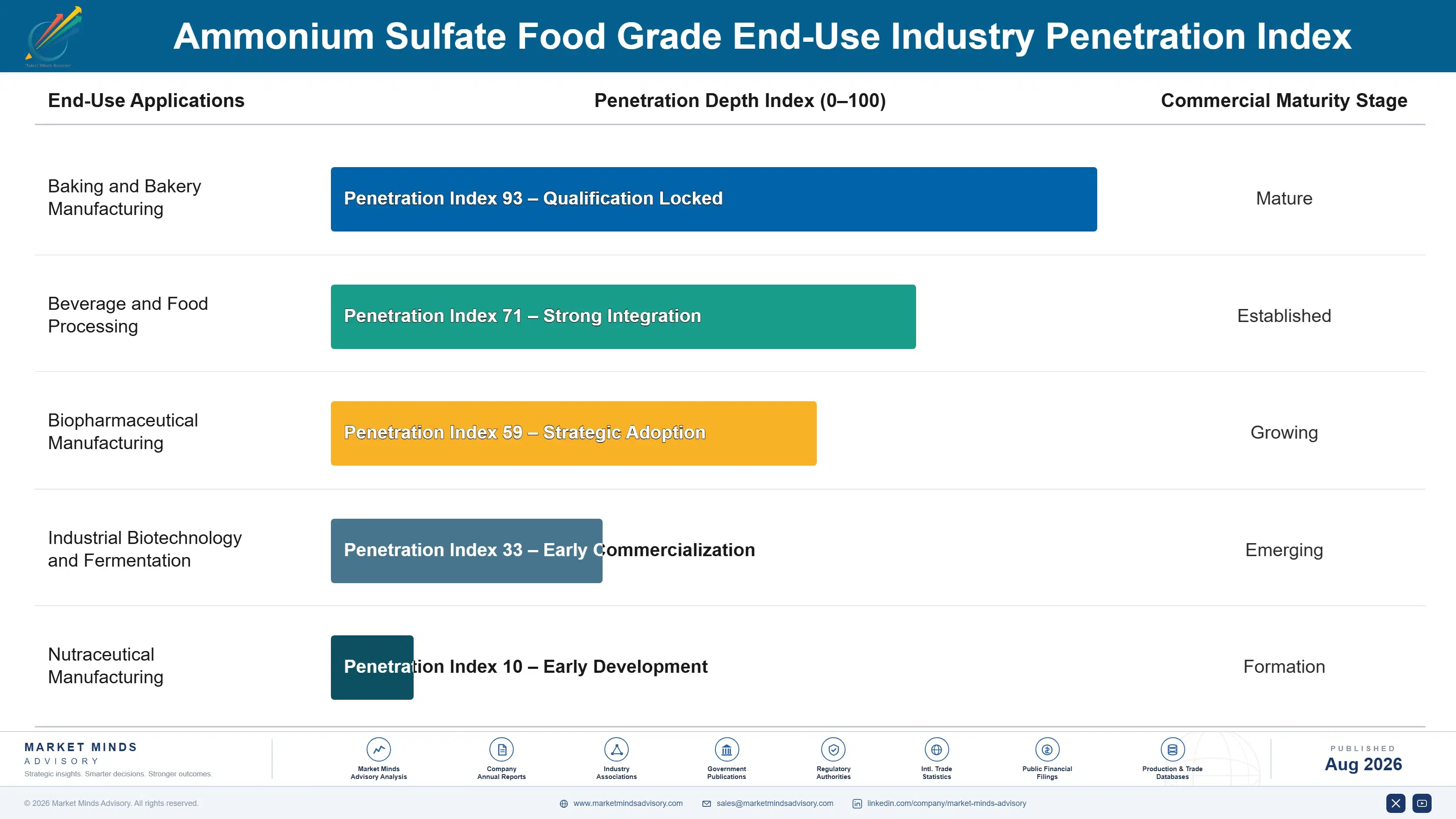
Validated Supply and Switching Barriers

Food-grade ammonium sulfate demand runs on multi-year supply contracts tied directly to validated manufacturing processes, since biopharma customers must requalify an entire purification process, often including regulatory filing updates, before switching to a different reagent supplier. This gives incumbent suppliers a meaningful retention advantage once a customer's validated process depends on their specific product specification and consistency profile across every production batch.
Adoption depth varies sharply by customer type: standard bakery and beverage manufacturers treat food-grade suppliers as relatively interchangeable within quality specifications, switching more readily on price at contract renewal, while pharmaceutical and biotechnology customers show far stronger supplier lock-in since switching means requalifying an entire validated manufacturing process. Biopharma customers manufacturing regulator-approved biologics show the least willingness to switch of any group, given the regulatory filing implications of changing a validated reagent source.

A generational shift is underway among biopharma procurement teams too: younger quality and supply chain professionals increasingly scrutinize full documentation and traceability credentials during supplier qualification in ways their predecessors treated as secondary to price, rewarding producers that invested early in certification over those still competing purely on standard food-grade cost alone.
ammonium-sulfate-food-grade-market-end-use-penetration-index-1787462093819

Where Ammonium Sulfate Margin Concentrates

These are among the four positions where our research anticipates prominent divergence between winners and laggards over the coming forecast period. Each is grounded in the demand model, the regulatory perimeter, and the announced capacity pipeline.
01 / PURIFICATION TIMING ADVANTAGE

Early pharmaceutical-grade investment now defends a durable contract lead

Producers that built dedicated pharmaceutical-grade purification capacity ahead of rising biologics demand now hold validated customer relationships that later movers cannot quickly replicate, since biopharma manufacturers rarely requalify an established, validated reagent supplier. This timing advantage matters more than raw co-product scale, because pharmaceutical contracts increasingly require purification capability as a baseline qualification rather than a differentiator. Producers without early purification investment now face a multi-year capital and validation process before they can compete for the same premium pharmaceutical contracts.
02 / CAPROLACTAM SUPPLY EXPOSURE

Single-facility producers face the sharpest by-product disruption risk

Producers dependent on a single caprolactam co-production facility face the sharpest exposure to sudden supply tightness when nylon demand at that specific site softens, since ammonium sulfate output moves directly with an entirely separate product's production schedule. This risk concentrates specifically among smaller regional producers lacking the capital to diversify sourcing across multiple co-production sites simultaneously. Producers that diversified sourcing early face meaningfully less disruption during co-product supply swings than those still dependent on one facility for the bulk of their volume.
03 / EMERGING MARKET CAPACITY RACE

India is where the next wave of pharmaceutical-grade demand gets built

India's rapidly expanding biosimilar manufacturing base is pulling pharmaceutical-grade ammonium sulfate demand faster than any other market tracked, as domestic biologics production scales toward genuine self-sufficiency. This capacity race reflects genuinely new category formation rather than share shifting among already-established Western and Japanese competitors fighting over the same mature customer base. Producers and distributors that build relationships in India now will be better positioned than those waiting for the shift to become obvious in import and trade data years from now.
04 / CERTIFICATION COMPLIANCE GAP

Documentation gaps are quietly excluding producers from premium contracts

Producers without formal pharmacopoeia certification increasingly find themselves excluded from premium pharmaceutical contracts regardless of their underlying product purity, since biopharma customers treat verified documentation as a baseline requirement rather than a differentiator today. This compliance gap compounds over time, since biopharma customers rarely revisit uncertified suppliers once a documented, validated relationship has been established elsewhere in their supply chain. Producers investing in certification now will close this gap faster than competitors waiting for customers to mandate it outright across every major contract category.

Engagement Snapshot From the Field

A live engagement with an industry participant carrying material or product regulatory and market exposure ahead of a defining policy shift, showing how our research translates into a defensible multi-year portfolio strategy.
MARKET MINDS ADVISORY · CLIENT ENGAGEMENT SUMMARY
Ammonium Sulfate Food Grade Producer Strategic Portfolio Review and Transition Roadmap 2026·Investment Scenario on Ammonium Sulfate Food Grade Exposure Evaluation 2025-26
CLIENT PROFILE
The client is a mid-sized regional chemical producer supplying standard food-grade ammonium sulfate as a caprolactam co-product to bakery and beverage manufacturers across a single national market. Revenue approached $145 million in the most recent fiscal year (client-reported, unverified by MMA), though margins had compressed steadily as larger integrated competitors expanded pharmaceutical-grade capacity the client had not pursued.
STRATEGIC CHALLENGE
The chemical producer had no dedicated pharmaceutical-grade purification capability and no pharmacopoeia certification, leaving it entirely dependent on standard food-grade pricing at a moment when biopharma customers were consolidating purchases with certified, validated suppliers. Leadership needed to decide whether to invest in purification capacity, certification systems, or both simultaneously given limited available capital.
MMA APPROACH
MMA benchmarked the producer's cost structure against pharmaceutical-grade-diversified competitors, modeled the capital and timeline required for both purification capacity and pharmacopoeia certification, and evaluated a phased sequencing that would let certification-driven contract wins help fund the larger purification capital investment over time, reducing strain on working capital during the transition period.
KEY FINDINGS
  1. The producer's standard food-grade margin had compressed meaningfully faster than regional peers already diversified into pharmaceutical-grade or certified fermentation nutrient supply over the prior several years.
  2. Pharmacopoeia certification required substantially less upfront capital than dedicated purification capacity, making it the faster near-term path to premium contract qualification for the business.
  3. Pharmaceutical customers confirmed that certified documentation, not price, was the binding constraint on awarding new supply contracts to the regional producer under evaluation.
  4. Regional competitors that invested earliest in both certification and purification capacity already held multi-year validated contracts that would be difficult to displace quickly.
CLIENT PROFILE
The client is a mid-sized regional chemical producer supplying standard food-grade ammonium sulfate as a caprolactam co-product to bakery and beverage manufacturers across a single national market. Revenue approached $145 million in the most recent fiscal year (client-reported, unverified by MMA), though margins had compressed steadily as larger integrated competitors expanded pharmaceutical-grade capacity the client had not pursued.
STRATEGIC CHALLENGE
The chemical producer had no dedicated pharmaceutical-grade purification capability and no pharmacopoeia certification, leaving it entirely dependent on standard food-grade pricing at a moment when biopharma customers were consolidating purchases with certified, validated suppliers. Leadership needed to decide whether to invest in purification capacity, certification systems, or both simultaneously given limited available capital.
MMA APPROACH
MMA benchmarked the producer's cost structure against pharmaceutical-grade-diversified competitors, modeled the capital and timeline required for both purification capacity and pharmacopoeia certification, and evaluated a phased sequencing that would let certification-driven contract wins help fund the larger purification capital investment over time, reducing strain on working capital during the transition period.
KEY FINDINGS
  1. The producer's standard food-grade margin had compressed meaningfully faster than regional peers already diversified into pharmaceutical-grade or certified fermentation nutrient supply over the prior several years.
  2. Pharmacopoeia certification required substantially less upfront capital than dedicated purification capacity, making it the faster near-term path to premium contract qualification for the business.
  3. Pharmaceutical customers confirmed that certified documentation, not price, was the binding constraint on awarding new supply contracts to the regional producer under evaluation.
  4. Regional competitors that invested earliest in both certification and purification capacity already held multi-year validated contracts that would be difficult to displace quickly.
RECOMMENDED STRATEGY
Phase 1: Phase 1 (Year 1): Implement pharmacopoeia certification and quality documentation systems across existing food-grade production to qualify for pharmaceutical contract consideration. Phase 2: Phase 2 (Years 2 to 3): Use improved certified contract volume and margin to fund dedicated pharmaceutical-grade purification capacity investment at the primary facility. Phase 3: Phase 3 (Years 3 to 4): Pursue multi-year pharmaceutical and fermentation nutrient supply contracts using newly certified and purified capacity as validated proof of capability.
OUTCOME
Within eighteen months, the producer's certified contract volume reached a meaningful share of total revenue and funded purification capacity planning ahead of the original timeline (client-reported, unverified by MMA). The phased approach let the company diversify without straining working capital, positioning it to compete for pharmaceutical contracts it could not have pursued previously.

Frequently Asked Questions

Foundational context covering the market sizes, CAGR, scope, country, region and competition that inform every finding below. This section is provided to cover basics and most often pre-purchase conversations, answered from the MMA Primary Research Dataset.

What is the current size of the Ammonium Sulfate Food Grade Market?

The global food-grade ammonium sulfate market was valued at approximately $1.8 billion in 2025. This covers dough conditioner, acidulant, fermentation nutrient, and pharmaceutical-grade forms sold to food and biopharma manufacturers.

How large will the Ammonium Sulfate Food Grade Market be by 2036?

MMA projects the market will reach approximately $3.5 billion by 2036, up from roughly $1.9 billion in 2026. That represents an expansion multiple of about 1.84 times over the ten-year forecast period.

What is the CAGR for the Ammonium Sulfate Food Grade Market 2026 to 2036?

The base case CAGR is 6.2% annually, with a bull scenario near 7.5% and a bear scenario near 4.9%. This range reflects sensitivity to caprolactam supply and biologics manufacturing expansion pace.

Which segment is growing fastest?

Pharmaceutical ultra-high-purity grade is the fastest-growing segment, expanding at roughly 11.2% annually, about 1.8 times the overall market's pace. Fermentation nutrient grade follows at approximately 8.5% annually.

Who are the major companies in the Ammonium Sulfate Food Grade Market?

Leading players include BASF SE, AdvanSix Inc., LANXESS AG, Fibrant, and Sinopec (China Petroleum and Chemical Corporation). Together these five hold an estimated 42% combined market concentration today.

Which country is growing fastest?

India is the fastest-growing national market, expanding near 9.8% annually as its biosimilar manufacturing base rapidly scales domestic demand. China follows as a significant secondary growth center in the region.

Report Segmentation Architecture

The full report scope spans multiple orthogonal segmentation dimensions, with cross-tabulated demand data provided for each dimension pair. Coverage extends further to regional breakdowns, trend trajectories, and the competitive detail needed to support segment-level decision-making.

By Purity and Application Grade

  • Food-Grade Granular Ammonium Sulfate
  • Food-Grade Fine and Powder Ammonium Sulfate
  • Yeast Nutrient and Dough Conditioner Grade
  • Beverage and Food Acidulant Grade
  • Fermentation Nutrient Grade
  • Pharmaceutical Ultra-High-Purity Grade

By End-Use Industry

  • Baking and Bakery Manufacturing
  • Beverage and Food Processing
  • Biopharmaceutical Manufacturing
  • Industrial Biotechnology and Fermentation
  • Nutraceutical Manufacturing

By Commercial Dimension

  • Direct Supply Contracts
  • Distributor and Wholesale Trade
  • Co-Product Integrated Supply
  • Export and Cross-Border Trade

By Region

  • North America
  • Western Europe
  • East Asia
  • South Asia and Pacific
  • Latin America
  • Middle East and Africa
  • Eastern Europe

Scope, Methodology, and Coverage

Every figure in this report is reproducible from documented input assumptions. The scope below maps the historical period, the forecast horizon, the segmentation dimensions, and the countries covered, alongside the underlying primary and qualitative methodology.
Historical Period
2020 to 2025
Forecast Period
2026 to 2036
Base Year
2025 (USD billions; MMA Primary Research Dataset, August 2026)
Market Definition
This report defines the food-grade ammonium sulfate market as food and pharmaceutical-grade ammonium sulfate used as a dough conditioner, yeast nutrient, food acidulant, fermentation nutrient, and protein precipitation reagent globally. It excludes agricultural and fertilizer-grade ammonium sulfate, and industrial-grade material used in non-food, non-pharmaceutical applications.
Quantitative Units
USD billions (current prices); metric tonnes product weight where cited
Segmentation Dimensions
By Purity and Application Grade; By End-Use Industry; By Commercial Dimension; By Region
Regions Covered
North America, Western Europe, East Asia, South Asia and Pacific, Latin America, Middle East and Africa, Eastern Europe
Countries Covered
USA, China, Germany, France, UK, Japan, South Korea, India, Australia, Canada, Brazil, Mexico, Indonesia, Vietnam, Thailand, Malaysia, UAE, Saudi Arabia, South Africa, Nigeria, Turkey, Poland, Netherlands, Italy, Spain, Sweden, Switzerland, Argentina, Colombia, Singapore, and additional markets relevant to this sector
Key Companies Profiled
BASF SE, AdvanSix Inc., LANXESS AG, Fibrant, Sinopec (China Petroleum and Chemical Corporation), Evonik Industries AG, Sumitomo Chemical Co., Ltd., DOMO Chemicals, Nutrien Ltd., CF Industries Holdings, Ma'aden (Saudi Arabian Mining Company), Yara International, Merck KGaA, Thermo Fisher Scientific, Spectrum Chemical Manufacturing Corp., Univar Solutions, Shandong Hualu-Hengsheng Chemical, Gujarat State Fertilizers and Chemicals Ltd., Rashtriya Chemicals and Fertilizers Limited, PVS Chemicals Inc.
Quantitative Methodology
Primary survey, n=3,800 respondents, Q4 2025, six countries; demand-side model with trade association cross-validation
Qualitative Methodology
47 expert interviews, Q4 2025; applied to validate demand model assumptions, identify emerging dynamics, and assess competitive positioning
Report Format
PDF and XLSX data workbook (Word format preview document)
Publisher
Market Minds Advisory
Report Code
MMA-2026-CHM-106
Published
August 2026
Contact
sales@marketmindsadvisory.com | www.marketmindsadvisory.com

Purchase the full Ammonium Sulfate Food Grade Market Report (2026 to 2036).

The full Ammonium Sulfate Food Grade Market report delivers detailed sizing and forecasts across all six purity-grade segments, all seven world regions, and twenty profiled companies through 2036. It includes granular regional data tables, competitive benchmarking on a consistent production volume basis, and input cost sensitivity modeling tied to global ammonia and caprolactam markets. Subscribers receive access to the underlying primary survey dataset (n=3,800 respondents, Q4 2025, six countries) and qualitative expert interview findings (n=47 interviews, Q4 2025). The report also includes segment-level margin analysis and a portfolio tiering framework analysts can apply directly to company assessments.
Full segmentation across six purity-grade categories
Seven-region market sizing with growth forecasts
Twenty-company competitive benchmarking on consistent basis
Input cost sensitivity modeling tied to ammonia markets
Access to primary survey dataset of 3,800 respondents
Portfolio tiering framework for margin benchmarking

Built For The People Who Decide

From boardroom strategy to bench-side execution, this report is read cover-to-cover by leaders shaping the next decade of their industry, turning demand scenarios, market dynamics and valuation benchmarks into decisions.
CXOs/ Presidents/ VPs/ Managers
M&A and Corporate Development
Strategy Teams and R&D Heads
Procurement and Product Directors
Regulatory and Compliance Leaders
Investor Relations and Equity Analysts