

Market Minds Advisory
Ammonium Chloride Food Grade Market

Ammonium Chloride Food Grade Market: One Chemical, Three Purity Standards: Baking, Licorice, And Feed Redefine Ammonium Chloride

Food-grade ammonium chloride moves from an overlooked Solvay process co-product into a specified baking, licorice, and feed ingredient, as bakers, Nordic confectioners, and cattle nutritionists each demand a distinct purity grade from the same chemical.

Lead Analyst

Lisa Gevelber

Published

September 2026

Make Smarter Decisions with Customized Research Insights

Request a free sample report and evaluate market opportunities, growth trends, and competitive dynamics relevant to your business needs.

2025 MARKET VALUE$0.7BMarket Size 2025
2036 FORECAST VALUE$1.1BBase Case , 2026 to 2036
CAGR 2026 TO 20364.1 %Bull 5.3% / Bear 2.9%
INCREMENTAL OPPORTUNITY$0.3BNet 10- year value creation
EXPANSION MULTIPLE1.49x2036 value over 2026 base
Strategic Levers
M&A Pipeline
Regional Outlook
Country Rankings
Competitive Intelligence
Segmental Deep-dive
Call-Us : 91 93563 13602

Executive Snapshot and Market Trajectory

Food-grade ammonium chloride has moved from an overlooked Solvay process co-product into a specified, purity-graded ingredient, as clean-label bakers, Nordic salty licorice confectioners, and cattle nutritionists each now demand a distinct grade from the same underlying industrial chemical rather than treating it as generic, undifferentiated filler material.
The market stands at USD 0.68 billion in 2025 and reaches USD 1.06 billion by 2036 at a 4.1% CAGR. Licorice-grade material grows fastest at 6.8%, about 1.66 times the overall rate, as Dutch and Nordic confectioners export salty licorice to a growing global novelty snack audience. East Asia holds 38% of value on China's massive soda ash byproduct manufacturing scale, while Western Europe leads on genuine licorice and bakery consumption depth.
Concentration sits at a moderate 30%, split between diversified soda ash and chlor-alkali majors treating ammonium chloride as a co-product and specialist refiners who purify it specifically for food, licorice, and pharmaceutical grades. Buyers increasingly specify grade by end use, since licorice-grade purity tolerances differ meaningfully from bakery or feed specifications required elsewhere. Pharmaceutical-grade demand remains a small but genuinely stable adjacent category worth tracking closely.
Market Definition
The ammonium chloride food grade market covers refined, purity-graded ammonium chloride sold into baking, confectionery, animal feed, and pharmaceutical applications, sourced from Solvay process co-production or dedicated synthetic manufacturing. It excludes industrial and fertilizer-grade ammonium chloride sold without food or feed purity certification, and finished baked goods, confectionery, or feed products beyond the ingredient itself.
Base Year Value
$0.7B in 2025 (MMA Primary Research Dataset, August 2026)
Forecast Period
2026 to 2036, eleven discrete annual values
CAGR
4.1% base case. Bull 5.3%. Bear 2.9%.
Fastest Growth Segment
Licorice-Grade Ammonium Chloride: 6.8% CAGR
Fastest Growth Country
Netherlands: 8.9% CAGR
Fastest Growth Region
South Asia and Pacific: 6.1% CAGR
Largest Region
East Asia: 38% of 2025 global value
Market Leaders
Tata Chemicals, Ciech, Solvay, Gujarat Alkalies and Chemicals Limited, Juhua Group. Source: MMA Analysis based on company annual reports.
Primary Survey
n=3,800 procurement and R&D decision-makers, Q4 2025, six countries
Methodology
Demand-side build-up, cross-validated against public data, 47 expert interviews

Ammonium Chloride Food Grade Market Forecast Scenarios

ammonium-chloride-food-grade-market-size-forecast-scenario-1787463111279
Food-grade ammonium chloride compounded near 4.1% from 2020 to 2025, a stable period tracking closely with baking industry volume, Nordic licorice confectionery demand, and steady ruminant feed additive use across major markets. No single disruptive event reshaped the category during the period, distinguishing it from faster-moving specialty ingredient markets undergoing genuine technology transitions elsewhere in food chemistry more broadly.
Three mechanisms carry the base case to 4.1%. First, Dutch and Nordic licorice confectioners are exporting salty licorice products to new international markets riding genuine social-media-driven novelty interest, a demand source barely relevant a decade ago. Second, cattle nutritionists are specifying feed-grade ammonium chloride more precisely for urinary calculi prevention in specific herd management contexts. Third, bakers are substituting food-grade material for less consistent industrial-grade product as quality documentation requirements tighten across major retail baking supply chains.
The bull case at 5.3% assumes licorice export growth accelerates further as novelty snack demand broadens beyond its current niche international audience into mainstream retail channels. The bear case at 2.9% assumes licorice demand plateaus once initial novelty interest fades and baking and feed volume alone drive the category at its slower, more traditional historical pace of expansion.

Why One Industrial Salt Now Carries Three Purity Grades

Three forces converge on food-grade ammonium chloride today. Bakers want documented purity that behaves predictably in dough formulations batch after batch, licorice confectioners want an ultra-pure grade that delivers the sharp, clean salty flavor salmiakki candy depends on entirely, and cattle nutritionists want a feed-grade material with consistent urinary-acidifying performance. Suppliers able to serve more than one of these buyers simultaneously capture pricing single-channel commodity sellers cannot match.
MARKET CONCENTRATIONCR5: 30%Diversified chemical majors compete with specialist refiners directly
LICORICE GRADE PRICE PREMIUM2 to 3x industrial gradeConfectionery purity commands meaningfully higher refined pricing overall
TOP PRODUCING COUNTRY SHAREChina: ~34% of global outputSoda ash byproduct manufacturing concentrates heavily in one country
REFINING CAPACITY UTILISATION60% to 75%Purification lines run considerably below full nameplate capacity
FEEDSTOCK SHARE OF COGS25% to 40% (co-product input)Raw ammonium chloride costs little; purification energy dominates instead
LICORICE CONFECTIONERY DEMAND SHARE12% to 18% of food-grade volumeNordic and Dutch confectionery absorbs a meaningful ingredient share
The commercial character remains closer to specialty industrial chemistry than to a typical food ingredient category, since most producers built their core business around chlor-alkali or soda ash manufacturing and treat food-grade refinement as a secondary, higher-margin product line layered on top of existing operations. Licorice-grade material behaves most like a genuine specialty ingredient, commanding real pricing power from confectioners who will not substitute a lower grade under any circumstance.
The next decade turns on whether Dutch and Nordic salty licorice exports keep broadening into new international markets, or settle back into a smaller, more traditional regional confectionery category once initial novelty interest inevitably fades over time. Baking and feed-grade demand should keep growing steadily regardless, tracking broader food and livestock production volume across every major region.
"Everyone assumes this is a boring commodity salt. Then you find out a Dutch candy maker will pay three times industrial pricing for the exact same molecule, purified one extra step, because salty licorice fans can genuinely taste the difference."
Director, Specialty Food Ingredients and Industrial Chemicals Practice · MMA Chemicals and Materials / Specialty Food and Feed Grade Inorganic Salts Practice · August 2026

Market Trends

Salty Licorice Exports Pull Ammonium Chloride Into New Markets

Dutch and Nordic salty licorice, traditionally a regional confectionery niche largely unknown outside Northern Europe, has gained genuine international novelty attention over the past several years, driven partly by social media videos exposing new audiences to the candy's distinctively sharp, salty flavor. Licorice confectioners including those supplied by Nouryon and regional refiners require ultra-pure, tightly specified ammonium chloride grades that behave predictably in confectionery formulations, a purity standard considerably tighter than bakery or feed-grade material requires. Export volume into North American and Asian novelty snack retail channels has grown from an essentially negligible base into a meaningful demand source.
Market Impact: Commands 2x to 3x industrial-grade pricing
Clean Label Bakers Demand Documented Purity Over Industrial Grade

Major retail bakery supply chains increasingly require documented purity and consistency certification for every ingredient, including ammonium chloride used as a dough conditioner and yeast nutrient in specific bread formulations, pushing bakers away from generic industrial-grade material toward certified food-grade product. Tata Chemicals and Ciech have both expanded dedicated food-grade purification capacity specifically to serve this documentation-driven shift, since industrial-grade ammonium chloride, while chemically similar, typically lacks the batch consistency and contaminant testing retail bakery supply chains now require as standard practice. The shift mirrors documentation trends already reshaping other specialty food ingredient categories across the broader industry.
Market Impact: Feed-grade demand grows 4.2% annually

Market Opportunities and Growth Drivers

Nordic And Dutch Licorice Confectionery Exports Keep Expanding

Salty licorice confectionery, long a beloved regional category across the Netherlands, Finland, and Denmark, has found genuine new export demand as international novelty snack retailers stock salmiakki-style candy for curious consumers exposed to it through social media and travel. Dutch confectionery manufacturers including those supplied by Nouryon have expanded ammonium chloride purchasing specifically to meet this growing export volume, which requires the ultra-pure licorice-grade material that delivers the sharp, clean salty flavor the category depends on. This export channel barely existed as a meaningful demand source a decade ago, and it keeps broadening into new markets.
Market Impact: Cuts supply up to 10%

Cattle Nutritionists Specify Feed Grade For Urinary Health

Feed-grade ammonium chloride is specified in ruminant, particularly cattle and sheep, diets to help prevent urinary calculi, a genuinely painful and sometimes fatal condition affecting male livestock in certain feeding and mineral-balance contexts. Veterinary nutritionists increasingly specify precise feed-grade ammonium chloride inclusion rates as a preventive measure rather than a reactive treatment, a shift toward proactive herd health management mirroring broader trends already reshaping animal nutrition more generally. Deepak Fertilisers and other regional producers have expanded feed-grade purification capacity to serve this steady, veterinarian-driven demand across major cattle-producing regions worldwide.
Market Impact: Caps addressable market near 15%

Market Restraints and Challenges

Supply Tracks Soda Ash Output, Not Food Grade Demand

Most ammonium chloride originates as a co-product of the Solvay ammonia-soda process for soda ash production, meaning raw supply tracks soda ash demand rather than food-grade demand specifically, leaving refiners as genuine price-takers on their own feedstock. The root cause is that essentially nobody operates a Solvay plant primarily to produce ammonium chloride, since soda ash carries far greater production value per tonne than its co-product ever could. The impact is that supply can tighten when soda ash producers reduce output for reasons unrelated to food-grade demand. Refiners are responding by securing dedicated co-product offtake agreements with major producers.
Market Impact: Licorice-grade demand grows 6.8% annually

Licorice Demand Concentrates In A Narrow Regional Culture

Salty licorice confectionery remains a genuinely niche taste preference outside the Netherlands, Nordic countries, and a handful of export-receptive novelty markets, limiting how large licorice-grade demand can realistically grow regardless of social media attention. The root cause is that salmiakki's distinctive ammonium chloride flavor profile is an acquired taste many consumers outside its traditional cultural home never develop a genuine preference for. The impact is that licorice-grade growth, while fast in percentage terms, remains small in absolute volume relative to baking and feed-grade demand. Confectioners are responding by developing milder salty licorice formulations aimed at broadening mainstream international appeal gradually.
Market Impact: Adds 15% to 20% documentation cost
3 additional market trends, 4 additional growth drivers, and 2 additional restraints and challenges are covered in the full report. Contact sales@marketmindsadvisory.com to access the complete intelligence.

Segment CAGR and Growth Architecture

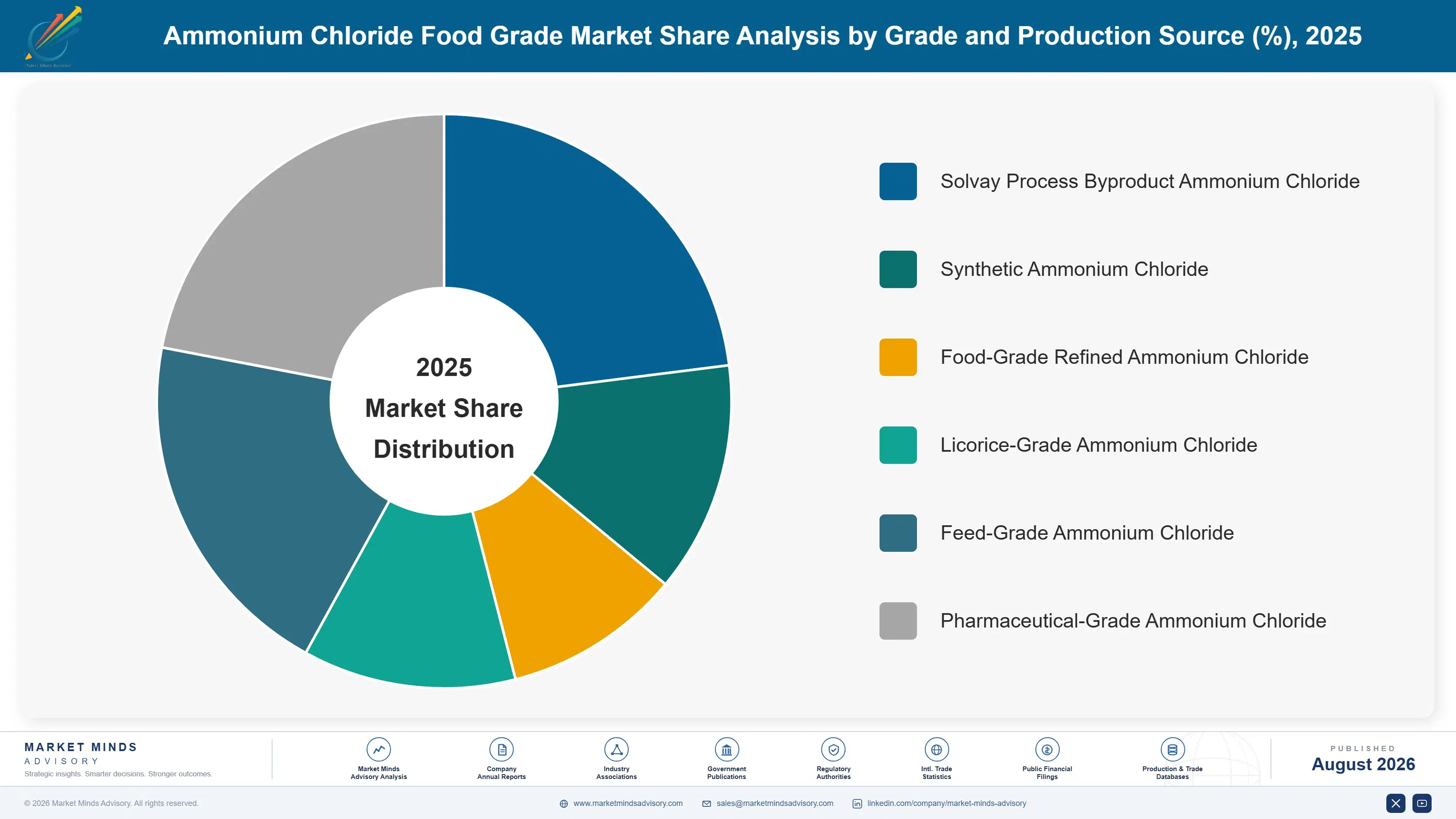
Segmentation follows production source and purity grade, the single classification logic separating how ammonium chloride is manufactured and refined before sale. Solvay byproduct, synthetic, food-grade refined, licorice-grade, feed-grade, and pharmaceutical-grade material each carry distinct purification cost and buyer type. End-use industry and distribution channel sit separately within the framework rather than folded into this same hierarchy.
ammonium-chloride-food-grade-market-market-share-analysis-1787463111814

Licorice-Grade Ammonium Chloride

Licorice-grade ammonium chloride grows fastest at 6.8%, about 1.66 times the overall 4.1% rate, as Dutch and Nordic confectioners export salty licorice to a growing international novelty snack audience discovering the category for the first time. This grade requires the tightest purity specification of any food application, since licorice confectionery depends entirely on a sharp, clean salty flavor that even minor contaminant traces can noticeably degrade. Nouryon and regional Dutch refiners supply confectionery manufacturers directly, commanding pricing considerably above bakery or feed-grade material given the specification precision required. The segment remains small in absolute volume relative to baking and feed-grade categories, but growth reflects a genuinely new export channel that barely existed a decade ago.
CAGR 6.8%

Pharmaceutical-Grade Ammonium Chloride

Pharmaceutical-grade ammonium chloride grows second-fastest at 5.9%, roughly 1.44 times the overall rate, serving expectorant cough medicine and electrolyte replacement formulations that require the tightest analytical purity and heavy-metal testing documentation of any application category. This grade commands meaningful pricing above food-grade material given the additional pharmacopeia-standard testing and documentation burden manufacturers must satisfy before any batch can be released commercially. Gujarat Alkalies and Chemicals Limited and other specialty refiners maintain dedicated pharmaceutical-grade production lines separate from bulk food and feed-grade output, reflecting the genuinely different quality system investment this category requires. Demand growth tracks steady global cough and cold medicine volume rather than any single dramatic category-reshaping event or shift.
CAGR 5.9%
Full segment breakdown across 6 segments available in the complete report.

Regional Architecture and Country Demand Map

East Asia leads overwhelmingly on China's massive soda ash byproduct manufacturing scale, while Western Europe leads on genuine licorice confectionery and bakery consumption depth built over generations. North America sits below its usual band given a comparatively modest domestic licorice culture relative to Northern Europe's deeply established tradition.

North America

A comparatively modest domestic salty licorice culture, relative to Northern Europe's deeply established confectionery tradition, holds North America to 18% of value, below the 22 to 32% band, even though baking and feed-grade demand remain genuinely substantial across the region's large food and livestock industries. Tata Chemicals and regional refiners supply food-grade material into American and Canadian bakery supply chains directly, serving major retail and commercial baking customers. Feed-grade demand tracks the region's substantial cattle industry, with veterinary nutritionists specifying ammonium chloride for urinary health management in specific herd contexts. The share sits below band because licorice-driven demand, a meaningful contributor elsewhere, remains genuinely minor here. Growth of 4.9% reflects steady baking and feed-grade expansion without any licorice-driven acceleration.
Share: 18% | CAGR: 4.9% (2026 to 2036)

Western Europe

The Netherlands, Finland, and Denmark's deeply established salty licorice confectionery tradition, combined with a substantial regional baking industry, gives Western Europe 22% of value, within the 18 to 26% band, and the region's genuine cultural and commercial center for this category worldwide. Nouryon and Solvay both supply licorice-grade material directly to Dutch and Nordic confectioners, serving both domestic consumption and the region's growing international export volume. German and French bakers specify food-grade material for documented consistency across major retail supply chains. Growth of 2.8%, the slowest of the seven regions, reflects a market where domestic licorice consumption is already deeply mature, with growth increasingly dependent on export volume rather than any further domestic category expansion.
Share: 22% | CAGR: 2.8% (2026 to 2036)
Regional intelligence for 5 additional markets available in the complete report: East Asia, South Asia and Pacific, Latin America, Middle East and Africa, Eastern Europe. Contact sales@marketmindsadvisory.com.
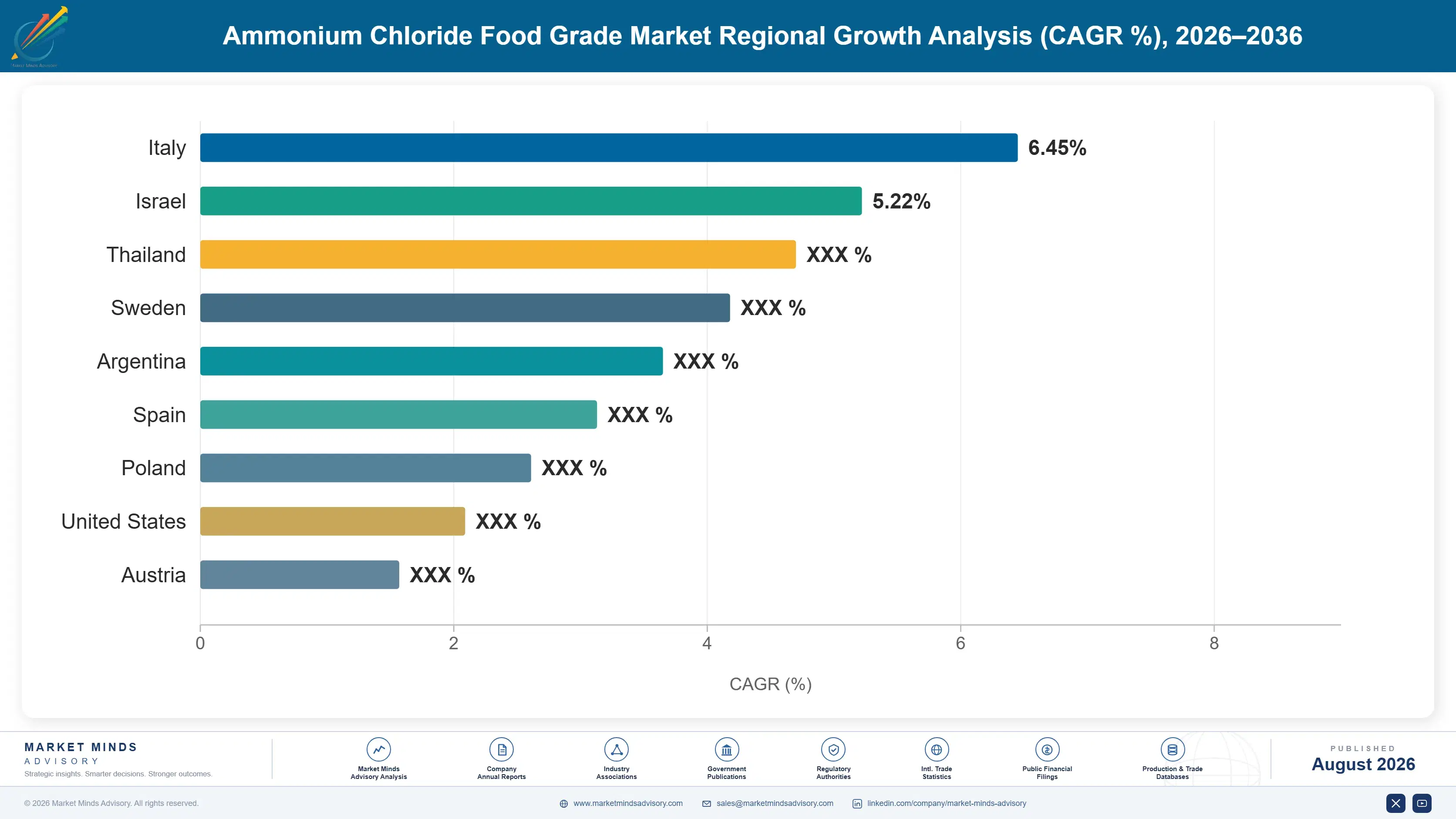
ammonium-chloride-food-grade-market-country-cagr-analysis-1787463112345

Where Ammonium Chloride Refiners Capture More Value

Selling ammonium chloride as an undifferentiated industrial commodity leaves considerable value on the table, since licorice confectioners, pharmaceutical formulators, and documentation-conscious bakers will all pay meaningfully more for the same base chemical refined to a specific grade. The four moves below focus on licorice-grade specification, pharmaceutical documentation, direct confectioner relationships, and dedicated co-product supply contracting.

Refine Material To Licorice-Grade Purity Specification

Bulk industrial-grade ammonium chloride competes purely on price, whereas licorice-grade material meeting the tight purity tolerances Dutch and Nordic confectioners require commands 2 to 3 times industrial pricing from a customer base that will not accept substitution. Refiners able to invest in the additional purification steps that remove trace contaminants affecting flavor can access this considerably higher-margin channel directly rather than selling undifferentiated bulk material through an intermediary. Nouryon and regional Dutch refiners built dedicated licorice-grade production specifically around this specification gap. The refinement investment is modest relative to the price differential it captures across a refiner's export-destined output.
Market Impact: Commands a 2x to 3x licorice-grade price premium

Build Pharmaceutical-Grade Documentation And Testing Capability

Pharmaceutical formulators require heavy-metal testing and pharmacopeia-standard documentation that most industrial ammonium chloride producers simply do not maintain, creating a genuine barrier that protects the 20% to 35% pricing premium suppliers who invest in this capability directly can command. Gujarat Alkalies and Chemicals Limited maintains dedicated pharmaceutical-grade quality systems separate from bulk industrial output, capturing meaningfully higher margin on a smaller but genuinely stable volume base tied to steady cough and cold medicine demand. Suppliers without this documentation capability compete purely on commodity industrial pricing regardless of the underlying chemical purity they could otherwise technically achieve.
Market Impact: Commands a genuine 20% to 35% pharmaceutical-grade premium

Build Direct Relationships With Licorice Confectioners

Selling through generic industrial chemical brokers captures a smaller share of delivered value than contracting directly with licorice confectioners willing to commit to multi-year supply agreements at negotiated specification and pricing terms. Solvay and regional Dutch refiners have both expanded direct confectioner relationships, cutting out a distribution layer and capturing the 10% to 20% margin that previously went to chemical trading intermediaries. Direct relationships also give refiners demand visibility supporting licorice-grade purification capacity planning against genuinely growing export volume. The approach requires sales investment few purely industrial chemical producers have historically built.
Market Impact: Cuts broker margin by roughly 10% to 20%

Secure Dedicated Soda Ash Co-Product Offtake Agreements

Ammonium chloride supply depends entirely on Solvay process soda ash production, leaving food-grade refiners without dedicated offtake agreements exposed to feedstock availability swings of 15% or more tied to soda ash market cycles they do not control directly. Refiners securing multi-year co-product offtake agreements directly with major soda ash producers lock in feedstock access and pricing ahead of these swings, converting an unpredictable input into a plannable one across production budgets. Tata Chemicals and Ciech have both pursued exactly this approach given their own integrated soda ash operations, avoiding the volatility open-market buyers face.
Market Impact: Locks in feedstock supply within a 15% band

Who Controls the Margin Pool

Concentration sits at a moderate 30%, split between diversified soda ash and chlor-alkali majors treating ammonium chloride as a secondary co-product and specialist refiners who purify it specifically for food, licorice, and pharmaceutical grades. All participants are assessed on one basis: attributable food-grade ammonium chloride revenue across baking, licorice, feed, and pharmaceutical applications.
Competition runs along three lines. First, purification capability, since licorice and pharmaceutical grades require specification precision bulk industrial producers rarely maintain. Second, soda ash co-product access, where refiners with integrated or contracted feedstock supply avoid the volatility open-market buyers face directly. Third, direct confectioner and formulator relationships, as buyers increasingly want technical support alongside the raw ingredient itself.

Pressure is building from two directions. Specialist Dutch and Nordic refiners are expanding licorice-grade capacity to capture genuinely growing export demand, competing directly with diversified chemical majors for the same limited soda ash co-product supply. Meanwhile pharmaceutical-grade demand is pulling some producers toward heavier documentation investment they previously considered unnecessary for a commodity co-product. Rankings should favor participants holding both purification capability and secure feedstock access over those competing purely on undifferentiated industrial pricing alone.
ammonium-chloride-food-grade-market-company-positioning-matrix-1787463112866

Competitive Moat and Risk Dimensions

TATA CHEMICALS

Moat: Integrated soda ash feedstock access

Tata Chemicals operates substantial integrated soda ash production, giving it direct, low-cost access to ammonium chloride co-product feedstock that refiners dependent on open-market purchasing cannot easily replicate at comparable scale. That integration lets it invest confidently in food-grade purification capacity well ahead of demand materializing.
TATA CHEMICALS

Risk: Limited licorice-grade specialization

Tata Chemicals' food-grade focus concentrates more heavily on baking and feed applications than on the tighter licorice-grade specification Dutch and Nordic confectioners require, leaving it less positioned than regional European specialists to capture the category's fastest-growing demand segment specifically and durably over time as export volume continues expanding.
SOLVAY

Moat: Direct European confectioner relationships

Solvay's proximity to the Dutch and Nordic licorice confectionery industry and its established European chemical distribution network give it direct customer relationships specialist producers elsewhere in the world cannot easily replicate at comparable scale, speed, or reliability across the wider region and its many export markets.
SOLVAY

Risk: Minor product line overall

Ammonium chloride represents a genuinely small share of Solvay's overall diversified chemical portfolio, meaning food-grade-specific investment must compete internally against many larger business lines for capital and management attention across the broader organization's much wider strategic priorities and competing capital demands company-wide, year after year.

Players Tracked

Prominent Players

Tata Chemicals
Ciech
Solvay
Gujarat Alkalies and Chemicals Limited
Juhua Group

Other Key Players

Nirma Limited
AGC Inc
Nouryon
Tosoh Corporation
Deepak Fertilisers
Gujarat Narmada Valley Fertilizers and Chemicals
Coromandel International
Qatar Fertiliser Company
SABIC
Yara International
Zuari Agro Chemicals
Hubei Yihua Chemical
Sumitomo Chemical
Nagarjuna Fertilizers and Chemicals
China National Salt Industry Group

Recent Developments

MARCH 2024

Tata Chemicals expands food-grade ammonium chloride purification capacity

Tata Chemicals announced an organic expansion of its food-grade ammonium chloride purification capacity in India, adding output to serve growing baking and feed-grade demand across South Asian markets. This was an organic capacity expansion funded from existing integrated soda ash operations, not an acquisition or joint venture.
Signal: Capacity investment tied to existing soda ash operations shows integrated producers defending their feedstock cost advantage directly.
SEPTEMBER 2023

Ciech expands ammonium chloride byproduct recovery capacity in Poland

Ciech announced expanded ammonium chloride byproduct recovery and purification capacity at its Polish soda ash facility, adding output to serve growing European food-grade and licorice-grade demand across export markets. This was an organic capacity expansion funded from existing operations, not an acquisition or joint venture.
Signal: Byproduct recovery investment confirms producers are treating ammonium chloride as a genuine growth line rather than pure afterthought.
JANUARY 2024

Solvay expands food-grade supply agreement with European licorice confectioners

Solvay announced an expanded multi-year supply agreement with several European licorice confectionery manufacturers, securing committed licorice-grade ammonium chloride volume ahead of continued export demand growth across several new international markets. This was a supply agreement expansion, not an acquisition or joint venture with another company.
Signal: Multi-year confectioner supply commitments signal producers expect licorice export growth to continue for several more years.

Soda Ash Co-Product Availability And Purification Energy

Raw ammonium chloride co-product feedstock carries a modest cost, running 25% to 40% of cost of goods sold, since it arrives as a byproduct of soda ash production already substantially paid for by the primary revenue stream. Purification, drying, and quality-testing energy instead dominate cost structure, running 35% to 50% of total production cost, reflecting the analytical testing intensity food, licorice, and pharmaceutical grades require relative to industrial-grade material.
Global natural gas prices spiked sharply through 2022 following disruption of Russian pipeline supply into Europe, raising purification and drying energy cost for European refiners considerably during the period. Ciech's 2022 Annual Report documented materially higher energy cost passing through to refined product lines, compressing margins for producers unable to reprice contracts quickly enough. Asian producers, facing lower domestic energy cost, proved comparatively more insulated from the sharpest volatility.

Exposure separates producers by energy source rather than by scale alone in most cases. European refiners dependent on natural gas absorbed the sharpest of the 2022 spike, while Asian producers with lower domestic energy cost held a landed cost advantage throughout the crisis period. Producers with integrated soda ash operations generally weathered the volatility better than open-market buyers did.
ammonium-chloride-food-grade-market-cost-volatility-analysis-1787463113062

Secure long-term energy contracts ahead of purification campaigns

European refiners exposed to spot natural gas markets absorbed the sharpest of the 2022 energy price spike, while competitors holding long-term fixed-price energy contracts weathered the shock considerably better across their full schedule. Locking energy pricing ahead of major purification campaigns converts the largest variable cost line into a plannable one rather than a gamble on volatile gas markets.

Integrate with soda ash operations where feasible

Producers with integrated soda ash operations captured co-product feedstock at meaningfully lower effective cost than those purchasing on the open market, and this integration also provided better visibility into feedstock availability during the 2022 disruption specifically. Vertical integration requires substantial capital investment but delivers a durable cost and supply-security advantage over purely downstream refiners lacking it.

Diversify purification capacity across multiple energy-cost regions

Refiners concentrated entirely in high-energy-cost European facilities carried disproportionate exposure during the 2022 spike, while those with purification capacity spread across lower-cost Asian regions absorbed the shock more evenly across their global production base and supply chain. Building geographic energy-cost diversification into capacity planning reduces this concentration risk meaningfully over time, regardless of where the next disruption originates.

Portfolio Architecture for Margin Defence

The portfolio splits into three tiers by purity grade and documentation depth. Industrial and bulk feed-grade material sold into price-competitive channels competes almost entirely on cost per tonne against generic co-product supply. Documented food-grade material sold into bakery supply chains earns considerably more, since consistency and contaminant testing carry real commercial value. Licorice-grade and pharmaceutical-grade material sit at the top, priced against specialty confectionery and pharmaceutical ingredient economics rather than industrial chemical benchmarks.
The tension runs between volume that keeps purification lines running and margin that rewards specification and documentation investment. Industrial and bulk feed-grade sales fund plant utilization but earn thin margins under intense price competition from undifferentiated co-product supply. Licorice and pharmaceutical-grade volume carries the returns but depends on testing infrastructure and confectioner or formulator relationships smaller refiners often lack. Producers weighting entirely toward industrial channels carry real exposure to commodity price competition with little differentiation to defend against it.

High-value pools concentrate wherever a buyer needs a documented attribute: licorice-grade purity for confectionery flavor, pharmaceutical-grade testing for medicine formulation, or food-grade consistency for retail bakery supply chains. Industrial-grade material sold into undifferentiated commodity channels competes on price alone and generally earns the thinnest margin across the category.

Volume / Commodity-Adjacent Tier

Industrial and bulk feed-grade ammonium chloride sold into price-competitive channels, priced against generic co-product supply on a functional-equivalence basis. Margins stay thin because buyers treat this largely as an interchangeable commodity input.
Gross Margin: 8-16%

Premium / Certified Tier

Documented food-grade material sold into bakery supply chains, commanding a real premium because buyers pay for consistency and contaminant testing rather than generic industrial material alone, at meaningful volume across major retail supply chains.
Gross Margin: 18-30%

Sustainability / Regulatory / Next-Generation Tier

Licorice-grade and pharmaceutical-grade material sold into confectionery and medicine formulation, priced against specialty ingredient economics given the purification and testing investment required to earn and maintain this premium grade over time.
Gross Margin: 28-45%
ammonium-chloride-food-grade-market-portfolio-architecture-1787463113570

High-value Sub-segments and Strategic Watch-out

Licorice-Grade Ammonium Chloride

High value and the fastest growth at 6.8%, driven by Dutch and Nordic confectioners exporting salty licorice to a growing international novelty snack audience discovering the category for the first time. Nouryon and regional Dutch refiners both supply this segment directly at genuinely premium and growing pricing.
Gross Margin: 28-45%

Pharmaceutical-Grade Ammonium Chloride

High value with strong growth at 5.9%, serving expectorant and electrolyte formulations requiring pharmacopeia-standard testing and documentation across every major market and jurisdiction worldwide today. Gujarat Alkalies and Chemicals Limited leads dedicated pharmaceutical-grade production separate from bulk industrial output entirely, consistently, reliably, and at scale.
Gross Margin: 25-40%

Solvay Process Byproduct Ammonium Chloride

The volume core at 2.8% growth, the slowest of the six segments, built on decades of established soda ash co-product supply and industrial-grade demand across every major producing region worldwide. Growth now tracks broader soda ash output rather than outpacing it meaningfully at all today.
Gross Margin: 8-16%

Feed-Grade Ammonium Chloride

The strategic watch-out at 4.2% growth, constrained by veterinary nutrition adoption that remains inconsistent across regions and by price competition from alternative urinary-acidifying feed additives gaining some traction among cost-sensitive cattle producers across several major livestock markets globally, particularly across price-sensitive emerging regions right now.
Gross Margin: 10-20%

Why Grade Relationships Rarely Downgrade

A confectioner or baker who validates a formulation around a specific ammonium chloride grade rarely downgrades afterward, since doing so means re-running sensory or consistency testing and risking the exact quality complaints that justified the original upgrade in the first place. That switching cost behaves like an annuity for incumbent refiners, converting a single successful qualification into years of recurring ingredient revenue rather than a one-time commodity transaction.
Adoption depth varies considerably by application. Licorice confectionery adopted deepest, since the category's entire flavor profile depends on a specific purity grade confectioners will not risk substituting casually. Pharmaceutical formulation follows closely, tied to strict regulatory documentation requirements that rarely change once approved. Baking adoption is steadier and more price-sensitive, while feed-grade adoption remains the most inconsistent, tied to veterinary nutrition practice that still varies considerably across regions and individual herd management approaches.

Buyer profiles have shifted from generic chemical purchasing agents toward confectionery flavor scientists, pharmaceutical quality specialists, and veterinary nutritionists who each specify ammonium chloride by precise technical attribute rather than treating it as an undifferentiated commodity salt. This specification shift has been most pronounced in licorice confectionery, where flavor consistency increasingly drives purchasing decisions directly.
ammonium-chloride-food-grade-market-end-use-penetration-index-1787463114062

Our Call On Ammonium Chloride

These are among the four positions where our research anticipates prominent divergence between winners and laggards over the coming forecast period. Each is grounded in the demand model, the regulatory perimeter, and the announced capacity pipeline.
01 / LICORICE EXPORT DRIVES GROWTH

A regional confectionery niche is becoming a genuine export category

Dutch and Nordic salty licorice exports have grown from an essentially negligible commercial base into a genuinely meaningful demand source, driven by social-media-fueled novelty snack interest reaching audiences that had never previously encountered salmiakki confectionery at all before. Licorice-grade ammonium chloride now commands two to three times industrial pricing from confectioners unwilling to substitute a lower purity grade under any circumstance. Refiners without licorice-grade capability should evaluate this segment now, before broader international demand recognition fully matures and competition intensifies considerably.
02 / SODA ASH SETS SUPPLY

Feedstock availability depends on a market this category cannot influence

Ammonium chloride supply depends entirely on Solvay process soda ash production, leaving food-grade refiners as genuine price-takers on feedstock availability driven by soda ash market cycles rather than by food-grade demand strength itself or timing. The 2022 energy crisis demonstrated this exposure directly, tightening European refining economics even as underlying food-grade demand kept growing steadily throughout the entire disruption period. Refiners should secure dedicated co-product offtake agreements now, ahead of the next inevitable soda ash market cycle and its accompanying disruption.
03 / DOCUMENTATION SEPARATES PREMIUM GRADES

Testing investment, not raw chemistry, defines the premium tiers

Licorice and pharmaceutical-grade ammonium chloride command meaningful premiums over industrial material not because the underlying chemistry differs fundamentally, but because the purification, testing, and documentation investment behind each grade differs considerably in both depth and cost structure. Gujarat Alkalies and Chemicals Limited and Nouryon both built dedicated quality systems specifically around this documentation gap, capturing margin bulk sellers leave behind. Refiners without this capability should treat testing infrastructure investment as a near-term priority rather than an optional upgrade pursued only opportunistically when convenient.
04 / EAST ASIA LEADS VOLUME

China's soda ash scale reshapes where raw supply actually sits

China's massive soda ash manufacturing scale gives East Asia 38% of category value, far above what regional food-grade consumption intensity alone would ever suggest for a market historically weaker on licorice and pharmaceutical-grade sophistication than Europe. Japanese and South Korean producers add regulatory maturity and refinement precision, making the region's position genuinely multidimensional rather than a single-country volume story alone. Western buyers seeking lowest delivered cost should evaluate Chinese supply directly, while buyers needing licorice-grade specification should still look toward Dutch and Nordic specialists.

Engagement Snapshot From the Field

A live engagement with an industry participant carrying material or product regulatory and market exposure ahead of a defining policy shift, showing how our research translates into a defensible multi-year portfolio strategy.
MARKET MINDS ADVISORY · CLIENT ENGAGEMENT SUMMARY
Ammonium Chloride Food Grade Producer Strategic Portfolio Review and Transition Roadmap 2026·Investment Scenario on Ammonium Chloride Food Grade Exposure Evaluation 2025-26
CLIENT PROFILE
A Dutch salty licorice confectionery manufacturer engaged MMA while planning a significant international export expansion beyond its traditional Northern European customer base. The client reported annual revenue near USD 95 million and sourced licorice-grade ammonium chloride from a single regional refiner under a short-term purchase arrangement, with leadership uncertain whether existing supply could scale to meet projected export demand growth (client-reported, unverified by MMA).
STRATEGIC CHALLENGE
Management could not determine whether its existing single-supplier relationship carried genuine capacity and reliability risk at the export volume being planned, or whether qualifying a second licorice-grade supplier was worth the cost and formulation-consistency risk that switching or adding suppliers might introduce across the wider business and its established customer relationships.
MMA APPROACH
MMA assessed the existing supplier's realistic capacity headroom against the client's projected export growth curve, screened three alternative licorice-grade refiners against the client's exact purity and consistency specifications, and modeled the formulation-validation cost and timeline required to qualify a genuine second source successfully and entirely on the client's original schedule.
KEY FINDINGS
  1. The existing supplier's realistic capacity headroom covered only the first eighteen months of projected export growth, well short of the client's three-year expansion horizon (client-reported, unverified by MMA).
  2. Two of three alternative refiners screened could meet the client's exact purity specification without requiring any formulation adjustment or reformulation work whatsoever.
  3. Qualifying a second supplier added approximately 8% to total ingredient cost during the first year, reflecting smaller initial order volumes and validation testing expense (client-reported, unverified by MMA).
  4. Maintaining single-source dependence risked a supply interruption that could have jeopardized delivery commitments to three newly signed international distribution partners simultaneously and permanently.
CLIENT PROFILE
A Dutch salty licorice confectionery manufacturer engaged MMA while planning a significant international export expansion beyond its traditional Northern European customer base. The client reported annual revenue near USD 95 million and sourced licorice-grade ammonium chloride from a single regional refiner under a short-term purchase arrangement, with leadership uncertain whether existing supply could scale to meet projected export demand growth (client-reported, unverified by MMA).
STRATEGIC CHALLENGE
Management could not determine whether its existing single-supplier relationship carried genuine capacity and reliability risk at the export volume being planned, or whether qualifying a second licorice-grade supplier was worth the cost and formulation-consistency risk that switching or adding suppliers might introduce across the wider business and its established customer relationships.
MMA APPROACH
MMA assessed the existing supplier's realistic capacity headroom against the client's projected export growth curve, screened three alternative licorice-grade refiners against the client's exact purity and consistency specifications, and modeled the formulation-validation cost and timeline required to qualify a genuine second source successfully and entirely on the client's original schedule.
KEY FINDINGS
  1. The existing supplier's realistic capacity headroom covered only the first eighteen months of projected export growth, well short of the client's three-year expansion horizon (client-reported, unverified by MMA).
  2. Two of three alternative refiners screened could meet the client's exact purity specification without requiring any formulation adjustment or reformulation work whatsoever.
  3. Qualifying a second supplier added approximately 8% to total ingredient cost during the first year, reflecting smaller initial order volumes and validation testing expense (client-reported, unverified by MMA).
  4. Maintaining single-source dependence risked a supply interruption that could have jeopardized delivery commitments to three newly signed international distribution partners simultaneously and permanently.
RECOMMENDED STRATEGY
Phase 1: Phase 1 (0 to 4 months): Qualify the strongest-positioned alternative refiner as a genuine second source without disrupting existing supply. Phase 2: Phase 2 (4 to 12 months): Shift 30% of volume to the new supplier while monitoring formulation consistency across production batches. Phase 3: Phase 3 (12 to 24 months): Rebalance sourcing toward whichever supplier demonstrates the strongest reliability as export volume continues scaling.
OUTCOME
The client completed second-source qualification ahead of its planned export launch and avoided a supply interruption when its primary supplier faced an unrelated equipment outage the following year. The client reported the diversification strategy protected an estimated USD 12 million in new export revenue that a supply disruption would otherwise have jeopardized (client-reported, unverified by MMA).

Frequently Asked Questions

Foundational context covering the market sizes, CAGR, scope, country, region and competition that inform every finding below. This section is provided to cover basics and most often pre-purchase conversations, answered from the MMA Primary Research Dataset.

What is the current size of the Ammonium Chloride Food Grade Market?

The ammonium chloride food grade market reached USD 0.68 billion in 2025. Growth is driven by Nordic and Dutch licorice confectionery exports, documented bakery purity requirements, and steady feed-grade demand.

How large will the Ammonium Chloride Food Grade Market be by 2036?

The market is projected to reach USD 1.06 billion by 2036, an increase of USD 0.35 billion over the 2026 base as licorice-grade and pharmaceutical-grade demand both continue expanding steadily.

What is the CAGR for the Ammonium Chloride Food Grade Market 2026 to 2036?

The market is projected to grow at a 4.1% CAGR between 2026 and 2036, with a bull case of 5.3% and a bear case of 2.9% depending on licorice export growth.

Which segment is growing fastest?

Licorice-grade ammonium chloride grows fastest at a 6.8% CAGR, about 1.66 times the overall market rate, as Dutch and Nordic confectioners export salty licorice to a growing international novelty snack audience.

Who are the major companies in the Ammonium Chloride Food Grade Market?

Leading suppliers include Tata Chemicals, Ciech, Solvay, Gujarat Alkalies and Chemicals Limited, and Juhua Group, assessed on attributable food-grade ammonium chloride revenue across baking, licorice, feed, and pharmaceutical channels.

Which country is growing fastest?

The Netherlands grows fastest among tracked countries as its confectionery manufacturers export salty licorice to new international novelty snack markets, pulling licorice-grade ammonium chloride demand well ahead of the broader category.

Report Segmentation Architecture

The full report scope spans multiple orthogonal segmentation dimensions, with cross-tabulated demand data provided for each dimension pair. Coverage extends further to regional breakdowns, trend trajectories, and the competitive detail needed to support segment-level decision-making.

By Grade and Production Source

  • Solvay Process Byproduct Ammonium Chloride
  • Synthetic Ammonium Chloride
  • Food-Grade Refined Ammonium Chloride
  • Licorice-Grade Ammonium Chloride
  • Feed-Grade Ammonium Chloride
  • Pharmaceutical-Grade Ammonium Chloride

By End-Use Industry

  • Bakery and Dough Conditioning
  • Confectionery (Salty Licorice)
  • Animal Feed and Livestock Nutrition
  • Pharmaceutical Formulation
  • Other Food Processing Applications

By Distribution Channel

  • Direct Confectioner and Formulator Supply
  • Bakery Ingredient Distributors
  • Feed Compounder Channels
  • Bulk Chemical Trading Channels

By Region

  • North America
  • Western Europe
  • East Asia
  • South Asia and Pacific
  • Latin America
  • Middle East and Africa
  • Eastern Europe

Scope, Methodology, and Coverage

Every figure in this report is reproducible from documented input assumptions. The scope below maps the historical period, the forecast horizon, the segmentation dimensions, and the countries covered, alongside the underlying primary and qualitative methodology.
Historical Period
2020 to 2025
Forecast Period
2026 to 2036
Base Year
2025 (USD billions; MMA Primary Research Dataset, August 2026)
Market Definition
The ammonium chloride food grade market comprises refined, purity-graded ammonium chloride sold into baking, confectionery, animal feed, and pharmaceutical applications, sourced from Solvay process co-production or dedicated synthetic manufacturing. It excludes industrial and fertilizer-grade ammonium chloride sold without food or feed purity certification, and finished baked goods, confectionery, or feed products beyond the ingredient itself.
Quantitative Units
USD billions (current prices); ingredient volume in metric tonnes where applicable
Segmentation Dimensions
By Grade and Production Source; By End-Use Industry; By Distribution Channel; By Region
Regions Covered
North America, Western Europe, East Asia, South Asia and Pacific, Latin America, Middle East and Africa, Eastern Europe
Countries Covered
USA, China, Germany, France, UK, Japan, South Korea, India, Australia, Canada, Brazil, Mexico, Indonesia, Vietnam, Thailand, Malaysia, UAE, Saudi Arabia, South Africa, Nigeria, Turkey, Poland, Netherlands, Italy, Spain, Sweden, Switzerland, Argentina, Colombia, Singapore, and additional markets relevant to this sector
Key Companies Profiled
Tata Chemicals, Ciech, Solvay, Gujarat Alkalies and Chemicals Limited, Juhua Group, Nirma Limited, AGC Inc, Nouryon, Tosoh Corporation, Deepak Fertilisers, Gujarat Narmada Valley Fertilizers and Chemicals, Coromandel International, Qatar Fertiliser Company, SABIC, Yara International, Zuari Agro Chemicals, Hubei Yihua Chemical, Sumitomo Chemical, Nagarjuna Fertilizers and Chemicals, China National Salt Industry Group
Quantitative Methodology
Primary survey, n=3,800 respondents, Q4 2025, six countries; demand-side model with trade association cross-validation
Qualitative Methodology
47 expert interviews, Q4 2025; applied to validate demand model assumptions, identify emerging dynamics, and assess competitive positioning
Report Format
PDF and XLSX data workbook (Word format preview document)
Publisher
Market Minds Advisory
Report Code
MMA-2026-CHM-108
Published
August 2026
Contact
sales@marketmindsadvisory.com | www.marketmindsadvisory.com

Purchase the full Ammonium Chloride Food Grade Market Report (2026 to 2036).

The full MMA Ammonium Chloride Food Grade report sizes the market across six production and grade categories, five end-use industries, four distribution channels, and seven regions through 2036. It profiles 20 participants on a consistent basis of attributable food-grade ammonium chloride revenue, scoring each on purification capability, soda ash feedstock access, and documentation depth. Scenario models quantify how licorice export growth, pharmaceutical documentation requirements, and soda ash market cycles move both volume and achievable price. The report also includes a licorice-grade export opportunity screen, a soda ash co-product supply security model, and a pharmaceutical-grade documentation gap assessment for sourcing and product development teams.
Six-grade and four-channel market sizing to 2036
Twenty-participant benchmark on attributable food-grade revenue
Licorice-grade export opportunity screen across major markets
Soda ash co-product supply security model by producer
Pharmaceutical-grade documentation gap assessment by supplier
Feed-grade veterinary adoption benchmark across regions

Built For The People Who Decide

From boardroom strategy to bench-side execution, this report is read cover-to-cover by leaders shaping the next decade of their industry, turning demand scenarios, market dynamics and valuation benchmarks into decisions.
CXOs/ Presidents/ VPs/ Managers
M&A and Corporate Development
Strategy Teams and R&D Heads
Procurement and Product Directors
Regulatory and Compliance Leaders
Investor Relations and Equity Analysts