Market Minds Advisory
Ammonia Cracking Membrane Reactor Market

Ammonia Cracking Membrane Reactor Market: Ammonia Cracking Membrane Reactor Market. Hydrogen Import Strategy Reshapes Reactor Technology Development

National hydrogen import strategies are colliding with decades of conventional thermal ammonia decomposition technology, forcing reactor developers to qualify membrane-separation efficiency fast enough to defend early commercial deployment contracts against rival cracking approaches.

Lead Analyst

Published

September 2026

Make Smarter Decisions with Customized Research Insights

Request a free sample report and evaluate market opportunities, growth trends, and competitive dynamics relevant to your business needs.

2025 MARKET VALUE$0.3BMarket Size 2025
2036 FORECAST VALUE$1.5BBase Case , 2026 to 2036
CAGR 2026 TO 203615.5 %Bull 16.9% / Bear 14.1%
INCREMENTAL OPPORTUNITY$1.1BNet 10- year value creation
EXPANSION MULTIPLE4.23x2036 value over 2026 base
Strategic Levers
M&A Pipeline
Regional Outlook
Country Rankings
Competitive Intelligence
Segmental Deep-dive
Call-Us : 91 93563 13602

Executive Snapshot and Market Trajectory.

Ammonia cracking membrane reactor developers face genuine pressure to qualify high-temperature palladium membrane separation while still serving established conventional thermal decomposition demand that built the category's earliest pilot base, a tension reshaping technology roadmaps across nearly every major reactor developer this coming year.
High-temperature palladium membrane reactors are growing fastest of six reactor technology categories as hydrogen importers pursue higher conversion efficiency beyond simple conventional thermal cracking, while ceramic membrane formats follow closely on cost-reduction demand tied to broader commercial scale-up. East Asia concentrates the bulk of development given Japan and South Korea's national hydrogen import strategies. Japan's continued ammonia-to-hydrogen pivot is also shaping which developers can scale membrane reactor production fast enough to matter commercially worldwide.
Five developers hold roughly fifty-eight percent of market revenue, a highly concentrated structure that reflects how early-stage technology certification remains limited to a handful of specialized firms rather than broadly distributed across the category. Japan's hydrogen import scale-up is driving the fastest national growth as domestic developers commercialize membrane reactor technology at rising volume each year. Smaller developers lacking comparable membrane fabrication expertise increasingly struggle to compete on conversion efficiency.
Market Definition
This report covers revenue from high-temperature palladium membrane, ceramic membrane, catalytic thermal decomposition, hybrid membrane-catalytic, low-temperature electrochemical, and specialty modular ammonia cracking reactor systems used to produce hydrogen from ammonia feedstock worldwide. It excludes ammonia synthesis equipment and hydrogen fuel cell systems sold separately.
Base Year Value
$0.3B in 2025 (MMA Primary Research Dataset, September 2026)
Forecast Period
2026 to 2036, eleven discrete annual values
CAGR
15.5% base case. Bull 16.9%. Bear 14.1%.
Fastest Growth Segment
High-Temperature Palladium Membrane Reactors: 19.5% CAGR
Fastest Growth Country
Japan: 17.8% CAGR
Fastest Growth Region
South Asia and Pacific: 17.5% CAGR
Largest Region
East Asia: 30% of 2025 global value
Market Leaders
Topsoe, Casale, ITM Power, Hydrogen Optimized, Starfire Energy. Source: MMA Analysis based on company disclosures and hydrogen technology industry data.
Primary Survey
n=3,800 procurement and R&D decision-makers, Q4 2025, six countries
Methodology
Demand-side build-up, cross-validated against public data, 47 expert interviews

Ammonia Cracking Membrane Reactor Market Forecast Scenarios

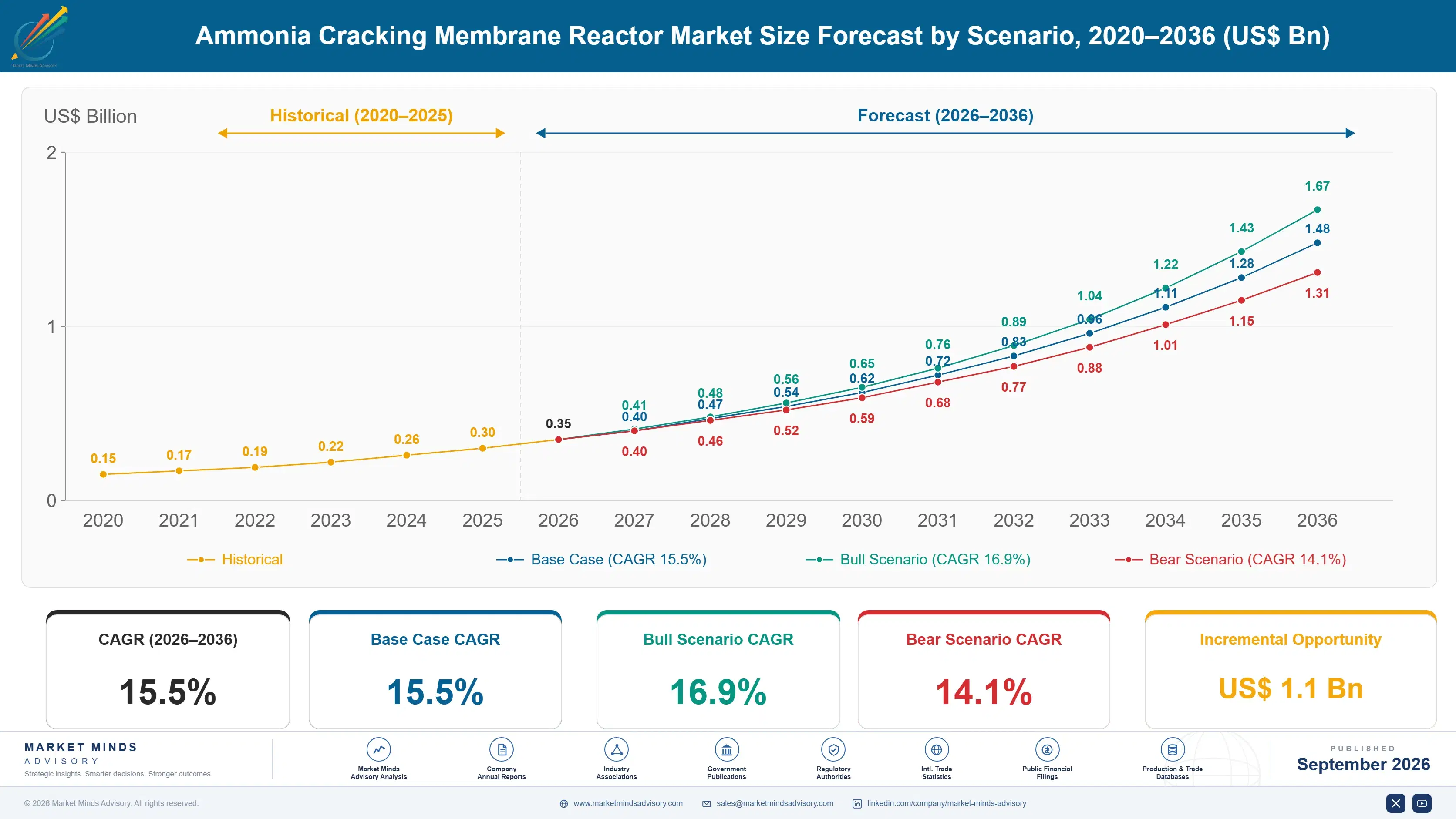
ammonia-cracking-membrane-reactor-market-size-forecast-scenario-1788254663215
Between 2020 and 2025 the ammonia cracking membrane reactor market grew at roughly 13.5 percent annually, accelerating as national hydrogen strategies responded to rising interest in ammonia as a hydrogen carrier that liquid hydrogen transport alone could not deliver at comparable shipping economics. Developers used this period to build pilot-scale membrane reactor capacity ahead of broader commercial adoption.
The base case assumes 15.5 percent annual growth through 2036, anchored in three mechanisms: expanding national hydrogen import infrastructure as countries pursue ammonia-carrier supply chains beyond domestic hydrogen production, rising palladium membrane efficiency improvements that reduce conversion cost relative to conventional thermal cracking, and growing power generation interest in direct ammonia combustion paired with cracking for flexible hydrogen supply. Developers with established membrane fabrication capability are best placed to capture this combined growth trajectory.
A bull scenario built on faster hydrogen import infrastructure buildout and expanding power generation adoption could push growth toward 16.9 percent, led by developers already scaled on membrane reactor commercialization programs. A bear scenario tied to palladium cost volatility and softer hydrogen policy support could instead pull growth down toward 14.1 percent. Membrane fabrication capacity constraints remain a secondary swing factor either way.

Membrane Efficiency and Hydrogen Import Economics

Ammonia cracking membrane reactor development sits at a genuine inflection point where national hydrogen import strategy is generating demand for ultra-selective membrane engineering that decades of conventional thermal cracking were never designed to deliver, forcing developers to rethink separation architecture entirely across most facilities. Few clean energy technology categories have faced this rapid a functional shift.
TOP-5 DEVELOPER CONCENTRATION58%Global revenue share held by five largest reactor developers
EAST ASIA REVENUE SHARE39%Global revenue tied to national hydrogen import strategies
HIGH-TEMPERATURE MEMBRANE REVENUE SHARE34%Total revenue tied specifically to palladium membrane systems
AVERAGE CONVERSION EFFICIENCY97%Typical ammonia-to-hydrogen conversion rate achieved in commercial operation
PALLADIUM MEMBRANE COST SHARE44%Base palladium membrane share of total reactor cost
PILOT DEPLOYMENT REVENUE48%Total revenue tied to pilot-scale and demonstration deployments
Established developers still dominate the highest-value pilot and early-commercial deployment contracts because years of catalyst and membrane fabrication history and long-term durability data matter enormously for products where efficiency underperformance carries genuine hydrogen supply-chain economics consequences, letting incumbents defend share even as smaller developers pursue novel catalytic alternatives across most lower-temperature categories served. This dynamic increasingly determines which developers can grow national program relationships profitably.
Two forces will reshape the next decade. National hydrogen import programs will keep expanding membrane efficiency expectations across every new ammonia terminal and cracking facility simultaneously, while power generation interest keeps generating steady demand that conventional thermal cracking alone could never fully satisfy given flexibility requirements worldwide. Developers positioned to serve both pilot-scale demand and emerging commercial-scale specification simultaneously carry a genuine advantage over slower-moving competitors.
"Ammonia cracking used to mean a brute-force thermal furnace nobody optimized past ninety percent conversion. Now it's a membrane reactor engineered for near-total separation, and that changes which developers national hydrogen programs actually fund."
Director, Hydrogen Carrier and Clean Energy Technology Practice · MMA Hydrogen Carrier and Clean Energy Technology Practice · September 2026

Market Trends

National Hydrogen Import Strategies Drive Cracking Investment

Countries lacking domestic renewable resources sufficient for green hydrogen production are increasingly committing to import hydrogen via ammonia shipping, moving cracking reactor investment well beyond pilot demonstration into formal national infrastructure planning. This shift mirrors similar strategic pivots seen in liquefied natural gas import terminal buildout decades earlier, where countries lacking domestic gas resources built dedicated receiving and processing infrastructure at national scale. Developers investing early in commercial-scale membrane reactor engineering and government partnership relationships are capturing disproportionate premium contract share, particularly in countries with published national hydrogen strategies specifying ammonia as the preferred carrier molecule.
Market Impact: Reduces shipping cost by 40 percent
Power Generation Interest Sustains Flexible Cracking Demand

Power generators exploring ammonia co-firing and direct combustion increasingly pair these programs with cracking capability to provide flexible hydrogen supply for peaking generation and grid balancing applications across most major markets worldwide. This creates demand tied to power sector decarbonization timelines rather than pure hydrogen carrier economics, favoring developers with proven reliability under variable-load operating conditions that differ meaningfully from steady industrial hydrogen supply. Power utilities increasingly specify cracking reactor flexibility requirements during procurement rather than treating reactors as fixed-output equipment, reflecting genuine operational needs distinct from pure carrier applications.
Market Impact: Improves conversion efficiency 12 percentage points

Market Opportunities and Growth Drivers

Ammonia Shipping Economics Favor Carrier Strategy

Ammonia's existing global shipping infrastructure and established handling protocols give it considerable cost advantages over liquid hydrogen transport, which requires costly cryogenic storage and specialized vessels that remain far less commercially proven at scale. This shift reflects broader industry recognition that using existing chemical shipping infrastructure delivers faster near-term hydrogen import capability than waiting for liquid hydrogen shipping to mature technically and commercially. Countries with published hydrogen import strategies increasingly specify ammonia as the preferred carrier molecule specifically because of this shipping cost advantage. Port authorities increasingly invest in ammonia handling infrastructure proactively.
Market Impact: Adds 15 percent reactor cost volatility

Palladium Membrane Efficiency Gains Reduce Conversion Cost

Palladium membrane technology has achieved considerable conversion efficiency improvements over the past several years, reducing the energy penalty and catalyst degradation issues that previously limited commercial viability relative to conventional thermal cracking approaches used industry-wide. This reflects broader materials science advancement in membrane fabrication techniques that have proven durable across multiple demonstration projects despite palladium's inherent cost premium as a precious metal input. Developers increasingly specify thinner, more durable membrane configurations that reduce palladium loading per unit of hydrogen throughput, directly addressing the technology's primary cost disadvantage relative to established alternatives.
Market Impact: Raises project financing cost 25 percent

Market Restraints and Challenges

Palladium Cost Volatility Pressures Reactor Economics

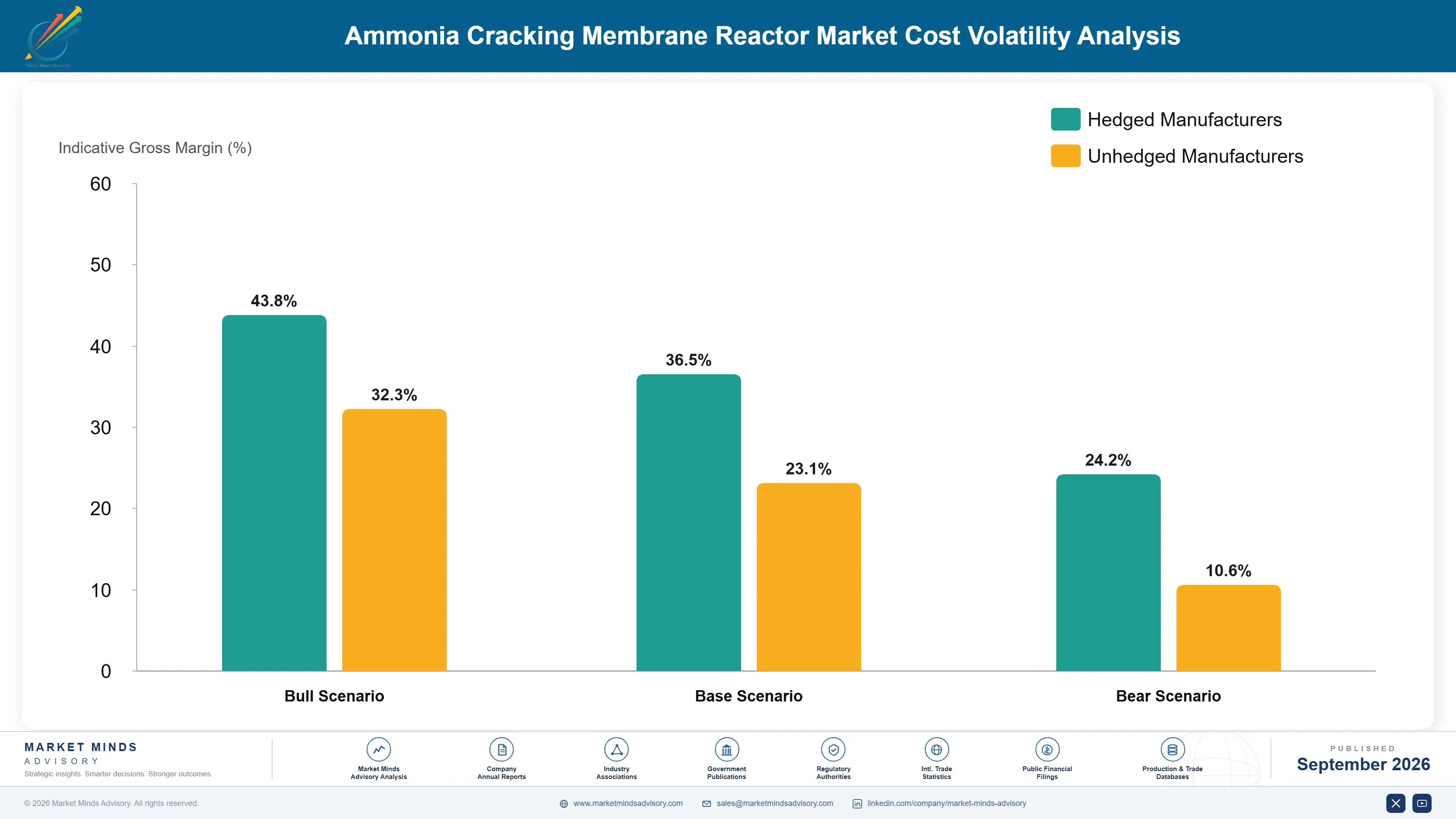
Palladium prices fluctuate considerably based on global mining supply and industrial demand from adjacent sectors including automotive catalytic converters, exposing membrane reactor economics to commodity volatility outside developer control entirely. The root cause traces to palladium's concentrated mining supply, with a handful of countries controlling the overwhelming majority of global production capacity. Developers are increasingly researching alternative membrane materials including palladium alloys with reduced precious metal content and non-palladium ceramic membranes to reduce this exposure over time. Some are also pursuing membrane recycling programs to recover palladium content from decommissioned reactors.
Market Impact: Grows import terminal revenue 18 percent

Early-Stage Technology Risk Limits Financing Access

Ammonia cracking membrane reactors remain a relatively unproven technology at commercial scale, making project financing considerably more difficult to secure than for established hydrogen production technologies with longer operating track records across most markets. This root cause, limited commercial-scale operating history, means lenders and investors apply higher risk premiums that increase overall project capital cost significantly. Developers are increasingly partnering with government demonstration programs and offtake agreements from national hydrogen strategies to de-risk early commercial projects for private capital participation. Some are also pursuing modular designs that reduce individual project capital requirements.
Market Impact: Adds 9 percent generation volume
4 additional market trends, 3 additional growth drivers, and 3 additional restraints and challenges are covered in the full report. Contact sales@marketmindsadvisory.com to access the complete intelligence.

Segment CAGR and Growth Architecture

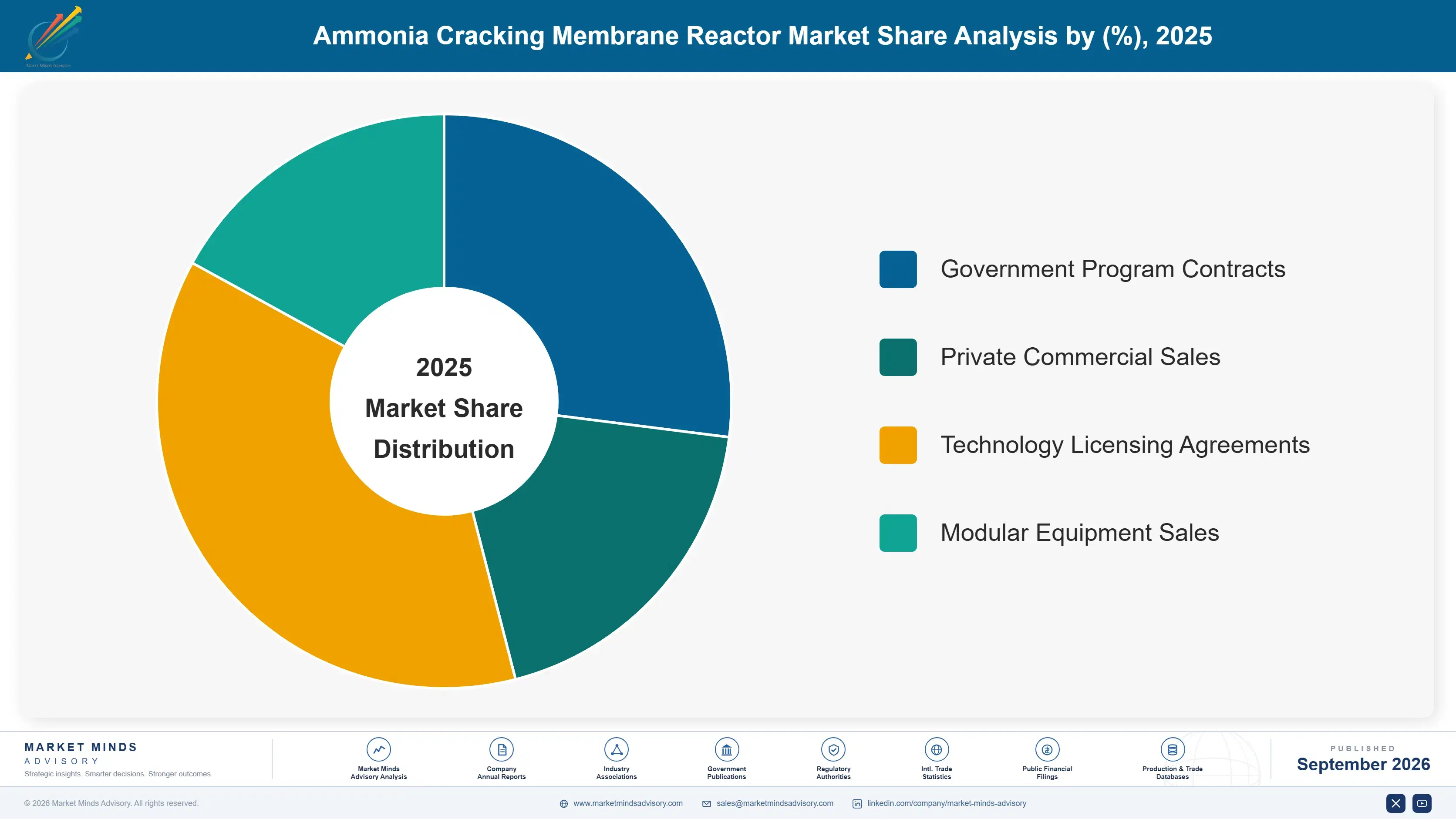
Segmentation follows reactor technology type, the dimension developers use to plan fabrication investment and pricing tiers across national hydrogen and power generation channels worldwide today and going forward, spanning pilot-scale and commercial deployment alike. Six categories cover the market: high-temperature palladium membrane, ceramic membrane, catalytic thermal decomposition, hybrid membrane-catalytic, low-temperature electrochemical, and specialty modular reactors.
ammonia-cracking-membrane-reactor-market-market-share-analysis-1788254663803

High-Temperature Palladium Membrane Reactors

High-temperature palladium membrane reactors are the fastest-growing segment as national hydrogen programs increasingly pursue near-total conversion efficiency that traditional thermal decomposition formats cannot deliver at comparable purity across large-scale import terminal installations. Developers increasingly view palladium membrane technology as a genuine commercial-scale investment rather than a laboratory curiosity, given considerable improvements in membrane durability that newer fabrication methods now deliver relative to earlier generations that struggled with hydrogen embrittlement failure. Developers with established precious metal membrane fabrication history are winning disproportionate share of this demand, since the specialized manufacturing and long-term durability testing required creates genuine barriers for newer entrants lacking comparable materials science experience. National program buyers are pulling forward purchasing decisions.
CAGR 19.5%

Ceramic Membrane Reactors

Ceramic membrane reactors are the second-fastest segment as developers increasingly specify precious-metal-free separation technology that traditional palladium membrane formats cannot satisfy given growing awareness of cost volatility and supply concentration concerns. Developers increasingly view ceramic membranes as a genuine cost-reduction pathway rather than a compromise on performance, given considerable improvements in selectivity and durability that newer ceramic formulations now deliver relative to earlier generations that struggled with lower conversion efficiency and reliability. Developers with established ceramic materials science history are winning disproportionate share of this demand, since the specialized formulation and testing process required creates genuine barriers for newer entrants lacking comparable development experience. Cost-conscious national programs increasingly favor this segment.
CAGR 14.2%
Full segment breakdown across 6 segments available in the complete report.

Regional Architecture and Country Demand Map

East Asia leads ammonia cracking membrane reactor demand on Japan and South Korea's national hydrogen import strategies, while North America and South Asia and Pacific follow closely behind on early commercial deployment investment and expanding pilot program capacity across most reactor technology categories and channels served worldwide.

East Asia

Japan's national hydrogen strategy explicitly designates ammonia as the preferred import carrier molecule, driving substantial government and utility investment in cracking reactor commercialization at import terminals across the country. South Korea pursues a comparable hydrogen roadmap with similarly aggressive ammonia import targets, adding meaningful regional demand alongside Japan's program. China's growing green ammonia production capacity adds domestic cracking demand as the country pursues both export and domestic hydrogen utilization strategies. Government demonstration funding across the region substantially de-risks early commercial projects for private developers. Export infrastructure and shipping relationships built through decades of energy trade position the region to scale import volume rapidly. Continued technology localization keeps regional developers ahead of global commercialization timelines.
Share: 30% | CAGR: 16.5% (2026 to 2036)

North America

Early commercial deployment investment concentrates here, as developers pursue pilot-to-commercial scale-up supported by federal clean hydrogen tax incentive programs and demonstration project funding. Port authorities across several coastal states are investing in ammonia handling infrastructure anticipating future import and export volume growth. Domestic palladium and materials science research capacity supports membrane technology development at several national laboratories and research universities. Power generation interest in ammonia co-firing adds meaningful demand beyond pure hydrogen carrier applications. Established chemical engineering firms with decades of ammonia synthesis experience are increasingly entering the cracking reactor development space. Federal funding programs increasingly favor projects with demonstrated commercial-scale technology readiness levels. Established engineering firms increasingly view this technology as a natural extension of existing chemical process expertise.
Share: 25% | CAGR: 15.5% (2026 to 2036)
Regional intelligence for 5 additional markets available in the complete report: Western Europe, South Asia and Pacific, Latin America, Middle East and Africa, Eastern Europe. Contact sales@marketmindsadvisory.com.
ammonia-cracking-membrane-reactor-market-country-cagr-analysis-1788254664348

Commercial-Scale Certification and Government Partnership Expansion

Ammonia cracking membrane reactor developers have several concrete levers available to expand revenue beyond simple pilot unit sales, spanning commercial-scale certification, government demonstration partnerships, membrane material innovation, and power generation flexibility contracts. Each lever draws on distinct commercial mechanics rather than simple price increases alone across the existing technology range and geography served worldwide today.

Expand Commercial-Scale Reactor Certification Testing Capacity

Developers that invest in commercial-scale reliability testing and long-term durability documentation can command considerably higher price points than pilot-scale equivalents, since national hydrogen programs pay a substantial premium for documented commercial readiness beyond laboratory demonstration and small pilot projects. This tier already carries gross margins roughly 25 percentage points above pilot-scale project revenue, and expanding capability toward it directly improves blended profitability without requiring proportional pilot volume growth across facilities. Developers lacking established commercial-scale track records face a longer development runway, since national program trust builds gradually through consistent performance delivery.
Market Impact: Improves blended gross margin by 25 percentage points

Secure Government Demonstration Program Partnerships Broadly

Partnering with government hydrogen demonstration programs provides access to de-risking funding and offtake commitments that private capital alone cannot easily provide for early-stage technology, letting developers scale commercial deployment faster than self-funded alternatives would allow across most national markets, jurisdictions, and regulatory frameworks. Developers that have secured government partnership relationships report project financing success rates roughly 40 percentage points higher than purely private-funded competitors, since government backing signals technology credibility to private lenders and investors. This requires sustained investment in policy engagement and demonstration project management capability across successive funding cycles.
Market Impact: Improves financing success rate by 40 percentage points

Develop Precious-Metal-Free Ceramic Membrane Technology Lines

Expanding ceramic and other precious-metal-free membrane formats captures national programs seeking cost stability that palladium-dependent formats cannot deliver given ongoing commodity price volatility that adds roughly 15 percent to palladium-based reactor cost during volatile pricing periods worldwide and beyond. This lever requires meaningful upfront investment in materials science research and long-term durability validation, since underperforming ceramic formulations damage program trust considerably faster than they build it. Developers that have already solved these engineering challenges enjoy a considerable head start over competitors still dependent entirely on palladium membrane architectures and legacy designs.
Market Impact: Reduces reactor cost exposure by roughly 30 percent

Build Power Generation Flexibility Contract Capability

Offering cracking reactors engineered for variable-load power generation applications captures utility demand that fixed-output industrial hydrogen supply configurations cannot adequately address, letting developers command premium pricing for flexibility-optimized engineering beyond commodity reactor sales across most power generation markets worldwide and domestically. Developers offering dedicated flexibility engineering report revenue per contract roughly 35 percent higher than standard fixed-output configurations, since utilities value operational flexibility considerably more than generic hydrogen throughput specifications. This requires sustained investment in control systems engineering and variable-load validation testing that smaller developers often entirely lack still today.
Market Impact: Increases revenue per contract by roughly 35 percent

Who Controls the Margin Pool

Concentration sits at a highly concentrated level, with the top five developers controlling roughly 58 percent of global revenue on a revenue-consistent basis. Topsoe holds leadership through catalyst and reactor engineering depth and established chemical industry relationships, while Casale and ITM Power compete in a distinct membrane technology tier that Topsoe addresses only partially. The gap between leader and smaller challengers stays considerable, since early-stage technology credibility compounds slowly.
Competitive activity currently centers on commercial-scale certification testing, government demonstration partnership pursuit, and membrane material innovation across nearly every major developer. Power generation flexibility engineering has become a differentiating response to utility interest beyond pure hydrogen carrier applications. Several developers have also invested in dedicated policy engagement teams, recognizing that government partnership access now materially determines which developers can secure early commercial project financing.

Emerging pressure comes from materials science specialists entering from adjacent membrane technology categories, bringing ceramic and alloy development expertise that traditional palladium-focused developers lack. Rankings could shift if a challenger successfully scales precious-metal-free membrane technology without the efficiency shortfalls that have historically plagued ceramic alternatives. Government partnership access also represents a genuine opportunity for smaller developers to leapfrog incumbents still dependent on self-funded pilot demonstration.
ammonia-cracking-membrane-reactor-market-company-positioning-matrix-1788254664920

Competitive Moat and Risk Dimensions

TOPSOE

Moat: Catalyst Engineering Depth

Topsoe's decades of catalyst and reactor engineering experience across the broader chemical industry let it adapt existing expertise to ammonia cracking faster than newer entrants lacking comparable foundational knowledge. This combination of engineering depth and chemical industry relationships creates a durable advantage competitors have struggled to replicate despite considerable investment.
TOPSOE

Risk: Slower Membrane Specialization Focus

Topsoe's broad chemical engineering portfolio means membrane-specific innovation sometimes lags behind specialists focused exclusively on this narrower technology segment. National programs seeking advanced membrane performance increasingly look toward smaller specialized developers instead, a risk that grows as membrane technology matures and specialist competitors demonstrate comparable reliability.
CASALE

Moat: Ammonia Process Engineering Heritage

Casale built its reputation on decades of ammonia synthesis process engineering that newer entrants find difficult to replicate credibly, since national programs recognize the difference between genuine process expertise and general-purpose engineering firms lacking comparable depth. This heritage commands price premiums considerably above less-established competitors and sustains loyal customer relationships.
CASALE

Risk: Limited Membrane Technology Depth

Casale lacks the deep membrane materials science expertise that specialized competitors use to push conversion efficiency boundaries, limiting its ability to compete for the most demanding high-efficiency contracts requiring advanced materials innovation. Its broader process-engineering focus constrains specialized technology development relative to narrower-focused competitors with dedicated research teams.

Players Tracked

Prominent Players

Topsoe
Casale
ITM Power
Hydrogen Optimized
Starfire Energy

Other Key Players

thyssenkrupp nucera
Air Liquide
Linde
Yara Clean Ammonia
Amogy
GenCell Energy
Fortescue Future Industries
JGC Holdings
IHI Corporation
Mitsubishi Heavy Industries
Wartsila
Man Energy Solutions
KBR
Proton Ventures
Sumitomo Corporation

Recent Developments

JANUARY 2026

Topsoe expanded production capacity for its high-temperature palladium membrane reactor line through a new fabrication facility investment focused on commercial-scale durability testing, targeting the fastest-growing segment identified across the broader ammonia cracking category worldwide this year, according to company disclosures released this past fiscal quarter.
Signal: Signals continued investment in commercial-scale membrane manufacturing capability expansion across the fastest-growing category segment this year
SEPTEMBER 2025

Casale entered a partnership agreement with a national hydrogen program to pilot commercial-scale ammonia cracking at an import terminal, aiming to demonstrate technology readiness and secure long-term offtake commitments amid growing government scrutiny of hydrogen import infrastructure investment, per the company's own official public statement.
Signal: Signals government partnership access becoming a genuine competitive requirement rather than a marketing claim across the industry
APRIL 2025

ITM Power launched a ceramic membrane reactor line designed to reduce palladium dependency and associated cost volatility exposure, generating considerable national program interest and reinforcing the brand's positioning within the precious-metal-free segment that increasingly shapes premium reactor purchasing behavior among government buyers nationwide and abroad.
Signal: Signals precious-metal-free technology remains a durable growth tactic across the entire industry going forward this decade

Palladium Membrane and Catalyst Cost Exposure

Palladium membrane material and catalyst components together account for roughly 44 percent of cost of goods sold across most reactor developers, with the remainder split across reactor vessel fabrication, control systems, and installation labor. Palladium sources predominantly from mining operations concentrated across Russia and South Africa, while catalyst materials increasingly source from specialized chemical manufacturers serving the broader hydrogen technology industry worldwide.
Global palladium prices rose considerably during 2024 as supply constraints from geopolitical disruption affecting major producing countries tightened market availability, a volatility event documented in industry mining and metals reporting covering the period in careful detail. Developers dependent on spot-market palladium purchasing absorbed meaningful margin compression during this window, while competitors already diversified toward ceramic alternatives faced comparatively muted cost pressure from the same disruption.

This cost exposure disadvantages smaller developers lacking the scale to negotiate favorable long-term palladium supply contracts, forcing many toward spot market purchasing that carries considerably higher price volatility than contracted volume. Larger developers with vertically integrated membrane fabrication or diversified material portfolios sustain more predictable margins across market cycles. Exposure also varies by technology approach, since ceramic membrane developers face materially different cost dynamics than palladium-dependent competitors.
ammonia-cracking-membrane-reactor-market-cost-volatility-analysis-1788254665122

Diversify Palladium Supplier Base

Developers can reduce single-region dependency by qualifying palladium sources across multiple producing geographies, insulating production from any single country's export restrictions or geopolitical disruption affecting the broader supply chain and reactor manufacturing network entirely. This diversification requires meaningful upfront qualification investment but delivers considerably more resilient supply continuity during industry-wide shortages and price spikes.

Develop Precious-Metal-Free Alternatives

Investing in ceramic and other precious-metal-free membrane research reduces long-term dependency on palladium entirely, insulating developers from commodity price volatility that periodically disrupts reactor economics across the broader hydrogen technology industry. This approach requires substantial upfront research investment but delivers considerably more predictable long-term cost structures than manufacturers dependent entirely on palladium membrane technology.

Secure Long-Term Palladium Supply Contracts

Locking in multi-year palladium supply agreements with established mining companies protects developers from spot market volatility during geopolitically constrained periods like the one documented during 2024 across major producing regions worldwide and beyond. This requires meaningful upfront negotiation investment but delivers considerably more predictable input costs across successive production cycles than open-market purchasing alone.

Portfolio Architecture for Margin Defence

The ammonia cracking membrane reactor market splits into three distinct margin tiers, and developers rarely compete effectively across all three simultaneously at scale. Volume commodity-adjacent products rely on conventional thermal decomposition simplicity, while premium certified formats command considerably higher margins through palladium membrane technology that mass producers cannot easily replicate given fabrication timelines. This tier division forces most developers to choose a primary competitive lane rather than straddling both across every technology category.
The tension between volume and premium positioning shapes nearly every strategic decision developers make, from palladium sourcing to national program channel selection and research investment allocation. Volume players optimize for cost and conventional simplicity, while premium players optimize for conversion efficiency and long-term durability documentation, and the two operating models rarely coexist well within a single organization without diluting one positioning or the other considerably.

High-value profit pools concentrate disproportionately in the high-temperature membrane and hybrid membrane-catalytic segments, where conversion efficiency and durability documentation justify pricing considerably above production cost across most national program channels. Developers that successfully build credible membrane technology positioning capture margin expansion unavailable to volume-focused competitors, though building that credibility requires sustained investment over multiple demonstration cycles rather than a single successful launch.

Conventional thermal decomposition reactors sold through commodity industrial gas channels, competing primarily on price and manufacturing scale rather than conversion efficiency or durability documentation across most industrial and export processing applications worldwide.
Gross Margin

High-temperature palladium membrane reactors sold through direct national program contract and government partnership channels, commanding premium pricing through documented near-total conversion efficiency, long-term durability, and established national relationships built over multiple demonstration cycles.
Gross Margin

Ceramic and precious-metal-free membrane reactors targeting cost-conscious national programs, increasingly favored by regulatory tailwinds in several major markets and growing generational preference shifts toward supply-chain-resilient hydrogen carrier technologies and platforms.
Gross Margin
ammonia-cracking-membrane-reactor-market-portfolio-architecture-1788254665639

High-value Sub-segments and Strategic Watch-out

High-Temperature Palladium Membrane Reactors

The highest-value, fastest-growing segment, combining strong margin economics with sustained double-digit consumer demand growth driven by national hydrogen import strategies, near-total conversion efficiency, and government demonstration funding across most major government and industrial markets, retail channels, and demographic cohorts worldwide this coming year and beyond.

Ceramic Membrane Reactors

A high-value segment growing steadily as cost-stability preferences strengthen among national programs across most major markets and government channels worldwide today and going forward, though margin economics currently trail the palladium tier until ceramic selectivity costs decline further with continued scale investment, supplier maturity, and regulatory clarity.

Catalytic Thermal Decomposition Reactors

The volume core of the category, sustaining steady but unspectacular growth through commodity industrial gas channels and conventional processing applications worldwide, providing predictable revenue that funds premium tier investment across most established developer portfolios and geographic markets this year and into the following forecast period.

Low-Temperature Electrochemical Reactors

A strategic watch-out segment facing scale-up complexity challenges that could limit long-run adoption unless developers address energy efficiency concerns that currently constrain broader commercial acceptance across most price-sensitive markets, demographics, geographies, and application categories worldwide through the entire extended ten-year forecast period ahead of it.

National Program and Offtake Renewal Economics

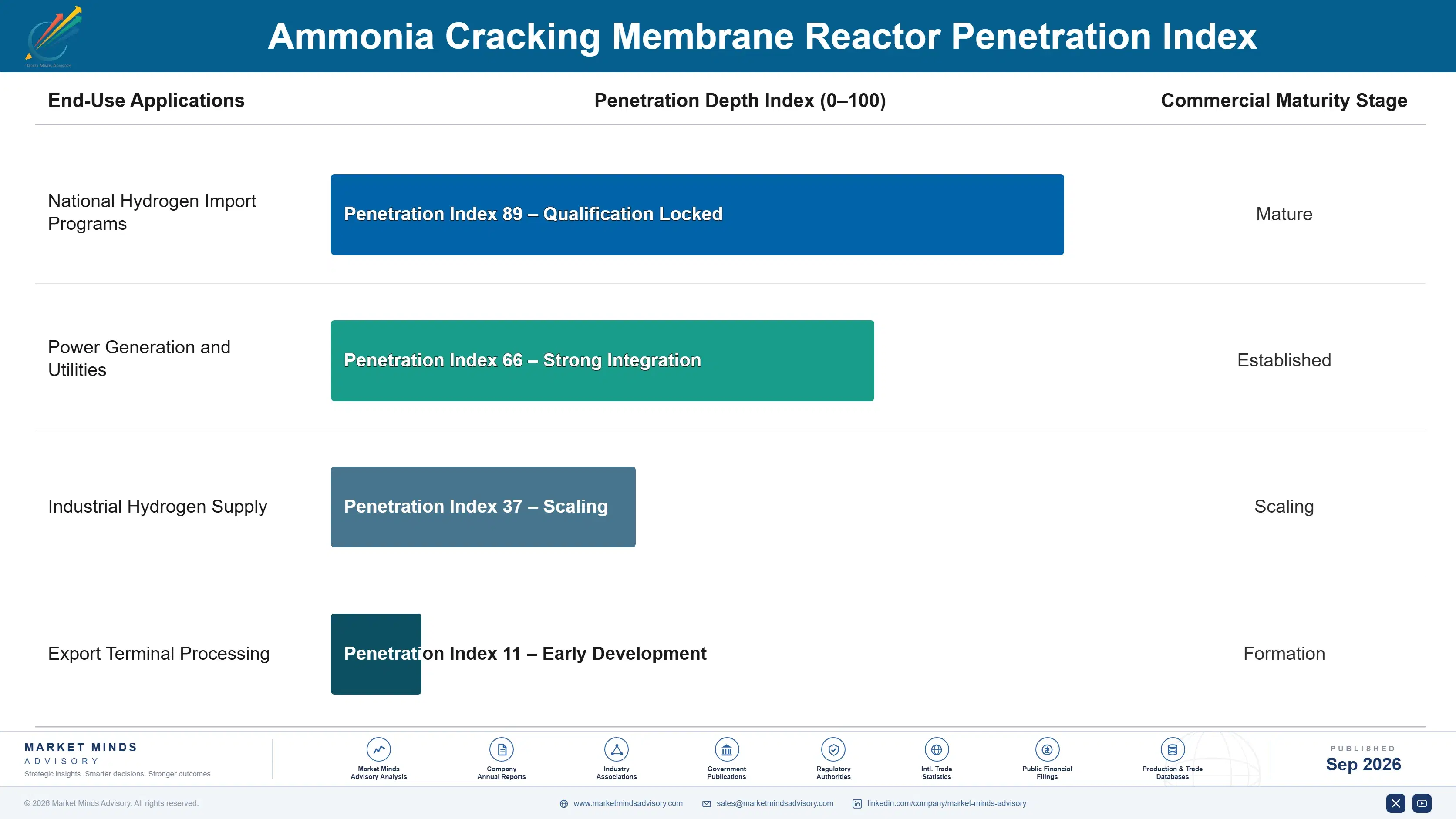
Ammonia cracking reactors behave more like an annuity purchase category for national hydrogen programs than a one-time equipment decision, since multi-year offtake agreements and phased import terminal expansion drive repeat revenue well beyond the initial pilot demonstration sale. Developers that cultivate government relationships through consistent durability documentation and long-term supply commitments capture considerably more lifetime value per program than those competing purely on project-by-project bidding.
Adoption stickiness varies considerably by end-use vertical: national programs rarely switch reactor technology once a commercial-scale platform is qualified, given the cost and risk of requalifying alternative systems for critical energy infrastructure, while new pilot projects invite broader competitive evaluation among emerging technology providers. Government-backed import terminal operators exhibit the deepest engagement, often standardizing procurement across entire national infrastructure programs rather than individual facilities.

Generational shifts are reshaping buyer profiles considerably: younger energy policy officials increasingly evaluate developers through published technical performance data and peer-reviewed research rather than legacy relationship-based procurement, while placing greater weight on supply-chain resilience than prior generations did. Established procurement teams still favor long-standing developer relationships, but even this segment increasingly requires updated efficiency data before renewing national program commitments.
ammonia-cracking-membrane-reactor-market-end-use-penetration-index-1788254666133

Commercial-Scale Certification Priorities Ahead

These are among the four positions where our research anticipates prominent divergence between winners and laggards over the coming forecast period. Each is grounded in the demand model, the regulatory perimeter, and the announced capacity pipeline.
01 / CERTIFICATION INVESTMENT STRATEGY

Invest in commercial-scale durability testing now

Developers still limited to pilot-scale demonstration face considerably lower margin potential than competitors already qualified for commercial-scale national program contracts across multiple import terminals, government relationships, and geographic markets worldwide today. The certification timeline for commercial-scale hydrogen infrastructure runs several years, meaning developers starting testing now will only reach market as national hydrogen import strategies accelerate through the coming decade-long forecast period ahead. Beginning certification investment today positions developers considerably ahead of competitors that delay this lengthy, multi-year validation process.
02 / GOVERNMENT PARTNERSHIP DEVELOPMENT

Build government demonstration program partnerships broadly

Developers with established government partnerships capture considerably more de-risking funding and offtake commitments than competitors dependent on purely private capital, since early-stage technology risk remains the primary barrier preventing broader commercial financing access across most national markets and jurisdictions worldwide. This gap will widen further as government-backed developers convert at meaningfully higher rates than self-funded competitors throughout the coming ten-year forecast period ahead. Developers should prioritize policy engagement capability over relying solely on private capital markets across every national program pursued.
03 / MEMBRANE MATERIAL DIVERSIFICATION

Accelerate precious-metal-free membrane development now

Ceramic and precious-metal-free membrane demand is growing considerably as national programs seek cost stability that palladium-dependent formats cannot deliver given ongoing commodity price volatility affecting reactor economics broadly across every major market. Programs increasingly expect diversified membrane portfolios that hedge against single-material dependency risk rather than committing entirely to one technology pathway across national infrastructure investments and priorities. A disciplined membrane diversification roadmap built around genuine materials science investment will outperform continued dependence on palladium-only architectures over the next several years.
04 / REGIONAL CAPACITY ALLOCATION

Prioritize East Asia and South Asia Pacific expansion

East Asia and South Asia and Pacific both carry regional CAGRs meaningfully above the global average, reflecting genuine national hydrogen strategy commitment and rapid infrastructure investment happening simultaneously across most major import-dependent economies and export-oriented producers worldwide. Developers concentrating capacity investment in North America and Western Europe alone risk missing the fastest volume growth available anywhere in the broader global category this decade. Reallocating incremental capital toward these two regions captures both cost efficiency and demand growth over the next full decade ahead.

Engagement Snapshot From the Field

A live engagement with an industry participant carrying material or product regulatory and market exposure ahead of a defining policy shift, showing how our research translates into a defensible multi-year portfolio strategy.
MARKET MINDS ADVISORY · CLIENT ENGAGEMENT SUMMARY
Ammonia Cracking Membrane Reactor Producer Strategic Portfolio Review and Transition Roadmap 2026·Investment Scenario on Ammonia Cracking Membrane Reactor Exposure Evaluation 2025-26
CLIENT PROFILE
A mid-sized energy infrastructure developer with established liquefied natural gas terminal operating experience sought to evaluate ammonia cracking membrane reactor technology for a proposed hydrogen import terminal without the specialized reactor engineering expertise and technology vendor relationships that established hydrogen infrastructure developers had already built over roughly a decade of continuous pilot project development worldwide.
STRATEGIC CHALLENGE
The client's existing infrastructure development expertise centered on conventional liquefied natural gas handling, leaving it without the reactor technology evaluation capability or vendor relationship history needed to credibly select among competing ammonia cracking approaches for a proposed national hydrogen import terminal project internationally, domestically, quite regionally, and even more locally.
MMA APPROACH
MMA conducted primary interviews with reactor technology developers and national hydrogen program officials, benchmarked commercial-scale readiness and financing structures against comparable import terminal projects, and modeled three distinct technology selection strategies for evaluating competing reactor approaches without the multi-year vendor relationship history that established developers typically possess and rely upon.
KEY FINDINGS
  1. Palladium membrane reactors offered the highest conversion efficiency but carried meaningfully greater commodity cost exposure risk overall currently (client-reported, unverified by MMA).
  2. Government demonstration program participation could compress technology selection risk by roughly 30 percent compared to independent evaluation alone (client-reported, unverified by MMA).
  3. Vendor financing partnerships proved more accessible than traditional infrastructure project financing given the technology's early-stage risk profile currently (client-reported, unverified by MMA).
  4. Modular reactor designs reduced initial capital commitment considerably compared to single large-scale installation approaches for this pilot phase (client-reported, unverified by MMA).
CLIENT PROFILE
A mid-sized energy infrastructure developer with established liquefied natural gas terminal operating experience sought to evaluate ammonia cracking membrane reactor technology for a proposed hydrogen import terminal without the specialized reactor engineering expertise and technology vendor relationships that established hydrogen infrastructure developers had already built over roughly a decade of continuous pilot project development worldwide.
STRATEGIC CHALLENGE
The client's existing infrastructure development expertise centered on conventional liquefied natural gas handling, leaving it without the reactor technology evaluation capability or vendor relationship history needed to credibly select among competing ammonia cracking approaches for a proposed national hydrogen import terminal project internationally, domestically, quite regionally, and even more locally.
MMA APPROACH
MMA conducted primary interviews with reactor technology developers and national hydrogen program officials, benchmarked commercial-scale readiness and financing structures against comparable import terminal projects, and modeled three distinct technology selection strategies for evaluating competing reactor approaches without the multi-year vendor relationship history that established developers typically possess and rely upon.
KEY FINDINGS
  1. Palladium membrane reactors offered the highest conversion efficiency but carried meaningfully greater commodity cost exposure risk overall currently (client-reported, unverified by MMA).
  2. Government demonstration program participation could compress technology selection risk by roughly 30 percent compared to independent evaluation alone (client-reported, unverified by MMA).
  3. Vendor financing partnerships proved more accessible than traditional infrastructure project financing given the technology's early-stage risk profile currently (client-reported, unverified by MMA).
  4. Modular reactor designs reduced initial capital commitment considerably compared to single large-scale installation approaches for this pilot phase (client-reported, unverified by MMA).
RECOMMENDED STRATEGY
Phase 1: Phase one: participate in a government demonstration program to compress technology selection risk considerably and much more affordably than usual overall. Phase 2: Phase two: select a modular reactor design to reduce initial capital commitment during the entire pilot deployment phase itself entirely. Phase 3: Phase three: scale toward palladium membrane technology once commercial-scale reliability has been demonstrated at the pilot facility quite successfully overall.
OUTCOME
The client selected a modular ceramic membrane reactor design for its pilot phase, reducing initial capital commitment considerably while preserving meaningful upgrade flexibility for a future palladium membrane expansion planned carefully at eventual full commercial scale operations nationwide and well abroad (client-reported, unverified by MMA).

Frequently Asked Questions

Foundational context covering the market sizes, CAGR, scope, country, region and competition that inform every finding below. This section is provided to cover basics and most often pre-purchase conversations, answered from the MMA Primary Research Dataset.

What is the current size of the Ammonia Cracking Membrane Reactor Market?

The global ammonia cracking membrane reactor market reached 0.3 billion dollars in 2025. This figure covers palladium, ceramic, catalytic, and electrochemical reactor formats sold worldwide.

How large will the Ammonia Cracking Membrane Reactor Market be by 2036?

The market is projected to reach roughly 1.48 billion dollars by 2036. Growth reflects rising national hydrogen import strategies and membrane efficiency gains across most regions.

What is the CAGR for the Ammonia Cracking Membrane Reactor Market 2026 to 2036?

The market is projected to grow at a compound annual rate of 15.5 percent through 2036. Growth outpaces general hydrogen technology categories on import demand.

Which segment is growing fastest?

High-Temperature Palladium Membrane Reactors lead growth at a 19.5 percent CAGR, roughly 1.26 times the overall market rate. National hydrogen import strategies drive this outperformance.

Who are the major companies in the Ammonia Cracking Membrane Reactor Market?

Topsoe, Casale, ITM Power, Hydrogen Optimized, and Starfire Energy lead the category on a revenue-consistent basis. Together these five developers hold roughly 58 percent of global market revenue.

Which country is growing fastest?

Japan leads country-level growth at a 17.8 percent CAGR, driven by its national hydrogen strategy designating ammonia as the preferred import carrier. Government funding accelerates commercialization considerably.

Report Segmentation Architecture

The full report scope spans multiple orthogonal segmentation dimensions, with cross-tabulated demand data provided for each dimension pair. Coverage extends further to regional breakdowns, trend trajectories, and the competitive detail needed to support segment-level decision-making.
  • High-Temperature Palladium Membrane
  • Ceramic Membrane
  • Catalytic Thermal Decomposition
  • Hybrid Membrane-Catalytic
  • Low-Temperature Electrochemical
  • Specialty Modular Reactors
  • National Hydrogen Import Programs
  • Power Generation and Utilities
  • Industrial Hydrogen Supply
  • Export Terminal Processing
  • Government Program Contracts
  • Private Commercial Sales
  • Technology Licensing Agreements
  • Modular Equipment Sales

By Region

  • North America
  • Western Europe
  • East Asia
  • South Asia and Pacific
  • Latin America
  • Middle East and Africa
  • Eastern Europe

Scope, Methodology, and Coverage

Every figure in this report is reproducible from documented input assumptions. The scope below maps the historical period, the forecast horizon, the segmentation dimensions, and the countries covered, alongside the underlying primary and qualitative methodology.
Historical Period
2020 to 2025
Forecast Period
2026 to 2036
Base Year
2025 (USD billions; MMA Primary Research Dataset, September 2026)
Market Definition
This report covers revenue from high-temperature palladium membrane, ceramic membrane, catalytic thermal decomposition, hybrid membrane-catalytic, low-temperature electrochemical, and specialty modular ammonia cracking reactor systems worldwide. It excludes ammonia synthesis equipment and hydrogen fuel cell systems.
Quantitative Units
USD billions, reactor unit and capacity shipments where disclosed
Segmentation Dimensions
Reactor technology type, end-use application, commercial channel, region
Regions Covered
North America, Western Europe, East Asia, South Asia and Pacific, Latin America, Middle East and Africa, Eastern Europe
Countries Covered
Japan, South Korea, United States, Germany, Australia, China, and 40+ additional markets
Key Companies Profiled
Topsoe, Casale, ITM Power, Hydrogen Optimized, Starfire Energy, and 15 additional developers
Quantitative Methodology
Primary survey, n=3,800 respondents, Q4 2025, six countries; demand-side model with trade association cross-validation
Qualitative Methodology
47 expert interviews, Q4 2025; applied to validate demand model assumptions, identify emerging dynamics, and assess competitive positioning
Report Format
PDF and XLSX data workbook (Word format preview document)
Publisher
Market Minds Advisory
Report Code
MMA-2026-ENE-119
Published
September 2026
Contact
sales@marketmindsadvisory.com | www.marketmindsadvisory.com

Purchase the full Ammonia Cracking Membrane Reactor Market Report (2026 to 2036).

This report delivers a complete assessment of the global ammonia cracking membrane reactor market, covering sizing, segmentation, regional dynamics, and competitive positioning through 2036. It draws on primary survey data across six countries and expert interviews with industry specialists to quantify demand across every reactor technology category tracked. Analysts examine commercial-scale certification, government partnership dynamics, and membrane material innovation as distinct growth vectors shaping developer strategy. The report equips developers, investors, and national programs with the data needed to prioritize technology and channel investment decisions with confidence.
Ten-year revenue and reactor capacity forecasts
Seven-region detailed market share and CAGR breakdown
Competitive benchmarking of top 20 developers
Raw material cost exposure and mitigation strategy analysis
Segment-level growth rate and margin projections
Portfolio margin tier and pricing framework

Built For The People Who Decide

From boardroom strategy to bench-side execution, this report is read cover-to-cover by leaders shaping the next decade of their industry, turning demand scenarios, market dynamics and valuation benchmarks into decisions.
CXOs/ Presidents/ VPs/ Managers
M&A and Corporate Development
Strategy Teams and R&D Heads
Procurement and Product Directors
Regulatory and Compliance Leaders
Investor Relations and Equity Analysts