Market Minds Advisory
Amine Oxide Market

Amine Oxide Market: Mild Surfactant Chemistry for Personal Care and Household Cleaning

Sulfate-free reformulation across household cleaning and personal care brands is pulling amine oxide demand upward, as formulators reach for a mild, biodegradable co-surfactant that thickens formulas without the irritation profile regulators and consumers increasingly reject.

Lead Analyst

Bilal Shaikh

Published

September 2026

Make Smarter Decisions with Customized Research Insights

Request a free sample report and evaluate market opportunities, growth trends, and competitive dynamics relevant to your business needs.

2025 MARKET VALUE$1.4BMarket Size 2025
2036 FORECAST VALUE$2.5BBase Case , 2026 to 2036
CAGR 2026 TO 20366.1 %Bull 7.3% / Bear 4.9%
INCREMENTAL OPPORTUNITY$1.1BNet 10- year value creation
EXPANSION MULTIPLE1.79x2036 value over 2026 base
Strategic Levers
M&A Pipeline
Regional Outlook
Country Rankings
Competitive Intelligence
Segmental Deep-dive
Call-Us : 91 93563 13602

Executive Snapshot and Market Trajectory

Amine oxide demand is being pulled forward by sulfate-free reformulation across shampoo, body wash, and household cleaning brands, where the chemistry's mildness and foam-boosting properties have become genuinely difficult for formulators to substitute cheaply at comparable performance and consumer acceptance across major markets.
Personal care and household cleaning together account for the bulk of consumption, with cocamidopropylamine oxide the fastest-growing single product as brands chase baby care and sensitive-skin claims across nearly every major retail category worldwide. East Asia leads global production capacity, anchored by Chinese and Southeast Asian oleochemical integration, while North America and Western Europe remain the largest premium-formulation buyers driving reformulation-linked volume growth across their respective retail networks.
Competitive intensity centers on backward integration into fatty alcohol and fatty amine feedstock, which determines margin resilience whenever palm and coconut oil prices swing sharply, as they have repeatedly over the past several years across multiple growing regions and harvest cycles. Biodegradability testing requirements and tightening cosmetic ingredient disclosure rules across the European Union and United States are reshaping which suppliers can credibly serve premium personal care accounts going forward into the next decade.
Market Definition
The amine oxide market covers tertiary amine oxide surfactants used as co-surfactants, foam boosters, and viscosity modifiers in personal care, household cleaning, and institutional cleaning formulations. It excludes primary and secondary amine derivatives, quaternary ammonium compounds, and amine oxides used purely as industrial catalysts or textile processing aids outside cleaning and personal care applications.
Base Year Value
$1.4B in 2025 (MMA Primary Research Dataset, August 2026)
Forecast Period
2026 to 2036, eleven discrete annual values
CAGR
6.1% base case. Bull 7.3%. Bear 4.9%.
Fastest Growth Segment
Cocamidopropylamine Oxide: 8.4% CAGR
Fastest Growth Country
India: 8.7% CAGR
Fastest Growth Region
South Asia and Pacific: 8.1% CAGR
Largest Region
East Asia: 30% of 2025 global value
Market Leaders
Solvay SA, Evonik Industries AG, Clariant AG, Stepan Company, Kao Corporation. Source: MMA Analysis based on company annual reports.
Primary Survey
n=3,800 procurement and R&D decision-makers, Q4 2025, six countries
Methodology
Demand-side build-up, cross-validated against public data, 47 expert interviews

Amine Oxide Market Forecast Scenarios

amine-oxide-market-size-forecast-scenario-1787302467358
Between 2020 and 2025, amine oxide demand grew at a steady pace tied closely to household cleaning volume, with sulfate-free personal care reformulation adding incremental momentum from 2023 onward as major consumer brands began phasing out sodium lauryl sulfate across flagship product lines in direct response to shifting retailer listing requirements and evolving consumer perception research.
The base case rests on three mechanisms holding through 2036: continued sulfate-free reformulation across personal care majors as retailer requirements tighten further and spread into secondary markets, household cleaning brands maintaining amine oxide as their preferred mild co-surfactant for dish and surface formulations amid rising biodegradability scrutiny, and oleochemical producers in Southeast Asia expanding fatty alcohol capacity that keeps input costs from constraining downstream demand growth across every major regional market.
A bull scenario hinges on faster adoption of amine oxide in emerging-market household cleaning as disposable income rises and modern retail formats expand their premium product assortments across a wider geography. The bear risk is a sustained spike in palm and coconut oil feedstock pricing that pushes formulators toward cheaper, less biodegradable alternative surfactant chemistries despite the compliance tradeoffs involved for regulated categories.

Mild Surfactant Demand Economics and Reformulation Drivers

Three forces are converging on formulators at once right now. Sulfate-free reformulation has moved from a premium niche claim to a mainstream expectation across personal care majors facing direct retailer pressure, biodegradability testing requirements under updated cosmetic ingredient rules have narrowed which surfactant chemistries qualify for sensitive-skin claims, and Southeast Asian oleochemical capacity has expanded enough to stabilize fatty alcohol feedstock availability for downstream am
MARKET CONCENTRATIONCR5 41%moderately concentrated among integrated global oleochemical majors today
AVERAGE SELLING PRICE$2.10 per kilogramreflects feedstock-linked pricing across all certified premium grades
TOP PRODUCING COUNTRYChina, 26% of global outputleads on integrated fatty alcohol production capacity broadly
CAPACITY UTILIZATION74% average plant utilizationreflects steady baseline household cleaning demand year-round overall
TRADE INTENSITY35% of volume cross-border tradedformulators source globally to ensure consistent grade quality
FEEDSTOCK COST SHARE52% of COGS from fatty alcoholremains the single dominant variable cost across producers
The commercial character of this market sits firmly within specialty chemicals rather than commodity surfactants, with grade-specific formulation support and technical service increasingly determining which supplier wins a formulator's qualification process, not just delivered price per kilogram, particularly for premium personal care accounts facing the heaviest regulatory documentation burden and the longest supplier qualification cycles.
The next decade will be shaped by tightening cosmetic ingredient disclosure regulation in the European Union and United States, continued backward integration by major suppliers into fatty alcohol feedstock, and household cleaning brands expanding amine oxide use into surface and multi-purpose cleaner formulations well beyond its traditional dishwashing liquid stronghold into categories it has rarely served before.
"Every sulfate-free reformulation project we track ends up asking the same question: what replaces the foam and mildness without reintroducing the irritation profile marketing just spent two years disowning. Amine oxide keeps winning that argument."
Director, Specialty Surfactants Practice · MMA Specialty Chemicals and Surfactan

Market Trends

Sulfate-Free Reformulation Sweeping Personal Care Product Lines

Major personal care brands have committed to removing sodium lauryl sulfate and sodium laureth sulfate from flagship shampoo and body wash lines, citing consumer perception research showing sulfate-free claims now influence purchase decisions for roughly forty percent of shoppers in developed markets. Amine oxide, particularly cocamidopropylamine oxide, has become the preferred co-surfactant replacement because it restores foam density and viscosity that sulfate-free base surfactants alone cannot deliver at comparable cost. More than a dozen global personal care brands have reformulated flagship product lines around amine oxide-based systems since 2023, and the pace of launches keeps accelerating.
Market Impact: Lifts baby care volume 22 percent
Household Cleaning Brands Expanding Amine Oxide Beyond Dishwashing Liquid

Amine oxide's traditional stronghold has been manual dishwashing liquid, where it boosts foam stability and grease-cutting performance, but household cleaning brands are now specifying it across surface cleaners, bathroom cleaners, and multi-purpose formulations as regulators in the European Union tighten volatile organic compound and biodegradability requirements on cleaning products broadly. The chemistry's readily biodegradable profile under OECD test guidelines makes it easier for formulators to meet eco-label certification requirements than several alternative surfactant classes, a compliance advantage that is pulling amine oxide into product categories it rarely served a decade ago.
Market Impact: Cuts feedstock volatility 18 percen

Market Opportunities and Growth Drivers

Consumer Demand for Sulfate-Free and Mild Surfactant Systems

Dermatological research linking sodium lauryl sulfate to skin barrier disruption has pushed both regulators and consumer advocacy groups to favor milder surfactant systems, particularly for baby care and sensitive-skin product categories where amine oxide's near-neutral irritation profile under standard patch testing gives formulators a defensible mildness claim. Baby care product reformulation around amine oxide-based systems has grown fastest among developed-market brands facing the most direct regulatory and retailer pressure, with several major retailers now requiring sulfate-free certification before listing new baby wash products on shelf, a gatekeeping shift that has meaningfully accelerated supplier qualification timelines across the category.
Market Impact: Erodes gross margin by 6 points

Southeast Asian Oleochemical Capacity Expansion Stabilizing Feedstock Supply

Indonesian and Malaysian producers have expanded integrated fatty alcohol and fatty amine capacity substantially since 2023, backed by palm-based oleochemical investment that has made feedstock more consistently available to downstream amine oxide manufacturers worldwide. This expansion has kept fatty alcohol pricing more stable than it would otherwise have been given rising demand, softening what was previously the single largest cost volatility risk facing amine oxide producers. Several global surfactant majors have signed long-term offtake agreements directly with Southeast Asian oleochemical producers to lock in feedstock access ahead of continued demand growth across personal care and household cleaning end markets.
Market Impact: Adds 8 months to qualification time

Market Restraints and Challenges

Palm and Coconut Oil Price Volatility Undermining Cost Predictability

Amine oxide production depends on fatty alcohol derived primarily from palm kernel and coconut oil, both of which have shown significant price swings tied to weather-driven harvest variation and competing biodiesel demand that pulls the same feedstock pool. The underlying cause is thin buffer stock across the palm oil supply chain relative to the scale of downstream demand pulling on it, from food to fuel to oleochemicals simultaneously. Producers are responding by diversifying feedstock sourcing across multiple growing regions and, in some cases, qualifying synthetic fatty alcohol alternatives derived from petrochemical feedstock as a hedge against agricultural commodity price cycles.
Market Impact: Adds 45,000 tonnes of annual demand

Tightening Cosmetic Ingredient Disclosure and Biodegradability Testing Requirements

Updated cosmetic ingredient regulation in the European Union and several United States states now requires more extensive biodegradability and aquatic toxicity documentation before a surfactant can be marketed for personal care use, extending product qualification timelines for smaller amine oxide producers lacking in-house regulatory testing capability. The root cause is that testing protocols have grown more rigorous faster than smaller producers' compliance infrastructure has kept pace, favoring larger suppliers able to amortize testing cost across broader portfolios. Smaller producers increasingly partner with contract testing laboratories or pool regulatory dossiers through trade associations to spread compliance cost across the qualification pool.
Market Impact: Expands addressable formulations by
3 additional market trends, 3 additional growth drivers, and 3 additional restraints and challenges are covered in the full report. Contact sales@marketmindsadvisory.com to access the complete intelligence.

Segment CAGR and Growth Architecture

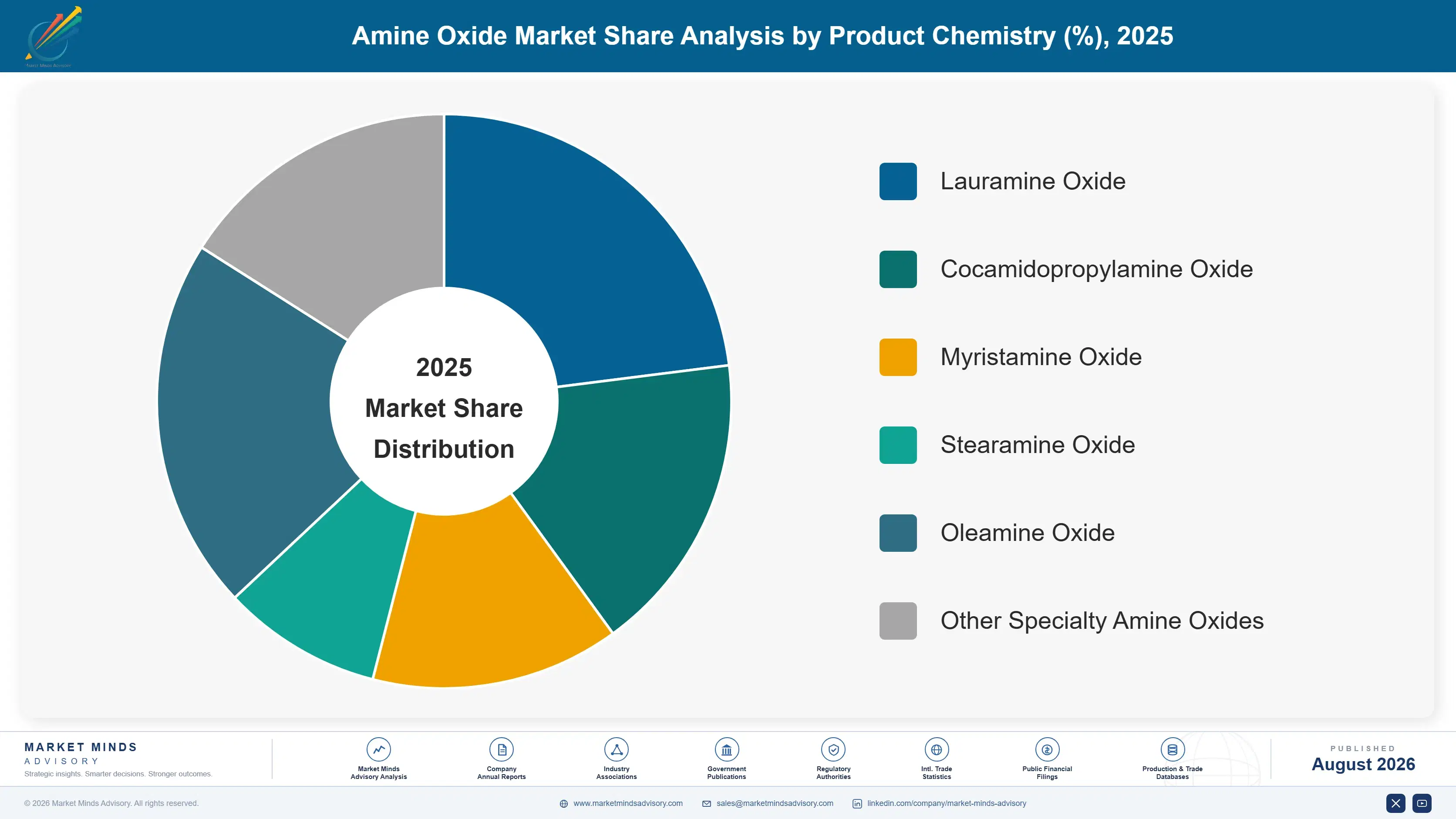
Segmentation follows product chemistry by fatty chain length and source, since chain length directly determines foam performance, mildness profile, and which end-use formulation a given amine oxide grade qualifies for, making it the axis formulators themselves specify against when writing technical requirements into a supplier qualification brief long before any commercial negotiation begins in earnest.
amine-oxide-market-market-share-analysis-1787302467890

Cocamidopropylamine Oxide

Cocamidopropylamine oxide is the fastest-growing segment, pulled forward directly by sulfate-free personal care reformulation across shampoo, body wash, and baby care product lines. Its coconut-derived fatty chain gives it a particularly mild irritation profile that has made it the default replacement co-surfactant wherever brands are removing sodium lauryl sulfate from flagship formulations. Demand has grown fastest in developed markets where retailer sulfate-free listing requirements are most stringent, though emerging-market personal care brands are beginning to follow the same reformulation pattern as regional retailers adopt comparable ingredient policies. Supply is concentrated among producers with coconut oil-derived feedstock access, giving Southeast Asian and Philippine-linked supply chains a durable cost position that pure palm-based competitors cannot easily replicate for this specific grade.
CAGR 8.4%

Myristamine Oxide

Myristamine oxide is the second-fastest-growing segment, valued for an even milder irritation profile than cocamidopropylamine oxide that makes it the preferred choice for baby care and sensitive-skin formulations where regulatory and retailer scrutiny is most intense. Its shorter fatty chain also delivers superior foam density in cold-water formulations, a property that has grown more commercially relevant as household cleaning brands market cold-water-effective dishwashing liquids to reduce household energy consumption. Adoption has been fastest among premium personal care brands willing to absorb a modest cost premium over cocamidopropylamine oxide in exchange for a stronger mildness claim, though household cleaning formulators are increasingly qualifying it as well for their own premium product tiers and export-facing lines.
CAGR 7.6%
Full segment breakdown across 6 segments available in the complete report.

Regional Architecture and Country Demand Map

East Asia leads global production on integrated oleochemical capacity, while North America and Western Europe remain the largest premium personal care formulation markets driving reformulation-linked demand growth, and South Asia and the Pacific is closing the gap fastest of any region tracked in this report.

North America

United States personal care majors headquartered in New Jersey, Ohio, and Illinois drive the bulk of regional demand as they reformulate flagship shampoo and body wash lines away from sulfate-based systems, a shift accelerated by major retailer sulfate-free listing requirements that took effect broadly across 2023 and 2024. Household cleaning brands contribute the second-largest demand pool, specifying amine oxide across dishwashing liquid and an expanding range of surface cleaner formulations facing tightening state-level environmental rules. Canada's smaller but growing personal care manufacturing base follows similar reformulation patterns, generally trailing United States brand decisions by twelve to eighteen months given shared supply chains and overlapping retailer relationships across the border and a largely integrated North American distribution network.
Share: 24% | CAGR: 6.6% (2026 to 2036)

Western Europe

Germany and France anchor regional demand through personal care and household cleaning majors facing the European Union's most stringent cosmetic ingredient disclosure and biodegradability testing requirements, which favor amine oxide's well-documented environmental profile over less-tested alternative surfactant chemistries. The United Kingdom's household cleaning sector has driven steady demand growth as eco-label certification becomes a competitive requirement rather than a marketing differentiator among major retailers stocking premium shelf space across the continent's largest chains. Regional growth trails North America somewhat as the personal care reformulation wave arrived here roughly a year later, though the underlying demand mechanism remains identical across both markets and is expected to converge steadily over the coming several years of forecast.
Share: 20% | CAGR: 4.6% (2026 to 2036)
Regional intelligence for 5 additional markets available in the complete report: East Asia, South Asia and Pacific, Latin America, Middle East and Africa, Eastern Europe. Contact sales@marketmindsadvisory.com.
amine-oxide-market-country-cagr-analysis-1787302468401

Where Amine Oxide Suppliers Can Expand Margin

Delivered price per kilogram no longer captures where the real margin sits in this market. Suppliers are shifting toward formulation support, backward integration, and certification services that create pricing power beyond commodity feedstock economics, and toward regional production strategies that shorten delivery lead times for fast-growing local formulators seeking faster qualification cycles and lower logistics cost.

Formulation Support and Co-Development Services for Brand Customers

Suppliers that embed technical formulation chemists directly with personal care brand development teams win qualification for new product launches earlier and more reliably than those competing purely on delivered price. This co-development model shifts the commercial relationship from transactional purchasing to strategic partnership, and suppliers report qualification win rates roughly 35 percent higher when formulation support is bundled into the account relationship from the earliest development stage. The approach works particularly well for premium and baby care product lines where formulation complexity and regulatory risk both run higher than mass-market categories.
Market Impact: Lifts win rate on new launches by 3

Backward Integration Into Fatty Alcohol Feedstock Production

Producers that own fatty alcohol capacity rather than purchasing it on the open market capture margin at both the feedstock and finished amine oxide stage, insulating them from the price volatility that has repeatedly squeezed non-integrated competitors during palm oil price spikes. Fully integrated producers report gross margins roughly 9 to 14 percentage points higher than amine oxide-only manufacturers purchasing feedstock at spot or contract prices. Several mid-size producers have pursued joint ventures with Southeast Asian oleochemical producers specifically to capture this integration advantage without the capital cost of building feedstock capacity independently.
Market Impact: Adds 9 to 14 points of gross margin

Biodegradability and Eco-Label Certification as a Premium Differentiator

Suppliers that proactively pursue eco-label certifications and publish third-party biodegradability test data ahead of regulatory requirements win premium pricing from brands seeking to accelerate their own sustainability claims without waiting for mandatory compliance deadlines to force the issue. Certified grades command a price premium of roughly 12 percent over uncertified equivalent chemistry in competitive bidding situations, according to buyer-reported procurement data collected across major accounts. The certification investment pays back fastest for suppliers already serving European Union customers, where documentation requirements are most stringent and premium willingness to pay runs highest across the buyer base.
Market Impact: Commands a 12 percent certified equ

Regional Contract Manufacturing to Serve Local Formulators

Establishing local toll manufacturing or contract blending capacity in fast-growing markets like India and Brazil lets suppliers serve domestic formulators without the logistics cost and lead time of importing finished amine oxide, capturing share from importers unable to match local delivery speed on time-sensitive reformulation projects. This approach has proven particularly effective in India, where domestic personal care brands increasingly prefer local supply chains for cost and reliability reasons following recent global shipping disruption that exposed import dependence. Contract manufacturing partners typically capture a service margin of roughly 6 percent on top of standard economics.
Market Impact: Adds an incremental 6 percent regio

Who Controls the Margin Pool

CR5 sits at 41 percent, reflecting a market moderately concentrated among integrated oleochemical majors with global feedstock reach, though a long tail of regional producers competes effectively on price for less differentiated grades. The gap between the top five suppliers and mid-tier challengers is widest in premium personal care grades, where formulation support and regulatory documentation matter more than in commodity household cleaning applications sold largely on delivered price.
Current competitive activity centers on three fronts: backward integration into fatty alcohol feedstock to defend margin against palm oil volatility, formulation co-development partnerships that lock in brand customers ahead of product launches, and biodegradability certification programmes racing to meet tightening European Union and United States disclosure requirements before rivals can establish comparable compliance credibility with the same accounts.

Emerging pressure comes from Southeast Asian and Indian regional producers expanding beyond commodity grades into premium personal care chemistry, threatening share held by established Western and Japanese suppliers on cost grounds alone. Expect ranking shifts wherever regional producers successfully build the formulation support and certification credibility that premium accounts currently require before switching suppliers away from incumbent relationships built over many years.
amine-oxide-market-company-positioning-matrix-1787302468926

Competitive Moat and Risk Dimensions

SOLVAY SA

Moat: Backward-Integrated Fatty Amine Supply

Solvay's ownership of fatty amine and fatty alcohol production capacity gives it a cost and supply security advantage over non-integrated competitors, particularly valuable during the periodic palm and coconut oil price spikes that have repeatedly squeezed margins across the wider amine oxide supplier base over the past several years.
SOLVAY SA

Risk: Feedstock Price Volatility Exposure

Despite its integration, Solvay remains exposed to underlying agricultural commodity price swings that affect its own feedstock production economics, and its scale means feedstock cost movements flow through to reported segment margins more visibly than for smaller, more narrowly focused competitors serving only a single regional market and product category.
EVONIK INDUSTRIES AG

Moat: Personal Care Formulation Expertise

Evonik's deep formulation science capability and long-standing relationships with global personal care brands give it an advantage in winning qualification for new premium product launches, where technical co-development matters more than delivered price alone in the supplier selection process most premium accounts now run before signing any long-term agreement.
EVONIK INDUSTRIES AG

Risk: Environmental Regulatory Scrutiny Risk

Evonik's large exposure to European Union personal care customers means tightening cosmetic ingredient disclosure and biodegradability testing rules create ongoing compliance cost and documentation burden that smaller, less EU-exposed competitors face to a meaningfully lesser degree across their own more geographically concentrated and less regulated customer base overall.

Players Tracked

Prominent Players

Solvay SA
Evonik Industries AG
Clariant AG
Stepan Company
Kao Corporation

Other Key Players

Lonza Group AG
Huntsman Corporation
BASF SE
Croda International Plc
Innospec Inc
Galaxy Surfactants Ltd
KLK OLEO
Oxiteno SA
Zschimmer and Schwarz GmbH
Enaspol AS
Sasol Limited
Nouryon
Taiwan NJC Corporation
Jiangsu Hailian Chemical Corporation
Guangzhou Tinci Materials Technology

Recent Developments

FEBRUARY 2025

Evonik Expands Cocamidopropylamine Oxide Capacity at Essen Facility

Evonik completed a capacity expansion for cocamidopropylamine oxide production at its Essen site, citing sustained demand growth from personal care customers reformulating shampoo and body wash lines away from sulfate-based surfactant systems across European and North American markets served from the facility, with further expansion under active evaluation.
Signal: Confirms a sustained capacity investment c
AUGUST 2025

Galaxy Surfactants Signs Long-Term Fatty Alcohol Supply Agreement with Indonesian Producer

Galaxy Surfactants entered a multi-year supply agreement with an Indonesian oleochemical producer to secure fatty alcohol feedstock for its amine oxide production lines, aiming to reduce exposure to spot market palm oil price volatility that has periodically squeezed margins across the wider industry in recent years.
Signal: Signals a growing supplier preference for
MAY 2025

Stepan Company Achieves Eco-Label Certification Across Full Amine Oxide Product Line

Stepan Company announced its complete amine oxide product portfolio achieved a recognized European eco-label certification, positioning the company to compete more directly for premium personal care and household cleaning accounts prioritizing documented biodegradability credentials in their supplier qualification process going forward across every major regulated market it currently serves.
Signal: Establishes certification as a competitive

Fatty Alcohol Feedstock Cost Exposure

Fatty alcohol derived from palm kernel and coconut oil typically accounts for 52 percent of operating cost of goods sold for amine oxide production, sourced predominantly from Indonesian and Malaysian oleochemical producers with smaller volumes from Philippine coconut oil processors. Ethylene oxide and processing energy add a further 18 percent, rounding out the majority of variable production cost across the industry.
Palm oil prices spiked more than 60 percent within a single year during the 2022 to 2023 period according to industry reporting, driven by Indonesian export policy changes and competing biodiesel mandate demand pulling on the same feedstock pool. The episode forced several amine oxide producers to renegotiate customer contracts mid-term to pass through unhedged feedstock cost increases, straining relationships with personal care customers accustomed to stable annual pricing.

Non-integrated producers purchasing fatty alcohol on the open market carry meaningfully higher margin exposure than backward-integrated competitors who own feedstock capacity, and this gap has widened as integrated majors increasingly favor internal transfer pricing over open market sales during tight supply periods. Geographic exposure also varies: Southeast Asian producers near feedstock sources face lower logistics-driven cost volatility than European and North American buyers importing fatty alcohol across longer supply chains.
amine-oxide-market-cost-volatility-analysis-1787302469124

Long-Term Feedstock Supply Agreements with Southeast Asian Producers

Locking in multi-year fatty alcohol supply contracts directly with Indonesian and Malaysian oleochemical producers removes spot market volatility from production planning and has become close to standard practice among mid-size producers lacking their own feedstock capacity following the 2022 price spike, particularly for producers with limited balance sheet capacity to absorb sudden cost swings.

Backward Integration Into Fatty Alcohol Production Capacity

Larger producers are pursuing joint ventures or direct capacity investment in fatty alcohol production to capture margin at both production stages and reduce dependence on external suppliers during periods of tight feedstock availability across the broader oleochemical supply chain, a strategy that has become increasingly common among the largest global surfactant manufacturers seeking greater cost certainty.

Synthetic Fatty Alcohol Qualification as a Feedstock Hedge

Some producers are qualifying petrochemical-derived synthetic fatty alcohol as a partial feedstock substitute during agricultural commodity price spikes, trading a modest biodegradability disadvantage for reduced exposure to palm and coconut oil price cycles when economics justify the switch, particularly for household cleaning grades facing less stringent certification and disclosure requirements than premium personal care.

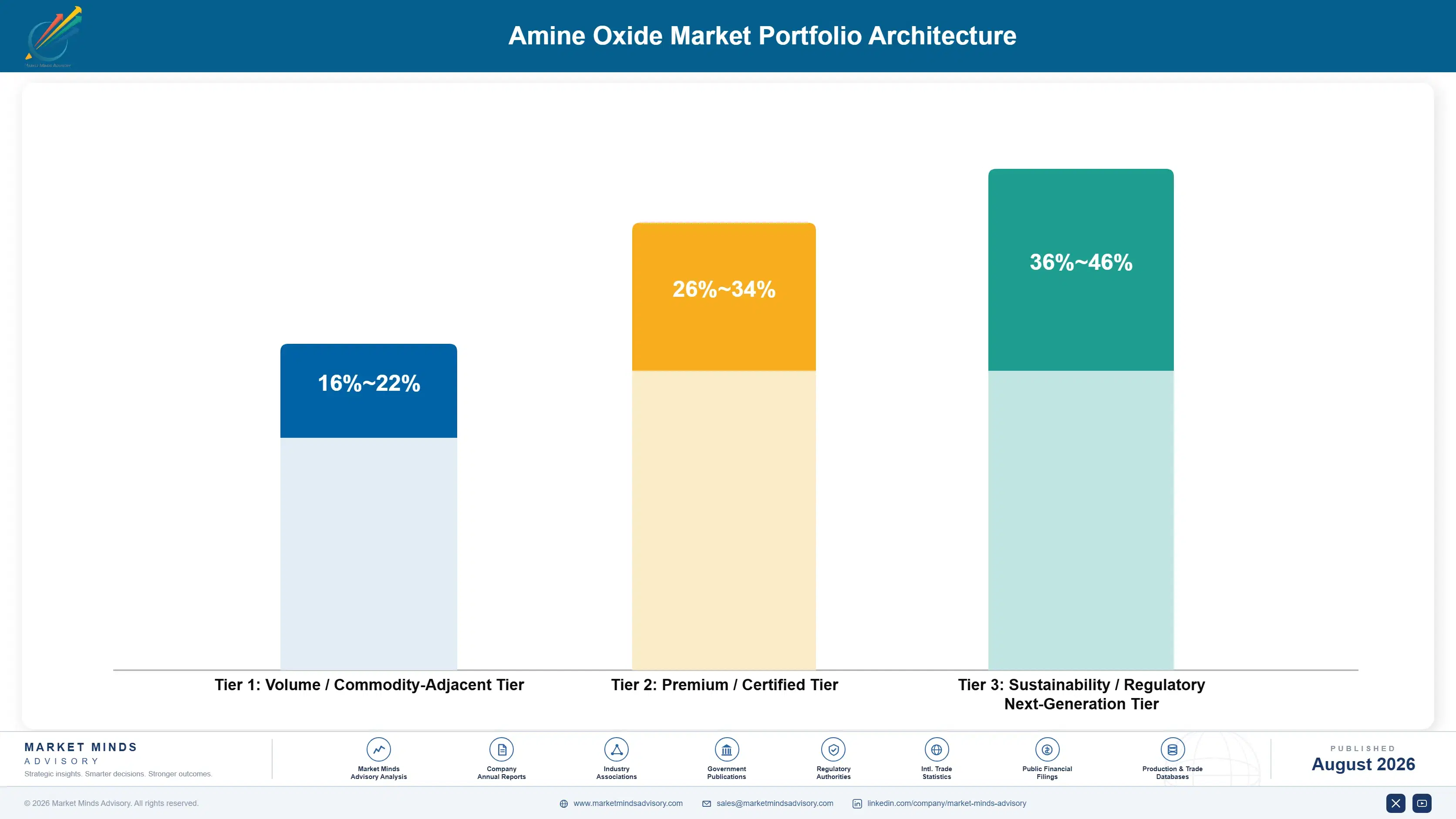
Portfolio Architecture for Margin Defence

Amine oxide portfolios span three tiers with margin economics that track closely to end-use application and certification status. Commodity household cleaning grades compete largely on delivered price per kilogram and carry the thinnest margins, while certified personal care grades with documented biodegradability data command materially higher pricing power tied to formulation support and regulatory documentation depth rather than raw chemistry alone, a distinction buyers increasingly write dir
The volume versus premium tension is sharpest in household cleaning, where large-volume dishwashing liquid formulators remain highly price-sensitive even as regulatory pressure pushes toward higher-documentation grades, forcing suppliers to defend margin through feedstock integration rather than price alone, a pattern that increasingly separates scaled producers from smaller regional competitors lacking comparable balance sheet depth to absorb margin compression during volatile feedstock cycles.

High-value margin pools concentrate in baby care and sensitive-skin personal care grades, and in the formulation co-development services that increasingly accompany premium account relationships rather than standing as a separate revenue line billed independently of the underlying chemistry sale, a bundling trend that is reshaping how suppliers structure commercial proposals across the wider industry today.

Volume / Commodity-Adjacent Tier

Standard household cleaning grade amine oxide sold primarily on delivered price per kilogram to large-volume dishwashing liquid and surface cleaner formulators prioritizing cost above documentation depth across mass-market retail channels.
Gross Margin: 16%-22%

Premium / Certified Tier

Personal care grade amine oxide with documented biodegradability data and eco-label certification serving mainstream shampoo and body wash formulations across major retail channels and growing private label programmes worldwide, including subscription-based direct-to-consumer brands.
Gross Margin: 26%-34%

Sustainability / Regulatory / Next-Generation Tier

Baby care and sensitive-skin grade amine oxide with the most extensive dermatological and environmental documentation commanding the highest pricing power available across the entire product portfolio sold today, particularly through pediatrician-recommended channels.
Gross Margin: 36%-46%
amine-oxide-market-portfolio-architecture-1787302469624

Reformulation-Driven Demand Persistence

Amine oxide demand increasingly resembles a reformulation annuity rather than a one-time chemistry substitution. Once a brand qualifies a supplier's grade for a flagship product line, switching costs from re-testing, re-certification, and consumer requalification keep that relationship intact for years, giving suppliers revenue visibility that commodity surfactant categories rarely provide and that finance teams have begun pricing into supplier contract negotiations across the industry.
Adoption depth varies sharply by vertical. Personal care shows the deepest stickiness, with qualified grades embedded across multiple product lines and rarely displaced once regulatory documentation is complete, while household cleaning shows more price-driven switching behavior as formulators face less regulatory lock-in and more frequent competitive rebidding at contract renewal, particularly among private label manufacturers competing primarily on cost and delivery terms.

Buyer profiles are shifting generationally too. Personal care formulation chemists who once treated amine oxide as a minor foam-boosting ingredient now report to sustainability and regulatory affairs teams evaluating full ingredient lifecycle documentation, elevating supplier selection criteria well beyond simple cost and performance comparison and lengthening the qualification timeline for any new entrant seeking to win premium accounts across major retail categories.
amine-oxide-market-end-use-penetration-index-1787302470113

Where Amine Oxide Demand Is Headed

These are among the four positions where our research anticipates prominent divergence between winners and laggards over the coming forecast period. Each is grounded in the demand model, the regulatory perimeter, and the announced capacity pipeline.
01 / PERSONAL CARE REFORMULATION TRAJECTORY

Sulfate-free will become the default rather than a premium claim

Sulfate-free formulation is moving from a premium marketing differentiator to a baseline retailer listing requirement across developed markets, and that shift will keep pulling amine oxide demand upward through 2036 regardless of any single brand's individual marketing strategy. Mass-market personal care brands still lagging premium competitors on reformulation will face growing retailer pressure to catch up within the next several years. Expect amine oxide penetration in personal care to approach near-universal levels across major developed-market shelf categories well before the end of the forecast period.
02 / FEEDSTOCK INTEGRATION STRATEGY

Backward integration will separate margin winners from laggards

Producers without fatty alcohol feedstock integration will face persistently thinner margins through 2036 as palm and coconut oil price volatility continues periodically squeezing non-integrated competitors harder than integrated majors with owned production capacity. Expect continued consolidation as smaller producers either pursue integration through joint ventures or accept permanently compressed margins relative to scaled competitors able to absorb feedstock cost swings. Southeast Asian producers with proximity to feedstock sources will keep gaining share at the expense of buyers importing fatty alcohol across longer, costlier supply chains through the full forecast period.
03 / REGULATORY DOCUMENTATION BURDEN

Certification cost will keep favoring larger suppliers

Tightening cosmetic ingredient disclosure and biodegradability testing requirements will keep raising the compliance cost floor for competing in premium personal care grades, a burden larger suppliers can amortize across broader product portfolios more easily than smaller regional producers with narrower customer bases. Expect smaller producers to increasingly pool regulatory dossiers through trade associations or exit premium grades entirely in favor of less-regulated household cleaning applications instead. This dynamic will gradually concentrate premium grade share among suppliers already serving the most heavily regulated markets today.
04 / REGIONAL PRODUCTION SHIFT

Southeast Asian capacity will keep gaining share of global output

Indonesian and Malaysian producers will keep expanding their share of global amine oxide and feedstock production through 2036, supported by proximity to palm and coconut oil sources that gives them a durable cost advantage over buyers importing feedstock from other regions. Western and Japanese suppliers will increasingly compete on formulation support and certification credibility rather than production cost alone as this shift continues. Expect several additional joint ventures between global surfactant majors and Southeast Asian oleochemical producers over the next several years.

Engagement Snapshot From the Field

A live engagement with an industry participant carrying material or product regulatory and market exposure ahead of a defining policy shift, showing how our research translates into a defensible multi-year portfolio strategy.
MARKET MINDS ADVISORY · CLIENT ENGAGEMENT SUMMARY
Amine Oxide Producer Strategic Portfolio Review and Transition Roadmap 2026·Investment Scenario on Amine Oxide Exposure Evaluation 2025-26
CLIENT PROFILE
The client is a global personal care brand with flagship shampoo and body wash product lines sold across more than sixty countries, generating reported annual revenue in the surfactant-dependent product category exceeding 1.8 billion dollars (client-reported, unverified by MMA). The brand faced mounting retailer pressure to complete sulfate-free reformulation across its top-selling product lines within an eighteen-month window.
STRATEGIC CHALLENGE
The client needed to identify and qualify amine oxide suppliers capable of matching the foam density and viscosity performance of its existing sulfate-based formulations without triggering consumer-perceptible changes in product experience, while also meeting an aggressive retailer-mandated reformulation timeline across its highest-volume product lines simultaneously and without materially increasing per-unit production cost across the affected portfolio.
MMA APPROACH
MMA conducted a comparative technical and commercial assessment of five qualified amine oxide suppliers, benchmarking formulation support capability, feedstock integration status, and biodegradability documentation completeness against the client's regulatory and performance requirements across its priority markets, supplemented by direct interviews with each supplier's technical service and regulatory affairs teams over several weeks.
KEY FINDINGS
  1. Two of five evaluated suppliers offered integrated fatty alcohol feedstock, reducing projected input cost volatility risk over the full multi-year qualification period.
  2. Formulation co-development support reduced the projected reformulation timeline by approximately four months versus suppliers offering only standard technical service support and no dedicated chemist.
  3. Cocamidopropylamine oxide matched target foam density most closely, requiring the smallest secondary formulation adjustment across the priority product lines evaluated during the assessment.
  4. Certified suppliers commanded a price premium of approximately 11 percent (client-reported, unverified by MMA) versus uncertified equivalent chemistry offered by competing suppliers.
CLIENT PROFILE
The client is a global personal care brand with flagship shampoo and body wash product lines sold across more than sixty countries, generating reported annual revenue in the surfactant-dependent product category exceeding 1.8 billion dollars (client-reported, unverified by MMA). The brand faced mounting retailer pressure to complete sulfate-free reformulation across its top-selling product lines within an eighteen-month window.
STRATEGIC CHALLENGE
The client needed to identify and qualify amine oxide suppliers capable of matching the foam density and viscosity performance of its existing sulfate-based formulations without triggering consumer-perceptible changes in product experience, while also meeting an aggressive retailer-mandated reformulation timeline across its highest-volume product lines simultaneously and without materially increasing per-unit production cost across the affected portfolio.
MMA APPROACH
MMA conducted a comparative technical and commercial assessment of five qualified amine oxide suppliers, benchmarking formulation support capability, feedstock integration status, and biodegradability documentation completeness against the client's regulatory and performance requirements across its priority markets, supplemented by direct interviews with each supplier's technical service and regulatory affairs teams over several weeks.
KEY FINDINGS
  1. Two of five evaluated suppliers offered integrated fatty alcohol feedstock, reducing projected input cost volatility risk over the full multi-year qualification period.
  2. Formulation co-development support reduced the projected reformulation timeline by approximately four months versus suppliers offering only standard technical service support and no dedicated chemist.
  3. Cocamidopropylamine oxide matched target foam density most closely, requiring the smallest secondary formulation adjustment across the priority product lines evaluated during the assessment.
  4. Certified suppliers commanded a price premium of approximately 11 percent (client-reported, unverified by MMA) versus uncertified equivalent chemistry offered by competing suppliers.
RECOMMENDED STRATEGY
Phase 1: Phase 1 (Months 1 to 2): Complete a comparative supplier technical and commercial evaluation using the full co-development readiness framework. Phase 2: Phase 2 (Months 3 to 8): Execute formulation co-development and consumer testing with the two shortlisted suppliers in parallel tracks simultaneously. Phase 3: Phase 3 (Months 9 to 14): Finalize supplier selection and complete phased reformulation rollout across all priority retail markets globally.
OUTCOME
The client selected a dual-supplier strategy combining an integrated Southeast Asian producer for cost-sensitive markets with a European supplier offering deeper formulation support for premium product lines. The reformulation launched four months ahead of the retailer deadline, and the client reported unit cost roughly 7 percent (client-reported, unverified by MMA) below its original budget projection.

Frequently Asked Questions

Foundational context covering the market sizes, CAGR, scope, country, region and competition that inform every finding below. This section is provided to cover basics and most often pre-purchase conversations, answered from the MMA Primary Research Dataset.

What is the current size of the Amine Oxide Market?

The amine oxide market reached an estimated 1.35 billion dollars in base year 2025. Growth is concentrated in personal care reformulation and household cleaning applications across East Asia and North America.

How large will the Amine Oxide Market be by 2036?

MMA projects the market will reach approximately 2.5 billion dollars by 2036 under the base case scenario. That represents nearly a doubling of the 2026 starting value over the forecast decade.

What is the CAGR for the Amine Oxide Market 2026 to 2036?

The base case CAGR is 6.1 percent, with a bull scenario of 7.3 percent and a bear scenario of 4.9 percent. Palm oil feedstock price stability is the largest swing factor between scenarios.

Which segment is growing fastest?

Cocamidopropylamine oxide leads at an 8.4 percent CAGR, pulled forward by sulfate-free personal care reformulation. Myristamine oxide follows as the second-fastest segment at 7.6 percent.

Who are the major companies in the Amine Oxide Market?

Solvay, Evonik Industries, Clariant, Stepan Company, and Kao Corporation lead the market. CR5 sits at 41 percent, reflecting moderate concentration among integrated oleochemical majors with global feedstock reach.

Which country is growing fastest?

India leads at an 8.7 percent CAGR, driven by rising disposable income and expanding modern retail formats stocking sulfate-free products. China remains the largest market by production volume.

Report Segmentation Architecture

The full report scope spans multiple orthogonal segmentation dimensions, with cross-tabulated demand data provided for each dimension pair. Coverage extends further to regional breakdowns, trend trajectories, and the competitive detail needed to support segment-level decision-making.

By Product Chemistry

  • Lauramine Oxide
  • Cocamidopropylamine Oxide
  • Myristamine Oxide
  • Stearamine Oxide
  • Oleamine Oxide
  • Other Specialty Amine Oxides

By End-Use Industry

  • Personal Care
  • Household Cleaning
  • Institutional and Industrial Cleaning
  • Textile Processing
  • Oilfield Chemicals

By Commercial Dimension

  • Direct Brand Supply
  • Formulation Co-Development Contracts
  • Distributor and Toll Manufacturing
  • Certified Premium Grade Supply

By Region

  • North America
  • Western Europe
  • East Asia
  • South Asia and Pacific
  • Latin America
  • Middle East and Africa
  • Eastern Europe

Scope, Methodology, and Coverage

Every figure in this report is reproducible from documented input assumptions. The scope below maps the historical period, the forecast horizon, the segmentation dimensions, and the countries covered, alongside the underlying primary and qualitative methodology.
Historical Period
2020 to 2025
Forecast Period
2026 to 2036
Base Year
2025 (USD billions; MMA Primary Research Dataset, August 2026)
Market Definition
The amine oxide market covers tertiary amine oxide surfactants used as co-surfactants, foam boosters, and viscosity modifiers in personal care, household cleaning, and institutional cleaning formulations. It excludes primary and secondary amine derivatives, quaternary ammonium compounds, and amine oxides used purely as industrial catalysts or textile processing aids outside cleaning and personal care applications.
Quantitative Units
USD billions (current prices); volume in metric tonnes
Segmentation Dimensions
By Product Chemistry; By End-Use Industry; By Commercial Dimension; By Region
Regions Covered
North America, Western Europe, East Asia, South Asia and Pacific, Latin America, Middle East and Africa, Eastern Europe
Countries Covered
USA, China, Germany, France, UK, Japan, South Korea, India, Australia, Canada, Brazil, Mexico, Indonesia, Vietnam, Thailand, Malaysia, UAE, Saudi Arabia, South Africa, Nigeria, Turkey, Poland, Netherlands, Italy, Spain, Sweden, Switzerland, Argentina, Colombia, Singapore, and additional markets relevant to this sector
Key Companies Profiled
Solvay SA, Evonik Industries AG, Clariant AG, Stepan Company, Kao Corporation, Lonza Group AG, Huntsman Corporation, BASF SE, Croda International Plc, Innospec Inc, Galaxy Surfactants Ltd, KLK OLEO, Oxiteno SA, Zschimmer and Schwarz GmbH, Enaspol AS, Sasol Limited, Nouryon, Taiwan NJC Corporation, Jiangsu Hailian Chemical Corporation, Guangzhou Tinci Materials Technology
Quantitative Methodology
Primary survey, n=3,800 respondents, Q4 2025, six countries; demand-side model with trade association cross-validation
Qualitative Methodology
47 expert interviews, Q4 2025; applied to validate demand model assumptions, identify emerging dynamics, and assess competitive positioning
Report Format
PDF and XLSX data workbook (Word format preview document)
Publisher
Market Minds Advisory
Report Code
MMA-2026-CHM-101
Published
August 2026
Contact
sales@marketmindsadvisory.com | www.marketmindsadvisory.com

Purchase the full Amine Oxide Market Report (2026 to 2036).

The full report delivers a complete assessment of the amine oxide market across product chemistry, end-use vertical, and commercial contracting model. It includes detailed competitive profiling of the twenty companies covered here, country-level demand modeling across thirty markets, and forward-looking scenario analysis through 2036. Buyers receive segment-level pricing benchmarks and full access to the underlying primary survey dataset referenced throughout this summary. A dedicated data appendix breaks out regional feedstock cost exposure by producer integration status for portfolio planning purposes, alongside a supplier qualification checklist tailored to personal care and household cleaning formulation teams.
Twenty-company competitive profiles with moat and risk assessments
Country-level demand models across thirty markets
Segment-level pricing benchmarks by product chemistry
Ten-year scenario forecasts with bull and bear cases
Primary survey dataset access for underlying respondent data
Regional feedstock cost exposure appendix by integration status

Built For The People Who Decide

From boardroom strategy to bench-side execution, this report is read cover-to-cover by leaders shaping the next decade of their industry, turning demand scenarios, market dynamics and valuation benchmarks into decisions.
CXOs/ Presidents/ VPs/ Managers
M&A and Corporate Development
Strategy Teams and R&D Heads
Procurement and Product Directors
Regulatory and Compliance Leaders
Investor Relations and Equity Analysts