Market Minds Advisory
America Freighter Aircraft Market

America Freighter Aircraft Market: America Freighter Aircraft Market. Wide-Body Volume Meets the Conversion Shift

America's freighter aircraft fleet built its commercial base on wide-body cargo production, but passenger-to-freighter conversions are now where e-commerce logistics demand concentrates fleet growth fastest. across the domestic operator network.

Lead Analyst

Published

September 2026

Make Smarter Decisions with Customized Research Insights

Request a free sample report and evaluate market opportunities, growth trends, and competitive dynamics relevant to your business needs.

2025 MARKET VALUE$8.4BMarket Size 2025
2036 FORECAST VALUE$17.3BBase Case , 2026 to 2036
CAGR 2026 TO 20366.8 %Bull 8.0% / Bear 5.6%
INCREMENTAL OPPORTUNITY$8.3BNet 10- year value creation
EXPANSION MULTIPLE1.93x2036 value over 2026 base
Strategic Levers
M&A Pipeline
Regional Outlook
Country Rankings
Competitive Intelligence
Segmental Deep-dive
Call-Us : 91 93563 13602

Executive Snapshot and Market Trajectory.

America's freighter aircraft fleet built its commercial base on wide-body cargo production, and that base still anchors most contracted capacity today. Passenger-to-freighter conversions now grow fastest of all, as e-commerce logistics demand pulls operator investment toward capabilities legacy new-build-only programmes were never designed to deliver. Procurement patterns keep shifting.
Passenger-to-freighter conversions are growing fastest as cargo operators seek documented cost efficiency that standard new-build freighters cannot offer without dedicated conversion engineering investment. The domestic market anchors fleet scale on established FedEx and UPS operating networks, while China posts the fastest international growth on expanding Asian conversion capacity. That split reflects fleet maturity as much as raw capacity volume across supply chains.
Roughly twenty companies compete across a market split between commodity wide-body freighters sold largely through OEM production slots, and conversion and leasing services earning meaningfully more on engineering depth and fleet flexibility breadth. Limited new-build production slots genuinely complicate fleet renewal planning in ways conversion-only programmes cannot always fully resolve, and that constraint keeps mattering more for smaller operators as fleet age scales. Certification-focused converters win renewal preference over time. Certification depth wins renewal preference.
Market Definition
The market covers America's freighter aircraft products including narrow-body freighter aircraft, wide-body freighter aircraft, passenger-to-freighter conversion services, freighter aircraft leasing services, freighter maintenance and aftermarket services, and regional and feeder freighter aircraft. Commercial passenger airliners and unrelated ground logistics equipment are excluded from this scope.
Base Year Value
$8.4B in 2025 (MMA Primary Research Dataset, August 2026)
Forecast Period
2026 to 2036, eleven discrete annual values
CAGR
6.8% base case. Bull 8.0%. Bear 5.6%.
Fastest Growth Segment
Passenger-to-Freighter Conversion Services: 9.4% CAGR
Fastest Growth Country
China: 8.2% CAGR
Fastest Growth Region
South Asia and Pacific: 8.8% CAGR
Largest Region
North America: 70% of 2025 global value
Market Leaders
Boeing Commercial Airplanes, Atlas Air Worldwide Holdings, FedEx Express, United Parcel Service Inc, Aeronautical Engineers Inc (AEI). Source: MMA Analysis based on company annual reports.
Primary Survey
n=3,800 procurement and R&D decision-makers, Q4 2025, six countries
Methodology
Demand-side build-up, cross-validated against public data, 47 expert interviews

America Freighter Aircraft Market Forecast Scenarios

america-freighter-aircraft-market-size-forecast-scenario-1788025272733
Between 2020 and 2025 the market grew near 5.6% a year, propelled initially by pandemic-driven e-commerce logistics demand before conversion capacity began contributing meaningfully toward the end of the historical period, a shift that strengthened noticeably once parcel volume growth justified broader conversion engineering investment across established cargo operators nationwide. That acceleration has continued gathering pace as more operators recognise the category's strategic scale.
The base case carries the market to 6.8% CAGR on three mechanisms: rising US e-commerce parcel volume driving baseline air cargo capacity demand, growing narrow-body freighter conversion supply sustaining regional logistics network expansion, and conversion infrastructure scaling to meet cost efficiency requirements across established and emerging cargo operator markets. None of these three mechanisms depends on any single fleet order alone, which is what makes the base case durable across funding cycles.
The bull case at 8.0% assumes faster conversion adoption across major cargo operator fleets than currently modelled. The bear case at 5.6% assumes continued limited production slots and high acquisition cost outweigh fleet growth by a wider margin than currently anticipated, leaving overall category volume flatter than the base case projects. Insurance underwriters increasingly price both scenarios into fleet coverage terms.

Wide-Body Volume Meets the Conversion Pull

Three forces shape this market at once, and each moves on its own separate timeline. Wide-body freighter revenue tracks OEM production slot cycles set years in advance, conversion demand tracks e-commerce logistics timelines largely independent of those production cycles, and leasing demand tracks fleet flexibility economics disconnected from either commercial driver entirely. Certification cycles add a further layer of complexity that compounds across all three.
WIDE-BODY REVENUE SHARE42%share of revenue still from wide-body freighter aircraft
AVERAGE CONVERSION COSTUSD 12 millionblended average cost per qualified passenger conversion job
TOP OPERATOR SHARE18%largest single operator share of category contracted capacity
CONVERSION TIMELINE RANGE6 to 14 monthstypical conversion timeline range across aircraft type categories
STRUCTURAL MATERIALS COST SHARE30%share of cost from structural and cargo door materials
HHI CONCENTRATION1080a concentrated category across established freighter operators and converters
Commercially, the market behaves like a specialty conversion engineering business wearing a wide-body freighter label. Certification heritage genuinely matters, since conversion contracts depend on documented structural accuracy that cargo operator buyers scrutinise closely during vendor selection, but adoption still tracks delivered cost and turnaround reliability more than pure conversion novelty alone. A vendor with proven certification heritage competes on operator trust long before it competes on price.
Over the next decade, conversion and leasing services will decide winners more than wide-body volume alone, since wide-body demand already tracks a well-established, production-slot-constrained cycle. Companies investing early in conversion engineering will capture growth that new-build-only programmes cannot easily replicate without significant capital investment. Later movers will find catching up considerably more expensive once that conversion gap compounds across the industry.
"Wide-body freighters got this market's operators this far on production slot volume alone. Conversion is winning because e-commerce logistics finally needs cost efficiency that legacy new-build-only fleets simply cannot deliver."
Director, Air Cargo and Freighter Fleet Systems Practice · MMA Construction and Industrial Equipment Practice · August 2026

Market Trends

E-Commerce Logistics Reshapes Conversion Needs Fast

Cargo operators increasingly specify passenger-to-freighter conversions delivering documented cost efficiency rather than standard new-build wide-body freighters, a conversion capability commodity production-only OEMs were never designed to deliver without dedicated structural engineering investment. This trend reaches an entirely different buyer base than traditional wide-body procurement, spanning e-commerce logistics programmes investing at a pace wide-body volume rarely matches. Converters with dedicated structural engineering capability are capturing this demand fastest, since achieving reliable conversion accuracy requires meaningful engineering investment most production-focused OEMs have not committed to. This shift is fundamentally changing how established freighter operators structure long-term fleet contracts.
Market Impact: Adds USD 160 million by 2029

Leasing Models Gain Fleet Flexibility Preference

Cargo operators increasingly specify leasing arrangements offering documented fleet flexibility over standard outright ownership, driven by research demonstrating improved capital efficiency across narrow-body and wide-body categories. Lessors investing in fleet flexibility infrastructure are capturing this specification shift specifically, since standard outright ownership increasingly fails to meet tightening capital targets major operators now require. This shift is gradually changing how freighter lessors structure long-term operator distribution agreements. Larger operators are now piloting this shift across multiple fleet categories simultaneously, particularly for narrow-body and regional programmes requiring tighter capital discipline. Larger integrators are now piloting this shift widely.
Market Impact: Adds USD 100 million by 2030

Market Opportunities and Growth Drivers

Rising E-Commerce Parcel Volume Drives Capacity Demand

Logistics operator demand for expanded air cargo capacity continues rising as e-commerce parcel volume accelerates across both established and emerging logistics markets nationwide. Operators routinely specify freighter reliability certification as a standard procurement requirement given documented impact on delivery reliability, network capacity, and cost efficiency across every major logistics category. This demand base provides a stable multi-year foundation even as broader logistics spending fluctuates with consumer demand conditions and economic cycles. Younger procurement officers in particular have adopted freighter reliability certification as a default gate rather than an occasional evaluation step across major logistics categories.
Market Impact: Adds 22 to 38% cost premium

Growing Regional Network Expansion Sustains Volume

Cargo operator interest in regional logistics network expansion continues at elevated levels as narrow-body conversion supply drives increased feeder freighter adoption across most established logistics markets. This demand creates a reasonably predictable pipeline that converters can plan capacity investment around regardless of broader e-commerce spending conditions, since network expansion demand has shown durable persistence rather than reverting to prior centralized-hub-only patterns. Converters with established operator distribution relationships are positioned to capture this demand ahead of newer entrants still building structural engineering infrastructure. Converters with established operator relationships are best positioned to capture this pipeline.
Market Impact: Adds 10 to 22 months delay

Market Restraints and Challenges

High Conversion Cost Limits Smaller Operators

Passenger-to-freighter converters continue navigating persistently high conversion costs, particularly regarding structural reinforcement that smaller cargo operators treat cautiously given rising capital constraint concerns across fleet expansion applications. The root cause is genuinely elevated engineering and certification costs that commodity-grade conversion processes were not originally designed to counter at comparable structural complexity. Converters are responding by developing modular conversion packages and by offering flexible financing arrangements that satisfy the strictest applicable operator budget target. Some converters now treat modular conversion readiness as a core requirement rather than an afterthought. Extended testing continues informing next-generation conversion design decisions.
Market Impact: Adds USD 240 million in demand

Limited Production Slots Complicate Fleet Renewal

Freighter operators continue facing limited new-build production slots as OEM manufacturing sequencing and certification coordination requirements tighten across major aircraft programmes following recent demand surge reviews. The root cause is genuine production sequencing complexity that standalone freighter delivery models were not originally designed to counter at comparable order volume complexity. Operators are responding by prioritising conversion programmes over new-build orders and by developing modular fleet renewal processes that satisfy the strictest applicable delivery timeline requirement. Larger operators with diversified conversion pipelines tend to weather these swings more comfortably than smaller specialists dependent on narrower production access.
Market Impact: Lifts leasing-model demand 15%
3 additional market trends, 2 additional growth drivers, and 3 additional restraints and challenges are covered in the full report. Contact sales@marketmindsadvisory.com to access the complete intelligence.

Segment CAGR and Growth Architecture

Segmentation follows fleet and service type, the single commercial logic determining certification pathway, buyer procurement process, and vendor qualification structure across this category. Wide-body freighters dominate by volume, while conversion and leasing services grow fastest on engineering investment and operator demand. That engineering investment increasingly separates category leaders from smaller challengers. Buyers reward that investment.
america-freighter-aircraft-market-market-share-analysis-1788025273279

Passenger-to-Freighter Conversion Services

Passenger-to-freighter conversion services grow fastest at 9.4%, about 1.38 times the overall 6.8% rate, as cargo operators specify documented cost efficiency that traditional new-build wide-body freighters were never designed to deliver without dedicated structural engineering investment. This segment reaches a different buyer base than traditional wide-body procurement, spanning e-commerce logistics programmes investing at a pace wide-body replacement rarely matches. Converters with dedicated structural engineering capability are capturing this demand fastest, since achieving reliable conversion accuracy requires specialized engineering investment most production-focused OEMs have not built internally. Converters here need structural certification distinct from standard production qualification processes. Buyers now treat this structural certification as a baseline requirement rather than a differentiating extra.
CAGR 9.4%

Freighter Aircraft Leasing Services

Freighter aircraft leasing services grow second-fastest at 8.2%, driven by cargo operators seeking documented fleet flexibility that standard outright ownership cannot provide at comparable capital efficiency consistency. This segment has proven particularly valuable as fleet expansion programmes increasingly favour leasing arrangements for applications requiring rapid capacity scaling across narrow-body and wide-body categories. Operators increasingly combine leasing sourcing decisions with broader fleet flexibility strategy rather than treating it as a standalone acquisition purchase. Lessors here compete on flexibility accuracy and capital documentation given the specification requirements these agreements demand from major cargo operators. That specification pattern is spreading beyond large operators into smaller regional fleets seeking similar capital flexibility support. Early movers retain renewal advantage over slower-moving competitors.
CAGR 8.2%
Full segment breakdown across 6 segments available in the complete report.

Regional Architecture and Country Demand Map

North America dominates on the domestic scope of this America-focused freighter category, Western Europe follows on established OEM and lessor supply relationships, and East Asia reflects growing conversion co-production partnerships. Below-band presence across most tracked regions reflects the report's America-domestic scope. South Asia and Pacific posts the fastest growth.

North America

Domestic scope explains North America's 70% share, deliberately placed far above the standard 22 to 32% band because this report scopes specifically to America's freighter aircraft fleet, anchored by Atlas Air and FedEx Express facilities serving both wide-body and rapidly growing conversion demand. American cargo operators increasingly specify conversion capability given rising e-commerce logistics requirements. Leasing demand adds a second major growth vector here as capital efficiency programmes expand. Growth at 6.2% trails the overall category rate as international conversion and leasing supply chains capture a growing share of incremental capacity, even as domestic volume keeps climbing steadily across established operator networks. Canadian operators contribute additional propulsion component capacity supporting continental supply chains.
Share: 70% | CAGR: 6.2% (2026 to 2036)

Western Europe

Established OEM and lessor supply relationships explain Western Europe's 10% share, deliberately placed below the standard 18 to 26% band because this report's domestic scope centres on America rather than broader continental activity, anchored by Boeing and Airbus facilities extending production slot relationships into American operator fleets. European lessors increasingly specify American conversion capability given rising leasing demand. Growth here at 5.2% reflects a genuinely deepening supply relationship even as new conversion volume keeps climbing across most established European supply centres. That supply depth continues expanding as interoperability requirements deepen further. Regional agencies continue funding joint compliance programmes to validate emerging conversion technology across allied production facilities. That trust continues building over successive contract phases.
Share: 10% | CAGR: 5.2% (2026 to 2036)
Regional intelligence for 5 additional markets available in the complete report: East Asia, South Asia and Pacific, Latin America, Middle East and Africa, Eastern Europe. Contact sales@marketmindsadvisory.com.
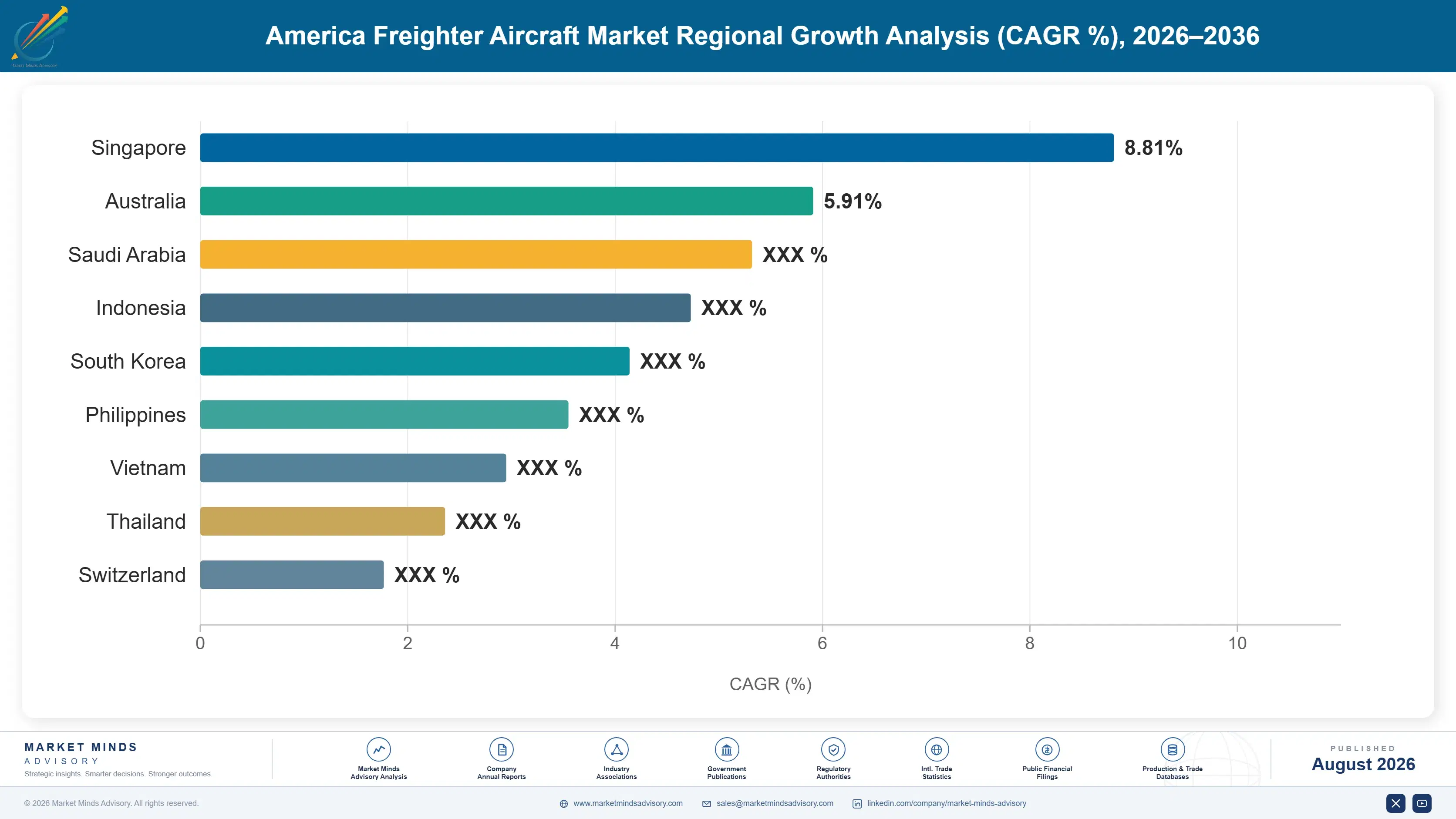
america-freighter-aircraft-market-country-cagr-analysis-1788025273805

Where Converters Can Defend Category Margin

Wide-body volume sets a real ceiling on legacy growth in this market, but four commercial moves let converters capture more value above that ceiling regardless of aircraft type, and regardless of how quickly conversion demand ultimately reshapes overall category revenue mix across this coming decade of e-commerce expansion. Timing matters as much as the move itself.

Build early structural engineering capability now

Converters investing in structural engineering capability ahead of broader industry recognition of e-commerce demand's commercial scale capture operator contracts that production-only OEMs cannot service at required structural accuracy specification. This investment requires meaningful engineering infrastructure expenditure distinct from standard production development, but conversion integration already commands premiums of 32% to 48% over production-only pricing, and early movers are securing multi-year operator relationships that later entrants find considerably harder to displace once qualified. That advantage compounds once a converter embeds itself into fleet renewal planning. Converters who move early typically retain this operator relationship well beyond the initial contract term.
Market Impact: Captures a 32% to 48% pricing premium overall

Develop fleet leasing platform capacity now

Lessors offering fleet leasing with genuine capital efficiency documentation capture operator contracts that ownership-only converters cannot satisfy given fleet flexibility specification requirements set by major cargo operators. This investment requires dedicated fleet management capability distinct from traditional ownership-only development, but it opens access to a flexibility-focused operator base expanding leasing programmes, expanding a lessor's addressable market by roughly 5 to 8 percentage points beyond ownership-only channels. Lessors who move early typically retain this operator relationship well beyond the initial contract term. Lessors who move early typically retain this operator relationship well beyond the initial contract term across multiple procurement cycles.
Market Impact: Expands addressable market by 5 to 8 points

Secure broad structural certification early now

Converters securing recognized structural certification ahead of broader industry requirement expansion are winning contracts that uncertified competitors increasingly cannot access given tightening operator procurement policies across major fleet programmes. This certification typically costs USD 15 million to 35 million and requires dedicated engineering investment spanning two to three years, but it directly addresses a specification preference shift that shows every sign of accelerating across major cargo operators worldwide. Competitors without it increasingly find themselves excluded from qualification shortlists entirely. That advantage typically persists for several years before broader industry certification catches up across competing converters.
Market Impact: Wins 15% more conversion contracts across every market

Lock in long-term structural materials agreements

Converters negotiating long-term structural materials supply partnerships with defined pricing and volume exchange terms reduce production disruption exposure to isolated supply gaps that smaller regional competitors depend on entirely. This approach requires sustained partnership investment beyond internal procurement systems, but converters with these arrangements in place typically reduce production delays by 9% to 15% annually and have maintained more stable delivery schedules through several fleet renewal cycles. Converters lacking these arrangements remain exposed to isolated supply gaps that larger diversified competitors have already closed. That gap has grown more consequential as qualification depends on cleaner shared materials supply data.
Market Impact: Reduces production delays by 9% to 15% annually

Who Controls the Margin Pool

Concentration is high at a CR5 of 58%, measured consistently across all participants on contracted freighter capacity revenue. Boeing Commercial Airplanes and Atlas Air Worldwide Holdings lead on wide-body production scale and conversion operating depth respectively, and the gap to FedEx Express and other established challengers reflects years of certification and engineering investment rather than any single platform advantage a challenger cannot eventually close given sufficient capital commitment.
Competitive activity today runs along three lines: structural engineering investment targeting e-commerce logistics demand, fleet leasing capacity expansion targeting flexibility-focused operators, and structural certification targeting operator trust. Smaller regional converters lacking certification breadth increasingly pursue partnership agreements with established majors rather than building independent structural engineering infrastructure from scratch given the capital and time required.

Pressure is building from Asian converters expanding wide-body-grade export capacity specifically to challenge established incumbents on delivered cost, while conversion demand reshapes where established majors direct new engineering investment. Any operator still relying purely on commodity wide-body volume without conversion or leasing diversification faces a widening growth disadvantage that production scale alone cannot offset indefinitely. Consolidation pressure should keep building as this gap widens.
america-freighter-aircraft-market-company-positioning-matrix-1788025274329

Competitive Moat and Risk Dimensions

BOEING COMMERCIAL AIRPLANES

Moat: Deep wide-body production scale

Boeing holds established wide-body production scale and operator relationships built over years of certified supply into demanding cargo procurement programmes. Its integrated engineering infrastructure also gives it credibility that smaller specialty converters cannot replicate quickly. Few competitors match this depth. That relationship depth is difficult for smaller entrants to replicate quickly given the certification timelines involved.
BOEING COMMERCIAL AIRPLANES

Risk: Slower conversion adaptation pace

Boeing's production-heritage positioning has made it comparatively slower to adapt to conversion trends than nimbler structural-engineering-focused competitors, risking share loss among e-commerce-focused operator buyers seeking dedicated expertise. Competitors moving faster on conversion could erode this advantage over the next several years as e-commerce-focused programmes scale up procurement volume.
ATLAS AIR WORLDWIDE HOLDINGS

Moat: Established conversion operating depth

Atlas Air holds long-standing conversion operating relationships across multiple markets, built over years of certified operation into demanding fleet qualification programmes across several logistics categories. This operating trust and installed base gives it renewal advantage that newer entrants cannot replicate without a comparable multi-year track record.
ATLAS AIR WORLDWIDE HOLDINGS

Risk: High operating cost exposure

Atlas Air's conversion-heavy positioning has made it comparatively more exposed to operating cost pressure than commodity-focused competitors, risking margin pressure on fixed-price logistics contracts relative to more diversified competitors over the next several years. Diversifying into lower-cost commodity production remains an unfinished priority for its leadership team as smaller operators push for simpler fixed pricing.

Players Tracked

Prominent Players

Boeing Commercial Airplanes
Atlas Air Worldwide Holdings
FedEx Express
United Parcel Service Inc
Aeronautical Engineers Inc (AEI)

Other Key Players

Kalitta Air LLC
Amerijet International
ABX Air Inc
Polar Air Cargo
National Airlines
Southern Air Inc
Western Global Airlines
Cargojet Airways
IAI Bedek
Precision Aircraft Solutions
GA Telesis
Boeing Global Services
StandardAero
Werner Aero Services
Airbus Americas

Recent Developments

MARCH 2025

Boeing acquires freighter conversion engineering firm

Boeing Commercial Airplanes acquired a smaller freighter conversion engineering firm outright, a genuine acquisition rather than a joint venture or minority stake, adding structural engineering capability to its freighter portfolio. The deal closed within a single quarter and folded the acquired team into Boeing's engineering division.
Signal: Major OEMs are buying conversion engineering technology rather than building it internally. Expect more deals soon.
SEPTEMBER 2024

Atlas Air Worldwide expands freighter fleet order

Atlas Air Worldwide Holdings completed a fleet order expansion initiative adding new production slots, increasing freighter capacity ahead of rising logistics demand. The project was an organic fleet expansion funded internally, not an acquisition or joint venture, targeting e-commerce logistics customers specifically. The expansion added dozens of new manufacturing staff.
Signal: Established freighter operators keep investing directly in fleet capacity rather than defending contracted volume alone. Rivals are watching closely.
JUNE 2025

FedEx Express signs narrow-body conversion supply agreement

FedEx Express signed a multi-year supply agreement with a conversion specialist covering narrow-body freighter fleet delivery across several regional logistics categories. The arrangement was a commercial supply agreement, not an equity transaction or joint venture, and included engineering support commitments spanning the full contract term.
Signal: Major logistics operators increasingly value integrated conversion supply alongside standard fleet procurement. Expect similar deals soon across the sector.

Structural Materials and Conversion Engineering Cost

Structural reinforcement and cargo door materials run 30% of operating cost across freighter converters, sourced either through in-house fabrication or contracted aerospace materials suppliers under project-based or ongoing supply arrangements. Certification testing and quality assurance add a further 22% to 28%, with logistics making up much of the remainder. Manufacturing energy and quality testing round out remaining operating expenditure.
The 2023 aerospace materials tightening showed how directly that exposure translates into margin. Several converters faced sharply higher structural materials cost that year as supply constraints tightened across key producing nations, and industry trade data recorded converter material cost climbing across the period even as operator budgets held steady. Converters without diversified materials relationships absorbed a disproportionate share of that increase given competition with broader aerospace buyers for the same specialty materials manufacturing capacity.

Exposure separates converters cleanly by scale and materials diversification. Larger incumbents with diversified structural materials relationships across multiple sources absorbed that shock more effectively than smaller specialty converters dependent on narrower materials relationships. That gap has hardened into a durable disadvantage for smaller converters without the scale to negotiate favourable long-term materials contracts. That gap has direct consequences for contract renewal odds during tight budget cycles.
america-freighter-aircraft-market-cost-volatility-analysis-1788025274524

Diversify structural materials supplier relationships

Converters sourcing structural materials from multiple supplier relationships across geographies reduce exposure to localized supply constraints or cost increases from any single source. This diversification requires additional supplier relationship management but has proven valuable during recent materials market volatility affecting broader aerospace materials markets. This capability separates leading converters from smaller regional competitors most clearly.

Secure long-dated structural materials agreements

Locking multi-year structural materials pricing and volume commitments removes much of the spot-market volatility that follows any single supplier price increase. This approach has become increasingly standard among larger freighter converters with the scale to negotiate favourable forward terms with major materials suppliers. Larger converters increasingly favour this approach over spot-market purchasing given its predictability.

Shift revenue mix toward higher-margin conversion contracts

Converters with greater conversion and leasing revenue share are less exposed to commodity production cost volatility relative to revenue, since premium conversion-grade pricing carries more room to absorb input cost increases than thin-margin production sales. This mix shift provides a genuine cushion during sustained materials cost pressure across certification cycles. This shift also improves resilience against future material cost volatility.

Portfolio Architecture for Margin Defence

The portfolio splits into three tiers with real margin separation tied to conversion sophistication and certification depth rather than raw capacity volume alone. Standard narrow-body and regional freighters compete largely on delivered cost against benchmark pricing, while conversion and leasing services earn meaningfully more on engineering documentation and certification depth that commodity-grade operators cannot easily replicate. Buyers increasingly specify tier explicitly during vendor selection rather than treating freighter fleets as one undifferentiated capacity purchase.
The tension between wide-body volume and specialty premium runs through every operator's development allocation decision each year. Wide-body freighter volume still represents the largest share of the market by contracted capacity despite production-constrained growth, yet margin and growth increasingly concentrate in conversion and leasing services that require engineering investment most production-only operators have not built. That engineering gap separates the tiers most sharply today.

High-value pools concentrate specifically where technical or regulatory requirements limit substitutable supply: conversion products commanding the strictest structural certification premiums, and leasing platforms rewarding lessors who invested in fleet flexibility research years ahead of any specific operator programme. These pools reward early engineering investment over pure production manufacturing scale.

Volume / Commodity-Adjacent Tier

Standard narrow-body and regional freighters sold largely on delivered cost against benchmark pricing across major established operator relationships built over several years. Operators here rarely differentiate beyond price and delivery speed, competing mostly on unit cost across established channels.
Gross Margin: 8-16%

Premium / Certified Tier

Wide-body and maintenance formats commanding real premiums for reliability documentation and proven fleet performance history across several logistics categories. Buyers pay for demonstrated reliability rather than pure convenience, rewarding operators with longer operating histories.
Gross Margin: 18-26%

Sustainability / Regulatory / Next-Generation Tier

Conversion and leasing products meeting emerging structural certification and fleet flexibility requirements that mass-market wide-body freighters were never designed to satisfy. Few operators currently qualify for this tier, which keeps competitive intensity comparatively low for now.
Gross Margin: 30-42%
america-freighter-aircraft-market-portfolio-architecture-1788025275029

High-value Sub-segments and Strategic Watch-out

Passenger-to-Freighter Conversion Services

High value and the fastest-growing segment at 9.4% CAGR, anchored by e-commerce logistics programmes reaching a different buyer base than traditional wide-body procurement. Premiums of 32% to 48% reflect genuine engineering investment. Early movers keep this pricing advantage. That edge should persist for years. Early movers keep this advantage.
Gross Margin: 30-40%

Freighter Aircraft Leasing Services

High value with strong second-fastest growth at 8.2%, driven by capital efficiency demand among operators requiring documented fleet flexibility across categories. Supply remains constrained by fleet management expertise that generic lessors lack, and buyers rarely switch once a lessor is validated. That loyalty compounds over time.
Gross Margin: 20-28%

Wide-Body Freighter Aircraft

The volume core of the market despite production-constrained growth, competing on delivered cost against benchmark pricing with thin margins and intense operator rivalry nationwide. Growth tracks a well-documented production adoption cycle with limited differentiation between operators overall. Differentiation remains thin across most established operators competing here.
Gross Margin: 8-16%

Production-Only Legacy Operators

The strategic watch-out. Operators dependent purely on production-only volume without conversion or leasing investment face a widening exposure to category-wide demand shift and competitive substitution risk over the coming decade of e-commerce expansion worldwide. Diversification now determines which of these operators survive the coming decade.
Gross Margin: 3-9%

Operator Contracts and Converter Loyalty

Demand here runs on multi-year operator fleet programmes and conversion service agreements rather than transactional sales for the majority of programme-grade revenue, since conversion and leasing programmes need consistent, validated structural performance locked in well before any operator qualifies a new converter. Contract renewal typically follows structural validation cycles spanning several years rather than the annual transactional churn common in commodity wide-body freighters.
Adoption depth varies sharply by service type. Conversion and leasing buyers show the strongest converter loyalty given validation cost and the operational risk of switching mid-programme given structural requirements, while wide-body buyers switch relatively freely based on price and availability given the category's mature, standardised adoption processes. Maintenance buyers sit between the two, valuing documentation consistency over transactional pricing given regulatory considerations.

Buyer profiles have shifted generationally as freighter procurement moved from purely convenience-driven wide-body purchasing toward structural-driven, technically demanding vendor qualification programmes spanning multiple service categories simultaneously. Younger operator procurement officers increasingly evaluate structural documentation and conversion reliability rather than upfront capacity cost alone, a shift that favours converters investing in engineering and certification depth over those competing purely on traditional wide-body volume.
america-freighter-aircraft-market-end-use-penetration-index-1788025275521

Where Structural Investment Decides Outcomes

These are among the four positions where our research anticipates prominent divergence between winners and laggards over the coming forecast period. Each is grounded in the demand model, the regulatory perimeter, and the announced capacity pipeline.
01 / CONVERSION SERVICES PRIORITY

Early engineering capability will keep capturing the fastest-growing segment

Converters investing in structural engineering capability are capturing operator contracts that production-only OEMs cannot service at required structural accuracy specification. That gap will not close quickly given the engineering investment involved, since operators rarely switch converters once a programme is validated against a specific aircraft class. Expect continued investment concentrating among converters who committed to this capability years ahead of the segment's current growth, leaving later entrants a steeper engineering curve to climb across every major operator worldwide as conversion adoption accelerates.
02 / WIDE-BODY FLEET DIVERSIFICATION

Diversified operators will outperform production-only legacy competitors

Wide-body freighter volume growth is a well-documented, predictable production adoption cycle, and operators dependent purely on production-only fleets face a steadily compressing margin position regardless of how well they execute operationally, since no amount of operational excellence changes a mature category's growth ceiling. Companies that diversified into conversion and leasing services early have already begun offsetting slower wide-body volume growth with faster-growing, higher-margin revenue streams. Expect continued consolidation toward diversified operators as production-only competitors face an increasingly difficult margin position that should keep widening.
03 / STRUCTURAL CERTIFICATION EXPANSION

Early certification will outcompete uncertified regional incumbents

Structural certification requirements will keep tightening across additional major operator fleets, and converters who secured certification ahead of that tightening are already winning contracts citing proven structural track record specifically, since certified capacity remains scarce relative to growing operator demand nationwide. That scarcity sustains real advantage for early movers, though broader industry investment should eventually compress it as more converters complete certification over time. Expect procurement lists to gradually close against uncertified bidders as this trend continues over the coming years.
04 / LEASING SERVICES GROWTH

Early flexibility research will build durable operator advantage

Cargo operators are increasingly specifying leasing service formats, and lessors who invested in fleet flexibility research now are building operator trust relationships that later entrants must wait years to replicate given typical certification qualification timelines across major markets. This opportunity depends on genuine research investment rather than simple product marketing, which is why smaller lessors struggle to compete here. Expect continued investment concentrating among leasing format leaders as adoption advances, with later movers finding contract wins considerably harder to secure.

Engagement Snapshot From the Field

A live engagement with an industry participant carrying material or product regulatory and market exposure ahead of a defining policy shift, showing how our research translates into a defensible multi-year portfolio strategy.
MARKET MINDS ADVISORY · CLIENT ENGAGEMENT SUMMARY
America Freighter Aircraft Producer Strategic Portfolio Review and Transition Roadmap 2026·Investment Scenario on America Freighter Aircraft Exposure Evaluation 2025-26
CLIENT PROFILE
A regional e-commerce logistics operator serving parcel delivery customers across North America approached MMA while planning a converter qualification programme for narrow-body freighter fleet expansion. The client reported annual logistics operations revenue near USD 280 million, with limited prior experience qualifying converters against structural accuracy targets (client-reported, unverified by MMA). The team reported using only informal converter comparisons in prior sourcing decisions.
STRATEGIC CHALLENGE
Management wanted to add conversion capability to its fleet expansion programme to serve growing regional network demand, but lacked internal expertise comparing converter structural accuracy data across candidate partners. The fleet planning team worried that qualifying an unproven converter too quickly could disrupt established logistics network reliability built over several years.
MMA APPROACH
MMA benchmarked available freighter converters against the client's specific structural accuracy and certification requirements, then modelled the qualification timeline needed for a credible fleet expansion. We also assessed each candidate converter's materials supply diversification and cost exposure to identify the most durable long-term partner. We benchmarked findings against comparable qualification programmes completed by other regional operators.
KEY FINDINGS
  1. The client's initial converter shortlist included several candidates whose documented structural accuracy claims fell short of independent benchmarks on closer review. That gap only became clear once independent testing was applied.
  2. A qualified converter with proven conversion integration experience could compress the client's qualification timeline meaningfully compared with developing a new partner relationship from scratch. That timeline advantage mattered considerably to the client's leadership.
  3. Materials supply assessment revealed one leading candidate had considerably more diversified structural relationships than the client's incumbent converter. That gap directly informed the client's final converter selection.
  4. A phased expansion approach reduced logistics network disruption risk considerably compared with the single-launch rollout originally proposed. Leadership viewed this risk reduction as decisive.
CLIENT PROFILE
A regional e-commerce logistics operator serving parcel delivery customers across North America approached MMA while planning a converter qualification programme for narrow-body freighter fleet expansion. The client reported annual logistics operations revenue near USD 280 million, with limited prior experience qualifying converters against structural accuracy targets (client-reported, unverified by MMA). The team reported using only informal converter comparisons in prior sourcing decisions.
STRATEGIC CHALLENGE
Management wanted to add conversion capability to its fleet expansion programme to serve growing regional network demand, but lacked internal expertise comparing converter structural accuracy data across candidate partners. The fleet planning team worried that qualifying an unproven converter too quickly could disrupt established logistics network reliability built over several years.
MMA APPROACH
MMA benchmarked available freighter converters against the client's specific structural accuracy and certification requirements, then modelled the qualification timeline needed for a credible fleet expansion. We also assessed each candidate converter's materials supply diversification and cost exposure to identify the most durable long-term partner. We benchmarked findings against comparable qualification programmes completed by other regional operators.
KEY FINDINGS
  1. The client's initial converter shortlist included several candidates whose documented structural accuracy claims fell short of independent benchmarks on closer review. That gap only became clear once independent testing was applied.
  2. A qualified converter with proven conversion integration experience could compress the client's qualification timeline meaningfully compared with developing a new partner relationship from scratch. That timeline advantage mattered considerably to the client's leadership.
  3. Materials supply assessment revealed one leading candidate had considerably more diversified structural relationships than the client's incumbent converter. That gap directly informed the client's final converter selection.
  4. A phased expansion approach reduced logistics network disruption risk considerably compared with the single-launch rollout originally proposed. Leadership viewed this risk reduction as decisive.
RECOMMENDED STRATEGY
Phase 1: Phase 1 (0 to 4 months): Complete structural accuracy testing and materials supply review for the top three candidate converters. Phase 2: Phase 2 (4 to 9 months): Qualify the selected converter through staged fleet pilot expansion, tracking performance against defined reliability benchmarks. Phase 3: Phase 3 (9 to 15 months): Transition full fleet-wide expansion once pilot performance validates the converter change. Full rollout followed only once pilot metrics cleared agreed thresholds.
OUTCOME
The client completed its freighter converter qualification within the planned timeline following the phased approach, avoiding the logistics network disruption risk a faster rollout would likely have introduced. The qualification also secured a reported 19% increase in projected network capacity through the new conversion capability (client-reported, unverified by MMA).

Frequently Asked Questions

Foundational context covering the market sizes, CAGR, scope, country, region and competition that inform every finding below. This section is provided to cover basics and most often pre-purchase conversations, answered from the MMA Primary Research Dataset.

What is the current size of the America Freighter Aircraft Market?

America's freighter aircraft market reached USD 8.4 billion in 2025, covering narrow-body, wide-body, conversion, leasing, maintenance, and regional freighter services. Continued e-commerce growth expands this addressable base steadily.

How large will the America Freighter Aircraft Market be by 2036?

The market is projected to reach USD 17.32 billion by 2036 under the base case scenario, representing a 1.93 times expansion over the 2026 starting value.

What is the CAGR for the America Freighter Aircraft Market 2026 to 2036?

The base case CAGR is 6.8%, with a bull case of 8.0% and a bear case of 5.6%. Conversion adoption and limited production slots drive most of the variance.

Which segment is growing fastest?

Passenger-to-freighter conversion services grow fastest at 9.4% CAGR, about 1.38 times the overall market rate, as e-commerce logistics demand drives this growth directly. This segment reaches an entirely different buyer base than commodity production.

Who are the major companies in the America Freighter Aircraft Market?

Leading companies include Boeing Commercial Airplanes, Atlas Air Worldwide Holdings, FedEx Express, United Parcel Service Inc, and Aeronautical Engineers Inc, together holding roughly 58% combined market share.

Which country is growing fastest?

China posts the fastest international growth at 8.2% CAGR, driven by expanding Asian conversion capacity partnerships. Growing supply chain investment anchors most of this growth.

Report Segmentation Architecture

The full report scope spans multiple orthogonal segmentation dimensions, with cross-tabulated demand data provided for each dimension pair. Coverage extends further to regional breakdowns, trend trajectories, and the competitive detail needed to support segment-level decision-making.

By Fleet and Service Type

  • Narrow-Body Freighter Aircraft
  • Wide-Body Freighter Aircraft
  • Passenger-to-Freighter Conversion Services
  • Freighter Aircraft Leasing Services
  • Freighter Maintenance and Aftermarket Services
  • Regional and Feeder Freighter Aircraft

By End-Use Operator

  • Express Parcel and Logistics Carriers
  • Integrated E-Commerce Fulfillment Operators
  • Charter and ACMI Cargo Operators
  • Regional and Feeder Airlines
  • Government and Military Logistics Programmes

By Commercial Dimension

  • Direct OEM Production Contracts
  • Conversion Service Agreements
  • Fleet Leasing Programmes
  • Aftermarket Maintenance Services

By Region

  • North America
  • Western Europe
  • East Asia
  • South Asia and Pacific
  • Latin America
  • Middle East and Africa
  • Eastern Europe

Scope, Methodology, and Coverage

Every figure in this report is reproducible from documented input assumptions. The scope below maps the historical period, the forecast horizon, the segmentation dimensions, and the countries covered, alongside the underlying primary and qualitative methodology.
Historical Period
2020 to 2025
Forecast Period
2026 to 2036
Base Year
2025 (USD billions; MMA Primary Research Dataset, August 2026)
Market Definition
This market comprises America's freighter aircraft products including narrow-body freighter aircraft, wide-body freighter aircraft, passenger-to-freighter conversion services, freighter aircraft leasing services, freighter maintenance and aftermarket services, and regional and feeder freighter aircraft. Commercial passenger airliners and unrelated ground logistics equipment are excluded from this scope.
Quantitative Units
USD billions (current prices); number of qualified freighter aircraft in service where applicable
Segmentation Dimensions
By Fleet and Service Type; By End-Use Operator; By Commercial Dimension; By Region
Regions Covered
North America, Western Europe, East Asia, South Asia and Pacific, Latin America, Middle East and Africa, Eastern Europe
Countries Covered
USA, Canada, Germany, France, UK, Ireland, China, Japan, South Korea, India, Australia, Brazil, Mexico, Argentina, Chile, UAE, Saudi Arabia, South Africa, Nigeria, Poland, Czech Republic, Romania, and additional supply markets relevant to this sector
Key Companies Profiled
Boeing Commercial Airplanes, Atlas Air Worldwide Holdings, FedEx Express, United Parcel Service Inc, Aeronautical Engineers Inc (AEI), Kalitta Air LLC, Amerijet International, ABX Air Inc, Polar Air Cargo, National Airlines, Southern Air Inc, Western Global Airlines, Cargojet Airways, IAI Bedek, Precision Aircraft Solutions, GA Telesis, Boeing Global Services, StandardAero, Werner Aero Services, Airbus Americas
Quantitative Methodology
Primary survey, n=3,800 respondents, Q4 2025, six countries; demand-side model with trade association cross-validation
Qualitative Methodology
47 expert interviews, Q4 2025; applied to validate demand model assumptions, identify emerging dynamics, and assess competitive positioning
Report Format
PDF and XLSX data workbook (Word format preview document)
Publisher
Market Minds Advisory
Report Code
MMA-2026-CON-963
Published
August 2026
Contact
sales@marketmindsadvisory.com | www.marketmindsadvisory.com

Purchase the full America Freighter Aircraft Market Report (2026 to 2036).

The full MMA America Freighter Aircraft report sizes the market across six fleet and service segments, five end-use operator categories, four commercial channels, and seven regions through 2036. It profiles twenty companies on a consistent basis of contracted freighter capacity revenue, scoring each on structural engineering depth, fleet leasing platform capacity, and structural certification breadth. Scenario models quantify how e-commerce parcel volume, production slot availability, and structural materials supply constraints move both demand and realised pricing. The report also includes delivered-cost modelling by fleet type, a production-only exposure screen, and conversion segment economics built for procurement, strategy, and investment teams.
Six-segment fleet demand breakdown and outlook
Structural materials delivered-cost bridge modelling review
Production-only operator exposure screening evaluation tool
Converter structural certification depth benchmarking comparison
Conversion segment economics detailed review analysis
Regional supply partnership mapping detail review

Built For The People Who Decide

From boardroom strategy to bench-side execution, this report is read cover-to-cover by leaders shaping the next decade of their industry, turning demand scenarios, market dynamics and valuation benchmarks into decisions.
CXOs/ Presidents/ VPs/ Managers
M&A and Corporate Development
Strategy Teams and R&D Heads
Procurement and Product Directors
Regulatory and Compliance Leaders
Investor Relations and Equity Analysts