Market Minds Advisory
AMEA Nanotech Photocatalysis Coatings Market

AMEA Nanotech Photocatalysis Coatings Market: Titania-Based Functional Surfaces Across Asia, Middle East and Africa, 2026 to 2036

A coating that breaks down pollution using daylight sells well where air quality rules exist and barely at all where they do not, which makes this a regulatory market wearing a technology label.

Lead Analyst

Bilal Shaikh

Published

September 2026

Make Smarter Decisions with Customized Research Insights

Request a free sample report and evaluate market opportunities, growth trends, and competitive dynamics relevant to your business needs.

2025 MARKET VALUE$1.4BMarket Size 2025
2036 FORECAST VALUE$4.2BBase Case , 2026 to 2036
CAGR 2026 TO 203610.6 %Bull 11.9% / Bear 9.4%
INCREMENTAL OPPORTUNITY$2.7BNet 10- year value creation
EXPANSION MULTIPLE2.74x2036 value over 2026 base
Strategic Levers
M&A Pipeline
Regional Outlook
Country Rankings
Competitive Intelligence
Segmental Deep-dive
Call-Us : 91 93563 13602

Executive Snapshot and Market Trajectory

Photocatalytic coatings have a physics problem that dictates their commercial history. Conventional anatase titania needs ultraviolet light below 387 nanometres to activate, which is roughly 4% of daylight and almost none of what falls on an indoor wall. Everything commercially interesting here follows from attempts to fix that limitation.
Growth concentrates in visible-light-active doped titania, expanding at 15.9%, where nitrogen, tungsten or copper doping shifts activation into the visible spectrum and opens interior surfaces, tunnels and shaded facades that ultraviolet-dependent formulations never served. East Asia holds 52% of value within this regionally scoped market, since Japan commercialised the technology and China now applies it at a scale driven by urban air quality programmes rather than by any architectural preference.
The supplier base is moderately concentrated, with the top five holding 38% of coating volume supplied, and it splits between photocatalyst producers who sell active material and paint companies who formulate and apply it. Competition runs on demonstrated performance under local testing standards rather than on formulation chemistry. Air quality regulation and green building certification decide where this market grows and where it simply does not.
Market Definition
The market comprises functional coatings incorporating photocatalytic nanomaterials, principally titanium dioxide and doped or composite derivatives, applied to building facades, interior surfaces, road infrastructure, glass and industrial substrates across Asia, the Middle East and Africa. Sizing captures formulated coating revenue at realised delivered price, spanning visible-light-active doped titania, composite and hybrid photocatalyst systems, anatase sol-gel coatings, nanoparticle dispersion coatings and cementitious photocatalytic formulations. Photocatalyst powders sold as raw material, self-cleaning glass manufactured with integral coatings, air purification equipment, water treatment photocatalysis and conventional architectural paint fall outside scope.
Base Year Value
$1.4B in 2025 (MMA Primary Research Dataset, August 2026)
Forecast Period
2026 to 2036, eleven discrete annual values
CAGR
10.6% base case. Bull 11.9%. Bear 9.4%.
Fastest Growth Segment
Visible-Light-Active Doped Titania Coatings: 15.9% CAGR
Fastest Growth Country
India: 12.4% CAGR
Fastest Growth Region
South Asia and Pacific: 12.7% CAGR
Largest Region
East Asia: 52% of 2025 global value
Market Leaders
TOTO, Nippon Paint Holdings, Resonac, Ishihara Sangyo Kaisha, Evonik Industries. Source: MMA Analysis based on company annual reports.
Primary Survey
n=3,800 procurement and R&D decision-makers, Q4 2025, six countries
Methodology
Demand-side build-up, cross-validated against public data, 47 expert interviews

AMEA Nanotech Photocatalysis Coatings Market Forecast Scenarios

amea-nanotech-photocatalysis-coatings-market-size-forecast-scenario-1787310250989
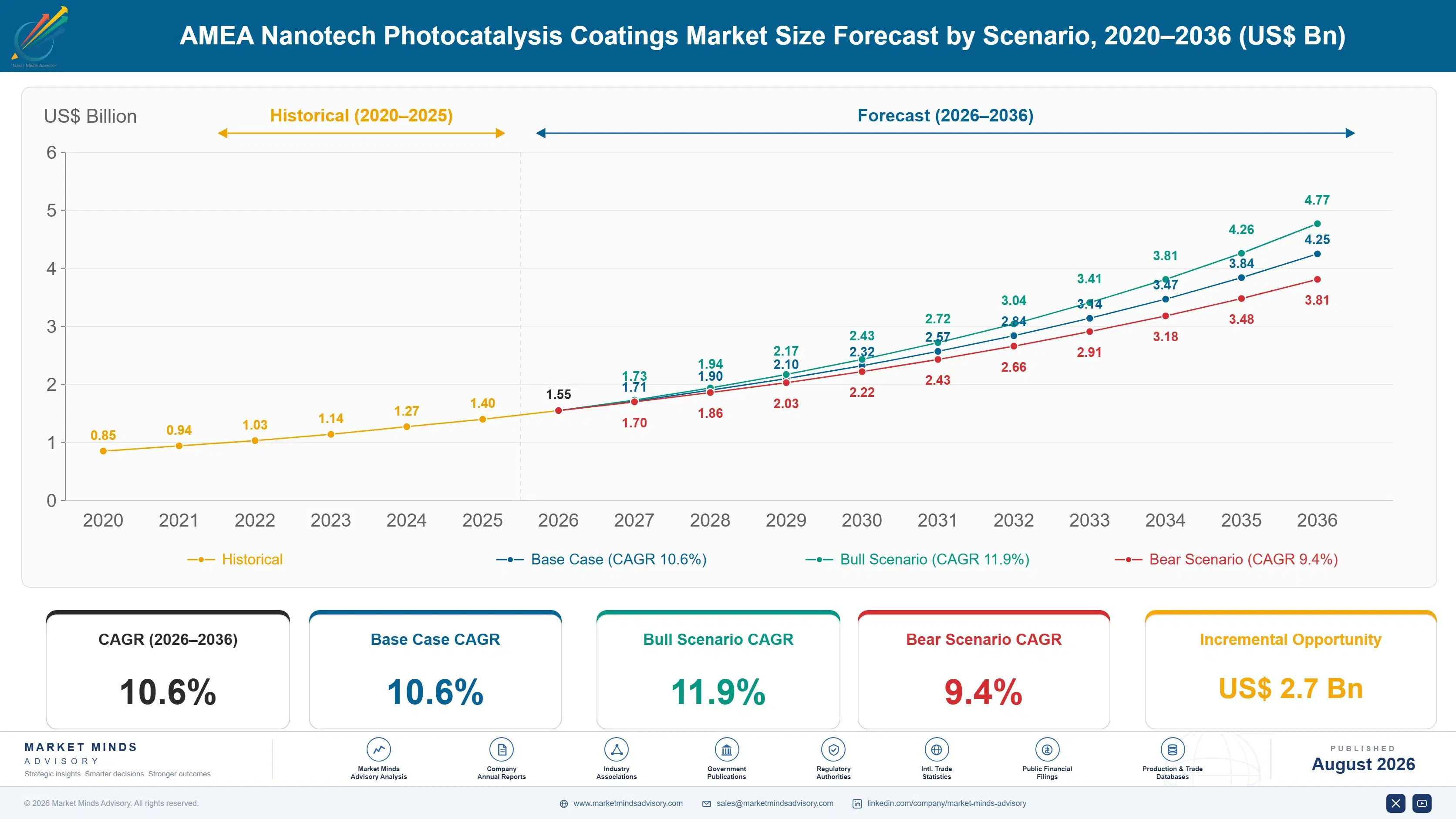
Growth of 9.3% across 2020 to 2025 was pulled forward by something nobody had planned for. Antimicrobial surface claims found sudden commercial interest during the pandemic, and photocatalytic coatings were applied across transport hubs, hospitals and public buildings on evidence of varying quality. That demand faded, and what remained was the slower air quality and self-cleaning business that had been building underneath it.
The base case at 10.6% rests on three mechanisms. Urban air quality programmes across Chinese, Indian and Gulf cities keep specifying photocatalytic treatment for road infrastructure, tunnels and public facades where nitrogen oxide reduction is measurable and politically visible. Green building certification schemes award credits that architects increasingly design toward from concept stage. And visible-light-active formulations open interior applications that conventional anatase never reached, expanding addressable surface area across a typical building considerably.
The bull case at 11.9% turns on a major economy mandating photocatalytic treatment on new road infrastructure, which would convert a specification preference into procurement volume overnight. The bear case at 9.4% turns on evidence. Independent testing that fails to reproduce claimed pollutant removal under real conditions would damage the category broadly, and the antimicrobial episode left regulators considerably more sceptical than they were.

What Decides Photocatalytic Coating Value

The commercial character of this market is decided by a wavelength. Conventional anatase titania activates only below 387 nanometres, a band representing a small fraction of daylight and effectively absent indoors, which confined the technology to sunlit exterior surfaces for two decades. Doped and composite formulations shift activation into visible light and open interiors, tunnels and shaded elevations. That single physical change is what turned a niche architectural product into something wi
TOP FIVE SHARE38%Concentration of formulated coating volume across the largest suppliers
APPLIED COATING COSTUSD 3.80 per sqmApplied cost per square metre of treated exterior facade surface
ACTIVATION WAVELENGTH387 nanometresLongest wavelength activating conventional anatase titania photocatalyst coatings
COATING SERVICE LIFE8 yearsExpected functional life before recoating on exterior facade surfaces
TITANIA COST SHARE34%Photocatalyst share of formulated coating cost of goods
NITROGEN OXIDE REMOVAL42%Reduction measured across treated surfaces under standard laboratory conditions
Value is unusually sensitive to who does the applying. Applied cost runs around USD 3.80 per square metre of facade, of which the photocatalyst itself is 34% of formulated coating cost and the rest is binder, formulation and labour. Poor application destroys performance entirely, which is why the participants who control application quality earn considerably more than those selling material into an open contractor market.
Measured performance is the commercial currency and it varies wildly. Nitrogen oxide removal reaches 42% under standard laboratory conditions and considerably less on a dirty facade in August. Buyers who test locally get honest numbers; those who accept datasheet figures are the reason this category periodically loses credibility with regulators.
"This industry sells a laboratory number to buyers who will experience a field number, and the gap between them is where every credibility problem in the category has come from. The suppliers with a future are the ones commissioning independent local testing before the customer thinks to ask for it."
Director, Functional Coatings and Advanced Materials Practice · MMA Chemicals an

Market Trends

Visible-Light Doping Opens Interior And Shaded Applications

Nitrogen, tungsten and copper doping shifts photocatalytic activation from the ultraviolet into visible wavelengths, which sounds like an incremental improvement and is not. Ultraviolet-dependent coatings work on sunlit exterior surfaces and nowhere else, while visible-light formulations function under interior lighting, in road tunnels and on shaded elevations. That expands addressable treated surface area by roughly 60% across a typical building. Formulation difficulty is real, since doping usually costs some quantum efficiency, and the suppliers who have solved the trade-off hold genuine advantage in the fastest growing part of this market.
Market Impact: Covers 3,200 certified regional pro
Urban Air Quality Programmes Specify Infrastructure Treatment

Chinese, Indian and Gulf municipal authorities have begun specifying photocatalytic treatment on road surfaces, tunnel linings, noise barriers and public building facades, on the reasoning that nitrogen oxide reduction near traffic is measurable and politically demonstrable. Roughly 28% of regional demand now originates from public infrastructure procurement rather than from private construction. This changes the commercial model completely: tenders, local testing requirements and long payment cycles replace architectural specification, and suppliers without public sector capability find themselves shut out of the fastest growing channel in this market entirely. Payment terms alone deter several established formulators.
Market Impact: Extends cleaning intervals roughly

Market Opportunities and Growth Drivers

Green Building Certification Awards Credits For Treated Surfaces

Certification schemes across Asia and the Gulf award points for measurable indoor air quality improvement and reduced facade maintenance, both of which photocatalytic coatings can document. Around 3,200 certified projects across the region have specified photocatalytic treatment for credit purposes. Architects design toward certification thresholds early in a project, which means specification decisions are locked well before procurement and are difficult for any competitor to displace afterwards without a compelling reason. The commercial value lies less in the credit itself than in how early it places a supplier into a project's own documentation.
Market Impact: Removal drops from 42% in field

Facade Maintenance Economics Favour Self-Cleaning Treatment

High-rise facade cleaning in Gulf and East Asian cities costs enough that a coating extending intervals pays for itself on maintenance alone, before any air quality benefit is counted. Photocatalytic superhydrophilicity causes dirt to sheet off with rainfall rather than adhering, extending cleaning intervals by roughly 40% on treated elevations. Building owners understand maintenance budgets in a way they do not understand nitrogen oxide chemistry, which makes this the easier commercial argument by a considerable margin. It also gives the category a benefit that survives any dispute about pollutant removal claims.
Market Impact: Affects 8 year service life directl

Market Restraints and Challenges

Field Performance Falls Short Of Laboratory Claims

Nitrogen oxide removal reaches 42% under standard test conditions and substantially less on a real facade carrying dust, humidity and traffic film. The root cause is that standard test protocols use clean substrates, controlled light and fixed pollutant concentrations, none of which resembles a road tunnel in Delhi during summer. Commercially this creates recurring credibility damage when a monitored project underperforms its specification. Participants are responding with independent local field testing, performance guarantees written against measured rather than laboratory values, and maintenance protocols that restore surface activity between recoating intervals.
Market Impact: Expands addressable surface roughly

Application Quality Determines Performance More Than Formulation

A well-formulated coating applied badly performs worse than an average coating applied properly, and most application in this region is done by general painting contractors with no photocatalysis training. The root cause is that these coatings need controlled film thickness and substrate preparation that conventional architectural paint does not. Commercially the failures damage the coating supplier's reputation rather than the applicator's, which is an unfair allocation nobody has managed to change. Mitigation runs through certified applicator programmes, pre-mixed formulations that reduce site error, and supplying application services directly on any project where measured performance carries a contractual guarantee.
Market Impact: Covers 28% of regional demand
3 additional market trends, 4 additional growth drivers, and 2 additional restraints and challenges are covered in the full report. Contact sales@marketmindsadvisory.com to access the complete intelligence.

Segment CAGR and Growth Architecture

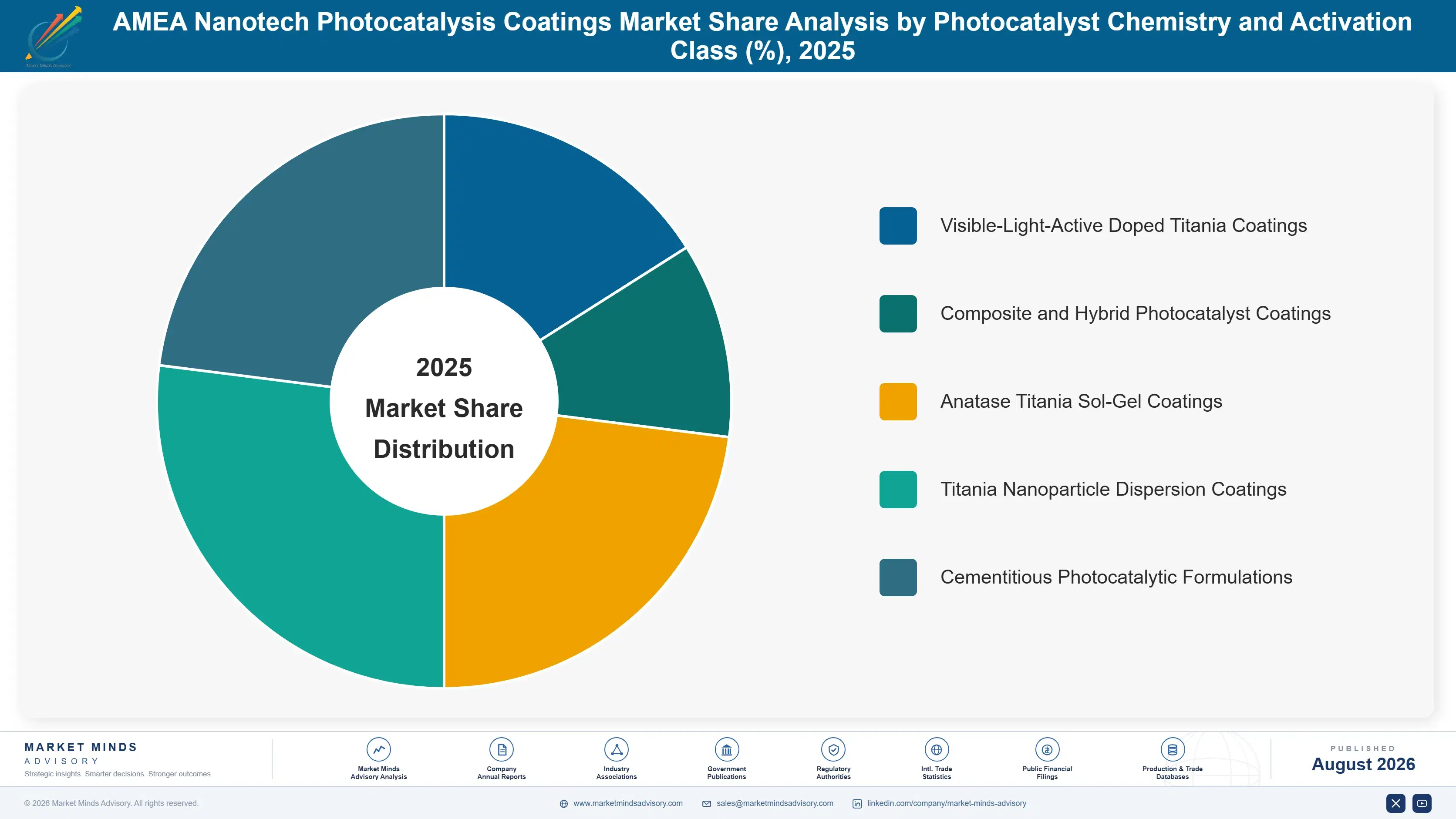
Segmentation follows photocatalyst chemistry and activation class, which is the dimension determining where a coating can physically be used, what performance it delivers and what price it commands. Substrate and building application cut across every chemistry without distinguishing between them commercially, since the same formulation serves a facade and a tunnel lining, so both belong in demand analysis instead.
amea-nanotech-photocatalysis-coatings-market-market-share-analysis-1787310251525

Visible-Light-Active Doped Titania Coatings

Growing at 15.9%, exactly 1.50 times the market rate, and the only part of this market whose addressable surface area is still expanding rather than merely being penetrated further. Nitrogen, tungsten, copper or carbon doping narrows the titania band gap enough to activate under visible wavelengths, which brings interior walls, ceilings, tunnel linings and permanently shaded elevations into scope for the first time. Doping generally costs some quantum efficiency, and balancing activation range against activity is the formulation problem that separates serious suppliers from the rest. Realised pricing sits roughly 40% above conventional anatase systems and shows no sign of converging yet, which is unusual for a chemistry this widely researched.
CAGR 15.9%

Composite and Hybrid Photocatalyst Coatings

Expanding at 13.2% on formulations pairing titania with zinc oxide, silver, graphitic carbon nitride or noble metal deposits in order to suppress electron-hole recombination and add antimicrobial function that titania alone delivers only weakly. These systems command premium pricing in healthcare, transport and food processing environments where a documented antimicrobial claim carries commercial weight beyond the air quality argument. Regulatory treatment of silver-containing formulations differs sharply across the region, which fragments the market considerably and rewards suppliers holding local registration capability. Cost is the practical constraint, since noble metal loading raises formulated cost well above what general construction procurement will accept, confining these systems to environments where the claim genuinely matters.
CAGR 13.2%
Full segment breakdown across 5 segments available in the complete report.

Regional Architecture and Country Demand Map

Regional distribution here reflects a market scoped to Asia, the Middle East and Africa, so those regions carry shares far above the bands this report applies to global markets. Remaining shares represent the volumes that regional producers and licensors supply into markets outside the covered geography.

East Asia

Fifty-two percent of value sits here, well outside the band applied to global markets. Note: the deviation follows from a market scoped to Asia, the Middle East and Africa rather than from any analytical judgement about global distribution. Japan commercialised photocatalytic coatings and still sets the technical reference, with TOTO's licensing model spreading the technology across construction materials from tile to glass to paint. China applies the technology at far greater volume, driven by municipal air quality programmes specifying treatment on tunnels, noise barriers and public facades in cities where nitrogen oxide reduction is politically visible. South Korean demand concentrates in commercial construction. Growth of 11.6% runs above the market rate.
Share: 52% | CAGR: 11.6% (2026 to 2036)

South Asia and Pacific

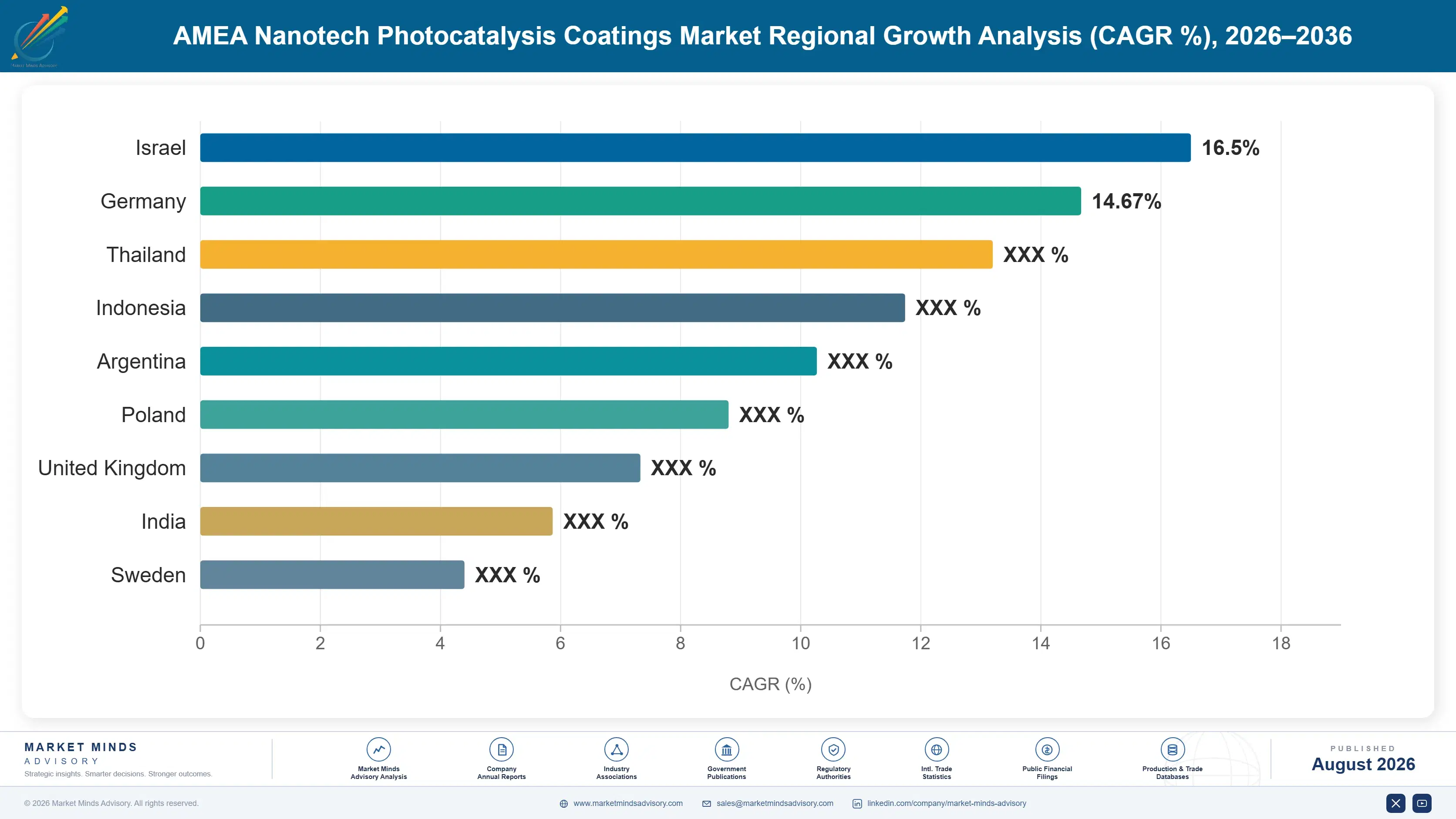
Twenty-six percent of value and the fastest growth at 12.7%, again outside global bands for the scoping reason set out above. India dominates the picture, where urban air quality has become a genuine political issue and municipal authorities in Delhi, Mumbai and Bengaluru have specified photocatalytic treatment on road infrastructure and public buildings. Domestic paint manufacturers have added photocatalytic lines rather than importing finished formulations, which keeps applied cost within reach of Indian construction budgets in a way imported product never managed. Southeast Asian demand is smaller and concentrated in commercial and hospitality construction in Singapore, Malaysia and Thailand, where green building certification rather than air quality regulation drives the specification decision.
Share: 26% | CAGR: 12.7% (2026 to 2036)
Regional intelligence for 5 additional markets available in the complete report: North America, Western Europe, Latin America, Middle East and Africa, Eastern Europe. Contact sales@marketmindsadvisory.com.
amea-nanotech-photocatalysis-coatings-market-country-cagr-analysis-1787310252051

Where Coating Suppliers Can Earn More

Selling formulated material into an open contractor market gives away both the application margin and any control over whether the product works at all. The value available sits in measured performance nobody can dispute, in application quality, in public procurement channels, and in the visible-light chemistry that competitors have not yet managed to match.

Commission Independent Local Field Testing Before Customers Ask

Every credibility problem this category has suffered came from laboratory numbers meeting field conditions in front of a customer. Suppliers who commission independent testing under local climate, dust and traffic conditions, and quote those figures rather than standard protocol results, win specification decisions worth roughly 30% more volume in public procurement where testing evidence is evaluated formally. The testing cost is trivial against the value of a single infrastructure contract. Competitors quoting datasheet performance look increasingly evasive beside a supplier holding locally measured data, and evaluation panels have started noticing.
Market Impact: Wins roughly 30% more public procur

Certify Applicators Rather Than Selling Into Open Contracting

Application quality decides performance more than formulation does, and general painting contractors ruin coatings routinely without ever being blamed for it. Running a certified applicator programme, with training, film thickness verification and warranty tied to certification, cuts field failure rates by roughly 45% and moves the reputational risk to where it belongs. It also creates a channel that competitors cannot enter without building the same infrastructure. Suppliers resist this because it reads as cost rather than as what it actually is, which is control over the product's own reputation in the field.
Market Impact: Cuts field failure rates by roughly

Build Public Infrastructure Procurement Capability Deliberately

Around 28% of regional demand now originates in municipal and infrastructure tenders rather than in architectural specification, and that share keeps rising as air quality programmes expand. Tender qualification, local testing evidence and long payment terms are a different commercial competence from selling to architects. Suppliers building it capture demand growing considerably faster than private construction, at contract sizes worth roughly 8 times an average commercial facade project. Those who stay with architectural specification alone are competing for the slower half of a market that is reorganising around public buyers.
Market Impact: Wins contracts roughly 8 times larg

Own Visible-Light Formulation Rather Than Licensing It

Doped titania grows at 15.9% and the formulation trade-off between activation range and quantum efficiency is genuinely difficult, which is exactly why realised pricing sits roughly 40% above conventional anatase systems and has stubbornly refused to converge. Suppliers developing this chemistry internally hold that premium across the whole product generation, while those licensing it pay most of the advantage away in royalties on every litre sold. The development investment is measured in single-digit millions against a segment that will carry the majority of this market's growth across the coming decade.
Market Impact: Holds pricing roughly 40% above ana

Who Controls the Margin Pool

Concentration is moderate and the participant base is genuinely split. The top five hold 38% of formulated coating volume supplied, the basis used throughout this section, and the gap between them reflects two different businesses rather than one ranking. TOTO and the Japanese photocatalyst producers built the technology and license it widely; Nippon Paint and the regional coatings companies formulate, distribute and apply at volumes the material suppliers never touch directly.
Competition currently runs on three dimensions. Demonstrated performance under local testing standards decides public procurement, which is the fastest growing channel. Application control decides whether performance survives contact with a construction site. Regional registration and claims substantiation decides which formulations can be sold where, particularly for silver-containing antimicrobial systems facing quite different treatment across the covered geography.

Pressure is building from two directions. Chinese formulators are moving from domestic supply into export markets across South Asia and the Gulf at prices Japanese licensed products cannot match. Independent testing scrutiny is tightening after the antimicrobial claims episode. Rankings shift first in public infrastructure, where evidence requirements at prequalification now exceed what a good many established suppliers can actually produce.
amea-nanotech-photocatalysis-coatings-market-company-positioning-matrix-1787310252576

Competitive Moat and Risk Dimensions

TOTO

Moat: Founding technology and licensing

Commercialising photocatalytic surfaces first, and building a licensing model that put the technology into tile, glass, paint and cladding across dozens of manufacturers, created a position resting on patents, accumulated field data and technical reference status rather than on manufacturing scale. Three decades of documented installations is evidence no newer entrant can assemble quickly.
TOTO

Risk: Licensing model limits capture

A licensor captures a fraction of the value its technology creates and has limited control over how licensees formulate, apply or substantiate claims. As core patents age and Chinese formulators develop independent chemistry, the royalty base erodes without any corresponding growth in directly controlled business. Field failures by licensees still damage the underlying brand.
NIPPON PAINT HOLDINGS

Moat: Regional distribution and application

The largest coatings distribution network across the covered geography reaches contractors, developers and public buyers directly, which matters in a category where application quality determines performance and where specification happens locally. Formulation capability combined with applicator relationships lets the company control the product from mixing through to the finished surface.
NIPPON PAINT HOLDINGS

Risk: Photocatalysis is small internally

Functional photocatalytic coatings represent a modest line within an enormous architectural paint business, which limits how much development investment and specialist technical support the category can command internally. Specialist competitors focused entirely on photocatalysis can outspend it on formulation and field evidence while remaining commercially far smaller overall.

Players Tracked

Prominent Players

TOTO
Nippon Paint Holdings
Resonac
Ishihara Sangyo Kaisha
Evonik Industries

Other Key Players

Tayca Corporation
Toshiba Materials
Nippon Soda
Shin-Etsu Chemical
Kronos Worldwide
Tronox Holdings
Kansai Paint
Asian Paints
Berger Paints India
Jotun
National Paints Factories
Sto SE
PPG Industries
AkzoNobel
Kingfa Sci and Tech

Recent Developments

MAY 2025

Indian municipal authority specifies photocatalytic road treatment

An Indian metropolitan authority specified photocatalytic surface treatment across tunnel linings, noise barriers and elevated road structures under a funded urban air quality programme, requiring locally measured nitrogen oxide reduction evidence at prequalification rather than standard laboratory protocol results from any supplier bidding for the work.
Signal: Public buyers demanding local field eviden
AUGUST 2025

Visible-light photocatalyst production capacity commissioned

Additional doped titania photocatalyst production capacity entered commercial operation at an East Asian site, targeting visible-light-active formulations for interior, tunnel and shaded facade applications, with output committed to regional coatings formulators under multi-year supply arrangements covering several nitrogen, tungsten and copper doped grades across the range.
Signal: Capacity built specifically for visible-li
FEBRUARY 2025

Certified applicator programme launched across Gulf markets

A coatings supplier established a certified applicator training and field verification programme across Gulf construction markets, tying performance warranties to certified application and film thickness verification after repeated field underperformance was traced to contractor application practice rather than to any fault in the formulation supplied.
Signal: Controlling application is finally being t

What Sits Inside Formulated Coating Cost

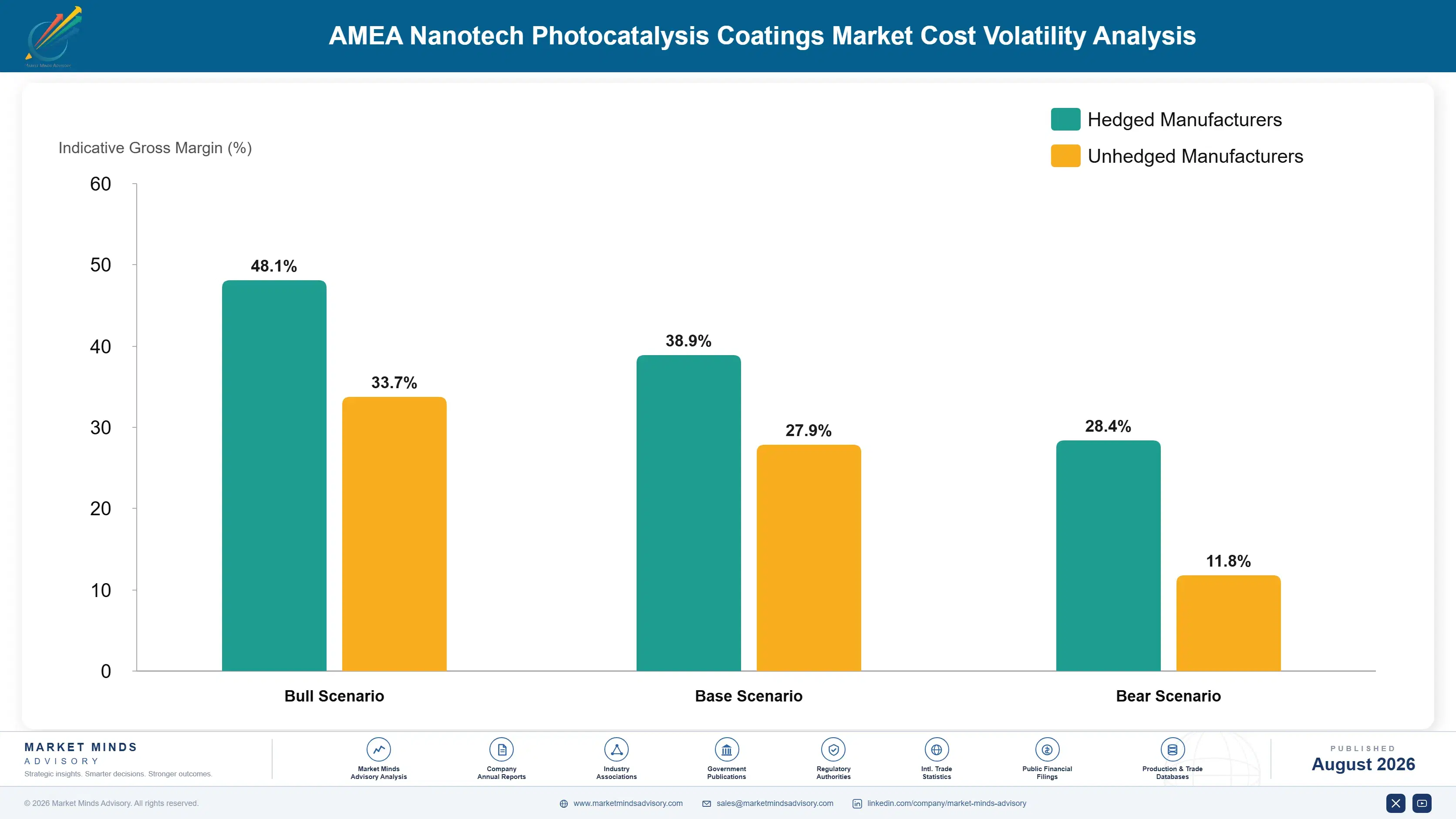
Nano-grade titanium dioxide accounts for roughly 34% of formulated coating cost, produced from ilmenite and rutile feedstock through chloride or sulphate routes and sourced principally from Chinese, Japanese and Australian producers. Silica sol and binder systems add around 18%. Dopants including tungsten, copper and silver contribute about 9% but vary enormously by formulation, and solvents and dispersants make up a further 12%.
Titanium feedstock and energy costs moved sharply through 2021 and 2022. Chinese provincial power rationing during the second half of 2021 constrained titanium dioxide output across several producing regions, and European and Asian energy prices through 2022 raised calcination and processing costs across the industry. Tronox Holdings Annual Report 2022 and Kronos Worldwide Annual Report 2022 both recorded elevated energy and feedstock costs, alongside pigment pricing that moved ahead of underlying demand.

The competitive disadvantage mechanism runs through photocatalyst grade rather than through commodity pigment pricing. Nano-anatase and doped grades come from a much narrower supplier base than pigment titania, and qualifying an alternative grade means revalidating photocatalytic performance rather than simply matching a specification. Formulators tied to a single photocatalyst grade face months of revalidation if supply moves. Those holding dual-qualified grades absorb disruption far more easily.
amea-nanotech-photocatalysis-coatings-market-cost-volatility-analysis-1787310252775

Dual-qualify photocatalyst grades across separate producers

Validating a second nano-titania grade means repeating photocatalytic performance testing rather than merely matching a chemical specification, which is why so few formulators bother until supply fails. The work takes months and costs relatively little. Formulators who have done it can switch grades within weeks while single-source competitors wait for allocation to improve on somebody else's timetable.

Reformulate to reduce noble metal dopant loading

Silver and platinum group dopants improve antimicrobial performance and carry cost and price volatility out of proportion to their weight fraction. Alternative dopant systems using copper, tungsten or carbon nitride deliver much of the benefit at considerably lower exposure. The reformulation and revalidation work is one-off; the volatility it removes recurs continually and without warning.

Contract titania supply on multi-year indexed terms

Pigment and nano-grade titania pricing moves with feedstock and energy in cycles that a formulator cannot hedge through spot purchasing at any useful scale. Multi-year agreements indexed to published feedstock benchmarks share that exposure with the producer, and they secure allocation of specialist grades during periods when general pigment supply tightens ahead of specialist grades.

Portfolio Architecture for Margin Defence

Margin architecture separates by how much of the delivered outcome a supplier actually controls. Material sold into an open contractor market earns a formulation margin and nothing else, while suppliers controlling application and warranting measured performance earn on the outcome rather than on the litre. That distinction matters more here than in almost any other coatings category, because application quality determines whether the product functions at all once it leaves the tin.
The volume versus premium tension runs between construction and infrastructure. General architectural facade treatment carries the volume at prices that regional construction procurement caps tightly. Public infrastructure and specialist antimicrobial applications carry far better economics on fewer, larger, slower-paying contracts. Suppliers chasing facade volume fund a technical organisation from margins that architectural tender will not support, which is a familiar pattern in functional coatings and rarely ends well.

High-value pools concentrate in three places. Visible-light doped formulations command price because the formulation trade-off is genuinely hard to solve. Warranted performance contracts earn on the outcome rather than the material. And composite antimicrobial systems carry premiums in healthcare and food processing that general construction never approaches.

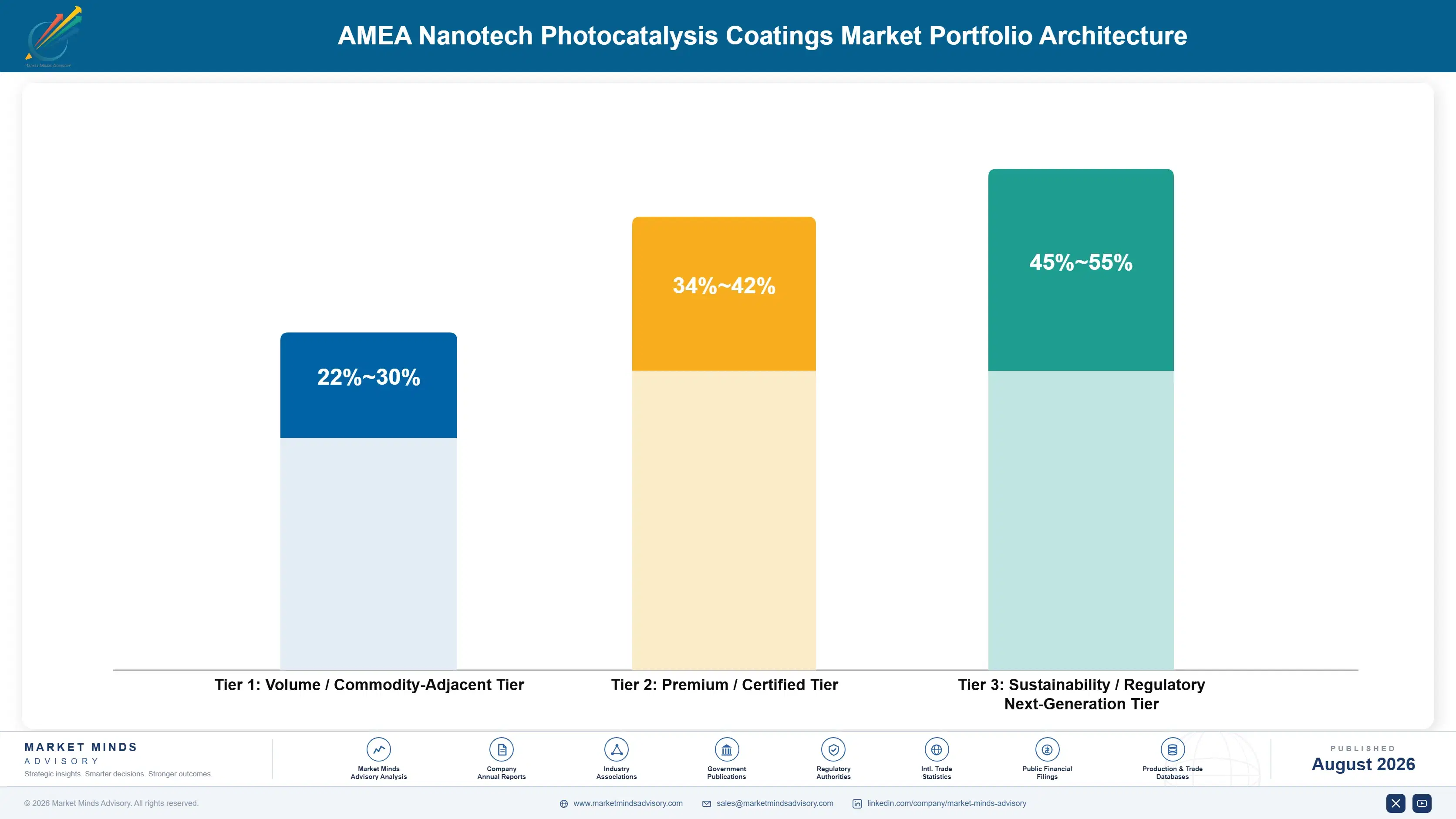
Volume / Commodity-Adjacent Tier

Conventional anatase sol-gel and nanoparticle dispersion coatings sold into general architectural facade work through distributors and painting contractors, priced against ordinary exterior coatings with a modest functional premium attached and very little control over application.
Gross Margin: 22-30%

Premium / Certified Tier

Coatings supplied with certified application, film thickness verification and warranted performance against locally measured values. Control over the delivered outcome defends pricing here. The eight-point range reflects warranted against unwarranted supply arrangements.
Gross Margin: 34-42%

Sustainability / Regulatory / Next-Generation Tier

Visible-light-active doped titania and composite antimicrobial systems serving interiors, tunnels and regulated environments. Formulation difficulty and registration requirements defend pricing strongly. The ten-point range reflects doped against noble metal composite economics.
Gross Margin: 45-55%
amea-nanotech-photocatalysis-coatings-market-portfolio-architecture-1787310253271

High-value Sub-segments and Strategic Watch-out

Visible-light doped titania formulations

High value and high growth together, because the chemistry expands treatable surface area by roughly 60% across a typical building and the activation-efficiency trade-off remains genuinely difficult to solve. Realised pricing sits well above conventional anatase and shows no sign of converging over the forecast.
Gross Margin: 45-55%

Warranted infrastructure performance contracts

Strong realised value on rapid growth, because public buyers increasingly require locally measured evidence and are increasingly willing to pay for warranted outcomes rather than for supplied material. Tender qualification and testing capability keep the competitive set unusually narrow across most of the covered geography.
Gross Margin: 34-42%

General architectural facade treatment

The volume core here, growing with regional construction activity while earning only a modest premium over ordinary exterior coatings and carrying every field failure risk that uncontrolled contractor application creates. Necessary for manufacturing scale, but this tier will not fund serious formulation development on its own.
Gross Margin: 22-30%

Silver-containing antimicrobial composites

The strategic watch-out, because regulatory treatment of silver-bearing formulations differs sharply across the covered geography and claims substantiation requirements have tightened noticeably since the pandemic-era episode. Registration capability rather than formulation skill now decides which suppliers can sell these systems into which markets at all.
Gross Margin: 38-55%

How Coating Demand Behaves Here

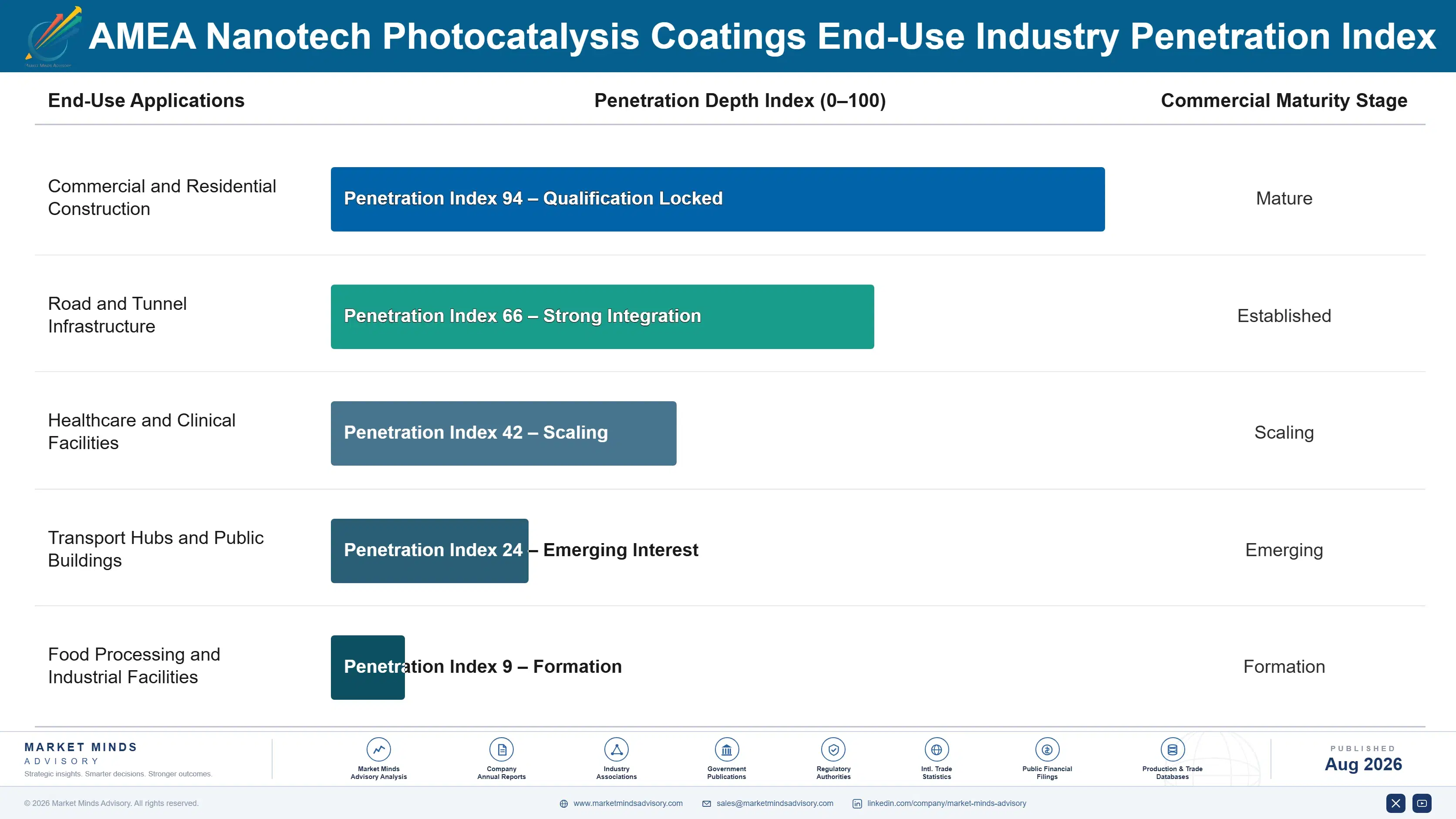
Demand is specification-locked rather than repeat-purchase. A coating specified into a building's documentation at design stage is bought once at construction and again at recoating perhaps eight years later, and the supplier who was in the specification usually gets both. Winning the initial specification is slow and expensive; holding it through construction is comparatively easy. That structure rewards early technical engagement with architects and public authorities far more than it rewards
Stickiness varies sharply by application depth. General facade treatment is loosest, retendered against price where any compliant product qualifies. Public infrastructure sits considerably tighter, because locally measured performance evidence and tender prequalification narrow the field before pricing is discussed. Regulated interior applications in healthcare and food processing are stickiest of all, where registration, documented claims and validation history make substitution a genuine project rather than a purchasing decision.

The buyer profile has moved away from the architect in a way many suppliers were slow to notice. A decade ago specification ran through design practices pursuing certification credits. Today municipal air quality programmes and infrastructure authorities decide a growing share, and they evaluate measured field evidence, tender compliance and payment terms rather than architectural intent.
amea-nanotech-photocatalysis-coatings-market-end-use-penetration-index-1787310253763

Where We Land On This

These are among the four positions where our research anticipates prominent divergence between winners and laggards over the coming forecast period. Each is grounded in the demand model, the regulatory perimeter, and the announced capacity pipeline.
01 / FIELD EVIDENCE INVESTMENT

Commission local field testing before any customer asks

Every credibility problem this category has suffered traces to laboratory figures meeting real conditions in front of a customer who had not been warned about the difference. Suppliers commissioning independent testing under local climate, dust and traffic conditions win specification decisions worth roughly 30% more volume in public procurement, where evidence is evaluated formally rather than accepted from a datasheet. The testing cost is trivial against the value of a single infrastructure contract, and it makes every competitor quoting datasheet figures look evasive by comparison.
02 / APPLICATION QUALITY CONTROL

Certify applicators instead of selling into open contracting

Application quality decides delivered performance more than formulation chemistry does, and general painting contractors compromise these coatings routinely without ever carrying the blame for it afterwards. Certified applicator programmes with training, film thickness verification and warranty tied to certification cut field failure rates by roughly 45% and put reputational risk where it belongs. Suppliers resist the investment because it reads as cost on a budget line rather than as what it is, which is direct control over the product's field reputation.
03 / PUBLIC PROCUREMENT CAPABILITY

Build infrastructure tender capability, not architectural selling

Around 28% of regional demand now originates in municipal and infrastructure tenders rather than architectural specification, and that share keeps rising as urban air quality programmes expand across Chinese, Indian and Gulf cities. Tender qualification, local testing evidence and long payment terms constitute a different commercial competence entirely, at contract sizes running roughly 8 times an average commercial facade project. Suppliers staying with architectural selling alone are competing for the slower half of a market that is reorganising around public buyers.
04 / VISIBLE-LIGHT CHEMISTRY OWNERSHIP

Develop doped formulations internally rather than licensing them

Visible-light-active doped titania grows at 15.9% and expands treatable surface area by roughly 60% across a typical building, which is why realised pricing sits about 40% above conventional anatase and has not converged. The trade-off between activation range and quantum efficiency remains genuinely difficult to solve, so suppliers developing the chemistry internally hold that premium across an entire product generation. Licensees pay most of that advantage away in royalties they have no realistic prospect of recovering, and they inherit somebody else's development roadmap alongside it.

Engagement Snapshot From the Field

A live engagement with an industry participant carrying material or product regulatory and market exposure ahead of a defining policy shift, showing how our research translates into a defensible multi-year portfolio strategy.
MARKET MINDS ADVISORY · CLIENT ENGAGEMENT SUMMARY
AMEA Nanotech Photocatalysis Coatings Producer Strategic Portfolio Review and Transition Roadmap 2026·Investment Scenario on AMEA Nanotech Photocatalysis Coatings Exposure Evaluation 2025-26
CLIENT PROFILE
A coatings formulator operating across South Asia and the Gulf, supplying photocatalytic facade and interior systems alongside a larger conventional architectural paint business, supplied through distributors and independent painting contractors across both regions. Photocatalytic revenue approached USD 46 million annually (client-reported, unverified by MMA), almost entirely in general architectural facade work sold on a per-litre basis to contractors.
STRATEGIC CHALLENGE
Field complaints about performance had risen for three years and management treated them as a formulation problem, funding successive reformulation programmes that changed nothing. Public infrastructure tenders were being lost without the client understanding why. A proposed investment in expanded photocatalyst blending capacity assumed volume growth would continue from the architectural channel.
MMA APPROACH
MMA interviewed forty-seven contractors, municipal engineers, architects and photocatalyst producers across five markets, reconstructing how specification and tender decisions were actually reached. We commissioned field measurement at eleven completed sites, benchmarked the client's formulations against competitors under identical conditions, and reviewed every lost tender submission from the previous two years in detail.
KEY FINDINGS
  1. Field measurement at the eleven sites showed performance varying by a factor of four between them, and the variation tracked application film thickness rather than any difference in the formulation supplied.
  2. Nine of twelve lost public tenders had been rejected at prequalification for lacking locally measured performance evidence, before pricing was examined by anybody on the evaluation panel.
  3. Not one competitor in the client's markets ran a certified applicator programme, which meant the field failure problem was industry-wide rather than specific to the client's products.
  4. Visible-light doped formulations sold at a substantial premium to the client's anatase systems (client-reported, unverified by MMA), and the client held no doped product at all.
CLIENT PROFILE
A coatings formulator operating across South Asia and the Gulf, supplying photocatalytic facade and interior systems alongside a larger conventional architectural paint business, supplied through distributors and independent painting contractors across both regions. Photocatalytic revenue approached USD 46 million annually (client-reported, unverified by MMA), almost entirely in general architectural facade work sold on a per-litre basis to contractors.
STRATEGIC CHALLENGE
Field complaints about performance had risen for three years and management treated them as a formulation problem, funding successive reformulation programmes that changed nothing. Public infrastructure tenders were being lost without the client understanding why. A proposed investment in expanded photocatalyst blending capacity assumed volume growth would continue from the architectural channel.
MMA APPROACH
MMA interviewed forty-seven contractors, municipal engineers, architects and photocatalyst producers across five markets, reconstructing how specification and tender decisions were actually reached. We commissioned field measurement at eleven completed sites, benchmarked the client's formulations against competitors under identical conditions, and reviewed every lost tender submission from the previous two years in detail.
KEY FINDINGS
  1. Field measurement at the eleven sites showed performance varying by a factor of four between them, and the variation tracked application film thickness rather than any difference in the formulation supplied.
  2. Nine of twelve lost public tenders had been rejected at prequalification for lacking locally measured performance evidence, before pricing was examined by anybody on the evaluation panel.
  3. Not one competitor in the client's markets ran a certified applicator programme, which meant the field failure problem was industry-wide rather than specific to the client's products.
  4. Visible-light doped formulations sold at a substantial premium to the client's anatase systems (client-reported, unverified by MMA), and the client held no doped product at all.
RECOMMENDED STRATEGY
Phase 1: Phase 1 (0 to 6 months): Halt the reformulation programme and commission independent local field testing across representative climate and traffic conditions. Phase 2: Phase 2 (6 to 18 months): Establish a certified applicator programme with warranty tied to verified film thickness, and build tender prequalification capability. Phase 3: Phase 3 (18 to 36 months): Develop visible-light doped formulations internally, targeting interior and tunnel applications the anatase range cannot serve.
OUTCOME
The client redirected roughly USD 6 million from blending capacity into field testing and applicator certification (client-reported, unverified by MMA). Field complaints fell sharply within a year, the first two public infrastructure tenders were won on locally measured evidence, and a doped formulation entered commercial supply twenty months into the programme.

Frequently Asked Questions

Foundational context covering the market sizes, CAGR, scope, country, region and competition that inform every finding below. This section is provided to cover basics and most often pre-purchase conversations, answered from the MMA Primary Research Dataset.

What is the current size of the AMEA Nanotech Photocatalysis Coatings Market?

The market reached USD 1.4 billion in 2025, measured as formulated coating revenue at realised delivered price across Asia, the Middle East and Africa. Architectural facade treatment accounts for the largest share.

How large will the AMEA Nanotech Photocatalysis Coatings Market be by 2036?

MMA forecasts USD 4.25 billion by 2036, an expansion of 2.74 times the 2026 level. Incremental value across the forecast period reaches USD 2.7 billion.

What is the CAGR for the AMEA Nanotech Photocatalysis Coatings Market 2026 to 2036?

The base case compound annual growth rate is 10.6%, with a bull case of 11.9% and a bear case of 9.4%. Infrastructure mandates and independent testing scrutiny separate those scenarios.

Which segment is growing fastest?

Visible-light-active doped titania coatings grow fastest at 15.9%, exactly 1.50 times the overall market rate. Doping opens interiors, tunnels and shaded elevations that ultraviolet-dependent formulations never reached.

Who are the major companies in the AMEA Nanotech Photocatalysis Coatings Market?

TOTO, Nippon Paint Holdings, Resonac, Ishihara Sangyo Kaisha and Evonik Industries lead, holding 38% of coating volume between them. Photocatalyst producers and formulating paint companies compete from quite different positions.

Which country is growing fastest?

India grows fastest at 12.4%, where urban air quality has become a political issue and municipal authorities specify photocatalytic treatment on road infrastructure. Domestic manufacturers formulate locally rather than importing finished products.

Report Segmentation Architecture

The full report scope spans multiple orthogonal segmentation dimensions, with cross-tabulated demand data provided for each dimension pair. Coverage extends further to regional breakdowns, trend trajectories, and the competitive detail needed to support segment-level decision-making.

By Photocatalyst Chemistry and Activation Class

  • Visible-Light-Active Doped Titania Coatings
  • Composite and Hybrid Photocatalyst Coatings
  • Anatase Titania Sol-Gel Coatings
  • Titania Nanoparticle Dispersion Coatings
  • Cementitious Photocatalytic Formulations

By End-Use Industry

  • Commercial and Residential Construction
  • Road and Tunnel Infrastructure
  • Healthcare and Clinical Facilities
  • Transport Hubs and Public Buildings
  • Food Processing and Industrial Facilities

By Customer Type and Channel

  • Municipal and Infrastructure Authorities
  • Property Developers and Building Owners
  • Architectural Specification Practices
  • Certified Applicator Networks
  • Coatings Distributors and Contractors

By Region

  • North America
  • Western Europe
  • East Asia
  • South Asia and Pacific
  • Latin America
  • Middle East and Africa
  • Eastern Europe

Scope, Methodology, and Coverage

Every figure in this report is reproducible from documented input assumptions. The scope below maps the historical period, the forecast horizon, the segmentation dimensions, and the countries covered, alongside the underlying primary and qualitative methodology.
Historical Period
2020 to 2025
Forecast Period
2026 to 2036
Base Year
2025 (USD billions; MMA Primary Research Dataset, August 2026)
Market Definition
The market comprises functional coatings incorporating photocatalytic nanomaterials, principally titanium dioxide together with doped, composite and hybrid derivatives, applied to building facades, interior surfaces, road and tunnel infrastructure, glass and industrial substrates across Asia, the Middle East and Africa. Sizing captures formulated coating revenue at realised delivered price, spanning visible-light-active doped titania, composite and hybrid photocatalyst systems, anatase sol-gel coatings, nanoparticle dispersion coatings and cementitious photocatalytic formulations, including volumes regional producers supply outside the covered geography. Photocatalyst powders sold as raw material, self-cleaning glass with integral factory coatings, air purification equipment, water treatment photocatalysis and conventional architectural paint fall outside scope.
Quantitative Units
USD billions (current prices); treated surface area in million square metres annually; USD per square metre at applied cost
Segmentation Dimensions
By Photocatalyst Chemistry and Activation Class; By End-Use Industry; By Customer Type and Channel; By Region
Regions Covered
North America, Western Europe, East Asia, South Asia and Pacific, Latin America, Middle East and Africa, Eastern Europe
Countries Covered
China, Japan, South Korea, Taiwan, India, Singapore, Malaysia, Thailand, Vietnam, Indonesia, Philippines, Australia, Saudi Arabia, UAE, Qatar, Kuwait, Oman, Bahrain, Egypt, Morocco, South Africa, Nigeria, Kenya, Turkey, USA, UK, Germany, France, Brazil, Mexico, Poland, and additional markets relevant to this sector
Key Companies Profiled
TOTO, Nippon Paint Holdings, Resonac, Ishihara Sangyo Kaisha, Evonik Industries, Tayca Corporation, Toshiba Materials, Nippon Soda, Shin-Etsu Chemical, Kronos Worldwide, Tronox Holdings, Kansai Paint, Asian Paints, Berger Paints India, Jotun, National Paints Factories, Sto SE, PPG Industries, AkzoNobel, Kingfa Sci and Tech.
Quantitative Methodology
Primary survey, n=3,800 respondents, Q4 2025, six countries; demand-side model with trade association cross-validation
Qualitative Methodology
47 expert interviews, Q4 2025; applied to validate demand model assumptions, identify emerging dynamics, and assess competitive positioning
Report Format
PDF and XLSX data workbook (Word format preview document)
Publisher
Market Minds Advisory
Report Code
MMA-2026-CHM-410
Published
August 2026
Contact
sales@marketmindsadvisory.com | www.marketmindsadvisory.com

Purchase the full AMEA Nanotech Photocatalysis Coatings Market Report (2026 to 2036).

The full report sizes the AMEA nanotech photocatalysis coatings market across five photocatalyst chemistries, five end-use industries, five customer channels and seven regions, with annual forecasts to 2036 in revenue and treated surface area. It compares laboratory protocol performance against measured field results by climate and application condition, which is the analysis that establishes what these coatings actually deliver in service. Twenty participants are assessed on a consistent formulated coating volume basis, with application control and registration capability mapped separately. Public infrastructure tender requirements are documented market by market across the covered geography.
Five photocatalyst chemistries sized and forecast annually
Laboratory performance compared against measured field results
Twenty participants on consistent coating volume supplied basis
Application control and registration capability mapped separately
Public infrastructure tender requirements documented market by market
Green building certification credit schemes compared across the region

Built For The People Who Decide

From boardroom strategy to bench-side execution, this report is read cover-to-cover by leaders shaping the next decade of their industry, turning demand scenarios, market dynamics and valuation benchmarks into decisions.
CXOs/ Presidents/ VPs/ Managers
M&A and Corporate Development
Strategy Teams and R&D Heads
Procurement and Product Directors
Regulatory and Compliance Leaders
Investor Relations and Equity Analysts