Market Minds Advisory
Aluminum Hydroxide Market

Aluminum Hydroxide Market: Grade Economics, Halogen-Free Flame Retardancy and Bauxite Cost Exposure, 2026 to 2036

Cable makers eliminating halogenated flame retardants now need filler loading levels above sixty percent that only surface-treated fine grades survive, and very few producers can hold that specification consistently at volume.

Lead Analyst

Bilal Shaikh

Published

September 2026

Make Smarter Decisions with Customized Research Insights

Request a free sample report and evaluate market opportunities, growth trends, and competitive dynamics relevant to your business needs.

2025 MARKET VALUE$1.6BMarket Size 2025
2036 FORECAST VALUE$2.9BBase Case , 2026 to 2036
CAGR 2026 TO 20365.6 %Bull 6.8% / Bear 4.4%
INCREMENTAL OPPORTUNITY$1.2BNet 10- year value creation
EXPANSION MULTIPLE1.72x2036 value over 2026 base
Strategic Levers
M&A Pipeline
Regional Outlook
Country Rankings
Competitive Intelligence
Segmental Deep-dive
Call-Us : 91 93563 13602

Executive Snapshot and Market Trajectory

Halogen-free flame retardancy has become the whole growth story in this market. Cable, construction panel and electrical enclosure makers removing brominated systems need mineral filler loadings above sixty percent by weight, and only fine surface-treated aluminium hydroxide holds mechanical properties intact at that level.
Nanoscale and submicron precipitated grades grow at 8.4%, a full 1.50 times the market rate, pulled by thin-wall cable insulation and by engineering thermoplastics where coarse filler destroys impact strength. East Asia holds 32% of global value, slightly above the standard regional band, because Chinese producers sit beside both Bayer refinery capacity and the world's largest single concentration of cable compounding operations, so supply and demand reinforce each other.
Concentration is moderate at 43% for the top five, and the field splits cleanly between Western specialty producers selling narrow particle distributions with surface treatment and Chinese producers selling ground filler tonnage. Building regulation is the sharper force here. Fire performance requirements tightened right across European and Asian construction codes after several high-profile facade failures, and those rules converted what had been a cost-driven filler choice into a compliance-driven specification that nobody reopens.
Market Definition
The market covers aluminium hydroxide supplied as a functional mineral for flame retardancy, filling, pharmaceutical and water treatment applications, spanning ground coarse, standard precipitated, fine surface-treated, nanoscale precipitated and pharmacopoeial grades. It excludes metallurgical grade aluminium hydroxide produced as a Bayer process intermediate for smelting, calcined and activated aluminas, aluminium oxide abrasives, boehmite, and finished compounds or formulations containing the material.
Base Year Value
$1.6B in 2025 (MMA Primary Research Dataset, August 2026)
Forecast Period
2026 to 2036, eleven discrete annual values
CAGR
5.6% base case. Bull 6.8%. Bear 4.4%.
Fastest Growth Segment
Nanoscale and Submicron Precipitated Grade: 8.4% CAGR
Fastest Growth Country
India: 8.6% CAGR
Fastest Growth Region
South Asia and Pacific: 7.9% CAGR
Largest Region
East Asia: 32% of 2025 global value
Market Leaders
Huber Engineered Materials, Nabaltec, Sumitomo Chemical, Resonac Holdings, Almatis. Source: MMA Primary Research Dataset, July 2026.
Primary Survey
n=3,800 procurement and R&D decision-makers, Q4 2025, six countries
Methodology
Demand-side build-up, cross-validated against public data, 47 expert interviews

Aluminum Hydroxide Market Forecast Scenarios

aluminum-hydroxide-market-trends-size-forecast-scenario-1787311648074
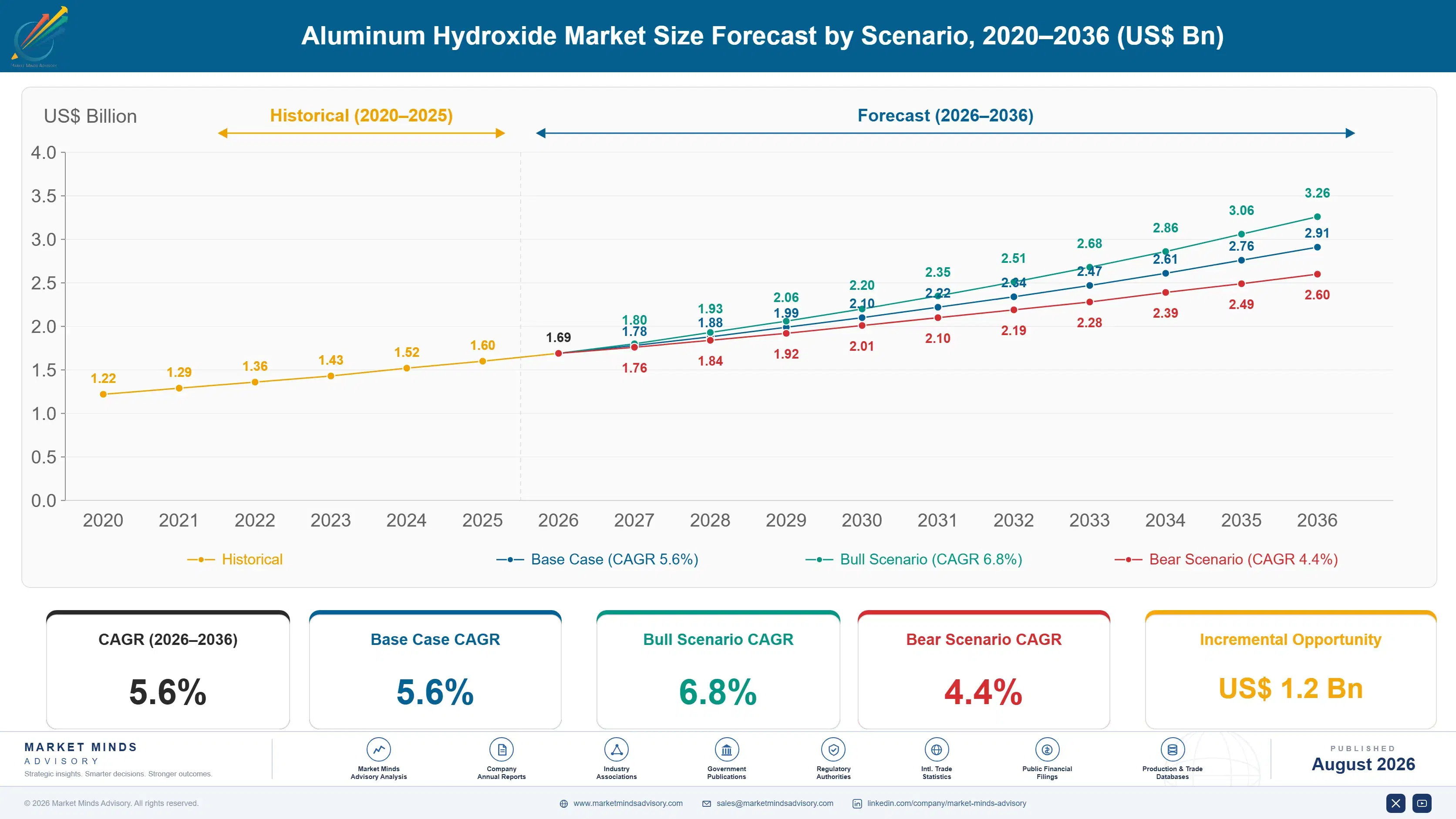
The market compounded at 4.6% between 2020 and 2025, and construction cycles did most of the shaping. Cable and panel demand fell through 2020, recovered sharply across 2021 and 2022 on infrastructure spending, then flattened as European construction weakened. Caustic soda and energy costs rose steeply through 2022, and producers spent two years recovering margin rather than growing volume.
The 5.6% base case rests on three mechanisms. First, halogen-free cable specifications keep spreading through data centre, rail and building wiring applications, and each conversion raises filler content per kilogram of compound sharply. Second, grade mix shifts upward as compounders move from ground filler to fine surface-treated material to hold mechanical properties. Third, water treatment demand grows steadily with municipal and desalination investment across South Asia and the Middle East.
The bull case at 6.8% assumes construction fire codes tighten further across Asian markets while data centre cable demand holds at current levels. The bear case at 4.4% turns on competing mineral chemistry: magnesium hydroxide continues taking share in applications processed above two hundred degrees, and a faster shift would remove some of the highest-value volume this market currently expects to capture.

Why Particle Treatment Decides Grade Value

Aluminium hydroxide is chemically simple and commercially anything but. The same compound sells as a ground filler near three hundred dollars a tonne and as a surface-treated submicron grade above two thousand, and the price gap has widened rather than closed since 2021.
TOP FIVE CONCENTRATION43%Combined position of the five largest specialty grade producers
AVERAGE SELLING PRICE$620 per tonneTypical realised price across filler and treated grades
TOP PRODUCING COUNTRY SHARE48%Chinese share of global specialty aluminium hydroxide output
BAUXITE AND CAUSTIC SHARE34% of COGSBauxite and caustic soda share of delivered production cost
CAPACITY UTILISATION69%Average operating rate across precipitation and milling plants
FLAME RETARDANT DEMAND SHARE54%Portion of output consumed by halogen-free flame retardancy
The difference sits in what the particle does inside a polymer. Flame retardancy depends on water release during decomposition, which every grade delivers. Holding tensile strength and elongation at sixty percent loading depends on particle size distribution, aspect ratio and the silane or stearate treatment bonding filler to matrix, and that is knowledge accumulated across many production campaigns rather than bought with equipment. Compounders who have qualified a treated grade rarely switch, because requalifying a cable compound means retesting fire performance and mechanical properties together.
Feedstock position sets the ceiling on ambition. Fine grades require precipitation from Bayer liquor under controlled conditions rather than grinding of coarse hydrate, so producers without refinery access or a liquor supply arrangement are confined to filler grades. Geology and refinery ownership therefore decide strategic options before any management decision does, which is why the specialty field here has stayed so remarkably stable for so long.
"Everyone in this business talks about halogen-free conversion as though it were a single event. It is not: it is a thousand separate compound requalifications, each one taking a year and each one locking a supplier in for a decade. The producers winning now are the ones who staffed applications laboratories in 2019 rather than the ones who added capacity."
Senior Analyst, Functional Minerals and Additives Practice · MMA Chemicals and M

Market Trends

Halogen-Free Cable Conversion Moves Into Mainstream Wiring

Low-smoke halogen-free cable was once confined to tunnels, ships and public buildings. It has now become standard specification for data centre power distribution, rail rolling stock and residential building wiring across the European Union and much of East Asia. Each converted compound carries filler loading between fifty-five and sixty-five percent by weight, against under ten percent in a brominated formulation. Roughly 41% of building wire sold in the European Union now uses halogen-free insulation, against about 22% five years earlier, and each percentage point of conversion moves substantial filler volume.
Market Impact: Covers 2.6 billion square metres an

Surface Treatment Becomes The Commercial Differentiator

Untreated fine hydroxide agglomerates and destroys elongation at the loadings halogen-free compounds require, so silane and stearate treatment matched to specific polymer systems has become the actual product being sold. Treated grades realise roughly 45% higher pricing than untreated fine material of identical particle size. The capital requirement is modest, typically under $8 million for treatment and characterisation capability, but the formulation knowledge takes years to build properly. That imbalance between low capital and high accumulated knowledge is precisely what keeps the qualified supplier list so short, and it shows no sign of changing.
Market Impact: Raises cable volume 30% per megawat

Market Opportunities and Growth Drivers

Construction Fire Codes Tighten After Facade Failures

Building regulation across the European Union, United Kingdom, Australia and increasingly the Gulf states has tightened combustibility requirements on facade panels, insulation and cable systems following several high-profile fires. Aluminium hydroxide filled composite panels and mineral-filled cable pass those requirements comfortably where polymer-rich alternatives do not. Roughly 2.6 billion square metres of annual facade construction now falls under tightened combustibility rules. That converts filler selection from a cost decision into a compliance decision, and compliance decisions do not reverse when input prices fall back again, which makes this demand unusually durable.
Market Impact: Limits processing above 200 degrees

Data Centre Cable Demand Adds High-Loading Volume

Data centre construction consumes unusual quantities of power and communication cable per square metre of floor area, and operators specify halogen-free insulation almost universally because smoke and corrosive gas release inside a sealed equipment hall is simply unacceptable to them. Cable volume per megawatt of installed capacity has risen roughly 30% since 2021 as power density climbed steadily. The demand is concentrated among relatively few buyers, which makes it distinctly lumpy, but conversions are permanent and the compound qualifications sitting behind them last for the whole life of a cable design.
Market Impact: Compressed margins by 6 points

Market Restraints and Challenges

Decomposition Temperature Caps Processing Window Severely

Aluminium hydroxide releases water from roughly 180 to 200 degrees Celsius, which rules it out of any polymer processed above that range. The root cause is chemistry rather than product quality: the water release that provides flame retardancy is the same mechanism that causes foaming during extrusion at higher temperatures. Commercially this hands polypropylene, polyamide and engineering thermoplastic applications to magnesium hydroxide entirely. Participants are responding with boehmite grades that decompose higher, and with fine hydroxide dispersions permitting lower processing temperatures on some polyolefin systems, though neither approach closes the gap fully.
Market Impact: Reaches 41% of European building wi

Caustic Soda And Energy Costs Move Faster Than Contracts

Bauxite and caustic soda together account for roughly 34% of cost of goods, and energy for precipitation and drying adds a further 16%. The root cause is contract mismatch: compounders negotiate annual pricing while caustic and power move continuously, so producers absorb the whole difference. Margin compression of four to six points across 2022 followed exactly that mechanism. Participants are addressing it through quarterly indexation clauses, which the larger cable compounders now accept readily enough, and through electrification of drying wherever grid power happens to be both cheap and reasonably low carbon.
Market Impact: Realises 45% higher grade pricing
3 additional market trends, 2 additional growth drivers, and 4 additional restraints and challenges are covered in the full report. Contact sales@marketmindsadvisory.com to access the complete intelligence.

Segment CAGR and Growth Architecture

Segmentation follows product grade, defined by particle size distribution, purity and whether the surface carries a coupling treatment. That single dimension determines the production route a producer needs, whether refinery liquor access is required at all, which customers can be qualified, and very nearly the whole of the realised price range visible across this market today.
aluminum-hydroxide-market-trends-market-share-analysis-1787311648649

Nanoscale and Submicron Precipitated Grade

The fastest segment at 8.4%, a full 1.50 times the market rate, covering material precipitated to submicron particle size with controlled surface treatment to prevent agglomeration. Demand comes from thin-wall cable insulation, engineering thermoplastic compounds and translucent applications where coarse filler destroys both impact strength and appearance. Realised pricing runs three to five times ground filler levels, and the qualified supplier list is short because precipitation at this size demands refinery liquor access alongside treatment capability. Dispersion behaviour inside the customer's own compound, rather than the nominal particle size on a data sheet, is what actually decides qualification here, and it varies more between polymer systems than any specification suggests.
CAGR 8.4%

Surface-Treated Fine Flame Retardant Grade

Growing at 7.3% annually on precipitated material in the one to three micron size range carrying silane or stearate treatment matched to specific polymer systems. This grade is the volume backbone of halogen-free cable and panel compounding everywhere, where loadings between fifty-five and sixty-five percent by weight demand filler that bonds properly to the matrix rather than simply occupying space within it and weakening everything around it. Pricing runs roughly 45% above untreated material of identical particle size. Customer positions here are unusually durable, because requalifying a cable compound means retesting fire performance and mechanical properties together, which nobody undertakes lightly or without a genuinely compelling commercial reason for doing so.
CAGR 7.3%
Full segment breakdown across 5 segments available in the complete report.

Regional Architecture and Country Demand Map

East Asia leads on both specialty production capacity and cable compounding concentration rather than on construction demand alone. South Asia and Pacific grows fastest as Indian cable manufacture and water treatment investment scale together. Western Europe holds the tightest specification positions rather than any volume advantage.

East Asia

Thirty-two percent of global value sits here. Note: this slightly exceeds the standard regional band because Chinese producers sit beside both Bayer refinery capacity in Shandong and Henan and the world's largest concentration of cable compounding operations, so production and consumption reinforce each other. Chinese output covers roughly 48% of global specialty grade volume. Japanese producers occupy a distinct position at the fine and treated end, supplying grades at prices several times Chinese filler levels. Growth of 6.8% reflects domestic cable conversion alongside construction panel demand. Environmental enforcement on precipitation effluent has consolidated the smaller producer field considerably since 2020. Export volumes now skew increasingly toward the treated fine grades rather than filler.
Share: 32% | CAGR: 6.8% (2026 to 2036)

North America

Twenty-two percent of global value, weighted toward wire and cable compounding, solid surface countertop manufacture and water treatment chemistry. Domestic specialty production exists at meaningful scale and freight economics protect it, since ground filler grades cannot economically cross the Pacific while treated fine grades carry enough value density to be imported. Growth of 5.0% tracks construction and data centre cable demand closely. Solid surface manufacture is an unusually large application here compared with other regions, absorbing coarse grades in volumes that materially affect producer loading. Bauxite and hydrate feedstock arrive largely from Caribbean and Australian refineries. Water treatment coagulant demand adds a steady baseline volume that construction cycles barely affect at all.
Share: 22% | CAGR: 5.0% (2026 to 2036)
Regional intelligence for 5 additional markets available in the complete report: Western Europe, South Asia and Pacific, Latin America, Middle East and Africa, Eastern Europe. Contact sales@marketmindsadvisory.com.
aluminum-hydroxide-market-trends-country-cagr-analysis-1787311649176

Where Grade Margin Actually Accumulates

Four commercial moves separate the producers earning genuine specialty margins from those merely clearing filler tonnage at freight-adjusted parity. Each depends on holding something a compounder cannot obtain by switching supplier: refinery liquor access, surface treatment capability, applications laboratory support, or a pharmacopoeial site qualification that takes years rather than capital to assemble properly.

Secure Bayer Liquor Access For Fine Precipitation

Fine and submicron grades require precipitation from refinery liquor under controlled conditions, not grinding of coarse hydrate, so producers without liquor access are confined to filler grades regardless of downstream investment. Long-term supply arrangements or refinery adjacency typically cost a premium of six to nine percent over hydrate purchase, and they take years to negotiate properly. Against fine grades selling at three to five times filler pricing, that premium is close to irrelevant. Submicron grades sell above $2,000 per tonne against filler near $300. It is the single decision determining which half of this market a producer can participate in.
Market Impact: Opens grades priced 5 times above g

Build Surface Treatment Matched To Polymer Systems

Treated grades realise roughly 45% higher pricing than untreated material of identical particle size, and the treatment chemistry must be matched to the specific polymer a compounder uses rather than applied generically across the range. Treatment capability costs under $8 million to establish, including the characterisation instrumentation required. The formulation knowledge takes years, which is why the field of credible suppliers stays small even though the capital barrier is genuinely low. Producers who treat this as a chemistry problem rather than as an equipment purchase are the ones holding durable positions today.
Market Impact: Adds about 45% to realised treated

Staff An Applications Laboratory For Compounders

Halogen-free conversion is not one decision but hundreds of entirely separate compound requalifications, and most mid-sized compounders lack the laboratory capacity to optimise loading and mechanical properties themselves. Producers offering formulation support convert a service cost into specification lock-in: compounders who receive that development work almost never go on to resource the filler afterwards. Suppliers running this model report renewal rates roughly 25 points above material-only relationships and hold pricing about 8% higher. The laboratory itself costs under $2 million to establish and pays for itself across two or three successful compound conversions.
Market Impact: Lifts renewal rates by 25 percentag

Qualify A Site For Pharmacopoeial Gel Supply

Pharmacopoeial aluminium hydroxide gel used in antacids and as a vaccine adjuvant demands site-level regulatory compliance rather than product testing alone, which keeps the qualified supplier list to a handful of names worldwide. Site qualification costs roughly $12 million to $20 million and takes about two years to complete. Pricing runs four to six times industrial filler levels and holds through construction cycles entirely, because pharmaceutical demand does not follow building activity. Customer positions last many years, since requalifying an excipient or adjuvant supplier is slow, expensive and regulatorily unattractive for everyone involved.
Market Impact: Commands up to 6 times filler grade

Who Controls the Margin Pool

Concentration is moderate at 43% for the top five, measured on specialty aluminium hydroxide revenue across all participants, and the ranking looks very different depending on whether tonnage or value is counted. Huber Engineered Materials leads on treated fine grade revenue while Chinese producers lead comfortably on volume, and the gap between those two positions defines this industry.
Competition runs on three dimensions. Surface treatment capability matched to specific polymer systems matters most at the fine end, where compounders requalify slowly and value consistency above nominal specification. Refinery liquor access matters almost as much, because it determines which grades a producer can attempt at all. Delivered cost dominates ground filler, where freight economics create regional contests rather than a global one and Chinese producers win wherever shipping allows.

Two pressures are building. Chinese producers that survived environmental consolidation are investing into treated fine grades, and several now hold specifications that would have been unavailable from the country five years ago. Meanwhile magnesium hydroxide continues taking the applications processed above two hundred degrees, which caps how far up the polymer range this chemistry can follow its own customers. Rankings shift where Chinese treatment capability meets European applications support.
aluminum-hydroxide-market-trends-company-positioning-matrix-1787311649698

Competitive Moat and Risk Dimensions

HUBER ENGINEERED MATERIALS

Moat: Deepest treated grade formulation knowledge

Decades of surface treatment development matched to specific cable and composite polymer systems give the company grades that compounders qualify and then hold for years afterwards. That advantage rests on accumulated formulation knowledge rather than on any patent or equipment, which makes it slow to erode and effectively impossible for a competitor to purchase outright.
HUBER ENGINEERED MATERIALS

Risk: Exposure to construction cycle timing

A large share of volume depends on cable, panel and solid surface demand tied directly to building activity across North America and Europe. Both markets have weakened, and pharmaceutical or water treatment volumes are far too small to offset a sustained construction downturn. The specialty mix cushions pricing but does nothing for the underlying volume swing.
NABALTEC

Moat: Integrated fine precipitation position

Control of precipitation from refinery liquor through to treated fine product lets the company hold particle distributions that grinding-based competitors cannot approach at all. European cable and laminate customers requalify slowly and pay for batch consistency above nominal specification, which rewards this integration considerably more than raw scale ever would.
NABALTEC

Risk: European cost base under pressure

Manufacturing concentrated in Germany carries energy, caustic soda and compliance costs that Chinese and Indian competitors simply do not face. As those competitors move into treated fine grades, the premium justifying the cost gap narrows steadily. Relocating specialty production would surrender the process consistency that underpins the company's entire position.

Players Tracked

Prominent Players

Huber Engineered Materials
Nabaltec
Sumitomo Chemical
Resonac Holdings
Almatis

Other Key Players

Nippon Light Metal
Sibelco
TOR Minerals
Alteo
Hindalco Industries
Chalco
Zibo Pengfeng New Material
Jinan Taixing Fine Chemicals
R.J. Marshall
Kimitsu Chemical Industries
Aluchem
Silkem
Shandong Aluminium Industry
Kyowa Chemical Industry
Dadco Alumina and Chemicals

Recent Developments

FEBRUARY 2025

Nabaltec expands treated fine grade capacity in Germany

Two additional precipitation and surface treatment lines entered commercial service at the company's Bavarian site, aimed at halogen-free cable and composite panel compounders whose conversion programmes had comfortably outrun the treated fine grade supply available anywhere across the European market during the preceding two years.
Signal: Treated fine capacity rather than raw tonn
JUNE 2025

Huber commissions applications laboratory for cable compounders

A dedicated applications and formulation laboratory opened at a North American site to support halogen-free compound development, reflecting how conversion decisions get made compound by compound rather than at category level, and how much technical support mid-sized compounders genuinely require in order to complete them at all.
Signal: Formulation support is now being sold as a
OCTOBER 2025

Zibo Pengfeng secures long-term refinery liquor supply agreement

A multi-year liquor supply agreement with a Shandong alumina refinery was concluded to underpin fine grade precipitation, reflecting how liquor access rather than installed precipitation capacity has become the binding constraint on Chinese producers that are attempting to move up the grade ladder into treated fine material.
Signal: Refinery liquor access is now treated as a

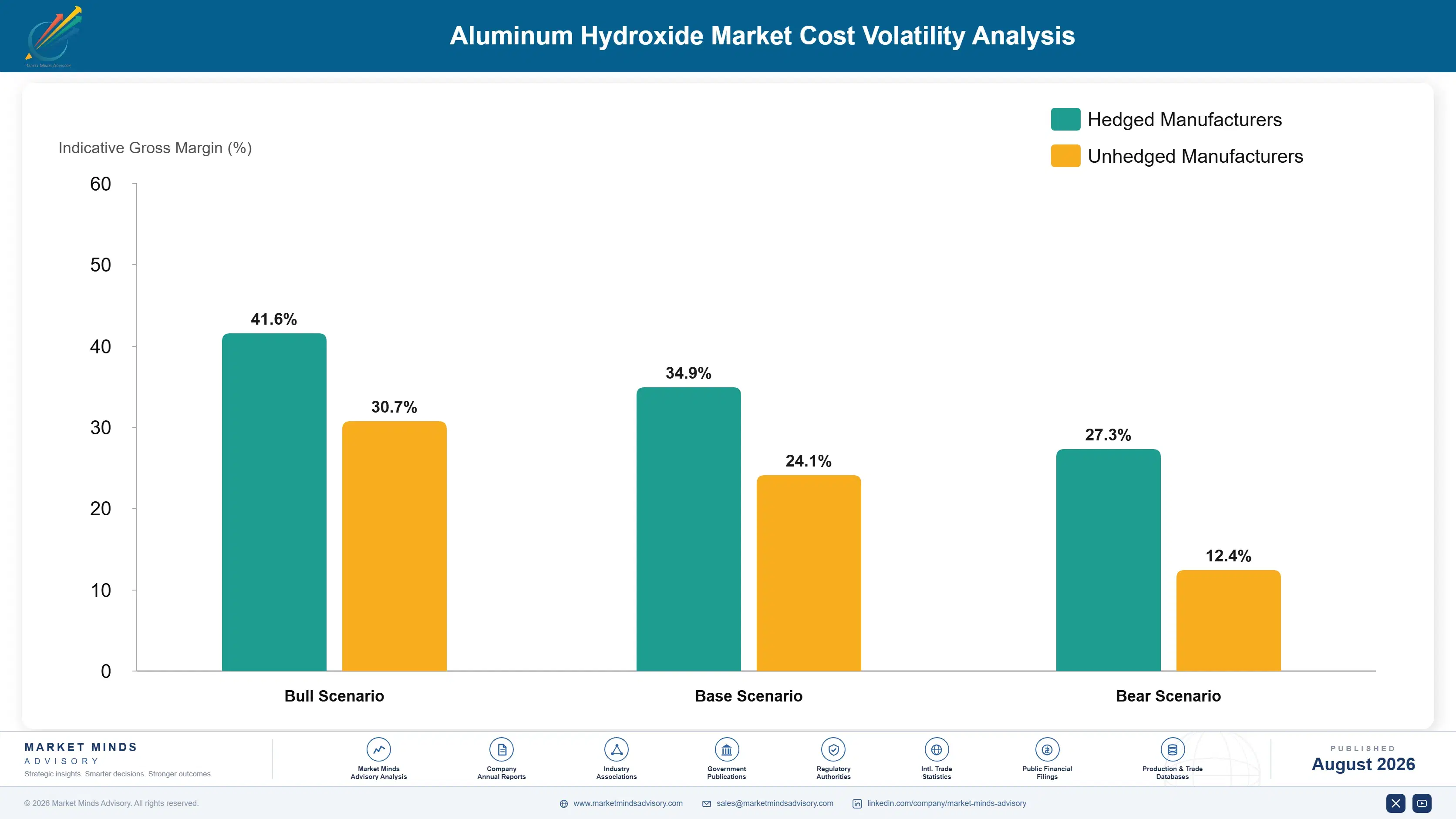
What Drives Delivered Production Cost

Bauxite and caustic soda together account for roughly 34% of cost of goods, with caustic the more volatile because it prices against chlor-alkali economics rather than mining supply. Energy for precipitation, filtration and drying contributes 16%. Surface treatment chemistry adds 9% on treated grades, and milling and classification a further 11% across the fine product range.
The 2022 European energy and caustic episode showed how thin the buffer really is. IEA data recorded European industrial gas prices at many times their historical range that winter, and caustic soda moved sharply as chlor-alkali operators curtailed output. German producers reported cost increases they could not recover inside annual compounder contracts, and Nabaltec annual reporting documented substantial energy and raw material pressure. Chinese producers gained relative position without any operational improvement.

The competitive disadvantage mechanism runs through refinery adjacency more than anything else. Producers sited beside an alumina refinery take liquor or hydrate at effectively no freight cost, while independents absorb transport on every tonne of a low-value feedstock. That difference reaches $45 per tonne of finished product. It matters little on submicron treated grades selling above $2,000 per tonne and decides everything on ground filler selling near $300.
aluminum-hydroxide-market-trends-cost-volatility-analysis-1787311649892

Index compounder contracts to caustic soda benchmarks

Annual price fixing against continuously moving caustic soda remains the single largest source of margin damage anywhere in this business. Producers now negotiate indexation clauses referencing published caustic soda and industrial power benchmarks, typically with a quarterly reset and a collar limiting total movement to eight percent in either direction across any given year.

Electrify precipitation and drying heat where grids allow

Gas-fired drying dominates energy cost and exposes producers directly to regional gas pricing. Electrification combined with heat recovery costs roughly $14 million per plant and cuts energy cost of goods by around four percentage points where grid power is cheap and low carbon, with payback improving sharply wherever carbon pricing applies to industrial fuel use.

Contract refinery liquor or hydrate on multi-year terms

Spot hydrate purchasing leaves fine grade producers exposed to both price and composition variation, and inconsistent feedstock shows up as failed production batches rather than as any visible line cost. Multi-year arrangements with a named refinery stabilise both, typically at a premium of six to nine percent that fine grade pricing absorbs without difficulty.

Portfolio Architecture for Margin Defence

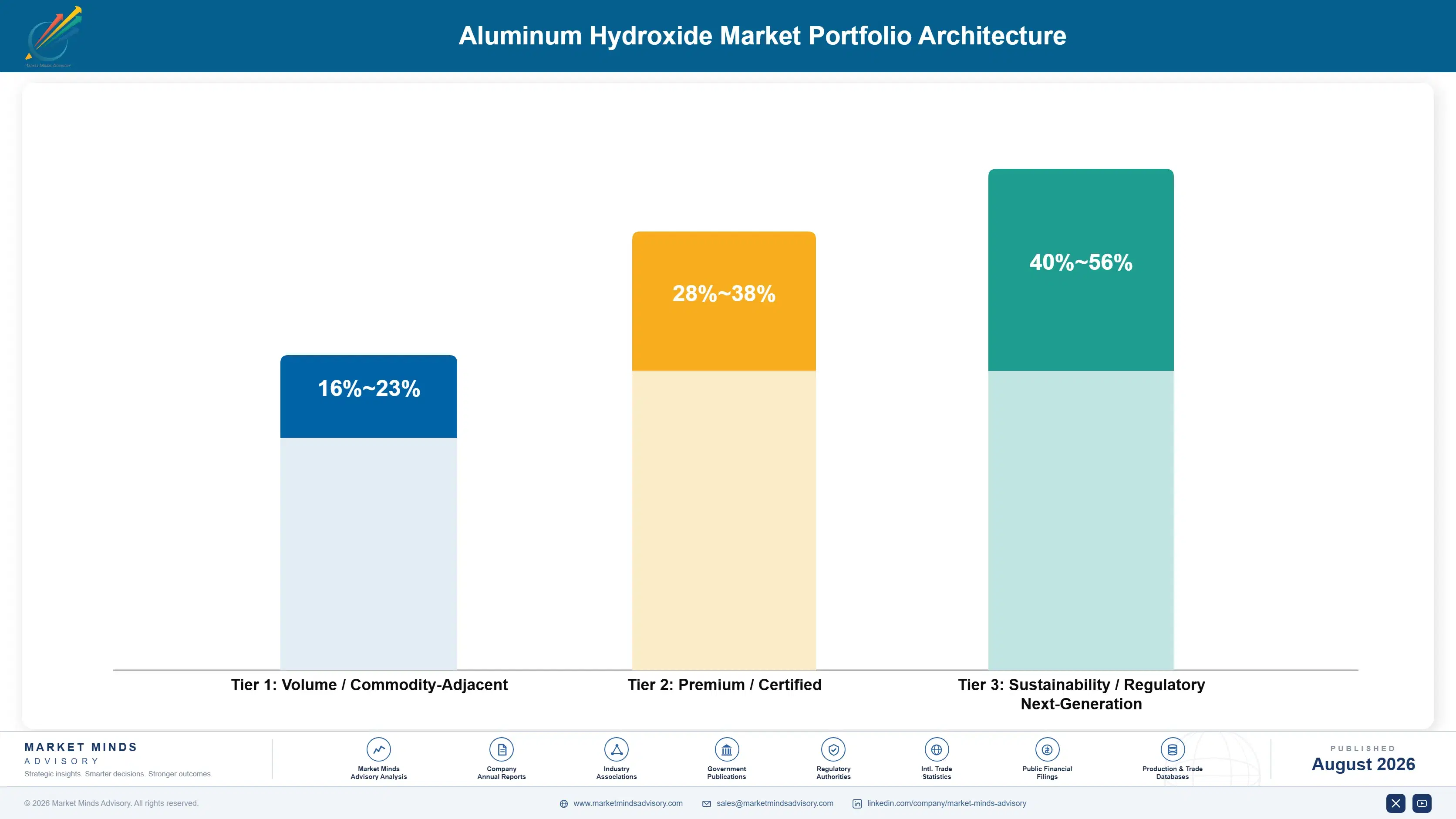
Margin architecture tracks particle specification and surface treatment almost exactly. Ground coarse filler sold into solid surface, adhesive and general filling applications runs at gross margins in the high teens, competing purely on delivered cost within each freight region. Treated fine and submicron grades earn roughly twice that or better.
The volume-versus-premium tension is genuine because precipitation and drying assets need loading. Ground filler tonnage is what provides it at predictable volumes, yet that is exactly where Chinese competition bites hardest and where only ocean freight offers any protection. Producers who abandon filler grades to chase treated margin find fixed cost recovery collapses, while those holding both watch the tonnage business slowly erode their blended average. Nobody has found a comfortable answer to that tension.

Value concentrates where the customer cannot verify performance cheaply. Treated fine grades for halogen-free cable are the clearest case: a compounder must run full fire and mechanical testing to assess a substitute, so it pays for consistency instead. Pharmacopoeial gel sits above them on regulatory logic. Ground filler sits at the other extreme, where a certificate of analysis tells the buyer everything it needs and pricing compresses toward feedstock cost.

Volume / Commodity-Adjacent

Ground coarse filler grades for solid surface countertops, adhesives, sealants and general polymer filling. Specifications are loose, supplier choice is wide within each freight region, and buyers move on delivered cost. This tonnage exists mainly to keep milling and drying capacity loaded.
Gross Margin: 16-23%

Premium / Certified

Standard precipitated and untreated fine grades supplied into cable, laminate and composite panel compounding where particle consistency matters. Pricing improves with distribution control, and buyers requalify slowly enough to hold it. Range reflects the spread between panel and cable compounding requirements.
Gross Margin: 28-38%

Sustainability / Regulatory / Next-Generation

Surface-treated fine, submicron and pharmacopoeial gel grades supplied into halogen-free cable, engineering thermoplastics and pharmaceutical applications. Treatment chemistry and site regulatory qualification, rather than the underlying compound itself, justify the pricing achieved here.
Gross Margin: 40-56%
aluminum-hydroxide-market-trends-portfolio-architecture-1787311650396

High-value Sub-segments and Strategic Watch-out

Submicron Treated Grades

High value on genuinely high growth at 8.4%, with the strongest realised pricing found anywhere in this market. Refinery liquor access and treatment chemistry together keep the competitive field very small, and dispersion behaviour inside a customer compound decides qualification rather than nominal particle size.
Gross Margin: 44-56%

Treated Fine Cable Grades

Strong margins on solid growth at 7.3%, and the volume backbone of halogen-free conversion everywhere. Positions here are unusually durable because requalifying a cable compound means retesting fire performance and mechanical properties together, which no compounder undertakes without a genuinely compelling commercial reason to do so.
Gross Margin: 38-48%

Ground Coarse Filler

The loading backbone of every precipitation and milling plant, necessary for fixed cost recovery but earning gross margins in the high teens. Chinese producers win this pool wherever ocean freight permits, and the regional protection sheltering Western producers weakens whenever container freight rates fall back again.
Gross Margin: 16-23%

Pharmacopoeial Gel Grades

The strategic watch-out sitting in this portfolio. Margins are excellent and demand ignores construction cycles entirely, but the volumes are small and adjuvant demand depends on vaccine programme funding that has proven politically volatile rather than commercially predictable across each of the past several years.
Gross Margin: 46-58%

How This Demand Actually Repeats

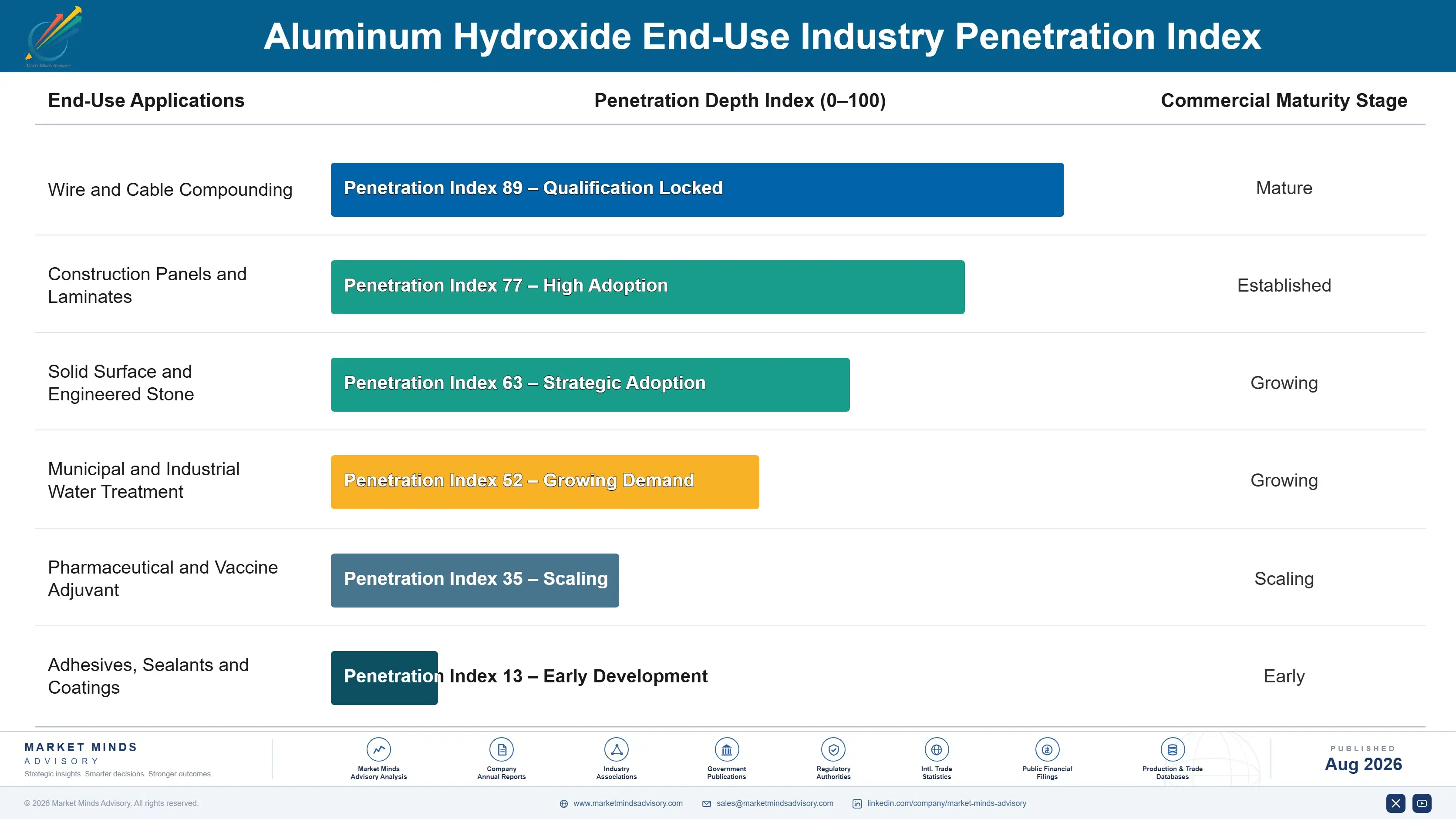
Demand behaves as an annuity attached to a qualified compound rather than a series of purchases. Once a treated grade is designed into a cable or panel formulation, it ships against that formulation for years, because requalification means retesting fire performance and mechanical properties together at real cost.
Stickiness varies sharply across end uses. Pharmacopoeial customers are the tightest, held by site regulatory qualification that makes a supplier change a genuine project rather than a purchase. Halogen-free cable compounds sit close behind, locked by fire classification testing that nobody reopens casually. Composite panel and laminate work is moderately sticky, held by appearance and processing consistency that data sheets describe poorly. Solid surface and general filling is barely sticky at all, with buyers switching on delivered price whenever freight or currency shifts the arithmetic.

Buyer profiles have changed considerably. Purchasing once sat with compounders comparing price per tonne against a particle size specification. It now frequently involves polymer formulators and regulatory functions asking about dispersion data, coupling chemistry and fire classification test evidence. Producers whose commercial approach still leads with tonnage pricing find themselves negotiating with people for whom cost is the third question rather than the first one.
aluminum-hydroxide-market-trends-end-use-penetration-index-1787311650889

Where To Commit Capital

These are among the four positions where our research anticipates prominent divergence between winners and laggards over the coming forecast period. Each is grounded in the demand model, the regulatory perimeter, and the announced capacity pipeline.
01 / LIQUOR ACCESS POSITIONING

Refinery adjacency decides which grades you can sell

Fine and submicron production requires precipitation from Bayer refinery liquor rather than grinding of coarse hydrate, which means producers without liquor access are confined to filler grades regardless of any downstream investment they choose to make. Long-term liquor arrangements cost premiums of six to nine percent over hydrate purchase and take years to negotiate properly. Against fine grades selling at three to five times filler pricing, that premium is close to irrelevant to the economics of any producer able to secure it.
02 / TREATMENT CHEMISTRY DEPTH

Coupling chemistry beats particle size for margin

Untreated fine hydroxide destroys elongation at the loadings halogen-free compounds require, so the surface treatment matched to a specific polymer is the actual product being sold rather than the mineral itself. Treated grades realise roughly 45% higher pricing than identical untreated material of the same particle size. Capability costs under $8 million but the formulation knowledge takes years, and that imbalance between low capital and high accumulated knowledge keeps the competitive field genuinely small even where the equipment itself is readily available.
03 / APPLICATIONS SUPPORT INVESTMENT

Laboratory support converts conversions into lock-in

Halogen-free conversion happens compound by compound rather than at any category level, and most mid-sized compounders simply cannot optimise filler loading against mechanical properties without external technical help. Producers offering that formulation support report renewal rates roughly 25 points above material-only supply relationships, and they hold realised pricing about 8% higher right across the grade family. An applications laboratory of this kind costs under $2 million to establish, which makes it comfortably the cheapest defensive investment available anywhere in this business today.
04 / FILLER TONNAGE DEFENCE

Hold the tonnage, but price it honestly

Ground filler earns gross margins in the high teens, yet it provides exactly the plant loading that makes fixed cost recovery work at all. Abandoning that work to chase treated grade margin collapses plant utilisation and destroys considerably more value than the mix improvement ever creates for anybody. The realistic approach is holding volume at honest regional pricing while freight economics still protect it, and reading any sustained fall in container freight rates as an early warning rather than as an opportunity.

Engagement Snapshot From the Field

A live engagement with an industry participant carrying material or product regulatory and market exposure ahead of a defining policy shift, showing how our research translates into a defensible multi-year portfolio strategy.
MARKET MINDS ADVISORY · CLIENT ENGAGEMENT SUMMARY
Aluminum Hydroxide Producer Strategic Portfolio Review and Transition Roadmap 2026·Investment Scenario on Aluminum Hydroxide Exposure Evaluation 2025-26
CLIENT PROFILE
A mid-sized European functional minerals producer with annual revenue near $120 million (client-reported, unverified by MMA), operating precipitation and milling capacity at two sites and supplying cable, panel and adhesive customers across Western and Eastern Europe. Roughly 58% of volume sat in ground filler and untreated precipitated grades sold on delivered cost, with very limited surface treatment capability and no applications laboratory at all.
STRATEGIC CHALLENGE
Filler margins had fallen six points across four years as Chinese material reached European ports economically again, while the company watched competitors capture halogen-free cable conversions it could not serve. The board needed to know whether investing in surface treatment and applications support represented a credible repositioning, and whether existing feedstock arrangements could support fine grade production.
MMA APPROACH
MMA modelled grade-level margin and volume outcomes under three portfolio scenarios, assessed the client's hydrate supply against fine precipitation requirements, and benchmarked competitor treatment and applications capability across Europe and East Asia. Findings were tested against 47 expert interviews covering cable compounder qualification practice, fire classification testing requirements and refinery liquor supply arrangements.
KEY FINDINGS
  1. Spot hydrate purchasing showed composition variation wide enough to make consistent submicron precipitation impossible without a named refinery liquor arrangement the client had never pursued.
  2. Surface treatment capability would cost roughly $6.8 million (client-reported estimate, unverified by MMA) and deliver pricing 41% above the untreated fine material the company already produced.
  3. An applications laboratory at under $1.9 million would open compounder conversations the company had been excluded from entirely, and it ranked ahead of treatment capacity on return per dollar committed.
  4. Filler volumes could not be abandoned without dropping plant utilisation below 58%, at which point fixed cost recovery failed regardless of any improvement achieved in the overall grade mix.
CLIENT PROFILE
A mid-sized European functional minerals producer with annual revenue near $120 million (client-reported, unverified by MMA), operating precipitation and milling capacity at two sites and supplying cable, panel and adhesive customers across Western and Eastern Europe. Roughly 58% of volume sat in ground filler and untreated precipitated grades sold on delivered cost, with very limited surface treatment capability and no applications laboratory at all.
STRATEGIC CHALLENGE
Filler margins had fallen six points across four years as Chinese material reached European ports economically again, while the company watched competitors capture halogen-free cable conversions it could not serve. The board needed to know whether investing in surface treatment and applications support represented a credible repositioning, and whether existing feedstock arrangements could support fine grade production.
MMA APPROACH
MMA modelled grade-level margin and volume outcomes under three portfolio scenarios, assessed the client's hydrate supply against fine precipitation requirements, and benchmarked competitor treatment and applications capability across Europe and East Asia. Findings were tested against 47 expert interviews covering cable compounder qualification practice, fire classification testing requirements and refinery liquor supply arrangements.
KEY FINDINGS
  1. Spot hydrate purchasing showed composition variation wide enough to make consistent submicron precipitation impossible without a named refinery liquor arrangement the client had never pursued.
  2. Surface treatment capability would cost roughly $6.8 million (client-reported estimate, unverified by MMA) and deliver pricing 41% above the untreated fine material the company already produced.
  3. An applications laboratory at under $1.9 million would open compounder conversations the company had been excluded from entirely, and it ranked ahead of treatment capacity on return per dollar committed.
  4. Filler volumes could not be abandoned without dropping plant utilisation below 58%, at which point fixed cost recovery failed regardless of any improvement achieved in the overall grade mix.
RECOMMENDED STRATEGY
Phase 1: Phase one: establish the applications laboratory first, since it costs least and opens compounder relationships before any new production capability actually exists. Phase 2: Phase two: negotiate multi-year refinery liquor supply on composition terms before committing any capital to fine precipitation or treatment equipment. Phase 3: Phase three: install surface treatment sized for cable compounding demand only, holding filler volume at honest regional pricing for utilisation throughout.
OUTCOME
The client opened its applications laboratory within five months and secured composition-based liquor supply the following year, reporting realised pricing on treated cable grades roughly 37% above its untreated fine material (client-reported, unverified by MMA). Filler volume was held deliberately rather than defended, and plant utilisation stayed above 68% throughout the transition.

Frequently Asked Questions

Foundational context covering the market sizes, CAGR, scope, country, region and competition that inform every finding below. This section is provided to cover basics and most often pre-purchase conversations, answered from the MMA Primary Research Dataset.

What is the current size of the Aluminum Hydroxide Market?

The market was worth $1.6 billion in 2025 and is forecast to reach $1.69 billion in 2026. This covers functional grades only, excluding metallurgical hydrate produced for smelting.

How large will the Aluminum Hydroxide Market be by 2036?

MMA forecasts $2.91 billion by 2036, an expansion multiple of 1.72 times the 2026 base. That represents $1.22 billion of incremental value across the forecast period.

What is the CAGR for the Aluminum Hydroxide Market 2026 to 2036?

The base case compound annual growth rate is 5.6%, with a bull case of 6.8% and a bear case of 4.4%. Historical growth from 2020 to 2025 ran at 4.6%.

Which segment is growing fastest?

Nanoscale and submicron precipitated grade at 8.4%, a full 1.50 times the market rate. Thin-wall cable insulation and engineering thermoplastic compounds drive most of that demand.

Who are the major companies in the Aluminum Hydroxide Market?

Huber Engineered Materials, Nabaltec, Sumitomo Chemical, Resonac Holdings and Almatis lead with 43% between them. Fifteen further producers hold meaningful grade-specific or regional positions across the market.

Which country is growing fastest?

India at 8.6%, pulled by cable manufacture expanding on grid investment and by municipal water treatment programmes. Domestic bauxite refining gives producers there a genuine feedstock position.

Report Segmentation Architecture

The full report scope spans multiple orthogonal segmentation dimensions, with cross-tabulated demand data provided for each dimension pair. Coverage extends further to regional breakdowns, trend trajectories, and the competitive detail needed to support segment-level decision-making.

By Product Grade

  • Nanoscale and Submicron Precipitated Grade
  • Surface-Treated Fine Flame Retardant Grade
  • Pharmacopoeial and Gel Grade
  • Standard Precipitated Filler Grade
  • Ground Coarse Filler Grade

By End-Use Industry

  • Wire and Cable Compounding
  • Construction Panels and Laminates
  • Solid Surface and Engineered Stone
  • Municipal and Industrial Water Treatment
  • Pharmaceutical and Vaccine Adjuvant
  • Adhesives, Sealants and Coatings

By Commercial Dimension

  • Direct Supply to Polymer Compounders
  • Panel and Laminate Manufacturer Channel
  • Distributor and Trading House Sales
  • Toll Treatment and Custom Grade Development
  • Pharmaceutical Excipient Supply Agreements

By Region

  • North America
  • Western Europe
  • East Asia
  • South Asia and Pacific
  • Latin America
  • Middle East and Africa
  • Eastern Europe

Scope, Methodology, and Coverage

Every figure in this report is reproducible from documented input assumptions. The scope below maps the historical period, the forecast horizon, the segmentation dimensions, and the countries covered, alongside the underlying primary and qualitative methodology.
Historical Period
2020 to 2025
Forecast Period
2026 to 2036
Base Year
2025 (USD billions; MMA Primary Research Dataset, August 2026)
Market Definition
This report covers aluminium hydroxide supplied as a functional mineral for flame retardancy, polymer filling, pharmaceutical and water treatment applications. Coverage spans ground coarse filler, standard precipitated, untreated fine, surface-treated fine, nanoscale and submicron precipitated and pharmacopoeial gel grades, together with the applications and formulation services supplied alongside them. Metallurgical grade aluminium hydroxide produced as a Bayer process intermediate for aluminium smelting, calcined and activated aluminas, aluminium oxide abrasives, boehmite, and finished compounds containing the material are excluded from scope.
Quantitative Units
USD billions at producer realised prices; volume in thousand tonnes; gross margin percentages and capacity utilisation by tier.
Segmentation Dimensions
Product grade, end-use industry, commercial dimension, region.
Regions Covered
North America, Western Europe, East Asia, South Asia and Pacific, Latin America, Middle East and Africa, Eastern Europe
Countries Covered
China, Japan, South Korea, India, Australia, Indonesia, United States, Canada, Mexico, Germany, France, Italy, Netherlands, Spain, Brazil, Poland, Czechia, Turkey, Saudi Arabia, South Africa.
Key Companies Profiled
Huber Engineered Materials, Nabaltec, Sumitomo Chemical, Resonac Holdings, Almatis, Nippon Light Metal, Sibelco, TOR Minerals, Hindalco Industries, Zibo Pengfeng New Material, and ten further producers.
Quantitative Methodology
Primary survey, n=3,800 respondents, Q4 2025, six countries; demand-side model with trade association cross-validation
Qualitative Methodology
47 expert interviews, Q4 2025; applied to validate demand model assumptions, identify emerging dynamics, and assess competitive positioning
Report Format
PDF and XLSX data workbook (Word format preview document)
Publisher
Market Minds Advisory
Report Code
MMA-2026-CHM-732
Published
August 2026
Contact
sales@marketmindsadvisory.com | www.marketmindsadvisory.com

Purchase the full Aluminum Hydroxide Market Report (2026 to 2036).

The full report sets out ten-year forecasts for functional aluminium hydroxide by product grade, end-use industry and commercial model across seven regions. It quantifies halogen-free conversion progress application by application and models filler content per kilogram of compound across each converted formulation type. Competitive assessment covers twenty producers on a consistent revenue basis, separating refinery liquor access and treatment capability from installed tonnage. Input cost exposure is broken out by refinery adjacency, with freight sensitivity modelled across the ground filler pool. Findings draw on a quantitative survey of 3,800 respondents across six countries and 47 expert interviews conducted during the fourth quarter of 2025.
Ten-year forecasts by product grade and region
Halogen-free conversion tracked application by application
Refinery liquor access mapped across twenty named producers
Surface treatment capability benchmarked across Europe and Asia
Freight sensitivity modelling across the ground filler pool
Grade margin architecture across three commercial tiers

Built For The People Who Decide

From boardroom strategy to bench-side execution, this report is read cover-to-cover by leaders shaping the next decade of their industry, turning demand scenarios, market dynamics and valuation benchmarks into decisions.
CXOs/ Presidents/ VPs/ Managers
M&A and Corporate Development
Strategy Teams and R&D Heads
Procurement and Product Directors
Regulatory and Compliance Leaders
Investor Relations and Equity Analysts