Market Minds Advisory
Aluminum Market

Aluminum Market: Decarbonization Pressure and Recycled Metal Premiums Through 2036

Decarbonization commitments from automakers and packaging companies are pulling demand toward low-carbon and recycled aluminum even as Chinese smelting capacity continues to define primary metal supply and pricing worldwide today.

Lead Analyst

Bilal Shaikh

Published

September 2026

Make Smarter Decisions with Customized Research Insights

Request a free sample report and evaluate market opportunities, growth trends, and competitive dynamics relevant to your business needs.

2025 MARKET VALUE$175.0BMarket Size 2025
2036 FORECAST VALUE$275.2BBase Case , 2026 to 2036
CAGR 2026 TO 20364.2 %Bull 5.3% / Bear 3.0%
INCREMENTAL OPPORTUNITY$92.8BNet 10- year value creation
EXPANSION MULTIPLE1.51x2036 value over 2026 base
Strategic Levers
M&A Pipeline
Regional Outlook
Country Rankings
Competitive Intelligence
Segmental Deep-dive
Call-Us : 91 93563 13602

Executive Snapshot and Market Trajectory

Aluminum demand is bifurcating sharply between conventional primary metal, priced largely on energy cost and smelting capacity, and a fast-growing low-carbon and recycled tier commanding a meaningful premium as automakers and packaging companies commit to verified emissions reduction targets across their supply chains, reshaping producer investment priorities today.
China's smelting capacity, built over two decades of state-supported industrial expansion, still anchors global primary aluminum supply and effectively sets the marginal cost curve that producers everywhere else must compete against. Electric vehicle body panels and battery enclosures are pulling extrusion demand higher, while packaging companies expand recycled content commitments faster than secondary aluminum supply chains can currently scale to meet that demand, and reshaping how downstream fabricators plan capacity investment.
Producers including Rio Tinto and Alcoa Corporation are investing in lower-carbon smelting technology to defend premium pricing as buyers increasingly specify verified emissions intensity per tonne rather than treating aluminum as an undifferentiated commodity input. Regional power costs and carbon border tariffs are reshaping where new smelting capacity gets built, favoring regions with cheap renewable electricity over historically dominant coal-powered production hubs, reinforcing this shift overall.
Market Definition
The aluminum market covers primary aluminum ingot and billet, flat-rolled sheet and plate products, extrusions, foil, recycled and low-carbon aluminum, and aluminum castings and alloy components sold to automotive, construction, packaging, and industrial manufacturers. It excludes bauxite mining and alumina refining sold as standalone commodities.
Base Year Value
$175.0B in 2025 (MMA Primary Research Dataset, August 2026)
Forecast Period
2026 to 2036, eleven discrete annual values
CAGR
4.2% base case. Bull 5.3%. Bear 3.0%.
Fastest Growth Segment
Recycled and Low-Carbon Aluminum: 7.5% CAGR
Fastest Growth Country
India: 6.5% CAGR
Fastest Growth Region
South Asia and Pacific: 6.2% CAGR
Largest Region
East Asia: 38% of 2025 global value
Market Leaders
Chinalco, Rio Tinto, Alcoa Corporation, Rusal, Emirates Global Aluminium. Source: MMA Analysis based on company annual reports.
Primary Survey
n=3,800 procurement and R&D decision-makers, Q4 2025, six countries
Methodology
Demand-side build-up, cross-validated against public data, 47 expert interviews

Aluminum Market Forecast Scenarios

aluminum-chemicals-market-trends-size-forecast-scenario-1787463597132
Between 2020 and 2025 the market grew at roughly 3.5 percent a year, with pandemic-era construction and automotive production disruptions briefly slowing demand before a recovery in vehicle production and packaging consumption restored steadier growth through the back half of the period across most major consuming regions worldwide, and Chinese production capacity utilization steadied notably as domestic demand normalized.
The base case assumes 4.2 percent annual growth to 2036, built on three mechanisms: continued electric vehicle adoption driving lightweight aluminum body and battery enclosure demand, packaging industry recycled content commitments expanding secondary aluminum consumption faster than primary metal demand, and construction sector aluminum substitution for steel in regions pursuing lower embodied carbon in new buildings. Together these three mechanisms sustain growth above simple industrial production trends, beyond the industry's traditional pace.
A bull case near 5.3 percent depends on carbon border tariffs accelerating faster than currently planned, pushing buyers toward verified low-carbon aluminum sooner than expected. The bear case near 3.0 percent assumes global construction and automotive production slows enough that primary metal demand growth stalls near historical industrial baseline levels, and buyers postpone specifying premium low-carbon aluminum where budgets stay constrained.

Energy Cost Curves and the Low-Carbon Premium

Aluminum production economics run on electricity above almost everything else, since smelting consumes enormous power per tonne produced, and that single input determines which regions can compete on cost and which face a lasting disadvantage regardless of labor or capital efficiency elsewhere. This dynamic has held steady across multiple decades of industry consolidation and capacity relocation, and this dynamic has held steady across decades of industry consolidation.
PRODUCER CONCENTRATIONCR5 35%top five producers hold roughly one-third of global capacity
AVERAGE SELLING PRICE$2,450/tonneblended benchmark price across primary and recycled aluminum grades
CHINA PRODUCTION SHARE58%share of global primary aluminum smelting capacity located here
RECYCLED CONTENT PENETRATION34%share of total supply sourced from secondary recycled aluminum today
TRADE INTENSITY44%share of tonnage crossing a border before reaching final buyers
ENERGY COST SHARE38% of COGSelectricity cost burden within primary smelting production expense
Commercially, the market splits between commodity primary metal priced against global benchmark exchanges and a growing premium tier for verified low-carbon and recycled aluminum sold under long-term supply contracts to automakers and packaging companies with public emissions commitments. Margins concentrate in that premium tier, where certification and traceability matter more than pure production scale, as buyers increasingly demand documented carbon intensity data before signing long-term contracts.
Over the next decade, access to cheap renewable electricity and verified low-carbon certification will matter more to competitive position than raw smelting capacity, since basic primary aluminum production technology has changed little in decades and competes almost entirely on energy cost per tonne produced, particularly as carbon border tariffs reshape where new capacity investment ultimately gets built.
"Aluminum used to be a pure commodity trade. Now half the conversations we have with buyers start with a carbon intensity number before anyone mentions price at all."
Director, Chemicals and Materials Practice · MMA Chemicals and Materials Practice · August 2026

Market Trends

Automakers Specify Low-Carbon Aluminum for Body Panels

Major automakers have begun specifying verified low-carbon aluminum for body panels and structural components as part of public emissions reduction commitments spanning their entire supply chains, moving beyond simple recycled content targets toward tracked carbon intensity per tonne. Rio Tinto and Alcoa Corporation have both expanded low-carbon smelting capacity specifically to capture this premium demand rather than competing purely on commodity primary metal pricing. This shift is spreading from European and North American automakers into Asian manufacturers as global supply chain emissions reporting requirements tighten further, reflecting how quickly emissions reporting requirements are converging across major automotive markets.
Market Impact: EVs use 25% more aluminum
Carbon Border Tariffs Reshape Global Trade Flows

The European Union's carbon border adjustment mechanism is beginning to apply tariffs on imported aluminum based on embedded carbon intensity, effectively penalizing coal-powered smelting exports while favoring producers using renewable or nuclear electricity. This policy is reshaping where global producers direct export volume, with lower-carbon producers gaining preferential access to European buyers over higher-carbon competitors. Norsk Hydro and other renewable-powered producers have expanded European sales specifically to capture this emerging tariff advantage, reinforcing how quickly trade policy is becoming a genuine competitive factor in aluminum sourcing decisions, and several other jurisdictions are studying similar carbon-based tariff structures closely.
Market Impact: Mandates target 70% recycled content

Market Opportunities and Growth Drivers

Electric Vehicle Adoption Lifts Lightweight Aluminum Demand

Electric vehicles use meaningfully more aluminum per unit than comparable internal combustion vehicles, since manufacturers substitute aluminum for steel in body panels and battery enclosures to offset battery pack weight and preserve driving range. This substitution trend gives aluminum extrusion and sheet producers a demand tailwind tied directly to electric vehicle production volume growth, independent of broader industrial aluminum consumption cycles. Novelis and Constellium have both expanded automotive sheet production capacity specifically to serve this growing electric vehicle demand across multiple manufacturing regions, reinforcing sustained capital investment plans across the aluminum sheet and extrusion supply chain.
Market Impact: Power spikes cut margins 40%

Packaging Recycled Content Mandates Expand Secondary Demand

Beverage can and packaging manufacturers face increasing recycled content mandates and voluntary sustainability commitments requiring a rising share of secondary aluminum in their products, and that mandate structure is expanding secondary aluminum demand faster than collection and processing capacity can currently scale in several major consuming regions. Novelis has expanded recycling capacity specifically to serve this demand, while smaller recyclers struggle to match the collection scale that large packaging customers increasingly require, widening the gap between demand growth and available secondary supply each year, putting sustained upward pressure on scrap prices industry-wide.
Market Impact: Recycling capped near 34% share

Market Restraints and Challenges

Electricity Price Volatility Compresses Smelter Margins

Primary aluminum smelting margins remain highly exposed to electricity price volatility, and the underlying cause is that smelting consumes such enormous power per tonne that even modest electricity price increases translate directly into meaningful cost pressure regardless of operational efficiency elsewhere. The commercial impact has forced several smelters in Europe to curtail production during periods of high power prices, permanently removing capacity from the market. Producers are mitigating this through long-term power purchase agreements and relocating capacity toward regions with cheaper, more stable renewable electricity supply, particularly across regions lacking access to abundant low-cost renewable generation capacity.
Market Impact: Low-carbon demand adds 15% price premium

Recycled Aluminum Supply Chain Bottlenecks Limit Growth

Recycled aluminum supply cannot currently scale fast enough to meet rising demand from automakers and packaging companies, and the underlying cause is that scrap collection and sorting infrastructure in many regions remains fragmented and underinvested relative to the volume growth buyers now expect. The commercial impact forces some manufacturers to rely on primary metal at higher carbon intensity than their sustainability targets specify. Companies are mitigating this through direct investment in scrap collection networks and sorting technology upgrades, particularly across markets where formal scrap collection systems remain immature or inconsistently enforced.
Market Impact: Tariffs target imports above 20%
3 additional market trends, 4 additional growth drivers, and 3 additional restraints and challenges are covered in the full report. Contact sales@marketmindsadvisory.com to access the complete intelligence.

Segment CAGR and Growth Architecture

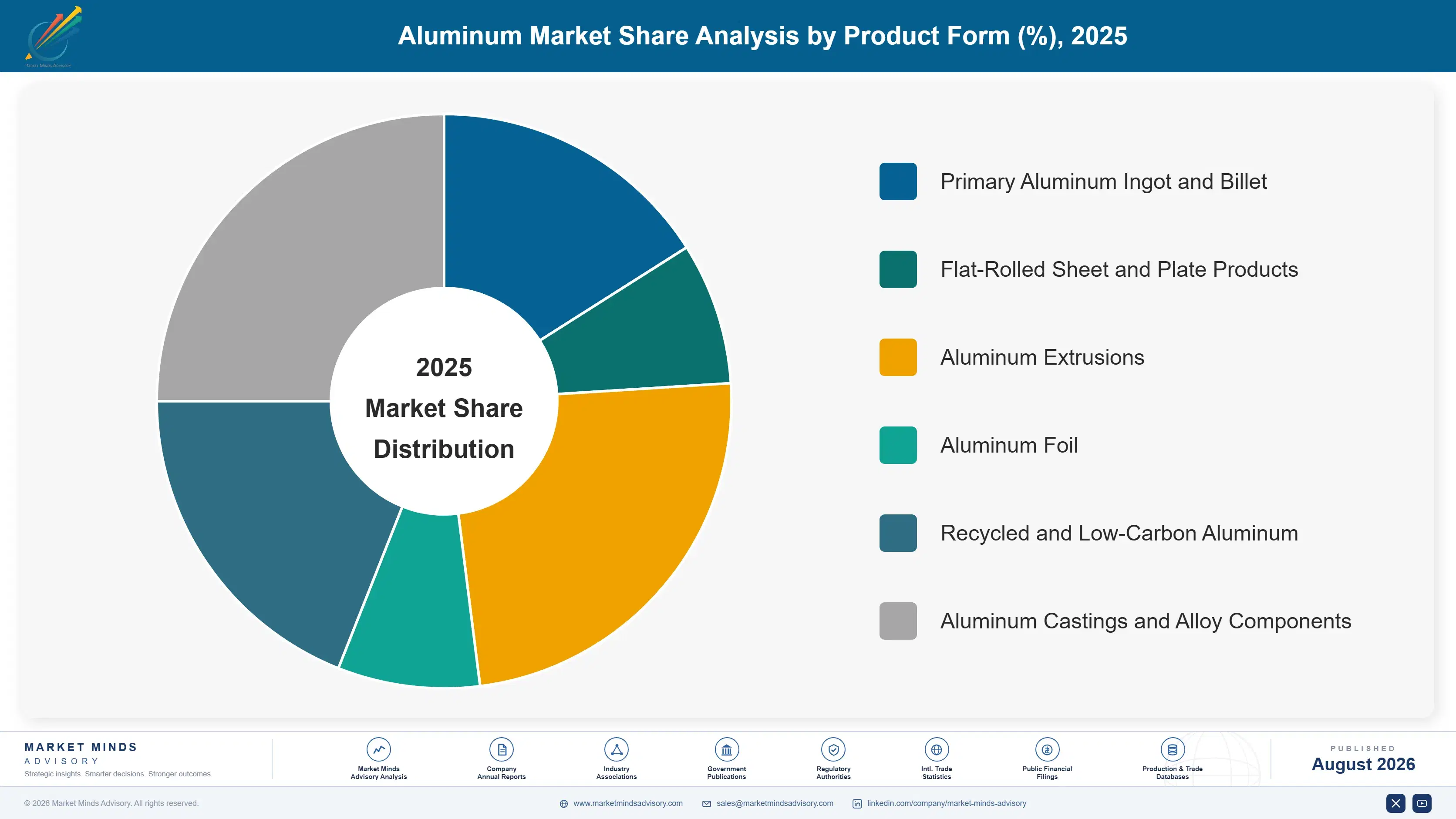
Aluminum splits into six categories by product form, from primary ingot through finished extrusions, foil, and recycled metal. Recycled and low-carbon aluminum is electrifying, so to speak, fastest as decarbonization commitments pull buyers toward verified low-emissions supply, while extrusions gain from electric vehicle and construction demand, and packaging companies pull secondary supply toward its practical scaling limits.
aluminum-chemicals-market-trends-market-share-analysis-1787463597675

Recycled and Low-Carbon Aluminum

Recycled and low-carbon aluminum is growing faster than any other category because automakers and packaging companies increasingly specify verified emissions intensity rather than treating aluminum as an undifferentiated commodity input, and recycled metal requires roughly a twentieth of the electricity that primary smelting consumes per tonne produced. That energy advantage lets recyclers offer both a sustainability story and a genuine cost advantage during periods of high electricity prices, a combination primary producers cannot match without their own renewable power investments. Novelis has expanded recycling capacity specifically to capture this demand, while collection and sorting infrastructure gaps in several regions still constrain how quickly the segment can scale to meet buyer commitments already made public.
CAGR 7.5%

Aluminum Extrusions

Aluminum extrusions are benefiting from two independent demand drivers converging simultaneously: electric vehicle manufacturers substituting extruded aluminum for steel in battery enclosures and structural body components, and construction firms specifying aluminum framing systems in buildings pursuing lower embodied carbon than comparable steel alternatives. Constellium and other specialist extruders have expanded automotive-grade capacity specifically to serve electric vehicle manufacturers, where dimensional precision and alloy consistency requirements exceed typical construction-grade extrusion specifications considerably. This combination of automotive and construction demand gives extrusions a growth rate meaningfully above the broader aluminum market average. Rio Tinto has similarly directed additional extrusion billet output toward automotive customers as this demand accelerates, and this dual demand pattern differentiates extrusions clearly from other product categories.
CAGR 6.2%
Full segment breakdown across 7 segments available in the complete report.

Regional Architecture and Country Demand Map

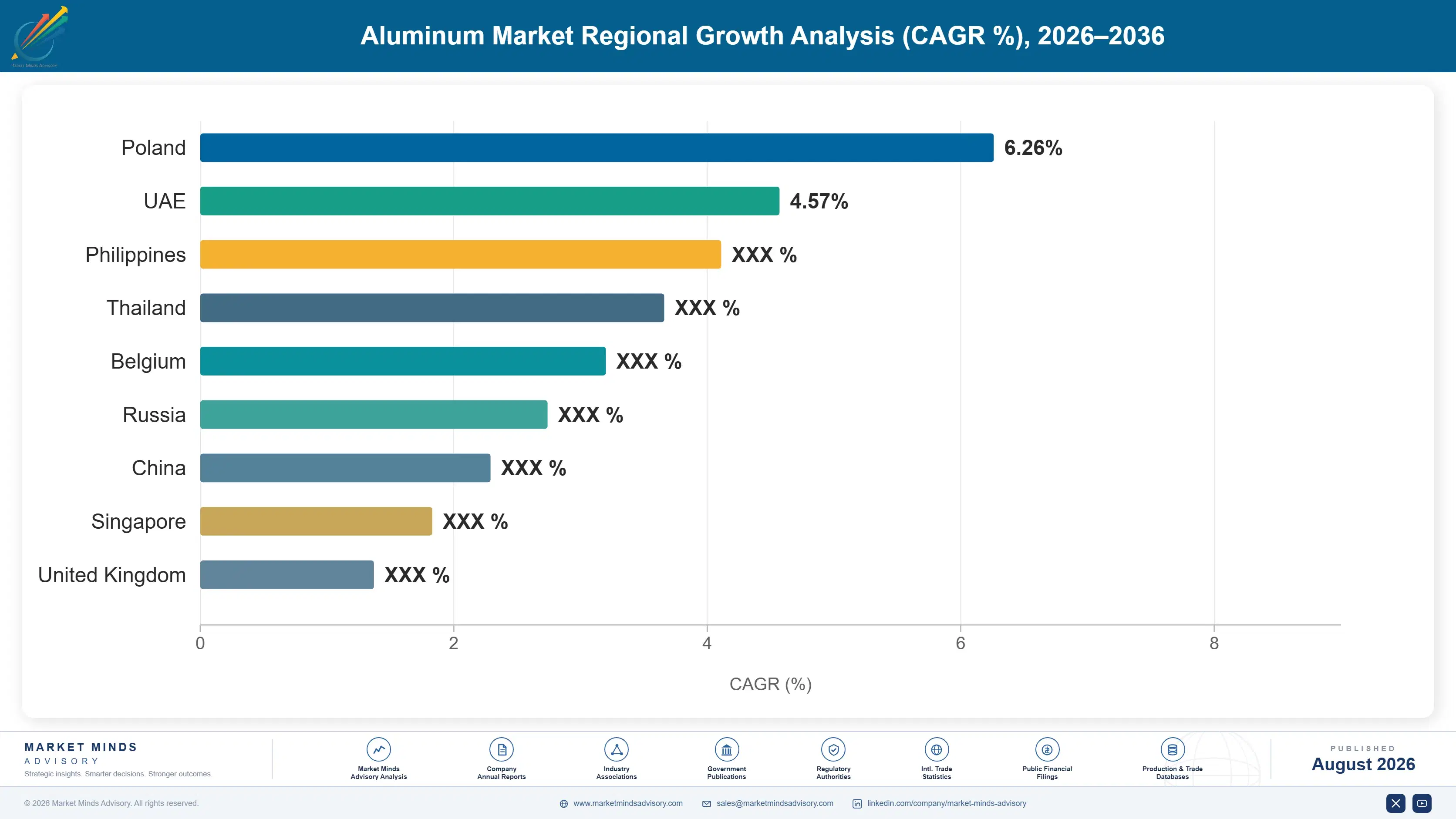
East Asia dominates global aluminum supply, reflecting China's decades-long buildout of smelting capacity that now anchors the world price. North America and Western Europe follow as major consuming regions, while South Asia and Pacific posts the fastest growth on rapid industrial expansion, on rapid industrial expansion and infrastructure investment.

North America

US automakers and beverage can manufacturers drive steady aluminum consumption, increasingly specifying recycled content as sustainability commitments mature across their supply chains, while Alcoa Corporation and Century Aluminum maintain domestic primary smelting capacity that has shrunk over past decades under competition from cheaper Chinese and Gulf-region metal. Canada's hydroelectric-powered smelters in Quebec offer a genuine low-carbon supply advantage that European and American buyers increasingly value under new emissions reporting requirements. Electric vehicle production expansion across the region is adding further extrusion and sheet demand tied directly to new manufacturing plant announcements across several states pursuing large battery and assembly investments, with recycled beverage can content rising steadily as packaging companies expand sustainability commitments.
Share: 22% | CAGR: 4.5% (2026 to 2036)

Western Europe

Norsk Hydro's renewable-powered Norwegian smelters give the region a durable cost and carbon advantage that positions it well as carbon border tariffs penalize higher-emission imports from elsewhere. Germany's automotive sector remains the largest single demand driver for aluminum sheet and extrusions, tightly linked to electric vehicle production volume across several major manufacturing plants. The region's share sits below the standard band because China's smelting scale so heavily dominates global primary supply that no other single region can approach a comparable share today. Recycled aluminum collection infrastructure here remains among the most developed globally, supporting steady secondary supply growth, and several producers are expanding low-carbon certification programs to defend that positioning further.
Share: 20% | CAGR: 2.5% (2026 to 2036)
Regional intelligence for 5 additional markets available in the complete report: East Asia, South Asia and Pacific, Latin America, Middle East and Africa, Eastern Europe. Contact sales@marketmindsadvisory.com.
aluminum-chemicals-market-trends-country-cagr-analysis-1787463598200

Capturing Value as Carbon Intensity Matters

Producers capture the largest margin gains not from selling more metal but from shifting what they sell: verified low-carbon aluminum, recycled content, and long-term supply contracts that lock in premium pricing before competitors catch up. Each lever depends on capability incumbents already have and challengers must still build, and it favors producers who move on it early.

Certify Low-Carbon Aluminum for Premium Contracts

Producers with renewable or nuclear-powered smelting capacity can certify their metal's carbon intensity and sell it into long-term contracts at a premium of roughly 12 to 18 percent over standard primary aluminum, capturing value from buyers whose emissions commitments require documented supply chain data rather than simple recycled content claims. Rio Tinto and Norsk Hydro have both prioritized this certification strategy with automotive and packaging customers rather than competing purely on commodity exchange pricing, since certified supply chains are harder for competitors to replicate quickly without comparable low-carbon power access.
Market Impact: Certified low-carbon metal adds a 12-18% price premium

Expand Recycled Content Blending Capability Further

Producers that invest in scrap sorting and blending technology can offer buyers a flexible mix of recycled and primary content calibrated to specific sustainability targets, generating recurring revenue worth an estimated 10 to 15 percent above comparable primary-only supply contracts. Novelis has expanded this blending capability specifically to capture packaging customers seeking documented recycled content ratios without sacrificing the alloy consistency that primary-only aluminum traditionally guaranteed. Competitors without comparable sorting technology cannot match this flexible blending offer easily, and reinforces multi-year customer loyalty across each contract renewal cycle across every major geography.
Market Impact: Recycled blending adds 10-15% margin over primary-only supply

Lock In Long-Term Power Purchase Agreements

Producers that secure long-term renewable power purchase agreements insulate their margins from the electricity price volatility that periodically compresses smelter profitability by an estimated 30 to 40 percent during price spikes, giving them a meaningful cost stability advantage over competitors exposed to spot electricity markets. Emirates Global Aluminium has pursued this strategy through favorable long-term gas supply arrangements, while several European producers are now pursuing comparable renewable power contracts to defend margin stability during future volatility episodes, and this gap is widening as electricity markets grow more volatile globally across every major producing region.
Market Impact: Power agreements help avoid a 30-40% margin compression

Who Controls the Margin Pool

Concentration sits moderate at a CR5 near 35 percent, reflecting an industry with many mid-sized regional smelters alongside a handful of scale leaders. Chinalco holds the clearest leadership position given its domestic production scale, though the gap between Chinalco and challengers like Rio Tinto and Alcoa Corporation is narrower than in many industrial metals categories, since basic smelting technology is widely accessible and competitive advantage increasingly rests on energy access rather than proprietary process technology.
Current competitive activity centers on low-carbon smelting investment and long-term power purchase agreements, as producers race to defend margins against electricity price volatility while capturing the emerging premium for verified low-emissions metal. Rio Tinto and Norsk Hydro have both expanded certified low-carbon production capacity, while Novelis continues investing in recycled aluminum sorting technology to serve packaging customers with rising recycled content requirements.

Emerging pressure comes from Gulf producers like Emirates Global Aluminium scaling capacity on cheap natural gas advantages, and from Indian producers like Hindalco Industries and Vedanta Aluminium expanding rapidly to serve their large domestic market. Rankings could shift meaningfully over the next decade if Gulf and Indian capacity growth continues outpacing traditional producers in Europe and North America facing higher energy costs.
aluminum-chemicals-market-trends-company-positioning-matrix-1787463598718

Competitive Moat and Risk Dimensions

CHINALCO

Moat: Domestic Production Scale

Chinalco's vast domestic smelting capacity gives it cost advantages tied to China's concentrated coal and hydroelectric power infrastructure, letting it compete on scale that few producers elsewhere can match, particularly for buyers prioritizing supply reliability over certified low-carbon sourcing credentials specifically, and reinforcing its position as the preferred supplier for large industrial buyers.
CHINALCO

Risk: Carbon Intensity Exposure

Chinalco's coal-heavy power mix leaves it exposed as carbon border tariffs and buyer emissions commitments increasingly penalize higher-carbon primary metal, a risk that could erode its cost advantage in export markets over time as certification requirements continue tightening globally, particularly in export markets covered by carbon border adjustment mechanisms.
RIO TINTO

Moat: Low-Carbon Certification Leadership

Rio Tinto has invested early in certified low-carbon aluminum production and traceability systems, positioning it favorably with automotive and packaging customers whose emissions commitments increasingly require documented carbon intensity data rather than simple recycled content claims across every major geography, as more customers formalize supplier scorecards around documented carbon performance.
RIO TINTO

Risk: Diversified Mining Focus

Rio Tinto's broader mining portfolio competes for internal capital allocation against its aluminum business, potentially slowing low-carbon smelting investment relative to focused specialists like Norsk Hydro pursuing aluminum decarbonization as their primary strategic priority, as its exclusive priority across every major capital allocation decision over time.

Players Tracked

Prominent Players

Chinalco
Rio Tinto
Alcoa Corporation
Rusal
Emirates Global Aluminium

Other Key Players

Norsk Hydro
South32
Hindalco Industries
China Hongqiao Group
Novelis
Century Aluminum
Vedanta Aluminium
East Hope Group
Alba
Constellium
Kaiser Aluminum
Aluar Aluminio Argentino
Shandong Xinfa Group
Yunnan Aluminium
UACJ Corporation

Recent Developments

APRIL 2025

Rio Tinto announced an expansion of certified low-carbon aluminum production capacity at its Canadian smelting operations, adding capacity specifically to serve automotive customers requiring documented emissions data across their supply chains ahead of tightening reporting requirements, and reinforcing its position as a preferred supplier for premium-focused vehicle manufacturers.
Signal: Signals producer confidence that certified low-carbon demand will keep sustaining long-term capacity utilization across the industry
OCTOBER 2025

Emirates Global Aluminium entered a long-term supply agreement with a major European automaker to provide certified aluminum across several manufacturing facilities over a multi-year period, capitalizing on its favorable natural gas cost position relative to European competitors, and extending its reach beyond traditional Gulf regional buyers into premium European contracts.
Signal: Confirms automotive buyers increasingly commit to multi-year supply contracts over spot market purchasing across the sector
JANUARY 2026

Novelis expanded its recycled aluminum sorting and processing capacity at a major North American facility, adding technology aimed at increasing recycled content ratios for packaging customers facing rising sustainability mandate requirements across their product lines, and reinforcing its position as a leader in recycled content technology investment.
Signal: Signals a broader competitive shift toward recycled content capability as a genuine differentiator across the industry

Electricity Exposure and Alumina Feedstock

Electricity represents roughly 38 percent of cost of goods sold for primary aluminum smelters, sourced from a mix of coal, hydroelectric, and natural gas generation depending on regional infrastructure, while alumina refined from bauxite ore makes up a further significant share, concentrated among a limited number of large refiners whose own pricing cycles directly influence smelter margins.
European electricity prices spiked sharply during the 2022 energy crisis following supply disruptions tied to reduced natural gas availability, according to IEA energy market reporting, and that spike forced several European smelters to curtail or fully idle production as power costs exceeded what aluminum sale prices could sustain profitably. Smelters without long-term power purchase agreements absorbed the sharpest margin pressure during that period, while those with fixed-price renewable contracts maintained steadier production economics throughout the crisis.

Smelters without long-term power contracts or access to cheap renewable generation absorb electricity price volatility directly in margin, while producers with hydroelectric or natural gas cost advantages, concentrated in Canada, Norway, and the Gulf region, maintain steadier profitability across market cycles. That resilience gap increasingly determines which producers can sustain production during periods of high global energy prices without resorting to capacity curtailment.
aluminum-chemicals-market-trends-cost-volatility-analysis-1787463598914

Long-Term Renewable Power Purchase Agreements

Producers are securing electricity supply through multi-year renewable power purchase agreements rather than relying on spot electricity markets, smoothing cost volatility during periods when broader energy demand pushes power prices higher than budgeted across a given production cycle industry-wide, helping preserve stable margins even when broader industrial power demand elsewhere tightens overall grid capacity.

Diversified Alumina Sourcing Across Multiple Refiners

Producers are securing alumina supply through multiple refiners rather than relying on a single source, smoothing cost volatility during regional supply disruptions that periodically affect specific bauxite mining or alumina refining regions and their surrounding markets, and helping producers maintain smelting output even when a single refiner faces unexpected capacity constraints or delays globally.

Capacity Relocation Toward Low-Cost Power Regions

Some producers are relocating smelting capacity toward regions with abundant low-cost renewable or natural gas power, reducing long-term exposure to volatile electricity markets while positioning their production closer to buyers demanding certified low-carbon supply chains, an approach increasingly valued by producers seeking to avoid dependence on any single national power grid, across every major geography.

Portfolio Architecture for Margin Defence

The market splits across three tiers: commodity primary metal sold on thin margins against global benchmark exchange pricing, certified low-carbon and recycled aluminum sold at a meaningful premium under long-term contracts, and an emerging tier of specialty alloys and value-added fabricated products commanding the highest margins as automakers and aerospace manufacturers seek precise performance specifications, reflecting how quickly the underlying technology and certification mix within the industry keeps shifting.
Volume sits overwhelmingly in commodity primary metal, where producers compete on energy cost and production scale against a wide field of global competitors with limited differentiation opportunity. Premium tension is sharpest in certified low-carbon aluminum, where documented emissions intensity earns meaningfully better margins than undifferentiated primary metal, pulling producer investment toward renewable power access and certification capability disproportionately, as more buyers formalize documented carbon requirements.

High-value margin pools concentrate in certified low-carbon aluminum and specialty alloy products sold to automotive and aerospace manufacturers, a category still smaller in absolute tonnage than commodity primary metal but growing considerably faster and attracting the bulk of producer research investment each year, a pattern likely to continue strengthening as more manufacturers finalize their own decarbonization roadmaps over the coming years.

Volume / Commodity-Adjacent Tier

Standardized primary aluminum ingot and billet sold against global benchmark exchange pricing, competing primarily on electricity cost and production scale across most major producing regions, reflecting the intense price sensitivity these commodity buyers bring to every large-volume procurement decision.
Gross Margin: 6%-12%

Premium / Certified Tier

Certified low-carbon and recycled aluminum sold with documented emissions intensity data, commanding a meaningful premium over standard primary metal across most automotive and packaging contracts, as regulatory pressure continues building steadily across an expanding set of jurisdictions worldwide.
Gross Margin: 18%-26%

Sustainability / Regulatory / Next-Generation Tier

Specialty alloys and value-added fabricated products tied to automotive and aerospace performance specifications, sold into the industry's highest-margin arrangements currently available, as manufacturers seek precise performance guarantees over standardized commodity-grade material specifications.
Gross Margin: 28%-36%
aluminum-chemicals-market-trends-portfolio-architecture-1787463599415

High-value Sub-segments and Strategic Watch-out

Certified Low-Carbon Primary Aluminum

Certified low-carbon primary aluminum commands the category's highest margins and is growing fastest as buyers formalize documented emissions intensity requirements across every major automotive and packaging supply chain currently, and producers with established renewable power access are capturing the bulk of this expanding demand today.

Recycled Aluminum for Packaging

Recycled aluminum for packaging is growing steadily as beverage can manufacturers expand recycled content commitments, though collection infrastructure gaps in several regions continue constraining how quickly supply can scale, a combination increasingly viewed as a competitive necessity rather than an optional differentiator today now each year.

Standardized Primary Aluminum Ingot

The largest volume pool by far, standardized primary ingot generates scale revenue for major producers but offers little margin expansion room given intense global price competition among established smelters, leaving producers to compete mainly on energy cost and established regional logistics networks consistently region-wide too.

Gulf Region Smelting Capacity Growth

Gulf region producers scaling capacity on cheap natural gas could challenge traditional European and North American suppliers on cost over the next decade, a shift worth monitoring closely going forward, particularly if natural gas cost advantages persist longer than currently anticipated by most industry observers.

Contract Cycles and Supply Chain Loyalty

Original equipment demand behaves like an annuity once an automaker or packaging company qualifies a specific supplier's aluminum against its own alloy and quality specifications, since switching suppliers again requires repeating extensive material qualification testing that most manufacturers avoid unless supply is disrupted, giving incumbent producers durable multi-year volume once they win the initial contract and pass the first renewal cycle successfully.
Adoption depth varies by end-use vertical: automotive and aerospace manufacturers show the deepest supplier stickiness given the scale of material qualification testing required for safety-critical applications, while construction and general industrial buyers switch suppliers more readily since their specifications are less stringent and requalification costs correspondingly lower relative to total procurement spend involved, particularly where material specifications rotate more frequently across shorter product design cycles.

A generational shift among younger sustainability and procurement officers toward treating verified carbon intensity as a core purchasing criterion rather than a secondary consideration is pulling supplier selection earlier into buyer decision processes, giving certified low-carbon producers a seat at the table that commodity-focused suppliers historically never had, reshaping how procurement teams weigh certified supply against simple unit price alone.
aluminum-chemicals-market-trends-end-use-penetration-index-1787463599902

Positioning as Carbon Intensity Matters

These are among the four positions where our research anticipates prominent divergence between winners and laggards over the coming forecast period. Each is grounded in the demand model, the regulatory perimeter, and the announced capacity pipeline.
01 / LOW-CARBON CERTIFICATION INVESTMENT

Build low-carbon certification capability ahead of mandatory tariffs

Certified low-carbon aluminum already commands a 12 to 18 percent premium, and producers without renewable power access and documented traceability systems cannot access the long-term contracts that Rio Tinto and Norsk Hydro increasingly dominate with automotive and packaging customers. Building this capability now, even at meaningful capital investment, positions a producer to capture premium pricing before additional jurisdictions phase in comparable carbon border tariffs. Producers who wait risk permanent exclusion from contracts requiring years of certification history to win and open bidding to a wider field of competitors.
02 / RECYCLED CONTENT SCALING

Scale recycled content blending to capture packaging demand growth

Recycled aluminum blending capability adds an estimated 10 to 15 percent margin over primary-only supply, and packaging customers increasingly specify documented recycled content ratios that only producers with sorting technology can reliably deliver. Novelis already demonstrates this model successfully with large beverage can manufacturers facing rising sustainability mandates. Producers who build comparable blending capability now will secure recurring packaging contracts that primary-only competitors cannot match easily spanning both new supply contracts and existing customer relationships across every major packaging segment.
03 / POWER CONTRACT STABILITY

Lock in long-term power agreements to defend margin stability

Electricity price volatility periodically compresses smelter margins by 30 to 40 percent, and producers with long-term renewable or natural gas power agreements avoid this exposure entirely, unlike competitors dependent on spot electricity markets. Emirates Global Aluminium already demonstrates this advantage through favorable long-term gas supply arrangements that European competitors increasingly seek to replicate. Producers securing comparable power contracts now will maintain steadier profitability across future energy market volatility cycles across every region where energy markets remain genuinely volatile and pricing conditions.
04 / INDIAN MARKET LOCALIZATION

Localize capacity in India before domestic producers close the gap

India's aluminum market is growing at roughly 6.5 percent annually, and domestic producers Hindalco Industries and Vedanta Aluminium are scaling capacity rapidly to serve this expanding infrastructure and construction demand. Producers who build local manufacturing capacity now can secure long-term supply relationships before domestic champions capture the bulk of new demand growth entirely. Early localization secures market position before this fast-growing market matures and consolidates further around domestic leaders around a small number of dominant domestic producers over time ahead.

Engagement Snapshot From the Field

A live engagement with an industry participant carrying material or product regulatory and market exposure ahead of a defining policy shift, showing how our research translates into a defensible multi-year portfolio strategy.
MARKET MINDS ADVISORY · CLIENT ENGAGEMENT SUMMARY
Aluminum Producer Strategic Portfolio Review and Transition Roadmap 2026·Investment Scenario on Aluminum Exposure Evaluation 2025-26
CLIENT PROFILE
An automotive component manufacturer supplying body panels and structural parts to several major vehicle brands engaged MMA to guide an aluminum sourcing strategy after customers began requiring documented carbon intensity data as a condition of new supply contracts. The manufacturer's annual aluminum procurement spend exceeded 90 million dollars (client-reported, unverified by MMA), making supplier selection a material decision for its senior operations and sustainability leadership.
STRATEGIC CHALLENGE
The manufacturer's existing suppliers could not consistently provide documented low-carbon aluminum at the volume and alloy specification required, creating risk that the company would lose contract renewals with vehicle manufacturers now formalizing supplier carbon intensity scorecards as part of their own emissions reduction commitments, threatening a meaningful share of the manufacturer's forward order book.
MMA APPROACH
MMA benchmarked certified low-carbon aluminum suppliers against documented emissions data and alloy consistency, modeled the cost premium of switching a portion of supply, and structured a phased transition plan prioritizing the vehicle programs facing the nearest customer compliance deadlines across the manufacturer's product lineup, drawing on comparable transitions completed at similarly sized component manufacturers elsewhere.
KEY FINDINGS
  1. Switching to certified low-carbon aluminum for priority programs secured two major contract renewals ahead of schedule, validating the sourcing strategy earlier than the original engagement timeline anticipated.
  2. The cost premium for certified supply was smaller than initially budgeted once volume discounts were negotiated directly, improving the program's overall return on investment meaningfully.
  3. A phased transition across three vehicle programs avoided the supply disruption a full switch would have created, keeping production schedules on track throughout the transition period.
  4. Supplier traceability documentation proved as valuable to sustaining customer relationships as the material switch itself, giving leadership confidence to expand the program further.
CLIENT PROFILE
An automotive component manufacturer supplying body panels and structural parts to several major vehicle brands engaged MMA to guide an aluminum sourcing strategy after customers began requiring documented carbon intensity data as a condition of new supply contracts. The manufacturer's annual aluminum procurement spend exceeded 90 million dollars (client-reported, unverified by MMA), making supplier selection a material decision for its senior operations and sustainability leadership.
STRATEGIC CHALLENGE
The manufacturer's existing suppliers could not consistently provide documented low-carbon aluminum at the volume and alloy specification required, creating risk that the company would lose contract renewals with vehicle manufacturers now formalizing supplier carbon intensity scorecards as part of their own emissions reduction commitments, threatening a meaningful share of the manufacturer's forward order book.
MMA APPROACH
MMA benchmarked certified low-carbon aluminum suppliers against documented emissions data and alloy consistency, modeled the cost premium of switching a portion of supply, and structured a phased transition plan prioritizing the vehicle programs facing the nearest customer compliance deadlines across the manufacturer's product lineup, drawing on comparable transitions completed at similarly sized component manufacturers elsewhere.
KEY FINDINGS
  1. Switching to certified low-carbon aluminum for priority programs secured two major contract renewals ahead of schedule, validating the sourcing strategy earlier than the original engagement timeline anticipated.
  2. The cost premium for certified supply was smaller than initially budgeted once volume discounts were negotiated directly, improving the program's overall return on investment meaningfully.
  3. A phased transition across three vehicle programs avoided the supply disruption a full switch would have created, keeping production schedules on track throughout the transition period.
  4. Supplier traceability documentation proved as valuable to sustaining customer relationships as the material switch itself, giving leadership confidence to expand the program further.
RECOMMENDED STRATEGY
Phase 1: Phase 1 (Months 1-3): Switch the highest-priority vehicle program to certified low-carbon supply first, the program facing the nearest customer compliance deadline. Phase 2: Phase 2 (Months 4-9): Extend certified sourcing across two additional vehicle programs with continued monitoring, negotiating volume discounts to offset the certified supply premium. Phase 3: Phase 3 (Months 10-15): Complete transition across remaining programs and finalize supplier scorecard reporting, closing out the transition on schedule and within budget.
OUTCOME
The manufacturer completed its phased sourcing transition within the recommended fifteen-month window and secured contract renewals with two major vehicle brands ahead of schedule (client-reported, unverified by MMA), strengthening its competitive position heading into the next major supplier review cycle, strengthening its position ahead of upcoming customer sustainability audits.

Frequently Asked Questions

Foundational context covering the market sizes, CAGR, scope, country, region and competition that inform every finding below. This section is provided to cover basics and most often pre-purchase conversations, answered from the MMA Primary Research Dataset.

What is the current size of the Aluminum Market?

The global aluminum market was valued at approximately $175.0 billion in 2025. Low-carbon and recycled aluminum already account for a meaningful and growing share of total supply.

How large will the Aluminum Market be by 2036?

MMA projects the market will reach approximately $275.16 billion by 2036, roughly 1.51 times its 2026 value. Low-carbon aluminum adoption drives much of this expansion.

What is the CAGR for the Aluminum Market 2026 to 2036?

The market is projected to grow at a 4.2 percent compound annual rate between 2026 and 2036. Bull and bear scenarios range from 3.0 to 5.3 percent.

Which segment is growing fastest?

Recycled and low-carbon aluminum is the fastest-growing segment at a 7.5 percent CAGR, well above the overall market rate. Verified emissions intensity data increasingly drives buyer specification.

Who are the major companies in the Aluminum Market?

Leading producers include Chinalco, Rio Tinto, Alcoa Corporation, Rusal, and Emirates Global Aluminium. Together they hold a CR5 near 35 percent of global capacity of global production capacity today.

Which country is growing fastest?

India posts the fastest national growth at roughly 6.5 percent, driven by rapid infrastructure investment and expanding domestic smelting capacity. Government electrification programs are sustaining this demand.

Report Segmentation Architecture

The full report scope spans multiple orthogonal segmentation dimensions, with cross-tabulated demand data provided for each dimension pair. Coverage extends further to regional breakdowns, trend trajectories, and the competitive detail needed to support segment-level decision-making.

By Product Form

  • Primary Aluminum Ingot and Billet
  • Flat-Rolled Sheet and Plate Products
  • Aluminum Extrusions
  • Aluminum Foil
  • Recycled and Low-Carbon Aluminum
  • Aluminum Castings and Alloy Components

By End-Use Industry

  • Automotive and Transportation
  • Construction and Infrastructure
  • Packaging
  • Electrical and Electronics
  • Aerospace and Defense
  • Industrial Machinery

By Commercial Dimension

  • Direct Mill Supply Contracts
  • Distributor and Service Center Sales
  • Long-Term Certified Low-Carbon Agreements
  • Spot Exchange Trading

By Region

  • North America
  • Western Europe
  • East Asia
  • South Asia and Pacific
  • Latin America
  • Middle East and Africa
  • Eastern Europe

Scope, Methodology, and Coverage

Every figure in this report is reproducible from documented input assumptions. The scope below maps the historical period, the forecast horizon, the segmentation dimensions, and the countries covered, alongside the underlying primary and qualitative methodology.
Historical Period
2020 to 2025
Forecast Period
2026 to 2036
Base Year
2025 (USD billions; MMA Primary Research Dataset, August 2026)
Market Definition
The aluminum market covers primary aluminum ingot and billet, flat-rolled sheet and plate products, extrusions, foil, recycled and low-carbon aluminum, and aluminum castings and alloy components sold to automotive, construction, packaging, and industrial manufacturers. It excludes bauxite mining and alumina refining sold as standalone commodities.
Quantitative Units
USD billions (current prices); metric tonnes for volume detail
Segmentation Dimensions
By Product Form; By End-Use Industry; By Commercial Dimension; By Region
Regions Covered
North America, Western Europe, East Asia, South Asia and Pacific, Latin America, Middle East and Africa, Eastern Europe
Countries Covered
China, USA, India, Russia, Canada, Australia, UAE, Bahrain, Brazil, Norway, Germany, France, UK, Japan, South Korea, Iceland, Qatar, Saudi Arabia, South Africa, Mozambique, Indonesia, Vietnam, Poland, Netherlands, Italy, Spain, Argentina, Mexico, Malaysia, and additional markets relevant to this sector
Key Companies Profiled
Chinalco, Rio Tinto, Alcoa Corporation, Rusal, Emirates Global Aluminium, Norsk Hydro, South32, Hindalco Industries, China Hongqiao Group, Novelis, Century Aluminum, Vedanta Aluminium, East Hope Group, Alba, Constellium, Kaiser Aluminum, Aluar Aluminio Argentino, Shandong Xinfa Group, Yunnan Aluminium, UACJ Corporation
Quantitative Methodology
Primary survey, n=3,800 respondents, Q4 2025, six countries; demand-side model with trade association cross-validation
Qualitative Methodology
47 expert interviews, Q4 2025; applied to validate demand model assumptions, identify emerging dynamics, and assess competitive positioning
Report Format
PDF and XLSX data workbook (Word format preview document)
Publisher
Market Minds Advisory
Report Code
MMA-2026-CHM-103
Published
August 2026
Contact
sales@marketmindsadvisory.com | www.marketmindsadvisory.com

Purchase the full Aluminum Market Report (2026 to 2036).

The full Aluminum Market report delivers a comprehensive 2026 to 2036 forecast across six product form categories, seven regions, and twenty profiled companies active in this sector. It includes detailed segmentation by end-use industry, electricity and alumina cost modeling, and competitive benchmarking measured against a single consistent production capacity basis throughout. Analysts document the decarbonization and recycled content trends reshaping producer positioning across the industry. Buyers receive full access to the underlying data tables, regional breakouts, and a customizable Excel model built for scenario planning.
2026-2036 volume and value forecasts by segment
Six-category product form breakdown and detailed analysis
Seven-region market sizing and share detail
Twenty-company competitive profiles and full benchmarking
Electricity and alumina cost sensitivity modeling
Editable Excel forecast workbook with scenario toggles

Built For The People Who Decide

From boardroom strategy to bench-side execution, this report is read cover-to-cover by leaders shaping the next decade of their industry, turning demand scenarios, market dynamics and valuation benchmarks into decisions.
CXOs/ Presidents/ VPs/ Managers
M&A and Corporate Development
Strategy Teams and R&D Heads
Procurement and Product Directors
Regulatory and Compliance Leaders
Investor Relations and Equity Analysts