Market Minds Advisory
Aluminium Ammonium Sulphate Market

Aluminium Ammonium Sulphate Market: Grade Economics, Regulatory Narrowing, and the Coagulant That Keeps Losing to Polyaluminium Chloride

Ammonium alum earns almost nothing as a bulk coagulant and a great deal as a pharmacopoeial or food-grade salt, yet most producers still run plants sized for the business they are steadily losing.

Lead Analyst

Lisa Gevelber

Published

September 2026

Make Smarter Decisions with Customized Research Insights

Request a free sample report and evaluate market opportunities, growth trends, and competitive dynamics relevant to your business needs.

2025 MARKET VALUE$0.3BMarket Size 2025
2036 FORECAST VALUE$0.5BBase Case , 2026 to 2036
CAGR 2026 TO 20364.1 %Bull 5.3% / Bear 2.9%
INCREMENTAL OPPORTUNITY$0.2BNet 10- year value creation
EXPANSION MULTIPLE1.52x2036 value over 2026 base
Strategic Levers
M&A Pipeline
Regional Outlook
Country Rankings
Competitive Intelligence
Segmental Deep-dive
Call-Us : 91 93563 13602

Executive Snapshot and Market Trajectory

Ammonium alum is really several markets sharing one molecular formula. The same salt sells for a few hundred dollars a tonne into water treatment and for many multiples of that as a pharmacopoeial or reagent grade, and the difference is documentation and crystal purity rather than chemistry.
Commercial power sits with producers holding pharmacopoeial and food specification approvals rather than with those holding the most capacity. Polyaluminium chloride keeps taking municipal coagulation volume because it performs better across a wider pH range, which erodes the bulk business steadily. Cosmetic and personal care grade grows fastest at 7.1%, roughly 1.73 times the market, carried by alum crystal deodorant demand. East Asia holds 30% of value.
Concentration is low, with the top five holding around 31% of capacity, since crystallisation is not technically demanding and dozens of Chinese and Indian producers operate at regional scale. Regulation has narrowed use rather than expanded it: European rules restrict aluminium ammonium sulphate as a food additive to a short list of applications, while Japanese food processing continues to use it widely in pickling and confectionery. Certification is the real barrier here.
Market Definition
This report covers aluminium ammonium sulphate, also known as ammonium alum, produced and sold as a crystalline or powdered salt across technical, water treatment, food additive, pharmacopoeial, cosmetic, and analytical reagent grades. Value is measured at producer level on a dodecahydrate equivalent basis. Aluminium sulphate, potassium alum, sodium alum, polyaluminium chloride, and other aluminium coagulants fall outside scope, as do finished formulations such as deodorant sticks and baking powder blends.
Base Year Value
$0.3B in 2025 (MMA Primary Research Dataset, August 2026)
Forecast Period
2026 to 2036, eleven discrete annual values
CAGR
4.1% base case. Bull 5.3%. Bear 2.9%.
Fastest Growth Segment
Cosmetic and Personal Care Grade: 7.1% CAGR
Fastest Growth Country
India: 6.7% CAGR
Fastest Growth Region
South Asia and Pacific: 6.2% CAGR
Largest Region
East Asia: 30% of 2025 global value
Market Leaders
Nippon Light Metal Holdings, Chemtrade Logistics, Kemira, GFS Chemicals, Merck KGaA. Source: MMA Analysis based on company annual reports.
Primary Survey
n=3,800 procurement and R&D decision-makers, Q4 2025, six countries
Methodology
Demand-side build-up, cross-validated against public data, 47 expert interviews

Aluminium Ammonium Sulphate Market Forecast Scenarios

aluminium-ammonium-sulphate-market-size-forecast-scenario-1787462285637
Growth between 2020 and 2025 was slow and shaped by grade mix. Bulk coagulant volume drifted downward as municipal water utilities across Europe and North America converted to polyaluminium chloride, while pharmacopoeial, reagent, and cosmetic grades grew at far higher unit values. Ammonia price movements after 2021 pushed selling prices up sharply, so the 3.5% historical growth reflects feedstock inflation as much as tonnage.
The 4.1% base case rests on three mechanisms. Specification grade demand keeps growing as pharmaceutical, diagnostic, and analytical laboratories expand across Asia, and those buyers pay for monograph compliance rather than for aluminium content. Alum crystal deodorant demand keeps rising through natural personal care retail in Europe, North America, and increasingly India. And Japanese and Korean food processing sustains steady food-grade offtake in pickling, chestnut preparation, and confectionery applications where no substitute performs identically.
The 5.3% bull case assumes cosmetic and pharmacopoeial demand accelerates while ammonia costs stay elevated, lifting realised prices across the book. The 2.9% bear case reflects faster municipal conversion to polyaluminium chloride combined with further regulatory narrowing of permitted food additive uses in major jurisdictions. Neither outcome changes the fundamental grade economics that separate producers in this market.

Why Grade, Not Volume, Sets Price

Three forces shape this small market, and only one of them is growth. Municipal water treatment, historically the volume anchor, keeps converting to polyaluminium chloride, which works across a wider pH range and needs less alkalinity correction. Regulatory review has narrowed permitted food additive applications rather than widening them. And specification grades, sold to laboratories, formulators, and personal care brands, keep growing quietly at prices the bulk business never sees.
TOP-FIVE CONCENTRATION31%Share of global production capacity held by leading suppliers
AVERAGE SELLING PRICE$690/tonneBlended price across technical and specification grade material
FOOD GRADE SHARE14%Portion of output meeting food additive specification requirements
AMMONIA COST SHARE27%Ammonium sulphate feedstock as proportion of production cost
CAPACITY UTILISATION67%Average loading across crystallisation and drying plant assets
TRADE INTENSITY48%Share of output crossing a border before final use
That leaves an unusual commercial character for an inorganic salt. Crystallisation and drying are straightforward, so nobody wins on process technology. What separates producers is whether their plant holds food-grade certification, whether their material meets a pharmacopoeial monograph consistently batch after batch, and whether their documentation survives a pharmaceutical customer's audit. Those capabilities cost money to maintain and generate far more value than extra capacity would.
The next decade rewards deliberate narrowing. Producers still competing for municipal coagulant tenders against polyaluminium chloride are defending a position that chemistry has already decided, and that tonnage is not coming back. The ones performing best have shrunk capacity, invested in certification, and accepted lower utilisation in exchange for a book where every tonne carries a specification the customer cannot source casually.
"Nobody has ever won an alum tender on product quality, because the product is a well-understood salt. They win on whether the certificate of analysis holds up when a regulator reads it, which is a completely different capability."
Director, Inorganic Specialty Chemicals Practice · MMA Specialty Chemicals / Inorganic Salts Practice · August 2026

Market Trends

Alum Crystal Deodorants Drive Personal Care Grade Demand

Natural personal care retail has grown a category built on alum crystal deodorant sticks and sprays, marketed heavily on the absence of conventional antiperspirant salts even though the active is itself an aluminium compound. European Scientific Committee on Consumer Safety opinions have set concentration limits for aluminium in cosmetic products, which brands treat as a compliance framework rather than an obstacle. Demand growth of 7.1% comes with unusually attractive economics, because personal care brands buy small volumes of highly specified material and care far more about heavy metal profiles and consistency than about price per tonne.
Market Impact: Adds 5.4% reagent segment growth

Pharmacopoeial Compliance Separates Two Otherwise Identical Products

United States and European Pharmacopoeia monographs specify identity, purity, heavy metal limits, and assay ranges for alum, and material meeting those requirements sells at several times the technical grade price despite identical chemistry. Pharmaceutical and diagnostic buyers require documented batch consistency, validated analytical methods, and facilities that withstand customer audit. Producers who invest in that system convert a commodity salt into a qualified supply position. Those who do not remain locked in bulk tenders regardless of how pure their crystal actually is, because purity without documentation cannot be sold at a premium.
Market Impact: Anchors 14% of total output

Market Opportunities and Growth Drivers

Laboratory and Diagnostic Expansion Lifts Reagent Grade Volume

Analytical reagent alum is consumed across academic laboratories, clinical diagnostics, water testing, and industrial quality control, and that installed base keeps expanding as Asian research and healthcare infrastructure grows. Indian and Chinese laboratory chemical consumption has risen consistently through 2024 and 2025 alongside new institutional capacity. Reagent buyers purchase in kilogram quantities at prices per kilogram that bulk customers pay per tonne, so modest volume growth translates into meaningful value. Distribution matters more than manufacturing here, because laboratory buyers order through catalogue channels rather than through chemical tenders. Catalogue positions rarely face a competitive tender at all.
Market Impact: Displaced 22% of municipal volume

Japanese Food Processing Sustains Reliable Food Grade Offtake

Aluminium ammonium sulphate remains widely used in Japanese food manufacturing as a firming agent in pickled vegetables, in chestnut and sweet potato preparation where it stabilises colour, and in certain confectionery processes. No substitute reproduces the same texture and colour outcomes, which makes the demand genuinely inelastic within those applications. Japanese and Korean processors buy to tight specification with established supplier relationships that have run for decades. The volume is not large but it is dependable, well priced, and effectively closed to any producer without food-grade certification and a proven quality history.
Market Impact: Cut European food uses to 2

Market Restraints and Challenges

Polyaluminium Chloride Keeps Displacing Municipal Coagulant Volume

Polyaluminium chloride flocculates effectively across a wider pH range, consumes less alkalinity, produces less sludge, and dose-for-dose removes turbidity more efficiently than alum does. The root cause is chemical rather than commercial: pre-hydrolysed aluminium species simply outperform a simple salt in most raw water conditions. European and North American utilities have converted steadily, and Asian municipalities are following as treatment plants are upgraded. Alum producers respond by targeting utilities with raw water chemistry where alum still performs acceptably, by supplying industrial rather than municipal treatment, and by exiting the tender business entirely.
Market Impact: Delivers 7.1% annual segment growth

Regulatory Review Has Narrowed Permitted Food Additive Uses

European food additive rules restrict aluminium ammonium sulphate to a short list of applications, principally egg white products and sugared fruit and vegetable preparations, following reassessment of dietary aluminium exposure against the tolerable weekly intake. The root cause is cumulative exposure arithmetic rather than any finding specific to this compound. Commercially the effect is a permanently smaller European food-grade market and uncertainty about further review elsewhere. Producers respond by concentrating food-grade supply on Japanese and Asian applications, by diversifying toward pharmacopoeial and cosmetic grades, and by maintaining certification even where volumes are modest.
Market Impact: Commands 4x technical grade pricing
3 additional market trends, 2 additional growth drivers, and 4 additional restraints and challenges are covered in the full report. Contact sales@marketmindsadvisory.com to access the complete intelligence.

Segment CAGR and Growth Architecture

Segmentation follows grade specification, a single commercial logic that determines price, qualification requirements, and which customers may legally purchase the material at all. Grade decides everything that matters here, since the underlying chemistry is identical across every segment. Application industries and distribution channels appear separately in the framework as commercial dimensions rather than as parallel segments.
aluminium-ammonium-sulphate-market-market-share-analysis-1787462286176

Cosmetic and Personal Care Grade

Growth of 7.1%, roughly 1.73 times the market, comes from a category that barely existed commercially twenty years ago. Alum crystal deodorants, aftershave blocks, and astringent preparations sell through natural personal care retail on positioning that emphasises what the product does not contain, and brands specify tight heavy metal profiles, consistent crystal habit, and documented cosmetic-grade manufacture. Volumes per customer are small, so the economics resemble a specialty ingredient business rather than a chemical one. European Scientific Committee on Consumer Safety guidance provides a stable compliance framework brands work within comfortably. The commercial risk is category fashion rather than regulation, since consumer positioning built on ingredient avoidance can reverse quickly.
CAGR 7.1%

Pharmacopoeial Grade

Material meeting United States and European Pharmacopoeia monographs sells at several times technical grade pricing for chemistry that is otherwise indistinguishable. Growth of 6.3% follows pharmaceutical and diagnostic manufacturing expansion, particularly across India, China, and Southeast Asia. What buyers actually purchase is documented batch consistency, validated analytical method data, and a facility that survives audit, none of which a producer can assemble quickly. Qualification typically takes twelve to eighteen months and, once complete, rarely gets revisited because changing a qualified excipient source triggers regulatory work that nobody undertakes voluntarily. That combination makes the segment unusually durable for a commodity inorganic salt. Producers without validated quality systems cannot enter this segment at any price.
CAGR 6.3%
Full segment breakdown across 6 segments available in the complete report.

Regional Architecture and Country Demand Map

East Asia holds the largest share at 30%, combining Chinese production capacity with Japanese food processing demand that has no substitute. South Asia and Pacific grows fastest as Indian pharmaceutical and laboratory consumption expands, while Western Europe declines in relative terms under regulatory narrowing. North America holds specification value.

North America

Specification grades carry this market while bulk volume erodes underneath. Pharmaceutical excipient and analytical reagent demand is strong and well priced, supplied through catalogue distributors and qualified suppliers into laboratories, diagnostics manufacturers, and formulators across New Jersey, Massachusetts, and California. Municipal water treatment demand continues converting to polyaluminium chloride as utilities upgrade plants, and that conversion is effectively permanent once dosing systems are reconfigured. Leather tanning demand persists at modest scale in specialty operations. Chemtrade and regional producers supply industrial water treatment where raw water chemistry still favours simple aluminium salts. Regional growth of 3.3% reflects mix improvement rather than any recovery in tonnage. Certification, not capacity, decides who participates profitably here.
Share: 23% | CAGR: 3.3% (2026 to 2036)

Western Europe

Regulation has shaped this market more than commercial forces have. European food additive rules restrict aluminium ammonium sulphate to a short list of permitted applications following reassessment of dietary aluminium exposure, which permanently reduced the food-grade pool. Municipal conversion to polyaluminium chloride is further advanced here than almost anywhere, particularly across Germany, the Netherlands, and Scandinavia. What remains is high-value: pharmacopoeial supply to pharmaceutical manufacturers, reagent grade through laboratory distribution, and a growing cosmetic grade demand serving natural personal care brands in France, Germany, and the United Kingdom. Growth of 2.5% is the slowest of any region and reflects a market that has narrowed deliberately rather than declined accidentally. The remaining market is small but well priced.
Share: 19% | CAGR: 2.5% (2026 to 2036)
Regional intelligence for 5 additional markets available in the complete report: East Asia, South Asia and Pacific, Latin America, Middle East and Africa, Eastern Europe. Contact sales@marketmindsadvisory.com.
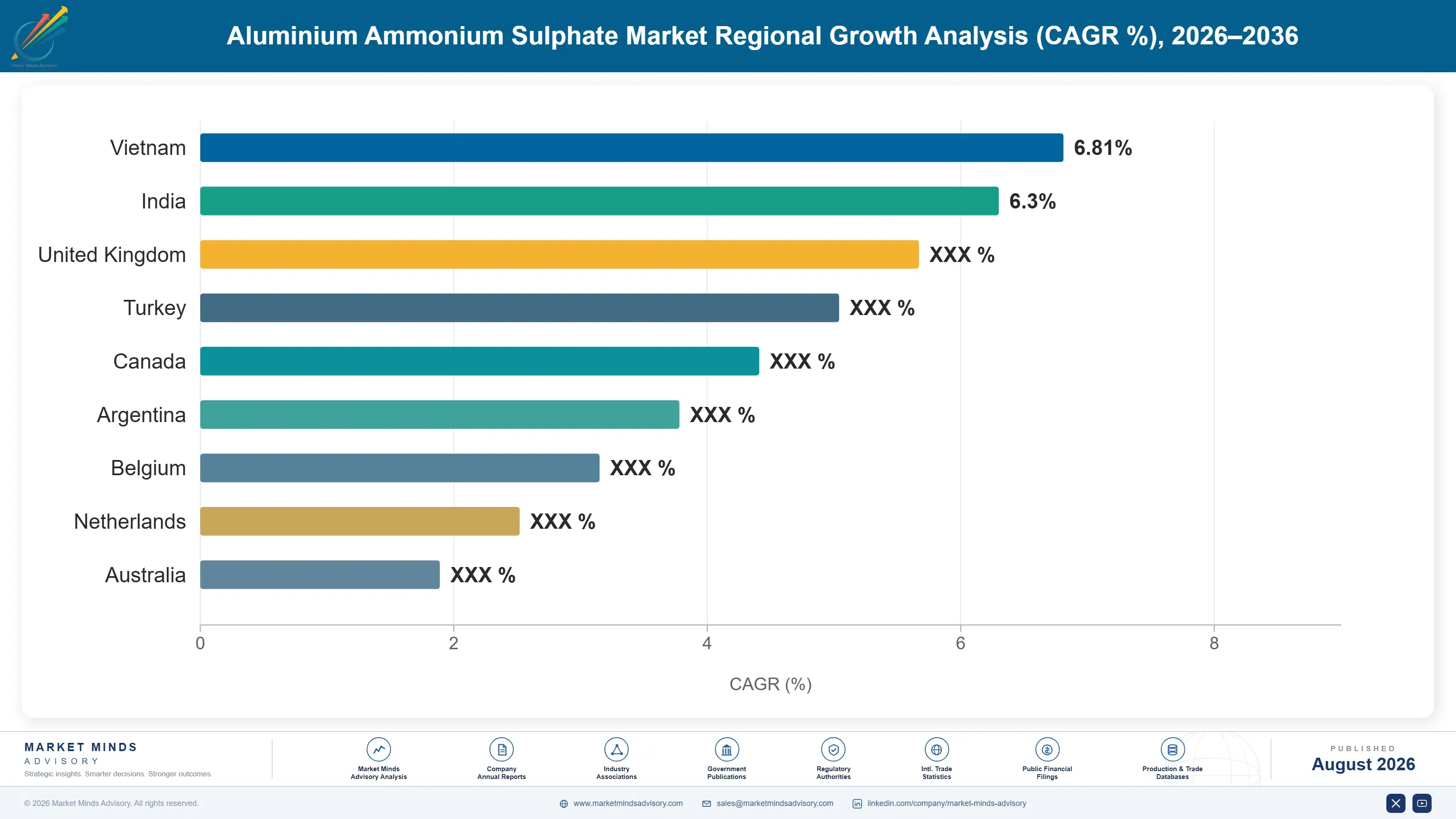
aluminium-ammonium-sulphate-market-country-cagr-analysis-1787462286692

Where Alum Margin Actually Lives

Competing for municipal coagulant tenders is a way to lose slowly against better chemistry. The four moves below shift revenue toward positions where documentation, qualification, and consistency matter more than price per tonne: pharmacopoeial certification, cosmetic specification, catalogue distribution, and the deliberate retirement of capacity that no longer earns. None of the four requires new plant.

Qualify Plants Against Pharmacopoeial Monographs and Customer Audits

Material meeting United States and European Pharmacopoeia requirements sells at roughly four times technical grade pricing for identical chemistry, and the barrier is quality systems rather than crystallisation skill. Building validated analytical methods, batch documentation, and audit-ready facilities costs around $2.5 million and takes eighteen months. Once a pharmaceutical customer qualifies the source, changing it triggers regulatory work they will avoid indefinitely, so the position lasts for years. Most regional producers have never attempted this, which is precisely why the pricing has held. The real barrier here is patience and paperwork rather than chemistry.
Market Impact: Delivers roughly 4x the technical grade selling price

Serve Personal Care Brands With Specified Small Volumes

Alum crystal deodorant brands buy tonnes rather than shiploads, specify heavy metal profiles and crystal habit tightly, and pay accordingly because ingredient cost is trivial against their retail price. Setting up cosmetic-grade manufacture, documentation, and small-lot packaging costs perhaps $900,000 and opens a segment growing at 7.1%. The commercial rhythm suits a producer willing to run short campaigns rather than continuous bulk production. Brands also stay loyal, since reformulating a deodorant around a new supplier's crystal is disruptive out of proportion to any saving available. Campaign scheduling suits a smaller producer rather well.
Market Impact: Opens the fastest growing segment at 7.1% annually

Reach Laboratory Buyers Through Catalogue Distribution Channels

Analytical reagent alum sells per kilogram at prices bulk customers pay per tonne, and laboratory buyers order through catalogue distributors rather than through chemical tenders. Producers who package, label, and certify to reagent specification, then partner with established laboratory distributors, access a channel that never sees a competitive tender at all. Margins run 30% to 45% above technical grade after distribution cost. The work is packaging and documentation rather than manufacturing, which makes it unusually capital-light for the return it generates. Distributors handle the customer relationship entirely, which suits a producer with no sales network.
Market Impact: Earns 30 to 45% above technical grade pricing

Retire Capacity Aimed at Municipal Coagulant Tenders

Polyaluminium chloride outperforms alum across a wider pH range with less sludge and lower alkalinity demand, and roughly 22% of municipal volume has already converted. Holding capacity for that business means running crystallisers at 67% utilisation while bidding against a superior product. Deliberate retirement of one line, redirecting maintenance capital toward certification instead, typically improves blended margin by 5 to 8 points within two years. Utilisation falls further and earnings improve, which is counterintuitive enough that most operators refuse to do it. Falling utilisation while earnings rise is genuinely difficult to explain internally.
Market Impact: Improves blended margin by 5 to 8 points

Who Controls the Margin Pool

The top five hold roughly 31% of global capacity, measured consistently as aluminium ammonium sulphate production capability on a dodecahydrate equivalent basis. Concentration is low because crystallisation from aluminium sulphate and ammonium sulphate is straightforward, and dozens of Chinese and Indian operators run regional plants. The gap between leaders and challengers is entirely certification depth: which grades a producer can legally supply and to which customers.
Competition runs along three lines that rarely intersect. Bulk water treatment supply is contested on delivered cost, increasingly against polyaluminium chloride rather than against other alum producers. Specification grade supply is contested on quality systems and audit history, where Merck, GFS, and a handful of qualified Asian producers hold positions others cannot enter quickly. Japanese food-grade supply is effectively a closed relationship market built over decades.

Two pressures are reshaping positions. Chinese producers continue taking technical and water treatment volume on delivered cost across Asia, Africa, and Latin America, compressing regional manufacturers everywhere. Meanwhile the bulk pool itself keeps shrinking as utilities convert. Rankings will shift among mid-sized producers holding capacity but no pharmacopoeial, food, or cosmetic certification, since they face a contracting market with nothing differentiated to move toward.
aluminium-ammonium-sulphate-market-company-positioning-matrix-1787462287221

Competitive Moat and Risk Dimensions

NIPPON LIGHT METAL HOLDINGS

Moat: Japanese Food Grade Relationships

The company supplies food-grade alum into Japanese pickling, chestnut processing, and confectionery applications through relationships measured in decades, where specification consistency matters more than price. Japanese food manufacturers qualify suppliers slowly and change them almost never. That position is effectively closed to outside entrants regardless of product quality, and it generates dependable volume at attractive and stable pricing.
NIPPON LIGHT METAL HOLDINGS

Risk: Domestic Market Contraction

Japanese food processing volumes track a shrinking and ageing population, and traditional pickled vegetable consumption has declined steadily for years. The relationships are durable but the underlying demand base is not growing. Without meaningful export development into other Asian food markets, an advantaged position gradually applies to a smaller pool of demand each year.
MERCK KGAA

Moat: Reagent Distribution and Certification

Merck supplies analytical reagent and pharmacopoeial grade alum through a laboratory distribution network reaching institutional buyers who order by catalogue rather than by tender. That channel carries pricing per kilogram which bulk customers pay per tonne, and the certification and documentation behind it are trusted without further audit. Competitors must build both the quality system and the distribution reach.
MERCK KGAA

Risk: Marginal Portfolio Position

Alum is a very small line within an enormous life science catalogue, so it receives limited commercial attention and no dedicated development effort. Focused specialty producers can undercut on price while matching specification for buyers willing to qualify an alternative. In price-sensitive Asian laboratory markets, that erosion is already visible among institutional purchasers comparing catalogue costs.

Players Tracked

Prominent Players

Nippon Light Metal Holdings
Chemtrade Logistics
Kemira
GFS Chemicals
Merck KGaA

Other Key Players

Thermo Fisher Scientific
Loba Chemie
Spectrum Chemical Manufacturing
American Elements
Central Drug House
Otto Chemie
Nikunj Chemicals
Salvi Chemical Industries
Shandong Fengyuan Chemical
Hunan Xiangheng Chemical Technology
Sinopharm Chemical Reagent
Alpha Chemika
Nihon Kagaku Sangyo
Wuxi Yatai United Chemical
Bhagyalaxmi Chemicals

Recent Developments

MARCH 2025

Indian specialty producers expand pharmacopoeial excipient capability

Several Indian specialty chemical producers extended pharmacopoeial grade capability across inorganic excipients including alum, investing in validated analytical methods and audit-ready documentation systems. The investment targets domestic formulation manufacturers who had previously imported qualified excipient material from European and American suppliers at considerable cost. Qualification programmes began during the year.
Signal: Excipient qualification capability is migrating toward the formulation manufacturing base rather than remaining with Western suppliers.
SEPTEMBER 2024

European utilities continue polyaluminium chloride conversion programmes

Municipal water utilities across Germany, the Netherlands, and Scandinavia continued converting coagulation systems from simple aluminium salts to polyaluminium chloride during plant upgrade cycles, citing lower sludge production and reduced alkalinity correction. Alum suppliers serving those contracts reported volume losses that dosing system changes make effectively permanent.
Signal: Municipal coagulant conversion is a one-way transition, since reconfigured dosing systems rarely revert to simple salts.
JUNE 2025

Natural personal care brands expand alum crystal deodorant ranges

Several European and North American natural personal care brands broadened alum crystal deodorant ranges across retail and online channels, specifying tightly controlled heavy metal profiles and cosmetic-grade manufacturing documentation from suppliers. Volumes remain small in tonnage terms but carry pricing several multiples above technical grade material of identical chemistry.
Signal: Personal care specification, rather than tonnage, is where incremental alum value is being created most reliably.

Ammonia, Sulphuric Acid, and Energy

Ammonium sulphate feedstock accounts for roughly 27% of production cost, priced against ammonia and therefore against natural gas across Europe, North America, and Asia. Aluminium sulphate or alumina hydrate contributes a further 29%, sourced from bauxite processing operations in China, Australia, and Brazil. Sulphuric acid takes around 11%, and energy for dissolution, crystallisation, and drying absorbs 14%.
European ammonia production was curtailed heavily through 2022 as gas prices rose to levels that made operation uneconomic, with IEA reporting documenting the scale of the increase, and ammonium sulphate pricing moved sharply upward alongside it. Alum producers passed costs through where grade positioning allowed and absorbed them where bulk tenders did not, which widened the earnings gap between specification and commodity producers considerably. Kemira referenced raw material and energy inflation across its 2022 and 2023 annual reporting.

Exposure divides between bulk and specification producers rather than by size. Bulk suppliers bidding annual municipal tenders carry fixed prices against variable feedstock and absorb every movement. Specification producers reprice with less resistance, because a pharmaceutical customer facing requalification will accept an increase rather than change source. Chinese producers, sitting close to both feedstocks, held delivered cost advantage and expanded export share.
aluminium-ammonium-sulphate-market-cost-volatility-analysis-1787462287418

Index bulk tender pricing against published ammonia benchmarks

Fixed-price annual municipal contracts against variable ammonia feedstock is a structure that only works when input prices fall. Writing indexation clauses referencing published ammonia or ammonium sulphate benchmarks removes the exposure without requiring the customer to accept unpredictable pricing. Utilities resist initially, then accept once the alternative is explained as an annual renegotiation instead.

Shift mix toward grades that reprice without customer resistance

Pharmaceutical, reagent, and cosmetic customers accept price increases because requalifying a source costs them more than the increase does. Bulk tender customers accept nothing. Deliberately moving mix toward specification grades therefore reduces feedstock exposure at portfolio level, independent of any hedging activity, and it does so permanently rather than for the length of a contract.

Secure alumina hydrate supply under multi-year contracted terms

Alumina hydrate pricing follows bauxite and refining economics that move independently of ammonia markets, so contracting it separately and on longer terms smooths the combined input basket. Producers close to refining operations in China and Australia have an inherent cost position others cannot match. For everyone else, contract length is the available substitute for proximity.

Portfolio Architecture for Margin Defence

Three tiers separate on certification rather than on anything a chemist would recognise. Technical and water treatment grade sold into municipal and industrial tenders earns 9% to 16%, and competes increasingly against a superior coagulant rather than against other alum. Food and cosmetic grade material carrying certification and documented specification earns 24% to 34%. Pharmacopoeial and reagent grades earn most of all, and that gap has widened steadily since 2021.
The tension is between plant loading and portfolio quality, and the correct answer is uncomfortable. Bulk tonnage keeps crystallisers running, but it is the volume actively disappearing to polyaluminium chloride and the volume that absorbs every ammonia price movement without recourse. Producers who have retired a line and redirected maintenance capital toward certification report better earnings on lower utilisation, which contradicts every operating instinct in a chemicals business.

High-value pools concentrate where the customer cannot switch casually. Pharmacopoeial excipient supply, Japanese food-grade relationships, and cosmetic-grade specification all carry qualification costs on the buyer's side that make price comparison largely irrelevant to the purchasing decision. Those qualification costs sit on the buyer's side of the transaction, which is exactly why price comparison rarely decides the outcome.

Volume / Commodity-Adjacent Tier

Technical and water treatment grade sold into municipal and industrial coagulation tenders on delivered cost. Competes against polyaluminium chloride as much as against other producers. The wide range reflects large differences in feedstock proximity and plant scale.
Gross Margin: 9%-16%

Premium / Certified Tier

Food additive grade and cosmetic grade material carrying certification, documented specification, and controlled heavy metal profiles. Buyers pay for compliance and consistency. Range width separates standard food grade from tightly specified cosmetic supply within the tier.
Gross Margin: 24%-34%

Sustainability / Regulatory / Next-Generation Tier

Pharmacopoeial excipient and analytical reagent grades supported by validated methods, batch documentation, and audit history. Qualification cost on the buyer side, rather than production economics, sustains the margin structure across this tier.
Gross Margin: 38%-52%
aluminium-ammonium-sulphate-market-portfolio-architecture-1787462287921

High-value Sub-segments and Strategic Watch-out

Pharmacopoeial Excipient Grade

Highest value in the market, growing at 6.3% with pharmaceutical manufacturing expansion across Asia. Qualification takes twelve to eighteen months and is rarely revisited, because changing a qualified excipient source triggers regulatory work nobody undertakes voluntarily. Quality systems are the barrier. Capacity is not the constraint anywhere.
Gross Margin: 40%-52%

Cosmetic and Personal Care Grade

Fastest growth at 7.1%, carried by alum crystal deodorant demand through natural personal care retail. Small volumes, tight specifications, and pricing largely detached from tonnage economics. The genuine risk here is category fashion rather than regulatory restriction. Brands rarely switch once a formulation performs on shelf.
Gross Margin: 30%-42%

Water Treatment and Technical Grade

The volume core and the position losing ground to polyaluminium chloride permanently, since converted dosing systems rarely revert. It loads crystallisers and absorbs every ammonia price movement without recourse. Retain only what fixed-cost recovery genuinely requires. Everything else in the portfolio should be funded from somewhere else.
Gross Margin: 8%-15%

European Food Additive Grade

The strategic watch-out. Regulatory reassessment has already narrowed permitted applications to a short list, and further review elsewhere cannot be ruled out. Maintain certification because it is cheap, but do not size capacity or capital plans against this pool. Treat it as a retained option, not a growth position.
Gross Margin: 22%-32%

Why Specification Grades Rarely Change

Revenue in the specification grades behaves as a long annuity, which is unusual for an inorganic salt. A pharmaceutical formulator qualifying an excipient source runs analytical comparison, stability work, and regulatory filing updates, and having completed that will not revisit the decision for as long as supply holds. Typical qualified excipient tenure runs eight to twelve years. Japanese food-grade relationships run longer still, in several cases measured across generations of purchasing managers rather than contract cycles.
Stickiness varies enormously across the book. Pharmacopoeial excipient supply is the most durable, protected by regulatory requalification cost on the buyer's side. Japanese food-grade positions come next, protected by relationship history and specification consistency. Cosmetic supply sits in the middle, sticky while a brand's formulation holds. Municipal water treatment is the least sticky of all, retendered annually on delivered price with no attachment whatsoever to the incumbent supplier from one year to the next.

Buyer profiles have changed noticeably. Quality and regulatory affairs now lead supplier selection in the specification grades, and questions about analytical method validation and audit history arrive well before any discussion of price per kilogram.
aluminium-ammonium-sulphate-market-end-use-penetration-index-1787462288412

Where Alum Producers Should Focus

These are among the four positions where our research anticipates prominent divergence between winners and laggards over the coming forecast period. Each is grounded in the demand model, the regulatory perimeter, and the announced capacity pipeline.
01 / PHARMACOPOEIAL GRADE QUALIFICATION

Build monograph compliance and audit readiness, not more capacity

Material meeting United States and European Pharmacopoeia requirements sells at roughly four times the technical grade price for chemistry that is otherwise indistinguishable, and the barrier is quality systems rather than crystallisation skill or plant scale. Building validated analytical methods, batch documentation, and audit-ready facilities costs around $2.5 million across eighteen months, which is modest against the pricing it secures permanently. Once a pharmaceutical customer qualifies a source, changing it triggers regulatory work they will actively avoid for a decade or longer.
02 / BULK CAPACITY RETIREMENT

Retire coagulant capacity rather than defending a lost chemistry contest

Polyaluminium chloride simply outperforms alum across a wider pH range with less sludge and lower alkalinity demand, and roughly 22% of all municipal volume has already converted permanently because reconfigured dosing systems very rarely revert to simple salts. Holding capacity for that business means running crystallisers at 67% utilisation while bidding annually against a demonstrably superior product. Retiring a line and redirecting maintenance capital toward certification typically improves blended margin by 5 to 8 points within two years, on lower volume.
03 / PERSONAL CARE POSITIONING

Serve deodorant brands with small, tightly specified campaign volumes

Alum crystal deodorant brands buy in tonnes rather than in shiploads, specify heavy metal profiles and crystal habit very closely, and pay accordingly because ingredient cost is trivial against the retail price they command. Establishing dedicated cosmetic-grade manufacture, documentation, and small-lot packaging costs perhaps $900,000 and opens the fastest-growing segment in the whole market at 7.1% annually. Brands rarely switch, since reformulating a deodorant around a different supplier's crystal is disruptive far out of proportion to whatever saving might be available.
04 / FEEDSTOCK INDEXATION DISCIPLINE

Stop writing fixed-price tenders against variable ammonia feedstock

Ammonium sulphate accounts for roughly 27% of production cost and prices against ammonia, which prices against natural gas, as European producers discovered painfully through 2022 when widespread curtailment moved values sharply upward. Fixed annual municipal contracts written against that exposure only work while input prices are falling, and they have not been. Index all bulk tender pricing against published ammonia benchmarks instead, and shift portfolio mix toward specification grades whose customers accept increases rather than face their own requalification costs.

Engagement Snapshot From the Field

A live engagement with an industry participant carrying material or product regulatory and market exposure ahead of a defining policy shift, showing how our research translates into a defensible multi-year portfolio strategy.
MARKET MINDS ADVISORY · CLIENT ENGAGEMENT SUMMARY
Aluminium Ammonium Sulphate Producer Strategic Portfolio Review and Transition Roadmap 2026·Investment Scenario on Aluminium Ammonium Sulphate Exposure Evaluation 2025-26
CLIENT PROFILE
An Indian inorganic chemicals producer operating two crystallisation plants supplying aluminium ammonium sulphate and related salts, with annual revenue near USD 62 million (client-reported, unverified by MMA). Around 74% of alum output went to municipal and industrial water treatment tenders across western India, with the remainder split between textile mordant applications and a small unqualified laboratory supply relationship.
STRATEGIC CHALLENGE
Municipal tender pricing had been flat for three years while ammonium sulphate costs rose sharply, cutting alum gross margin to 7%. Two large utility customers were evaluating polyaluminium chloride conversion, and management had no view on whether pharmaceutical or cosmetic grade entry was realistic given the plant's existing configuration and quality systems.
MMA APPROACH
MMA assessed both plants against pharmacopoeial and cosmetic grade requirements, costing the gap in analytical capability, documentation systems, and facility upgrades. Tender profitability was rebuilt using actual delivered feedstock costs rather than standard costing. Domestic pharmaceutical excipient demand was sized against import substitution potential, with findings tested through 47 expert interviews during Q4 2025.
KEY FINDINGS
  1. Municipal tender volume was contributing 4% gross margin on average, and two of the six contracts were loss-making once actual ammonium sulphate costs were correctly allocated.
  2. The newer plant required roughly USD 1.9 million in analytical and documentation investment to meet pharmacopoeial monograph requirements, well below a greenfield alternative.
  3. Domestic formulation manufacturers were importing qualified excipient alum from European suppliers at landed costs 3.4 times the client's technical grade selling price.
  4. Cosmetic grade entry needed only packaging and heavy metal control investment, but no domestic deodorant brand was large enough to justify the campaign scheduling alone.
CLIENT PROFILE
An Indian inorganic chemicals producer operating two crystallisation plants supplying aluminium ammonium sulphate and related salts, with annual revenue near USD 62 million (client-reported, unverified by MMA). Around 74% of alum output went to municipal and industrial water treatment tenders across western India, with the remainder split between textile mordant applications and a small unqualified laboratory supply relationship.
STRATEGIC CHALLENGE
Municipal tender pricing had been flat for three years while ammonium sulphate costs rose sharply, cutting alum gross margin to 7%. Two large utility customers were evaluating polyaluminium chloride conversion, and management had no view on whether pharmaceutical or cosmetic grade entry was realistic given the plant's existing configuration and quality systems.
MMA APPROACH
MMA assessed both plants against pharmacopoeial and cosmetic grade requirements, costing the gap in analytical capability, documentation systems, and facility upgrades. Tender profitability was rebuilt using actual delivered feedstock costs rather than standard costing. Domestic pharmaceutical excipient demand was sized against import substitution potential, with findings tested through 47 expert interviews during Q4 2025.
KEY FINDINGS
  1. Municipal tender volume was contributing 4% gross margin on average, and two of the six contracts were loss-making once actual ammonium sulphate costs were correctly allocated.
  2. The newer plant required roughly USD 1.9 million in analytical and documentation investment to meet pharmacopoeial monograph requirements, well below a greenfield alternative.
  3. Domestic formulation manufacturers were importing qualified excipient alum from European suppliers at landed costs 3.4 times the client's technical grade selling price.
  4. Cosmetic grade entry needed only packaging and heavy metal control investment, but no domestic deodorant brand was large enough to justify the campaign scheduling alone.
RECOMMENDED STRATEGY
Phase 1: Phase 1 (months one to five): exit the two loss-making municipal tenders and index the remaining four against published ammonium sulphate benchmarks. Phase 2: Phase 2 (months six to twenty): invest in analytical and documentation capability at the newer plant and pursue pharmacopoeial qualification with three formulators. Phase 3: Phase 3 (months twenty-one to thirty-two): add cosmetic grade packaging capability and pursue export personal care customers alongside domestic brands.
OUTCOME
The producer exited both loss-making tenders and reported alum gross margin improving from 7% to 18% within sixteen months despite lower volume (client-reported, unverified by MMA). Two pharmaceutical qualifications completed and a third is in progress. Crystalliser utilisation fell to 58%, which management now treats as an acceptable outcome.

Frequently Asked Questions

Foundational context covering the market sizes, CAGR, scope, country, region and competition that inform every finding below. This section is provided to cover basics and most often pre-purchase conversations, answered from the MMA Primary Research Dataset.

What is the current size of the Aluminium Ammonium Sulphate Market?

The market was valued at USD 0.30 billion in 2025, rising to an estimated USD 0.31 billion in 2026. East Asia holds the largest regional share at 30% of global value.

How large will the Aluminium Ammonium Sulphate Market be by 2036?

MMA forecasts USD 0.47 billion by 2036 under the base case, an expansion multiple of 1.52 times the 2026 level. Incremental value creation across the period reaches USD 0.16 billion.

What is the CAGR for the Aluminium Ammonium Sulphate Market 2026 to 2036?

The base case CAGR is 4.1%, with a bull case of 5.3% and a bear case of 2.9%. Historical growth between 2020 and 2025 ran at 3.5%, reflecting feedstock inflation more than tonnage.

Which segment is growing fastest?

Cosmetic and personal care grade, at 7.1%, roughly 1.73 times the overall market rate. Alum crystal deodorant demand through natural personal care retail carries almost all of that growth.

Who are the major companies in the Aluminium Ammonium Sulphate Market?

Nippon Light Metal Holdings, Chemtrade Logistics, Kemira, GFS Chemicals, and Merck KGaA lead, holding roughly 31% of capacity between them. Numerous Chinese and Indian producers follow.

Which country is growing fastest?

India, at 6.7%, driven by pharmaceutical excipient demand and expanding laboratory infrastructure. Domestic producers are investing in monograph compliance to displace imported qualified material from Europe.

Report Segmentation Architecture

The full report scope spans multiple orthogonal segmentation dimensions, with cross-tabulated demand data provided for each dimension pair. Coverage extends further to regional breakdowns, trend trajectories, and the competitive detail needed to support segment-level decision-making.

By Grade Specification

  • Technical Grade
  • Water Treatment Grade
  • Food Additive Grade
  • Pharmacopoeial Grade
  • Cosmetic and Personal Care Grade
  • Analytical Reagent Grade

By End-Use Industry

  • Municipal and Industrial Water Treatment
  • Food Processing and Preservation
  • Pharmaceutical and Diagnostic Manufacturing
  • Personal Care and Cosmetics
  • Leather Tanning and Textile Processing

By Commercial Dimension

  • Direct Industrial Supply
  • Municipal Tender Contracts
  • Laboratory Catalogue Distribution
  • Specialty Ingredient Supply

By Region

  • North America
  • Western Europe
  • East Asia
  • South Asia and Pacific
  • Latin America
  • Middle East and Africa
  • Eastern Europe

Scope, Methodology, and Coverage

Every figure in this report is reproducible from documented input assumptions. The scope below maps the historical period, the forecast horizon, the segmentation dimensions, and the countries covered, alongside the underlying primary and qualitative methodology.
Historical Period
2020 to 2025
Forecast Period
2026 to 2036
Base Year
2025 (USD billions; MMA Primary Research Dataset, August 2026)
Market Definition
The market comprises aluminium ammonium sulphate, commonly known as ammonium alum, produced and traded as a crystalline or powdered salt across technical, water treatment, food additive, pharmacopoeial, cosmetic and personal care, and analytical reagent grades. Value is measured at producer level on a dodecahydrate equivalent basis. Aluminium sulphate, potassium alum, sodium alum, polyaluminium chloride, and other aluminium-based coagulants fall outside scope, as do finished consumer formulations including deodorant sticks and packaged baking powder.
Quantitative Units
USD billions (current prices); tonnes dodecahydrate equivalent; USD per tonne average selling price
Segmentation Dimensions
By Grade Specification; By End-Use Industry; By Commercial Dimension; By Region
Regions Covered
North America, Western Europe, East Asia, South Asia and Pacific, Latin America, Middle East and Africa, Eastern Europe
Countries Covered
USA, China, Germany, France, UK, Japan, South Korea, India, Australia, Canada, Brazil, Mexico, Indonesia, Vietnam, Thailand, Malaysia, UAE, Saudi Arabia, South Africa, Nigeria, Turkey, Poland, Netherlands, Italy, Spain, Sweden, Switzerland, Argentina, Colombia, Singapore, and additional markets relevant to this sector
Key Companies Profiled
Nippon Light Metal Holdings, Chemtrade Logistics, Kemira, GFS Chemicals, Merck KGaA, Thermo Fisher Scientific, Loba Chemie, Spectrum Chemical Manufacturing, American Elements, Central Drug House, Otto Chemie, Nikunj Chemicals, Salvi Chemical Industries, Shandong Fengyuan Chemical, Hunan Xiangheng Chemical Technology, Sinopharm Chemical Reagent, Alpha Chemika, Nihon Kagaku Sangyo, Wuxi Yatai United Chemical, Bhagyalaxmi Chemicals
Quantitative Methodology
Primary survey, n=3,800 respondents, Q4 2025, six countries; demand-side model with trade association cross-validation
Qualitative Methodology
47 expert interviews, Q4 2025; applied to validate demand model assumptions, identify emerging dynamics, and assess competitive positioning
Report Format
PDF and XLSX data workbook (Word format preview document)
Publisher
Market Minds Advisory
Report Code
MMA-2026-CHM-241
Published
August 2026
Contact
sales@marketmindsadvisory.com | www.marketmindsadvisory.com

Purchase the full Aluminium Ammonium Sulphate Market Report (2026 to 2036).

The full report sizes aluminium ammonium sulphate demand across six grade specifications and seven regions with 2026 to 2036 forecasts under base, bull, and bear cases. It quantifies municipal coagulant conversion to polyaluminium chloride by country, showing how much bulk volume remains genuinely addressable. Competitive profiles cover twenty producers assessed consistently on dodecahydrate equivalent capacity and certification depth by grade. Regulatory analysis maps food additive permissions, pharmacopoeial monograph requirements, and cosmetic concentration limits across major jurisdictions. Commercial guidance addresses qualification investment, capacity retirement, personal care entry, and feedstock indexation.
Six grade specifications sized and forecast separately
Coagulant conversion quantified by country and utility type
Twenty producer profiles on consistent capacity basis
Certification requirements mapped by grade and jurisdiction
Pharmacopoeial qualification cost and timeline benchmarks provided
Ammonia feedstock exposure modelled across producer types

Built For The People Who Decide

From boardroom strategy to bench-side execution, this report is read cover-to-cover by leaders shaping the next decade of their industry, turning demand scenarios, market dynamics and valuation benchmarks into decisions.
CXOs/ Presidents/ VPs/ Managers
M&A and Corporate Development
Strategy Teams and R&D Heads
Procurement and Product Directors
Regulatory and Compliance Leaders
Investor Relations and Equity Analysts