

Market Minds Advisory
Alternative Protein Market

Alternative Protein Market: The Repeat Purchase Problem, Dairy's Quiet Resilience, and Fermentation Doing What Extrusion Could Not

Plant-based meat never had a trial problem, it had a repeat purchase problem, and the category spent five years and considerable capital discovering that those two things require completely different fixes.

Lead Analyst

Lisa Gevelber

Published

September 2026

Make Smarter Decisions with Customized Research Insights

Request a free sample report and evaluate market opportunities, growth trends, and competitive dynamics relevant to your business needs.

2025 MARKET VALUE$31.4BMarket Size 2025
2036 FORECAST VALUE$75.5BBase Case , 2026 to 2036
CAGR 2026 TO 20368.3 %Bull 9.6% / Bear 7.0%
INCREMENTAL OPPORTUNITY$41.5BNet 10- year value creation
EXPANSION MULTIPLE2.22x2036 value over 2026 base
Strategic Levers
M&A Pipeline
Regional Outlook
Country Rankings
Competitive Intelligence
Segmental Deep-dive
Call-Us : 91 93563 13602

Executive Snapshot and Market Trajectory

Alternative protein has two halves and only one of them is in trouble. Dairy and beverage substitutes keep growing steadily on taste, convenience, and a genuine functional case, while plant-based meat spent three years discovering that people who tried it once did not come back.
Commercial power sits with companies whose products work as food rather than as substitutes. Repeat purchase rates near 23% across plant-based meat exposed a product problem that marketing spend could not close, and the ultra-processed criticism arrived precisely when the category needed goodwill. Cultivated meat and seafood grows fastest at 26.8%, roughly 3.23 times the market, from a base close to nothing commercially. East Asia holds 29% of value.
The market is barely concentrated at roughly 14% for the top five, because it assembled from start-ups, dairy groups, and meat processors hedging simultaneously. Regulation is fragmenting rather than converging: American approvals for cultivated meat arrived in 2023 while Italy banned domestic production and Florida and Alabama banned sale, and European novel food assessment still runs around 31 months. Fragmentation is now the operating condition rather than a phase, and nobody plans around it easily.
Market Definition
This report covers protein products for human consumption produced without conventional animal agriculture, spanning plant protein extraction and texturisation, biomass fermentation proteins, precision fermentation proteins, cultivated meat and seafood, insect protein for human food, and algal protein. Value is measured at retail and foodservice sales value of finished products and at ingredient level where sold as inputs. Animal feed proteins, conventional dairy and meat, and pulses sold as whole foods fall outside scope.
Base Year Value
$31.4B in 2025 (MMA Primary Research Dataset, August 2026)
Forecast Period
2026 to 2036, eleven discrete annual values
CAGR
8.3% base case. Bull 9.6%. Bear 7.0%.
Fastest Growth Segment
Cultivated Meat and Seafood: 26.8% CAGR
Fastest Growth Country
India: 11.2% CAGR
Fastest Growth Region
South Asia and Pacific: 10.4% CAGR
Largest Region
East Asia: 29% of 2025 global value
Market Leaders
Danone, Oatly Group, Beyond Meat, Impossible Foods, Monde Nissin. Source: MMA Analysis based on company annual reports.
Primary Survey
n=3,800 procurement and R&D decision-makers, Q4 2025, six countries
Methodology
Demand-side build-up, cross-validated against public data, 47 expert interviews

Alternative Protein Market Forecast Scenarios

alternative-protein-market-size-forecast-scenario-1787462267126
The 2020 to 2025 period contained a boom and a correction inside five years. Plant-based meat expanded rapidly through 2020 and 2021 on distribution gains and investor enthusiasm, then retail unit sales declined across the United States and United Kingdom as repeat purchase failed to materialise and ultra-processed criticism gained traction. Dairy alternatives held up throughout. The 7.1% historical growth conceals two categories moving in opposite directions entirely.
The 8.3% base case rests on three mechanisms. Dairy and beverage alternatives keep growing on taste and functional positioning rather than on ethical argument, and they represent 57% of category value already. Biomass and precision fermentation keep scaling, delivering protein functionality that extrusion never matched and doing so with shorter ingredient lists. And Asian demand keeps rising from a base where soy-derived protein foods are mainstream rather than substitutes, which changes the conversation completely.
The 9.6% bull case assumes fermentation-derived proteins reach cost parity and reformulate plant-based meat into products people actually repurchase. The 7.0% bear case reflects continued plant-based meat contraction in Western retail alongside regulatory fragmentation that keeps cultivated products confined to a handful of jurisdictions indefinitely. Fermentation cost curves will decide which of those two cases arrives.

Why Repeat Purchase Decided Everything

Three things decided this market and none of them was consumer intent. Repeat purchase came first, because trial rates were high and the category read that as validation rather than warning. Ingredient perception came second, as ultra-processed criticism landed on products defending themselves with long declaration lists. And price came third, with a premium near 68% that shoppers accepted once and rarely twice.
TOP-FIVE CONCENTRATION14%Share of global alternative protein value held collectively
AVERAGE PRICE PREMIUM68%Uplift over conventional animal protein at comparable retail shelf
REPEAT PURCHASE RATE23%Share of trial buyers returning within a twelve-week window
DAIRY ALTERNATIVE SHARE57%Portion of category value supplied by beverage and dairy substitutes
CAPACITY UTILISATION48%Average loading across extrusion and fermentation production assets
NOVEL FOOD APPROVAL TIME31 monthsTypical European authorisation duration for fermentation-derived protein ingredients
The commercial character now splits cleanly. Dairy and beverage alternatives behave like ordinary food categories, competing on taste and price against conventional equivalents and winning often enough to keep growing. Plant-based meat behaves like a technology looking for a product, with capacity built against forecasts that assumed trial would convert. Fermentation sits in between, technically credible and commercially unproven, with regulatory timelines that make planning difficult.
The next decade turns on whether fermentation fixes what extrusion could not. Biomass and precision fermentation deliver texture, binding, and mouthfeel through mechanisms extrusion only approximates, with shorter ingredient lists that answer the processing criticism directly. If those routes reach cost parity, plant-based meat gets a second chance with a genuinely better product. If they do not, the category consolidates around dairy alternatives and stays there.
"Everyone in this category obsessed over converting meat eaters and nobody spent enough on the second purchase. Trial was never the constraint. The constraint was that the product had to be good enough to buy again."
Director, Protein Transition and Emerging Foods Practice · MMA Food Technology / Protein Transition Practice · August 2026

Market Trends

Biomass Fermentation Displaces Extruded Plant Protein Formats

Mycoprotein and microbial biomass proteins arrive with fibrous structure already formed, which removes the texturisation step that extrusion performs imperfectly and that requires methylcellulose and other binders to hold together. Quorn built the category over decades, and newer producers have added capacity across Europe and North America. The commercial advantage is a shorter ingredient declaration that answers ultra-processed criticism directly rather than arguing with it. Fermentation also decouples protein supply from crop cycles and land, though capital intensity remains high and utilisation across the sector sits well below design. Nobody has yet reached the cost of extruded protein.
Market Impact: Supplies 57% of category value

Regulatory Fragmentation Traps Cultivated Products Geographically

Singapore approved cultivated chicken in 2020, American regulators cleared two producers in 2023, and Israel followed in 2024, while Italy banned domestic production in 2023 and Florida and Alabama prohibited sale during 2024. European novel food assessment continues without a decision. That patchwork means a product legal in one jurisdiction is a criminal offence in another, which makes capacity siting and investment planning close to impossible. Companies have responded by concentrating on the few permissive markets and by pursuing ingredient applications rather than whole-cut products. Investment planning under those conditions is close to guesswork at present.
Market Impact: Adds 9.3% regional growth rate

Market Opportunities and Growth Drivers

Dairy Alternatives Grow on Function Rather Than Ideology

Oat, almond, and soy beverages sell to households buying for taste in coffee, for lactose tolerance, or simply because the product performs, and that purchasing logic has proved far more durable than the ethical positioning that carried plant-based meat. Dairy and beverage substitutes now supply 57% of category value and continue growing across every major region. Barista formulations in particular created a foodservice channel that conventional dairy previously owned outright. The category also carries a shorter ingredient list, which insulated it from the processing criticism that damaged meat analogues. Function sells the repeat purchase; ideology never did.
Market Impact: Repeat purchase near 23%

Asian Demand Treats Plant Protein as Ordinary Food

Soy milk, tofu, tempeh, and wheat gluten products are mainstream staples across China, Japan, Korea, Indonesia, and Vietnam rather than substitutes for something else, which removes the entire framing problem that Western marketing created for itself. Consumption grows with income and packaged food penetration rather than with dietary conviction, and modern retail expansion keeps adding distribution. Chinese national agricultural planning has explicitly included plant-based and cultivated protein development since 2022. The commercial implication is that Asian growth requires product quality and distribution rather than category persuasion. Category persuasion is unnecessary and frequently counterproductive in those markets.
Market Impact: Carries 68% price premium

Market Restraints and Challenges

Repeat Purchase Failure Undermined the Whole Plant-Based Meat Case

Trial rates for plant-based meat were consistently high across Western retail, but repeat purchase settled near 23% within twelve weeks, which means the category was selling curiosity rather than food. The root cause was product performance: texture, flavour release, and cooking behaviour did not match expectations set by the packaging or the price. Marketing spend cannot fix that, and several years of it demonstrated as much. Responses include reformulation using fermentation-derived ingredients, repositioning toward vegetarian rather than flexitarian buyers, and pricing that stops assuming a premium is defensible. Nobody in the category enjoyed learning that particular lesson.
Market Impact: Cuts ingredient list by 40%

Price Premium Persists Despite Scale and Capacity Overhang

Plant-based products still carry roughly a 68% premium over conventional animal protein at comparable retail shelf, despite substantial capacity investment and the theoretical efficiency of skipping an animal entirely. The root cause is that protein isolation, texturisation, and flavour systems are expensive processes and volumes never reached the scale that would amortise them, leaving utilisation near 48%. Responses include simplifying formulations toward concentrates rather than isolates, contract manufacturing to consolidate volume across brands, and accepting parity pricing rather than defending premiums shoppers have already rejected. Defending a premium that shoppers rejected accelerates the volume decline.
Market Impact: Permits sale in 3 jurisdictions
3 additional market trends, 2 additional growth drivers, and 4 additional restraints and challenges are covered in the full report. Contact sales@marketmindsadvisory.com to access the complete intelligence.

Segment CAGR and Growth Architecture

Segmentation follows production platform, the single technical logic that determines capital structure, regulatory pathway, ingredient declaration, and what the finished product can credibly claim. Platform decides whether protein is extracted, grown, fermented, or cultured, and each route carries entirely different economics. Product format, end-use category, and channel structure appear separately in the framework as commercial dimensions.
alternative-protein-market-market-share-analysis-1787462267659

Cultivated Meat and Seafood

Growth of 26.8%, roughly 3.23 times the market, comes off a base that is commercially close to zero, so the rate describes ambition more than trade. Singapore approved cultivated chicken in 2020, American regulators cleared two producers in 2023, and Israel followed in 2024, yet Italy banned domestic production and Florida and Alabama prohibited sale, which leaves a product that is legal in one jurisdiction and criminal in another. Cost remains the binding constraint, with growth media, bioreactor capital, and scale-up engineering all well short of anything resembling food economics. Most companies have retreated toward ingredient and blended applications rather than whole cuts, which is a sensible commercial retreat rather than a failure.
CAGR 26.8%

Precision Fermentation Proteins

Precision fermentation produces dairy and egg proteins molecularly identical to their animal equivalents, which solves functionality problems that plant proteins approximate at best. Growth of 21.4% reflects commercialisation in American frozen desserts, beverages, and bakery applications, with additional capacity announced across Europe and Asia. The awkwardness is regulatory and definitional: because the proteins are identical to milk and egg proteins, products must declare the corresponding allergen despite containing nothing of animal origin, which satisfies vegan buyers while excluding allergic households entirely. European novel food assessment runs around 31 months, so commercial rollout remains heavily concentrated in jurisdictions with faster clearance routes. American commercialisation is running years ahead of European approval, and that gap is widening.
CAGR 21.4%
Full segment breakdown across 6 segments available in the complete report.

Regional Architecture and Country Demand Map

East Asia holds the largest share at 29%, where soy-derived protein foods are mainstream staples rather than substitutes for anything. North America and Western Europe follow with mature but contracting plant-based meat categories, while South Asia and Pacific grows fastest from a rising base. Latin America follows dairy alternatives.

North America

This region generated the boom and the correction, and both were larger here than anywhere else. Plant-based meat retail unit sales declined from 2022 as repeat purchase failed and ultra-processed criticism gained traction in mainstream media, leaving substantial extrusion capacity underused. Dairy alternatives held up considerably better, with oat beverages capturing coffee and barista occasions that conventional dairy previously owned. Federal regulators cleared two cultivated meat producers in 2023, and Florida and Alabama then prohibited sale during 2024, which illustrates the regulatory fragmentation the sector now plans around. Regional growth of 7.4% depends almost entirely on dairy alternatives and fermentation rather than on meat analogues. Extrusion capacity built here still sits badly underused.
Share: 26% | CAGR: 7.4% (2026 to 2036)

Western Europe

European demand divided along the same lines as North America but with different regulation shaping the outcome. Plant-based meat contracted across British and German retail from 2022 while oat and soy beverages held their positions comfortably. Novel food authorisation for fermentation-derived proteins runs around 31 months from submission, which has kept precision fermentation products largely out of the market while American competitors commercialised. Italy prohibited cultivated meat production in 2023, and several member states have restricted meat-related naming for plant-based products. Dutch and Danish plant protein processing capability remains among the strongest globally. Growth of 6.8% is the slowest of any region and reflects category maturity plus regulatory drag. Regulatory drag is now a competitive disadvantage.
Share: 22% | CAGR: 6.8% (2026 to 2036)
Regional intelligence for 5 additional markets available in the complete report: East Asia, South Asia and Pacific, Latin America, Middle East and Africa, Eastern Europe. Contact sales@marketmindsadvisory.com.
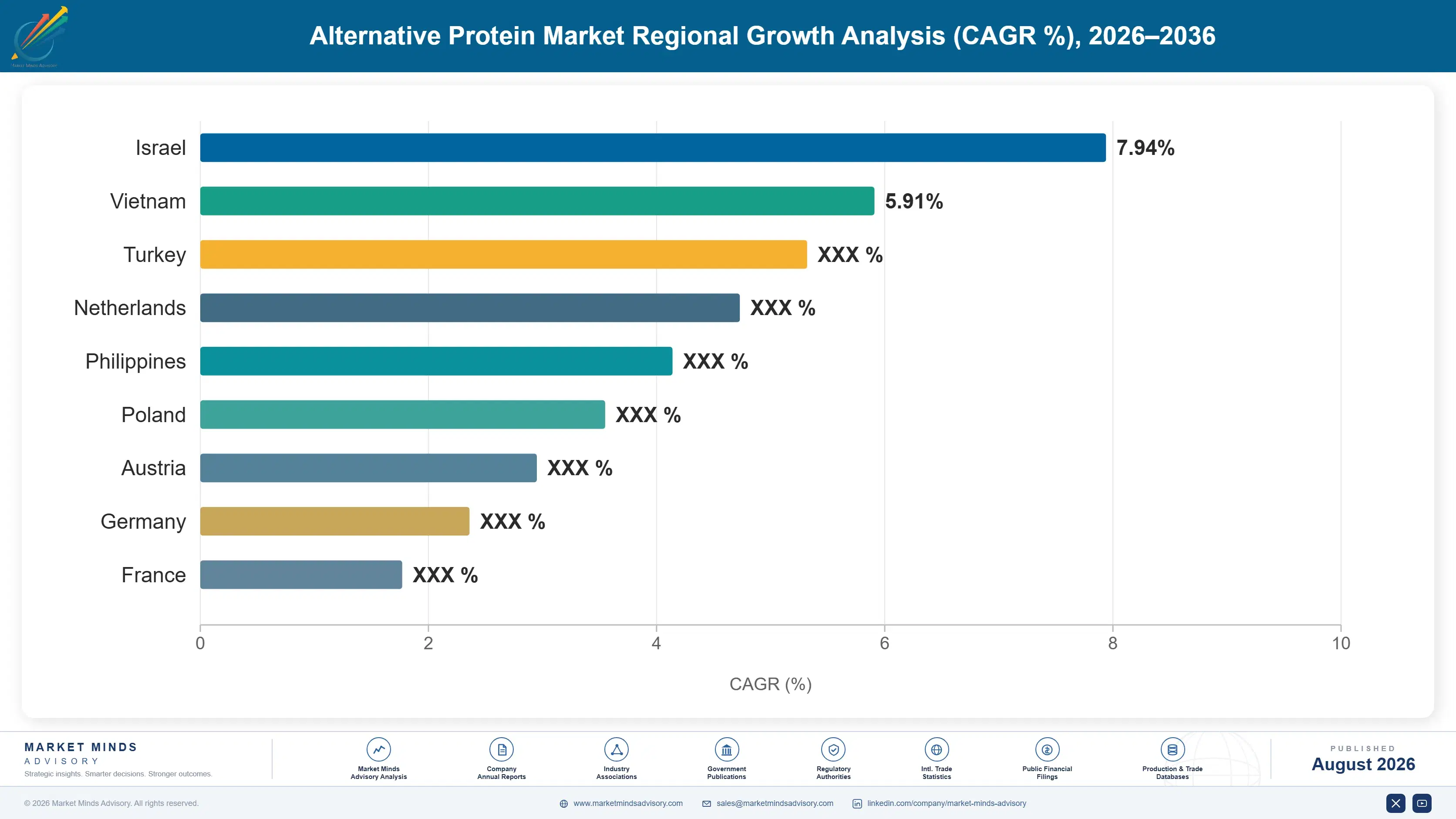
alternative-protein-market-country-cagr-analysis-1787462268165

Where Alternative Protein Margin Actually Sits

Chasing flexitarian trial with marketing spend is how this category burned through several billion dollars of capital. The four moves below shift revenue toward buyers who repurchase: dairy and beverage formats that compete on taste, fermentation ingredients that shorten declarations, contract manufacturing that fixes utilisation, and Asian markets where no persuasion is required. None requires new plant capacity.

Concentrate Investment on Dairy and Beverage Formats

Dairy and beverage alternatives already supply 57% of category value and keep growing because households buy them for taste, coffee performance, and lactose tolerance rather than out of conviction. Repeat purchase behaves like an ordinary food category rather than like meat analogues. Redirecting brand and capital investment here, particularly toward barista and foodservice formulations, produces revenue that compounds rather than requiring constant reacquisition. The foodservice channel alone represents demand conventional dairy previously owned outright and is defended on product performance rather than on price. Households already buy these products without being persuaded to each week.
Market Impact: Targets the 57% of category value already growing

Reformulate With Fermentation Ingredients to Shorten Declarations

Ultra-processed criticism landed hardest on products defending long ingredient lists, and no amount of communication answers a shopper reading the back of a pack. Biomass and precision fermentation ingredients replace methylcellulose, isolates, and multiple binders with structure and functionality that arrives already formed, cutting declared ingredients by roughly 40%. Reformulation costs perhaps $2.4 million per product family including sensory and shelf-life work. It also produces something that tastes materially better, which is the actual problem repeat purchase data was pointing at all along. Another year of advertising costs considerably more than that does.
Market Impact: Cuts declared ingredients by roughly 40% per format

Consolidate Volume Through Contract Manufacturing Arrangements

Extrusion and fermentation capacity across the sector runs near 48% utilisation, which loads every kilogram with fixed cost that the 68% retail premium then has to carry. Brands operating their own underused plants should consolidate onto shared contract capacity, and asset owners should fill lines with third-party volume rather than defending exclusivity. Utilisation improvements of 20 to 30 points translate directly into cost per kilogram and make parity pricing achievable. Owning a plant stopped being a strategic asset once the demand forecasts behind it proved wrong. Nobody is buying the product because of who extruded it.
Market Impact: Lifts plant utilisation by 20 to 30 points

Sell Into Asian Markets Without Transition Framing

Soy milk, tofu, and wheat gluten products are ordinary food across China, Japan, Korea, and Southeast Asia, which means the entire category persuasion exercise that Western marketing built is unnecessary and frequently counterproductive there. Growth of 9.3% in East Asia comes from product quality, format innovation, and distribution rather than from advocacy. Entering requires local formulation and partnership rather than brand transplantation, at perhaps $6 million per market. The absence of a framing battle makes commercial economics considerably more predictable than Western launches proved. Product quality and distribution do the work that advocacy cannot.
Market Impact: Accesses East Asian growth running at 9.3% annually

Who Controls the Margin Pool

Concentration is very low at roughly 14% for the top five, measured consistently as alternative protein revenue at retail and foodservice sales value. Danone and Oatly lead on dairy alternatives, Beyond Meat and Impossible Foods on meat analogues, and Monde Nissin through Quorn in biomass fermentation. Conventional food and meat companies participate through brand extensions and acquisitions without committing at scale, which has proved a well-judged hedge.
Competition runs along three lines. Taste and repeat purchase performance is the first and the one the category underweighted for years. Ingredient declaration length is the second, now that processing criticism has become a purchase consideration rather than a fringe argument. The third is regulatory position, particularly for fermentation and cultivated products where authorisation timelines and outright prohibitions determine which markets are addressable at all.

Two pressures will reshape positions. Capacity overhang across extrusion and fermentation assets is forcing consolidation, and several brands will not survive the utilisation arithmetic. Meanwhile fermentation-derived ingredients threaten to reset the technical basis of the category, favouring companies with platform access over those holding brands alone. The exposed position is a single-format plant-based meat brand with its own underused plant and no fermentation route available.
alternative-protein-market-company-positioning-matrix-1787462268683

Competitive Moat and Risk Dimensions

DANONE

Moat: Dairy Alternative Portfolio Breadth

Danone holds plant-based beverage positions across soy, oat, almond, and coconut through Alpro, Silk, and regional brands, giving it reach across whatever substitution preference prevails locally. Chilled distribution and retail relationships built for conventional dairy transfer directly and are difficult to replicate. The company participated in the plant-based meat boom lightly, which spared it the capacity overhang others carry.
DANONE

Risk: Cannibalising Conventional Dairy

Growth in plant-based beverages comes partly at the expense of the company's own conventional dairy business, which limits how aggressively it can push the transition. Competitors without a dairy portfolio face no such constraint and can position more sharply. That internal tension shows in marketing that avoids direct comparison, and pure-play rivals exploit precisely that hesitation.
OATLY GROUP

Moat: Barista Format and Foodservice Position

Oatly built a foodservice channel around barista formulations that perform in espresso where earlier plant milks failed, and that technical work created demand conventional dairy previously owned outright. Coffee shop presence also functions as continuous product sampling at scale. The brand position among younger urban consumers remains genuinely strong despite the category turbulence around it.
OATLY GROUP

Risk: Capacity Investment Overhang

The company built production capacity against growth expectations that the category did not deliver, leaving fixed costs spread across volumes well below plan and a balance sheet under pressure. Private label oat beverages have improved considerably and now compete credibly on shelf. Recovering utilisation requires either volume growth the category is not producing or contract arrangements that dilute exclusivity.

Players Tracked

Prominent Players

Danone
Oatly Group
Beyond Meat
Impossible Foods
Monde Nissin

Other Key Players

Nestle
Unilever
Kellanova
Conagra Brands
Maple Leaf Foods
JBS
Tyson Foods
Ingredion
Roquette Freres
Puris
Perfect Day
Upside Foods
Eat Just
Mosa Meat
Redefine Meat

Recent Developments

JANUARY 2025

American state prohibitions on cultivated meat sale take effect

State-level prohibitions on cultivated meat sale came into force in Florida and Alabama, following federal clearance of two producers during 2023. Companies responded by concentrating commercial activity in permissive jurisdictions and by shifting emphasis toward ingredient and blended applications rather than pursuing whole-cut products at retail.
Signal: Sub-national prohibition has now become a live commercial risk that federal approval offers no protection against.
AUGUST 2024

Plant-based meat brands consolidate production onto shared capacity

Several plant-based meat brands moved production from owned facilities onto shared contract manufacturing capacity as utilisation across the sector remained well below design levels. The consolidation reduced fixed cost per kilogram and released capital, though it also removed the production exclusivity that earlier brand positioning had emphasised heavily.
Signal: Owning extrusion capacity turned from strategic asset into balance sheet liability once demand forecasts proved wrong.
MAY 2025

Precision fermentation proteins extend across American food categories

Brands using precision fermentation whey and casein extended distribution across American frozen dessert, beverage, and bakery categories, marketing animal-free positioning while carrying mandatory dairy allergen declarations. European commercialisation remained constrained by novel food assessment timelines running around 31 months from submission. Additional submissions were filed during the period.
Signal: Regulatory speed, rather than technical readiness, now determines where fermentation-derived proteins actually reach consumers at all.

Protein Isolate, Extrusion, and Fermentation Energy

Protein isolates and concentrates account for roughly 41% of cost of goods, drawn from pea, soy, and wheat processing across North America, Europe, and China. Flavour systems, binders, fats, and colours contribute a further 19%. Energy for extrusion, fermentation, and drying takes 14%, and packaging, labour, and cold chain absorb the remainder across most producers in the category.
European industrial energy prices rose steeply through 2022 and 2023 according to IEA reporting, which hit extrusion and fermentation operations directly since both carry continuous thermal and mechanical loads. Pea and soy protein isolate pricing moved sharply through the same window under Black Sea grain disruption and crop shortfalls. Beyond Meat and Oatly both referenced input cost and utilisation pressure across their reporting in the period, and several smaller producers ceased operating rather than continue negative.

Exposure divides on utilisation far more than on ingredient sourcing. A plant running at 48% of design spreads fixed cost across half the volume it was built for, dwarfing any ingredient price movement. Producers moving onto shared contract capacity improved cost position immediately without renegotiating any ingredient contract. Asian producers using traditional soy routes carry a fundamentally lower cost base.
alternative-protein-market-cost-volatility-analysis-1787462268878

Consolidate production onto shared contract capacity immediately

Utilisation is the dominant cost variable in this category, and a brand running its own plant at half design capacity is carrying fixed cost that no ingredient negotiation will offset. Moving onto shared contract lines improves cost per kilogram immediately and releases capital tied up in assets built against wrong forecasts. Exclusivity was worth less than the balance sheet suggested.

Formulate with concentrates rather than isolates where texture permits

Protein isolates cost considerably more than concentrates and are frequently specified out of habit rather than technical necessity. Where the format tolerates it, particularly in patties, mince, and beverage applications, concentrates deliver acceptable performance at materially lower ingredient cost. The reformulation work is modest and also shortens the declaration, which addresses processing criticism at the same time.

Contract protein supply across multiple crops and origins annually

Pea, soy, and wheat protein pricing follows unrelated agricultural cycles and different export policy regimes, so contracting across several removes dependence on any single crop outcome. Formulations designed to tolerate substitution between protein sources give procurement genuine optionality rather than theoretical alternatives. Black Sea disruption showed clearly what single-origin dependence costs when it goes wrong.

Portfolio Architecture for Margin Defence

Three tiers separate on whether the product competes as food or as a substitute. Plant-based meat analogues sold at a premium against conventional protein earn 12% to 22%, because the premium is not defensible and utilisation is poor. Dairy and beverage alternatives earn 26% to 36%, since they compete on taste and performance in ordinary occasions rather than requiring category persuasion. Fermentation-derived ingredients and specialised functional proteins earn most of all.
The tension is between sunk capacity and honest positioning. Enormous extrusion capacity was built against forecasts that assumed trial would convert into repeat purchase, and it now sits near 48% utilisation carrying fixed cost that the retail premium cannot absorb. Several brands are defending premium pricing precisely because their cost structure requires it, which accelerates the volume decline that created the problem. Accepting parity pricing and consolidating production is the uncomfortable answer.

High-value pools sit where the product solves a functional problem rather than making an argument. Barista performance, precision fermentation dairy functionality, and biomass fermentation texture all deliver something a shopper or chef can verify immediately, which is why they resist the price comparison that meat analogues consistently lose.

Volume / Commodity-Adjacent Tier

Plant-based burgers, mince, and sausage formats sold at a premium against conventional protein through grocery retail. Utilisation and repeat purchase are both poor. The wide range reflects large differences in plant loading and ingredient specification between producers.
Gross Margin: 12%-22%

Premium / Certified Tier

Dairy and beverage alternatives including barista and foodservice formulations that compete on taste and performance in ordinary consumption occasions. Range width separates commodity oat and soy beverages from technically formulated barista products within this tier.
Gross Margin: 26%-36%

Sustainability / Regulatory / Next-Generation Tier

Biomass and precision fermentation ingredients, functional protein systems, and cultivated applications where authorisation permits. Technical scarcity and regulatory position, rather than production economics, sustain the margin structure across this tier at present.
Gross Margin: 38%-56%
alternative-protein-market-portfolio-architecture-1787462269382

High-value Sub-segments and Strategic Watch-out

Precision Fermentation Dairy Proteins

Highest value in the category, delivering functionality plant proteins only approximate. Growth of 21.4% is constrained by novel food timelines rather than by demand or technology. Allergen declaration requirements limit the addressable household considerably in practice. Approval timelines, not technology, set the commercial pace in this segment.
Gross Margin: 44%-56%

Barista and Foodservice Beverage Formats

High value with durable growth, built on technical performance in espresso that earlier plant milks could not deliver. Coffee shop presence functions as continuous sampling at scale. Chefs and baristas verify the product immediately, which removes any persuasion requirement. Nothing else in the category verifies itself this quickly.
Gross Margin: 32%-42%

Retail Plant-Based Meat Analogues

The volume core and the position that broke, with repeat purchase near 23% and a premium shoppers rejected. Capacity built against wrong forecasts now carries the cost. Reformulate with fermentation ingredients or accept parity pricing and consolidate production. Parity pricing is the uncomfortable but correct answer.
Gross Margin: 10%-20%

Cultivated Meat Whole-Cut Products

The strategic watch-out. Legal in three jurisdictions, criminal in others, and still far from food economics on growth media and bioreactor capital. Ingredient and blended applications are the sensible near-term route rather than pursuing whole cuts. Treat it as a long-dated option rather than a plan.
Gross Margin: 18%-40%

Why Dairy Alternatives Held On

Revenue in this category is annuity revenue only where the product earns a routine place in a household or a kitchen, and that distinction explains almost everything about the past five years. Dairy alternative buyers repurchase weekly because the product performs in coffee, cereal, and cooking without requiring a decision each time. Plant-based meat never achieved that, and repeat purchase near 23% within twelve weeks meant the category was continuously reacquiring the same shoppers it had already lost once.
Stickiness varies enormously by format and by channel. Foodservice barista supply is the most durable, because a coffee chain that has trained staff, adjusted recipes, and printed menus around a product does not switch on price alone. Household dairy alternative purchasing comes next, embedded in weekly shopping routines. Retail plant-based meat is the least sticky of all, bought on promotion, tried, and frequently abandoned without the shopper ever forming a habit worth defending.

Buyer profiles have shifted considerably since 2021. Shoppers now read ingredient declarations before health claims, and retail category managers ask about repeat purchase data rather than about trial rates when reviewing ranges. Rate of sale now decides listings, and no brand deck substitutes for it.
alternative-protein-market-end-use-penetration-index-1787462269874

Where Alternative Protein Capital Belongs

These are among the four positions where our research anticipates prominent divergence between winners and laggards over the coming forecast period. Each is grounded in the demand model, the regulatory perimeter, and the announced capacity pipeline.
01 / DAIRY FORMAT CONCENTRATION

Put the money where households already repurchase every week

Dairy and beverage alternatives supply 57% of category value and keep growing because people buy them for coffee performance, lactose tolerance, and taste rather than out of any conviction that needs renewing at every single purchase. Repeat behaviour there resembles an ordinary food category, which is precisely what plant-based meat never managed to achieve at any point in five years. Redirecting brand and capital investment toward barista and foodservice formulations produces compounding revenue instead of the continuous reacquisition that consumed the category's capital.
02 / FERMENTATION REFORMULATION PROGRAMME

Fix the product with fermentation, not the message with marketing

Repeat purchase near 23% was a product signal that several years of expensive communication comprehensively failed to overturn or even dent, and ultra-processed criticism landed hardest on exactly the long declarations that extrusion formats require. Biomass and precision fermentation ingredients replace binders and isolates with structure that arrives already formed, cutting declared ingredients by roughly 40% while genuinely improving taste. At around $2.4 million per product family including sensory and shelf-life work, that is considerably cheaper than another year of category advertising.
03 / CAPACITY CONSOLIDATION DECISION

Stop owning underused plants and consolidate onto shared lines

Extrusion and fermentation capacity across the sector currently runs near 48% utilisation, which loads every kilogram produced with fixed cost that a rejected 68% retail premium cannot possibly absorb any longer. Brands defending premium pricing because their cost structure demands it are accelerating exactly the volume decline that created the problem for them in the first place. Consolidating production onto shared contract capacity lifts utilisation by 20 to 30 points, releases trapped capital, and makes parity pricing achievable rather than merely aspirational.
04 / ASIAN MARKET ENTRY

Sell food in Asia rather than selling a transition anywhere else

Soy milk, tofu, tempeh, and wheat gluten products are ordinary staples across China, Japan, Korea, and Southeast Asia, so the entire framing exercise that Western marketing constructed is unnecessary and sometimes actively counterproductive in each of those markets. East Asian growth of 9.3% comes from product quality, format innovation, and distribution rather than from category advocacy of any kind. Entry needs local formulation and partnership rather than brand transplantation, at roughly $6 million per market, and delivers far more predictable commercial economics.

Engagement Snapshot From the Field

A live engagement with an industry participant carrying material or product regulatory and market exposure ahead of a defining policy shift, showing how our research translates into a defensible multi-year portfolio strategy.
MARKET MINDS ADVISORY · CLIENT ENGAGEMENT SUMMARY
Alternative Protein Producer Strategic Portfolio Review and Transition Roadmap 2026·Investment Scenario on Alternative Protein Exposure Evaluation 2025-26
CLIENT PROFILE
A European alternative protein brand owner selling plant-based burgers, mince, and sausages alongside a smaller oat beverage range across nine countries, with annual revenue near EUR 142 million (client-reported, unverified by MMA). Meat analogues supplied roughly 78% of revenue and were produced in a company-owned extrusion facility commissioned in 2021 against growth forecasts that the category never delivered.
STRATEGIC CHALLENGE
Meat analogue volume had fallen 31% across three years, the extrusion plant was operating at 44% of design capacity, and two major retailers had delisted formats citing poor rate of sale. The oat beverage range was growing and profitable but received under a tenth of commercial resource, and the board was weighing a capital raise against a sale of the business.
MMA APPROACH
MMA rebuilt profitability by format and by retailer, separating volume that covered marginal cost from volume that did not. Repeat purchase was analysed using retailer loyalty data across both ranges. Contract manufacturing options were costed against continued in-house extrusion, and fermentation ingredient reformulation was assessed for the three highest-volume formats, with findings tested through 47 expert interviews during Q4 2025.
KEY FINDINGS
  1. Repeat purchase for meat analogues sat at 21% within twelve weeks against 64% for the oat beverage range, and the gap had widened in each of the preceding three years.
  2. The extrusion facility could not reach cost-competitive loading on internal volume alone, and contract manufacturing offered equivalent output at 22% lower cost per kilogram.
  3. Oat beverage gross margin was 34% against 15% for meat analogues, yet the beverage range received under 10% of marketing spend and no dedicated commercial resource.
  4. Reformulating three core formats with biomass fermentation ingredients would cut declared ingredients from nineteen to eleven and improve blind sensory scores measurably.
CLIENT PROFILE
A European alternative protein brand owner selling plant-based burgers, mince, and sausages alongside a smaller oat beverage range across nine countries, with annual revenue near EUR 142 million (client-reported, unverified by MMA). Meat analogues supplied roughly 78% of revenue and were produced in a company-owned extrusion facility commissioned in 2021 against growth forecasts that the category never delivered.
STRATEGIC CHALLENGE
Meat analogue volume had fallen 31% across three years, the extrusion plant was operating at 44% of design capacity, and two major retailers had delisted formats citing poor rate of sale. The oat beverage range was growing and profitable but received under a tenth of commercial resource, and the board was weighing a capital raise against a sale of the business.
MMA APPROACH
MMA rebuilt profitability by format and by retailer, separating volume that covered marginal cost from volume that did not. Repeat purchase was analysed using retailer loyalty data across both ranges. Contract manufacturing options were costed against continued in-house extrusion, and fermentation ingredient reformulation was assessed for the three highest-volume formats, with findings tested through 47 expert interviews during Q4 2025.
KEY FINDINGS
  1. Repeat purchase for meat analogues sat at 21% within twelve weeks against 64% for the oat beverage range, and the gap had widened in each of the preceding three years.
  2. The extrusion facility could not reach cost-competitive loading on internal volume alone, and contract manufacturing offered equivalent output at 22% lower cost per kilogram.
  3. Oat beverage gross margin was 34% against 15% for meat analogues, yet the beverage range received under 10% of marketing spend and no dedicated commercial resource.
  4. Reformulating three core formats with biomass fermentation ingredients would cut declared ingredients from nineteen to eleven and improve blind sensory scores measurably.
RECOMMENDED STRATEGY
Phase 1: Phase 1 (months one to six): exit loss-making meat analogue formats, reprice remaining lines toward parity, and open contract manufacturing negotiations. Phase 2: Phase 2 (months seven to sixteen): transfer extrusion production to contract capacity, divest the facility, and redirect resource to the oat beverage range. Phase 3: Phase 3 (months seventeen to twenty-eight): reformulate three core analogue formats with fermentation ingredients and relaunch on ingredient simplicity and taste.
OUTCOME
The brand owner divested the extrusion facility and reported group gross margin improving from 19% to 29% within fifteen months on lower revenue (client-reported, unverified by MMA). The oat beverage range grew 38% with dedicated resource behind it. Two reformulated analogue formats are scheduled for relaunch during 2027.

Frequently Asked Questions

Foundational context covering the market sizes, CAGR, scope, country, region and competition that inform every finding below. This section is provided to cover basics and most often pre-purchase conversations, answered from the MMA Primary Research Dataset.

What is the current size of the Alternative Protein Market?

The market was valued at USD 31.4 billion in 2025, rising to an estimated USD 34.0 billion in 2026. East Asia holds the largest regional share at 29% of global value.

How large will the Alternative Protein Market be by 2036?

MMA forecasts USD 75.5 billion by 2036 under the base case, an expansion multiple of 2.22 times the 2026 level. Incremental value creation across the period reaches USD 41.5 billion.

What is the CAGR for the Alternative Protein Market 2026 to 2036?

The base case CAGR is 8.3%, with a bull case of 9.6% and a bear case of 7.0%. Historical growth between 2020 and 2025 ran at 7.1%, concealing two divergent category halves.

Which segment is growing fastest?

Cultivated meat and seafood, at 26.8%, roughly 3.23 times the overall market rate. The rate comes off a base that is commercially close to zero, so it describes ambition.

Who are the major companies in the Alternative Protein Market?

Danone, Oatly Group, Beyond Meat, Impossible Foods, and Monde Nissin lead, though the top five hold only about 14% of value. Nestle and Unilever participate through brand extensions.

Which country is growing fastest?

India, at 11.2%, driven by dairy alternatives serving widespread lactose intolerance alongside an existing vegetarian population that buys protein foods without any transition framing at all.

Report Segmentation Architecture

The full report scope spans multiple orthogonal segmentation dimensions, with cross-tabulated demand data provided for each dimension pair. Coverage extends further to regional breakdowns, trend trajectories, and the competitive detail needed to support segment-level decision-making.

By Production Platform

  • Plant Protein Extraction and Texturisation
  • Biomass Fermentation Proteins
  • Precision Fermentation Proteins
  • Cultivated Meat and Seafood
  • Insect Protein for Human Food
  • Algal and Microalgal Protein

By End-Use Industry

  • Grocery and Supermarket Retail
  • Quick Service and Casual Restaurants
  • Coffee Shops and Beverage Foodservice
  • Institutional and Contract Catering
  • Food Manufacturing Ingredient Supply

By Commercial Dimension

  • Branded Manufacturer Supply
  • Retailer Private Label Contract
  • Contract Manufacturing and Co-Packing
  • Ingredient Business-to-Business Sales

By Region

  • North America
  • Western Europe
  • East Asia
  • South Asia and Pacific
  • Latin America
  • Middle East and Africa
  • Eastern Europe

Scope, Methodology, and Coverage

Every figure in this report is reproducible from documented input assumptions. The scope below maps the historical period, the forecast horizon, the segmentation dimensions, and the countries covered, alongside the underlying primary and qualitative methodology.
Historical Period
2020 to 2025
Forecast Period
2026 to 2036
Base Year
2025 (USD billions; MMA Primary Research Dataset, August 2026)
Market Definition
The market comprises protein products for human consumption produced without conventional animal agriculture, covering plant protein extraction and texturisation, biomass fermentation proteins, precision fermentation proteins, cultivated meat and seafood, insect protein for human food, and algal protein. Value is measured at retail and foodservice sales value of finished products, and at ingredient level where supplied to other manufacturers. Animal feed proteins, conventional dairy and meat products, and pulses or grains sold as whole foods fall outside scope.
Quantitative Units
USD billions (retail and foodservice sales value); tonnes of product; percentage premium over conventional protein
Segmentation Dimensions
By Production Platform; By End-Use Industry; By Commercial Dimension; By Region
Regions Covered
North America, Western Europe, East Asia, South Asia and Pacific, Latin America, Middle East and Africa, Eastern Europe
Countries Covered
USA, China, Germany, France, UK, Japan, South Korea, India, Australia, Canada, Brazil, Mexico, Indonesia, Vietnam, Thailand, Malaysia, UAE, Saudi Arabia, South Africa, Nigeria, Turkey, Poland, Netherlands, Italy, Spain, Sweden, Switzerland, Argentina, Colombia, Singapore, and additional markets relevant to this sector
Key Companies Profiled
Danone, Oatly Group, Beyond Meat, Impossible Foods, Monde Nissin, Nestle, Unilever, Kellanova, Conagra Brands, Maple Leaf Foods, JBS, Tyson Foods, Ingredion, Roquette Freres, Puris, Perfect Day, Upside Foods, Eat Just, Mosa Meat, Redefine Meat
Quantitative Methodology
Primary survey, n=3,800 respondents, Q4 2025, six countries; demand-side model with trade association cross-validation
Qualitative Methodology
47 expert interviews, Q4 2025; applied to validate demand model assumptions, identify emerging dynamics, and assess competitive positioning
Report Format
PDF and XLSX data workbook (Word format preview document)
Publisher
Market Minds Advisory
Report Code
MMA-2026-AGR-140
Published
August 2026
Contact
sales@marketmindsadvisory.com | www.marketmindsadvisory.com

Purchase the full Alternative Protein Market Report (2026 to 2036).

The full report sizes alternative protein demand across six production platforms and seven regions with 2026 to 2036 forecasts under base, bull, and bear cases. It separates trial from repeat purchase behaviour by format and market, which conventional category tracking merges and therefore misreads badly. Competitive profiles cover twenty companies assessed consistently on alternative protein revenue at sales value, platform access, and capacity position. Regulatory analysis maps novel food timelines, cultivated meat approvals and prohibitions, and labelling restrictions by jurisdiction. Commercial guidance addresses dairy format concentration, fermentation reformulation, capacity consolidation, and Asian market entry.
Six production platforms sized and forecast separately
Trial and repeat purchase separated by format and market
Twenty company profiles on consistent sales value basis
Cultivated meat approvals and prohibitions mapped by jurisdiction
Capacity utilisation tracked across extrusion and fermentation assets
Fermentation reformulation cost and sensory benchmarks provided

Built For The People Who Decide

From boardroom strategy to bench-side execution, this report is read cover-to-cover by leaders shaping the next decade of their industry, turning demand scenarios, market dynamics and valuation benchmarks into decisions.
CXOs/ Presidents/ VPs/ Managers
M&A and Corporate Development
Strategy Teams and R&D Heads
Procurement and Product Directors
Regulatory and Compliance Leaders
Investor Relations and Equity Analysts