Market Minds Advisory
Alternative Lending Platform Market

Alternative Lending Platform Market: Alternative Lending Platform Market. Underwriting Data Depth Is Becoming the Real Competitive Line

Consumers and small businesses shut out of traditional bank credit are shifting borrowing toward platforms that underwrite risk from transaction data rather than credit history, forcing lenders to defend share against faster, data native challengers.

Lead Analyst

Published

September 2026

Make Smarter Decisions with Customized Research Insights

Request a free sample report and evaluate market opportunities, growth trends, and competitive dynamics relevant to your business needs.

2025 MARKET VALUE$9.6BMarket Size 2025
2036 FORECAST VALUE$28.5BBase Case , 2026 to 2036
CAGR 2026 TO 203610.4 %Bull 11.7% / Bear 9.0%
INCREMENTAL OPPORTUNITY$17.9BNet 10- year value creation
EXPANSION MULTIPLE2.69x2036 value over 2026 base
Strategic Levers
M&A Pipeline
Regional Outlook
Country Rankings
Competitive Intelligence
Segmental Deep-dive
Call-Us : 91 93563 13602

Executive Snapshot and Market Trajectory.

Consumers and small businesses shut out of traditional bank credit are shifting borrowing toward digital platforms that underwrite risk from transaction data rather than credit history alone, and that data driven underwriting shift is now the single most consequential qualitative dynamic reshaping platform product roadmaps this year.
Demand concentrates among younger consumers seeking instant point of sale financing and small businesses needing faster capital access than traditional banks provide, with buy now pay later point of sale financing platforms growing fastest of all six segments as e-commerce checkout integration accelerates rapidly. North America carries the largest regional share, reflecting the country's concentrated fintech venture funding and consumer adoption relative to every other region tracked in this report.
Competitive structure remains fragmented among well capitalised digital native lenders with sophisticated underwriting algorithms, alongside traditional banks launching competing digital lending products defensively. Borrowers increasingly expect instant approval decisions and transparent pricing rather than accepting lengthy application processes alone, a shift reordering platform market share faster than several legacy lenders without dedicated data science investment anticipated when digital competitors first launched. This shift is visible in how fast digital challengers gain volume sector wide.
Market Definition
This report covers digital lending platforms that originate consumer and small business credit outside traditional bank branch channels, including peer to peer lending, marketplace lending, buy now pay later financing, invoice financing, and merchant cash advance platforms. It excludes traditional bank branch lending and credit card issuance by conventional card networks.
Base Year Value
$9.6B in 2025 (MMA Primary Research Dataset, September 2026)
Forecast Period
2026 to 2036, eleven discrete annual values
CAGR
10.4% base case. Bull 11.7%. Bear 9.0%.
Fastest Growth Segment
Buy Now Pay Later Point-of-Sale Financing Platforms: 14.0% CAGR
Fastest Growth Country
India: 12.8% CAGR
Fastest Growth Region
South Asia and Pacific: 12.4% CAGR
Largest Region
North America: 30% of 2025 global value
Market Leaders
SoFi Technologies Inc, Affirm Holdings Inc, Klarna Bank AB, Upstart Holdings Inc, Block Inc. Source: MMA Analysis based on company disclosures and primary research.
Primary Survey
n=3,800 procurement and R&D decision-makers, Q4 2025, six countries
Methodology
Demand-side build-up, cross-validated against public data, 47 expert interviews

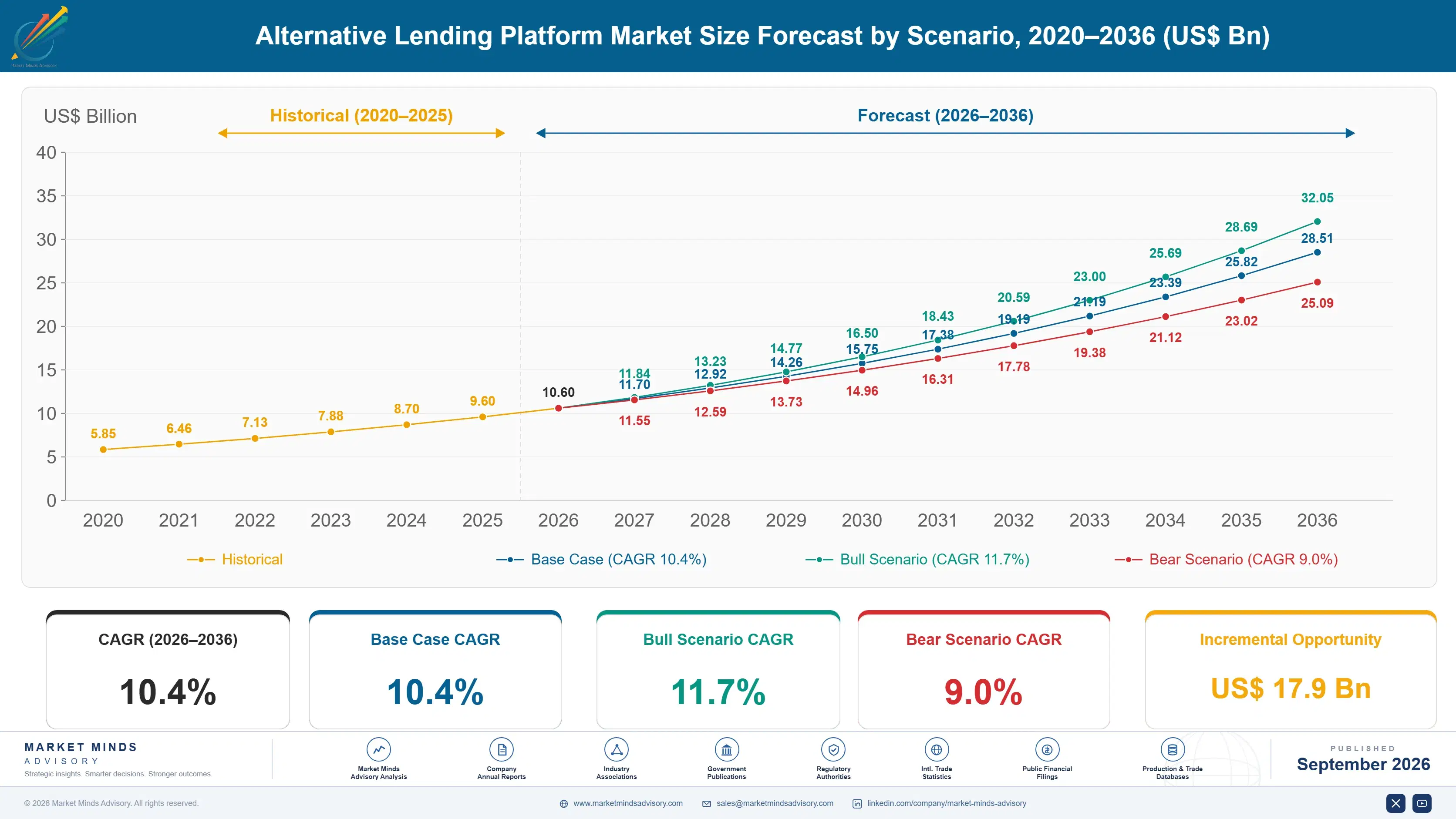
Alternative Lending Platform Market Forecast Scenarios

alternative-lending-platform-market-size-forecast-scenario-1789981216920
Between 2020 and 2025 the category grew rapidly as digital lending platforms expanded consumer and small business origination volume, with growth accelerating from 2022 onward as buy now pay later adoption at e-commerce checkout scaled sharply across major retailers, reflecting a historical CAGR of 9.4 percent across the trailing five year period tracked closely here.
The base case assumes sustained growth driven by three mechanisms. Consumers are shifting point of sale financing toward instant approval buy now pay later platforms rather than traditional credit cards carrying higher interest costs. Small businesses are adopting marketplace and invoice financing platforms that approve funding within days rather than weeks. Digital lending infrastructure providers are equipping banks with underwriting software that lets them compete against digital native challengers, and these mechanisms compound fastest among platforms with the deepest proprietary transaction data access.
A bull scenario turns on accelerated small business adoption of marketplace lending platforms as traditional bank credit tightens further during economic uncertainty. The bear risk is rising loan default rates during an economic downturn triggering tighter underwriting standards and reduced investor funding for loan originations, despite the underlying multi year shift toward digital credit access continuing to support long term platform growth.

Underwriting Data Depth Resets Platform Competition

Two forces are reshaping this category at once: data driven underwriting compressing the time required to approve a loan, and borrowers increasingly treating approval speed and pricing transparency as the primary selection criterion rather than accepting brand familiarity as sufficient justification. This is pulling platform investment toward proprietary transaction data access and machine learning underwriting models and away from the incremental credit scoring refinement that historically defined much of the category.
MARKET CONCENTRATIONCR5 32%Reflects a fragmented digital lending platform category overall
AVERAGE LOAN ORIGINATION FEEUSD 340 per approved consumer loanBlended fee across consumer and small business loan products
TOP PRODUCING COUNTRY SHAREUnited States at 36% of global origination volumeReflects the country's concentrated fintech lending customer base
DIGITAL UNDERWRITING REVENUE SHARE41% of total category revenueShare of revenue tied to data driven underwriting platforms
AVERAGE APPROVAL TIME REDUCTION78% versus traditional bank lendingTypical approval time improvement from digital underwriting platforms
LOAN LOSS PROVISION SHARE29% of total operating costShare of platform operating cost tied to credit loss reserves
Commercially, the market behaves like a data driven financial services category where documented default rate performance and demonstrated underwriting accuracy separate credible platforms from newer entrants relying on unproven risk models alone. Investors and funding partners evaluate platforms heavily on measurable default rate and portfolio yield performance and integration ease with existing capital markets funding structures, creating real switching friction once a partner's capital becomes embedded across a platform's origination pipeline.
Over the next decade, expect data driven underwriting to become the standard baseline across nearly every consumer and small business lending decision rather than a premium capability reserved for the largest platforms alone. Platforms with genuine data depth and proven default management will capture a growing share of category value beyond legacy scoring that defines smaller lending programmes.
"Borrowers used to ask how low the interest rate was. Now they ask how fast the money arrives, and that shift is rewarding platforms that solved the data problem, not just the pricing one."
Director, Digital Financial Services Practice · MMA Technology Practice · September 2026

Market Trends

Alternative Data Underwriting Displaces Traditional Credit Scoring

Digital lending platforms are increasingly underwriting loan applications using alternative transaction, cash flow, and behavioural data rather than relying solely on traditional credit bureau scores that cannot capture a borrower's real time financial situation. MMA's Q4 2025 primary research found platforms using alternative data underwriting reporting approval time reductions averaging 78 percent versus comparable traditional bank lending processes, as platforms completed the machine learning model development needed to assess credit risk reliably from non traditional data sources. This shift is resetting platform investment priorities across the category broadly. Platforms without comparable data capability face mounting pressure.
Market Impact: Drives 54 percent of new applications
Buy Now Pay Later Adoption Extends Into New Retail Categories

Buy now pay later platforms are increasingly extending point of sale financing into new retail categories beyond apparel and electronics, including travel, healthcare, and home improvement purchases that traditional installment lending had not historically served at meaningful digital scale. MMA's expert interview programme found merchants citing checkout conversion rate improvement, not financing cost alone, as an increasingly important criterion in buy now pay later provider selection decisions across expanding retail categories specifically. This shift favours platforms that invested early in smooth checkout integration over platforms offering only standalone application processes.
Market Impact: Sustains growth across 33 percent

Market Opportunities and Growth Drivers

Small Business Capital Access Gaps Sustain Marketplace Demand

Continued difficulty accessing traditional bank credit is sustaining demand for marketplace small business lending platforms capable of approving funding within days rather than the weeks traditional underwriting typically requires. Surveyed small business owners linked 54 percent of new financing applications directly to marketplace lending platforms rather than traditional bank loan applications, according to MMA's Q4 2025 primary research programme covering small business borrowers across six countries. This capital access gap is sustaining platform origination growth even where broader credit conditions face continued tightening across several major economies. Platforms without comparable data access face slower origination growth across most borrower segments.
Market Impact: Raises funding costs by 12 percent

E-Commerce Checkout Integration Sustains Point of Sale Financing

Continued e-commerce merchant adoption of embedded point of sale financing options is sustaining demand for buy now pay later platforms capable of increasing average order value and checkout conversion rates simultaneously. Announced new merchant integration partnerships tracked in MMA's primary research programme climbed steadily through 2025, sustaining platform growth across merchants treating embedded financing as essential conversion optimisation infrastructure rather than a discretionary feature reserved only for the largest retail brands operating today. Smaller merchants are increasingly adopting this same embedded financing pattern too. This pattern is expected to accelerate through the remainder of the decade across most retail categories.
Market Impact: Adds 18 percent to expansion cost

Market Restraints and Challenges

Rising Default Rates Complicate Underwriting Model Confidence

Digital lending platforms face rising loan default rates during periods of economic uncertainty, complicating underwriting model confidence and raising questions about whether alternative data models perform reliably across a full economic cycle rather than only favourable conditions. The root cause is that many alternative data underwriting models have not yet operated through a complete recession, leaving their true default prediction accuracy genuinely uncertain during stress conditions. The commercial impact concentrates funding cost increases among platforms without long operating track records specifically. Several platforms are responding by tightening underwriting criteria and building larger loan loss reserves ahead of anticipated stress.
Market Impact: Cuts approval time by 78 percent

Regulatory Scrutiny Complicates Cross-Border Platform Expansion

Increasing regulatory scrutiny of consumer lending practices, particularly around buy now pay later disclosure requirements, complicates cross border platform expansion for lenders seeking to scale beyond their home market. The root cause is that consumer lending regulation varies significantly by jurisdiction, and platforms must build compliance infrastructure specific to each new market before launching operations. The commercial impact concentrates expansion delay risk among platforms without dedicated regulatory affairs teams specifically. Platforms are responding by partnering with regulated bank sponsors to accelerate compliant market entry timelines. This regulatory complexity is expected to persist across most emerging expansion markets.
Market Impact: Adds 26 percent to volume
4 additional market trends, 3 additional growth drivers, and 3 additional restraints and challenges are covered in the full report. Contact sales@marketmindsadvisory.com to access the complete intelligence.

Segment CAGR and Growth Architecture

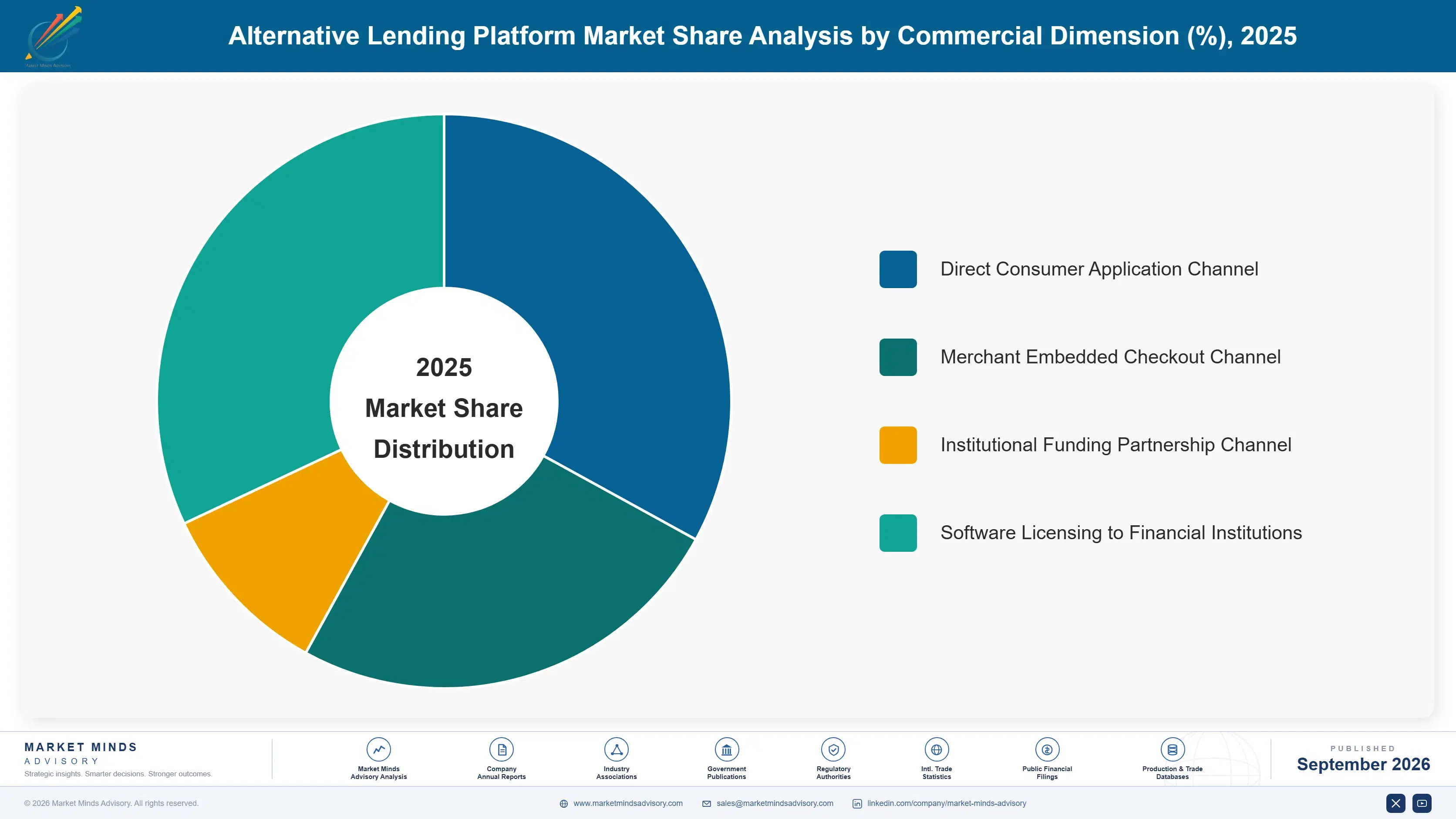
Segmentation follows the lending product and platform dimension, since that lens best explains both platform engineering investment and borrower selection behaviour, spanning established consumer and business lending formats through to newer point of sale and infrastructure software categories reshaping the broader category landscape and platform investment priorities steadily across the broader industry this decade overall.
alternative-lending-platform-market-market-share-analysis-1789981217470

Buy Now Pay Later Point-of-Sale Financing Platforms

This segment covers instant installment financing offered at the point of sale, typically integrated directly into e-commerce and in-store checkout flows, distinct from traditional personal loan platforms that require a separate standalone application process, and from merchant cash advance platforms that finance business working capital rather than individual consumer purchases. Demand is rising sharply as younger consumers increasingly prefer transparent, interest free installment plans over revolving credit card debt for everyday and larger discretionary purchases alike. Growth is outpacing every other segment in this report because checkout integration is scaling faster across merchant categories than any comparable lending distribution channel, creating urgent competitive pressure among providers specifically. Merchants increasingly treat this option as essential conversion infrastructure.
CAGR 14.0%

Digital Lending Infrastructure and Underwriting Software

This segment covers underwriting, loan servicing, and risk decisioning software that banks and fintech platforms license to power their own lending operations, distinct from direct to consumer lending platforms that originate loans under their own brand, and from loan marketplace platforms that connect borrowers with third party funding sources rather than licensing underwriting technology. Demand is rising as traditional banks seek to compete with digital native lenders without building proprietary underwriting technology internally from scratch. Growth trails the buy now pay later segment only because infrastructure software adoption, while accelerating steadily among banks under competitive pressure, builds on a smaller existing installed base relative to the faster scaling consumer financing category specifically.
CAGR 13.0%
Full segment breakdown across 6 segments available in the complete report.

Regional Architecture and Country Demand Map

North America and East Asia together anchor more than half of global revenue, reflecting concentrated fintech venture funding and large digitally native consumer bases, while South Asia and Pacific delivers the fastest regional expansion through rapid digital credit adoption across the region overall this decade.

North America

United States digital lending platforms account for the large majority of regional revenue, reflecting the country's concentrated fintech venture funding and continued buy now pay later adoption across major e-commerce retailers throughout the forecast period. Canadian digital lending platforms contribute a steady secondary share tied to comparable consumer and small business credit access requirements across established fintech relationships. Growth here tracks close to the global base as steady origination volume growth sustains demand relative to faster expanding emerging market regions elsewhere in this report, reinforcing the region's position as the largest single revenue base for established platforms overall. Continued institutional capital availability supports sustained origination funding across most major platforms.
Share: 30% | CAGR: 10.4% (2026 to 2036)

Western Europe

United Kingdom and German digital lending platforms anchor regional demand through established buy now pay later adoption and continued small business marketplace lending growth across national markets. French and Nordic fintech platforms contribute a meaningful secondary share tied to comparable consumer credit access requirements across established, mature domestic markets. Growth trails the global rate because the region's digital lending infrastructure is already comparatively mature relative to faster growing emerging development regions, limiting incremental origination growth even as underwriting technology upgrades remain steady across the forecast period overall. Rising consumer protection regulation is gradually reshaping platform economics somewhat. Rising consumer protection compliance costs are gradually reshaping smaller platform economics across the region too.
Share: 20% | CAGR: 8.9% (2026 to 2036)
Regional intelligence for 5 additional markets available in the complete report: East Asia, South Asia and Pacific, Latin America, Middle East and Africa, Eastern Europe. Contact sales@marketmindsadvisory.com.
alternative-lending-platform-market-country-cagr-analysis-1789981218001

Where Lending Platforms Can Still Expand Margin

Four commercial levers separate platforms capturing durable premium economics from those competing purely on interest rate, spanning underwriting data depth, default management discipline, embedded checkout integration, and diversified capital funding sources. Each lever rewards sustained data and infrastructure investment well ahead of confirmed origination demand rather than reactive spending once a competitor already holds documented advantage.

Building Genuinely Deep Proprietary Underwriting Data

Platforms that built proprietary underwriting data depth, demonstrated through measurable default rate and approval accuracy improvement across live origination volume rather than backtested model claims alone, are winning a disproportionate share of borrower volume from competitors offering only generic credit bureau based scoring. Platforms with demonstrated live origination performance reported approval accuracy roughly 24 percent higher than platforms offering only conventional scoring models without proprietary data. The approach requires sustained data science investment that smaller platforms sometimes cannot justify given limited existing transaction data access and constrained engineering budgets. Smaller platforms often struggle to match this depth quickly.
Market Impact: Lifts approval accuracy meaningfully by 24 total points

Securing Fully Diversified Institutional Capital Sources

Platforms that diversified institutional capital funding sources across multiple bank and asset manager partners are winning origination volume that platforms reliant on a single funding source cannot easily sustain during periods of tightening credit market conditions. This lever requires sustained capital markets relationship investment that smaller platforms sometimes have not built internally across their finance teams. Platforms with diversified funding reported origination volume growth roughly 22 percent higher than platforms dependent on a single institutional funding partner. Platforms without diversification remain exposed to single point funding disruption across their pipeline.
Market Impact: Lifts origination volume growth by 22 total points

Building Genuinely Deep Checkout Integration Partnerships

Platforms that built deep embedded checkout integration partnerships directly with merchants are winning transaction volume that platforms offering only standalone application experiences cannot easily secure from merchants seeking smooth conversion optimisation at the point of sale. This lever requires sustained merchant partnership investment that smaller platforms sometimes have not built internally across commercial teams. Platforms with embedded checkout partnerships reported transaction volume roughly 26 percent higher than platforms offering only standalone application flows without merchant integration. Platforms without deep integration risk losing merchant volume to better connected competitors. Merchants increasingly favour this integration depth over generic application flows.
Market Impact: Lifts transaction volume meaningfully by 26 total points

Building Disciplined Default Management And Collections

Platforms that built disciplined default management and collections capability are sustaining funding partner confidence that platforms with weaker collections infrastructure cannot easily maintain during periods of rising economic uncertainty and default pressure across the category. This lever requires sustained operations investment that smaller platforms sometimes have not developed internally across their risk teams. Platforms with disciplined collections reported funding costs roughly 2 to 3 percentage points lower than platforms with comparatively weaker default management infrastructure in place. This recurring cost advantage also strengthens long term funding partner relationships considerably over the full funding relationship.
Market Impact: Cuts funding costs by 2 to 3 points

Who Controls the Margin Pool

CR5 sits at 32 percent, evaluated on disclosed loan origination volume across the top platforms, reflecting a fragmented category where well capitalised digital native lenders with sophisticated underwriting algorithms compete alongside traditional banks launching competing digital lending products defensively. The gap between the largest platforms and the smaller lender tail remains meaningful given the data investment required to compete at the top.
Current competitive activity centers on three fronts: building proprietary underwriting data depth to win borrower trust beyond generic scoring, diversifying institutional capital funding sources to sustain origination through credit cycles, and expanding embedded checkout integration to capture transaction volume at the point of sale. Price competition remains most intense among smaller platforms serving prime borrower segments, while data rich platforms compete on approval speed instead.

Emerging pressure is building from two directions. Traditional banks launching competing digital lending products are investing to close the underwriting technology gap, threatening digital native platforms in prime borrower segments where bank funding costs remain durably lower due to insured deposit access. At the innovation end, embedded finance infrastructure providers are attracting renewed venture investment, a dynamic that could reorder segment rankings as underwriting technology becomes a larger share of positioning industry wide.
alternative-lending-platform-market-company-positioning-matrix-1789981218528

Competitive Moat and Risk Dimensions

SOFI TECHNOLOGIES INC

Moat: Diversified Financial Services Platform

SoFi's diversified product portfolio spanning lending, banking, and investing gives it a credibility advantage in winning and retaining borrowers seeking a single integrated financial relationship rather than a narrow, single product lending platform relationship alone, deepening customer lifetime value considerably over time. This cross sell advantage is difficult for narrower platforms to replicate quickly.
SOFI TECHNOLOGIES INC

Risk: Higher Regulatory Compliance Burden

SoFi's expanding banking charter and diversified product scope carries a comparatively higher regulatory compliance burden than narrower, single product lending platforms, potentially slowing its pace of new product launches relative to more narrowly focused competitors entering adjacent categories. Simplifying internal approval workflows could meaningfully reduce this friction over time.
AFFIRM HOLDINGS INC

Moat: Deep Merchant Integration Network

Affirm's extensive network of embedded checkout integrations across major e-commerce merchants gives it a durable advantage in capturing point of sale transaction volume that platforms without comparable merchant relationships cannot easily replicate, reinforcing its position at checkout across a growing number of retail categories. This network advantage strengthens further with every new merchant partnership signed.
AFFIRM HOLDINGS INC

Risk: Exposure To Consumer Credit Cycles

Affirm's revenue concentration in consumer point of sale financing exposes it to consumer credit cycle volatility more directly than platforms with diversified small business or infrastructure revenue streams, potentially pressuring margins during periods of rising default rates. Diversifying into small business financing could meaningfully reduce this exposure over time.

Players Tracked

Prominent Players

SoFi Technologies Inc
Affirm Holdings Inc
Klarna Bank AB
Upstart Holdings Inc
Block Inc

Other Key Players

LendingClub Corporation
Prosper Marketplace Inc
Funding Circle Holdings plc
Enova International Inc
BlueVine Inc
Ant Group Co Ltd
Lufax Holding Ltd
PayPal Holdings Inc
Zopa Bank Limited
Avant LLC
GreenSky Inc
C2FO Inc
Fundbox Inc
RateSetter Ltd
Behalf Inc

Recent Developments

FEBRUARY 2026

Upstart Launches Enhanced Small Business Underwriting Model

Upstart launched an enhanced small business underwriting model incorporating expanded alternative data sources, extending its existing consumer lending underwriting portfolio to address growing demand for validated approval accuracy improvement ahead of accelerating origination targets across new lending partners. The launch follows extensive backtesting against historical data.
Signal: Confirms established platforms racing to expand validated underwriting depth as a core differentiator ahead of intensifying investor scrutiny.
OCTOBER 2025

Block Acquires Small Business Underwriting Specialist CreditFlow Analytics

Block completed the acquisition of small business underwriting specialist CreditFlow Analytics, adding cash flow based risk modelling capability intended to strengthen its Square Capital lending portfolio ahead of increasing demand for validated underwriting depth. The deal closed after a multi month regulatory review, with both companies confirming terms.
Signal: Indicates underwriting technology acquisition activity accelerating among established lending platforms broadly this year. This trend should continue steadily.
JUNE 2025

Klarna Signs Multi-Year Partnership With Major European Retailer Group

Klarna signed a multi year partnership agreement with a major European retailer group covering embedded checkout financing across the retailer's expanding e-commerce footprint, securing long term transaction volume commitment tied to the retailer's phased digital expansion schedule extending through the decade. Financial terms were not disclosed by either party.
Signal: Signals large multi year merchant partnerships remaining a key competitive lever for scaled platforms with deep integration capacity.

Capital Funding and Credit Loss Provision Exposure

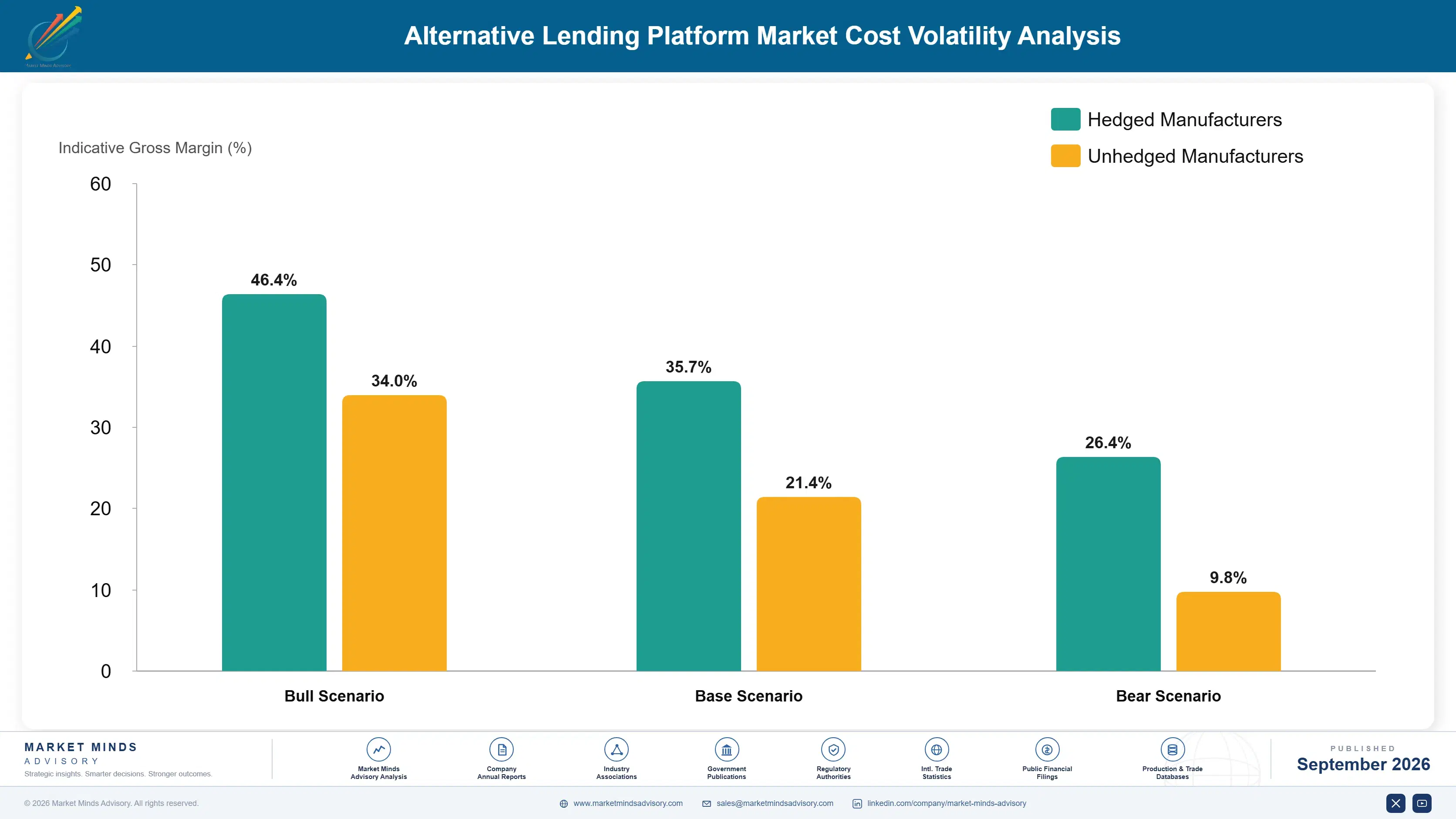
Wholesale capital funding costs and credit loss provisions together represent the largest cost input for lending platforms, running an estimated 42 to 50 percent of total operating cost, sourced primarily from institutional debt markets and warehouse credit facilities whose pricing tracks broader benchmark interest rate movements closely across most funding structures used today across the sector.
Benchmark interest rates rose meaningfully across the broader credit markets during 2022 and 2023 amid well documented central bank tightening cycles, a pattern confirmed in multiple platform annual reports and in US Census Bureau and Federal Reserve commentary on consumer credit conditions from the same period. Platforms without diversified fixed rate funding agreements faced larger funding cost increases than those with existing multi source agreements established beforehand across their capital structure.

The competitive disadvantage falls hardest on smaller platforms without the balance sheet scale to secure favourable fixed rate institutional funding during periods of tight credit market conditions. Exposure varies by platform type too, since platforms funding loans primarily through securitisation markets face materially greater rate exposure than platforms with diversified deposit funded bank partnerships built on more stable, lower cost funding sources.
alternative-lending-platform-market-cost-volatility-analysis-1789981218725

Diversifying Institutional Funding Partner Relationships

Larger platforms are diversifying institutional funding partner relationships across multiple banks and asset managers from the outset, reducing single source funding exposure while maintaining the capital availability that origination growth requires across the full lending pipeline. This also shortens replacement time considerably whenever a single funding partner reduces allocation. This proactive diversification also strengthens negotiating leverage across future funding cycles.

Building Larger Loan Loss Reserve Buffers

Several platforms are building larger loan loss reserve buffers well ahead of anticipated default cycles, reducing exposure to sudden earnings volatility during periods of industry wide credit deterioration across multiple borrower segments. These buffers typically cover several quarters of anticipated default exposure across the platform's active loan portfolio. These buffers typically span several quarters of anticipated exposure.

Securing Longer Term Fixed Rate Funding Agreements

Platforms are increasingly securing longer term fixed rate funding agreements with institutional partners, reducing exposure to short term benchmark rate volatility that variable rate funding structures cannot avoid during periods of rising interest rates. This approach is now standard practice across most large scale platforms. These agreements are now standard practice across most large scale lending platforms operating today.

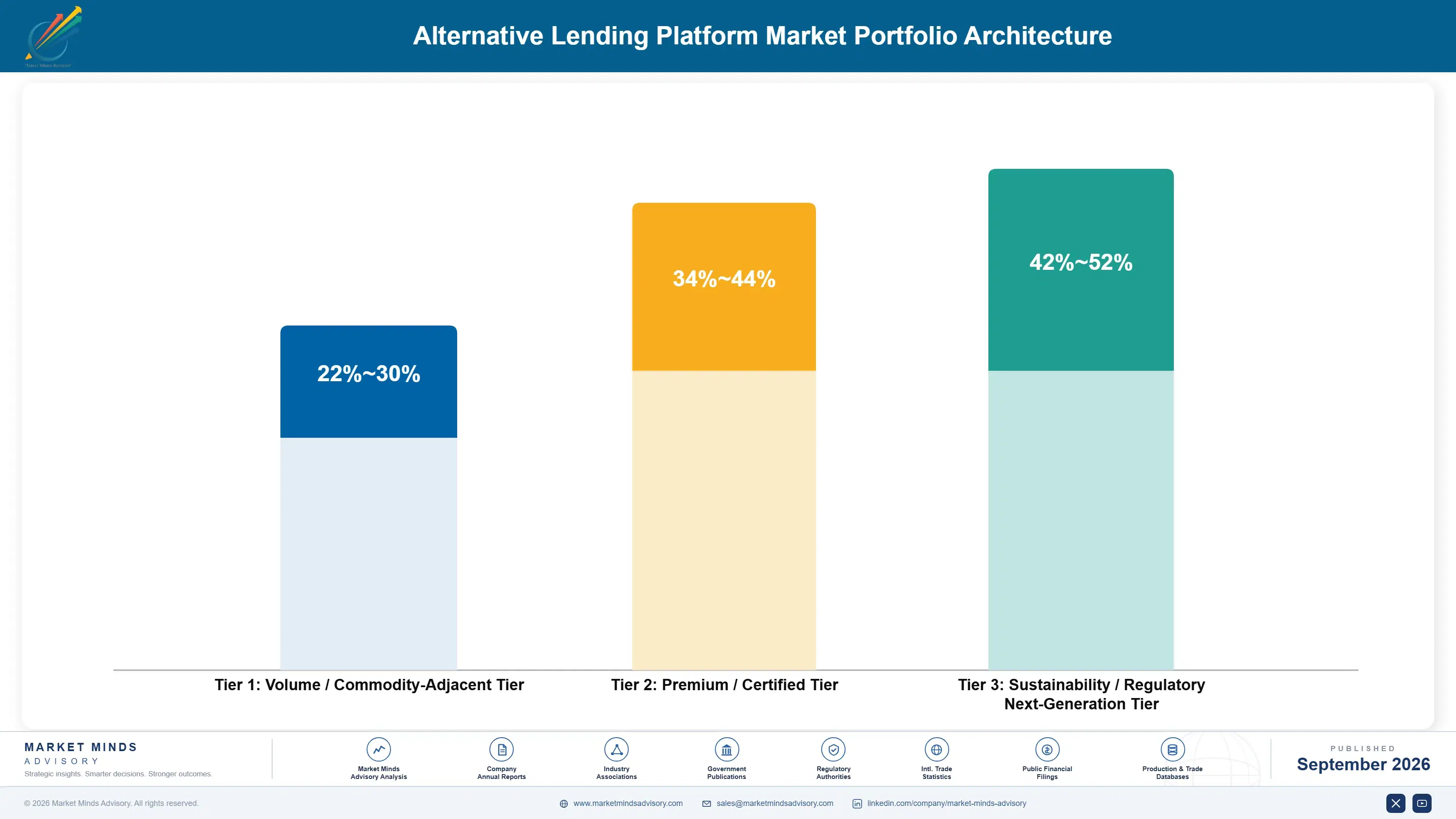
Portfolio Architecture for Margin Defence

Portfolio economics split into three tiers. Volume tier prime consumer lending carries thinner margins under continued price competition and rate transparency pressure, while premium small business and near prime lending carries meaningfully higher margins tied to underwriting sophistication and default management discipline. The sustainability and next generation tier, built around proprietary data underwriting and embedded infrastructure licensing, currently carries the strongest margins given genuine differentiation and long term recurring platform revenue.
The volume versus premium tension shows up clearly in platform engineering allocation. Investment devoted to defending prime consumer lending margin against rate competition competes directly against investment needed for underwriting data depth and infrastructure licensing capability, and platforms that under invest in either risk losing ground to a competitor optimised specifically for that segment of the market.

High value margin pools concentrate in data rich underwriting and infrastructure licensing lines, where technical differentiation and validated default performance still command premium economics before broader commoditisation eventually sets in across the category. The prime consumer lending tier remains essential for scale and brand reach but contributes a shrinking share of blended gross margin across the category overall. This dynamic is already visible in platform product roadmaps announced over the past year.

Volume / Commodity-Adjacent Tier

Prime consumer lending facing continued price competition and rate transparency pressure, leaving platforms reliant on volume rather than underwriting depth to defend share, amid shrinking premium pricing power across most consumer segments.
Gross Margin: 22-30%

Premium / Certified Tier

Small business and near prime lending bundling validated underwriting performance carrying margins tied to risk discrimination and default management, with borrowers willing to pay a meaningful premium for speed. Borrowers increasingly value speed.
Gross Margin: 34-44%

Sustainability / Regulatory / Next-Generation Tier

Proprietary data underwriting and infrastructure licensing systems commanding the strongest current margins given genuine differentiation and recurring platform revenue value across licensing relationships, across licensing partnerships broadly, for licensed technology partners.
Gross Margin: 42-52%
alternative-lending-platform-market-portfolio-architecture-1789981219228

High-value Sub-segments and Strategic Watch-out

Embedded Checkout Financing Contracts

The fastest growing margin segment in this report, combining strong current margins with accelerating merchant demand for embedded point of sale financing integration across new retail categories this decade, across the broader industry overall today, across most merchant categories. Merchants increasingly demand this option globally.
Gross Margin: 42-52%

Small Business Marketplace Lending Contracts

Premium offerings tied to borrower demand for documented approval speed, offering strong margins and durable revenue visibility across major institutional funding accounts broadly, across the broader lending category and most established regional markets today, across recent funding cycles too. Institutional partners favour proven results today.
Gross Margin: 34-44%

Prime Consumer Personal Loan Contracts

The largest existing revenue base, standard prime lending engagements facing steady rate competition but funding most platforms' ongoing data science and underwriting investment across the wider business, across the wider portfolio overall for most platforms today, even as growth slows gradually. Platforms depend on this steady base.
Gross Margin: 24-32%

Legacy Credit Bureau Scoring Exposure

A shrinking strategic watch out segment as alternative data underwriting continues displacing traditional bureau scoring approaches across most lending categories tracked in this report, across the category broadly overall for smaller regional lenders too, who risk losing further ground without meaningful data investment soon, overall industry wide.

Funding Lock-In and Data Advantage Economics

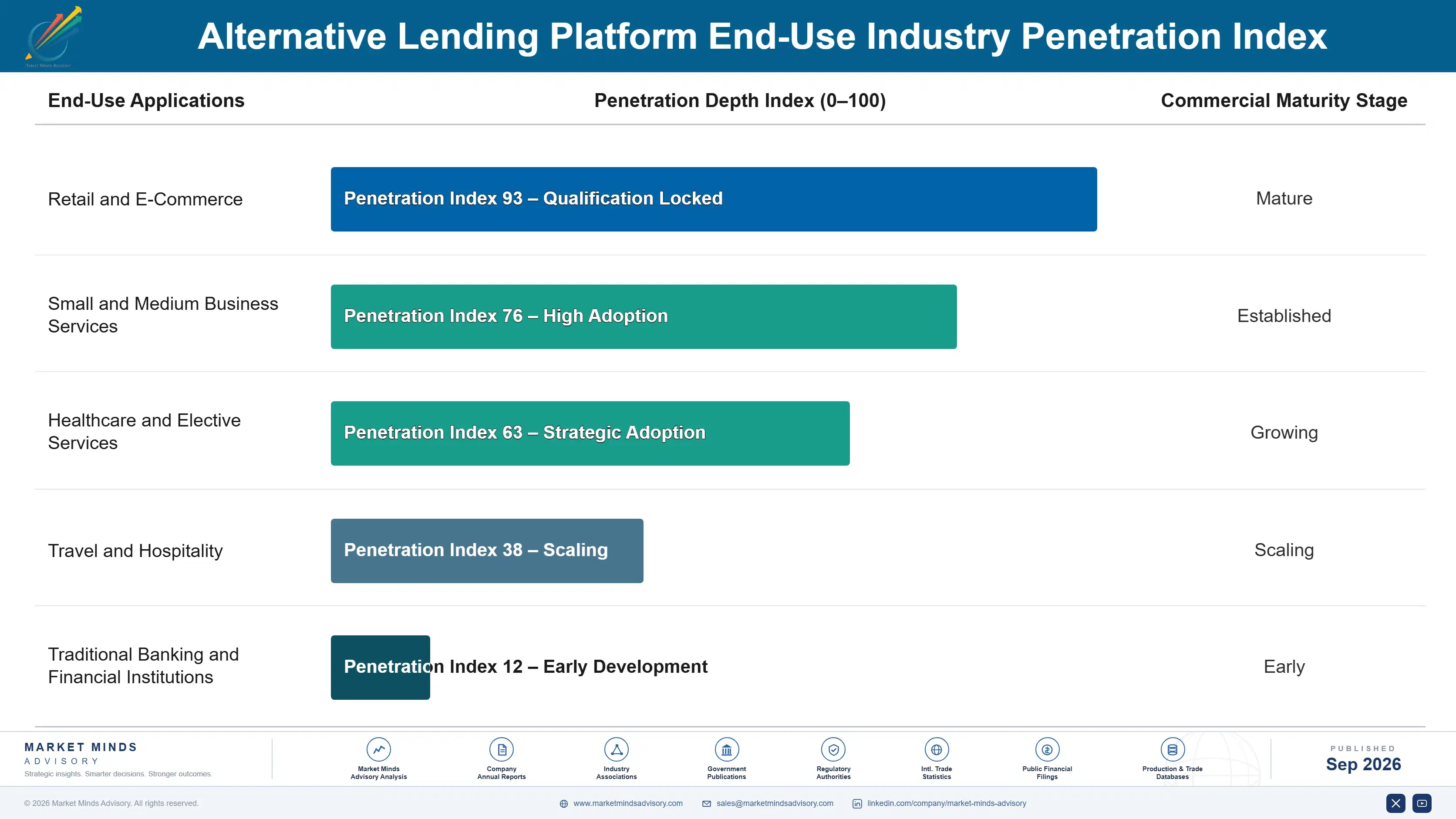
Revenue behaves like a compounding annuity once a platform's underwriting model accumulates enough proprietary transaction data to outperform generic credit scoring meaningfully, since switching lending platforms means rebuilding a borrower's transaction history and re-establishing trust in a new provider's approval process rather than a simple account transfer. That data accumulation advantage explains most of this category's durable competitive positioning once a platform reaches sufficient origination scale.
Adoption depth varies sharply by end use vertical. Small business borrowers running continuous, high value working capital cycles integrate platform relationships deeply into ongoing multi year financing arrangements spanning repeated draw and repayment cycles, creating durable multi year platform relationships, while individual consumer borrowers with occasional point of sale financing needs treat lending platforms more transactionally around individual purchases, creating shallower platform loyalty and greater exposure to competitive switching.

Buyer profiles are shifting generationally too. Borrowers who came up through the traditional bank credit era still favour proven, established lender relationships at a price premium, while younger borrowers increasingly default to evaluating approval speed and transparent pricing as standard selection considerations. That difference in buying philosophy is shaping which platforms win newly acquired borrower segments versus established legacy lending relationships.
alternative-lending-platform-market-end-use-penetration-index-1789981219722

Where the Category Reorders Next

These are among the four positions where our research anticipates prominent divergence between winners and laggards over the coming forecast period. Each is grounded in the demand model, the regulatory perimeter, and the announced capacity pipeline.
01 / UNDERWRITING DATA INVESTMENT

Proprietary data depth is separating category leaders from claims

Platforms that built proprietary underwriting data depth are capturing a disproportionate share of borrower volume as funding partners grow wary of unproven alternative data promises circulating across the category. Platforms without demonstrated live origination evidence risk being relegated to generic scoring positioning carrying materially lower approval accuracy than data leaders currently command. Building this evidence base now, while funding partners actively reassess underwriting evaluation criteria across nearly every major relationship, looks like the more urgent priority for most platforms heading into next year.
02 / CAPITAL FUNDING STRATEGY

Diversified institutional funding is compounding into durable growth

Platforms that diversified institutional capital funding sources are capturing a disproportionate share of origination growth as funding partners increasingly demand resilience beyond single source commitments alone. This dynamic rewards platforms willing to invest in capital markets relationships well ahead of confirmed industry wide funding tightness across the category. Platforms without established diversification should prioritise smaller funding partners first, since pilot relationships with two or three partners tend to reveal most recurring funding requirements early, well before a broader, portfolio wide expansion begins in earnest.
03 / EMBEDDED CHECKOUT POSITIONING

Merchant integration depth remains a genuinely underexploited advantage

Embedded checkout integration remains underexploited relative to its clear value potential as merchants continue seeking smooth conversion optimisation faster than many standalone platforms can credibly demonstrate comparable integration depth. Platforms building genuine integration now are positioning for meaningful transaction volume advantage as point of sale financing continues broadening across retail categories worldwide. Treating checkout integration as a secondary afterthought rather than a distinct strategic asset risks underinvesting in an important, durable competitive moat that rival platforms are already beginning to build out steadily.
04 / LEGACY SCORING EXPOSURE

Platforms without data depth face continued displacement pressure

Platforms remaining concentrated in generic credit bureau scoring positioning without proprietary data or validated underwriting differentiation face continued displacement pressure as borrower and funding partner criteria shift decisively toward precision, technically differentiated offerings. Platforms should actively diversify toward proprietary data depth, funding diversification, or checkout integration rather than defending scoring only positioning alone across every borrower segment. Treating scoring only positioning as stable rather than declining understates the category's ongoing competitive transition already well underway across most developed lending markets tracked closely throughout this report.

Engagement Snapshot From the Field

A live engagement with an industry participant carrying material or product regulatory and market exposure ahead of a defining policy shift, showing how our research translates into a defensible multi-year portfolio strategy.
MARKET MINDS ADVISORY · CLIENT ENGAGEMENT SUMMARY
Alternative Lending Platform Producer Strategic Portfolio Review and Transition Roadmap 2026·Investment Scenario on Alternative Lending Platform Exposure Evaluation 2025-26
CLIENT PROFILE
The client is a regional small business lender originating approximately four hundred million dollars in annual loan volume, operating across a dozen states with historically manual, credit bureau dependent underwriting practices inherited from decades of traditional bank lending experience (client-reported, unverified by MMA). The client's credit risk organisation includes roughly thirty five analysts coordinating underwriting modernisation across multiple regional lending teams.
STRATEGIC CHALLENGE
Leadership needed to modernise its underwriting platform to compete against digital native lenders offering faster approval times, without triggering costly default rate deterioration during the transition from traditional credit scoring to alternative data underwriting across active lending operations. Any delay in deployment risked continued borrower attrition to faster digital native competitors already gaining market share.
MMA APPROACH
MMA benchmarked candidate underwriting technology vendors against disclosed default rate performance and existing client references at comparable regional lenders, prioritising vendors demonstrating genuine validated performance over marketing claims alone. The engagement included structured model validation reviews to assess actual accuracy improvement potential. MMA also reviewed each candidate's documented deployment history across comparable lending portfolios.
KEY FINDINGS
  1. Two of the three candidate vendors already held integration experience with the client's existing core banking system, suggesting a lower risk implementation path than a fully custom integration build.
  2. Several vendors claiming strong accuracy improvement in marketing materials had not actually validated those figures through independent backtesting at comparable regional lenders previously.
  3. A phased loan product by product rollout sequence reduced total implementation risk considerably compared to a simultaneous full portfolio underwriting replacement approach across every product line.
  4. Credit analyst adoption of the retained vendor's underwriting platform exceeded initial expectations once early accuracy results were shared transparently across regional lending teams.
CLIENT PROFILE
The client is a regional small business lender originating approximately four hundred million dollars in annual loan volume, operating across a dozen states with historically manual, credit bureau dependent underwriting practices inherited from decades of traditional bank lending experience (client-reported, unverified by MMA). The client's credit risk organisation includes roughly thirty five analysts coordinating underwriting modernisation across multiple regional lending teams.
STRATEGIC CHALLENGE
Leadership needed to modernise its underwriting platform to compete against digital native lenders offering faster approval times, without triggering costly default rate deterioration during the transition from traditional credit scoring to alternative data underwriting across active lending operations. Any delay in deployment risked continued borrower attrition to faster digital native competitors already gaining market share.
MMA APPROACH
MMA benchmarked candidate underwriting technology vendors against disclosed default rate performance and existing client references at comparable regional lenders, prioritising vendors demonstrating genuine validated performance over marketing claims alone. The engagement included structured model validation reviews to assess actual accuracy improvement potential. MMA also reviewed each candidate's documented deployment history across comparable lending portfolios.
KEY FINDINGS
  1. Two of the three candidate vendors already held integration experience with the client's existing core banking system, suggesting a lower risk implementation path than a fully custom integration build.
  2. Several vendors claiming strong accuracy improvement in marketing materials had not actually validated those figures through independent backtesting at comparable regional lenders previously.
  3. A phased loan product by product rollout sequence reduced total implementation risk considerably compared to a simultaneous full portfolio underwriting replacement approach across every product line.
  4. Credit analyst adoption of the retained vendor's underwriting platform exceeded initial expectations once early accuracy results were shared transparently across regional lending teams.
RECOMMENDED STRATEGY
Phase 1: Phase 1 (Months 1 to 3): Benchmark vendors against validated default performance and verified deployment evidence from comparable regional lenders. Phase 2: Phase 2 (Months 4 to 8): Deploy the new underwriting model on the highest volume loan product first to validate performance. Phase 3: Phase 3 (Months 9 to 14): Extend the platform across remaining loan products based on initial performance results achieved during this final phase.
OUTCOME
Fourteen months after the engagement began, the client successfully modernised underwriting across three of four loan product lines, reporting measurably improved approval time consistency relative to its prior traditional scoring baseline (client-reported, unverified by MMA). Leadership also reported improved confidence in managing future underwriting modernisation independently, and reduced average default rate variance considerably across the transition.

Frequently Asked Questions

Foundational context covering the market sizes, CAGR, scope, country, region and competition that inform every finding below. This section is provided to cover basics and most often pre-purchase conversations, answered from the MMA Primary Research Dataset.

What is the current size of the Alternative Lending Platform Market?

The Alternative Lending Platform Market reached an estimated USD 9.6 billion in global revenue in 2025. This base year figure anchors the forecast period beginning in 2026.

How large will the Alternative Lending Platform Market be by 2036?

MMA projects the market will reach approximately USD 28.51 billion by 2036 under the base case scenario. That represents roughly a 2.69 times expansion from the 2026 starting value of USD 10.60 billion.

What is the CAGR for the Alternative Lending Platform Market 2026 to 2036?

The base case compound annual growth rate is 10.4% across the 2026 to 2036 forecast window. Bull and bear scenarios range from 9.0% to 11.7% depending on default rate trends and institutional funding availability.

Which segment is growing fastest?

Buy Now Pay Later Point-of-Sale Financing Platforms lead all segments at a 14.0% CAGR, roughly 1.35 times the overall market rate. This segment benefits from expanding merchant checkout integration across new retail categories.

Who are the major companies in the Alternative Lending Platform Market?

Leading platforms include SoFi Technologies Inc, Affirm Holdings Inc, Klarna Bank AB, Upstart Holdings Inc, and Block Inc. Together these five hold an estimated 32% combined share on a disclosed loan origination volume basis.

Which country is growing fastest?

India leads national growth at an estimated 12.8% CAGR, driven by government backed digital identity infrastructure accelerating credit access. Vietnam follows within the same South Asia and Pacific region.

Report Segmentation Architecture

The full report scope spans multiple orthogonal segmentation dimensions, with cross-tabulated demand data provided for each dimension pair. Coverage extends further to regional breakdowns, trend trajectories, and the competitive detail needed to support segment-level decision-making.

By Primary Market Dimension

  • Peer-to-Peer Consumer Lending Platforms
  • Marketplace Small and Medium Enterprise Lending Platforms
  • Buy Now Pay Later Point-of-Sale Financing Platforms
  • Invoice and Supply Chain Financing Platforms
  • Merchant Cash Advance and Revenue-Based Financing Platforms
  • Digital Lending Infrastructure and Underwriting Software

By End-Use Industry

  • Retail and E-Commerce
  • Small and Medium Business Services
  • Healthcare and Elective Services
  • Travel and Hospitality
  • Traditional Banking and Financial Institutions

By Commercial Dimension

  • Direct Consumer Application Channel
  • Merchant Embedded Checkout Channel
  • Institutional Funding Partnership Channel
  • Software Licensing to Financial Institutions

By Region

  • North America
  • Western Europe
  • East Asia
  • South Asia and Pacific
  • Latin America
  • Middle East and Africa
  • Eastern Europe

Scope, Methodology, and Coverage

Every figure in this report is reproducible from documented input assumptions. The scope below maps the historical period, the forecast horizon, the segmentation dimensions, and the countries covered, alongside the underlying primary and qualitative methodology.
Historical Period
2020 to 2025
Forecast Period
2026 to 2036
Base Year
2025 (USD billions; MMA Primary Research Dataset, September 2026)
Market Definition
This report covers digital lending platforms that originate consumer and small business credit outside traditional bank branch channels, including peer to peer lending, marketplace lending, buy now pay later financing, invoice financing, and merchant cash advance platforms. It excludes traditional bank branch lending and credit card issuance by conventional card networks.
Quantitative Units
USD billions (current prices); loan origination volume; average approval time reduction
Segmentation Dimensions
By Primary Market Dimension; By End-Use Industry; By Commercial Dimension; By Region
Regions Covered
North America, Western Europe, East Asia, South Asia and Pacific, Latin America, Middle East and Africa, Eastern Europe
Countries Covered
USA, Canada, UK, Germany, France, Sweden, China, Japan, South Korea, India, Australia, Vietnam, Indonesia, Brazil, Mexico, Colombia, UAE, Saudi Arabia, South Africa, Kenya, Poland, Romania, and additional markets relevant to this sector
Key Companies Profiled
SoFi Technologies Inc; Affirm Holdings Inc; Klarna Bank AB; Upstart Holdings Inc; Block Inc; LendingClub Corporation; Prosper Marketplace Inc; Funding Circle Holdings plc; Enova International Inc; BlueVine Inc; Ant Group Co Ltd; Lufax Holding Ltd; PayPal Holdings Inc; Zopa Bank Limited; Avant LLC; GreenSky Inc; C2FO Inc; Fundbox Inc; RateSetter Ltd; Behalf Inc
Quantitative Methodology
Primary survey, n=3,800 respondents, Q4 2025, six countries; demand-side model with trade association cross-validation
Qualitative Methodology
47 expert interviews, Q4 2025; applied to validate demand model assumptions, identify emerging dynamics, and assess competitive positioning
Report Format
PDF and XLSX data workbook (Word format preview document)
Publisher
Market Minds Advisory
Report Code
MMA-2026-TEC-248
Published
September 2026
Contact
sales@marketmindsadvisory.com | www.marketmindsadvisory.com

Purchase the full Alternative Lending Platform Market Report (2026 to 2036).

The full report delivers complete segmentation data across all six lending product and platform segments, all seven regional markets, and detailed competitive profiles for all twenty companies named in this summary. It includes the underlying primary survey dataset of three thousand eight hundred respondents and forty seven expert interviews conducted during the fourth quarter of 2025. Buyers also receive downloadable data tables covering historical 2020 to 2025 figures alongside the full 2026 to 2036 annual forecast. A dedicated appendix addresses underwriting data benchmarks across three platform scenarios.
Full Seven-Region Regional Data Tables and Charts
All Twenty Company Competitive Profiles and Rankings
Ten-Year Annual Forecast Model With Scenarios
Primary Survey Raw Data Access and Tables
Underwriting Data Benchmark Appendix and Guide
Quarterly Update Subscription Option for Buyers

Built For The People Who Decide

From boardroom strategy to bench-side execution, this report is read cover-to-cover by leaders shaping the next decade of their industry, turning demand scenarios, market dynamics and valuation benchmarks into decisions.
CXOs/ Presidents/ VPs/ Managers
M&A and Corporate Development
Strategy Teams and R&D Heads
Procurement and Product Directors
Regulatory and Compliance Leaders
Investor Relations and Equity Analysts