Market Minds Advisory
Alpha Hydroxy Acid (AHA) Serums Market

Alpha Hydroxy Acid (AHA) Serums Market: Alpha Hydroxy Acid Serums Market: Consumers Compare Percentages And The Percentage Barely Matters, While Only Four Per Cent Disclose Free Acid, 2026 to 2036

Efficacy depends on free acid availability rather than labelled percentage, and only about 4% of products disclose it. Barrier damage from over-frequent use is reported by 29% of users. Only 37% pair sun protection.

Lead Analyst

Published

September 2026

Make Smarter Decisions with Customized Research Insights

Request a free sample report and evaluate market opportunities, growth trends, and competitive dynamics relevant to your business needs.

2025 MARKET VALUE$2.1BMarket Size 2025
2036 FORECAST VALUE$6.1BBase Case , 2026 to 2036
CAGR 2026 TO 203610.2 %Bull 11.5% / Bear 8.9%
INCREMENTAL OPPORTUNITY$3.8BNet 10- year value creation
EXPANSION MULTIPLE2.65x2036 value over 2026 base
Strategic Levers
M&A Pipeline
Regional Outlook
Country Rankings
Competitive Intelligence
Segmental Deep-dive
Call-Us : 91 93563 13602

Executive Snapshot and Market Trajectory.

A 10% glycolic serum buffered to pH 4.5 does considerably less than a 5% one at pH 3.5. Consumers compare the percentage on the front and only about 4% of products disclose the free acid value that actually decides the outcome. The comparison the category taught is close to empty.
Encapsulated and time-release AHA serums grow at 15.3%, half again the market rate of 10.2%, because controlling delivery rate addresses the barrier damage that ends most users' relationship with the category. Mandelic acid serums follow at 13.4% on molecule size and tolerance rather than potency. Glycolic serums grow slowest at 7.4%, despite being the best studied acid in the field. Multi-acid blends are displacing single-acid products among users already through one round of over-exfoliation.
East Asia holds 35% of demand, and South Korean growth of 16.8% leads every market covered on gentle acid formulation the rest of the world subsequently copied. Around 29% of users report persistent irritation from over-frequent application, and only 37% pair an acid serum with the daily sun protection that regulators and dermatologists both direct them to use. Gentle formats exist substantially to repair damage the first wave caused.
Market Definition
This market covers finished topical alpha hydroxy acid serum products, including glycolic acid serums, lactic acid serums, mandelic acid serums, multi-acid AHA blend serums, encapsulated and time-release AHA serums, and AHA and PHA hybrid serums. It excludes beta hydroxy acid products where salicylic acid is the primary acid, professional chemical peels and in-office treatments, AHA cleansers and toners, anti-pollution positioned skincare, and prescription retinoid or dermatology products.
Base Year Value
$2.1B in 2025 (MMA Primary Research Dataset, September 2026)
Forecast Period
2026 to 2036, eleven discrete annual values
CAGR
10.2% base case. Bull 11.5%. Bear 8.9%.
Fastest Growth Segment
Encapsulated And Time-Release AHA Serums: 15.3% CAGR
Fastest Growth Country
South Korea: 16.8% CAGR
Fastest Growth Region
South Asia and Pacific: 12.2% CAGR
Largest Region
East Asia: 35% of 2025 global value
Market Leaders
L'Oreal Groupe, Unilever, Shiseido, Amorepacific, and Beiersdorf lead the field. Source: MMA Primary Research Dataset, July 2026.
Primary Survey
n=3,800 procurement and R&D decision-makers, Q4 2025, six countries
Methodology
Demand-side build-up, cross-validated against public data, 47 expert interviews

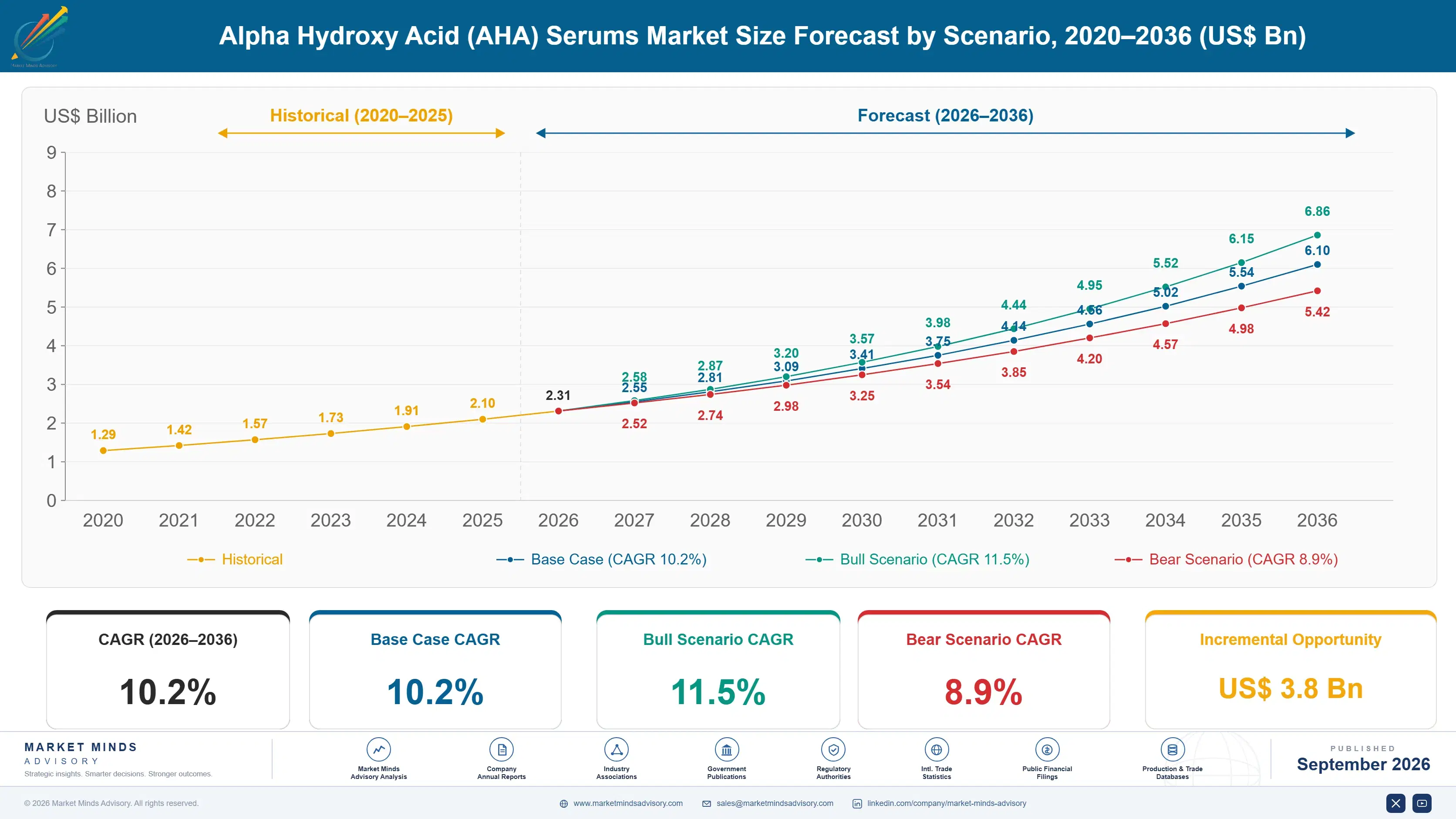
Alpha Hydroxy Acid (AHA) Serums Market Forecast Scenarios

alpha-hydroxy-acid-aha-serums-market-size-forecast-scenario-1790017833575
Growth from 2020 to 2025 ran at 9.0% and came almost entirely from ingredient-led brands making acid concentration a front-of-pack number. That framing built the category quickly and taught consumers to compare a figure that means very little on its own. A parallel wave of barrier damage followed, and the gentle acid formats that now grow fastest are largely a response to the harm the first wave did.
The base case at 10.2% rests on three mechanisms. Korean and Chinese formulation keeps driving tolerance-led architecture, with South Korean growth at 16.8% leading every country covered. Encapsulation takes share as brands address the barrier damage that ends most category relationships. And multi-acid blends keep displacing single-acid products among users who have already been through one round of over-exfoliation. None of the three assumes free acid disclosure becomes a norm during the period.
The bull case at 11.5% depends on free acid disclosure becoming a competitive norm, which would let a genuinely better formulation demonstrate it and reprice the category around performance. The bear case at 8.9% is regulatory: European scientific opinion has already tightened AHA concentration and pH guidance, and further restriction would remove products rather than reformulate them.

The Number On The Front

An alpha hydroxy acid works through the portion of it that exists in free acid form, and that portion is set by the formulation pH and its buffering rather than by the percentage printed on the bottle. A 10% glycolic serum buffered up to pH 4.5 delivers meaningfully less free acid than a 5% one held at pH 3.5. Around 18% of products disclose pH and about 4% disclose free acid value.
TOP FIVE CONCENTRATION26%Share of category revenue held by the leading brand owners
FREE ACID DISCLOSURE RATE4%Products stating free acid value alongside the labelled percentage
FORMULATION PH DISCLOSURE18%Serums publishing the finished formulation pH on pack
BARRIER DAMAGE REPORTS29%Users reporting persistent irritation from over-frequent acid application
SUNSCREEN PAIRING COMPLIANCE37%Acid serum users applying daily sun protection as directed
GENTLE ACID VOLUME SHARE31%Volume using larger molecules chosen for tolerance over potency
So the number consumers compare is close to meaningless in isolation, and the category taught them to compare it. Ingredient-led brands built the market by putting concentration on the front of the pack, which was commercially effective and analytically empty. Two products at the same stated percentage can differ several-fold in what they deliver, and no label says so.
The consequence shows up as barrier damage. Roughly 29% of users report persistent irritation from applying acids more often than their skin tolerates, and the tingling is widely read as evidence of working rather than as a warning. Only 37% pair a serum with the daily sun protection both regulators and dermatologists direct. Gentle formats exist mostly to repair that.
"This category trained an entire generation of buyers to compare a number that tells them almost nothing, and now sells them gentler products to undo the damage the first number caused. Publishing free acid value would fix it in an afternoon and would embarrass a lot of formulations."
Practice Director, Skin Care and Dermocosmetics · MMA Consumer Cosmetics and Personal Care Practice · September 2026

Market Trends

Encapsulation Addresses The Category's Own Damage

Encapsulated and time-release serums grow at 15.3%, fastest of the six formats, by controlling how quickly free acid reaches the skin rather than how much of it is present. That directly addresses the 29% of users reporting persistent irritation, which is the single largest reason people leave the category. Formulation difficulty is real, since a carrier must hold the acid stable at low pH and release it predictably. Brands that solved it hold a position competitors cannot reach by adjusting a percentage upward or downward. Cost per unit runs well above conventional formats and price realisation holds accordingly.
Market Impact: Country grows at 16.8%
Gentle Acids Grow On Tolerance Not Potency

Mandelic acid serums grow at 13.4% and AHA and PHA hybrids at 12.1%, together holding around 31% of volume, and the argument for both is molecule size rather than performance. Larger molecules penetrate more slowly, which makes them better tolerated and less effective per application. That is a legitimate trade for a damaged barrier and a poor one for an intact barrier being sold a gentler product it does not need. Very few brands make that distinction at the point of sale. Selling gentleness to an intact barrier wastes money and patience without harming anyone.
Market Impact: Affects 29% of users

Market Opportunities and Growth Drivers

Korean Formulation Sets The Tolerance Architecture

South Korea grows at 16.8%, faster than any country covered, and Korean formulation originated the gentle acid architecture that Western brands adopted several years later. East Asia holds 35% of world demand on that basis. Korean routines assume frequent low-strength application rather than occasional high-strength treatment, which produces a different product design and a considerably lower irritation rate. Chinese domestic brands follow Korean direction rather than Western practice, which is where regional volume growth is concentrating. Western brands adopted the architecture several years after it established, and mostly without the routine guidance that makes it work properly.
Market Impact: Only 4% disclose value

Damaged Barriers Create Their Own Replacement Demand

About 29% of users report persistent irritation from over-frequent acid use, and a large share of them migrate to gentler formats rather than leaving skincare altogether. That turns the category's central failure into a source of demand for its fastest growing segments, which is commercially convenient and worth naming plainly. Multi-acid blends and PHA hybrids capture most of those consumers. The pattern also means category growth partly depends on a harm the products themselves cause. That pattern means category growth partly depends on a harm the products themselves cause, which is worth naming rather than describing as a trade-up.
Market Impact: Compliance near 37% only

Market Restraints and Challenges

The Comparable Number Is The Wrong Number

Only about 4% of products disclose free acid value and 18% disclose pH, and the root cause is that ingredient-led brands built the category on front-of-pack concentration because it was simple to communicate. Commercially this caps what a genuinely better formulation can charge, since it cannot demonstrate the difference. Brands respond by publishing pH and free acid value, by including third-party verification, and by pushing industry bodies toward disclosure norms before a regulator writes one. Publishing the figure would embarrass a considerable number of formulations currently competing on a percentage alone.
Market Impact: Segment grows at 15.3%

Sun Protection Compliance Sits Below Forty Per Cent

Around 37% of acid serum users apply daily sun protection as directed, and the root cause is that the direction appears in small print while the product is sold on immediate visible smoothness. Commercially this creates an adverse outcome risk the category carries collectively rather than individually. Brands respond by bundling sun protection with acid ranges, by moving the direction onto front-of-pack, and by designing evening-only formats that sidestep the exposure window entirely. Bundling sun protection into a range is the only response that changes behaviour rather than restating the instruction, and very few brands have tried it.
Market Impact: Gentle acids hold 31%
4 additional market trends, 3 additional growth drivers, and 2 additional restraints and challenges are covered in the full report. Contact sales@marketmindsadvisory.com to access the complete intelligence.

Segment CAGR and Growth Architecture

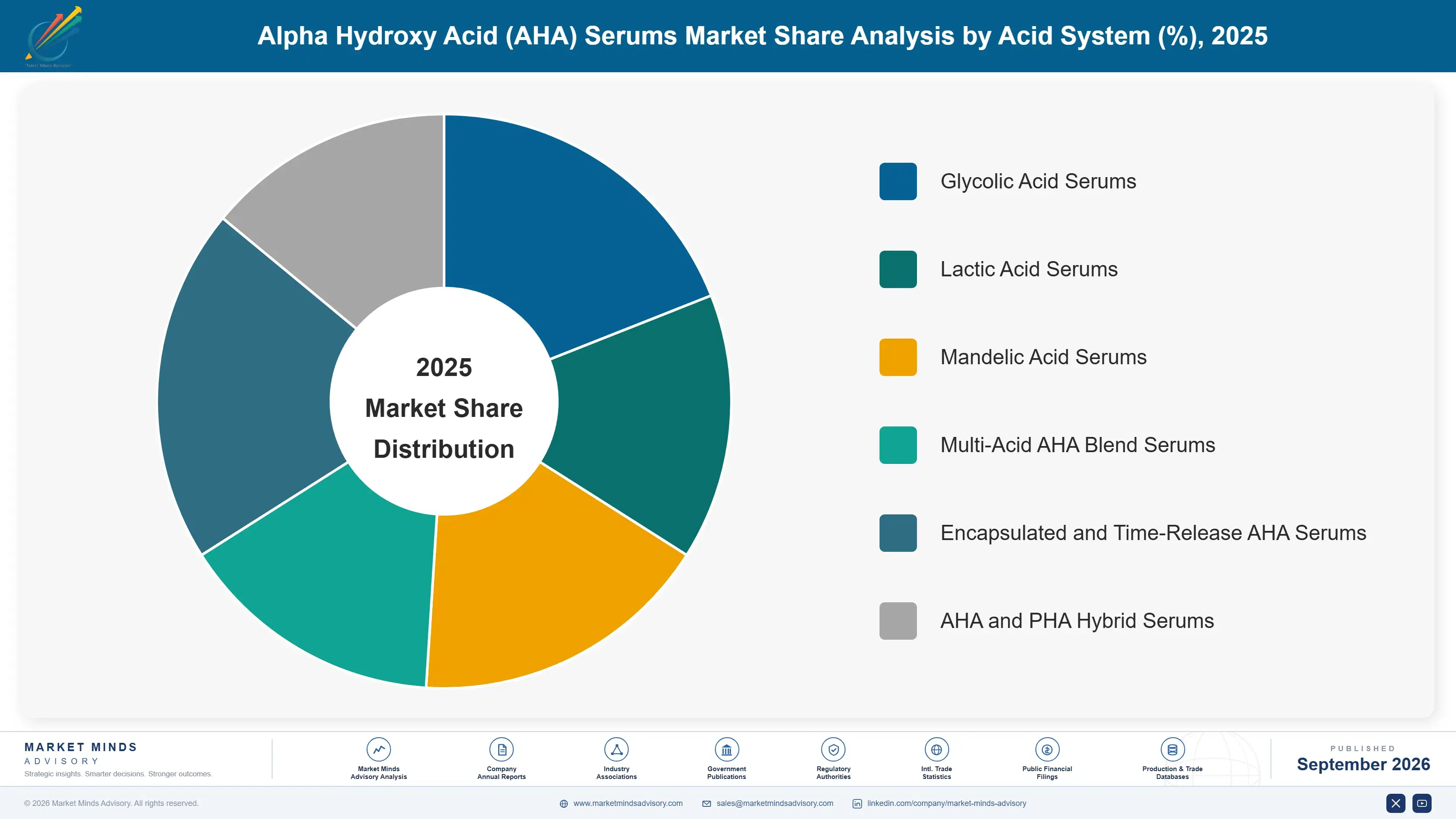
Segmentation follows acid system across six categories: glycolic acid serums, lactic acid serums, mandelic acid serums, multi-acid AHA blend serums, encapsulated and time-release AHA serums, and AHA and PHA hybrid serums. Price tier, distribution channel, and disclosure practice are treated as separate dimensions rather than folded into this hierarchy. Salicylic acid products and professional peels fall outside the defined scope.
alpha-hydroxy-acid-aha-serums-market-market-share-analysis-1790017834134

Encapsulated And Time-Release AHA Serums

Encapsulated serums grow at 15.3%, half again the market rate of 10.2%, by controlling the rate at which free acid reaches skin rather than the quantity present in the bottle. That is the only approach in the category that addresses irritation without reducing the total acid delivered over a course of use. Formulation is genuinely difficult, because a carrier has to hold acid stable at low pH and release it on a predictable curve rather than all at once. Brands that solved it hold ground competitors cannot reach by adjusting a percentage. Cost per unit runs well above conventional formats and price realisation holds accordingly. Returning users rather than new entrants drive most of the demand here.
CAGR 15.3%

Mandelic Acid Serums

Mandelic acid serums grow at 13.4% on molecule size rather than on any performance advantage over glycolic. A larger molecule penetrates more slowly, producing less irritation per application and less effect per application alongside it, which is an honest trade for a compromised barrier and a poor one for an intact barrier. Korean formulation established the format and Western brands followed several years behind. The segment's growth is substantially fed by consumers leaving stronger acids after over-exfoliation, which makes it a repair category as much as a treatment one. Very few brands say so at the point of sale. That makes it a repair category as much as a treatment one.
CAGR 13.4%
Full segment breakdown across 6 segments available in the complete report.

Regional Architecture and Country Demand Map

Regional shares reflect where alpha hydroxy acid serums are purchased rather than where they are formulated or filled. Three regions sit outside the standard bands, for reasons named in their own paragraphs and summarised below for operator review. Routine intensity and sun exposure vary considerably between them.

East Asia

At 35% this sits above the standard band, and the justification is that Korean formulation originated the tolerance-led acid architecture the rest of the world subsequently adopted. South Korean growth of 16.8% leads every country covered. Regional routines assume frequent low-strength application rather than occasional high-strength treatment, which produces both different products and a considerably lower irritation rate. Japanese formulation leads on encapsulation and stability chemistry. Chinese domestic brands follow Korean direction rather than Western practice and are where regional volume growth concentrates. Sun protection compliance is materially higher here than in any Western market. Encapsulation and stability chemistry are where Japanese formulation leads, and both are hard to reproduce.
Share: 35% | CAGR: 11.2% (2026 to 2036)

North America

Ingredient-led brands built this category here by putting acid concentration on the front of the pack, and that framing still shapes how consumers compare products across every price tier. Growth of 9.4% runs a little under the world rate. Barrier damage reporting is highest of any region, which is a direct consequence of the concentration-led framing and the routine intensity it encouraged. Dermatologist-founded brands are gaining share on disclosure and moderation messaging. Sun protection compliance is among the lowest covered. Multi-acid blends are displacing single-acid products fastest here. Dermatologist-founded brands are gaining share on disclosure and moderation rather than on concentration, which reverses how the category was built here. Sun protection compliance is among the lowest covered anywhere.
Share: 22% | CAGR: 9.4% (2026 to 2036)
Regional intelligence for 5 additional markets available in the complete report: Western Europe, South Asia and Pacific, Latin America, Middle East and Africa, Eastern Europe. Contact sales@marketmindsadvisory.com.
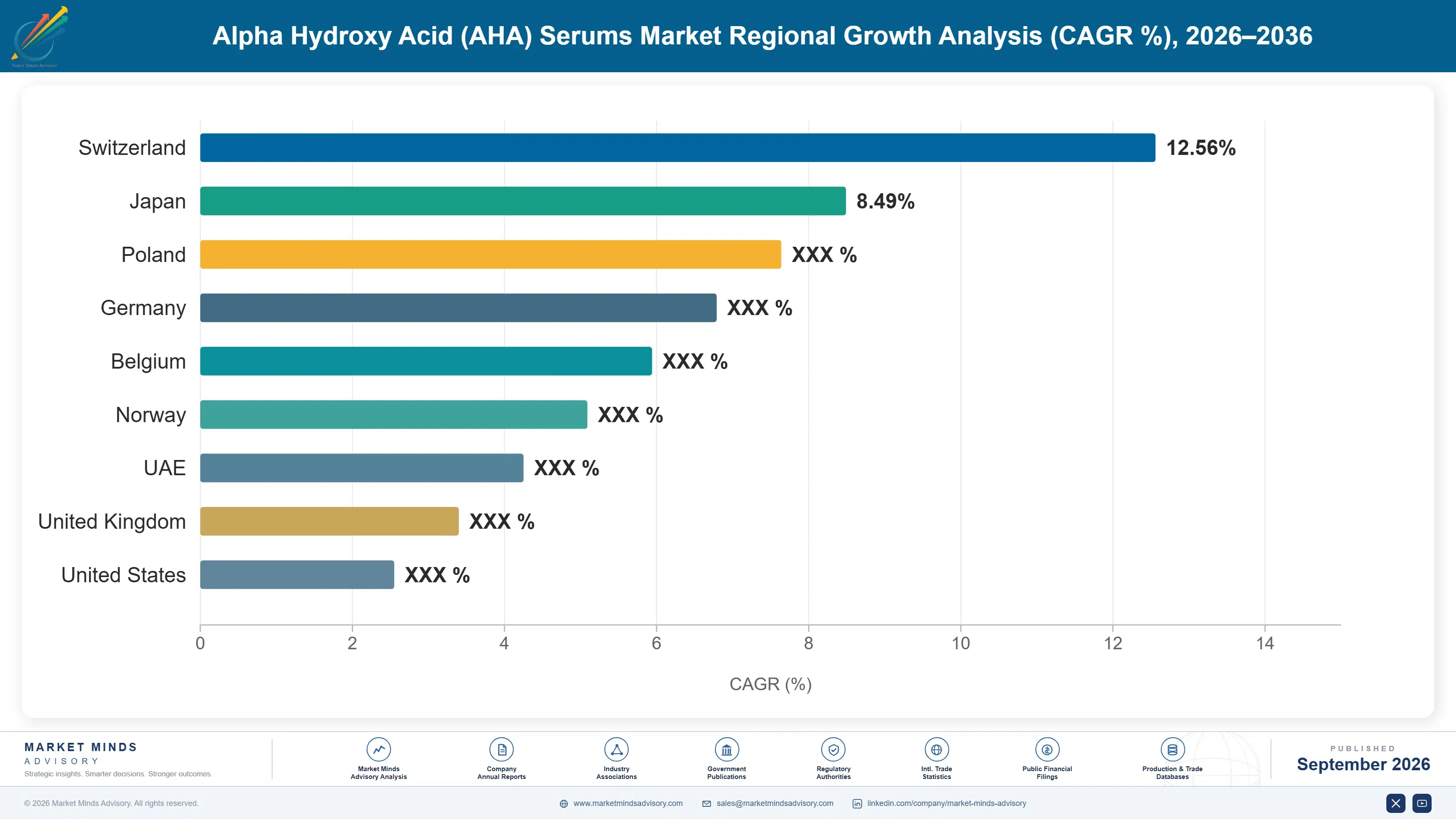
alpha-hydroxy-acid-aha-serums-market-country-cagr-analysis-1790017834666

Where Acid Brands Build Position

Four commercial moves matter in a category that taught its own consumers to compare the wrong number and then sold them gentler products to repair the result. Each involves disclosing or designing around something the field currently prefers to leave unstated at the point of sale. Each is available immediately and none requires new chemistry.

Publish Free Acid Value On Every Product

Only about 4% of products disclose free acid value and 18% disclose pH, which means a genuinely better formulation cannot demonstrate that it is one. Brands publishing both alongside third-party verification report price realisation 2.6 times higher than concentration-only equivalents in premium tiers. The measurement costs almost nothing and the disclosure would embarrass a considerable number of competing formulations. Setting the norm first also shapes what a regulator eventually requires everybody else to state. A regulator writing a disclosure requirement would arrive on a timetable shorter than building the measurement practice takes from nothing.
Market Impact: Raises achieved price realisation to 2.6 times higher

Engineer Release Rate Rather Than Concentration

Roughly 29% of users report persistent irritation, and encapsulated formats grow at 15.3% by controlling how fast free acid reaches skin rather than how much sits in the bottle. Brands with genuine encapsulation capability report gross margin 2.1 times better than conventional formats at comparable retail prices. The formulation work is difficult, which is exactly why the position holds. A competitor cannot answer it by moving a percentage up or down on a label. Returning users who left the category after irritation are the demand this addresses, and they buy at higher price points than first-time entrants do.
Market Impact: Raises gross margin to 2.1 times better overall

Bundle Sun Protection Into Acid Ranges

Only about 37% of acid serum users apply daily sun protection as directed, and the direction currently appears in small print beneath a claim about visible smoothness. Brands bundling sun protection with acid ranges report basket value 1.8 times higher alongside materially lower adverse outcome reporting. This is a commercial improvement and a safety one at the same time, which is unusual. It also removes a liability the category currently carries collectively rather than individually. Moving the direction onto front-of-pack costs a label revision and does more for compliance than any amount of education copy inside the carton.
Market Impact: Raises category basket value to 1.8 times higher

Match Acid Strength To Barrier Condition

Gentle acids hold around 31% of volume and are frequently sold to intact barriers that would tolerate and benefit from something stronger. Brands running barrier assessment at point of sale, through diagnostic tools or guided routines, report repurchase rates 2.3 times higher than undifferentiated recommendation. Selling a gentler product to somebody who does not need one wastes their money and their patience. Selling a stronger one to a damaged barrier loses the customer entirely. A diagnostic step at point of sale costs very little and answers the one question that decides whether a customer stays in the category at all.
Market Impact: Raises repurchase rates to 2.3 times higher overall

Who Controls the Margin Pool

Concentration is very low. Five brand owners hold 26% of category revenue, measured consistently on that basis across all participants, and the remainder spreads across ingredient-led value brands, Korean and Chinese domestic houses, dermocosmetic ranges, and dermatologist-founded independents. Formulation barriers are low for conventional acids and considerably higher for encapsulated systems, which is where the field genuinely separates. Fragmentation at this level is unusual for a skincare category of this size.
Competition currently turns on three dimensions: disclosure practice, since free acid value and pH are the only ways a better formulation can prove itself; encapsulation capability, which addresses the irritation ending most category relationships; and tolerance-led routine design, where Korean formulation continues to set direction for everybody else. Price decides at value tier, which still accounts for the majority of units moved across every region covered here.

Pressure builds from two directions. Korean and Chinese brands originate the architecture and reach the fastest growing consumers first. European scientific guidance on concentration and pH is tightening. Rankings will shift toward brands holding encapsulation capability and published formulation data rather than front-of-pack concentration. Brands holding only concentration-led positioning face the most exposed position in the field.
alpha-hydroxy-acid-aha-serums-market-company-positioning-matrix-1790017835192

Competitive Moat and Risk Dimensions

L'OREAL GROUPE

Moat: Encapsulation And Formulation Depth

Research capability in delivery systems and stability chemistry supports encapsulated formats that competitors cannot answer by adjusting a labelled percentage. That position addresses the irritation ending most category relationships, and it becomes more valuable as European guidance on concentration and pH continues to tighten. Returning users buy at higher price points than first-time entrants.
L'OREAL GROUPE

Risk: Concentration-Led Brand Legacy

Several brands in the portfolio built their following on front-of-pack concentration, which is precisely the framing that produced widespread barrier damage. Migrating those consumers toward disclosure and moderation messaging risks the positioning that acquired them in the first place. Disclosure would also make some of those formulations look considerably worse than their labelled percentage currently implies.
AMOREPACIFIC

Moat: Tolerance Architecture And Korean Cycle

Korean formulation originated the frequent low-strength routine design that the rest of the world adopted years later, and proximity to that development cycle gives both timing advantage and a genuine read on what will travel. The architecture also produces materially lower irritation rates than concentration-led alternatives.
AMOREPACIFIC

Risk: Thin Disclosure Practice

Leadership built on formulation architecture rather than published data leaves the position exposed if free acid disclosure becomes a competitive norm or a regulatory requirement. Brands already publishing pH and free acid value would be ready; those relying on routine design would need to build that evidence from nothing.

Players Tracked

Prominent Players

L'Oreal Groupe
Unilever
Shiseido
Amorepacific
Beiersdorf

Other Key Players

Estee Lauder Companies
Galderma
Pierre Fabre
LG Household and Health Care
Kose
COSRX
Some By Mi
Medicube
Yatsen Holding
Proya Cosmetics
Hero Cosmetics
Naos Group
Rodan and Fields
Obagi Global
Kao Corporation

Recent Developments

MARCH 2026

Unilever Publishes Free Acid Value Across Its Acid Serum Range

Unilever began stating measured free acid value and formulation pH on pack across its acid serum products, with third-party verification of the figures. The disclosure puts a comparable number where labelled concentration has stood alone. Verification method documentation was published alongside the figures themselves in full.
Signal: Whoever sets a disclosure norm first shapes what regulators later require. A comparable number changes what competition is actually about.
OCTOBER 2025

Amorepacific Expands Encapsulated Acid Delivery Production Capacity

Amorepacific completed an organic expansion of encapsulated acid delivery manufacturing at a Korean site, funded internally with no partner involved. Management cited demand from consumers returning to the category after barrier damage rather than new entrants. Carrier stability at low formulation pH was the stated engineering focus of the expansion.
Signal: Returning damaged users rather than new buyers are driving encapsulated growth. Churn is funding the fastest format.
MAY 2025

Beiersdorf Acquires Dermatologist-Founded Acid Serum Brand

Beiersdorf completed an acquisition of a dermatologist-founded acid serum brand publishing pH and free acid value across its range. The transaction was an outright acquisition rather than a joint venture or minority stake, with disclosure practice cited as the rationale. Clinical and dermatological relationships transferred with the business.
Signal: Disclosure credibility is being bought because it takes years to build. Credibility of this kind takes years rather than campaigns.

What An Acid Serum Costs

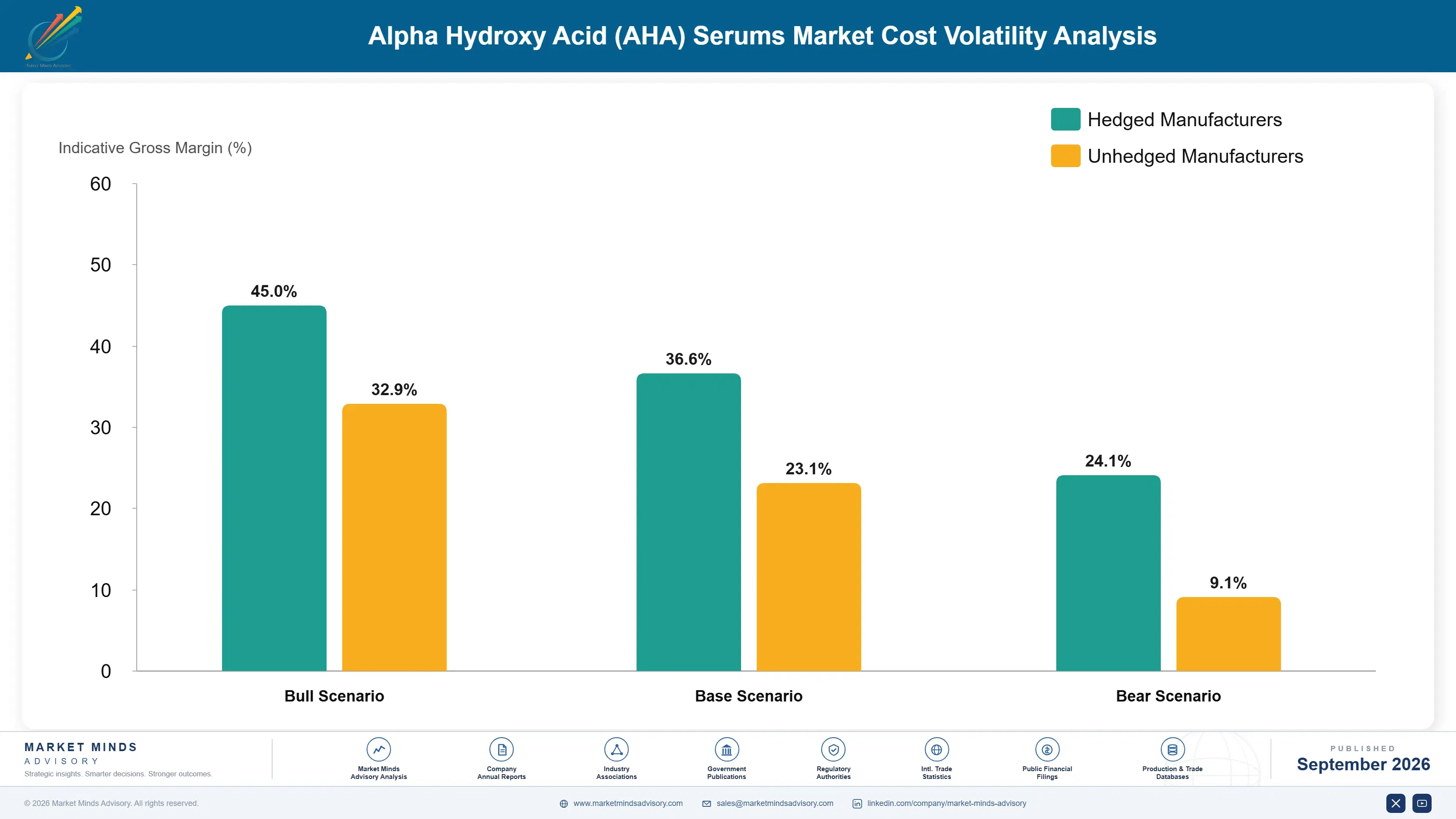
The cost structure is unusual because the active is cheap. Glycolic, lactic, and mandelic acids together run 14% to 22% of cost of goods sold, and the eight-point range reflects acid choice rather than grade. Formulation base, humectants, buffering systems, and encapsulation take 26% to 34%, rising sharply for controlled release. Packaging and claim substantiation account for 30% to 38%, the largest single group.
Glycolic acid pricing stayed comparatively stable through 2024 and 2025 as production capacity remained ample against cosmetic demand, while cosmetic packaging costs moved sharply on resin and freight together, and United States Census Bureau trade data recorded the divergence across the period. Several brand owners described packaging cost pressure specifically in their annual reports. Encapsulation materials moved on specialty polymer cycles unrelated to either of them.

The competitive disadvantage mechanism runs through packaging and substantiation rather than through active cost. A brand at mid tier price points carries component and claim cost as a large share of a modest unit price and cannot absorb resin movements the way a premium brand spreading the same components over a higher price can. Exposure varies by price tier rather than scale, and value brands are most squeezed.
alpha-hydroxy-acid-aha-serums-market-cost-volatility-analysis-1790017835390

Standardise Component Architecture Across Acid Ranges

Packaging and substantiation run close to a third of goods sold and rise fastest at value price points where they can least be absorbed. A shared component architecture across a range converts a per-product tooling and inventory burden into a volume position, which is the only lever that materially moves this line for an ingredient-led brand.

Contract Encapsulation Materials Across Multiple Seasons

Specialty polymer carriers behind controlled release follow cycles entirely unrelated to acid pricing or packaging resin. Contracting them on their own calendar protects the fastest growing format in the category against tightening that arrives whenever demand catches up with the capacity additions that preceded it. Encapsulation capacity has historically tightened faster than acid supply ever has.

Treat Substantiation As Capability Rather Than Cost

Free acid and pH measurement costs very little per product and currently sits in almost nobody's budget as a deliberate investment. Treating it as a published capability rather than a compliance expense converts a cost line into the one differentiator available in a category where labelled concentration tells a buyer almost nothing. It costs almost nothing per unit produced.

Portfolio Architecture for Margin Defence

Margin follows formulation difficulty and disclosure rather than acid choice. Value glycolic serums compete close to commodity terms on an active costing very little. Lactic and multi-acid blends earn moderately on formulation elegance. Mandelic and PHA hybrids earn well on tolerance positioning, and encapsulated controlled-release serums earn most, because the carrier chemistry is genuinely hard and the benefit is real. The spread from bottom to top tier is wide even by skincare standards.
The tension between volume and premium runs through what the consumer thinks they are comparing. A buyer choosing between two products by their stated percentage is running a comparison that means very little, and price decides it. A buyer choosing on published free acid value, pH, and release profile is running a real comparison, and the better formulation wins it. Almost nobody offers that buyer the data to do so.

High-value pools concentrate in encapsulated controlled-release formats, in dermatologist-endorsed ranges publishing formulation data, and in Korean tolerance-led architectures reaching Western premium channels. Where the product is a value glycolic serum sold on a front-of-pack percentage, the active is cheap, formulation is broadly available, and the contest runs on packaging and distribution alone.

Volume / Commodity-Adjacent

Value glycolic and lactic serums sold on front-of-pack concentration at accessible price points. The twelve-point range reflects packaging and distribution cost rather than formulation capability, since the acids themselves cost very little to obtain.
Gross Margin: 52% to 64%

Premium / Certified

Multi-acid blends, mandelic serums, and PHA hybrids where buffering and tolerance design require genuine formulation work. The twelve-point range separates real formulation capability from products assembling an acid blend without controlling delivery at all.
Gross Margin: 68% to 80%

Sustainability / Regulatory / Next-Generation

Encapsulated controlled-release serums and ranges publishing verified free acid value and pH. The ten-point range reflects carrier chemistry and disclosure practice, neither of which a competitor can assemble on any short timescale.
Gross Margin: 82% to 92%
alpha-hydroxy-acid-aha-serums-market-portfolio-architecture-1790017835894

High-value Sub-segments and Strategic Watch-out

Encapsulated Controlled Release Serums

Highest value in the category and fastest growing at 15.3%, addressing the irritation that ends most consumers' relationship with acids. The ten-point range reflects carrier chemistry, since holding acid stable at low pH is genuinely difficult work. Returning users buy here at higher prices than new entrants.
Gross Margin: 84% to 94%

Verified Disclosure Ranges

High value because published free acid value and pH are the only way a better formulation can prove it. The twelve-point range reflects verification depth, with only about 4% of the category disclosing anything at all today. Setting the norm first shapes what a regulator later requires.
Gross Margin: 74% to 86%

Tolerance-Led Gentle Acid Formats

Volume core holding around 31% of the market and growing on molecule size rather than measured performance. The twelve-point range reflects formulation architecture, since a slower acid still needs buffering and delivery designed properly around it. Korean architecture assumes frequent low-strength application rather than occasional treatment.
Gross Margin: 66% to 78%

Value Front-Of-Pack Percentage Serums

The strategic watch-out. Slowest growing format, an active costing very little, and a comparison metric that tells a buyer almost nothing. The twelve-point range reflects packaging and distribution position, with nothing else defending it. Discounting it raises trial and accelerates churn simultaneously. That is expensive.
Gross Margin: 50% to 62%

How This Demand Repeats

Repeat purchase follows tolerance rather than satisfaction, which is the reverse of most skincare categories. A serum that produces visible smoothing quickly also produces the irritation that around 29% of users eventually report, and those consumers do not repurchase the product that worked fastest. They buy something gentler instead, which means the category's own most effective formats generate the churn its fastest growing formats absorb.
Attachment depth follows routine design more than brand preference. A tolerance-led architecture assuming frequent low-strength application builds a habit that persists for years, because nothing ever goes wrong badly enough to interrupt it. A concentration-led product used two or three times a week produces a cycle of visible improvement followed by irritation followed by a pause, and that cycle rarely survives more than a few rounds.

The buyer profile is shifting from consumers who entered through front-of-pack percentage toward consumers arriving from Korean routine practice or from a dermatologist recommendation. Both of those groups ask what the pH is, and almost no brand can answer at the point of sale. The question is being asked considerably more often than it was three years ago, and the field is not ready for it.
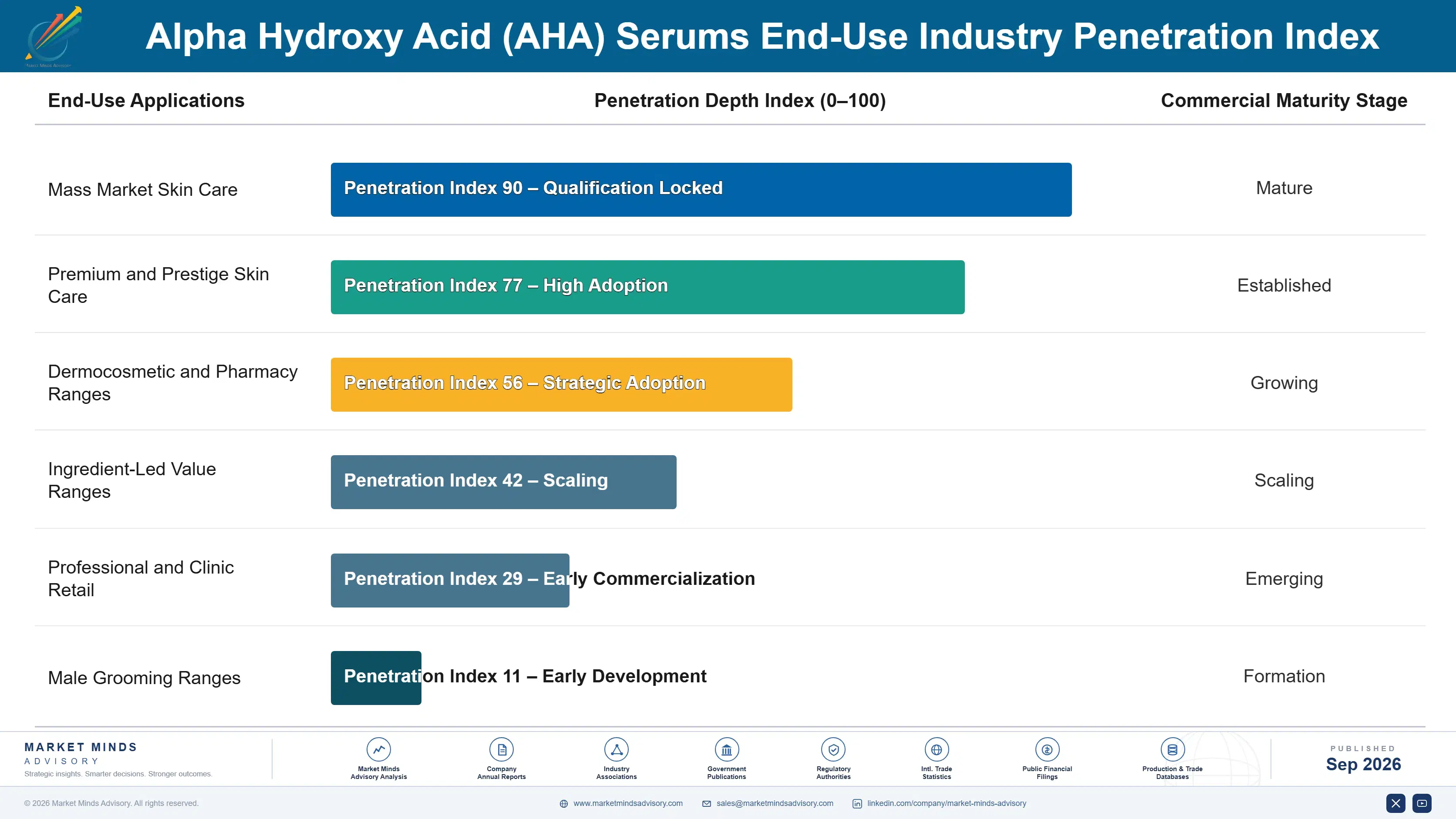
alpha-hydroxy-acid-aha-serums-market-end-use-penetration-index-1790017836413

Where This Market Rewards

These are among the four positions where our research anticipates prominent divergence between winners and laggards over the coming forecast period. Each is grounded in the demand model, the regulatory perimeter, and the announced capacity pipeline.
01 / FREE ACID DISCLOSURE

Publish the number that matters

Only about 4% of products disclose free acid value and 18% disclose formulation pH, which means a genuinely superior formulation currently has no way at all to demonstrate that it is one. Brands publishing both figures with third-party verification report price realisation 2.6 times higher than concentration-only equivalents in premium tiers. The measurement costs almost nothing, and setting the norm first shapes what a regulator eventually requires every competitor to state, and publishing it would make a considerable number of competing formulations look worse.
02 / RELEASE RATE ENGINEERING

Control speed instead of quantity

Roughly 29% of users report persistent irritation from over-frequent application, and encapsulated formats grow at 15.3% by governing how quickly free acid reaches skin rather than how much of it sits in the bottle. Brands with genuine encapsulation capability report gross margin 2.1 times better than conventional formats at comparable retail prices. The carrier chemistry is difficult, which is exactly why a competitor cannot answer it by moving a percentage on a label, and returning users who left after irritation buy at higher price points than new entrants.
03 / SUN PROTECTION BUNDLING

Thirty-seven per cent follow directions

Around 37% of acid serum users apply the daily sun protection that both regulators and dermatologists direct, largely because the direction appears in small print beneath a claim about visible smoothness. Brands bundling sun protection into acid ranges report basket value 1.8 times higher alongside materially lower adverse outcome reporting across their user base. It is simultaneously a commercial improvement and a safety one, which is a rarer combination than it sounds, and moving the direction onto front-of-pack costs only a label revision to achieve.
04 / BARRIER CONDITION MATCHING

Gentle is wrong for intact skin

Gentle acids hold around 31% of volume and are routinely sold to intact barriers that would tolerate and benefit from a stronger product with a faster measurable result. Brands running barrier assessment at point of sale through diagnostics or guided routines report repurchase rates 2.3 times higher than undifferentiated recommendation delivers. Selling gentleness to somebody who does not need it wastes their patience, and selling strength to a damaged barrier loses them outright, and a diagnostic step at point of sale costs very little to run properly.

Engagement Snapshot From the Field

A live engagement with an industry participant carrying material or product regulatory and market exposure ahead of a defining policy shift, showing how our research translates into a defensible multi-year portfolio strategy.
MARKET MINDS ADVISORY · CLIENT ENGAGEMENT SUMMARY
Alpha Hydroxy Acid (AHA) Serums Producer Strategic Portfolio Review and Transition Roadmap 2026·Investment Scenario on Alpha Hydroxy Acid (AHA) Serums Exposure Evaluation 2025-26
CLIENT PROFILE
An ingredient-led skincare brand with acid serum revenue near USD 118 million (client-reported, unverified by MMA) across nineteen markets. Front-of-pack concentration had built the range quickly, first-purchase conversion was strong, and repurchase had fallen for three consecutive years without anybody establishing the cause behind it. First-purchase conversion had never been the problem. Nobody had contacted a lapsed customer at any point in three years.
STRATEGIC CHALLENGE
The commercial team read falling repurchase as a competitive pricing problem and had proposed discounting the flagship glycolic serum further. Nobody had contacted lapsed customers, and the brand did not publish pH or free acid value on any product in the range at any price tier. Lifetime value was falling while acquisition metrics looked healthy.
MMA APPROACH
MMA surveyed lapsed purchasers across the range, measured free acid value and pH across the brand's products and eight competitor benchmarks, mapped repurchase against reported irritation, and modelled outcomes under disclosure, encapsulation, and gentler reformulation options separately. Benchmark products were measured under identical laboratory conditions so the comparison held across brands rather than resting on label claims.
KEY FINDINGS
  1. A clear majority of lapsed customers had stopped after irritation rather than after any comparison on price, and most had migrated to gentler formats from other brands.
  2. The flagship glycolic serum delivered free acid well above its nearest benchmarks at the same labelled concentration, which explained both the fast visible result and the churn.
  3. Two competitor products at identical stated percentages delivered less than half the free acid, and no label on any of the three would have told a buyer that.
  4. Discount modelling showed further price reduction would raise trial and accelerate churn, worsening the lifetime value the commercial team was attempting to defend.
CLIENT PROFILE
An ingredient-led skincare brand with acid serum revenue near USD 118 million (client-reported, unverified by MMA) across nineteen markets. Front-of-pack concentration had built the range quickly, first-purchase conversion was strong, and repurchase had fallen for three consecutive years without anybody establishing the cause behind it. First-purchase conversion had never been the problem. Nobody had contacted a lapsed customer at any point in three years.
STRATEGIC CHALLENGE
The commercial team read falling repurchase as a competitive pricing problem and had proposed discounting the flagship glycolic serum further. Nobody had contacted lapsed customers, and the brand did not publish pH or free acid value on any product in the range at any price tier. Lifetime value was falling while acquisition metrics looked healthy.
MMA APPROACH
MMA surveyed lapsed purchasers across the range, measured free acid value and pH across the brand's products and eight competitor benchmarks, mapped repurchase against reported irritation, and modelled outcomes under disclosure, encapsulation, and gentler reformulation options separately. Benchmark products were measured under identical laboratory conditions so the comparison held across brands rather than resting on label claims.
KEY FINDINGS
  1. A clear majority of lapsed customers had stopped after irritation rather than after any comparison on price, and most had migrated to gentler formats from other brands.
  2. The flagship glycolic serum delivered free acid well above its nearest benchmarks at the same labelled concentration, which explained both the fast visible result and the churn.
  3. Two competitor products at identical stated percentages delivered less than half the free acid, and no label on any of the three would have told a buyer that.
  4. Discount modelling showed further price reduction would raise trial and accelerate churn, worsening the lifetime value the commercial team was attempting to defend.
RECOMMENDED STRATEGY
Phase 1: Phase one: halt the proposed discounting and publish measured free acid value and formulation pH across every product in the range. Phase 2: Phase two: add an encapsulated version of the flagship at a higher price, positioned on the same free acid delivered more slowly. Phase 3: Phase three: build a gentler entry product so consumers leaving the flagship stay inside the brand rather than migrating elsewhere.
OUTCOME
Repurchase stabilised within two quarters and the encapsulated launch achieved a higher price point than any prior product (client-reported, unverified by MMA). Discounting was withdrawn. Free acid value now appears on every pack the brand produces worldwide. Lifetime value recovered above its level three years earlier within the following year.

Frequently Asked Questions

Foundational context covering the market sizes, CAGR, scope, country, region and competition that inform every finding below. This section is provided to cover basics and most often pre-purchase conversations, answered from the MMA Primary Research Dataset.

What is the current size of the Alpha Hydroxy Acid (AHA) Serums Market?

The market was worth USD 2.1 billion in 2025 and stands at USD 2.3 billion in 2026. Value covers finished topical alpha hydroxy acid serums at retail selling price.

How large will the Alpha Hydroxy Acid (AHA) Serums Market be by 2036?

MMA forecasts USD 6.1 billion by 2036, an increase of USD 3.8 billion across the forecast period. That represents 2.65 times the 2026 base of USD 2.3 billion.

What is the CAGR for the Alpha Hydroxy Acid (AHA) Serums Market 2026 to 2036?

The base case compound annual growth rate is 10.2%, with a bull case at 11.5% and a bear case at 8.9%. Historical growth from 2020 to 2025 ran at 9.0%.

Which segment is growing fastest?

Encapsulated and time-release serums grow at 15.3%, half again the market rate of 10.2%. They control how fast free acid reaches skin rather than how much is present.

Who are the major companies in the Alpha Hydroxy Acid (AHA) Serums Market?

L'Oreal Groupe, Unilever, Shiseido, Amorepacific and Beiersdorf lead the field. Together they hold only 26% of category revenue, which makes this an unusually fragmented skincare market.

Which country is growing fastest?

South Korea grows at 16.8%, and Korean formulation originated the tolerance-led acid architecture Western brands adopted several years later. Routines there assume frequent low-strength application.

Report Segmentation Architecture

The full report scope spans multiple orthogonal segmentation dimensions, with cross-tabulated demand data provided for each dimension pair. Coverage extends further to regional breakdowns, trend trajectories, and the competitive detail needed to support segment-level decision-making.

By Acid System

  • Glycolic Acid Serums
  • Lactic Acid Serums
  • Mandelic Acid Serums
  • Multi-Acid AHA Blend Serums
  • Encapsulated and Time-Release AHA Serums
  • AHA and PHA Hybrid Serums

By End-Use Industry

  • Mass Market Skin Care
  • Premium and Prestige Skin Care
  • Dermocosmetic and Pharmacy Ranges
  • Ingredient-Led Value Ranges
  • Professional and Clinic Retail
  • Male Grooming Ranges

By Commercial Dimension

  • Social Commerce and Direct to Consumer
  • Specialist Beauty Retail
  • Pharmacy and Drugstore Channels
  • Department Store and Prestige Retail
  • Dermatologist and Clinic Recommendation
  • Cross-Border Online Marketplaces

By Region

  • East Asia
  • North America
  • Western Europe
  • South Asia and Pacific
  • Latin America
  • Middle East and Africa
  • Eastern Europe

Scope, Methodology, and Coverage

Every figure in this report is reproducible from documented input assumptions. The scope below maps the historical period, the forecast horizon, the segmentation dimensions, and the countries covered, alongside the underlying primary and qualitative methodology.
Historical Period
2020 to 2025
Forecast Period
2026 to 2036
Base Year
2025 (USD billions; MMA Primary Research Dataset, September 2026)
Market Definition
This market covers finished topical alpha hydroxy acid serum products, across glycolic acid serums, lactic acid serums, mandelic acid serums, multi-acid AHA blend serums, encapsulated and time-release AHA serums, and AHA and PHA hybrid serums. It excludes beta hydroxy acid products where salicylic acid is the primary acid, professional chemical peels and in-office treatments, AHA cleansers and toners, anti-pollution positioned skincare, and prescription retinoid or dermatology products.
Quantitative Units
USD billions, revenue at retail selling price
Segmentation Dimensions
Acid system, retail tier, commercial dimension, region
Regions Covered
East Asia, North America, Western Europe, South Asia and Pacific, Latin America, Middle East and Africa, Eastern Europe
Countries Covered
South Korea, China, Japan, Taiwan, United States, Canada, Mexico, Germany, France, United Kingdom, Italy, Spain, Netherlands, Poland, Czechia, India, Indonesia, Thailand, Vietnam, Philippines, Australia, Brazil, Argentina, Colombia, Chile, Saudi Arabia, United Arab Emirates, Turkey, Egypt, South Africa
Key Companies Profiled
L'Oreal Groupe, Unilever, Shiseido, Amorepacific, Beiersdorf, Estee Lauder Companies, Galderma, Pierre Fabre, LG Household and Health Care, Kose, COSRX, Some By Mi, Medicube, Yatsen Holding, Proya Cosmetics, Hero Cosmetics, Naos Group, Rodan and Fields, Obagi Global, Kao Corporation
Quantitative Methodology
Primary survey, n=3,800 respondents, Q4 2025, six countries; demand-side model with trade association cross-validation
Qualitative Methodology
47 expert interviews, Q4 2025; applied to validate demand model assumptions, identify emerging dynamics, and assess competitive positioning
Report Format
PDF and XLSX data workbook (Word format preview document)
Publisher
Market Minds Advisory
Report Code
MMA-2026-CHM-551
Published
September 2026
Contact
sales@marketmindsadvisory.com | www.marketmindsadvisory.com

Purchase the full Alpha Hydroxy Acid (AHA) Serums Market Report (2026 to 2036).

The full report sizes the alpha hydroxy acid serums market across six acid systems, seven regions, and thirty countries, with forecasts to 2036 under base, bull, and bear cases. It measures free acid value and formulation pH across the category rather than relying on labelled concentration, quantifies barrier damage reporting and sun protection compliance, and traces how gentle acid formats grew out of the harm concentration-led framing caused. Competitive analysis covers twenty participants evaluated consistently on category revenue, with detailed treatment of encapsulation capability and disclosure practice. Cost structure by price tier is analysed throughout. Primary research includes 3,800 survey responses and 47 expert interviews.
Six acid systems sized and forecast separately
Twenty participants evaluated on category revenue consistently
Free acid value measured against labelled concentration across benchmarks
Barrier damage reporting quantified by acid system
Sun protection pairing compliance measured across regions
Encapsulation capability assessed by individual brand owner

Built For The People Who Decide

From boardroom strategy to bench-side execution, this report is read cover-to-cover by leaders shaping the next decade of their industry, turning demand scenarios, market dynamics and valuation benchmarks into decisions.
CXOs/ Presidents/ VPs/ Managers
M&A and Corporate Development
Strategy Teams and R&D Heads
Procurement and Product Directors
Regulatory and Compliance Leaders
Investor Relations and Equity Analysts