Market Minds Advisory
Alpha-1 Antitrypsin Deficiency Market

Alpha-1 Antitrypsin Deficiency Market: Augmentation Therapy Meets Gene Correction

Three manufacturers still supply nearly every infused augmentation dose worldwide, but gene correction and RNA-silencing candidates now entering late-stage trials threaten to convert this lifelong infusion market into a one-time treatment category within a decade.

Lead Analyst

Alice Ballenger

Published

September 2026

Make Smarter Decisions with Customized Research Insights

Request a free sample report and evaluate market opportunities, growth trends, and competitive dynamics relevant to your business needs.

2025 MARKET VALUE$1.3BMarket Size 2025
2036 FORECAST VALUE$3.6BBase Case , 2026 to 2036
CAGR 2026 TO 20369.8 %Bull 11.1% / Bear 8.5%
INCREMENTAL OPPORTUNITY$2.2BNet 10- year value creation
EXPANSION MULTIPLE2.55x2036 value over 2026 base
Strategic Levers
M&A Pipeline
Regional Outlook
Country Rankings
Competitive Intelligence
Segmental Deep-dive
Call-Us : 91 93563 13602

Executive Snapshot and Market Trajectory

Alpha-1 antitrypsin deficiency treatment is entering a genuine platform transition, as gene correction and RNA-silencing candidates move through late-stage trials that could eventually replace the weekly infusion regimen patients have relied on for nearly four decades of continuous, costly specialty infusion care across major treatment centers worldwide today.
Gene therapy grows fastest at 22.5%, roughly 2.30 times the overall rate, as several one-time correction candidates advance through pivotal trials aimed at replacing lifelong augmentation infusion entirely for eligible patients. North America holds the largest regional share at 32%, anchored by established Medicare reimbursement and the highest diagnosed-patient volume worldwide, while Western Europe follows on decades of dedicated treatment center infrastructure serving concentrated genetic prevalence across Scandinavian and Northern European populations.
Competitive intensity stays concentrated: five manufacturers control nearly two thirds of revenue, led by Grifols and CSL Behring through decades of accumulated plasma fractionation infrastructure that regional biotechs still struggle to replicate at comparable scale. Expanding genetic screening keeps surfacing new diagnosed patients across every major reimbursement market simultaneously, forcing manufacturers to fund diagnosis-funnel investment that legacy augmentation suppliers never previously required of their commercial teams at all.
Market Definition
The alpha-1 antitrypsin deficiency market covers augmentation infusion therapy, emerging gene and RNA-based correction candidates, small molecule correctors, and liver disease management specifically tied to AATD genetic mutations. It excludes general chronic obstructive pulmonary disease treatment unrelated to confirmed AATD genotype and unrelated liver transplant procedures.
Base Year Value
$1.3B in 2025 (MMA Primary Research Dataset, August 2026)
Forecast Period
2026 to 2036, eleven discrete annual values
CAGR
9.8% base case. Bull 11.1%. Bear 8.5%.
Fastest Growth Segment
Gene Therapy: 22.5% CAGR
Fastest Growth Country
China: 13.2% CAGR
Fastest Growth Region
South Asia and Pacific: 11.8% CAGR
Largest Region
North America: 32% of 2025 global value
Market Leaders
Grifols, CSL Behring, Takeda, Arrowhead Pharmaceuticals, Vertex Pharmaceuticals. Source: MMA Analysis based on company annual reports.
Primary Survey
n=3,800 procurement and R&D decision-makers, Q4 2025, six countries
Methodology
Demand-side build-up, cross-validated against public data, 47 expert interviews

Alpha-1 Antitrypsin Deficiency Market Forecast Scenarios

alpha-1-antitrypsin-deficiency-market-2-size-forecast-scenario-1787303814086
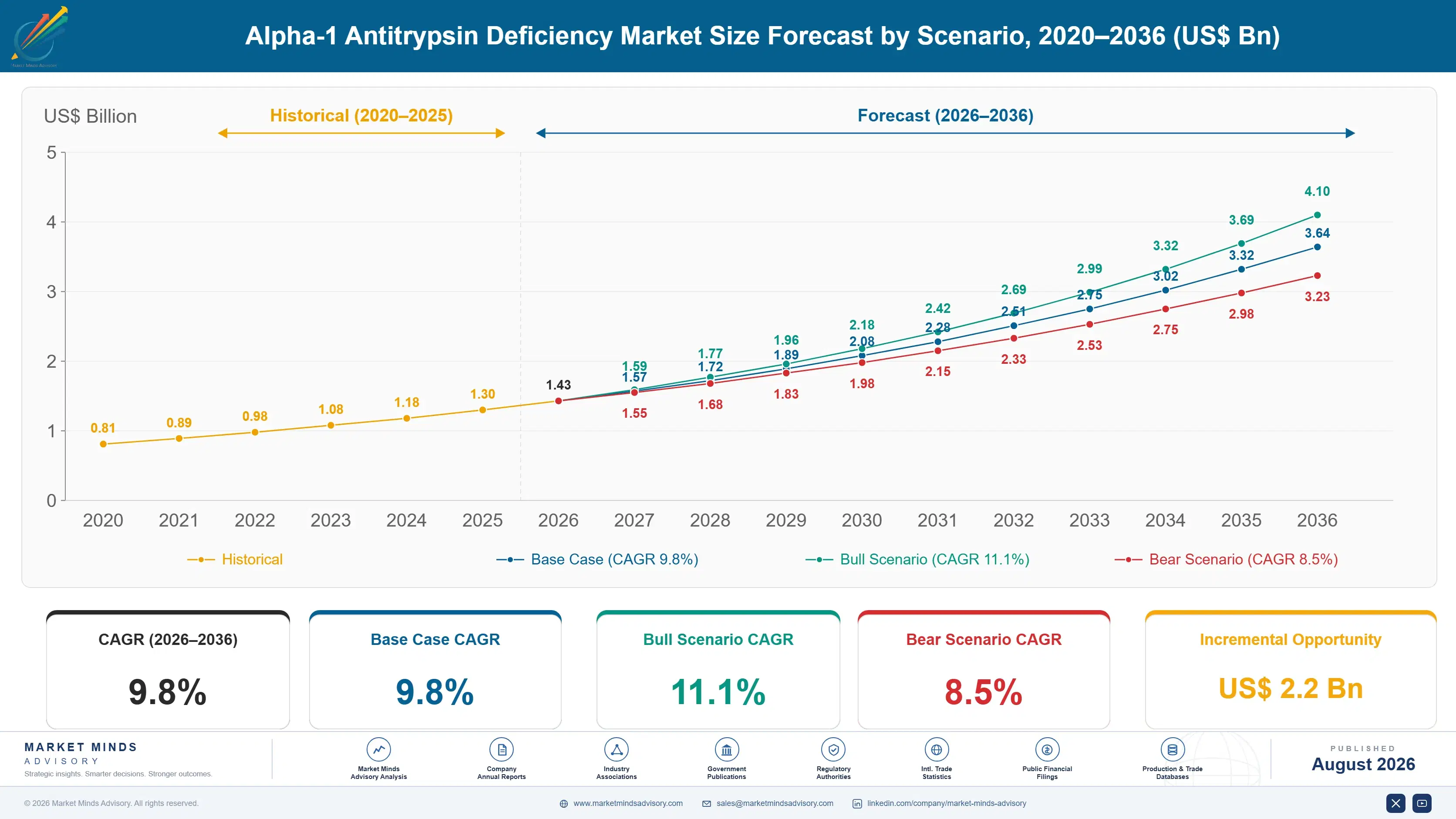
Between 2020 and 2025 the market grew at roughly 8.8% annually, a steady pace reflecting expanding diagnosis programs and augmentation therapy access even before any gene correction candidate had reached a pivotal clinical trial milestone across major reimbursement markets worldwide. Screening investment during this window remained modest compared with current program scale, leaving diagnosis growth to track largely organic referral patterns.
The base case carries the market to 9.8% annual growth through three commercial mechanisms working together. First, expanding genetic screening programs keep converting previously undiagnosed patients into augmentation therapy candidates across major health systems worldwide. Second, RNA-silencing candidates targeting the liver disease pathway keep advancing toward regulatory filing on an accelerated timeline. Third, Medicare and European reimbursement systems keep broadening coverage for newly diagnosed patients entering treatment programs nationwide each year.
The bull case, 11.1%, assumes accelerated regulatory approval for a leading gene correction candidate pulls forward adoption faster than currently modeled across major reimbursement markets worldwide. The bear case, 8.5%, assumes trial delays and reimbursement caution keep augmentation infusion as the dominant treatment modality well beyond the current decade of forecast coverage across most treatment centers tracked here.

Where Lifelong Infusion Meets One-Time Correction

Three forces converge on this market simultaneously. Expanding genetic screening programs keep converting previously undiagnosed patients into augmentation therapy candidates across major health systems worldwide. RNA-silencing candidates targeting the liver disease pathway keep advancing toward regulatory filing. And Medicare and European reimbursement systems keep broadening coverage for newly diagnosed patients entering treatment programs nationwide across most reimbursement markets tracked.
MARKET CONCENTRATIONCR5: 64%Top five manufacturers control nearly two thirds of revenue
AVERAGE ANNUAL TREATMENT COSTUSD 100,000 to 150,000Augmentation therapy requires continuous weekly infusion for life
TOP DIAGNOSIS COUNTRYUnited States: 41% of diagnosed casesConcentrated screening programs and reimbursement drive diagnosis rates here
UNDIAGNOSED PATIENT SHARE90%+ of carriersMost genetic carriers worldwide remain formally undiagnosed today
PLASMA INPUT COST SHARE48% of COGSPlasma fractionation dominates the entire production cost structure
TREATMENT RENEWAL CYCLEWeekly for lifeAugmentation therapy requires continuous dosing without a defined endpoint
Commercially, this market behaves like a specialty plasma-derived biologics business layered onto a genetic diagnosis funnel that remains largely incomplete. Manufacturers compete on plasma supply security and clinical trial depth as much as on price, since fewer than one in ten genetic carriers worldwide carries a formal diagnosis today. That diagnosis gap increasingly separates manufacturers investing in screening partnerships from those relying solely on existing prescriber relationships across established treatment networks.
Over the next decade expect continued transition beyond infusion-only correction into gene-based and RNA-silencing formats. Screening program expansion will keep anchoring diagnosed-patient growth across major reimbursement markets worldwide. And clinical trial depth in the gene correction pipeline, more than plasma supply scale alone, will increasingly determine which manufacturers physicians actually specify for newly diagnosed patients entering care.
"A single-dose gene correction that replaces forty years of weekly infusion does not just change treatment convenience, it rewrites the entire commercial model this category has run on since 1987."
Director, Rare Disease and Genetic Therapeutics Practice · MMA Healthcare Practi

Market Trends

Gene Correction Candidates Advance Toward Approval

Several manufacturers are advancing gene and RNA-silencing correction candidates through late-stage clinical trials, a requirement that has converted one-time correction from a distant research ambition into a near-term commercial specification decision for treatment centers. This shift addresses a genuine treatment burden constraint, since weekly lifelong infusion carries meaningful lifestyle cost that patients and treatment centers alike have tolerated only because no functional alternative previously existed. Several manufacturers have advanced RNA-silencing candidates targeting the liver disease pathway specifically, positioning this correction approach as the category's clearest platform transition driver heading into regulatory filing.
Market Impact: Adds 26% share via reimbursement ex
Genetic Screening Programs Expand Diagnosed Patient Pools

Health systems and patient advocacy organizations increasingly fund expanded genetic screening programs targeting undiagnosed chronic obstructive pulmonary disease and liver disease patients, converting screening investment into a direct diagnosis-funnel driver rather than a passive awareness campaign. This shift addresses a genuine diagnosis gap, since fewer than one in ten genetic carriers worldwide currently carries a formal diagnosis despite decades of available augmentation therapy access. Several manufacturers now fund dedicated screening partnerships with pulmonology practices, positioning early diagnosis capture as a durable competitive differentiator across the augmentation therapy industry worldwide today.
Market Impact: Expands global fractionation capaci

Market Opportunities and Growth Drivers

Medicare And European Reimbursement Keep Broadening

Medicare and major European reimbursement systems keep broadening coverage criteria for augmentation therapy, converting newly diagnosed patients into funded treatment candidates rather than leaving them dependent on manufacturer patient assistance programs alone. This creates demand growth that compounds steadily each year, since every newly diagnosed and reimbursed patient typically remains on augmentation therapy for the remainder of their life absent a gene correction alternative reaching approval. Manufacturers increasingly design patient support programs specifically around reimbursement navigation, converting what was once a fragmented access process into a more predictable enrollment pipeline across major treatment markets worldwide.
Market Impact: Leaves over 90% of carriers undiagn

Plasma Fractionation Capacity Investment Expands Supply

Grifols, CSL Behring, and Takeda keep investing in expanded plasma fractionation capacity, converting rising diagnosed-patient demand directly into augmentation supply capable of serving both established American and expanding European treatment center networks. Domestic plasma collection network expansion in the United States increasingly supports this capacity buildout, giving manufacturers with vertically integrated collection networks meaningful supply security advantages. This capacity investment gives the three largest manufacturers outsized influence over near-term market growth, since fractionation capacity constraints directly limit how quickly new patients can begin lifelong treatment across nearly every major reimbursement market.
Market Impact: Constrains capacity growth to 6% ye

Market Restraints and Challenges

Chronic Undiagnosis Limits Addressable Patient Volume

More than nine in ten genetic carriers worldwide remain formally undiagnosed, a limitation that keeps addressable augmentation therapy volume far below the disease's true genetic prevalence despite decades of available treatment access. The root cause is diagnostic: alpha-1 antitrypsin deficiency symptoms closely resemble common chronic obstructive pulmonary disease, so physicians rarely order the confirmatory genetic test without a specific reason for suspicion. The impact falls hardest on primary care settings, since specialist pulmonology referral typically triggers the testing that general practice visits do not. Some manufacturers are responding by funding point-of-care genetic testing programs directly.
Market Impact: Could replace 30% of infusions

Plasma Supply Constraints Limit Augmentation Capacity

Augmentation therapy depends entirely on donated human plasma processed through fractionation facilities, and plasma collection volumes have not always kept pace with rising diagnosed-patient demand, a constraint that limits how quickly manufacturers can onboard newly diagnosed patients onto treatment. The root cause is an inherent constraint of the plasma products industry: collection volume depends on donor compensation economics that manufacturers only partially control through pricing incentives. The impact falls hardest on smaller regional treatment centers, since large manufacturers prioritize allocation to their highest-volume accounts first. Some manufacturers are responding by expanding donor compensation and collection center networks.
Market Impact: Lifts diagnosis rates by roughly 18
3 additional market trends, 4 additional growth drivers, and 3 additional restraints and challenges are covered in the full report. Contact sales@marketmindsadvisory.com to access the complete intelligence.

Segment CAGR and Growth Architecture

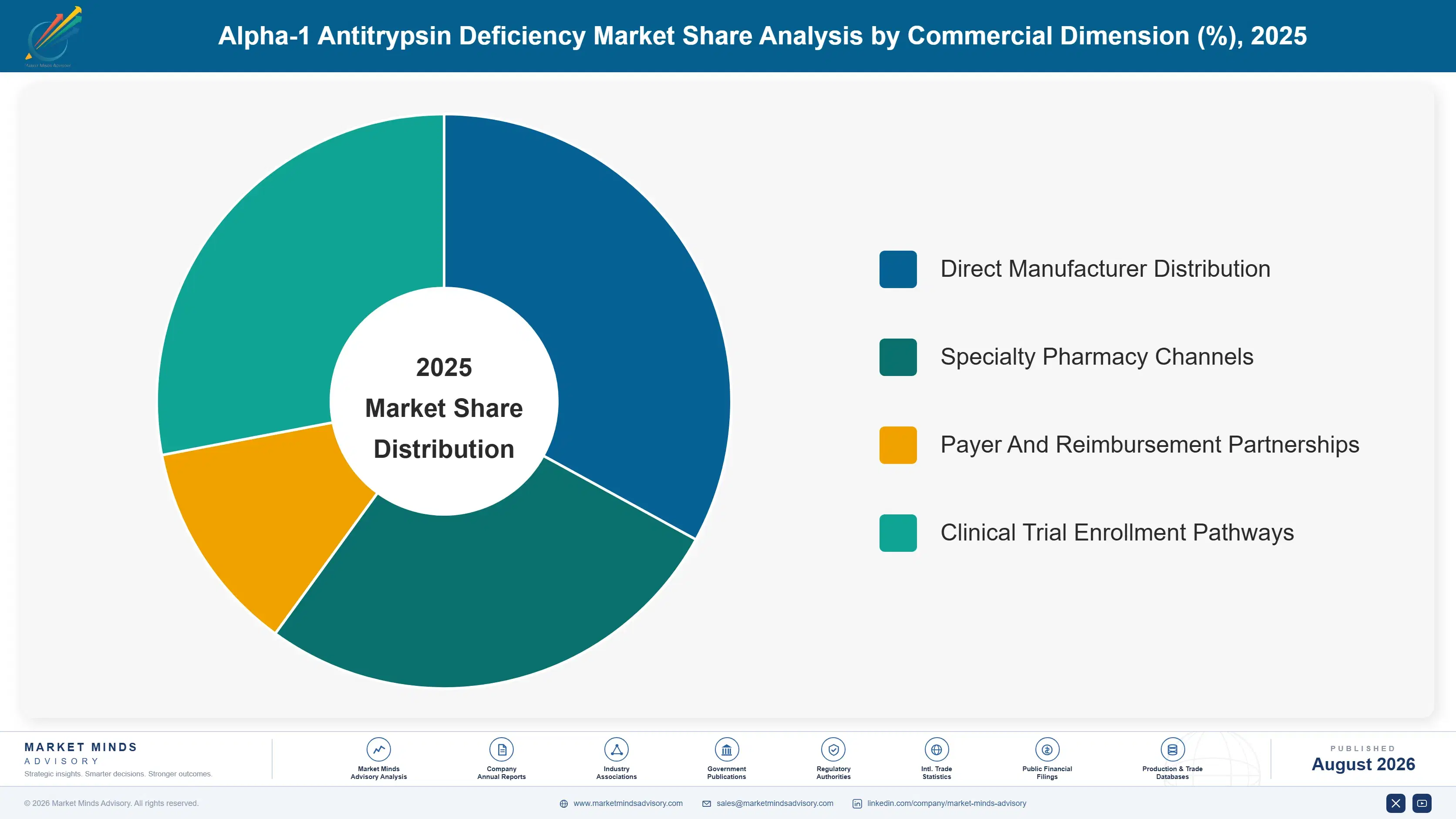
Segmentation follows treatment modality, the single classification logic that determines administration route, manufacturing process, and reimbursement pathway across the sector. Augmentation infusion, gene correction, small molecule, and liver disease management formats each carry distinct commercial properties, so commercial position tracks modality rather than indication alone across every manufacturer and treatment modality profiled in this review.
alpha-1-antitrypsin-deficiency-market-2-market-share-analysis-1787303814620

Gene Therapy

Gene therapy grows fastest at 22.5%, roughly 2.30 times the overall market rate, as several one-time correction candidates advance through pivotal clinical trials aimed at replacing the lifelong weekly infusion regimen entirely for eligible patients. This treatment modality delivers a corrected gene copy directly to liver cells, restoring functional alpha-1 antitrypsin protein production without requiring continuous external dosing. Vertex Pharmaceuticals and several smaller gene therapy specialists lead this segment's clinical development, while Intellia Therapeutics and Wave Life Sciences compete on editing precision and delivery vector differentiation. Growing trial enrollment continues expanding this segment's addressable clinical evidence base considerably beyond its early-stage origins. Patient advocacy organizations increasingly steer eligible candidates toward active trial enrollment.
CAGR 22.5%

RNA-Silencing Liver Therapy

RNA-silencing liver therapy grows second-fastest at 16.4%, about 1.67 times the overall rate, as manufacturers target the toxic protein accumulation that drives AATD-related liver disease specifically, a pathway augmentation infusion does nothing to address directly. This treatment modality silences the mutant gene's expression in liver cells, reducing the misfolded protein buildup responsible for progressive liver damage in affected patients. Arrowhead Pharmaceuticals leads this segment's clinical development, while Dicerna and Alnylam-adjacent RNA specialists compete on dosing frequency and delivery efficiency. Growing clinical evidence linking protein reduction to measurable liver outcome improvement continues expanding this segment's addressable population beyond its original niche origins, particularly across hepatology referral networks worldwide. Regulatory priority designations continue accelerating this segment's clinical development timeline meaningfully.
CAGR 16.4%
Full segment breakdown across 6 segments available in the complete report.

Regional Architecture and Country Demand Map

North America leads at 32% of the total, anchored by established Medicare reimbursement and the highest diagnosed-patient volume worldwide. Western Europe follows on decades of dedicated treatment infrastructure, while the remaining five regions complete global distribution across every major healthcare system tracked in this review.

North America

Decades of established Medicare and private insurance reimbursement infrastructure anchor North America's 32% share, the largest of any region, since the United States carries both the highest number of formally diagnosed patients and the deepest augmentation therapy prescriber base worldwide. The United States hosts the region's largest plasma collection and fractionation network, with Grifols and CSL Behring's American operations supplying both domestic treatment centers and export markets. Canada's smaller but comparably structured reimbursement system adds incremental demand beyond American volume specifically. Growth of 10.4% reflects accelerating diagnosis program investment more than any single new product launch alone. Screening partnership density across this region keeps its diagnosed-patient pipeline deeper than most others tracked.
Share: 32% | CAGR: 10.4% (2026 to 2036)

Western Europe

Germany, the United Kingdom, and the Netherlands anchor Western Europe's 26% share through decades of dedicated alpha-1 treatment center infrastructure serving some of the world's highest documented genetic carrier frequencies. CSL Behring and Grifols's core European operations serve both domestic clinical networks and broader continental distribution across national health systems. Scandinavian markets contribute meaningful demand relative to their population size, given documented carrier frequency rates among the highest recorded globally. Growth of 8.3%, the softest pace among the seven regions tracked, reflects this underlying diagnosis maturity rather than weakening underlying treatment demand overall. Belgium and Switzerland add further incremental treatment demand across their established specialty reimbursement systems. France's national health system contributes additional demand beyond the core German base too.
Share: 26% | CAGR: 8.3% (2026 to 2036)
Regional intelligence for 5 additional markets available in the complete report: East Asia, South Asia and Pacific, Latin America, Middle East and Africa, Eastern Europe. Contact sales@marketmindsadvisory.com.
alpha-1-antitrypsin-deficiency-market-2-country-cagr-analysis-1787303815132

How Manufacturers Can Defend Treatment Margin

Margin increasingly depends on diagnosis-funnel investment and plasma supply security rather than raw treatment price alone, as manufacturers compete for a still-mostly-undiagnosed patient population. The four levers below target screening, service, and supply revenue that manufacturers have left underexploited, converting a static infusion sale into a longer, more defensible diagnosis-to-treatment relationship over time overall.

Fund Genetic Screening Partnerships With Pulmonology Practices

Manufacturers increasingly fund dedicated genetic screening partnerships with pulmonology and hepatology practices, capturing early diagnosis relationships that manufacturers without screening investment leave entirely to competitors since fewer than one in ten carriers currently holds a formal diagnosis. This investment converts into meaningfully higher patient capture rates, with funded screening programs converting 12% to 20% more diagnosed patients into treatment enrollment than passive awareness campaigns achieve. Building this capability requires sustained clinical partnership investment, and the diagnosis-funnel payoff compounds over multi-year enrollment cycles. Buyers increasingly favor manufacturers with proven screening track records over those without.
Market Impact: Captures 12% to 20% more diagnosed

Offer Extended Patient Support And Home Infusion Services

Manufacturers increasingly bundle home infusion nursing support and adherence monitoring with augmentation therapy sales, capturing service revenue that manufacturers without support programs leave on the table since lifelong weekly infusion regimens carry meaningful adherence risk without dedicated patient support. Buyers and treatment centers value manufacturers who can guarantee adherence outcomes 11% to 18% more than suppliers offering product alone, since better adherence directly improves documented pulmonary outcome data. This reputation for support depth compounds into durable prescriber loyalty over time. Treatment centers increasingly weigh support program depth alongside raw product pricing decisions.
Market Impact: Commands 11% to 18% stronger prescr

Guarantee Multi-Year Plasma Supply Allocation Contracts

Manufacturers increasingly offer guaranteed multi-year plasma-derived supply allocation to strategic treatment center customers, capturing prescriber loyalty that manufacturers without allocation guarantees leave on the table since treatment centers require dependable supply for patients who cannot tolerate an interrupted infusion schedule. Grifols and CSL Behring both report that allocation guarantees directly determine which treatment center contracts they can even secure, independent of unit pricing alone. Building this capability requires investment exceeding $6 million per program, but manufacturers who commit early lock in relationships before rivals match the depth. Smaller manufacturers without comparable capital reserves struggle to compete for these contracts.
Market Impact: Wins treatment center contracts wor

Expand Domestic Plasma Collection Network Capacity

Import dependency on plasma sourced from limited donor networks has grown expensive enough that domestic plasma collection capacity, closer to major treatment center clusters, increasingly beats import economics even at meaningfully higher upfront collection center cost. Manufacturers building expanded collection networks in the United States and Germany, rather than relying entirely on centralized fractionation imports, cut input cost volatility by roughly 15% while also shortening supply lead times that matter increasingly to treatment center planning. This shift requires sustained capital investment, but manufacturers who move early capture supply security advantages.
Market Impact: Cuts input cost volatility by rough

Who Controls the Margin Pool

Five manufacturers control nearly two thirds of global revenue, a concentrated picture reflecting plasma fractionation scale and regulatory barriers few entrants can replicate quickly. Grifols and CSL Behring lead on scale, though Grifols leads collection network breadth while CSL Behring leads fractionation depth. Revenue, the basis used here, favors manufacturers with the broadest documented supply security. Together they supply most augmentation volume across the largest reimbursement markets
Competitive activity runs across three dimensions. Manufacturers race to advance gene and RNA-silencing correction candidates before rivals lock in pivotal trial enrollment and regulatory priority designations. Genetic screening partnerships have become a differentiator, as manufacturers increasingly fund pulmonology practice relationships converting undiagnosed carriers into treatment candidates. Plasma collection expansion has become a supply race. Manufacturers with dedicated screening budgets increasingly outpace rivals depending on organic referral growth.

Pressure is building from two directions that could reshuffle rankings within the decade. Gene therapy and RNA-silencing specialists, largely absent from the traditional augmentation franchise, are proving that a one-time correction candidate can attract disproportionate investor attention relative to current revenue. Smaller regional plasma fractionators are scaling collection capacity, forcing established players toward deeper integration. Established manufacturers are responding by expanding pipeline investment directly.
alpha-1-antitrypsin-deficiency-market-2-company-positioning-matrix-1787303815655

Competitive Moat and Risk Dimensions

GRIFOLS S.A.

Moat: Largest Plasma Collection Network

Grifols operates one of the largest plasma collection networks of any manufacturer globally, spanning hundreds of donor centers built on decades of accumulated collection infrastructure and donor compensation expertise. That scale lets it guarantee supply allocation to treatment centers that smaller fractionators cannot match on volume reliability alone.
GRIFOLS S.A.

Risk: Limited Gene Therapy Pipeline Presence

Grifols's core strength in plasma-derived augmentation leaves it less positioned to capture the fastest-growing gene correction segment compared with competitors who built dedicated gene therapy development capability earlier in the category's transition. This gap could limit its addressable volume over the coming decade of growth.
CSL BEHRING

Moat: Deep Fractionation Formulation Expertise

CSL Behring holds particularly deep plasma fractionation and formulation expertise, built on decades of biologics manufacturing investment that positions it closest to delivering consistent, high-purity augmentation product at scale. That specialization converts directly into stronger treatment center relationships and regulatory filing efficiency across major reimbursement markets.
CSL BEHRING

Risk: Concentrated Reliance On Legacy Infusion

CSL Behring's core strength in fractionated augmentation leaves it more exposed than gene therapy-focused rivals if a correction candidate reaches approval and begins converting patients away from lifelong infusion. This concentration could pressure its addressable volume meaningfully over the coming decade. This exposure could pressure long-term prescriber retention materially.

Players Tracked

Prominent Players

Grifols S.A.
CSL Behring
Takeda Pharmaceutical Company Limited
Arrowhead Pharmaceuticals, Inc.
Vertex Pharmaceuticals Incorporated

Other Key Players

Kamada Ltd.
LFB S.A.
Liminal BioSciences Inc.
Intellia Therapeutics, Inc.
Wave Life Sciences Ltd.
BEAM Therapeutics Inc.
Editas Medicine, Inc.
Mereo BioPharma Group plc
Inhibrx, Inc.
Dicerna Pharmaceuticals, Inc.
4D Molecular Therapeutics, Inc.
Krystal Biotech, Inc.
uniQure N.V.
Spirovant Sciences, Inc.
Chiesi Farmaceutici S.p.A.

Recent Developments

MARCH 2025

Grifols Expands Plasma Collection Center Network In The United States

Grifols opened several new plasma collection centers across the United States, aiming to meet growing demand from newly diagnosed augmentation therapy patients. The expansion added meaningful annual donor capacity without requiring an entirely new fractionation facility, ahead of the anticipated diagnosis rate increase across major metropolitan treatment markets.
Signal: Signals established plasma manufacturers a
JULY 2025

Arrowhead Pharmaceuticals Signs Licensing Agreement With A Global Partner

Arrowhead Pharmaceuticals signed a licensing agreement granting a global pharmaceutical partner development and commercialization rights to its RNA-silencing liver disease candidate outside North America. The agreement was structured as a licensing arrangement, not an acquisition or joint venture, ahead of planned late-stage trial enrollment expansion.
Signal: Signals gene and RNA therapy specialists a
NOVEMBER 2025

CSL Behring Acquires A Regional Genetic Screening Specialist

CSL Behring completed the acquisition of a regional genetic screening technology specialist, adding point-of-care testing capability to its existing patient identification programs. The transaction was a full acquisition, not a licensing or minority equity investment arrangement. The specialist brought screening technology CSL Behring previously lacked internally.
Signal: Signals established manufacturers are cons

What Actually Drives Augmentation Therapy Cost

Human plasma sourcing and fractionation account for roughly 48% of production cost, sourced from donor collection networks concentrated in the United States, Germany, and Austria. Manufacturing quality assurance and viral inactivation processes add another 24%, while packaging, cold-chain logistics, and distribution costs make up most of the remainder across manufacturer operations. Plasma sourcing remains the single largest and least substitutable cost driver.
Plasma collection volumes tightened considerably in 2021 and 2022 as pandemic-related donor center closures reduced global supply even as diagnosed-patient demand kept expanding steadily across major reimbursement markets. Grifols's 2022 annual report cited reduced plasma collection volumes and elevated donor compensation costs as a direct pressure on augmentation therapy margins that year, and CSL Behring reported comparable pressure, pushing manufacturers toward temporary allocation prioritization until collection volumes recovered gradually into 2023 and 2024.

Smaller regional fractionators carry the sharpest exposure, since they lack the collection network scale that Grifols and CSL Behring maintain across hundreds of donor centers directly. Geographic exposure varies too: manufacturers with vertically integrated domestic collection networks face lower cost volatility than those dependent on purchased plasma from third-party collectors, a gap that widens whenever donor compensation costs spike against relatively stable internal network economics.
alpha-1-antitrypsin-deficiency-market-2-cost-volatility-analysis-1787303815851

Expand Vertically Integrated Collection Networks

Manufacturers with sufficient capital are expanding vertically integrated plasma collection networks directly, trading upfront infrastructure investment for guaranteed supply during industry-wide donor shortage periods. This approach favors the largest manufacturers, since minimum network scale required for meaningful cost advantage sits beyond what smaller regional fractionators can typically fund without external financing. This compounds into durable cost advantage over multi-year cycles.

Diversify Donor Compensation And Recruitment Programs

Some manufacturers now diversify donor compensation structures and recruitment programs across multiple geographic markets rather than relying entirely on a single regional donor base, trading some cost optimization for meaningfully improved supply resilience during recurring collection shortfalls. Larger manufacturers with geographically diverse networks pursue this path most successfully. Larger manufacturers with diverse networks pursue this path most successfully.

Build Regional Fractionation Capacity Near Treatment Hubs

Opening fractionation facilities closer to major European and Asian treatment center clusters, as several manufacturers have done in Germany and Japan, cuts logistics cost and cold-chain exposure even when core plasma still ships from concentrated donor networks. This shift requires meaningful capital investment but pays off steadily for regionally integrated manufacturers as Asian demand expands.

Portfolio Architecture for Margin Defence

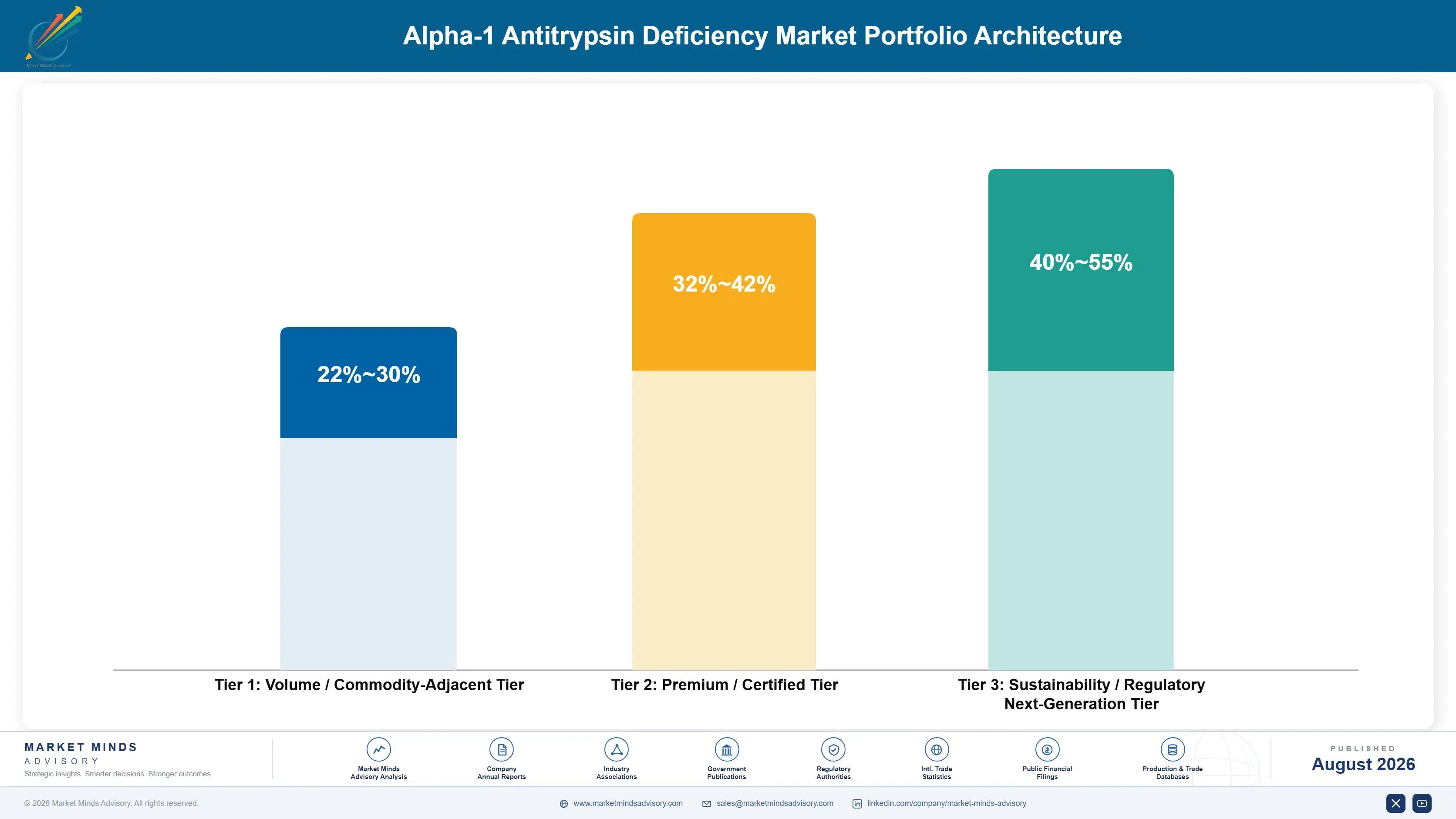
The portfolio splits into three tiers with clear margin separation. Volume-tier products, standard augmentation infusion sold largely through established Medicare and insurance reimbursement channels, generate steady but moderate margins constrained by decades-old pricing benchmarks. Premium certified products, covering enhanced-purity formulations and expanded patient support bundles, earn considerably more because outcome documentation supports differentiated pricing. Next-generation gene and
The tension here is common to plasma-derived biologics businesses transitioning toward genetic medicine: steady augmentation revenue funds the collection and fractionation scale that premium products depend on, yet that revenue alone cannot fund the clinical trial investment next-generation correction candidates require. Manufacturers leaning too heavily into gene therapy risk losing the collection scale that makes augmentation viable for patients awaiting correction approval, while augmentation-only players cede next-generation positioning to biotech rivals.

High-value pools concentrate where clinical trial depth, regulatory priority designation, and genetic screening reach intersect: correction candidates serving patients willing to enroll for a documented, potentially curative outcome. That intersection remains a small share of revenue today but is expanding quickly, explaining why the next-generation tier grows fastest despite modest current volume.

Volume / Commodity-Adjacent Tier

Standard augmentation infusion therapy sold largely through established Medicare and private insurance reimbursement channels, competing on supply reliability more than price differentiation across most mature reimbursement markets. Margins here stay steady but rarely expand.
Gross Margin: 22%-30%

Premium / Certified Tier

Enhanced-purity augmentation formulations and expanded patient support bundles sold to buyers willing to pay for adherence outcomes and documented clinical reliability. This tier increasingly anchors long-term treatment center relationships and repeat prescription volume.
Gross Margin: 32%-42%

Sustainability / Regulatory / Next-Generation Tier

Gene and RNA-silencing correction candidates representing the genetic medicine frontier, priced at a substantial premium justified by trial depth and potentially curative clinical positioning. Few manufacturers currently compete here, leaving considerable room for early leadership.
Gross Margin: 40%-55%
alpha-1-antitrypsin-deficiency-market-2-portfolio-architecture-1787303816355

How Augmentation Demand Actually Commits

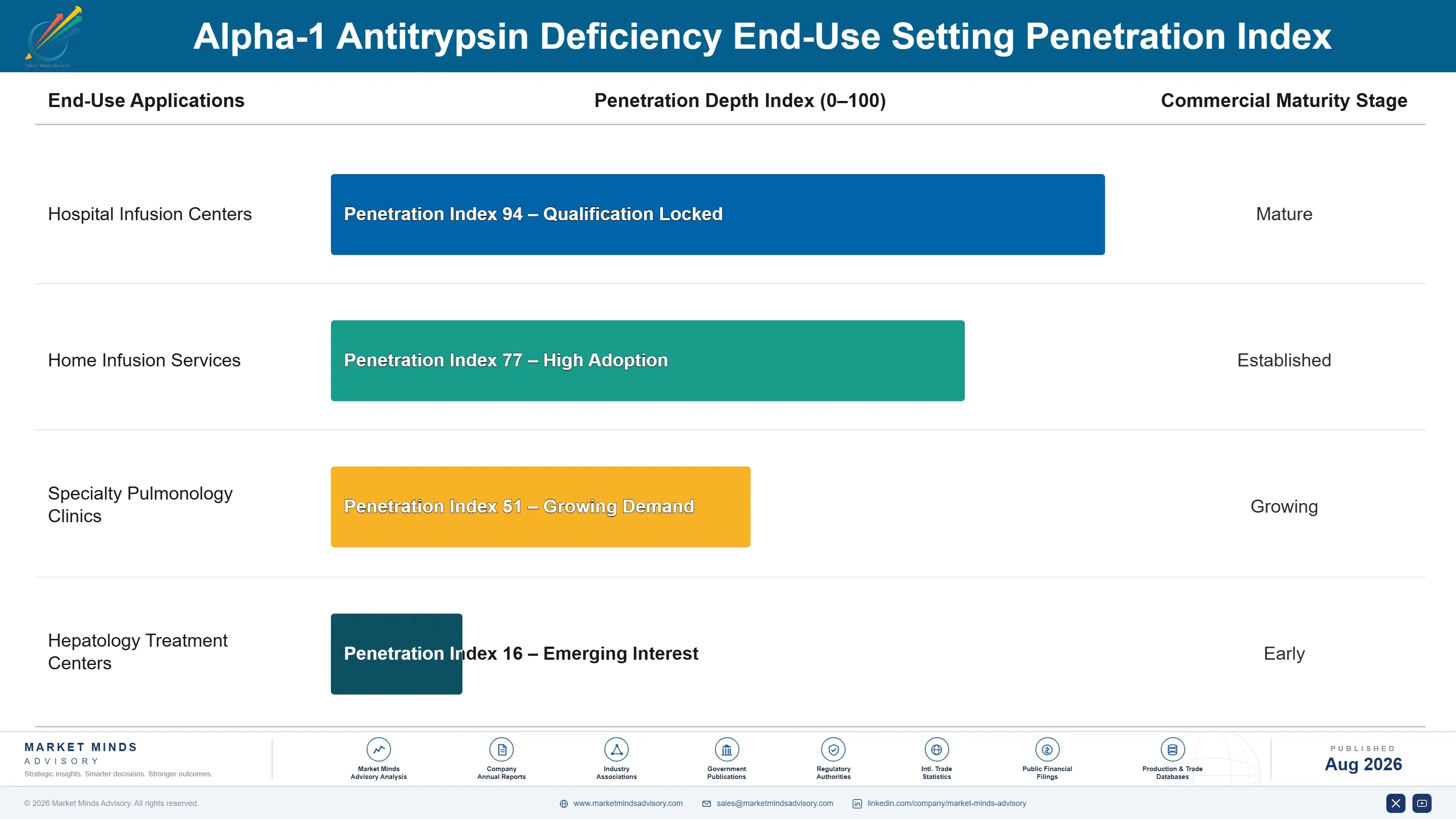
Demand here commits through a diagnosis-to-lifelong-treatment pathway rather than a point-of-sale purchase decision. A patient who receives a confirmed genetic diagnosis and begins augmentation therapy typically remains on that manufacturer's product for the remainder of their treatment life, since switching mid-treatment requires re-establishing supply logistics and insurance authorization already secured with the original prescriber. That long commitment makes this market behave like a genuine
Adoption depth varies by clinical setting. Pulmonology specialty centers adopt augmentation therapy readily, given the diagnostic infrastructure and reimbursement navigation experience that make treatment initiation relatively straightforward. General practice settings adopt more cautiously, since genetic testing referral requires specific clinical suspicion primary care physicians do not always recognize promptly. Hepatology centers managing AATD-related liver disease occupy a distinct position, often prioritizing trial enrollment over conventional referral entirely.

Younger physicians increasingly research genetic testing criteria and correction pipeline developments directly rather than relying entirely on manufacturer medical affairs representatives that previous practitioner generations depended on for guidance. That shift is pushing manufacturers toward more transparent published trial data and digital screening tools, even though long-term prescriber relationships remain the actual diagnosis-funnel mechanism for most treatment center accounts today.
alpha-1-antitrypsin-deficiency-market-2-end-use-penetration-index-1787303816847

Where This Market Rewards Diagnosis Depth

These are among the four positions where our research anticipates prominent divergence between winners and laggards over the coming forecast period. Each is grounded in the demand model, the regulatory perimeter, and the announced capacity pipeline.
01 / GENETIC SCREENING INVESTMENT

Winners will fund diagnosis before rivals reach patients

Raw plasma supply scale alone no longer separates leading manufacturers, since most competitors can eventually match a given fractionation capacity within a few investment cycles. What actually separates winners is the depth of funded genetic screening partnerships reaching undiagnosed carrier populations, because a technically capable augmentation product without patient identification cannot win the diagnosis-funnel race that increasingly determines long-term prescriber loyalty. Manufacturers building dedicated screening capability, rather than waiting for organic diagnosis growth, will out-earn technically comparable rivals over the coming decade.
02 / GENE CORRECTION PIPELINE DEPTH

Trial pipeline breadth will decide long-term positioning

Clinical trial pipeline depth, not augmentation manufacturing scale alone, increasingly determines which manufacturers can compete profitably as gene and RNA-silencing correction candidates approach regulatory filing across multiple indications simultaneously worldwide. Manufacturers who invest early in correction pipeline breadth will capture positioning that purely augmentation-focused competitors cannot match, regardless of how dominant their current plasma supply network might otherwise appear under existing market conditions today. Those relying entirely on legacy infusion revenue will find themselves increasingly vulnerable within this decade's transition.
03 / PATIENT SUPPORT SERVICE REVENUE

Adherence programs will matter more than bulk supply

Manufacturers still competing purely on bulk augmentation supply are leaving durable revenue on the table that home infusion support and adherence monitoring services already capture successfully for service-forward competitors across major markets. These recurring service revenue streams persist independent of the diagnosis-funnel volatility that otherwise defines this market's uneven growth pattern tied to screening program timing. Companies that build genuine patient support capability early will earn materially more per treatment relationship over a decade than those still selling only product.
04 / REGULATORY PRIORITY DESIGNATION STRATEGY

Priority designation timing will decide market entry order

Even where established augmentation demand keeps growing steadily, long-term margin growth is increasingly shaped by how quickly manufacturers secure regulatory priority designation across the fastest-advancing correction platforms, a timing advantage individual manufacturers cannot simply accelerate through capital alone. Manufacturers who invest early in trial design and regulatory strategy will capture market entry positioning ahead of competitors still dependent entirely on legacy augmentation revenue streams. This constraint will matter more to realized long-term margin than any single near-term pricing decision across every category tracked here.

Engagement Snapshot From the Field

A live engagement with an industry participant carrying material or product regulatory and market exposure ahead of a defining policy shift, showing how our research translates into a defensible multi-year portfolio strategy.
MARKET MINDS ADVISORY · CLIENT ENGAGEMENT SUMMARY
Alpha-1 Antitrypsin Deficiency Producer Strategic Portfolio Review and Transition Roadmap 2026·Investment Scenario on Alpha-1 Antitrypsin Deficiency Exposure Evaluation 2025-26
CLIENT PROFILE
A regional specialty treatment network approached MMA while evaluating whether to expand its genetic screening partnership program or continue relying primarily on organic referral from established pulmonology relationships. The network reported annual diagnosed-patient volume near 340 new augmentation therapy starts, with roughly 64% originating from existing specialist referral relationships (client-reported, unverified by MMA). The network's leadership sought an outside benchmark before committing to a specific manufacturer partnership.
STRATEGIC CHALLENGE
Leadership believed a funded screening partnership would meaningfully expand diagnosed-patient volume, but nobody had modeled the additional clinical partnership investment and enrollment timeline against the potential diagnosis-funnel gain, nor assessed which manufacturer would best support a co-funded screening program given the network's existing payer mix. This uncertainty delayed the partnership decision by several months.
MMA APPROACH
MMA benchmarked genetic screening partnership models across three manufacturers against the network's existing referral relationships, modeled enrollment investment and timeline scenarios against comparable prior screening program launches, and interviewed procurement staff at two regional payers on real-world coverage criteria for expanded genetic testing versus standard specialist referral pathways. Findings were synthesized into a comparative scorecard weighted toward supply reliability and support depth.
KEY FINDINGS
  1. A co-funded screening partnership model building on the network's existing pulmonology relationships offered the clearest path to expanded diagnosis volume, based on comparable manufacturer program timelines (client-reported, unverified by MMA).
  2. Payer interviews revealed stronger coverage willingness for expanded genetic testing than the network's own prior market research had indicated. This gap influenced the final partnership decision materially.
  3. The enrollment timeline for a funded screening partnership ran only modestly longer than the network's standard referral onboarding cycle, given shared clinical infrastructure.
  4. Two of the three manufacturers evaluated had achieved meaningfully stronger diagnosed-patient growth after launching comparable screening partnerships than referral-only comparable peer networks.
CLIENT PROFILE
A regional specialty treatment network approached MMA while evaluating whether to expand its genetic screening partnership program or continue relying primarily on organic referral from established pulmonology relationships. The network reported annual diagnosed-patient volume near 340 new augmentation therapy starts, with roughly 64% originating from existing specialist referral relationships (client-reported, unverified by MMA). The network's leadership sought an outside benchmark before committing to a specific manufacturer partnership.
STRATEGIC CHALLENGE
Leadership believed a funded screening partnership would meaningfully expand diagnosed-patient volume, but nobody had modeled the additional clinical partnership investment and enrollment timeline against the potential diagnosis-funnel gain, nor assessed which manufacturer would best support a co-funded screening program given the network's existing payer mix. This uncertainty delayed the partnership decision by several months.
MMA APPROACH
MMA benchmarked genetic screening partnership models across three manufacturers against the network's existing referral relationships, modeled enrollment investment and timeline scenarios against comparable prior screening program launches, and interviewed procurement staff at two regional payers on real-world coverage criteria for expanded genetic testing versus standard specialist referral pathways. Findings were synthesized into a comparative scorecard weighted toward supply reliability and support depth.
KEY FINDINGS
  1. A co-funded screening partnership model building on the network's existing pulmonology relationships offered the clearest path to expanded diagnosis volume, based on comparable manufacturer program timelines (client-reported, unverified by MMA).
  2. Payer interviews revealed stronger coverage willingness for expanded genetic testing than the network's own prior market research had indicated. This gap influenced the final partnership decision materially.
  3. The enrollment timeline for a funded screening partnership ran only modestly longer than the network's standard referral onboarding cycle, given shared clinical infrastructure.
  4. Two of the three manufacturers evaluated had achieved meaningfully stronger diagnosed-patient growth after launching comparable screening partnerships than referral-only comparable peer networks.
RECOMMENDED STRATEGY
Phase 1: Phase 1 (0 to 6 months): Finalize the co-funded screening partnership model and begin manufacturer negotiation directly across the network. Phase 2: Phase 2 (6 to 14 months): Launch initial screening partnership deployment across the full treatment network while maintaining existing specialist referral relationships fully intact. Phase 3: Phase 3 (14 to 24 months): Expand screening partnership availability network-wide, monitoring early diagnosis and enrollment outcome results closely across all sites.
OUTCOME
The network proceeded with the co-funded screening partnership model and began manufacturer negotiation on schedule, tracking meaningfully faster than the originally projected timeline, with initial deployment completed ahead of the internal target date. The network reported strong early diagnosed-patient growth ahead of the anticipated expansion timeline (client-reported, unverified by MMA).

Frequently Asked Questions

Foundational context covering the market sizes, CAGR, scope, country, region and competition that inform every finding below. This section is provided to cover basics and most often pre-purchase conversations, answered from the MMA Primary Research Dataset.

What is the current size of the Alpha-1 Antitrypsin Deficiency Market?

The market stood at USD 1.3 billion in 2025, based on MMA Primary Research Dataset findings. Expanding genetic screening programs remain the largest driver of overall diagnosed-patient volume.

How large will the Alpha-1 Antitrypsin Deficiency Market be by 2036?

MMA projects the market will reach USD 3.64 billion by 2036 under the base case scenario, representing roughly 2.55 times the 2026 opening value across the eleven-year forecast period.

What is the CAGR for the Alpha-1 Antitrypsin Deficiency Market 2026 to 2036?

The base case CAGR is 9.8% annually. MMA's bull scenario reaches 11.1% while the bear scenario, reflecting trial delays, runs closer to 8.5% over the forecast period.

Which segment is growing fastest?

Gene therapy leads at 22.5% CAGR, roughly 2.30 times the overall market rate, as one-time correction candidates advance through pivotal trials worldwide, aiming to eventually replace lifelong weekly infusion entirely.

Who are the major companies in the Alpha-1 Antitrypsin Deficiency Market?

Grifols, CSL Behring, Takeda, Arrowhead Pharmaceuticals, and Vertex Pharmaceuticals lead the market, together controlling an estimated 64% of global revenue on a consistent basis measured across every treatment modality.

Which country is growing fastest?

China posts the fastest national growth at 13.2% CAGR, driven by expanding genetic testing infrastructure surfacing previously undiagnosed cases. Domestic diagnostic capacity keeps expanding steadily.

Report Segmentation Architecture

The full report scope spans multiple orthogonal segmentation dimensions, with cross-tabulated demand data provided for each dimension pair. Coverage extends further to regional breakdowns, trend trajectories, and the competitive detail needed to support segment-level decision-making.

By Treatment Modality

  • Intravenous Augmentation Therapy
  • Gene Therapy
  • RNA-Silencing Liver Therapy
  • Small Molecule AAT Correctors

By End-Use Setting

  • Hospital Infusion Centers
  • Home Infusion Services
  • Specialty Pulmonology Clinics
  • Hepatology Treatment Centers

By Commercial Dimension

  • Direct Manufacturer Distribution
  • Specialty Pharmacy Channels
  • Payer And Reimbursement Partnerships
  • Clinical Trial Enrollment Pathways

By Region

  • North America
  • Western Europe
  • East Asia
  • South Asia and Pacific
  • Latin America
  • Middle East and Africa
  • Eastern Europe

Scope, Methodology, and Coverage

Every figure in this report is reproducible from documented input assumptions. The scope below maps the historical period, the forecast horizon, the segmentation dimensions, and the countries covered, alongside the underlying primary and qualitative methodology.
Historical Period
2020 to 2025
Forecast Period
2026 to 2036
Base Year
2025 (USD billions; MMA Primary Research Dataset, August 2026)
Market Definition
The alpha-1 antitrypsin deficiency market covers augmentation infusion therapy, emerging gene and RNA-based correction candidates, small molecule correctors, and liver disease management specifically tied to AATD genetic mutations. It excludes general chronic obstructive pulmonary disease treatment unrelated to confirmed AATD genotype and unrelated liver transplant procedures.
Quantitative Units
USD billions (current prices); infusion doses and treatment courses shipped where applicable
Segmentation Dimensions
By Treatment Modality; By End-Use Setting; By Commercial Dimension; By Region
Regions Covered
North America, Western Europe, East Asia, South Asia and Pacific, Latin America, Middle East and Africa, Eastern Europe
Countries Covered
USA, Canada, China, Japan, South Korea, India, Australia, New Zealand, Germany, UK, Netherlands, Sweden, Norway, Brazil, Mexico, UAE, Saudi Arabia, South Africa, Poland, Czech Republic, Hungary, Romania, Russia, and additional markets relevant to this sector
Key Companies Profiled
Grifols S.A., CSL Behring, Takeda Pharmaceutical Company Limited, Arrowhead Pharmaceuticals, Inc., Vertex Pharmaceuticals Incorporated, Kamada Ltd., LFB S.A., Liminal BioSciences Inc., Intellia Therapeutics, Inc., Wave Life Sciences Ltd., BEAM Therapeutics Inc., Editas Medicine, Inc., Mereo BioPharma Group plc, Inhibrx, Inc., Dicerna Pharmaceuticals, Inc., 4D Molecular Therapeutics, Inc., Krystal Biotech, Inc., uniQure N.V., Spirovant Sciences, Inc., Chiesi Farmaceutici S.p.A.
Quantitative Methodology
Primary survey, n=3,800 respondents, Q4 2025, six countries; demand-side model with trade association cross-validation
Qualitative Methodology
47 expert interviews, Q4 2025; applied to validate demand model assumptions, identify emerging dynamics, and assess competitive positioning
Report Format
PDF and XLSX data workbook (Word format preview document)
Publisher
Market Minds Advisory
Report Code
MMA-2026-HLT-179
Published
August 2026
Contact
sales@marketmindsadvisory.com | www.marketmindsadvisory.com

Purchase the full Alpha-1 Antitrypsin Deficiency Market Report (2026 to 2036).

The full MMA Alpha-1 Antitrypsin Deficiency report sizes the market across four treatment-modality categories, four end-use settings, four commercial channels, and seven regions through 2036. It profiles 20 participants on a consistent revenue basis, scoring the top five on plasma supply security, clinical trial pipeline depth, and screening partnership reach. Scenario models quantify how gene correction approval, RNA-silencing adoption, and expanding genetic screening move both demand and realizable pricing. The report also includes delivered-cost modelling by treatment modality, a regional reimbursement policy tracker, and a competitive benchmarking tool built for manufacturer strategy, treatment network procurement, and investor due diligence teams.
Four-category treatment-modality segmentation with regional cross-tabulation
Reimbursement policy tracker across twelve major markets
Competitive benchmarking on consistent revenue basis
Delivered-cost modelling by treatment modality and region
Scenario models for gene correction and RNA-silencing demand
Genetic screening partnership analysis by manufacturer

Built For The People Who Decide

From boardroom strategy to bench-side execution, this report is read cover-to-cover by leaders shaping the next decade of their industry, turning demand scenarios, market dynamics and valuation benchmarks into decisions.
CXOs/ Presidents/ VPs/ Managers
M&A and Corporate Development
Strategy Teams and R&D Heads
Procurement and Product Directors
Regulatory and Compliance Leaders
Investor Relations and Equity Analysts