

Market Minds Advisory
Aloe Vera Extracts Market

Aloe Vera Extracts Market: Beauty Formulation Overtakes the Beverage Aisle

Cosmetic formulators across East Asia and North America are pulling aloe vera extract demand away from beverage applications faster than Mexican and Indian leaf cultivation capacity can comfortably expand to supply it.

Lead Analyst

Lisa Gevelber

Published

September 2026

Make Smarter Decisions with Customized Research Insights

Request a free sample report and evaluate market opportunities, growth trends, and competitive dynamics relevant to your business needs.

2025 MARKET VALUE$2.1BMarket Size 2025
2036 FORECAST VALUE$4.5BBase Case , 2026 to 2036
CAGR 2026 TO 20367.2 %Bull 8.5% / Bear 5.9%
INCREMENTAL OPPORTUNITY$2.3BNet 10- year value creation
EXPANSION MULTIPLE2.00x2036 value over 2026 base
Strategic Levers
M&A Pipeline
Regional Outlook
Country Rankings
Competitive Intelligence
Segmental Deep-dive
Call-Us : 91 93563 13602

Executive Snapshot and Market Trajectory

Aloe vera extracts reached USD 2.1 billion in 2025, a botanical ingredient category quietly shifting its center of gravity from beverage applications toward cosmetic and personal care formulation, where margins run considerably higher and demand keeps expanding steadily across most major consumer and industrial markets worldwide.
Cosmetic and personal care aloe extracts grow fastest at 10.8%, about 1.50 times the overall 7.2% rate, as clean beauty and K-beauty formulation trends pull processed aloe gel into skincare lines faster than beverage manufacturers can absorb comparable volume growth across the board. East Asia carries the largest regional share on established aloe drink culture and expanding cosmetic manufacturing, while India posts the quickest national growth as domestic cultivation and processing capacity scale rapidly.
Competition remains fragmented at a CR5 of 26%, split between vertically integrated direct-selling companies with proprietary aloe farms and specialized ingredient processors supplying food, beverage, and cosmetic manufacturers on a business-to-business basis across most global markets today. Raw leaf sourcing concentration in Mexico, alongside continued cosmetic formulation growth, are the two forces deciding where the category's margin concentrates over the next decade of category evolution.
Market Definition
The aloe vera extracts market covers processed aloe gel, juice, powder, and latex extracts derived from the aloe vera plant, sold for beverage, dietary supplement, cosmetic, and topical skincare use. It excludes whole aloe vera plants sold for ornamental or home cultivation purposes and finished consumer products where aloe is a minor labeled ingredient rather than the primary formulation basis.
Base Year Value
$2.1B in 2025 (MMA Primary Research Dataset, August 2026)
Forecast Period
2026 to 2036, eleven discrete annual values
CAGR
7.2% base case. Bull 8.5%. Bear 5.9%.
Fastest Growth Segment
Cosmetic and Personal Care Aloe Extracts: 10.8% CAGR
Fastest Growth Country
India: 10.5% CAGR
Fastest Growth Region
South Asia and Pacific: 9.4% CAGR
Largest Region
East Asia: 28% of 2025 global value
Market Leaders
Forever Living Products, Aloecorp Inc, Terry Laboratories, Lily of the Desert, Natural Aloe Costa Rica. Source: MMA Analysis based on company annual reports.
Primary Survey
n=3,800 procurement and R&D decision-makers, Q4 2025, six countries
Methodology
Demand-side build-up, cross-validated against public data, 47 expert interviews

Aloe Vera Extracts Market Forecast Scenarios

aloe-vera-extracts-market-trends-growth-size-forecast-scenario-1787461939518
Between 2020 and 2025 the market grew near 6.2% annually as beverage-grade aloe demand held steady across East Asia while cosmetic formulation applications began accelerating meaningfully late in the period. Processing capacity investment in Mexico and India started scaling to meet growing demand from both established beverage manufacturers and newer cosmetic formulators entering the category.
The base case carries the market to 7.2% through 2036 on three mechanisms. First, clean beauty and K-beauty formulation trends keep pulling processed aloe gel into cosmetic and skincare product lines at a pace beverage demand alone would not sustain. Second, Indian and Southeast Asian cultivation and processing capacity keeps expanding, supporting both domestic consumption and export volume into Western cosmetic manufacturing. Third, dietary supplement demand for aloe capsules and softgels keeps growing steadily as digestive health positioning gains broader consumer acceptance.
The bull case reaches 8.5% if cosmetic formulators accelerate reformulation toward plant-based actives faster than currently scheduled, pulling aloe extract demand ahead of existing processing capacity. The bear case falls to 5.9% if beverage-grade aloe demand in East Asia plateaus as consumers shift toward newer functional beverage categories, a pattern already visible in several adjacent drink segments that lost share to emerging formats.

A Beverage Ingredient Reinventing Itself as a Beauty Actives

Aloe vera has spent decades as a familiar but unglamorous ingredient, known mostly for sunburn gel and the occasional bottled juice drink sold at a supermarket checkout. That framing is genuinely shifting as cosmetic formulators increasingly specify processed aloe extract as a functional active ingredient in moisturizers, serums, and sheet masks, a use case that commands meaningfully higher margins than beverage-grade juice ever achieved across most established markets.
MARKET CONCENTRATIONCR5: 26%Fragmented across direct-selling farms and specialized ingredient processors
AVERAGE SELLING PRICEUSD 3 to 45 per kgReflects wide gap between bulk juice and cosmetic-grade gel
TOP PRODUCING REGION SHAREEast Asia: 28%Anchored by established aloe drink culture and cosmetics scale
CAPACITY UTILISATION70% to 82%Processing capacity still ramping to meet cosmetic demand
LEAF SHARE OF COGS35% to 45%Fresh leaf sourcing and stabilization dominates cost structure
REPLACEMENT CYCLE LENGTH1 to 3 yearsTime between major cosmetic brand formulation requalification rounds
Commercially, the category increasingly rewards stabilization and processing technology over raw leaf sourcing scale alone, a genuine departure from how the business ran a decade ago. A processor capable of delivering a consistent, shelf-stable cosmetic-grade gel with documented purity can command premium pricing against suppliers offering only commodity beverage-grade extract, since cosmetic brands specify by processing certification as much as by raw ingredient source or origin story.
Over the next decade, the pace of cosmetic formulation adoption relative to beverage demand growth will decide how quickly the category's center of gravity shifts toward the higher-margin personal care segment across most major global markets. Processors with established cosmetic-grade certification and formulation support capability are positioned to capture that shift first regardless of how quickly it unfolds.
"Aloe used to be something you rubbed on a sunburn or drank because your neighbor swore by it. Now a cosmetic chemist specifies it by purity grade and stabilization method, and that is the whole story of where the margin went."
Director, Botanical and Personal Care Ingredients Practice · MMA Botanical and Personal Care Ingredients Practice · August 2026

Market Trends

Cosmetic Formulators Specify Aloe as a Functional Active

Skincare and cosmetic manufacturers across East Asia, North America, and Western Europe are increasingly specifying processed aloe gel as a functional active ingredient in moisturizers, serums, and sheet masks, rather than treating it as a minor supporting ingredient on an otherwise synthetic formulation. This shift follows growing clean beauty consumer demand for recognizable plant-derived ingredients with documented skin benefits, a positioning aloe fits naturally given decades of consumer familiarity with its topical use. South Korean cosmetic brands have led this formulation trend, and manufacturers across other regions are following as K-beauty product formats gain global market share.
Market Impact: Expands cosmetic demand 20% annually
Indian Aloe Cultivation and Processing Capacity Expands Rapidly

India's aloe vera cultivation and processing sector has expanded significantly as domestic demand for Ayurvedic and wellness products grows alongside increasing export capability serving Western cosmetic and dietary supplement manufacturers seeking diversified sourcing beyond Mexico specifically over recent years and seasons. This capacity expansion follows government agricultural diversification programs encouraging aloe cultivation in arid and semi-arid regions where the crop grows well with minimal water input relative to alternative cash crops. Indian processors are increasingly achieving cosmetic-grade certification standards that previously limited their access to premium Western formulation contracts and buyers.
Market Impact: Grows supplement volume 15% yearly

Market Opportunities and Growth Drivers

K-Beauty Formulation Trends Drive Global Aloe Cosmetic Adoption

South Korean cosmetic brands have built substantial global market share around multi-step skincare routines featuring plant-derived actives, with aloe vera gel appearing prominently in soothing gels, sheet masks, and after-sun products that have since been adopted by cosmetic brands across North America, Europe, and the rest of Asia. This formulation influence extends well beyond Korean-branded products themselves, as Western cosmetic manufacturers increasingly reformulate existing product lines to include aloe gel specifically to match consumer expectations set by popular Korean skincare formats. Ingredient suppliers with established South Korean cosmetic industry relationships are capturing formulation trends before they scale globally.
Market Impact: Limits transport radius under 12 hours

Digestive Health Positioning Sustains Supplement Demand Growth

Aloe vera capsules and softgels marketed for digestive health and gut comfort have gained broader mainstream consumer acceptance as digestive wellness positioning expands beyond the probiotic category into a wider range of botanical supplement formats sold across major retail channels. This demand growth benefits from aloe's long-established, if informally documented, reputation for digestive benefits in traditional and folk medicine practices across multiple cultures, giving supplement brands a credible positioning story without requiring extensive new clinical substantiation investment. Manufacturers are increasingly combining aloe with other digestive-focused botanicals in combination supplement formats.
Market Impact: Excludes suppliers from 50% contracts

Market Restraints and Challenges

Raw Leaf Perishability Limits Processing Location Flexibility

Fresh aloe leaves degrade rapidly after harvest, losing key beneficial compounds within hours unless processed or stabilized quickly, a perishability constraint that ties processing facilities closely to cultivation regions and limits the geographic flexibility available to ingredient buyers. The root cause is the plant's high water content and the sensitivity of its active polysaccharide compounds to degradation once the leaf is cut, a biological constraint no processing technology has fully overcome. This restricts new market entrants to regions with existing cultivation infrastructure rather than allowing capacity to be built wherever demand is greatest.
Market Impact: Adds 8,000 new cosmetic SKUs

Cosmetic-Grade Certification Requirements Exclude Smaller Producers

Major cosmetic brands increasingly require documented purity, stabilization method, and traceability certification before specifying an aloe supplier, a compliance burden that smaller regional processors without dedicated quality assurance infrastructure struggle to meet regardless of their underlying product quality or established reputation in the market. The root cause is cosmetic manufacturers' own regulatory exposure around ingredient safety claims, which pushes certification requirements down through the supply chain to raw ingredient suppliers. This excludes smaller processors from premium cosmetic contracts even when their aloe gel meets comparable quality standards to certified competitors.
Market Impact: Lifts Indian capacity roughly 25%
3 additional market trends, 3 additional growth drivers, and 4 additional restraints and challenges are covered in the full report. Contact sales@marketmindsadvisory.com to access the complete intelligence.

Segment CAGR and Growth Architecture

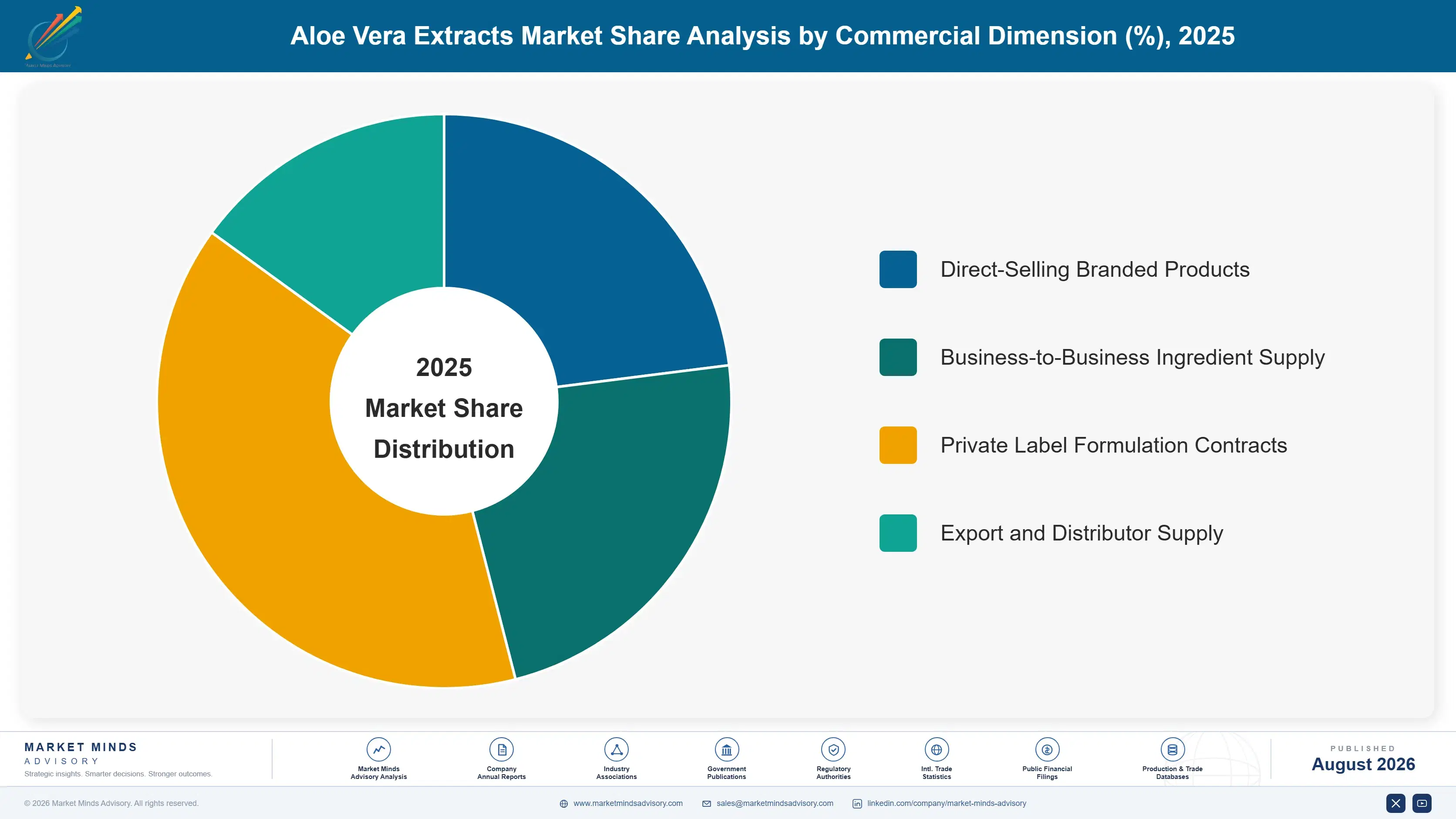
Segmentation follows product form, a single processing dimension shared across every aloe vera extract sold into global food, beverage, and cosmetic manufacturing markets today. Each form carries distinct stabilization, certification, and margin characteristics, so commercial position tracks the underlying processed form itself rather than the specific end application, brand, or geography it ultimately serves.
aloe-vera-extracts-market-trends-growth-market-share-analysis-1787461940054

Cosmetic and Personal Care Aloe Extracts

Cosmetic and personal care aloe extracts grow fastest at 10.8%, about 1.50 times the overall 7.2% rate, as clean beauty and K-beauty formulation trends pull processed aloe gel into skincare product lines faster than beverage demand can match. Growth concentrates most heavily in South Korea, Japan, and increasingly North America, where cosmetic brands specify documented purity and stabilization certification that beverage-grade suppliers typically do not maintain. Processors serving this segment increasingly invest in dedicated cosmetic-grade production lines separate from their beverage or supplement operations, reflecting genuine confidence in demand durability beyond a single formulation trend cycle. Capacity constraints tied to cosmetic-grade certification requirements are keeping this segment's growth somewhat below what underlying formulator demand alone would otherwise support.
CAGR 10.8%

Beverage-Grade Aloe Juice and Gel Extracts

Beverage-grade aloe juice and gel extracts grow at 9.0% as East Asian consumption of aloe drink beverages continues expanding alongside growing beverage manufacturing adoption in South Asia and Latin America. This segment remains the category's largest by absolute volume, anchored by established consumer familiarity with aloe drinks in China, South Korea, and Japan, where bottled aloe beverages have been a mainstream retail category for decades rather than a recent wellness trend. Growth trails the cosmetic segment specifically because beverage demand tracks broader packaged drink consumption patterns rather than a specific accelerating formulation trend. Processors serving this segment compete primarily on cost and consistent supply rather than on the certification depth that increasingly differentiates cosmetic-grade suppliers.
CAGR 9.0%
Full segment breakdown across 6 segments available in the complete report.

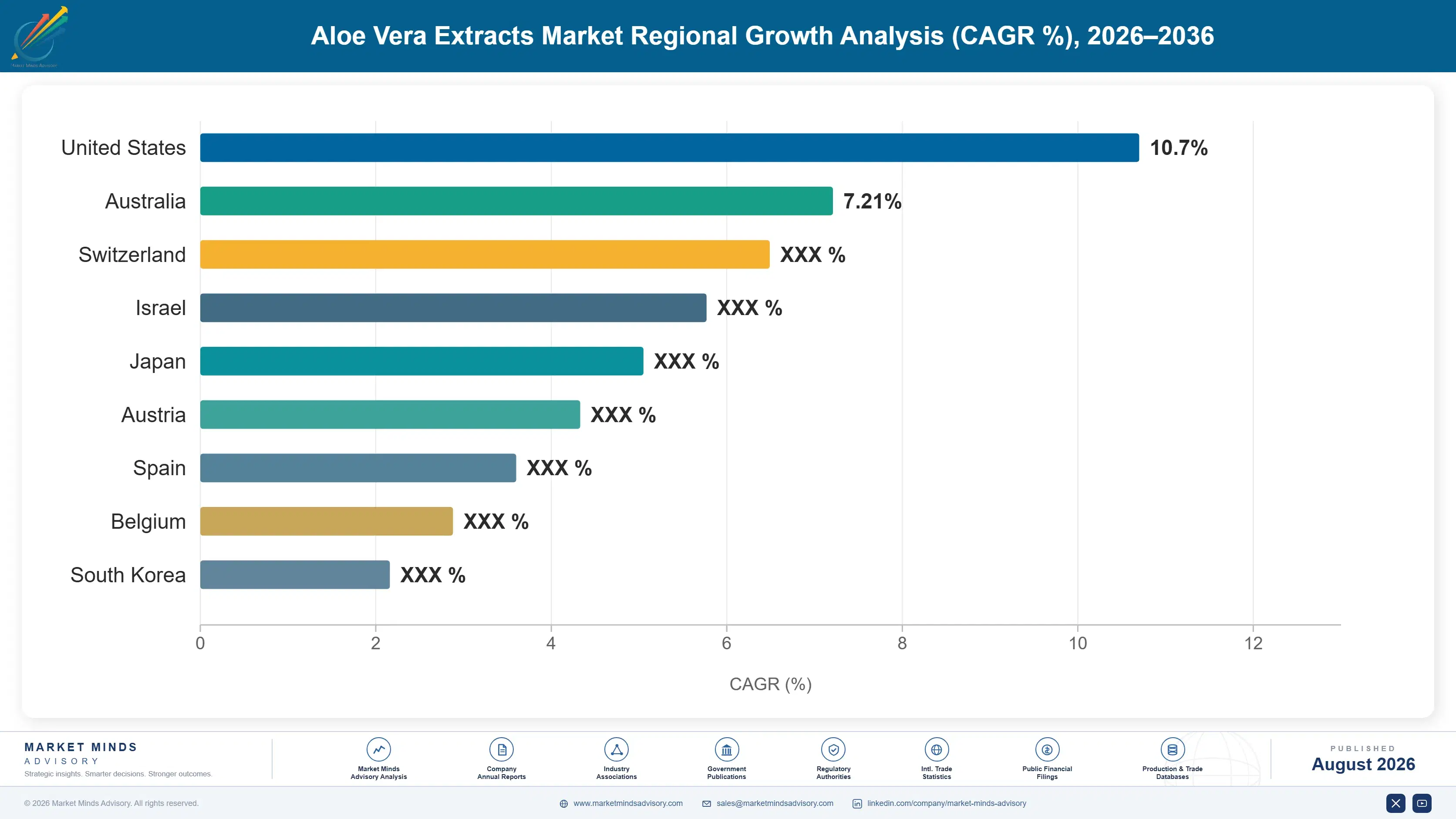
Regional Architecture and Country Demand Map

East Asia leads on established aloe drink culture and expanding cosmetic manufacturing scale, followed closely by North America and Western Europe, both growing at a genuinely steady pace. South Asia and Pacific posts the fastest regional growth as Indian cultivation capacity expands rapidly across the country.

North America

The United States anchors regional demand through both an established dietary supplement and topical skincare retail base and a fast-growing cosmetic formulation sector increasingly specifying aloe as a functional active ingredient across a wide range of skincare, haircare, and beverage product categories sold nationwide today. Forever Living Products, headquartered domestically, operates substantial vertically integrated aloe farming and processing capacity supplying its global direct-selling network from American operations across many countries. Canada follows a broadly similar retail and consumer pattern at smaller scale. Growth here outpaces most mature botanical ingredient categories specifically because cosmetic formulation adoption keeps expanding the addressable premium segment within an otherwise stable beverage and supplement demand base.
Share: 24% | CAGR: 7.5% (2026 to 2036)

Western Europe

Germany, France, and the United Kingdom drive regional demand through established cosmetic and personal care manufacturing sectors increasingly specifying aloe gel under strict European Union cosmetic ingredient safety and labeling regulation that shapes formulation choices considerably across the bloc. Growth trails the global average as the region's cosmetic formulation trend adoption, while genuine, runs somewhat behind the pace set by South Korean and North American brands leading the broader clean beauty movement. Southern European markets add modest additional demand tied to traditional topical aloe use, particularly in Spain and Italy where the plant grows natively in warmer climate zones. Nordic markets contribute a smaller but steadily growing segment oriented toward certified organic aloe formulations specifically.
Share: 18% | CAGR: 5.6% (2026 to 2036)
Regional intelligence for 5 additional markets available in the complete report: East Asia, South Asia and Pacific, Latin America, Middle East and Africa, Eastern Europe. Contact sales@marketmindsadvisory.com.
aloe-vera-extracts-market-trends-growth-country-cagr-analysis-1787461940567

Capturing Margin as Aloe Goes Cosmetic

The beverage-to-cosmetic demand shift is the clearest margin opportunity this category has seen in years, rewarding processors who can deliver certified, stabilized gel rather than commodity juice at meaningful scale across the industry. The four moves below target where participants across the value chain can capture that shift's genuine value most effectively over time.

Build Dedicated Cosmetic-Grade Processing Lines Now

Processors still producing cosmetic-grade gel on the same lines as beverage-grade juice face contamination and consistency risks that increasingly disqualify them from premium cosmetic contracts requiring documented purity and stabilization certification and full traceability across every single production batch made. Companies investing in dedicated cosmetic-grade processing infrastructure are capturing formulation contracts at pricing 3 to 8 times above beverage-grade extract, converting a certification requirement into a genuine competitive moat. This investment pays back quickly given how much premium cosmetic brands pay for documented, traceable supply relative to commodity beverage buyers.
Market Impact: Captures 3 to 8 times pricing over beverage grade

Secure Diversified Raw Leaf Supply Across Growing Regions

Aloe leaf perishability ties processing capacity closely to cultivation regions, and processors dependent on a single growing region face genuine supply risk from weather events or disease outbreaks affecting that specific area entirely and without any real advance warning. Manufacturers securing supply agreements across both Mexican and Indian growing regions simultaneously reduce dependence on any single geography's harvest outcome in a given season, protecting margin predictability against the roughly 20% cost swings that single-region competitors have periodically faced. This diversification also supports more credible traceability marketing claims valued by premium cosmetic buyers.
Market Impact: Reduces supply disruption risk by roughly 20% annually

Pursue South Korean Cosmetic Formulation Partnerships

South Korean cosmetic brands drive global aloe formulation trends that manufacturers worldwide subsequently adopt, making early relationships with Korean formulators a genuine window into where broader cosmetic aloe demand is heading before it scales internationally to other major markets. Suppliers building dedicated South Korean cosmetic industry relationships are capturing formulation trends roughly 12 to 18 months ahead of competitors waiting for trends to reach Western markets first. This positions early movers to scale capacity ahead of demand rather than reacting to it after Western brands have already committed to competing suppliers.
Market Impact: Gains a 12 to 18 month formulation trend lead

Offer Certification Support to Regional Growers

Cosmetic-grade certification requirements exclude smaller regional processors from roughly 50% of premium cosmetic contracts regardless of their underlying aloe quality, leaving genuine untapped supply capacity that larger processors can access through certification partnership rather than direct acquisition of cultivation assets outright and immediately. Companies offering technical and quality assurance support to smaller regional growers in exchange for preferred supply agreements are expanding their effective sourcing base without the capital cost of building new cultivation and processing capacity themselves. This approach also builds grower loyalty that pure spot-market buyers struggle to replicate.
Market Impact: Expands effective sourcing base by 15% to 25%

Who Controls the Margin Pool

Concentration sits at a fragmented CR5 of 26%, split between vertically integrated direct-selling companies including Forever Living Products with proprietary aloe farms, and specialized processors including Aloecorp supplying food, beverage, and cosmetic manufacturers on a business-to-business basis. The gap between Forever Living and specialized processors is meaningful in that each competes on a different commercial model. All participants are assessed on one basis: revenue attributable to aloe vera extract product lines.
Current competitive activity runs along three lines. Cosmetic-grade certification capability increasingly differentiates processors competing for premium formulation contracts from those serving only beverage and bulk supplement channels. Raw leaf sourcing diversification across Mexican and Indian growing regions is emerging as a genuine advantage as buyers seek supply resilience. South Korean cosmetic industry relationships are becoming a meaningful differentiator for suppliers positioning ahead of global trends.

Emerging pressure comes from Indian processors building cosmetic-grade certification capability close to expanding domestic cultivation, challenging the advantage Mexican and established Western processors held through longer operating history. Rankings over the next five years will likely shift toward whichever companies combine certified cosmetic-grade processing with diversified raw leaf sourcing, since that addresses both the category's fastest-growing demand segment and its underlying supply concentration risk.
aloe-vera-extracts-market-trends-growth-company-positioning-matrix-1787461941088

Competitive Moat and Risk Dimensions

FOREVER LIVING PRODUCTS

Moat: Vertically integrated global distribution

Forever Living's proprietary aloe farms combined with its multi-decade direct-selling network across dozens of countries give it supply and distribution control that specialized ingredient processors selling through intermediaries cannot easily replicate, supporting consistent branded product quality across nearly every market it currently serves worldwide today.
FOREVER LIVING PRODUCTS

Risk: Direct-selling model faces scrutiny

Forever Living's reliance on a direct-selling and multi-level marketing distribution model exposes it to the same regulatory scrutiny and generational consumer skepticism affecting the broader direct-selling industry, a risk that pure ingredient suppliers selling through conventional retail channels simply do not face at all today.
ALOECORP INC

Moat: Established cosmetic-grade certification

Aloecorp's long-standing cosmetic-grade certification and extensive processing infrastructure give it credibility with major cosmetic and beverage manufacturers that newer or smaller processors take years to fully establish and replicate, supporting premium contracts with multinational formulation buyers across several categories and many geographic markets worldwide today.
ALOECORP INC

Risk: Exposure to concentrated leaf sourcing

Aloecorp's substantial reliance on Mexican raw leaf sourcing exposes it to weather and agricultural disruption risk concentrated in a single growing region, and any significant harvest shortfall could compress margins faster than its certification advantage can realistically offset in the near term ahead as well.

Players Tracked

Prominent Players

Forever Living Products
Aloecorp Inc
Terry Laboratories
Lily of the Desert
Natural Aloe Costa Rica

Other Key Players

OKF Corporation
Aloe Laboratories Inc
Concentrated Aloe Corp
Health and Nutrition Biotech
Aloe Farms Inc
Hainan Yeguo Fruit Beverage
Univera Inc
Fruit of the Earth
Chamdor Pty Ltd
Curaloe
Vitagenne
Cape Aloe Processors
AMB Aloe International
Aloe Vera Rajasthan
Ken Aloe

Recent Developments

FEBRUARY 2025

Aloecorp Expands Cosmetic-Grade Processing Capacity in Texas

Aloecorp commissioned an expanded cosmetic-grade aloe gel processing line at its Texas facility to serve growing formulator demand across North America. The expansion was funded from Aloecorp's own capital budget as an organic capacity addition, not an acquisition or partnership. Full production ramp is expected within twelve months.
Signal: Confirms cosmetic-grade demand now justifies dedicated new processing investment, not simply routine expansion of existing capacity.
JUNE 2025

Terry Laboratories and an Indian Aloe Cooperative Form Supply Partnership

Terry Laboratories entered a supply partnership with an Indian aloe growers cooperative to diversify its raw leaf sourcing beyond its existing Mexican supply base. The partnership combines Terry's processing and certification expertise with the cooperative's growing operations. Initial contracted volume covers several hundred hectares of cultivation.
Signal: Signals that supply diversification, not single-region scale, is now a genuine and consistently growing strategic priority overall.
OCTOBER 2025

Forever Living Acquires Regional Cosmetic Formulation Specialist

Forever Living Products acquired a mid-sized cosmetic formulation specialist to expand its own branded skincare product development capability beyond its traditional supplement and juice lines. The acquired company brought formulation expertise that Forever Living previously lacked internally. Integration is expected to complete within nine months of close.
Signal: Confirms direct-selling aloe brands now see cosmetic formulation as a genuinely core capability, not merely a peripheral one.

Raw Leaf Sourcing and Stabilization Cost Exposure

Fresh aloe leaf sourcing and stabilization processing together account for 35% to 45% of cost of goods sold across aloe extract manufacturers, sourced from Mexican, Indian, and to a lesser extent Chinese and Central American growing regions that supply the raw leaf underlying most commercial extraction. This concentration leaves the category exposed to weather and agricultural disruption affecting any single major producing area.
A 2021 to 2022 drought across parts of northern Mexico, documented in national agricultural ministry crop reports, reduced aloe leaf yields meaningfully and pushed raw leaf costs up within a single growing season for processors dependent on that specific region. Producers with diversified sourcing across multiple growing regions absorbed that shortfall more smoothly than those dependent on a single supplier relationship. Prices partially normalized over the following season as growing conditions improved.

Exposure varies by processor integration and sourcing diversification. Vertically integrated companies with direct farming operations across multiple regions absorb weather-driven volatility more smoothly than smaller processors buying leaf through intermediaries, who face sharper margin compression during poor growing seasons. Geography matters too: Indian processors face somewhat different monsoon-driven seasonal risk than Mexican producers dependent on different rainfall patterns entirely.
aloe-vera-extracts-market-trends-growth-cost-volatility-analysis-1787461941283

Diversify Raw Leaf Sourcing Across Growing Regions

Manufacturers qualifying leaf supply from both Mexican and Indian growing regions simultaneously reduce dependence on any single country's weather or agricultural disruption in a given growing season and calendar year each and every time. This adds supplier qualification complexity but meaningfully smooths aggregate input cost volatility across a full multi-year sourcing cycle and planning horizon.

Invest in Faster On-Site Stabilization Technology

Processors investing in faster stabilization technology at or near the point of harvest reduce the perishability constraint that otherwise limits sourcing flexibility and increases waste from degraded leaf across the wider supply chain overall. This raises upfront capital commitment but genuinely expands the practical radius from which fresh leaf can be sourced and processed.

Secure Multi-Year Grower Supply Agreements

Direct multi-year contracts with aloe growers, bypassing intermediate leaf traders, lock pricing terms and protect against the weather-driven price spikes that have periodically hit unsecured buyers during poor growing seasons across recent years and several past decades as well. This requires closer grower relationship management but delivers meaningfully more predictable input costs over time.

Portfolio Architecture for Margin Defence

The portfolio splits into three tiers with meaningful margin separation tied to processing certification and end-use application rather than raw leaf cost alone. Commodity beverage-grade juice competes mainly on price and delivery reliability, while certified cosmetic-grade gel and specialty supplement formats command durable premiums tied to documented purity and formulation performance across most major buyers.
The tension between volume and premium is sharpening as cosmetic demand grows faster than beverage demand, pulling processor investment toward the higher-margin segment even though beverage-grade extract remains the larger volume base globally today, particularly across East Asia. Companies that maintain a foothold in both segments preserve optionality, while those chasing only cosmetic-grade volume risk losing the stable cash flow that beverage demand still reliably provides across established Asian markets.

High-value margin pools concentrate specifically in certified cosmetic-grade gel and premium supplement formats, both requiring real processing and certification investment that commodity beverage suppliers must build or acquire rather than simply extend from existing capability. Commodity beverage-grade juice, by contrast, remains a large but slower-growing volume base offering thin, stable margins rather than genuine expansion opportunity for most processors going forward.

Volume / Commodity-Adjacent Tier

Standard beverage-grade aloe juice sold primarily on price and delivery reliability into established East Asian and Southeast Asian bottled drink manufacturing, largely unchanged for many decades across the wider industry.
Gross Margin: 12-20%

Premium / Certified Tier

Certified cosmetic-grade aloe gel and standard supplement capsules serving personal care and wellness brands with documented purity requirements and consistent quality specifications maintained carefully across every single production batch produced.
Gross Margin: 26-38%

Sustainability / Regulatory / Next-Generation Tier

Traceable, organic-certified cosmetic actives and next-generation stabilization formats representing the newest and most technically demanding corner of the entire portfolio available across most major global markets currently today and going forward.
Gross Margin: 32-46%
aloe-vera-extracts-market-trends-growth-portfolio-architecture-1787461941782

High-value Sub-segments and Strategic Watch-out

Certified Cosmetic-Grade Aloe Gel

High value and high growth, driven by K-beauty and clean beauty formulation trends pulling aloe into skincare product lines across many major markets and retail channels worldwide today. Processors with documented certification are capturing this segment's fastest-growing contracts across North America and East Asia simultaneously.
Gross Margin: 32-46%

Traceable Organic Supplement Formats

High value with strong growth, tied to digestive health positioning gaining mainstream consumer acceptance across wellness retail channels worldwide today and increasingly well beyond that narrow scope entirely and consistently. Organic certification increasingly decides which supplier wins long-term formulation contracts here across most major markets.
Gross Margin: 28-40%

Standard Beverage-Grade Aloe Juice

The volume core, anchored by decades of established East Asian bottled drink consumption across a wide range of retail channels and product formats nationwide and well beyond. Steady growth tracks packaged beverage consumption rather than any specific formulation trend or premium pricing opportunity emerging soon.
Gross Margin: 12-20%

Uncertified Bulk Cosmetic Supply

The strategic watch-out, facing accelerating exclusion as cosmetic brands tighten certification and traceability requirements industry-wide across nearly every major market and available distribution channel today and increasingly again each tomorrow. Remaining demand concentrates mostly in markets with weaker certification enforcement standards currently in place today.
Gross Margin: 10-16%

Certification Lock-In Meets Beverage Habit

Demand architecture here splits between certification-driven formulation lock-in and habitual beverage repeat purchasing that behave differently across end uses. Cosmetic brands, once they validate a certified aloe supplier's gel against a formulation, rarely switch suppliers absent a significant quality or supply disruption, since requalifying a formulation against a new source requires repeating stability testing that can run many months. Beverage buyers behave differently, treating aloe juice more as a commodity input with lower switching costs tied to price.
Adoption depth varies sharply by end-use application. Cosmetic and personal care formulators show the deepest lock-in once a supplier achieves certification and approval, given the regulatory and testing burden associated with switching. Dietary supplement manufacturers show moderate lock-in, balancing cost sensitivity against the value of a documented, consistent source. Beverage manufacturers show the least lock-in, switching between suppliers more readily on price and reliability.

Generational buyer shifts are reshaping category demand meaningfully. Younger cosmetic formulators increasingly prioritize documented plant-derived actives and traceability over synthetic alternatives, a shift that favors aloe processors investing in certification and sourcing narratives. This generational shift, more than any single marketing campaign, explains why cosmetic aloe demand has scaled faster than beverage demand across most developed markets recently.
aloe-vera-extracts-market-trends-growth-end-use-penetration-index-1787461942273

Where Aloe Processors Should Focus Next

These are among the four positions where our research anticipates prominent divergence between winners and laggards over the coming forecast period. Each is grounded in the demand model, the regulatory perimeter, and the announced capacity pipeline.
01 / COSMETIC CERTIFICATION INVESTMENT

Build Dedicated Cosmetic-Grade Lines Ahead of Demand

Cosmetic-grade certification increasingly separates processors capturing premium formulation contracts from those confined to lower-margin beverage and bulk supplement channels, and this gap will likely widen as more cosmetic brands tighten sourcing requirements industry-wide over the coming years. Processors investing in dedicated cosmetic-grade infrastructure now are positioning ahead of demand that continues outpacing available certified capacity across most major markets. Waiting until cosmetic demand fully materializes means competing for capacity investment against competitors who committed years earlier and already hold established formulation relationships.
02 / SUPPLY DIVERSIFICATION PRIORITY

Diversify Leaf Sourcing Before the Next Weather Shock

Raw leaf sourcing concentration in Mexico exposes the broader category to weather and agricultural disruption risk that has already caused meaningful cost spikes during past drought events affecting northern growing regions in recent years across the sector. Processors diversifying supply across Mexican and Indian growing regions simultaneously are protecting margin predictability that single-region competitors cannot match during the next inevitable disruption. This diversification also supports more credible traceability marketing claims that increasingly matter to premium cosmetic buyers evaluating potential suppliers.
03 / SOUTH KOREAN MARKET ACCESS

Build Korean Cosmetic Relationships Ahead of Trend Cycles

South Korean cosmetic brands drive global aloe formulation trends that manufacturers worldwide subsequently adopt, and suppliers with established Korean industry relationships gain genuine visibility into emerging formulation demand before it scales internationally to other major markets worldwide and quite well beyond. This visibility advantage compounds over successive trend cycles, since suppliers positioned early capture manufacturing capacity commitments before competing suppliers even recognize the emerging opportunity. Companies without Korean cosmetic industry relationships risk permanently trailing better-positioned competitors on emerging formulation trends.
04 / GROWER CERTIFICATION SUPPORT

Expand Sourcing Through Certification Partnerships, Not Acquisition

Certification requirements exclude roughly half of potential cosmetic contracts for smaller regional growers regardless of their underlying aloe quality, representing genuine untapped supply capacity that larger processors can access through partnership rather than costly direct acquisition of cultivation assets. Companies offering technical and certification support to smaller growers in exchange for preferred supply terms are expanding effective sourcing capacity while building grower loyalty that pure spot-market buyers cannot easily replicate. This approach scales sourcing more efficiently than acquiring cultivation operations directly.

Engagement Snapshot From the Field

A live engagement with an industry participant carrying material or product regulatory and market exposure ahead of a defining policy shift, showing how our research translates into a defensible multi-year portfolio strategy.
MARKET MINDS ADVISORY · CLIENT ENGAGEMENT SUMMARY
Aloe Vera Extracts Producer Strategic Portfolio Review and Transition Roadmap 2026·Investment Scenario on Aloe Vera Extracts Exposure Evaluation 2025-26
CLIENT PROFILE
A mid-sized North American cosmetic brand approached MMA while planning to reformulate its flagship moisturizer line around a certified cosmetic-grade aloe active following consumer research showing strong demand for recognizable plant-derived ingredients. The client reported annual revenue near USD 95 million and had previously sourced aloe indirectly through a formulation contractor rather than a direct ingredient relationship (client-reported, unverified by MMA).
STRATEGIC CHALLENGE
Management needed to identify a certified cosmetic-grade aloe supplier capable of meeting both the client's purity documentation requirements and its production volume needs without disrupting an already tight product launch timeline set months earlier. The client's formulation team had limited direct experience evaluating aloe suppliers independent of its existing contract manufacturer's recommendations.
MMA APPROACH
MMA benchmarked certification documentation and delivered cost across four candidate cosmetic-grade aloe suppliers under the client's specific formulation and volume requirements. We modeled total sourcing cost including certification verification and assessed each supplier's raw leaf sourcing diversification given recent Mexican drought-related volatility. We also evaluated each candidate's capacity to scale alongside the client's projected launch volume growth.
KEY FINDINGS
  1. Two of the four candidate suppliers offered comparable certification documentation, but only one maintained diversified sourcing across both Mexican and Indian growing regions (client-reported, unverified by MMA).
  2. The client's existing contract manufacturer's recommended supplier priced meaningfully above the eventual selected alternative without offering demonstrably superior certification or traceability documentation.
  3. Switching to a direct aloe supplier relationship, bypassing the contract manufacturer's existing arrangement, required renegotiating certain terms but ultimately improved the client's cost transparency substantially.
  4. The selected supplier's diversified sourcing model provided meaningful reassurance to the client's board regarding long-term supply continuity ahead of a significant planned launch investment.
CLIENT PROFILE
A mid-sized North American cosmetic brand approached MMA while planning to reformulate its flagship moisturizer line around a certified cosmetic-grade aloe active following consumer research showing strong demand for recognizable plant-derived ingredients. The client reported annual revenue near USD 95 million and had previously sourced aloe indirectly through a formulation contractor rather than a direct ingredient relationship (client-reported, unverified by MMA).
STRATEGIC CHALLENGE
Management needed to identify a certified cosmetic-grade aloe supplier capable of meeting both the client's purity documentation requirements and its production volume needs without disrupting an already tight product launch timeline set months earlier. The client's formulation team had limited direct experience evaluating aloe suppliers independent of its existing contract manufacturer's recommendations.
MMA APPROACH
MMA benchmarked certification documentation and delivered cost across four candidate cosmetic-grade aloe suppliers under the client's specific formulation and volume requirements. We modeled total sourcing cost including certification verification and assessed each supplier's raw leaf sourcing diversification given recent Mexican drought-related volatility. We also evaluated each candidate's capacity to scale alongside the client's projected launch volume growth.
KEY FINDINGS
  1. Two of the four candidate suppliers offered comparable certification documentation, but only one maintained diversified sourcing across both Mexican and Indian growing regions (client-reported, unverified by MMA).
  2. The client's existing contract manufacturer's recommended supplier priced meaningfully above the eventual selected alternative without offering demonstrably superior certification or traceability documentation.
  3. Switching to a direct aloe supplier relationship, bypassing the contract manufacturer's existing arrangement, required renegotiating certain terms but ultimately improved the client's cost transparency substantially.
  4. The selected supplier's diversified sourcing model provided meaningful reassurance to the client's board regarding long-term supply continuity ahead of a significant planned launch investment.
RECOMMENDED STRATEGY
Phase 1: Phase 1 (0 to 2 months): Select the diversified-sourcing cosmetic-grade aloe supplier and finalize all direct contract terms fully and promptly. Phase 2: Phase 2 (2 to 6 months): Complete formulation requalification testing thoroughly with the newly certified ingredient supply source identified earlier. Phase 3: Phase 3 (6 to 9 months): Launch the reformulated moisturizer line with aloe sourcing featured as a primary labeled marketing point.
OUTCOME
The client launched the reformulated product line within the nine-month timeline using the recommended direct supplier relationship. Early sales data showed the aloe-forward positioning resonating with the client's target consumer segment, and the direct sourcing relationship also reduced the client's blended ingredient cost meaningfully (client-reported, unverified by MMA).

Frequently Asked Questions

Foundational context covering the market sizes, CAGR, scope, country, region and competition that inform every finding below. This section is provided to cover basics and most often pre-purchase conversations, answered from the MMA Primary Research Dataset.

What is the current size of the Aloe Vera Extracts Market?

The market stood at approximately USD 2.1 billion in 2025, according to MMA's primary research dataset. This reflects global demand across beverage, cosmetic, and supplement applications.

How large will the Aloe Vera Extracts Market be by 2036?

MMA projects the market will reach approximately USD 4.51 billion by 2036 under the base case scenario. This represents roughly 2.00 times the 2026 market entry value.

What is the CAGR for the Aloe Vera Extracts Market 2026 to 2036?

The base case CAGR is 7.2%, with a bull case of 8.5% and a bear case of 5.9%. The range reflects uncertainty around cosmetic formulation adoption pace.

Which segment is growing fastest?

Cosmetic and personal care aloe extracts grow fastest at 10.8%, about 1.50 times the overall market rate. K-beauty and clean beauty formulation trends are the primary driver.

Who are the major companies in the Aloe Vera Extracts Market?

Leading companies include Forever Living Products, Aloecorp Inc, Terry Laboratories, Lily of the Desert, and Natural Aloe Costa Rica. These five companies together hold an estimated 26% of the market on a revenue basis.

Which country is growing fastest?

India posts the fastest national growth at 10.5% CAGR, driven by rapidly expanding domestic cultivation and processing capacity. This outpaces the broader South Asia and Pacific regional average.

Report Segmentation Architecture

The full report scope spans multiple orthogonal segmentation dimensions, with cross-tabulated demand data provided for each dimension pair. Coverage extends further to regional breakdowns, trend trajectories, and the competitive detail needed to support segment-level decision-making.

By Product Form

  • Beverage-Grade Aloe Juice and Gel Extracts
  • Cosmetic and Personal Care Aloe Extracts
  • Aloe Vera Powder
  • Aloe Vera Capsules and Softgel Supplements
  • Pharmaceutical-Grade Aloe Latex Extracts
  • Topical Skincare Aloe Gel

By End-Use Application

  • Functional and Wellness Beverages
  • Skincare and Cosmetic Formulation
  • Dietary Supplements
  • Topical and Personal Care Products
  • Pharmaceutical and Nutraceutical Use

By Commercial Dimension

  • Direct-Selling Branded Products
  • Business-to-Business Ingredient Supply
  • Private Label Formulation Contracts
  • Export and Distributor Supply

By Region

  • North America
  • Western Europe
  • East Asia
  • South Asia and Pacific
  • Latin America
  • Middle East and Africa
  • Eastern Europe

Scope, Methodology, and Coverage

Every figure in this report is reproducible from documented input assumptions. The scope below maps the historical period, the forecast horizon, the segmentation dimensions, and the countries covered, alongside the underlying primary and qualitative methodology.
Historical Period
2020 to 2025
Forecast Period
2026 to 2036
Base Year
2025 (USD billions; MMA Primary Research Dataset, August 2026)
Market Definition
The aloe vera extracts market comprises processed aloe gel, juice, powder, and latex extracts derived from the aloe vera plant, sold for beverage, dietary supplement, cosmetic, and topical skincare use. It excludes whole aloe vera plants sold for ornamental or home cultivation purposes and finished consumer products where aloe is a minor labeled ingredient rather than the primary formulation basis.
Quantitative Units
USD billions (current prices); metric tonnes of processed aloe extract volume where applicable
Segmentation Dimensions
By Product Form; By End-Use Application; By Commercial Dimension; By Region
Regions Covered
North America, Western Europe, East Asia, South Asia and Pacific, Latin America, Middle East and Africa, Eastern Europe
Countries Covered
USA, China, Germany, France, UK, Japan, South Korea, India, Australia, Canada, Brazil, Mexico, Indonesia, Vietnam, Thailand, Malaysia, UAE, Saudi Arabia, South Africa, Nigeria, Turkey, Poland, Netherlands, Italy, Spain, Sweden, Switzerland, Argentina, Colombia, Singapore, and additional markets relevant to this sector
Key Companies Profiled
Forever Living Products, Aloecorp Inc, Terry Laboratories, Lily of the Desert, Natural Aloe Costa Rica, OKF Corporation, Aloe Laboratories Inc, Concentrated Aloe Corp, Health and Nutrition Biotech, Aloe Farms Inc, Hainan Yeguo Fruit Beverage, Univera Inc, Fruit of the Earth, Chamdor Pty Ltd, Curaloe, Vitagenne, Cape Aloe Processors, AMB Aloe International, Aloe Vera Rajasthan, Ken Aloe
Quantitative Methodology
Primary survey, n=3,800 respondents, Q4 2025, six countries; demand-side model with trade association cross-validation
Qualitative Methodology
47 expert interviews, Q4 2025; applied to validate demand model assumptions, identify emerging dynamics, and assess competitive positioning
Report Format
PDF and XLSX data workbook (Word format preview document)
Publisher
Market Minds Advisory
Report Code
MMA-2026-AGR-174
Published
August 2026
Contact
sales@marketmindsadvisory.com | www.marketmindsadvisory.com

Purchase the full Aloe Vera Extracts Market Report (2026 to 2036).

The full MMA Aloe Vera Extracts report sizes the market across six product forms, five end-use applications, and seven regions through 2036. It profiles 20 participants on a consistent revenue basis, scoring each on cosmetic-grade certification, raw leaf sourcing diversification, and South Korean formulation industry relationships. Scenario models quantify how cosmetic formulation adoption and beverage demand trends move pricing and volume mix. The report also includes delivered raw leaf cost modeling, a cosmetic certification exposure screen, and a South Korean formulation trend tracker built for ingredient sourcing, formulation, and category strategy teams.
Six-format segmentation with detailed growth forecasts
Raw leaf sourcing and drought risk assessment
Cosmetic-grade certification tracking and monitoring tool
Beverage versus cosmetic margin comparison model
Regional aloe cultivation capacity mapping tool
Twenty-company competitive benchmarking scorecard and assessment

Built For The People Who Decide

From boardroom strategy to bench-side execution, this report is read cover-to-cover by leaders shaping the next decade of their industry, turning demand scenarios, market dynamics and valuation benchmarks into decisions.
CXOs/ Presidents/ VPs/ Managers
M&A and Corporate Development
Strategy Teams and R&D Heads
Procurement and Product Directors
Regulatory and Compliance Leaders
Investor Relations and Equity Analysts