Market Minds Advisory
Almond Products Market

Almond Products Market: Plant-Based Dairy Substitution and California Supply Concentration Through 2036

Almond milk continues pulling category growth ahead of whole nut sales as plant-based dairy substitution spreads into mainstream grocery, while California dominance of global supply leaves buyers exposed to recurring drought risk.

Lead Analyst

Lisa Gevelber

Published

September 2026

Make Smarter Decisions with Customized Research Insights

Request a free sample report and evaluate market opportunities, growth trends, and competitive dynamics relevant to your business needs.

2025 MARKET VALUE$11.5BMarket Size 2025
2036 FORECAST VALUE$23.7BBase Case , 2026 to 2036
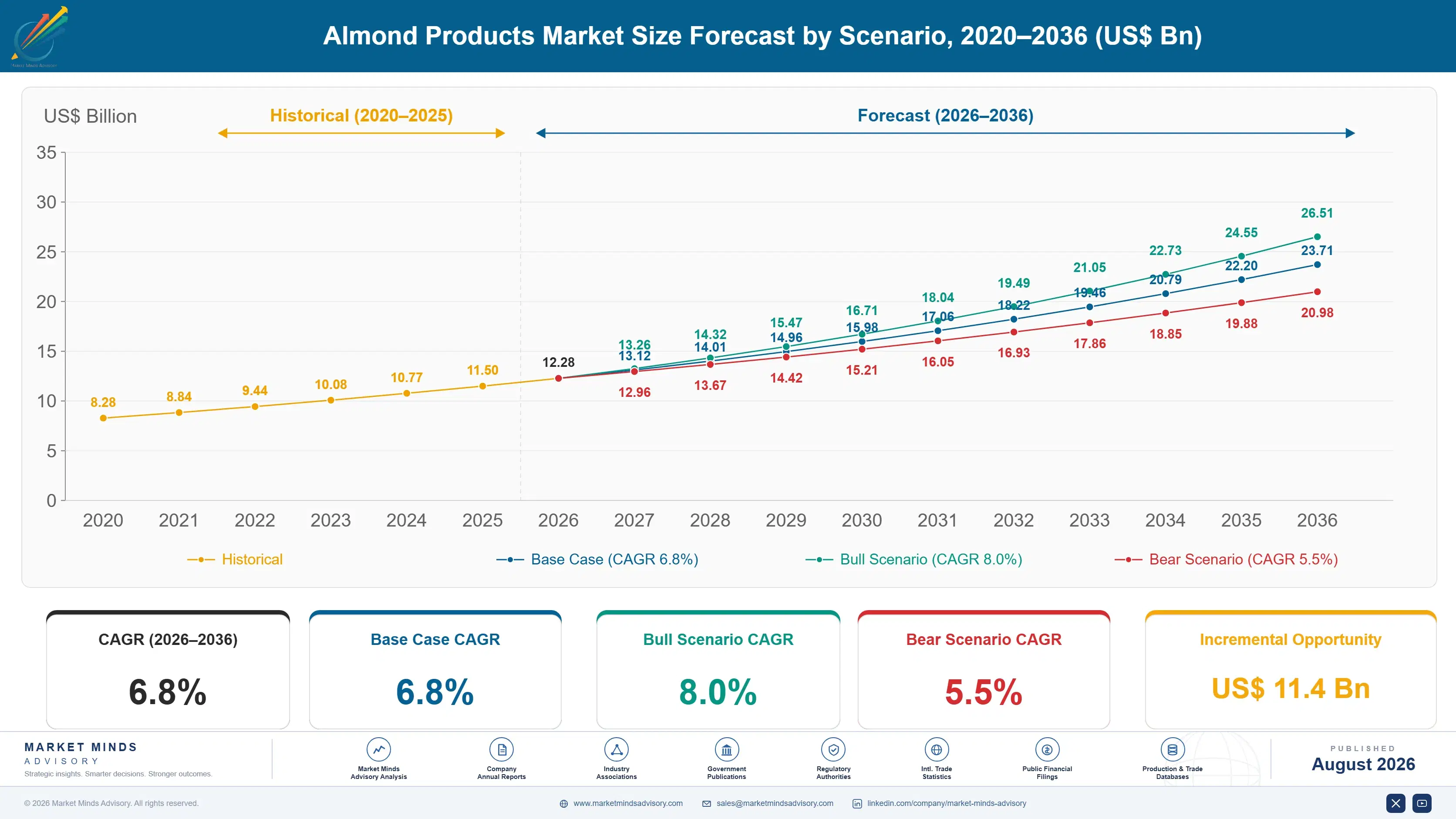
CAGR 2026 TO 20366.8 %Bull 8.0% / Bear 5.5%
INCREMENTAL OPPORTUNITY$11.4BNet 10- year value creation
EXPANSION MULTIPLE1.93x2036 value over 2026 base
Strategic Levers
M&A Pipeline
Regional Outlook
Country Rankings
Competitive Intelligence
Segmental Deep-dive
Call-Us : 91 93563 13602

Executive Snapshot and Market Trajectory

Almond products are splitting into two distinct growth tracks: whole and processed nuts growing steadily with snacking demand, and almond milk expanding much faster as plant-based dairy substitution moves from a niche health choice into a mainstream grocery staple across most developed markets today. Consumers are noticing.
California grows roughly four in five of the world's almonds, giving the entire category an unusual concentration risk that few other food commodities carry at this scale. Buyers in Western Europe and East Asia have diversified processing and blending capacity, but raw supply itself remains almost entirely dependent on a single growing region's water availability and weather patterns, a persistent vulnerability the industry has never fully resolved despite two decades of price volatility.
Processors are pushing further into value-added forms, since almond flour, butter, and beverage products carry meaningfully better margins than raw or lightly processed nuts sold in bulk to wholesale buyers. Cooperative structures dominate California processing, giving growers collective bargaining power that keeps the supply side more consolidated than the fragmented downstream beverage and snack brands competing for retail shelf space across every major market this report tracks.
Market Definition
The almond products market covers whole and raw almonds, almond milk and beverages, almond butter and spreads, almond flour and meal, almond oil, and sliced, diced, and blanched almonds sold for food and beverage applications. It excludes almond-derived cosmetic and pharmaceutical ingredients sold outside food and beverage channels.
Base Year Value
$11.5B in 2025 (MMA Primary Research Dataset, August 2026)
Forecast Period
2026 to 2036, eleven discrete annual values
CAGR
6.8% base case. Bull 8.0%. Bear 5.5%.
Fastest Growth Segment
Almond Milk and Beverages: 9.8% CAGR
Fastest Growth Country
India: 9.5% CAGR
Fastest Growth Region
South Asia and Pacific: 8.8% CAGR
Largest Region
North America: 30% of 2025 global value
Market Leaders
Blue Diamond Growers, The Wonderful Company, Olam Group, Select Harvests, Borges International Group. Source: MMA Analysis based on company annual reports.
Primary Survey
n=3,800 procurement and R&D decision-makers, Q4 2025, six countries
Methodology
Demand-side build-up, cross-validated against public data, 47 expert interviews

Almond Products Market Forecast Scenarios

almond-products-market-2024-2034-trends-size-forecast-scenario-1787461250072
Between 2020 and 2025 the market grew at roughly 5.8 percent a year, with California drought conditions periodically constraining supply and pushing prices higher even as almond milk demand kept expanding steadily through grocery and food-service channels across most major consuming markets worldwide during this period. Retail demand proved resilient even when raw nut prices spiked sharply during those same years.
The base case assumes 6.8 percent annual growth to 2036, built on three mechanisms: continued almond milk penetration into mainstream dairy aisle placement as plant-based substitution spreads beyond early adopters, expanding almond butter and protein snack demand tracking broader high-protein diet trends across major consumer markets, and steady value-added processing investment that captures more margin per acre of California orchard capacity. Together these three mechanisms sustain growth above simple acreage expansion trends.
A bull case near 8.0 percent depends on plant-based beverage adoption accelerating faster than currently expected across additional geographies beyond its current core markets and demographics. The bear case near 5.5 percent assumes recurring California drought years constrain supply enough that price spikes push some buyers toward alternative nut and plant milk substitutes across every retail channel tracked.

Supply Concentration and the Value-Added Margin Shift

Almond products sit on an unusual foundation for a global food category: nearly all of the world's supply originates from a single growing region, and that concentration shapes every strategic decision from processor contract structure to retail brand pricing. As almond milk demand keeps climbing, buyers are discovering that diversifying processing geography does little to reduce the underlying supply risk sitting upstream in California's orchards.
PRODUCER CONCENTRATIONCR5 30%top five hold less than a third of global capacity
AVERAGE SELLING PRICE$5.80/kgblended price across whole nut and processed forms
CALIFORNIA PRODUCTION SHARE78%share of global almond output originating from this region
ALMOND MILK RETAIL PENETRATION34%share of plant-based milk category held by almond variants
TRADE INTENSITY68%share of volume crossing a border before final processing
WATER COST EXPOSURE22% of COGSirrigation and water rights cost burden across growers
Commercially, the market splits between commodity whole and raw nuts sold largely on price and grade consistency, and a faster-growing value-added tier spanning almond milk, butter, and flour sold with brand positioning and formulation investment. Margins concentrate heavily in the value-added tier, where processors and beverage brands capture retail pricing power that raw nut sellers operating on thinner commodity margins cannot access.
Over the next decade, water rights access and drought resilience investment in California orchards will matter more to supply security than any downstream processing innovation, since the fundamental growing region concentration that defines this market shows no sign of meaningfully diversifying within the forecast period covered by this analysis. Buyers plan accordingly. Timing matters here. Buyers plan around it every quarter.
"Every almond milk carton on a shelf anywhere in the world eventually traces back to the same handful of California counties. That single fact explains more about this industry's pricing behavior than any consumer trend report ever could."
Director, Food and Beverage Ingredients Practice · MMA Food and Beverage Ingredients Practice · August 2026

Market Trends

Almond Milk Displaces Dairy on Mainstream Grocery Shelves

Almond milk now holds roughly 34 percent of the plant-based milk category and has moved from a specialty aisle placement into direct competition with dairy milk on mainstream grocery shelves across North America and Western Europe. Danone and Califia Farms have both expanded production capacity specifically to meet retail demand that has consistently outpaced supply forecasts made just a few years earlier. This mainstreaming trend is pulling almond demand growth well above what whole nut snacking and baking use alone would otherwise generate, effectively creating a second, beverage-driven demand engine for the underlying raw nut supply.
Market Impact: Substitution grows share 5% yearly

Protein Snacking Trend Lifts Almond Butter Demand

High-protein diet trends have pushed almond butter from a niche health food product into a mainstream spread and snack ingredient, with retail sales climbing at a pace well above traditional peanut butter growth in most developed markets tracked in this analysis. Manufacturers are increasingly incorporating almond butter into protein bars, snack packs, and bakery applications rather than selling it solely as a standalone jar product. The Wonderful Company and Blue Diamond Growers have both expanded almond butter processing capacity specifically to capture this broadening application base beyond traditional retail spread sales.
Market Impact: Processing captures 2-3x raw nut margins

Market Opportunities and Growth Drivers

Plant-Based Dairy Substitution Keeps Broadening Steadily

Consumer surveys across North America and Western Europe continue to show growing adoption of plant-based milk alternatives for reasons spanning lactose intolerance, environmental concern, and general dietary preference shifts among younger demographic cohorts increasingly setting household purchasing habits. Almond milk retains the largest single share of this broader plant-based category despite competition from oat and soy alternatives, benefiting from an established taste profile and decades of brand investment predating more recent oat milk entrants. This sustained substitution trend gives almond beverage demand a durable growth floor that whole nut snacking trends alone would not otherwise provide.
Market Impact: Drought years can cut yield 10-15%

Value-Added Processing Investment Captures More Margin

Processors converting raw almonds into flour, butter, and beverage products capture meaningfully more margin per pound than selling whole or lightly processed nuts in bulk commodity channels, and that margin gap is pulling capital investment toward value-added processing capacity rather than simple orchard acreage expansion across the industry. Blue Diamond Growers and The Wonderful Company have both expanded processing infrastructure specifically to shift their product mix toward these higher-margin categories each year. This shift is gradually changing the industry's profit pool even as raw almond acreage growth itself remains comparatively modest.
Market Impact: Oat milk share now exceeds 20%

Market Restraints and Challenges

California Water Scarcity Threatens Supply Stability

Almond orchards require substantial irrigation, and the underlying cause of recurring supply disruption is that California's water allocation system increasingly rations agricultural water rights during drought years, forcing some growers to fallow acreage or accept reduced yields. The commercial impact shows up directly in global pricing whenever a drought year hits, since no alternative growing region can absorb meaningful demand on short notice given the scale of California's dominance. Mitigation efforts include growers investing in more efficient drip irrigation systems and water-recycling infrastructure to reduce per-acre water demand over time.
Market Impact: Almond milk holds 34% share

Plant Milk Category Competition Keeps Intensifying

Oat milk and other plant-based alternatives have gained meaningful share within the broader plant-based beverage category, and the underlying cause is oat milk's perceived sustainability advantage given its lower water footprint compared with almond cultivation in a water-scarce growing region. The commercial impact shows up as almond milk brands increasingly compete on sustainability messaging rather than taste or price alone, adding marketing cost that did not previously factor into category competition. Almond milk producers are mitigating this through water-efficiency certification programs aimed at countering the sustainability narrative oat milk brands have built.
Market Impact: Butter sales up 15% yearly
3 additional market trends, 3 additional growth drivers, and 3 additional restraints and challenges are covered in the full report. Contact sales@marketmindsadvisory.com to access the complete intelligence.

Segment CAGR and Growth Architecture

The market segments by product form rather than end-use application, since a given form such as almond flour or almond milk typically serves multiple consumer and food manufacturing purposes interchangeably depending on the specific recipe or product a buyer is formulating across bakery, beverage, and snack categories sold through modern retail and food-service channels worldwide.
almond-products-market-2024-2034-trends-market-share-analysis-1787461250605

Almond Milk and Beverages

Almond milk and beverages are the fastest-growing segment as plant-based dairy substitution moves from a niche health choice into mainstream grocery placement directly alongside traditional dairy products across most major retail chains. Demand is concentrated among younger consumers and lactose-intolerant households, though adoption has broadened well beyond those original core segments into general household purchasing habits. Danone and Califia Farms both lead regional production, expanding capacity specifically to meet retail demand that has consistently outpaced supply forecasts made just a few years earlier. Competition from oat milk has intensified in recent years, pushing almond beverage brands toward sustainability messaging and water-efficiency certification to defend their established category position against a fast-growing rival.
CAGR 9.8%

Almond Butter and Spreads

Almond butter and spreads demand is climbing as high-protein diet trends push the category from a niche health food product into a mainstream snack and spread ingredient used well beyond standalone jar sales. Manufacturers increasingly incorporate almond butter into protein bars, snack packs, and bakery applications, broadening the demand base beyond traditional retail spread purchases alone. The Wonderful Company and Blue Diamond Growers both lead processing capacity in this category, having expanded specifically to capture applications beyond the standalone spread market that historically defined almond butter demand. Pricing carries a meaningful premium over peanut butter, reflecting both almond input cost and the health positioning that supports premium retail placement each year.
CAGR 8.0%
Full segment breakdown across 6 segments available in the complete report.

Regional Architecture and Country Demand Map

North America holds the largest regional share reflecting California's dominance of global almond production and processing, with Western Europe and East Asia following as major consuming markets and South Asia and Pacific posting the fastest regional growth off a smaller base and rising incomes overall.

North America

California's near-total dominance of global almond production gives North America a fundamentally different position than any other region in this analysis, since demand and supply sit within the same geographic footprint rather than requiring long-distance import logistics. US almond milk brands including Califia Farms and Elmhurst 1925 lead category innovation, and domestic retail placement has advanced furthest toward treating almond milk as a mainstream dairy aisle product rather than a specialty item. Canadian demand tracks closely with the United States given shared retail supply chains and cross-border brand distribution. Growth here trails the fastest-growing regions since almond milk penetration is already comparatively mature domestically, leaving less headroom than markets earlier in their own adoption curve.
Share: 30% | CAGR: 6.5% (2026 to 2036)

Western Europe

Spain's own almond production, the second largest in the world after California, gives Western Europe partial supply independence that other consuming regions lack entirely, softening the region's exposure to California-specific drought disruption somewhat. German and UK retailers have driven almond milk mainstreaming aggressively, with private label almond beverage lines now standard across major supermarket chains throughout the region. Traditional almond use in Mediterranean confectionery and marzipan production adds a demand base that other regions do not carry to the same degree, reflecting centuries of established culinary tradition. Growth trails the global average since much of the region's plant-based beverage adoption already occurred over the past decade. Retail brand development continues to advance steadily across the wider region.
Share: 22% | CAGR: 5.3% (2026 to 2036)
Regional intelligence for 5 additional markets available in the complete report: East Asia, South Asia and Pacific, Latin America, Middle East and Africa, Eastern Europe. Contact sales@marketmindsadvisory.com.
almond-products-market-2024-2034-trends-country-cagr-analysis-1787461251115

Where Almond Processors Can Capture Value

Processors who move well beyond raw and whole nut sales toward beverage brands, protein snack applications, and water-efficiency positioning capture materially better margins each fiscal year than those competing purely on price for commodity whole almonds sold in bulk to wholesale buyers across every regional market this analysis covers in real depth and detail overall.

Branded Almond Milk and Beverage Development

Launching or expanding branded almond milk and beverage lines lets processors capture retail pricing power that raw nut sales cannot access, since beverage brands earn margins 2 to 3 times above commodity nut sales once packaging and distribution investment pays off across a growing customer base. Danone and Califia Farms have both expanded capacity specifically to meet retail demand that has outpaced supply forecasts, positioning themselves as consumer brands rather than agricultural commodity sellers. The approach requires meaningful capital and marketing investment upfront, but the margin upside justifies it for processors with sufficient scale and balance sheet strength to commit.
Market Impact: Beverage margins run 2 to 3 times higher

Protein Snack and Bakery Application Partnerships

Partnering directly with protein bar and snack manufacturers to supply almond butter and flour as functional ingredients, rather than selling only through standalone retail spread channels, gives processors access to a demand pool growing faster than traditional jarred spread sales by an estimated 6 to 8 percentage points annually. The Wonderful Company and Blue Diamond Growers have both expanded processing capacity specifically to serve this broader application base. This requires technical formulation support beyond simply supplying bulk ingredient, but suppliers willing to invest in food scientist relationships win multi-year contracts that commodity-only competitors cannot access.
Market Impact: Captures growth 6 to 8 points above spreads

Water-Efficiency Certification and Sustainability Positioning Programs

Investing in drip irrigation and water-recycling infrastructure, then certifying the resulting water efficiency gains, lets almond beverage brands counter the sustainability narrative oat milk competitors have built around their lower water footprint claims. Processors who can document meaningful water use reduction, in the range of 15 to 20 percent per pound produced, gain a defensible marketing position that pure price competition cannot replicate on its own. This investment requires meaningful upfront capital but protects category share against a fast-growing plant milk rival gaining ground on sustainability messaging alone each passing year.
Market Impact: Cuts water use 15 to 20 percent per pound

Geographic Supply Diversification Strategy Beyond California

Developing meaningful almond cultivation capacity in Australia, Spain, or other suitable growing regions beyond California reduces the single-region drought risk that has repeatedly disrupted global pricing over the past two decades and the current 78 percent concentration it reflects. Select Harvests and Borges International Group have both expanded non-Californian cultivation specifically to offer buyers supply continuity that fully California-dependent competitors cannot promise during drought years. This diversification requires long lead times given orchard maturation cycles, but early movers can lock in supply contracts before local supply tightens further. Buyers increasingly value this optionality.
Market Impact: Reduces reliance on the current 78 percent share

Who Controls the Margin Pool

CR5 sits near 30 percent, reflecting a category where California grower cooperatives concentrate raw supply while downstream beverage and snack brands remain considerably more fragmented in their own competitive positioning. The gap between the largest processors and the long tail of regional beverage brands is wide on marketing scale, though considerably narrower on raw almond sourcing cost, since nearly everyone buys from the same growing region.
Current competitive activity centers on three fronts: almond milk brand expansion by beverage companies chasing mainstream dairy aisle placement, value-added processing investment by growers and cooperatives shifting product mix toward higher-margin categories, and water-efficiency certification programs aimed at defending category share against fast-growing oat milk competitors gaining ground on sustainability messaging across every major distribution channel and geography and buyer expectations.

Emerging pressure comes from non-Californian growing regions, particularly Australia and Spain, expanding cultivation as a hedge against California-specific drought risk, potentially challenging the current supply concentration over the next decade. Rankings among the largest beverage and processing brands are unlikely to shift quickly, but supply-side diversification is advancing faster than most buyers expected just a few years ago just a few seasons back.
almond-products-market-2024-2034-trends-company-positioning-matrix-1787461251640

Competitive Moat and Risk Dimensions

BLUE DIAMOND GROWERS

Moat: Cooperative scale and brand recognition

Blue Diamond's cooperative structure gives it direct access to a large share of California grower supply alongside decades of consumer brand recognition, letting it compete across whole nut, butter, and beverage categories simultaneously in a way smaller single-category competitors cannot match at comparable scale or capital.
BLUE DIAMOND GROWERS

Risk: Concentrated single-region supply exposure

As a cooperative built around California grower membership, Blue Diamond carries concentrated exposure to the same regional drought and water policy risk affecting the entire industry, without the geographic diversification some competitors are beginning to build themselves at all at present too every year as well.
THE WONDERFUL COMPANY

Moat: Vertically integrated orchard ownership

The Wonderful Company's direct ownership of substantial California almond orchard acreage gives it cost and supply visibility that buyers dependent on open-market purchasing cannot match, letting it manage margin more predictably through drought-driven price cycles and across every planting season it operates. Few rivals can say the same.
THE WONDERFUL COMPANY

Risk: Water rights and regulatory exposure

Direct orchard ownership means The Wonderful Company bears water rights and regulatory risk directly on its own balance sheet, rather than passing that exposure through to third-party growers the way pure processing and brand companies can partially avoid across their own operations. This exposure has grown over time.

Players Tracked

Prominent Players

Blue Diamond Growers
The Wonderful Company
Olam Group
Select Harvests
Borges International Group

Other Key Players

Treehouse Foods
ADM
John B. Sanfilippo and Son
Mariani Packing Company
Harris Woolf California Almonds
Stewart and Jasper Orchards
Campos Brothers Farms
Intersnack Group
Kanegrade
Danone
Califia Farms
Elmhurst 1925
Nutex Company
Malk Organics
Pacific Foods

Recent Developments

MARCH 2026

The Wonderful Company Expands Drip Irrigation Infrastructure

The Wonderful Company completed an expansion of drip irrigation infrastructure across a significant share of its California almond orchards, aiming to cut water use meaningfully per pound produced while countering sustainability criticism from plant milk competitors citing water footprint concerns across the state this year.
Signal: Water efficiency investment signals growers see sustainability messaging as a genuine competitive necessity, not just marketing
OCTOBER 2025

Danone Expands Almond Milk Production Capacity in Europe

Danone announced a capacity expansion at its European almond milk production facility, adding output aimed at meeting retail demand that had outpaced the company's existing supply forecasts across several major Western European grocery markets and private label contracts as well too and beyond too too.
Signal: Capacity expansion signals major beverage companies expect almond milk demand growth to continue well beyond current levels
JANUARY 2026

Select Harvests Expands Non-Californian Cultivation Partnerships

Select Harvests announced expanded cultivation partnerships across Australian growing regions, positioning the company to offer buyers supply diversified away from California-specific drought risk as climate volatility continues affecting global almond pricing cycles in future years as well and elsewhere too each year too overall region wide.
Signal: Non-Californian cultivation expansion signals the industry is finally taking supply concentration risk seriousl than before for good reasony

Water Access and California Concentration Exposure

Water and irrigation infrastructure account for roughly 22 percent of cost of goods sold for California almond growers, a share far higher than most other agricultural commodities given the crop's substantial water requirements per acre, while labor for harvest and processing makes up most of the remaining cost structure across the industry's growing and packing operations.
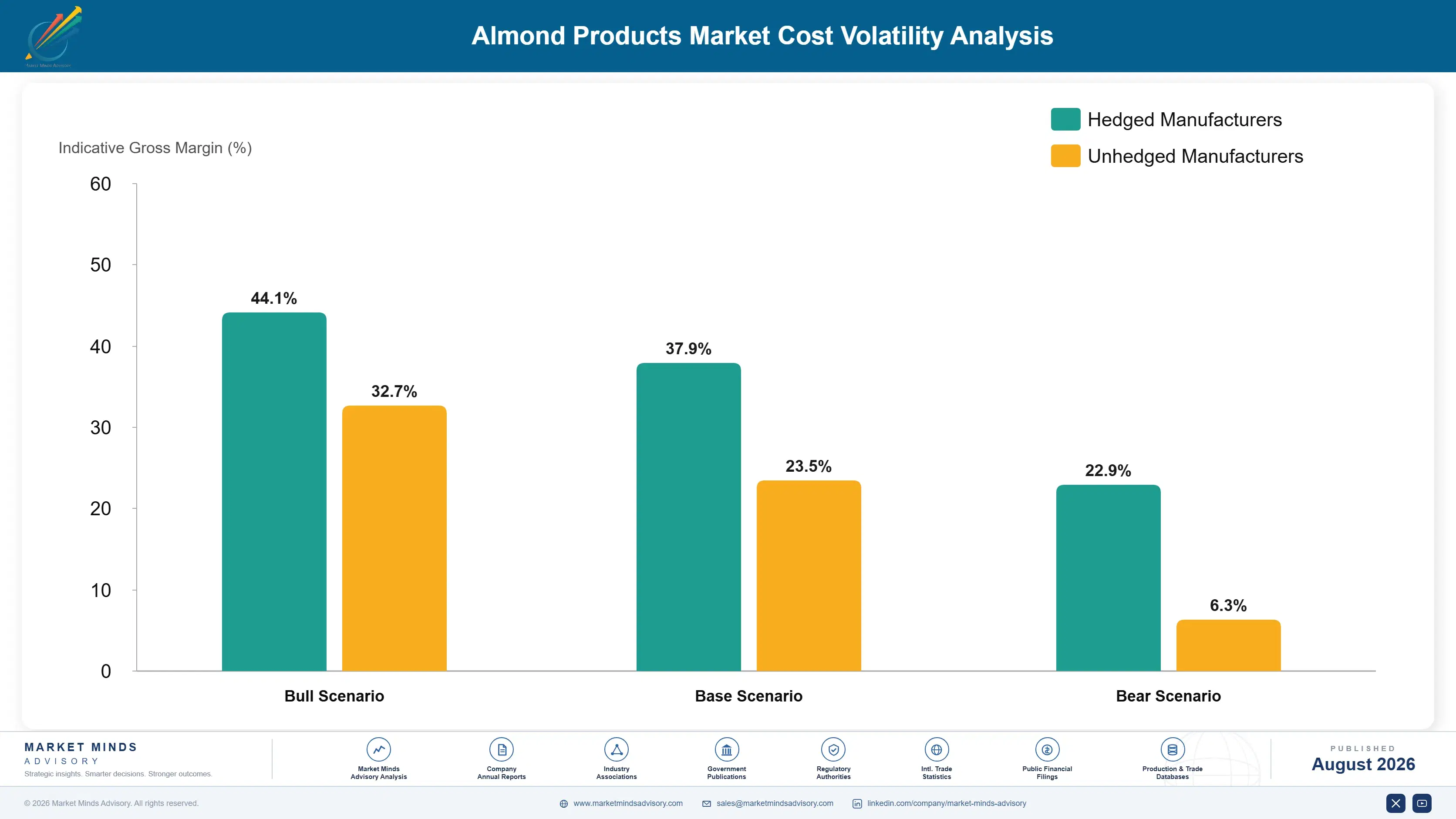
California experienced severe multi-year drought conditions between 2020 and 2022, forcing some growers to fallow orchard acreage entirely, and global almond prices rose more than 20 percent during the most acute shortage period according to industry pricing data tracked across major commodity exchanges. Buyers without diversified sourcing relationships or forward purchase contracts absorbed the sharpest price increases during that period, while larger processors with grower cooperative relationships smoothed pricing somewhat for their own downstream customers.

Smaller regional beverage and snack brands without diversified sourcing or forward purchase contracts absorb almond price volatility directly in margin, while larger processors with grower cooperative relationships and geographic diversification smooth pricing for their downstream customers instead. That gap in sourcing resilience increasingly separates brands who can offer stable retail pricing from those who must pass volatility through to consumers.
almond-products-market-2024-2034-trends-cost-volatility-analysis-1787461251839

Drip Irrigation and Water Efficiency Investment

Growers are investing in drip irrigation and water-recycling infrastructure to reduce per-acre water demand, cutting exposure to future rationing during drought years while also supporting sustainability certification claims that help almond beverage brands compete against oat milk on environmental messaging a practice now standard among the largest California growers active in this category each season.

Geographic Cultivation Diversification

Processors are developing cultivation partnerships in Australia, Spain, and other suitable growing regions to reduce dependence on California alone, though these newer growing areas still represent a small share of total global supply relative to California's continued dominance particularly across Australian and Spanish growing corridors serving multiple continents where filing standards can differ meaningfully.

Forward Purchase and Cooperative Contracts

Larger buyers are locking in forward purchase agreements with grower cooperatives to stabilize pricing through drought cycles, accepting a modest premium in stable years in exchange for protection against the sharp price spikes that hit unhedged buyers during shortage periods a model that has grown more common as drought volatility intensifies further across geographies.

Portfolio Architecture for Margin Defence

The market splits across three tiers: bulk whole and raw almonds sold on thin margins against commodity price and grade consistency, branded value-added products including butter and flour sold with formulation and marketing investment, and an emerging tier of premium almond beverage and protein products commanding the highest margins as brands invest in differentiation a structure that mirrors the broader specialty food sector worldwide.
Volume sits overwhelmingly in the commodity tier, where bulk whole nut contracts with food manufacturers and wholesalers generate revenue scale but comparatively thin margins. Premium tension is sharpest in almond milk and butter, where established brands earn meaningfully better margins than private label or unbranded equivalents, pulling processor investment toward capacity that can serve both tiers simultaneously across their operations.

High-value margin pools concentrate in branded almond beverage and protein snack products sold to health-conscious retail consumers, categories still smaller in absolute volume than commodity whole nut sales but growing faster and attracting disproportionate marketing investment from the leading processors each year across every major consuming market. This trend shows no sign of slowing down soon. Investors are taking notice. Investors have noticed widely.

Volume / Commodity-Adjacent Tier

Bulk whole and raw almonds sold on price and grade consistency to food manufacturers and wholesale distributors across every major consuming market tracked Suppliers here typically operate on thin single-digit to low double-digit margins.
Gross Margin: 10%-16%

Premium / Certified Tier

Branded almond butter, flour, and milk products sold with formulation and marketing investment, commanding a retail premium over unbranded commodity equivalents Suppliers with strong marketing teams typically win this business over price-only competitors.
Gross Margin: 24%-32%

Sustainability / Regulatory / Next-Generation Tier

Water-efficiency certified and premium protein-positioned almond products sold into the industry's highest-margin retail contracts available to differentiated brands This tier remains small in volume but is expanding fastest across every region tracked.
Gross Margin: 34%-42%
almond-products-market-2024-2034-trends-portfolio-architecture-1787461252335

High-value Sub-segments and Strategic Watch-out

Certified Water-Efficient Almond Milk

Almond milk backed by documented water-efficiency certification commands the category's highest margins and is growing fastest as brands counter oat milk sustainability messaging each successive year and continue investing heavily each year Brands with existing certification programs hold a clear early advantage here and beyond.
Gross Margin: 34%-40%

Protein Snack Almond Butter

Almond butter sold into protein bar and snack applications commands steady premium pricing on functional positioning, growing reliably as high-protein diet trends continue expanding across retail categories across every program renewal cycle Brands with proven formulation partnerships win the bulk of new contracts each cycle.
Gross Margin: 24%-30%

Bulk Whole Nut Contracts

The largest volume pool by far, bulk whole nut contracts generate scale revenue for top processors but offer little margin expansion room given intense multi-year price competition among established growers across nearly every contract negotiation Suppliers here compete mainly on scale rather than any real differentiation.
Gross Margin: 10%-14%

Non-Californian Cultivation Regions

Emerging cultivation regions in Australia and Spain could challenge California supply dominance over the next decade, a shift in growing geography worth monitoring closely for its pricing implications rather than competing purely on unit price Multinational buyers are responding by deepening these emerging supplier relationships.
Gross Margin: 14%-20%

Brand Loyalty and Retail Shelf Renewal

Almond beverage demand behaves like an annuity once a consumer establishes a brand preference and retail habit, since switching plant-based milk brands requires overcoming taste and texture familiarity that most consumers do not readily abandon, giving incumbent beverage brands durable repeat purchase volume once they win initial trial and shelf placement in a given household Brands who lose that initial trial rarely win back a satisfied household.
Adoption depth varies by category: almond milk shows the deepest brand loyalty once established, while whole nut and snack purchases remain more price-sensitive and switch readily between brands based on promotional pricing, since taste differentiation matters less for a commodity-like whole nut product than it does for a beverage consumed daily as a dairy replacement This split shapes how brands allocate their marketing and promotional budgets.

A generational shift among younger consumers toward plant-based diets as a default rather than an exception is pulling almond product purchasing earlier into household grocery habits, giving beverage and protein brands a growing customer base that legacy commodity nut sellers historically never cultivated directly That shift favors brands who invest early in consumer-facing sustainability credibility.
almond-products-market-2024-2034-trends-end-use-penetration-index-1787461252826

Positioning Across the Value Chain

These are among the four positions where our research anticipates prominent divergence between winners and laggards over the coming forecast period. Each is grounded in the demand model, the regulatory perimeter, and the announced capacity pipeline.
01 / BEVERAGE BRAND INVESTMENT

Build branded beverage capacity ahead of continued almond milk growth

Almond milk already holds roughly 34 percent of the plant-based milk category and keeps moving further into mainstream dairy aisle placement across North America and Western Europe. Processors without branded beverage capability cannot capture the retail pricing power that Danone and Califia Farms already command, leaving them dependent on thinner commodity whole nut margins instead. Building or expanding beverage brand capacity now positions a processor to capture continued category growth before oat milk competitors capture more of the remaining shelf space.
02 / WATER EFFICIENCY CERTIFICATION

Invest in water-efficiency certification to counter oat milk messaging

Oat milk has built a meaningful sustainability advantage in consumer perception given its lower water footprint relative to almond cultivation in a water-scarce growing region. Brands that document real water-use reduction through drip irrigation and recycling infrastructure, in the range of 15 to 20 percent per pound produced, gain a defensible counter-narrative that pure price competition cannot replicate on its own. Suppliers who invest in this certification now will hold a credibility advantage over competitors who wait for the sustainability debate to fully resolve.
03 / GEOGRAPHIC SUPPLY DIVERSIFICATION

Diversify cultivation beyond California before the next drought cycle

California drought conditions have repeatedly disrupted global almond pricing over the past two decades, and given how concentrated production remains in this single growing region, another severe drought would again squeeze buyers without diversified sourcing already in place. Developing cultivation partnerships in Australia and Spain now, even though orchard maturation takes years, gives buyers a continuity option that fully California-dependent competitors cannot offer. That continuity increasingly matters to beverage brands negotiating long-term supply agreements before regional buyers lock in alternative arrangements of their own.
04 / PROTEIN APPLICATION EXPANSION

Expand almond butter into protein snack applications before rivals do

High-protein diet trends have pushed almond butter demand growth well above traditional jarred spread sales, with protein bars and snack manufacturers increasingly incorporating almond butter as a functional ingredient rather than a standalone retail product. Producers who build direct application partnerships with these manufacturers now, following the model The Wonderful Company and Blue Diamond Growers have already established, can secure multi-year supply agreements before competitors build comparable formulation relationships. This channel is growing meaningfully faster than the traditional spread category alone.

Engagement Snapshot From the Field

A live engagement with an industry participant carrying material or product regulatory and market exposure ahead of a defining policy shift, showing how our research translates into a defensible multi-year portfolio strategy.
MARKET MINDS ADVISORY · CLIENT ENGAGEMENT SUMMARY
Almond Products Producer Strategic Portfolio Review and Transition Roadmap 2026·Investment Scenario on Almond Products Exposure Evaluation 2025-26
CLIENT PROFILE
A regional plant-based beverage manufacturer with almond milk brands sold across Western Europe engaged MMA to redesign its almond sourcing strategy after a California drought year sharply increased its raw input costs. The client's annual raw almond procurement spend exceeded 25 million dollars (client-reported, unverified by MMA), making supplier and geographic diversification a material cost decision for its senior leadership team.
STRATEGIC CHALLENGE
The client sourced nearly all of its raw almonds through a single California grower cooperative and faced a significant cost increase when a severe drought year forced that cooperative to ration allocation among its buyers, threatening the client's production margins during a critical retail growth period for its beverage brand.
MMA APPROACH
MMA benchmarked alternative almond suppliers across California, Australia, and Spain, modeled the cost and lead-time implications of diversifying a portion of the client's sourcing away from a single cooperative relationship, and structured a phased dual-sourcing plan that balanced cost against genuine supply continuity before finalizing a recommendation for leadership across all functions.
KEY FINDINGS
  1. Australian and Spanish suppliers offered comparable almond quality to the client's existing California source at a modest cost premium based on trial shipments.
  2. A dual-sourcing structure across two growing regions would have meaningfully reduced the client's exposure during the drought year shortage based on modeled pricing.
  3. Forward purchase contracts with the client's existing cooperative offered pricing stability that spot-market purchases could not match over multiple seasons and structures.
  4. A modest buffer inventory reduced the client's exposure to future single-region drought disruptions across its production facilities going forward and into subsequent seasons as well.
CLIENT PROFILE
A regional plant-based beverage manufacturer with almond milk brands sold across Western Europe engaged MMA to redesign its almond sourcing strategy after a California drought year sharply increased its raw input costs. The client's annual raw almond procurement spend exceeded 25 million dollars (client-reported, unverified by MMA), making supplier and geographic diversification a material cost decision for its senior leadership team.
STRATEGIC CHALLENGE
The client sourced nearly all of its raw almonds through a single California grower cooperative and faced a significant cost increase when a severe drought year forced that cooperative to ration allocation among its buyers, threatening the client's production margins during a critical retail growth period for its beverage brand.
MMA APPROACH
MMA benchmarked alternative almond suppliers across California, Australia, and Spain, modeled the cost and lead-time implications of diversifying a portion of the client's sourcing away from a single cooperative relationship, and structured a phased dual-sourcing plan that balanced cost against genuine supply continuity before finalizing a recommendation for leadership across all functions.
KEY FINDINGS
  1. Australian and Spanish suppliers offered comparable almond quality to the client's existing California source at a modest cost premium based on trial shipments.
  2. A dual-sourcing structure across two growing regions would have meaningfully reduced the client's exposure during the drought year shortage based on modeled pricing.
  3. Forward purchase contracts with the client's existing cooperative offered pricing stability that spot-market purchases could not match over multiple seasons and structures.
  4. A modest buffer inventory reduced the client's exposure to future single-region drought disruptions across its production facilities going forward and into subsequent seasons as well.
RECOMMENDED STRATEGY
Phase 1: Phase 1 (Months 1-3): Qualify Australian and Spanish almond suppliers as secondary sourcing options meeting quality standards and lead times. Phase 2: Phase 2 (Months 4-6): Establish dual-sourcing contracts with both suppliers each month, weighting volume splits toward cost and continuity internally. Phase 3: Phase 3 (Months 7-12): Build a buffer inventory and monitor growing conditions across both supply regions and adjust as needed.
OUTCOME
The client completed supplier diversification within the recommended twelve-month window and avoided a repeat cost shock during the following drought-affected season, reporting a meaningful reduction in single-region supply risk exposure (client-reported, unverified by MMA) alongside modestly improved input cost stability across its production network and beyond.

Frequently Asked Questions

Foundational context covering the market sizes, CAGR, scope, country, region and competition that inform every finding below. This section is provided to cover basics and most often pre-purchase conversations, answered from the MMA Primary Research Dataset.

What is the current size of the Almond Products Market?

The global almond products market was valued at approximately $11.5 billion in 2025. Almond milk is the fastest-growing product category driving revenue across every category.

How large will the Almond Products Market be by 2036?

MMA projects the market will reach approximately $23.71 billion by 2036, roughly 1.93 times its 2026 value. Plant-based dairy substitution drives much of this growth.

What is the CAGR for the Almond Products Market 2026 to 2036?

The market is projected to grow at a 6.8 percent compound annual rate between 2026 and 2036. Bull and bear scenarios range from 5.5 to 8.0 percent.

Which segment is growing fastest?

Almond milk and beverages are the fastest-growing segment at a 9.8 percent CAGR, well above the overall market rate. Mainstream dairy aisle placement drives this expansion.

Who are the major companies in the Almond Products Market?

Leading companies include Blue Diamond Growers, The Wonderful Company, Olam Group, Select Harvests, and Borges International Group. Together they hold a CR5 near 30 percent.

Which country is growing fastest?

India posts the fastest national growth at roughly 9.5 percent, driven by rising urban middle-class snacking and beverage adoption. This growth builds from a comparatively small starting base.

Report Segmentation Architecture

The full report scope spans multiple orthogonal segmentation dimensions, with cross-tabulated demand data provided for each dimension pair. Coverage extends further to regional breakdowns, trend trajectories, and the competitive detail needed to support segment-level decision-making.

By Product Form

  • Whole and Raw Almonds
  • Almond Milk and Beverages
  • Almond Butter and Spreads
  • Almond Flour and Meal
  • Almond Oil
  • Sliced, Diced, and Blanched Almonds

By End-Use Application

  • Retail Snacking
  • Bakery and Confectionery
  • Beverage Manufacturing
  • Protein and Sports Nutrition
  • Food Service

By Distribution Channel

  • Grower Cooperative Direct Sale
  • Retail Private Label
  • Branded Consumer Products
  • Food Manufacturer Ingredient Supply

By Region

  • North America
  • Western Europe
  • East Asia
  • South Asia and Pacific
  • Latin America
  • Middle East and Africa
  • Eastern Europe

Scope, Methodology, and Coverage

Every figure in this report is reproducible from documented input assumptions. The scope below maps the historical period, the forecast horizon, the segmentation dimensions, and the countries covered, alongside the underlying primary and qualitative methodology.
Historical Period
2020 to 2025
Forecast Period
2026 to 2036
Base Year
2025 (USD billions; MMA Primary Research Dataset, August 2026)
Market Definition
The almond products market covers whole and raw almonds, almond milk and beverages, almond butter and spreads, almond flour and meal, almond oil, and sliced, diced, and blanched almonds sold for food and beverage applications. It excludes almond-derived cosmetic and pharmaceutical ingredients sold outside food and beverage channels.
Quantitative Units
USD billions (current prices); metric tonnes for volume detail
Segmentation Dimensions
By Product Form; By End-Use Application; By Distribution Channel; By Region
Regions Covered
North America, Western Europe, East Asia, South Asia and Pacific, Latin America, Middle East and Africa, Eastern Europe
Countries Covered
USA, China, Germany, France, UK, Japan, South Korea, India, Australia, Canada, Brazil, Mexico, Indonesia, Vietnam, Thailand, Malaysia, UAE, Saudi Arabia, South Africa, Nigeria, Turkey, Poland, Netherlands, Italy, Spain, Sweden, Switzerland, Argentina, Colombia, Singapore, and additional markets relevant to this sector
Key Companies Profiled
Blue Diamond Growers, The Wonderful Company, Olam Group, Select Harvests, Borges International Group, Treehouse Foods, ADM, John B. Sanfilippo and Son, Mariani Packing Company, Harris Woolf California Almonds, Stewart and Jasper Orchards, Campos Brothers Farms, Intersnack Group, Kanegrade, Danone, Califia Farms, Elmhurst 1925, Nutex Company, Malk Organics, Pacific Foods
Quantitative Methodology
Primary survey, n=3,800 respondents, Q4 2025, six countries; demand-side model with trade association cross-validation
Qualitative Methodology
47 expert interviews, Q4 2025; applied to validate demand model assumptions, identify emerging dynamics, and assess competitive positioning
Report Format
PDF and XLSX data workbook (Word format preview document)
Publisher
Market Minds Advisory
Report Code
MMA-2026-AGR-107
Published
August 2026
Contact
sales@marketmindsadvisory.com | www.marketmindsadvisory.com

Purchase the full Almond Products Market Report (2026 to 2036).

The full Almond Products Market report delivers a comprehensive 2026 to 2036 forecast across six product forms, seven regions, and twenty profiled companies active in this category. It includes detailed segmentation by end-use application, water cost and California concentration risk modeling, and competitive benchmarking measured against a single consistent revenue basis throughout. Analysts document the plant-based substitution and supply diversification trends reshaping supplier positioning across the industry. Buyers receive full access to the underlying data tables, regional breakouts, and a customizable Excel model built for scenario planning.
2026-2036 volume and value forecasts by segment
Six-segment product form breakdown and detailed analysis
Seven-region market sizing and share detail
Twenty-company competitive profiles and full benchmarking
Water cost and supply concentration sensitivity modeling
Editable Excel forecast workbook with scenario toggles

Built For The People Who Decide

From boardroom strategy to bench-side execution, this report is read cover-to-cover by leaders shaping the next decade of their industry, turning demand scenarios, market dynamics and valuation benchmarks into decisions.
CXOs/ Presidents/ VPs/ Managers
M&A and Corporate Development
Strategy Teams and R&D Heads
Procurement and Product Directors
Regulatory and Compliance Leaders
Investor Relations and Equity Analysts