Market Minds Advisory
Almond Milk Market

Almond Milk Market: Mainstream Dairy Alternative Meets Water-Use Scrutiny

Almond milk's growth is splitting between commoditized private-label cartons squeezed on price and barista-grade blends commanding premium coffee-shop pricing, while California's water-intensive almond orchards face mounting scrutiny that could reshape where future supply gets grown.

Lead Analyst

Lisa Gevelber

Published

September 2026

Make Smarter Decisions with Customized Research Insights

Request a free sample report and evaluate market opportunities, growth trends, and competitive dynamics relevant to your business needs.

2025 MARKET VALUE$6.8BMarket Size 2025
2036 FORECAST VALUE$14.2BBase Case , 2026 to 2036
CAGR 2026 TO 20366.9 %Bull 8.1% / Bear 5.7%
INCREMENTAL OPPORTUNITY$6.9BNet 10- year value creation
EXPANSION MULTIPLE1.95x2036 value over 2026 base
Strategic Levers
M&A Pipeline
Regional Outlook
Country Rankings
Competitive Intelligence
Segmental Deep-dive
Call-Us : 91 93563 13602

Executive Snapshot and Market Trajectory

Almond milk has moved from niche health-food shelf to mainstream dairy-aisle staple, and that maturity is splitting the category into a low-margin commodity carton business and a high-margin barista-blend business serving coffee shops and specialty cafes. Suppliers increasingly have to choose which side of that split to compete on.
North America remains the largest market by a wide margin, anchored by California's almond orchards supplying both domestic processors and export volume, though water-use scrutiny of that growing region is intensifying. East Asia is growing fastest among regions, driven by expanding coffee culture and rising plant-based dairy adoption in China and neighboring markets. Barista and foaming blend formulations are the fastest-growing product category because coffee shops and consumers demand milk-like foaming performance from plant-based alternatives.
Competition is fragmented across branded national players, private-label co-packers, and specialty barista-focused startups, with the top five suppliers holding roughly a third of global volume. Blue Diamond Growers and Danone lead on branded retail scale, while smaller specialty brands like Malk Organics and Three Trees compete on premium, minimally processed positioning. Water-use and land-use scrutiny of California almond cultivation is becoming a real reputational and supply-chain risk factor industry-wide.
Market Definition
The almond milk market covers plant-based beverages made from ground almonds and water, sold as sweetened, unsweetened, flavored, barista-formulated, and powdered concentrate products for direct consumption, coffee preparation, and food and beverage manufacturing use. It excludes almond-based yogurt, cheese, or ice cream alternatives sold as distinct finished products, and excludes raw almonds or almond flour sold without liquid beverage processing.
Base Year Value
$6.8B in 2025 (MMA Primary Research Dataset, August 2026)
Forecast Period
2026 to 2036, eleven discrete annual values
CAGR
6.9% base case. Bull 8.1%. Bear 5.7%.
Fastest Growth Segment
Barista and Foaming Blend Almond Milk: 10.5% CAGR
Fastest Growth Country
China: 8.6% CAGR
Fastest Growth Region
South Asia and Pacific: 8.9% CAGR
Largest Region
North America: 32% of 2025 global value
Market Leaders
Blue Diamond Growers, Danone, Califia Farms, SunOpta, and Elmhurst 1925 lead global supply. Source: MMA Analysis based on company annual reports.
Primary Survey
n=3,800 procurement and R&D decision-makers, Q4 2025, six countries
Methodology
Demand-side build-up, cross-validated against public data, 47 expert interviews

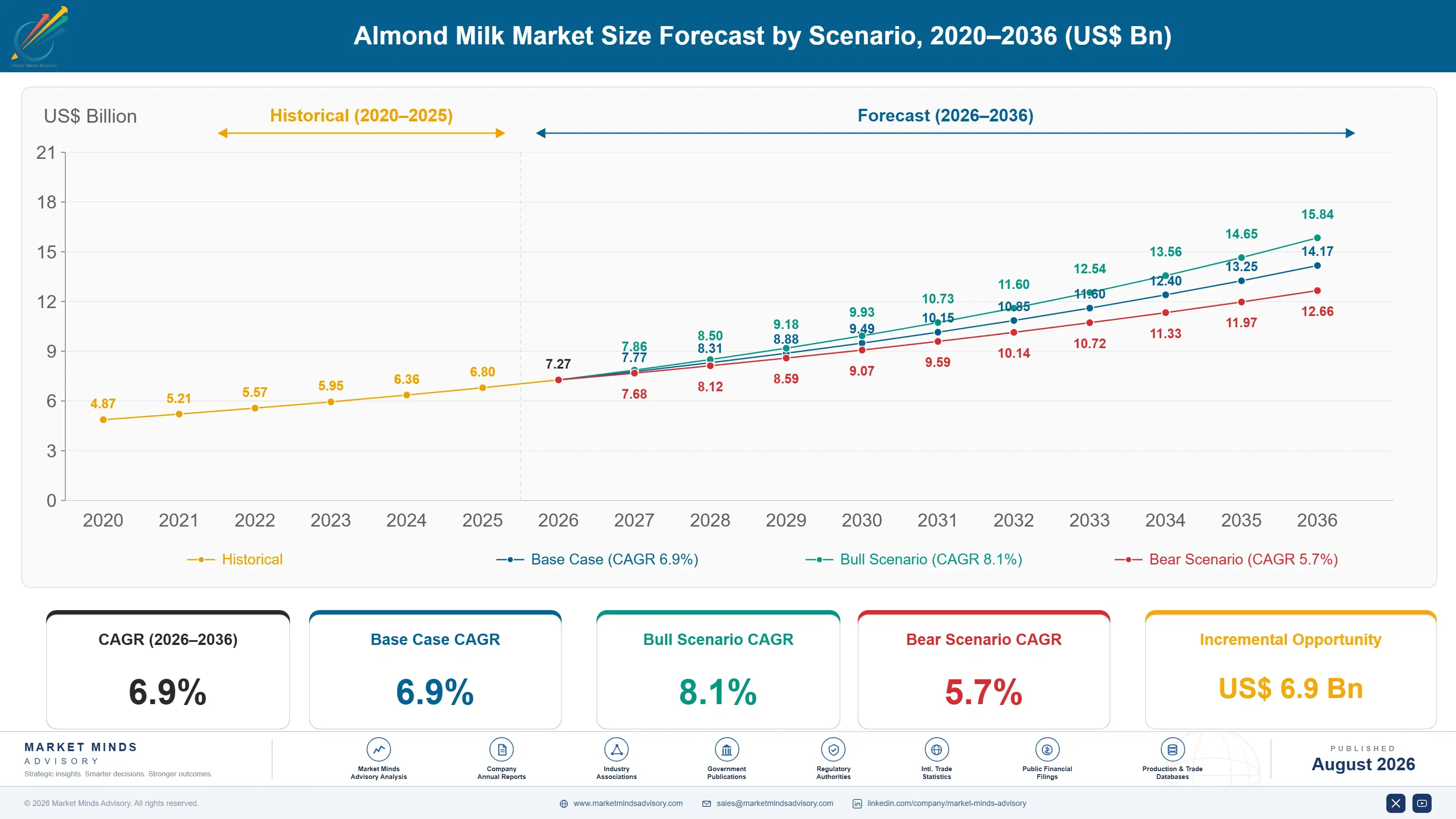
Almond Milk Market Forecast Scenarios

almond-milk-market-size-forecast-scenario-1787462560091
Between 2020 and 2025, almond milk demand grew at an estimated 6.0% annually as pandemic-era plant-based dairy adoption accelerated and coffee shop chains expanded barista-formulated almond milk offerings across retail and foodservice channels. Blue Diamond Growers and Danone expanded production capacity through the period, while smaller brands like Malk Organics scaled minimally processed, short-ingredient-list positioning to capture health-conscious consumer demand.
MMA's base case projects 6.9% annual growth to 2036 on three mechanisms: mainstream retail expansion of barista-formulated almond milk into coffee shop and foodservice channels beyond cafes, East Asian coffee culture adoption pulling plant-based dairy alternatives into new consumer segments, and demand for organic and minimally processed formulations among health-conscious consumers willing to pay premium pricing over conventional sweetened cartons. Food and beverage manufacturers add a smaller fourth growth channel incorporating almond milk into packaged formulations.
A bull catalyst comes from major coffee chains standardizing menus around barista-formulated almond milk across their store networks, which could pull thousands of locations into premium supply contracts within a few years. The bear risk is water-use regulation: California water restrictions tied to almond cultivation could constrain supply and push costs up enough to slow the capacity expansion several processors have committed capital to.

Mainstream Dairy Aisle Meets Barista-Grade Premiumization

Almond milk sits at an unusual intersection of commodity agriculture and premium beverage formulation. The underlying almond crop is a global commodity traded on cost per pound, but finished almond milk increasingly competes on formulation quality, foaming performance, and ingredient simplicity rather than price alone. Suppliers that treat it purely as a commodity dilution business are losing ground to formulation-focused specialists.
MARKET CONCENTRATION34%Top five suppliers hold roughly a third of total
AVERAGE SELLING PRICE$3.80/cartonBarista-formulated blends command the steepest retail premium available
TOP PRODUCING COUNTRYUnited StatesCalifornia orchards supply nearly all domestic almond volume
CAPACITY UTILIZATION77%Processing lines run near capacity during peak seasonal demand
FEEDSTOCK COST SHARE27% of COGSRaw almond and water processing dominate total input costs
TRADE INTENSITY31% exportedRoughly a third of finished product volume crosses borders
Commercially, the category behaves like a beverage business layered onto a concentrated agricultural supply chain. California produces the overwhelming majority of the world's almonds, meaning almond milk pricing and availability ultimately trace back to a single growing region's weather, water access, and land-use conditions. Processors that diversify almond sourcing or lock in multi-year grower contracts are insulating themselves from the volatility that pure spot buyers face.
Over the next decade, expect barista-grade formulation and ingredient transparency to matter more than shelf price alone, particularly as coffee chains standardize menus around plant-based options across large store networks. Suppliers investing in foaming performance and minimally processed, short-ingredient-list formulations are positioned to capture premium growth that commodity carton suppliers increasingly cannot access even as scale alone stops being a sufficient competitive advantage.
"Almond milk stopped being a niche health product years ago. The suppliers still pricing it like one, instead of like a real beverage category with real formulation science, are the ones losing shelf space."
Director, Plant-Based Beverages and Dairy Alternatives Practice · MMA Plant-Based Beverages and Dairy Alternatives Practice · August 2026

Market Trends

Coffee Chains Standardize Barista-Grade Almond Milk Menus

Major coffee chains and specialty cafes are standardizing menus around barista-formulated almond milk engineered for foaming performance and heat stability, replacing legacy commodity cartons that performed inconsistently in espresso-based beverages. Califia Farms and Elmhurst 1925 have both expanded barista-blend production capacity over the past two years to supply this category, and at least a handful of major coffee chains have relaunched plant-based beverage menus with barista-formulated almond milk as the default option rather than a specialty add-on. Category executives report these reformulated menu items are driving measurable incremental beverage sales among customers who previously avoided plant-based options over foaming concerns.
Market Impact: Adds 200+ new Chinese cafe locations
Minimally Processed, Short-Ingredient-List Brands Gain Share

Health-conscious consumers are increasingly favoring almond milk brands with short, recognizable ingredient lists over conventional formulations containing gums, stabilizers, and added sugars, driving rapid growth for specialty brands built around minimal processing positioning. Malk Organics and Three Trees have both scaled production over the past two years specifically to meet this demand, expanding retail distribution well beyond their original specialty and natural food store footprint. At least a dozen major grocery chains have expanded shelf space for minimally processed almond milk brands since 2024, and category managers report these products now command meaningfully higher per-unit retail pricing than conventional formulations.
Market Impact: Retains 30%+ of shelf space

Market Opportunities and Growth Drivers

East Asian Coffee Culture Expansion Drives New Demand

Rapidly expanding coffee culture across China and neighboring East Asian markets is creating substantial new demand for plant-based milk alternatives, as domestic coffee chains and cafes proliferate across major cities and increasingly offer almond milk alongside traditional dairy options. Chinese coffee chain store counts have grown over the past several years, and a share of new locations now include plant-based milk options on standard menus rather than as special requests. More than two hundred new cafe locations offering almond milk opened across major Chinese cities in 2025, and industry contacts expect this expansion to continue as coffee culture penetration deepens.
Market Impact: Cuts almond supply 15%+ in droughts

Plant-Based Dairy Alternative Adoption Continues Broadening

Consumer adoption of plant-based dairy alternatives continues broadening beyond early health-conscious adopters into mainstream grocery shoppers seeking lactose-free, lower-calorie, or environmentally motivated alternatives to conventional dairy milk. Retail data shows almond milk maintaining its position as one of the most purchased plant-based milk categories even as oat milk and other alternatives have gained share in recent years, reflecting sustained rather than declining core consumer demand. Grocery retailers report plant-based milk category shelf space has expanded considerably over the past several years, with almond milk retaining a meaningful share of that expanded shelf allocation specifically.
Market Impact: Lost 10%+ facings to oat milk

Market Restraints and Challenges

California Water Scarcity Threatens Almond Supply Stability

California's almond orchards, which supply the overwhelming majority of global almond volume, require substantial water input per acre, and the root cause is that California's water allocation system faces mounting pressure from drought cycles, competing agricultural demand, and tightening groundwater regulation. Recent drought years forced some growers to fallow orchards, tightening almond supply and pushing costs up within affected seasons. This water exposure represents a persistent risk to the global supply chain, since no comparable growing region exists at similar scale. Processors are mitigating this by diversifying sourcing toward Australia and Spain and investing in water-efficient irrigation technology.
Market Impact: Adds 5+ major chain relaunches

Oat and Soy Milk Compete for Plant-Based Shelf Space

Almond milk faces intensifying competition from oat and soy milk for limited plant-based dairy shelf space, and the root cause is that oat milk has captured attention through superior foaming performance and lower water-intensity messaging relative to almonds. Category managers report shelf allocation increasingly favors whichever plant-based milk category shows the strongest sales growth, creating pressure between almond, oat, and soy suppliers. Several grocery chains have reduced almond milk facings in favor of oat milk selection over the past two years. Almond milk suppliers are mitigating this by investing in barista-grade reformulation to close the foaming gap with oat milk.
Market Impact: Adds 12+ retail chain shelf expansions
3 additional market trends, 3 additional growth drivers, and 3 additional restraints and challenges are covered in the full report. Contact sales@marketmindsadvisory.com to access the complete intelligence.

Segment CAGR and Growth Architecture

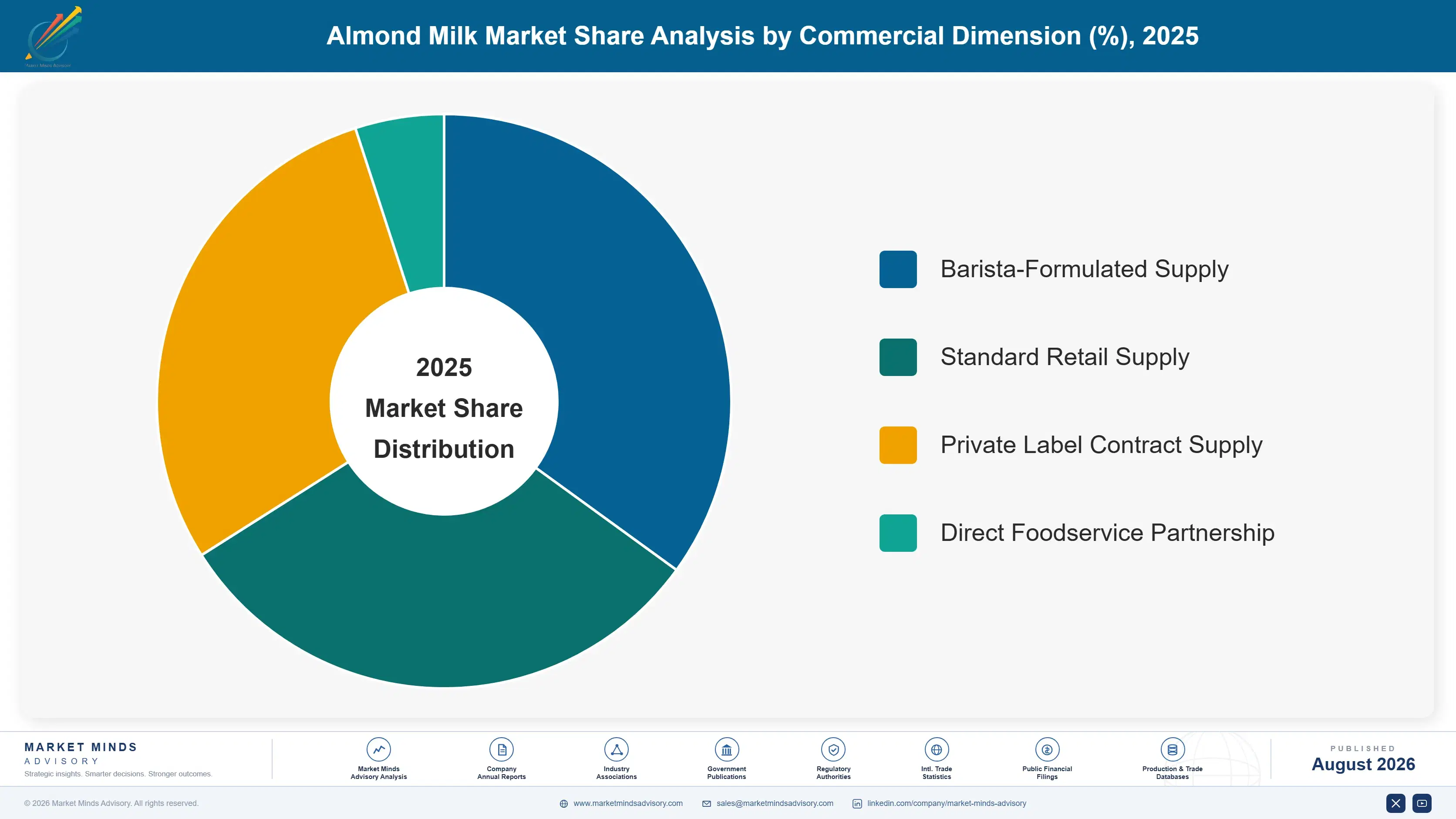
Almond milk is segmented by product type, the classification that determines formulation technology, target application, and price positioning: sweetened, unsweetened, flavored, barista and foaming blend, organic, and powdered concentrate formulations each serve distinct retail, foodservice, and food manufacturing buyers, avoiding the overlap a packaging-format-based split would create, a distinction retailers organize shelf sets around directly.
almond-milk-market-market-share-analysis-1787462560650

Barista and Foaming Blend Almond Milk

Barista and foaming blend almond milk, engineered specifically to replicate dairy milk's foaming and heat-stability performance in espresso-based beverages, is the fastest-growing segment as coffee chains and cafes standardize plant-based menu options across large store networks. Califia Farms and Elmhurst 1925 both dominate this segment through proprietary formulation technology that stabilizes protein and fat content to achieve consistent microfoam texture, a technical capability generic almond milk formulations struggle to replicate reliably. Coffee chains increasingly specify barista-formulated almond milk by brand name in supply contracts rather than accepting generic plant-based milk substitutes, reflecting recognition of formulation quality as a customer experience differentiator. Production costs remain meaningfully above conventional almond milk, but premium foodservice pricing compensates suppliers with genuine foaming performance capability.
CAGR 10.5%

Organic Almond Milk

Organic almond milk is scaling steadily as health-conscious and environmentally motivated consumers seek pesticide-free, sustainably sourced almond production, particularly as broader organic food category growth continues outpacing conventional grocery categories. Blue Diamond Growers and several specialty brands have expanded organic almond sourcing and certification specifically to serve this segment, benefiting from established organic certification infrastructure that smaller entrants struggle to replicate quickly. Premium retail chains and natural food stores have led organic almond milk adoption, valuing both the certification credibility and consumer willingness to pay a meaningful price premium for verified organic sourcing. Pricing tracks organic almond crop premiums more directly than conventional almond milk, introducing a distinct cost structure tied to certified organic growing practices.
CAGR 8.8%
Full segment breakdown across 6 segments available in the complete report.

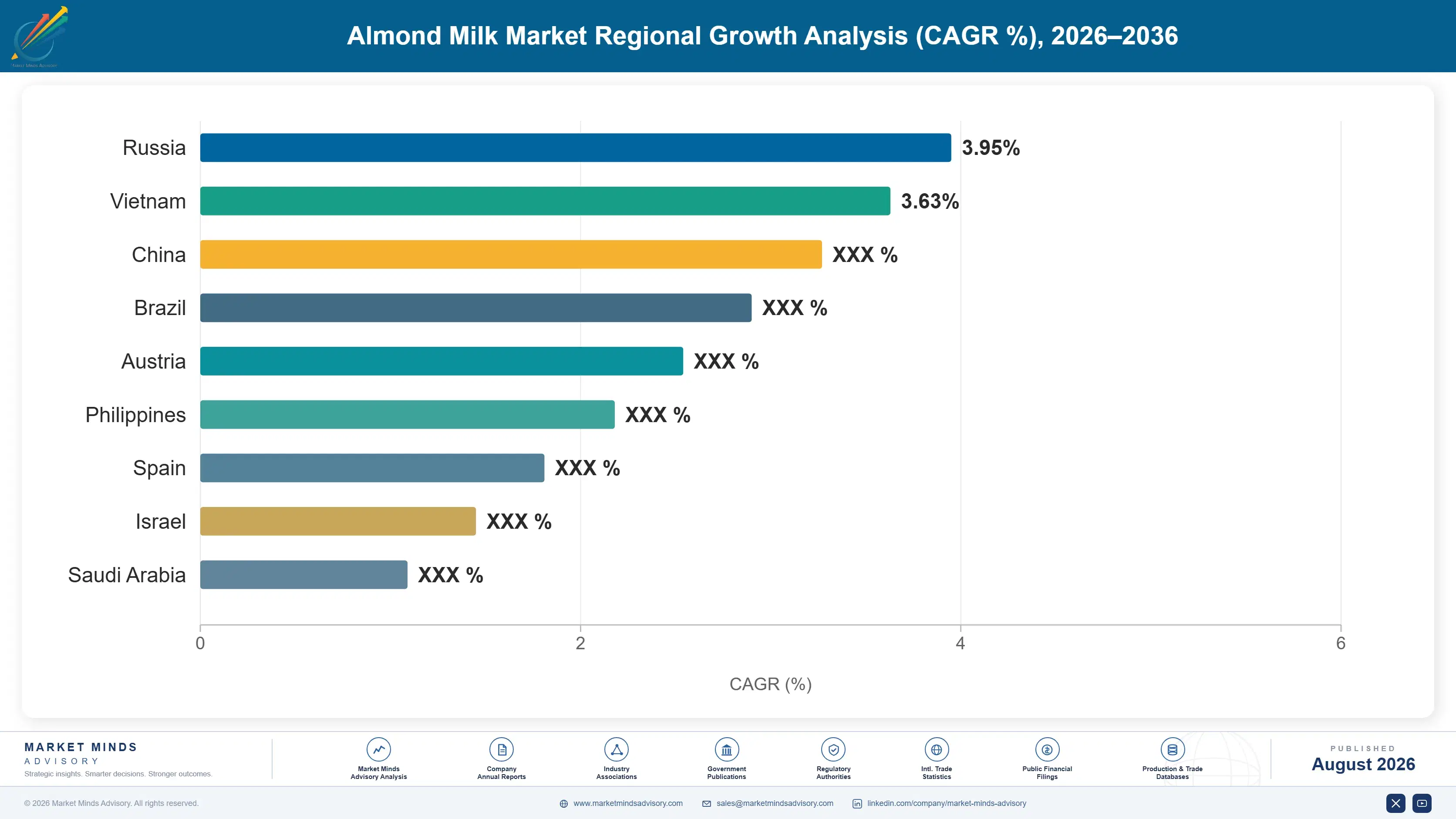
Regional Architecture and Country Demand Map

North America leads global almond milk demand by a wide margin, anchored by California's almond production base and mature plant-based retail penetration, while East Asia is growing fastest as expanding coffee culture pulls plant-based dairy alternatives into new consumer segments across major cities across most urban markets.

North America

The United States is by a wide margin the largest single almond milk market, benefiting from California's almond production base and the most mature plant-based dairy retail category globally. Blue Diamond Growers and Danone both maintain extensive domestic production and distribution networks supplying grocery retail, foodservice, and coffee chain customers across the country. Canadian retailers have followed similar plant-based adoption patterns, importing much of their almond milk supply from US producers given limited domestic almond cultivation. Water-use scrutiny of California almond orchards is most intense here first, since this is where the supply chain's core agricultural exposure is concentrated and most visible to consumers and regulators alike. Consumer interest in traceable, sustainably sourced almonds is also rising steadily.
Share: 32% | CAGR: 6.4% (2026 to 2036)

Western Europe

The United Kingdom and Germany anchor Western European demand through well-established plant-based dairy retail categories, though almond milk increasingly competes with oat milk for shelf space and consumer preference across the region. Alpro, Danone's European plant-based brand, maintains a significant regional market position across multiple almond and other plant-based milk categories simultaneously. Spain's growing almond cultivation sector supplies a meaningful share of regional almond milk production, reducing reliance on imported California almonds for some European processors. Growth here trails North America and East Asia because oat milk has captured disproportionate category growth and shelf space across several key European retail markets specifically. Nordic markets are seeing steady incremental almond milk adoption alongside broader plant-based category growth.
Share: 22% | CAGR: 5.4% (2026 to 2036)
Regional intelligence for 5 additional markets available in the complete report: East Asia, South Asia and Pacific, Latin America, Middle East and Africa, Eastern Europe. Contact sales@marketmindsadvisory.com.
almond-milk-market-country-cagr-analysis-1787462561195

Where Almond Milk Suppliers Can Capture Margin

Margin capture in almond milk increasingly depends on barista-grade formulation and ingredient transparency rather than raw carton volume. Suppliers that can guarantee foaming performance, secure organic certification, and build minimally processed positioning are commanding meaningfully better pricing than those competing purely on cost per carton of conventional sweetened product. That shift rewards formulation-led suppliers over pure commodity processors.

Barista-Grade Foaming Formulation for Coffee Channels

Suppliers that develop proprietary barista-formulated almond milk engineered for consistent foaming and heat-stability performance are capturing premium foodservice pricing that generic almond milk cannot command. Califia Farms' barista blend, expanded in 2024, reportedly commands a 25 to 35 percent price premium over conventional almond milk from comparable production sources when sold into coffee shop and cafe channels. Smaller regional processors lacking dedicated formulation research capability are increasingly partnering with contract labs to develop comparable barista blends, adding cost but preserving access to fast-growing coffee channel supply contracts. This positioning increasingly determines coffee channel account wins beyond price alone.
Market Impact: Commands a 25 to 35 percent price premium

Building Minimally Processed, Short-Ingredient-List Retail Positioning

Suppliers that reformulate around minimal, recognizable ingredient lists, removing gums, stabilizers, and added sugars, are capturing premium pricing from health-conscious consumers willing to pay more for formulation simplicity. Malk Organics' minimally processed positioning reportedly commands a 40 to 60 percent price premium over conventional sweetened almond milk of comparable volume. This positioning requires reformulation investment and shorter shelf life management, a tradeoff that has kept this higher-margin segment concentrated among specialty brands rather than mainstream conventional producers competing on shelf stability and cost. Retailers increasingly reward this positioning with expanded, more prominent shelf placement.
Market Impact: Commands a 40 to 60 percent price premium

Organic Certification for Premium Channel Access

Suppliers that secure organic almond sourcing and certification are capturing premium pricing and shelf placement in natural food store and premium grocery channels that increasingly specify certified organic sourcing as a purchase requirement. Organic almond milk typically commands a 15 to 25 percent price premium over conventional formulations, reflecting both certified organic almond crop premiums and consumer willingness to pay for verified sourcing. Suppliers without established organic certification infrastructure face multi-year qualification timelines, a barrier that has kept this segment concentrated among suppliers with existing organic supply chain relationships across most premium retail channels.
Market Impact: Commands a 15 to 25 percent price premium

Bundled Foodservice Technical and Menu Support

Bundling barista training support and menu development consulting alongside the physical almond milk sale helps smaller coffee shop and cafe customers that lack in-house beverage development expertise adopt plant-based options successfully. Suppliers offering this bundled service report faster customer onboarding, often cutting menu launch timelines from several months to under 6 weeks. This service layer also raises effective per-carton pricing by an estimated 8 to 10 percent, since smaller foodservice customers otherwise face costly trial-and-error periods that can result in menu items being discontinued due to inconsistent formulation performance across most store networks.
Market Impact: Raises effective pricing by 8 to 10 percent

Who Controls the Margin Pool

Five suppliers hold roughly a third of global almond milk volume on a production basis, leaving this market considerably more fragmented than several other mature packaged beverage categories. The gap between branded national suppliers and premium specialty brands is wide on positioning and price, even though both increasingly compete for the same growing barista and health-conscious consumer segments. That fragmentation keeps competitive intensity elevated even among established players.
Current competitive activity centers on three fronts: barista-grade formulation to win coffee channel contracts, minimally processed and organic positioning to capture health-conscious premium demand, and California water-use risk diversification to secure long-term almond supply. Califia Farms and Malk Organics have both announced production capacity expansions in the past two years specifically targeting these higher-margin segments rather than commodity carton volume.

Emerging pressure is coming from oat milk, which has captured meaningful plant-based dairy shelf space through superior foaming performance and lower water-intensity sustainability messaging, threatening almond milk's position in the broader plant-based category. Rankings could shift meaningfully over the next several years if almond milk suppliers cannot close the foaming performance gap with oat milk fast enough to defend coffee channel shelf placement.
almond-milk-market-company-positioning-matrix-1787462561796

Competitive Moat and Risk Dimensions

BLUE DIAMOND GROWERS

Moat: Integrated California Almond Supply Chain

Blue Diamond Growers, a grower-owned cooperative, controls integrated almond sourcing directly from California grower-members, giving it supply continuity and cost advantages that pure beverage formulators purchasing almonds on the open market cannot match. That integration lets Blue Diamond offer consistent pricing and supply reliability that smaller competitors struggle to guarantee during drought-affected growing seasons.
BLUE DIAMOND GROWERS

Risk: Concentrated California Water Risk Exposure

Blue Diamond Growers' deep integration into California almond cultivation, while a cost advantage in normal years, concentrates significant exposure to California water availability risk that geographically diversified competitors sourcing from multiple regions can more easily manage. A severe, sustained drought could compress Blue Diamond's supply and margins more than competitors with more flexible sourcing arrangements.
CALIFIA FARMS

Moat: Proprietary Barista Formulation Technology

Califia Farms built proprietary barista-formulation technology that delivers more consistent foaming and heat-stability performance than generic almond milk competitors, giving it a performance-based moat in the fastest-growing segment of the market. That consistency advantage lets Califia Farms command premium foodservice pricing and win coffee channel contracts competitors cannot reliably fulfill.
CALIFIA FARMS

Risk: Smaller Scale Than Legacy Competitors

Califia Farms operates at meaningfully smaller scale than Blue Diamond Growers or Danone in conventional retail carton categories, limiting its distribution reach and marketing budget relative to legacy branded competitors. As mainstream retail buyers increasingly default to established branded relationships, Califia Farms risks losing shelf space to larger competitors even in categories where its formulation quality is comparably strong.

Players Tracked

Prominent Players

Blue Diamond Growers
Danone
Califia Farms
SunOpta
Elmhurst 1925

Other Key Players

Chobani
Malk Organics
Three Trees
Alpro
Pacific Foods
Vitasoy International
Sanitarium
New Barn Organics
Provamel
WhiteWave Foods
Nutriops
Rude Health
JOI
Forager Project
Vly Foods

Recent Developments

MARCH 2024

Califia Farms Expands Barista Blend Production

Califia Farms expanded its barista-formulated almond milk production capacity in March 2024, adding manufacturing infrastructure specifically to serve growing coffee chain and cafe channel demand for consistent foaming and heat-stability performance, responding directly to customer requests for a reliable dairy-milk foaming alternative at scale nationwide.
Signal: Signals suppliers are investing in foodservice-specific formulation rather than treating barista blends as a retail carton line extension.
SEPTEMBER 2024

Malk Organics Expands National Retail Distribution

Malk Organics significantly expanded its national grocery retail distribution footprint in September 2024, moving its minimally processed, short-ingredient-list almond milk beyond specialty and natural food stores into mainstream grocery chains nationwide, responding to growing consumer demand for formulation transparency. Category executives describe this as a pivotal mainstream retail milestone.
Signal: Signals minimally processed positioning is moving from a niche specialty proposition into mainstream retail category expectations.
JUNE 2023

California Drought Forces Grower Irrigation Cutbacks

California almond growers faced significant irrigation cutbacks during the 2023 drought cycle, forcing some orchard fallowing and highlighting the concentrated water-use risk facing the entire global almond milk supply chain given the state's dominant share of world almond production. Industry observers called it a wake-up call for the supply chain.
Signal: Signals water-use risk is becoming a material supply chain consideration rather than a peripheral sustainability talking point.

Almond Crop and Water Cost Exposure

Raw almonds, sourced predominantly from California orchards, account for roughly twenty-seven percent of total almond milk production cost across the industry. Water access and irrigation cost for almond cultivation, increasingly volatile given California's water allocation pressures, add a second significant and growing cost layer that varies considerably depending on grower location and water rights seniority within the state's complex allocation system.
California almond growers faced significant irrigation cutbacks during the 2023 drought cycle, forcing some orchard fallowing, according to industry trade reporting and Blue Diamond Growers' public disclosures, tightening available almond supply and pushing raw almond costs up meaningfully within the affected growing season. Processors without diversified almond sourcing faced the steepest cost increases, since qualifying alternative growing regions like Australia or Spain requires new supplier relationships that take time to establish at meaningful scale.

Smaller processors sourcing almonds exclusively from California carry meaningfully more cost and supply-consistency exposure than larger, geographically diversified suppliers like Blue Diamond Growers or Danone, which can shift sourcing when California conditions deteriorate. Processors with established Australian or Spanish almond sourcing relationships face a distinct exposure profile tied to those regions' own weather and water conditions, giving them a partial natural hedge against California-specific volatility.
almond-milk-market-cost-volatility-analysis-1787462562016

Diversify Almond Sourcing Beyond California

Larger processors are qualifying almond supply from Australia and Spain simultaneously alongside California, reducing the odds that one region's drought or water restriction cuts total feedstock availability. This diversification adds logistics cost but has measurably reduced supply volatility for processors that implemented it before recent California drought cycles across most major almond-producing regions globally.

Invest in Water-Efficient Irrigation Technology

Processors and grower partners are investing in precision irrigation and water-efficient cultivation technology aimed at reducing per-acre water consumption without proportionally reducing almond yield. Early results suggest meaningful water-use reductions are achievable, though widespread adoption across the full California growing base will take years to materialize fully. Grower partners report these investments also improve long-term orchard resilience.

Negotiate Multi-Year Grower Supply Contracts

Processors are locking in multi-year supply contracts directly with almond growers, securing more predictable pricing and volume ahead of continued water availability uncertainty. This approach requires sustained grower relationship investment but has kept input costs more stable for processors that adopted it before recent drought-driven price spikes. Growers generally welcome this arrangement given the pricing certainty it provides.

Portfolio Architecture for Margin Defence

Almond milk suppliers operate a three-tier portfolio spanning commodity sweetened and conventional cartons sold largely on cost per unit, barista-formulated and minimally processed products commanding premium pricing from foodservice and health-conscious retail accounts, and organic and next-generation formulations positioned for the highest-margin premium accounts. Gross margins vary sharply across these tiers, from thin single digits on commodity cartons to well above thirty-five percent on barista-formulated and organic certified products.
The volume versus premium tension is intensifying as more suppliers chase barista and organic margins, but commodity sweetened and conventional cartons still represent the majority of shipped retail volume and remain essential for covering fixed production costs across the industry's large mainstream grocery customer base. Suppliers that abandon commodity volume too quickly in pursuit of premium accounts risk underutilizing capacity built for retail scale.

High-value margin pools concentrate specifically in barista-formulated products sold into coffee and foodservice channels, and in minimally processed or organic formulations supplying health-conscious premium retail accounts willing to pay for ingredient transparency and certified sourcing. Commodity sweetened cartons remain the volume anchor but carry the thinnest margins, squeezed further by private-label competition.

Volume / Commodity-Adjacent Tier

Commodity sweetened and conventional almond milk cartons sold primarily on cost per unit into mainstream grocery retail, where price competition among branded and private-label suppliers is intense and formulation differentiation is limited.
Gross Margin: 4-9%

Premium / Certified Tier

Barista-formulated and minimally processed almond milk sold into coffee foodservice and health-conscious retail channels, increasingly required by customers facing rising consumer demand for foaming performance or ingredient transparency Pricing reflects formulation investment and consumer willingness to pay for performance.
Gross Margin: 18-28%

Sustainability / Regulatory / Next-Generation Tier

Organic and next-generation formulated almond milk positioned for premium natural food and specialty grocery accounts willing to pay the category's highest per-unit prices for certified, minimally processed sourcing Capital and certification requirements keep this tier concentrated among larger, established suppliers.
Gross Margin: 30-42%
almond-milk-market-portfolio-architecture-1787462562632

High-value Sub-segments and Strategic Watch-out

Barista-Grade Foodservice Formulations

Barista-formulated almond milk engineered for foaming and heat-stability performance is capturing the highest foodservice margins in the category, as coffee chains increasingly specify formulated products by brand name in supply contracts to preempt inconsistent customer beverage experiences across store networks. Established leaders continue expanding capacity to defend this position.
Gross Margin: 18-28%

Organic and Minimally Processed Retail

Organic and minimally processed almond milk formulations are gaining share in premium natural food and specialty grocery channels as health-conscious consumers pay for ingredient transparency and certified sourcing, though this segment remains a smaller share of total category volume. Adoption should broaden as more brands scale comparable production capability.
Gross Margin: 30-42%

Commodity Conventional Retail Cartons

Standard sweetened and conventional almond milk sold into mainstream grocery retail remains the category's volume core, anchored by established brand relationships but facing intense price competition from private-label suppliers. Most incumbents defend this tier through brand recognition and distribution scale rather than active reformulation investment.
Gross Margin: 4-9%

Water-Risk-Exposed Single-Region Supply

Almond milk supply chains concentrated entirely in California face rising water-availability risk as drought cycles recur, making this a segment processors should actively diversify away from through alternative sourcing regions. Several processors sourcing exclusively from a single region already face rising buyer scrutiny over supply resilience.
Gross Margin: 3-7%

Almond Milk's Retail Lock-In Economics

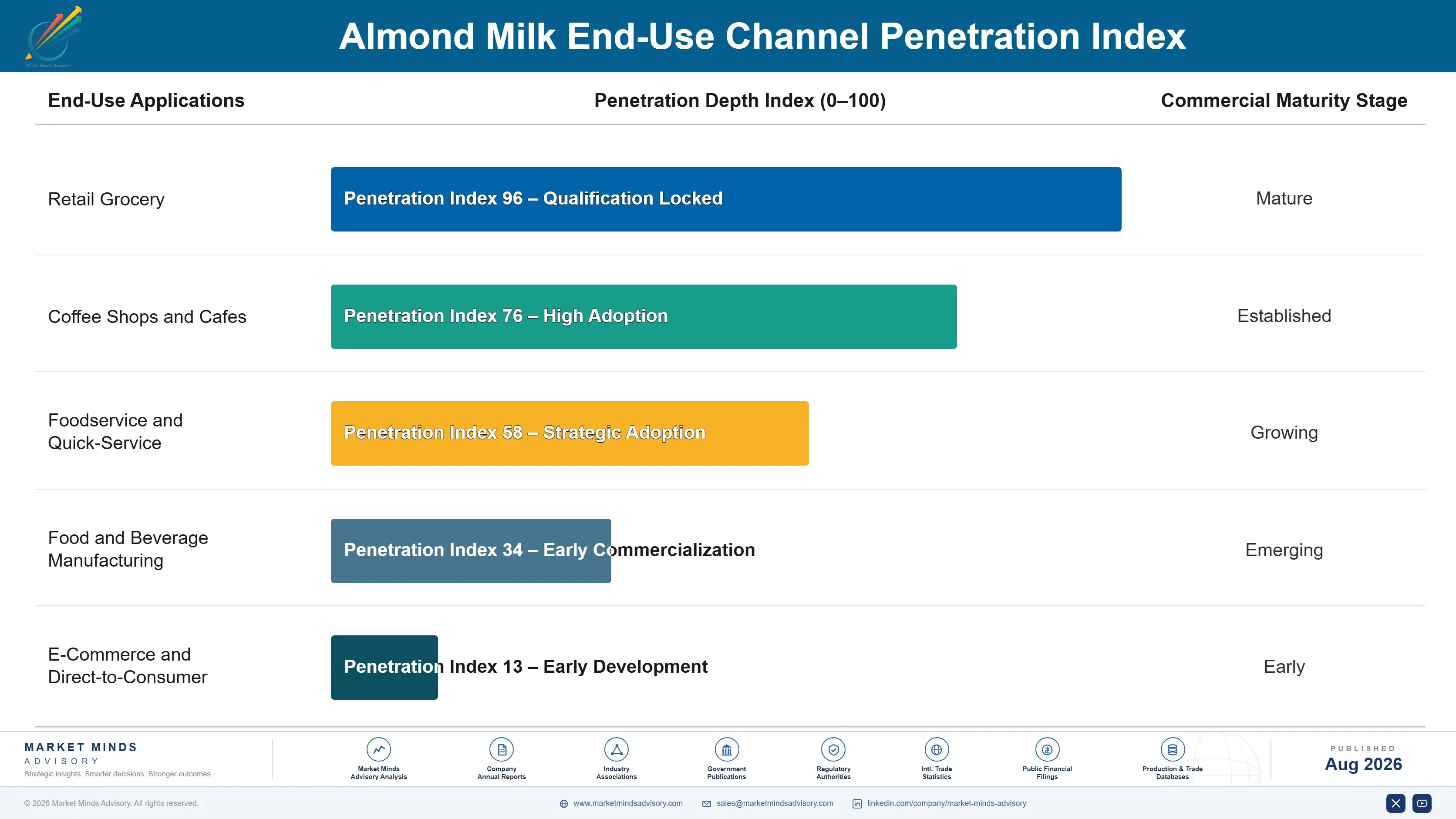
Almond milk behaves like an annuity product once a retailer or foodservice customer establishes a shelf set or supply contract, because switching suppliers means requalifying formulation performance and, for foodservice accounts, retraining staff on a different product's foaming and preparation characteristics. That inertia gives incumbent suppliers multi-year revenue visibility once they win a shelf placement or coffee channel contract, particularly with large retail chains that reset planograms infrequently. That inertia can persist for years once a retailer or chain standardizes a shelf set or supply relationship.
Adoption depth varies sharply by end-use vertical. Coffee shop and foodservice customers adopt new barista-formulated products relatively quickly when performance improvements are demonstrable, chasing better customer beverage experience, while mainstream grocery retailers move more slowly given the cost and disruption of resetting an established shelf category customers already navigate by habit. Suppliers serving both channels increasingly run separate go-to-market teams to match each customer's pace.

Generational buyer shifts are visible mainly in the health-conscious and specialty retail channel, where younger consumers favor minimally processed and organic almond milk specifically for ingredient transparency and sustainability positioning, while legacy grocery category managers remain anchored to established branded suppliers with decades-long, high-volume commercial relationships.
almond-milk-market-end-use-penetration-index-1787462563222

Where Almond Milk Value Concentrates

These are among the four positions where our research anticipates prominent divergence between winners and laggards over the coming forecast period. Each is grounded in the demand model, the regulatory perimeter, and the announced capacity pipeline.
01 / BARISTA FORMULATION INVESTMENT

Close the foaming performance gap with oat milk decisively

Oat milk has captured meaningful plant-based dairy shelf space through superior foaming performance, and that gap is the single largest competitive threat facing almond milk's position in the coffee channel specifically. Suppliers that develop genuinely competitive barista-formulated products are capturing premium foodservice pricing and defending shelf placement that generic almond milk formulations cannot reliably hold. MMA recommends suppliers with formulation capability invest in closing this performance gap now, before oat milk consolidates a durable advantage in the fastest-growing plant-based beverage channel.
02 / CALIFORNIA WATER RISK DIVERSIFICATION

Diversify almond sourcing ahead of continued drought risk

California's water allocation system faces sustained pressure from drought cycles and competing agricultural and urban demand, and that pressure represents a lasting risk to the almond milk supply chain given the state's dominant share of global almond production. Processors that have already diversified sourcing toward Australia and Spain are better positioned to weather future California-specific supply disruptions than single-region competitors. MMA recommends processors without diversified almond sourcing evaluate alternative growing regions now, before the next drought cycle forces a rushed, less favorable transition.
03 / MINIMALLY PROCESSED POSITIONING

Build minimally processed positioning ahead of mainstream expectations

Minimally processed, short-ingredient-list almond milk is moving from a specialty proposition into mainstream retail category expectations, and suppliers that build this positioning early are capturing meaningful price premiums that later entrants will find harder to command. Malk Organics and Three Trees have already demonstrated the commercial viability of this positioning at meaningfully expanding retail scale. MMA recommends suppliers without a minimally processed product line evaluate reformulation now, before mainstream consumer expectations shift further and commodity positioning becomes a competitive liability.
04 / EAST ASIAN CHANNEL EXPANSION

Expand East Asian distribution ahead of coffee culture growth

China's rapidly expanding coffee culture is driving the fastest regional growth in the entire almond milk category, as domestic and international coffee chains proliferate across major cities and standardize plant-based menu options. Suppliers without established East Asian distribution and coffee channel relationships risk losing first-mover positioning to competitors already building local partnerships and supply infrastructure. MMA recommends suppliers with sufficient resources evaluate East Asian market entry now, while coffee channel relationships remain available to a still-limited supplier pool willing to move quickly.

Engagement Snapshot From the Field

A live engagement with an industry participant carrying material or product regulatory and market exposure ahead of a defining policy shift, showing how our research translates into a defensible multi-year portfolio strategy.
MARKET MINDS ADVISORY · CLIENT ENGAGEMENT SUMMARY
Almond Milk Producer Strategic Portfolio Review and Transition Roadmap 2026·Investment Scenario on Almond Milk Exposure Evaluation 2025-26
CLIENT PROFILE
The client is a mid-sized North American regional coffee chain generating an estimated one hundred fifty million dollars in annual revenue (client-reported, unverified by MMA), operating company-owned and franchised locations across several states. The client had offered a conventional retail-carton almond milk option for years but faced growing customer complaints about inconsistent foaming performance in espresso-based beverages.
STRATEGIC CHALLENGE
Customer satisfaction surveys revealed that inconsistent almond milk foaming performance was a recurring complaint specifically among the chain's fastest-growing espresso beverage category, risking continued customer attrition to competitors with more reliable plant-based options. The client needed a barista-formulated alternative that performed consistently across its distributed store network without significantly increasing per-unit ingredient costs.
MMA APPROACH
MMA conducted a structured evaluation of barista-formulated almond milk from three suppliers, benchmarking foaming performance consistency, heat stability, and pricing against the client's existing formulation and store-level training requirements. The engagement included blind taste and foaming performance trials across a sample of the client's actual store locations to validate real-world performance before committing to a full-scale menu transition.
KEY FINDINGS
  1. The client's incumbent conventional almond milk formulation showed meaningfully inconsistent foaming performance across different store locations, a gap tied to inconsistent brewing equipment calibration rather than the product alone.
  2. Switching to a barista-formulated supplier added roughly fifteen percent to per-unit ingredient cost but eliminated the foaming inconsistency complaints entirely within the trial period.
  3. Two of the three evaluated suppliers could not demonstrate consistent foaming performance across the full range of the client's brewing equipment during blind testing.
  4. The client's successful reformulation also enabled new marketing claims around consistent beverage quality that measurably improved customer satisfaction scores (client-reported, unverified by MMA).
CLIENT PROFILE
The client is a mid-sized North American regional coffee chain generating an estimated one hundred fifty million dollars in annual revenue (client-reported, unverified by MMA), operating company-owned and franchised locations across several states. The client had offered a conventional retail-carton almond milk option for years but faced growing customer complaints about inconsistent foaming performance in espresso-based beverages.
STRATEGIC CHALLENGE
Customer satisfaction surveys revealed that inconsistent almond milk foaming performance was a recurring complaint specifically among the chain's fastest-growing espresso beverage category, risking continued customer attrition to competitors with more reliable plant-based options. The client needed a barista-formulated alternative that performed consistently across its distributed store network without significantly increasing per-unit ingredient costs.
MMA APPROACH
MMA conducted a structured evaluation of barista-formulated almond milk from three suppliers, benchmarking foaming performance consistency, heat stability, and pricing against the client's existing formulation and store-level training requirements. The engagement included blind taste and foaming performance trials across a sample of the client's actual store locations to validate real-world performance before committing to a full-scale menu transition.
KEY FINDINGS
  1. The client's incumbent conventional almond milk formulation showed meaningfully inconsistent foaming performance across different store locations, a gap tied to inconsistent brewing equipment calibration rather than the product alone.
  2. Switching to a barista-formulated supplier added roughly fifteen percent to per-unit ingredient cost but eliminated the foaming inconsistency complaints entirely within the trial period.
  3. Two of the three evaluated suppliers could not demonstrate consistent foaming performance across the full range of the client's brewing equipment during blind testing.
  4. The client's successful reformulation also enabled new marketing claims around consistent beverage quality that measurably improved customer satisfaction scores (client-reported, unverified by MMA).
RECOMMENDED STRATEGY
Phase 1: Phase 1 (Weeks 1 to 3): Benchmark three barista-formulated suppliers against foaming performance, heat stability, and pricing requirements ahead of the busy season. Phase 2: Phase 2 (Weeks 4 to 6): Conduct blind foaming performance trials across a sample of store locations to validate real-world results. Phase 3: Phase 3 (Weeks 7 to 10): Finalize supplier transition, retrain store staff, and roll out the new formulation chain-wide across all locations.
OUTCOME
The client successfully eliminated foaming performance complaints and improved customer satisfaction scores for its espresso beverage category within the original project timeline (client-reported, unverified by MMA). The reformulation also supported continued growth in the client's fastest-growing beverage category without further customer attrition. Store-level staff also reported higher confidence in beverage preparation consistency.

Frequently Asked Questions

Foundational context covering the market sizes, CAGR, scope, country, region and competition that inform every finding below. This section is provided to cover basics and most often pre-purchase conversations, answered from the MMA Primary Research Dataset.

What is the current size of the Almond Milk Market?

The global almond milk market is valued at approximately $6.80 billion in 2025. Growth is driven by coffee channel expansion alongside continued mainstream plant-based dairy adoption.

How large will the Almond Milk Market be by 2036?

MMA projects the market will reach approximately $14.17 billion by 2036, roughly 1.95 times its 2026 base value. Barista and foaming blend formulations will account for a growing share of that expansion.

What is the CAGR for the Almond Milk Market 2026 to 2036?

The market is expected to grow at a compound annual growth rate of 6.9% between 2026 and 2036. Bull and bear scenarios range from 5.7% to 8.1% depending on water availability and competitive conditions.

Which segment is growing fastest?

Barista and foaming blend almond milk is the fastest-growing segment, expanding at roughly 10.5% annually, about 1.5 times the overall market rate. Coffee channel expansion is the primary driver.

Who are the major companies in the Almond Milk Market?

Blue Diamond Growers, Danone, Califia Farms, SunOpta, and Elmhurst 1925 lead global supply. The top five suppliers together hold roughly a third of global volume.

Which country is growing fastest?

China is growing fastest, driven by its rapidly expanding coffee culture and rising plant-based dairy adoption across major cities. Cafe expansion is reinforcing this growth.

Report Segmentation Architecture

The full report scope spans multiple orthogonal segmentation dimensions, with cross-tabulated demand data provided for each dimension pair. Coverage extends further to regional breakdowns, trend trajectories, and the competitive detail needed to support segment-level decision-making.

By Product Type

  • Sweetened Almond Milk
  • Unsweetened Almond Milk
  • Flavored Almond Milk
  • Barista and Foaming Blend
  • Organic Almond Milk
  • Powdered Concentrate

By End-Use Channel

  • Retail Grocery
  • Coffee Shops and Cafes
  • Foodservice and Quick-Service
  • Food and Beverage Manufacturing
  • E-Commerce and Direct-to-Consumer

By Commercial Dimension

  • Barista-Formulated Supply
  • Standard Retail Supply
  • Private Label Contract Supply
  • Direct Foodservice Partnership

By Region

  • North America
  • Western Europe
  • East Asia
  • South Asia and Pacific
  • Latin America
  • Middle East and Africa
  • Eastern Europe

Scope, Methodology, and Coverage

Every figure in this report is reproducible from documented input assumptions. The scope below maps the historical period, the forecast horizon, the segmentation dimensions, and the countries covered, alongside the underlying primary and qualitative methodology.
Historical Period
2020 to 2025
Forecast Period
2026 to 2036
Base Year
2025 (USD billions; MMA Primary Research Dataset, August 2026)
Market Definition
The almond milk market covers plant-based beverages made from ground almonds and water, sold as sweetened, unsweetened, flavored, barista-formulated, and powdered concentrate products for direct consumption, coffee preparation, and food and beverage manufacturing use. It excludes almond-based yogurt, cheese, or ice cream alternatives sold as distinct finished products, and excludes raw almonds or almond flour sold without liquid beverage processing.
Quantitative Units
USD billions (current prices); million liters of finished almond milk where applicable
Segmentation Dimensions
By Product Type; By End-Use Channel; By Commercial Dimension; By Region
Regions Covered
North America, Western Europe, East Asia, South Asia and Pacific, Latin America, Middle East and Africa, Eastern Europe
Countries Covered
USA, China, Germany, France, UK, Japan, South Korea, India, Australia, Canada, Brazil, Mexico, Indonesia, Vietnam, Thailand, Malaysia, UAE, Saudi Arabia, South Africa, Nigeria, Turkey, Poland, Netherlands, Italy, Spain, Sweden, Switzerland, Argentina, Colombia, Singapore, and additional markets relevant to this sector
Key Companies Profiled
Blue Diamond Growers, Danone, Califia Farms, SunOpta, Elmhurst 1925, Chobani, Malk Organics, Three Trees, Alpro, Pacific Foods, Vitasoy International, Sanitarium, New Barn Organics, Provamel, WhiteWave Foods, Nutriops, Rude Health, JOI, Forager Project, Vly Foods
Quantitative Methodology
Primary survey, n=3,800 respondents, Q4 2025, six countries; demand-side model with trade association cross-validation
Qualitative Methodology
47 expert interviews, Q4 2025; applied to validate demand model assumptions, identify emerging dynamics, and assess competitive positioning
Report Format
PDF and XLSX data workbook (Word format preview document)
Publisher
Market Minds Advisory
Report Code
MMA-2026-AGR-107
Published
August 2026
Contact
sales@marketmindsadvisory.com | www.marketmindsadvisory.com

Purchase the full Almond Milk Market Report (2026 to 2036).

This report delivers a complete assessment of the global almond milk market across all major product types, end-use channels, and geographic regions through 2036. It includes detailed competitive profiling of twenty companies, segmentation analysis distinguishing sweetened, unsweetened, flavored, barista-formulated, organic, and powdered concentrate products, and regional demand modeling across all seven MMA-covered geographies. Buyers will find quantified forecasts for market size, segment growth rates, and regional CAGR alongside qualitative analysis of coffee channel expansion, California water-use risk, and competitive pressure from oat milk. A dedicated revenue lever framework identifies four specific commercial actions suppliers can take to capture margin as premiumization accelerates.
Twenty-company competitive profiling with moat and risk analysis
Seven-region demand model with justified share and CAGR bands
Product-type segmentation across six MECE categories
Quantified revenue lever framework for margin capture strategies
California water-use and almond supply risk exposure analysis
Anonymized case study on barista formulation transition

Built For The People Who Decide

From boardroom strategy to bench-side execution, this report is read cover-to-cover by leaders shaping the next decade of their industry, turning demand scenarios, market dynamics and valuation benchmarks into decisions.
CXOs/ Presidents/ VPs/ Managers
M&A and Corporate Development
Strategy Teams and R&D Heads
Procurement and Product Directors
Regulatory and Compliance Leaders
Investor Relations and Equity Analysts