Market Minds Advisory
Almond Ingredients Market

Almond Ingredients Market: Plant-Based Protein Expansion and Water Footprint Economics

Plant-based dairy and protein reformulation is pulling almond ingredient demand toward higher-margin protein isolates even as California drought risk and water allocation policy threaten the supply base underpinning most global processing capacity today.

Lead Analyst

Lisa Gevelber

Published

September 2026

Make Smarter Decisions with Customized Research Insights

Request a free sample report and evaluate market opportunities, growth trends, and competitive dynamics relevant to your business needs.

2025 MARKET VALUE$8.4BMarket Size 2025
2036 FORECAST VALUE$18.4BBase Case , 2026 to 2036
CAGR 2026 TO 20367.4 %Bull 8.6% / Bear 6.2%
INCREMENTAL OPPORTUNITY$9.4BNet 10- year value creation
EXPANSION MULTIPLE2.04x2036 value over 2026 base
Strategic Levers
M&A Pipeline
Regional Outlook
Country Rankings
Competitive Intelligence
Segmental Deep-dive
Call-Us : 91 93563 13602

Executive Snapshot and Market Trajectory

Plant-based dairy and protein reformulation is pulling almond ingredient demand toward higher-margin protein isolates, even as almond milk base, the category's original growth driver, faces slowing volume growth as oat and pea alternatives capture a growing share of retail shelf space. Buyers now weigh water footprint alongside taste and cost.
Almond protein isolate now drives the fastest volume growth as formulators seek allergen-friendlier plant protein sources, while almond milk base still represents the largest single segment by tonnage given its established position across retail dairy-alternative categories. North America anchors both almond production and ingredient processing capacity, tied closely to California's dominant global growing position. Almond flour adds a further fast-growing demand pool as gluten-free and low-carbohydrate baking trends spread across multiple regions.
Blue Diamond Growers and Olam Food Ingredients dominate through integrated orchard-to-ingredient processing scale that smaller regional formulators cannot easily match on cost or supply reliability. California water allocation policy and rising plant-based protein reformulation demand are the two forces most likely to reshape supply and demand allocation across the next decade specifically. Regional processors are also expanding diversified sourcing rapidly to reduce single-region dependence.
Market Definition
The almond ingredients market covers commercial production and sale of processed almond-derived ingredients, including almond milk base, flour, butter, protein isolate, oil, and whole or sliced inclusions, used across food and beverage, bakery, snack, and cosmetic applications. It excludes whole raw almonds sold as a standalone retail snack product and finished consumer products that merely incorporate almond ingredients as one component.
Base Year Value
$8.4B in 2025 (MMA Primary Research Dataset, August 2026)
Forecast Period
2026 to 2036, eleven discrete annual values
CAGR
7.4% base case. Bull 8.6%. Bear 6.2%.
Fastest Growth Segment
Almond Protein Isolate: 11.2% CAGR
Fastest Growth Country
India: 9.5% CAGR
Fastest Growth Region
South Asia and Pacific: 9.4% CAGR
Largest Region
North America: 32% of 2025 global value
Market Leaders
Blue Diamond Growers, Olam Food Ingredients, SunOpta Inc., Borges International Group, The Wonderful Company. Source: MMA Analysis based on company annual reports.
Primary Survey
n=3,800 procurement and R&D decision-makers, Q4 2025, six countries
Methodology
Demand-side build-up, cross-validated against public data, 47 expert interviews

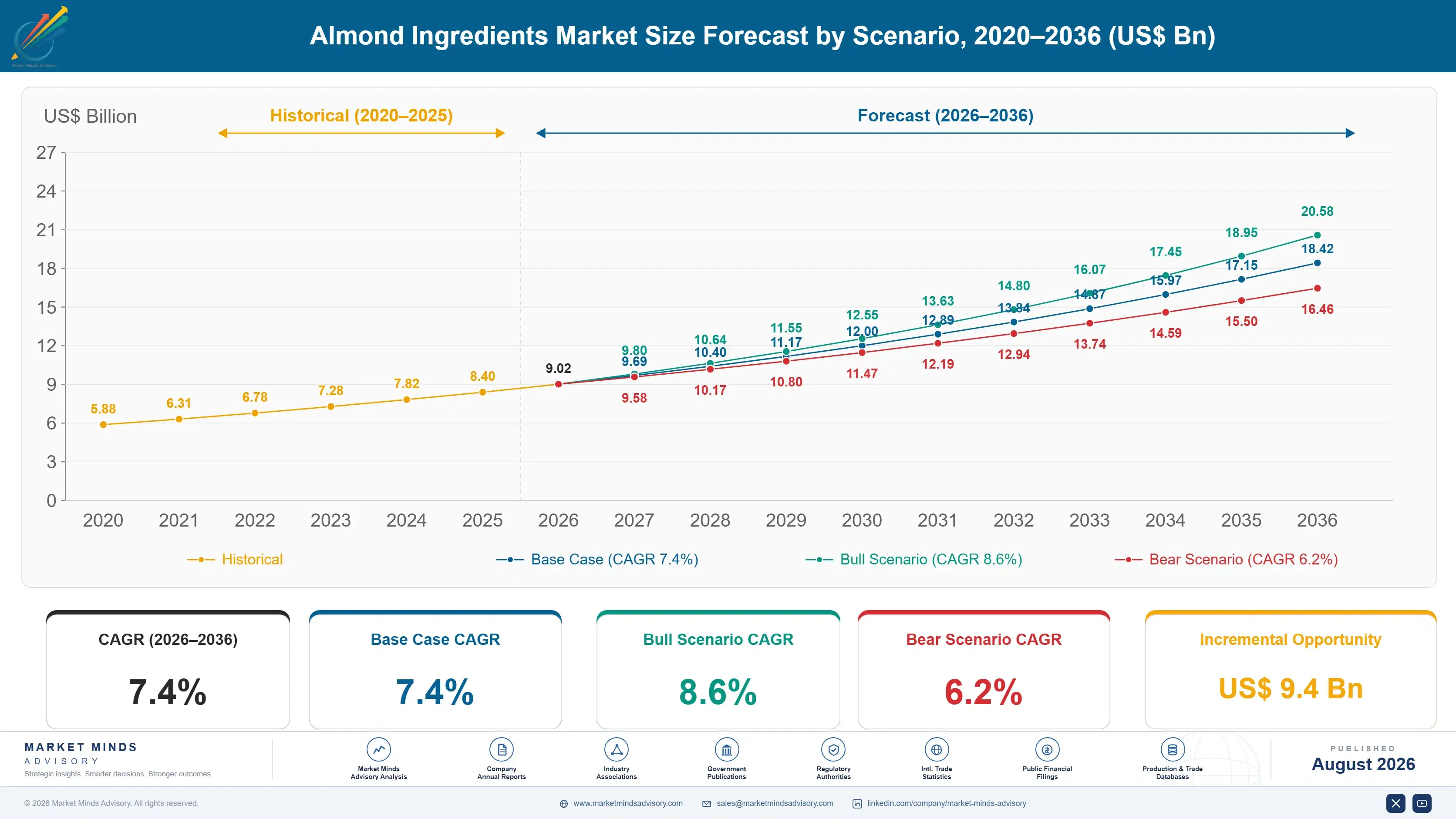
Almond Ingredients Market Forecast Scenarios

almond-ingredients-market-2024-2034-trends-size-forecast-scenario-1787461410090
Between 2020 and 2025 the market grew at a somewhat slower pace than the current forecast implies, as pandemic-era supply chain disruption and California drought conditions temporarily constrained processing volume, before both supply and plant-based demand recovered and accelerated through the latter half of the historical period specifically. Processors serving both segments benefited from relatively stable long-term contract structures during this window.
The base case through 2036 rests on three mechanisms: continued plant-based dairy and protein reformulation sustaining almond milk and protein isolate demand growth, expanding gluten-free and low-carbohydrate baking trends supporting almond flour volume across North America and Western Europe, and rising snack and bakery inclusion demand as almond pieces substitute for costlier tree nut alternatives in packaged food formulations. None of these mechanisms depends on a single weather event, supporting the base case holding under most plausible scenarios for supply.
The bull case turns on plant-based protein reformulation accelerating faster than currently expected across additional food categories, pulling almond isolate demand well above current base case assumptions. The bear risk is sustained California water restriction that constrains orchard acreage and processing capacity, tightening supply enough to slow the volume growth that underpins much of the projected category expansion.

Plant-Based Reformulation and Water Footprint Dynamics

Two forces are reshaping almond ingredients at once: plant-based dairy and protein reformulation pulling demand toward higher-margin isolates, and California water policy constraining the supply base nearly the entire category depends on. Each pulls the market in a somewhat different direction, splitting demand growth from a supply base that is not expanding at anywhere near the same pace. Processors slow to recognize this split risk losing relevance in both directions.
MARKET CONCENTRATIONCR5 34%reflects a fairly fragmented global processing base overall
AVERAGE SELLING PRICE$3.80/kgprotein isolate commands a substantial premium over milk base
TOP PRODUCING COUNTRY SHAREUSA 76%reflects California's dominant global almond growing position overall
CAPACITY UTILIZATION81%processing lines running near their practical seasonal ceiling
WATER COGS SHARE22%irrigation and water allocation costs weigh heavily on production
TRADE INTENSITY58%share of global production moving across national export borders
Commercially, almond ingredient supply behaves like a specialty agricultural relationship rather than a pure commodity trade. Buyers contract processing capacity a season or more in advance, qualify suppliers against consistent particle size and protein purity specifications, and premium protein isolate pricing has held even through periods of raw almond cost relief, evidence that formulation demand is now the primary price driver. Buyers treat validated supply security as a reliability signal.
The next decade will be shaped by how California water allocation policy evolves under sustained drought pressure, whether plant-based protein reformulation continues expanding beyond dairy alternatives into broader food categories, and how fast alternative growing regions in Australia and Spain can scale to offset any California supply constraint. How retailers respond to sustainability pressure will also shape economics.
"Every almond ingredient roadmap now has a line item for water risk. That never used to be true a decade ago, and now it drives half the capital planning conversation."
Director, Plant-Based Ingredients Practice · MMA Agricultural Ingredients & Plant-Based Nutrition Practice · August 2026

Market Trends

Plant-Based Protein Formulators Shift Toward Almond Isolate

Food and beverage formulators increasingly specify almond protein isolate over soy and pea alternatives for products targeting consumers seeking allergen-friendlier or less commonly used plant protein sources, a positioning that has gained traction as soy and pea protein saturate retail shelf space. Blue Diamond Growers and Olam Food Ingredients have both expanded protein isolate production capacity over recent years specifically targeting this demand, and several major plant-based beverage brands have publicly disclosed reformulation roadmaps incorporating almond protein blends. This has pulled premium pricing for protein-grade ingredients further away from standard milk-base pricing than in the past decade.
Market Impact: Adds 175 million dollars flour demand
California Water Policy Constrains Orchard Expansion

California's Sustainable Groundwater Management Act has tightened water allocation for almond orchards considerably over the past several years, forcing growers to reduce planted acreage or shift toward more water-efficient irrigation technology rather than expanding supply to match rising ingredient demand. The California Department of Water Resources has documented steady reductions in groundwater allocation across the Central Valley, directly constraining the supply base nearly the entire global almond ingredients category depends on for raw material. This has made water availability, not processing capacity, the primary constraint on category supply growth specifically.
Market Impact: Adds 120 million dollars demand

Market Opportunities and Growth Drivers

Gluten-Free and Low-Carbohydrate Baking Trends Expand

Rising consumer adoption of gluten-free and low-carbohydrate diets across North America and Western Europe continues to expand almond flour demand considerably, as bakers and packaged food manufacturers substitute almond flour for wheat flour in bread, crackers, and baked snack products. The US Food and Drug Administration's continued gluten-free labeling framework has supported steady category growth by giving manufacturers a clear regulatory path for product claims. This demand carries meaningfully better margins for processors supplying food-grade flour specifications than standard commodity almond sales, since bakery customers pay for consistent particle size and moisture content.
Market Impact: Cuts supply growth to 1 percent

Plant-Based Dairy Alternative Category Continues Expanding

Retail plant-based dairy alternative sales have continued growing across North America and Western Europe even as growth decelerates from earlier peak rates, with almond milk maintaining a meaningful share of shelf space despite competition from oat and pea-based alternatives gaining ground. Several major retailers have expanded private-label plant-based dairy lines considerably over the past several years, sustaining volume demand for almond milk base even as the category matures beyond its earlier rapid growth phase. Several major grocery chains have also expanded almond creamer and yogurt alternative lines, offsetting slower fluid milk-alternative growth.
Market Impact: Cuts milk share by 8 points

Market Restraints and Challenges

California Water Scarcity Threatens Long-Term Supply Growth

Almond orchards require substantially more water per acre than most competing California crops, making the category a frequent target for water allocation restrictions during drought periods when state and local water agencies must ration limited supply across competing agricultural uses. The root cause is that California's almond acreage expanded rapidly during a period of relatively favorable water availability that has not persisted, leaving growers now managing a supply base sized for conditions that no longer reliably exist. Processors are mitigating this through drip irrigation investment and diversified sourcing toward Australian and Spanish growing regions.
Market Impact: Adds 340 million dollars demand

Oat and Pea Alternatives Compete for Retail Shelf Space

Oat milk and pea protein have both captured meaningful retail shelf space from almond-based alternatives in recent years, since oat milk requires substantially less water to produce and pea protein carries a lower allergen profile that appeals to a broader consumer base than tree nut derivatives. Several major plant-based beverage brands have shifted marketing emphasis toward oat-based formulations specifically, citing sustainability positioning as a key differentiator against almond's water-intensive production profile. Almond ingredient producers are mitigating this through targeted marketing emphasizing taste and nutritional profile advantages that oat alternatives cannot match as directly.
Market Impact: Limits acreage growth to 1
3 additional market trends, 3 additional growth drivers, and 4 additional restraints and challenges are covered in the full report. Contact sales@marketmindsadvisory.com to access the complete intelligence.

Segment CAGR and Growth Architecture

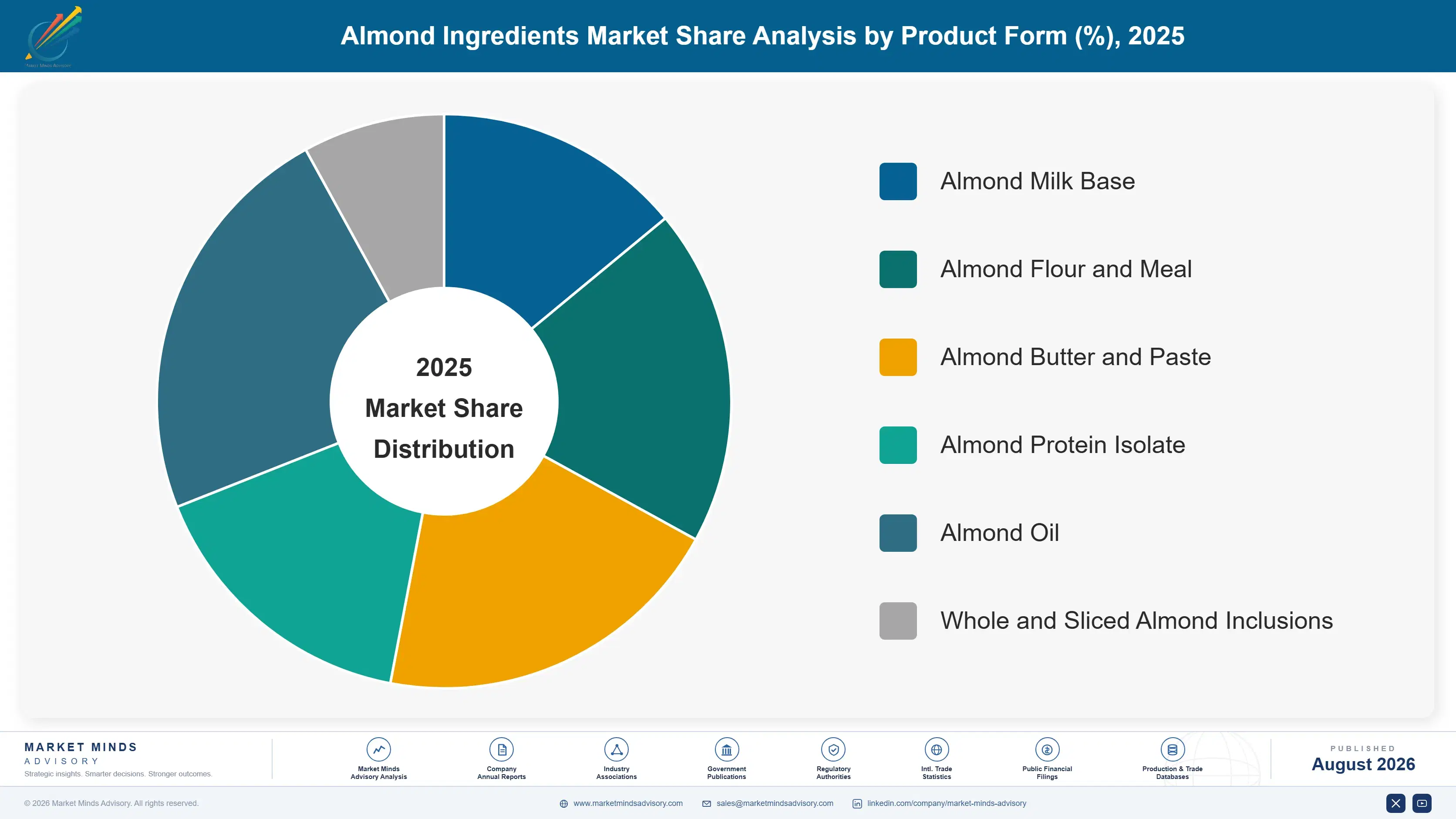
Almond ingredients are segmented here by product form rather than by end-use application, distribution channel, formulation grade, or the underlying growing region, since milk base, flour, butter, protein isolate, oil, and whole inclusions each require quite distinct processing infrastructure and face separate buyer qualification cycles that shape demand largely independently of one another today.
almond-ingredients-market-2024-2034-trends-market-share-analysis-1787461411083

Almond Protein Isolate

This segment is growing fastest as plant-based formulators across North America and Western Europe increasingly specify almond protein isolate over saturated soy and pea alternatives for products targeting consumers seeking a differentiated or allergen-friendlier plant protein source. Blue Diamond Growers and Olam Food Ingredients have both expanded dedicated protein isolate processing capacity considerably over the past several years to meet this rising demand across multiple beverage and bar categories. Pricing has held up considerably better than the broader almond ingredient category average, since protein-grade specifications require additional processing investment that commodity milk-base producers have not made. Contract cycles here run longer than in most segments, since formulators value consistent purity enough to commit to dedicated partnerships.
CAGR 11.2%

Almond Milk Base

This segment remains the largest by tonnage even as growth decelerates from earlier peak rates, since almond milk maintains meaningful established retail shelf space despite competition from oat and pea-based dairy alternatives gaining ground across major grocery chains. SunOpta and Borges International dominate supply, benefiting from integrated processing scale that smaller regional formulators lack entirely. This segment faces the most direct competitive pressure of any almond ingredient category, since oat milk's lower water footprint gives sustainability-focused retailers and consumers a genuine alternative narrative that almond producers must actively counter through marketing and reformulation investment across their broader product portfolios consistently. Producers here are increasingly investing in taste and nutrition-focused marketing to defend this position over the coming years.
CAGR 9.6%
Full segment breakdown across 6 segments available in the complete report.

Regional Architecture and Country Demand Map

North America and East Asia together account for over half of global almond ingredient demand, reflecting California's dominant production base and China's large consumer market, while South Asia and Pacific posts the fastest regional growth on expanding retail health food adoption nationwide across the region.

North America

California's Central Valley produces the overwhelming majority of the world's commercial almond supply, giving North America both the largest processing capacity and the largest single demand market for almond ingredients across bakery, beverage, and snack applications. Plant-based dairy and protein reformulation continues driving steady demand growth across the United States and Canada, even as oat and pea alternatives compete for retail shelf space. Water allocation policy under California's Sustainable Groundwater Management Act remains the single most significant long-term supply risk facing processors and growers throughout the region. The region hosts the vast majority of global almond processing infrastructure through Blue Diamond Growers and other integrated cooperatives. Mexico contributes further demand tied to its own growing packaged food sector.
Share: 32% | CAGR: 7.9% (2026 to 2036)

Western Europe

Germany, France, and the United Kingdom account for the bulk of regional almond ingredient demand, concentrated in bakery, plant-based dairy, and confectionery applications tied to the region's mature packaged food manufacturing base. Spain contributes meaningful domestic almond production capacity, positioning the region with somewhat more supply diversification than markets reliant purely on California imports. Gluten-free and low-carbohydrate baking trends have driven particularly strong almond flour adoption across the region's retail bakery sector. Import dependence on California supply remains substantial despite Spanish production, since domestic capacity has not scaled to match the region's growing ingredient demand. Cosmetic manufacturers across the region add a smaller specialty demand channel too. Belgium adds smaller specialty ingredient trading activity supporting regional flows.
Share: 20% | CAGR: 5.9% (2026 to 2036)
Regional intelligence for 5 additional markets available in the complete report: East Asia, South Asia and Pacific, Latin America, Middle East and Africa, Eastern Europe. Contact sales@marketmindsadvisory.com.
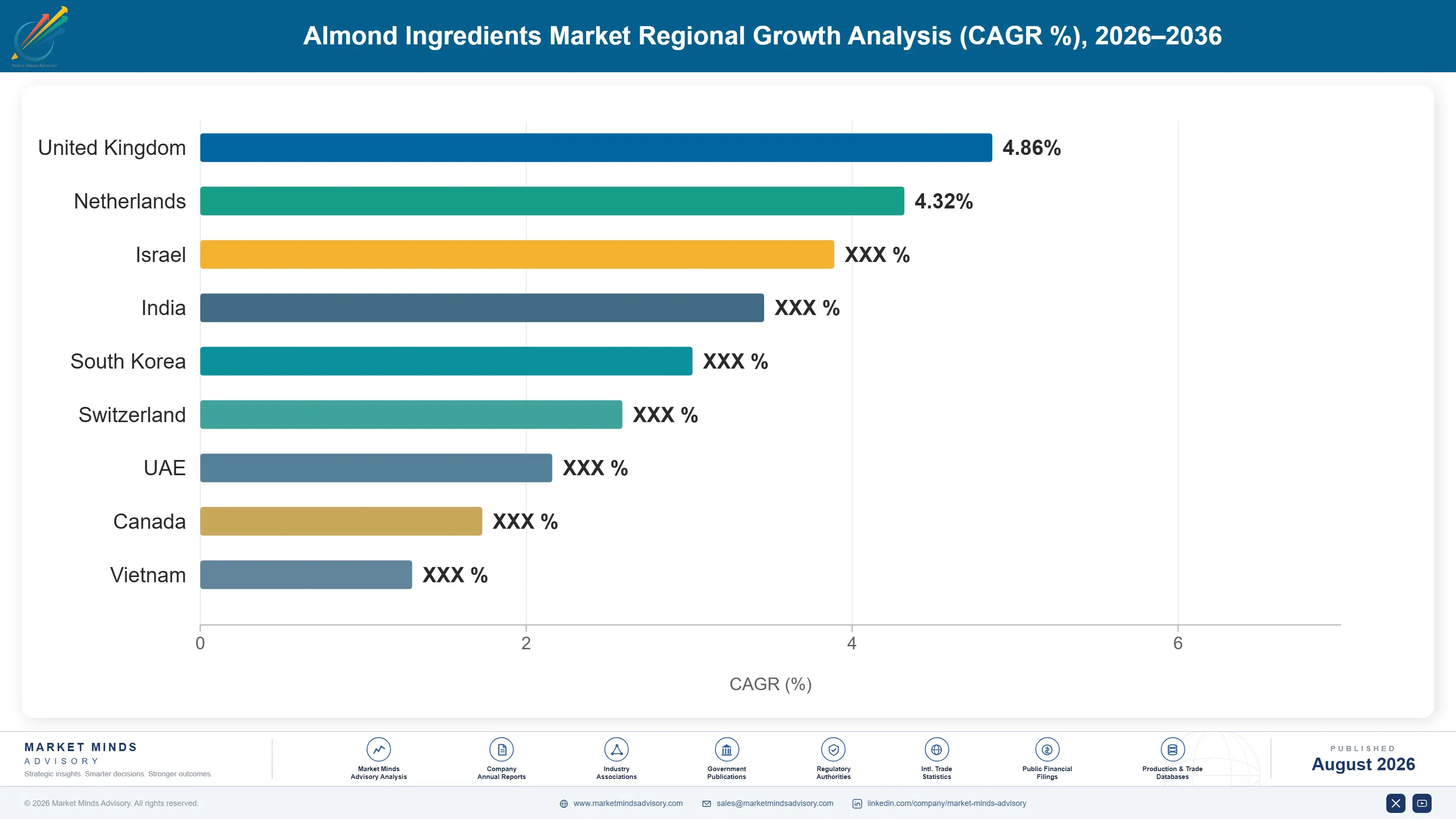
almond-ingredients-market-2024-2034-trends-country-cagr-analysis-1787461411992

Where Almond Ingredient Producers Can Capture Margin

Producers can lift margin capture by shifting mix toward protein isolate serving plant-based formulators, diversifying growing regions beyond California to manage water supply risk, and building direct relationships with bakery and beverage manufacturers seeking reliable long-term ingredient supply. Investing in certified water-efficient sourcing further strengthens positioning with sustainability-focused retail and manufacturer accounts more consistently.

Protein Isolate Production Mix Shift Strategy

Producers who shift processing capacity toward protein isolate capture meaningfully better margins than those still concentrated in commodity milk base, since formulators seeking differentiated plant protein sources are often willing to pay a premium of 20 to 28 percent for validated purity specifications. Blue Diamond Growers and Olam Food Ingredients, which made this shift earliest, now command pricing consistently above producers still weighted toward milk-base processing. The capital investment in isolate processing capability is significant, but the payback period has compressed as plant-based reformulation continues expanding across additional beverage and bar categories.
Market Impact: Lifts blended margin by 20 to 28 percentage points

Growing Region Diversification and Sourcing Strategy

Producers who establish or expand sourcing relationships with Australian and Spanish growers reduce their exposure to California water allocation risk that increasingly threatens supply reliability for processors dependent on a single growing region. Several producers have gained an estimated 6 to 9 percentage points of supply security improvement over the past several years through this diversification approach. Building alternative growing region relationships and quality validation takes 2 to 3 years before this lever meaningfully reduces single-region dependence across a producer's broader supply base. Producers pursuing this path expect meaningfully improved resilience against any single region's weather disruption over time.
Market Impact: Adds 6 to 9 percentage points of supply security

Direct Bakery and Beverage Manufacturer Contracts

Locking multi-year supply agreements directly with large bakery and plant-based beverage manufacturers trades some spot-market upside for guaranteed volume and dramatically reduced customer acquisition cost, an arrangement manufacturers increasingly prefer too given water-related supply security concerns following recent California drought years. Producers with such agreements report considerably lower customer churn than those selling primarily through distributor channels, and the visibility supports more confident processing capacity planning 3 to 5 years ahead of anticipated demand. Producers pursuing this approach report the strongest long-term account visibility across their entire customer base. This compounds in value the longer a relationship lasts.
Market Impact: Cuts customer churn by roughly 17 percentage points

Water-Efficient Certification and Processing Investment Strategy

Producers who invest in drip irrigation efficiency and pursue third-party water stewardship certification capture goodwill and pricing advantage from sustainability-focused retailers and manufacturers increasingly scrutinizing almond's water footprint relative to oat and pea alternatives. Early adopters of certified water-efficient sourcing report volume gains of 10 to 14 percent among sustainability-conscious retail accounts within 18 months of certification. This lever requires meaningful upfront irrigation infrastructure investment that smaller growers sometimes struggle to finance without processor support. This approach captures accounts competitors focused purely on cost would otherwise never reach. Producers here build durable trust with sustainability-minded buyers.
Market Impact: Adds 10 to 14 percent volume among certified accounts

Who Controls the Margin Pool

The market sits at moderate concentration, with the top five producers controlling thirty-four percent of global processing capacity on a production basis. Blue Diamond Growers and Olam Food Ingredients lead by a meaningful margin over the next tier of challengers, both benefiting from integrated orchard-to-ingredient processing scale that smaller regional formulators cannot easily replicate on cost or supply reliability grounds. Regional challengers largely compete on price rather than validated supply security credentials.
Current competitive activity centers on three fronts: shifting production mix toward protein isolate serving plant-based formulators, diversifying growing regions beyond California to manage water supply risk, and building direct manufacturer relationships that lock in long-term volume. Australian and Spanish growers are also expanding capacity to compete for supply diversification-focused customers. These fronts increasingly determine which processors retain their most valuable customer accounts.

Emerging pressure comes from Australian almond producers who have scaled orchard capacity considerably faster than expected in response to California water constraints, and from oat and pea-based alternative producers targeting the same plant-based dairy shelf space almond milk has historically occupied. Rankings could shift meaningfully if California water restrictions tighten further before alternative growing regions scale sufficiently to offset any resulting supply constraint.
almond-ingredients-market-2024-2034-trends-company-positioning-matrix-1787461412921

Competitive Moat and Risk Dimensions

BLUE DIAMOND GROWERS

Moat: Grower cooperative supply integration

Blue Diamond's cooperative structure gives it direct integration with a large share of California almond growers, providing supply security and cost visibility that competitors relying purely on open-market almond purchasing cannot easily replicate, particularly during periods of tight regional supply. This integration advantage becomes especially valuable during periods of tight regional supply and water uncertainty.
BLUE DIAMOND GROWERS

Risk: Concentrated California supply exposure

Blue Diamond's cooperative model concentrates its supply base heavily in California, leaving it more exposed than geographically diversified competitors to the water allocation risk that increasingly threatens the region's long-term almond production capacity. This exposure is already visible in the company's sourcing flexibility relative to diversified rivals.
OLAM FOOD INGREDIENTS

Moat: Global sourcing and processing network

Olam Food Ingredients operates almond processing and sourcing relationships across California, Australia, and Spain simultaneously, giving it a geographic diversification advantage that single-region competitors cannot match when water risk or weather disruption affects any one growing area specifically. This diversification advantage becomes especially valuable as water risk grows across California specifically.
OLAM FOOD INGREDIENTS

Risk: Complexity managing a global network

Olam's geographically diverse sourcing network requires managing quality consistency and logistics across multiple regions with different growing conditions, a complexity that can slow response time relative to more geographically focused competitors. Investors have begun watching this complexity closely as a factor shaping future margin trajectory.

Players Tracked

Prominent Players

Blue Diamond Growers
Olam Food Ingredients
SunOpta Inc.
Borges International Group
The Wonderful Company

Other Key Players

Select Harvests Limited
John B. Sanfilippo and Son
Hain Celestial Group
TreeHouse Foods
Diana Food
South Valley Almond Company
Meridian Foods
Ingredion Incorporated
Archer-Daniels-Midland
Campos Brothers Farms
Harris Woolf Almonds
Stewart and Jasper Orchards
Nutiva Inc
Kerry Group
Wawona Frozen Foods

Recent Developments

APRIL 2025

Blue Diamond Growers expands protein isolate capacity

Blue Diamond Growers commissioned an expansion of protein isolate production capacity at one of its California facilities, aimed at meeting growing demand from plant-based beverage manufacturers seeking differentiated protein sources. The expansion followed years of order growth from formulators reformulating away from saturated soy and pea alternatives.
Signal: Signals incumbents investing ahead of confirmed long-term isolate demand growth across every major plant-based beverage category worldwide
SEPTEMBER 2024

Olam Food Ingredients expands Australian sourcing partnerships

Olam Food Ingredients announced expanded sourcing partnerships with Australian almond growers to diversify supply beyond California amid ongoing water allocation uncertainty. The agreement followed several years of California drought conditions that had periodically constrained processing volume for the company. Several Australian growers have signed initial multi-year agreements already.
Signal: Confirms producers actively diversifying away from California supply risk as water risk reshapes sourcing strategy industry-wide
JANUARY 2026

SunOpta commissions new almond milk processing line

SunOpta brought online a new almond milk base processing line at one of its North American facilities, materially increasing capacity to serve retail private-label plant-based dairy customers. The expansion followed continued growth in private-label plant-based dairy demand across major grocery retailers. Regional retailers welcomed the added domestic capacity.
Signal: Signals milk base demand remains resilient despite oat competition even as oat-based competitors continue gaining broader market attention

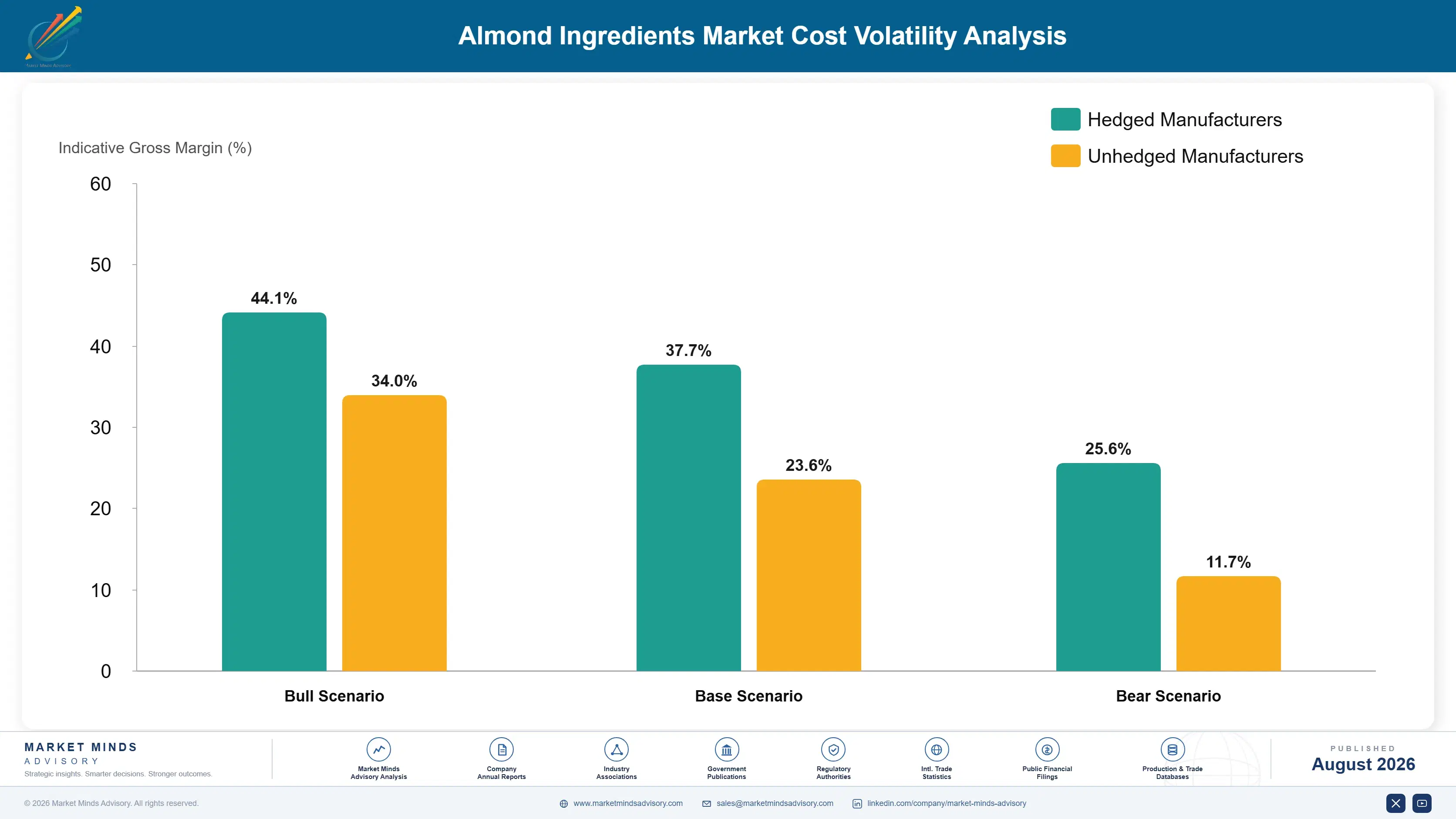
Water Allocation and Orchard Land Cost Exposure

Water allocation and irrigation costs, together with orchard land lease or ownership costs, account for roughly forty-eight percent of production cost of goods sold for California-based almond processors. Labor costs for harvesting and initial processing add a further meaningful input, particularly during peak harvest season when demand for seasonal agricultural labor is highest. Packaging and transportation costs add a smaller but meaningful further input for most processors.
Water costs spiked sharply in 2022 following the severe California drought documented in the US Bureau of Reclamation's Central Valley Project operations reports, pushing irrigation costs for almond growers up by an estimated thirty percent within a single season before partially easing through 2023 and 2024 as rainfall improved. Several mid-tier growers reported margin compression during this period severe enough to fallow a portion of their planted acreage.

Cost exposure varies considerably by grower scale and water rights seniority. Large integrated growers with senior water rights, including those within Blue Diamond's cooperative network, absorb drought-driven cost spikes more easily than smaller independent growers reliant on junior water allocations. Geographically, Australian and Spanish growers face different climate risk profiles entirely, giving processors sourcing from multiple regions meaningfully better diversification against any single water crisis.
almond-ingredients-market-2024-2034-trends-cost-volatility-analysis-1787461413233

Drip Irrigation Efficiency Investment Programs

Growers are investing considerably in drip irrigation and soil moisture monitoring technology that reduces total water consumption per acre without sacrificing yield, a direct hedge against future water allocation restrictions. Adoption has concentrated among larger operations able to justify the upfront capital investment required for full-scale conversion. Several buyers now cite this efficiency as a factor when evaluating suppliers.

Multi-Region Sourcing Diversification Strategy

Processors are increasingly diversifying sourcing across California, Australia, and Spain to reduce dependence on any single region's water availability or weather conditions, trading some logistics complexity for meaningfully improved supply security during regional drought events specifically. Producers pursuing this path report meaningfully improved resilience against single-region weather disruption over time. This has already reduced exposure during recent drought years.

Water Rights and Allocation Advocacy Engagement

Grower cooperatives and industry associations are engaging more actively with state water regulators to advocate for allocation frameworks that balance agricultural water needs against competing municipal and environmental demands, seeking greater predictability for long-term orchard investment planning. Industry groups continue engaging regulators to secure greater predictability for long-term orchard investment decisions. Predictable frameworks would support future orchard investment decisions.

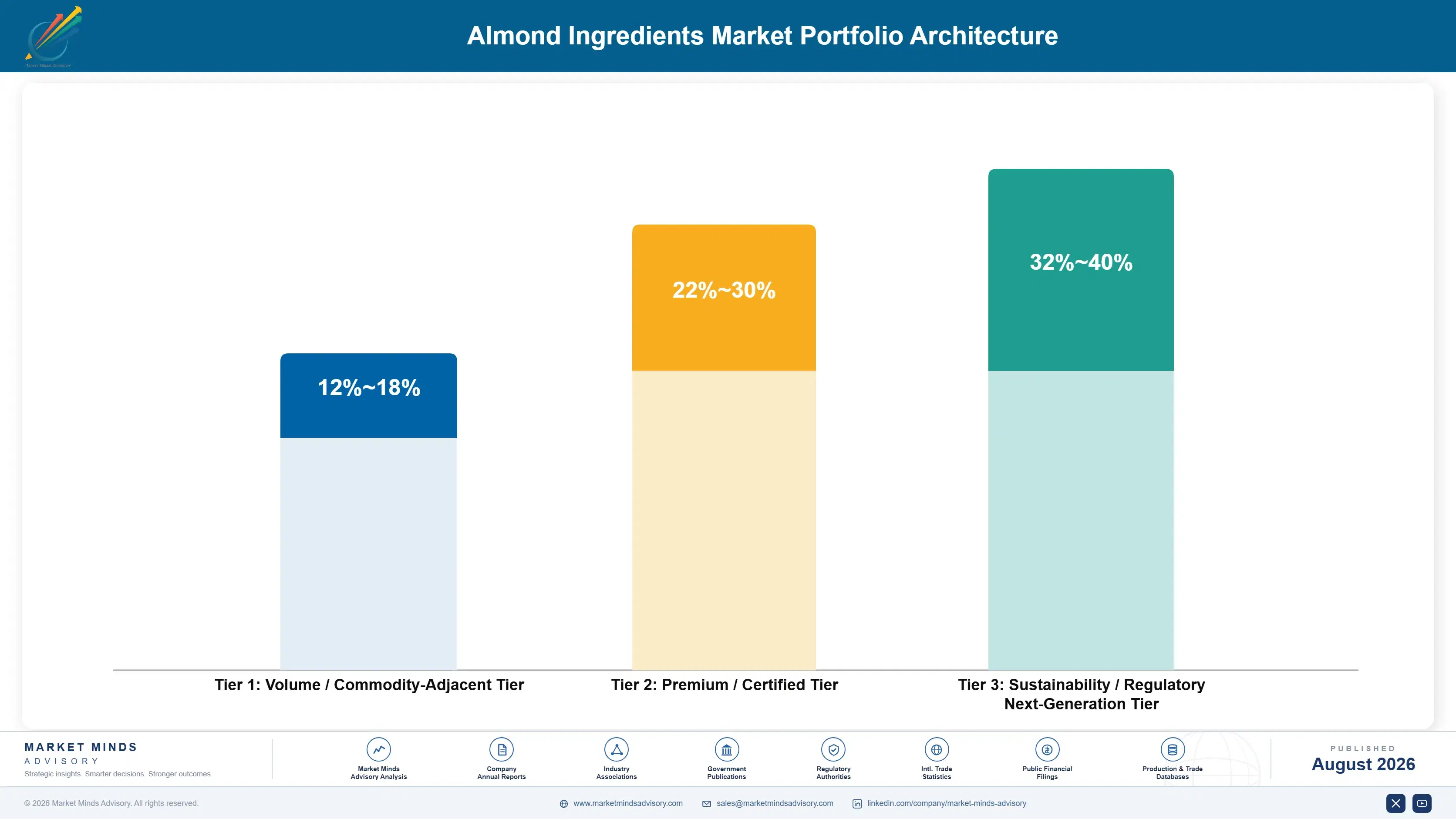
Portfolio Architecture for Margin Defence

The portfolio splits into three tiers with distinct margin economics. Volume commodity-adjacent milk base and whole inclusions compete largely on price against oat and pea alternatives, premium flour and butter formulations command a durable pricing advantage tied to bakery-grade consistency, and a smaller next-generation tier built on protein isolate sits above both on a per-unit margin basis. This means margin depends more on mix shift than on growing total volume.
The volume versus premium tension is real: milk base and whole inclusions still represent meaningful global tonnage across retail and food service channels, but nearly all incremental margin growth is concentrated in protein isolate and premium flour, creating pressure on processors to shift capacity mix even where legacy demand remains a stable base business. Processors who delay risk ceding relationships to rivals already positioned in the premium tier.

High-value margin pools concentrate in protein isolate and certified water-efficient sourcing, both of which reward processors able to demonstrate validated performance and supply security consistently across demanding customer qualification cycles rather than simply offering the lowest per-kilogram price available. Processors demonstrating this consistency across multiple qualification cycles increasingly command a durable pricing advantage over less consistent rivals.

Volume / Commodity-Adjacent Tier

Standard almond milk base and whole inclusions sold into retail and food service applications where price competition against oat and pea alternatives dominates purchasing decisions broadly. Little differentiation exists among processors competing for this cost-sensitive business today.
Gross Margin: 12-18%

Premium / Certified Tier

Bakery-grade flour and butter formulations sold to manufacturers requiring consistent particle size and moisture content specifications for gluten-free and premium product lines. Buyers here validate consistency thoroughly before committing to a chosen supplier.
Gross Margin: 22-30%

Sustainability / Regulatory / Next-Generation Tier

Protein isolate and certified water-efficient sourcing serving plant-based formulators and sustainability-focused manufacturers with the most demanding validated requirements. Growth here outpaces both other tiers as plant-based reformulation expands. This tier's premium is likely to widen further as plant-based reformulation continues.
Gross Margin: 32-40%
almond-ingredients-market-2024-2034-trends-portfolio-architecture-1787461414100

High-value Sub-segments and Strategic Watch-out

Plant-Based Protein Isolate Formulations

This segment combines the fastest volume growth with the strongest margins in the category, driven by plant-based reformulation across North America and Europe and rewarding processors with dedicated isolate capability already in place today. Few competitors currently match this combination of growth and pricing power.
Gross Margin: 32-40%

Water-Certified Sustainable Sourcing

Sustainability-focused retailers and manufacturers increasingly demand certified water-efficient sourcing here, supporting steady premium pricing, though volume remains smaller than commodity milk base and flour categories overall currently. Producers here compete primarily on validated sustainability credentials rather than price. This positioning should strengthen as sustainability scrutiny intensifies further.
Gross Margin: 26-34%

Standard Almond Milk Base

This remains a large volume base in the category, with pricing under continuous pressure from oat and pea competitors, leaving margins thinner than the premium isolate and certified tiers by a wide margin overall. Little brand differentiation exists among suppliers competing here today. Volume here should remain steady but unremarkable.
Gross Margin: 12-18%

California Water Risk Exposed Supply

A strategic watch-out segment where continued California water restriction could constrain the supply base nearly the entire category depends on, disrupting volume growth across every downstream product form simultaneously. Diversified processors are watching this risk closely across their broader portfolios. Timing here remains genuinely difficult to predict with confidence.
Gross Margin: 14-22%

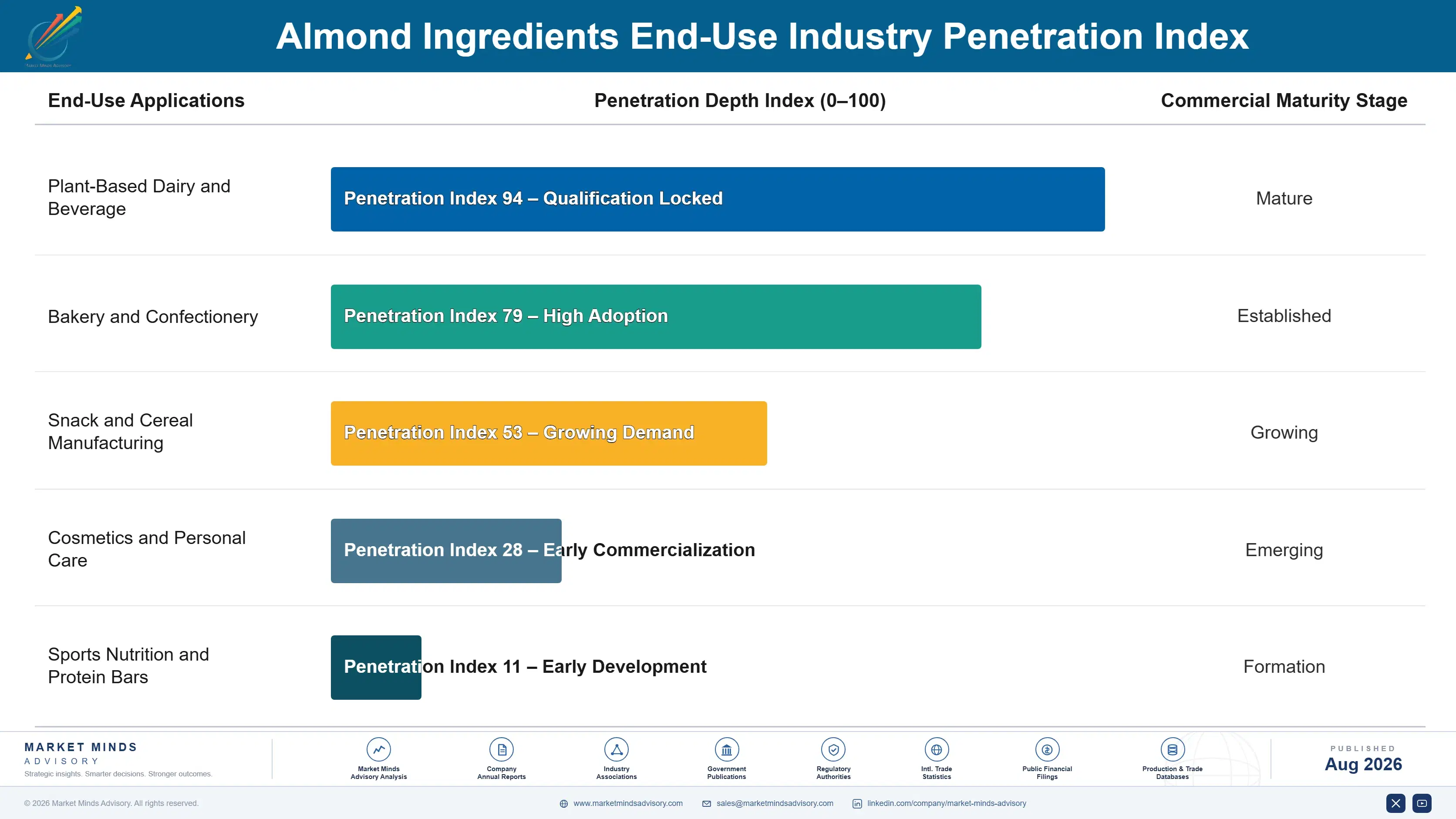
Reformulation Cycles and Supply Risk Dynamics

Almond ingredient demand behaves less like a discretionary purchase and more like a recurring formulation commitment once a manufacturer integrates a specific almond specification into its product recipe, since switching suppliers requires re-validating taste, texture, and nutritional outcomes rather than simply comparing price sheets each quarter across the broader portfolio. Buyers rarely reverse a formulation decision once taste and texture outcomes are validated positively.
Adoption depth varies considerably by end-use vertical. Plant-based beverage and protein bar manufacturers commit deepest, often single-sourcing a qualified protein isolate supplier across multiple product lines for years given the reformulation risk of switching. Bakery manufacturers commit almost as deeply once a flour specification is validated, since reformulating recipes disrupts texture consistency that consumers notice immediately. Snack manufacturers, by contrast, show shallower commitment and will switch suppliers more readily if pricing gaps widen meaningfully across a given season.

A generational shift in buyer profile is underway too. Younger brand and procurement teams at food manufacturers increasingly treat water footprint transparency as a default sourcing requirement rather than a negotiable specification, a mindset shift that is reshaping supplier selection even independent of near-term commodity price swings. This shift persists even where near-term regulatory action seems unlikely.
almond-ingredients-market-2024-2034-trends-end-use-penetration-index-1787461414933

Where Almond Ingredient Value Concentrates Next

These are among the four positions where our research anticipates prominent divergence between winners and laggards over the coming forecast period. Each is grounded in the demand model, the regulatory perimeter, and the announced capacity pipeline.
01 / PROTEIN ISOLATE STRATEGY

Prioritize isolate capacity over commodity milk base expansion

Protein isolate demand is compounding well above the category average, and processors who have already shifted mix toward this segment report meaningfully better margins than those still weighted toward commodity milk base and whole inclusions. Processors still expanding milk-base capacity are chasing a shrinking margin pool relative to isolate alternatives gaining share. The economics of this mix shift now clear payback thresholds that looked marginal only a few years ago, making it the clearest capital allocation priority for processors with flexibility to reallocate capacity toward isolate production.
02 / SUPPLY DIVERSIFICATION POSITIONING

Build Australian and Spanish sourcing before the next drought

California water allocation risk remains the single largest threat to category supply, and processors who have already diversified sourcing toward Australia and Spain report meaningfully better supply security than those still fully dependent on California. Processors without diversified sourcing risk losing customer confidence entirely during the next drought event, as manufacturers increasingly favor suppliers who can demonstrate genuine geographic resilience. This window for building credible alternative relationships will not stay open indefinitely once demand for diversified sourcing intensifies across every major manufacturer account.
03 / WATER RISK MANAGEMENT

Invest in efficiency before the next allocation restriction

The 2022 water cost spike showed how exposed unhedged growers with junior water rights are to California's tightening allocation framework under sustained drought conditions across the Central Valley. Growers without dedicated drip irrigation investment or diversified regional sourcing remain vulnerable to a repeat event, and margin compression during the last spike was severe enough to force some growers to fallow planted acreage entirely. Investing in efficiency now costs considerably less than repeating that same costly mistake again a second time.
04 / REGIONAL GROWTH SEQUENCING

Prioritize South Asia and Pacific expansion ahead of slower regions

South Asia and Pacific is growing faster than every other region tracked in this report, on the strength of India's expanding health food retail sector and Australia's steadily growing domestic production capacity. Processors sequencing expansion should weight this region ahead of slower-growing Eastern Europe or Middle East and Africa markets, where retail health food adoption remains comparatively muted for now. Early positioning here compounds advantage as regional buyers finalize long-term supplier relationships over the next several years across the category.

Engagement Snapshot From the Field

A live engagement with an industry participant carrying material or product regulatory and market exposure ahead of a defining policy shift, showing how our research translates into a defensible multi-year portfolio strategy.
MARKET MINDS ADVISORY · CLIENT ENGAGEMENT SUMMARY
Almond Ingredients Producer Strategic Portfolio Review and Transition Roadmap 2026·Investment Scenario on Almond Ingredients Exposure Evaluation 2025-26
CLIENT PROFILE
The client, a mid-tier almond ingredient processor headquartered in California with reported annual revenue of approximately 310 million dollars (client-reported, unverified by MMA), operates processing facilities supplying standard milk base and whole inclusions primarily into regional retail and food service markets, with limited presence in higher-margin protein isolate segments relative to established leaders. with a processing footprint built over more than a decade of regional operation.
STRATEGIC CHALLENGE
The client faced sustained margin compression from oat and pea competition on its core milk base business, while lacking the protein isolate production capability and diversified sourcing relationships needed to compete for higher-margin contracts, leaving it exposed to California water risk and uncertain how to reposition its portfolio. a decision that would shape its competitive positioning for years to come.
MMA APPROACH
MMA conducted a comparative margin analysis across product forms using primary survey data and expert interviews with plant-based beverage and bakery manufacturer buyers, benchmarked the client's cost structure against integrated competitors, and modeled portfolio shift scenarios weighted by projected demand growth across each segment through 2036, drawing on this report's underlying dataset.
KEY FINDINGS
  1. Protein isolate conversion offered a projected twenty to twenty-eight point margin improvement over the client's existing milk base product line within three years of sustained investment.
  2. Regional plant-based beverage manufacturers were actively seeking additional qualified isolate suppliers, an opportunity the client had not yet pursued despite relevant processing infrastructure.
  3. The client's existing processing capacity was reasonably well suited to isolate manufacturing with moderate process modifications rather than entirely new facility investment.
  4. Competing regional processors had not yet made equivalent portfolio shifts, giving the client a meaningful first-mover window in its home market region.
CLIENT PROFILE
The client, a mid-tier almond ingredient processor headquartered in California with reported annual revenue of approximately 310 million dollars (client-reported, unverified by MMA), operates processing facilities supplying standard milk base and whole inclusions primarily into regional retail and food service markets, with limited presence in higher-margin protein isolate segments relative to established leaders. with a processing footprint built over more than a decade of regional operation.
STRATEGIC CHALLENGE
The client faced sustained margin compression from oat and pea competition on its core milk base business, while lacking the protein isolate production capability and diversified sourcing relationships needed to compete for higher-margin contracts, leaving it exposed to California water risk and uncertain how to reposition its portfolio. a decision that would shape its competitive positioning for years to come.
MMA APPROACH
MMA conducted a comparative margin analysis across product forms using primary survey data and expert interviews with plant-based beverage and bakery manufacturer buyers, benchmarked the client's cost structure against integrated competitors, and modeled portfolio shift scenarios weighted by projected demand growth across each segment through 2036, drawing on this report's underlying dataset.
KEY FINDINGS
  1. Protein isolate conversion offered a projected twenty to twenty-eight point margin improvement over the client's existing milk base product line within three years of sustained investment.
  2. Regional plant-based beverage manufacturers were actively seeking additional qualified isolate suppliers, an opportunity the client had not yet pursued despite relevant processing infrastructure.
  3. The client's existing processing capacity was reasonably well suited to isolate manufacturing with moderate process modifications rather than entirely new facility investment.
  4. Competing regional processors had not yet made equivalent portfolio shifts, giving the client a meaningful first-mover window in its home market region.
RECOMMENDED STRATEGY
Phase 1: Phase 1 (0-6 months): Commission process modifications to enable protein isolate production alongside existing milk base capacity. with priority given to its largest existing customer relationships. Phase 2: Phase 2 (6-18 months): Pursue qualification trials with regional plant-based beverage manufacturers directly seeking supply. while validating performance data across multiple production batches. Phase 3: Phase 3 (18-36 months): Scale isolate production based on qualification success and begin diversifying almond sourcing regionally. while monitoring customer conversion rates closely throughout the rollout.
OUTCOME
Within eighteen months of implementing the phased strategy, the client reported securing several new protein isolate supply contracts and a reported blended gross margin improvement of roughly nine percentage points across its product portfolio (client-reported, unverified by MMA), partially offsetting continued milk base volume pressure.

Frequently Asked Questions

Foundational context covering the market sizes, CAGR, scope, country, region and competition that inform every finding below. This section is provided to cover basics and most often pre-purchase conversations, answered from the MMA Primary Research Dataset.

What is the current size of the Almond Ingredients Market?

The global almond ingredients market was valued at approximately 8.4 billion dollars in 2025. Growth is concentrated in protein isolate and flour rather than legacy milk base demand.

How large will the Almond Ingredients Market be by 2036?

The market is projected to reach approximately 18.42 billion dollars by 2036. This represents roughly a 2.04 times expansion from 2026 levels over the forecast period.

What is the CAGR for the Almond Ingredients Market 2026 to 2036?

The market is forecast to grow at a compound annual growth rate of 7.4 percent between 2026 and 2036. Bull and bear scenarios range from 6.2 to 8.6 percent depending on water supply conditions.

Which segment is growing fastest?

Almond protein isolate is the fastest-growing segment, expanding at approximately 11.2 percent annually. This is roughly 1.51 times the overall market growth rate, driven by plant-based reformulation.

Who are the major companies in the Almond Ingredients Market?

Leading processors include Blue Diamond Growers, Olam Food Ingredients, SunOpta Inc., Borges International Group, and The Wonderful Company. These five companies control roughly thirty-four percent of global capacity.

Which country is growing fastest?

India is the fastest-growing national market, expanding at approximately 9.5 percent annually. Growth is driven by expanding health food retail adoption and rising urban middle-class consumption.

Report Segmentation Architecture

The full report scope spans multiple orthogonal segmentation dimensions, with cross-tabulated demand data provided for each dimension pair. Coverage extends further to regional breakdowns, trend trajectories, and the competitive detail needed to support segment-level decision-making.

By Product Form

  • Almond Milk Base
  • Almond Flour and Meal
  • Almond Butter and Paste
  • Almond Protein Isolate
  • Almond Oil
  • Whole and Sliced Almond Inclusions

By End-Use Industry

  • Plant-Based Dairy and Beverage
  • Bakery and Confectionery
  • Snack and Cereal Manufacturing
  • Cosmetics and Personal Care
  • Sports Nutrition and Protein Bars

By Commercial Dimension

  • Direct Manufacturer Supply
  • Distributor Channel Sales
  • Private-Label Contract Supply
  • Retail Co-Packing Arrangements

By Region

  • North America
  • Western Europe
  • East Asia
  • South Asia and Pacific
  • Latin America
  • Middle East and Africa
  • Eastern Europe

Scope, Methodology, and Coverage

Every figure in this report is reproducible from documented input assumptions. The scope below maps the historical period, the forecast horizon, the segmentation dimensions, and the countries covered, alongside the underlying primary and qualitative methodology.
Historical Period
2020 to 2025
Forecast Period
2026 to 2036
Base Year
2025 (USD billions; MMA Primary Research Dataset, August 2026)
Market Definition
The almond ingredients market covers commercial production and sale of processed almond-derived ingredients, including almond milk base, flour, butter, protein isolate, oil, and whole or sliced inclusions, used across food and beverage, bakery, snack, and cosmetic applications. It excludes whole raw almonds sold as a standalone retail snack product and finished consumer products that merely incorporate almond ingredients.
Quantitative Units
USD billions (current prices); metric tons of processing volume where applicable
Segmentation Dimensions
By Product Form; By End-Use Industry; By Commercial Dimension; By Region
Regions Covered
North America, Western Europe, East Asia, South Asia and Pacific, Latin America, Middle East and Africa, Eastern Europe
Countries Covered
USA, China, Germany, France, UK, Japan, South Korea, India, Australia, Canada, Brazil, Mexico, Indonesia, Vietnam, Thailand, Malaysia, UAE, Saudi Arabia, South Africa, Nigeria, Turkey, Poland, Netherlands, Italy, Spain, Sweden, Switzerland, Argentina, Colombia, Singapore, and additional markets relevant to this sector
Key Companies Profiled
Blue Diamond Growers, Olam Food Ingredients, SunOpta Inc., Borges International Group, The Wonderful Company, Select Harvests Limited, John B. Sanfilippo and Son, Hain Celestial Group, TreeHouse Foods, Diana Food, South Valley Almond Company, Meridian Foods, Ingredion Incorporated, Archer-Daniels-Midland, Campos Brothers Farms, Harris Woolf Almonds, Stewart and Jasper Orchards, Nutiva Inc, Kerry Group, Wawona Frozen Foods
Quantitative Methodology
Primary survey, n=3,800 respondents, Q4 2025, six countries; demand-side model with trade association cross-validation
Qualitative Methodology
47 expert interviews, Q4 2025; applied to validate demand model assumptions, identify emerging dynamics, and assess competitive positioning
Report Format
PDF and XLSX data workbook (Word format preview document)
Publisher
Market Minds Advisory
Report Code
MMA-2026-AGR-103
Published
August 2026
Contact
sales@marketmindsadvisory.com | www.marketmindsadvisory.com

Purchase the full Almond Ingredients Market Report (2026 to 2036).

This report delivers a complete commercial assessment of the global almond ingredients market across product forms, competitive dynamics, and seven world regions. It includes detailed segmentation analysis, competitive benchmarking of twenty profiled companies, and quantified water supply and cost risk assessments across every major producing geography. Analysts combine primary survey data from 3,800 respondents with 47 expert interviews conducted in the fourth quarter of 2025 to validate demand forecasts running through 2036. The report is designed to support portfolio strategy, supply diversification, and customer segment prioritization decisions for almond ingredient processors.
Ten-year quantitative market forecast across all segments
Detailed product-form segmentation analysis and pricing
Seven-region demand breakdown with share and CAGR data
Twenty-company competitive profiles with moat and risk analysis
Water supply risk assessment with grower mitigation strategies
Plant-based protein reformulation and water risk analysis

Built For The People Who Decide

From boardroom strategy to bench-side execution, this report is read cover-to-cover by leaders shaping the next decade of their industry, turning demand scenarios, market dynamics and valuation benchmarks into decisions.
CXOs/ Presidents/ VPs/ Managers
M&A and Corporate Development
Strategy Teams and R&D Heads
Procurement and Product Directors
Regulatory and Compliance Leaders
Investor Relations and Equity Analysts