Market Minds Advisory
Almond Drink Market

Almond Drink Market: Plant-Based, Barista, and Fortified Beverage Demand Through 2036

Almond drink built the plant-based milk category before oat milk existed, and now defends it on two fronts: barista-grade foaming for coffee shops and fortified nutrition claims for households that never touch an espresso machine.

Lead Analyst

Lisa Gevelber

Published

September 2026

Make Smarter Decisions with Customized Research Insights

Request a free sample report and evaluate market opportunities, growth trends, and competitive dynamics relevant to your business needs.

2025 MARKET VALUE$6.8BMarket Size 2025
2036 FORECAST VALUE$14.6BBase Case , 2026 to 2036
CAGR 2026 TO 20367.2 %Bull 8.4% / Bear 6.0%
INCREMENTAL OPPORTUNITY$7.3BNet 10- year value creation
EXPANSION MULTIPLE2.00x2036 value over 2026 base
Strategic Levers
M&A Pipeline
Regional Outlook
Country Rankings
Competitive Intelligence
Segmental Deep-dive
Call-Us : 91 93563 13602

Executive Snapshot and Market Trajectory

Almond drink built the modern plant-based milk category well before oat milk arrived, and it now defends that position by splitting into two distinct commercial identities: barista-grade foaming formulations chasing coffee shop volume, and fortified household formats competing on nutrition claims that oat milk has never matched as effectively.
Barista and foodservice formulations are now the fastest-growing segment, expanding at roughly 10.5% annually as coffee chains specify almond formulations engineered for consistent foam texture, well over 45% faster than the wider market's pace. North America anchors close to a third of global value through decades of established retail distribution and consumer familiarity, while East Asia's growing lactose-intolerant, health-conscious urban population pulls import and domestic production volume steadily higher.
Competitive intensity concentrates around a handful of established plant-based beverage majors who control retail shelf space and barista-channel relationships, even as smaller organic and clean-label brands compete on ingredient transparency and simplicity. Oat milk's continued foaming performance advantage keeps pressuring almond drink's barista-channel share, while fortification claims and lower environmental footprint messaging increasingly shape which formulations retailers prioritize for household grocery shelf space.
Market Definition
The almond drink market covers commercial production and sale of plant-based beverages made from almonds, water, and added ingredients, sold in sweetened, unsweetened, flavored, barista, organic, and fortified formats for retail and foodservice consumption. It excludes almond milk used as a cooking or baking ingredient sold in concentrated or powdered form, which the industry classifies as a separate ingredient category.
Base Year Value
$6.8B in 2025 (MMA Primary Research Dataset, August 2026)
Forecast Period
2026 to 2036, eleven discrete annual values
CAGR
7.2% base case. Bull 8.4%. Bear 6.0%.
Fastest Growth Segment
Barista and Foodservice Almond Drink: 10.5% CAGR
Fastest Growth Country
India: 11.0% CAGR
Fastest Growth Region
South Asia and Pacific: 9.2% CAGR
Largest Region
North America: 32% of 2025 global value
Market Leaders
Blue Diamond Growers, Danone SA, Califia Farms LLC, SunOpta Inc, Alpro NV. Source: MMA Analysis based on company annual reports.
Primary Survey
n=3,800 procurement and R&D decision-makers, Q4 2025, six countries
Methodology
Demand-side build-up, cross-validated against public data, 47 expert interviews

Almond Drink Market Forecast Scenarios

almond-drink-market-2024-2034-trends-size-forecast-scenario-1787462794623
Almond drink demand grew steadily from 2020 to 2025, as broader plant-based beverage adoption continued expanding even as oat milk's rapid emergence captured a meaningful share of category growth that might otherwise have gone to almond formulations. Barista-channel demand accelerated further from 2023 onward as coffee chains expanded plant-based menu options. The market grew at a 6.2% historical CAGR from 2020 to 2025.
The base case carries almond drink to a 7.2% CAGR through 2036 on three mechanisms. First, barista and foodservice formulations keep expanding as coffee chains specify almond-specific recipes alongside oat milk options rather than choosing one exclusively. Second, fortified formats keep gaining household share as retailers position almond drink around calcium, vitamin D, and protein content claims. Third, East Asian urban consumers keep adopting plant-based beverages as lactose intolerance awareness and health-conscious purchasing spread across the region's largest cities.
The bull case, 8.4%, assumes barista-channel expansion accelerates faster than currently projected as more coffee chains add almond-specific menu items alongside oat milk rather than replacing almond entirely. The bear case, 6.0%, assumes oat milk's foaming and sustainability marketing advantages continue capturing category growth that would otherwise flow to almond drink, capping share gains even as total plant-based beverage demand keeps expanding steadily.

The Original Plant-Based Milk Defends Its Position

Almond drink's commercial position rests on decades of category-defining retail presence that newer plant-based entrants, including oat milk, cannot simply replicate through marketing investment alone. Blue Diamond and Danone-owned Silk built consumer familiarity and shelf space relationships well before oat milk existed as a mainstream category, giving almond drink a distribution advantage that persists even as oat milk captures a growing share of incremental category growth.
MARKET CONCENTRATIONCR5: 46%Top five brands hold under half of retail sales
AVERAGE SELLING PRICEUSD 3.60 per half gallonRetail pricing varies sharply between value and premium tiers
TOP CONSUMING COUNTRYUSA: 29% of global volumeDecades of retail distribution anchor consumption leadership broadly
EXPORT TRADE INTENSITY24% of output crosses a borderCross border trade links Californian almond supply to global brands
ALMOND INPUT COST SHARE22% to 30% of COGSCalifornia crop pricing drives meaningful margin volatility directly
BARISTA FORMAT PRICE PREMIUM15% to 25% over standard formulationsFoam-optimized recipes command meaningfully higher retail prices overall
Buyers increasingly split by occasion and formulation requirement. Barista-channel buyers demand foaming performance and flavor neutrality that standard retail formulations do not always optimize for, pushing brands to develop dedicated foodservice recipes distinct from household products. Household buyers instead respond more to fortification claims, ingredient simplicity, and price, treating almond drink as one interchangeable option among several plant-based alternatives on the same retail shelf.
Over the next decade, barista-channel and fortified household formats should keep pulling value toward higher-margin, differentiated formulations, while standard sweetened and unsweetened formats face continued price competition from private-label and newer plant-based entrants. Oat milk's foaming performance advantage, not underlying almond drink demand weakness, increasingly looks like the primary constraint on category growth in the barista channel specifically.
"Almond drink invented the category everyone associates with oat milk today. The brands that forget that keep losing barista-channel share to a beverage that showed up a decade later."
Director, Plant-Based Beverage and Alternative Dairy Practice · MMA Food and Beverage Practice · August 2026

Market Trends

Coffee Chains Expand Dedicated Barista Almond Formulations

Major coffee chains and independent cafes have expanded plant-based milk menu options to include dedicated almond formulations engineered specifically for foaming consistency and flavor neutrality in espresso-based beverages, rather than offering only a single generic plant-based option. Brands including Califia Farms and Alpro have invested in barista-specific recipe development distinct from their standard retail products, recognizing that foodservice buyers evaluate performance criteria retail buyers rarely consider. This expansion is adding meaningful incremental demand from a channel that previously favored oat milk almost by default, as coffee chains increasingly offer almond alongside oat rather than choosing one exclusively.
Market Impact: Lactose-intolerant demand grows 8.2% annually
Fortification Claims Differentiate Household Retail Positioning

Retail brands increasingly position almond drink around calcium, vitamin D, and protein fortification claims that let it compete directly against dairy milk on nutritional grounds rather than solely on plant-based positioning alone. Several major brands have reformulated flagship products specifically to increase protein and calcium content, responding to consumer research showing nutritional equivalence to dairy remains a genuine purchase consideration for many household buyers switching categories. This fortification trend differentiates almond drink from newer plant-based entrants including oat milk, which generally carries less protein content naturally and requires more extensive fortification to achieve comparable nutritional positioning against dairy milk.
Market Impact: Environmental switching adds 6% annually

Market Opportunities and Growth Drivers

Lactose Intolerance Awareness Sustains Baseline Demand

Growing consumer awareness of lactose intolerance prevalence, particularly across Asian populations where intolerance rates run considerably higher than in Western countries, continues sustaining baseline almond drink demand independent of broader plant-based wellness trends or environmental sustainability marketing. Almond drink's decades-long market presence gives it stronger existing distribution and consumer trust in this use case than newer plant-based entrants still building category awareness from scratch across many of these same growing markets. That combination of genuine physiological need and established distribution gives lactose-intolerance-driven demand a durability that purely trend-driven plant-based purchasing does not always share to the same degree.
Market Impact: Oat competition costs 15% barista share

Environmental Positioning Sustains Household Switching Trends

Continued consumer interest in reducing dairy-related environmental footprint sustains household switching toward plant-based alternatives broadly, and almond drink retains meaningful share of this switching behavior despite oat milk's generally stronger water-use marketing narrative in comparative environmental messaging. Retailers increasingly stock almond drink alongside comparative environmental footprint information on shelf tags and packaging, a transparency trend that helps offset almond cultivation's genuinely higher water intensity relative to oat crops specifically. Brands are responding with sourcing transparency initiatives highlighting California water stewardship practices to address this specific competitive vulnerability directly and proactively.
Market Impact: Drought years lift input costs 18%

Market Restraints and Challenges

Oat Milk Competition Erodes Barista-Channel Share

Oat milk's superior foaming performance and creamier mouthfeel in espresso beverages has captured barista-channel share that might otherwise have gone to almond drink, particularly among chains that adopted oat as their default plant-based option during its rapid emergence. The underlying cause is genuine chemistry: oat milk's starch content creates foam stability that almond drink's naturally lower protein content struggles to match without additional stabilizing ingredients affecting flavor and label simplicity. That disadvantage concentrates specifically in the barista channel, where almond drink retains stronger household brand recognition. Producers are responding by investing in reformulated barista-specific recipes closing that gap.
Market Impact: Barista formulations grow 10.5% annually

California Water Costs Pressure Cultivation Economics

Almond cultivation requires meaningfully more water per unit of output than oat crops used in competing plant-based beverages, exposing almond drink producers to California water availability and pricing pressure that oat milk producers sourcing from wetter regions generally avoid. The underlying cause is almond trees' year-round water requirement compared with oat crops grown in less water-intensive rotational farming across a broader range of climates. That water cost exposure pressures almond drink's raw material economics specifically during California drought years, adding volatility competing categories sourcing from water-abundant regions do not face. Producers are responding by investing in water-efficient irrigation technology across contracted operations.
Market Impact: Fortified formats grow 8.5% annually
3 additional market trends, 3 additional growth drivers, and 3 additional restraints and challenges are covered in the full report. Contact sales@marketmindsadvisory.com to access the complete intelligence.

Segment CAGR and Growth Architecture

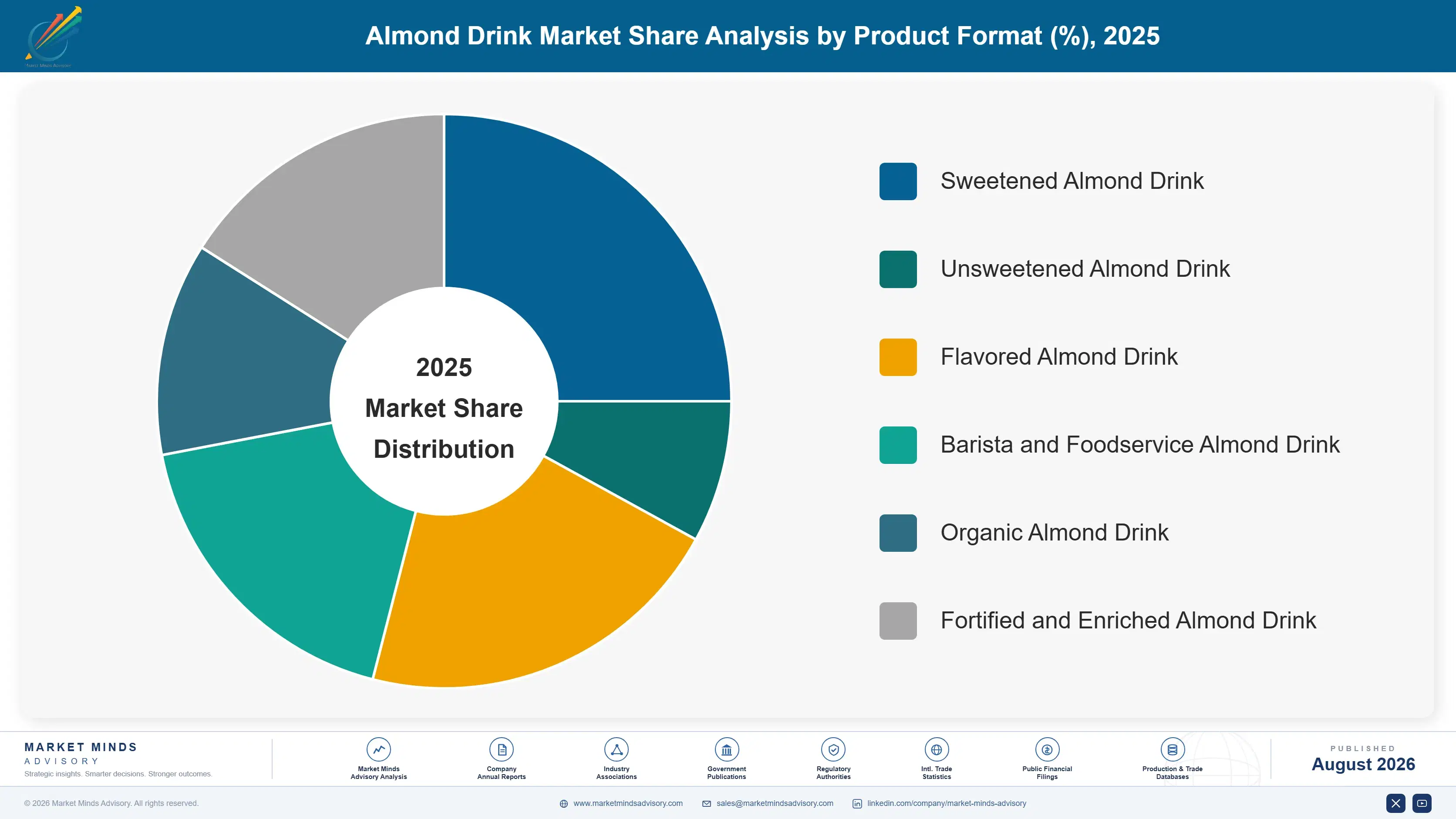
Segmentation follows product format, a single classification logic separating almond drink by sweetening, flavoring, and functional positioning. Sweetened, unsweetened, flavored, barista, organic, and fortified formats each carry distinct formulation requirements and buyer occasions, keeping upstream sourcing economics and downstream retail positioning from blurring together across every buyer segment and price tier.
almond-drink-market-2024-2034-trends-market-share-analysis-1787462795162

Barista and Foodservice Almond Drink

Barista and foodservice almond drink is growing at 10.5% annually, well over 45% faster than the wider market's 7.2% pace, as coffee chains and independent cafes specify dedicated formulations engineered for foaming consistency and flavor neutrality in espresso-based beverages. This format requires formulation expertise distinct from standard retail products, since foodservice buyers evaluate foaming stability and heat tolerance that household purchasing rarely considers. Retail and foodservice pricing for barista formulations runs 15% to 25% above standard formats, reflecting both formulation investment and coffee chains' willingness to pay for consistent quality across thousands of daily transactions. Califia Farms and Alpro have both prioritized capital investment in dedicated barista recipe development, recognizing it as best positioned to recapture oat milk's share.
CAGR 10.5%

Organic Almond Drink

Organic almond drink grows at 9.0% annually, driven by clean-label retail positioning among health-conscious household buyers seeking documented organic almond sourcing and minimal ingredient lists compared with standard sweetened formulations. This format commands meaningfully higher retail pricing than conventional almond drink, reflecting both organic certification cost and genuine consumer willingness to pay for documented sourcing transparency in a category increasingly scrutinized for environmental and ingredient claims. Established brands including Califia Farms and newer entrants including Malk Organics have both expanded organic-certified production capacity specifically to meet retailer demand for premium clean-label shelf sections. Capacity constraints in certified organic almond supply have limited how quickly this format can scale relative to conventional formulations sourced from broader commodity almond supply.
CAGR 9.0%
Full segment breakdown across 6 segments available in the complete report.

Regional Architecture and Country Demand Map

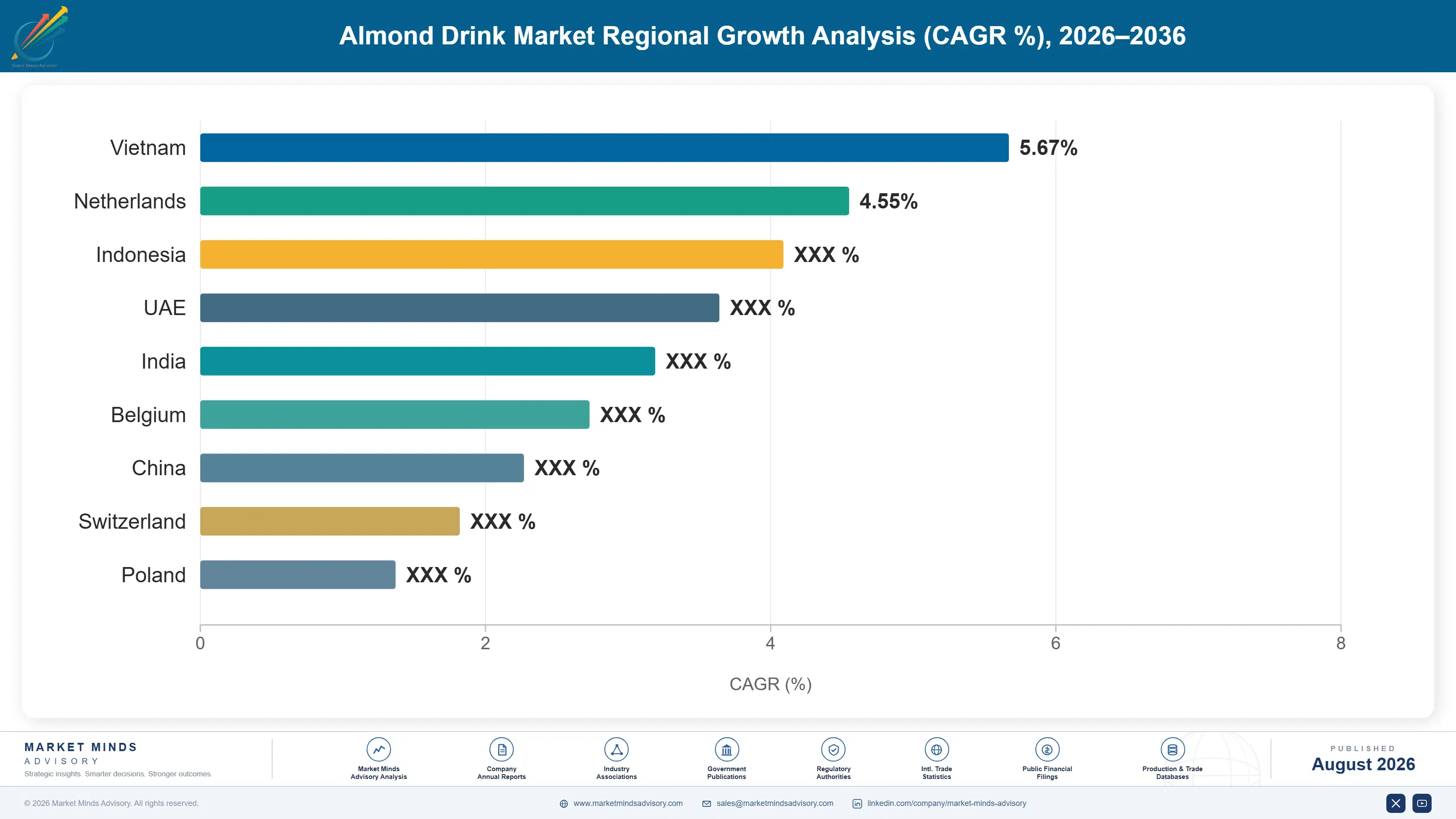
Almond drink consumption concentrates in North America, anchored by decades of category-defining retail distribution and consumer familiarity that predate oat milk's emergence considerably. East Asia carries disproportionate growth relative to its current consumption share, as lactose intolerance awareness and plant-based adoption spread across the region's largest urban centers.

North America

United States demand anchors North American almond drink consumption, built on decades of category-defining retail distribution through Blue Diamond's Almond Breeze and Danone-owned Silk that established almond drink as the default plant-based milk long before oat milk existed as a mainstream alternative. Coffee chains across the country increasingly stock dedicated barista almond formulations alongside oat milk options, adding meaningful incremental foodservice demand beyond traditional retail sales. Canada follows a similar consumption pattern at smaller scale, with comparable retail distribution and barista-channel trends. Growth here outpaces Western Europe as barista-channel expansion and fortified format adoption compound alongside the region's already-dominant retail distribution infrastructure and deep consumer familiarity built over decades of continuous market presence and steady marketing investment.
Share: 32% | CAGR: 7.5% (2026 to 2036)

Western Europe

Western Europe's almond drink demand centers on Germany, France, and the United Kingdom, where established plant-based beverage brands including Alpro built substantial retail distribution well before oat milk's rapid European emergence reshaped competitive dynamics across the broader plant-based beverage category. Oat milk's strong sustainability marketing narrative has captured meaningful category growth in this region specifically, given European consumers' particular sensitivity to water-use and environmental footprint messaging across grocery retail. Growth trails North America and East Asia as oat milk competition weighs more heavily on regional almond drink growth than in markets where almond retains stronger category-defining brand recognition and less direct sustainability-focused pressure from newer entrants across the retail category.
Share: 22% | CAGR: 5.8% (2026 to 2036)
Regional intelligence for 5 additional markets available in the complete report: East Asia, South Asia and Pacific, Latin America, Middle East and Africa, Eastern Europe. Contact sales@marketmindsadvisory.com.
almond-drink-market-2024-2034-trends-country-cagr-analysis-1787462795681

Where Almond Drink Brands Can Defend Margin

Margin defense in almond drink increasingly depends on moving beyond commodity retail pricing toward positioning that lets a brand charge for barista-channel performance, fortification credibility, or organic certification. The four moves below target the fastest-growing buyer segments most willing to pay well above standard formulation pricing for genuinely credible, documented differentiation.

Develop Dedicated Barista-Grade Formulations Now Broadly

Barista-optimized almond drink commands retail and foodservice pricing running 15% to 25% above standard formulations, and demand from coffee chains has grown considerably faster than the industry's dedicated barista-formulation development pipeline currently available. Brands that invest in foam-stability and flavor-neutrality research now capture premium foodservice contracts before competitors establish comparable formulation credibility, since coffee chains increasingly specify almond-specific recipes rather than accepting generic plant-based products. The formulation investment requires meaningful research and development spending, but the margin uplift over standard retail pricing more than justifies the cost for most established plant-based beverage brands.
Market Impact: Barista formulations command a 15% to 25% premium

Build Fortification Credibility Against Dairy Comparison

Fortified almond drink carrying documented calcium, vitamin D, and protein content commands meaningful retail premium over standard formulations, letting brands compete directly against dairy milk on nutritional grounds rather than solely on plant-based positioning that oat milk and other newer entrants also claim. Brands that invest in fortification research and third-party nutritional validation now capture premium household contracts before competitors establish comparable nutritional credibility with increasingly label-literate consumers. The fortification investment requires meaningful formulation and testing cost, but the roughly 12% pricing premium and differentiation from newer plant-based entrants justifies the cost for most established brands.
Market Impact: Fortification credibility typically adds roughly a 12% premium

Secure Organic Almond Supply Ahead of Retailer Demand

Organic-certified almond drink commands meaningful retail premium over conventional formulations, and demand from clean-label retail buyers has grown considerably faster than the industry's dedicated organic almond sourcing capacity currently available across major growing regions worldwide today. Brands that contract organic-certified almond acreage now capture premium retail shelf space before competitors establish comparable certified supply relationships with California and emerging organic growing regions. The sourcing investment requires meaningful multi-year grower relationship development, but the roughly 20% pricing premium organic formulations command justifies the cost for brands pursuing premium clean-label positioning today.
Market Impact: Organic certification typically commands roughly a 20% premium

Invest In California Water Stewardship Transparency

Consumers increasingly scrutinize almond cultivation's water intensity relative to competing plant-based beverage crops, and brands that document genuine water stewardship practices differentiate from competitors vulnerable to negative environmental comparison marketing from oat milk producers. Brands that invest in transparent water-use reporting and efficient irrigation partnerships now defend retail shelf space against environmental positioning attacks before competitors establish comparable credibility on this specific competitive vulnerability. The transparency investment requires meaningful grower partnership and reporting infrastructure, but the roughly 8% share protection it provides against environmentally-motivated switching justifies the cost for most established brands.
Market Impact: Water transparency typically protects roughly 8% of share

Who Controls the Margin Pool

Competitive concentration sits at a moderate CR5 of 46%, reflecting a market split between established plant-based beverage majors competing on retail distribution scale and smaller organic and clean-label brands competing on ingredient transparency and formulation simplicity. The gap between category leaders and mid-tier challengers remains meaningful, built on decades of retail shelf relationships that predate most current competitors entirely.
Competitive activity currently runs along three lines. Large brands compete on retail distribution breadth and barista-channel formulation investment, applying decades of category-defining relationships smaller competitors cannot replicate quickly. Organic and clean-label challengers compete on ingredient transparency and simplicity, targeting health-conscious buyers willing to pay premium pricing. Private-label retailers compete almost entirely on price, since standard formulation chemistry offers little room for meaningful differentiation at the value tier.

Pressure is building from two directions. Oat milk continues capturing barista-channel share that almond drink historically dominated, forcing established almond brands to invest heavily in reformulated recipes to defend foodservice relationships. Meanwhile fortification and organic certification investment is becoming a genuine competitive differentiator in retail, rewarding brands willing to fund nutritional and sourcing credibility over those competing purely on commodity pricing. Rankings over the next five years will favor whoever combines barista-channel recovery with credible fortification and sourcing transparency positioning.
almond-drink-market-2024-2034-trends-company-positioning-matrix-1787462796202

Competitive Moat and Risk Dimensions

BLUE DIAMOND GROWERS

Moat: Category-defining retail brand recognition

Blue Diamond's Almond Breeze brand holds retail distribution relationships and consumer brand recognition built over decades of category-defining presence that newer plant-based entrants, including oat milk brands, cannot replicate on any reasonable timeline, giving it shelf access and consumer trust that smaller specialized competitors genuinely struggle to match.
BLUE DIAMOND GROWERS

Risk: Slower barista-channel reformulation pace

Blue Diamond has been somewhat slower than smaller, more agile competitors to develop dedicated barista-grade formulations specifically, exposing the company to continued oat milk share erosion in the fast-growing foodservice channel while it works to close that specific formulation gap over the coming several years.
DANONE SA

Moat: Diversified plant-based portfolio scale

Danone's Silk brand benefits from the company's broader diversified food and beverage portfolio, giving it retail negotiating position and cross-category marketing resources that smaller standalone almond drink competitors cannot easily match, alongside substantial research and development capacity across its wider global plant-based beverage business overall.
DANONE SA

Risk: Portfolio diversification dilutes almond focus

Danone's almond drink business sits within a much broader plant-based and dairy portfolio spanning multiple brands and categories, meaning the company may allocate capital and management attention toward larger or faster-growing categories rather than prioritizing almond-specific barista or fortification investment relative to more focused competitors.

Players Tracked

Prominent Players

Blue Diamond Growers
Danone SA
Califia Farms LLC
SunOpta Inc
Alpro NV

Other Key Players

Elmhurst 1925
Malk Organics LLC
Pacific Foods of Oregon LLC
Vitasoy International Holdings Limited
Milkadamia
Three Trees Inc
Forager Project LLC
Nutriops SL
Rude Health Ltd
Emmi AG
Good Karma Foods Inc
Hain Celestial Group Inc
Nutpods LLC
Almond Cow Inc
Sanitarium Health and Wellbeing Company

Recent Developments

APRIL 2024

Califia Farms launches reformulated barista almond blend

Califia Farms launched a reformulated barista-grade almond drink specifically engineered for improved foam stability, responding to sustained coffee chain demand for almond formulations competitive with oat milk performance. The launch was an organic product introduction, not a joint venture or acquisition of any competing formulation company.
Signal: Signals established almond brands investing directly in closing the barista-channel performance gap with oat milk competitors.
SEPTEMBER 2024

Alpro expands organic almond sourcing partnerships in Spain

Alpro announced expanded organic almond sourcing partnerships with Spanish growers to diversify supply beyond its historical California-concentrated purchasing ahead of anticipated organic demand growth across Europe. The move was an organic sourcing expansion, not a joint venture or acquisition of any Spanish grower cooperative.
Signal: Signals European brands building diversified organic almond supply well ahead of confirmed clean-label retail demand growth.
JANUARY 2025

Danone acquires minority stake in barista-focused plant beverage startup

Danone acquired a minority equity stake in a specialty barista-focused plant-based beverage startup to strengthen its foodservice formulation capability ahead of anticipated coffee chain demand growth across its customer base. The transaction was a minority equity investment, not a full acquisition, merger, or joint venture arrangement.
Signal: Signals established plant-based beverage majors buying specialized formulation capability rather than building it internally from scratch.

California Almond Supply Sets The Margin Ceiling

Raw almonds account for 22% to 30% of production cost for almond drink, sourced almost entirely from California growers rather than any globally diversified agricultural supply chain given the state's dominant global cultivation share. Water, packaging, and fortification ingredient costs add a further meaningful share, varying considerably depending on whether a brand targets standard sweetened formulations or premium organic and fortified output specifically.
The 2021 and 2022 California drought illustrated raw almond exposure directly. USDA agricultural data recorded meaningfully reduced almond yields across both years as water availability constrained irrigation across major growing regions in the Central Valley. Almond drink producers without locked-in supply contracts absorbed significant cost increases, passing some of that cost through to retail customers who had few alternative low-cost almond supply sources to switch toward given California's dominant cultivation position globally.

Exposure falls hardest on smaller almond drink producers without long-term grower relationships or forward purchase contracts, who must buy almonds closer to spot pricing during harvest season and absorb whatever margin compression results from drought-driven yield swings. Larger diversified producers with established multi-year grower contracts and geographic sourcing diversification smooth that volatility considerably better than smaller, California-dependent competitors currently exposed to full seasonal cost variability.
almond-drink-market-2024-2034-trends-cost-volatility-analysis-1787462796397

Lock Multi-Year Contracts With California Growers

Producers negotiating multi-year almond purchase agreements directly with California growers convert volatile harvest-season spot pricing into a planned input cost, protecting downstream retail pricing that resists frequent adjustments. This favors larger established producers with existing grower relationships, but smaller producers can access similar terms through regional purchasing consortia rather than negotiating individually against larger established buyers.

Diversify Almond Sourcing Beyond California

Producers reduce single-region drought exposure by sourcing almonds across California, Australia, and Spain rather than depending entirely on California supply for the majority of raw almond volume. That diversification smooths input availability across different weather patterns and growing seasons, though it adds supplier qualification complexity across each additional growing region a producer incorporates into its network.

Invest In Water-Efficient Irrigation Partnerships

Producers reduce drought exposure by investing directly in water-efficient irrigation technology partnerships with contracted growing operations, reducing the water volume required per unit of almond output and providing genuine water stewardship credentials for marketing purposes. This capital investment suits larger producers best, but delivers durable margin and reputational benefit that persists regardless of future drought severity.

Portfolio Architecture for Margin Defence

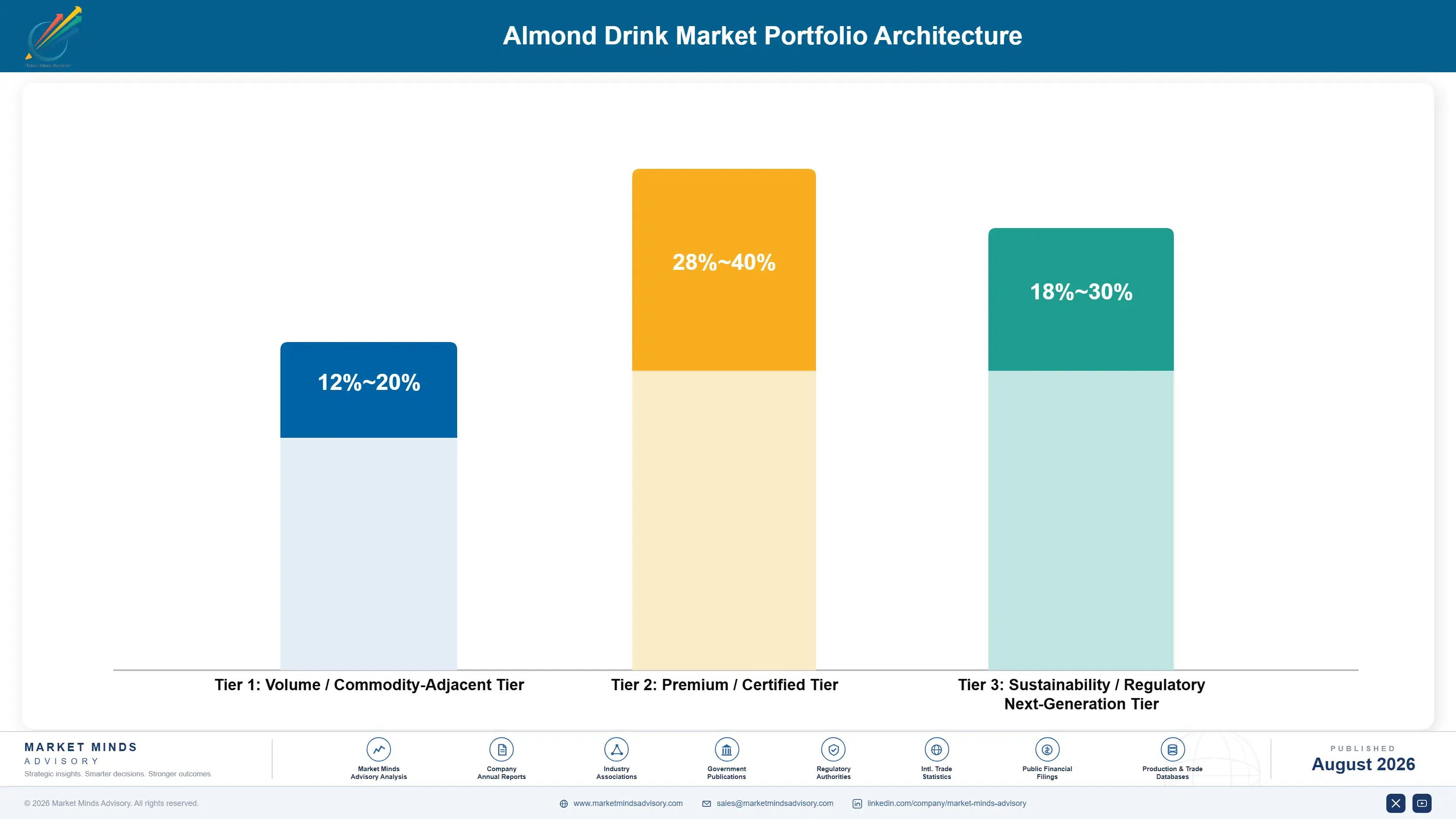
Almond drink's portfolio splits into three tiers with meaningfully different margin economics. Volume standard sweetened and unsweetened formats, sold through mass retail on price and brand recognition, compete on cost and earn steady but thin margins. Barista, fortified, and organic-certified formulations earn substantially more, since formulation differentiation and documented sourcing create switching costs commodity retail competitors cannot replicate quickly.
The tension for brands is capital allocation between two economics. Volume standard production generates dependable cash flow that funds operations and brand marketing, while barista and fortified capacity requires meaningful research and certification investment before generating comparable returns at much higher margin. Brands leaning entirely on volume risk losing share to faster-growing differentiated formats, while those chasing premium formulation too aggressively risk underutilized capacity if barista-channel recovery from oat milk competition proves slower than currently projected.

High-value margin pools concentrate in barista-grade and fortified formulations carrying genuine performance or nutritional differentiation that standard formats cannot match. Frontier opportunity sits in combining diversified California-adjacent almond supply with credible barista and fortification investment, letting brands capture premium pricing from foodservice and health-conscious household buyers while retaining steady standard-format revenue simultaneously.

Volume / Commodity-Adjacent Tier

Standard sweetened and unsweetened almond drink sold through mass retail channels on price and brand recognition, priced close to comparable plant-based beverages with minimal differentiation between competing established brands nationwide.
Gross Margin: 12-20%

Premium / Certified Tier

Barista-grade, fortified, and organic-certified almond drink carrying documented formulation performance or nutritional claims that commands sustained premiums over standard formulations across foodservice and health-conscious retail buyers broadly and consistently.
Gross Margin: 28-40%

Sustainability / Regulatory / Next-Generation Tier

Emerging water-stewardship-certified and diversified-sourcing formulations designed to address environmental scrutiny ahead of tightening retailer sustainability requirements, though scale-up economics and consumer willingness to pay remain largely unproven today across most markets.
Gross Margin: 18-30%
almond-drink-market-2024-2034-trends-portfolio-architecture-1787462796899

High-value Sub-segments and Strategic Watch-out

Barista and Foodservice Almond Drink

Barista demand grows fastest at 10.5% annually and already commands meaningful retail and foodservice premiums over standard formulations. Brands investing in foam-stability research and specialized processors both continue expanding capacity, and growing coffee chain adoption should keep margin strong through the forecast period ahead across most markets.
Gross Margin: 28-40%

Organic Almond Drink

Organic demand grows at a healthy 9.0% annually, driven by clean-label retail positioning, though certified organic almond supply constraints and multi-year sourcing development limit how quickly brands can scale beyond current contracted volume commitments across most existing retail customers today.
Gross Margin: 28-40%

Sweetened and Unsweetened Almond Drink

Standard sweetened and unsweetened formats remain the largest category by volume, anchored by decades of established retail distribution and brand recognition. Margins stay steady but modest, competing on price rather than differentiation, but the segment anchors baseline category revenue globally across every market today.
Gross Margin: 12-20%

Flavored Almond Drink

Flavored formulations including chocolate and vanilla face gradual commoditization pressure as private-label retailers increasingly replicate popular flavor profiles at lower price points nationwide. Brands concentrated purely in this segment risk margin erosion absent diversification into barista or fortified premium formats going forward.
Gross Margin: 14-24%

Why Almond Loyalty Splits Sharply

Almond drink demand behaves like an annuity within established retail brand relationships, since household buyers who select a brand during initial category trial often repurchase habitually for years absent a specific reason to switch, given limited motivation to re-evaluate a satisfactory, low-consideration grocery purchase repeatedly. Foodservice buyers behave considerably less predictably, since coffee chains actively evaluate formulation performance against competing plant-based options on an ongoing basis rather than defaulting to habitual repurchase.
Stickiness varies sharply by purchasing channel and buyer sophistication. Household retail buyers rarely switch brands once satisfied, given limited motivation to re-evaluate a low-consideration grocery category purchase repeatedly across routine shopping trips. Foodservice buyers show considerably less loyalty, actively benchmarking formulation performance against oat milk and other plant-based competitors on an ongoing basis. Organic and clean-label buyers sit in between, loyal to ingredient transparency principles more than any specific brand relationship itself.

Buyer profiles are shifting generationally within the household retail channel specifically. Younger consumers increasingly treat plant-based beverage choice as one interchangeable option among several rather than a fixed category loyalty, a shift that favors brands offering genuine formulation or nutritional differentiation over those relying purely on legacy brand recognition built decades ago.
almond-drink-market-2024-2034-trends-end-use-penetration-index-1787462797392

Where Almond Drink Brands Should Bet

These are among the four positions where our research anticipates prominent divergence between winners and laggards over the coming forecast period. Each is grounded in the demand model, the regulatory perimeter, and the announced capacity pipeline.
01 / BARISTA FORMULATION RECOVERY

Close the foaming performance gap before oat milk locks in share permanently

Barista and foodservice almond drink is growing well over 45% faster than the wider market's pace, and already commands meaningful premiums over standard formulations, yet oat milk continues capturing barista-channel share that almond drink historically dominated before oat milk's rapid market emergence. Brands that invest now in foam-stability and flavor-neutrality research position to recapture foodservice contracts before coffee chains fully entrench oat milk as their default plant-based option. Waiting risks ceding the category's fastest-growing segment permanently to a competitor that entered the market considerably later.
02 / FORTIFICATION INVESTMENT PRIORITY

Build documented nutritional credibility before competitors close the gap

Fortified almond drink commands meaningful premiums by competing directly against dairy milk on nutritional grounds, a positioning oat milk and other newer plant-based entrants generally cannot match given their naturally lower protein content without extensive additional fortification. Brands that invest now in fortification research and third-party validation position ahead of continuing consumer scrutiny of nutritional equivalence claims across the broader plant-based beverage category. Waiting risks ceding this genuine differentiation advantage to competitors currently building comparable fortification credibility of their own across the category.
03 / ORGANIC SUPPLY SECURITY

Secure organic almond acreage before clean-label retail demand outpaces supply

Organic-certified almond drink commands meaningful retail premiums, and demand from clean-label retail buyers has grown considerably faster than the industry's dedicated organic almond sourcing capacity currently available across major growing regions worldwide. Brands that contract organic-certified acreage now capture premium retail shelf space before competitors establish comparable certified supply relationships with California and emerging organic growing regions. Every brand without an organic sourcing strategy today risks losing premium shelf space permanently to competitors who invested in supply security much earlier.
04 / WATER STEWARDSHIP TRANSPARENCY

Build water-use credibility before environmental marketing attacks intensify further

Consumers increasingly scrutinize almond cultivation's water intensity relative to competing plant-based beverage crops, and oat milk producers have built sustained marketing advantage around this specific competitive vulnerability across environmentally-conscious retail segments nationwide. Brands that invest now in transparent water-use reporting and efficient irrigation partnerships defend retail shelf space against continuing environmental positioning attacks before the competitive gap widens further. Every brand without a credible water stewardship narrative risks losing environmentally-motivated switching to oat milk and other lower water-intensity alternatives.

Engagement Snapshot From the Field

A live engagement with an industry participant carrying material or product regulatory and market exposure ahead of a defining policy shift, showing how our research translates into a defensible multi-year portfolio strategy.
MARKET MINDS ADVISORY · CLIENT ENGAGEMENT SUMMARY
Almond Drink Producer Strategic Portfolio Review and Transition Roadmap 2026·Investment Scenario on Almond Drink Exposure Evaluation 2025-26
CLIENT PROFILE
A mid-sized North American coffee chain operating several hundred locations approached MMA while evaluating whether to expand its plant-based milk menu beyond a single default oat milk option to include a dedicated almond formulation. The client reported annual beverage revenue near USD 380 million, with plant-based milk add-ons appearing in roughly 35% of espresso-based beverage transactions and rising customer requests for almond-specific options (client-reported, unverified by MMA).
STRATEGIC CHALLENGE
Management faced a menu complexity decision between adding a second plant-based option, which would increase inventory and training complexity, or continuing to offer only oat milk despite rising customer requests for almond alternatives. The commercial team worried complexity would slow peak-hour service, while marketing worried ignoring customer requests risked losing them to broader-selection competitors.
MMA APPROACH
MMA benchmarked comparable coffee chains that had already added a second plant-based option against those that had not, assessing sales lift, customer satisfaction, and operational complexity impact across each approach. We also evaluated several almond formulation suppliers on foaming performance and consistency, and modeled inventory and training cost against projected incremental beverage sales from expanded plant-based selection.
KEY FINDINGS
  1. Coffee chains offering both almond and oat milk options showed meaningfully higher plant-based beverage attach rates than those offering oat milk alone, suggesting genuine unmet customer demand.
  2. Operational complexity from adding a second plant-based option was manageable with adequate staff training investment, though peak-hour service time increased modestly during the initial rollout period.
  3. Barista-grade almond formulations from established suppliers matched oat milk foaming performance closely enough that customer-facing quality complaints remained minimal after formulation testing (client-reported, unverified by MMA).
  4. Customer satisfaction scores improved meaningfully following the addition, particularly among customers who had previously requested almond options through established customer feedback channels.
CLIENT PROFILE
A mid-sized North American coffee chain operating several hundred locations approached MMA while evaluating whether to expand its plant-based milk menu beyond a single default oat milk option to include a dedicated almond formulation. The client reported annual beverage revenue near USD 380 million, with plant-based milk add-ons appearing in roughly 35% of espresso-based beverage transactions and rising customer requests for almond-specific options (client-reported, unverified by MMA).
STRATEGIC CHALLENGE
Management faced a menu complexity decision between adding a second plant-based option, which would increase inventory and training complexity, or continuing to offer only oat milk despite rising customer requests for almond alternatives. The commercial team worried complexity would slow peak-hour service, while marketing worried ignoring customer requests risked losing them to broader-selection competitors.
MMA APPROACH
MMA benchmarked comparable coffee chains that had already added a second plant-based option against those that had not, assessing sales lift, customer satisfaction, and operational complexity impact across each approach. We also evaluated several almond formulation suppliers on foaming performance and consistency, and modeled inventory and training cost against projected incremental beverage sales from expanded plant-based selection.
KEY FINDINGS
  1. Coffee chains offering both almond and oat milk options showed meaningfully higher plant-based beverage attach rates than those offering oat milk alone, suggesting genuine unmet customer demand.
  2. Operational complexity from adding a second plant-based option was manageable with adequate staff training investment, though peak-hour service time increased modestly during the initial rollout period.
  3. Barista-grade almond formulations from established suppliers matched oat milk foaming performance closely enough that customer-facing quality complaints remained minimal after formulation testing (client-reported, unverified by MMA).
  4. Customer satisfaction scores improved meaningfully following the addition, particularly among customers who had previously requested almond options through established customer feedback channels.
RECOMMENDED STRATEGY
Phase 1: Phase 1 (0 to 6 months): Pilot a dedicated barista-grade almond formulation across a limited set of high-volume locations to validate performance and demand. Phase 2: Phase 2 (6 to 18 months): Expand almond milk availability chain-wide once pilot data confirms sales lift justifies the added operational complexity involved. Phase 3: Phase 3 (18 to 36 months): Evaluate additional plant-based options based on customer feedback patterns observed following the almond milk rollout.
OUTCOME
The client piloted the almond formulation across high-volume locations, achieving meaningful attach rate improvement and positive customer feedback within the first quarter. The client is now expanding availability chain-wide and reported the operational complexity was manageable relative to the sales lift achieved (client-reported, unverified by MMA).

Frequently Asked Questions

Foundational context covering the market sizes, CAGR, scope, country, region and competition that inform every finding below. This section is provided to cover basics and most often pre-purchase conversations, answered from the MMA Primary Research Dataset.

What is the current size of the Almond Drink Market?

The global almond drink market reached USD 7.29 billion in 2025, based on MMA Primary Research Dataset findings. Growth increasingly reflects barista-channel and fortified formats rather than standard retail volume alone.

How large will the Almond Drink Market be by 2036?

MMA's base case projects the market reaching USD 14.61 billion by 2036, an incremental opportunity of roughly USD 7.32 billion over the full 2026 to 2036 forecast period.

What is the CAGR for the Almond Drink Market 2026 to 2036?

The base case CAGR is 7.2%, with a bull case of 8.4% and a bear case of 6.0% depending on barista-channel recovery pace and oat milk competitive intensity.

Which segment is growing fastest?

Barista and foodservice formulations lead at a 10.5% CAGR, well over 45% faster than the overall market rate, as coffee chains specify dedicated almond recipes nationwide.

Who are the major companies in the Almond Drink Market?

Leading participants include Blue Diamond Growers, Danone SA, Califia Farms LLC, SunOpta Inc, and Alpro NV, assessed on retail distribution reach, formulation breadth, and barista-channel investment.

Which country is growing fastest?

India leads country-level growth, driven by rising urban middle-class adoption of plant-based beverages tied to both lactose intolerance prevalence and health-conscious purchasing behavior nationwide.

Report Segmentation Architecture

The full report scope spans multiple orthogonal segmentation dimensions, with cross-tabulated demand data provided for each dimension pair. Coverage extends further to regional breakdowns, trend trajectories, and the competitive detail needed to support segment-level decision-making.

By Product Format

  • Sweetened Almond Drink
  • Unsweetened Almond Drink
  • Flavored Almond Drink
  • Barista and Foodservice Almond Drink
  • Organic Almond Drink
  • Fortified and Enriched Almond Drink

By End-Use Industry

  • Household Retail Consumption
  • Coffee Shop and Foodservice
  • Food and Beverage Manufacturing
  • Institutional and Corporate Catering
  • Specialty and Health Food Retail

By Commercial Dimension

  • Branded Retail Distribution
  • Private-Label Retail Supply
  • Foodservice Direct Supply
  • Direct-to-Consumer Subscription

By Region

  • North America
  • Western Europe
  • East Asia
  • South Asia and Pacific
  • Latin America
  • Middle East and Africa
  • Eastern Europe

Scope, Methodology, and Coverage

Every figure in this report is reproducible from documented input assumptions. The scope below maps the historical period, the forecast horizon, the segmentation dimensions, and the countries covered, alongside the underlying primary and qualitative methodology.
Historical Period
2020 to 2025
Forecast Period
2026 to 2036
Base Year
2025 (USD billions; MMA Primary Research Dataset, August 2026)
Market Definition
The almond drink market covers commercial production and sale of plant-based beverages made from almonds, water, and added ingredients, sold in sweetened, unsweetened, flavored, barista, organic, and fortified formats for retail and foodservice consumption. It excludes almond milk used as a cooking or baking ingredient sold in concentrated or powdered form, which the industry classifies as a separate ingredient category.
Quantitative Units
USD billions (current prices); liters of almond drink production and retail volume where applicable
Segmentation Dimensions
By Product Format; By End-Use Industry; By Commercial Dimension; By Region
Regions Covered
North America, Western Europe, East Asia, South Asia and Pacific, Latin America, Middle East and Africa, Eastern Europe
Countries Covered
USA, China, Germany, France, UK, Japan, South Korea, India, Australia, Canada, Brazil, Mexico, Indonesia, Vietnam, Thailand, Malaysia, UAE, Saudi Arabia, South Africa, Nigeria, Turkey, Poland, Netherlands, Italy, Spain, Sweden, Switzerland, Argentina, Colombia, Singapore, and additional markets relevant to this sector
Key Companies Profiled
Blue Diamond Growers, Danone SA, Califia Farms LLC, SunOpta Inc, Alpro NV, Elmhurst 1925, Malk Organics LLC, Pacific Foods of Oregon LLC, Vitasoy International Holdings Limited, Milkadamia, Three Trees Inc, Forager Project LLC, Nutriops SL, Rude Health Ltd, Emmi AG, Good Karma Foods Inc, Hain Celestial Group Inc, Nutpods LLC, Almond Cow Inc, Sanitarium Health and Wellbeing Company
Quantitative Methodology
Primary survey, n=3,800 respondents, Q4 2025, six countries; demand-side model with trade association cross-validation
Qualitative Methodology
47 expert interviews, Q4 2025; applied to validate demand model assumptions, identify emerging dynamics, and assess competitive positioning
Report Format
PDF and XLSX data workbook (Word format preview document)
Publisher
Market Minds Advisory
Report Code
MMA-2026-AGR-108
Published
August 2026
Contact
sales@marketmindsadvisory.com | www.marketmindsadvisory.com

Purchase the full Almond Drink Market Report (2026 to 2036).

The full MMA Almond Drink report sizes the market across six product format segments, five end-use industries, four commercial supply models, and seven regions through 2036. It profiles twenty participants on a consistent basis of retail distribution reach and formulation breadth across standard, barista, and fortified formats, scoring each on barista-channel investment, fortification credibility, and organic sourcing capability. Scenario models quantify how oat milk competitive intensity, barista-channel recovery, and California water availability move both category volume and realizable pricing. The report also includes almond input cost modeling, a barista formulation benchmark, and fortification credibility assessment built for brand, retail, and investment strategy teams.
Six-format demand model with formulation-adjusted pricing
Almond input cost and drought volatility scenario modeling
Barista-channel formulation and foam performance benchmarking
Twenty-company competitive profiling on consistent distribution basis
Seven-region demand map with country-level growth detail
Oat milk competitive displacement and share recovery assessment

Built For The People Who Decide

From boardroom strategy to bench-side execution, this report is read cover-to-cover by leaders shaping the next decade of their industry, turning demand scenarios, market dynamics and valuation benchmarks into decisions.
CXOs/ Presidents/ VPs/ Managers
M&A and Corporate Development
Strategy Teams and R&D Heads
Procurement and Product Directors
Regulatory and Compliance Leaders
Investor Relations and Equity Analysts