Market Minds Advisory
Almond Butter Market

Almond Butter Market: Clean-Label Premiumization and the Almond Price Squeeze

Almond butter brands are racing to defend margin against volatile California almond pricing even as protein-forward, flavored, and single-ingredient clean-label formats pull the category further from its natural-foods-aisle origins into mainstream grocery.

Lead Analyst

Lisa Gevelber

Published

September 2026

Make Smarter Decisions with Customized Research Insights

Request a free sample report and evaluate market opportunities, growth trends, and competitive dynamics relevant to your business needs.

2025 MARKET VALUE$2.4BMarket Size 2025
2036 FORECAST VALUE$5.1BBase Case , 2026 to 2036
CAGR 2026 TO 20367.0 %Bull 8.3% / Bear 5.7%
INCREMENTAL OPPORTUNITY$2.5BNet 10- year value creation
EXPANSION MULTIPLE1.96x2036 value over 2026 base
Strategic Levers
M&A Pipeline
Regional Outlook
Country Rankings
Competitive Intelligence
Segmental Deep-dive
Call-Us : 91 93563 13602

Executive Snapshot and Market Trajectory

Almond butter has moved from a natural-foods niche into mainstream grocery, with clean-label, single-ingredient positioning and protein-forward reformulation both pulling volume higher even as California almond price swings tied to water allocation policy squeeze branded manufacturer margins across the category's broader retail and foodservice supply chain nationwide.
Growth concentrates in flavored and protein-enriched formats aimed at fitness-conscious and snacking-occasion shoppers, alongside squeeze-pack and portable formats that pull the category into on-the-go consumption. North America still accounts for the largest branded volume by far, while China's rapidly growing nut butter category is expanding faster than any other country tracked as Western-style snacking habits spread through urban retail and e-commerce channels alike.
Competitive character splits between established natural-foods brands like Justin's that built the category's clean-label identity and large packaged food manufacturers like Hormel's Justin's-adjacent portfolio and J.M. Smucker's Santa Cruz Organic that scaled it into mainstream grocery. Regulatory pressure is modest here compared to other food categories, but volatile almond commodity pricing tied to California drought and water allocation policy is compressing margins fastest for smaller processors without grower contracts locked in ahead of the volatility.
Market Definition
This report covers packaged retail and foodservice almond butter, including classic, flavored, protein-enriched, and organic formats sold in jars, squeeze packs, and single-serve portions. It excludes other tree nut and seed butters, almond milk, and almond flour or other non-butter almond products.
Base Year Value
$2.4B in 2025 (MMA Primary Research Dataset, August 2026)
Forecast Period
2026 to 2036, eleven discrete annual values
CAGR
7.0% base case. Bull 8.3%. Bear 5.7%.
Fastest Growth Segment
Flavored and Protein-Enriched Almond Butter: 11.0% CAGR
Fastest Growth Country
China: 9.6% CAGR
Fastest Growth Region
South Asia and Pacific: 9.2% CAGR
Largest Region
North America: 46% of 2025 global value
Market Leaders
Justin's (Hormel Foods), J.M. Smucker Company (Santa Cruz Organic), Once Again Nut Butter, MaraNatha (Hain Celestial Group), Barney Butter. Source: MMA Analysis based on company annual reports.
Primary Survey
n=3,800 procurement and R&D decision-makers, Q4 2025, six countries
Methodology
Demand-side build-up, cross-validated against public data, 47 expert interviews

Almond Butter Market Forecast Scenarios

almond-butter-market-2024-2034-trends-size-forecast-scenario-1787462072408
Almond butter demand grew steadily between 2020 and 2025 as pandemic-era home cooking habits persisted into sustained clean-label and plant-forward snacking growth. A historical CAGR of 5.6% reflects that steady build, with flavored and protein-enriched formats gaining share fastest as brands sought differentiation beyond classic creamy and crunchy positioning that had defined the category for decades.
The base case assumes 7.0% annual growth through 2036, anchored by three mechanisms: continued protein-enriched reformulation aimed at fitness-conscious snackers, expanding squeeze-pack and portable formats that pull the category into new on-the-go consumption occasions, and growing adoption across China and other Asian markets as Western-style snacking habits spread through urban retail. Together these push almond butter further from its natural-foods origins into a genuine mainstream snacking category with its own dedicated retail shelf space.
A bull scenario assumes protein-forward and portable formats scale faster than expected across both mature and emerging markets, pushing growth toward 8.3%. The bear case turns on sustained California almond price inflation driven by water scarcity squeezing brand margins enough to slow reformulation investment, dragging growth down toward roughly 5.7% across the most exposed manufacturers.

Clean-Label Momentum Meets Almond Price Volatility

Almond butter sits at the intersection of clean-label snacking and mainstream grocery convenience, a positioning few nut butter categories occupy as comfortably given almonds' relatively neutral flavor and broad allergen-friendlier perception relative to peanuts. The category built its early identity in natural foods retail before packaged giants brought it into mainstream grocery aisles nationwide, a transition that reshaped both pricing and manufacturing scale requirements across nearly every branded manufacturer competing in the category today.
MARKET CONCENTRATION (CR5)36%Branded manufacturers hold meaningful but not dominant share
AVERAGE RETAIL PRICE$8.20 per jarBranded packaged pricing across major grocery retailers nationwide
TOP PRODUCING COUNTRY SHAREUnited States, 62%Largest single national market tied to California almond supply
PRIVATE LABEL PENETRATION26% of volumeRetailer own-brand jars capture meaningful category shelf space
PROTEIN FORMAT PENETRATION19% of revenueProtein-enriched and flavored formats capture rising revenue share
KEY INPUT COST SHARE58% of COGSRaw almond kernel purchases dominate total production cost base
Commercially, the category splits between classic jarred formats competing on price against private label and a growing premium tier built on protein-enriched, flavored, and squeeze-pack formats. Branded manufacturers with integrated formulation capability, Justin's and Barney Butter among them, capture disproportionate margin even where their classic-format tonnage share stays flat year over year across most retail accounts they currently serve nationwide.
Over the next decade, growth concentrates in protein-forward reformulation and portable formats as fitness and on-the-go snacking occasions pull the category beyond its breakfast-table origins. Volatile California almond pricing tied to water allocation policy will keep pressuring manufacturers to defend margin through format innovation rather than relying on stable commodity input costs alone, a pricing environment the category has rarely enjoyed in recent years.
"Almond butter won shelf space by being the clean-label alternative to peanut butter. It keeps that shelf space now by being whatever the protein-conscious shopper wants that week."
Director, Consumer Packaged Foods and Snacking Practice · MMA Agriculture & Food Ingredients Practice · August 2026

Market Trends

Protein-Enriched Almond Butter for Fitness Snacking

Manufacturers are reformulating almond butter with added whey, pea, or collagen protein to capture fitness-oriented snackers who want familiar clean-label taste without pure indulgence positioning. Justin's and several premium brands have added protein-enriched variants to their core lineups since 2024, priced at a meaningful premium over classic formulations. Packaged retail competitors are following with shelf-stable protein jar formats aimed at the same shopper base. This reformulation trend is pulling almond butter into the broader functional snacking category, a positioning that was largely a footnote in the category only a few years ago.
Market Impact: Adds 5-7% clean-label segment share

Squeeze-Pack and Portable Formats for On-the-Go Snacking

Brands are expanding squeeze-pack and single-serve portable almond butter formats that let consumers snack directly without a spoon, opening occasions traditional jarred formats cannot serve well, including lunchboxes, gym bags, and travel. Once Again Nut Butter and similar manufacturers have expanded dedicated squeeze-pack production lines separate from standard jar filling operations, since the two formats require different packaging equipment entirely. This format shift is pulling almond butter into snacking occasions the category rarely reached historically, widening its addressable consumption base beyond the breakfast table and into daily on-the-go routines shoppers had not previously associated with the category.
Market Impact: Adds 9.6% China demand growth

Market Opportunities and Growth Drivers

Clean-Label Reformulation Away From Added Sugar and Oil

Rising shopper scrutiny of ingredient lists is pushing manufacturers toward single-ingredient and no-added-sugar almond butter formulations, since the category's natural-foods heritage gives brands genuine credibility to lead on this positioning versus other spreads. Barney Butter and several organic-focused brands have expanded dedicated single-ingredient product lines since 2023, typically priced at a meaningful premium over formulations containing added palm oil or sugar, a premium shoppers increasingly accept without hesitation. This reformulation trend is measurable in shelf space allocation, with single-ingredient SKUs increasingly displacing formulated products in premium grocery sets nationwide across nearly every major retail chain tracked.
Market Impact: Raises almond input costs 8-14% annually

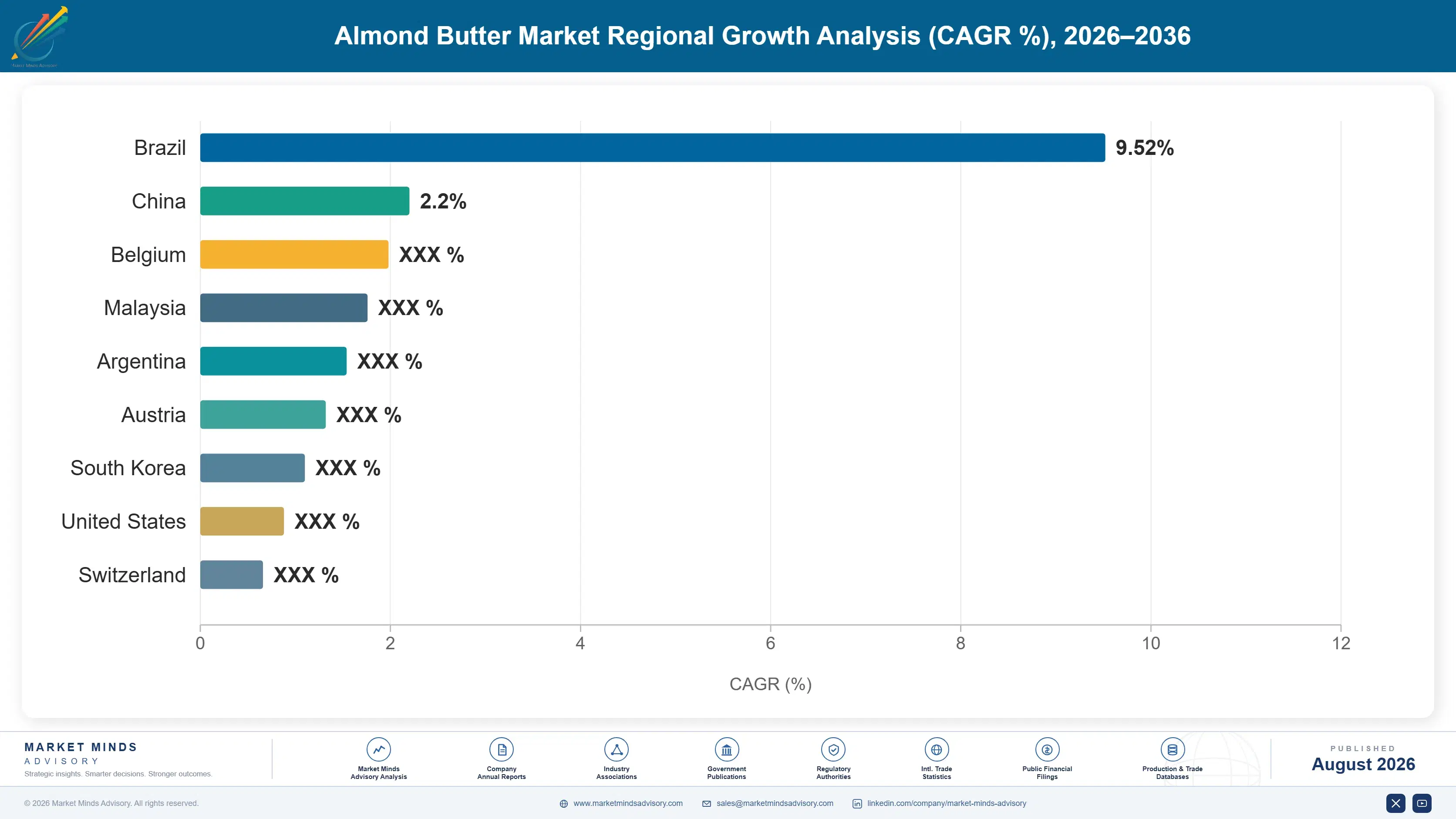
China's Rapidly Expanding Western-Style Snacking Category

China's rapidly growing interest in Western-style health snacking is pulling almond butter into urban retail and e-commerce channels faster than any other market tracked, as domestic consumers increasingly associate the product with premium, imported-style nutrition positioning. International brands have expanded distribution and e-commerce partnerships with Chinese retailers to capture this demand ahead of domestic manufacturers building comparable production capability of their own. This driver is measurable in import volume growth consistently outpacing overall Chinese packaged food category growth across recent reporting periods, a gap that continues widening each successive year.
Market Impact: Cuts branded margin 130 basis points

Market Restraints and Challenges

California Almond Price and Water Scarcity Exposure

Almond butter manufacturers depend almost entirely on California-grown almonds, a supply base exposed to recurring drought conditions and tightening agricultural water allocation policy that has driven meaningful kernel price volatility over the past several growing seasons. The root cause is the category's near-total geographic concentration in a single growing region rather than diversified sourcing typical of other tree nut categories. The commercial impact shows up as margin compression for manufacturers unable to pass through higher almond costs to price-sensitive grocery shoppers quickly. Larger manufacturers are mitigating exposure through multi-year grower contracts that smaller regional brands cannot always secure.
Market Impact: Adds 11.0% protein format segment growth

Private Label Price Pressure on Branded Margins

Grocery retailers have expanded own-brand almond butter lines priced meaningfully below branded competitors, capturing volume from shoppers who see limited difference between private label and branded classic formulations for a category with relatively simple ingredient lists. The root cause is almond butter's low technical differentiation ceiling in its classic format, since private label processors can replicate quality closely using the same almond supply base. The commercial impact shows up as margin compression for branded manufacturers defending shelf space through promotional spending. Branded players are mitigating exposure by shifting toward protein-enriched and flavored formats private label has been slower to replicate.
Market Impact: Adds 8.4% portable format segment growth
3 additional market trends, 2 additional growth drivers, and 4 additional restraints and challenges are covered in the full report. Contact sales@marketmindsadvisory.com to access the complete intelligence.

Segment CAGR and Growth Architecture

MMA segments the almond butter market by product formulation rather than by sales channel, since dietary formulation, not where a jar is sold, drives the cost structure and margin differences that separate classic recipes from protein-enriched, flavored, and organic variants competing for the same shopper occasion across grocery, natural foods, and e-commerce channels today.
almond-butter-market-2024-2034-trends-market-share-analysis-1787462072943

Flavored and Protein-Enriched Almond Butter

Flavored and protein-enriched almond butter is the fastest-growing segment, pulled by fitness-oriented snackers and flavor-seeking shoppers who want familiar clean-label taste without settling for classic, unflavored formulations. Justin's and several premium brands added protein-fortified and flavored variants including chocolate, vanilla, and honey since 2024, and packaged retail brands quickly followed with shelf-stable versions using whey, pea, or collagen protein blends. The segment commands a meaningful price premium over classic recipes, since fortification and flavoring add real ingredient cost that manufacturers pass through to less price-sensitive shoppers. Demand concentrates in North America, where gym culture and flavor-forward snacking trends run deepest, though the format is beginning to appear in premium retail across urban China and other emerging markets as well.
CAGR 11.0%

Squeeze-Pack and Portable Almond Butter

Squeeze-pack and portable almond butter is the second-fastest segment, benefiting from consumer demand for mess-free, spoon-free formats that fit lunchboxes, gym bags, and travel occasions traditional jars cannot serve well. Once Again Nut Butter and similar manufacturers built dedicated squeeze-pack production lines separate from standard jar filling, since portable formats require different packaging equipment and shelf-life engineering entirely. The segment also draws interest from parents seeking portion-controlled formats for children's lunches, widening its addressable base beyond adult snacking occasions alone. Growth concentrates in North America and Western Europe, where portable snacking culture and retail merchandising infrastructure for single-serve formats is most developed across major grocery chains and convenience retail channels alike.
CAGR 8.4%
Full segment breakdown across 6 segments available in the complete report.

Regional Architecture and Country Demand Map

Almond butter production and consumption concentrate overwhelmingly in North America given its direct tie to California almond supply, while China's rapidly growing Western-style snacking category is expanding faster than any other country tracked in this analysis across the full ten-year forecast period that lies ahead.

North America

The United States anchors both global almond butter production and consumption, given its near-total dependence on California-grown almonds and its decades-long head start building the category's clean-label identity through natural foods retail before mainstream grocery adoption. Justin's, Barney Butter, and Once Again Nut Butter all manufacture domestically, giving the region a direct cost and logistics advantage that import-dependent markets elsewhere cannot match. This region's modeled share sits well above the standard band used elsewhere in this report, reflecting that almond butter is fundamentally a North American category tied to a single dominant growing region rather than a globally distributed commodity. Protein-enriched and squeeze-pack reformulation is advancing fastest here too, tracking broader domestic fitness and portable snacking trends.
Share: 46% | CAGR: 7.6% (2026 to 2036)

Western Europe

The United Kingdom and Germany host the region's largest almond butter markets, with clean-label and organic positioning translating well to European shoppers already familiar with nut butter spreads through established peanut butter and hazelnut spread categories. Import dependence on California almonds remains total across the region, since no meaningful domestic almond cultivation exists at commercial scale. Private label penetration runs higher here than in North America, since European grocers have built sophisticated own-brand programs shoppers trust as closely comparable to branded recipes. Growth trails North America modestly since the region's category is already reasonably established across premium retail channels, leaving format innovation as the primary source of incremental volume going forward.
Share: 22% | CAGR: 5.5% (2026 to 2036)
Regional intelligence for 5 additional markets available in the complete report: East Asia, South Asia and Pacific, Latin America, Middle East and Africa, Eastern Europe. Contact sales@marketmindsadvisory.com.
almond-butter-market-2024-2034-trends-country-cagr-analysis-1787462073448

Format Innovation and Margin Defense Playbook

Almond butter manufacturers extract more value from a maturing category by shifting format and channel mix rather than competing purely on price against private label. The levers below concentrate on capturing premium formats, defending margin against almond price volatility, and building distribution in markets where the category remains comparatively underdeveloped relative to peanut and other nut butters.

Protein Fortification for Fitness Snacking Occasions

Manufacturers that added whey, pea, or collagen protein to almond butter recipes are capturing a shopper segment willing to pay a price premium of roughly 25 to 35% over classic recipes, since protein fortification directly addresses a specific dietary goal rather than pure indulgence. Justin's and several premium brands moved early on this reformulation, securing shelf presence before slower-moving competitors could respond to rising fitness snacking demand. Manufacturers without protein-enriched offerings increasingly lose fitness-oriented shoppers entirely to competitors, since these shoppers actively seek out the format by name at shelf.
Market Impact: Adds a 25 to 35% price premium overall

Squeeze-Pack Licensing for Portable Snacking Channels

Squeeze-pack and portable almond butter formats let manufacturers reach lunchbox, gym bag, and travel snacking occasions that traditional jarred formats cannot serve well, opening a distribution channel that classic packaging cannot reach at all. Once Again Nut Butter and similar manufacturers have built dedicated squeeze-pack production capability generating a meaningful 6 to 9% margin premium over standard jarred formats, since shoppers pay for convenience and portion control rather than negotiating purely on ingredient cost. Manufacturers without squeeze-pack capability are effectively locked out of this specific occasion regardless of how strong their classic jarred brand recognition already is.
Market Impact: Adds 6 to 9% portable format revenue share

Multi-Year Grower Contracts to Reduce Price Exposure

Manufacturers that lock in multi-year almond grower contracts rather than depending on spot market purchasing reduce their exposure to sudden California drought-driven price spikes that can strand smaller competitors mid-contract with retail customers. Building these grower relationships typically takes 3 to 5 years of consistent purchasing history to secure favorable multi-year pricing terms, but it lets a manufacturer maintain stable retail pricing when spot almond costs spike sharply. Manufacturers without secured grower contracts risk losing retail shelf contracts during price spike periods, since retailers cannot absorb sudden branded price increases easily.
Market Impact: Cuts input cost volatility by roughly 30% overall

Clean-Label Certification for Premium Retail Sets

Manufacturers that built dedicated single-ingredient, no-added-sugar product lines are winning placement in the fast-growing clean-label retail sets that most major grocery chains now merchandise separately from standard nut butter aisles, a placement standard formulated competitors cannot access without reformulation. Barney Butter and organic-focused brands that moved early captured shelf space in these sets before competitors could qualify, and clean-label set placement typically carries 15 to 20% less private label competition than standard aisles today. Manufacturers still absent from clean-label sets are increasingly invisible to the specific shopper segment actively searching that part of the store.
Market Impact: Wins 15 to 20% more clean-label set placement

Who Controls the Margin Pool

CR5 in almond butter sits near 36%, reflecting a category shaped by natural-foods heritage brands and packaged food conglomerates rather than a single dominant player. Justin's leads through Hormel's distribution scale, with Smucker's Santa Cruz Organic close behind through natural foods retail relationships, while the gap to smaller regional brands stays wide enough that consolidation looks likely as almond price volatility raises the capital bar.
Current competitive activity centers on three fronts: protein and flavor reformulation racing to capture fitness and snacking-occasion shoppers, squeeze-pack and portable format expansion into new consumption occasions, and multi-year grower contract securing to defend margin against almond price volatility. Larger manufacturers with reformulation and grower relationship capability are moving fastest on all three, while smaller regional brands without capital access risk losing both premium format placement and margin stability.

Emerging pressure comes from private label proliferation across North American and Western European grocery chains, where retailers increasingly view classic almond butter as easy to replicate at acceptable quality without licensing a branded recipe. China's rapidly growing category is also producing fast-growing domestic and international entrants building distribution ahead of full market maturity, positioning some to eventually challenge established Western brands as the category matures.
almond-butter-market-2024-2034-trends-company-positioning-matrix-1787462073962

Competitive Moat and Risk Dimensions

JUSTIN'S (HORMEL FOODS)

Moat: Natural Foods Brand Heritage Scale

Justin's natural-foods brand heritage combined with Hormel's national grocery distribution scale gives it shelf presence and consumer trust that newer entrants struggle to replicate quickly. This combination lets the brand command premium pricing while still reaching mainstream grocery shoppers beyond the natural foods aisle across nearly every major national retail account.
JUSTIN'S (HORMEL FOODS)

Risk: Premium Positioning Erosion Risk

Justin's premium positioning depends on maintaining meaningful differentiation from private label and mainstream competitors, and any perceived quality convergence could erode the price premium that currently supports its margin structure across grocery accounts nationwide, particularly as retailers continue expanding their own comparable clean-label private label offerings each year.
J.M. SMUCKER COMPANY (SANTA CRUZ ORGANIC)

Moat: Organic Certification and Retail Scale

Smucker's Santa Cruz Organic brand combines organic certification credibility with the company's broader grocery distribution infrastructure, letting it defend premium shelf space more effectively than smaller organic-focused competitors lacking comparable retail relationships and logistics scale across national accounts and regional distribution networks built up over decades.
J.M. SMUCKER COMPANY (SANTA CRUZ ORGANIC)

Risk: Portfolio Prioritization Risk

Santa Cruz Organic competes for capital and management attention within Smucker's much larger branded food portfolio, meaning almond butter-specific investment could lose priority against larger revenue categories elsewhere in the company's business during periods of constrained capital allocation across the wider organization and its many competing brands.

Players Tracked

Prominent Players

Justin's (Hormel Foods)
J.M. Smucker Company (Santa Cruz Organic)
Once Again Nut Butter
MaraNatha (Hain Celestial Group)
Barney Butter

Other Key Players

Woodstock Farms (Nature's Best)
Trader Joe's (private label)
Kirkland Signature (Costco)
Wild Friends Foods
RXBAR (Kellanova)
Artisana Organics
Nuttzo
Georgia Grinders
Fix & Fogg
NuttEase
Manilife
Pip & Nut
Meridian Foods
Whole Earth Brands
Rhythm 108

Recent Developments

MARCH 2025

Justin's Launches Protein-Enriched Almond Butter Line

Justin's launched a protein-enriched almond butter line across United States grocery chains, formulated with added whey protein and priced at a premium over its classic almond butter jars. The launch followed positive response to limited regional testing conducted during the prior year across select markets.
Signal: Confirms major almond butter brands are treating protein fortification as a mainstream growth strategy rather than a niche test.
AUGUST 2025

Once Again Nut Butter Expands Squeeze-Pack Production Capacity

Once Again Nut Butter expanded its dedicated squeeze-pack production capacity at its New York facility to meet rising demand for portable almond butter formats from both retail and foodservice customers. The expansion followed strong reorder rates from grocery partners that added the format over the prior year.
Signal: Confirms portable formats are becoming a durable distribution channel independent of traditional jarred retail sales nationwide.
JANUARY 2026

Barney Butter Signs Multi-Year California Grower Supply Agreement

Barney Butter signed a multi-year supply agreement with a consortium of California almond growers to secure pricing stability ahead of anticipated water allocation policy changes affecting the region. The agreement locks in a meaningful share of the company's annual almond kernel requirements at fixed pricing terms.
Signal: Signals manufacturers are proactively securing grower relationships well ahead of anticipated water policy disruption across the industry.

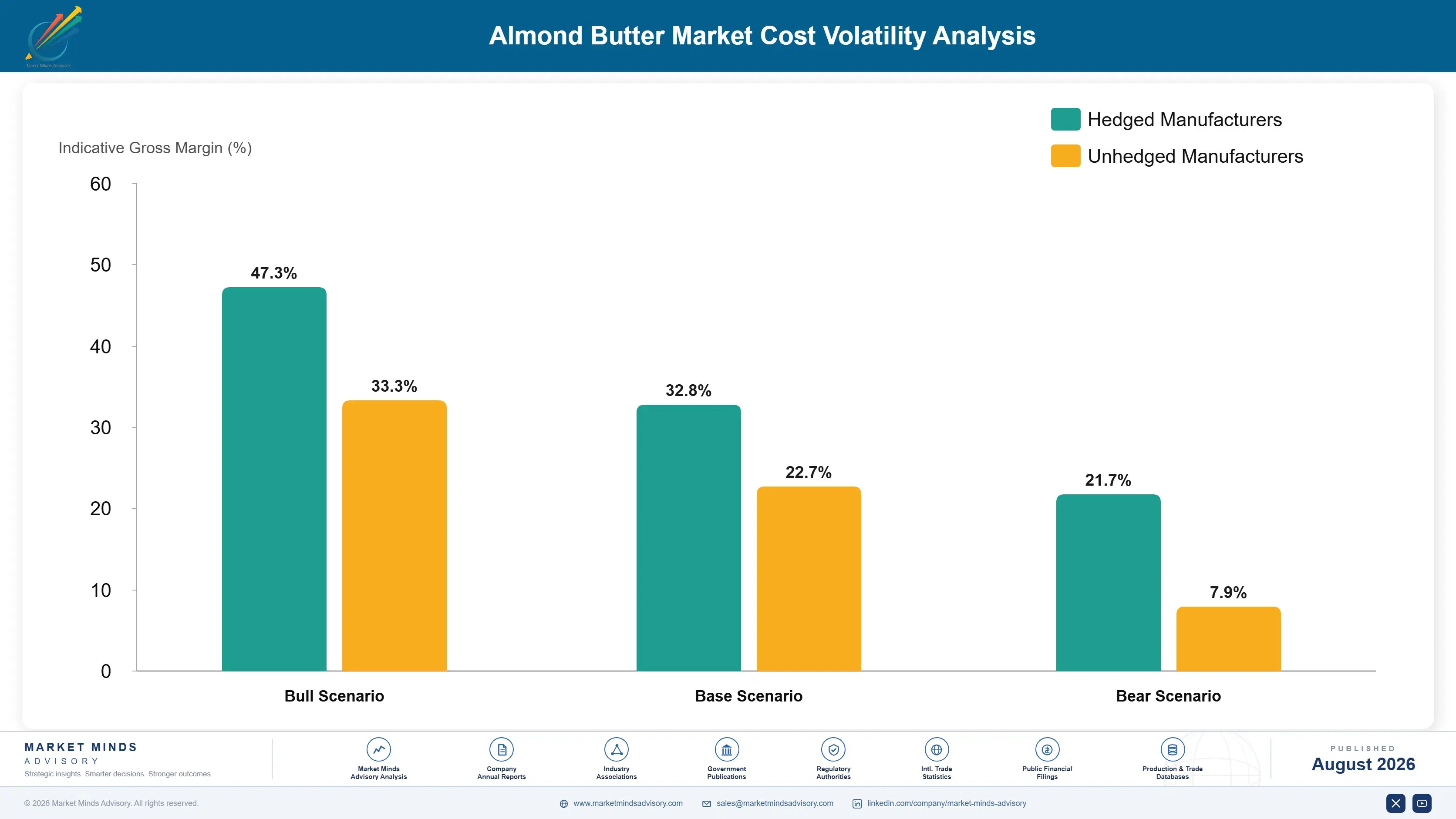
California Almond Kernel Cost Exposure

Raw almond kernel purchases account for roughly 58% of manufacturer cost of goods sold, sourced almost entirely from California growers whose pricing tracks water availability, weather conditions, and global almond export demand rather than domestic packaged food demand alone. This exposure sits meaningfully higher than in most packaged food categories, given the category's near-total dependence on a single geographic growing region worldwide.
California almond prices rose sharply following drought conditions and tightening agricultural water allocation policy across 2021 through 2023, with the USDA's agricultural market reports documenting sustained price volatility across that period as growers absorbed rising irrigation costs. Manufacturers without long-term grower contracts absorbed meaningfully higher per-pound kernel costs than competitors with existing multi-year supply agreements already in place well before the volatility began, according to company disclosures from the period.

Exposure varies sharply by manufacturer type: larger manufacturers with multi-year grower contracts and diversified purchasing relationships absorb volatility more evenly than smaller regional brands dependent on spot market purchasing. Private label processors with retailer-backed volume commitments often secure comparable grower terms to branded manufacturers, narrowing the cost advantage branded players might otherwise expect to hold consistently.
almond-butter-market-2024-2034-trends-cost-volatility-analysis-1787462074157

Multi-Year Grower Supply Contracts

Larger manufacturers increasingly lock in multi-year almond supply agreements directly with California growers, trading some pricing flexibility for predictable long-term input cost visibility across consecutive growing seasons. Smaller manufacturers without the volume commitments to negotiate multi-year grower terms remain more exposed to spot almond price spikes during periods of tight supply each growing season across the state.

Recipe Formulation Flexibility on Almond Content

Some manufacturers have built recipe flexibility that allows adjusting almond content ratios slightly based on relative kernel pricing without meaningfully affecting product taste or texture, reducing exposure to any single severe almond price spike. This flexibility requires meaningful formulation science investment but pays back through pricing resilience across volatile growing seasons and shifting commodity price cycles.

Diversified Product Mix Beyond Classic Formats

Manufacturers with diversified product mix across classic, protein-enriched, and flavored formats can shift promotional emphasis toward higher-margin formats when almond costs spike, protecting overall portfolio margin even as classic format profitability compresses. Manufacturers dependent entirely on classic formats lack this margin-shifting flexibility during cost spikes, leaving them more exposed to sustained input cost pressure each season.

Portfolio Architecture for Margin Defence

Almond butter portfolios split across three tiers with different margin economics: a volume tier built on classic packaged and private label recipes, a premium tier built on protein-enriched and flavored formats, and an emerging next-generation tier tied to regenerative agriculture and full traceability positioning that shoppers are only beginning to pay a defined premium for consistently.
The tension between volume and premium runs deep in how manufacturers allocate limited almond supply and reformulation capacity: every pound of almonds committed to premium reformulated output is a pound unavailable for classic recipe volume that still generates the bulk of category revenue today. Get the mix wrong and a manufacturer either misses premium demand or overcommits almond supply to specialty formats that outpace actual shopper willingness to pay.

High-value margin pools concentrate overwhelmingly in protein-enriched, flavored, and portable formats sold at retail price points well above classic jarred almond butter, not in private-label-adjacent classic packaging. Manufacturers that built reformulation and grower relationship capability early, Justin's and Barney Butter among them, now capture a share of total category profit well above their share of total volume sold each year.

Volume / Commodity-Adjacent Tier

Classic and private label almond butter sold through grocery retail on tight promotional pricing, competing primarily on shelf price and jar size rather than formulation differentiation or premium positioning across most accounts.
Gross Margin: 10-14%

Premium / Certified Tier

Protein-enriched, flavored, and organic almond butter sold at meaningful price premiums to fitness and clean-label shoppers through dedicated retail sets, commanding stronger margin through formulation differentiation and certification that private label cannot easily match.
Gross Margin: 22-28%

Sustainability / Regulatory / Next-Generation Tier

Regenerative-agriculture-certified and fully traceable almond butter aimed at shoppers and retailers with public sustainability positioning commitments, still a small volume tier but growing as water-use transparency expectations continue rising across major retail chains.
Gross Margin: 20-26%
almond-butter-market-2024-2034-trends-portfolio-architecture-1787462074651

High-value Sub-segments and Strategic Watch-out

Flavored and Protein-Enriched Almond Butter (High-Value, High-Growth)

Protein-enriched and flavored almond butter combines the fastest unit growth in the category with meaningfully above-average margins, making it the single most attractive segment for manufacturers with reformulation capability already in place. Demand continues to outpace available shelf space across most developed grocery markets tracked.
Gross Margin: 22-28%

Squeeze-Pack and Portable Almond Butter (High-Value, Moderate-Growth)

Portable formats carry better margin than classic jarred recipes and continue gaining distribution, though growth is more moderate than protein-enriched formats since it depends on dedicated packaging equipment investment that smaller manufacturers have been slower to commit to at meaningful national scale across every retail channel.
Gross Margin: 18-24%

Classic Almond Butter (Volume Core)

Classic almond butter remains the largest single format by unit volume and the backbone of manufacturer cash flow, even though margin sits well below the specialty tiers. Nearly every brand depends on this volume base to fund reformulation investment elsewhere in the broader portfolio each fiscal year.
Gross Margin: 10-14%

Private-Label-Adjacent Classic Jars (Strategic Watch-Out)

Branded classic almond butter sold in categories where private label quality has closed most of the perceived gap carries the thinnest margin in the portfolio, making it the segment most exposed to being displaced if retailers keep expanding own-brand programs further in the years ahead.
Gross Margin: 5-9%

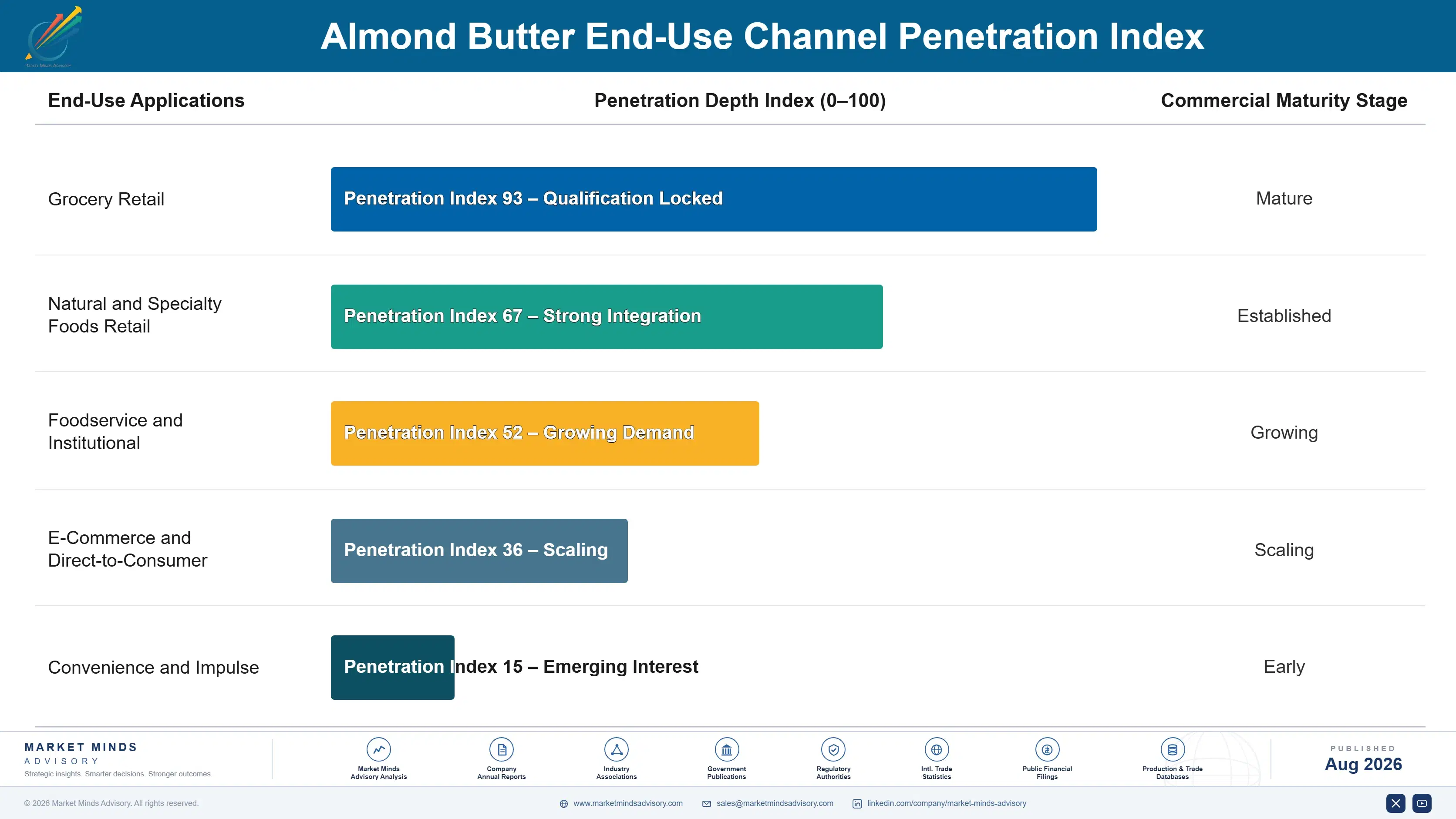
Occasion Habit and Format Switching

Almond butter demand runs more on repeat occasion habit than on formal contracts, since most volume moves through everyday grocery purchases rather than negotiated supply agreements typical of industrial food categories. Shoppers who buy almond butter as a breakfast or snacking habit tend to repurchase the same format regularly, giving manufacturers a meaningful base of predictable, low-churn demand once a shopper adopts the category into their routine.
Adoption depth varies sharply by shopper type: shoppers buying almond butter as a health-conscious staple show strong format loyalty and resist switching even when private label offers a lower price, while fitness-oriented protein snackers switch more readily toward whichever brand currently offers the strongest protein content or flavor variety at shelf. Parents buying portable formats for children's lunches, largely driven by convenience and portion control, show comparatively less brand loyalty than health-conscious adult shoppers.

A generational shift is underway among shoppers too: younger buyers increasingly treat almond butter as a functional snack tied to fitness or protein goals rather than pure clean-label positioning, rewarding manufacturers that reformulated early over those still positioning the product purely as a natural-foods classic from an earlier retail era.
almond-butter-market-2024-2034-trends-end-use-penetration-index-1787462075142

Where Almond Butter Margin Concentrates

These are among the four positions where our research anticipates prominent divergence between winners and laggards over the coming forecast period. Each is grounded in the demand model, the regulatory perimeter, and the announced capacity pipeline.
01 / REFORMULATION TIMING ADVANTAGE

Early protein and flavor movers now defend a durable shelf lead

Manufacturers that reformulated almond butter with added protein or flavor variants before competitors now hold shelf placement that later movers cannot quickly replicate, since retailers rarely displace an established reformulated item once shopper habit forms around it. This timing advantage matters more than raw brand heritage, because premium retail sets reward whichever product already occupies the position at shelf. Manufacturers without early reformulation now face a slower path back into these categories, even with meaningful new marketing investment behind a late entry.
02 / ALMOND PRICE EXPOSURE

Manufacturers without grower contracts face the sharpest margin risk

Manufacturers dependent on spot market almond purchasing face the sharpest exposure to sudden California drought-driven price spikes, since water allocation policy can tighten supply with limited advance warning across an entire growing season. This risk concentrates specifically among smaller regional brands lacking the purchasing scale to negotiate favorable multi-year grower contracts. Manufacturers that secured grower relationships early face meaningfully less margin disruption during price spike periods than those still dependent on spot purchasing for the bulk of their almond supply.
03 / REGIONAL GROWTH OPPORTUNITY

China is where the category's next wave of adoption is being built

China's rapidly growing interest in Western-style health snacking is pulling almond butter into urban retail and e-commerce channels faster than any other market tracked in this report. This growth reflects genuinely new category adoption rather than share shifting among already-established Western competitors fighting over an already mature, saturated shopper base. Manufacturers and distributors that build relationships in China now will be better positioned than those waiting for the shift to become obvious in import and retail sales data years from now.
04 / PRIVATE LABEL SUBSTITUTION RISK

Classic format brands face the sharpest private label substitution risk

Branded classic almond butter faces the sharpest private label substitution risk in the category, since the recipe's technical simplicity gives retailer own-brand processors little quality gap to close before shoppers stop paying a branded premium. This risk concentrates specifically in commodity-adjacent packaged retail rather than in reformulated premium tiers where private label has not meaningfully caught up. Manufacturers still depending heavily on classic recipe volume without reformulation face continued margin erosion as private label penetration keeps rising across major grocery chains.

Engagement Snapshot From the Field

A live engagement with an industry participant carrying material or product regulatory and market exposure ahead of a defining policy shift, showing how our research translates into a defensible multi-year portfolio strategy.
MARKET MINDS ADVISORY · CLIENT ENGAGEMENT SUMMARY
Almond Butter Producer Strategic Portfolio Review and Transition Roadmap 2026·Investment Scenario on Almond Butter Exposure Evaluation 2025-26
CLIENT PROFILE
The client is a mid-sized regional almond butter manufacturer producing classic packaged product for grocery retail across a single national market, with no reformulated product lines and no secured multi-year grower contracts. Revenue approached $95 million in the most recent fiscal year (client-reported, unverified by MMA), though margins had compressed steadily as national grocery chains expanded private label almond butter lines priced meaningfully below the client's branded packaged jars.
STRATEGIC CHALLENGE
The manufacturer had no protein-enriched or squeeze-pack product lines and no secured almond grower contracts, leaving it entirely exposed to both private label price pressure and spot market almond price volatility simultaneously. Leadership needed to decide which reformulation and grower relationship investments to prioritize given limited available capital, and how quickly competitors might close the same opportunity.
MMA APPROACH
MMA benchmarked the manufacturer's cost structure and margin against reformulated, grower-contracted peers, modeled the capital and timeline required for both squeeze-pack production capability and multi-year grower contract negotiation, and evaluated a phased sequencing that would let improved reformulated product margin help fund the grower contract negotiation process over time without straining existing working capital.
KEY FINDINGS
  1. The manufacturer's classic recipe portfolio faced the sharpest private label substitution risk in its core market, with retailer own-brand jars already capturing meaningful volume share.
  2. Spot market almond purchasing exposed the manufacturer to meaningfully higher per-pound kernel costs than competitors with existing multi-year grower supply agreements already in place.
  3. Protein-enriched reformulation required lower capital investment than squeeze-pack production capability, making it the faster near-term path to premium margin capture given constraints.
  4. Regional grocery chains confirmed interest in carrying a reformulated protein line from the manufacturer, representing a genuine near-term distribution opportunity competitors had not yet pursued.
CLIENT PROFILE
The client is a mid-sized regional almond butter manufacturer producing classic packaged product for grocery retail across a single national market, with no reformulated product lines and no secured multi-year grower contracts. Revenue approached $95 million in the most recent fiscal year (client-reported, unverified by MMA), though margins had compressed steadily as national grocery chains expanded private label almond butter lines priced meaningfully below the client's branded packaged jars.
STRATEGIC CHALLENGE
The manufacturer had no protein-enriched or squeeze-pack product lines and no secured almond grower contracts, leaving it entirely exposed to both private label price pressure and spot market almond price volatility simultaneously. Leadership needed to decide which reformulation and grower relationship investments to prioritize given limited available capital, and how quickly competitors might close the same opportunity.
MMA APPROACH
MMA benchmarked the manufacturer's cost structure and margin against reformulated, grower-contracted peers, modeled the capital and timeline required for both squeeze-pack production capability and multi-year grower contract negotiation, and evaluated a phased sequencing that would let improved reformulated product margin help fund the grower contract negotiation process over time without straining existing working capital.
KEY FINDINGS
  1. The manufacturer's classic recipe portfolio faced the sharpest private label substitution risk in its core market, with retailer own-brand jars already capturing meaningful volume share.
  2. Spot market almond purchasing exposed the manufacturer to meaningfully higher per-pound kernel costs than competitors with existing multi-year grower supply agreements already in place.
  3. Protein-enriched reformulation required lower capital investment than squeeze-pack production capability, making it the faster near-term path to premium margin capture given constraints.
  4. Regional grocery chains confirmed interest in carrying a reformulated protein line from the manufacturer, representing a genuine near-term distribution opportunity competitors had not yet pursued.
RECOMMENDED STRATEGY
Phase 1: Phase 1 (Year 1): Launch a protein-enriched almond butter line using existing production equipment, funding grower contract negotiation from improved reformulated product margin. Phase 2: Phase 2 (Years 2 to 3): Secure a multi-year almond grower supply agreement to stabilize input costs ahead of anticipated water allocation policy changes. Phase 3: Phase 3 (Years 3 to 4): Invest in dedicated squeeze-pack production capacity once reformulated margin gains have funded the required capital investment.
OUTCOME
Within two fiscal years, the manufacturer's protein-enriched line reached a meaningful share of total volume and secured a multi-year grower contract stabilizing almond input costs ahead of the original timeline (client-reported, unverified by MMA). The phased approach let the business diversify without straining working capital, positioning it for premium retail placement it could not have pursued previously.

Frequently Asked Questions

Foundational context covering the market sizes, CAGR, scope, country, region and competition that inform every finding below. This section is provided to cover basics and most often pre-purchase conversations, answered from the MMA Primary Research Dataset.

What is the current size of the Almond Butter Market?

The global almond butter market was valued at approximately $2.4 billion in 2025. This covers classic, protein-enriched, flavored, and organic almond butter sold through retail and foodservice channels globally.

How large will the Almond Butter Market be by 2036?

MMA projects the market will reach approximately $5.1 billion by 2036, up from roughly $2.6 billion in 2026. That represents an expansion multiple of about 1.96 times over the ten-year forecast period.

What is the CAGR for the Almond Butter Market 2026 to 2036?

The base case CAGR is 7.0% annually, with a bull scenario near 8.3% and a bear scenario near 5.7%. This range reflects sensitivity to California almond price volatility and reformulation pace.

Which segment is growing fastest?

Flavored and protein-enriched almond butter is the fastest-growing segment, expanding at roughly 11.0% annually, about 1.6 times the overall market's pace. Squeeze-pack and portable formats follow at approximately 8.4% annually.

Who are the major companies in the Almond Butter Market?

Leading players include Justin's (Hormel Foods), Smucker's Santa Cruz Organic, Once Again Nut Butter, MaraNatha (Hain Celestial Group), and Barney Butter. Together these five hold an estimated 36% combined market concentration today.

Which country is growing fastest?

China is the fastest-growing national market, expanding near 9.6% annually as Western-style health snacking spreads through urban retail. Australia follows as a smaller but meaningfully growing regional producer and market.

Report Segmentation Architecture

The full report scope spans multiple orthogonal segmentation dimensions, with cross-tabulated demand data provided for each dimension pair. Coverage extends further to regional breakdowns, trend trajectories, and the competitive detail needed to support segment-level decision-making.

By Product Formulation

  • Classic Almond Butter
  • Flavored Almond Butter
  • Protein-Enriched Almond Butter
  • Organic Almond Butter
  • Squeeze-Pack and Portable Almond Butter
  • Crunchy and Textured Almond Butter

By End-Use Channel

  • Grocery Retail
  • Natural and Specialty Foods Retail
  • Foodservice and Institutional
  • E-Commerce and Direct-to-Consumer
  • Convenience and Impulse

By Commercial Dimension

  • Branded Packaged Goods
  • Private Label
  • Direct Foodservice Supply
  • Export and Cross-Border Trade

By Region

  • North America
  • Western Europe
  • East Asia
  • South Asia and Pacific
  • Latin America
  • Middle East and Africa
  • Eastern Europe

Scope, Methodology, and Coverage

Every figure in this report is reproducible from documented input assumptions. The scope below maps the historical period, the forecast horizon, the segmentation dimensions, and the countries covered, alongside the underlying primary and qualitative methodology.
Historical Period
2020 to 2025
Forecast Period
2026 to 2036
Base Year
2025 (USD billions; MMA Primary Research Dataset, August 2026)
Market Definition
This report defines the almond butter market as packaged retail and foodservice almond butter sold globally, across classic, flavored, protein-enriched, organic, and portable format variants. It excludes other tree nut and seed butters, almond milk, and almond flour or other non-butter almond products.
Quantitative Units
USD billions (current prices); metric tonnes product weight where cited
Segmentation Dimensions
By Product Formulation; By End-Use Channel; By Commercial Dimension; By Region
Regions Covered
North America, Western Europe, East Asia, South Asia and Pacific, Latin America, Middle East and Africa, Eastern Europe
Countries Covered
USA, China, Germany, France, UK, Japan, South Korea, India, Australia, Canada, Brazil, Mexico, Indonesia, Vietnam, Thailand, Malaysia, UAE, Saudi Arabia, South Africa, Nigeria, Turkey, Poland, Netherlands, Italy, Spain, Sweden, Switzerland, Argentina, Colombia, Singapore, and additional markets relevant to this sector
Key Companies Profiled
Justin's (Hormel Foods), J.M. Smucker Company (Santa Cruz Organic), Once Again Nut Butter, MaraNatha (Hain Celestial Group), Barney Butter, Woodstock Farms (Nature's Best), Trader Joe's (private label), Kirkland Signature (Costco), Wild Friends Foods, RXBAR (Kellanova), Artisana Organics, Nuttzo, Georgia Grinders, Fix & Fogg, NuttEase, Manilife, Pip & Nut, Meridian Foods, Whole Earth Brands, Rhythm 108
Quantitative Methodology
Primary survey, n=3,800 respondents, Q4 2025, six countries; demand-side model with trade association cross-validation
Qualitative Methodology
47 expert interviews, Q4 2025; applied to validate demand model assumptions, identify emerging dynamics, and assess competitive positioning
Report Format
PDF and XLSX data workbook (Word format preview document)
Publisher
Market Minds Advisory
Report Code
MMA-2026-AGR-107
Published
August 2026
Contact
sales@marketmindsadvisory.com | www.marketmindsadvisory.com

Purchase the full Almond Butter Market Report (2026 to 2036).

The full Almond Butter Market report delivers detailed sizing and forecasts across all six product-formulation segments, all seven world regions, and twenty profiled companies through 2036. It includes granular regional data tables, competitive benchmarking on a consistent retail volume basis, and input cost sensitivity modeling tied to California almond markets. Subscribers receive access to the underlying primary survey dataset (n=3,800 respondents, Q4 2025, six countries) and qualitative expert interview findings (n=47 interviews, Q4 2025). The report also includes segment-level margin analysis and a portfolio tiering framework analysts can apply directly to company assessments.
Full segmentation across six product-formulation categories
Seven-region market sizing with growth forecasts
Twenty-company competitive benchmarking on consistent basis
Input cost sensitivity modeling tied to almond markets
Access to primary survey dataset of 3,800 respondents
Portfolio tiering framework for margin benchmarking

Built For The People Who Decide

From boardroom strategy to bench-side execution, this report is read cover-to-cover by leaders shaping the next decade of their industry, turning demand scenarios, market dynamics and valuation benchmarks into decisions.
CXOs/ Presidents/ VPs/ Managers
M&A and Corporate Development
Strategy Teams and R&D Heads
Procurement and Product Directors
Regulatory and Compliance Leaders
Investor Relations and Equity Analysts