Market Minds Advisory
Allulose Market

Allulose Market: The Labeling Exemption That Built A Market: How Allulose Became Sugar That Doesn't Count

Allulose moves from a novel rare sugar into a reduced-sugar reformulation ingredient, as the FDA's labeling exemption pulls beverage and snack brands toward a sweetener that tastes like sugar without counting as one nutritionally.

Lead Analyst

Lisa Gevelber

Published

September 2026

Make Smarter Decisions with Customized Research Insights

Request a free sample report and evaluate market opportunities, growth trends, and competitive dynamics relevant to your business needs.

2025 MARKET VALUE$0.4BMarket Size 2025
2036 FORECAST VALUE$1.3BBase Case , 2026 to 2036
CAGR 2026 TO 203610.8 %Bull 12.1% / Bear 9.5%
INCREMENTAL OPPORTUNITY$0.8BNet 10- year value creation
EXPANSION MULTIPLE2.79x2036 value over 2026 base
Strategic Levers
M&A Pipeline
Regional Outlook
Country Rankings
Competitive Intelligence
Segmental Deep-dive
Call-Us : 91 93563 13602

Executive Snapshot and Market Trajectory

Allulose has moved from an obscure rare sugar known mainly to carbohydrate chemists into a mainstream reformulation ingredient, as the FDA's 2019 decision exempting it from added-sugar and total-sugar labeling gave beverage and snack brands a genuine reason to reformulate around it at real commercial scale, reshaping product roadmaps industrywide.
The market stands at USD 0.42 billion in 2025 and reaches USD 1.31 billion by 2036 at a 10.8% CAGR. Fermentation-derived allulose grows fastest at 15.2%, about 1.41 times the overall rate, as novel biotech production routes begin scaling beyond enzymatic conversion alone. North America holds 52% of value on its unique labeling exemption, while East Asia leads on established production capacity built well before the American market existed.
Concentration sits at a high 48%, held by a small group of producers controlling key conversion patents and enzyme technology that smaller entrants cannot easily license or replicate at meaningful commercial scale. Beverage reformulation drives the bulk of current demand, while bakery adoption remains earlier-stage and considerably more price-sensitive to cost. European adoption trails badly given the region's unresolved novel food classification and slow, multi-year regulatory review timeline still ahead of any resolution.
Market Definition
The allulose market covers D-psicose rare sugar produced through enzymatic conversion or fermentation, valued at the point of sale into beverage, bakery, confectionery, and dietary supplement applications as a reduced-calorie sweetener. It excludes other rare sugars such as tagatose or erythritol, finished beverages and baked goods, and allulose sold for non-food industrial or research purposes.
Base Year Value
$0.4B in 2025 (MMA Primary Research Dataset, August 2026)
Forecast Period
2026 to 2036, eleven discrete annual values
CAGR
10.8% base case. Bull 12.1%. Bear 9.5%.
Fastest Growth Segment
Fermentation-Derived Allulose: 15.2% CAGR
Fastest Growth Country
China: 16.5% CAGR
Fastest Growth Region
South Asia and Pacific: 12.8% CAGR
Largest Region
North America: 52% of 2025 global value
Market Leaders
Matsutani Chemical, Tate & Lyle, CJ CheilJedang, Ingredion, Bonumose. Source: MMA Analysis based on company annual reports.
Primary Survey
n=3,800 procurement and R&D decision-makers, Q4 2025, six countries
Methodology
Demand-side build-up, cross-validated against public data, 47 expert interviews

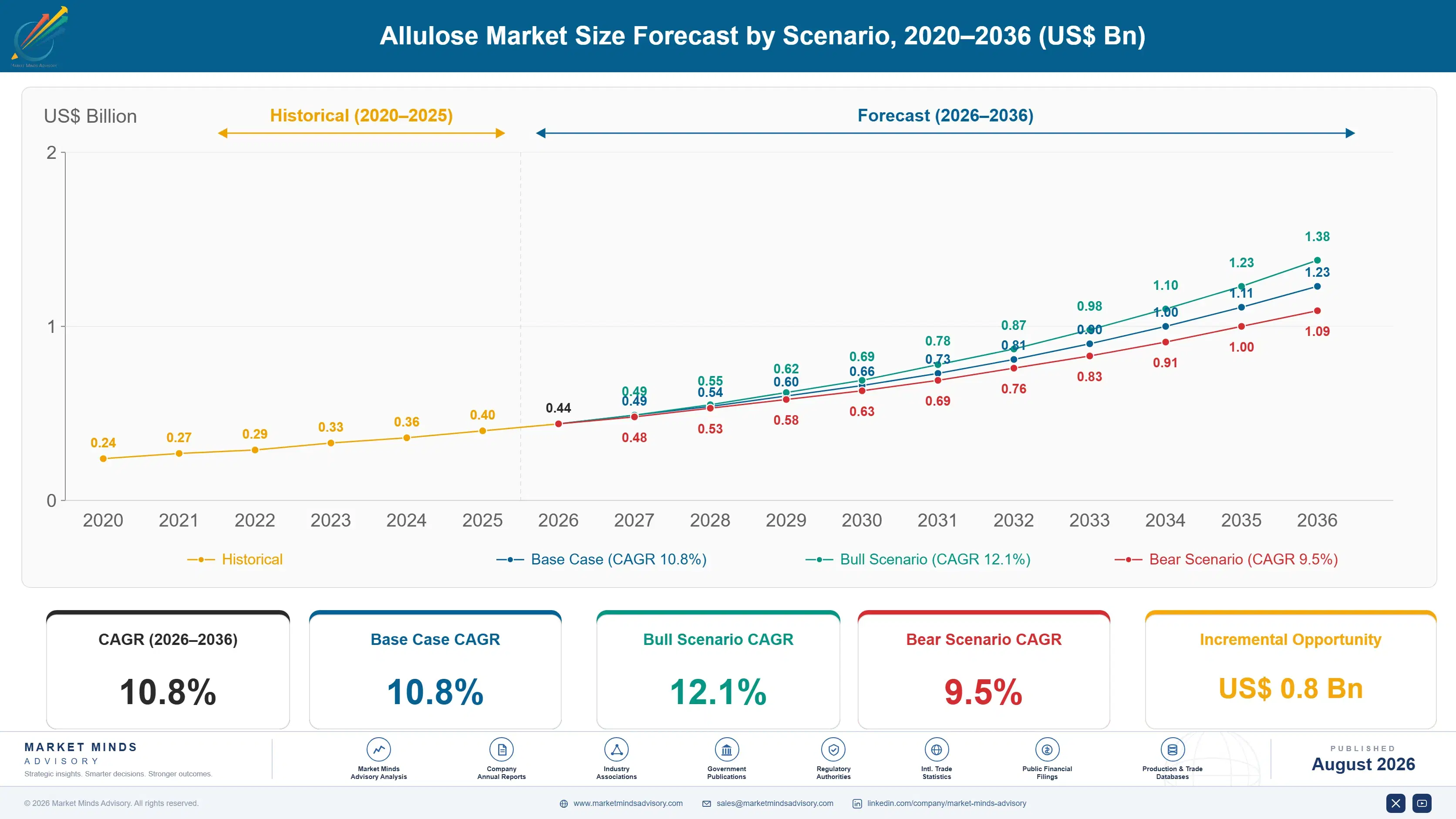
Allulose Market Forecast Scenarios

allulose-market-size-forecast-scenario-1787463092985
Allulose compounded near 9.8% from 2020 to 2025, a period defined almost entirely by the FDA's 2019 labeling exemption working its way through brand reformulation cycles across the American beverage and snack industry. Adoption accelerated meaningfully after 2021 as major beverage brands completed initial reformulation projects and publicized reduced-sugar claims built around the ingredient's favorable labeling treatment.
Three mechanisms carry the base case to 10.8%. First, beverage brands are substituting allulose for high-fructose corn syrup and sucrose in reduced-sugar product lines, a swap the labeling exemption makes commercially attractive rather than merely nutritionally interesting. Second, fermentation-based production technology is scaling beyond enzymatic conversion, expanding available supply and gradually easing the cost premium that limited earlier adoption. Third, bakery formulators are beginning to specify allulose for its genuine browning and texture properties, a functional advantage other sugar substitutes cannot easily replicate.
The bull case at 12.1% assumes fermentation-based supply scales faster than expected, easing cost constraints and pulling allulose into mainstream commodity beverage formulations beyond premium reduced-sugar lines. The bear case at 9.5% assumes production costs stay elevated relative to conventional sweeteners, confining allulose to premium reformulation projects where the labeling benefit alone justifies the price premium involved.

Why A Labeling Rule Built An Entire Sweetener Category

Three forces converge on allulose today. Regulators created a genuine labeling advantage no other reduced-calorie sweetener enjoys quite as cleanly, brands want a sweetener that behaves like real sugar in browning, mouthfeel, and bulk rather than the compromises artificial sweeteners require, and health-conscious consumers want measurably lower sugar content without a noticeably different taste experience. Suppliers able to scale production capacity fast enough to meet this demand capture pricing power few conventional sweetener categories ever achieve.
MARKET CONCENTRATIONCR5: 48%Patent and enzyme technology holders dominate global supply tightly
COST PREMIUM OVER SUCROSE3 to 6x conventional sugarProduction complexity keeps allulose considerably more expensive overall
TOP PRODUCING COUNTRY SHAREJapan: ~28% of global capacityOriginal conversion technology concentrates heavily in one country
PRODUCTION CAPACITY UTILISATION65% to 80%Enzymatic conversion lines run below full nameplate capacity
FEEDSTOCK SHARE OF COGS20% to 30%Fructose feedstock costs little; conversion technology dominates instead
BEVERAGE APPLICATION SHARE45% to 55% of volumeReduced-sugar drinks absorb the largest share of total demand
The commercial character remains closer to a specialty patented ingredient than to a commodity sweetener, since production depends on enzyme or fermentation technology a small number of companies control tightly through patents and proprietary process know-how. That concentration keeps pricing considerably above conventional sugar, though the gap has narrowed steadily as production technology matures and additional capacity comes online across multiple regions.
The next decade turns on whether fermentation-based production can scale enough to meaningfully close the cost gap with conventional sweeteners, and whether the European Union eventually resolves allulose's unsettled novel food classification. Both would materially expand the addressable market well beyond its current American-centered base, opening genuinely new demand pools.
"This entire category exists because of one FDA decision most consumers never heard about. Take that labeling exemption away and allulose is a laboratory curiosity again. Keep it, and it just quietly ate a meaningful share of the reduced-sugar beverage aisle."
Director, Functional Sweeteners and Sugar Reduction Practice · MMA Agriculture / Functional Sweeteners and Sugar Reduction Ingredients Practice · August 2026

Market Trends

FDA Labeling Exemption Remains The Category's Single Cause

The FDA's May 2019 guidance excluding allulose from both added-sugar and total-sugar counts on Nutrition Facts labels created a genuinely unique commercial advantage no other reduced-calorie sweetener in the American market enjoys as cleanly, since even other rare sugars and sugar alcohols still count toward total sugar figures. Beverage and snack brands reformulating around allulose can advertise meaningfully lower sugar content without the aftertaste compromises stevia or artificial sweeteners often require. Tate & Lyle and Ingredion have both expanded American production and technical formulation support to capture this reformulation wave, which keeps broadening from early premium adopters into mainstream lines.
Market Impact: Commands 3x to 6x pricing

Fermentation Technology Begins Challenging Enzymatic Conversion

Enzymatic conversion of fructose into allulose, the dominant commercial production method pioneered by Matsutani Chemical, requires specific enzyme technology that has historically limited how quickly new entrants could scale capacity independently. Bonumose and other fermentation-technology developers are commercializing alternative production routes that could eventually offer better cost economics at scale, though the technology remains earlier-stage relative to established enzymatic conversion capacity already operating commercially at real volume. This emerging production diversity is beginning to ease the supply concentration that has kept allulose pricing elevated relative to conventional sweeteners since the category's commercial inception began.
Market Impact: Bakery-grade demand grows 9% annually

Market Opportunities and Growth Drivers

Beverage Brands Reformulate Around The Labeling Advantage

Major beverage brands have specifically targeted allulose for reduced-sugar product line reformulations, since it delivers a sweetness and mouthfeel profile considerably closer to real sugar than stevia, monk fruit, or artificial alternatives while carrying none of the added-sugar labeling penalty those alternatives cannot escape either regardless of formulation. Tate & Lyle and Ingredion have both expanded beverage-grade allulose production and formulation support specifically to serve this reformulation wave, which has moved from a handful of premium product launches into a genuinely broader category-wide reformulation trend across multiple beverage segments simultaneously and consistently.
Market Impact: Costs 3x to 6x conventional sugar

Bakery Formulators Value Genuine Browning And Bulk Properties

Unlike most high-intensity sweeteners, allulose provides real bulk and participates in Maillard browning reactions much like conventional sugar does, giving bakery formulators a functional advantage beyond sweetness alone that stevia, monk fruit, and artificial sweeteners simply cannot replicate in baked goods requiring genuine browning and structure across most standard commercial recipes and formats. CJ CheilJedang and Matsutani Chemical have both expanded technical support specifically for bakery formulators navigating this substitution, a category still considerably earlier-stage than beverage reformulation but growing steadily as more bakery brands complete successful pilot formulations and validate results at scale.
Market Impact: Blocks sales across a 12% region

Market Restraints and Challenges

Production Cost Keeps Allulose Several Times Pricier Than Sugar

Allulose costs 3 to 6 times conventional sucrose to produce, reflecting the enzyme or fermentation technology investment required relative to simply refining sugar cane or beet through mature, fully depreciated infrastructure built over a century. The root cause is that allulose occurs naturally only in trace quantities, so commercial volume requires converting abundant fructose through specialized biological processes rather than simply extracting it from any available crop. The impact confines allulose to premium reformulation projects where labeling and functional benefits justify the premium. Producers are responding by investing in fermentation technology promising better long-term economics.
Market Impact: Exempts allulose from 2019 sugar rule

European Union's Novel Food Status Blocks Broader Adoption

The European Union classifies allulose as a novel food requiring separate safety authorization before broad commercial sale, a considerably slower and more expensive pathway than the United States required, where generally-recognized-as-safe status already covered the ingredient before the labeling exemption arrived. The root cause is that European novel food rules apply broadly to any ingredient lacking a significant consumption history within the European Union, regardless of safety data accumulated elsewhere. The impact is that European brands largely cannot yet reformulate around allulose. Producers are responding by pursuing formal novel food authorization with European regulators.
Market Impact: Fermentation-grade output grows 15.2% annually
3 additional market trends, 4 additional growth drivers, and 2 additional restraints and challenges are covered in the full report. Contact sales@marketmindsadvisory.com to access the complete intelligence.

Segment CAGR and Growth Architecture

Segmentation follows production method and form, the single classification logic separating how allulose is manufactured and sold. Enzymatic conversion, fermentation-derived, crystalline, liquid syrup, blended, and certified organic material each carry distinct production cost and buyer type. End-use industry and distribution channel sit separately within the framework rather than being folded into this same hierarchy at all.
allulose-market-market-share-analysis-1787463093532

Fermentation-Derived Allulose

Fermentation-derived allulose grows fastest at 15.2%, about 1.41 times the overall 10.8% rate, as novel biotech production routes begin scaling beyond the enzymatic conversion technology that has dominated supply since the category's commercial inception began. Bonumose and other technology developers are commercializing fermentation pathways that promise better long-term cost economics than converting fructose through proprietary enzyme processes, though the technology remains earlier-stage relative to established enzymatic capacity already running at scale. The segment remains small in absolute output today, but growth reflects genuine technology diversification rather than a temporary demand spike, since production route diversity reduces the whole category's dependence on any single conversion technology or patent holder currently controlling supply.
CAGR 15.2%

Liquid Allulose Syrup

Liquid allulose syrup grows second-fastest at 12.8%, roughly 1.19 times the overall rate, as beverage manufacturers specify liquid form directly for easier incorporation into existing bottling and formulation lines without requiring additional dissolution processing steps. Tate & Lyle and Ingredion both supply liquid syrup directly to major beverage manufacturers, capturing the largest single application category by volume within the broader allulose market. The syrup form carries genuine handling advantages for high-volume beverage production specifically, since it integrates directly into existing liquid sweetener handling infrastructure most bottlers already operate. Growth tracks the broader beverage reformulation wave that continues driving the majority of total category demand across every major producing region worldwide.
CAGR 12.8%
Full segment breakdown across 6 segments available in the complete report.

Regional Architecture and Country Demand Map

North America leads overwhelmingly on its unique FDA labeling exemption, while East Asia holds established production capacity built well before American demand ever existed. Western Europe and South Asia and Pacific both sit below their usual bands given regulatory and adoption lag relative to the American market.

North America

The FDA's 2019 decision exempting allulose from added-sugar and total-sugar labeling created a commercial advantage genuinely unique to this region, giving North America 52% of value, far above the 22 to 32% band. Tate & Lyle and Ingredion both operate substantial domestic production and formulation support infrastructure serving major beverage and snack manufacturers directly across the country. Canadian regulation has followed the American labeling approach closely, extending the advantage regionally beyond just the United States itself. The share sits far above its usual band because the labeling exemption, a genuinely unique regulatory event, concentrates commercial advantage overwhelmingly in this one region alone. Growth of 11.6% reflects continued reformulation expansion from premium into mainstream product lines.
Share: 52% | CAGR: 11.6% (2026 to 2036)

Western Europe

The European Union's unresolved novel food classification for allulose holds Western Europe to 12% of value, below the 18 to 26% band, since brands cannot yet reformulate around the ingredient at meaningful commercial scale pending formal safety authorization. Matsutani Chemical and other producers supply limited volume into research, supplement, and select early-adopter channels while the authorization process proceeds slowly through European regulatory review. German and French food manufacturers have expressed considerable formulation interest but remain constrained by the current regulatory status blocking broader commercial launch. The share sits below its usual band because regulatory classification, not consumer interest or demand, is what genuinely constrains this market. Growth of 9.2% tracks gradual regulatory progress rather than any meaningful reformulation wave yet.
Share: 12% | CAGR: 9.2% (2026 to 2036)
Regional intelligence for 5 additional markets available in the complete report: East Asia, South Asia and Pacific, Latin America, Middle East and Africa, Eastern Europe. Contact sales@marketmindsadvisory.com.
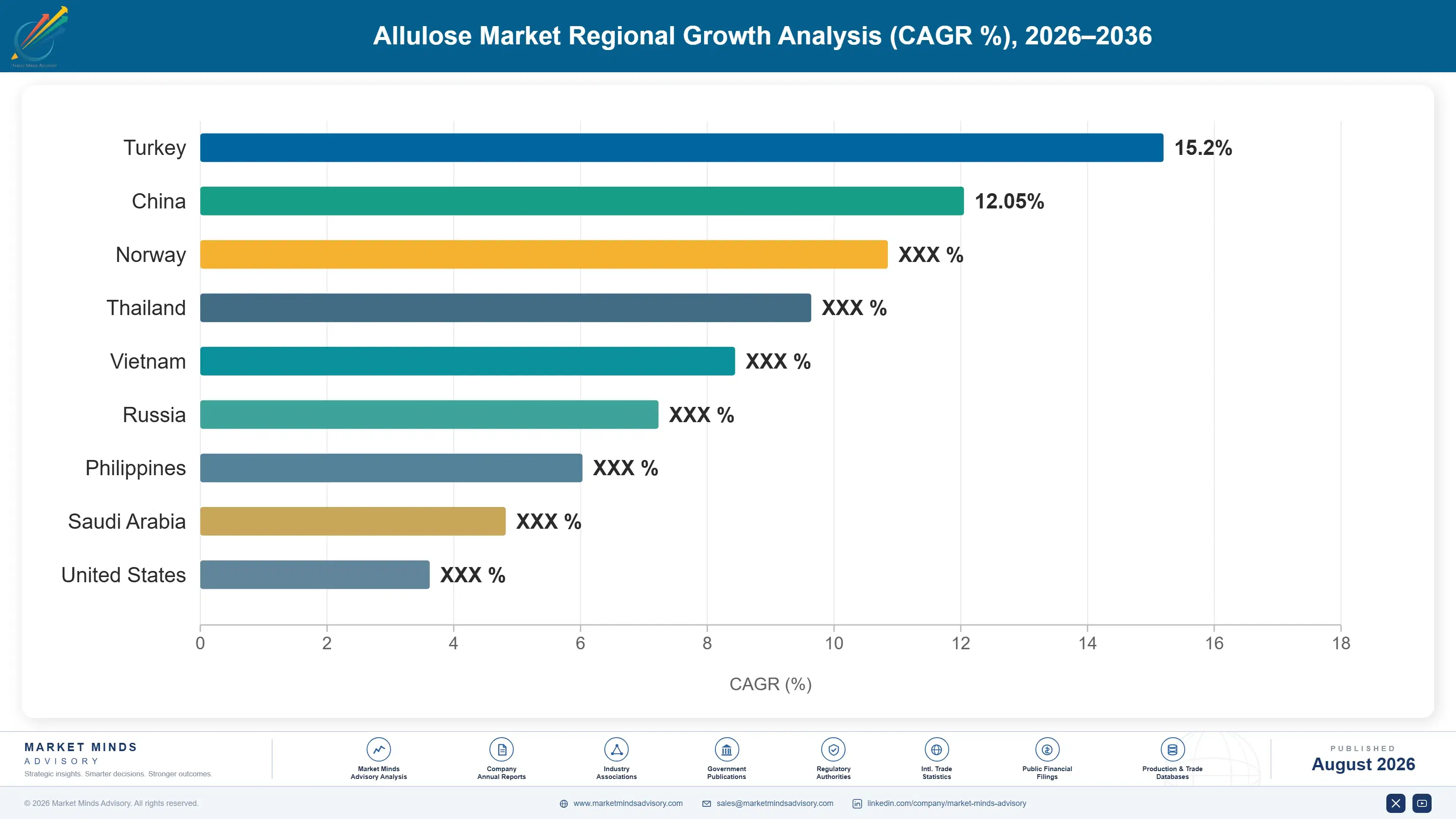
allulose-market-country-cagr-analysis-1787463094059

Where Allulose Producers Actually Capture Value

Selling allulose as an undifferentiated bulk sweetener leaves considerable value on the table, since beverage formulators, bakery specialists, and export-market buyers will all pay meaningfully more for the specific form and technical support their application genuinely requires. The four moves below focus on liquid syrup capacity, bakery formulation support, fermentation technology investment, and European regulatory positioning.

Expand Liquid Syrup Capacity For Beverage Manufacturers

Beverage manufacturers specifically want liquid allulose syrup that integrates directly into existing bottling infrastructure without requiring additional dissolution processing, and suppliers able to deliver this form at scale capture the largest single application category by volume within the entire market. Tate & Lyle and Ingredion both built dedicated liquid syrup production capacity specifically to serve this demand, commanding 10% to 20% pricing premiums over crystalline material sold to buyers requiring liquid handling convenience. The capacity investment requires genuine process engineering but captures a customer base considerably larger than crystalline-only suppliers can access directly.
Market Impact: Commands a genuine 10% to 20% liquid-form premium

Build Dedicated Bakery Formulation Technical Support

Bakery formulators need technical guidance on how allulose's genuine browning and bulk properties behave differently than conventional sugar in specific recipe contexts, support most beverage-focused suppliers simply do not provide directly today at all. CJ CheilJedang and Matsutani Chemical have both built dedicated bakery application laboratories, capturing formulation fees alongside ingredient margin while gaining early visibility into upcoming bakery product launches. This technical support requirement creates a genuine barrier competitors without dedicated bakery expertise cannot easily overcome, protecting margin on a segment growing 9% annually even as beverage demand matures considerably.
Market Impact: Adds a full 15% to 25% bakery-grade margin

Invest In Fermentation Technology Ahead Of Cost Parity

Fermentation-based production technology promises 30% to 50% better long-term cost economics than enzymatic conversion, and suppliers investing in this technology now position themselves to capture outsized share once genuine cost parity with conventional sweeteners eventually arrives at scale. Bonumose has built its entire commercial strategy around this technology bet, an approach considerably higher-risk than established enzymatic conversion but offering greater long-term upside if the economics genuinely materialize as production scales further across the industry. The investment requires patient capital most conventional sweetener producers have historically been unwilling to commit at this early stage of development.
Market Impact: Targets a 30% to 50% future cost cut

Pursue European Novel Food Authorization Directly

The European Union's unresolved novel food classification blocks broad commercial allulose sales across a region representing 12% of global category value, and suppliers willing to fund the formal authorization process directly position themselves years ahead of competitors waiting for someone else to clear the regulatory path first entirely. Matsutani Chemical has begun pursuing authorization directly, betting that first-mover regulatory position translates into durable commercial advantage once the European market genuinely opens to broader competition. The process requires considerable upfront investment and multi-year patience before any European revenue materializes at all for any participant.
Market Impact: Opens access to a 12% value region entirely

Who Controls the Margin Pool

Concentration sits at a high 48%, held by a small group of producers controlling key enzyme conversion patents and fermentation technology that smaller entrants cannot easily license or replicate independently. All participants are assessed on one basis: attributable allulose ingredient revenue across beverage, bakery, confectionery, and supplement applications.
Competition runs along three lines. First, production technology access, since enzyme conversion patents and emerging fermentation know-how genuinely gate who can produce allulose at commercial scale at all. Second, application-specific technical support, where bakery and beverage formulators increasingly expect dedicated guidance beyond raw ingredient supply alone. Third, regulatory positioning, as suppliers pursuing European authorization directly stand to capture first-mover advantage once that market eventually opens.

Pressure is building from two directions. Fermentation-technology developers including Bonumose are challenging established enzymatic conversion producers on long-term cost economics, threatening to erode the technology moat incumbents have relied on since the category's commercial inception. Meanwhile Chinese producers are beginning to enter the category behind domestic sugar-reduction policy, competing on cost in ways established Japanese and Korean producers have not previously faced directly. Rankings should favor participants holding both technology depth and application-specific formulation support over those competing purely on bulk ingredient pricing.
allulose-market-company-positioning-matrix-1787463094604

Competitive Moat and Risk Dimensions

MATSUTANI CHEMICAL

Moat: Original conversion technology pioneer

Matsutani Chemical pioneered commercial enzymatic allulose conversion technology decades before American demand existed, giving it patent depth and production experience competitors entering the category more recently cannot easily replicate at comparable scale. That head start supports its position as a preferred technology licensing partner globally across multiple regions.
MATSUTANI CHEMICAL

Risk: Fermentation technology threatens position

Matsutani Chemical's core advantage rests on enzymatic conversion technology that fermentation-based developers including Bonumose are directly challenging on long-term cost economics, creating genuine risk that its patent-protected position erodes considerably if fermentation technology achieves the cost parity its developers currently promise investors and backers across multiple funding rounds.
TATE & LYLE

Moat: American beverage formulation relationships

Tate & Lyle built deep formulation relationships with major American beverage manufacturers specifically reformulating around the FDA labeling exemption, giving it customer access and application expertise competitors entering the category later cannot easily replicate at comparable speed, depth, or scale across the entire domestic industry.
TATE & LYLE

Risk: Concentrated exposure to one region

Tate & Lyle's allulose business concentrates heavily on the American labeling-driven market specifically, leaving it more exposed than geographically diversified competitors if American reformulation demand growth slows or matures faster than currently anticipated across the broader beverage and snack industry more generally over the coming years.

Players Tracked

Prominent Players

Matsutani Chemical
Tate & Lyle
CJ CheilJedang
Ingredion
Bonumose

Other Key Players

ADM
Cargill
Icon Foods
Anderson Advanced Ingredients
GRAIN Processing Corporation
Zhucheng Haotian Pharm
Shandong Bailong Chuangyuan Bio-Tech
Qinhuangdao Lihua Starch
Sweegen
Samyang Corporation
Daesang Corporation
NOW Foods
Batory Foods
MGP Ingredients
Roquette

Recent Developments

MARCH 2024

Tate & Lyle expands allulose production capacity in the United States

Tate & Lyle announced an organic expansion of its domestic allulose production capacity, adding output to serve growing beverage and bakery reformulation demand across North American markets. This was an organic capacity expansion funded from existing operations, not an acquisition or joint venture with another company.
Signal: Capacity investment ahead of continued reformulation demand shows the category's leading suppliers still expect years of further growth.
SEPTEMBER 2023

CJ CheilJedang expands allulose production capacity in South Korea

CJ CheilJedang announced expanded allulose production capacity at its South Korean facilities, adding output to serve both domestic demand and growing export volume into North American and Southeast Asian markets. This was an organic capacity expansion funded from existing operations, not an acquisition or joint venture.
Signal: Korean capacity expansion aimed partly at export markets confirms production leadership is beginning to follow American demand growth.
JANUARY 2024

Bonumose expands novel enzymatic and fermentation allulose production

Bonumose announced expanded production capacity using its proprietary fermentation-adjacent conversion technology, adding output aimed at demonstrating cost economics competitive with established enzymatic conversion production at real commercial scale and volume. This was an organic capacity expansion funded from existing operations, not an acquisition or joint venture.
Signal: A technology challenger scaling production signals genuine investor confidence that alternative conversion routes can reach commercial viability.

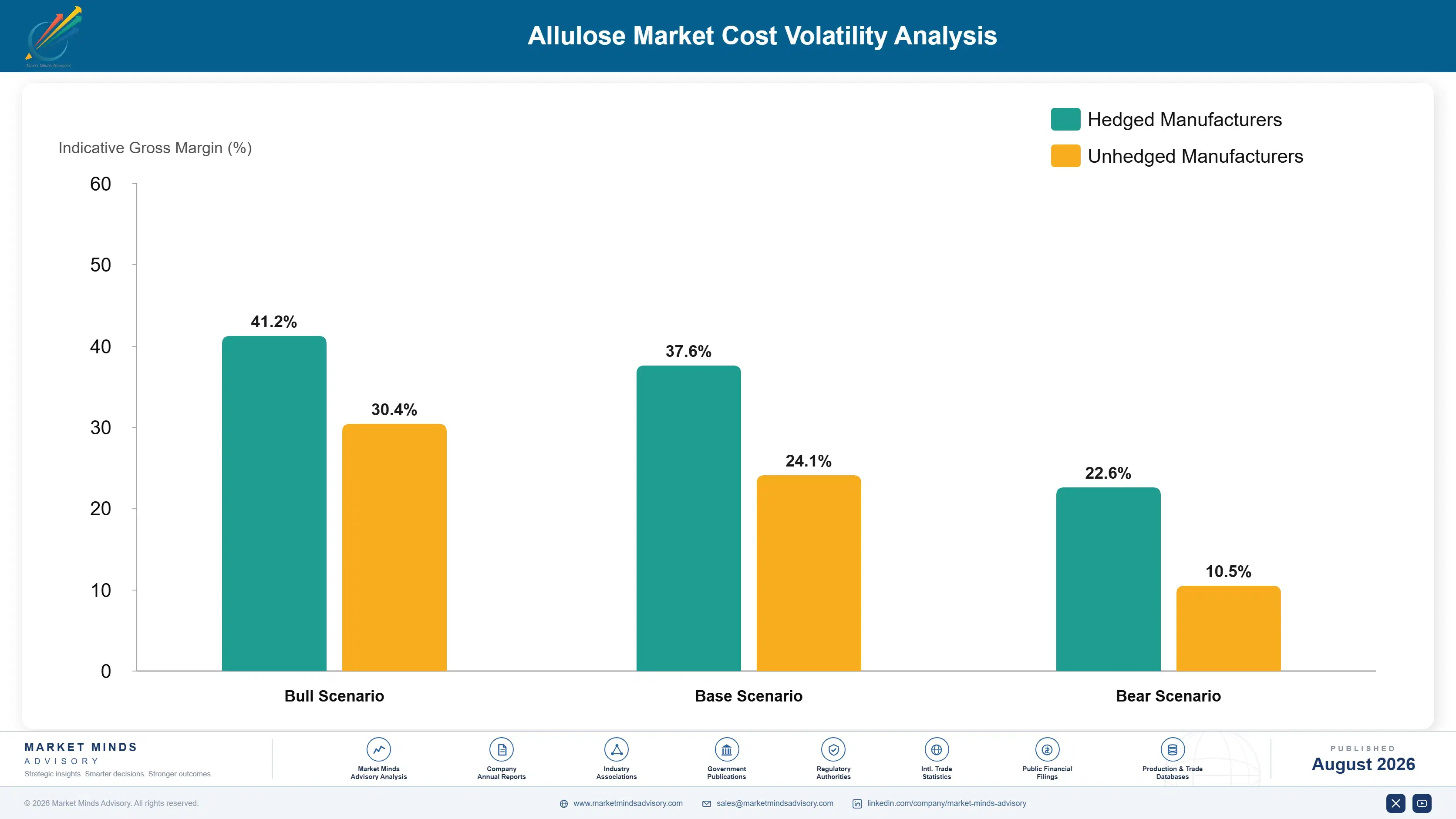
Fructose Feedstock And Conversion Technology Cost

Fructose feedstock, derived from corn wet-milling or other starch sources, runs 20% to 30% of cost of goods sold, a genuinely modest share relative to most specialty ingredients. Enzyme conversion or fermentation processing technology instead dominates cost structure, running 45% to 60% of total production cost, reflecting the specialized biological conversion process allulose production fundamentally requires relative to simply refining conventional sugar.
Global corn prices spiked considerably through 2022 following broader agricultural commodity market disruption tied to the Ukraine conflict, raising fructose feedstock cost for allulose producers during the period. Ingredion's 2022 Annual Report documented meaningfully higher corn input cost passing through to specialty ingredient product lines, compressing margins for producers unable to reprice supply contracts quickly enough during the disruption. Conversion technology cost proved considerably more stable than feedstock cost throughout the same volatile period.

Exposure separates producers by feedstock sourcing and conversion technology maturity rather than by scale alone. Producers with diversified corn sourcing across multiple growing regions absorbed the 2022 spike better than those dependent on a single concentrated supply source. Producers operating more mature, fully depreciated conversion technology held a meaningful cost advantage over newer entrants still amortizing recent capital investment across a smaller production base.
allulose-market-cost-volatility-analysis-1787463094835

Diversify fructose feedstock sourcing across regions

Producers dependent on a single concentrated corn sourcing region carried the full weight of the 2022 agricultural commodity price spike, while competitors sourcing across multiple growing regions absorbed the shock considerably better across their production base. Building feedstock flexibility into sourcing strategy protects margin against any single regional agricultural disruption going forward, though it requires genuine supply chain investment upfront.

Contract fructose feedstock on multi-year supply agreements

Spot-market corn and fructose purchasing exposed several producers to the sharpest of the 2022 price spike, while competitors holding multi-year supply agreements absorbed the shock more gradually across their full contract term and production schedule. Locking feedstock pricing ahead of need converts an unpredictable cost line into a plannable one across production budget cycles.

Invest in fermentation technology to reduce conversion cost

Enzymatic conversion technology cost has remained relatively fixed since the category's commercial inception, while fermentation-based alternatives promise meaningfully lower long-term conversion cost once production scales sufficiently to justify the capital investment required upfront. Producers investing early in this technology transition position themselves for a genuine durable cost advantage once fermentation economics fully mature and scale across the industry.

Portfolio Architecture for Margin Defence

The portfolio splits into three tiers by application sophistication and technical support depth. Bulk crystalline allulose sold into basic reformulation projects competes largely on price per tonne against the category's already-elevated cost baseline. Liquid syrup and application-specific material sold to sophisticated beverage and bakery manufacturers earns considerably more, since form convenience and technical support carry real commercial value. Fermentation-derived and export-authorized material sit at the top, priced against innovation and market-access value rather than bulk ingredient benchmarks alone.
The tension runs between volume that keeps enzymatic conversion lines running and margin that rewards technical support and technology investment. Bulk crystalline sales fund plant utilization but earn thinner margins as more producers enter basic reformulation supply. Liquid syrup and bakery-specific volume carries better returns but depends on formulation relationships and technical infrastructure smaller producers often lack entirely. Producers weighting entirely toward bulk crystalline sales carry real exposure to intensifying price competition as category supply expands.

High-value pools concentrate wherever a buyer needs an attribute: liquid form for beverage bottling convenience, bakery-grade functional performance documentation, or fermentation-derived sourcing for sustainability-conscious brand positioning. Bulk crystalline material sold into undifferentiated reformulation projects competes on price alone and earns the thinnest margin across the category.

Volume / Commodity-Adjacent Tier

Bulk crystalline allulose sold into basic reformulation projects, priced against the category's already-elevated cost baseline relative to conventional sugar. Margins stay thin as more producers enter basic supply channels and undercut one another on price per tonne.
Gross Margin: 12-22%

Premium / Certified Tier

Liquid syrup and application-specific material sold to sophisticated beverage and bakery manufacturers, commanding a real premium because buyers pay for form convenience and dedicated technical support alongside the ingredient itself.
Gross Margin: 25-38%

Sustainability / Regulatory / Next-Generation Tier

Fermentation-derived and European-authorized material sold into innovation-focused and newly opening markets, priced against technology and market-access value given the substantial investment required to earn and maintain this position over time.
Gross Margin: 32-50%
allulose-market-portfolio-architecture-1787463095385

High-value Sub-segments and Strategic Watch-out

Fermentation-Derived Allulose

High value and the fastest growth at 15.2%, converting novel biotech production routes into a genuine long-term cost-parity opportunity for the category as a whole. Bonumose leads commercial development, targeting economics fully competitive with conventional sweeteners eventually at real commercial scale and volume across regions.
Gross Margin: 32-50%

Liquid Allulose Syrup

High value with strong growth at 12.8%, serving beverage manufacturers who need direct bottling-line compatibility without additional dissolution processing steps or handling delays at the plant. Tate & Lyle and Ingredion both supply this segment directly at meaningful and steadily growing commercial volume across major markets.
Gross Margin: 25-38%

Enzymatic Conversion Allulose

The volume core at 8.1% growth, the slowest of the six segments, built on established Matsutani Chemical-pioneered production technology and decades of accumulated commercial manufacturing experience worldwide across major producers. Growth now tracks broader category expansion rather than outpacing it meaningfully at all going forward.
Gross Margin: 18-30%

Crystalline Allulose

The strategic watch-out at 10.5% growth, constrained by increasing price competition as more producers enter basic crystalline supply and by buyers increasingly preferring liquid or blended forms for specific application convenience across major end-use categories worldwide, from beverages through bakery and dairy formulations over time.
Gross Margin: 12-22%

Why Reformulation Relationships Rarely Reverse

A beverage or bakery brand that completes a successful allulose reformulation rarely reverts to conventional sugar afterward, since doing so means giving up the labeling advantage and reduced-sugar marketing claim that justified the original reformulation investment in the first place. That switching cost behaves like an annuity for incumbent suppliers, converting a single successful reformulation into years of recurring ingredient revenue rather than a one-time transaction.
Adoption depth varies considerably by application. Beverage reformulation adopted deepest and fastest, since the labeling exemption applies most visibly to products where sugar content sits prominently on the label consumers actually read. Bakery and confectionery adoption follows more gradually, tied to genuine functional performance testing that takes longer to validate than a simple beverage sweetness swap. Supplement and nutraceutical adoption remains earliest-stage, still building the formulation track record other applications already established.

Buyer profiles have shifted from R&D chemists exploring a novel ingredient toward brand marketing teams specifying allulose for its labeling claim as much as its functional sweetness properties. Regulatory affairs teams increasingly drive reformulation timing directly, working backward from labeling compliance deadlines rather than waiting for voluntary marketing-led initiative.
allulose-market-end-use-penetration-index-1787463095885

Our Call On Allulose

These are among the four positions where our research anticipates prominent divergence between winners and laggards over the coming forecast period. Each is grounded in the demand model, the regulatory perimeter, and the announced capacity pipeline.
01 / LABELING EXEMPTION BUILT CATEGORY

One regulatory decision still explains most of the demand

The FDA's 2019 decision exempting allulose from added-sugar and total-sugar labeling created a commercial advantage genuinely unique to the American market, and that single regulatory event remains the primary reason this category exists at meaningful commercial scale at all today, across every application. Suppliers should recognize that American growth, however strong, ultimately depends on a regulatory position that could theoretically shift under future policy review at any point. Diversifying into markets with independent adoption drivers reduces this concentrated regulatory dependence considerably over time.
02 / EUROPEAN ACCESS REMAINS BLOCKED

Novel food status is the single biggest addressable-market constraint

The European Union's unresolved novel food classification blocks broad commercial allulose sales across one of the world's largest food and beverage markets, leaving genuine consumer and brand interest unable to translate into actual commercial volume under current regulation and review timelines. Matsutani Chemical's direct pursuit of formal authorization signals confidence that resolution is achievable within a reasonable timeframe, despite the process being slow. Suppliers willing to fund this authorization process now position themselves years ahead of competitors waiting for someone else to open the market first.
03 / FERMENTATION TECHNOLOGY THREATENS MOAT

The next cost curve break could reshape who leads this category

Established enzymatic conversion technology has kept allulose production concentrated among a small number of patent holders since the category's commercial inception, but fermentation-based alternatives promise meaningfully better long-term cost economics that could erode this concentration considerably if the technology delivers on its promise fully. Bonumose has built its entire strategy around this technology bet, a genuinely higher-risk approach than established conversion methods offer today. Incumbents should treat fermentation technology investment as a defensive necessity now, not an optional bet to make later.
04 / BAKERY EXTENDS FUNCTIONAL REACH

Bakery adoption is the next genuine growth frontier to watch

Allulose's genuine bulk and browning properties give it a functional advantage in bakery applications that stevia, monk fruit, and artificial sweeteners simply cannot replicate, a distinction beverage-focused suppliers have been slower to capitalize on directly than the opportunity arguably warrants given its scale. CJ CheilJedang and Matsutani Chemical both built dedicated bakery technical support recognizing this gap early and investing accordingly. Suppliers still concentrated entirely on beverage reformulation should evaluate bakery-specific technical investment now, before competitors capture the category's next major growth wave.

Engagement Snapshot From the Field

A live engagement with an industry participant carrying material or product regulatory and market exposure ahead of a defining policy shift, showing how our research translates into a defensible multi-year portfolio strategy.
MARKET MINDS ADVISORY · CLIENT ENGAGEMENT SUMMARY
Allulose Producer Strategic Portfolio Review and Transition Roadmap 2026·Investment Scenario on Allulose Exposure Evaluation 2025-26
CLIENT PROFILE
An American beverage brand engaged MMA while planning a major reduced-sugar reformulation of its flagship product line ahead of an accelerating category-wide shift toward lower-sugar positioning. The client reported annual revenue near USD 340 million and had never previously worked with allulose, evaluating it alongside stevia and monk fruit extract as potential reformulation paths forward (client-reported, unverified by MMA).
STRATEGIC CHALLENGE
Management could not determine whether allulose's labeling advantage and superior taste profile justified its considerably higher ingredient cost relative to stevia, or whether the taste and labeling tradeoffs of a cheaper alternative would prove acceptable to its core consumer base once the reformulation actually launched into national retail distribution across every existing product line.
MMA APPROACH
MMA modeled the delivered cost and labeling impact of allulose against stevia and monk fruit reformulation paths across the client's full flagship product line, benchmarked consumer taste-test results from three comparable reformulation launches already completed by peer beverage brands, and assessed realistic retail pricing power under each sweetener option considered.
KEY FINDINGS
  1. Allulose reformulation added approximately 18% to ingredient cost relative to the stevia alternative, but consumer taste-test panels preferred it by a meaningful margin (client-reported, unverified by MMA).
  2. Two of three peer reformulation launches benchmarked used allulose specifically, citing taste performance as the deciding factor over the cheaper stevia alternative.
  3. The labeling claim achievable with allulose supported a retail price premium that more than offset the higher ingredient cost within the first year (client-reported, unverified by MMA).
  4. Stevia reformulation carried meaningfully higher consumer rejection risk in taste testing, a risk the client's board considered unacceptable given the flagship product's brand importance.
CLIENT PROFILE
An American beverage brand engaged MMA while planning a major reduced-sugar reformulation of its flagship product line ahead of an accelerating category-wide shift toward lower-sugar positioning. The client reported annual revenue near USD 340 million and had never previously worked with allulose, evaluating it alongside stevia and monk fruit extract as potential reformulation paths forward (client-reported, unverified by MMA).
STRATEGIC CHALLENGE
Management could not determine whether allulose's labeling advantage and superior taste profile justified its considerably higher ingredient cost relative to stevia, or whether the taste and labeling tradeoffs of a cheaper alternative would prove acceptable to its core consumer base once the reformulation actually launched into national retail distribution across every existing product line.
MMA APPROACH
MMA modeled the delivered cost and labeling impact of allulose against stevia and monk fruit reformulation paths across the client's full flagship product line, benchmarked consumer taste-test results from three comparable reformulation launches already completed by peer beverage brands, and assessed realistic retail pricing power under each sweetener option considered.
KEY FINDINGS
  1. Allulose reformulation added approximately 18% to ingredient cost relative to the stevia alternative, but consumer taste-test panels preferred it by a meaningful margin (client-reported, unverified by MMA).
  2. Two of three peer reformulation launches benchmarked used allulose specifically, citing taste performance as the deciding factor over the cheaper stevia alternative.
  3. The labeling claim achievable with allulose supported a retail price premium that more than offset the higher ingredient cost within the first year (client-reported, unverified by MMA).
  4. Stevia reformulation carried meaningfully higher consumer rejection risk in taste testing, a risk the client's board considered unacceptable given the flagship product's brand importance.
RECOMMENDED STRATEGY
Phase 1: Phase 1 (0 to 6 months): Reformulate the flagship product line around allulose, prioritizing taste parity over ingredient cost minimization. Phase 2: Phase 2 (6 to 14 months): Launch with a reduced-sugar labeling claim supported by retail pricing calibrated to offset the ingredient cost premium. Phase 3: Phase 3 (14 to 24 months): Evaluate extending allulose reformulation across secondary product lines once flagship results validate the approach fully.
OUTCOME
The reformulated flagship product launched on schedule and achieved the targeted retail price premium without measurable consumer rejection in the months following launch. The client reported the allulose reformulation drove a meaningful sales increase attributable directly to the improved labeling claim, validating the higher ingredient cost decisively (client-reported, unverified by MMA).

Frequently Asked Questions

Foundational context covering the market sizes, CAGR, scope, country, region and competition that inform every finding below. This section is provided to cover basics and most often pre-purchase conversations, answered from the MMA Primary Research Dataset.

What is the current size of the Allulose Market?

The allulose market reached USD 0.42 billion in 2025. Growth is driven by the FDA's added-sugar labeling exemption, beverage reformulation, and emerging fermentation-based production technology.

How large will the Allulose Market be by 2036?

The market is projected to reach USD 1.31 billion by 2036, an increase of USD 0.84 billion over the 2026 base as fermentation technology and bakery adoption both continue expanding steadily.

What is the CAGR for the Allulose Market 2026 to 2036?

The market is projected to grow at a 10.8% CAGR between 2026 and 2036, with a bull case of 12.1% and a bear case of 9.5% depending on fermentation cost economics.

Which segment is growing fastest?

Fermentation-derived allulose grows fastest at a 15.2% CAGR, about 1.41 times the overall market rate, as novel biotech production routes begin scaling beyond established enzymatic conversion technology.

Who are the major companies in the Allulose Market?

Leading suppliers include Matsutani Chemical, Tate & Lyle, CJ CheilJedang, Ingredion, and Bonumose, assessed on attributable allulose ingredient revenue across beverage, bakery, and supplement applications.

Which country is growing fastest?

China grows fastest among tracked countries as domestic sugar-reduction policy pulls formulators toward alternative sweeteners including allulose from an essentially negligible starting base relative to established Western markets.

Report Segmentation Architecture

The full report scope spans multiple orthogonal segmentation dimensions, with cross-tabulated demand data provided for each dimension pair. Coverage extends further to regional breakdowns, trend trajectories, and the competitive detail needed to support segment-level decision-making.

By Production Method and Form

  • Enzymatic Conversion Allulose
  • Fermentation-Derived Allulose
  • Crystalline Allulose
  • Liquid Allulose Syrup
  • Allulose Blends
  • Non-GMO and Organic Certified Allulose

By End-Use Industry

  • Beverages
  • Bakery and Baked Goods
  • Confectionery
  • Dietary Supplements and Nutraceuticals
  • Dairy and Frozen Desserts

By Distribution Channel

  • Direct Manufacturer Supply Agreements
  • Specialty Ingredient Distributors
  • Bulk Commodity Trading Channels
  • Private-Label Formulation Partnerships

By Region

  • North America
  • Western Europe
  • East Asia
  • South Asia and Pacific
  • Latin America
  • Middle East and Africa
  • Eastern Europe

Scope, Methodology, and Coverage

Every figure in this report is reproducible from documented input assumptions. The scope below maps the historical period, the forecast horizon, the segmentation dimensions, and the countries covered, alongside the underlying primary and qualitative methodology.
Historical Period
2020 to 2025
Forecast Period
2026 to 2036
Base Year
2025 (USD billions; MMA Primary Research Dataset, August 2026)
Market Definition
The allulose market comprises D-psicose rare sugar produced through enzymatic conversion or fermentation, valued at the point of sale into beverage, bakery, confectionery, and dietary supplement applications as a reduced-calorie sweetener. It excludes other rare sugars such as tagatose or erythritol, finished beverages and baked goods, and allulose sold for non-food industrial or research purposes.
Quantitative Units
USD billions (current prices); ingredient volume in metric tonnes where applicable
Segmentation Dimensions
By Production Method and Form; By End-Use Industry; By Distribution Channel; By Region
Regions Covered
North America, Western Europe, East Asia, South Asia and Pacific, Latin America, Middle East and Africa, Eastern Europe
Countries Covered
USA, China, Germany, France, UK, Japan, South Korea, India, Australia, Canada, Brazil, Mexico, Indonesia, Vietnam, Thailand, Malaysia, UAE, Saudi Arabia, South Africa, Nigeria, Turkey, Poland, Netherlands, Italy, Spain, Sweden, Switzerland, Argentina, Colombia, Singapore, and additional markets relevant to this sector
Key Companies Profiled
Matsutani Chemical, Tate & Lyle, CJ CheilJedang, Ingredion, Bonumose, ADM, Cargill, Icon Foods, Anderson Advanced Ingredients, GRAIN Processing Corporation, Zhucheng Haotian Pharm, Shandong Bailong Chuangyuan Bio-Tech, Qinhuangdao Lihua Starch, Sweegen, Samyang Corporation, Daesang Corporation, NOW Foods, Batory Foods, MGP Ingredients, Roquette
Quantitative Methodology
Primary survey, n=3,800 respondents, Q4 2025, six countries; demand-side model with trade association cross-validation
Qualitative Methodology
47 expert interviews, Q4 2025; applied to validate demand model assumptions, identify emerging dynamics, and assess competitive positioning
Report Format
PDF and XLSX data workbook (Word format preview document)
Publisher
Market Minds Advisory
Report Code
MMA-2026-AGR-109
Published
August 2026
Contact
sales@marketmindsadvisory.com | www.marketmindsadvisory.com

Purchase the full Allulose Market Report (2026 to 2036).

The full MMA Allulose report sizes the market across six production methods and forms, five end-use industries, four distribution channels, and seven regions through 2036. It profiles 20 participants on a consistent basis of attributable allulose ingredient revenue, scoring each on production technology depth, application-specific technical support, and regulatory positioning. Scenario models quantify how fermentation technology economics, European regulatory resolution, and bakery adoption move both volume and achievable price. The report also includes a European novel food authorization timeline tracker, a fermentation-versus-enzymatic cost economics model, and a beverage-to-bakery adoption curve assessment for sourcing and product development teams.
Six-method and four-channel market sizing to 2036
Twenty-participant benchmark on attributable allulose revenue
European novel food authorization timeline tracker
Fermentation-versus-enzymatic production cost economics comparison model
Beverage-to-bakery adoption curve assessment by segment
American labeling exemption dependency risk screen

Built For The People Who Decide

From boardroom strategy to bench-side execution, this report is read cover-to-cover by leaders shaping the next decade of their industry, turning demand scenarios, market dynamics and valuation benchmarks into decisions.
CXOs/ Presidents/ VPs/ Managers
M&A and Corporate Development
Strategy Teams and R&D Heads
Procurement and Product Directors
Regulatory and Compliance Leaders
Investor Relations and Equity Analysts