Market Minds Advisory
Allergen-Free Food Market

Allergen-Free Food Market: Segregation Economics, Precautionary Labelling, and the Sesame Rule That Backfired

Removing an allergen from a recipe is trivial; proving it is absent costs a dedicated line, a testing regime, and a certification audit, which is why free-from products still carry a substantial premium.

Lead Analyst

Lisa Gevelber

Published

September 2026

Make Smarter Decisions with Customized Research Insights

Request a free sample report and evaluate market opportunities, growth trends, and competitive dynamics relevant to your business needs.

2025 MARKET VALUE$62.8BMarket Size 2025
2036 FORECAST VALUE$137.7BBase Case , 2026 to 2036
CAGR 2026 TO 20367.4 %Bull 8.7% / Bear 6.1%
INCREMENTAL OPPORTUNITY$70.3BNet 10- year value creation
EXPANSION MULTIPLE2.04x2036 value over 2026 base
Strategic Levers
M&A Pipeline
Regional Outlook
Country Rankings
Competitive Intelligence
Segmental Deep-dive
Call-Us : 91 93563 13602

Executive Snapshot and Market Trajectory

The hard part of allergen-free food is not the recipe, it is the factory. Any formulator can remove wheat or milk from a product; proving the finished item is genuinely free of it requires segregated lines, validated cleaning, analytical testing, and a certification audit most contract manufacturers cannot pass.
Commercial power sits with manufacturers who own dedicated capacity rather than with brand owners who rent it. Only about a third of category output is made on allergen-segregated lines, which is why so many free-from products still carry precautionary cross-contact statements that undermine the claim. Egg-free grows fastest at 10.4%, roughly 1.41 times the market, on avian influenza price volatility and plant-based baking. East Asia holds 28% of value.
The category is barely concentrated, with the top five holding around 21% of value, because free-from began as a specialist niche and mainstream manufacturers arrived late. Regulation has expanded rather than settled: the American FASTER Act added sesame as a ninth major allergen from January 2023, and several bakers responded by adding sesame to products deliberately rather than managing cross-contact, which was not the intended outcome anywhere. Manufacturing economics beat regulatory intent every time.
Market Definition
This report covers packaged food and beverage products marketed with an explicit allergen exclusion claim, segmented by primary excluded allergen across gluten, dairy and lactose, tree nut and peanut, egg, soy, and other regulated allergens including sesame, fish, shellfish, and sulphites. Value is measured at retail sales value. Products that happen to be free of an allergen without making a claim, prescription medical foods, allergen testing services, and immunotherapy treatments fall outside scope.
Base Year Value
$62.8B in 2025 (MMA Primary Research Dataset, August 2026)
Forecast Period
2026 to 2036, eleven discrete annual values
CAGR
7.4% base case. Bull 8.7%. Bear 6.1%.
Fastest Growth Segment
Egg-Free: 10.4% CAGR
Fastest Growth Country
India: 10.1% CAGR
Fastest Growth Region
South Asia and Pacific: 9.4% CAGR
Largest Region
East Asia: 28% of 2025 global value
Market Leaders
Danone, Nestle, General Mills, Dr. Schar, Kellanova. Source: MMA Analysis based on company annual reports.
Primary Survey
n=3,800 procurement and R&D decision-makers, Q4 2025, six countries
Methodology
Demand-side build-up, cross-validated against public data, 47 expert interviews

Allergen-Free Food Market Forecast Scenarios

allergen-free-food-market-size-forecast-scenario-1787462248588
Growth between 2020 and 2025 came from mainstream adoption rather than from rising diagnosis. Gluten-free moved from pharmacy shelves into every major grocery format, and most buyers had no clinical need, which broadened the category while flattening its premium. Avian influenza outbreaks lifted egg costs and pushed bakers toward replacers. The 6.3% historical growth reflects distribution gains more than any change in underlying allergy prevalence.
The 7.4% base case rests on three mechanisms. Lactose-free dairy keeps expanding across East and South Asia, where intolerance prevalence runs far above Western levels and packaged dairy consumption is still rising. Egg replacement keeps gaining as avian influenza makes egg supply and pricing unreliable for industrial bakers. And regulatory expansion, notably sesame in the United States and continued scrutiny of precautionary labelling, keeps forcing reformulation and recertification cycles that favour manufacturers with dedicated capacity.
The 8.7% bull case assumes precautionary labelling reform gives properly segregated manufacturers a clear shelf advantage over hedged competitors. The 6.1% bear case reflects private label expansion compressing premiums, combined with oral immunotherapy adoption gradually reducing the number of households that must avoid an allergen absolutely. Labelling reform timing decides which case actually plays out in practice.

Why Cross-Contact Costs More Than Ingredients

Three forces shape this category and consumer preference is only the most visible. Clinical need sets a floor, since coeliac and severe allergy households have no alternative and buy regardless of price. Lifestyle adoption sets the volume, and those buyers are price-sensitive and easily lost to private label. Manufacturing capability then determines who serves the clinical buyer, because a precautionary statement makes a product unusable for the household that needs it most.
TOP-FIVE CONCENTRATION21%Share of global allergen-free packaged food value held collectively
AVERAGE PRICE PREMIUM43%Uplift over conventional equivalent products on comparable retail shelf
DEDICATED FACILITY SHARE34%Portion of output made in allergen-segregated production lines
COELIAC DIAGNOSIS RATE1.1%Share of population with confirmed clinical gluten intolerance
PRIVATE LABEL PENETRATION27%Retailer own-brand portion of free-from category shelf value
PRECAUTIONARY LABELLING INCIDENCE38%Products carrying advisory cross-contact statements despite exclusion claims
That produces an unusual split in commercial character. Mainstream manufacturers chase lifestyle volume while hedging their labels, and specialists with dedicated facilities serve the clinical segment at genuine premiums. The two groups compete for shelf space but not really for the same shopper. A parent buying for a child with anaphylactic peanut allergy reads the advisory statement first and the brand second, which no marketing budget overcomes.
The next decade turns on precautionary labelling reform. International work on allergen reference doses is pushing toward thresholds that would make advisory statements meaningful rather than defensive. If that lands, manufacturers with validated segregation gain a clear shelf advantage over those hedging, and the current situation where 38% of free-from products carry a cross-contact warning becomes commercially untenable.
"The sesame rule is the clearest case of regulation producing the opposite of its intent. Faced with a choice between segregating a line and adding sesame to the recipe, a striking number of bakers just added the sesame."
Director, Packaged Food and Specialty Nutrition Practice · MMA Packaged Food / Specialty Nutrition Practice · August 2026

Market Trends

Precautionary Labelling Faces Quantitative Threshold Reform

International expert consultation on allergen reference doses has produced eliciting dose thresholds intended to make advisory statements evidence-based rather than defensive, and Australian and New Zealand voluntary programmes already apply action levels derived from that work. Roughly 38% of free-from products currently carry a may-contain warning, which renders them unusable for clinically allergic households while protecting the manufacturer legally. Threshold-based labelling would separate manufacturers with validated segregation from those hedging, and reward dedicated capacity that presently earns no shelf advantage over a hedged competitor sitting beside it. Manufacturers hedging today would find the shelf reorganised around them.
Market Impact: Addresses 85% of adult population

Precision Fermentation Proteins Complicate Dairy-Free Claims

Animal-free whey and casein produced by precision fermentation deliver dairy functionality without a cow, and several American brands have commercialised them in ice cream and beverages. The regulatory position is awkward: because the proteins are molecularly identical to milk proteins, products must declare milk as an allergen despite containing nothing of animal origin. That satisfies vegan and sustainability buyers while excluding the dairy-allergic households the free-from aisle exists to serve. The distinction between dairy-free and lactose-free is now commercially material and poorly understood by most shoppers. Retail shelving has not yet caught up with the distinction at all.
Market Impact: Drives 10.4% egg-free growth

Market Opportunities and Growth Drivers

Lactose Intolerance Prevalence Drives Asian Dairy Reformulation

Lactase non-persistence affects the large majority of adults across East and Southeast Asia, and packaged dairy consumption in those markets has grown steadily as cold chain and modern retail expand. Chinese, Japanese, Korean, and Thai processors have built substantial lactose-free ranges as a result, treating it as a mainstream requirement rather than a specialist claim. Yili, Mengniu, and regional dairy groups now carry lactose-free variants across core lines. The commercial logic differs entirely from Western free-from marketing, because here the majority of the population is the target rather than a minority.
Market Impact: Limits output to 34% segregated

Egg Supply Volatility Pushes Industrial Bakers Toward Replacers

Repeated highly pathogenic avian influenza outbreaks have cut laying flocks across the United States, Europe, and Japan, sending egg prices to records and making supply unreliable for bakers, sauce manufacturers, and confectioners who need continuity. Plant protein, starch, and aquafaba-based replacers have moved from vegan specialty into industrial reformulation on cost and availability grounds alone. Once a manufacturer has validated a replacer and reformulated a line, reverting when egg prices normalise rarely happens. That ratchet effect is why egg-free grows at 10.4% while egg allergy prevalence has not moved. Allergy prevalence explains almost none of this particular growth.
Market Impact: Holds 27% of shelf value

Market Restraints and Challenges

Dedicated Facility Economics Exclude Most Contract Manufacturers

Genuine allergen segregation requires separate lines or entire plants, validated cleaning protocols, air handling separation, staff flow controls, and routine analytical verification, and the capital and operating burden excludes most contract manufacturers from serving the clinical segment at all. The root cause is that cross-contact happens at parts-per-million levels invisible to any visual inspection. Brands renting capacity therefore hedge their labels, which defeats the purpose. Participants respond by acquiring dedicated plants, by co-investing in segregated lines with contract partners, and by accepting lower utilisation in exchange for a defensible claim.
Market Impact: Affects 38% of category products

Private Label Expansion Compresses the Free-From Price Premium

Retailers across Europe and North America have built own-brand free-from ranges that now hold roughly 27% of category shelf value, and they price several points below branded equivalents on identical claims. The cause is that lifestyle buyers, who make up most of the volume, cannot distinguish between a certified brand and a retailer line on the shelf. Clinical buyers can and do, but they are a minority of transactions. Manufacturers respond by competing on certification depth, by supplying retailer ranges themselves, and by concentrating brand investment on multi-allergen products retailers find hardest to replicate.
Market Impact: Splits 8.6% dairy-free growth
3 additional market trends, 2 additional growth drivers, and 4 additional restraints and challenges are covered in the full report. Contact sales@marketmindsadvisory.com to access the complete intelligence.

Segment CAGR and Growth Architecture

Segmentation follows primary excluded allergen, the single logic that determines regulatory obligation, manufacturing separation requirement, reformulation difficulty, and which household buys the product. Products carrying several claims are assigned to the exclusion their positioning leads with. Product category, retail channel, and buyer type appear separately in the framework as commercial dimensions rather than parallel segments.
allergen-free-food-market-market-share-analysis-1787462249118

Egg-Free

Egg-free growth of 10.4%, roughly 1.41 times the market, has almost nothing to do with egg allergy prevalence, which has not changed. It is driven by supply economics: repeated avian influenza outbreaks have cut laying flocks across the United States, Europe, and Japan, sending prices to records and making continuity unreliable for industrial bakers, sauce makers, and confectioners. Plant protein, starch, and legume-based replacers entered those formulations on cost and availability grounds. The important commercial feature is that reformulation ratchets: once a manufacturer has validated a replacer, revalidated shelf life, and reprinted packaging, reverting when egg prices normalise almost never happens, which converts a price shock into permanent category volume.
CAGR 10.4%

Other Regulated Allergen-Free

This segment covers sesame, fish, shellfish, sulphites, mustard, celery, and lupin exclusions, and it grows at 9.7% principally because regulators keep adding to the list. The American FASTER Act made sesame the ninth major allergen from January 2023, and European Regulation 1169/2011 already covers fourteen. Each addition forces label changes, supplier declarations, and cross-contact assessment across affected lines. The sesame case is instructive and slightly absurd: facing a choice between segregating production and reformulating, a number of American bakers simply added sesame to products so it could be declared as an ingredient, which expanded rather than reduced exposure for allergic consumers. Regulators keep expanding the list, and each addition creates work the industry must absorb.
CAGR 9.7%
Full segment breakdown across 6 segments available in the complete report.

Regional Architecture and Country Demand Map

East Asia holds the largest share at 28%, reflecting lactase non-persistence across most of the adult population and rapid packaged dairy growth. North America follows on gluten-free depth and the widest allergen labelling regime, while South Asia and Pacific grows fastest. Western Europe is the most mature.

North America

This is the deepest gluten-free market anywhere and the one with the most active labelling regime. The FASTER Act added sesame as a ninth major allergen from January 2023, and the industry response, with a number of bakers adding sesame deliberately rather than segregating, became a case study in regulatory unintended consequence. Egg replacement has accelerated through repeated avian influenza outbreaks that cut laying flocks and sent prices to records. Certification programmes run by advocacy organisations carry real shelf weight with clinical buyers here, more so than in Europe. Private label free-from ranges have expanded quickly across the major grocers at 6.8% regional growth. Certification carries more shelf weight here than anywhere else.
Share: 27% | CAGR: 6.8% (2026 to 2036)

Western Europe

European labelling has been comprehensive for longer than anywhere else, with Regulation 1169/2011 requiring emphasis of fourteen allergens in ingredient lists across every member state. That maturity means the category grew earlier and now grows slower, at 5.9%, the lowest of any region. Free-from aisles are established in British, German, Italian, and Spanish grocery, and Italian coeliac reimbursement schemes support unusually high per-capita gluten-free spending. Dr. Schar built a dominant specialist position on dedicated manufacturing rather than on marketing. Private label penetration is the highest globally, which has compressed branded premiums considerably and pushed specialists toward multi-allergen products retailers find harder to copy. Certification depth is now the only defence against own-brand pricing.
Share: 22% | CAGR: 5.9% (2026 to 2036)
Regional intelligence for 5 additional markets available in the complete report: East Asia, South Asia and Pacific, Latin America, Middle East and Africa, Eastern Europe. Contact sales@marketmindsadvisory.com.
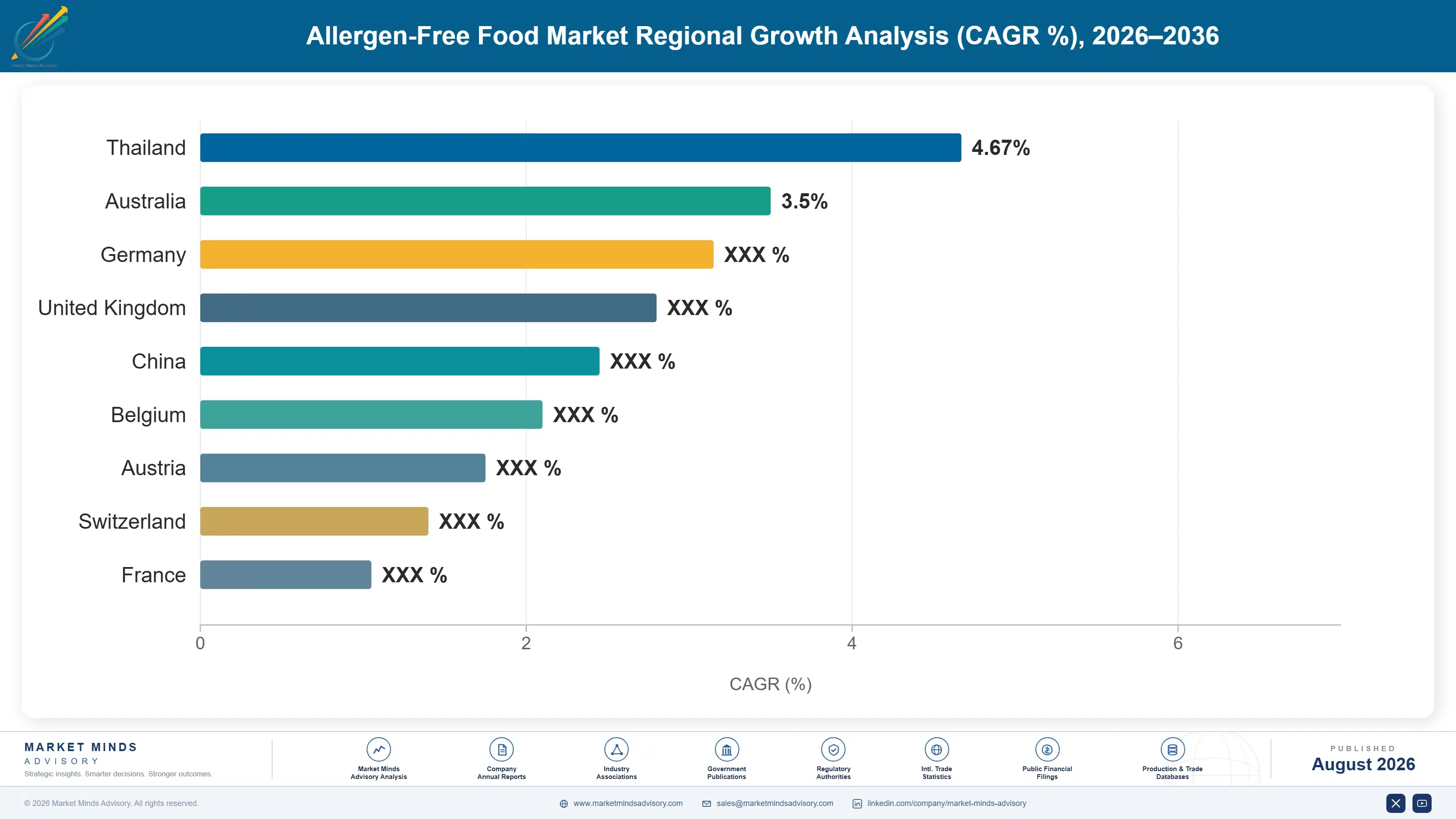
allergen-free-food-market-country-cagr-analysis-1787462249635

Where Allergen-Free Margin Actually Sits

Competing for lifestyle free-from volume against retailer own-brand is a race to a thin premium. The four moves below shift revenue toward buyers who cannot substitute: validated segregation that removes the advisory statement, multi-allergen formulation retailers struggle to copy, clinical channel positioning, and reformulation capability that turns supply shocks into permanent volume. None of the four needs new distribution.

Remove Precautionary Statements Through Validated Segregation

A may-contain warning makes a product unusable for the clinically allergic household, which is the buyer who pays full price and never trades down. Investing in dedicated lines, validated cleaning, air separation, and routine analytical verification costs roughly $6 million for a mid-sized plant and permits the claim to stand unhedged. Products without advisory statements command 18% to 26% above hedged equivalents on the same shelf. Around 38% of category products currently carry the warning, so the competitive gap is wide and most competitors cannot close it quickly. Utilisation falls while margin rises, which reads oddly internally.
Market Impact: Commands 18 to 26% above hedged shelf equivalents

Formulate Against Several Allergens at Once

A product free from gluten, dairy, egg, and nuts simultaneously serves households managing multiple diagnoses and is materially harder for a retailer to replicate under own brand, because the formulation and segregation demands compound rather than add. Multi-allergen products sustain premiums 30% to 40% above single-claim equivalents and face far less private label pressure. Development cost is higher and palatability is genuinely difficult, which is precisely the barrier. Households managing two or more allergies also buy across a whole basket rather than a single item, which raises the value of winning them.
Market Impact: Sustains a 30 to 40% higher shelf premium

Sell Through Clinical and Dietitian Referral Channels

Newly diagnosed coeliac and severe allergy households form purchasing habits within weeks of diagnosis and keep them for years, and the recommendation that shapes those habits usually comes from a dietitian or clinic rather than from advertising. Supporting patient organisations, funding dietitian education, and supplying hospital and clinic starter programmes costs perhaps $1.1 million annually and reaches buyers at the one moment they are genuinely choosing. Households acquired this way show retention roughly 3 times longer than those acquired through retail promotion alone. Retail promotion reaches these households far too late to matter.
Market Impact: Delivers roughly 3x longer average household retention rates

Build Replacer Capability Before the Next Supply Shock

Avian influenza has cut laying flocks repeatedly and egg prices have reached records more than once, and every industrial baker forced to reformulate mid-crisis kept the replacer afterwards because revalidating shelf life twice makes no sense. Holding qualified egg, dairy, and wheat replacement systems with completed sensory and stability work lets a manufacturer convert a customer in one quarter rather than three. The technical investment runs about $800,000 per replacement system and converts commodity volatility into permanent category volume worth several times that. Nobody revalidates shelf life twice for the same product line.
Market Impact: Converts affected customers within roughly 90 days typically

Who Controls the Margin Pool

Concentration is low at roughly 21% for the top five, measured consistently as allergen-free packaged food revenue at retail sales value. Danone, Nestle, General Mills, and Kellanova arrived through acquisition and brand extension, while Dr. Schar built a specialist position on dedicated manufacturing rather than marketing spend. Hundreds of regional producers hold meaningful local share, and retailer own-brand takes more than any single manufacturer.
Competitive activity runs along three lines. Manufacturing segregation is the first and the most consequential, since it determines who can serve clinical buyers without hedging a label. Multi-allergen formulation is the second, where palatability at several simultaneous exclusions remains genuinely hard. The third is certification and channel credibility, particularly with advocacy organisations and dietitians whose recommendations shape household purchasing at the point of diagnosis.

Two pressures will reshape positions. Retailer own-brand keeps expanding into lifestyle free-from volume, compressing branded premiums on single-claim products across Europe and North America. Meanwhile Asian dairy processors are building lactose-free scale that dwarfs Western specialist output, though in a market that treats it as mainstream rather than premium. The exposed position is a mid-sized single-claim brand renting contract capacity with a precautionary statement on pack.
allergen-free-food-market-company-positioning-matrix-1787462250151

Competitive Moat and Risk Dimensions

DR. SCHAR

Moat: Dedicated Gluten-Free Manufacturing Network

Dr. Schar operates plants built exclusively for gluten-free production, which removes cross-contact risk at source and lets products carry unhedged claims contract-manufactured competitors cannot match. Clinical buyers recognise that difference and pay for it. Replicating the network requires capital and years of validation rather than a recipe, and the company has held position through successive waves of mainstream entry.
DR. SCHAR

Risk: Single Allergen Concentration

The business is built almost entirely around gluten exclusion, which is the slowest-growing major segment at 6.5% and the one facing heaviest private label pressure across European grocery. Multi-allergen and dairy-free demand is growing faster and the company participates less. Extending into those categories means competing against specialists with their own dedicated capacity and established clinical credibility.
DANONE

Moat: Dairy Alternative Portfolio Breadth

Danone holds plant-based and lactose-free positions across multiple geographies through brands spanning soy, oat, almond, and lactose-reduced dairy, which lets it serve dairy-free demand whatever the substitution preference happens to be locally. Distribution reach into chilled grocery is difficult to replicate. The portfolio also spans clinical nutrition, which brings dietitian relationships competitors have to build from nothing.
DANONE

Risk: Nut Base Allergen Conflict

A meaningful share of the plant-based range is built on almond, cashew, and soy bases, each of which is itself a major allergen, so products serving dairy-free demand are unusable for nut or soy households. That limits the addressable clinical segment considerably. Competitors formulating on oat and pea bases face fewer conflicts and are gaining ground in multi-allergen households.

Players Tracked

Prominent Players

Danone
Nestle
General Mills
Dr. Schar
Kellanova

Other Key Players

Conagra Brands
Hain Celestial
Barilla Group
Valio
Arla Foods
Inner Mongolia Yili
China Mengniu Dairy
Mondelez International
Simple Mills
Bob's Red Mill Natural Foods
Ecotone
Freedom Foods Group
Amy's Kitchen
Oatly Group
Eat Just

Recent Developments

JANUARY 2025

Sesame labelling requirement completes second year with mixed outcomes

Two years after the FASTER Act made sesame a ninth major allergen, American advocacy organisations continued documenting bakers who added sesame to products rather than segregate production, expanding rather than reducing consumer exposure. Regulators and industry groups debated whether guidance or enforcement changes were needed to address the practice directly.
Signal: Regulation that ignores manufacturing economics produces compliance outcomes that harm the consumers it intended to protect.
OCTOBER 2024

European retailers expand own-brand free-from ranges across formats

Major European grocery chains extended own-brand free-from ranges into additional categories and price tiers, taking further share in gluten-free bakery, pasta, and snacks. Branded specialists reported premium compression on single-claim products while multi-allergen and clinically positioned lines held pricing considerably better through the period. The trend continued into 2025.
Signal: Private label is taking lifestyle free-from volume while leaving clinical and multi-allergen positions largely intact so far.
MAY 2025

Precision fermentation dairy proteins expand in American frozen desserts

Brands using precision fermentation whey and casein extended distribution in American frozen dessert and beverage categories, marketing animal-free positioning while carrying mandatory milk allergen declarations. The products serve vegan and sustainability buyers but remain unsuitable for dairy-allergic households, a distinction most shoppers do not currently understand.
Signal: Animal-free and allergen-free have now diverged commercially, and the free-from aisle has not caught up yet.

Segregated Lines, Testing, and Ingredients

Specialty ingredients account for roughly 38% of cost of goods, covering gluten-free flours, hydrocolloids, plant proteins, and replacer systems sourced from European, North American, and Asian suppliers. Segregated manufacturing overhead adds around 17%, reflecting lower line utilisation and validated changeover time. Analytical testing and certification take 6%, and packaging, labour, and distribution absorb the remainder.
Rice, tapioca, and specialty flour pricing moved sharply through 2022 and 2023 as Indian export restrictions tightened rice availability, and USDA reporting documented pressure on global rice trade. Egg prices reached records repeatedly under avian influenza, which cut costs for egg-free formulators while raising them for conventional competitors. Kellanova and Hain Celestial both referenced input cost pressure in the period, and several smaller specialists absorbed increases rather than risk premium resistance.

Exposure divides on manufacturing model rather than on scale. Producers owning dedicated plants carry higher fixed overhead but avoid changeover validation costs entirely and can run continuously. Brands renting contract capacity pay changeover premiums, accept scheduling constraints, and frequently end up hedging labels anyway. Asian lactose-free processors face a different cost structure entirely, since lactase treatment adds little to a conventional dairy line and needs no segregation.
allergen-free-food-market-cost-volatility-analysis-1787462250348

Own dedicated capacity rather than paying changeover premiums

Contract manufacturers price allergen changeovers to cover validated cleaning and lost production time, and those premiums accumulate to more than the cost of owning a line at moderate volume. Dedicated plants also remove the scheduling constraints that force brands into inconvenient production windows. The break-even point arrives earlier than most brand owners expect once changeover charges are counted honestly.

Contract specialty flours across multiple origins and crop types

Rice, tapioca, sorghum, and pulse flours follow unrelated agricultural cycles and different export policy regimes, so contracting across several removes dependence on any single origin. Indian rice export restrictions demonstrated the risk clearly during 2022 and 2023. Formulations designed to tolerate substitution between flour types give procurement genuine optionality rather than theoretical alternatives. Optionality must be designed in.

Design formulations that tolerate replacer substitution without revalidation

Reformulating a line means new sensory work, shelf-life testing, and packaging changes, which is why manufacturers rarely revert after a supply shock. Building formulations with pre-validated alternative replacer systems, approved in advance, turns a six-month reformulation into a specification switch. The upfront testing cost is modest against the disruption it prevents when supply moves suddenly.

Portfolio Architecture for Margin Defence

Three tiers separate on whether the claim can stand without a hedge. Single-claim products made on shared lines with precautionary statements earn 16% to 24%, competing directly against retailer own-brand for lifestyle volume that trades down readily. Certified products from dedicated facilities carrying unhedged claims earn 30% to 40%, because the clinical household will not consider anything else. Multi-allergen and clinically positioned products earn most of all, and that gap keeps widening as private label advances.
The tension is between volume and defensibility, and it resolves differently than most food categories. Lifestyle free-from volume is large, growing, and almost entirely undefendable, since a shopper without clinical need cannot detect the difference between a certified brand and a retailer line at a lower price. Clinical volume is smaller, price-insensitive, and effectively closed to anyone without dedicated capacity. Manufacturers who have chased the larger pool have watched their premiums evaporate while their capital sat in shared lines.

High-value pools sit where substitution is physically impossible for the buyer. Unhedged claims for anaphylaxis-risk households, multi-allergen formulations serving several diagnoses at once, and clinically referred products all resist price comparison because the alternative is not a cheaper product but no product at all.

Volume / Commodity-Adjacent Tier

Single-claim free-from products manufactured on shared lines with precautionary cross-contact statements. Competes directly against retailer own-brand for lifestyle buyers. The wide range reflects large differences in ingredient cost and contract manufacturing terms between producers.
Gross Margin: 16%-24%

Premium / Certified Tier

Products from dedicated allergen-segregated facilities carrying certified unhedged claims and third-party audit. Clinical households will not consider hedged alternatives. Range width separates single-allergen certified lines from fully audited multi-programme certification within this tier.
Gross Margin: 30%-40%

Sustainability / Regulatory / Next-Generation Tier

Multi-allergen formulations, clinically referred products, and pre-validated replacer systems ready for supply disruption. Formulation difficulty and clinical channel credibility, rather than production economics, sustain the margin structure across this tier.
Gross Margin: 44%-58%
allergen-free-food-market-portfolio-architecture-1787462250854

High-value Sub-segments and Strategic Watch-out

Multi-Allergen Certified Products

Highest value in the category, sustaining premiums 30% to 40% above single-claim equivalents. Formulation and segregation demands compound rather than add, which is exactly why retailers struggle to replicate them. Households managing several diagnoses also buy across an entire basket. Palatability at several exclusions is genuinely hard.
Gross Margin: 46%-58%

Unhedged Clinical Claim Products

High value with steady growth, serving anaphylaxis-risk households who read the advisory statement before the brand name. Dedicated capacity is the entry requirement and roughly 38% of category products fail it. Pricing sits 18% to 26% above hedged shelf equivalents. Recalls, not price, are what move these buyers.
Gross Margin: 36%-48%

Single-Claim Gluten-Free Bakery and Pasta

The volume core, growing at 6.5% and facing the heaviest private label pressure anywhere in the category. It generates scale and shelf presence but should be priced as ballast, since lifestyle buyers cannot detect what separates it from a retailer line. Scale and shelf presence are its only arguments.
Gross Margin: 14%-22%

Nut-Based Dairy Alternative Products

The strategic watch-out. Almond, cashew, and soy bases are themselves major allergens, so these products serve dairy-free preference while remaining unusable for nut and soy households. Oat and pea formulations face fewer conflicts and are gaining ground steadily. Reformulate the base or accept a narrower addressable household.
Gross Margin: 24%-36%

Why Free-From Households Rarely Switch

Allergen-free revenue is the most durable annuity in packaged food, because for clinically diagnosed households the purchase is not discretionary and the search cost of finding a trusted alternative is high. A parent managing a child's anaphylactic allergy learns which brands can be relied on, which carry advisory statements, and which have had recalls, and that knowledge is expensive to rebuild. Typical brand tenure in clinically driven households runs eight to twelve years, considerably longer than any comparable grocery category achieves.
Stickiness varies enormously by buyer type rather than by product. Clinically diagnosed households are the most durable, since a recall or a changed advisory statement is the only realistic trigger for switching and price plays almost no role. Households managing multiple allergies are more loyal still, because their options are fewer. Lifestyle buyers, who make up most of the volume, are the least sticky of all and move to retailer own-brand on price alone with no discernible hesitation.

Buyer profiles have shifted noticeably. Diagnosis increasingly happens in childhood, so brands are now acquiring households through paediatric dietitians and patient organisations rather than through retail promotion.
allergen-free-food-market-end-use-penetration-index-1787462251344

Where Free-From Capital Belongs

These are among the four positions where our research anticipates prominent divergence between winners and laggards over the coming forecast period. Each is grounded in the demand model, the regulatory perimeter, and the announced capacity pipeline.
01 / DEDICATED CAPACITY INVESTMENT

Own segregated lines and remove the precautionary statement entirely

A may-contain warning makes a product unusable for the clinically allergic household, which is precisely the buyer who pays full price, never trades down, and stays with a brand for a decade. Dedicated lines with validated cleaning, air separation, and routine analytical verification cost roughly $6 million for a mid-sized plant and let the claim stand unhedged on the shelf. Products without advisory statements command 18% to 26% above hedged equivalents, and around 38% of the category currently cannot match that at all.
02 / MULTI-ALLERGEN FORMULATION CAPABILITY

Formulate against several exclusions, because retailers cannot copy it

A product free from gluten, dairy, egg, and nuts at once serves households managing several diagnoses at once and defeats own-brand replication, because formulation difficulty and segregation requirements compound on each other rather than simply adding together. Multi-allergen products sustain premiums 30% to 40% above single-claim equivalents and face considerably less private label pressure across every major grocery market. Palatability at several simultaneous exclusions is genuinely hard, which is exactly the kind of barrier worth being on the right side of.
03 / CLINICAL CHANNEL ACQUISITION

Reach households at diagnosis, not at the shelf edge

Newly diagnosed coeliac and severe allergy households form purchasing habits within a few weeks and keep them for years, and the recommendation shaping those habits comes from a dietitian or clinic rather than from any amount of retail promotion. Funding dietitian education, patient organisation partnerships, and hospital starter programmes costs around $1.1 million annually and reaches buyers at the single moment they are genuinely choosing anything. Households acquired through this route retain roughly three times longer than those won through retail promotion.
04 / REPLACER READINESS PROGRAMME

Hold validated replacers before the next supply shock arrives

Avian influenza has cut laying flocks repeatedly and egg prices have hit records more than once, and every industrial baker forced to reformulate during a crisis kept the replacer afterwards rather than revalidate shelf life a second time. Holding qualified egg, dairy, and wheat replacement systems with sensory and stability work already completed lets a supplier convert a customer inside one quarter instead of three of them. At roughly $800,000 per system, it turns commodity price volatility into permanent category volume.

Engagement Snapshot From the Field

A live engagement with an industry participant carrying material or product regulatory and market exposure ahead of a defining policy shift, showing how our research translates into a defensible multi-year portfolio strategy.
MARKET MINDS ADVISORY · CLIENT ENGAGEMENT SUMMARY
Allergen-Free Food Producer Strategic Portfolio Review and Transition Roadmap 2026·Investment Scenario on Allergen-Free Food Exposure Evaluation 2025-26
CLIENT PROFILE
A European free-from brand owner selling gluten-free bakery, snacks, and pasta across seven countries with annual revenue near EUR 118 million (client-reported, unverified by MMA). All production ran through three contract manufacturers on shared lines, every pack carried a precautionary cross-contact statement, and the portfolio consisted almost entirely of single-claim gluten-free products competing directly against retailer own-brand ranges.
STRATEGIC CHALLENGE
Retailer own-brand had taken significant share across three of the seven markets and branded premiums had compressed from 38% to 21% in two years. Clinical buyers and coeliac organisations were recommending competitors with dedicated facilities, one contract manufacturer had experienced a gluten detection incident, and management could not decide between price defence and capital investment.
MMA APPROACH
MMA rebuilt profitability by product and by buyer type, separating clinically driven repeat purchasing from lifestyle volume using loyalty and basket data. Dedicated manufacturing options were costed against contract changeover premiums at realistic volumes. Multi-allergen formulation feasibility was assessed across the existing range, and clinical channel reach was benchmarked against competitors through 47 expert interviews during Q4 2025.
KEY FINDINGS
  1. Clinically driven households represented 29% of transactions but 54% of gross contribution, and their repeat purchase rate was roughly four times that of lifestyle buyers.
  2. Contract manufacturer changeover premiums across three years exceeded the capital cost of acquiring and converting a dedicated bakery line that was available locally.
  3. Coeliac organisations in two markets had stopped recommending the brand following the detection incident, and recovery required demonstrable segregation rather than reassurance.
  4. Four existing products could be reformulated as gluten, dairy, and egg free without significant palatability loss, opening a tier retailers had not entered anywhere.
CLIENT PROFILE
A European free-from brand owner selling gluten-free bakery, snacks, and pasta across seven countries with annual revenue near EUR 118 million (client-reported, unverified by MMA). All production ran through three contract manufacturers on shared lines, every pack carried a precautionary cross-contact statement, and the portfolio consisted almost entirely of single-claim gluten-free products competing directly against retailer own-brand ranges.
STRATEGIC CHALLENGE
Retailer own-brand had taken significant share across three of the seven markets and branded premiums had compressed from 38% to 21% in two years. Clinical buyers and coeliac organisations were recommending competitors with dedicated facilities, one contract manufacturer had experienced a gluten detection incident, and management could not decide between price defence and capital investment.
MMA APPROACH
MMA rebuilt profitability by product and by buyer type, separating clinically driven repeat purchasing from lifestyle volume using loyalty and basket data. Dedicated manufacturing options were costed against contract changeover premiums at realistic volumes. Multi-allergen formulation feasibility was assessed across the existing range, and clinical channel reach was benchmarked against competitors through 47 expert interviews during Q4 2025.
KEY FINDINGS
  1. Clinically driven households represented 29% of transactions but 54% of gross contribution, and their repeat purchase rate was roughly four times that of lifestyle buyers.
  2. Contract manufacturer changeover premiums across three years exceeded the capital cost of acquiring and converting a dedicated bakery line that was available locally.
  3. Coeliac organisations in two markets had stopped recommending the brand following the detection incident, and recovery required demonstrable segregation rather than reassurance.
  4. Four existing products could be reformulated as gluten, dairy, and egg free without significant palatability loss, opening a tier retailers had not entered anywhere.
RECOMMENDED STRATEGY
Phase 1: Phase 1 (months one to seven): acquire and convert the available dedicated bakery line, and exit the contract manufacturer involved in the detection incident. Phase 2: Phase 2 (months eight to eighteen): remove precautionary statements across converted lines and rebuild clinical channel relationships with coeliac organisations and dietitians. Phase 3: Phase 3 (months nineteen to thirty): launch four multi-allergen reformulations into the tier retailer own-brand ranges have not yet reached.
OUTCOME
The brand owner completed the line acquisition and removed advisory statements from 61% of the range within sixteen months (client-reported, unverified by MMA). Branded premium recovered from 21% to 33% on converted products. Both coeliac organisations resumed recommendation, and the multi-allergen launch is scheduled for 2027.

Frequently Asked Questions

Foundational context covering the market sizes, CAGR, scope, country, region and competition that inform every finding below. This section is provided to cover basics and most often pre-purchase conversations, answered from the MMA Primary Research Dataset.

What is the current size of the Allergen-Free Food Market?

The market was valued at USD 62.8 billion in 2025, rising to an estimated USD 67.4 billion in 2026. East Asia holds the largest regional share at 28% of global value.

How large will the Allergen-Free Food Market be by 2036?

MMA forecasts USD 137.7 billion by 2036 under the base case, an expansion multiple of 2.04 times the 2026 level. Incremental value creation across the period reaches USD 70.3 billion.

What is the CAGR for the Allergen-Free Food Market 2026 to 2036?

The base case CAGR is 7.4%, with a bull case of 8.7% and a bear case of 6.1%. Historical growth between 2020 and 2025 ran at 6.3%, driven by distribution rather than diagnosis.

Which segment is growing fastest?

Egg-free, at 10.4%, roughly 1.41 times the overall market rate. Growth reflects avian influenza supply volatility rather than any change in egg allergy prevalence at all.

Who are the major companies in the Allergen-Free Food Market?

Danone, Nestle, General Mills, Kellanova, and specialist Dr Schar lead, though the top five hold only about 21% of value. Retailer own-brand now exceeds any single manufacturer.

Which country is growing fastest?

India, at 10.1%, driven by packaged dairy expansion into a population with widespread lactose intolerance alongside a rising urban free-from category following Western positioning closely.

Report Segmentation Architecture

The full report scope spans multiple orthogonal segmentation dimensions, with cross-tabulated demand data provided for each dimension pair. Coverage extends further to regional breakdowns, trend trajectories, and the competitive detail needed to support segment-level decision-making.

By Primary Excluded Allergen

  • Gluten-Free
  • Dairy-Free and Lactose-Free
  • Tree Nut and Peanut-Free
  • Egg-Free
  • Soy-Free
  • Other Regulated Allergen-Free

By End-Use Industry

  • Grocery and Supermarket Retail
  • Specialist Health and Natural Retail
  • Foodservice and Institutional Catering
  • Hospital and Clinical Nutrition Supply
  • Online and Subscription Channels

By Commercial Dimension

  • Branded Manufacturer Supply
  • Retailer Private Label Contract
  • Contract Manufacturing and Co-Packing
  • Direct-to-Consumer Sales

By Region

  • North America
  • Western Europe
  • East Asia
  • South Asia and Pacific
  • Latin America
  • Middle East and Africa
  • Eastern Europe

Scope, Methodology, and Coverage

Every figure in this report is reproducible from documented input assumptions. The scope below maps the historical period, the forecast horizon, the segmentation dimensions, and the countries covered, alongside the underlying primary and qualitative methodology.
Historical Period
2020 to 2025
Forecast Period
2026 to 2036
Base Year
2025 (USD billions; MMA Primary Research Dataset, August 2026)
Market Definition
The market comprises packaged food and beverage products marketed with an explicit allergen exclusion claim, segmented by primary excluded allergen across gluten, dairy and lactose, tree nut and peanut, egg, soy, and other regulated allergens including sesame, fish, shellfish, mustard, celery, and sulphites. Value is measured at retail sales value across grocery, specialist, foodservice, and online channels. Products incidentally free of an allergen without a claim, prescription medical foods, allergen testing services, and immunotherapy treatments fall outside scope.
Quantitative Units
USD billions (retail sales value, current prices); tonnes of product; percentage price premium over conventional equivalents
Segmentation Dimensions
By Primary Excluded Allergen; By End-Use Industry; By Commercial Dimension; By Region
Regions Covered
North America, Western Europe, East Asia, South Asia and Pacific, Latin America, Middle East and Africa, Eastern Europe
Countries Covered
USA, China, Germany, France, UK, Japan, South Korea, India, Australia, Canada, Brazil, Mexico, Indonesia, Vietnam, Thailand, Malaysia, UAE, Saudi Arabia, South Africa, Nigeria, Turkey, Poland, Netherlands, Italy, Spain, Sweden, Switzerland, Argentina, Colombia, Singapore, and additional markets relevant to this sector
Key Companies Profiled
Danone, Nestle, General Mills, Dr. Schar, Kellanova, Conagra Brands, Hain Celestial, Barilla Group, Valio, Arla Foods, Inner Mongolia Yili, China Mengniu Dairy, Mondelez International, Simple Mills, Bob's Red Mill Natural Foods, Ecotone, Freedom Foods Group, Amy's Kitchen, Oatly Group, Eat Just
Quantitative Methodology
Primary survey, n=3,800 respondents, Q4 2025, six countries; demand-side model with trade association cross-validation
Qualitative Methodology
47 expert interviews, Q4 2025; applied to validate demand model assumptions, identify emerging dynamics, and assess competitive positioning
Report Format
PDF and XLSX data workbook (Word format preview document)
Publisher
Market Minds Advisory
Report Code
MMA-2026-AGR-186
Published
August 2026
Contact
sales@marketmindsadvisory.com | www.marketmindsadvisory.com

Purchase the full Allergen-Free Food Market Report (2026 to 2036).

The full report sizes allergen-free demand across six exclusion categories and seven regions with 2026 to 2036 forecasts under base, bull, and bear cases. It separates clinically driven purchasing from lifestyle volume market by market, which conventional category tracking merges and therefore obscures entirely. Competitive profiles cover twenty manufacturers assessed consistently on retail sales value, dedicated manufacturing capability, and certification depth. Regulatory analysis maps allergen labelling obligations, precautionary threshold work, and certification programmes across major jurisdictions. Commercial guidance addresses segregated capacity investment, multi-allergen formulation, clinical channel acquisition, and replacer readiness.
Six exclusion categories sized and forecast separately
Clinical and lifestyle demand separated by market
Twenty manufacturer profiles on consistent retail value basis
Precautionary labelling incidence tracked across regions and categories
Dedicated facility investment cases and payback benchmarks provided
Certification programme requirements compared across major jurisdictions

Built For The People Who Decide

From boardroom strategy to bench-side execution, this report is read cover-to-cover by leaders shaping the next decade of their industry, turning demand scenarios, market dynamics and valuation benchmarks into decisions.
CXOs/ Presidents/ VPs/ Managers
M&A and Corporate Development
Strategy Teams and R&D Heads
Procurement and Product Directors
Regulatory and Compliance Leaders
Investor Relations and Equity Analysts