Market Minds Advisory
Algae Fats Market

Algae Fats Market: Fish Oil Substitution and Aquafeed Sustainability Through 2036

Aquaculture operators are replacing fish oil with algal DHA as sustainability certification pressure spreads through salmon and shrimp export supply chains, while nutraceutical buyers keep pulling algal oil further into mainstream omega-3 formulation.

Lead Analyst

Lisa Gevelber

Published

September 2026

Make Smarter Decisions with Customized Research Insights

Request a free sample report and evaluate market opportunities, growth trends, and competitive dynamics relevant to your business needs.

2025 MARKET VALUE$0.9BMarket Size 2025
2036 FORECAST VALUE$3.3BBase Case , 2026 to 2036
CAGR 2026 TO 203612.5 %Bull 14.0% / Bear 11.0%
INCREMENTAL OPPORTUNITY$2.3BNet 10- year value creation
EXPANSION MULTIPLE3.25x2036 value over 2026 base
Strategic Levers
M&A Pipeline
Regional Outlook
Country Rankings
Competitive Intelligence
Segmental Deep-dive
Call-Us : 91 93563 13602

Executive Snapshot and Market Trajectory

Algae fats are moving from a niche vegan omega-3 alternative into a genuine fish oil substitute at industrial scale, as aquaculture operators facing wild fish stock pressure adopt algal DHA to keep salmon and shrimp exports compliant with tightening sustainability certification standards worldwide.
Aquafeed is now the fastest-growing application, overtaking the nutraceutical and infant formula uses that first commercialized algal oil decades ago, since aquaculture consumes omega-3 lipids at a volume scale nutraceutical capsules never approached. East Asia's enormous aquaculture industry and Norway's salmon farming sector are pulling demand growth in different directions, one on sheer volume and the other on certification-driven premium pricing for traceable, non-fish-derived omega-3 sources and buyer priorities across every regional market.
Production remains technically demanding and capital intensive, concentrated among a handful of specialized fermentation and photobioreactor operators rather than the broad commodity supplier base found in mature ingredient categories. Cost per kilogram still sits well above fish oil in most applications, meaning adoption depends heavily on sustainability premiums and regulatory mandates rather than price competitiveness alone across most current commercial contracts in place. Each contract varies. Buyers plan accordingly.
Market Definition
The algae fats market covers DHA algal oil for nutraceuticals and supplements, DHA algal oil for infant formula, algal oil for aquafeed, algal oil for animal feed, algal-derived culinary and cooking oils, and algal lipid co-products sold for food, feed, and nutraceutical applications. It excludes algae cultivated specifically for biofuel or industrial chemical feedstock.
Base Year Value
$0.9B in 2025 (MMA Primary Research Dataset, August 2026)
Forecast Period
2026 to 2036, eleven discrete annual values
CAGR
12.5% base case. Bull 14.0%. Bear 11.0%.
Fastest Growth Segment
Algal Oil for Aquafeed: 16.5% CAGR
Fastest Growth Country
Indonesia: 15.2% CAGR
Fastest Growth Region
South Asia and Pacific: 14.5% CAGR
Largest Region
East Asia: 27% of 2025 global value
Market Leaders
Corbion, DSM-Firmenich, Alltech, Cellana, Fermentalg. Source: MMA Analysis based on company annual reports.
Primary Survey
n=3,800 procurement and R&D decision-makers, Q4 2025, six countries
Methodology
Demand-side build-up, cross-validated against public data, 47 expert interviews

Algae Fats Market Forecast Scenarios

algae-fats-market-2024-2034-trends-growth-size-forecast-scenario-1787461231026
Between 2020 and 2025 the market grew at roughly 11.0 percent a year, with early pandemic supply chain disruption briefly slowing photobioreactor capacity expansion before aquafeed demand accelerated through the back half of the period as sustainability certification requirements tightened across major salmon and shrimp export markets worldwide during this period. Retail demand for algal supplements grew steadily even through that early disruption.
The base case assumes 12.5 percent annual growth to 2036, built on three mechanisms: accelerating aquafeed substitution of fish oil as wild stock sustainability pressure intensifies across major exporting regions, expanding nutraceutical demand for a vegan-friendly, ocean-independent omega-3 source among health-conscious consumers, and gradual production cost reduction as photobioreactor and fermentation technology matures at commercial scale. Together these three mechanisms sustain growth well above general aquafeed or supplement market expansion rates.
A bull case near 14.0 percent depends on additional export markets adopting mandatory sustainability certification standards faster than currently expected across their supply chains. The bear case near 11.0 percent assumes production cost reduction stalls enough that algal oil remains a premium niche rather than achieving broader fish oil price parity across mainstream aquafeed categories.

Fish Oil Displacement and Production Cost Economics

Algae fats occupy an unusual position in the ingredient world: a technically proven fish oil substitute that still costs several multiples more to produce, meaning its growth depends as much on regulatory and certification pressure as on genuine cost competitiveness. That dynamic is slowly shifting as photobioreactor and fermentation technology matures, but producers still compete more on sustainability credentials than on price parity with the wild-caught fish oil they aim to replace.
PRODUCER CONCENTRATIONCR5 42%top five hold a substantial share of global capacity
AVERAGE SELLING PRICE$28/kgblended price across nutraceutical and aquafeed grade oil
FISH OIL PRICE PREMIUM3.5xmultiple algal oil currently costs versus conventional fish oil
AQUAFEED PENETRATION8%share of total omega fatty acid inclusion now algal sourced
TRADE INTENSITY58%share of volume crossing a border before final feed blending
R&D COST SHARE16% of revenueresearch and process improvement spending burden across producers
Commercially, the market splits between nutraceutical-grade oil sold at premium pricing to supplement and infant formula manufacturers, and a faster-growing aquafeed-grade tier sold at larger volume but thinner margins to feed manufacturers under sustainability-linked supply contracts. Margins concentrate in the nutraceutical tier, though aquafeed represents the larger long-term volume opportunity as certification mandates spread across most supply contracts negotiated today.
Over the next decade, production cost reduction through improved fermentation yield and photobioreactor efficiency will matter more to competitive position than marketing or brand investment, since the fundamental adoption barrier remains cost rather than product performance or consumer acceptance at this stage of the category's development given the technology's current maturity level and buyer expectations.
"Algal oil doesn't need to convince anyone it works. It needs to convince buyers it's worth paying three times more for, and that argument gets easier every time a certification body tightens its fish oil sourcing rules."
Director, Food and Beverage Ingredients Practice · MMA Food and Beverage Ingredients Practice · August 2026

Market Trends

Aquaculture Certification Mandates Drive Fish Oil Substitution

Sustainability certification bodies covering major salmon and shrimp export markets have tightened fish oil sourcing requirements over the past several years, pushing aquafeed manufacturers to blend in algal oil to maintain certification status that international buyers increasingly demand before accepting shipments. Corbion's AlgaPrime DHA and Alltech's algae-based feed additives have both expanded production specifically to meet this certification-driven demand rather than pure nutraceutical growth. This trend is spreading from premium export-oriented aquaculture operations into broader commercial feed formulations as certification standards continue tightening across additional markets and additional geographic markets.
Market Impact: Buyers set 2027 diversification targets
Vegan and Ocean-Independent Omega-3 Demand Expands

Consumer demand for vegan and ocean-independent omega-3 supplements has grown steadily as environmental concern over wild fish stock depletion spreads beyond aquaculture into broader consumer purchasing decisions. DSM-Firmenich and Fermentalg have both expanded nutraceutical-grade algal oil production specifically to serve this consumer-driven demand channel, which operates somewhat independently of the certification-driven aquafeed growth occurring simultaneously. This dual demand structure, spanning both consumer wellness trends and industrial sustainability compliance, gives algal oil producers two distinct and complementary growth channels unlike conventional fish oil producers who lack this dual channel. Both channels are expected to keep growing steadily.
Market Impact: Costs down 30% in 5 years

Market Opportunities and Growth Drivers

Wild Fish Stock Pressure Forces Aquafeed Reformulation

Wild fish stocks supplying traditional fish oil production face mounting pressure from both overfishing concern and climate-driven shifts in fish population distribution, and major aquaculture buyers have responded by setting explicit sourcing diversification targets that reduce reliance on a single upstream supply chain increasingly viewed as environmentally and commercially fragile. This reformulation pressure gives algal oil producers a receptive buyer base actively seeking alternatives rather than one that must be persuaded from a neutral starting position, accelerating adoption timelines compared with typical ingredient substitution cycles in other categories across the broader industry.
Market Impact: Costs 3.5x conventional fish oil

Production Cost Reduction Narrows the Fish Oil Price Gap

Photobioreactor and fermentation yield improvements have cut algal oil production cost by an estimated 30 percent over the past five years, narrowing though not closing the price gap with conventional fish oil that continues to constrain broader mainstream adoption beyond premium and certification-driven applications. Cellana and Heliae Development have both invested in process efficiency improvements specifically to accelerate this cost curve, recognizing that price parity, not technical performance, remains the primary barrier to capturing mainstream aquafeed volume beyond current niche applications across their own production facilities. This trend is expected to continue steadily.
Market Impact: Lead times run 2-3 years

Market Restraints and Challenges

High Production Cost Limits Mainstream Aquafeed Adoption

Algal oil still costs roughly three and a half times more than conventional fish oil per kilogram, and the underlying cause is the capital intensity of photobioreactor and fermentation infrastructure combined with production yields that still trail decades-optimized fish oil extraction processes. The commercial impact limits algal oil adoption to premium, certification-driven, or regulation-mandated applications rather than broad mainstream aquafeed formulation where cost remains the dominant purchasing factor. Mitigation efforts include continued process efficiency investment and government subsidy programs in some jurisdictions supporting sustainable aquaculture input development across most major producing regions.
Market Impact: Algal aquafeed inclusion reaches 8% share

Limited Production Scale Constrains Rapid Volume Growth

Global algal oil production capacity remains small relative to total aquafeed and nutraceutical omega-3 demand, and the underlying cause is that building new photobioreactor or fermentation capacity requires multi-year lead times and substantial capital investment that few producers can commit to without long-term offtake agreements in place first. The commercial impact shows up as supply constraints during periods of accelerating demand, occasionally forcing buyers to wait for capacity expansion rather than securing volume immediately. Producers are mitigating this through long-term offtake agreements that justify capacity investment ahead of confirmed demand.
Market Impact: Vegan omega-3 demand grows double digits
3 additional market trends, 3 additional growth drivers, and 3 additional restraints and challenges are covered in the full report. Contact sales@marketmindsadvisory.com to access the complete intelligence.

Segment CAGR and Growth Architecture

The market segments by end-use application rather than production method, since a given producer's algal oil often serves nutraceutical, infant formula, and aquafeed customers interchangeably depending on purity grade and the specific certification a buyer requires for their own downstream product, export market, and regulatory jurisdiction each season and product certification and export destination.
algae-fats-market-2024-2034-trends-growth-market-share-analysis-1787461231590

Algal Oil for Aquafeed

Algal oil for aquafeed is the fastest-growing segment as sustainability certification requirements push salmon and shrimp producers to reduce dependence on wild-caught fish oil across their export supply chains. Demand is concentrated among premium export-oriented aquaculture operations, though adoption is spreading into broader commercial feed formulation as certification standards continue tightening across additional markets. Corbion's AlgaPrime DHA leads this segment, backed by dedicated fermentation capacity built specifically to serve aquafeed customers rather than the nutraceutical market that originally commercialized algal oil decades earlier. Pricing still carries a substantial premium over conventional fish oil, but that gap has narrowed meaningfully as production efficiency has improved, and further narrowing is expected to broaden adoption beyond current certification-driven applications.
CAGR 16.5%

DHA Algal Oil for Nutraceuticals and Supplements

Nutraceutical and supplement demand for algal DHA is climbing as consumer interest in vegan and ocean-independent omega-3 sources spreads beyond the vegetarian niche that originally drove early adoption into broader health-conscious purchasing behavior. DSM-Firmenich and Fermentalg both lead this segment, backed by decades of accumulated clinical research supporting DHA's cognitive and cardiovascular health benefits that predate the more recent aquafeed application entirely. Retail positioning emphasizes sustainability and purity credentials that conventional fish oil supplements cannot match, supporting premium pricing that partially offsets algal oil's higher production cost relative to fish-derived alternatives. Supply remains concentrated among a small group of established fermentation producers with decades of process refinement behind them each year.
CAGR 13.5%
Full segment breakdown across 6 segments available in the complete report.

Regional Architecture and Country Demand Map

East Asia holds the largest regional share on the strength of its enormous aquaculture production base, with North America and Western Europe following as major nutraceutical and salmon farming markets and South Asia and Pacific posting the fastest regional growth as export certification spreads across major export corridors.

North America

US nutraceutical and infant formula manufacturers were among the earliest commercial adopters of algal DHA decades ago, giving the region deep clinical research infrastructure that supports premium retail positioning other markets still lack. DSM-Firmenich and Cellana both maintain significant domestic production capacity, reflecting the depth of established customer relationships this market demands relative to simpler commodity ingredient trading elsewhere. Canadian aquaculture demand is smaller but growing as sustainability certification requirements spread across North American salmon farming operations. Growth here trails the fastest-growing regions since nutraceutical adoption is already comparatively mature, leaving less headroom than aquafeed-focused markets still early in their adoption curve. Domestic aquafeed certification programs are expected to expand further in coming years.
Share: 24% | CAGR: 12.5% (2026 to 2036)

Western Europe

Norway's massive salmon farming industry drives the region's aquafeed demand, with certification requirements from major retail buyers pushing feed manufacturers to blend algal oil into formulations at a pace approaching global leadership in this specific application. Fermentalg's French production and Corbion's Dutch facility both anchor regional supply, giving European buyers shorter, more traceable supply chains than markets dependent on distant imports. Nutraceutical demand adds a second, steady contribution across Germany and the UK, where consumer interest in vegan omega-3 sources continues to grow. Growth trails the fastest-growing regions since salmon farming capacity itself expands only gradually given environmental permitting constraints across major fjord production sites. Regulatory permitting timelines remain a persistent constraint on faster expansion.
Share: 22% | CAGR: 11.0% (2026 to 2036)
Regional intelligence for 5 additional markets available in the complete report: East Asia, South Asia and Pacific, Latin America, Middle East and Africa, Eastern Europe. Contact sales@marketmindsadvisory.com.
algae-fats-market-2024-2034-trends-growth-country-cagr-analysis-1787461232110

Where Algal Oil Producers Can Capture Value

Producers who move beyond standardized oil sales toward certification partnership, production cost reduction, and dual nutraceutical-aquafeed positioning capture materially better margins than those competing purely on volume in a category where cost still exceeds fish oil several times over in most current supply contracts across the whole category worldwide today and international geography each year.

Sustainability Certification Partnership Development Programs Strategy

Partnering directly with sustainability certification bodies and major aquaculture export buyers to co-develop algal oil inclusion standards lets producers lock in multi-year supply agreements 2 to 3 years before certification requirements fully mature and attract broader competitive bidding. Corbion's early partnership work with certification programs demonstrates the approach, giving the company a first-mover advantage other producers now struggle to replicate quickly. This requires sustained engagement with standard-setting processes rather than simply supplying product, but the resulting demand visibility justifies the investment for producers with sufficient scale to commit meaningfully each fiscal year.
Market Impact: Locks in contracts 2 to 3 years early

Fermentation Yield and Process Efficiency Investment

Investing in fermentation yield improvement and photobioreactor efficiency lets producers narrow the roughly 3.5 times cost gap with conventional fish oil faster than competitors relying on existing process technology, directly expanding the addressable market beyond current premium and certification-driven applications. Cellana and Heliae Development have both prioritized this investment specifically to accelerate mainstream aquafeed adoption rather than remaining confined to nutraceutical niches. Producers who achieve cost reductions first can capture volume from price-sensitive buyers before competitors match the efficiency gain across every major producing facility as well each cycle consistently.
Market Impact: Narrows the 3.5x fish oil cost ga further each yearp

Dual Nutraceutical and Aquafeed Market Positioning

Serving both nutraceutical and aquafeed customers from shared production infrastructure lets producers smooth demand volatility between the two channels, since nutraceutical demand tracks consumer wellness trends while aquafeed demand tracks certification and regulatory cycles that move somewhat independently across most of the past 5 years tracked in this analysis. DSM-Firmenich and Fermentalg both benefit from this dual exposure, capturing premium nutraceutical margins while also building the volume scale that aquafeed contracts require. Producers confined to a single channel carry more concentrated demand risk than diversified competitors serving both markets simultaneously.
Market Impact: Smooths demand across 2 distinct channel at onces

Long-Term Offtake Agreement Capacity Financing Strategy

Securing long-term offtake agreements with major aquaculture and nutraceutical buyers before committing to new capacity lets producers justify the multi-year capital investment that photobioreactor and fermentation facility construction requires, typically spanning 2 to 3 years before full output. This approach reduces the financing risk that has historically constrained capacity expansion in this category, since lenders and investors view contracted future revenue as meaningfully de-risking the capital outlay. Producers who secure these agreements first can expand capacity ahead of competitors still negotiating comparable long-term commitments. Producers who wait risk ceding this advantage entirely to faster-moving rivals in the meantime.
Market Impact: De-risks financing for 2 to 3 year builds

Who Controls the Margin Pool

CR5 sits near 42 percent, reflecting a genuinely nascent category where capital intensity and technical complexity keep the field of scaled producers smaller than in most mature ingredient markets. The gap between the largest diversified producers and smaller specialty operators is wide on both production scale and clinical or certification credibility, since both matter enormously in a market still proving its cost case against fish oil.
Current competitive activity centers on three fronts: certification partnership development with aquaculture standard-setting bodies to lock in demand ahead of broader competitive bidding, fermentation and photobioreactor efficiency investment to narrow the fish oil cost gap, and dual nutraceutical-aquafeed positioning by diversified suppliers seeking to smooth demand volatility across two fundamentally different customer bases across every certification body and export market.

Emerging pressure comes from smaller specialty producers in Asia and the Middle East beginning to build domestic fermentation capacity to serve their own rapidly growing aquaculture sectors, potentially challenging established Western and multinational suppliers on regional cost within the next decade. Rankings among the largest global producers are unlikely to shift quickly given their technical and certification head start, but the competitive field is widening faster than it was just a few years ago.
algae-fats-market-2024-2034-trends-growth-company-positioning-matrix-1787461232639

Competitive Moat and Risk Dimensions

CORBION

Moat: Aquafeed certification partnership leadership

Corbion's early and sustained partnership work with aquaculture certification bodies gives it a credibility and relationship advantage that newer entrants cannot replicate quickly, letting AlgaPrime DHA capture certification-driven contracts before competitors can bid on comparable terms each renewal cycle and negotiation each time too indeed.
CORBION

Risk: Concentrated aquafeed segment exposure

Corbion's strong positioning specifically within aquafeed leaves it more exposed than diversified competitors to any slowdown in certification-driven demand or a shift in aquaculture sustainability policy that reduces the urgency behind fish oil substitution programs across several major markets as well too too as well.
DSM-FIRMENICH

Moat: Deep nutraceutical clinical research base

DSM-Firmenich's decades of accumulated clinical research supporting DHA's health benefits give it a credibility advantage in nutraceutical and infant formula markets that newer algal oil entrants without comparable research investment cannot match at a similar commercial scale across every major market it serves too indeed.
DSM-FIRMENICH

Risk: Slower aquafeed segment positioning

DSM-Firmenich's nutraceutical heritage means it entered the faster-growing aquafeed segment later than specialists like Corbion, potentially ceding early certification partnership relationships that are proving difficult to displace once established with major buyers across the wider industry consistently over time each cycle as well too indeed.

Players Tracked

Prominent Players

Corbion
DSM-Firmenich
Alltech
Cellana
Fermentalg

Other Key Players

Algatechnologies
Qualitas Health
Cyanotech Corporation
Heliae Development
AlgaEnergy
Photanol
Allmicroalgae
Necton
BlueBioTech
Algae.Tec
Matis
Advanced BioNutrition Corporation
EnerGaia
Simris Alg
Sea6 Energy

Recent Developments

MARCH 2026

Corbion Expands AlgaPrime DHA Production Capacity

Corbion completed a capacity expansion at its algal fermentation facility, adding AlgaPrime DHA output aimed at meeting aquafeed customer demand that had outpaced existing production forecasts across multiple certification-driven export markets. The expansion followed roughly two years of planning and regulatory coordination. Buyers welcomed the timing given rising order volumes.
Signal: Dedicated capacity growth signals certification-driven aquafeed demand has moved well past a temporary tren into a durable long-term commitmentd
SEPTEMBER 2025

Fermentalg Signs Supply Agreement With European Salmon Producer

Fermentalg entered a multi-year supply agreement with a major Norwegian salmon producer to provide algal oil for certification-compliant feed formulations, securing volume tied directly to the producer's sustainability commitments rather than discretionary sourcing decisions across its production network starting immediately too too region wide too.
Signal: Salmon producers are locking in algal oil supply years ahead of certification deadlines taking full effect
JANUARY 2026

Cellana Announces Photobioreactor Efficiency Breakthrough

Cellana announced a process improvement at its production facility that meaningfully increased algal oil yield per photobioreactor unit, a development the company said would narrow its production cost gap with conventional fish oil ahead of previously announced timelines for mainstream adoption. Analysts view the improvement as commercially significant.
Signal: Yield efficiency breakthroughs signal the industry is finally making real progress toward fish oil price parity

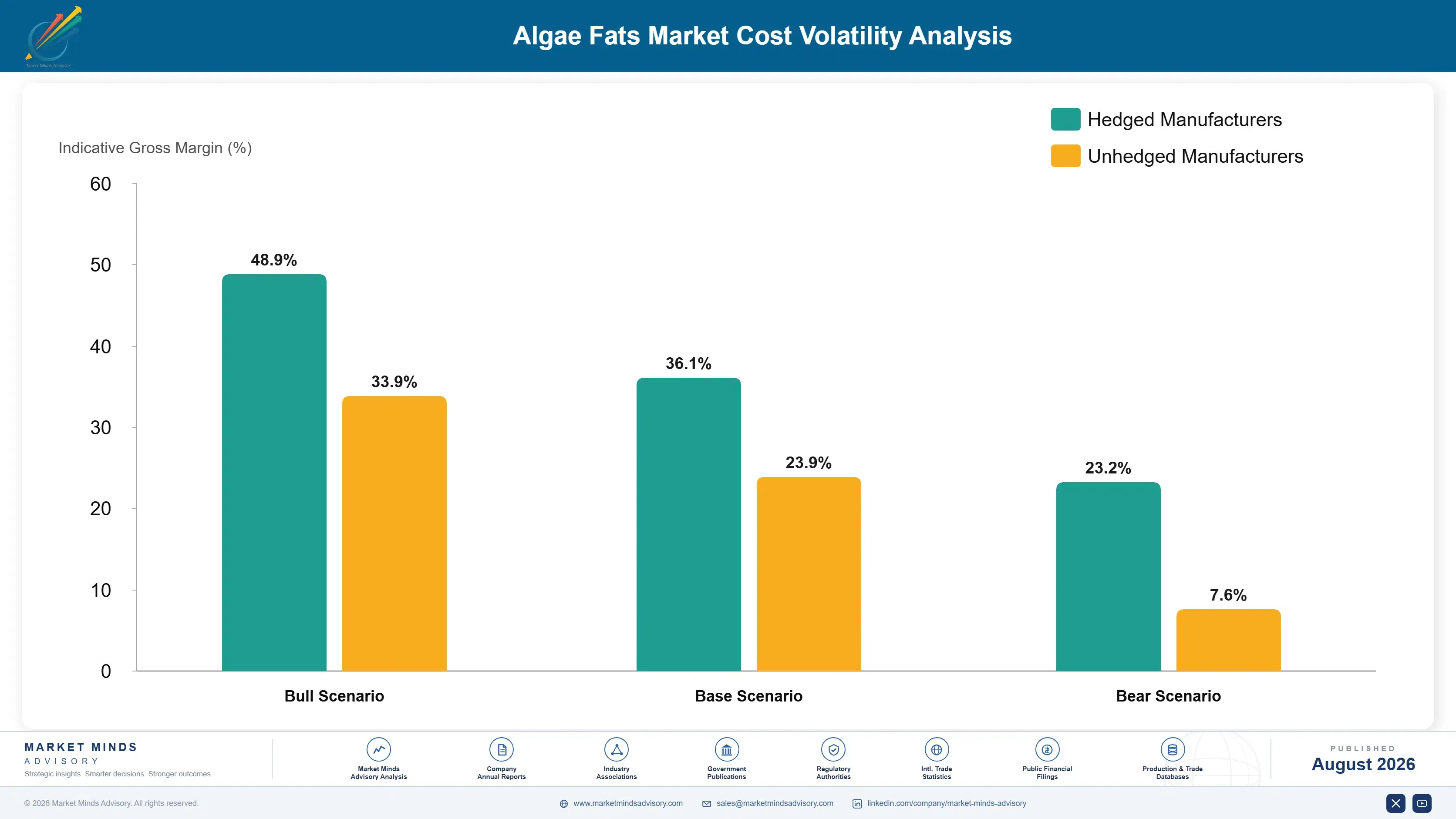
Fermentation Feedstock and Energy Cost Exposure

Fermentation feedstock, primarily sugar or glycerol depending on the production strain, and energy for photobioreactor operation or fermentation tank climate control together represent the largest cost components for algal oil producers, concentrated among a limited number of specialized production facilities worldwide that have invested in the capital-intensive infrastructure this category requires at commercial scale and rely on continuous, tightly controlled operating conditions.
Sugar and glycerol feedstock prices rose meaningfully during 2022 agricultural commodity volatility tied to global grain market disruptions, and that cost pressure passed through to algal oil contract pricing within roughly two to three quarters as producers renegotiated terms with customers already committed to certification-driven supply agreements. Producers without diversified feedstock sourcing or long-term supply contracts absorbed the sharpest cost increases during that period, while larger diversified producers with broader procurement relationships smoothed pricing somewhat for their own downstream customers.

Smaller specialty producers without diversified feedstock sourcing or long-term energy contracts absorb cost volatility directly in margin, while larger diversified producers with both capabilities smooth pricing for their downstream aquafeed and nutraceutical customers instead. That gap in resilience increasingly determines which producers can offer multi-year fixed-price contracts that large certification-driven buyers now prefer over shorter agreements.
algae-fats-market-2024-2034-trends-growth-cost-volatility-analysis-1787461232839

Diversified Feedstock Sourcing Contracts

Larger producers are securing sugar and glycerol feedstock through multiple agricultural origins rather than relying on a single supply source, smoothing cost volatility during years when commodity prices spike due to weather disruption or competing demand from other industrial users a practice now standard among the five largest producers active in this category and beyond.

Renewable Energy Integration for Production Facilities

Some producers are integrating renewable energy sources into photobioreactor and fermentation operations to reduce exposure to energy price volatility while also supporting the sustainability positioning that helps justify premium pricing to certification-focused buyers particularly across facilities in regions with abundant renewable generation capacity available and where energy supply contracts run longer than typical grid arrangements.

Long-Term Supply Contracts With Price Floors

Producers are negotiating long-term supply agreements with price floor and ceiling mechanisms, smoothing volatility for both sides while reducing the spot market exposure that hurt buyers during recent feedstock-driven cost shortfalls across the industry. This model has grown more common as feedstock volatility intensifies further across markets and geographies across every producing region too.

Portfolio Architecture for Margin Defence

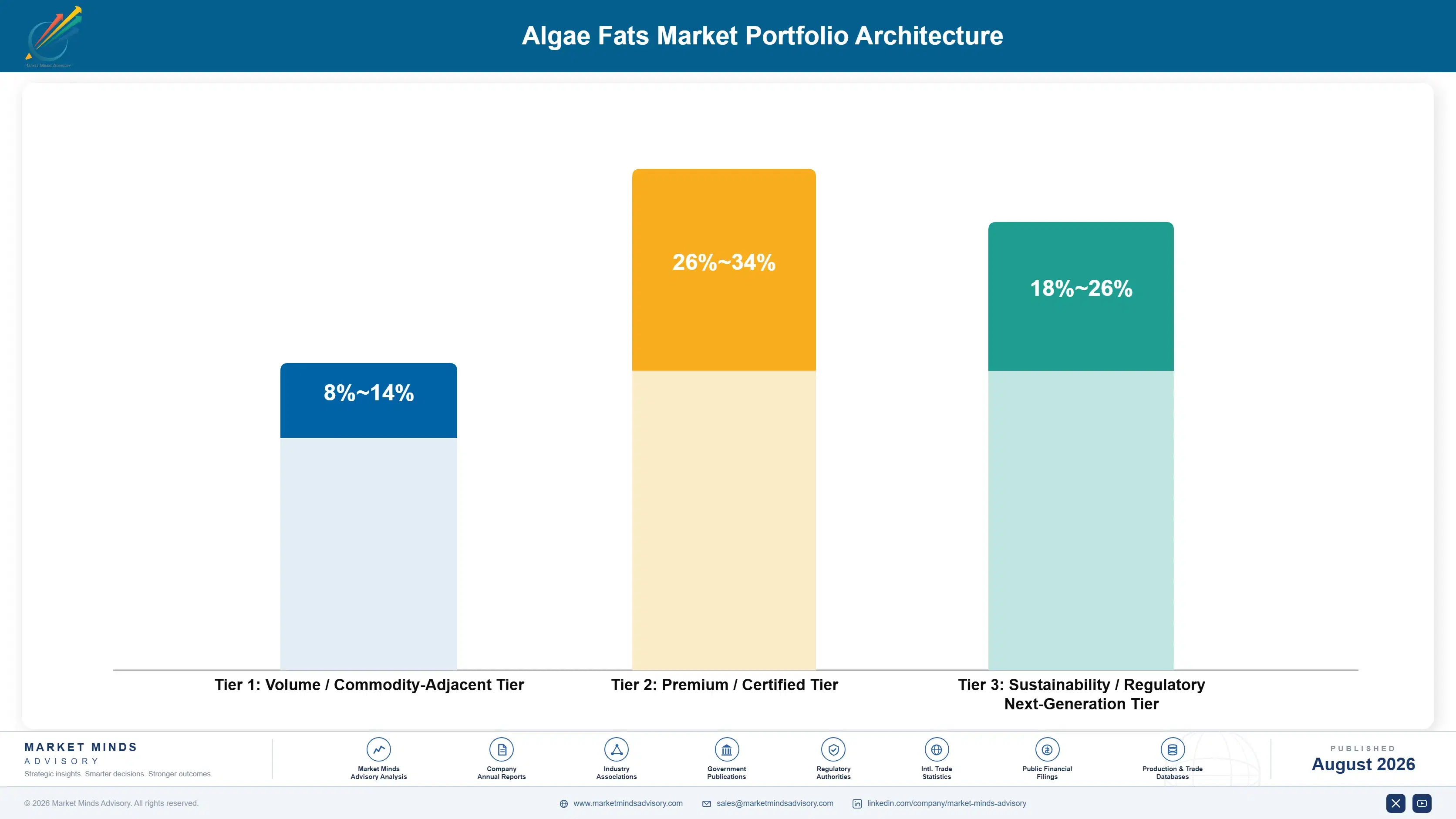
The market splits across three tiers: standardized aquafeed-grade oil sold on volume contracts against thin margins, certified nutraceutical-grade oil sold with clinical substantiation at a premium, and an emerging tier of next-generation, cost-optimized production sold into both channels as fermentation efficiency continues improving across the industry, a structure that mirrors the broader specialty ingredients sector worldwide each year and continues expanding.
Volume sits increasingly in the aquafeed tier as certification mandates spread, though margins remain thinner there than in nutraceutical sales given the larger volumes and more price-sensitive buyer base involved. Premium tension is sharpest between certified nutraceutical oil and standard aquafeed-grade product, pulling producer investment toward process efficiency that can serve both tiers profitably as the category matures without compromising either segment's distinct commercial requirements.

High-value margin pools concentrate in clinically substantiated nutraceutical oil sold to premium supplement and infant formula brands, a category smaller in absolute volume than aquafeed but consistently more profitable per kilogram and attracting sustained research investment from the leading global producers each year particularly among producers already serving the largest premium retail accounts and beyond particularly among producers already serving the largest premium accounts.

Volume / Commodity-Adjacent Tier

Standardized aquafeed-grade algal oil sold on volume contracts to feed manufacturers, competing primarily on price relative to conventional fish oil Producers here typically operate on thin single-digit margins given the persistent cost gap.
Gross Margin: 8%-14%

Premium / Certified Tier

Clinically substantiated nutraceutical and infant formula grade algal oil sold with research documentation, commanding a premium over aquafeed-grade equivalents Producers with strong clinical research teams typically win this business over price-only competitors.
Gross Margin: 26%-34%

Sustainability / Regulatory / Next-Generation Tier

Cost-optimized production using improved fermentation yield and photobioreactor efficiency, sold into both channels as the technology matures across the industry This tier remains small in volume but is expanding fastest across every region tracked here.
Gross Margin: 18%-26%
algae-fats-market-2024-2034-trends-growth-portfolio-architecture-1787461233398

High-value Sub-segments and Strategic Watch-out

Certified Nutraceutical-Grade Oil

Nutraceutical oil backed by decades of clinical research commands the category's highest margins and is growing steadily as vegan omega-3 demand expands across health-conscious retail channels each successive year Producers with existing clinical libraries hold a clear early advantage here and continue investing heavily each year.

Certification-Driven Aquafeed Contracts

Aquafeed sold under sustainability certification requirements commands steady premium pricing over standard fish oil blends, growing reliably as export certification standards continue spreading region by region. Producers with proven certification track records win the bulk of renewal contracts consistently and secure long-term volume each cycle.
Gross Margin: 18%-24%

Standard Aquafeed-Grade Volume

The largest volume pool by far, standard aquafeed contracts generate scale revenue for top producers but offer little margin expansion room given the persistent fish oil price gap this category still faces Producers here compete mainly on manufacturing scale rather than technical differentiation each contract cycle.
Gross Margin: 10%-14%

Emerging Asian and Middle Eastern Producers

Domestic producers scaling fermentation capacity in Asia and the Middle East could challenge established multinational suppliers on regional cost over the next decade, a shift worth monitoring closely for its implications Multinational producers are responding by deepening local certification partnerships instead rather than competing purely on unit price.

Certification Cycles and Contract Renewal

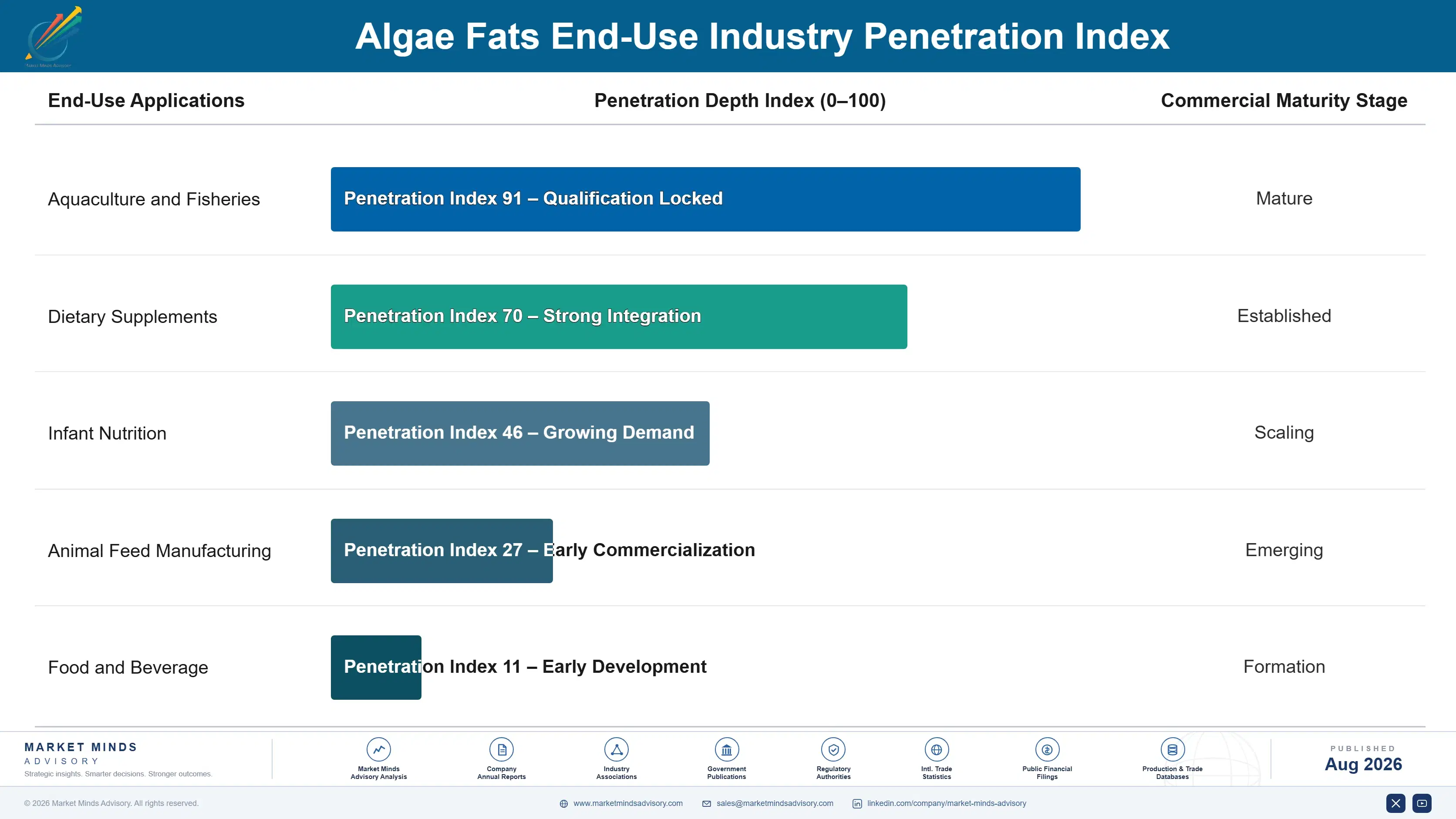
Certification-driven aquafeed demand behaves like an annuity once a producer's algal oil formulation passes an export buyer's sustainability audit, since switching suppliers again requires repeating that audit process that most buyers avoid unless supply is disrupted, giving incumbent producers durable multi-year volume once they win the initial certification approval and pass the first renewal cycle Producers who lose that initial certification rarely win it back from a satisfied buyer.
Adoption depth varies by channel: nutraceutical and infant formula customers show the deepest supplier stickiness given clinical substantiation and regulatory documentation requirements, while aquafeed buyers switch more readily as new certification-compliant suppliers enter the market, creating more frequent re-bid opportunities for challenger producers able to demonstrate comparable certification credentials This split shapes how producers allocate their certification and account service teams.

A generational shift among younger aquaculture operators toward treating sustainability credentials as a core commercial asset rather than a compliance afterthought is pulling algal oil adoption earlier into feed formulation decisions, giving certified producers a seat at the table that conventional fish oil suppliers historically never had to compete for directly That shift favors producers who invest early in verifiable sustainability credibility.
algae-fats-market-2024-2034-trends-growth-end-use-penetration-index-1787461233941

Positioning for the Substitution Decade

These are among the four positions where our research anticipates prominent divergence between winners and laggards over the coming forecast period. Each is grounded in the demand model, the regulatory perimeter, and the announced capacity pipeline.
01 / CERTIFICATION PARTNERSHIP INVESTMENT

Build certification partnerships ahead of broader aquafeed adoption

Sustainability certification requirements are tightening across major salmon and shrimp export markets, and producers without established relationships with standard-setting bodies cannot offer the certification credentials buyers increasingly require before signing supply agreements. Corbion's early partnership work already captures premium certification-driven contracts that newer entrants now struggle to access on comparable terms. Building these relationships now, before certification standards fully mature and attract broader competitive bidding, positions a producer to capture demand ahead of rivals still negotiating comparable partnerships with the strongest terms available.
02 / PRODUCTION COST REDUCTION

Invest in fermentation efficiency to narrow the fish oil cost gap

Algal oil still costs roughly three and a half times more than conventional fish oil, and that gap remains the primary barrier preventing broader mainstream aquafeed adoption beyond current premium and certification-driven applications. Producers who invest in photobioreactor and fermentation yield improvement, following the model Cellana and Heliae Development have already established, can capture price-sensitive volume before competitors match comparable efficiency gains. Achieving cost parity first would meaningfully expand the addressable market beyond its current niche positioning for producers and buyers alike.
03 / DUAL CHANNEL DIVERSIFICATION

Diversify across nutraceutical and aquafeed channels for resilience

Nutraceutical demand tracks consumer wellness trends while aquafeed demand tracks certification and regulatory cycles, and these two channels move largely independently of each other across most market conditions observed to date. Producers confined to a single channel carry more concentrated demand risk than diversified competitors like DSM-Firmenich and Fermentalg, who capture premium nutraceutical margins while also building aquafeed volume scale. Diversifying across both channels now provides a durable hedge against a slowdown in either demand source individually across their entire product portfolio.
04 / LONG-TERM OFFTAKE FINANCING

Secure offtake agreements before committing to new capacity

Photobioreactor and fermentation facility construction requires substantial capital investment with multi-year lead times, and producers without confirmed future revenue struggle to secure financing on favorable terms for this kind of capital-intensive buildout. Securing long-term offtake agreements with major aquaculture and nutraceutical buyers before breaking ground de-risks the capital outlay in the eyes of lenders and investors evaluating the project. Producers who secure these agreements first can expand capacity ahead of competitors still negotiating comparable long-term commitments for the industry as a whole.

Engagement Snapshot From the Field

A live engagement with an industry participant carrying material or product regulatory and market exposure ahead of a defining policy shift, showing how our research translates into a defensible multi-year portfolio strategy.
MARKET MINDS ADVISORY · CLIENT ENGAGEMENT SUMMARY
Algae Fats Producer Strategic Portfolio Review and Transition Roadmap 2026·Investment Scenario on Algae Fats Exposure Evaluation 2025-26
CLIENT PROFILE
A Norwegian salmon feed manufacturer engaged MMA to guide its fish oil substitution strategy after a major export retail buyer announced tightened sustainability sourcing requirements taking effect within eighteen months. The client's annual omega-3 ingredient procurement spend exceeded 35 million dollars (client-reported, unverified by MMA), making supplier and formulation selection a material cost and compliance decision for its senior leadership team.
STRATEGIC CHALLENGE
The client's existing feed formulations relied almost entirely on conventional fish oil and lacked any established algal oil supply relationships, threatening its ability to meet the retailer's new sourcing requirement within the announced timeline without risking a costly loss of its largest export contract and long-term brand reputation in key markets.
MMA APPROACH
MMA benchmarked algal oil suppliers against certification credentials, production scale, and delivered cost, modeled blended feed formulations combining algal and conventional fish oil at varying inclusion rates, and structured a phased transition plan that met the retailer's timeline without disrupting existing production before finalizing a formal recommendation across every relevant department.
KEY FINDINGS
  1. A blended formulation using a modest algal oil inclusion rate met the retailer's certification requirement without major reformulation costs across its main product lines.
  2. Two qualified algal oil suppliers offered comparable certification credentials at meaningfully different delivered pricing structures based on volume and contract length over time.
  3. A phased transition across production lines reduced implementation risk compared with the client's original full-conversion proposal across every major facility involved as planned.
  4. Locking in a multi-year supply agreement secured pricing stability the client could not access through short-term spot purchases across the full contract term.
CLIENT PROFILE
A Norwegian salmon feed manufacturer engaged MMA to guide its fish oil substitution strategy after a major export retail buyer announced tightened sustainability sourcing requirements taking effect within eighteen months. The client's annual omega-3 ingredient procurement spend exceeded 35 million dollars (client-reported, unverified by MMA), making supplier and formulation selection a material cost and compliance decision for its senior leadership team.
STRATEGIC CHALLENGE
The client's existing feed formulations relied almost entirely on conventional fish oil and lacked any established algal oil supply relationships, threatening its ability to meet the retailer's new sourcing requirement within the announced timeline without risking a costly loss of its largest export contract and long-term brand reputation in key markets.
MMA APPROACH
MMA benchmarked algal oil suppliers against certification credentials, production scale, and delivered cost, modeled blended feed formulations combining algal and conventional fish oil at varying inclusion rates, and structured a phased transition plan that met the retailer's timeline without disrupting existing production before finalizing a formal recommendation across every relevant department.
KEY FINDINGS
  1. A blended formulation using a modest algal oil inclusion rate met the retailer's certification requirement without major reformulation costs across its main product lines.
  2. Two qualified algal oil suppliers offered comparable certification credentials at meaningfully different delivered pricing structures based on volume and contract length over time.
  3. A phased transition across production lines reduced implementation risk compared with the client's original full-conversion proposal across every major facility involved as planned.
  4. Locking in a multi-year supply agreement secured pricing stability the client could not access through short-term spot purchases across the full contract term.
RECOMMENDED STRATEGY
Phase 1: Phase 1 (Months 1-3): Qualify two algal oil suppliers and finalize blended formulation testing under close technical oversight and quality assurance oversight. Phase 2: Phase 2 (Months 4-9): Transition production lines to the new blended formulation in stages with regular performance monitoring throughout weekly. Phase 3: Phase 3 (Months 10-18): Complete full certification compliance, confirm retailer acceptance, and document lessons learned fully for future reference and planning.
OUTCOME
The client achieved full certification compliance within the retailer's eighteen-month deadline and retained its largest export contract, reporting a successful fish oil substitution across its core product lines (client-reported, unverified by MMA) alongside manageable cost impact through the phased blended formulation approach MMA recommended across its full production network.

Frequently Asked Questions

Foundational context covering the market sizes, CAGR, scope, country, region and competition that inform every finding below. This section is provided to cover basics and most often pre-purchase conversations, answered from the MMA Primary Research Dataset.

What is the current size of the Algae Fats Market?

The global algae fats market was valued at approximately $0.9 billion in 2025. Aquafeed and nutraceutical applications drive most current demand across every application category.

How large will the Algae Fats Market be by 2036?

MMA projects the market will reach approximately $3.28 billion by 2036, roughly 3.25 times its 2026 value. Fish oil substitution in aquafeed drives much of this growth.

What is the CAGR for the Algae Fats Market 2026 to 2036?

The market is projected to grow at a 12.5 percent compound annual rate between 2026 and 2036. Bull and bear scenarios range from 11.0 to 14.0 percent.

Which segment is growing fastest?

Algal oil for aquafeed is the fastest-growing segment at a 16.5 percent CAGR, well above the overall market rate. Sustainability certification requirements drive this expansion.

Who are the major companies in the Algae Fats Market?

Leading producers include Corbion, DSM-Firmenich, Alltech, Cellana, and Fermentalg. Together they hold a CR5 near 42 percent of global capacity and continue expanding steadily each year.

Which country is growing fastest?

Indonesia posts the fastest national growth at roughly 15.2 percent, driven by its shrimp export industry adopting certification-compliant feed formulations. This growth builds from a small starting base.

Report Segmentation Architecture

The full report scope spans multiple orthogonal segmentation dimensions, with cross-tabulated demand data provided for each dimension pair. Coverage extends further to regional breakdowns, trend trajectories, and the competitive detail needed to support segment-level decision-making.

By Application

  • DHA Algal Oil for Nutraceuticals and Supplements
  • DHA Algal Oil for Infant Formula
  • Algal Oil for Aquafeed
  • Algal Oil for Animal Feed
  • Algal-Derived Culinary and Cooking Oils
  • Algal Lipid Co-Products

By End-Use Industry

  • Aquaculture and Fisheries
  • Dietary Supplements
  • Infant Nutrition
  • Animal Feed Manufacturing
  • Food and Beverage

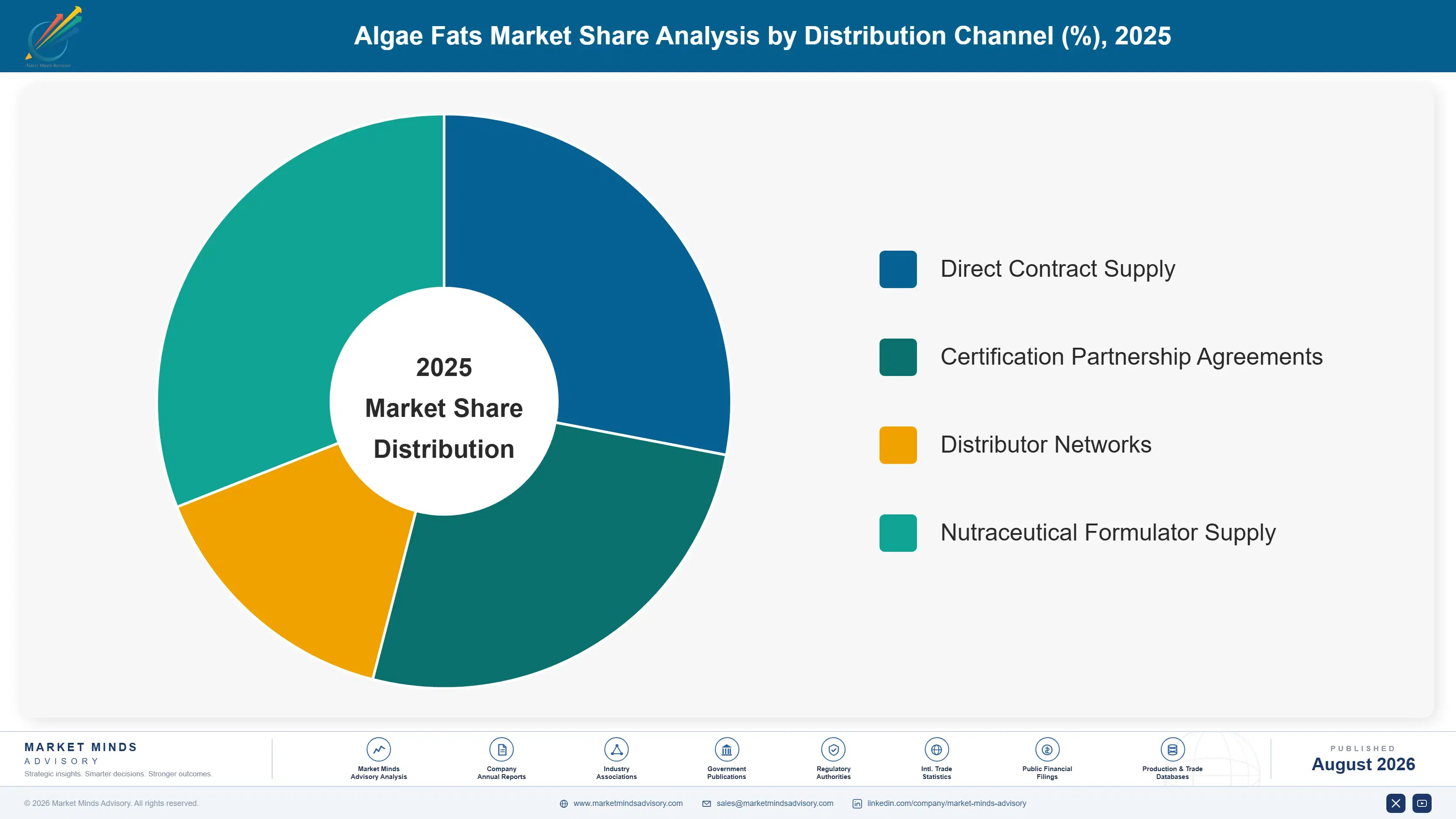
By Distribution Channel

  • Direct Contract Supply
  • Certification Partnership Agreements
  • Distributor Networks
  • Nutraceutical Formulator Supply

By Region

  • North America
  • Western Europe
  • East Asia
  • South Asia and Pacific
  • Latin America
  • Middle East and Africa
  • Eastern Europe

Scope, Methodology, and Coverage

Every figure in this report is reproducible from documented input assumptions. The scope below maps the historical period, the forecast horizon, the segmentation dimensions, and the countries covered, alongside the underlying primary and qualitative methodology.
Historical Period
2020 to 2025
Forecast Period
2026 to 2036
Base Year
2025 (USD billions; MMA Primary Research Dataset, August 2026)
Market Definition
The algae fats market covers DHA algal oil for nutraceuticals and supplements, DHA algal oil for infant formula, algal oil for aquafeed, algal oil for animal feed, algal-derived culinary and cooking oils, and algal lipid co-products sold for food, feed, and nutraceutical applications. It excludes algae cultivated specifically for biofuel or industrial chemical feedstock.
Quantitative Units
USD billions (current prices); metric tonnes for volume detail
Segmentation Dimensions
By Application; By End-Use Industry; By Distribution Channel; By Region
Regions Covered
North America, Western Europe, East Asia, South Asia and Pacific, Latin America, Middle East and Africa, Eastern Europe
Countries Covered
USA, China, Germany, France, UK, Japan, South Korea, India, Australia, Canada, Brazil, Mexico, Indonesia, Vietnam, Thailand, Malaysia, UAE, Saudi Arabia, South Africa, Nigeria, Turkey, Poland, Netherlands, Italy, Spain, Sweden, Switzerland, Argentina, Colombia, Singapore, and additional markets relevant to this sector
Key Companies Profiled
Corbion, DSM-Firmenich, Alltech, Cellana, Fermentalg, Algatechnologies, Qualitas Health, Cyanotech Corporation, Heliae Development, AlgaEnergy, Photanol, Allmicroalgae, Necton, BlueBioTech, Algae.Tec, Matis, Advanced BioNutrition Corporation, EnerGaia, Simris Alg, Sea6 Energy
Quantitative Methodology
Primary survey, n=3,800 respondents, Q4 2025, six countries; demand-side model with trade association cross-validation
Qualitative Methodology
47 expert interviews, Q4 2025; applied to validate demand model assumptions, identify emerging dynamics, and assess competitive positioning
Report Format
PDF and XLSX data workbook (Word format preview document)
Publisher
Market Minds Advisory
Report Code
MMA-2026-AGR-108
Published
August 2026
Contact
sales@marketmindsadvisory.com | www.marketmindsadvisory.com

Purchase the full Algae Fats Market Report (2026 to 2036).

The full Algae Fats Market report delivers a comprehensive 2026 to 2036 forecast across six application categories, seven regions, and twenty profiled companies active in this emerging category. It includes detailed segmentation by end-use industry, feedstock and energy cost modeling, and competitive benchmarking measured against a single consistent basis throughout. Analysts document the certification and cost-reduction trends reshaping fish oil substitution across the industry. Buyers receive full access to the underlying data tables, regional breakouts, and a customizable Excel model built for scenario planning as well as scenario stress-testing tools.
2026-2036 volume and value forecasts by segment
Six-segment application breakdown and detailed analysis
Seven-region market sizing and share detail
Twenty-company competitive profiles and full benchmarking
Feedstock and energy cost sensitivity modeling included
Editable Excel forecast workbook with scenario toggles

Built For The People Who Decide

From boardroom strategy to bench-side execution, this report is read cover-to-cover by leaders shaping the next decade of their industry, turning demand scenarios, market dynamics and valuation benchmarks into decisions.
CXOs/ Presidents/ VPs/ Managers
M&A and Corporate Development
Strategy Teams and R&D Heads
Procurement and Product Directors
Regulatory and Compliance Leaders
Investor Relations and Equity Analysts