Market Minds Advisory
Algae-Based Animal Feed Market

Algae-Based Animal Feed Market: Methane Credits as the Real Product, Cultivation Bottlenecks, and Omega-3 Substitution at Scale

Asparagopsis cuts enteric methane by up to seventy percent in trials, yet nobody can cultivate enough of it, which makes farming capacity rather than science the constraint on the entire category.

Lead Analyst

Lisa Gevelber

Published

September 2026

Make Smarter Decisions with Customized Research Insights

Request a free sample report and evaluate market opportunities, growth trends, and competitive dynamics relevant to your business needs.

2025 MARKET VALUE$1.2BMarket Size 2025
2036 FORECAST VALUE$4.9BBase Case , 2026 to 2036
CAGR 2026 TO 203613.6 %Bull 15.0% / Bear 12.2%
INCREMENTAL OPPORTUNITY$3.5BNet 10- year value creation
EXPANSION MULTIPLE3.59x2036 value over 2026 base
Strategic Levers
M&A Pipeline
Regional Outlook
Country Rankings
Competitive Intelligence
Segmental Deep-dive
Call-Us : 91 93563 13602

Executive Snapshot and Market Trajectory

The most valuable thing algae does in animal feed has nothing to do with nutrition. Asparagopsis fed at roughly 0.2% of a ruminant ration suppresses enteric methane by up to seventy percent in controlled trials, which turns a feed additive into an emissions instrument and changes who buys it.
Commercial power sits with whoever can cultivate at scale rather than with whoever holds the science. Asparagopsis biology is well documented and the supply base is tiny, so cultivation capacity across Australia, Hawaii, Vietnam, and the Atlantic coast is the binding constraint. Red macroalgae products grow fastest at 28.4%, roughly 2.09 times the market, entirely on that basis. East Asia holds 30% of value.
Concentration is low at roughly 22% for the top five, since the category assembled from seaweed harvesters, fermentation companies, and methane start-ups that share almost nothing operationally. Regulation matters unusually here: feed additive authorisation under Regulation 1831/2003 governs European access, and bromoform residue and stability questions still shape which jurisdictions permit Asparagopsis at all. Heterotrophic algal oils face none of that and scale on ordinary fermentation economics instead. Two businesses with almost no overlap.
Market Definition
This report covers algal biomass, extracts, and oils supplied as animal feed ingredients and additives, spanning brown, red, and green macroalgae products, photoautotrophic microalgae, heterotrophic microalgae oils and biomass, and mixotrophic and engineered strain products. Value is measured at ingredient level as sold to feed mills, integrators, and farms. Algae for human food and supplements, biofuel and cosmetic applications, whole seaweed harvested for hydrocolloid extraction, and finished compound feed fall outside scope.
Base Year Value
$1.2B in 2025 (MMA Primary Research Dataset, August 2026)
Forecast Period
2026 to 2036, eleven discrete annual values
CAGR
13.6% base case. Bull 15.0%. Bear 12.2%.
Fastest Growth Segment
Red Macroalgae Products: 28.4% CAGR
Fastest Growth Country
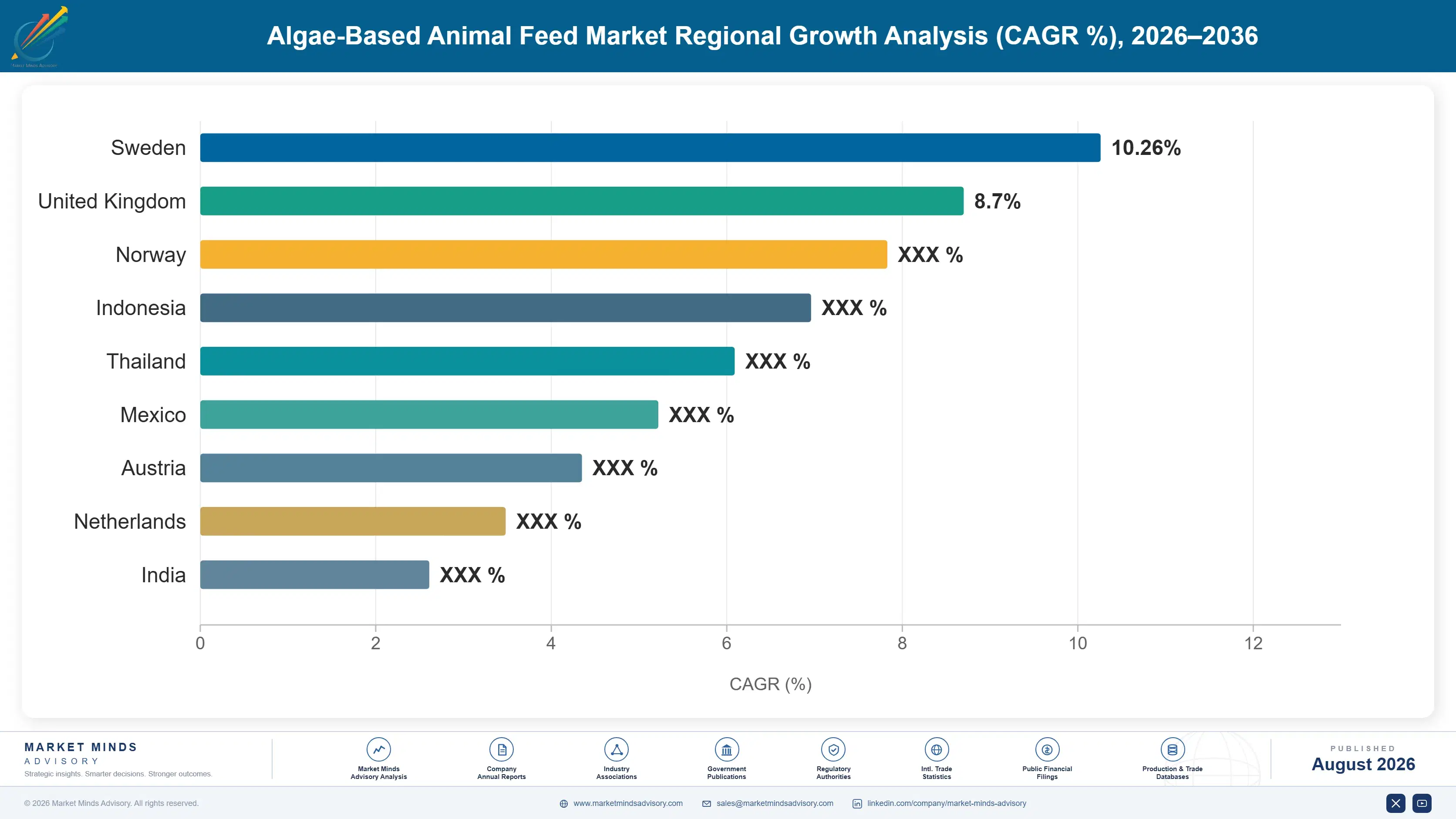
Indonesia: 16.9% CAGR
Fastest Growth Region
South Asia and Pacific: 15.6% CAGR
Largest Region
East Asia: 30% of 2025 global value
Market Leaders
Corbion, dsm-firmenich, Alltech, Cargill, Olmix Group. Source: MMA Analysis based on company annual reports.
Primary Survey
n=3,800 procurement and R&D decision-makers, Q4 2025, six countries
Methodology
Demand-side build-up, cross-validated against public data, 47 expert interviews

Algae-Based Animal Feed Market Forecast Scenarios

algae-based-animal-feed-market-trends-size-forecast-scenario-1787462210200
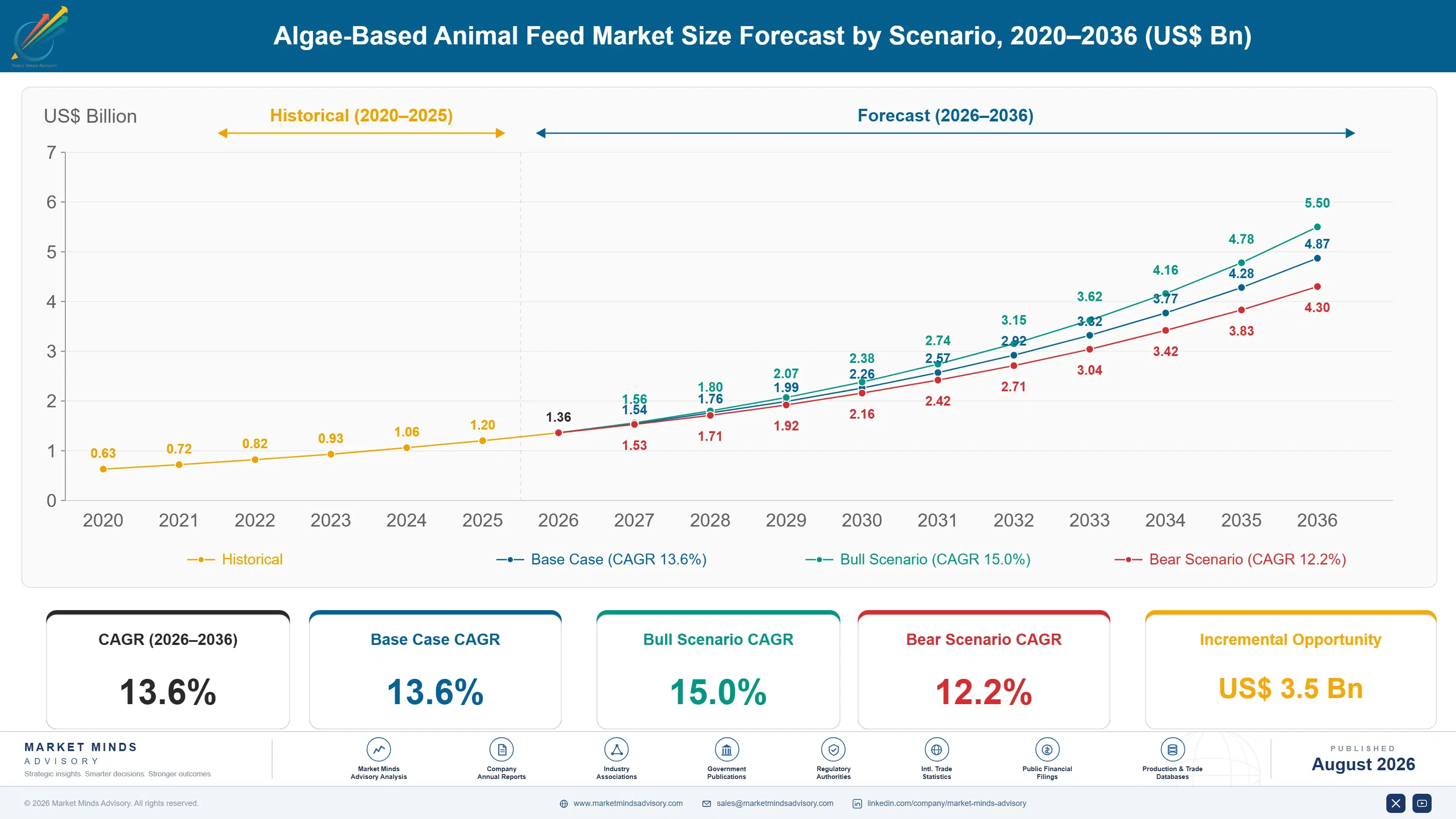
The 2020 to 2025 period was defined by two developments that barely touched each other. Heterotrophic algal oil scaled into salmon feed as anchoveta quota cuts made fish oil unreliable, with Veramaris and Corbion commissioning capacity. Separately, Asparagopsis moved from Australian research into small commercial trials with dairy processors. The 12.2% historical growth came almost entirely from the oil side, since red macroalgae supply stayed tiny.
The 13.6% base case rests on three mechanisms. Dairy and beef supply chains keep committing to emissions reduction targets that no other feed intervention can deliver at comparable cost, which underwrites Asparagopsis demand well ahead of proven farm economics. Heterotrophic algal oils keep displacing fish oil in salmonid and pet food formulations as marine supply stays capped. And established brown macroalgae products keep growing steadily on mineral and immune positioning in ruminant and poultry rations.
The 15.0% bull case assumes Asparagopsis cultivation reaches commercial scale while carbon markets price agricultural methane credibly, which would make the additive pay for itself. The 12.2% bear case reflects cultivation bottlenecks persisting alongside regulatory hesitation over bromoform, confining red macroalgae to demonstration volumes throughout the decade. Cultivation scale decides which of those cases actually arrives here.

Why Methane Credits Decide the Economics

Three forces govern this market and only one of them is nutritional. Emissions accounting comes first, because a processor with a supply chain reduction target pays for methane suppression in a way no farmer would pay for feed conversion. Cultivation capacity comes second, since red macroalgae supply is measured in hundreds of tonnes against demand in millions. And fish oil scarcity comes third, driving the entirely separate algal oil business.
TOP-FIVE CONCENTRATION22%Share of algal feed ingredient supply held collectively
AVERAGE SELLING PRICE$4,180/tonneBlended price across macroalgal meal and microalgal products
METHANE REDUCTION POTENTIAL72%Enteric emission cut demonstrated in controlled ruminant trials
CULTIVATED SUPPLY SHARE63%Farmed rather than wild-harvested proportion of macroalgal input
CAPACITY UTILISATION51%Average loading across cultivation and fermentation production assets
FEED INCLUSION RATE0.2%Typical dosing as proportion of finished ruminant ration
That produces a commercial character split between two unrelated businesses wearing one label. Heterotrophic algal oil is an industrial fermentation business selling into aquafeed and pet food on documented omega-3 delivery. Asparagopsis is closer to a carbon project with a feed additive attached, where the buyer is often not the farmer. Companies attempting both find almost nothing transfers between them.
The next decade turns on whether methane suppression gets paid for properly. Farm economics alone do not justify the additive at current cultivation costs, so the category depends on supply chain commitments, carbon methodologies, or regulation making the reduction valuable. Several dairy processors have begun funding it directly. If that funding holds while cultivation scales, the category becomes large quickly. If it does not, Asparagopsis stays a demonstration.
"Nobody is buying Asparagopsis because it makes cows grow better. They are buying it because a supermarket asked a processor a question about scope three emissions, and this is the only answer that currently exists."
Director, Algal Ingredients and Livestock Emissions Practice · MMA Animal Nutrition / Algal Ingredients Practice · August 2026

Market Trends

Dairy Processors Fund Methane Reduction Ahead of Farm Economics

Supply chain emissions targets adopted by major dairy processors and retailers have created a buyer for enteric methane reduction that is not the farmer feeding the additive. Processors in Australia, Ireland, the Netherlands, and the United States have funded Asparagopsis trials and early commercial programmes directly, absorbing a cost that farm-level economics do not currently justify. That arrangement is unusual in animal nutrition and it explains why demand exists at all ahead of cultivation scale. It also means the category's growth depends on corporate commitment durability rather than on agricultural returns.
Market Impact: Cuts emissions up to 72%
Heterotrophic Algal Oil Displaces Marine Omega-3 at Scale

Schizochytrium and related heterotrophic strains produce EPA and DHA in conventional fermentation tanks using sugar as substrate, which removes any dependence on reduction fishery quota. Veramaris and Corbion have both commissioned commercial capacity, and salmon producers across Norway, Scotland, and Chile now specify algal oil in commercial diets. Pet food premiumisation has added a second demand pool at better pricing. Cost per unit of omega-3 remains above fish oil but the gap keeps narrowing, and availability rather than price is increasingly what decides formulation choices. Pet food buyers qualify faster and pay considerably better than aquafeed does.
Market Impact: Serves 9% inclusion salmonid diets

Market Opportunities and Growth Drivers

Enteric Methane Has No Comparable Alternative Intervention

Enteric fermentation accounts for the largest single share of livestock greenhouse gas emissions, and the alternatives available to a dairy or beef supply chain are limited to breeding, herd reduction, or synthetic inhibitors with their own regulatory paths. Asparagopsis at roughly 0.2% ration inclusion suppresses methanogenesis through bromoform interference with the enzymatic pathway, delivering reductions up to seventy percent in controlled trials. No feed intervention approaches that magnitude. That absence of alternatives is why processors fund the additive despite cultivation costs no farm budget would tolerate unaided. Breeding and herd reduction both work far more slowly.
Market Impact: Supplies under 1% of demand

Fish Oil Scarcity Sustains Algal Omega-3 Demand Regardless of Price

Long-chain omega-3 supply for aquafeed is capped by reduction fishery quota, and Peru cancelled its first anchoveta season outright in 2023 while cutting allocations elsewhere. Salmon biomass keeps growing while the fishery does not, which leaves formulators needing EPA and DHA from somewhere that is not the ocean. Heterotrophic algal oil is the only route currently producing at commercial volume with proven salmonid performance. Demand therefore holds even when fish oil prices soften, because formulators have learned that availability matters more than the spot price does. Formulators now treat supply security as a specification requirement rather than preference.
Market Impact: Delays approval beyond 36 months

Market Restraints and Challenges

Asparagopsis Cultivation Capacity Is Measured in Hundreds of Tonnes

Demand for enteric methane suppression is theoretically enormous while red macroalgae supply remains tiny, and closing that gap requires ocean or land-based cultivation systems that nobody has yet operated at agricultural scale. The root cause is biological complexity: Asparagopsis has a two-stage life cycle requiring different conditions at each phase, which makes reliable mass cultivation genuinely difficult. Responses include land-based tank systems in Australia and Hawaii, ocean cultivation trials in Vietnam and Portugal, and encapsulation work to preserve bromoform through storage and mixing. Every commercial programme currently runs on volumes that would embarrass a vegetable grower.
Market Impact: Funds 72% methane reduction

Bromoform Residue Questions Constrain Regulatory Approval Pathways

Bromoform is the active compound suppressing methanogenesis and it is also a halogenated substance with its own toxicological and environmental profile, which regulators are examining carefully before authorising widespread use. The root cause is that the mechanism and the concern share the same molecule. European feed additive authorisation under Regulation 1831/2003 requires safety data covering the animal, the consumer, and the environment. Participants respond with residue studies in milk and meat, encapsulation to control release, and by pursuing approval sequentially in the most receptive jurisdictions first. Approval sequencing has become a commercial strategy rather than a formality.
Market Impact: Replaces 15% of fish oil
3 additional market trends, 2 additional growth drivers, and 4 additional restraints and challenges are covered in the full report. Contact sales@marketmindsadvisory.com to access the complete intelligence.

Segment CAGR and Growth Architecture

Segmentation follows algal source organism and cultivation biology, the single logic that determines production system, cost structure, regulatory pathway, and what the ingredient does. Source decides whether a product is farmed at sea, grown in a tank, or fermented on sugar. Target species, feed format, and channel structure appear separately in the framework as commercial dimensions.
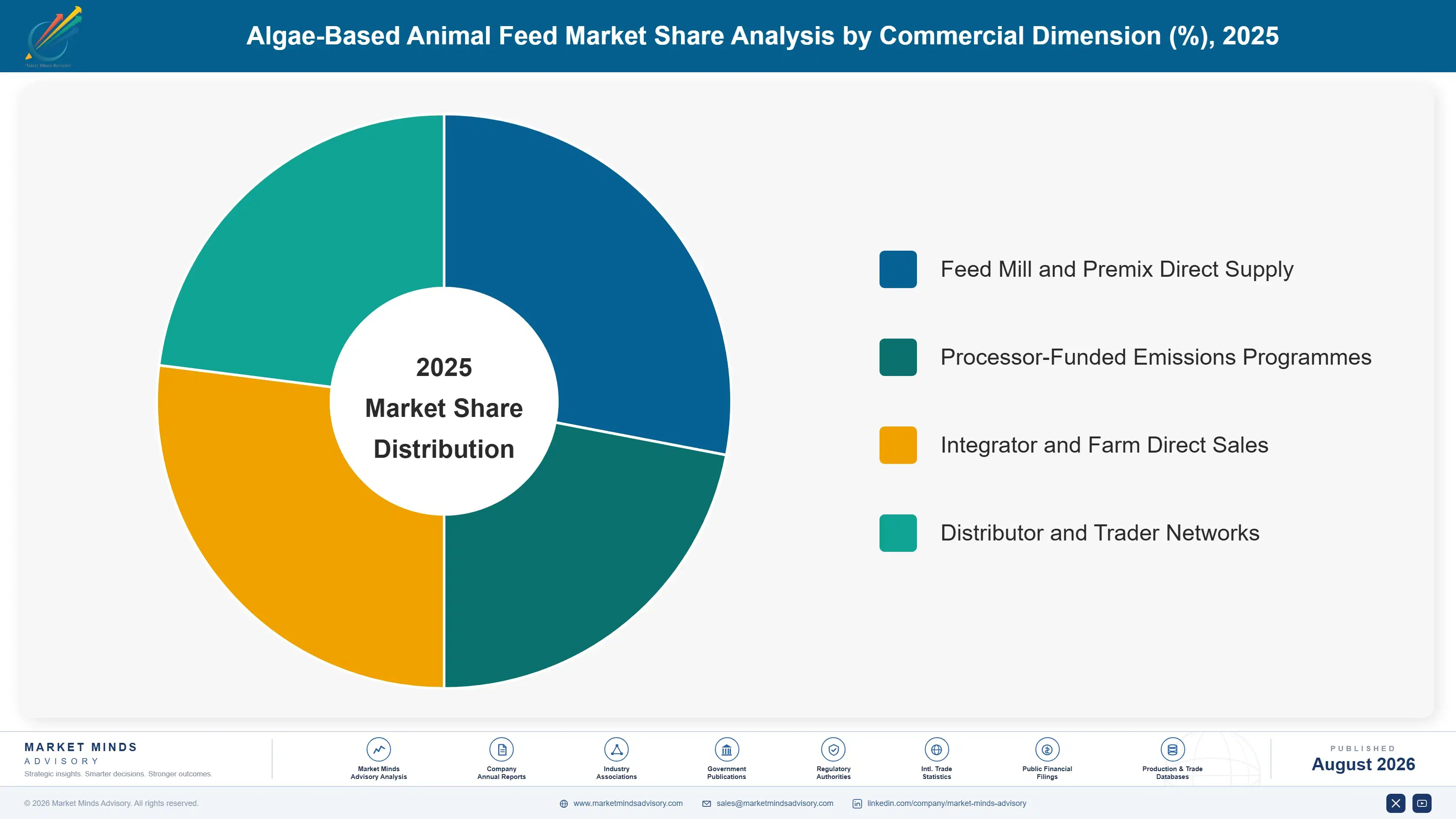
algae-based-animal-feed-market-trends-market-share-analysis-1787462210798

Red Macroalgae Products

This segment is almost entirely Asparagopsis and it is growing at 28.4%, roughly 2.09 times the market, from a supply base measured in hundreds of tonnes against theoretical demand in the millions. Bromoform in the plant interferes with the enzymatic pathway that produces enteric methane, and controlled trials have shown reductions up to seventy percent at inclusion around 0.2% of ration. The buyer is frequently a dairy processor or retailer with a supply chain emissions target rather than the farmer, which is unusual and commercially important. Cultivation is the binding constraint: the two-stage life cycle makes reliable mass production difficult, and nobody has yet operated it at genuinely agricultural scale anywhere.
CAGR 28.4%

Heterotrophic Microalgae Oils and Biomass

Schizochytrium and related strains grown on sugar in conventional fermentation tanks produce EPA and DHA without touching a reduction fishery, which matters enormously as anchoveta quota cuts leave salmon formulators short of marine omega-3. Growth of 19.4% reflects commercial capacity commissioned by Veramaris and Corbion alongside adoption across Norwegian, Scottish, and Chilean salmon production. Pet food premiumisation supplies a second and better-priced demand pool. Unlike the macroalgal side, this is straightforward industrial biotechnology with familiar economics, no cultivation mystery, and no unresolved regulatory question, which is precisely why it scaled first and continues to scale predictably. Pet food qualification also runs faster than aquafeed, since formulators test palatability and stability rather than running fish growth trials.
CAGR 19.4%
Full segment breakdown across 6 segments available in the complete report.

Regional Architecture and Country Demand Map

East Asia holds the largest share at 30%, combining Chinese seaweed cultivation scale with regional aquaculture demand for algal omega-3. South Asia and Pacific grows fastest as Indonesian and Vietnamese cultivation expands, while Western Europe leads on methane reduction programmes. North America runs the largest feeding trials.

North America

Two very different activities sit side by side here. Californian and Midwestern dairy operations have run some of the largest Asparagopsis feeding trials anywhere, funded by processors and retailers responding to supply chain emissions targets rather than by farm budgets, and Hawaii hosts significant land-based cultivation development. Separately, heterotrophic algal oil produced through fermentation supplies salmon feed and a rapidly premiumising pet food sector that pays well for documented DHA. Canadian Atlantic seaweed harvesting supplies brown macroalgae for mineral and immune products across ruminant and poultry rations. Regional growth of 13.9% is carried by both streams roughly equally at present. The two streams share a label and almost nothing else operationally at all.
Share: 22% | CAGR: 13.9% (2026 to 2036)

Western Europe

Emissions policy makes this the most committed region for methane reduction and the slowest for approval, which is an awkward combination. Irish, Dutch, and Danish dairy sectors face binding national emissions obligations, and processors have funded Asparagopsis programmes ahead of farm economics as a result. European feed additive authorisation under Regulation 1831/2003 requires safety data covering animal, consumer, and environment, and bromoform assessment has been careful rather than quick. Norwegian salmon feed represents the largest single algal oil demand pool in the region. French and Irish brown seaweed harvesting supplies established mineral products. Growth of 12.1% reflects regulatory drag rather than weak demand. Commitment is ahead of authorisation here, which is an awkward place.
Share: 20% | CAGR: 12.1% (2026 to 2036)
Regional intelligence for 5 additional markets available in the complete report: East Asia, South Asia and Pacific, Latin America, Middle East and Africa, Eastern Europe. Contact sales@marketmindsadvisory.com.
algae-based-animal-feed-market-trends-country-cagr-analysis-1787462211311

Where Algal Feed Value Actually Concentrates

Selling algal biomass on protein or mineral content puts it beside ingredients that cost a tenth as much. The four moves below shift revenue toward what buyers genuinely pay for: monetised methane reduction, cultivation capacity that nobody else holds, omega-3 supply security, and pet food channels where ingredient cost barely registers against retail price.

Structure Methane Reduction as a Monetised Emissions Instrument

Farm economics do not justify Asparagopsis at current cultivation costs, and pretending otherwise wastes commercial effort. Structuring supply around verified emissions reduction, sold to processors, retailers, or carbon markets under an accepted methodology, moves the payer from the farmer to the party that actually has the obligation. Programmes built this way have secured funding of roughly $180 per tonne of carbon dioxide equivalent avoided. The additive then costs the farmer nothing, which removes the only real barrier to on-farm adoption entirely. Nothing in conventional feed selling prepares a commercial team for this conversation.
Market Impact: Secures roughly $180 per tonne of carbon avoided

Build Cultivation Capacity Ahead of Any Approval

Red macroalgae supply currently meets under 1% of theoretical demand, so whoever holds cultivation capacity when approvals arrive captures a market that competitors cannot enter by writing a cheque. Land-based tank systems cost roughly $22 million for meaningful commercial output, and ocean cultivation is cheaper but less reliable given the two-stage life cycle. Building before regulatory certainty is uncomfortable and it is also the only sequence that works, because cultivation takes years to establish while an approval decision takes months to act on. Nobody has raised that capital speculatively at scale so far.
Market Impact: Captures demand currently exceeding available supply by 100x

Contract Algal Omega-3 Offtake With Salmon Feed Mills

Fish oil supply is capped by anchoveta quota while salmon biomass keeps growing, and formulators have learned that availability matters more than spot price. Multi-year offtake agreements with the major aquafeed groups lock volume at predictable pricing and justify the fermentation capacity investment that supplying them requires. Mills accept the structure because it removes their own supply risk. Contracts of this kind typically run five to seven years, which is long enough to underwrite a plant costing around $80 million and to survive a soft fish oil year. Fish oil recovery would test that preference, not remove it.
Market Impact: Underwrites fermentation plants costing roughly $80 million each

Prioritise Pet Food Where Ingredient Cost Barely Registers

A premium pet food brand pays for documented DHA without much resistance, because ingredient cost is a small fraction of a retail price built on humanisation positioning. Margins in that channel run 15 to 22 points above aquafeed supply for identical material, and volumes are small enough to serve from existing capacity while larger contracts are negotiated. The qualification process is also faster, since pet food formulators test palatability and stability rather than running multi-month fish growth trials before committing to anything. Serving pet food first also builds the reference data aquafeed buyers eventually want.
Market Impact: Adds 15 to 22 points of gross margin

Who Controls the Margin Pool

Concentration is low at roughly 22% for the top five, measured consistently as algal feed ingredient revenue at supplier level. Corbion and dsm-firmenich lead through heterotrophic fermentation oils, Alltech and Olmix through established macroalgal products, and Cargill through feed distribution reach. The Asparagopsis field is entirely separate, populated by venture-funded start-ups whose principal asset is cultivation capability rather than distribution.
Competition runs along three lines that barely intersect. Fermentation scale and omega-3 productivity is the first, a conventional industrial biotechnology contest with familiar economics. Cultivation capability for red macroalgae is the second, where nobody has yet solved reliable mass production and the winner takes an enormous market. The third is emissions methodology and buyer relationships, since the party paying for methane reduction is usually not the farmer feeding it.

Two pressures will reshape positions. Chinese and Indonesian cultivation scale is entering the macroalgal ingredient market at costs Western harvesters cannot match, compressing established mineral and immune product pricing. Meanwhile the Asparagopsis field will consolidate hard once approvals land, because cultivation capital requirements exceed what most start-ups can raise. The exposed position is a small macroalgal processor selling on protein and mineral content without cultivation assets or emissions capability.
algae-based-animal-feed-market-trends-company-positioning-matrix-1787462211836

Competitive Moat and Risk Dimensions

CORBION

Moat: Fermentation Scale and Aquafeed Qualification

Corbion operates commercial heterotrophic algal oil capacity with salmon feed qualification already completed across major producing regions, which took years of growth trials that a new entrant would have to repeat entirely. The fermentation platform also serves other applications, spreading fixed cost across a wider base. Salmon formulators change qualified omega-3 sources reluctantly once flesh quality data is established.
CORBION

Risk: Fish Oil Price Competition

Algal oil still costs more per unit of omega-3 than fish oil in most years, so a run of strong anchoveta seasons would narrow the availability argument that currently drives adoption. The business depends on formulators valuing supply security above spot price, which holds while quota remains volatile. Sustained fishery recovery would test that preference considerably.
ALLTECH

Moat: Macroalgal Product and Distribution Reach

Alltech combines established algal and yeast-derived ingredient lines with a global animal nutrition distribution network reaching integrators, mills, and farms across dozens of markets. That reach lets it introduce new algal products through relationships already in place rather than building a route to market. Technical service teams also generate the field evidence that novel ingredients require before adoption.
ALLTECH

Risk: Limited Cultivation Asset Position

The company sources macroalgal material rather than cultivating at scale, which leaves it exposed as Chinese and Indonesian supply compresses pricing on established mineral and immune products. It also holds no meaningful position in red macroalgae cultivation, the segment growing fastest. Entering that requires capital and biological capability quite different from ingredient formulation and distribution strength.

Players Tracked

Prominent Players

Corbion
dsm-firmenich
Alltech
Cargill
Olmix Group

Other Key Players

Evonik Industries
Veramaris
Symrise
Acadian Seaplants
Algaia
Sea6 Energy
Volta Greentech
Blue Ocean Barns
Symbrosia
CH4 Global
Qingdao Seawin Biotech
Allmicroalgae
Necton
Roquette Freres
Qingdao Gather Great Ocean Algae

Recent Developments

MARCH 2025

Dairy processors extend funded Asparagopsis feeding programmes

Major dairy processors in Ireland, the Netherlands, and Australia extended funded Asparagopsis feeding programmes across supplier farms, absorbing additive cost that farm-level economics do not yet justify. The programmes respond to supply chain emissions targets set with retail customers rather than to any nutritional or productivity case at farm level.
Signal: The buyer for methane reduction is the processor with the obligation, not the farmer feeding the additive.
SEPTEMBER 2024

Land-based Asparagopsis cultivation capacity expands in Australia

Australian producers extended land-based Asparagopsis cultivation capacity using tank systems designed around the species two-stage life cycle, targeting commercial supply for domestic beef and dairy programmes. Output remains small against theoretical demand, and cultivation reliability rather than downstream processing continues to constrain how quickly volume can grow.
Signal: Cultivation capacity, rather than science or regulation, is the variable actually limiting this segment right now.
JUNE 2025

Algal omega-3 producers expand capacity for salmonid feed

Producers of fermentation-derived algal oil extended manufacturing capacity aimed at salmonid feed formulators seeking long-chain omega-3 independent of reduction fishery quota. The additional volume supports higher inclusion in commercial diets across Norway, Scotland, and Chile, with pet food applications absorbing a growing share of output.
Signal: Heterotrophic algal oil is scaling on ordinary fermentation economics while the macroalgal side waits on cultivation.

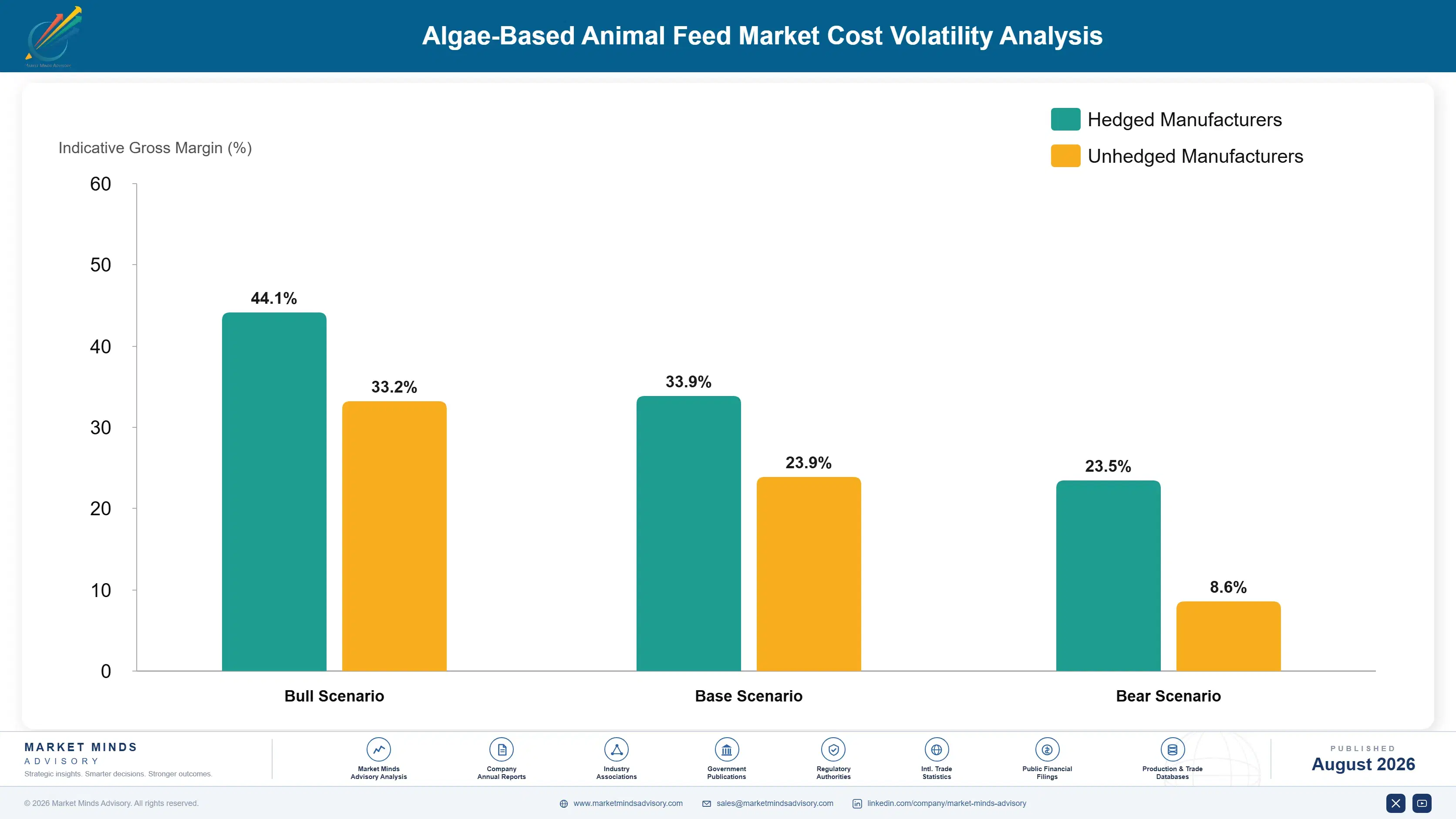
Cultivation Labour, Fermentation Sugar, and Drying

Cost structures diverge completely by production route. Macroalgal products are dominated by cultivation and harvest labour at roughly 39% of cost, drawn from farming communities across Indonesia, the Philippines, China, and coastal Europe. Heterotrophic fermentation instead runs on sugar substrate at around 31%, sourced from cane and corn processing. Energy for drying, extraction, and processing takes 18% across both routes.
Sugar prices rose substantially through 2023 and into 2024 as Indian export restrictions and Brazilian weather tightened global supply, which raised heterotrophic fermentation costs directly. European industrial energy prices had already risen steeply across 2022 and 2023 according to IEA reporting, compounding drying and extraction costs. Corbion referenced input cost pressure across its 2023 and 2024 reporting, and several smaller European algal producers reduced output rather than continue negative.

Exposure varies enormously by route and by siting rather than by scale. Fermentation producers sited near cane or corn processing with cheap power held cost position; spot buyers in high-tariff jurisdictions did not. Macroalgal producers in Indonesia and China, on low harvest labour costs, hold a base Western harvesters cannot approach on mineral products. Land-based Asparagopsis cultivation carries costs no feed economics would tolerate.
algae-based-animal-feed-market-trends-cost-volatility-analysis-1787462212033

Site fermentation capacity beside sugar processing and cheap power

Heterotrophic algal oil economics are dominated by substrate and energy, so plant location determines competitiveness for decades. Proximity to cane or corn processing outweighs proximity to feed mills, since concentrated oil ships cheaply relative to its value. Producers who sited on that logic held cost position through the 2023 sugar increase while those buying spot in high-tariff jurisdictions did not.

Contract sugar substrate across cane and corn origins annually

Cane and corn follow different agricultural cycles and different export policy regimes, so contracting across both removes dependence on any single crop or jurisdiction. Indian sugar export restrictions demonstrated that risk clearly during 2023. Fermentation processes designed to tolerate substitution between substrate types give procurement genuine optionality rather than theoretical alternatives on paper. Design it into the process.

Partner with established seaweed farming communities rather than building

Indonesian, Philippine, and Chinese cultivation communities already hold harvest capability, coastal access, and labour that would take years and considerable capital to replicate elsewhere. Contracting with grower cooperatives, paired with technical support on drying and grading, secures supply at costs no greenfield operation matches. It also builds the relationship that matters when supply tightens unexpectedly.

Portfolio Architecture for Margin Defence

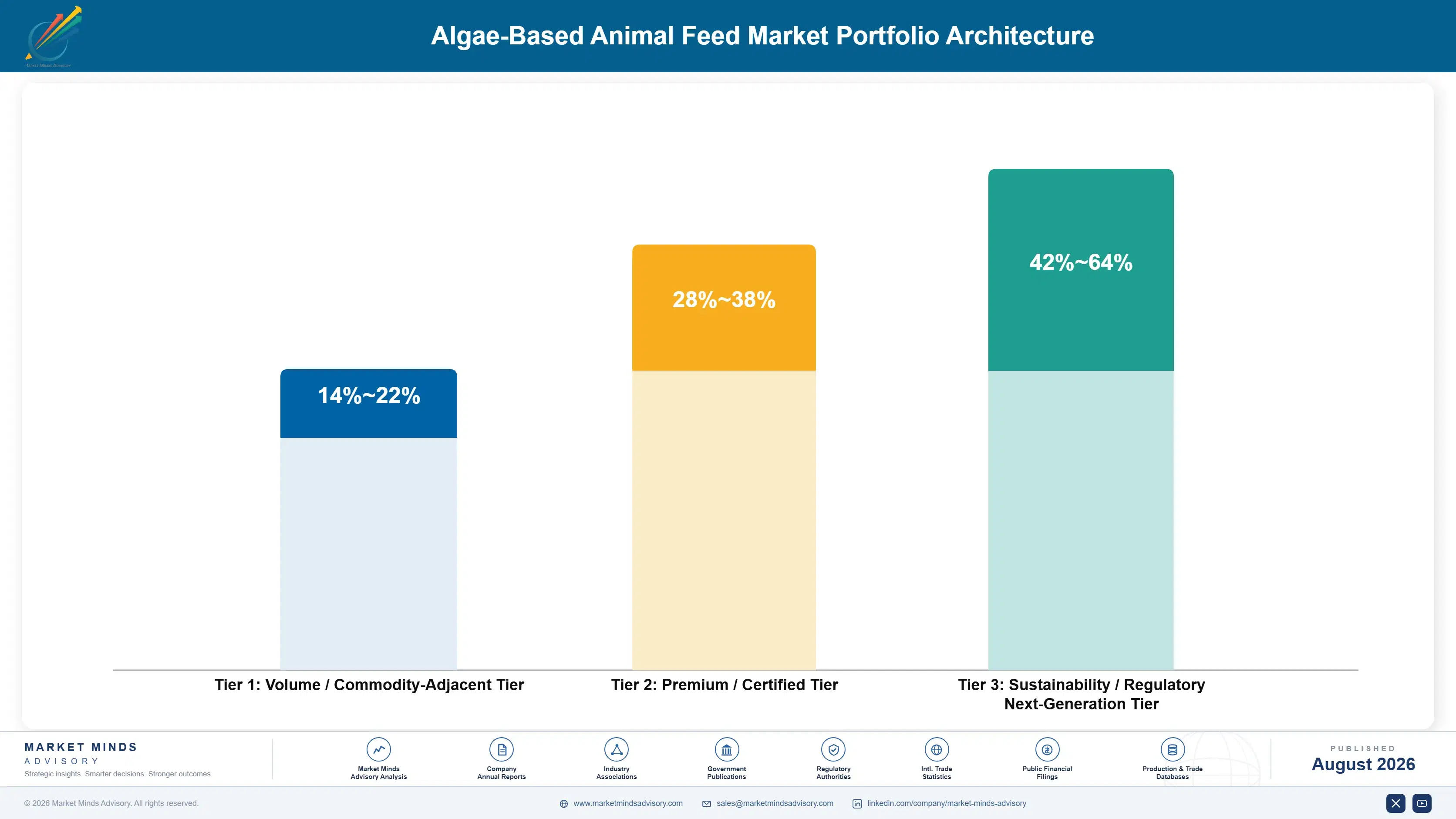
Three tiers separate on what the buyer is actually purchasing. Commodity macroalgal meal sold on mineral and protein content earns 14% to 22%, competing against Chinese and Indonesian cultivation on delivered cost with no differentiation available. Qualified algal omega-3 for salmonid and pet food earns 28% to 38%, since formulators are buying supply security and documented performance. Methane reduction supply structured as an emissions instrument earns most of all, and that gap is unlike anything else in animal nutrition.
The tension is that the established business funds the speculative one. Macroalgal mineral products generate cash and distribution relationships, yet they face relentless cost pressure from Asian cultivation and offer nothing defensible. Asparagopsis requires cultivation capital measured in tens of millions with no approval certainty and no farm-level economics. Companies attempting both are effectively running a declining ingredient business to fund a carbon venture, which is a portfolio structure few boards enjoy explaining.

High-value pools sit where the buyer has an obligation rather than a preference. Emissions targets, fishery quota constraints, and pet food premium positioning all create demand that is insensitive to ingredient cost in a way conventional feed purchasing never is.

Volume / Commodity-Adjacent Tier

Brown and green macroalgal meal sold on mineral, protein, and immune positioning into ruminant and poultry rations. Competes against Asian cultivation on delivered cost. The wide range reflects large differences in harvest labour cost and processing scale between producers.
Gross Margin: 14%-22%

Premium / Certified Tier

Qualified heterotrophic algal oils supplied to salmonid feed and premium pet food with documented omega-3 delivery and growth performance data. Range width separates aquafeed contract supply from premium pet food channels within the same tier.
Gross Margin: 28%-38%

Sustainability / Regulatory / Next-Generation Tier

Asparagopsis and methane suppression supply structured around verified emissions reduction, plus engineered strain products. Obligation-driven demand and cultivation scarcity, rather than production economics, sustain the margin structure across this tier entirely.
Gross Margin: 42%-64%
algae-based-animal-feed-market-trends-portfolio-architecture-1787462212535

High-value Sub-segments and Strategic Watch-out

Verified Methane Reduction Supply

Highest value in the market, structured as an emissions instrument rather than a feed additive and funded at roughly $180 per tonne of carbon dioxide equivalent avoided. Cultivation capacity is the only constraint. Demand is obligation-driven and therefore insensitive to ingredient cost. Nothing in animal nutrition works like this.
Gross Margin: 48%-64%

Qualified Algal Omega-3 for Salmonids

High value with strong growth, driven by fishery quota caps rather than by any preference for algal sourcing. Multi-year offtake agreements underwrite fermentation capacity. Formulators change qualified sources reluctantly once flesh quality data has been established properly. Quota volatility sustains the demand regardless of spot price movement.
Gross Margin: 32%-42%

Commodity Macroalgal Mineral Products

The volume core, generating cash and distribution relationships while facing relentless cost pressure from Chinese and Indonesian cultivation. Nothing about it is defensible on product grounds. Retain it for the channel access rather than for any margin it contributes. The channel is the asset, not the product.
Gross Margin: 12%-20%

Photoautotrophic Microalgal Biomass

The strategic watch-out. Open pond and photobioreactor production carries energy costs that feed economics cannot support, and heterotrophic fermentation delivers comparable actives far cheaper. Reserve it for applications where whole biomass specifically matters rather than extracts. Mothball rather than expand these assets for the time being.
Gross Margin: 18%-32%

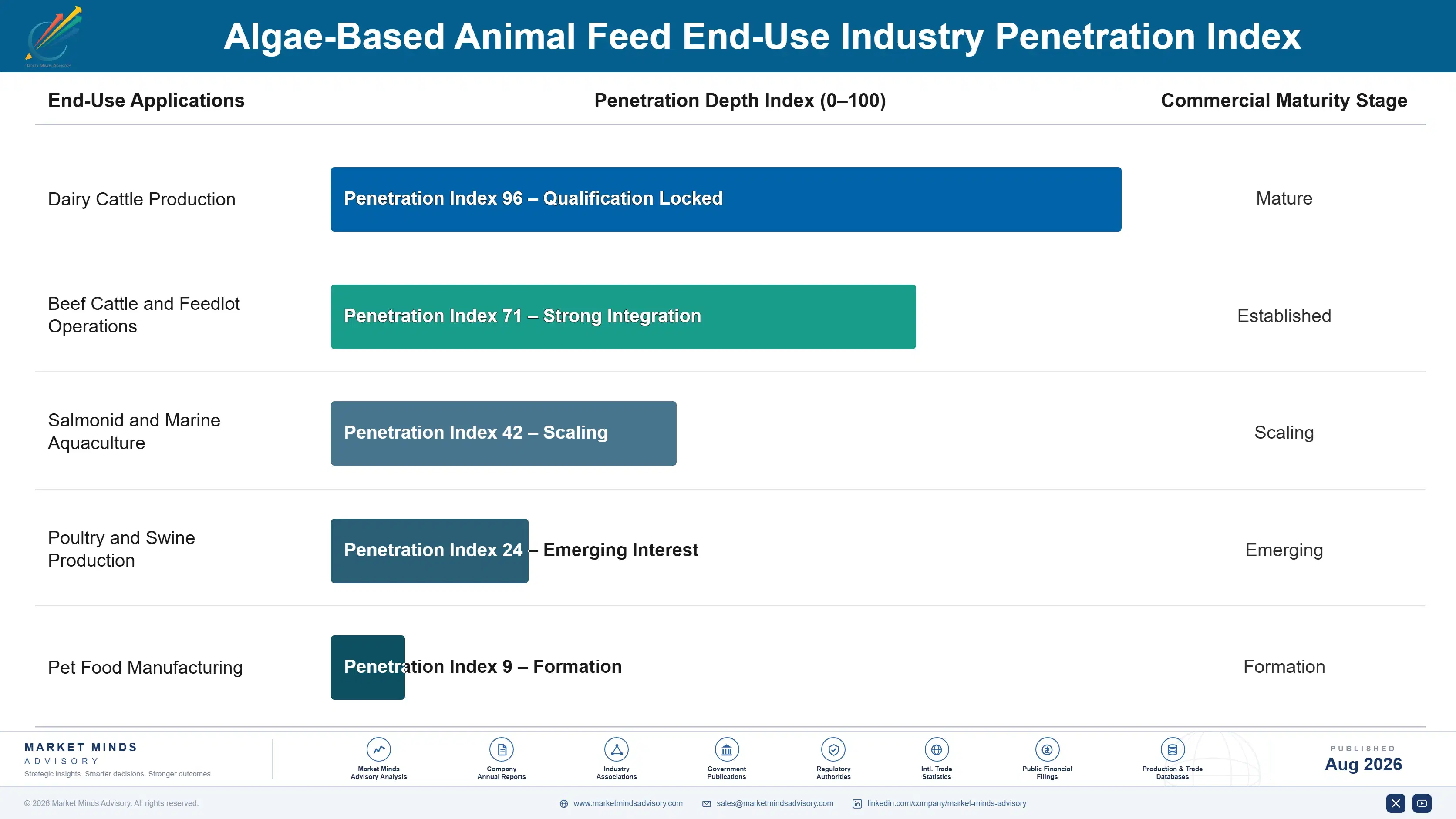
Why Ration Inclusion Rarely Reverses

Revenue in this market behaves as an annuity once an ingredient enters a standard ration or diet specification, and the reasons differ sharply between the two halves of the category. Salmon formulators who have qualified an algal oil across growth trials and flesh quality assessment leave it in place for years, because requalifying means repeating fish trials nobody wants to fund twice. Typical qualified omega-3 tenure runs six to nine years once flesh composition data has been signed off by the customer.
Stickiness varies by who is paying. Processor-funded methane programmes are durable while the emissions commitment behind them holds, and those commitments are typically multi-year and publicly stated, which makes reversal awkward. Qualified aquafeed omega-3 comes next, protected by trial data and formulation integration. Commodity macroalgal mineral products are the least sticky of all, retendered annually on delivered cost with Asian cultivation setting the reference price and no loyalty attached anywhere.

Buyer profiles have changed markedly. Sustainability and procurement teams now attend the same supplier meetings, and questions about verified emissions methodology arrive before any discussion of inclusion rate or price. Emissions methodology has become a supplier selection criterion in its own right.
algae-based-animal-feed-market-trends-end-use-penetration-index-1787462213024

Where Algal Feed Capital Belongs

These are among the four positions where our research anticipates prominent divergence between winners and laggards over the coming forecast period. Each is grounded in the demand model, the regulatory perimeter, and the announced capacity pipeline.
01 / EMISSIONS INSTRUMENT STRUCTURING

Sell verified methane reduction, not a feed additive

Farm economics do not justify Asparagopsis at current cultivation costs and no amount of agronomic argument changes that arithmetic in the near term at all. Structuring supply around verified emissions reduction sold to processors, retailers, or carbon markets moves the payer to whichever party actually carries the obligation, and programmes built this way have secured funding around $180 per tonne of carbon dioxide equivalent avoided. The additive then costs the farmer nothing, which removes the only genuine barrier to on-farm adoption entirely.
02 / CULTIVATION CAPACITY COMMITMENT

Build red macroalgae capacity before approvals, not after

Red macroalgae supply currently meets under 1% of theoretical demand, so whoever holds cultivation capacity when authorisations arrive takes a market competitors cannot enter simply by writing a cheque for inventory or capacity. Land-based tank systems cost roughly $22 million for meaningful commercial output and take years to establish reliably, while an approval decision takes only months to act upon. Building before regulatory certainty is genuinely uncomfortable, and it nonetheless remains the only sequence that actually works in this segment.
03 / OMEGA-3 OFFTAKE CONTRACTING

Lock multi-year aquafeed volume to underwrite fermentation plants

Fish oil supply stays capped by anchoveta quota while salmon biomass keeps growing, and formulators have learned through repeated shortages that availability matters considerably more than spot price ever does. Multi-year offtake agreements with the major aquafeed groups lock volume at predictable pricing and justify the fermentation capacity required to serve them, since the mills accept that structure precisely to remove their own supply risk. Contracts running five to seven years comfortably underwrite a plant costing around $80 million to build.
04 / COMMODITY TIER REALISM

Keep macroalgal meal for channel access, not for margin

Brown and green macroalgal meal sold on mineral and protein content now competes directly against Chinese and Indonesian cultivation output at delivered costs Western harvesters cannot approach, and nothing about the product is defensible on technical grounds whatsoever. It does generate cash and, more importantly, the distribution relationships through which novel algal products eventually reach integrators, mills, and farms. Retain it deliberately for that channel access, price it only to recover marginal cost, and expect nothing further from it at all.

Engagement Snapshot From the Field

A live engagement with an industry participant carrying material or product regulatory and market exposure ahead of a defining policy shift, showing how our research translates into a defensible multi-year portfolio strategy.
MARKET MINDS ADVISORY · CLIENT ENGAGEMENT SUMMARY
Algae-Based Animal Feed Producer Strategic Portfolio Review and Transition Roadmap 2026·Investment Scenario on Algae-Based Animal Feed Exposure Evaluation 2025-26
CLIENT PROFILE
A European algal ingredient producer operating coastal macroalgae harvesting and processing alongside a small photobioreactor microalgae facility, with annual revenue near EUR 41 million (client-reported, unverified by MMA). Around 81% of revenue came from brown macroalgal mineral and immune products sold into ruminant and poultry rations, with the microalgal facility running at 38% utilisation and contributing very little.
STRATEGIC CHALLENGE
Chinese and Indonesian cultivation had cut delivered pricing on macroalgal meal by roughly a quarter across three years while European harvest labour and energy costs rose, compressing gross margin to 11%. Two dairy processor customers had begun asking about enteric methane reduction supply the company could not provide, and the board was weighing further processing investment against exiting macroalgae entirely.
MMA APPROACH
MMA rebuilt product and customer profitability using actual delivered costs rather than standard costing, then benchmarked landed Asian macroalgal pricing under three energy and labour scenarios. Asparagopsis cultivation entry was costed as land-based tanks against licensing or partnership routes. Processor-funded methane programme structures were assessed against the client's existing customer relationships, tested through 47 expert interviews during Q4 2025.
KEY FINDINGS
  1. No achievable scale closed the delivered cost gap against Indonesian and Chinese macroalgal meal, because the difference was harvest labour and energy tariff rather than processing efficiency.
  2. The two dairy processor customers asking about methane reduction represented 34% of revenue and were prepared to fund supply at levels no farm budget would ever support.
  3. Photobioreactor microalgal production cost roughly 4.6 times equivalent heterotrophic fermentation output, and no application in the portfolio genuinely required whole photoautotrophic biomass.
  4. Land-based Asparagopsis cultivation entry required around EUR 19 million, against a partnership route with an Australian producer at roughly a fifth of that commitment.
CLIENT PROFILE
A European algal ingredient producer operating coastal macroalgae harvesting and processing alongside a small photobioreactor microalgae facility, with annual revenue near EUR 41 million (client-reported, unverified by MMA). Around 81% of revenue came from brown macroalgal mineral and immune products sold into ruminant and poultry rations, with the microalgal facility running at 38% utilisation and contributing very little.
STRATEGIC CHALLENGE
Chinese and Indonesian cultivation had cut delivered pricing on macroalgal meal by roughly a quarter across three years while European harvest labour and energy costs rose, compressing gross margin to 11%. Two dairy processor customers had begun asking about enteric methane reduction supply the company could not provide, and the board was weighing further processing investment against exiting macroalgae entirely.
MMA APPROACH
MMA rebuilt product and customer profitability using actual delivered costs rather than standard costing, then benchmarked landed Asian macroalgal pricing under three energy and labour scenarios. Asparagopsis cultivation entry was costed as land-based tanks against licensing or partnership routes. Processor-funded methane programme structures were assessed against the client's existing customer relationships, tested through 47 expert interviews during Q4 2025.
KEY FINDINGS
  1. No achievable scale closed the delivered cost gap against Indonesian and Chinese macroalgal meal, because the difference was harvest labour and energy tariff rather than processing efficiency.
  2. The two dairy processor customers asking about methane reduction represented 34% of revenue and were prepared to fund supply at levels no farm budget would ever support.
  3. Photobioreactor microalgal production cost roughly 4.6 times equivalent heterotrophic fermentation output, and no application in the portfolio genuinely required whole photoautotrophic biomass.
  4. Land-based Asparagopsis cultivation entry required around EUR 19 million, against a partnership route with an Australian producer at roughly a fifth of that commitment.
RECOMMENDED STRATEGY
Phase 1: Phase 1 (months one to six): reprice macroalgal meal to marginal cost recovery, retain it for channel access, and mothball the photobioreactor facility. Phase 2: Phase 2 (months seven to eighteen): negotiate an Asparagopsis supply and distribution partnership with an established Australian cultivator rather than building capacity. Phase 3: Phase 3 (months nineteen to thirty-two): structure processor-funded methane programmes with the two dairy customers under verified emissions reduction methodology.
OUTCOME
The producer mothballed the photobioreactor facility and reported gross margin improving from 11% to 21% within fourteen months on slightly lower revenue (client-reported, unverified by MMA). The Australian partnership was signed. One processor-funded methane programme entered commercial trial across supplier farms during 2026. Both remain on plan.

Frequently Asked Questions

Foundational context covering the market sizes, CAGR, scope, country, region and competition that inform every finding below. This section is provided to cover basics and most often pre-purchase conversations, answered from the MMA Primary Research Dataset.

What is the current size of the Algae-Based Animal Feed Market?

The market was valued at USD 1.20 billion in 2025, rising to an estimated USD 1.36 billion in 2026. East Asia holds the largest regional share at 30% of global value.

How large will the Algae-Based Animal Feed Market be by 2036?

MMA forecasts USD 4.88 billion by 2036 under the base case, an expansion multiple of 3.59 times the 2026 level. Incremental value creation across the period reaches USD 3.52 billion.

What is the CAGR for the Algae-Based Animal Feed Market 2026 to 2036?

The base case CAGR is 13.6%, with a bull case of 15.0% and a bear case of 12.2%. Historical growth between 2020 and 2025 also ran at 12.2%, carried almost entirely by algal oils.

Which segment is growing fastest?

Red macroalgae products, at 28.4%, roughly 2.09 times the overall market rate. Growth is driven by Asparagopsis methane suppression, with cultivation capacity the binding constraint throughout.

Who are the major companies in the Algae-Based Animal Feed Market?

Corbion, dsm-firmenich, Alltech, Cargill, and Olmix Group lead, holding roughly 22% of supply between them. Veramaris, Volta Greentech, and CH4 Global occupy specialist positions in cultivation.

Which country is growing fastest?

Indonesia, at 16.9%, driven by seaweed cultivation expansion alongside rising aquafeed demand. The country is also being assessed seriously as a potential Asparagopsis cultivation base.

Report Segmentation Architecture

The full report scope spans multiple orthogonal segmentation dimensions, with cross-tabulated demand data provided for each dimension pair. Coverage extends further to regional breakdowns, trend trajectories, and the competitive detail needed to support segment-level decision-making.

By Algal Source Organism

  • Brown Macroalgae Products
  • Red Macroalgae Products
  • Green Macroalgae Products
  • Photoautotrophic Microalgae
  • Heterotrophic Microalgae Oils and Biomass
  • Mixotrophic and Engineered Strain Products

By End-Use Industry

  • Dairy Cattle Production
  • Beef Cattle and Feedlot Operations
  • Salmonid and Marine Aquaculture
  • Poultry and Swine Production
  • Pet Food Manufacturing

By Commercial Dimension

  • Feed Mill and Premix Direct Supply
  • Processor-Funded Emissions Programmes
  • Integrator and Farm Direct Sales
  • Distributor and Trader Networks

By Region

  • North America
  • Western Europe
  • East Asia
  • South Asia and Pacific
  • Latin America
  • Middle East and Africa
  • Eastern Europe

Scope, Methodology, and Coverage

Every figure in this report is reproducible from documented input assumptions. The scope below maps the historical period, the forecast horizon, the segmentation dimensions, and the countries covered, alongside the underlying primary and qualitative methodology.
Historical Period
2020 to 2025
Forecast Period
2026 to 2036
Base Year
2025 (USD billions; MMA Primary Research Dataset, August 2026)
Market Definition
The market comprises algal biomass, extracts, and oils supplied as animal feed ingredients and additives, covering brown, red, and green macroalgae products, photoautotrophic microalgae, heterotrophic microalgae oils and biomass, and mixotrophic and engineered strain products. Value is measured at ingredient level as sold to feed mills, premix operators, integrators, and farms. Algae destined for human food and supplements, biofuel and cosmetic applications, seaweed harvested for hydrocolloid extraction, and finished compound feed fall outside scope.
Quantitative Units
USD billions (current prices); tonnes of algal ingredient; USD per tonne average selling price
Segmentation Dimensions
By Algal Source Organism; By End-Use Industry; By Commercial Dimension; By Region
Regions Covered
North America, Western Europe, East Asia, South Asia and Pacific, Latin America, Middle East and Africa, Eastern Europe
Countries Covered
USA, China, Germany, France, UK, Japan, South Korea, India, Australia, Canada, Brazil, Mexico, Indonesia, Vietnam, Thailand, Malaysia, UAE, Saudi Arabia, South Africa, Nigeria, Turkey, Poland, Netherlands, Italy, Spain, Sweden, Switzerland, Argentina, Colombia, Singapore, and additional markets relevant to this sector
Key Companies Profiled
Corbion, dsm-firmenich, Alltech, Cargill, Olmix Group, Evonik Industries, Veramaris, Symrise, Acadian Seaplants, Algaia, Sea6 Energy, Volta Greentech, Blue Ocean Barns, Symbrosia, CH4 Global, Qingdao Seawin Biotech, Allmicroalgae, Necton, Roquette Freres, Qingdao Gather Great Ocean Algae
Quantitative Methodology
Primary survey, n=3,800 respondents, Q4 2025, six countries; demand-side model with trade association cross-validation
Qualitative Methodology
47 expert interviews, Q4 2025; applied to validate demand model assumptions, identify emerging dynamics, and assess competitive positioning
Report Format
PDF and XLSX data workbook (Word format preview document)
Publisher
Market Minds Advisory
Report Code
MMA-2026-AGR-217
Published
August 2026
Contact
sales@marketmindsadvisory.com | www.marketmindsadvisory.com

Purchase the full Algae-Based Animal Feed Market Report (2026 to 2036).

The full report sizes algal feed ingredient demand across six source organism groups and seven regions with 2026 to 2036 forecasts under base, bull, and bear cases. It models red macroalgae cultivation capacity against theoretical methane suppression demand, showing exactly where the constraint sits and what would release it. Competitive profiles cover twenty suppliers assessed consistently on algal feed ingredient revenue, cultivation and fermentation assets, and regulatory position. Emissions analysis maps methodology status, processor funding structures, and approval pathways by jurisdiction. Commercial guidance addresses emissions instrument structuring, cultivation investment, offtake contracting, and commodity tier realism.
Six source organism groups sized and forecast separately
Cultivation capacity modelled against theoretical methane suppression demand
Twenty supplier profiles on consistent revenue basis
Feed additive authorisation pathways mapped across major jurisdictions
Processor-funded emissions programme structures analysed with funding benchmarks
Algal oil economics compared against fish oil availability scenarios

Built For The People Who Decide

From boardroom strategy to bench-side execution, this report is read cover-to-cover by leaders shaping the next decade of their industry, turning demand scenarios, market dynamics and valuation benchmarks into decisions.
CXOs/ Presidents/ VPs/ Managers
M&A and Corporate Development
Strategy Teams and R&D Heads
Procurement and Product Directors
Regulatory and Compliance Leaders
Investor Relations and Equity Analysts