Market Minds Advisory
Alfalfa Protein Concentrate Market

Alfalfa Protein Concentrate Market: Leaf Protein Meets Europe's Protein Autonomy Push

Alfalfa protein concentrate is shifting from a niche ruminant feed byproduct into a monogastric and human-food-grade protein source, and Europe's protein autonomy push is pulling investment toward purification technology most producers still lack.

Lead Analyst

Lisa Gevelber

Published

September 2026

Make Smarter Decisions with Customized Research Insights

Request a free sample report and evaluate market opportunities, growth trends, and competitive dynamics relevant to your business needs.

2025 MARKET VALUE$0.2BMarket Size 2025
2036 FORECAST VALUE$1.0BBase Case , 2026 to 2036
CAGR 2026 TO 203613.8 %Bull 15.1% / Bear 12.5%
INCREMENTAL OPPORTUNITY$0.7BNet 10- year value creation
EXPANSION MULTIPLE3.64x2036 value over 2026 base
Strategic Levers
M&A Pipeline
Regional Outlook
Country Rankings
Competitive Intelligence
Segmental Deep-dive
Call-Us : 91 93563 13602

Executive Snapshot and Market Trajectory

Alfalfa protein concentrate is graduating from a low-value ruminant feed ingredient into a genuine plant protein category, as purification technology advances enough to serve monogastric feed and, increasingly, human food applications. That technical leap is what separates today's investable protein concentrate business from yesterday's leaf-meal byproduct market.
Western Europe leads global production, anchored by France's decades-old alfalfa dehydration industry and reinforced by European Union protein autonomy policy funding domestic plant protein capacity. North America follows, driven by large-scale alfalfa hay acreage in the American West that could support new extraction capacity. Protein isolate, the highest-purity product tier suitable for human food formulation, is growing fastest as food technology companies explore alfalfa as a novel, land-efficient protein source relative to soy or pea.
Competition remains concentrated among a handful of European processors with purification technology, with the top five suppliers holding nearly half of global capacity. Desialis dominates French production through its La Luzerne de France brand, while Roquette is applying its plant protein extraction expertise to enter the category. Capital intensity is the barrier to entry, since building fractionation and purification capacity capable of food-grade purity requires investment few new entrants can justify.
Market Definition
The alfalfa protein concentrate market covers white and green protein concentrate, protein isolate, and related fractions extracted from alfalfa leaf biomass through mechanical pressing and purification, sold into monogastric animal feed, human food formulation, and specialty applications. It excludes raw alfalfa hay, pellets, or meal sold without protein extraction processing, and excludes alfalfa sprouts or fresh alfalfa sold for direct consumption.
Base Year Value
$0.2B in 2025 (MMA Primary Research Dataset, August 2026)
Forecast Period
2026 to 2036, eleven discrete annual values
CAGR
13.8% base case. Bull 15.1%. Bear 12.5%.
Fastest Growth Segment
Alfalfa Protein Isolate: 17.6% CAGR
Fastest Growth Country
France: 13.1% CAGR
Fastest Growth Region
South Asia and Pacific: 15.8% CAGR
Largest Region
Western Europe: 25% of 2025 global value
Market Leaders
Desialis, Roquette, Vandeputte Group, Limagrain, and DLG lead global supply. Source: MMA Analysis based on company annual reports.
Primary Survey
n=3,800 procurement and R&D decision-makers, Q4 2025, six countries
Methodology
Demand-side build-up, cross-validated against public data, 47 expert interviews

Alfalfa Protein Concentrate Market Forecast Scenarios

alfalfa-protein-concentrate-market-trends-size-forecast-scenario-1787462540918
Between 2020 and 2025, alfalfa protein concentrate demand grew at an estimated 12.4% annually as European Union protein autonomy policy began directing funding toward domestic plant protein capacity. Desialis expanded French extraction capacity through the period, while food technology companies began piloting alfalfa protein isolate in human food formulations previously dominated by soy and pea protein.
MMA's base case projects 13.8% annual growth to 2036 on three mechanisms: European Union protein autonomy funding directing capital toward domestic fractionation and purification capacity, food technology interest in alfalfa protein isolate as a land-efficient alternative to soy and pea protein in human food formulation, and monogastric feed adoption as purification technology closes the amino acid profile gap with conventional feed protein sources. Cosmetic and pharmaceutical formulators are adding a fourth growth channel through specialty functional fraction applications.
A bull catalyst comes from the European Union expanding protein autonomy subsidy programs, which could accelerate fractionation capacity investment beyond current projects within a few years. The bear risk is technical: if purification technology cannot close the remaining amino acid and taste profile gaps, alfalfa protein could remain confined to lower-value ruminant feed applications rather than reaching its human food and monogastric feed potential.

Leaf Protein Scales From Feed Byproduct to Novel Ingredient

Alfalfa protein concentrate is unusual because the category's economics are improving primarily through purification technology rather than agricultural yield gains. The underlying alfalfa crop is a well-established, low-cost forage commodity, but the fractionation and purification processes needed to extract food-grade or feed-premium protein remain capital-intensive and technically demanding. Suppliers that master purification are capturing value the raw crop alone never could. That distinction increasingly separates category winners from producers still competing on raw crop economics alone.
MARKET CONCENTRATION48%Top five suppliers hold nearly half the total
AVERAGE SELLING PRICE$3,200/tonneProtein isolate commands by far the steepest pricing available
TOP PRODUCING COUNTRYFranceLongest-established alfalfa dehydration and extraction industry by far
CAPACITY UTILIZATION64%Fractionation lines are scaling well below theoretical maximum
FEEDSTOCK COST SHARE31% of COGSFresh alfalfa biomass dominates total extraction production costs
TRADE INTENSITY22% exportedMost volume still serves domestic regional feed markets
Commercially, the category behaves like an emerging specialty ingredient business layered onto conventional forage agriculture. Alfalfa cultivation costs track ordinary hay and forage crop economics, but finished protein concentrate pricing tracks purity grade, amino acid profile documentation, and target application far more than raw crop cost. Processors that invest in higher-purity fractionation are capturing multiples of commodity green concentrate pricing.
Over the next decade, expect purification technology and European Union protein autonomy funding to matter more than raw production volume, particularly as food technology companies test alfalfa protein isolate against soy and pea protein benchmarks. Suppliers investing in food-grade purification capacity are positioned to capture human food formulation demand that commodity green concentrate producers cannot access.
"Alfalfa protein has been sitting in plain sight as cattle feed for decades. The moment purification technology got good enough for human food, it stopped being an agricultural byproduct and became a genuine protein category."
Director, Novel Proteins and Plant Protein Ingredients Practice · MMA Novel Proteins and Plant Protein Ingredients Practice · August 2026

Market Trends

Food Technology Companies Test Alfalfa Protein Isolate

Food technology companies developing plant-based meat and dairy alternatives are increasingly testing alfalfa protein isolate as a land-efficient alternative to soy and pea protein, drawn by alfalfa's high per-acre protein yield and favorable nitrogen-fixing cultivation profile. Roquette and several smaller specialty processors have expanded pilot-scale isolate production over the past two years specifically to supply these formulation trials. At least a handful of plant-based food brands have begun incorporating alfalfa protein isolate into early-stage product development since 2024, and food scientists report the protein's amino acid profile compares favorably with soy protein in several key nutritional metrics.
Market Impact: Accelerates capacity investment by 3+ years

European Protein Autonomy Policy Funds Fractionation

European Union protein autonomy policy, developed in response to concerns about dependence on imported soy protein for animal feed, is directing meaningful public funding toward domestic plant protein fractionation capacity, including alfalfa processing infrastructure specifically. Desialis and several French agricultural cooperatives have received policy-linked funding support to expand fractionation and purification capacity over the past two years. At least three new or expanded French fractionation facilities have been announced since 2023 citing protein autonomy policy support directly, and industry contacts expect additional funding rounds to continue supporting capacity expansion through the remainder of the decade.
Market Impact: Yields 2x+ protein per hectare

Market Opportunities and Growth Drivers

EU Protein Autonomy Strategy Directs Capital to Fractionation

The European Union's protein autonomy strategy, part of its broader Farm to Fork and Green Deal policy framework, specifically targets reduced dependence on imported soy protein for animal feed by funding domestic plant protein production capacity, including alfalfa fractionation infrastructure. Member states have allocated meaningful funding toward alfalfa and other legume protein processing capacity since the strategy's introduction, with France capturing a substantial share given its existing dehydration industry base. Industry analysts report this policy-driven funding has accelerated fractionation capacity investment that would otherwise have taken considerably longer to materialize through purely commercial investment alone.
Market Impact: Caps food-grade yield below 40%

Land-Efficiency Advantage Attracts Novel Protein Investment

Alfalfa's high per-acre protein yield and nitrogen-fixing cultivation profile, which reduces fertilizer input requirements relative to competing protein crops, is attracting novel protein investment interest from food technology companies and agricultural investors seeking land-efficient, lower-input protein sources. Comparative yield analyses suggest alfalfa can produce meaningfully more protein per hectare than soy under comparable growing conditions, a land-efficiency advantage that matters increasingly to investors evaluating protein sources against sustainability and land-use criteria. Several venture-backed food technology companies have specifically cited alfalfa's land-efficiency profile as a factor in sourcing decisions and investment interest over the past two years.
Market Impact: Caps pricing within 5% of meal

Market Restraints and Challenges

Purification Technology Limits Human Food-Grade Scale-Up

Producing human food-grade alfalfa protein isolate at commercial scale remains technically difficult, and the root cause is that removing the chlorophyll and saponins responsible for alfalfa's green color and bitter taste requires multi-stage purification that is capital-intensive and yield-limited at current technology maturity. Several pilot-scale runs have achieved purity and taste profiles suitable for human food testing, but scaling to commercial volume while maintaining cost competitiveness with soy or pea protein remains unresolved. This bottleneck is why alfalfa protein remains confined mostly to feed applications. Processors are mitigating this by partnering with specialized purification technology providers and research institutions.
Market Impact: Adds 5+ plant-based brand pilot trials

Green Concentrate Pricing Lags Competing Feed Proteins

Commodity green protein concentrate, the lower-purity, ruminant-feed-grade tier, competes on price with soybean meal and other feed protein sources, and the root cause is that it offers no nutritional or cost advantage over these alternatives at current scale. Feed formulators substitute toward green concentrate only when pricing is competitive with soybean meal, since the product carries no premium positioning absent higher purification. This pricing constraint limits margin potential for processors that have not invested in higher-purity fractionation capability. Larger processors are mitigating this by shifting production mix toward white concentrate and isolate tiers that command genuine premium pricing.
Market Impact: Funds 3+ new French facility expansions
3 additional market trends, 3 additional growth drivers, and 3 additional restraints and challenges are covered in the full report. Contact sales@marketmindsadvisory.com to access the complete intelligence.

Segment CAGR and Growth Architecture

Alfalfa protein concentrate is segmented by purification and processing level, the classification that determines purity grade, target application, and price positioning: white protein concentrate, green protein concentrate, protein isolate, leaf meal and fiber residue, brown juice extract, and specialty functional fractions each serve distinct feed, food, and industrial buyers, avoiding the overlap an end-use-based split would create.
alfalfa-protein-concentrate-market-trends-market-share-analysis-1787462541449

Alfalfa Protein Isolate

Alfalfa protein isolate, the highest-purity product tier suitable for human food formulation, is the fastest-growing segment as food technology companies test it as a land-efficient alternative to soy and pea protein in plant-based meat and dairy applications. Roquette and several specialty processors are scaling pilot-stage isolate production specifically to supply these formulation trials, though commercial-scale human food-grade capacity remains limited relative to overall category growth potential. Food brands increasingly evaluate alfalfa protein isolate specifically by name in formulation trials rather than treating it as a generic novel protein option, reflecting growing recognition of its distinct amino acid profile and sustainability positioning. Production costs remain substantially above commodity green concentrate, but premium human food pricing potential justifies continued purification technology investment.
CAGR 17.6%

Specialty Functional Fractions

Specialty functional fractions, including purified protein components isolated for pharmaceutical, cosmetic, and nutraceutical applications, are scaling quickly from a very small base as processors discover higher-value uses for fractions generated during standard purification processes. These fractions often command significantly higher per-kilogram pricing than even food-grade isolate, since pharmaceutical and cosmetic buyers pay for documented purity and functional properties rather than nutritional content alone. Desialis and Roquette both maintain research programs specifically exploring specialty fraction applications, benefiting from purification infrastructure already built for their core feed and food protein business. Adoption remains limited to a small number of sophisticated buyers currently, but growth potential is substantial given the category's very small starting base.
CAGR 16.4%
Full segment breakdown across 6 segments available in the complete report.

Regional Architecture and Country Demand Map

Western Europe leads global alfalfa protein concentrate production, anchored by France's established dehydration industry and reinforced by European Union protein autonomy policy funding, while North America's large-scale alfalfa hay acreage positions it as the second-largest and closely following production base across most emerging producing regions globally.

Western Europe

France hosts the world's most established alfalfa dehydration and protein extraction industry, anchored by Desialis' La Luzerne de France brand and decades of accumulated processing infrastructure and technical expertise. European Union protein autonomy policy, funded through Farm to Fork and Green Deal programs, is directing meaningful public capital toward expanding French and broader European fractionation capacity specifically to reduce dependence on imported soy protein. Belgium and the Netherlands host smaller but technically sophisticated processors, including Vandeputte Group, contributing specialty fraction and research capability to the regional supply base. Growth here trails some faster-growing regions in percentage terms only because the region's larger existing base means proportional growth translates into smaller relative increases.
Share: 25% | CAGR: 12.3% (2026 to 2036)

North America

The United States hosts substantial alfalfa hay acreage across California and other Western states, providing raw material capacity that could support significant extraction infrastructure investment if commercial economics justify the capital commitment. Domestic processors remain earlier in fractionation technology development than their French counterparts, though several agricultural cooperatives and ingredient companies are evaluating investment given rising novel protein market interest. Canadian alfalfa cultivation, concentrated in the Prairie provinces, supplies both domestic feed markets and export volume to US processors. Regional growth reflects the category's relatively early development stage here compared with the more mature European fractionation industry. Growing venture capital interest in novel protein technology is also drawing early-stage investment attention to potential North American extraction projects.
Share: 24% | CAGR: 13.9% (2026 to 2036)
Regional intelligence for 5 additional markets available in the complete report: East Asia, South Asia and Pacific, Latin America, Middle East and Africa, Eastern Europe. Contact sales@marketmindsadvisory.com.
alfalfa-protein-concentrate-market-trends-country-cagr-analysis-1787462541964

Where Alfalfa Protein Processors Can Capture Margin

Margin capture in alfalfa protein concentrate increasingly depends on purification technology investment rather than raw feedstock volume. Processors that can guarantee food-grade purity, secure European protein autonomy policy funding, and develop specialty functional fraction applications are commanding meaningfully better economics than those producing only commodity green concentrate for ruminant feed markets. That shift rewards technology-led processors over volume-focused commodity producers.

Food-Grade Isolate Purification Technology Capital Investment

Processors that develop purification technology capable of producing human food-grade alfalfa protein isolate are capturing premium pricing from food technology companies willing to pay substantially more than commodity feed protein rates. Roquette's pilot-scale isolate production, expanded in 2024, reportedly targets pricing at 4 to 6 times conventional green concentrate rates once commercial scale is achieved. Processors without dedicated purification research capability are increasingly partnering with specialized technology providers to accelerate development, adding cost but preserving access to the fastest-growing, highest-margin segment of the category. This capability gap is expected to persist for several more years given the technical complexity involved.
Market Impact: Targets a 4 to 6 times price premium

European Protein Autonomy Policy Funding Access

Processors that successfully secure European Union protein autonomy policy funding are accelerating fractionation capacity expansion years faster than pure commercial investment would otherwise support. Desialis and several French agricultural cooperatives have received policy-linked funding covering a meaningful share of recent capacity expansion project costs. Processors without established relationships with relevant funding bodies and agricultural policy administrators are increasingly partnering with agricultural cooperatives that have existing funding access, adding complexity but preserving access to capital that would otherwise be unavailable on comparable commercial terms. Policy-linked funding reportedly covers 30 to 40 percent of typical project capital costs.
Market Impact: Cuts capacity investment timelines by roughly 3+ years

Specialty Fraction Development for Pharma and Cosmetics

Processors that develop specialty functional fractions for pharmaceutical, cosmetic, and nutraceutical applications are capturing per-kilogram pricing well above even food-grade isolate, since these buyers pay for documented purity and functional properties rather than nutritional content alone. Desialis and Roquette both maintain research programs exploring these applications, using purification infrastructure already built for core feed and food protein business at limited incremental capital cost. This segment remains small today, representing under 5 percent of total category revenue, but early movers are establishing buyer relationships that will be difficult for later entrants to displace.
Market Impact: Represents under 5 percent of total category revenue

Bundled Amino Acid Documentation and Regulatory Support

Bundling amino acid profile documentation and regulatory compliance support alongside the physical protein concentrate sale helps smaller feed formulators and food technology companies that lack in-house analytical and regulatory capability evaluate alfalfa protein confidently. Processors offering this bundled service report shortened customer evaluation timelines by several months on average, since customers avoid commissioning duplicate analytical testing their supplier has already conducted. This service layer also raises effective per-tonne pricing by an estimated 8 to 12 percent, since smaller customers otherwise face analytical testing costs running into meaningful sums if commissioned independently.
Market Impact: Raises effective pricing by 8 to 12 percent

Who Controls the Margin Pool

Five suppliers hold nearly half of global alfalfa protein concentrate capacity on a production-volume basis, reflecting a market still concentrated among a small number of European processors with proprietary purification technology. The gap between purification-technology leaders and newer entrants attempting to enter the category is wide, since capital intensity and technical complexity create meaningful barriers to rapid scale-up. That barrier keeps the competitive set unusually stable for a still-emerging category.
Current competitive activity centers on three fronts: food-grade isolate purification technology development to capture human food formulation demand, European protein autonomy policy funding access to accelerate capacity expansion, and specialty functional fraction development to capture pharmaceutical and cosmetic applications. Desialis and Roquette have both continued investing in these areas specifically to defend leadership positioning against both new entrants and adjacent plant protein competitors.

Emerging pressure is coming from established plant protein companies like Cargill and ADM entering the category with their existing extraction and purification expertise, threatening the technical advantage smaller specialized alfalfa processors currently hold. Rankings could shift meaningfully over the next several years if these larger, better-capitalized entrants successfully adapt their existing protein extraction infrastructure to alfalfa feedstock at competitive cost.
alfalfa-protein-concentrate-market-trends-company-positioning-matrix-1787462542485

Competitive Moat and Risk Dimensions

DESIALIS

Moat: Decades of French Dehydration Infrastructure

Desialis operates France's most established alfalfa dehydration and extraction infrastructure, built over decades and reinforced by deep grower relationships across the country's alfalfa-growing regions. That accumulated infrastructure and technical expertise gives Desialis cost and scale advantages that newer entrants attempting to build comparable capacity from scratch cannot quickly replicate.
DESIALIS

Risk: Limited Food-Grade Isolate Scale-Up

Desialis' core strength in established green and white concentrate production has not yet translated into comparable leadership in food-grade isolate purification, where smaller, more specialized competitors and larger plant protein companies are moving faster. As human food applications become a larger share of category value, Desialis risks ceding leadership in the fastest-growing, highest-margin segment.
ROQUETTE

Moat: Broad Plant Protein Extraction Expertise

Roquette brings extensive plant protein extraction and purification expertise developed across pea, wheat, and other protein categories to its alfalfa protein business, letting it apply proven purification technology rather than developing capability from scratch. That transferable expertise positions Roquette to scale food-grade isolate production faster than alfalfa-specialist competitors lacking comparable broader protein extraction experience.
ROQUETTE

Risk: Alfalfa Remains a Smaller Priority

Roquette's alfalfa protein business remains a smaller priority relative to its much larger pea and wheat protein operations, potentially limiting the investment and management attention the category receives relative to dedicated alfalfa specialists like Desialis. If alfalfa protein demand accelerates faster than expected, Roquette could find itself under-invested relative to more focused competitors.

Players Tracked

Prominent Players

Desialis
Roquette
Vandeputte Group
Limagrain
DLG

Other Key Players

Cargill
ADM
Corteva Agriscience
Barenbrug
Ingredion
Buhler Group
Vegepro
AGRIFOOD Alpha Protein
GreenLab Skive
Timac Agro
Cosucra Groupe Warcoing
Emsland Group
Avril Group
InVivo Group
Terrena

Recent Developments

APRIL 2024

Roquette Expands Pilot-Scale Isolate Production

Roquette expanded its pilot-scale alfalfa protein isolate production capacity in April 2024, applying purification technology developed across its broader plant protein portfolio to accelerate food-grade isolate development, responding directly to growing food technology company interest in alfalfa as a land-efficient protein alternative. Analysts view this as validation of commercial potential.
Signal: Signals established plant protein companies are entering alfalfa specifically to capture emerging human food formulation demand.
NOVEMBER 2023

European Union Expands Protein Autonomy Funding Programs

The European Union expanded protein autonomy funding programs in November 2023, directing additional public capital toward domestic plant protein fractionation capacity including alfalfa processing infrastructure, responding to policy concerns about continued dependence on imported soy protein for animal feed across member states. Administrators expect continued expansion in coming budget cycles.
Signal: Signals policy support for domestic protein capacity will likely continue expanding rather than plateau near-term industry-wide.
JULY 2024

Desialis Announces Fractionation Capacity Expansion

Desialis announced expanded fractionation capacity investment in July 2024, supported partly by European protein autonomy policy funding, aimed at increasing both white concentrate and isolate production to meet growing monogastric feed and food technology customer demand across European markets. Company leadership called the investment a strategic priority for future growth.
Signal: Signals category leaders are scaling capacity ahead of confirmed demand, betting on continued policy and market momentum.

Alfalfa Biomass and Purification Cost Exposure

Fresh alfalfa biomass, harvested multiple times per growing season from established forage acreage, accounts for roughly thirty-one percent of total protein concentrate production cost across the industry. Purification and fractionation processing, particularly for food-grade isolate requiring multi-stage separation technology, adds a second significant and growing cost layer that varies considerably depending on target purity grade and required documentation.
European energy costs rose meaningfully during 2022 and 2023 following broader regional energy market disruption, according to industry trade reporting and Desialis' public disclosures, increasing dehydration and processing costs across the French alfalfa industry given its energy-intensive drying process requirements. Processors without long-term energy supply contracts faced the steepest cost increases, since alfalfa dehydration requires substantial thermal energy input that cannot be easily substituted or deferred without spoiling harvested biomass.

Smaller processors relying on spot-market energy purchases carry meaningfully more cost exposure than larger, more established suppliers like Desialis that maintain longer-term energy supply arrangements and more efficient, modernized drying infrastructure. Processors pursuing food-grade isolate purification face a distinct cost exposure profile tied to purification technology and yield efficiency rather than energy costs alone, introducing additional complexity beyond conventional green concentrate economics.
alfalfa-protein-concentrate-market-trends-cost-volatility-analysis-1787462542682

Negotiate Long-Term Energy Supply Contracts

Processors are locking in multi-year energy supply contracts to insulate dehydration and processing costs from the spot market volatility that affected the broader European energy market during 2022 and 2023. This approach requires longer-term commitment but has kept processing costs more stable for processors that implemented it before the recent energy price increases industry-wide.

Invest in Energy-Efficient Drying Technology

Processors are investing in modernized, energy-efficient dehydration equipment aimed at reducing thermal energy consumption per tonne of processed biomass without compromising protein quality. Early results suggest meaningful energy savings are achievable, though upgrading the full existing processing base will take considerable capital investment and time to complete. Grower partners report these upgrades also improve long-term facility reliability.

Diversify Toward Higher-Margin Product Mix

Processors are shifting production mix toward higher-margin white concentrate and isolate tiers, reducing sensitivity to energy and commodity cost pressure that affects lower-margin green concentrate economics most directly. This approach requires purification technology investment but has improved overall margin resilience for processors that pursued it before recent cost increases particularly for processors with sufficient purification capital available.

Portfolio Architecture for Margin Defence

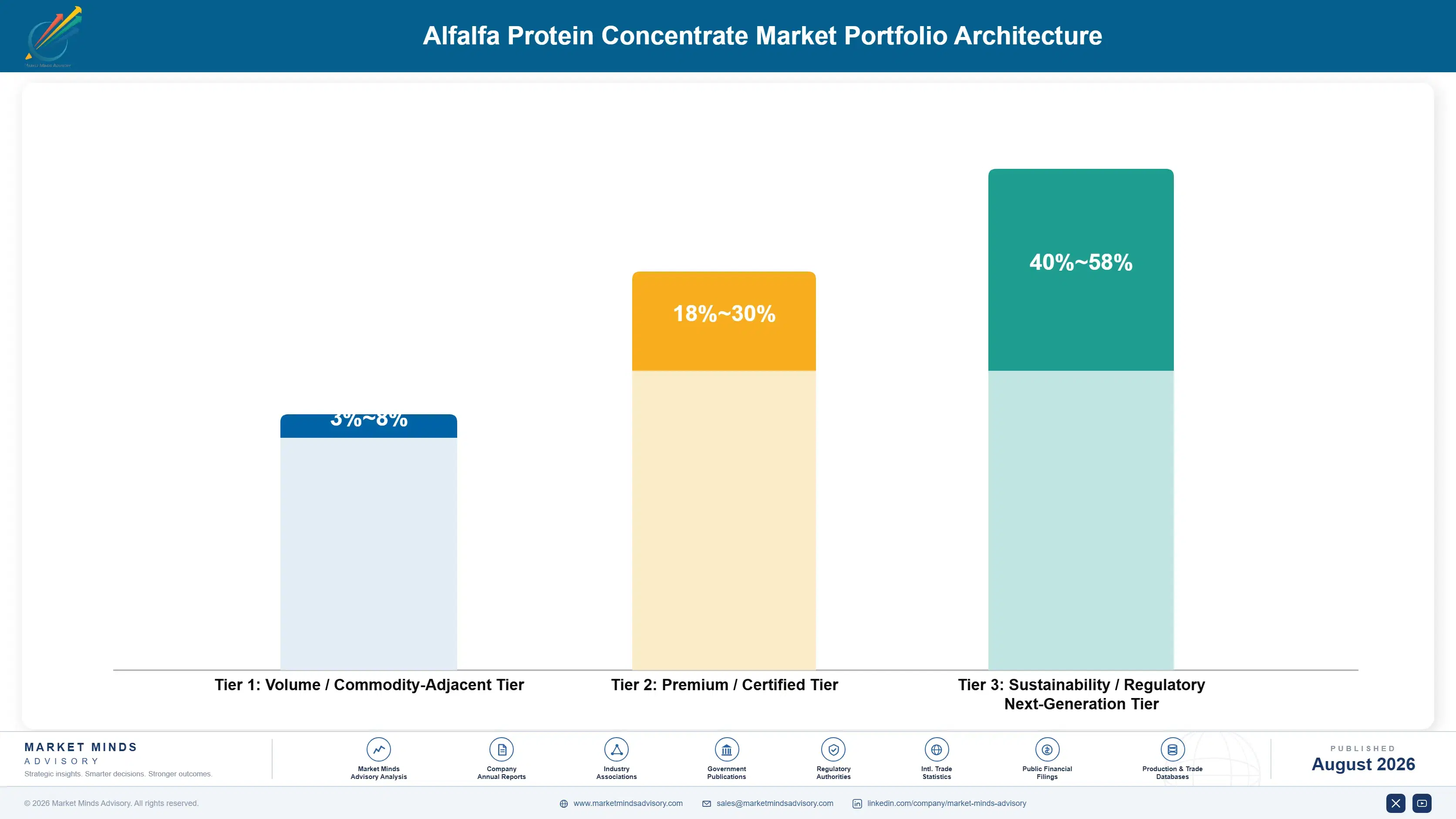
Alfalfa protein processors operate a three-tier portfolio spanning commodity green concentrate sold largely on cost per tonne into ruminant feed markets, white concentrate and human food-adjacent formulations commanding premium pricing from monogastric feed and early food applications, and protein isolate and specialty functional fractions positioned for the highest-margin human food, pharmaceutical, and cosmetic accounts. Gross margins vary enormously across these tiers, from thin single digits on commodity green concentrate to well above fifty percent on protein isolate and specialty fractions.
The volume versus premium tension is sharpening as more processors chase isolate and specialty fraction margins, but commodity green concentrate still represents meaningful shipped volume and remains important for covering fixed dehydration and processing costs during the industry's continued capacity buildout. Processors that abandon commodity volume too quickly in pursuit of premium accounts risk underutilizing capacity built for broader agricultural scale.

High-value margin pools concentrate specifically in protein isolate sold to food technology companies and specialty functional fractions supplying pharmaceutical and cosmetic buyers willing to pay for documented purity and functional properties. Commodity green concentrate remains the volume anchor but carries the thinnest margins, squeezed further by competition from established soybean meal pricing.

Volume / Commodity-Adjacent Tier

Commodity green protein concentrate sold primarily on cost per tonne into ruminant feed markets, competing directly with soybean meal and other established feed protein sources where price parity determines purchasing decisions.
Gross Margin: 3-8%

Premium / Certified Tier

White protein concentrate and early human-food-adjacent formulations sold into monogastric feed and pilot food applications, commanding premium pricing over commodity green concentrate through higher purity and documented amino acid profiles.
Gross Margin: 18-30%

Sustainability / Regulatory / Next-Generation Tier

Protein isolate and specialty functional fractions positioned for human food technology, pharmaceutical, and cosmetic accounts paying the category's highest per-kilogram prices for documented purity and functional properties Capital intensity and technical complexity keep this tier concentrated among a handful of processors.
Gross Margin: 40-58%
alfalfa-protein-concentrate-market-trends-portfolio-architecture-1787462543182

High-value Sub-segments and Strategic Watch-out

Human Food-Grade Protein Isolate

Food-grade alfalfa protein isolate is capturing the highest margins in the category as food technology companies test it against soy and pea protein benchmarks in plant-based meat and dairy applications, and established plant protein companies like Roquette are accelerating purification technology investment to capture this demand.
Gross Margin: 40-58%

Specialty Pharmaceutical and Cosmetic Fractions

Specialty functional fractions for pharmaceutical and cosmetic applications command exceptional per-kilogram pricing as buyers pay for documented purity and functional properties, though this segment remains a very small share of total category volume currently. Growth potential is substantial given how small the current revenue base remains today.
Gross Margin: 45-62%

Monogastric Feed White Concentrate

White protein concentrate sold into monogastric feed applications represents a growing middle tier between commodity green concentrate and premium isolate, commanding meaningful pricing premiums as feed formulators seek documented amino acid profiles. Adoption is likely to broaden steadily as feed formulators gain confidence in documented performance data.
Gross Margin: 18-30%

Commodity Ruminant Feed Green Concentrate

Standard green protein concentrate sold into ruminant feed markets remains the category's volume core, competing directly on price with soybean meal and facing limited margin expansion potential without further purification investment. Processors relying solely on this tier face limited margin expansion without further purification investment.
Gross Margin: 3-8%

Alfalfa Protein's Purification-Driven Lock-In

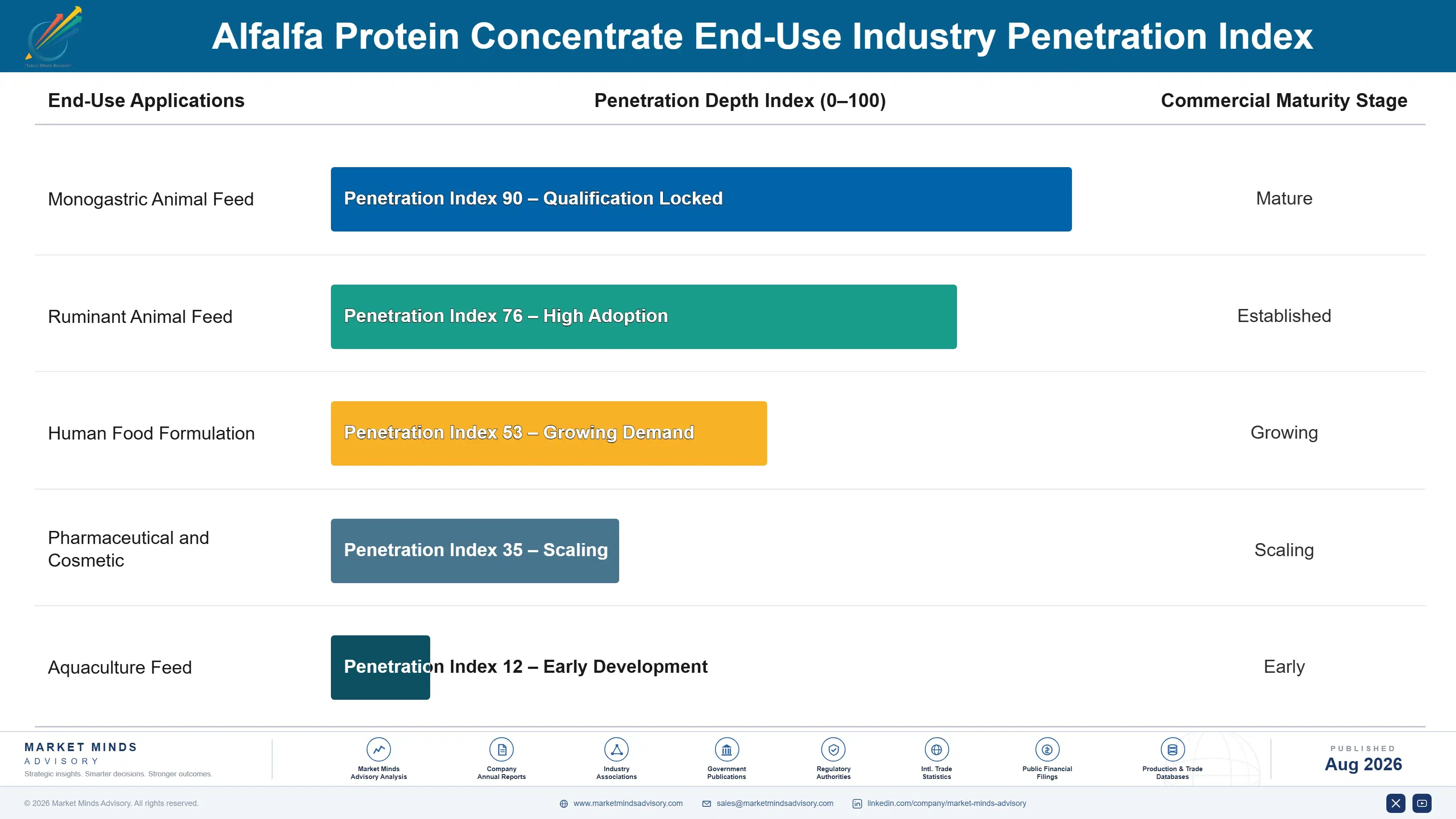
Alfalfa protein concentrate behaves less like a traditional annuity ingredient and more like a technology-driven category where purification capability, not established customer relationships alone, determines competitive position. Processors that develop genuine food-grade purification technology capture durable advantage because replicating that capability requires years of technical development that customer relationships alone cannot substitute for. That technology-driven moat differs meaningfully from typical ingredient categories where switching costs come mainly from established commercial relationships rather than genuine technical capability gaps.
Adoption depth varies sharply by end-use vertical. Food technology companies evaluate new protein sources relatively quickly when formulation trials show promise, moving fast to secure supply relationships with capable processors, while established feed formulators move more slowly, requiring extensive amino acid documentation and cost-parity demonstration before shifting away from established soybean meal supply relationships. Processors serving both channels increasingly maintain separate technical and commercial teams to match each customer's evaluation pace.

Generational and category shifts are visible mainly in how younger food technology entrepreneurs approach novel protein sourcing, increasingly favoring land-efficient, lower-input crops like alfalfa specifically for sustainability positioning, while legacy feed formulators remain anchored to established soybean meal relationships that have not yet faced sufficient cost or performance pressure to justify switching.
alfalfa-protein-concentrate-market-trends-end-use-penetration-index-1787462543671

Where Alfalfa Protein Value Concentrates

These are among the four positions where our research anticipates prominent divergence between winners and laggards over the coming forecast period. Each is grounded in the demand model, the regulatory perimeter, and the announced capacity pipeline.
01 / FOOD-GRADE ISOLATE INVESTMENT

Invest in isolate purification technology ahead of scale-up

Food-grade alfalfa protein isolate commands multiples of commodity green concentrate pricing, and that premium is sustained by the technical difficulty of purification processes competitors cannot easily replicate quickly. Roquette's pilot-scale isolate production has already demonstrated meaningful commercial interest from food technology companies, suggesting genuine demand exists once purification technology matures further. MMA recommends processors with purification research capability invest in isolate development now, before the category matures and premium pricing compresses toward commodity levels as more processors enter this increasingly visible segment.
02 / EUROPEAN POLICY FUNDING ACCESS

Secure protein autonomy funding ahead of program expansion

European Union protein autonomy policy funding is accelerating fractionation capacity investment years faster than pure commercial economics would otherwise support, and that funding availability is unlikely to diminish given continued policy concern about soy protein import dependence. Processors without established relationships with relevant funding administrators are missing capital access that better-connected competitors are actively capturing. MMA recommends processors evaluate funding access now, before program allocation becomes more competitive as additional processors recognize the opportunity and lock in policy-linked capital before allocation tightens.
03 / SPECIALTY FRACTION DEVELOPMENT

Develop specialty fractions ahead of broader market awareness

Specialty functional fractions for pharmaceutical and cosmetic applications command exceptional per-kilogram pricing well above even food-grade isolate, and this segment remains small enough that early movers can establish durable buyer relationships. Desialis and Roquette have already begun exploring these applications, using purification infrastructure built for their core protein business at limited incremental cost. MMA recommends processors with purification capability evaluate specialty fraction development now, while this remains a genuinely underexploited opportunity within the broader category and defend margin more effectively as broader awareness eventually spreads.
04 / FEEDSTOCK GEOGRAPHIC DIVERSIFICATION

Diversify feedstock sourcing ahead of European capacity constraints

Western Europe's leadership position rests heavily on France's established dehydration infrastructure, but North America's substantial alfalfa hay acreage could support significant new extraction capacity if commercial investment materializes at meaningful scale. Processors that establish early positioning in North American or other emerging growing regions could capture first-mover advantage as the category expands beyond its current European concentration. MMA recommends processors and investors evaluate geographic diversification now, before European capacity constraints limit the category's broader growth potential and secure relationships before larger competitors recognize the same opportunity.

Engagement Snapshot From the Field

A live engagement with an industry participant carrying material or product regulatory and market exposure ahead of a defining policy shift, showing how our research translates into a defensible multi-year portfolio strategy.
MARKET MINDS ADVISORY · CLIENT ENGAGEMENT SUMMARY
Alfalfa Protein Concentrate Producer Strategic Portfolio Review and Transition Roadmap 2026·Investment Scenario on Alfalfa Protein Concentrate Exposure Evaluation 2025-26
CLIENT PROFILE
The client is a mid-sized European monogastric feed formulator generating an estimated ninety million dollars in annual revenue (client-reported, unverified by MMA), supplying compound feed to poultry and swine producers across several countries. The client had relied on imported soybean meal as its primary protein source for years but faced growing pressure from customers seeking domestically sourced feed protein alternatives.
STRATEGIC CHALLENGE
Several major poultry integrator customers announced sourcing preferences favoring domestically produced feed protein, citing both supply chain resilience concerns and European protein autonomy policy alignment. The client needed to identify a domestic protein alternative that matched soybean meal's amino acid profile and cost competitiveness without disrupting existing feed formulation performance.
MMA APPROACH
MMA conducted a structured evaluation of white alfalfa protein concentrate suppliers, benchmarking amino acid profile documentation, cost competitiveness against soybean meal, and supply reliability against the client's existing formulation requirements. The engagement included direct supplier facility assessments and independent feed trial data review to validate performance before committing to formulation changes.
KEY FINDINGS
  1. White alfalfa protein concentrate matched soybean meal's core amino acid profile closely enough to substitute directly in most standard compound feed formulations without performance loss.
  2. Switching a meaningful share of soybean meal volume to domestic alfalfa concentrate added roughly six percent to per-tonne protein cost but satisfied customer sourcing preferences.
  3. Only one of the three evaluated suppliers could guarantee consistent supply volume sufficient to meet the client's full domestic sourcing commitment timeline.
  4. The client's successful transition helped retain several major poultry integrator contracts that had signaled willingness to seek alternative suppliers (client-reported, unverified by MMA).
CLIENT PROFILE
The client is a mid-sized European monogastric feed formulator generating an estimated ninety million dollars in annual revenue (client-reported, unverified by MMA), supplying compound feed to poultry and swine producers across several countries. The client had relied on imported soybean meal as its primary protein source for years but faced growing pressure from customers seeking domestically sourced feed protein alternatives.
STRATEGIC CHALLENGE
Several major poultry integrator customers announced sourcing preferences favoring domestically produced feed protein, citing both supply chain resilience concerns and European protein autonomy policy alignment. The client needed to identify a domestic protein alternative that matched soybean meal's amino acid profile and cost competitiveness without disrupting existing feed formulation performance.
MMA APPROACH
MMA conducted a structured evaluation of white alfalfa protein concentrate suppliers, benchmarking amino acid profile documentation, cost competitiveness against soybean meal, and supply reliability against the client's existing formulation requirements. The engagement included direct supplier facility assessments and independent feed trial data review to validate performance before committing to formulation changes.
KEY FINDINGS
  1. White alfalfa protein concentrate matched soybean meal's core amino acid profile closely enough to substitute directly in most standard compound feed formulations without performance loss.
  2. Switching a meaningful share of soybean meal volume to domestic alfalfa concentrate added roughly six percent to per-tonne protein cost but satisfied customer sourcing preferences.
  3. Only one of the three evaluated suppliers could guarantee consistent supply volume sufficient to meet the client's full domestic sourcing commitment timeline.
  4. The client's successful transition helped retain several major poultry integrator contracts that had signaled willingness to seek alternative suppliers (client-reported, unverified by MMA).
RECOMMENDED STRATEGY
Phase 1: Phase 1 (Weeks 1 to 4): Benchmark alfalfa protein suppliers against amino acid profile, cost, and supply volume requirements ahead of the sourcing deadline. Phase 2: Phase 2 (Weeks 5 to 8): Conduct independent feed trials to validate performance parity with existing soybean meal formulations before formal commitment. Phase 3: Phase 3 (Weeks 9 to 12): Finalize supplier agreements, transition formulation volume gradually, and confirm customer sourcing commitments across all regional facilities.
OUTCOME
The client successfully transitioned a meaningful share of its protein sourcing to domestic alfalfa concentrate, retaining major customer contracts that had signaled sourcing concerns (client-reported, unverified by MMA). The transition also positioned the client favorably ahead of continued customer interest in protein autonomy-aligned sourcing within the original project timeline.

Frequently Asked Questions

Foundational context covering the market sizes, CAGR, scope, country, region and competition that inform every finding below. This section is provided to cover basics and most often pre-purchase conversations, answered from the MMA Primary Research Dataset.

What is the current size of the Alfalfa Protein Concentrate Market?

The global alfalfa protein concentrate market is valued at approximately $0.24 billion in 2025. Growth is driven by European protein autonomy policy alongside emerging human food formulation interest.

How large will the Alfalfa Protein Concentrate Market be by 2036?

MMA projects the market will reach approximately $0.995 billion by 2036, more than 3.6 times its 2026 base value. Protein isolate will account for a growing share of that expansion.

What is the CAGR for the Alfalfa Protein Concentrate Market 2026 to 2036?

The market is expected to grow at a compound annual growth rate of 13.8% between 2026 and 2036. Bull and bear scenarios range from 12.5% to 15.1% depending on purification technology and policy conditions.

Which segment is growing fastest?

Alfalfa protein isolate is the fastest-growing segment, expanding at roughly 17.6% annually, about 1.3 times the overall market rate. Food technology interest is the primary driver.

Who are the major companies in the Alfalfa Protein Concentrate Market?

Desialis, Roquette, Vandeputte Group, Limagrain, and DLG lead global supply. The top five suppliers together hold nearly half of global capacity across all major producing regions.

Which country is growing fastest?

France is growing fastest, driven by its established dehydration infrastructure and European protein autonomy policy funding directed toward domestic fractionation capacity. Continued capacity investment is reinforcing this growth.

Report Segmentation Architecture

The full report scope spans multiple orthogonal segmentation dimensions, with cross-tabulated demand data provided for each dimension pair. Coverage extends further to regional breakdowns, trend trajectories, and the competitive detail needed to support segment-level decision-making.

By Purification Level

  • White Protein Concentrate
  • Green Protein Concentrate
  • Protein Isolate
  • Leaf Meal and Fiber Residue
  • Brown Juice Extract
  • Specialty Functional Fractions

By End-Use Industry

  • Monogastric Animal Feed
  • Ruminant Animal Feed
  • Human Food Formulation
  • Pharmaceutical and Cosmetic
  • Aquaculture Feed

By Commercial Dimension

  • Food-Grade Certified Supply
  • Feed-Grade Standard Supply
  • Contract Research Partnership
  • Direct Industrial Supply

By Region

  • North America
  • Western Europe
  • East Asia
  • South Asia and Pacific
  • Latin America
  • Middle East and Africa
  • Eastern Europe

Scope, Methodology, and Coverage

Every figure in this report is reproducible from documented input assumptions. The scope below maps the historical period, the forecast horizon, the segmentation dimensions, and the countries covered, alongside the underlying primary and qualitative methodology.
Historical Period
2020 to 2025
Forecast Period
2026 to 2036
Base Year
2025 (USD billions; MMA Primary Research Dataset, August 2026)
Market Definition
The alfalfa protein concentrate market covers white and green protein concentrate, protein isolate, and related fractions extracted from alfalfa leaf biomass through mechanical pressing and purification, sold into monogastric animal feed, human food formulation, and specialty applications. It excludes raw alfalfa hay, pellets, or meal sold without protein extraction processing, and excludes alfalfa sprouts or fresh alfalfa sold for direct consumption.
Quantitative Units
USD billions (current prices); metric tons of protein concentrate where applicable
Segmentation Dimensions
By Purification Level; By End-Use Industry; By Commercial Dimension; By Region
Regions Covered
North America, Western Europe, East Asia, South Asia and Pacific, Latin America, Middle East and Africa, Eastern Europe
Countries Covered
USA, China, Germany, France, UK, Japan, South Korea, India, Australia, Canada, Brazil, Mexico, Indonesia, Vietnam, Thailand, Malaysia, UAE, Saudi Arabia, South Africa, Nigeria, Turkey, Poland, Netherlands, Italy, Spain, Sweden, Switzerland, Argentina, Colombia, Singapore, and additional markets relevant to this sector
Key Companies Profiled
Desialis, Roquette, Vandeputte Group, Limagrain, DLG, Cargill, ADM, Corteva Agriscience, Barenbrug, Ingredion, Buhler Group, Vegepro, AGRIFOOD Alpha Protein, GreenLab Skive, Timac Agro, Cosucra Groupe Warcoing, Emsland Group, Avril Group, InVivo Group, Terrena
Quantitative Methodology
Primary survey, n=3,800 respondents, Q4 2025, six countries; demand-side model with trade association cross-validation
Qualitative Methodology
47 expert interviews, Q4 2025; applied to validate demand model assumptions, identify emerging dynamics, and assess competitive positioning
Report Format
PDF and XLSX data workbook (Word format preview document)
Publisher
Market Minds Advisory
Report Code
MMA-2026-AGR-108
Published
August 2026
Contact
sales@marketmindsadvisory.com | www.marketmindsadvisory.com

Purchase the full Alfalfa Protein Concentrate Market Report (2026 to 2036).

This report delivers a complete assessment of the global alfalfa protein concentrate market across all major purification levels, end-use industries, and geographic regions through 2036. It includes detailed competitive profiling of twenty companies, segmentation analysis distinguishing white concentrate, green concentrate, protein isolate, leaf meal, brown juice extract, and specialty functional fractions, and regional demand modeling across all seven MMA-covered geographies. Buyers will find quantified forecasts for market size, segment growth rates, and regional CAGR alongside qualitative analysis of purification technology trends, European protein autonomy policy, and energy cost exposure. A dedicated revenue lever framework identifies four specific commercial actions processors can take to capture margin as the category matures.
Twenty-company competitive profiling with moat and risk analysis
Seven-region demand model with justified share and CAGR bands
Purification-level segmentation across six MECE categories
Quantified revenue lever framework for margin capture strategies
Energy and biomass input cost exposure analysis
Anonymized case study on domestic feed protein transition

Built For The People Who Decide

From boardroom strategy to bench-side execution, this report is read cover-to-cover by leaders shaping the next decade of their industry, turning demand scenarios, market dynamics and valuation benchmarks into decisions.
CXOs/ Presidents/ VPs/ Managers
M&A and Corporate Development
Strategy Teams and R&D Heads
Procurement and Product Directors
Regulatory and Compliance Leaders
Investor Relations and Equity Analysts