Market Minds Advisory
Alarm Management System Market

Alarm Management System Market: Alarm Management System Market: Rationalisation, Dynamic Alarming and Configuration Enforcement, 2026 to 2036

Rationalisation projects work almost every time and almost always decay, because every plant change adds alarms and nobody removes any. The durable product is enforcement, and most sites still buy the project instead.

Lead Analyst

Published

September 2026

Make Smarter Decisions with Customized Research Insights

Request a free sample report and evaluate market opportunities, growth trends, and competitive dynamics relevant to your business needs.

2025 MARKET VALUE$1.4BMarket Size 2025
2036 FORECAST VALUE$2.9BBase Case , 2026 to 2036
CAGR 2026 TO 20366.8 %Bull 8.0% / Bear 5.6%
INCREMENTAL OPPORTUNITY$1.4BNet 10- year value creation
EXPANSION MULTIPLE1.93x2036 value over 2026 base
Strategic Levers
M&A Pipeline
Regional Outlook
Country Rankings
Competitive Intelligence
Segmental Deep-dive
Call-Us : 91 93563 13602

Executive Snapshot and Market Trajectory.

A rationalisation project brings alarm rates down to the published guidance figure and holds for about 34 months. Then configuration drift returns them to roughly where they started, because every plant modification adds alarms and almost nothing removes them. Sites buy the project again a few years later.
Only 19% of sites run an enforcement layer that would stop that cycle, which is the single most revealing figure in this market. Dynamic and state-based alarming grows at 10.2%, half again the market rate of 6.8%, because suppressing alarms irrelevant to the current operating state addresses flood at source rather than trimming a list. East Asia holds 30% of contracted value on new-build specification.
Five suppliers hold 51% of contracted value, and the concentration reflects control system ownership rather than software merit, since alarm configuration lives inside a distributed control system whose vendor holds the interface. Independent specialists compete on rationalisation methodology and on multi-vendor sites. Incident investigation remains the reliable budget trigger, and that has not changed in twenty years. What has changed is that corporate engineering functions now see the drift pattern across whole portfolios.
Market Definition
The alarm management system market covers software and engineering services that govern process alarm performance in industrial facilities, including alarm rationalisation and documentation, alarm analytics and performance reporting, dynamic and state-based alarming, operator console and display redesign, configuration management and enforcement, and compliance auditing against published guidance. It excludes distributed control systems themselves, safety instrumented systems, fire and gas detection hardware, and general industrial asset management platforms.
Base Year Value
$1.4B in 2025 (MMA Primary Research Dataset, September 2026)
Forecast Period
2026 to 2036, eleven discrete annual values
CAGR
6.8% base case. Bull 8.0%. Bear 5.6%.
Fastest Growth Segment
Dynamic And State-Based Alarming: 10.2% CAGR
Fastest Growth Country
India: 11.4% CAGR
Fastest Growth Region
South Asia and Pacific: 8.9% CAGR
Largest Region
East Asia: 30% of 2025 global value
Market Leaders
Honeywell, Emerson, Yokogawa, ABB, and Schneider Electric lead the field. Source: MMA Primary Research Dataset, July 2026.
Primary Survey
n=3,800 procurement and R&D decision-makers, Q4 2025, six countries
Methodology
Demand-side build-up, cross-validated against public data, 47 expert interviews

Alarm Management System Market Forecast Scenarios

alarm-management-system-market-size-forecast-scenario-1790005479343
Growth between 2020 and 2025 followed capital discipline rather than safety ambition. Process industry capital spending was constrained through much of the period, and alarm management, being a small line inside a larger control system budget, was deferred alongside everything else. Historical growth of 5.8% reflects that restraint, punctuated by bursts following incident investigations naming alarm flood.
The base case at 6.8% rests on three mechanisms. New refining and petrochemical capacity in Asia specifies alarm management at design stage, where it costs a fraction of retrofitting it later and nobody has to justify it separately. Operator demographic turnover removes the experienced judgement that previously compensated for poor alarm design. And insurers and regulators increasingly ask for alarm performance evidence during periodic assessment, which converts a good practice into a documented obligation.
The bull case at 8.0% turns on alarm performance becoming an explicit condition of operating permits in a major jurisdiction, which would move procurement from voluntary to compulsory across an entire installed base. The bear case at 5.6% is capital deferral: when process industry margins compress, alarm work is among the first items cut, since a plant running for years with poor alarm performance can visibly run another.

Rationalisation Works, Then It Decays

The uncomfortable pattern in this market is that the projects succeed and the results do not last. Rationalisation reliably brings an operator's alarm rate down toward the published guidance figure, and roughly 34 months later the rate has climbed back, because every plant modification adds alarms and no work process removes them. Only 23% of operating plants currently meet the guidance. That figure barely moves.
TOP FIVE CONCENTRATION51%Share of contracted value held by the leading suppliers
AVERAGE ALARM RATE9 per hourAlarms presented to a single operator during steady operation
GUIDANCE COMPLIANT SITES23%Operating plants meeting the published alarm performance guidance
POST-PROJECT DRIFT PERIOD34 monthsTime before rationalised alarm rates return to previous levels
MEDIAN PROJECT VALUEUSD 420,000Typical cost of a single site rationalisation engagement
ENFORCEMENT LAYER ADOPTION19%Sites running automated configuration control after a project
That decay is a commercial opportunity dressed as a technical failure. Repeat rationalisation sells well, and suppliers have not been in a hurry to explain that a configuration enforcement layer would prevent most of the drift. Only 19% of sites run one. The vendors who do lead with enforcement find they are arguing against their own services revenue, which is a difficult internal conversation. Nobody wants to be first to have it.
Budget arrives through incidents rather than through planning. Alarm flood appears in a substantial share of published process safety investigations, and a named finding releases money that years of good practice arguments never did. That dependency makes demand lumpy, geographically uneven, and unusually responsive to events that happen at somebody else's plant. Planning arguments have never moved money the same way.
"The honest version of this business is that we sell the same project to the same site every four years and call it continuous improvement. The suppliers who eventually break that cycle will lose services revenue and win the installed base, and very few boards want to be first."
Practice Director, Process Automation and Operational Safety · MMA Industrial Equipment Practice · September 2026

Market Trends

State-Based Suppression Attacks Alarm Flood At Source

Most alarm floods happen because alarms configured for normal operation fire during startup, shutdown, or equipment outage, when they carry no useful information for the operator. Dynamic and state-based alarming suppresses those conditionally, which addresses the problem at its origin rather than trimming a list that will grow again. The segment grows at 10.2% on that logic. Implementation demands genuine process knowledge and careful safety review, since suppressing the wrong alarm has consequences, and that engineering requirement is what limits adoption more than software cost ever has. Engineering capability decides who can deliver it.
Market Impact: Triggers 44% of projects
New Asian Capacity Specifies Alarm Management At Design

Refining and petrochemical capacity additions concentrated in Asia are being designed with alarm rationalisation embedded in the control system specification, rather than retrofitted after commissioning. Doing it at design costs a fraction of doing it later and requires no separate business case, since it sits inside the control system award. Indian growth of 11.4% leads every country covered on that basis. The commercial consequence for suppliers is that the control system vendor frequently captures the work by default, which disadvantages independent specialists on new-build sites considerably. Independents rarely arrive before the control award.
Market Impact: Affects 23% compliant site base

Market Opportunities and Growth Drivers

Incident Investigations Name Alarm Flood As Contributing Factor

Published process safety investigations regularly identify alarm flood among the conditions that prevented operators from responding effectively, and a named finding releases budget that years of good practice argument never did. The effect travels well beyond the site involved, since operators of similar facilities anticipate the questions their own regulator will ask next. Roughly 44% of rationalisation projects in the past three years were initiated within eighteen months of a relevant published investigation, which makes demand responsive to events happening at somebody else's plant entirely. Regulators ask the same questions everywhere afterwards.
Market Impact: Reverses gains in 34 months

Operator Demographic Turnover Removes Compensating Experience

Experienced control room operators learned which alarms mattered and quietly ignored the rest, which masked poor alarm design for decades. That cohort is retiring across most process industries, and the operators replacing them have neither the accumulated judgement nor any documented basis for acquiring it. Facilities discover their alarm performance was never acceptable, only survivable. This drives rationalisation demand independently of capital cycles, because the trigger is a staffing change management can see coming and cannot prevent through any amount of deferred maintenance spending. Retirement schedules are visible years ahead.
Market Impact: Sustains 51% supplier concentration

Market Restraints and Challenges

Configuration Drift Reverses Results Within Three Years

Alarm rates return to pre-project levels in a median 34 months, and the root cause is process rather than technology: plant modifications add alarms through management of change procedures that never require removing any. Every project therefore has a shelf life nobody discusses during the sale. Commercially this sustains repeat revenue and quietly damages credibility, since operations staff who have seen two cycles are sceptical of the third. Participants are responding with configuration enforcement layers, alarm addition governance built into change procedures, and continuous performance reporting that makes drift visible before it matters.
Market Impact: Grows at 10.2% annually

Control System Vendors Hold The Configuration Interface

Alarm configuration lives inside a distributed control system, and its vendor controls the interface through which any external tool must read and write. The root cause is architectural rather than contractual, though support agreements reinforce it. This sustains 51% concentration among control system suppliers and confines independents largely to rationalisation methodology, multi-vendor sites, and analytics that read data without writing configuration. Independents respond by qualifying across several control platforms, by focusing on the engineering judgement that no interface confers, and by winning sites where the control vendor has disengaged. Disengaged control vendors leave openings.
Market Impact: Drives 11.4% Indian growth
3 additional market trends, 4 additional growth drivers, and 2 additional restraints and challenges are covered in the full report. Contact sales@marketmindsadvisory.com to access the complete intelligence.

Segment CAGR and Growth Architecture

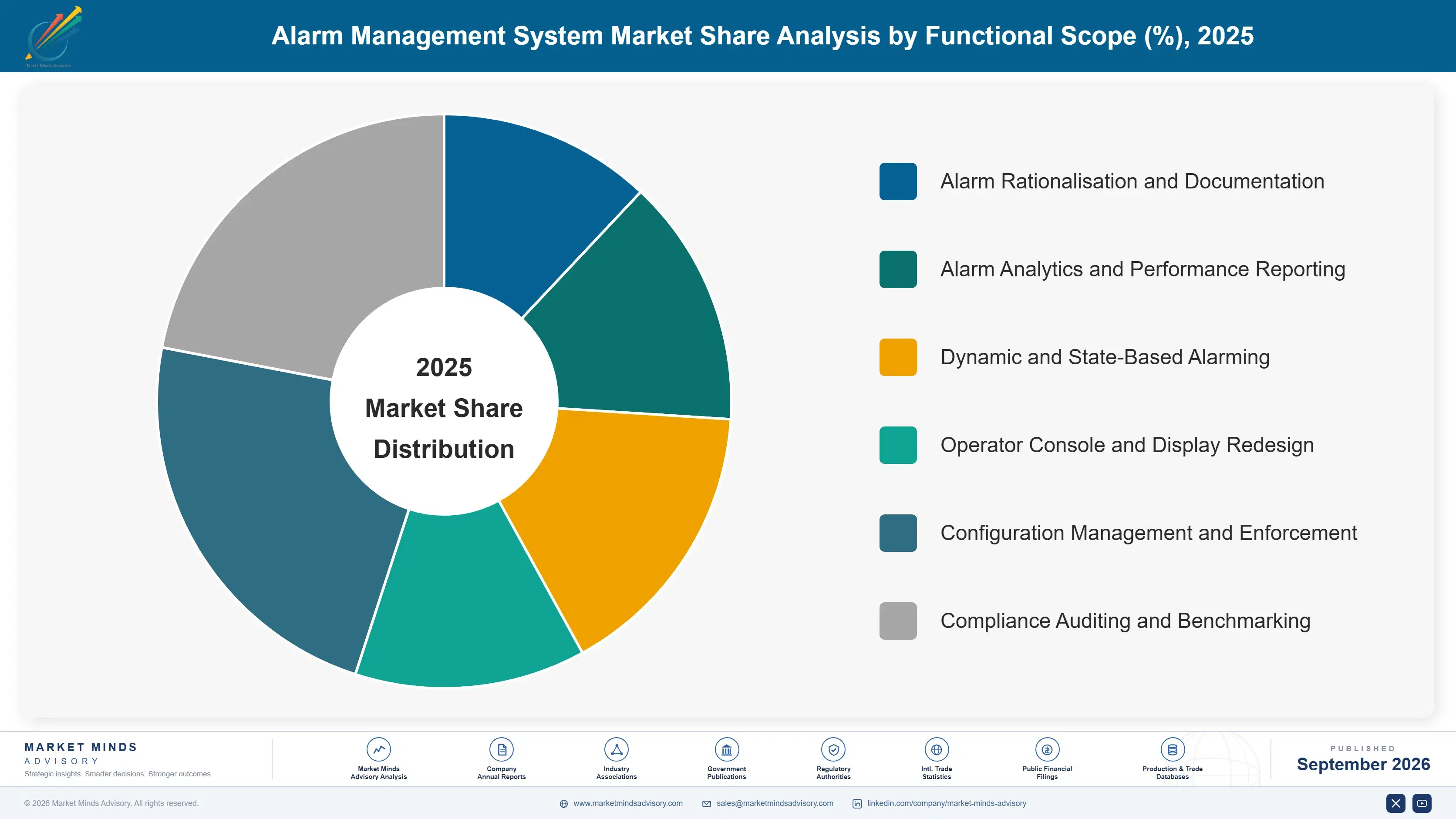
Segmentation follows what the work delivers. Six functional segments cover the field: alarm rationalisation and documentation, alarm analytics and performance reporting, dynamic and state-based alarming, operator console and display redesign, configuration management and enforcement, and compliance auditing and benchmarking. Rationalisation dominates spending; the durable value sits elsewhere. Enforcement and state-based work carry the growth.
alarm-management-system-market-market-share-analysis-1790005479903

Dynamic And State-Based Alarming

State-based alarming grows at 10.2%, half again the market rate of 6.8%, because it addresses where alarm floods actually originate. Alarms configured for normal running fire during startup, shutdown, and equipment outage, carrying no information the operator can act on, and suppressing them conditionally removes the flood rather than shortening a list that will grow back. What limits adoption is engineering rather than price: suppressing the wrong alarm in the wrong state has real consequences, so implementation requires process knowledge and formal safety review that many sites cannot resource internally. Suppliers with genuine process engineering depth capture this work almost by default. Competition here is thin for exactly that reason.
CAGR 10.2%

Alarm Configuration Management And Enforcement

Enforcement grows at 9.1% and remains the most commercially awkward segment in the category. An automated configuration control layer prevents most of the drift that returns alarm rates to pre-project levels within 34 months, which means it directly reduces the repeat rationalisation revenue that suppliers currently rely on. Only 19% of sites run one. Adoption is rising fastest among operators who have been through two rationalisation cycles and drawn the obvious conclusion, and among corporate engineering functions managing many sites where the drift pattern is visible in aggregate rather than obscured by local circumstance. Suppliers leading with enforcement are arguing directly against their own services revenue, which explains the slow adoption better than any technical objection does.
CAGR 9.1%
Full segment breakdown across 6 segments available in the complete report.

Regional Architecture and Country Demand Map

Regional shares follow process industry asset concentration and the vintage of that asset base, not general industrial output. New capacity specifies alarm management at design; older plants buy it after an incident, and those two purchasing patterns produce very different regional profiles. Asset vintage explains most of the difference.

East Asia

Chinese refining and petrochemical capacity is the largest and among the newest anywhere, and new units increasingly specify alarm rationalisation inside the control system award rather than retrofitting after commissioning. That places the work with the control system vendor by default and produces steady, planned demand rather than incident-driven bursts. Japanese and Korean facilities present the opposite profile, with older assets and rigorous operating discipline that produces regular auditing and console work. Growth of 7.9% runs above the world rate because new-build specification and mature-plant maintenance demand arrive together, which is unusual across the seven regions covered here. Control vendors capture new build scope before independents can compete for it.
Share: 30% | CAGR: 7.9% (2026 to 2036)

North America

The asset base is old and the regulatory attention is intense, which produces the most incident-responsive demand pattern in this market. Published investigations naming alarm flood move budgets across the whole refining and chemicals sector within months, and operators anticipate the questions their own regulators will ask afterward. Corporate engineering functions managing many sites are also the earliest adopters of configuration enforcement, because drift is visible to them in aggregate. Growth of 6.2% is moderate, tracking a maintenance-driven market where capital deferral during margin compression remains the single largest brake on activity. Corporate engineering functions here lead on enforcement adoption across multi-site portfolios. Capital deferral remains the largest brake on activity.
Share: 25% | CAGR: 6.2% (2026 to 2036)
Regional intelligence for 5 additional markets available in the complete report: Western Europe, South Asia and Pacific, Latin America, Middle East and Africa, Eastern Europe. Contact sales@marketmindsadvisory.com.
alarm-management-system-market-country-cagr-analysis-1790005480436

Where Suppliers Build Durable Revenue

Four commercial moves separate suppliers building an installed position from those selling the same project to the same site every four years. Each requires giving up some repeat services revenue, which is why the moves are widely understood, frequently discussed, and rarely executed by anybody. First mover advantage here is unusually durable. Very few boards want that.

Lead With Enforcement Rather Than Repeat Rationalisation

Configuration enforcement prevents most of the drift that returns alarm rates to pre-project levels within 34 months, and only 19% of sites run one. Suppliers leading with it lose repeat project revenue and gain a subscription position that renews without competition, typically worth 2.4 times the lifetime value of the rationalisation cycle it replaces. The internal argument is genuinely hard, since services organisations are measured on the revenue this removes, and that is precisely why the position remains available to whoever moves first. Renewal arrives without any competitive process attached.
Market Impact: Worth 2.4 times the cycle it displaces overall

Qualify Across Multiple Control System Platforms

Configuration interfaces are controlled by control system vendors, which confines single-platform specialists to a fraction of the addressable base. Qualifying tools across three or more platforms opens multi-vendor sites, which are common in operators grown through acquisition and are frequently the worst performing assets in a portfolio. Suppliers with multi-platform coverage address roughly 2.8 times the site population of single-platform competitors. Qualification is slow, unglamorous, and expensive, and it is the only route independents have into accounts the control vendor considers its own. Acquired estates are usually the worst performers.
Market Impact: Addresses 2.8 times more sites than single-platform rivals

Sell Into Corporate Engineering Rather Than Individual Sites

A site sees its own alarm performance and attributes drift to local circumstance. A corporate engineering function managing thirty plants sees the same pattern everywhere and draws the correct conclusion much faster. Selling at that level produces multi-site agreements averaging 6 to 9 times single-site project value, and it converts an incident-triggered purchase into a programme with its own budget line. It also removes the discount pressure that comes from every site procuring independently against local capital constraints. Standardisation across sites also creates documentation and training dependencies that survive personnel changes.
Market Impact: Averages 6 to 9 times single-site project value

Capture New Build Work At Specification Stage

Alarm management embedded in a control system specification costs a fraction of retrofitting and requires no separate business case, which is why new Asian capacity buys it as a matter of course. Suppliers engaged during front-end engineering win that scope at roughly 4.1 times the rate of those approaching after commissioning. The engagement is early, unbilled, and competes with nothing, since no incumbent exists yet at a plant that has not been built. Independents lose here by default unless they are present before the control award. No incumbent exists at a plant not yet built.
Market Impact: Wins 4.1 times more new build scope overall

Who Controls the Margin Pool

Concentration is high and architecturally determined. Five suppliers hold 51% of contracted value, measured consistently on that basis across all participants, and four of them are control system vendors whose position rests on owning the configuration interface rather than on any superiority in alarm methodology. The gap between the leader and the fifth is moderate, and it moves with control system installed base rather than with competitive performance.
Competition currently turns on three things: process engineering depth sufficient to implement state-based alarming safely, qualification across multiple control platforms, and access to corporate engineering functions rather than individual sites. Price competition is severe on basic rationalisation, where methodology is well documented and several credible providers exist, and much weaker on state-based work. Methodology is published and buyers compare day rates directly against it.

Pressure comes from two directions. Independent specialists with strong process engineering are taking state-based and enforcement work that control vendors have been slow to prioritise. Meanwhile engineering contractors are capturing new-build scope at specification stage. Rankings will shift toward whoever establishes enforcement subscriptions across multi-site operators, which is where recurring revenue is concentrating. Independents lose new build sites almost by default.
alarm-management-system-market-company-positioning-matrix-1790005480963

Competitive Moat and Risk Dimensions

HONEYWELL

Moat: Control Interface And Installed Base

Ownership of a very large distributed control installed base means alarm configuration work arrives without competition on most of those sites, since the interface through which any tool must read and write belongs to the company. Support agreements reinforce that position, and operators rarely introduce a third party into a control system they depend on continuously.
HONEYWELL

Risk: Services Revenue Blocks Enforcement

Configuration enforcement removes much of the repeat rationalisation revenue that a large services organisation is measured on, which makes the internally correct decision commercially painful. Independents unburdened by that services base are leading with enforcement, and the position they establish renews without the competition that project work always attracts.
YOKOGAWA

Moat: Process Engineering Depth Advantage

Genuine process engineering capability supports state-based alarming implementation, which requires knowing which alarms may safely be suppressed in which operating state and defending that judgement in a formal safety review. Few competitors can resource this credibly, and it is the fastest growing work in the category by a clear margin.
YOKOGAWA

Risk: Western Installed Base Thin

The strongest incident-driven demand sits in North American refining and chemicals, where the company's control installed base is considerably smaller than its Asian position. Competing there means winning against an incumbent interface holder on methodology alone, which is possible on multi-vendor sites and difficult everywhere else.

Players Tracked

Prominent Players

Honeywell
Emerson
Yokogawa
ABB
Schneider Electric

Other Key Players

Siemens
Rockwell Automation
AVEVA
Hexagon
Exida
ProSys
Kongsberg
Valmet
Azbil
Supcon
Hollysys
GE Vernova
Wood
Jacobs
Worley

Recent Developments

MARCH 2026

Honeywell Releases Configuration Enforcement Module For Alarm Governance

Honeywell released a configuration control capability that blocks undocumented alarm additions during management of change, addressing the drift that returns rationalised alarm rates to prior levels within roughly three years across most operating facilities. Additions require documented justification and a cumulative operator loading review before approval.
Signal: Control vendors are finally selling against their own repeat rationalisation revenue, which independents had been exploiting.
SEPTEMBER 2025

Yokogawa Awarded Alarm Management Scope For Indian Refinery Complex

Yokogawa was selected to deliver rationalisation and state-based alarming for a new Indian refining and petrochemical complex, with the scope specified during front-end engineering rather than procured separately after commissioning and operator handover. Scope covers rationalisation, state definition, and suppression logic across the whole complex.
Signal: New build specification hands the work to control vendors before independent suppliers can compete for it.
MAY 2025

Hexagon Acquires Alarm Performance Analytics Specialist

Hexagon completed an acquisition of a specialist supplier of alarm performance analytics and benchmarking, adding multi-platform reporting capability that reads configuration data across several distributed control systems without requiring write access to any. Multi-vendor sites were the principal commercial motivation behind the transaction. No write access is required anywhere.
Signal: Analytics that read without ever writing configuration is the route independents use around control interface ownership.

What This Work Costs To Deliver

Delivery cost is dominated by people. Process and control engineering labour accounts for 42% to 50% of cost of goods sold, software development and maintenance takes 14% to 20%, and control system interface certification with the associated testing adds a further 8% to 13%. Engineering capability is the constrained input, scarce in exactly the specialisms state-based alarming requires.
Process engineering labour rates rose materially through 2024 and 2025 as capital project activity competed with maintenance work for the same limited pool, and several suppliers described the resulting margin pressure in their annual reports for that period. Fixed-price rationalisation contracts signed before the movement carried the difference entirely, and rate review clauses have since become common in multi-year framework agreements across the sector. Rate exposure has moved toward buyers.

The competitive disadvantage mechanism runs through engineering utilisation rather than through software. A supplier maintaining process engineering capability for occasional state-based work carries idle cost that a supplier with continuous programme demand does not, and cannot price against it in competitive bidding. Exposure varies by player type. Control vendors absorb engineers across broader automation work. Independents carry them against lumpy alarm work alone.
alarm-management-system-market-cost-volatility-analysis-1790005481160

Convert Project Demand Into Continuous Programme Work

Multi-site agreements with corporate engineering functions smooth the engineering demand that individual site projects deliver in unpredictable bursts. Utilisation improves materially, and the same engineers who would sit idle between incident-driven projects carry a planned programme instead, which converts a cost problem and a revenue problem into one solution. Engineers move between planned scopes rather than sitting idle.

Standardise Rationalisation Method Into Repeatable Templates

Much of a rationalisation engagement repeats across similar process units, so building documented templates for common configurations moves work from senior engineers to less scarce staff. Suppliers who invested in this report engineering hours per site falling by roughly a quarter, without any measurable effect on the quality of the delivered result. Senior time goes where judgement matters.

Certify Interfaces Once Across Several Control Platforms

Interface certification is expensive per platform and considerably cheaper to maintain once obtained, so suppliers covering several platforms spread that cost across a wider addressable base. It also opens multi-vendor sites, which means the same investment addresses both the cost structure and the market access constraint simultaneously. Access and cost improve together. One investment solves both problems.

Portfolio Architecture for Margin Defence

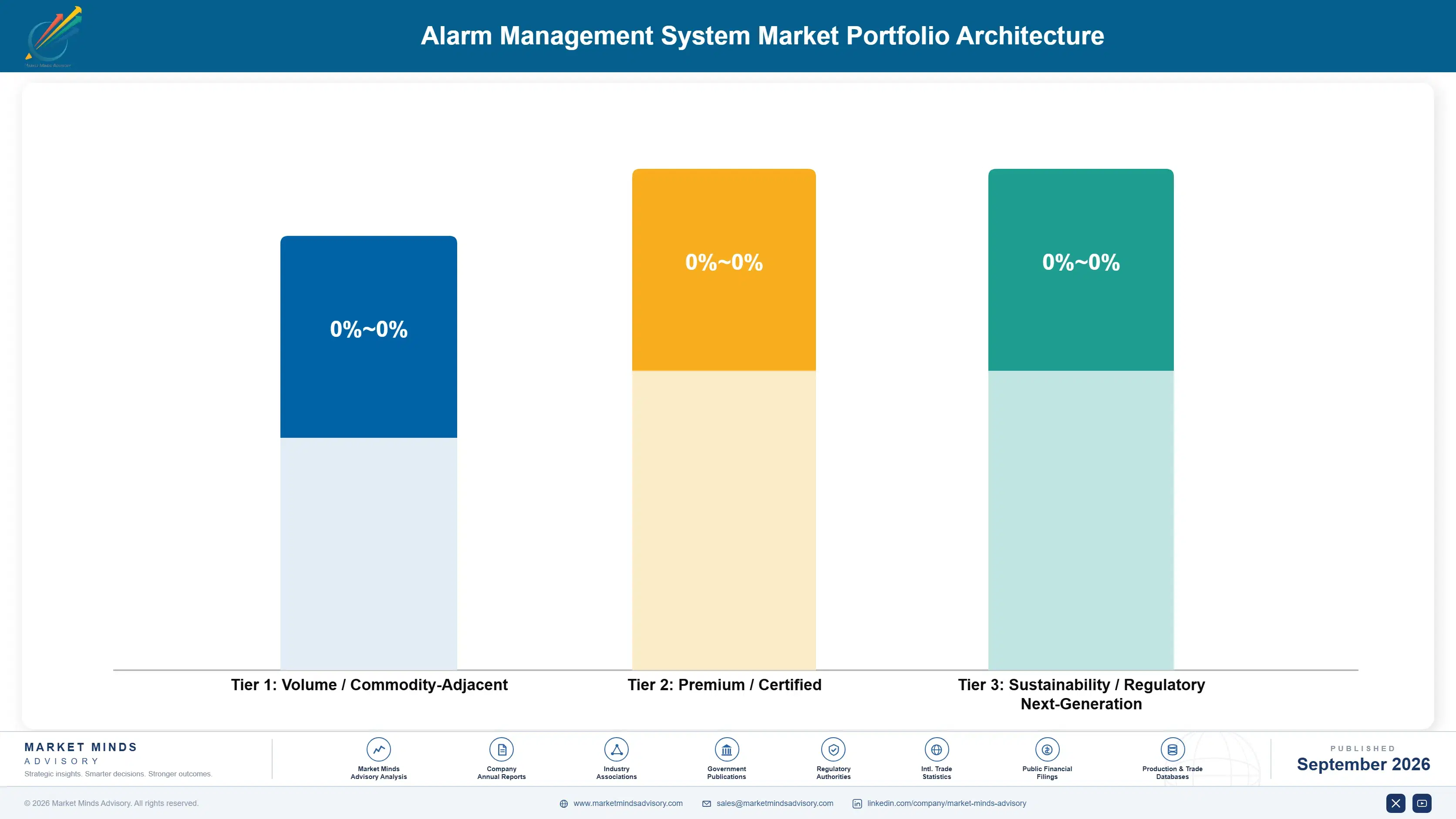
Margin follows scarcity of the engineering judgement required. Basic rationalisation is close to commodity, since the methodology is published, several providers are credible, and buyers compare day rates directly. State-based alarming earns considerably more because safe implementation requires process knowledge few suppliers can resource. Enforcement subscriptions earn most of all, carrying software economics rather than services economics once deployed. Judgement, not software, is what buyers actually pay for.
The tension between volume and premium runs through engineering utilisation. High-volume rationalisation work is only profitable where templates have moved effort away from senior engineers, and suppliers delivering every site bespoke lose margin steadily. Premium state-based work carries far better rates but scales only with the number of process engineers available, which is the binding constraint across the whole category.

High-value pools concentrate where consequence is severe and engineering capability is present to specify the work properly: Gulf petrochemical complexes, offshore production, and multi-site corporate programmes at large operators. These share a buyer who understands what they are purchasing and will pay for judgement rather than hours. Elsewhere, procurement compares day rates against a published methodology anybody can follow. Day rate comparison follows wherever judgement is not valued.

Volume / Commodity-Adjacent

Basic rationalisation, documentation, and console redesign delivered as engineering services. Methodology is published and several credible providers compete on day rates. The nine-point range reflects wide variation in whether suppliers use templates or deliver each site bespoke.
Gross Margin: 26% to 35%

Premium / Certified

State-based and dynamic alarming requiring process engineering judgement and formal safety review. Few suppliers can resource this credibly, which limits the competitive field considerably. The nine-point range separates suppliers with continuous programme demand from those carrying engineers against lumpy project work.
Gross Margin: 41% to 50%

Sustainability / Regulatory / Next-Generation

Configuration enforcement subscriptions and continuous performance reporting, carrying software economics once deployed. Renewal requires no competitive process and adoption remains under a fifth of sites. The eleven-point range reflects how differently suppliers price a product that displaces their own services revenue.
Gross Margin: 58% to 69%
alarm-management-system-market-portfolio-architecture-1790005481664

High-value Sub-segments and Strategic Watch-out

Configuration Enforcement Subscriptions

Highest value with strong growth at 9.1%, preventing the drift that returns alarm rates to prior levels within 34 months. Adoption sits at 19% of sites, leaving obvious headroom. The ten-point range reflects the awkwardness of pricing a product that displaces services revenue. Renewal needs no competition.
Gross Margin: 60% to 70%

State-Based And Dynamic Alarming

High value and the fastest growth at 10.2%, addressing alarm flood where it originates rather than trimming lists. Engineering scarcity rather than software cost limits adoption across the installed base. Suppliers with genuine process depth capture this work with limited competition. Safety review gates delivery.
Gross Margin: 44% to 52%

Site Rationalisation Engagements

The volume core, triggered by incident investigations in roughly 44% of cases and repeated every few years as drift returns. Growth tracks the market rate closely. Competition is severe because the methodology is published and buyers compare day rates directly against it. Repeat demand is guaranteed.
Gross Margin: 28% to 37%

Single Platform Independent Supply

The strategic watch-out. Qualification on one control platform confines a supplier to a fraction of the addressable base while competing directly against the interface owner. The eleven-point range reflects the gap between templated delivery and bespoke engineering on similar contracted scope. Interface ownership decides access.
Gross Margin: 22% to 33%

How This Demand Actually Recurs

Recurrence in this market is real but perverse. A site returns to the supplier every three to four years because the previous project decayed, which produces revenue that looks like an annuity and behaves like a treadmill. Enforcement subscriptions are the genuine recurring revenue, renewing without competition once deployed, and they remain at 19% adoption precisely because they end the treadmill that funds everything else.
Stickiness varies sharply by buyer type. Multi-site corporate engineering functions embed deeply, since a standardised approach across thirty plants creates documentation and training dependencies that survive personnel changes. Single sites are far less durable, procuring against local capital availability and switching suppliers on price. Operators under regulatory scrutiny following an incident are the most committed buyers of all, at least until the attention moves elsewhere.

The buyer profile has shifted. Control room and operations managers drove purchasing for years and bought on operator workload arguments. Process safety functions and corporate engineering now lead most significant awards, and they ask about drift prevention, evidence for regulatory assessment, and multi-site consistency. Suppliers still presenting alarm rate reduction as the outcome are answering a question the senior buyer stopped asking.
alarm-management-system-market-end-use-penetration-index-1790005482157

Where This Market Rewards

These are among the four positions where our research anticipates prominent divergence between winners and laggards over the coming forecast period. Each is grounded in the demand model, the regulatory perimeter, and the announced capacity pipeline.
01 / DRIFT PREVENTION POSITIONING

Selling the same project repeatedly is not a strategy

Rationalised alarm rates return to prior levels within a median 34 months because plant modifications add alarms and no work process removes them, which turns repeat projects into a treadmill operations staff have learned to recognise. Configuration enforcement prevents most of that drift and sits at just 19% adoption, worth roughly 2.4 times the lifetime value of the rationalisation cycle it displaces. The internal argument is hard, which is exactly why the position remains open to whoever moves first and takes it.
02 / PROCESS ENGINEERING SCARCITY

State-based work is limited by people, not software

Dynamic and state-based alarming grows at 10.2%, half again the market rate of 6.8%, because suppressing alarms irrelevant to the current operating state addresses flood at its origin rather than shortening a list. What constrains adoption is the process knowledge and formal safety review required to decide what may safely be suppressed. Suppliers who can resource that judgement capture the fastest growing work with remarkably little competition, because almost nobody else can defend the suppression decisions in a formal review.
03 / CORPORATE LEVEL SELLING

One site sees circumstance, thirty sites see pattern

An individual plant attributes alarm drift to its own particular conditions, while a corporate engineering function managing many facilities sees the identical pattern everywhere and reaches the right conclusion far faster. Multi-site agreements average 6 to 9 times single-site project value and convert an incident-triggered purchase into a programme with a standing budget line. They also remove the discount pressure that independent site procurement produces against local capital constraints, and they standardise documentation across the whole estate for the operator.
04 / SPECIFICATION STAGE ACCESS

New build scope is decided before commissioning starts

Alarm management embedded in a control system specification costs a fraction of retrofitting and needs no separate business case, which is why new Asian capacity buys it routinely and Indian growth of 11.4% leads every country covered. Suppliers engaged during front-end engineering win that scope at roughly 4.1 times the rate of those approaching after commissioning. Independents absent before the control award lose these sites entirely and permanently, since retrofitting later never carries the same business case at an operating plant.

Engagement Snapshot From the Field

A live engagement with an industry participant carrying material or product regulatory and market exposure ahead of a defining policy shift, showing how our research translates into a defensible multi-year portfolio strategy.
MARKET MINDS ADVISORY · CLIENT ENGAGEMENT SUMMARY
Alarm Management System Producer Strategic Portfolio Review and Transition Roadmap 2026·Investment Scenario on Alarm Management System Exposure Evaluation 2025-26
CLIENT PROFILE
An integrated refining operator running seven refineries and two petrochemical complexes across three countries, with combined throughput above 1.4 million barrels per day (client-reported, unverified by MMA). Six of the nine sites had completed alarm rationalisation projects at some point in the previous decade, delivered by four different suppliers using inconsistent methodologies and with no shared documentation.
STRATEGIC CHALLENGE
Corporate process safety had observed that alarm performance at rationalised sites was no better than at sites never treated, and could not explain why. A regulator had raised alarm management during a recent inspection at one refinery. Management needed to decide whether to repeat rationalisation across the portfolio or attempt something different entirely.
MMA APPROACH
MMA reconstructed alarm rate histories at each rationalised site from control system records, isolating the decay pattern and its causes, and traced added alarms back through management of change documentation. Supplier methodologies were compared against published guidance, and enforcement options were assessed for compatibility across the three distinct control platforms in the estate.
KEY FINDINGS
  1. Every rationalised site had returned to within ten percent of its pre-project alarm rate, with a median decay period of 31 months across the six treated facilities.
  2. Roughly 71% of added alarms entered through management of change procedures that required no justification for the addition and no review of cumulative operator loading.
  3. Two of the three control platforms in the estate supported configuration enforcement directly; the third required an independent tool the operator had never evaluated.
  4. Site level procurement had produced four incompatible alarm philosophies, preventing any comparison of performance across the portfolio or transfer of operators between facilities.
CLIENT PROFILE
An integrated refining operator running seven refineries and two petrochemical complexes across three countries, with combined throughput above 1.4 million barrels per day (client-reported, unverified by MMA). Six of the nine sites had completed alarm rationalisation projects at some point in the previous decade, delivered by four different suppliers using inconsistent methodologies and with no shared documentation.
STRATEGIC CHALLENGE
Corporate process safety had observed that alarm performance at rationalised sites was no better than at sites never treated, and could not explain why. A regulator had raised alarm management during a recent inspection at one refinery. Management needed to decide whether to repeat rationalisation across the portfolio or attempt something different entirely.
MMA APPROACH
MMA reconstructed alarm rate histories at each rationalised site from control system records, isolating the decay pattern and its causes, and traced added alarms back through management of change documentation. Supplier methodologies were compared against published guidance, and enforcement options were assessed for compatibility across the three distinct control platforms in the estate.
KEY FINDINGS
  1. Every rationalised site had returned to within ten percent of its pre-project alarm rate, with a median decay period of 31 months across the six treated facilities.
  2. Roughly 71% of added alarms entered through management of change procedures that required no justification for the addition and no review of cumulative operator loading.
  3. Two of the three control platforms in the estate supported configuration enforcement directly; the third required an independent tool the operator had never evaluated.
  4. Site level procurement had produced four incompatible alarm philosophies, preventing any comparison of performance across the portfolio or transfer of operators between facilities.
RECOMMENDED STRATEGY
Phase 1: Phase one: amend management of change procedures to require justification and cumulative loading review for every proposed alarm addition across all nine sites. Phase 2: Phase two: deploy configuration enforcement on the two supported control platforms, and evaluate independent tooling for the third before committing further. Phase 3: Phase three: adopt a single corporate alarm philosophy and re-rationalise only where the procedural and enforcement controls are already operating properly.
OUTCOME
Eighteen months after the procedural change, alarm additions across the estate fell by 63% and the two enforced sites held their rates without any further rationalisation work (client-reported, unverified by MMA). The regulator closed its observation. Planned re-rationalisation spending was reduced by roughly half against the original programme.

Frequently Asked Questions

Foundational context covering the market sizes, CAGR, scope, country, region and competition that inform every finding below. This section is provided to cover basics and most often pre-purchase conversations, answered from the MMA Primary Research Dataset.

What is the current size of the Alarm Management System Market?

The market was worth USD 1.4 billion in 2025 and reaches USD 1.5 billion in 2026. Value covers software licences and delivered engineering services combined.

How large will the Alarm Management System Market be by 2036?

MMA forecasts USD 2.9 billion by 2036, an increase of USD 1.4 billion across the forecast period. That represents 1.93 times the 2026 base of USD 1.5 billion.

What is the CAGR for the Alarm Management System Market 2026 to 2036?

The base case compound annual growth rate is 6.8%, with a bull case at 8.0% and a bear case at 5.6%. Historical growth from 2020 to 2025 ran at 5.8%.

Which segment is growing fastest?

Dynamic and state-based alarming grows at 10.2%, half again the market rate of 6.8%. It suppresses alarms irrelevant to the current operating state rather than shortening lists.

Who are the major companies in the Alarm Management System Market?

Honeywell, Emerson, Yokogawa, ABB, and Schneider Electric lead, holding 51% of contracted value between them. Four of the five are control system vendors holding the configuration interface.

Which country is growing fastest?

India grows at 11.4%, driven by refining and petrochemical capacity additions specifying alarm management at design stage. Retrofitting the same scope after commissioning costs considerably more.

Report Segmentation Architecture

The full report scope spans multiple orthogonal segmentation dimensions, with cross-tabulated demand data provided for each dimension pair. Coverage extends further to regional breakdowns, trend trajectories, and the competitive detail needed to support segment-level decision-making.

By Functional Scope

  • Alarm Rationalisation and Documentation
  • Alarm Analytics and Performance Reporting
  • Dynamic and State-Based Alarming
  • Operator Console and Display Redesign
  • Configuration Management and Enforcement
  • Compliance Auditing and Benchmarking

By End-Use Industry

  • Refining and Petrochemicals
  • Chemicals and Specialty Manufacturing
  • Oil and Gas Production
  • Power Generation and Utilities
  • Pharmaceuticals and Life Sciences
  • Water Treatment and Mining Processing

By Commercial Dimension

  • Control System Vendor Supplied
  • Independent Specialist Engagement
  • Engineering Contractor Delivered
  • Multi-Site Corporate Programme
  • New Build Specification Scope
  • Subscription Enforcement Service

By Region

  • East Asia
  • North America
  • Western Europe
  • South Asia and Pacific
  • Latin America
  • Middle East and Africa
  • Eastern Europe

Scope, Methodology, and Coverage

Every figure in this report is reproducible from documented input assumptions. The scope below maps the historical period, the forecast horizon, the segmentation dimensions, and the countries covered, alongside the underlying primary and qualitative methodology.
Historical Period
2020 to 2025
Forecast Period
2026 to 2036
Base Year
2025 (USD billions; MMA Primary Research Dataset, September 2026)
Market Definition
The alarm management system market covers software and engineering services governing process alarm performance in industrial facilities, including alarm rationalisation and documentation, alarm analytics and performance reporting, dynamic and state-based alarming, operator console and display redesign, configuration management and enforcement, and compliance auditing against published guidance. It excludes distributed control systems, safety instrumented systems, fire and gas detection hardware, and general industrial asset management platforms.
Quantitative Units
USD billions, contracted software and services value
Segmentation Dimensions
Functional scope, end-use industry, commercial dimension, region
Regions Covered
East Asia, North America, Western Europe, South Asia and Pacific, Latin America, Middle East and Africa, Eastern Europe
Countries Covered
China, Japan, South Korea, Taiwan, Singapore, United States, Canada, Mexico, Germany, Netherlands, Belgium, United Kingdom, Norway, Italy, Spain, India, Australia, Malaysia, Brazil, Chile, Peru, Saudi Arabia, United Arab Emirates, Qatar, Algeria, Poland, Romania
Key Companies Profiled
Honeywell, Emerson, Yokogawa, ABB, Schneider Electric, Siemens, Rockwell Automation, AVEVA, Hexagon, Exida, ProSys, Kongsberg, Valmet, Azbil, Supcon, Hollysys, GE Vernova, Wood, Jacobs, Worley
Quantitative Methodology
Primary survey, n=3,800 respondents, Q4 2025, six countries; demand-side model with trade association cross-validation
Qualitative Methodology
47 expert interviews, Q4 2025; applied to validate demand model assumptions, identify emerging dynamics, and assess competitive positioning
Report Format
PDF and XLSX data workbook (Word format preview document)
Publisher
Market Minds Advisory
Report Code
MMA-2026-CON-411
Published
September 2026
Contact
sales@marketmindsadvisory.com | www.marketmindsadvisory.com

Purchase the full Alarm Management System Market Report (2026 to 2036).

The full report sizes the alarm management system market across six functional scopes, seven regions, and twenty-seven countries, with forecasts to 2036 under base, bull, and bear cases. It examines why rationalisation results decay within roughly three years, what configuration enforcement changes commercially, and how control system interface ownership shapes competitive access. Competitive analysis covers twenty participants evaluated consistently on contracted value, with detailed treatment of new build specification capture and multi-site corporate programmes. Cost structure, margin architecture by scope, and regional asset base drivers are analysed in full. Primary research includes 3,800 survey responses and 47 expert interviews.
Six functional scopes sized and forecast separately
Twenty participants evaluated on contracted value consistently
Regional asset base and vintage drivers assessed
Margin architecture by scope and engineering intensity
Configuration drift analysis with reconstructed site histories
New build specification capture rates by supplier type

Built For The People Who Decide

From boardroom strategy to bench-side execution, this report is read cover-to-cover by leaders shaping the next decade of their industry, turning demand scenarios, market dynamics and valuation benchmarks into decisions.
CXOs/ Presidents/ VPs/ Managers
M&A and Corporate Development
Strategy Teams and R&D Heads
Procurement and Product Directors
Regulatory and Compliance Leaders
Investor Relations and Equity Analysts