Airway Management Devices Market: The Video Laryngoscopy Shift and the First-Pass Success Standard
Executive Snapshot and Market Trajectory
Airway Management Devices Market Forecast Scenarios

The base case assumes growth driven by three mechanisms: clinical guidelines increasingly recommending video laryngoscopy as a first-line rather than rescue intubation tool, expanding the addressable device category beyond difficult-airway cases; growing surgical procedure volume across Asia requiring proportional airway device consumption; and rising emergency medical services adoption of supraglottic airway devices for prehospital airway management. Replacement demand from routine single-use device consumption adds a steady secondary layer independent of new procedure growth.
The bull case rests on faster-than-expected video laryngoscopy guideline adoption pulling forward device replacement across thousands of hospital anesthesia departments simultaneously. The bear case centers on a hospital capital spending slowdown, mirroring past healthcare budget tightening cycles, that would defer video laryngoscope fleet upgrades and stretch replacement cycles while routine disposable device consumption remains comparatively stable.
Imaging Capability Redefines a Mechanical Device Category
"A direct laryngoscope used to be the default because it was cheap and everyone knew how to use one. Now a hospital risk management committee wants to see the first-pass success data before anyone signs off on the purchase order."
Market Trends
Emergency Medical Services Expand Supraglottic Airway Adoption
Market Opportunities and Growth Drivers
Expanding Surgical Volume Across Asian Healthcare Systems
Difficult Airway Guidelines Drive Device Standardization
Market Restraints and Challenges
Capital Cost Delays Video Laryngoscope Fleet Conversion
Single-Use Device Regulation Increases Compliance Complexity
Segment CAGR and Growth Architecture

Video Laryngoscopes
Supraglottic Airway Devices
Regional Architecture and Country Demand Map
North America
Western Europe

Capturing Value Beyond the Single Device Sale
Placing Video Laryngoscopy Systems With Disposable Blade Contracts
Building Clinical Evidence Generation Programs Broadly
Expanding Comprehensive Difficult Airway Cart Contracts
Growing EMS and Prehospital Distribution Relationships
Who Controls the Margin Pool
Emerging pressure comes from video laryngoscopy specialists building genuine imaging and outcomes data advantages that established mechanical device manufacturers are racing to match through acquisition rather than organic development across their broader portfolios. Rankings could shift meaningfully if a video specialist successfully wins a major hospital system's enterprise-wide fleet standardization contract, demonstrating credible multi-facility scale that has historically been the primary advantage of established diversified device manufacturers.

Competitive Moat and Risk Dimensions
Moat: Broad Multi-Category Device Portfolio
Risk: Exposure to Legacy Device Categories
Moat: Deep Difficult Airway Cart Relationships
Risk: Limited EMS Channel Presence
Players Tracked
Prominent Players
Other Key Players
Recent Developments
Medtronic Launches Expanded Video Laryngoscopy Product Line
Ambu Signs Major Hospital System Fleet Standardization Contract
Verathon Expands EMS Distribution Partnership Network
Optical Components, Medical Plastics, and Electronics
Smaller regional manufacturers without long-term component supply agreements face greater cost exposure than larger diversified players like Medtronic and Teleflex, who negotiate volume-based contracts directly with optics and electronics suppliers. Manufacturers focused on video laryngoscopy face additional exposure to imaging sensor pricing volatility, a supply chain risk that manufacturers of simpler disposable airway devices sourcing more standardized materials do not share to the same degree.

Qualifying Secondary Optical Component Suppliers
Standardizing Imaging Architectures for Component Flexibility
Building Strategic Component Inventory Reserves
Portfolio Architecture for Margin Defence
The market splits into three tiers running from commodity disposable airway devices to premium video laryngoscopy systems bundled with clinical evidence and comprehensive cart contracts. Margin concentrates heavily at the top: video laryngoscopy systems paired with disposable blade contracts earn gross margins 15 to 22 percentage points above commodity disposable devices, reflecting both imaging technology cost and the recurring consumable revenue layered on top of the initial equipment placement
High-value margin pools concentrate among suppliers serving large hospital systems through combined equipment placement, disposable consumable, and clinical evidence relationships, since these accounts generate recurring revenue across multiple device categories and facility expansions simultaneously, far exceeding the value of a single device transaction and remaining the primary target of every major manufacturer's account and growth strategy today.
Volume / Commodity-Adjacent Tier
Premium / Certified Tier
Sustainability / Regulatory / Next-Generation Tier

High-value Sub-segments and Strategic Watch-out
Video Laryngoscopy Platforms With Disposable Blade Contracts
Comprehensive Difficult Airway Cart Standardization Contracts
Standard Disposable Airway and Endotracheal Devices
Legacy Direct Laryngoscopes Facing Displacement
From Sale to Fleet Relationship
A generational shift in buyer profile is underway as anesthesia patient safety officers and clinical quality specialists, increasingly focused on documented outcomes data and standardized protocols, join anesthesiologists and procurement staff in purchasing decisions, a change reshaping which manufacturer capabilities actually win hospital system contracts across institutions of all sizes and clinical specialties.

Where Device Manufacturers Should Focus Next
Build video capability before direct laryngoscopy becomes fully obsolete
Build outcomes data ahead of broader hospital procurement standardization
Expand difficult airway cart offerings to capture larger hospital contracts
Build dedicated prehospital distribution ahead of protocol shifts broadening
Engagement Snapshot From the Field
- The client's mixed-vendor fleet carried maintenance and training costs roughly 28% higher than a standardized single-vendor fleet would, driven by inconsistent equipment familiarity and parts inventory complexity across departments.
- Two of the four vendors benchmarked offered disposable blade contract terms that reduced total five-year cost of ownership below the client's current mixed-vendor spending despite higher initial equipment placement cost.
- Clinical evidence supporting first-pass success rates varied meaningfully across the four vendors, with the two strongest performers showing statistically significant improvement over the client's existing direct laryngoscopy baseline.
- Staff retraining requirements were projected to take approximately ten weeks to complete across all eight facilities under a phased rollout rather than a simultaneous system-wide conversion.
- The client's mixed-vendor fleet carried maintenance and training costs roughly 28% higher than a standardized single-vendor fleet would, driven by inconsistent equipment familiarity and parts inventory complexity across departments.
- Two of the four vendors benchmarked offered disposable blade contract terms that reduced total five-year cost of ownership below the client's current mixed-vendor spending despite higher initial equipment placement cost.
- Clinical evidence supporting first-pass success rates varied meaningfully across the four vendors, with the two strongest performers showing statistically significant improvement over the client's existing direct laryngoscopy baseline.
- Staff retraining requirements were projected to take approximately ten weeks to complete across all eight facilities under a phased rollout rather than a simultaneous system-wide conversion.
Frequently Asked Questions
What is the current size of the Airway Management Devices Market?
How large will the Airway Management Devices Market be by 2036?
What is the CAGR for the Airway Management Devices Market 2026 to 2036?
Which segment is growing fastest?
Who are the major companies in the Airway Management Devices Market?
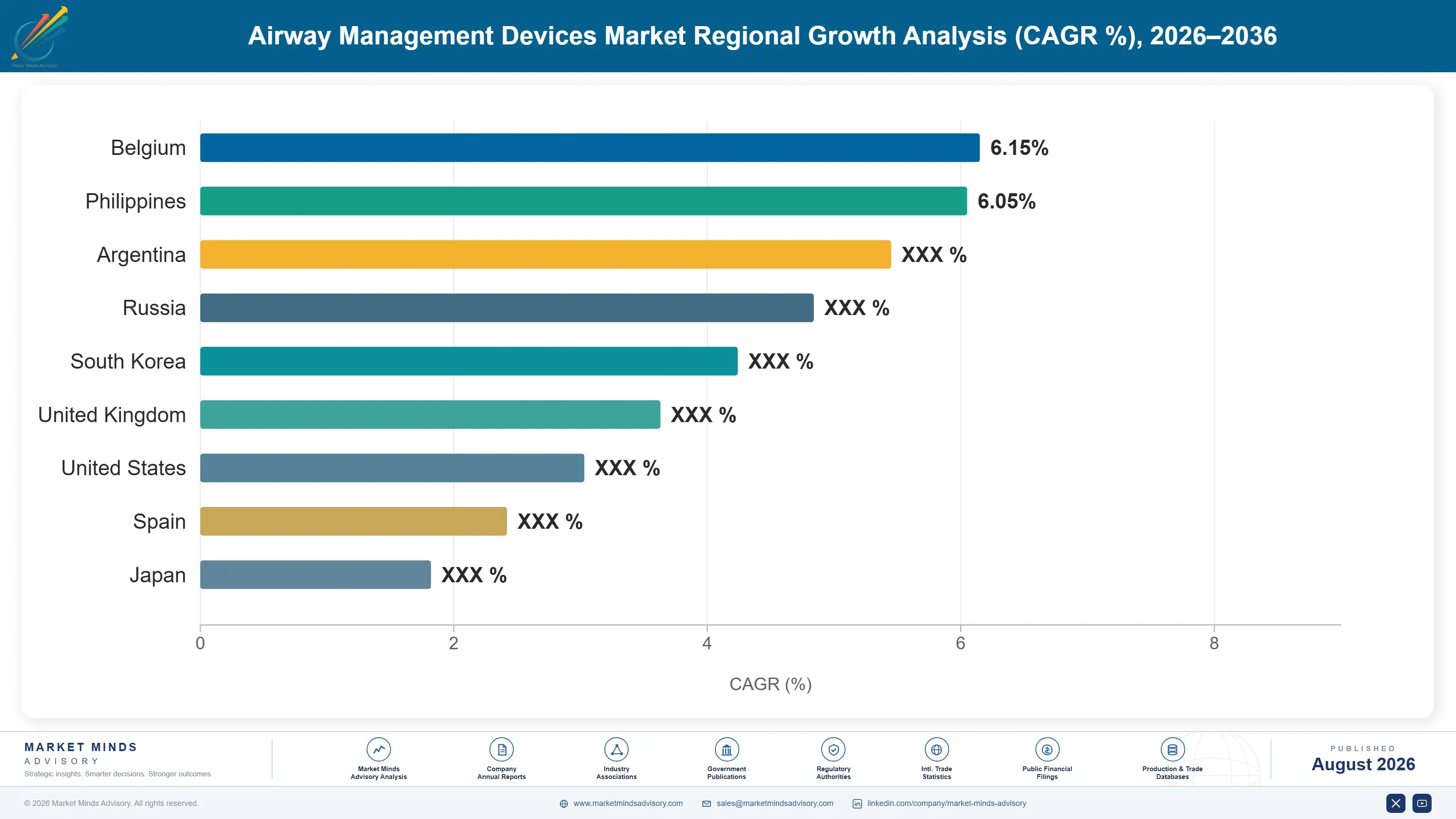
Which country is growing fastest?
Report Segmentation Architecture
By Device Type
- Endotracheal Tubes
- Supraglottic Airway Devices
- Video Laryngoscopes
- Direct Laryngoscopes
- Tracheostomy Tubes
- Airway Exchange Catheters and Introducers
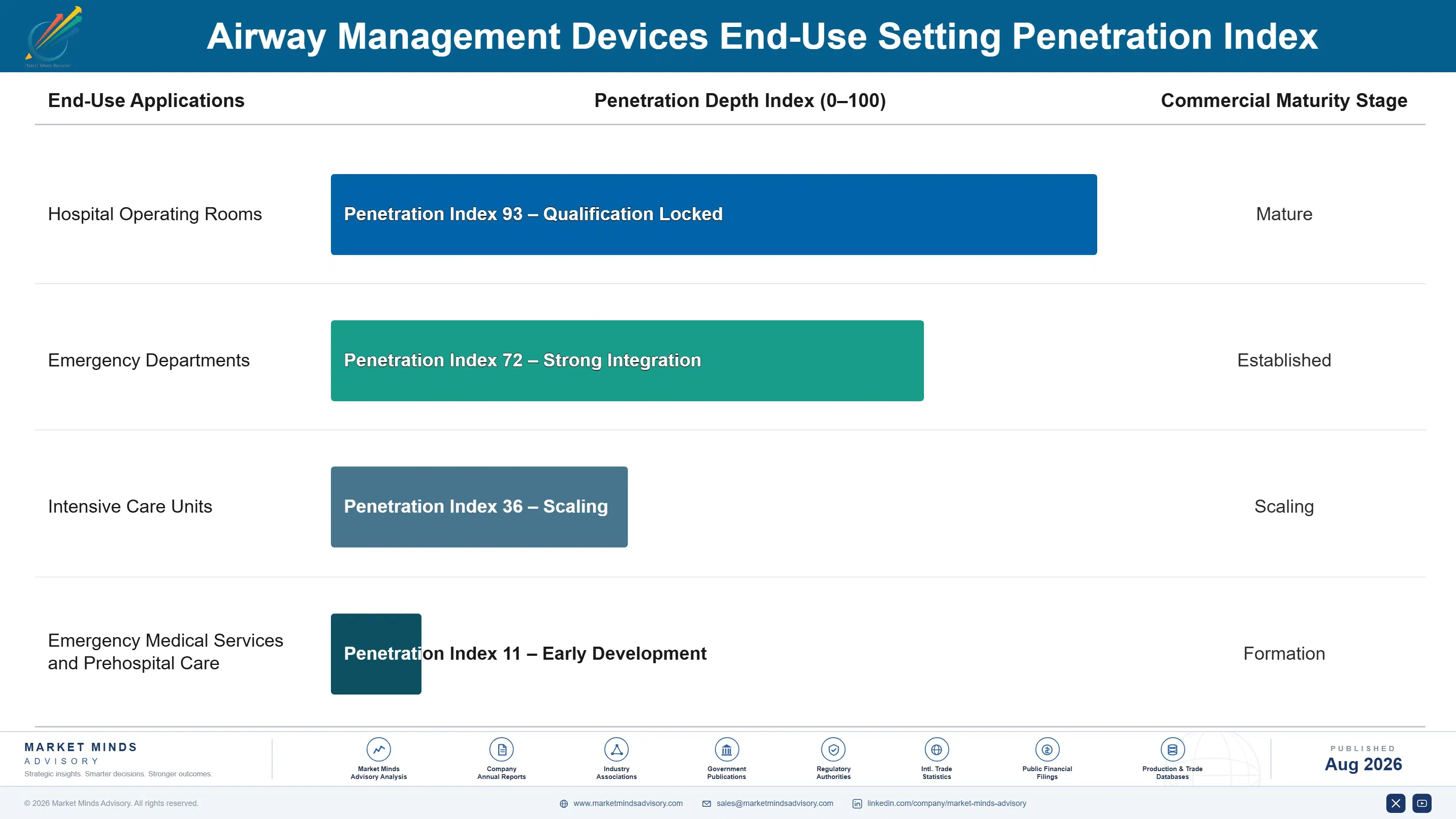
By End-Use Setting
- Hospital Operating Rooms
- Emergency Departments
- Intensive Care Units
- Emergency Medical Services and Prehospital Care
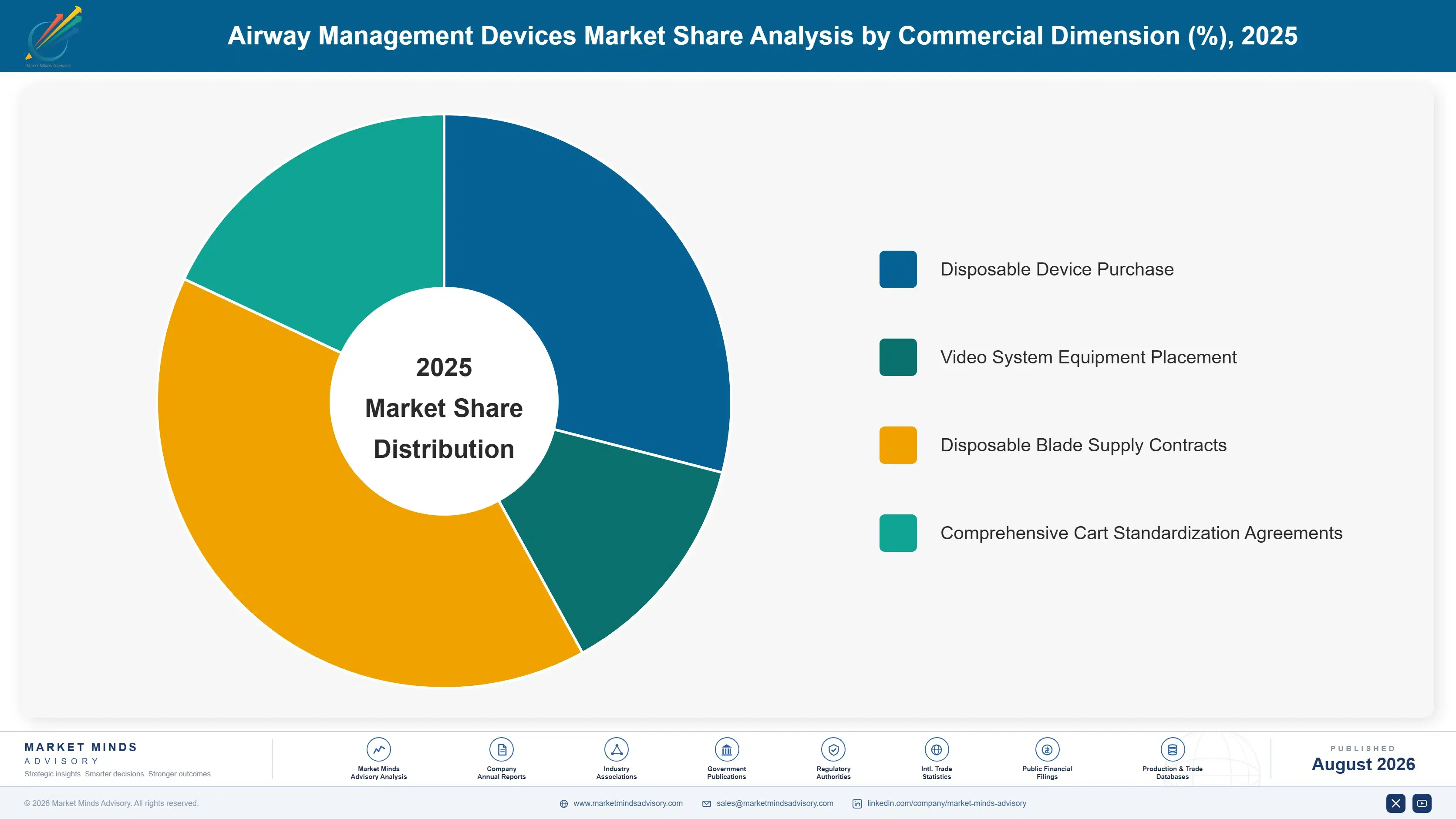
By Commercial Dimension
- Disposable Device Purchase
- Video System Equipment Placement
- Disposable Blade Supply Contracts
- Comprehensive Cart Standardization Agreements
By Region
- North America
- Western Europe
- East Asia
- South Asia and Pacific
- Latin America
- Middle East and Africa
- Eastern Europe