Market Minds Advisory
Airway Catheters Market

Airway Catheters Market: Stocking Mandates, Supraglottic Displacement, and Single-Use Exhaustion

The most-used device in this category costs under four dollars and kills the patient within minutes if it fails, which is why guidelines rather than purchasing departments decide what sits on the difficult airway trolley.

Lead Analyst

Alice Ballenger

Published

September 2026

Make Smarter Decisions with Customized Research Insights

Request a free sample report and evaluate market opportunities, growth trends, and competitive dynamics relevant to your business needs.

2025 MARKET VALUE$2.9BMarket Size 2025
2036 FORECAST VALUE$5.7BBase Case , 2026 to 2036
CAGR 2026 TO 20366.4 %Bull 7.7% / Bear 5.2%
INCREMENTAL OPPORTUNITY$2.6BNet 10- year value creation
EXPANSION MULTIPLE1.86x2036 value over 2026 base
Strategic Levers
M&A Pipeline
Regional Outlook
Country Rankings
Competitive Intelligence
Segmental Deep-dive
Call-Us : 91 93563 13602

Executive Snapshot and Market Trajectory

Part of this market sells devices that are almost never used. Difficult airway guidelines require hospitals to stock rescue catheters for an event occurring in roughly one intubation in a thousand, and those products are bought against a mandate rather than against consumption. Most of it expires unopened.
Supraglottic airway devices compound at 9.6%, a full 1.50x the market rate, by displacing full intubation in short elective surgery where laryngoscopy was never really necessary. East Asia holds the largest share at 30%, on the world's largest surgical and critical care volumes and on domestic manufacturers who supply much of global endotracheal tube output and set the price floor. Only one half of this market actually earns.
Concentration sits at 46%, with Teleflex and Ambu leading through quite different routes: broad hospital catalogue supply on one side and a single-use conversion built on visualisation on the other. Single-use conversion has now reached about 91% and cannot repeat, which removes the growth mechanism that carried this market through the pandemic years and immediately afterwards. Growth must now come from displacement and stocking mandate instead. Stock is replaced on expiry, not on use.
Market Definition
This market covers catheters and tubes used to establish, maintain, exchange or clear an artificial airway, spanning endotracheal tubes, tracheostomy tubes, supraglottic airway devices, suction and closed suction catheters, airway exchange and introducer catheters, and bronchial blockers with double-lumen tubes. Measurement is at manufacturer revenue across hospital, ambulatory, emergency and prehospital settings. Laryngoscopes and video intubation systems, ventilators and breathing circuits, humidification equipment, oxygen delivery interfaces, and bronchoscopes are excluded.
Base Year Value
$2.9B in 2025 (MMA Primary Research Dataset, August 2026)
Forecast Period
2026 to 2036, eleven discrete annual values
CAGR
6.4% base case. Bull 7.7%. Bear 5.2%.
Fastest Growth Segment
Supraglottic Airway Devices: 9.6% CAGR
Fastest Growth Country
India: 10.2% CAGR
Fastest Growth Region
South Asia and Pacific: 8.7% CAGR
Largest Region
East Asia: 30% of 2025 global value
Market Leaders
Teleflex, Medtronic, Ambu, ICU Medical, and Intersurgical. Source: MMA Primary Research Dataset, July 2026.
Primary Survey
n=3,800 procurement and R&D decision-makers, Q4 2025, six countries
Methodology
Demand-side build-up, cross-validated against public data, 47 expert interviews

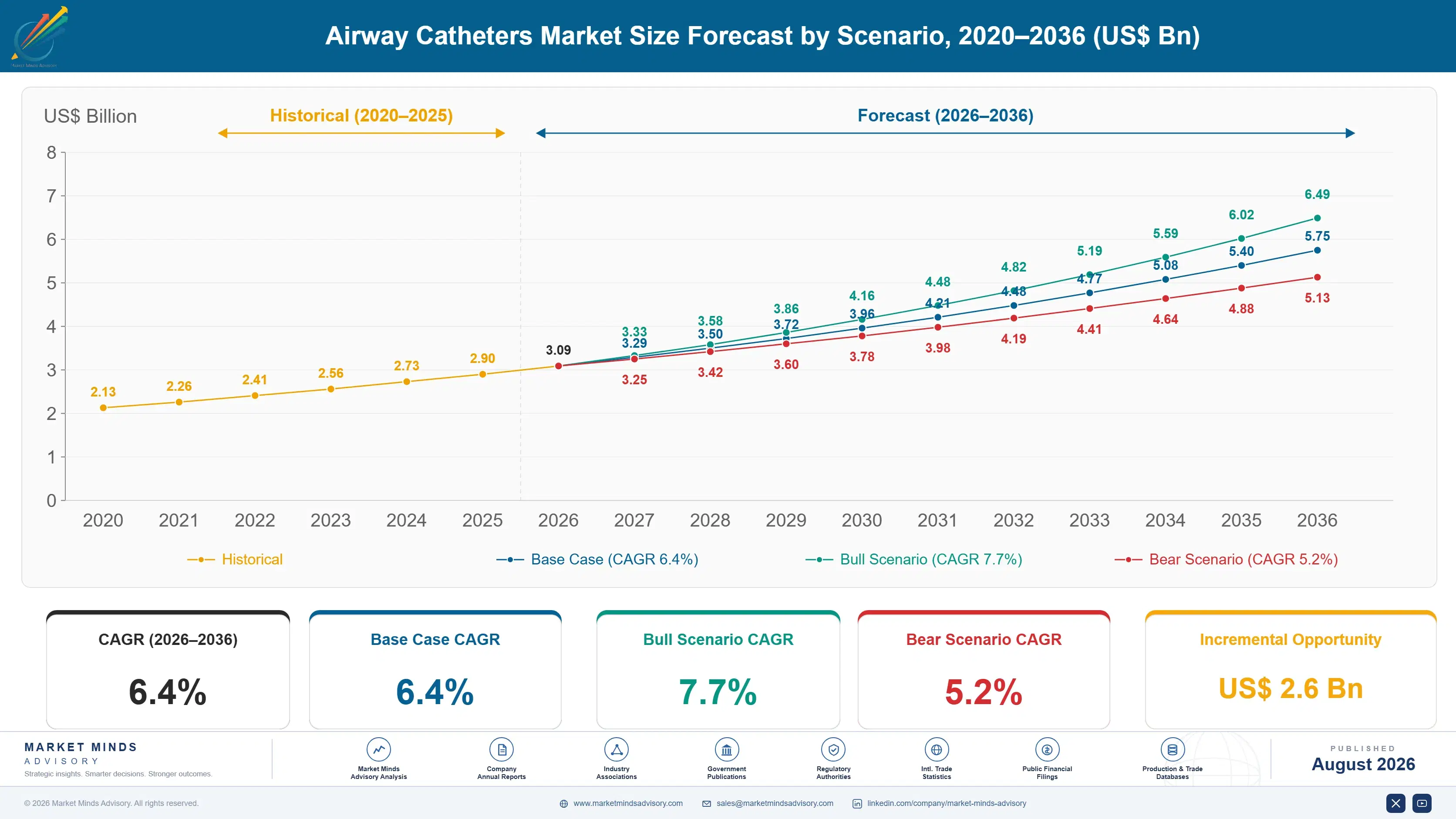
Airway Catheters Market Forecast Scenarios

airway-catheters-market-size-forecast-scenario-1787303413152
Growth ran at roughly 5.2% between 2020 and 2025, and the shape of it was unusual. Ventilated bed demand surged through 2020 and 2021 while elective surgery collapsed, so endotracheal tube and closed suction volumes rose sharply while supraglottic airway use fell. Both then reversed. Underneath the volatility, cross-contamination concern converted almost every remaining reusable airway product to single-use, a shift that has now largely run its course.
Base case growth of 6.4% rests on three mechanisms. Surgical procedure volumes keep rising with ageing populations and expanding access, and every general anaesthetic consumes an airway device of some kind. Supraglottic devices keep taking short elective cases from full intubation, and gastric drainage designs widened the eligible case mix. And difficult airway guideline updates keep adding stocked rescue products that hospitals must hold whether or not they use them.
The bull case at 7.7% assumes broader adoption of subglottic secretion drainage tubes in ventilated patients, which cost several times a standard tube and would lift average selling price materially. The bear case at 5.2% is a pricing one: Chinese manufacturers keep extending into Western tender markets, and purchasing organisations have shown they will move commodity tube volume on price alone.

Airway Catheters: Mandate Purchasing and Displacement Risk

Two quite different businesses sit inside this market and they behave nothing alike. Standard endotracheal tubes, suction catheters and basic airways are high-volume commodities bought on tendered price at a few dollars each, where Chinese manufacturers set the floor. Difficult airway rescue products are bought against guideline mandate, used in roughly one intubation in a thousand, and priced accordingly because nobody tenders a product they hope never to open.
TOP FIVE CONCENTRATION46%Catalogue suppliers and single-use specialists reach hospitals through different routes
SINGLE-USE CONVERSION RATE91%Airway device volume now supplied as single-use rather than reusable
AVERAGE TUBE PRICEUSD 3.80Blended global price for a standard cuffed endotracheal tube
FAILED INTUBATION RATE0.1%Intubation attempts requiring an unanticipated difficult airway rescue device
GLOBAL VENTILATED BEDS620,000 bedsCritical care capacity able to support mechanically ventilated patients worldwide
GROUP PURCHASING SHARE64%Hospital volume contracted through purchasing organisation and tender agreements
Single-use conversion was the growth engine and it has largely finished. Cross-contamination concern through 2020 and 2021 pushed conversion to about 91% of volume, and reusable stock that survived is now mostly in low-income settings where sterilisation remains cheaper than replacement. That transition lifted unit volumes and average selling prices simultaneously for several years. It cannot happen twice, and forecasts built on extrapolating it are wrong.
The interesting displacement runs inside the market rather than against it. Supraglottic airway devices avoid laryngoscopy entirely, cause less airway trauma, and are faster to place, so short elective cases have been migrating away from intubation for years. Second-generation designs adding gastric drainage channels widened the eligible case mix again. Endotracheal tube volume holds because critical care and long procedures still require it.
"Half this market is a commodity sold at four dollars against Chinese pricing, and half is an insurance policy a hospital buys because a guideline told it to. Very few manufacturers run both businesses well, and most do not appear to notice they are running two."
Director, Critical Care and Airway Management Practice · MMA Medical Devices Pra

Market Trends

Supraglottic devices displace intubation across short elective surgery

Second-generation supraglottic airways sit above the larynx rather than passing through it, avoiding laryngoscopy, reducing sore throat and airway trauma, and shortening induction and emergence time. Added gastric drainage channels addressed the aspiration concern that had confined earlier designs to fasted low-risk patients, which widened the eligible case mix considerably. Anaesthetists in high-throughput day surgery units now default to supraglottic placement for most procedures under two hours. Endotracheal intubation retains critical care, prone positioning, laparoscopic cases at high insufflation pressure and anything requiring prolonged ventilation. Anaesthetist familiarity with a specific design now protects pricing that expired patents no longer can.
Market Impact: Stocked for 1 case in 1,000
Single-use conversion has effectively exhausted itself as a driver

Cross-contamination concern through 2020 and 2021 converted almost all remaining reusable airway devices to single-use, and conversion now sits near 91% of global volume. That shift raised unit counts and average selling prices at the same time, which flattered growth for several consecutive years. What remains reusable sits largely in low and middle income settings where sterilisation costs less than replacement and will not convert on clinical argument alone. Manufacturers extrapolating pandemic-era growth rates into this forecast period are building on a mechanism that has already finished running. Growth from here has to come from displacement and stocking mandate.
Market Impact: Over 330 million procedures annuall

Market Opportunities and Growth Drivers

Difficult airway guidelines mandate stock that is rarely used

Airway society guidelines require hospitals to hold specified rescue devices, bougies, airway exchange catheters and emergency front-of-neck access kits, in every location where intubation occurs. Unanticipated difficult airway happens in roughly one intubation in a thousand, so most of that stock expires unopened and is replaced on shelf life rather than on consumption. Commercially this is a stocking mandate rather than a consumption market, which makes demand unusually predictable and largely insensitive to procedure volume or to price negotiation. No purchasing officer wants to be the one who substituted the emergency airway kit.
Market Impact: Tube pricing near USD 3.80

Rising surgical volume converts directly into airway device consumption

Every general anaesthetic consumes an airway device, and there is no substitution, no reuse and no way to defer it. Surgical procedure volumes rise steadily with ageing populations and with expanding access across Asia and Latin America, and airway consumption follows almost exactly. Critical care admissions add a second demand stream where ventilated patients consume closed suction catheters daily and endotracheal or tracheostomy tubes across the whole admission. Neither stream requires any product innovation from manufacturers to keep growing. Both streams grow with demography alone, and neither requires anything at all from a product development function.
Market Impact: Roughly 64% of volume tendered

Market Restraints and Challenges

Chinese manufacturing sets the price floor for commodity tubes

Well Lead Medical, Henan Tuoren and other Chinese manufacturers supply a large share of global endotracheal tube and suction catheter volume at costs Western producers cannot approach. The root cause is that these are extruded polymer products with converged specifications, where regulatory approval is achievable and manufacturing scale decides everything. Commercial impact is steady tender price erosion across the highest-volume part of the market. Western suppliers respond by concentrating on guideline-mandated rescue products, subglottic drainage designs and clinically differentiated formats that tenders cannot commoditise as easily. Conceding those lines deliberately is now a defensible commercial choice.
Market Impact: Supraglottic growth reaching 9.6%

Purchasing organisations tender commodity airway volume on price

Roughly 64% of hospital airway device volume moves through group purchasing or national tender agreements where efficacy and safety are qualifying thresholds rather than differentiators. The root cause is that standard tubes and suction catheters genuinely have converged, and clinicians rarely object to a substitution they will not notice. Commercial impact is annual price erosion on the largest volume lines. Suppliers respond by bundling difficult airway kits, training programmes and stocking management into contracts, which tender documents find awkward to price comparably. Clinical committees retain a veto only over preference-sensitive and guideline-mandated items.
Market Impact: Conversion complete at roughly 91%
2 additional market trends, 4 additional growth drivers, and 3 additional restraints and challenges are covered in the full report. Contact sales@marketmindsadvisory.com to access the complete intelligence.

Segment CAGR and Growth Architecture

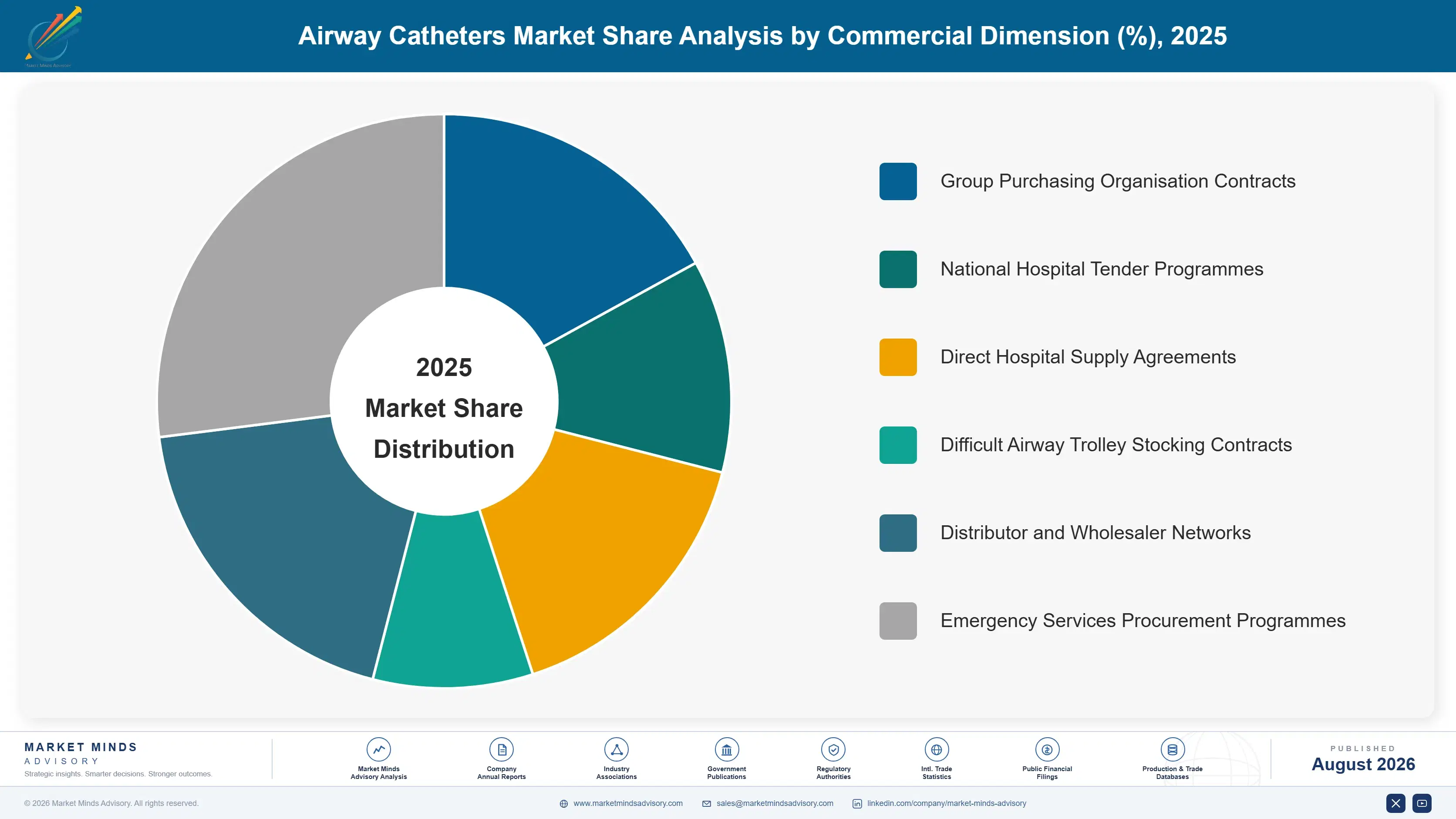
Segmentation follows device type, because device type determines the clinical indication, the regulatory class, the purchasing route and whether the product is bought against consumption or against a guideline stocking requirement. Six device types cover artificial airway management without overlap. Care setting cuts across every device type and is treated as an application attribute here.
airway-catheters-market-market-share-analysis-1787303413695

Supraglottic Airway Devices

Growing at 9.6%, a full 1.50x the market rate, supraglottic devices seat above the larynx and ventilate without passing through the vocal cords, avoiding laryngoscopy and the trauma that comes with it. Second-generation designs added a separate gastric drainage channel, which addressed the aspiration concern that had previously confined these devices to fasted low-risk patients and widened the eligible case mix substantially. High-throughput day surgery units now default to them for most procedures under two hours. Unit pricing sits well above a standard endotracheal tube, and the clinical argument is strong enough that purchasing organisations have not commoditised the category. Endotracheal intubation retains critical care, prone positioning and anything requiring prolonged ventilation, so displacement has a natural clinical limit.
CAGR 9.6%

Suction and Closed Suction Catheters

Suction catheters grow at 7.0% on critical care volume rather than surgical volume, because a ventilated patient consumes several every day for the whole admission. Closed suction systems that allow airway clearance without disconnecting the ventilator circuit have displaced open suctioning almost entirely in developed critical care, on infection control and oxygenation stability grounds that intensivists accept readily. That conversion raised both unit price and product complexity. Growth now follows critical care bed capacity and average ventilated length of stay, and it is one of the few parts of this market where clinical protocol still resists tender substitution effectively. Subglottic secretion drainage designs sit adjacent to this segment and remain well under a third of ventilated patients.
CAGR 7.0%
Full segment breakdown across 6 segments available in the complete report.

Regional Architecture and Country Demand Map

Regional value follows surgical and critical care volume adjusted for what a hospital pays per device, and those two diverge sharply. East Asia performs the most procedures at the lowest device prices, while North America performs far fewer at several times the unit cost. Unit and value share diverge widely.

East Asia

East Asia takes the largest share at 30%, on two reinforcing foundations. Chinese hospitals perform more surgical procedures and hold more critical care beds than any other national system, and Chinese manufacturers including Well Lead Medical and Henan Tuoren supply a substantial share of global endotracheal tube and suction catheter output from that same base. Centralised procurement has compressed domestic pricing hard, so value share understates unit share considerably. Japanese practice is protocol-driven with early supraglottic adoption and generous device reimbursement. South Korean and Taiwanese hospitals follow Japanese patterns at smaller scale. Growth at 7.4% is volume-led rather than price-led throughout. Domestic manufacturing and domestic demand reinforce each other here in a way no other region matches.
Share: 30% | CAGR: 7.4% (2026 to 2036)

North America

Twenty-five per cent of value on considerably fewer procedures than East Asia performs, because United States device pricing runs several times higher and difficult airway stocking requirements are enforced more strictly. American Society of Anesthesiologists guidance drives rescue device holdings across every location where intubation occurs, and that stock is replaced on shelf life rather than on use. Group purchasing organisations contract roughly 64% of hospital volume and have commoditised standard tubes thoroughly. Canadian pricing sits lower under provincial tendering. Growth at 5.5% reflects a mature procedure base absorbing steady price erosion on the commodity lines. Guideline-mandated rescue stock nonetheless remains the least price-contested category anywhere in this entire market.
Share: 25% | CAGR: 5.5% (2026 to 2036)
Regional intelligence for 5 additional markets available in the complete report: Western Europe, South Asia and Pacific, Latin America, Middle East and Africa, Eastern Europe. Contact sales@marketmindsadvisory.com.
airway-catheters-market-country-cagr-analysis-1787303414244

Where Airway Device Margin Actually Sits

Two businesses share this market: a commodity tube business decided on tendered price against Chinese cost, and a guideline-mandated rescue business decided by anaesthetists who will never tender a product they hope not to open. Value accrues almost entirely to the second, and most suppliers manage both as though they were one. They are not one business.

Build position inside difficult airway guideline recommendations

Guideline-mandated rescue devices are stocked in every location where intubation happens, used in roughly one case in a thousand, and replaced on shelf life rather than consumption. That produces predictable demand almost insensitive to price negotiation, because no purchasing officer wants to be the person who substituted the emergency airway kit. Suppliers whose products are named or illustrated in national airway society algorithms hold roughly 45% higher realised pricing than functionally equivalent alternatives. Guideline engagement is a clinical affairs investment rather than a commercial one, and it takes years. Commercial campaigns achieve nothing comparable.
Market Impact: Sustains roughly 45% higher realise

Bundle stocking management into difficult airway trolley contracts

Hospitals holding rescue devices across dozens of locations struggle to track expiry dates, and stock that lapses unnoticed is both a compliance failure and a clinical risk. Suppliers who manage the trolley, audit expiry and restock automatically convert a product sale into a service relationship, and hold contracts roughly 3 years longer than those selling kits alone. Tender documents find that awkward to price against a component quotation. The operational cost is modest relative to what the arrangement protects across a hospital network. Expiry management is a compliance failure waiting to happen at most hospital networks.
Market Impact: Extends supply contracts about 3 ye

Compete on ventilator-associated pneumonia rather than tube specification

Subglottic secretion drainage tubes cost several times a standard endotracheal tube and reduce ventilator-associated pneumonia, which costs a hospital tens of thousands per episode and appears in published infection reporting. Selling that arithmetic to an infection prevention committee works where selling tube specification to procurement does not. Adoption remains under 30% of ventilated patients in most systems, so the runway is substantial. The argument requires outcome data in the hospital's own population, which means funding local audit rather than citing published trials. Published trial data alone rarely persuades an infection prevention committee to change protocol.
Market Impact: Adoption still under 30% of all ven

Concede commodity tube tenders rather than defending them

Chinese manufacturers supply standard endotracheal tubes and suction catheters at costs Western producers cannot approach, and tendered pricing near USD 3.80 leaves nothing to defend. Suppliers who keep bidding those lines to protect volume subsidise them from the products that actually earn, and the volume delivers no strategic benefit because it creates no clinical relationship. Redirecting that commercial resource toward supraglottic devices, subglottic drainage and rescue equipment raises blended margin materially, at the cost of an internal argument about revenue that finance teams find uncomfortable. Reported revenue falls and blended margin rises, which is an argument worth having internally.
Market Impact: Commodity tender pricing now sits n

Who Controls the Margin Pool

Concentration sits at 46% across the top five, measured on annual revenue from airway catheters, tubes and related single-use consumables, the single basis applied throughout. Teleflex leads through broad hospital catalogue supply built on the LMA franchise, and Ambu through a single-use conversion strategy anchored in visualisation. Medtronic, ICU Medical and Intersurgical follow with positions built respectively in critical care, acquired airway portfolios and European breathing system supply.
Competition runs on two entirely different bases depending on the product. Standard tubes and suction catheters compete on tendered delivered price, and Chinese manufacturers win most of those contests wherever regulatory approval allows them to bid. Difficult airway rescue products, supraglottic devices and subglottic drainage tubes compete on clinical evidence, guideline placement and anaesthetist familiarity, and price rarely decides those. Very few suppliers manage both contests deliberately.

Pressure builds from two directions. Chinese manufacturers keep extending from domestic supply into Western tender markets as regulatory approvals accumulate. Separately, the single-use conversion that lifted growth for five years has finished, removing a mechanism nobody has replaced. Rankings shift most where a supplier concedes commodity volume deliberately and redirects that commercial capacity toward guideline-mandated and clinically differentiated categories instead.
airway-catheters-market-company-positioning-matrix-1787303414771

Competitive Moat and Risk Dimensions

TELEFLEX

Moat: Supraglottic clinical familiarity depth

The LMA franchise established supraglottic airway practice and generations of anaesthetists trained on those devices, which produces a familiarity advantage that outlives any patent. Broad catalogue presence across airway, vascular access and surgical categories also supports hospital-wide contracting that single-category competitors cannot match on breadth or on commercial reach.
TELEFLEX

Risk: Commodity tender exposure

A meaningful part of the portfolio sits in standard tubes and catheters where Chinese manufacturers price below Western cost and purchasing organisations tender freely. Supraglottic patents have long expired, and lower-cost second-generation equivalents keep improving. Defending catalogue breadth across categories that no longer earn is a slow drain on commercial resource.
AMBU

Moat: Single-use visualisation platform position

Ambu built its position on the argument that reusable airway and endoscopy equipment carries cross-contamination risk, and the pandemic settled that debate in its favour permanently. Single-use scopes paired with airway devices give it a clinical narrative and an installed monitor base that pure consumable suppliers cannot replicate quickly or cheaply.
AMBU

Risk: Conversion driver exhaustion

The single-use conversion that powered growth has reached roughly 91% of volume and cannot repeat, so the company must now grow on share and price rather than category expansion. Reusable stock that survives sits mainly in markets that cannot afford conversion. Competitors have built comparable single-use ranges at lower cost positions.

Players Tracked

Prominent Players

Teleflex
Medtronic
Ambu
ICU Medical
Intersurgical

Other Key Players

Fisher & Paykel Healthcare
Becton Dickinson
Convatec Group
Well Lead Medical
Henan Tuoren Medical Device
Flexicare Medical
Sumitomo Bakelite
VBM Medizintechnik
Pulmodyne
Armstrong Medical
Mercury Medical
TRUPHATEK International
Sunmed
Shandong Weigao Group
Angiplast

Recent Developments

MARCH 2025

Airway society guidance expands front-of-neck access stocking requirements

Updated national airway society guidance widened the range of emergency front-of-neck access equipment hospitals must hold in every location where intubation is performed, extending stocking obligations to areas including radiology, endoscopy suites and emergency departments previously outside scope. Hospitals were given a compliance deadline rather than guidance.
Signal: Guideline revision creates predictable sto
AUGUST 2025

Well Lead Medical secures further European regulatory approvals for airway range

Well Lead Medical obtained additional European regulatory clearances across its endotracheal tube and suction catheter range, extending a cost position built in domestic and emerging markets into Western European tender processes that had previously been difficult to enter. Pricing quoted sat well below incumbent tender levels.
Signal: Chinese cost positions are now reaching th
JANUARY 2026

Ambu extends single-use airway range with second-generation supraglottic design

Ambu broadened its single-use airway portfolio with a second-generation supraglottic device incorporating a gastric drainage channel, an organic product extension rather than an acquisition, aimed at day surgery units converting short elective cases away from full endotracheal intubation. No acquisition or partner facility was involved at all.
Signal: Suppliers are following anaesthetist pract

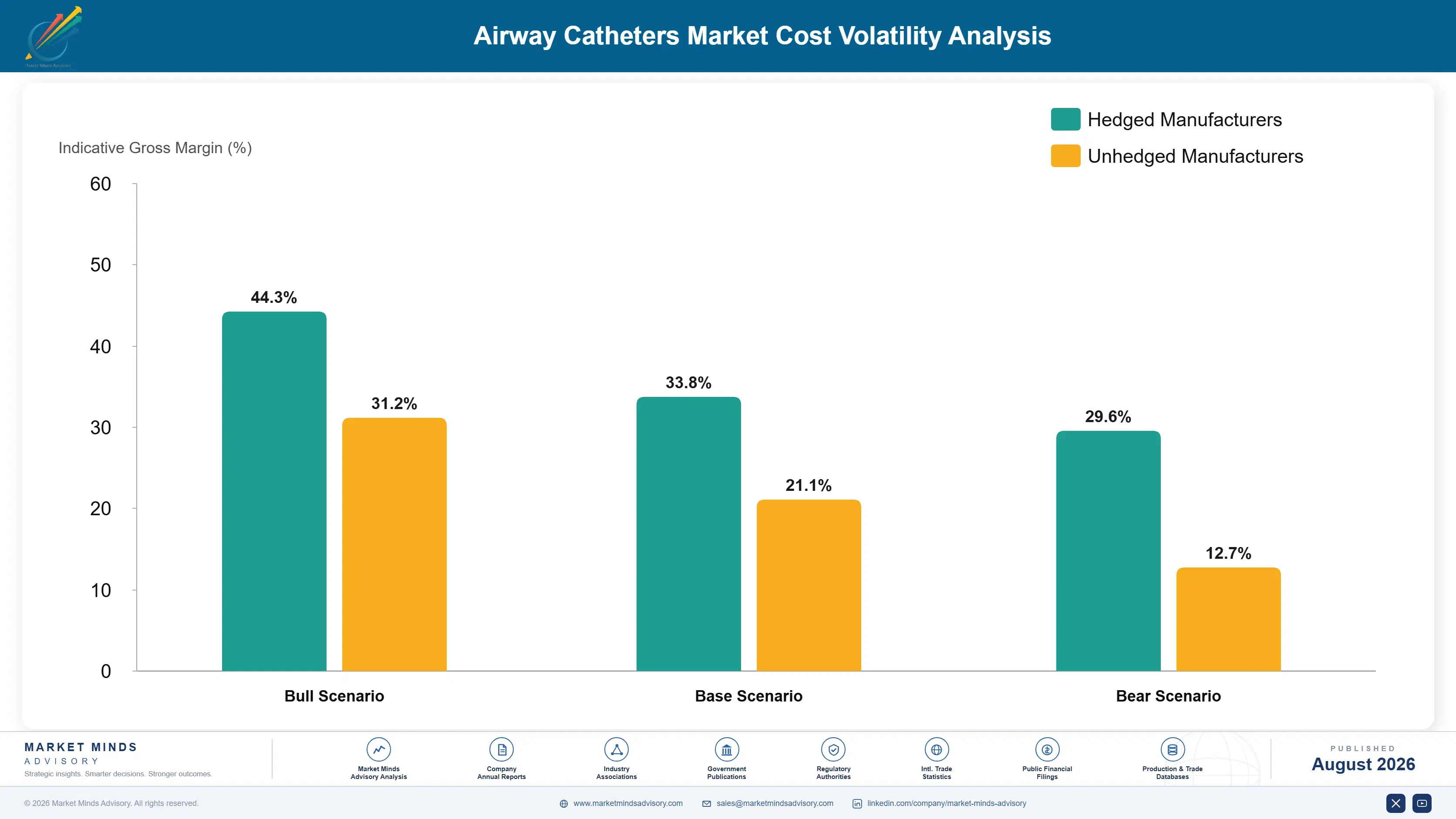
Polymer, Extrusion and Sterilisation Cost Exposure

Cost structures are dominated by polymer and by sterilisation rather than by anything sophisticated. Medical-grade PVC, silicone and thermoplastic elastomer account for roughly 34% of airway device cost of goods, sourced from a limited set of qualified resin suppliers because material change control is expensive. Ethylene oxide sterilisation and validated packaging contribute a further 16%, and precision extrusion with cuff bonding carries most of the balance.
Ethylene oxide capacity constraint through 2022 and 2023 demonstrated the exposure. United States facility closures under Environmental Protection Agency emissions scrutiny removed contract sterilisation capacity from an already tight market, and Becton Dickinson and Teleflex both disclosed sterilisation availability and cost pressure in their annual reporting for those years. Manufacturers could not reprice into tender contracts already signed, so margin absorbed most of the increase right across the industry.

The disadvantage falls hardest on Western producers competing for commodity tender volume. A Chinese manufacturer running high-volume extrusion at lower labour, energy and regulatory cost holds a position no Western efficiency programme can close on standard tubes. Geography compounds it: ethylene oxide emissions regulation binds in North America and Europe far more tightly than elsewhere, in a category where tenders decide on delivered price alone.
airway-catheters-market-cost-volatility-analysis-1787303414969

Secure owned or dedicated sterilisation capacity rather than contracting it

Contract sterilisation goes to whoever holds the largest standing commitment, and airway consumables rarely outrank higher-value device volumes when capacity tightens. Owning ethylene oxide or radiation capability costs more per unit in normal conditions and turns a capacity shortage into a scheduling problem rather than a tender default that loses the contract entirely. Very few competitors carry that cost.

Qualify alternative medical-grade resin grades across the whole portfolio

Material change control makes single-product requalification expensive, so the economics only work when an alternative grade is qualified once across many product codes together. Manufacturers with broad airway families spread that cost thinly enough to hold two approved resin sources permanently, which removes the worst of both the pricing and the availability exposure. Narrow portfolios cannot justify it.

Shift portfolio mix toward products that tenders cannot commoditise

Input cost increases cannot be passed through on standard tubes, because Chinese pricing sets the tender ceiling regardless of what resin costs. Guideline-mandated rescue devices, supraglottic designs and subglottic drainage tubes carry pricing latitude that commodity lines do not. Moving mix is a more reliable protection against input movement than any procurement strategy can supply.

Portfolio Architecture for Margin Defence

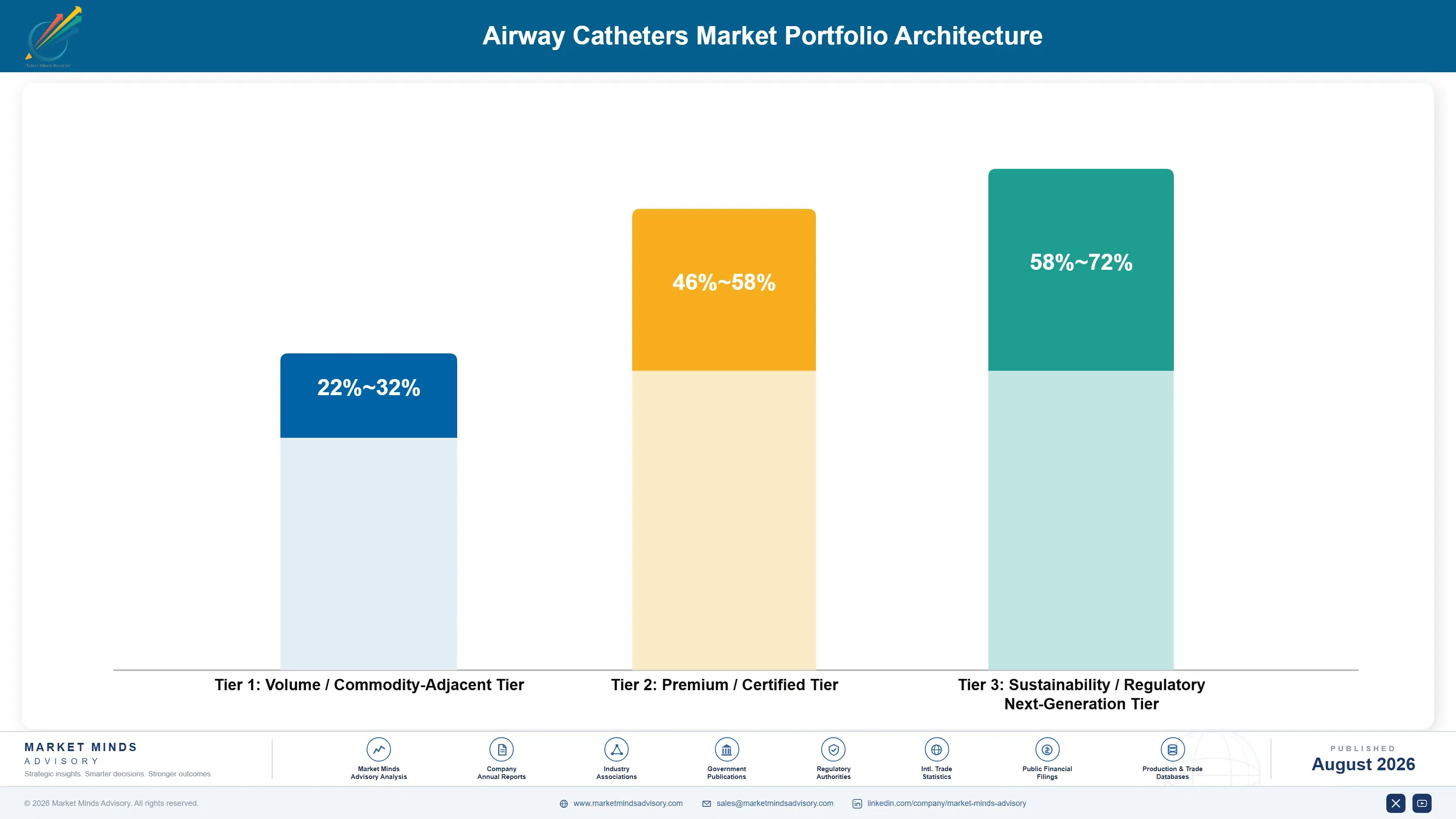
Margin architecture divides on whether a clinician will notice a substitution. Standard endotracheal tubes and suction catheters are functionally identical between suppliers and move on tendered price, earning commodity returns set by Chinese manufacturing cost. Supraglottic devices and closed suction systems earn considerably more, because anaesthetists and intensivists have preferences they will defend. Guideline-mandated rescue equipment earns the most, since nobody tenders the device that sa
The volume versus premium tension is unusually clean here. The commodity lines supply most units and almost none of the profit, and they create no clinical relationship because the clinician never chooses them. The premium lines supply few units and most of the margin, and they build exactly the relationships that make the next product easier to place. Defending commodity volume for its own sake consumes commercial resource that earns nothing.

High-value pools concentrate where a clinical committee rather than a procurement officer decides. Difficult airway rescue kits, front-of-neck access equipment, second-generation supraglottic devices and subglottic secretion drainage tubes all sit behind an anaesthetic or infection prevention decision. Standard tubes, basic oropharyngeal airways and open suction catheters sit entirely with purchasing, and their pricing reflects exactly that.

Volume / Commodity-Adjacent Tier

Standard endotracheal tubes, oropharyngeal and nasopharyngeal airways, and open suction catheters, tendered on delivered price with clinicians rarely objecting to substitution. Chinese manufacturers define the cost floor across every market that grants them regulatory approval.
Gross Margin: 22-32%

Premium / Certified Tier

Supraglottic airway devices, closed suction systems and tracheostomy tubes, where clinician preference, training familiarity and infection control protocol protect selection from straightforward tender substitution across most developed hospital systems. Technique familiarity outlasts patent protection here by a considerable margin.
Gross Margin: 46-58%

Sustainability / Regulatory / Next-Generation Tier

Difficult airway rescue catheters, front-of-neck access kits and subglottic secretion drainage tubes, protected by guideline mandate and infection outcome evidence. Best margins in the market and the least exposed to any purchasing pressure at all.
Gross Margin: 58-72%
airway-catheters-market-portfolio-architecture-1787303415469

Consumption Against Guideline Stocking Obligation

Two demand mechanisms operate here and they behave nothing alike. Consumption demand follows procedure and ventilated bed volume almost exactly: every general anaesthetic uses an airway device and every ventilated patient consumes suction catheters daily, with no substitution or deferral possible. Mandate demand follows guideline text instead, because rescue equipment must be stocked in every intubating location and replaced on expiry whether or not anybody opens it.
Stickiness tracks who makes the choice. Supraglottic devices are stickiest, since anaesthetists develop technique familiarity with a specific design and resist substitution firmly enough that purchasing rarely presses the point. Closed suction systems follow, held by critical care infection protocol. Standard endotracheal tubes and basic airways show essentially no stickiness at all and change supplier at every tender renewal without any clinician registering the difference.

Buyer profiles have moved steadily toward procurement across most of the category. A decade ago anaesthetic departments specified airway products and purchasing executed the order. Today roughly 64% of volume moves through group purchasing and national tender agreements, with clinical committees retaining a veto only over guideline-mandated and preference-sensitive items. Suppliers holding only clinical relationships have found themselves excluded from tenders for their own commodity lines.
airway-catheters-market-end-use-penetration-index-1787303415958

Where Airway Strategy Must Land

These are among the four positions where our research anticipates prominent divergence between winners and laggards over the coming forecast period. Each is grounded in the demand model, the regulatory perimeter, and the announced capacity pipeline.
01 / GUIDELINE PLACEMENT INVESTMENT

Named in the algorithm beats anything a salesperson achieves

Difficult airway rescue devices are stocked in every intubating location, used in roughly one case in a thousand, and replaced on expiry rather than consumption, which makes demand predictable and almost entirely insensitive to price negotiation. Suppliers whose products appear in national airway society algorithms hold roughly 45% higher realised pricing than functionally equivalent alternatives that do not. That is a clinical affairs investment measured in years rather than a commercial campaign measured in quarters, and it is not something a sales organisation can accelerate.
02 / COMMODITY CONCESSION DISCIPLINE

Stop defending tender volume that earns nothing at all

Chinese manufacturers supply standard tubes and suction catheters at costs no Western efficiency programme can approach, and tendered pricing near four dollars leaves nothing worth defending in that part of the portfolio. Suppliers who keep bidding those lines to protect reported volume are subsidising them from the products that genuinely earn, and the volume creates no clinical relationship because no clinician chooses it. Redirecting that commercial capacity toward preference-sensitive and mandated categories raises blended margin considerably, at the cost of an uncomfortable internal argument about reported revenue.
03 / CONVERSION DRIVER REPLACEMENT

The single-use mechanism has finished and needs replacing

Single-use conversion reached roughly 91% of global volume and lifted both unit counts and average selling prices simultaneously for five consecutive years, and the reusable stock that survives sits in markets that cannot afford to convert. Manufacturers extrapolating that period into their forward plans are building squarely on a mechanism that has already stopped running altogether. Growth from here has to come from supraglottic displacement, subglottic drainage adoption and guideline-driven stocking obligations rather than from any further category conversion at all.
04 / INFECTION OUTCOME SELLING

Sell pneumonia arithmetic to committees, not tubes to buyers

Subglottic secretion drainage tubes cost several times a standard endotracheal tube and reduce ventilator-associated pneumonia, an event costing a hospital tens of thousands per episode and appearing in published infection reporting that boards actually read. Adoption still sits under 30% of ventilated patients across most health systems, so the available runway is substantial. Making that case requires funding audit work in the hospital's own patient population, because published trial data on its own rarely persuades an infection prevention committee to change protocol.

Engagement Snapshot From the Field

A live engagement with an industry participant carrying material or product regulatory and market exposure ahead of a defining policy shift, showing how our research translates into a defensible multi-year portfolio strategy.
MARKET MINDS ADVISORY · CLIENT ENGAGEMENT SUMMARY
Airway Catheters Producer Strategic Portfolio Review and Transition Roadmap 2026·Investment Scenario on Airway Catheters Exposure Evaluation 2025-26
CLIENT PROFILE
A Western European airway device manufacturer supplying endotracheal tubes, supraglottic airways, suction catheters and difficult airway equipment across European and Middle Eastern hospital markets, with annual revenue of approximately USD 215 million (client-reported, unverified by MMA). Roughly 60% of unit volume and 24% of gross profit came from standard tubes and suction catheters sold through national tender processes across the region.
STRATEGIC CHALLENGE
Chinese manufacturers had won three national tube tenders within two years and pricing across the remaining commodity book had fallen for four consecutive years, while sterilisation and resin costs rose. The board wanted to know whether to invest in manufacturing cost reduction to defend tender volume, or to concede those lines deliberately and redirect commercial resource toward supraglottic, subglottic drainage and guideline-mandated rescue categories.
MMA APPROACH
MMA conducted 47 expert interviews across consultant anaesthetists, intensive care directors, infection prevention leads, hospital procurement officers and national tender administrators in six countries. A quantitative survey of 3,800 respondents established device selection authority, substitution tolerance and clinical preference strength by product type. We then modelled revenue, gross profit and commercial resource allocation under both options against observed tender pricing trends in each national market.
KEY FINDINGS
  1. Anaesthetists reported no objection to endotracheal tube substitution in any market surveyed, while the same clinicians resisted supraglottic device substitution firmly and consistently on technique familiarity grounds.
  2. Products named or illustrated in national airway society difficult airway algorithms achieved realised pricing roughly forty-five per cent above functionally equivalent alternatives that were not referenced.
  3. Subglottic secretion drainage tube adoption sat below thirty per cent of ventilated patients across five of six markets, and infection prevention leads cited absent local audit data rather than cost as the barrier.
  4. Commodity tender volume consumed roughly a third of the client's commercial resource while generating under a quarter of gross profit, and created no clinical relationship that supported other product placement.
CLIENT PROFILE
A Western European airway device manufacturer supplying endotracheal tubes, supraglottic airways, suction catheters and difficult airway equipment across European and Middle Eastern hospital markets, with annual revenue of approximately USD 215 million (client-reported, unverified by MMA). Roughly 60% of unit volume and 24% of gross profit came from standard tubes and suction catheters sold through national tender processes across the region.
STRATEGIC CHALLENGE
Chinese manufacturers had won three national tube tenders within two years and pricing across the remaining commodity book had fallen for four consecutive years, while sterilisation and resin costs rose. The board wanted to know whether to invest in manufacturing cost reduction to defend tender volume, or to concede those lines deliberately and redirect commercial resource toward supraglottic, subglottic drainage and guideline-mandated rescue categories.
MMA APPROACH
MMA conducted 47 expert interviews across consultant anaesthetists, intensive care directors, infection prevention leads, hospital procurement officers and national tender administrators in six countries. A quantitative survey of 3,800 respondents established device selection authority, substitution tolerance and clinical preference strength by product type. We then modelled revenue, gross profit and commercial resource allocation under both options against observed tender pricing trends in each national market.
KEY FINDINGS
  1. Anaesthetists reported no objection to endotracheal tube substitution in any market surveyed, while the same clinicians resisted supraglottic device substitution firmly and consistently on technique familiarity grounds.
  2. Products named or illustrated in national airway society difficult airway algorithms achieved realised pricing roughly forty-five per cent above functionally equivalent alternatives that were not referenced.
  3. Subglottic secretion drainage tube adoption sat below thirty per cent of ventilated patients across five of six markets, and infection prevention leads cited absent local audit data rather than cost as the barrier.
  4. Commodity tender volume consumed roughly a third of the client's commercial resource while generating under a quarter of gross profit, and created no clinical relationship that supported other product placement.
RECOMMENDED STRATEGY
Phase 1: Phase one: withdraw from national commodity tube tenders where realised gross margin sits below the portfolio threshold, accepting the reported revenue decline that follows. Phase 2: Phase two: redirect the released commercial resource into clinical affairs work aimed at national airway society guideline referencing for the rescue device range. Phase 3: Phase three: fund local ventilator-associated pneumonia audits at reference critical care units to build the subglottic drainage evidence infection committees require.
OUTCOME
The client withdrew from four commodity tenders and lost roughly a fifth of unit volume while blended gross margin improved about nine percentage points (client-reported, unverified by MMA). Two rescue products gained referencing in a national airway guideline update within eighteen months, and subglottic drainage revenue roughly doubled from the audit programme.

Frequently Asked Questions

Foundational context covering the market sizes, CAGR, scope, country, region and competition that inform every finding below. This section is provided to cover basics and most often pre-purchase conversations, answered from the MMA Primary Research Dataset.

What is the current size of the Airway Catheters Market?

The global airway catheters market was valued at USD 2.9 billion in 2025, covering endotracheal and tracheostomy tubes, supraglottic devices, suction catheters, airway exchange catheters and bronchial blockers. Laryngoscopes, ventilators and breathing circuits fall outside this definition.

How large will the Airway Catheters Market be by 2036?

MMA forecasts the market at USD 5.74 billion by 2036, expanding 1.86 times from the 2026 base of USD 3.09 billion. That represents roughly USD 2.65 billion of incremental value across the forecast decade.

What is the CAGR for the Airway Catheters Market 2026 to 2036?

The base case compound annual growth rate is 6.4%, with a bull case of 7.7% and a bear case of 5.2%. The bull case depends on broader subglottic secretion drainage tube adoption in ventilated patients.

Which segment is growing fastest?

Supraglottic airway devices grow at 9.6%, a full 1.50x the overall market rate. Second-generation designs with gastric drainage channels have widened the case mix that can avoid full endotracheal intubation.

Who are the major companies in the Airway Catheters Market?

Teleflex, Medtronic, Ambu, ICU Medical and Intersurgical together hold 46% of revenue. Chinese manufacturers including Well Lead Medical supply a substantial share of global commodity tube volume and set tender pricing.

Which country is growing fastest?

India grows fastest at 10.2%, driven by private hospital theatre and critical care expansion alongside continuing single-use conversion. South Asia and Pacific is the fastest region overall at 8.7%.

Report Segmentation Architecture

The full report scope spans multiple orthogonal segmentation dimensions, with cross-tabulated demand data provided for each dimension pair. Coverage extends further to regional breakdowns, trend trajectories, and the competitive detail needed to support segment-level decision-making.

By Device Type

  • Endotracheal Tubes
  • Tracheostomy Tubes
  • Supraglottic Airway Devices
  • Suction and Closed Suction Catheters
  • Airway Exchange and Introducer Catheters
  • Bronchial Blockers and Double-Lumen Tubes

By End-Use Industry

  • Hospital Operating Theatres
  • Intensive Care and Critical Care Units
  • Emergency Departments
  • Ambulatory Surgical Centres
  • Prehospital and Emergency Medical Services
  • Long-Term Ventilation and Home Care

By Commercial Dimension

  • Group Purchasing Organisation Contracts
  • National Hospital Tender Programmes
  • Direct Hospital Supply Agreements
  • Difficult Airway Trolley Stocking Contracts
  • Distributor and Wholesaler Networks
  • Emergency Services Procurement Programmes

By Region

  • East Asia
  • North America
  • Western Europe
  • South Asia and Pacific
  • Latin America
  • Middle East and Africa
  • Eastern Europe

Scope, Methodology, and Coverage

Every figure in this report is reproducible from documented input assumptions. The scope below maps the historical period, the forecast horizon, the segmentation dimensions, and the countries covered, alongside the underlying primary and qualitative methodology.
Historical Period
2020 to 2025
Forecast Period
2026 to 2036
Base Year
2025 (USD billions; MMA Primary Research Dataset, August 2026)
Market Definition
This market comprises catheters and tubes used to establish, maintain, exchange or clear an artificial airway, measured at manufacturer revenue across tendered, contracted and direct supply channels serving hospital, ambulatory, emergency and prehospital settings. Coverage spans cuffed and uncuffed endotracheal tubes including subglottic secretion drainage designs, tracheostomy tubes and their inner cannulae, first and second-generation supraglottic airway devices, open and closed suction catheters, airway exchange catheters, bougies and introducers, emergency front-of-neck access catheters, and bronchial blockers with double-lumen endobronchial tubes. Direct and video laryngoscopes, flexible intubation scopes, ventilators, anaesthesia machines and breathing circuits, humidification systems, oxygen delivery masks and cannulae, tracheostomy dressings and securement devices, and diagnostic bronchoscopes fall outside scope.
Quantitative Units
USD billions (current prices); device unit volumes by type; average price per device; surgical procedure and ventilated bed counts; single-use conversion share
Segmentation Dimensions
By Device Type; By End-Use Industry; By Commercial Dimension; By Region
Regions Covered
East Asia, North America, Western Europe, South Asia and Pacific, Latin America, Middle East and Africa, Eastern Europe
Countries Covered
China, Japan, South Korea, Taiwan, United States, Canada, Mexico, Germany, France, United Kingdom, Italy, Spain, Netherlands, Sweden, Denmark, India, Australia, Singapore, Malaysia, Thailand, Indonesia, Brazil, Argentina, Chile, Colombia, Saudi Arabia, United Arab Emirates, South Africa, Poland, Czechia, Hungary, Romania, and additional markets relevant to airway device supply analysis
Key Companies Profiled
Teleflex, Medtronic, Ambu, ICU Medical, Intersurgical, Fisher & Paykel Healthcare, Becton Dickinson, Convatec Group, Well Lead Medical, Henan Tuoren Medical Device, Flexicare Medical, Sumitomo Bakelite, VBM Medizintechnik, Pulmodyne, Armstrong Medical, Mercury Medical, TRUPHATEK International, Sunmed, Shandong Weigao Group, Angiplast
Quantitative Methodology
Primary survey, n=3,800 respondents, Q4 2025, six countries; demand-side model with trade association cross-validation
Qualitative Methodology
47 expert interviews, Q4 2025; applied to validate demand model assumptions, identify emerging dynamics, and assess competitive positioning
Report Format
PDF and XLSX data workbook (Word format preview document)
Publisher
Market Minds Advisory
Report Code
MMA-2026-MED-122
Published
August 2026
Contact
sales@marketmindsadvisory.com | www.marketmindsadvisory.com

Purchase the full Airway Catheters Market Report (2026 to 2036).

The full MMA report separates the two businesses inside this market, quantifying commodity tender erosion against guideline-mandated stocking demand that behaves nothing like consumption. It sizes six device types and seven regions to 2036, modelling surgical and ventilated bed volumes, single-use conversion and average selling price separately so unit and value trajectories can be distinguished. Competitive assessment covers twenty manufacturers on one consistent revenue basis. Input cost exposure is traced through medical-grade resin sourcing and ethylene oxide sterilisation capacity. Four commercial levers and a strategic verdict close the report, grounded in 47 expert interviews and a 3,800-respondent survey.
Six device types sized separately to 2036
Guideline stocking demand modelled against consumption demand
Single-use conversion exhaustion quantified across every region
Twenty manufacturers assessed on one consistent basis
Supraglottic displacement of intubation mapped by case type
Anonymised client engagement with tested strategic recommendations

Built For The People Who Decide

From boardroom strategy to bench-side execution, this report is read cover-to-cover by leaders shaping the next decade of their industry, turning demand scenarios, market dynamics and valuation benchmarks into decisions.
CXOs/ Presidents/ VPs/ Managers
M&A and Corporate Development
Strategy Teams and R&D Heads
Procurement and Product Directors
Regulatory and Compliance Leaders
Investor Relations and Equity Analysts