Market Minds Advisory
Airport Systems Market

Airport Systems Market: Airport Systems: Processing Throughput, Four Hour Shutdown Windows And Installations That Outlast Everyone Who Specified Them

An airport cannot close its baggage hall to rebuild it, which is why systems specified thirty years ago are still sorting bags and will keep doing so for years yet.

Lead Analyst

Published

September 2026

Make Smarter Decisions with Customized Research Insights

Request a free sample report and evaluate market opportunities, growth trends, and competitive dynamics relevant to your business needs.

2025 MARKET VALUE$26.5BMarket Size 2025
2036 FORECAST VALUE$56.9BBase Case , 2026 to 2036
CAGR 2026 TO 20367.2 %Bull 8.4% / Bear 6.0%
INCREMENTAL OPPORTUNITY$28.5BNet 10- year value creation
EXPANSION MULTIPLE2.00x2036 value over 2026 base
Strategic Levers
M&A Pipeline
Regional Outlook
Country Rankings
Competitive Intelligence
Segmental Deep-dive
Call-Us : 91 93563 13602

Executive Snapshot and Market Trajectory.

Airports cannot switch themselves off. A baggage hall gets a four hour window overnight and nothing longer, which means systems are replaced during terminal construction or effectively never, and installations from the nineties are still running. Nobody anywhere replaces a perfectly good working conveyor voluntarily either.
Passenger processing and biometric flow systems grow fastest at 10.8%, because border and identity regulation now sets throughput requirements that no amount of concrete satisfies. The European entry and exit registration regime added a processing step at every external border crossing simultaneously. Capacity at most airports is limited by checkpoint and border throughput rather than by runway or gate availability. Concrete takes a decade and does not address the constraint in any case.
Concentration sits at 41% and rests on installed base rather than on any technology position. A supplier holding a baggage or airside system supports it for decades, because replacing it means closing something the airport cannot close. New-build is where positions actually change hands, which is why the construction pipeline matters more than any product roadmap. Nobody in this business should be reading product roadmaps ahead of planning approvals.
Market Definition
Revenue from systems installed at airports to move, process and manage passengers, baggage and aircraft, covering baggage handling and sortation, security screening and detection, passenger processing and biometric flow systems, airport operations and resource management software, airside guidance, lighting and ground movement systems, and air traffic management and tower systems, together with associated maintenance and support. Excludes terminal construction and civil works, aircraft ground support equipment, retail and concession systems, and airline-owned departure control platforms.
Base Year Value
$26.5B in 2025 (MMA Primary Research Dataset, August 2026)
Forecast Period
2026 to 2036, eleven discrete annual values
CAGR
7.2% base case. Bull 8.4%. Bear 6.0%.
Fastest Growth Segment
Passenger Processing and Biometric Flow Systems: 10.8% CAGR
Fastest Growth Country
India: 9.4% CAGR
Fastest Growth Region
South Asia and Pacific: 9.4% CAGR
Largest Region
East Asia: 29% of 2025 global value
Market Leaders
Vanderlande, Daifuku, Smiths Detection, SITA and Thales lead on airport system revenue across installation and support. Source: company annual reports and MMA Primary Research Dataset, July 2026.
Primary Survey
n=3,800 procurement and R&D decision-makers, Q4 2025, six countries
Methodology
Demand-side build-up, cross-validated against public data, 47 expert interviews

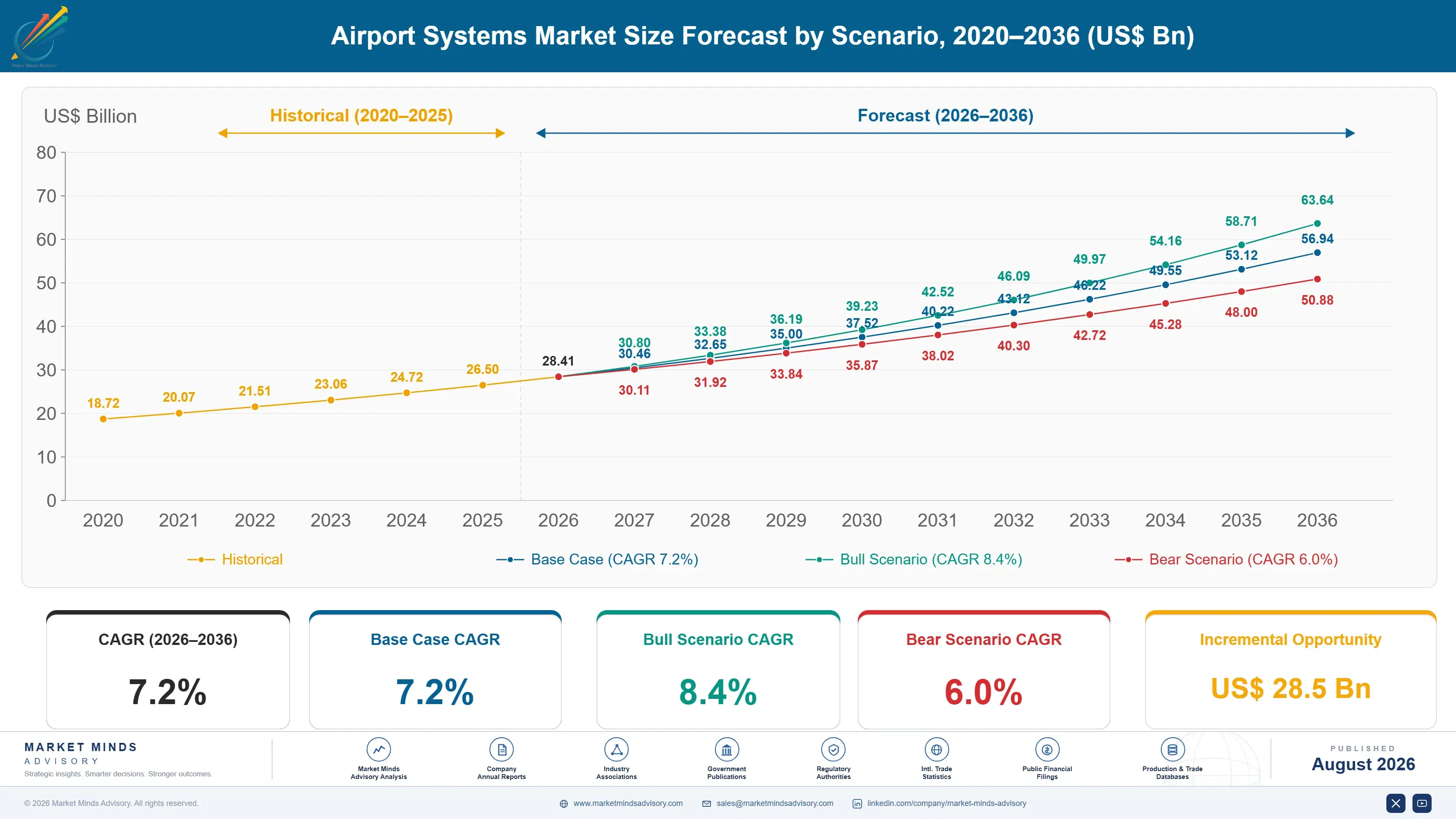
Airport Systems Market Forecast Scenarios

airport-systems-market-size-forecast-scenario-1788164592205
The 2020 to 2025 period pushed spending toward processing and away from capacity. Traffic collapse deferred terminal construction and the baggage and airside programmes that travel with it, while security screening replacement continued on regulatory deadlines that no downturn suspended. Border and identity requirements arrived on schedules set by legislation rather than by demand. Revenue compounded near 6.0%, with composition shifting considerably more than the total across the period.
Three mechanisms carry the base case. Border and identity regulation continues imposing processing steps that airports must absorb through systems rather than through floor space they do not have. Deferred terminal construction is returning across Asian and Middle Eastern programmes at scale. And screening replacement proceeds on detection standard deadlines that operate independently of traffic, funding cycles or anything an airport would prefer. None of the three depends on traffic growth.
The bull catalyst is a coordinated move to digital travel credentials across major jurisdictions, which would oblige processing system replacement at every international airport within a defined window. The bear risk is construction deferral: systems are installed when terminals are built, and a sustained pullback in airport capital programmes removes the only occasion on which most installations get replaced.

The System Outlives Everyone

Every commercial fact about this market follows from one operational constraint. An airport runs and cannot stop, a baggage hall gets perhaps four hours overnight, and no amount of money buys a longer window. So systems get replaced when a terminal is built or extended, and otherwise they are maintained, patched and extended in place. Handling installations reach around 27 years in service and several run considerably longer than that.
MARKET CONCENTRATION CR541%Share of airport system revenue held by leading suppliers
BAGGAGE SYSTEM SERVICE LIFE27 yearsTypical period a handling installation remains in operational service
PEAK HOUR THROUGHPUT4,100 passengersDesign capacity per hour across a modern terminal checkpoint
AVAILABLE SHUTDOWN WINDOW4 hoursNightly period when a handling system can be worked on
AFTERMARKET SERVICE SHARE46%Portion of revenue from maintenance rather than initial installation
CAPITAL CYCLE LENGTH18 yearsTypical interval between major terminal system replacement programmes
The second thing that follows is where capacity actually binds. Runways and gates are rarely the constraint at a busy airport; checkpoint and border processing are, with a modern checkpoint designed around 4,100 passengers per hour and border halls slower. Regulation keeps adding steps to that process, and an airport absorbing a new border requirement cannot build another hall for it. It has to process faster in existing space.
Commercially that produces an unusual pattern. Aftermarket support carries 46% of revenue because installations persist, and positions change hands only during construction on capital cycles running roughly 18 years. A supplier winning a new terminal wins three decades of support with it. A supplier losing one waits for the next building programme, which may be a very long time coming.
"The most valuable thing in this industry is a conveyor installed in 1997 that still works, because nobody can take the airport offline to remove it. Product roadmaps matter far less here than knowing which terminals are actually being built."
Director, Aviation Infrastructure Practice · MMA Aviation Infrastructure Systems Practice · August 2026

Market Trends

Border Regulation Sets Throughput Requirements Airports Cannot Build Around

Registration and identity requirements at external borders add processing steps that arrive on legislative schedules rather than on airport capital cycles, and an airport absorbing one cannot construct another border hall to accommodate it. The European entry and exit registration regime applied a new step at every external crossing simultaneously. That forces processing speed improvements inside existing floor space, which is a systems purchase rather than a construction one. Regulation has become the primary demand driver in this part of the market. Legislation now drives more purchasing here than passenger growth does.
Market Impact: Sets positions for 18 years
Screening Replacement Runs On Deadlines Independent Of Traffic

Detection standard deadlines oblige airports to replace screening equipment on dates set by regulators, and those dates did not move when traffic collapsed or when funding tightened. Computed tomography checkpoint equipment has been rolling out on exactly that basis across major jurisdictions. The demand is therefore uncorrelated with passenger volumes, which makes it the steadiest revenue line in this market. Suppliers holding certified detection products against current standards face demand that arrives whatever else is happening. A deadline that survives a global traffic collapse is an unusually dependable demand signal.
Market Impact: Caps terminals at 4,100 hourly

Market Opportunities and Growth Drivers

Asian Terminal Construction Returns At Considerable Scale

Deferred terminal programmes across Asia are proceeding again at a scale no other region approaches, and new construction is the only occasion on which most airport systems get replaced rather than maintained. A single new terminal carries baggage handling, screening, processing, airside and operations systems together in one procurement. Capital cycles run roughly 18 years, so a supplier winning one of these programmes holds the position for most of a working career. Losing one of these programmes means waiting most of two decades for another chance at that same airport.
Market Impact: Allows only 4 hours nightly

Processing Capacity Constrains Growth More Than Infrastructure Does

Passenger growth at busy airports runs into checkpoint and border throughput long before it runs into runway or gate capacity, and a checkpoint designed around 4,100 passengers per hour is what actually caps the terminal. Airports responding to growth therefore buy processing systems rather than concrete, because concrete takes a decade and does not address the constraint. That redirects capital toward exactly the systems that regulation is simultaneously making more demanding to operate. Buying throughput is considerably faster than building anything, and it addresses the constraint that actually binds the terminal.
Market Impact: Repeats roughly every 18 years

Market Restraints and Challenges

Four Hour Windows Make Replacement Practically Impossible

A live airport offers roughly four hours overnight to work on a baggage or airside system, which is enough to maintain and extend an installation and nowhere near enough to replace one. The root cause is that airports cannot suspend operations for construction the way other infrastructure can. Commercially it means replacement happens during terminal building or not at all. Mitigation runs through phased cutover designs, temporary parallel capacity, and modular architectures allowing sections to be replaced independently over several years. No supplier has ever persuaded an airport to close for their convenience.
Market Impact: Adds 1 step at every border

Capital Cycles Leave Suppliers Waiting Years Between Opportunities

Positions change hands on capital cycles running roughly 18 years, so a supplier losing a terminal programme has no route back into that airport until the next building phase. The root cause is that installations persist for decades and nobody replaces working equipment voluntarily. Commercially it produces long revenue droughts between wins and makes each competition disproportionately consequential. Mitigation runs through maintenance and upgrade contracting on competitors' installations, software layers above existing hardware, and expansion projects short of full replacement. Each competition therefore carries the weight of nearly two decades of revenue behind it.
Market Impact: Replaces against 1 fixed regulatory deadline
4 additional market trends, 3 additional growth drivers, and 2 additional restraints and challenges are covered in the full report. Contact sales@marketmindsadvisory.com to access the complete intelligence.

Segment CAGR and Growth Architecture

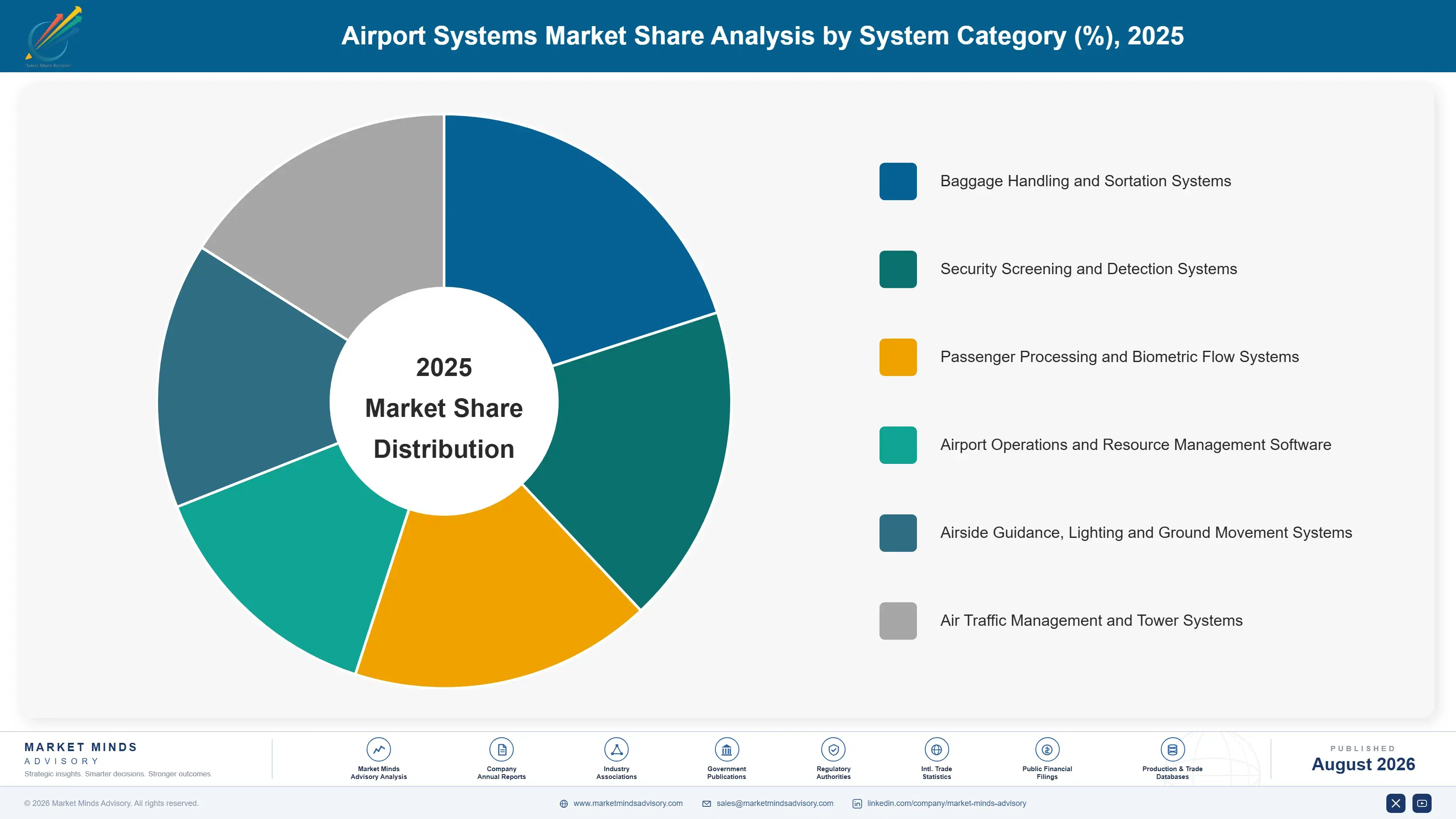
Segmentation follows system category, because each carries a different buyer, a different replacement trigger and a different relationship with the regulation now shaping airport operations. Six categories describe the market completely, from baggage handling replaced only during construction through to passenger processing where legislation rather than capacity sets the whole pace of the purchasing entirely.
airport-systems-market-market-share-analysis-1788164592736

Passenger Processing and Biometric Flow Systems

The fastest category grows at 10.8%, half again the market rate of 7.2%, and regulation rather than passenger preference explains most of it. Border registration and identity requirements arrive on legislative schedules that airports must absorb without building additional floor space, and the European entry and exit registration regime added a processing step at every external crossing at once. Self-service check-in, bag drop, biometric boarding and automated border control all address the same constraint: processing faster inside space that already exists. Unlike almost everything else here, these systems can be installed without closing anything, which is precisely why they get bought. Nothing else in this market can be bought that easily.
CAGR 10.8%

Security Screening and Detection Systems

Screening grows at 9.1% on regulatory deadlines that operate entirely independently of traffic, funding or anything an airport would prefer. Detection standard requirements oblige equipment replacement on dates set by authorities, and those dates did not move when passenger volumes collapsed. Computed tomography checkpoint equipment has rolled out across major jurisdictions on exactly that basis, replacing installations that were working perfectly well by any operational measure. The demand is uncorrelated with volume, which makes it the steadiest revenue in this market and the least dependent on whether any terminal happens to be under construction. Equipment working perfectly well gets replaced because a date arrived, which is unusual in infrastructure generally.
CAGR 9.1%
Full segment breakdown across 6 segments available in the complete report.

Regional Architecture and Country Demand Map

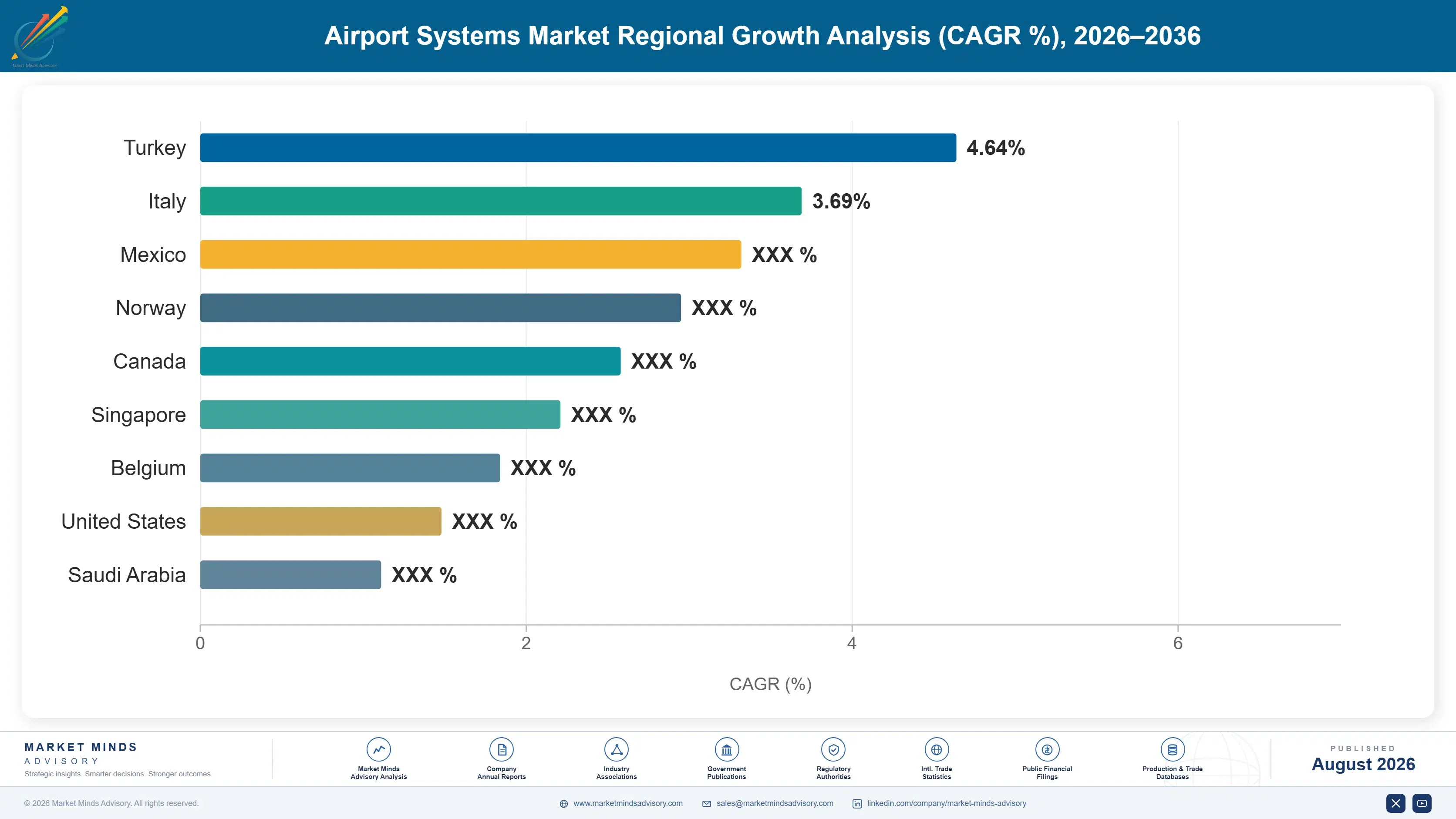
Airport system demand follows terminal construction and regulatory schedules rather than passenger volume alone. East Asia leads on the scale of building under way, with South Asia and Pacific growing fastest and mature regions spending predominantly on replacement within existing terminals. The construction pipeline explains most of it.

East Asia

The largest share at 29% follows terminal construction at a scale no other region approaches, and new building is the only occasion on which most airport systems change supplier rather than being maintained in place. Chinese airport expansion covers dozens of facilities simultaneously, with domestic suppliers taking a growing share of handling and airside content. Japanese and Korean airports invest heavily in processing automation against constrained labour availability. Regional buyers specify complete system packages within single procurements rather than contracting each category separately. Buying complete packages rather than separate categories favours suppliers who can lead an integration rather than supply one line into somebody else's, which is not how most Western procurement is structured.
Share: 29% | CAGR: 8.4% (2026 to 2036)

North America

Replacement within existing terminals accounts for most spending here rather than new construction, which suits incumbents and frustrates everybody else. Screening equipment replacement proceeds on federal detection standard deadlines regardless of traffic or airport funding position. Baggage installations reaching thirty years are being extended and rebuilt in sections rather than replaced outright, because the four hour overnight window permits nothing more ambitious. Operations software adoption has advanced faster here than the hardware underneath it, which creates awkward integration work. Rebuilding a thirty year old baggage installation in sections across several years is slower and more expensive than replacing it outright would be, and it remains the only approach a live terminal can actually accommodate.
Share: 24% | CAGR: 6.6% (2026 to 2036)
Regional intelligence for 5 additional markets available in the complete report: Western Europe, South Asia and Pacific, Latin America, Middle East and Africa, Eastern Europe. Contact sales@marketmindsadvisory.com.
airport-systems-market-country-cagr-analysis-1788164593262

Where Airport System Margin Sits

Four levers work on installed base control, construction pipeline access and software positioning rather than on product capability, which rarely decides these competitions alone. Maintenance capture, pipeline engagement, software layering and phased replacement each address something a supplier can pursue immediately. None of the four requires a better conveyor than anybody else already builds today.

Control Maintenance On Your Own Installed Base

Aftermarket support carries 46% of market revenue across installations lasting 27 years, and independent maintenance contractors take a substantial share of it from suppliers who never treated support as a business. Authorised service with parts control and response commitments typically recovers 15 to 22 percent of the value leaking outward. The installations are already there and the relationship already exists. Suppliers competing hard for new terminals while neglecting the airports they already serve have the priorities exactly reversed. The 46% figure is what most hardware suppliers here consistently overlook entirely.
Market Impact: Recovers roughly 18% of the leaking maintenance value

Track The Construction Pipeline Years In Advance

Positions change hands only during terminal building on capital cycles running roughly 18 years, which makes the construction pipeline the single most important commercial intelligence in this market. Airport programmes are visible 5 years ahead through planning approvals, financing arrangements and master plans. Suppliers engaging when the tender appears are competing against participants who shaped the requirement. Product development matters considerably less than knowing which terminals are actually going to be built and when. A full 5 year lead is the difference between shaping a requirement and answering somebody else's.
Market Impact: Requires roughly 5 years of commercial lead time

Sell Software Above Somebody Else's Hardware

Operations, resource management and flow analytics run above installed equipment regardless of who supplied it, which is the only route into an airport between construction cycles. It requires no shutdown window, no capital programme and no displacement of a working installation. Software revenue also reprices annually where hardware contracts run 10 years or longer. Suppliers who insist on selling hardware first are excluded from every airport that is not currently building something new. It is the only product in this market that installs without anybody's permission to stop something first.
Market Impact: Enters airports between the 18 year capital cycles

Design For Phased Cutover Not Full Replacement

A four hour overnight window makes full replacement impossible, and suppliers proposing it are proposing something the airport cannot accept whatever the merits. Modular architectures allowing sections to transfer independently across 3 years turn an impossible project into a fundable one. Airports consistently prefer the phased proposal and rarely receive it. The engineering is harder and the commercial position considerably stronger, since the supplier is present continuously rather than bidding once against everybody else. Airports tend to remember precisely which supplier proposed something they could actually build and operate around.
Market Impact: Phases replacement across 3 years without closing anything

Who Controls the Margin Pool

Concentration sits around 41% across the five largest participants measured on airport system revenue across installation and support, and it is moderate because the market spans several industries that share a customer and very little else. Baggage handling is a materials handling business, screening is detection instrumentation, processing is identity technology and air traffic management is defence-adjacent systems engineering.
Competition runs on installed base, construction access and integration capability. Installed base decides maintenance revenue and the incumbency that new-build competitions have to overcome. Construction access decides whether a supplier is in the competition at all, since positions change only when terminals are built. Integration capability decides who leads a package procurement rather than supplying one category into it.

Pressure is arriving from software participants and from regional integrators rather than from new equipment manufacturers. Operations and flow software enters airports without any shutdown window or capital programme, which is a route the hardware suppliers never had. Regional integrators meanwhile win package procurements on cost and proximity. Rankings will shift toward participants combining installed base with software capability, since one earns between cycles and the other wins them.
airport-systems-market-company-positioning-matrix-1788164593793

Competitive Moat and Risk Dimensions

VANDERLANDE

Moat: Installed base across major hubs

Vanderlande holds baggage handling installations across a very large number of major hubs, and those installations persist for around 27 years because no airport can close a baggage hall to replace one. Maintenance and extension revenue follows automatically for decades. Acquisition of competing airport logistics capability has deepened that position rather than adding any new technology.
VANDERLANDE

Risk: Dependence on construction cycles

New positions arrive only when terminals are built, and a sustained deferral of airport capital programmes removes the occasion on which market share changes at all. Maintenance revenue continues while growth does not. Regions where construction is concentrated are also where domestic suppliers are strongest and competition is most local.
SITA

Moat: Software presence without construction dependency

SITA reaches airports through operations, processing and communications software that installs without any shutdown window, capital programme or displacement of working equipment, which is a route hardware suppliers simply do not have. That lets it enter airports between construction cycles when everybody else must wait. Recurring software revenue reprices far more readily than hardware contracts running a decade.
SITA

Risk: Limited hardware and integration position

Package procurements at new terminals are led by participants supplying baggage, screening and airside equipment together, and a software-led position competes for a smaller share of those awards. Hardware suppliers are also building software layers of their own. Software without installed equipment underneath it is easier to displace than a conveyor nobody can remove.

Players Tracked

Prominent Players

Vanderlande
Daifuku
Smiths Detection
SITA
Thales

Other Key Players

BEUMER Group
Alstef Group
Leidos
Amadeus
Honeywell
Collins Aerospace
ADB SAFEGATE
Rapiscan Systems
Analogic Corporation
IDEMIA
NEC Corporation
Indra Sistemas
TAV Technologies
Veovo
Siemens Logistics

Recent Developments

OCTOBER 2025

European entry and exit registration regime began operation

A biometric registration requirement for third country nationals began operating at external border crossings, adding a processing step at every affected airport simultaneously on a schedule set by legislation rather than by airport capital planning. This was regulatory implementation rather than any commercial arrangement between system suppliers.
Signal: Regulation adding a processing step at every border forces systems purchasing that airports simply cannot defer.
MARCH 2024

Hub airport awarded phased checkpoint screening replacement programme

A major hub awarded a checkpoint screening replacement programme structured for phased cutover across several years, replacing equipment section by section because operations could not be suspended for a single full changeover. This was a competitive contract award rather than any acquisition, merger or joint venture between suppliers.
Signal: Phased cutover is how large airports actually replace their systems, and remarkably few suppliers propose it.
SEPTEMBER 2024

Handling supplier acquired a competing airport logistics business

A baggage handling supplier acquired a competitor's airport logistics operations, consolidating installed base and maintenance relationships across a substantial number of hubs rather than acquiring any distinctive technology. This was an acquisition rather than a merger or joint venture between the two businesses concerned in it.
Signal: Installed base rather than technology is what these acquisitions are actually buying in this particular market.

What An Airport System Costs

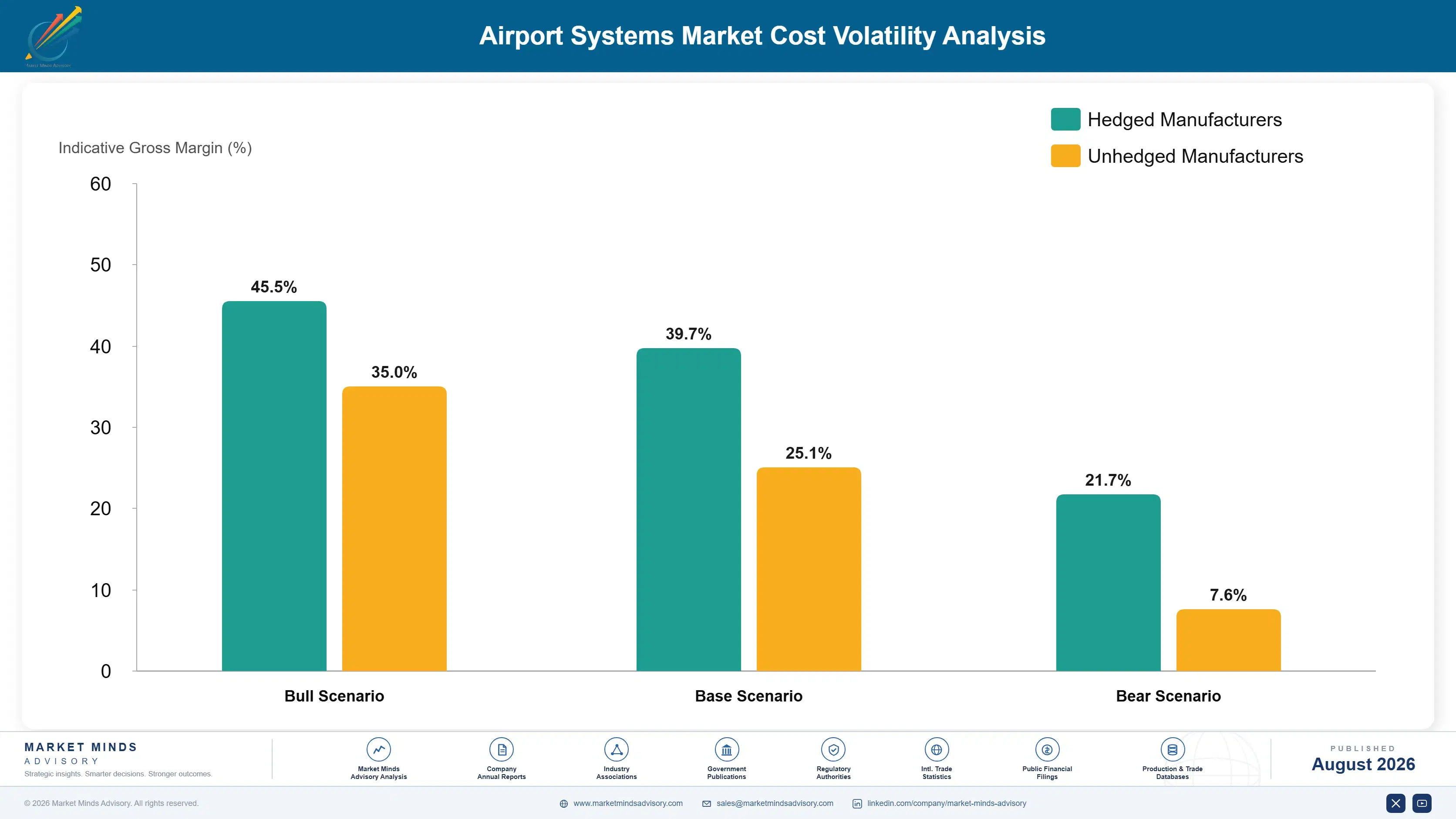
Cost divides four ways and installation labour is larger than most buyers expect. Site installation, commissioning and testing absorb roughly 34% of programme cost, equipment and mechanical content near 29%, software, controls and integration near 22%, and project management with compliance the remaining 15%. Four hour overnight windows drive that installation share, since the same work in an empty building costs far less.
Steel, electrical component and drive system pricing moved sharply across recent years and raised handling system cost accordingly, since these are mechanically heavy installations. Daifuku and Smiths Detection have both discussed input cost and supply conditions across recent reporting periods. Skilled installation labour availability has been the more damaging constraint, because overnight working in a live airport requires clearance, escort and experience that few contractors hold.

Exposure varies by contract structure rather than by geography. Suppliers on fixed-price installation contracts inside live terminals carry schedule risk that has repeatedly proved worse than material risk. Those holding maintenance positions recover cost across 46% of revenue that reprices more readily than installation contracts signed years earlier. Software-led participants carry almost no material exposure at all, which is part of why those positions look increasingly attractive.
airport-systems-market-cost-volatility-analysis-1788164593991

Phased cutover reducing overnight installation intensity

Installation absorbs roughly 34% of programme cost largely because work happens inside four hour overnight windows in a live terminal. Phasing a replacement across sections and years reduces the intensity of that work and the premium it carries. Airports prefer phased proposals and rarely receive them, so the approach improves both the cost position and the win rate together.

Cleared installation labour secured ahead of programme award

Overnight working in a live airport requires security clearance, escort arrangements and experience that few contractors hold, and the pool is far smaller than the number of programmes competing for it. Securing crews before award rather than after costs comparatively little against a schedule that slips. Most suppliers begin recruiting once the contract is already signed and the schedule fixed.

Maintenance contracting alongside original installation supply

Aftermarket carries 46% of revenue and reprices far more readily than installation contracts signed years earlier against fixed terms. Contracting maintenance at the point of award is considerably easier than recovering it from an independent contractor afterwards. Airports generally prefer support from whoever built the system, provided the response commitments are genuine rather than nominal.

Portfolio Architecture for Margin Defence

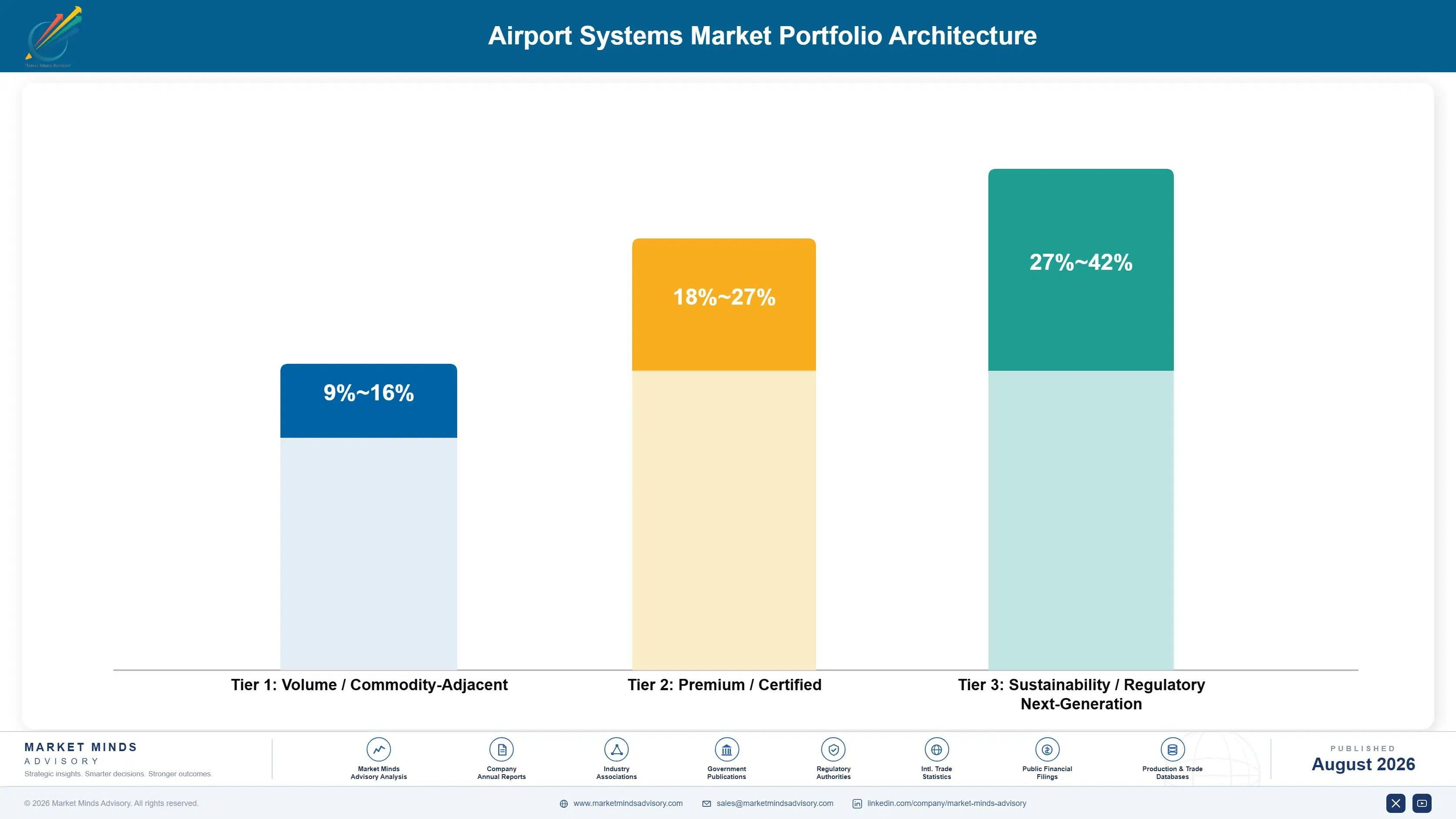
The portfolio separates by whether a system can be installed without stopping the airport. Baggage handling and airside infrastructure are the largest revenue blocks and the least accessible: replacement requires construction, positions run for decades, and a supplier not already present waits for the next building programme. Enormous revenue, genuinely durable, and closed between cycles. Nobody enters an airport that is not building.
Margin concentrates in processing systems, screening and maintenance. Processing and screening are bought on regulatory schedules rather than construction ones, which decouples them from the capital cycle entirely. Maintenance carries 46% of revenue across installations lasting 27 years. All three earn without requiring a terminal to be built, which is the characteristic that actually matters in this market. None of the three waits on a construction programme.

The overlooked pool is software above other suppliers' hardware. Operations and flow management run on installed equipment regardless of who made it, require no shutdown window and no capital programme, and reprice annually where hardware contracts run a decade. It is the only route into an airport between construction cycles, and hardware-led suppliers keep declining to take it. The route is open and mostly unused.

Volume / Commodity-Adjacent

Mechanical handling equipment, conveyors, installation contracting and civil interface work. Range spans seven points because schedule performance inside live terminals decides outcomes far more than any equipment distinction does. Nothing here is defensible.
Gross Margin: 9-16%

Premium / Certified

Sortation systems, airside guidance and lighting, air traffic management equipment and integration services. Range spans nine points because package leadership and maintenance capture vary considerably between suppliers here. Package leadership decides much.
Gross Margin: 18-27%

Sustainability / Regulatory / Next-Generation

Screening and detection, biometric processing systems, operations software and authorised maintenance. Range spans fifteen points because software economics and service contracting are barely comparable businesses inside one tier. Service contracting separates them.
Gross Margin: 27-42%
airport-systems-market-portfolio-architecture-1788164594483

High-value Sub-segments and Strategic Watch-out

Passenger Processing and Biometric Flow Systems

High value and high growth at 10.8%, bought on legislative schedules and installable without closing anything at all. The twelve point range separates suppliers holding identity and border capability from those supplying self-service hardware into somebody else's processing architecture. Nothing has to close for it.
Gross Margin: 30-42%

Security Screening and Detection Systems

High value with moderate growth at 9.1%, replaced on detection standard deadlines entirely uncorrelated with traffic or funding. The nine point range reflects certification position, since equipment approved against current standards competes very differently from equipment awaiting it. Perfectly working equipment gets replaced on the date regardless.
Gross Margin: 27-36%

Baggage Handling and Sortation Systems

The largest revenue block and the least accessible to anybody not already installed at the airport. Replacement needs construction, installations last around three decades, and a supplier losing a terminal waits for the next building programme entirely. Nobody can close a baggage hall to compete.
Gross Margin: 12-19%

Construction Pipeline Dependency

The strategic watch-out rather than a growth pool. Positions change hands only when terminals are built, capital cycles run roughly eighteen years, and a sustained construction pullback freezes market share exactly where it currently sits. Nothing else in this market moves market share at all.
Gross Margin: Variable

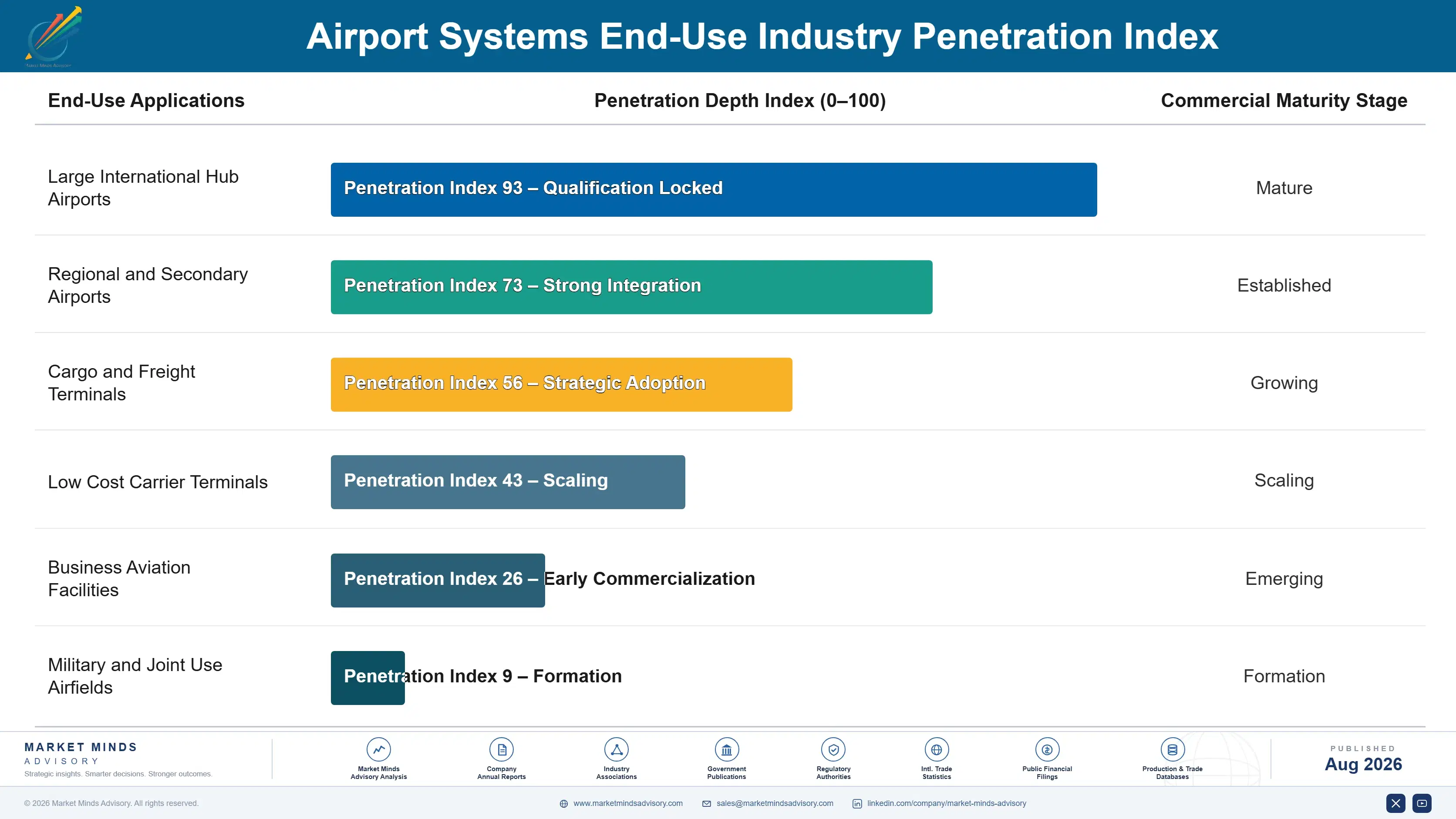
Why Installations Simply Persist

Airport systems produce annuity economics through sheer immovability. An installation reaching around 27 years generates maintenance, extension and upgrade revenue throughout, and displacing it requires a construction programme rather than a purchasing decision. Aftermarket at 46% of revenue arrives on that basis. No competitor can offer an airport a better conveyor persuasively enough to justify closing the baggage hall, which is the most durable commercial position in aviation infrastructure.
Stickiness varies enormously by category. Baggage and airside positions are effectively permanent between construction cycles. Screening equipment turns over on regulatory deadlines and is genuinely contested at each replacement. Processing systems sit between the two, replaced more readily because they can be installed without stopping anything. Software has the least incumbency of all, which is exactly why it is the accessible route in and the least defensible position once there.

The buyer has changed in composition rather than in behaviour. Concession operators and privatised airport groups now control a growing share of major facilities and evaluate systems against concession terms and passenger charges rather than public capital budgets. Regulators meanwhile specify processing requirements directly. Suppliers whose commercial approach assumed a public authority buying capacity find both audiences ask entirely different questions.
airport-systems-market-end-use-penetration-index-1788164594974

Where Suppliers Should Commit Now

These are among the four positions where our research anticipates prominent divergence between winners and laggards over the coming forecast period. Each is grounded in the demand model, the regulatory perimeter, and the announced capacity pipeline.
01 / INSTALLED BASE MAINTENANCE

Serve the airports you already have properly

Aftermarket support carries 46% of market revenue across installations that remain in service for around 27 years, and independent contractors take a substantial share of it from suppliers who never treated support as an actual business worth running properly. Authorised service with parts control and genuine response commitments typically recovers fifteen to twenty-two percent of the value currently leaking outward each year. Competing hard for new terminals while neglecting existing airports gets the commercial priorities exactly the wrong way round entirely.
02 / CONSTRUCTION PIPELINE INTELLIGENCE

Know which terminals are actually going to be built

Positions here change hands only during terminal construction, on capital cycles running roughly eighteen years or so, which makes the building pipeline easily the single most valuable commercial intelligence anybody in this market can possibly hold. Airport programmes are generally visible five years ahead through planning approvals, financing arrangements and published airport master plans. Suppliers who engage when the tender finally appears are competing directly against participants who helped shape the requirement it was written against in the first place.
03 / SOFTWARE LAYER POSITIONING

The only way into an airport between cycles

Operations, resource management and flow analytics all run above the installed equipment regardless of who originally supplied any of it, requiring no shutdown window at all, no capital programme and no displacement of anything that is currently working. Software revenue also reprices annually where hardware contracts commonly run ten years or considerably longer than that in practice. Suppliers who insist on selling the hardware first simply exclude themselves from every single airport that is not presently building something entirely new.
04 / PHASED CUTOVER DESIGN

Full replacement is a proposal airports cannot accept

A single four hour overnight window makes full system replacement effectively impossible in a live terminal, and suppliers who propose it are offering something the airport simply cannot accept whatever the technical merits of it happen to be. Modular architectures that allow sections to transfer independently across three years convert an impossible project into a genuinely fundable one instead. Airports consistently prefer the phased proposal and yet receive it surprisingly rarely from any of the suppliers bidding work to them.

Engagement Snapshot From the Field

A live engagement with an industry participant carrying material or product regulatory and market exposure ahead of a defining policy shift, showing how our research translates into a defensible multi-year portfolio strategy.
MARKET MINDS ADVISORY · CLIENT ENGAGEMENT SUMMARY
Airport Systems Producer Strategic Portfolio Review and Transition Roadmap 2026·Investment Scenario on Airport Systems Exposure Evaluation 2025-26
CLIENT PROFILE
A baggage handling and sortation supplier with installations at fourteen airports across two continents, competing primarily for new terminal programmes and leaving maintenance largely to independent contractors and airport in-house teams. Revenue was lumpy and heavily concentrated in construction years, and management regarded the quiet periods between programmes as an unavoidable feature of the industry.
STRATEGIC CHALLENGE
The board needed to establish whether building an authorised maintenance business justified the investment against continuing to concentrate on new terminal competitions. It also faced a decision on whether to develop operations software capability, which engineering leadership considered outside the company's core competence and commercial leadership considered the only route into airports between construction cycles.
MMA APPROACH
MMA sized maintenance and upgrade spending on the client's own installed base across three years, comparing it against the revenue the client actually captured from those airports. It modelled software capability development against continued hardware concentration. Expert interviews with airport operators, concession groups, independent maintenance contractors and competing suppliers established where the money goes and why.
KEY FINDINGS
  1. Maintenance and upgrade spending on the client's own installations exceeded its total new equipment revenue, and the client captured under a fifth of that spending itself.
  2. Independent contractors servicing the client's installed base were charging airports well above the parts prices the client supplied that same work at.
  3. Every terminal competition lost in three years had been shaped by requirements written before the tender, and the client had engaged only when tenders were published.
  4. Airport operators interviewed would buy operations software from an incumbent hardware supplier, and none had ever been offered any by the client at all.
CLIENT PROFILE
A baggage handling and sortation supplier with installations at fourteen airports across two continents, competing primarily for new terminal programmes and leaving maintenance largely to independent contractors and airport in-house teams. Revenue was lumpy and heavily concentrated in construction years, and management regarded the quiet periods between programmes as an unavoidable feature of the industry.
STRATEGIC CHALLENGE
The board needed to establish whether building an authorised maintenance business justified the investment against continuing to concentrate on new terminal competitions. It also faced a decision on whether to develop operations software capability, which engineering leadership considered outside the company's core competence and commercial leadership considered the only route into airports between construction cycles.
MMA APPROACH
MMA sized maintenance and upgrade spending on the client's own installed base across three years, comparing it against the revenue the client actually captured from those airports. It modelled software capability development against continued hardware concentration. Expert interviews with airport operators, concession groups, independent maintenance contractors and competing suppliers established where the money goes and why.
KEY FINDINGS
  1. Maintenance and upgrade spending on the client's own installations exceeded its total new equipment revenue, and the client captured under a fifth of that spending itself.
  2. Independent contractors servicing the client's installed base were charging airports well above the parts prices the client supplied that same work at.
  3. Every terminal competition lost in three years had been shaped by requirements written before the tender, and the client had engaged only when tenders were published.
  4. Airport operators interviewed would buy operations software from an incumbent hardware supplier, and none had ever been offered any by the client at all.
RECOMMENDED STRATEGY
Phase 1: Phase one: build an authorised maintenance business with parts control and response commitments across the fourteen airports the company already serves. Phase 2: Phase two: establish pipeline tracking on planning approvals and financing to engage terminal programmes years before any tender is published. Phase 3: Phase three: develop operations software above the installed base, entering airports between construction cycles rather than simply waiting for them.
OUTCOME
The client reported maintenance revenue rising sharply from a small base and total revenue smoothing considerably across the year (client-reported, unverified by MMA). Two terminal programmes were engaged before tender. Operations software entered pilot at three airports, and independent contractor share on the installed base fell materially.

Frequently Asked Questions

Foundational context covering the market sizes, CAGR, scope, country, region and competition that inform every finding below. This section is provided to cover basics and most often pre-purchase conversations, answered from the MMA Primary Research Dataset.

What is the current size of the Airport Systems Market?

The market is valued at USD 26.5 billion in 2025, measured as revenue from systems installed at airports to move, process and manage passengers, baggage and aircraft.

How large will the Airport Systems Market be by 2036?

MMA forecasts USD 56.94 billion by 2036, up from USD 28.41 billion in 2026. That represents incremental revenue of USD 28.53 billion and an expansion multiple of 2.00 times.

What is the CAGR for the Airport Systems Market 2026 to 2036?

The base case CAGR is 7.2%, with a bull case of 8.4% and a bear case of 6.0%. Border regulation and Asian terminal construction supply most of that growth.

Which segment is growing fastest?

Passenger processing and biometric flow systems grow at 10.8%, half again the market rate of 7.2%, because border regulation sets throughput requirements no amount of construction satisfies.

Who are the major companies in the Airport Systems Market?

Vanderlande, Daifuku, Smiths Detection, SITA and Thales lead on airport system revenue, holding around 41% between them across a market spanning several genuinely distinct industries.

Which country is growing fastest?

India grows fastest at 9.4%, driven by airport construction covering new greenfield facilities and substantial expansion at existing ones on a genuinely considerable programme scale.

Report Segmentation Architecture

The full report scope spans multiple orthogonal segmentation dimensions, with cross-tabulated demand data provided for each dimension pair. Coverage extends further to regional breakdowns, trend trajectories, and the competitive detail needed to support segment-level decision-making.

By System Category

  • Baggage Handling and Sortation Systems
  • Security Screening and Detection Systems
  • Passenger Processing and Biometric Flow Systems
  • Airport Operations and Resource Management Software
  • Airside Guidance, Lighting and Ground Movement Systems
  • Air Traffic Management and Tower Systems

By End-Use Industry

  • Large International Hub Airports
  • Regional and Secondary Airports
  • Cargo and Freight Terminals
  • Low Cost Carrier Terminals
  • Business Aviation Facilities
  • Military and Joint Use Airfields

By Commercial Dimension

  • New Terminal Programme Supply
  • Replacement and Upgrade Contracting
  • Authorised Maintenance Services
  • Independent Service Providers
  • Software Licensing and Subscription
  • Concession Operator Procurement

By Region

  • East Asia
  • North America
  • Western Europe
  • South Asia and Pacific
  • Latin America
  • Middle East and Africa
  • Eastern Europe

Scope, Methodology, and Coverage

Every figure in this report is reproducible from documented input assumptions. The scope below maps the historical period, the forecast horizon, the segmentation dimensions, and the countries covered, alongside the underlying primary and qualitative methodology.
Historical Period
2020 to 2025
Forecast Period
2026 to 2036
Base Year
2025 (USD billions; MMA Primary Research Dataset, August 2026)
Market Definition
Revenue from systems installed at airports to move, process and manage passengers, baggage and aircraft, spanning baggage handling and sortation systems, security screening and detection systems, passenger processing and biometric flow systems, airport operations and resource management software, airside guidance, lighting and ground movement systems, and air traffic management and tower systems, together with associated maintenance and support. New terminal programme supply, replacement and upgrade contracting, authorised maintenance, independent service provision, software licensing and concession operator procurement are all included. Terminal construction and civil works, aircraft ground support equipment, retail and concession systems, and airline-owned departure control platforms are excluded.
Quantitative Units
USD billions, airport system installation and support revenue
Segmentation Dimensions
System category, airport type, commercial contracting model, region
Regions Covered
East Asia, North America, Western Europe, South Asia and Pacific, Latin America, Middle East and Africa, Eastern Europe
Countries Covered
United States, Canada, United Kingdom, Germany, France, Netherlands, Spain, China, Japan, South Korea, India, Australia, Brazil, United Arab Emirates
Key Companies Profiled
Vanderlande, Daifuku, Smiths Detection, SITA, Thales, BEUMER Group, Alstef Group, ADB SAFEGATE, Amadeus, IDEMIA
Quantitative Methodology
Primary survey, n=3,800 respondents, Q4 2025, six countries; demand-side model with trade association cross-validation
Qualitative Methodology
47 expert interviews, Q4 2025; applied to validate demand model assumptions, identify emerging dynamics, and assess competitive positioning
Report Format
PDF and XLSX data workbook (Word format preview document)
Publisher
Market Minds Advisory
Report Code
MMA-2026-CON-441
Published
August 2026
Contact
sales@marketmindsadvisory.com | www.marketmindsadvisory.com

Purchase the full Airport Systems Market Report (2026 to 2036).

The full report follows the constraint that governs everything in this market, which is that an airport cannot stop running while its systems are replaced. It quantifies installed base persistence against capital cycle length, separates regulation-driven purchasing from construction-driven purchasing across the participant base, and assesses software as the only route into an airport between building programmes. Segment analysis covers all six system categories, with particular attention to passenger processing where legislation rather than capacity sets the pace. Competitive assessment ranks twenty participants on airport system revenue across installation and support.
Six system category segmentation with growth rates
Installed base persistence mapped against capital cycles
Twenty participant assessment on airport system revenue
Regulation-driven purchasing separated from construction-driven demand
Maintenance value traced through authorised and independent channels
Construction pipeline visibility assessed across major regions

Built For The People Who Decide

From boardroom strategy to bench-side execution, this report is read cover-to-cover by leaders shaping the next decade of their industry, turning demand scenarios, market dynamics and valuation benchmarks into decisions.
CXOs/ Presidents/ VPs/ Managers
M&A and Corporate Development
Strategy Teams and R&D Heads
Procurement and Product Directors
Regulatory and Compliance Leaders
Investor Relations and Equity Analysts