

Market Minds Advisory
Airport Robots Market

Airport Robots Market: Labor Shortage and AI Assistance Drive Terminal Automation

Persistent ground-service labor shortages and rising passenger expectations for instant assistance are pushing airports toward robotic cleaning, security, and wayfinding deployment far faster than the cautious pace airport technology adoption has historically followed.

Lead Analyst

Published

September 2026

Make Smarter Decisions with Customized Research Insights

Request a free sample report and evaluate market opportunities, growth trends, and competitive dynamics relevant to your business needs.

2025 MARKET VALUE$1.4BMarket Size 2025
2036 FORECAST VALUE$5.4BBase Case , 2026 to 2036
CAGR 2026 TO 203613.0 %Bull 14.3% / Bear 11.7%
INCREMENTAL OPPORTUNITY$3.8BNet 10- year value creation
EXPANSION MULTIPLE3.39x2036 value over 2026 base
Strategic Levers
M&A Pipeline
Regional Outlook
Country Rankings
Competitive Intelligence
Segmental Deep-dive
Call-Us : 91 93563 13602

Executive Snapshot and Market Trajectory

Airport robot deployment is accelerating well beyond the cautious pace airport technology adoption has historically followed, as persistent ground-service labor shortages force operators to treat automation as an operational necessity rather than an experimental pilot program. Operators increasingly treat automation as a baseline requirement rather than a discretionary technology investment.
Security and inspection robots are growing fastest of six categories as airports seek AI-enabled threat detection capability, while passenger assistance and wayfinding robots follow closely on rising demand for instant, always-available terminal guidance. China concentrates the bulk of global deployment given its unprecedented pace of new terminal construction. Suppliers with established artificial intelligence detection capability are winning disproportionate share of this accelerating demand. Data privacy rules are also shaping which suppliers can compete.
Five suppliers hold roughly thirty-eight percent of a genuinely fragmented market, led by SoftBank Robotics and LG Electronics' established cleaning robot platforms. Smaller airports increasingly access robotics through leasing arrangements rather than outright purchase, given the considerable upfront capital cost full ownership still requires. Robot-as-a-service leasing arrangements are opening this market to airports that could never justify full ownership. That matters most for smaller airports facing the tightest constraints.
Market Definition
This report covers revenue from autonomous and semi-autonomous robots deployed for cleaning, baggage handling, security, passenger assistance, mobility support, and ground support functions within airport terminal and airside environments. It excludes stationary automated systems like conveyor-based baggage handling, aircraft themselves, and general facility maintenance equipment without autonomous mobility capability.
Base Year Value
$1.4B in 2025 (MMA Primary Research Dataset, August 2026)
Forecast Period
2026 to 2036, eleven discrete annual values
CAGR
13.0% base case. Bull 14.3%. Bear 11.7%.
Fastest Growth Segment
Security and Inspection Robots: 16.0% CAGR
Fastest Growth Country
China: 15.0% CAGR
Fastest Growth Region
South Asia and Pacific: 15.0% CAGR
Largest Region
East Asia: 30% of 2025 global value
Market Leaders
SoftBank Robotics, LG Electronics, Gaussian Robotics, Bear Robotics, Avidbots. Source: MMA Analysis based on company annual reports and airport procurement disclosures.
Primary Survey
n=3,800 procurement and R&D decision-makers, Q4 2025, six countries
Methodology
Demand-side build-up, cross-validated against public data, 47 expert interviews

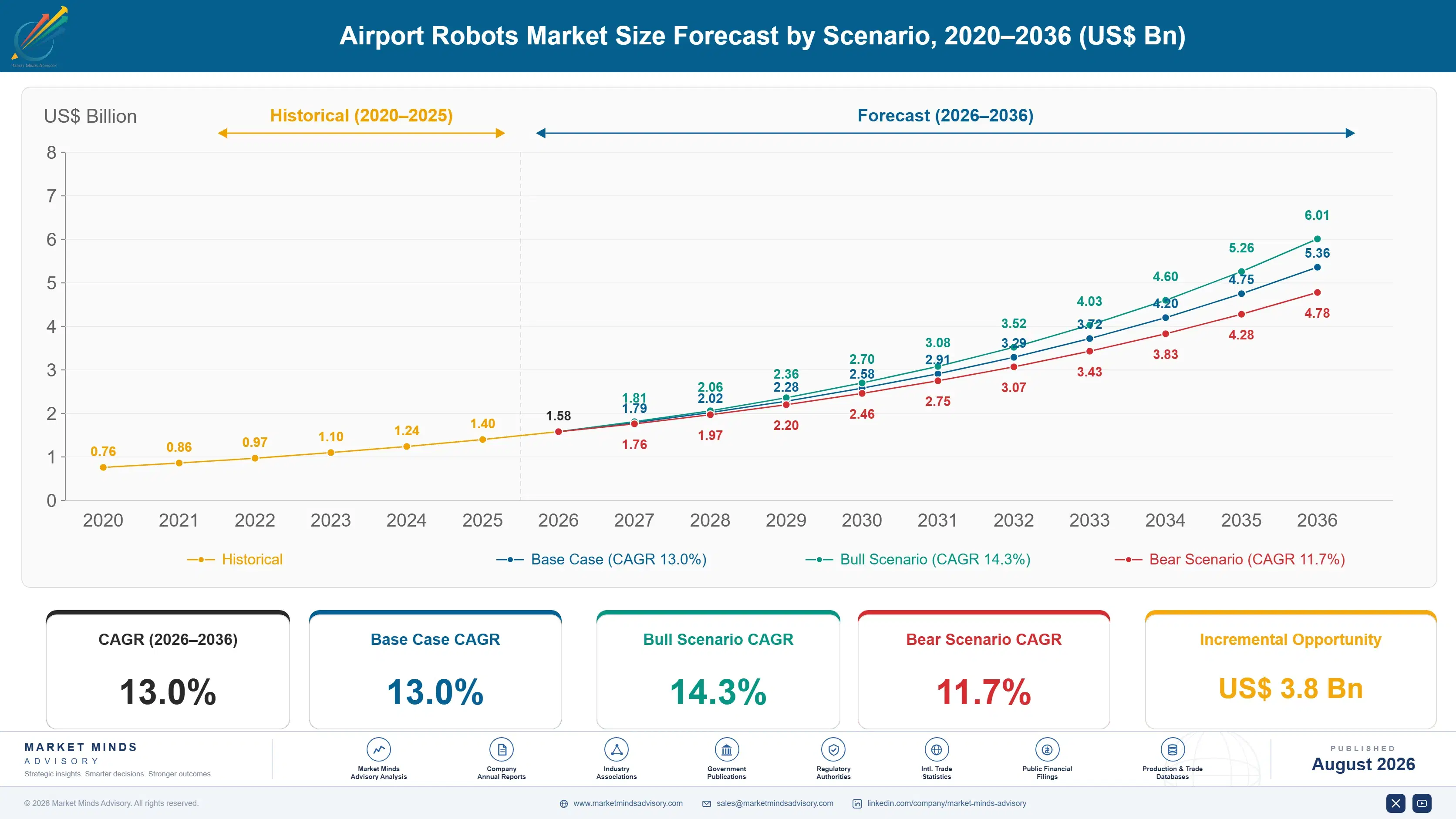
Airport Robots Market Forecast Scenarios

airport-robots-market-size-forecast-scenario-1787982176608
Between 2020 and 2025 the airport robots market grew at roughly 11.5 percent annually, accelerating from pandemic-era disinfection robot adoption as airports discovered broader operational applications for autonomous systems beyond the initial hygiene use case. Airports treated early deployments as limited pilot programs rather than fleet-wide commitments during this period. Deployment expanded meaningfully once early results proved reliable.
The base case assumes 13.0 percent annual growth through 2036, anchored in three mechanisms: persistent ground-service labor shortages forcing airports to treat automation as operational necessity, rising passenger expectations for instant AI-enabled terminal assistance rather than waiting for available human staff, and expanding leasing and robot-as-a-service models letting budget-constrained smaller airports access automation without large upfront capital outlays. Suppliers with proven artificial intelligence capability are best placed to capture the largest share of this combined growth.
A bull scenario built on faster AI capability improvement and accelerating labor cost pressure could push growth toward 14.3 percent. A bear scenario tied to slower integration progress with legacy airport systems and budget constraint at smaller airports could instead pull growth down toward 11.7 percent. Financing availability for leasing arrangements remains a secondary swing factor either way.

Labor Economics and AI-Enabled Terminal Automation

Airport robotics sits at an unusual point where labor economics have become compelling enough to override the traditionally cautious pace of airport technology procurement, a sector historically defined by multi-year evaluation cycles even for proven, lower-risk technology investments. Few technology categories have moved this quickly from experimental pilot to genuine operational necessity within a comparable timeframe. Labor economics simply overtook institutional caution faster than anyone expected.
TOP-5 SUPPLIER CONCENTRATION38%Revenue share held by five largest robotics suppliers
CHINA DEPLOYMENT SHARE34%Global robot units deployed within Chinese airport terminals
ROBOT-AS-A-SERVICE ADOPTION42%Deployments structured as leasing rather than outright purchase
AVERAGE LABOR COST DISPLACEMENT1.8 FTE per unitTypical labor staffing reduction achieved per robot unit deployed
SECURITY ROBOT ADOPTION RATE16%Major airports currently operating fully AI-enabled inspection robots
AVERAGE PAYBACK PERIOD22 monthsTypical time required to recover robot deployment investment
Persistent ground-service staffing shortages give airports genuine operational reasons to deploy robots beyond cost savings alone, since many airports simply cannot recruit enough cleaning and ground support staff regardless of wage levels offered in tight regional labor markets. This dynamic differs meaningfully from typical enterprise technology adoption, where cost savings alone rarely override institutional caution this quickly. Recruiting difficulty made the decision easier than cost analysis alone would.
Two forces will reshape the next decade. Robot-as-a-service leasing models will keep expanding access for budget-constrained smaller airports, while artificial intelligence capability improvement keeps pushing security and passenger assistance robots toward genuinely autonomous decision-making rather than simple scripted routines. Suppliers positioned to serve both cost-driven cleaning demand and capability-driven security demand simultaneously carry a genuine advantage. That advantage compounds further as artificial intelligence capability keeps improving.
"Airports spent a decade debating whether robots made sense, and then the labor market simply made the decision for them, because there was no one left to hire for these roles at any price point that made economic sense."
Director, Industrial Technology Practice · MMA Technology Practice · August 2026

Market Trends

AI-Enabled Threat Detection Reshapes Security Robotics

Security and inspection robots are increasingly incorporating artificial intelligence capable of identifying suspicious behavior patterns and unattended objects automatically, moving well beyond the simple scripted patrol routines that defined earlier generations of airport security robots. A single security robot covers considerably more terminal area than a human guard performing equivalent visual inspection, while maintaining consistent attention human staff cannot always sustain across extended shifts. Airports adopting this technology are treating it as a genuine security capability enhancement rather than simply a cost reduction measure, given the consistency advantage over human patrol during low-traffic overnight periods specifically.
Market Impact: Displaces 1.8 FTE per unit deployed

Robot-as-a-Service Models Expand Smaller Airport Access

Robotics suppliers are increasingly offering leasing and subscription-based access models rather than requiring outright purchase, letting smaller and mid-sized airports access automation technology without the considerable upfront capital investment full ownership traditionally required. This shift mirrors how software-as-a-service models transformed technology adoption patterns in other industries, converting a large capital expenditure decision into a smaller, more easily justified operating expense that budget-constrained airport finance departments can approve without extensive capital committee review processes. Suppliers offering these flexible models are winning disproportionate share of smaller airport contracts specifically. Airports adopting this model report faster procurement approval given the reduced commitment.
Market Impact: Grows assistance adoption 15 percent

Market Opportunities and Growth Drivers

Persistent Ground-Service Labor Shortages Force Automation

Airports worldwide face genuine difficulty recruiting sufficient cleaning and ground support staff regardless of wage levels offered, a persistent labor market challenge that robotics increasingly addresses as a direct operational necessity rather than a discretionary cost optimization initiative. This shortage has proven considerably more persistent than temporary pandemic-era staffing disruptions, reflecting broader demographic and workforce participation trends that most airport operators do not expect to reverse meaningfully within the coming decade. Robots deployed for cleaning and basic ground support functions typically displace roughly 1.8 full-time equivalent positions per unit, a meaningful staffing relief for chronically understaffed terminal operations teams.
Market Impact: Limits adoption to 42 percent leased

Rising Passenger Expectations Drive Assistance Robot Adoption

Passengers increasingly expect instant, always-available assistance for wayfinding and basic inquiries rather than waiting for available human staff during busy terminal periods, a service expectation that passenger assistance robots address directly through continuous availability human staffing levels cannot economically match around the clock. Airports view this capability as a genuine customer experience differentiator increasingly important for competitive positioning among comparable regional hub airports competing for connecting passenger traffic and associated retail and concession revenue that satisfied passengers generate during longer terminal dwell times. Airports increasingly market this capability directly to passengers as a service differentiator worth highlighting.
Market Impact: Adds 20 percent to integration cost

Market Restraints and Challenges

High Upfront Capital Cost Limits Smaller Airport Adoption

Full robot ownership requires considerable upfront capital investment that many smaller and budget-constrained airports struggle to justify against competing infrastructure priorities, even when the underlying labor cost economics would favor automation over time. The root cause is genuine capital scarcity at smaller airports rather than any doubt about robotics technology's operational value, since most airport operators broadly understand the labor-cost benefits automation would deliver given sufficient capital access. Suppliers are mitigating this through robot-as-a-service leasing models that convert large capital outlays into smaller, more easily justified operating expenses smaller airports can approve without extensive capital committee review.
Market Impact: Reaches 16 percent security adoption

Legacy System Integration Complexity Slows Deployment

Integrating robots with existing airport security, wayfinding, and operational management systems requires considerably more complex engineering than deploying standalone robots would, since robots must communicate with legacy systems never designed to interface with autonomous mobile equipment moving through shared terminal space. The root cause is the genuine technical difficulty of retrofitting decades-old airport infrastructure rather than any shortcoming in available robotics technology itself. Suppliers are mitigating this through standardized middleware and application programming interfaces that reduce customization requirements for airports with broadly similar existing system architectures. Airports evaluating multiple vendors increasingly favor suppliers already proven with comparable integration requirements.
Market Impact: Affects 42 percent of deployments
3 additional market trends, 4 additional growth drivers, and 3 additional restraints and challenges are covered in the full report. Contact sales@marketmindsadvisory.com to access the complete intelligence.

Segment CAGR and Growth Architecture

Segmentation follows robot function, the dimension airport operators use to plan procurement and integration budgets. Six categories cover the market: cleaning and disinfection, baggage handling, security and inspection, passenger assistance, mobility support, and ground support robots. This mirrors how airport operations teams themselves budget automation across functional departments. Regulators reference this same breakdown when assessing airport technology investment.
airport-robots-market-market-share-analysis-1787982177140

Security and Inspection Robots

Security and inspection robots are growing fastest because airports increasingly want AI-enabled threat detection capability that identifies suspicious behavior patterns and unattended objects automatically, moving well beyond the simple scripted patrol routines earlier robot generations offered. A single security robot covers considerably more terminal area than a human guard performing equivalent visual inspection, while maintaining consistent attention human staff cannot always sustain across extended overnight shifts. Airports are treating this as a genuine security capability enhancement rather than purely a cost reduction measure, particularly valuable during low-traffic overnight periods when staffing levels are typically thinnest. Suppliers with established artificial intelligence detection capability are winning disproportionate share of this fast-growing segment specifically.
CAGR 16.0%

Passenger Assistance and Wayfinding Robots

Passenger assistance and wayfinding robots are the second-fastest segment as travelers increasingly expect instant, always-available guidance rather than waiting for available human staff during busy terminal periods. These robots address a genuine customer experience gap that human staffing levels cannot economically match around the clock, since airports cannot justify staffing every terminal zone with dedicated information personnel at all hours. Airports increasingly view this capability as a competitive differentiator important for connecting passenger traffic and associated retail revenue, since satisfied passengers spend more time and money in terminal concessions when navigation friction is reduced meaningfully. Airports increasingly track passenger satisfaction scores directly against assistance robot deployment to justify continued investment in this capability.
CAGR 15.0%
Full segment breakdown across 6 segments available in the complete report.

Regional Architecture and Country Demand Map

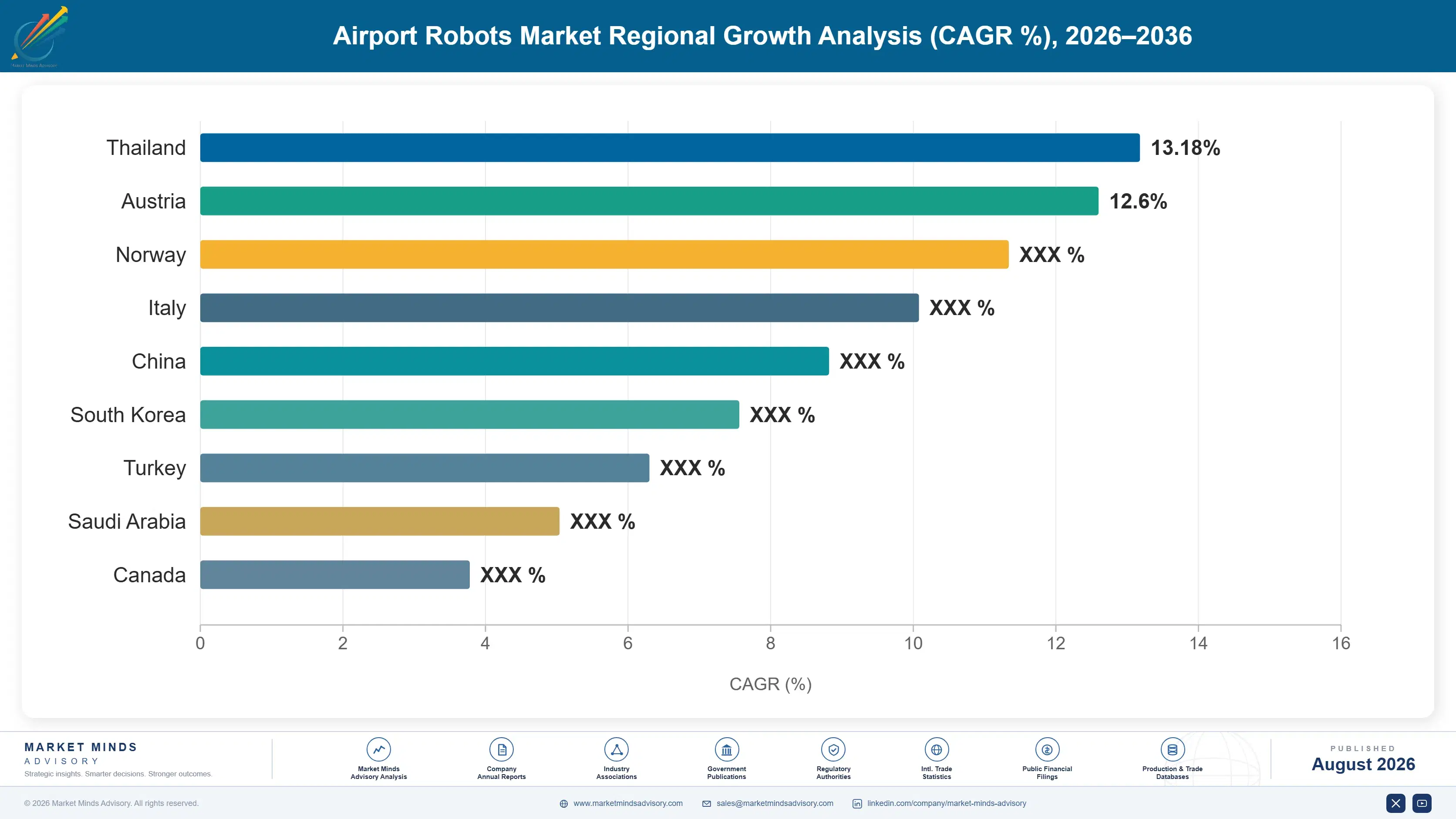
East Asia leads on unprecedented new terminal construction pace and deep robotics manufacturing capability, particularly in China. North America follows on labor-shortage-driven adoption, while South Asia and Pacific posts the fastest regional growth as airport modernization accelerates. Adoption pace varies considerably by regional labor market conditions.

East Asia

China's unprecedented pace of new terminal construction, including mega-hubs designed around some of the highest passenger throughput targets anywhere in the world, gives East Asia the largest regional share through genuine newbuild deployment rather than retrofit activity into existing terminals. Domestic robotics manufacturers including Gaussian Robotics and various SoftBank Robotics regional partners are scaling production considerably faster than most Western suppliers can match, benefiting from China's broader robotics manufacturing supply base depth. Japanese and South Korean airports maintain smaller but steady deployment programs, typically procuring from established domestic suppliers given strong regional robotics engineering capability built over decades of industrial automation development. Suppliers here increasingly export deployment expertise to other rapidly growing Asian markets nearby.
Share: 30% | CAGR: 14.0% (2026 to 2036)

North America

Persistent ground-service labor shortages are driving substantial robot deployment across major American hub airports, with operators treating automation as a direct operational necessity given genuine difficulty recruiting cleaning and ground support staff at any competitive wage level currently offered. SoftBank Robotics and several domestic startups maintain strong positions serving this labor-driven demand specifically, though American suppliers generally lag Asian manufacturing scale and cost efficiency on hardware production. Canadian airports separately fund smaller-scale deployment programs closely coordinated with American suppliers given the integrated nature of North American aviation industry supplier relationships across the shared border. Suppliers straddling both cleaning and security applications maintain a genuine strategic advantage in this labor-constrained market.
Share: 26% | CAGR: 13.5% (2026 to 2036)
Regional intelligence for 5 additional markets available in the complete report: Western Europe, South Asia and Pacific, Latin America, Middle East and Africa, Eastern Europe. Contact sales@marketmindsadvisory.com.
airport-robots-market-country-cagr-analysis-1787982177651

Where Robotics Suppliers Can Capture Growth

Four levers stand out for suppliers navigating a fragmented market shifting toward AI-enabled capability and flexible ownership models. Each trades traditional hardware-only sales for either recurring service revenue, capability differentiation, or access to budget-constrained customer segments. Each requires different capabilities, but all four are available to suppliers already operating profitably today. Two are already available broadly.

Expand Robot-as-a-Service Leasing Programs Very Broadly

42 percent of deployments already use leasing rather than outright purchase, reflecting how effectively this model converts a large capital expenditure decision into a smaller, more easily justified operating expense budget-constrained airports can approve without extensive capital committee review. Suppliers expanding leasing programs can access considerably larger addressable demand among smaller and mid-sized airports than competitors requiring outright purchase, while also generating more predictable recurring revenue than one-time hardware sales alone provide. This approach requires genuine financing capability beyond core robotics engineering, a capability gap that currently limits how many suppliers can pursue this model effectively.
Market Impact: Captures a full 42 percent of leased share

Build AI-Enabled Security Detection Capability Now

Security and inspection robots are growing at 16.0 percent annually against a 13.0 percent market average, and suppliers with genuine artificial intelligence threat detection capability can command premium pricing from airports viewing this as a security capability enhancement rather than simply a cost reduction measure. Building this capability requires considerably deeper machine learning investment than conventional cleaning or mobility robots demand, but the handful of suppliers with proven detection accuracy are winning disproportionate share of the highest-value security contracts specifically. This technology also transfers relatively cleanly to other secure-facility applications beyond airports alone.
Market Impact: Grows share within the fast 16 percent segment

Develop Legacy System Integration Middleware Fast

Integration complexity with existing airport security, wayfinding, and operational systems adds roughly 20 percent to deployment cost, but suppliers offering standardized middleware and application programming interfaces that reduce customization requirements can win contracts considerably faster than competitors requiring extensive bespoke integration for every deployment. This approach also shortens sales cycles meaningfully since airport technology teams can evaluate integration risk more confidently against a proven standardized approach rather than assessing entirely custom engineering proposals for each individual procurement decision. Airports evaluating multiple vendors increasingly favor this standardized approach over bespoke custom engineering proposals for each deployment.
Market Impact: Cuts full integration cost by 20 percent overall

Target China and Asian Greenfield Terminal Deployment

China and other rapidly expanding Asian aviation markets represent the fastest-growing deployment opportunity globally, driven by unprecedented new terminal construction where robotics can be specified directly into initial design rather than retrofitted later. Suppliers that establish strong regional manufacturing and support partnerships can capture considerably larger share of this greenfield opportunity than competitors treating the region as secondary to established Western airport relationships. This requires genuine local investment and regulatory relationship building rather than purely exporting products developed for Western markets. This region is growing at 15.0 percent annually, considerably faster than the 13.0 percent market average overall.
Market Impact: Reaches a full 15 percent of regional growth

Who Controls the Margin Pool

Five suppliers hold roughly thirty-eight percent of market revenue, a considerably lower concentration than more mature technology markets since airport robotics still splits across cleaning specialists, security technology developers, and passenger assistance platform providers pursuing different application niches. SoftBank Robotics and LG Electronics lead on established cleaning robot deployment, but no single supplier dominates across all six functional categories simultaneously.
Current competitive activity centers on three fronts: robot-as-a-service leasing program expansion aimed at smaller and mid-sized airports, artificial intelligence security detection capability development as airports seek genuine capability enhancement, and legacy system integration middleware development aimed at reducing deployment complexity and cost. Several suppliers are also investing in dedicated financing arms to support their own leasing program expansion directly. These financing capabilities matter increasingly.

Emerging pressure comes from specialized security robotics startups like Cobalt Robotics and Knightscope bringing focused artificial intelligence detection expertise that generalist cleaning robot manufacturers lacking comparable specialization struggle to match. Rankings could shift meaningfully as security and passenger assistance segments eventually rival cleaning robot revenue scale, since suppliers currently over-indexed on cleaning applications may find their higher-value segment pipeline underdeveloped once that shift accelerates.
airport-robots-market-company-positioning-matrix-1787982178174

Competitive Moat and Risk Dimensions

SOFTBANK ROBOTICS

Moat: Established Cleaning Platform Scale

SoftBank Robotics' Whiz cleaning robot platform has achieved broad deployment across major international airports, giving it manufacturing scale and operational track record advantages that smaller specialized competitors cannot match, letting it win large multi-terminal contracts other suppliers cannot credibly pursue. This scale advantage compounds further as more airports seek proven deployment references before committing.
SOFTBANK ROBOTICS

Risk: Limited Security Robot Expertise

SoftBank Robotics' core expertise concentrates in cleaning applications, leaving it comparatively less positioned in the faster-growing security and inspection segment where specialized artificial intelligence detection capability matters more than general robotics platform experience. This gap could widen further as security applications capture a growing share of total market spending.
LG ELECTRONICS

Moat: Deep Manufacturing Integration

LG Electronics' broader consumer and commercial robotics manufacturing capability lets it produce airport robots at meaningfully lower unit cost than smaller specialized competitors lacking comparable manufacturing scale, giving it a genuine price advantage in competitive procurement processes. This cost advantage matters most in competitive procurement processes where price sensitivity remains high.
LG ELECTRONICS

Risk: Generalist Positioning Disadvantage

LG Electronics' broader consumer electronics focus means airport robotics represents a smaller strategic priority than for dedicated specialists, potentially limiting the depth of airport-specific feature development competitors more singularly focused on this application can achieve. Dedicated specialists can potentially win share through deeper airport-specific product development over time.

Players Tracked

Prominent Players

SoftBank Robotics
LG Electronics
Gaussian Robotics
Bear Robotics
Avidbots

Other Key Players

Brain Corp
Cobalt Robotics
Knightscope
PAL Robotics
SMP Robotics
Diligent Robotics
Vecna Robotics
Zebra Technologies
Savioke
ICM Airport Technics
UBTECH Robotics
CloudMinds
Segway Robotics
Ecovacs Commercial
Aethon

Recent Developments

MARCH 2025

SoftBank Robotics Deploys Whiz Fleet at Major Hub Airport

SoftBank Robotics deployed an expanded fleet of Whiz cleaning robots across multiple terminals at a major international hub airport, covering routine floor cleaning and disinfection duties previously performed entirely by human cleaning staff. The deployment expansion follows successful results from an earlier smaller-scale pilot program at the same facility.
Signal: Confirms that established cleaning robot platforms continue winning large multi-terminal deployment contracts quite consistently overall today.
SEPTEMBER 2024

Gaussian Robotics Wins Airport Cargo Robot Contract

Gaussian Robotics secured a contract to deploy autonomous cargo handling robots at a major Asian airport, covering baggage transport applications between terminal processing areas and aircraft loading zones. Financial terms of the multi-year contract were not disclosed by either the supplier or the airport authority.
Signal: Shows that Chinese robotics manufacturers are winning meaningful international airport contracts beyond domestic deployment right now.
JUNE 2025

Bear Robotics Launches AI-Enabled Assistance Platform

Bear Robotics launched a new AI-enabled passenger assistance robot platform designed for real-time wayfinding and flight information queries, targeting airports seeking improved terminal customer service capability. The platform integrates with the airport's existing digital signage and flight information display systems directly. Deployment begins within the current calendar year.
Signal: Signals that specialized suppliers are prioritizing conversational AI capability over basic scripted assistance features entirely now.

Sensor, Compute, and Manufacturing Cost Pressures

Sensor suites, batteries, and specialized processing hardware together represent the largest cost-to-serve components for robotics suppliers, running roughly forty to forty-five percent of total unit cost, with assembly labor and quality testing adding a further fifteen percent on top. Nearly all specialized LiDAR and depth-sensing components originate from a concentrated group of suppliers in the United States, Japan, and China.
Global semiconductor supply tightness during 2022 and 2023 pushed processing chip costs higher across the robotics industry, a constraint SoftBank Robotics described in investor communications as meaningfully affecting production planning for several product lines during that period. Suppliers with diversified chip sourcing navigated this period considerably more comfortably than those dependent on single-source components. Suppliers with diversified chip sourcing recovered from this constraint more quickly than single-supplier competitors.

Smaller specialized suppliers face proportionally heavier exposure to this cost pressure because they lack the purchasing volume that larger manufacturers like LG Electronics command through broader consumer electronics manufacturing scale. Specialists without comparable purchasing power are consequently paying meaningfully higher per-unit component costs, compressing margin on price-sensitive smaller airport contracts specifically. This dynamic particularly affects specialists competing directly against larger diversified manufacturers on price-sensitive contracts.
airport-robots-market-cost-volatility-analysis-1787982178368

Diversify Sensor and Chip Supplier Relationships

Establishing relationships with multiple sensor and processing chip suppliers rather than concentrating with a single vendor reduces exposure to component shortages and pricing spikes, letting suppliers shift orders when any single vendor faces capacity constraints during demand surges. Manufacturers maintaining at least three active supplier relationships typically weather shortages more comfortably. This flexibility matters most during acute shortages.

Pursue Manufacturing Partnerships With Larger Electronics Firms

Partnering with larger consumer or industrial electronics manufacturers for component sourcing and production scale gives smaller robotics specialists access to purchasing volume they could not secure independently, while manufacturing partners gain specialized robotics engineering talent they lack internally. Several smaller robotics specialists have pursued exactly this kind of partnership successfully in recent years. Both parties benefit meaningfully.

Standardize Hardware Platforms Across Robot Categories

Designing sensor and compute hardware platforms that work across multiple robot categories rather than customizing separately for each application reduces per-unit engineering cost and lets suppliers achieve meaningful purchasing scale faster across a broader product line. This approach also shortens overall product development and testing timelines meaningfully across every category. Suppliers report faster delivery timelines overall.

Portfolio Architecture for Margin Defence

Robotics suppliers architect their offering across three tiers that trade capability sophistication for margin in fairly predictable steps. Basic cleaning and mobility robots anchor the volume tier at thin margin, baggage handling and ground support robots occupy a premium middle tier, and AI-enabled security and assistance robots sit at the top as the smallest but fastest-expanding category. No single tier alone determines a supplier's overall profitability across its full product line.
The tension between volume and premium tiers reflects genuine technical difficulty rather than positioning alone: basic cleaning robots require comparatively simple navigation and generate steady but thin-margin revenue, while AI-enabled security and assistance robots require considerably deeper machine learning investment that only the most capable suppliers can deliver, which is why margin concentrates so heavily at the top of this particular hierarchy. This dynamic mirrors how technology companies price entry-level versus enterprise-grade offerings generally.

The highest-value pools concentrate in AI-enabled security detection systems and passenger assistance platforms, both benefiting from genuine technical barriers that smaller, less capitalized competitors cannot easily replicate without years of dedicated engineering investment. Suppliers lacking either specialty risk drifting toward the thin-margin volume tier by default.

Volume / Commodity-Adjacent Tier

Basic cleaning and mobility robots requiring comparatively simple navigation, sold widely across airports seeking incremental labor cost relief without full AI capability investment. Most airports begin their automation adoption within this entry-level tier today.
Gross Margin: 14-17%

Premium / Certified Tier

Baggage handling and ground support robots requiring deeper integration engineering and reliability certification than basic cleaning robots demand, sold mainly to larger hub airports. This tier attracts steady demand from larger hub airports facing acute staffing pressure.
Gross Margin: 23-26%

Sustainability / Regulatory / Next-Generation Tier

AI-enabled security and passenger assistance robots built on years of machine learning engineering investment that smaller, less capitalized competitors cannot quickly replicate. Only a handful of suppliers worldwide currently operate confidently within this top tier.
Gross Margin: 28-31%
airport-robots-market-portfolio-architecture-1787982178858

High-value Sub-segments and Strategic Watch-out

Security and Inspection Robots

Fastest-growing and highest-margin pool in the portfolio, driven by demand for genuine AI threat detection capability, with margin concentrated among the handful of suppliers holding proven detection accuracy. Suppliers here also benefit from airports treating this as capability enhancement rather than pure cost reduction. Growth stays strong here.
Gross Margin: 28-31%

Passenger Assistance and Wayfinding Robots

High-value segment growing steadily on rising customer experience expectations, with margin concentrated among suppliers offering genuine conversational AI capability over scripted responses. These suppliers are winning disproportionate share of demand tied to customer experience differentiation specifically. Regulatory approval also moves faster given well-documented deployment precedent across comparable airports.
Gross Margin: 28-31%

Cleaning and Disinfection Robots

Largest volume core segment by installed base, serving labor-shortage-driven demand broadly, with margin staying thin due to competitive standardized pricing pressure across nearly every established supplier. Suppliers here increasingly compete on installation speed and total cost of ownership. Pricing pressure here shows no sign of easing anytime soon.
Gross Margin: 14-17%

Robot-as-a-Service Leasing Contracts

Strategic watch-out tied closely to financing capital availability, where tightening credit conditions could compress volume for suppliers dependent on this flexible ownership model specifically. Tightening credit conditions could meaningfully compress this segment's near-term growth trajectory. Suppliers dependent on this financing channel face the most exposure here overall.
Gross Margin: 20-23%

Deployment Cycles and Application Depth

Airport robot demand runs on shorter deployment cycles than typical annuity businesses: cleaning and mobility robots generate fast initial deployment followed by recurring maintenance and software update revenue, while larger security and baggage handling deployments involve longer integration timelines but correspondingly deeper ongoing service relationships. This lumpiness makes revenue forecasting genuinely harder than for comparable recurring-revenue software businesses.
Adoption depth varies sharply by vertical. Cleaning robots sit near mainstream adoption at major hub airports given years of proven deployment history, while security and passenger assistance robots remain earlier in their adoption curve, with many operators still evaluating pilot programs before committing to fleet-wide deployment. Bridging both ends well is what separates the strongest suppliers from everyone else in this market. Serving both segments effectively requires genuinely distinct engineering and sales approaches entirely.

A generational shift is underway among younger airport operations managers who increasingly expect robotics as standard operational infrastructure rather than experimental technology, in contrast to veteran facility managers who remain considerably more skeptical of ceding operational tasks to autonomous systems. Suppliers slow to build credibility with this newer generation risk losing relevance over the coming decade.
airport-robots-market-end-use-penetration-index-1787982179346

Where Robotics Suppliers Should Focus

These are among the four positions where our research anticipates prominent divergence between winners and laggards over the coming forecast period. Each is grounded in the demand model, the regulatory perimeter, and the announced capacity pipeline.
01 / LEASING MODEL EXPANSION

Expand robot-as-a-service programs to reach budget-constrained airports

Forty-two percent of deployments already use leasing, reflecting how effectively this model converts a large capital decision into a smaller, easily justified operating expense. Suppliers expanding leasing programs access considerably larger addressable demand among smaller airports than competitors requiring outright purchase, while generating more predictable recurring revenue. Suppliers without genuine financing capability, treating leasing as a minor add-on rather than a core commercial strategy, risk ceding this growing segment entirely to competitors who build the capability first and establish preferred-vendor status.
02 / AI SECURITY CAPABILITY

Build genuine threat detection capability ahead of competitors

Security and inspection robots are growing at sixteen percent annually as airports seek capability enhancement rather than simple cost reduction, and suppliers with genuine artificial intelligence detection capability can command premium pricing accordingly. Building this requires considerably deeper machine learning investment than conventional robots demand, but proven detection accuracy wins disproportionate share of the highest-value contracts. This technology also transfers cleanly to other secure-facility applications beyond airports, extending its value well beyond the initial contract that funded its development in the first place.
03 / INTEGRATION MIDDLEWARE INVESTMENT

Develop standardized middleware to reduce deployment complexity

Legacy system integration adds roughly twenty percent to deployment cost, but suppliers offering standardized middleware that reduces customization requirements win contracts considerably faster than competitors requiring bespoke integration for every deployment. This also shortens sales cycles meaningfully since technology teams can evaluate integration risk more confidently. Suppliers that skip this investment, continuing to propose fully bespoke integration for every deployment, risk losing deals entirely to faster, simpler competing proposals from better-prepared rivals who invested in standardization well before this integration cost pressure became a genuine competitive differentiator.
04 / ASIAN MARKET EXPANSION

Establish manufacturing partnerships in China's greenfield terminal boom

China and other rapidly expanding Asian markets represent the fastest-growing deployment opportunity globally, driven by unprecedented terminal construction where robotics can be specified into initial design rather than retrofitted later. Suppliers establishing strong regional manufacturing partnerships capture considerably larger share than competitors treating the region as secondary. This requires genuine local investment rather than exporting unmodified Western products, a distinction airport customers in these fast-growing markets increasingly notice and reward with preferred-supplier status ahead of competitors treating the region as an afterthought.

Engagement Snapshot From the Field

A live engagement with an industry participant carrying material or product regulatory and market exposure ahead of a defining policy shift, showing how our research translates into a defensible multi-year portfolio strategy.
MARKET MINDS ADVISORY · CLIENT ENGAGEMENT SUMMARY
Airport Robots Producer Strategic Portfolio Review and Transition Roadmap 2026·Investment Scenario on Airport Robots Exposure Evaluation 2025-26
CLIENT PROFILE
The client is a mid-sized regional hub airport operator handling roughly twelve million annual passengers, facing chronic difficulty recruiting sufficient cleaning and ground support staff despite repeated wage increases. Annual operating revenue was approximately 280 million dollars (client-reported, unverified by MMA) at engagement start. The client sought an independent assessment of robotics deployment options. The client's cleaning staff turnover rate had climbed considerably over the preceding two years.
STRATEGIC CHALLENGE
The client faced persistent understaffing across cleaning and ground support roles that was affecting terminal cleanliness scores and passenger satisfaction, but leadership was uncertain whether available robotics technology could handle the client's specific terminal layout and whether leasing or outright purchase would better fit its capital constraints and uncertain long-term passenger volume projections.
MMA APPROACH
MMA conducted a terminal-specific feasibility assessment benchmarking the client's layout against comparable completed deployments, modeled cost and staffing impact across leasing versus purchase options over a five-year horizon, and assessed integration requirements with the client's existing security and facilities management systems. The engagement combined this technical assessment with structured interviews across the client's operations and facilities teams.
KEY FINDINGS
  1. A leasing structure would deliver positive cash flow impact within the first year given the client's acute staffing gap (client-reported, unverified by MMA).
  2. The client's terminal layout closely matched conditions under which comparable cleaning robot deployments had already proven successful. This finding meaningfully shifted the client's internal risk assessment of the leasing option.
  3. Integration with existing facilities management systems required moderate custom engineering beyond standard deployment packages. This engineering work added modestly to the overall project timeline and budget.
  4. Security robot deployment would require a longer evaluation period given the client's more complex existing security infrastructure. The client deferred this decision pending results from the initial cleaning robot rollout.
CLIENT PROFILE
The client is a mid-sized regional hub airport operator handling roughly twelve million annual passengers, facing chronic difficulty recruiting sufficient cleaning and ground support staff despite repeated wage increases. Annual operating revenue was approximately 280 million dollars (client-reported, unverified by MMA) at engagement start. The client sought an independent assessment of robotics deployment options. The client's cleaning staff turnover rate had climbed considerably over the preceding two years.
STRATEGIC CHALLENGE
The client faced persistent understaffing across cleaning and ground support roles that was affecting terminal cleanliness scores and passenger satisfaction, but leadership was uncertain whether available robotics technology could handle the client's specific terminal layout and whether leasing or outright purchase would better fit its capital constraints and uncertain long-term passenger volume projections.
MMA APPROACH
MMA conducted a terminal-specific feasibility assessment benchmarking the client's layout against comparable completed deployments, modeled cost and staffing impact across leasing versus purchase options over a five-year horizon, and assessed integration requirements with the client's existing security and facilities management systems. The engagement combined this technical assessment with structured interviews across the client's operations and facilities teams.
KEY FINDINGS
  1. A leasing structure would deliver positive cash flow impact within the first year given the client's acute staffing gap (client-reported, unverified by MMA).
  2. The client's terminal layout closely matched conditions under which comparable cleaning robot deployments had already proven successful. This finding meaningfully shifted the client's internal risk assessment of the leasing option.
  3. Integration with existing facilities management systems required moderate custom engineering beyond standard deployment packages. This engineering work added modestly to the overall project timeline and budget.
  4. Security robot deployment would require a longer evaluation period given the client's more complex existing security infrastructure. The client deferred this decision pending results from the initial cleaning robot rollout.
RECOMMENDED STRATEGY
Phase 1: Phase 1 (Months 1 to 4): Deploy a pilot fleet of cleaning robots across the highest-traffic terminal zones, tracking cleanliness scores closely. Phase 2: Phase 2 (Months 5 to 10): Expand cleaning robot deployment fleet-wide based on pilot performance results, adjusting fleet size as needed. Phase 3: Phase 3 (Months 11 to 18): Evaluate passenger assistance robot deployment as a second automation phase, informed by cleaning results.
OUTCOME
Within eighteen months, the client deployed a full cleaning robot fleet and reported meaningfully improved terminal cleanliness scores despite continued staffing challenges (client-reported, unverified by MMA). The client is now evaluating passenger assistance robots as its next automation phase. Staff turnover in remaining roles also declined meaningfully during the same period.

Frequently Asked Questions

Foundational context covering the market sizes, CAGR, scope, country, region and competition that inform every finding below. This section is provided to cover basics and most often pre-purchase conversations, answered from the MMA Primary Research Dataset.

What is the current size of the Airport Robots Market?

The market generated approximately 1.4 billion dollars in revenue in 2025. Growth is fast but from a genuinely small base, reflecting the market's still-emerging deployment stage.

How large will the Airport Robots Market be by 2036?

MMA projects the market will reach approximately 5.4 billion dollars by 2036, nearly a fourfold expansion over the decade as growth compounds gradually with AI capability and labor pressure.

What is the CAGR for the Airport Robots Market 2026 to 2036?

The base-case compound annual growth rate is 13.0 percent. Bull and bear scenarios range from 11.7 to 14.3 percent depending on AI capability progress and labor market conditions.

Which segment is growing fastest?

Security and inspection robots lead at a 16.0 percent CAGR, driven by demand for AI-enabled threat detection capability. Passenger assistance and wayfinding robots follow at 15.0 percent.

Who are the major companies in the Airport Robots Market?

SoftBank Robotics, LG Electronics, Gaussian Robotics, Bear Robotics, and Avidbots lead the market, together holding roughly thirty-eight percent of revenue with no single company dominating every category.

Which country is growing fastest?

China leads at a 15.0 percent CAGR given its unprecedented new terminal construction pace and deep robotics manufacturing capability. India follows closely on similar airport expansion.

Report Segmentation Architecture

The full report scope spans multiple orthogonal segmentation dimensions, with cross-tabulated demand data provided for each dimension pair. Coverage extends further to regional breakdowns, trend trajectories, and the competitive detail needed to support segment-level decision-making.

By Primary Market Dimension

  • Cleaning and Disinfection Robots
  • Baggage and Cargo Handling Robots
  • Security and Inspection Robots
  • Passenger Assistance and Wayfinding Robots
  • Autonomous Wheelchair and Mobility Assistance Robots
  • Runway and Ground Support Robots

By End-Use Industry

  • Commercial Passenger Terminals
  • Cargo and Freight Terminals
  • Airport Retail and Concession Areas
  • Airside Ground Operations
  • Airport Security and Screening Zones

By Commercial Dimension

  • Outright Purchase Contracts
  • Robot-as-a-Service Leasing
  • Airport Authority Direct Contracts
  • Ground Handling Company Partnerships

By Region

  • North America
  • Western Europe
  • East Asia
  • South Asia and Pacific
  • Latin America
  • Middle East and Africa
  • Eastern Europe

Scope, Methodology, and Coverage

Every figure in this report is reproducible from documented input assumptions. The scope below maps the historical period, the forecast horizon, the segmentation dimensions, and the countries covered, alongside the underlying primary and qualitative methodology.
Historical Period
2020 to 2025
Forecast Period
2026 to 2036
Base Year
2025 (USD billions; MMA Primary Research Dataset, August 2026)
Market Definition
This report defines the Airport Robots Market as revenue from autonomous and semi-autonomous robots deployed for cleaning, baggage handling, security, passenger assistance, mobility support, and ground support functions within airport terminal and airside environments. It excludes stationary automated systems like conveyor-based baggage handling, aircraft themselves, and general facility maintenance equipment without autonomous mobility capability.
Quantitative Units
USD billions (current prices); revenue basis
Segmentation Dimensions
By Robot Function; By End-Use Application; By Commercial Dimension; By Region
Regions Covered
North America, Western Europe, East Asia, South Asia and Pacific, Latin America, Middle East and Africa, Eastern Europe
Countries Covered
China, United States, Japan, South Korea, Germany, United Kingdom, India, Singapore, Australia, Brazil, UAE, Qatar, Poland, and additional markets relevant to global robotics manufacturing supply
Key Companies Profiled
SoftBank Robotics, LG Electronics, Gaussian Robotics, Bear Robotics, Avidbots, Brain Corp, Cobalt Robotics, Knightscope, PAL Robotics, SMP Robotics, Diligent Robotics, Vecna Robotics, Zebra Technologies, Savioke, ICM Airport Technics, UBTECH Robotics, CloudMinds, Segway Robotics, Ecovacs Commercial, Aethon
Quantitative Methodology
Primary survey, n=3,800 respondents, Q4 2025, six countries; demand-side model with trade association cross-validation
Qualitative Methodology
47 expert interviews, Q4 2025; applied to validate demand model assumptions, identify emerging dynamics, and assess competitive positioning
Report Format
PDF and XLSX data workbook (Word format preview document)
Publisher
Market Minds Advisory
Report Code
MMA-2026-TEC-109
Published
August 2026
Contact
sales@marketmindsadvisory.com | www.marketmindsadvisory.com

Purchase the full Airport Robots Market Report (2026 to 2036).

The full report delivers a complete quantitative and qualitative assessment of the global airport robots market, spanning ten years of forecast detail across all six functional segments. It includes company-level competitive profiling of all twenty tracked suppliers and adoption analysis of robot-as-a-service leasing models across airport size categories. Buyers also receive detailed AI security capability assessment and passenger assistance adoption sizing not available in the summary version. A dedicated appendix walks through the primary survey and expert interview methodology underlying every forecast figure in detail. Regional benchmarking against comparable Asian and Western robotics deployment markets rounds out the deliverable.
Ten-year segment-level revenue forecast detail included
Full twenty-company competitive profiling and benchmarking
Robot-as-a-service adoption analysis by airport size
AI security detection capability assessment included
Passenger assistance adoption sizing detail included
Legacy system integration cost breakdown included

Built For The People Who Decide

From boardroom strategy to bench-side execution, this report is read cover-to-cover by leaders shaping the next decade of their industry, turning demand scenarios, market dynamics and valuation benchmarks into decisions.
CXOs/ Presidents/ VPs/ Managers
M&A and Corporate Development
Strategy Teams and R&D Heads
Procurement and Product Directors
Regulatory and Compliance Leaders
Investor Relations and Equity Analysts