Market Minds Advisory
Airless Packaging Market

Airless Packaging Market: Airless Packaging Market: When Formulation Chemistry Chooses The Container

Preservative-free and high-actives formulations only work if air never reaches them, which turned a packaging preference into a formulation requirement, and left the least recyclable component in beauty carrying the whole category.

Lead Analyst

Published

September 2026

Make Smarter Decisions with Customized Research Insights

Request a free sample report and evaluate market opportunities, growth trends, and competitive dynamics relevant to your business needs.

2025 MARKET VALUE$5.6BMarket Size 2025
2036 FORECAST VALUE$11.3BBase Case , 2026 to 2036
CAGR 2026 TO 20366.6 %Bull 7.8% / Bear 5.4%
INCREMENTAL OPPORTUNITY$5.3BNet 10- year value creation
EXPANSION MULTIPLE1.88x2036 value over 2026 base
Strategic Levers
M&A Pipeline
Regional Outlook
Country Rankings
Competitive Intelligence
Segmental Deep-dive
Call-Us : 91 93563 13602

Executive Snapshot and Market Trajectory.

Airless packaging is not a design choice. It is what makes a preservative-free serum with 15% vitamin C viable on a shelf for two years, and formulators specify it long before marketing sees the bottle. The chemistry drives the container. Nothing about that is reversible.
East Asia holds 32% of value, because Korea and China both consume premium skincare heavily and manufacture most of the world's airless pump assemblies. Refillable airless systems grow at 9.9%, half again the market rate of 6.6%, driven by European packaging regulation and by brands discovering that a refill cartridge costs less to ship than a full unit. Demand and supply sit in the same region, which is unusual in packaging.
Five suppliers hold 38% of dispensing revenue, and the pump assembly is where that concentration bites: a nine-part precision mechanism nobody makes casually. European packaging waste rules target exactly this component, because mixed polymers and a metal spring defeat every sorting line currently running. Brands are caught between a formulation that needs airless protection and a regulator counting recyclability. Refill architectures are the only answer anyone has found, and they are not cheap to tool.
Market Definition
The market covers packaging systems that dispense product without allowing air to re-enter the container, including airless pump bottles, jars, tubes, droppers, refillable cartridge systems and single-dose airless formats, together with the pump and piston mechanisms that make them function. Conventional atmospheric pumps, aerosols, sprayers with dip tubes and standard squeeze tubes are excluded. Decorative secondary packaging and contract filling services fall outside scope.
Base Year Value
$5.6B in 2025 (MMA Primary Research Dataset, August 2026)
Forecast Period
2026 to 2036, eleven discrete annual values
CAGR
6.6% base case. Bull 7.8%. Bear 5.4%.
Fastest Growth Segment
Refillable Airless Systems: 9.9% CAGR
Fastest Growth Country
China: 10.2% CAGR
Fastest Growth Region
South Asia and Pacific: 8.8% CAGR
Largest Region
East Asia: 32% of 2025 global value
Market Leaders
AptarGroup, Silgan Dispensing Systems, Quadpack, Lumson, Albea. Source: MMA Analysis based on disclosed dispensing and beauty packaging segment revenue, company annual reports 2025.
Primary Survey
n=3,800 procurement and R&D decision-makers, Q4 2025, six countries
Methodology
Demand-side build-up, cross-validated against public data, 47 expert interviews

Airless Packaging Market Forecast Scenarios

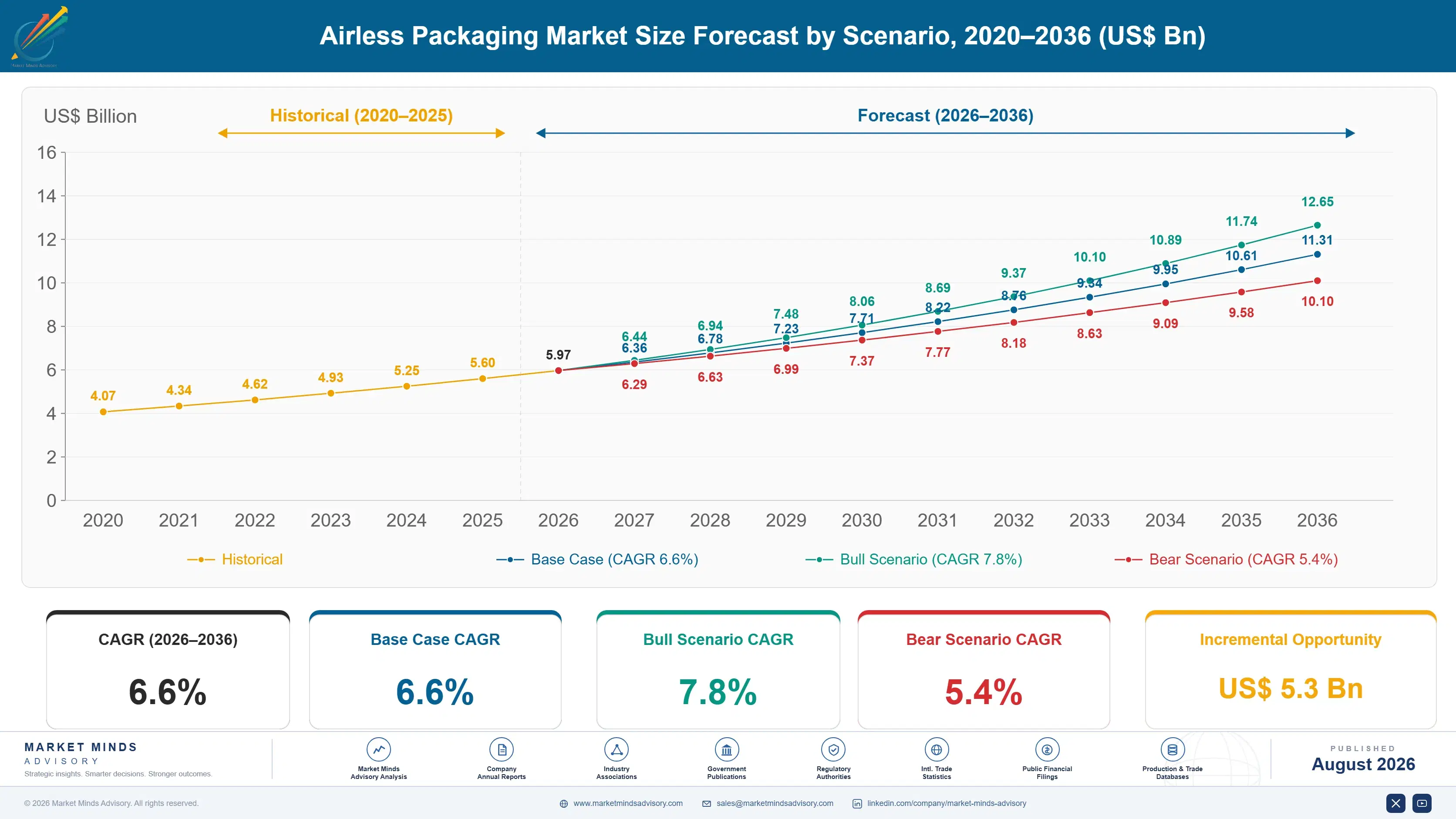
airless-packaging-market-size-forecast-scenario-1787676735337
The 2020 to 2025 period compounded at 5.4%, and two things drove it. Clean beauty positioning pushed brands toward shorter preservative systems, which only survive in airless containers. Then Korean and Chinese indie brands scaled fast on formats that were airless by default. Travel retail collapse hurt in 2020 and 2021, and the recovery came back weighted toward skincare rather than colour cosmetics.
The 6.6% base case rests on three mechanisms. Active ingredient concentrations keep rising across mass and prestige skincare, and retinoids, vitamin C and peptides all oxidise in conventional packaging. Dermocosmetic and pharmaceutical topical brands are converting from tubes to airless because regulators favour preservative reduction. And European packaging regulation is forcing refill architectures that carry higher content value per unit than the disposable formats they replace, which lifts revenue even where unit volumes stay flat. Formulation chemistry does the work.
The bull case at 7.8% turns on pharmaceutical topicals converting at scale, where preservative-free dosing has clinical value and pricing tolerates the packaging cost. The bear case at 5.4% is a recyclability ruling that classifies airless pumps as non-recyclable outright, which would push mass-market brands back to tubes regardless of formulation cost. Both scenarios are modelled.

Why The Pump Costs More Than The Bottle

Pull an airless bottle apart and the economics become obvious. The container is a blow-moulded shell worth a few cents. The pump is a nine-part assembly with a piston, a spring, two valves and tolerances measured in hundredths of a millimetre, and it accounts for roughly 61% of what the brand pays. Every commercial argument in this market is really an argument about that mechanism.
FIVE-FIRM CONCENTRATION38%Share of dispensing revenue held by leading suppliers
AVERAGE PUMP PRICE$0.42Typical unit cost of an airless pump assembly
TOP PRODUCING COUNTRYChina 34%Chinese share of global airless component unit output
PUMP COST SHARE61%Dispensing mechanism portion of total packaged unit cost
PRODUCT EVACUATION RATE94%Share of formulation recovered from a well-designed airless container
TOOLING LEAD TIME22 weeksTypical interval from mould design to validated production
Two mechanism philosophies compete. Piston systems push product up a rigid chamber and evacuate around 94% of contents, which brands quote in marketing because consumers notice waste. Collapsible pouch systems inside a rigid outer shell handle thicker formulations better and tolerate wider viscosity ranges. Pouch designs also refill more easily, which matters more each year as regulation tightens around single-use formats.
Tooling is the barrier nobody talks about. A new airless format takes 22 weeks from design to validated production and costs a supplier six figures before a single unit ships. That timeline sets the pace: brands planning a launch 12 months out cannot specify a new mechanism, so they pick from what exists. Innovation happens on supplier timetables, not on brand timetables, which explains why formats converge across competing brands.
"Brands think they are buying a bottle. They are buying a spring tolerance, and the three companies that can hold it know exactly what that is worth."
Director, Beauty and Personal Care Packaging Practice · MMA Packaging Practice · August 2026

Market Trends

Refill Cartridges Replace Disposable Airless Units In Europe

European packaging waste rules put reuse targets on cosmetic formats, and airless is the hardest category to comply with because the pump is the unrecyclable part. Refill architecture solves it by keeping the mechanism and replacing only an inner cartridge. Prestige brands moved first, since their customers tolerate a two-part purchase and the unit economics work at higher price points. Mass market is following more slowly, held back by retail shelf logic that assumes one product equals one package. The refill cartridge itself ships at roughly 40% of the weight of a complete unit.
Market Impact: Covers 78% of new serum launches
Mono-Material Pump Designs Enter Commercial Production

A conventional airless pump mixes polypropylene, polyethylene, an acetal valve and a stainless spring, which no sorting facility can separate economically. Mono-material designs replace the metal spring with a moulded polymer equivalent and standardise every component on polypropylene. The engineering compromise is real: polymer springs fatigue faster and dose accuracy drifts over the container's life. Several suppliers now ship them commercially for products with shorter use periods, and the performance gap narrows with each iteration. Brands with recyclability commitments are specifying them despite the compromise, which tells you where the pressure is.
Market Impact: Converts 1,400 dermocosmetic product lines

Market Opportunities and Growth Drivers

High Actives Formulations Cannot Survive Conventional Packaging

Retinol degrades in light and oxygen. Ascorbic acid oxidises within weeks of first opening in a jar. Peptides lose activity with repeated air exposure. As mass-market brands moved from 0.3% retinol to 1% and from stabilised vitamin C derivatives to L-ascorbic acid at 15 to 20%, the packaging stopped being a marketing decision and became a stability requirement written into the formulation brief. FDA and European Commission cosmetic stability testing protocols make this explicit, because a product that fails stability cannot make its claims. Formulators specify airless before designers see anything.
Market Impact: Rejects 96% of pumps sorted

Preservative Reduction Pushes Dermocosmetics Toward Airless Formats

Parabens, phenoxyethanol and isothiazolinones all face consumer resistance and tightening regulatory scrutiny, and the sensitive-skin brands feel it hardest because their customers read labels closely. Removing preservatives is only possible if the container never admits contamination, which is exactly what an airless piston does. European dermocosmetic brands converted first, and pharmaceutical topical manufacturers are following where the active tolerates it. The conversion is expensive: a preservative-free reformulation plus airless packaging adds meaningfully to unit cost, and it is being absorbed rather than passed on in most cases. Margins take the hit for now.
Market Impact: Adds 22 weeks to launch

Market Restraints and Challenges

Pump Mechanisms Defeat Every Municipal Sorting Line

An airless pump entering a recycling stream is a contamination problem, not a resource. Mixed polymers, a metal spring and residual product mean sorting facilities reject it, and most municipal systems have no route for it at all. The root cause is functional: dose accuracy and seal integrity require materials with different properties, and matching them to one polymer costs performance. Commercially this puts brands with recyclability commitments in an impossible position on their highest-value products. Mono-material designs and brand-operated take-back schemes are both being trialled, and neither yet handles meaningful volume.
Market Impact: Cuts shipped weight by 60%

Tooling Lead Times Lock Brands Into Existing Formats

A custom airless format takes 22 weeks to tool and validate, plus a six-figure investment the brand usually funds. Root cause is precision: piston seal tolerances leave no room for mould approximation, so every cavity gets qualified individually. The commercial impact is that brands planning launches on 12-month cycles cannot specify anything new, which pushes them toward stock formats and erodes the differentiation they were paying for. Suppliers have responded with modular platforms, where a standard mechanism accepts custom shells, and that compromise now covers most new launches. It is a decent second best.
Market Impact: Raises recyclability across 100% of components
4 additional market trends, 3 additional growth drivers, and 2 additional restraints and challenges are covered in the full report. Contact sales@marketmindsadvisory.com to access the complete intelligence.

Segment CAGR and Growth Architecture

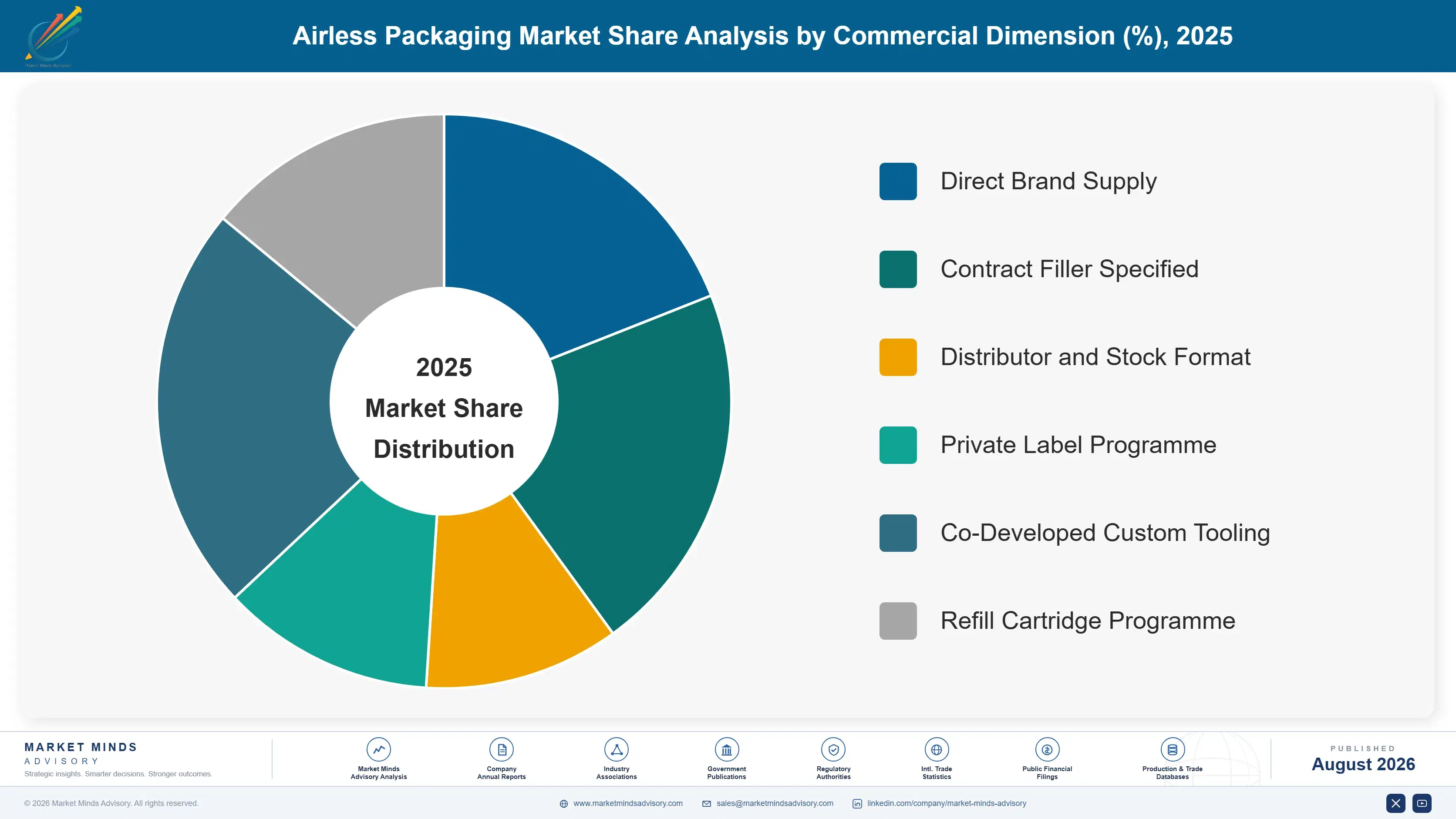
Segmentation follows container and dispensing format: the physical architecture of how product is held and delivered, rather than what is inside it or which brand tier buys it. Six formats cover the market cleanly, from pump bottles through to single-dose airless sachets. End-use category and brand positioning are treated separately, because both cut across every format.
airless-packaging-market-market-share-analysis-1787676735917

Refillable Airless Systems

A refillable airless system separates the mechanism from the product, so the customer buys a cartridge and keeps the pump. Growth at 9.9%, half again the market rate of 6.6%, is driven almost entirely by European packaging regulation rather than by consumer demand, which lags well behind brand commitments. The economics are awkward at first and improve quickly: the initial unit costs more to tool, and every subsequent refill ships at roughly 40% of the weight. Prestige skincare adopted first because the price point absorbs the tooling. Mass market resistance is about retail shelving and theft, not about the technology, which nobody expected. Solving the shelf problem is worth more than any engineering work.
CAGR 9.9%

Airless Droppers and Applicators

Droppers were the last format to go airless, because a conventional pipette admits air on every squeeze and nobody minded until serum actives got expensive. Airless dropper designs use a piston-backed chamber with a metered dispensing tip, giving dose control that a squeezed bulb never had. Growth at 8.6% tracks high-actives serums and the eye-care category, where applicator hygiene matters clinically rather than cosmetically. Metal-tipped applicators for eye contour products are the premium end of this, combining cooling sensation with airless protection. The engineering challenge is dispensing consistency at very small doses, and several suppliers still cannot hold it across a full container. That gap is where the qualification work happens.
CAGR 8.6%
Full segment breakdown across 6 segments available in the complete report.

Regional Architecture and Country Demand Map

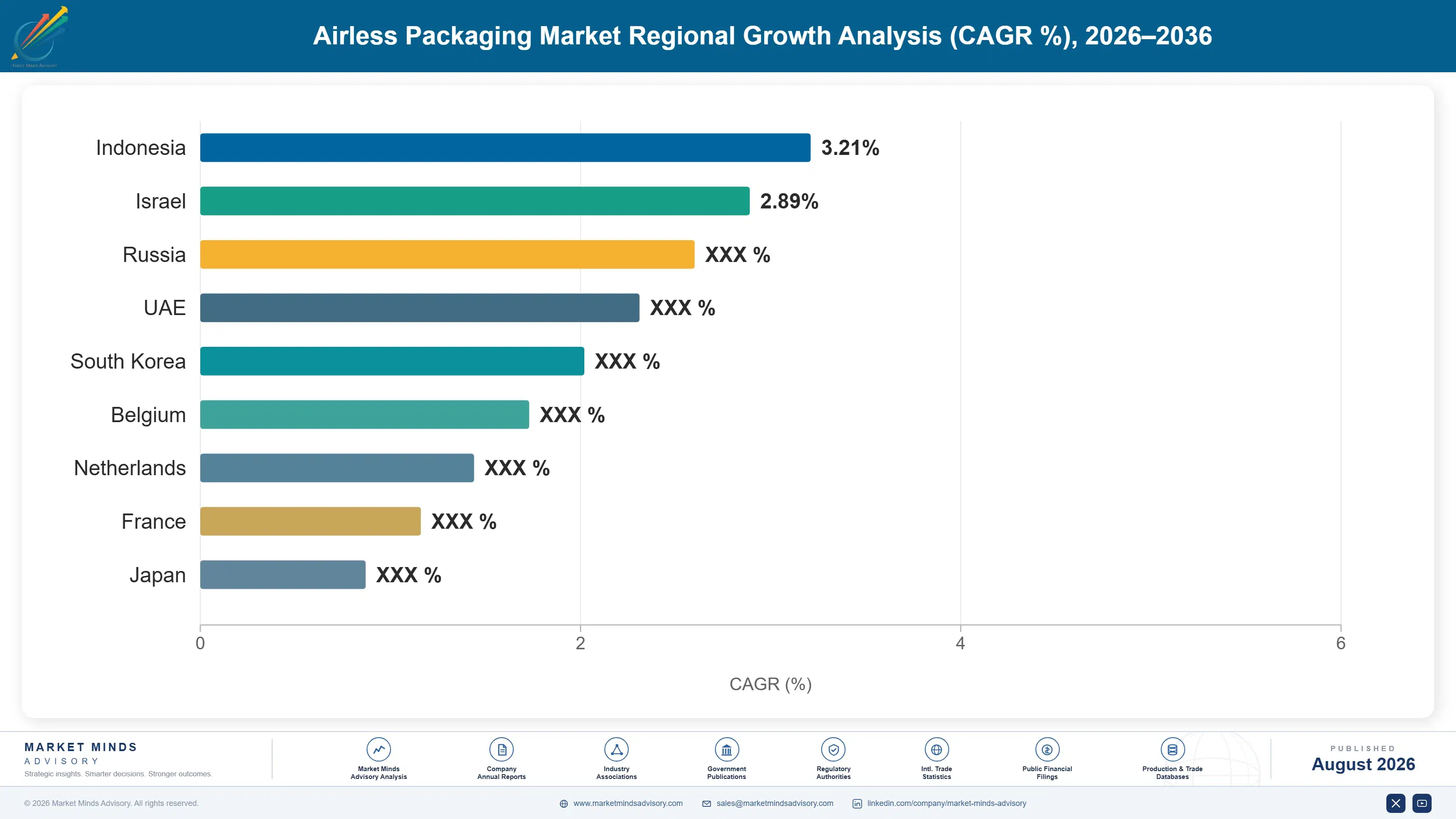
Geography follows premium skincare consumption and pump manufacturing, which happen to overlap. East Asia leads on both counts, holding the largest share of value and most of the world's component tooling. Western Europe drives regulatory change, while South Asia grows fastest from a genuinely small base.

North America

American demand is driven by the mass-prestige middle, where brands sold through drugstores and specialty retail have adopted actives-heavy formulations that need airless protection. Dermatologist-led brands are the sharpest growth within that. The professional and medspa channel adds a second stream, buying larger airless formats for treatment room use where cross-contamination matters. Canadian volumes are small and follow American specification entirely. Mexican manufacturing has become a meaningful component source for North American brands wanting shorter lead times than Asian supply allows, though tooling still originates elsewhere. Retail theft prevention shapes format decisions here more than in any other region, which pushes brands away from two-part refill systems. Nobody predicted that constraint.
Share: 23% | CAGR: 5.8% (2026 to 2036)

Western Europe

Europe sets the rules the rest of the market eventually follows. Packaging waste regulation targets airless pumps directly, and French and German brands have committed to refill architectures ahead of any deadline because their customers ask about it. French prestige houses remain the specification authority for the whole category, and a format qualified in Paris tends to appear everywhere within two years. Italian component manufacturing around Bergamo and Lombardy supplies the premium tier with tooling quality Asian suppliers still struggle to match. Spanish and Portuguese contract fillers handle much of the assembly. Nordic brands push mono-material designs hardest, accepting performance compromises others will not. Their consumers reward it and their regulators notice.
Share: 22% | CAGR: 5.0% (2026 to 2036)
Regional intelligence for 5 additional markets available in the complete report: East Asia, South Asia and Pacific, Latin America, Middle East and Africa, Eastern Europe. Contact sales@marketmindsadvisory.com.
airless-packaging-market-country-cagr-analysis-1787676736531

Selling The Mechanism, Not The Pack

The shell is a moulding anyone can quote. The mechanism is a tolerance nobody can copy quickly, and that difference is worth roughly four times the margin. Four levers move revenue toward the mechanism and away from the parts that get retendered every year, and each of them costs something upfront. None is a quick win.

Sell Modular Platforms Instead Of Bespoke Tooling

Brands want distinctive packaging and cannot wait 22 weeks for it. A modular platform keeps the mechanism standard and lets the shell, collar and cap change, which cuts qualification to about 6 weeks and removes most of the tooling investment from the brand's side. Suppliers who built these platforms early now capture launches that would otherwise have gone to whoever had a stock format available. The trade is real: platform standardisation limits how differentiated any single customer can be, and some prestige accounts will refuse it outright. Most take the speed instead.
Market Impact: Cuts launch qualification from 22 weeks to 6

Own The Refill Cartridge Rather Than The Pump

A pump sells once and a cartridge sells repeatedly, which reverses the entire revenue shape of the category. Suppliers who design the cartridge interface as proprietary capture roughly 8 refills per original unit over a typical product relationship. The catch is that brands understand this too, and increasingly demand open cartridge specifications as a condition of adoption. The suppliers winning here are the ones offering brands a share of refill economics rather than trying to hold the interface closed, which is a harder commercial conversation and a more durable position.
Market Impact: Captures roughly 8 refill sales per original unit sold

Certify Mono-Material Designs Before Brands Are Required To

European packaging regulation will eventually classify conventional airless pumps as non-recyclable, and brands with public commitments are already looking for alternatives. Suppliers holding certified mono-material designs today get specified without competing on price, because there is nothing else to compare against. The development cost is meaningful, roughly 18 months of engineering plus tooling, and the resulting product performs measurably worse on dose accuracy over container life. That gap closes with iteration. The specification position, once won, tends to persist through several product generations at the same brand. Timing is the whole advantage.
Market Impact: Wins specification roughly 18 months before deadlines bite

Move Assembly Closer To Regional Filling Operations

Airless components ship as air. A container of unassembled pumps carries a fraction of the value of the same volume assembled, and freight is charged on space. Suppliers who assemble regionally near contract fillers cut delivered cost by roughly 11% and, more usefully, cut lead time from 10 weeks to under 3. Brands increasingly award on responsiveness rather than on unit price, because a missed launch window costs more than any component saving. The investment is a regional assembly site with qualified clean conditions, which is not trivial and is not optional either.
Market Impact: Cuts lead time from 10 weeks to 3

Who Controls the Margin Pool

Measured on disclosed dispensing and beauty packaging segment revenue, the five largest suppliers hold a CR5 of 38%. Concentration is much higher in the mechanism than that figure implies, because shell moulding is widely available while pump assembly is not. AptarGroup and Silgan Dispensing sit ahead of the challenger group on precision manufacturing capacity and on qualified positions at the largest brand groups.
Three contests define current activity. Sustainability engineering is the loudest, with suppliers racing to demonstrate mono-material designs that brands can put in a report. Speed to market is the quieter one and probably matters more, since a supplier who can qualify a format in 6 weeks wins launches outright. The third is regional assembly footprint, where proximity to contract fillers has become a selection criterion in its own right. Korean and Chinese suppliers compete hardest on the last two.

Pressure comes from Asian component makers moving from contract supply into named brand relationships. Several Korean suppliers now hold direct qualifications with European prestige houses, which would have been unthinkable a decade ago. Rankings shift wherever tooling quality has converged, and it has converged fastest on standard formats rather than on precision dropper mechanisms.
airless-packaging-market-company-positioning-matrix-1787676737093

Competitive Moat and Risk Dimensions

APTARGROUP

Moat: Precision Dispensing Manufacturing Scale

Aptar operates precision moulding and assembly capacity across three continents at a scale no competitor matches, which lets it hold tolerance consistently across sites and serve global brands with identical product from any of them. That consistency is worth more than unit price to a brand launching simultaneously in 40 markets, and it cannot be replicated without similar capital commitment.
APTARGROUP

Risk: Pharmaceutical Segment Attention Diversion

Aptar's pharmaceutical dispensing business earns better margins and grows more predictably than beauty packaging, which makes it the natural home for engineering attention and capital. Beauty customers notice when development priorities sit elsewhere, and Asian suppliers compete precisely on responsiveness. The risk is not losing the largest accounts but losing the mid-tier brands where growth actually happens.
SILGAN DISPENSING SYSTEMS

Moat: Cross-Category Dispensing Platform Reuse

Silgan develops dispensing mechanisms across beauty, home care and food, which spreads engineering cost over volumes no beauty-only supplier can match and lets it price aggressively where it chooses to. Platform components migrate between categories, so a valve refined for a home care trigger can appear in a beauty pump two years later at almost no incremental development cost.
SILGAN DISPENSING SYSTEMS

Risk: Prestige Aesthetic Positioning Gap

Prestige beauty buys on finish, weight and the sound a closure makes, none of which appear in a home care specification. Silgan's platform advantage becomes a disadvantage at the top of the market, where brands want something that looks and feels unique to them. Specialist competitors with smaller volumes and better decoration capability win exactly those accounts.

Players Tracked

Prominent Players

AptarGroup
Silgan Dispensing Systems
Quadpack
Lumson
Albea

Other Key Players

Berry Global
Gerresheimer
HCP Packaging
Baralan
Fusion Packaging
Yonwoo
Pum-Tech Korea
Weener Plastics
TriMas Packaging
Nemera
Toly Group
Libo Cosmetics
Shya Hsin Packaging
Cosmogen
Raepak

Recent Developments

APRIL 2025

AptarGroup opens regional airless assembly site in Mexico

AptarGroup commissioned a regional airless assembly operation in Mexico serving North American contract fillers, an organic capacity investment rather than an acquisition. The stated purpose was cutting lead times for brands running compressed launch calendars, with component moulding remaining in existing plants and only final assembly moving closer to customers.
Signal: Lead time has replaced unit price as the selection criterion, and assembly location is how suppliers answer it.
AUGUST 2025

Quadpack launches certified mono-material airless range for European brands

Quadpack introduced a mono-material airless range using a moulded polymer spring in place of stainless steel, developed organically rather than through partnership. Independent recyclability certification accompanied the launch. Dose accuracy over full container life remains below conventional designs, which the company disclosed alongside the performance data.
Signal: Disclosing the performance compromise openly is a bet that regulatory pressure outweighs technical objection at brand level.
OCTOBER 2025

Lumson signs multi-year supply agreement with Korean prestige skincare group

Lumson entered a multi-year component supply agreement with a Korean prestige skincare group covering airless pouch systems for a global product line. The arrangement is a supply agreement, not a joint venture, and includes co-development work on a refillable cartridge interface intended for European market compliance.
Signal: European component suppliers winning Korean brand work reverses the usual direction of travel in this category.

What Goes Into A Pump

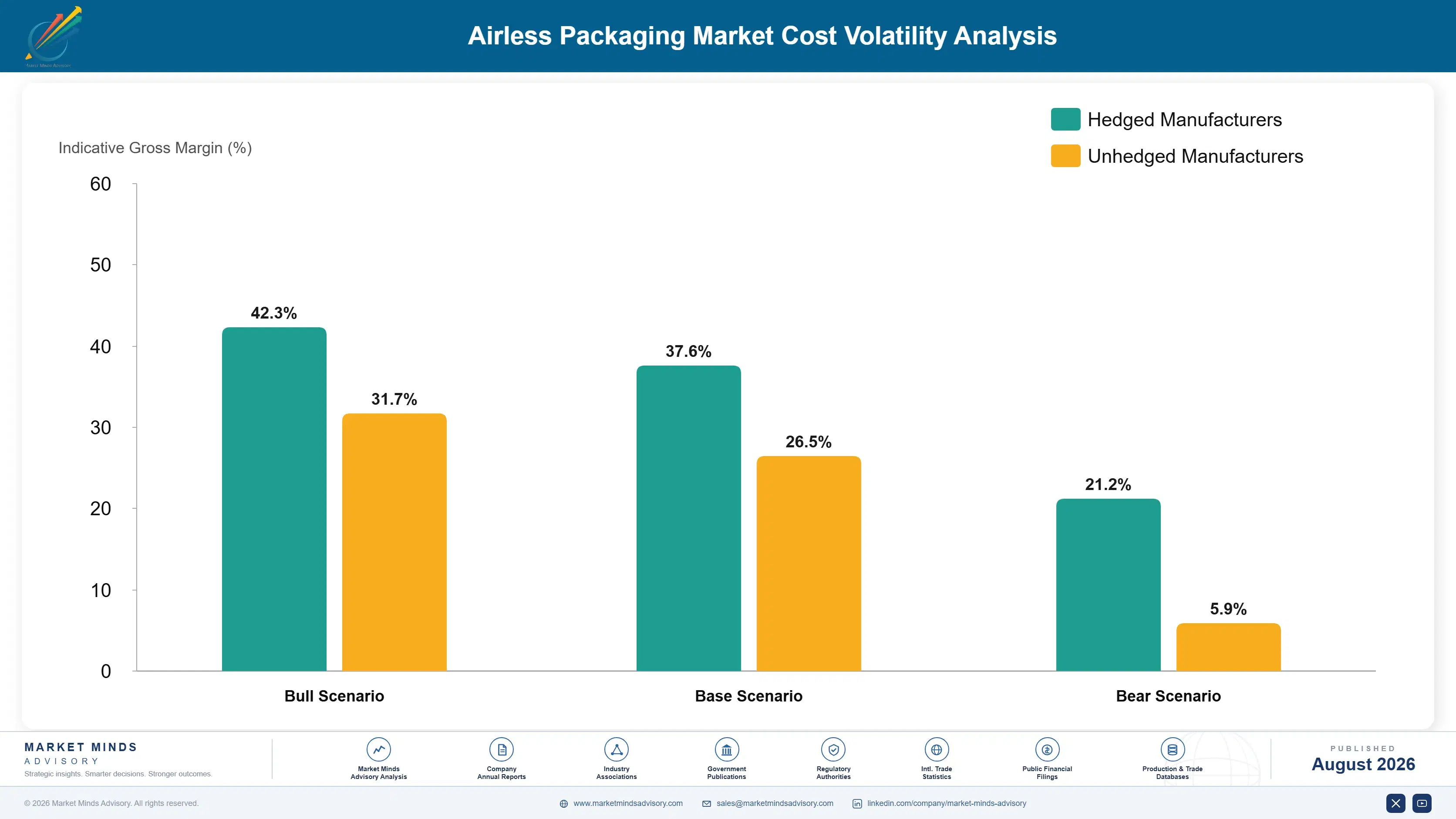
Resin dominates. Polypropylene, polyethylene and acetal together account for 34 to 37% of component COGS, sourced from European and Asian petrochemical producers with pricing tied to naphtha and ethylene. The stainless spring adds roughly 6%, small in value and disproportionate in supply risk. Precision moulding energy and tooling amortisation together carry another 21%, which is why utilisation matters more here than in most packaging.
The 2022 European energy shock hit precision moulders harder than resin buyers. IEA data on European industrial electricity prices through that period documents increases that made continuous moulding operations marginal, and several Italian and Spanish component makers ran reduced shifts rather than absorb the cost. Aptar and Silgan annual reports for 2022 describe energy surcharges applied to customers alongside resin pass-through. Brands accepted both, because the alternative was qualifying an Asian supplier on a timeline nobody had.

Exposure varies with where the moulding happens. Asian suppliers running on Chinese industrial power tariffs were barely affected and won share on price during that window. European moulders with tooling amortisation sunk could not relocate production. The smallest component makers, buying resin at spot and lacking surcharge clauses, took the move and several did not survive it.
airless-packaging-market-cost-volatility-analysis-1787676737301

Index component pricing to published resin benchmarks

Resin surcharge clauses tied to published indices are standard in industrial packaging and were unusual in beauty until 2022. They remove the annual argument entirely and protect both sides through a cycle. Brands resisted them for years on the grounds that packaging should have fixed pricing, and most now accept them without discussion. The shock did that work.

Qualify polymer spring designs to remove stainless exposure

The stainless spring is 6% of cost and a disproportionate share of supply risk, since specialist spring makers serve many industries and prioritise larger customers. Polymer replacements remove that dependency entirely while also solving the recyclability problem. Performance is genuinely worse today, which is why qualification should start on shorter-life products rather than flagship lines.

Run dual moulding footprints across energy price regions

Holding qualified tooling in two regions with different energy cost bases converts an exposure into an option. The cost is duplicate tooling, which is significant on precision cavities and is why most suppliers avoided it. Those who paid it during calm years could shift volume in 2022 without requalifying anything, and they took share from competitors who could not.

Portfolio Architecture for Margin Defence

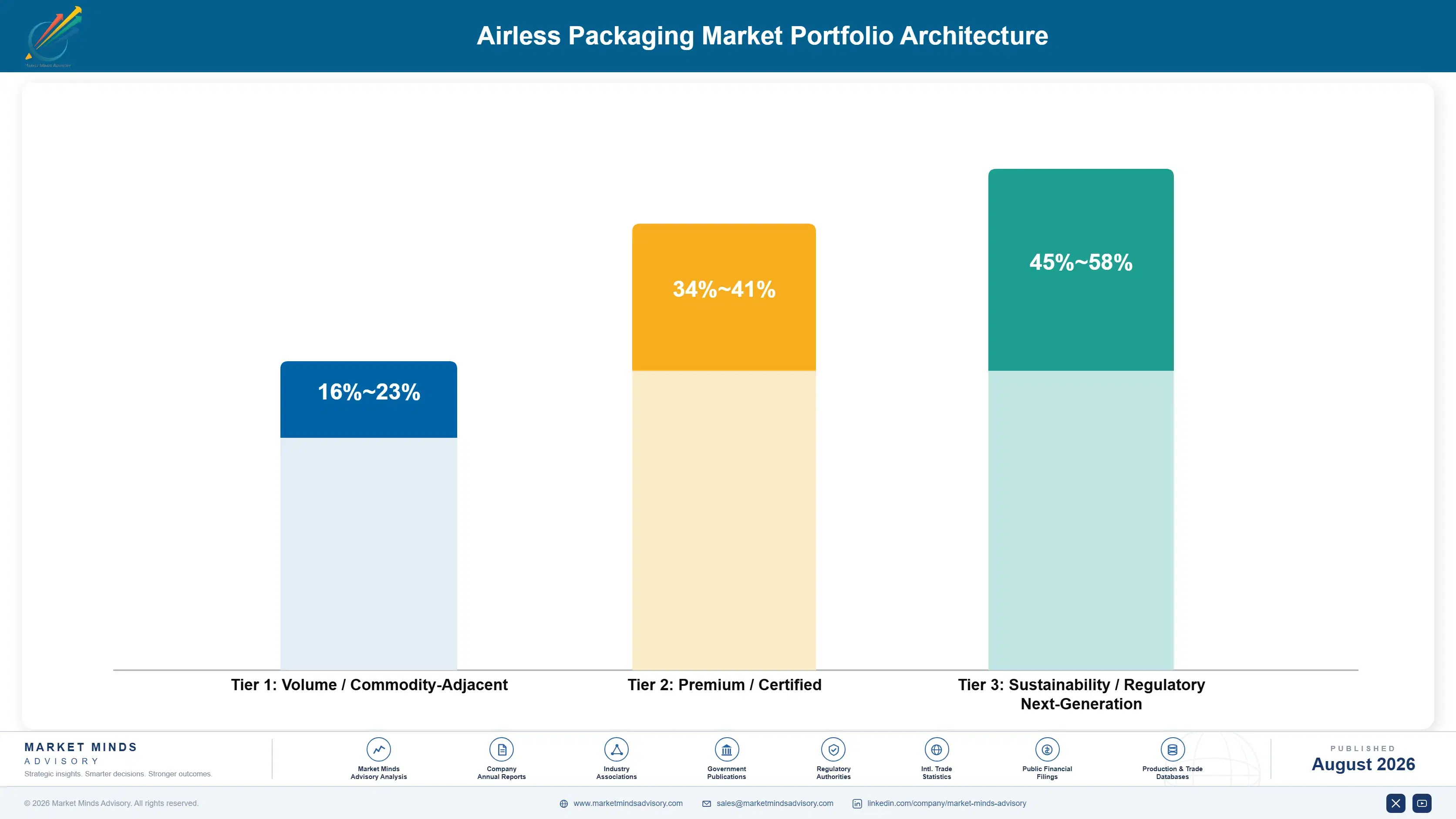
Margin here follows precision, not material. A blow-moulded shell earns commodity moulding margins because a thousand converters can make one. A qualified pump mechanism holding dose accuracy across a full container earns three to four times that, and the gap has not narrowed despite 20 years of Asian capacity growth. Decoration sits somewhere between, depending on technique.
The tension is that brands buy the complete unit and negotiate one price for it. A supplier who wins the shell on price then finds the mechanism benchmarked against that same expectation, which is how precision margin leaks away. Suppliers who quote the mechanism separately and let brands source shells elsewhere hold better margins and smaller revenue, and most have decided that trade is worth making. The ones who resisted are running high revenue at packaging-industry margins.

High-value pools concentrate in three places. Certified mono-material mechanisms, where scarcity creates pricing power that will not last but is real now. Precision dropper and metered applicator systems, where dose consistency at small volumes remains genuinely difficult. And refill cartridge interfaces, which convert a one-off sale into a repeating one. None of these carries the volume that standard pump bottles do.

Volume / Commodity-Adjacent

Standard airless bottles and jars in stock formats, sold to mass and masstige brands on annual tender. The 7-point range separates suppliers moulding their own shells from those assembling bought-in components. Price resets yearly and Asian capacity sets the floor.
Gross Margin: 16-23%

Premium / Certified

Custom-tooled prestige formats, precision dropper mechanisms and pharmaceutical-qualified airless systems. The 7-point spread reflects the difference between decorated cosmetic formats and those carrying documented dose accuracy for topical drug products. Qualification depth rather than aesthetics holds this pricing.
Gross Margin: 34-41%

Sustainability / Regulatory / Next-Generation

Certified mono-material mechanisms, refillable cartridge platforms and post-consumer recycled shell programmes. The 13-point range is unusually wide because certified mono-material designs currently price on scarcity while recycled-content shells compete against conventional moulding, and both sit in this tier.
Gross Margin: 45-58%
airless-packaging-market-portfolio-architecture-1787676737808

High-value Sub-segments and Strategic Watch-out

Certified Mono-Material Mechanisms

Highest value and fastest growth, driven by European regulation rather than by consumer demand. Scarcity supports pricing that will compress as competitors certify their own designs. The risk is exactly that: an advantage measured in months of lead rather than in anything defensible long term.
Gross Margin: 53-56%

Precision Dropper And Applicator Systems

High value with steady growth, tied to high-actives serum launches and eye-care products. Dose consistency at small volumes is genuinely hard, which keeps the supplier field narrow and pricing firm. Demand follows formulation trends rather than packaging cycles, making it less predictable than volume formats.
Gross Margin: 42-45%

Standard Airless Pump Bottles

The volume core, carrying most units shipped and the least margin per unit. Asian component capacity sets pricing and Western suppliers compete on lead time rather than cost. Most players manage this line for capacity utilisation rather than for return, which is a defensible position and not a comfortable one.
Gross Margin: 17-20%

Conventional Multi-Polymer Pump Assemblies

The strategic watch-out. This construction carries most current revenue and performs better than any alternative, but European regulation targets it specifically and no municipal sorting line accepts it. The risk is tooling investment in designs that regulation strands before amortisation completes. Timing that decision is the hard part.
Gross Margin: 31-34%

Why Formats Outlive Their Brands

An airless format qualified into a product line generates revenue for as long as that product sells, and skincare products sell for a long time. A serum launched in 2018 is often still shipping in the same pack. Component revenue therefore behaves more like an annuity than like a packaging sale, with reorder volumes that track retail sell-through rather than launch calendars.
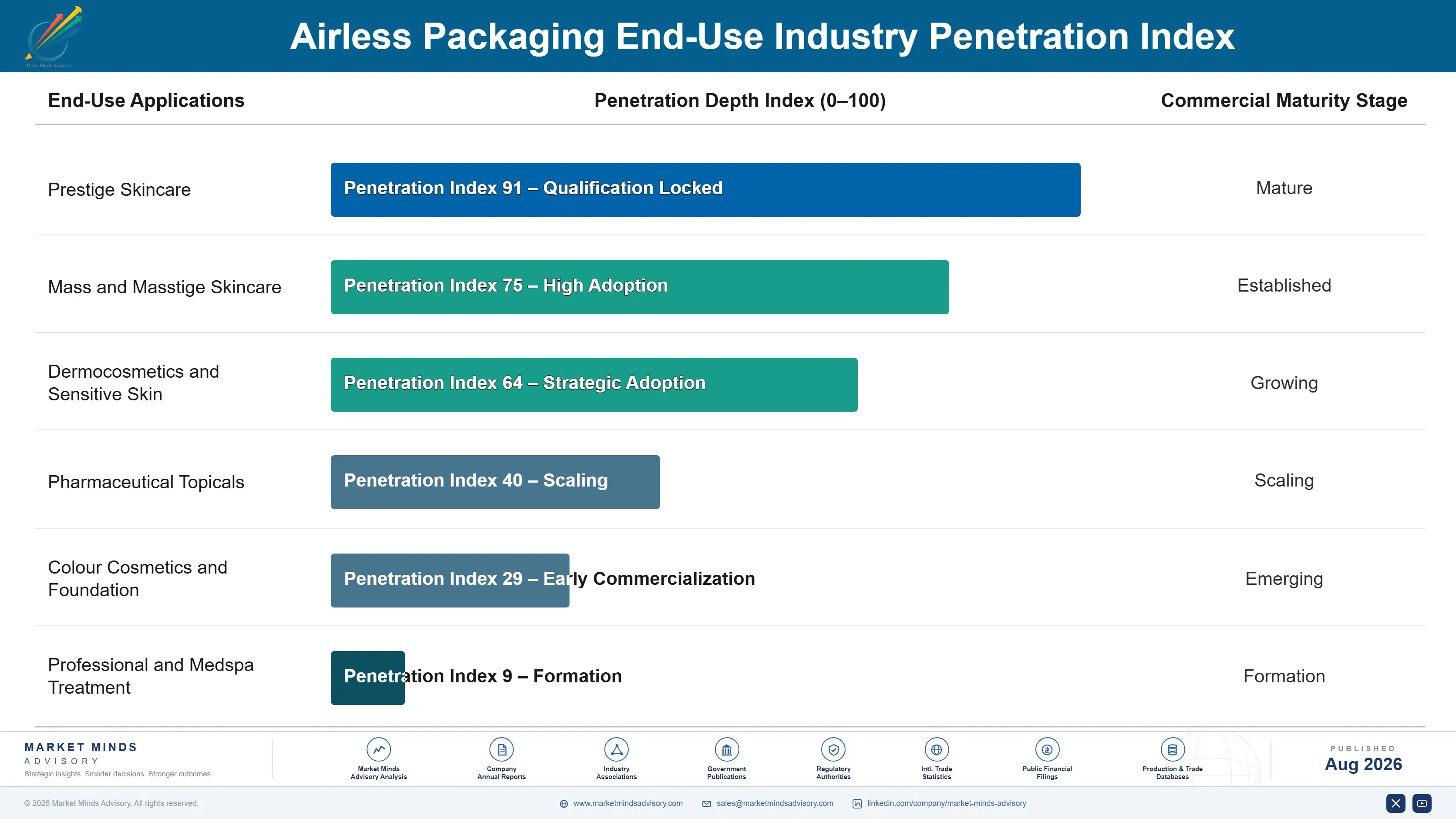
Stickiness varies by how much the format costs to change. Pharmaceutical topicals essentially never switch, because packaging appears in the regulatory filing. Prestige skincare switches rarely, since custom tooling is sunk and consumers recognise the pack. Mass market brands switch readily on price, and Asian suppliers win most of that movement. Indie brands are the most volatile of all, because they use stock formats with no tooling commitment and change suppliers whenever lead times slip.

The buying centre has moved. Ten years ago a packaging development manager chose the format. Now a sustainability lead holds veto power, a formulator sets the barrier requirement and procurement runs the tender, and any one of the three can stop a specification the others agreed. Suppliers who present to only one of them lose slowly and never quite understand why.
airless-packaging-market-end-use-penetration-index-1787676738309

Where The Precision Premium Sits

These are among the four positions where our research anticipates prominent divergence between winners and laggards over the coming forecast period. Each is grounded in the demand model, the regulatory perimeter, and the announced capacity pipeline.
01 / MECHANISM VALUE CAPTURE

Quote the mechanism separately from the shell

Shell moulding is available from a thousand converters and prices accordingly, while a qualified pump mechanism holding dose accuracy across a full container earns three to four times that margin. Bundling the two into one quotation lets procurement benchmark the mechanism against commodity moulding expectations, which is precisely how precision margin leaks out of this category. Suppliers who separate the quotation carry lower revenue and materially better returns, and the ones who refused that trade are now running packaging-industry margins on precision-industry capital.
02 / REFILL ARCHITECTURE TIMING

Build refill interfaces before regulation names a date

Refillable airless systems grow at 9.9%, half again the market rate of 6.6%, and the growth is regulatory rather than consumer-led, which makes it far more predictable than most packaging trends. A cartridge interface designed now captures roughly 8 refill sales per original unit across a typical product relationship, converting a one-off component sale into recurring revenue. Suppliers who wait for a compliance deadline will be designing under time pressure against competitors whose interfaces are already qualified at the brands that matter.
03 / REGIONAL ASSEMBLY FOOTPRINT

Assemble near fillers, mould wherever costs least

Unassembled components ship as air and freight is charged on volume, so assembling near contract fillers cuts delivered cost by roughly 11% while moulding stays wherever energy and labour are cheapest. The larger prize is lead time, which falls from 10 weeks to under 3 and has replaced unit price as the criterion brands actually award on. A missed launch window costs a brand more than any component saving could ever return, and suppliers who understood that early are winning work on responsiveness alone.
04 / MONO-MATERIAL ENGINEERING BET

Accept the performance compromise and certify early

Conventional pumps mix polymers and a stainless spring, which means 96% of them are rejected by the sorting lines they reach, and European regulation is closing on exactly that construction. Mono-material designs perform measurably worse on dose accuracy over container life, and brands with public recyclability commitments are specifying them regardless because they have no alternative to offer. The suppliers certifying now hold a specification position roughly 18 months ahead of the deadline, which is long enough to become the default at several major accounts.

Engagement Snapshot From the Field

A live engagement with an industry participant carrying material or product regulatory and market exposure ahead of a defining policy shift, showing how our research translates into a defensible multi-year portfolio strategy.
MARKET MINDS ADVISORY · CLIENT ENGAGEMENT SUMMARY
Airless Packaging Producer Strategic Portfolio Review and Transition Roadmap 2026·Investment Scenario on Airless Packaging Exposure Evaluation 2025-26
CLIENT PROFILE
A European prestige skincare group operating four brands across 38 markets, with annual revenue reported at 1.9 billion euros (client-reported, unverified by MMA). Roughly 62% of units shipped in airless formats sourced from five component suppliers across Europe and Asia. The group had committed publicly to full packaging recyclability by 2030 without having established whether its airless portfolio could reach that.
STRATEGIC CHALLENGE
The recyclability commitment covered every pack, and airless pumps were the only category with no compliant option at the required performance. Switching to mono-material designs meant accepting dose accuracy losses on flagship serums. Moving to refills meant retail negotiations across 38 markets with different shelf conventions. Nobody had established which route was cheaper, because nobody had priced either properly.
MMA APPROACH
MMA priced both routes by product line rather than across the portfolio, since flagship serums and secondary moisturisers face completely different performance requirements. Fourteen expert interviews with component suppliers established realistic mono-material performance data rather than marketing claims. The analysis treated retail shelf acceptance, not engineering feasibility, as the binding constraint on any refill rollout across markets.
KEY FINDINGS
  1. Mono-material designs held acceptable dose accuracy on 71% of the portfolio by volume, failing only on high-viscosity flagship serums where piston resistance is highest.
  2. Refill rollout was commercially viable in 11 of 38 markets, constrained by retail shelf conventions and theft exposure rather than by consumer willingness.
  3. Two of the five component suppliers had no mono-material development programme at all, creating a concentration risk the procurement team had not identified.
  4. Combining both routes covered 94% of portfolio volume against the 2030 commitment at roughly 40% of the cost of converting everything to refills (client-reported, unverified by MMA).
CLIENT PROFILE
A European prestige skincare group operating four brands across 38 markets, with annual revenue reported at 1.9 billion euros (client-reported, unverified by MMA). Roughly 62% of units shipped in airless formats sourced from five component suppliers across Europe and Asia. The group had committed publicly to full packaging recyclability by 2030 without having established whether its airless portfolio could reach that.
STRATEGIC CHALLENGE
The recyclability commitment covered every pack, and airless pumps were the only category with no compliant option at the required performance. Switching to mono-material designs meant accepting dose accuracy losses on flagship serums. Moving to refills meant retail negotiations across 38 markets with different shelf conventions. Nobody had established which route was cheaper, because nobody had priced either properly.
MMA APPROACH
MMA priced both routes by product line rather than across the portfolio, since flagship serums and secondary moisturisers face completely different performance requirements. Fourteen expert interviews with component suppliers established realistic mono-material performance data rather than marketing claims. The analysis treated retail shelf acceptance, not engineering feasibility, as the binding constraint on any refill rollout across markets.
KEY FINDINGS
  1. Mono-material designs held acceptable dose accuracy on 71% of the portfolio by volume, failing only on high-viscosity flagship serums where piston resistance is highest.
  2. Refill rollout was commercially viable in 11 of 38 markets, constrained by retail shelf conventions and theft exposure rather than by consumer willingness.
  3. Two of the five component suppliers had no mono-material development programme at all, creating a concentration risk the procurement team had not identified.
  4. Combining both routes covered 94% of portfolio volume against the 2030 commitment at roughly 40% of the cost of converting everything to refills (client-reported, unverified by MMA).
RECOMMENDED STRATEGY
Phase 1: Phase one: convert secondary lines to mono-material mechanisms immediately, where performance testing showed no measurable dose accuracy loss for consumers. Phase 2: Phase two: launch refill architecture on flagship serums in the 11 viable markets, holding conventional formats everywhere retail conventions block it. Phase 3: Phase three: add a sixth supplier with mono-material capability before existing contracts renew, removing the concentration exposure identified during the review.
OUTCOME
Secondary line conversion completed within nine months with no measurable consumer complaint. Refill launched in seven of the 11 identified markets during the first year, and sell-through matched conventional formats in five of them (client-reported, unverified by MMA). The sixth supplier was qualified before renewal, and the group now reports 79% of portfolio volume on a compliant path.

Frequently Asked Questions

Foundational context covering the market sizes, CAGR, scope, country, region and competition that inform every finding below. This section is provided to cover basics and most often pre-purchase conversations, answered from the MMA Primary Research Dataset.

What is the current size of the Airless Packaging Market?

The market was worth 5.6 billion dollars in 2025, covering airless pump bottles, jars, tubes, droppers and refillable cartridge systems. It reaches 6.0 billion dollars in 2026 on current forecasts.

How large will the Airless Packaging Market be by 2036?

MMA forecasts 11.3 billion dollars by 2036, an increase of 5.3 billion dollars over the 2026 base. That represents an expansion multiple of 1.88 times across the forecast period.

What is the CAGR for the Airless Packaging Market 2026 to 2036?

The base case compounds at 6.6% annually. MMA's bull case reaches 7.8% if pharmaceutical topicals convert at scale, while the bear case sits at 5.4% following any adverse recyclability ruling.

Which segment is growing fastest?

Refillable airless systems, at 9.9%, half again the market rate of 6.6%. European packaging regulation rather than consumer demand is what drives the adoption, which makes the growth unusually predictable.

Who are the major companies in the Airless Packaging Market?

AptarGroup, Silgan Dispensing Systems, Quadpack, Lumson and Albea lead on disclosed dispensing and beauty packaging segment revenue. Berry Global, Gerresheimer, HCP Packaging, Yonwoo and Baralan compete strongly in specific formats.

Which country is growing fastest?

China at 10.2%, driven by domestic premium skincare brands scaling on airless formats and by component capacity in Guangdong and Zhejiang. India follows on preservative-free positioning in domestic brands.

Report Segmentation Architecture

The full report scope spans multiple orthogonal segmentation dimensions, with cross-tabulated demand data provided for each dimension pair. Coverage extends further to regional breakdowns, trend trajectories, and the competitive detail needed to support segment-level decision-making.

By Container Format

  • Airless Pump Bottles
  • Airless Jars
  • Airless Tubes
  • Refillable Airless Systems
  • Airless Droppers and Applicators
  • Airless Sachets and Single-Dose Formats

By End-Use Industry

  • Prestige Skincare
  • Mass and Masstige Skincare
  • Dermocosmetics and Sensitive Skin
  • Pharmaceutical Topicals
  • Colour Cosmetics and Foundation
  • Professional and Medspa Treatment

By Commercial Dimension

  • Direct Brand Supply
  • Contract Filler Specified
  • Distributor and Stock Format
  • Private Label Programme
  • Co-Developed Custom Tooling
  • Refill Cartridge Programme

By Region

  • North America
  • Western Europe
  • East Asia
  • South Asia and Pacific
  • Latin America
  • Middle East and Africa
  • Eastern Europe

Scope, Methodology, and Coverage

Every figure in this report is reproducible from documented input assumptions. The scope below maps the historical period, the forecast horizon, the segmentation dimensions, and the countries covered, alongside the underlying primary and qualitative methodology.
Historical Period
2020 to 2025
Forecast Period
2026 to 2036
Base Year
2025 (USD billions; MMA Primary Research Dataset, August 2026)
Market Definition
Scope covers packaging systems that dispense product while preventing air re-entry, comprising airless pump bottles, jars, tubes, droppers and applicators, refillable cartridge systems and single-dose airless formats, together with the piston, pouch, valve and pump assemblies that deliver the function. Atmospheric pumps, aerosols, dip-tube sprayers and conventional squeeze tubes are excluded. Secondary cartons, decoration services and contract filling operations fall outside the boundary.
Quantitative Units
USD billions (current prices); units shipped; pump assemblies produced; refill cartridge volume; tooling programmes qualified
Segmentation Dimensions
By Container Format; By End-Use Industry; By Commercial Dimension; By Region
Regions Covered
North America, Western Europe, East Asia, South Asia and Pacific, Latin America, Middle East and Africa, Eastern Europe
Countries Covered
USA, China, Germany, France, UK, Japan, South Korea, India, Brazil, Mexico, Italy, Spain, Poland, Saudi Arabia, South Africa
Key Companies Profiled
AptarGroup, Silgan Dispensing Systems, Quadpack, Lumson, Albea, Berry Global, Gerresheimer, HCP Packaging, Baralan, Fusion Packaging, Yonwoo, Pum-Tech Korea, Weener Plastics, TriMas Packaging, Nemera, Toly Group, Libo Cosmetics, Shya Hsin Packaging, Cosmogen, Raepak
Quantitative Methodology
Primary survey, n=3,800 respondents, Q4 2025, six countries; demand-side model with trade association cross-validation
Qualitative Methodology
47 expert interviews, Q4 2025; applied to validate demand model assumptions, identify emerging dynamics, and assess competitive positioning
Report Format
PDF and XLSX data workbook (Word format preview document)
Publisher
Market Minds Advisory
Report Code
MMA-2026-PAC-112
Published
August 2026
Contact
sales@marketmindsadvisory.com | www.marketmindsadvisory.com

Purchase the full Airless Packaging Market Report (2026 to 2036).

The full report runs to 195 pages and covers all six container format segments, seven regions and 20 profiled companies in detail. It includes the complete segment CAGR set, regional consumption and component production data, and mechanism cost breakdown by design architecture. Company profiles carry evaluation on disclosed dispensing and beauty packaging segment revenue, with moat and risk assessment for the top five suppliers. The competitive section extends to 17 tracked corporate developments across 2024 and 2025, each with commercial interpretation. Primary research inputs include a quantitative survey of 3,800 respondents and 47 expert interviews conducted in Q4 2025.
Six container format segments with individual CAGR forecasts
Seven regional markets with consumption and production data
Twenty company profiles on consistent revenue evaluation basis
Seventeen tracked corporate developments with commercial interpretation notes
Mechanism cost breakdown across four design architectures
Refill and mono-material readiness assessment by supplier

Built For The People Who Decide

From boardroom strategy to bench-side execution, this report is read cover-to-cover by leaders shaping the next decade of their industry, turning demand scenarios, market dynamics and valuation benchmarks into decisions.
CXOs/ Presidents/ VPs/ Managers
M&A and Corporate Development
Strategy Teams and R&D Heads
Procurement and Product Directors
Regulatory and Compliance Leaders
Investor Relations and Equity Analysts