Market Minds Advisory
Aircraft Towbar Market

Aircraft Towbar Market: Type-Specific Heads, Shear Protection and Displacement From The Top Down

A piece of certified steel costing less than a business class seat, engineered to break before the nose landing gear does, and quietly disappearing from the largest hubs one stand at a time.

Lead Analyst

Published

September 2026

Make Smarter Decisions with Customized Research Insights

Request a free sample report and evaluate market opportunities, growth trends, and competitive dynamics relevant to your business needs.

2025 MARKET VALUE$0.3BMarket Size 2025
2036 FORECAST VALUE$0.5BBase Case , 2026 to 2036
CAGR 2026 TO 20364.4 %Bull 5.6% / Bear 3.2%
INCREMENTAL OPPORTUNITY$0.2BNet 10- year value creation
EXPANSION MULTIPLE1.55x2036 value over 2026 base
Strategic Levers
M&A Pipeline
Regional Outlook
Country Rankings
Competitive Intelligence
Segmental Deep-dive
Call-Us : 91 93563 13602

Executive Snapshot and Market Trajectory

A towbar exists to fail. Its shear device is engineered to break under load before the nose landing gear does, which means the product is bought as damage insurance and priced as a piece of steel. Very few buyers think about it that way.
The commercial structure follows from the head rather than the bar. Around 58% of unit cost sits in the type-specific interface that mates to one particular nose gear, so an operator flying six aircraft types buys six heads regardless of how many bars it owns. That is why fleet composition predicts towbar spending better than fleet size does, and why a mixed-fleet regional carrier spends more per aircraft than a single-type low cost operator.
The market is being squeezed from the top and fed from the bottom simultaneously. Towbarless tractors displace conventional towing at roughly 3.4% of movements annually, concentrated at large hubs where the equipment pays for itself. Business and general aviation grows fastest at 6.6%, because a flight department cannot justify a towbarless tug and never will be able to. The arithmetic at that end of the market is not close.
Market Definition
Revenue from conventional aircraft towbars and towing interface assemblies connecting a tug to an aircraft nose or main landing gear, including type-specific heads, shear protection devices, and associated inspection and recertification services. Excludes tugs and tractors themselves, towbarless handling systems, aircraft jacking and lifting equipment, and general purpose ground support equipment not used for aircraft towing.
Base Year Value
$0.3B in 2025 (MMA Primary Research Dataset, August 2026)
Forecast Period
2026 to 2036, eleven discrete annual values
CAGR
4.4% base case. Bull 5.6%. Bear 3.2%.
Fastest Growth Segment
Business and General Aviation: 6.6% CAGR
Fastest Growth Country
India: 6.4% CAGR
Fastest Growth Region
South Asia and Pacific: 6.4% CAGR
Largest Region
North America: 31% of 2025 global value
Market Leaders
Hydro Systems, Tronair, Aero Specialties, TLD Group and Textron Ground Support Equipment lead on towbar unit revenue. Source: company annual reports and MMA Primary Research Dataset, July 2026.
Primary Survey
n=3,800 procurement and R&D decision-makers, Q4 2025, six countries
Methodology
Demand-side build-up, cross-validated against public data, 47 expert interviews

Aircraft Towbar Market Forecast Scenarios

aircraft-towbar-market-size-forecast-scenario-1787982836856
The 2020 to 2025 period was unusually flat for a product tied to aviation activity. Aircraft stopped flying in 2020 but towbars are bought against fleet composition and replacement schedules rather than against movements, so demand fell far less than traffic did. Replacement cycles then resumed as handling companies rebuilt equipment estates that had been deferred. Revenue compounded near 4.4% throughout, matching its long-run rate almost exactly.
Three mechanisms carry the base case. Business aviation fleet growth continues, and every additional aircraft needs a towbar because no flight department can justify towbarless equipment. Secondary and regional airports across Asia keep opening with conventional handling equipment rather than premium alternatives. And mixed-fleet operators keep adding types, which adds heads regardless of whether they add aircraft, because the head is matched to one nose gear geometry and nothing else.
The bull catalyst is a tightening of towing damage regulation that mandates instrumented or load-monitoring towbars, which would reprice the entire installed base upward within a replacement cycle. The bear risk is towbarless displacement accelerating beyond hubs into secondary airports, which would remove the narrowbody volume that currently funds most manufacturers' fixed cost base entirely today.

Engineered To Break Before Something Expensive Does

The engineering premise is unusual and rarely stated plainly. A towbar carries a shear device calibrated to fail before towing loads reach the point where a nose landing gear would be damaged, so the product exists to be the cheapest thing that breaks. Replacing a sheared towbar costs a few thousand dollars. Replacing a damaged nose gear grounds an aircraft for days and costs hundreds of times more.
MARKET CONCENTRATION CR552%Share of unit revenue held by the largest manufacturers
AVERAGE UNIT PRICEUSD 24,000Typical cost of a certified commercial aircraft towbar
TYPE SPECIFIC HEAD SHARE58%Portion of unit cost carried by the aircraft interface
SERVICE LIFE14 yearsWorking life before mandatory replacement or major overhaul
TOWBARLESS DISPLACEMENT RATE3.4%Annual share of movements shifting away from conventional towing
MIXED FLEET TYPE COUNT6Distinct aircraft types requiring separate heads per operator
Pricing follows the interface rather than the structure. Roughly 58% of unit cost sits in the head that mates to one specific nose gear geometry, which is certified against that aircraft type and useless on any other. An operator running six types therefore holds six heads whether it owns three bars or thirty. Fleet composition, not fleet size, is what predicts spending, and mixed-fleet operators consistently underestimate that.
Displacement runs from the largest aircraft downward. Towbarless tractors lift the nose gear directly and avoid the towbar entirely, and they pay for themselves at hubs handling widebody movements repeatedly across a day. Roughly 3.4% of movements shift away annually. Below that threshold the equipment cannot be justified, which is why conventional towing remains secure at every airport that is not a major hub.
"Nobody in this industry sells a towbar. They sell a component calibrated to destroy itself so that a nose landing gear survives, and then they discount it against a competitor's steel like it were scaffolding."
Director, Ground Support and Airport Systems Practice · MMA Aerospace and Defence Components Practice · August 2026

Market Trends

Towbarless Handling Displaces Conventional Towing At Hubs

Towbarless tractors cradle and lift the nose gear directly, removing the towbar from the operation and eliminating the shear failures that interrupt a pushback. At a hub handling widebody movements repeatedly across a day the equipment justifies its cost within a few years. Displacement runs near 3.4% of movements annually and is concentrated almost entirely at large airports. Below that utilisation threshold the arithmetic reverses completely, which is why conventional towing remains secure everywhere that is not a major hub and shows no sign of moving. Nothing about that threshold is moving.
Market Impact: Grows business aviation 6.6% annually

Electric Tug Adoption Supports Rather Than Threatens Towbars

Small electric tugs have spread rapidly across fixed base operators, maintenance facilities and general aviation ramps, driven by emissions rules, noise limits and the simple fact that they cost far less to run than diesel equipment. Almost all of them use a conventional towbar or a nose wheel cradle rather than towbarless lifting, because the aircraft are light enough that lifting adds cost without adding capability. Every electric tug deployed at that end of the market therefore creates towbar demand rather than removing it. Electrification helps this market rather than harming it.
Market Impact: Equips 30 new airports annually

Market Opportunities and Growth Drivers

Business Aviation Fleet Growth Adds Towbars One By One

The global business jet fleet keeps expanding, and every aircraft added requires a towbar matched to its nose gear because no flight department operating a handful of aircraft can justify a towbarless tug. The economics are not close. A towbarless unit costs many times a towbar and delivers no benefit at the movement rates a corporate hangar generates. This is the most reliable demand mechanism in the market, it grows at 6.6% against a market rate of 4.4%, and towbarless equipment will never compete for it. Nothing in development threatens it either.
Market Impact: Holds pricing near USD 24,000

Secondary Airport Openings Buy Conventional Equipment First

New regional and secondary airports across Asia, Africa and Latin America equip themselves with conventional ground handling equipment rather than premium alternatives, because capital budgets are constrained and movement rates do not justify anything else initially. Each opening creates a towbar requirement across the aircraft types it expects to serve. Airport construction programmes in Asia alone imply hundreds of new equipment estates over the next decade, and essentially none of them will specify towbarless handling at the point of opening. Conventional equipment is what a constrained capital budget actually buys, every time.
Market Impact: Carries 58% cost in heads

Market Restraints and Challenges

Buyers Purchase Steel And Ignore The Shear Calibration

Procurement treats a towbar as fabricated metal and competes it on price against products whose shear devices are calibrated to different tolerances or, in the case of unapproved copies, not calibrated at all. The root cause is that the safety function is invisible until it matters. Commercially it compresses pricing on a product whose whole purpose is protecting an expensive asset. Manufacturers mitigate through approved supplier listings with operators, load testing documentation supplied with each unit, and recertification services that keep them in the relationship after the sale. The function is invisible until it matters.
Market Impact: Displaces 3.4% of movements yearly

Type-Specific Heads Fragment Every Production Run

A head certified for one nose gear geometry is useless on any other, so a manufacturer supporting a broad catalogue runs dozens of low-volume variants rather than one high-volume line. The root cause is that airframers design nose gear towing points independently with no cross-type standardisation. Tooling, inventory and certification cost are carried per variant. Manufacturers mitigate through modular bar designs with interchangeable heads, made-to-order production on shared tooling, and declining to support types whose installed base cannot cover the qualification cost. Airframers never coordinated their towing point geometry with each other.
Market Impact: Adds 4,200 tug deployments annually
3 additional market trends, 4 additional growth drivers, and 2 additional restraints and challenges are covered in the full report. Contact sales@marketmindsadvisory.com to access the complete intelligence.

Segment CAGR and Growth Architecture

Segmentation follows aircraft category, since the head is certified to one nose gear geometry and that certification defines both the product and the customer buying it. Six categories describe the market completely, from narrowbody commercial towbars sold in volume through to the rotorcraft and special purpose interfaces that exist in genuinely very small numbers.
aircraft-towbar-market-market-share-analysis-1787982837388

Business and General Aviation

The fastest category grows at 6.6%, half again the market rate of 4.4%, and it grows because towbarless equipment cannot compete for it at any price. A flight department operating three aircraft from one hangar generates movement rates that make a towbarless tractor economically absurd, while a towbar and a small electric tug cost a fraction as much and do the job entirely. Fleet growth in this category has been steady for a decade and shows no sign of slowing. Unit prices are lower than commercial towbars, but volumes are considerably higher and the buyer is far less price-sensitive, since the equipment sits alongside an aircraft costing several thousand times more.
CAGR 6.6%

Regional and Turboprop

Regional and turboprop towbars grow at 5.4%, driven by secondary airport openings across Asia, Africa and Latin America where conventional handling equipment is specified as a matter of course. These operators frequently run mixed fleets across two or three regional types, which multiplies heads faster than it multiplies aircraft, and they hold equipment for its full service life rather than replacing early. Margins sit above narrowbody commercial work because volumes per variant are lower and price competition is thinner. The commercial risk is concentration: regional fleet renewal decisions are taken by a small number of operators, and one fleet change removes a head variant from the catalogue entirely. That risk is real.
CAGR 5.4%
Full segment breakdown across 6 segments available in the complete report.

Regional Architecture and Country Demand Map

Towbar demand follows aircraft populations rather than airport size, so it distributes across every region operating aircraft. North America leads on the strength of a business and general aviation fleet larger than everywhere else combined, with East Asia second on commercial fleet growth and new airport construction.

North America

The largest share sits here at 31%, and the reason is general aviation rather than airlines. The region holds a business jet and light aircraft population larger than the rest of the world combined, spread across thousands of fixed base operators and private hangars, and every one of those aircraft needs a towbar matched to its nose gear. Electric tug adoption across that base has increased towbar demand rather than reducing it. Commercial hub towbarless displacement is more advanced here than anywhere, which offsets part of the general aviation growth. The two movements partially cancel, which is why a region with the world's largest aircraft population grows more slowly than several considerably smaller ones.
Share: 31% | CAGR: 4.2% (2026 to 2036)

Western Europe

A dense airport network and mature commercial fleets anchor this region, alongside the manufacturing base that supplies much of the world. German and British manufacturers hold strong positions in certified commercial and military towbars, exporting considerably more than the region consumes. Towbarless displacement at major hubs is advanced, which suppresses domestic demand growth to the lowest rate in the report. The region's commercial position rests on export manufacture and on military and special purpose variants rather than on its own conventional commercial replacement volumes. A manufacturing base exporting more than its home market consumes is a comfortable position while the export markets keep growing, and a considerably less comfortable one whenever they stop.
Share: 22% | CAGR: 3.0% (2026 to 2036)
Regional intelligence for 5 additional markets available in the complete report: East Asia, South Asia and Pacific, Latin America, Middle East and Africa, Eastern Europe. Contact sales@marketmindsadvisory.com.
aircraft-towbar-market-country-cagr-analysis-1787982837910

Where Towbar Margin Actually Hides

Four levers work on head economics, recertification and category selection rather than on unit price, which procurement compresses relentlessly on a product it treats as fabricated steel. Modular design, recertification capture, general aviation focus and load documentation each address something a manufacturer genuinely controls before any tender arrives at all. Unit price is not on that list.

Build Modular Bars With Interchangeable Certified Heads

A catalogue supporting many aircraft types runs dozens of low-volume variants, each carrying its own tooling, inventory and certification cost. Separating a common bar structure from interchangeable certified heads consolidates production onto shared tooling and cuts inventory carrying cost by 30% to 40% across a broad catalogue. Customers benefit too, since a mixed-fleet operator buys one bar and several heads rather than several complete units. The engineering is straightforward and the certification work is not, which is why most manufacturers have never attempted it. Almost nobody in this market has attempted it.
Market Impact: Cuts inventory carrying cost by around 35% typically

Sell Recertification Rather Than Ceding It Downstream

A towbar carries a fourteen year service life with periodic load testing and shear device inspection, and most manufacturers hand that work to independent shops or to the operator's own maintenance organisation. Retaining it generates recurring revenue worth roughly 45% of the original unit price across the asset life, and it keeps the manufacturer in the relationship when replacement finally arrives. Establishing approved inspection capability costs comparatively little. The obstacle is that manufacturers think of themselves as fabricators rather than as service providers. Fabricators do not think about service revenue.
Market Impact: Adds around 45% of the original unit value

Weight The Catalogue Toward General Aviation Variants

Business and general aviation grows at 6.6% against a market rate of 4.4%, carries thinner competition, and faces no towbarless threat because the equipment economics never work at those movement rates. Unit prices are lower and unit volumes are considerably higher, and the buyer is far less price-sensitive because the towbar sits alongside an aircraft worth thousands of times more. Manufacturers weighted toward commercial narrowbody work carry displacement risk they could reduce simply by changing where their catalogue investment goes. Redirecting catalogue investment costs nothing beyond deciding to do it.
Market Impact: Grows some 2.2 points above the market rate

Supply Load Documentation That Procurement Cannot Ignore

Buyers compete towbars on price against products whose shear devices are calibrated differently or, in the case of unapproved copies, never calibrated at all. Supplying individual load test certification and shear calibration records with every unit converts an invisible safety function into a documented one that procurement must evaluate. Manufacturers doing this consistently report 12% to 18% price realisation above unbranded competition on identical tenders. The cost of producing the documentation is trivial against the premium it defends. Nobody loses a tender because their documentation was too thorough for the buyer.
Market Impact: Defends around a 15% price premium against copies

Who Controls the Margin Pool

Concentration is moderate at around 52% across the five largest manufacturers, and the field splits between ground support specialists and divisions inside larger industrial groups. German and American manufacturers hold the strongest certified positions in commercial and military work. Below the leading group sit regional manufacturers competing largely on price, and fabricators supplying unapproved copies where certification acceptance is loosely enforced.
Competition runs on three dimensions. Certified type coverage is first, since an operator wants one supplier for every type it flies and consolidates accordingly. Approved supplier standing is second, since those lists are hard to enter and easy to stay on. Price is the third, and it dominates whenever a buyer treats the product as fabricated steel, which is most of the time.

Pressure comes from two directions that barely overlap. Towbarless tractors remove conventional towing at large hubs, taking the highest-value widebody work first. Meanwhile unapproved copies undercut certified products in markets where enforcement is weak, competing on a price that ignores the shear calibration entirely. Rankings shift against manufacturers holding neither broad certified coverage nor general aviation exposure, since both are what displacement cannot reach.
aircraft-towbar-market-company-positioning-matrix-1787982838427

Competitive Moat and Risk Dimensions

HYDRO SYSTEMS

Moat: Certified type coverage breadth

Hydro Systems holds certified head coverage across an unusually wide range of commercial, regional and military aircraft types, which lets an operator consolidate its entire towbar requirement with one supplier rather than managing several. Each additional certified type raises the switching cost for a mixed-fleet customer. Building comparable coverage means certifying dozens of variants nobody else has.
HYDRO SYSTEMS

Risk: Commercial hub displacement exposure

A catalogue weighted toward certified commercial types faces towbarless displacement first, since large hubs adopt that equipment earliest and widebody movements are the most attractive to convert. General aviation exposure is thinner than the displacement risk warrants. Rebalancing a catalogue toward lighter aircraft means certification investment in variants carrying considerably lower unit prices.
TRONAIR

Moat: Broad ground equipment catalogue

Tronair sells towbars alongside jacks, hydraulic test equipment and a wide ground support catalogue, so a fixed base operator or maintenance facility buys the towbar as part of a relationship rather than as an isolated commodity purchase. That bundling defends price on an item procurement would otherwise compete aggressively. Assembling a comparable catalogue and distribution takes many years.
TRONAIR

Risk: General aviation demand concentration

Revenue weighted toward business and general aviation customers depends on a fleet whose growth, while reliable, is sensitive to corporate profitability and to the cost of operating light aircraft. Commercial and military exposure is thinner than competitors carry. A downturn concentrated in general aviation would affect the towbar line and most of the surrounding catalogue simultaneously.

Players Tracked

Prominent Players

Hydro Systems
Tronair
Aero Specialties
TLD Group
Textron Ground Support Equipment

Other Key Players

Eagle Tugs
Lektro
Kalmar Motor
Goldhofer
Mototok International
JBT AeroTech
Douglas Equipment
Clyde Machines
Harlan Global Manufacturing
Weihai Guangtai Airport Equipment
Shenzhen CIMC-Tianda
Aviaco GSE
Air Plus Mak Industries
Malabar International
Columbus Jack

Recent Developments

JUNE 2024

Ground handling body reinforced towing procedure standardisation

The principal airline trade association extended standardised ground operations procedures covering aircraft towing and pushback, tightening requirements on equipment condition and operator training following continued ground damage costs across the industry. This was an industry standards revision rather than any commercial arrangement between equipment manufacturers.
Signal: Equipment condition entered the standard procedure rather than remaining a purchasing decision left entirely to operators.
MARCH 2025

Electric tug deployment accelerated across general aviation facilities

Fixed base operators and maintenance facilities continued replacing diesel handling equipment with small electric tugs, driven by airport emissions rules and considerably lower running costs. Almost all such units employ conventional towbars rather than towbarless lifting. This reflected independent purchasing decisions across many operators, not any coordinated commercial arrangement.
Signal: Electrification at the light end of aviation increases towbar demand instead of removing it entirely at all.
SEPTEMBER 2024

Major hub operators expanded towbarless tractor fleets further

Several large hub airports and handling companies continued expanding towbarless tractor fleets for widebody operations, citing pushback time and reduced shear failure interruptions. These were independent fleet investment decisions by separate operators rather than any merger, acquisition or joint venture among any of the equipment manufacturers.
Signal: Displacement keeps taking the highest value conventional towing work first, before it reaches anything else at all.

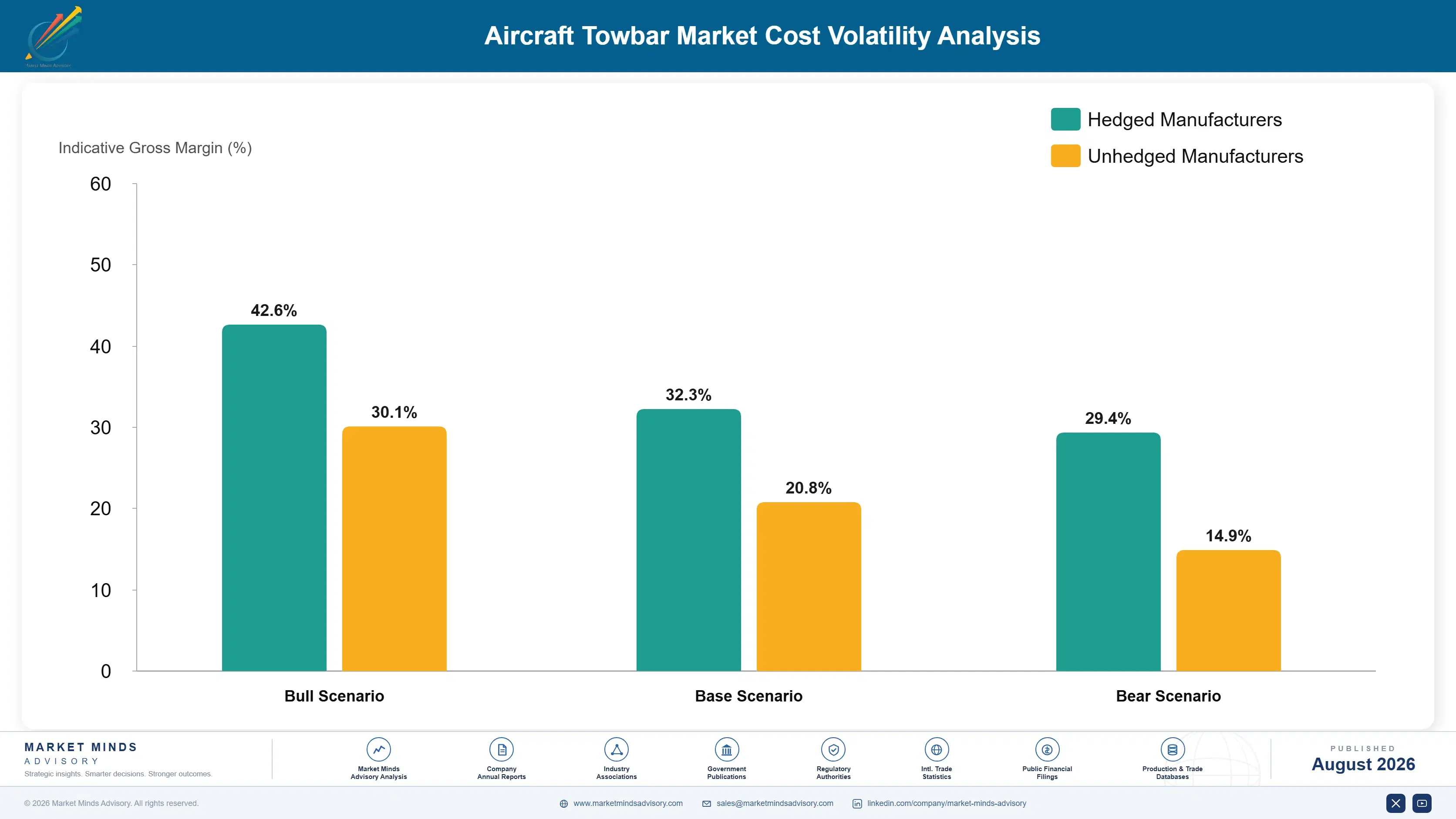
What A Certified Towbar Costs

Unit cost divides into four components across a typical certified towbar. The type-specific head absorbs roughly 58% of total cost, covering machined interface fittings, the shear device and its calibration. Bar structure, steel or aluminium fabrication and finishing run near 21%, certification, load testing and documentation near 13%, and assembly labour accounts for the remaining 8%.
Steel and aluminium movement through 2021 and 2022 showed how directly the bar structure responds to commodity conditions. Input prices rose sharply, manufacturers on fixed-price supply absorbed it and those without passed it through, and the gap persisted for two years afterwards. JBT and Curtiss-Wright both discussed input cost and supply chain pressure across that period in their annual reporting. The head component moved far less, because machining and certification dominate its cost rather than raw material.

Exposure varies by catalogue breadth and by manufacturing footprint. A manufacturer supporting many aircraft types carries tooling, inventory and certification cost across dozens of low-volume variants, while one supporting few carries far less overhead against a narrower addressable market. Manufacturers sourcing fabrication in Eastern Europe or South Asia hold cost positions Western European fabrication cannot match on the bar structure portion of the product.
aircraft-towbar-market-cost-volatility-analysis-1787982838624

Modular bar structures with interchangeable certified heads

Separating a common bar from interchangeable heads consolidates fabrication onto shared tooling and cuts inventory carrying cost substantially across a broad catalogue. Customers benefit as well, buying one bar and several heads instead of several complete units. The certification work required to approve the interface as a common element is what deters most manufacturers from attempting it at all.

Offshore bar fabrication with domestic head machining

The bar structure is fabricated steel or aluminium with no type-specific certification attached, so it moves offshore readily. The head carries the certification and the precision machining, and manufacturers generally keep it close to their approval authority. Splitting the two captures the cost advantage without moving the part that certification actually covers at all.

Catalogue rationalisation against installed base thresholds

Supporting an aircraft type whose installed base cannot cover its certification and tooling cost loses money on every unit sold, and manufacturers frequently maintain such variants for reasons of catalogue completeness alone. Setting a minimum installed base threshold before certifying a new head removes that loss. Withdrawing existing variants is considerably harder than declining new ones.

Portfolio Architecture for Margin Defence

The portfolio separates by whether towbarless equipment can reach the customer. Narrowbody and widebody commercial towbars form the volume core: high unit values, recognisable customers, and exposure to displacement that takes the highest value work first. Manufacturers hold this business because it carries the volume that funds fixed cost and because the certification breadth it requires is exactly what mixed-fleet operators consolidate around. Nobody enjoys it.
Margin concentrates where volumes per variant are low and competition is thin. Military, special purpose and rotorcraft interfaces are certified against small installed bases, priced accordingly, and rarely attract the price competition that commercial work does. The tension is that these variants carry the same certification and tooling cost as high-volume ones, so a catalogue too weighted toward them loses money on overhead the volume business would otherwise absorb.

The most defensible position is general aviation, and it is defensible for a reason nothing can change. Towbarless equipment cannot justify itself at the movement rates a corporate hangar generates, so no amount of technology development threatens that demand. Manufacturers weighted there carry growth and no displacement risk simultaneously, which is a rare pairing.

Volume / Commodity-Adjacent

Standard narrowbody and widebody commercial towbars sold to airlines and handling companies. Range spans six points because approved supplier standing defends price where unbranded competition otherwise compresses it to fabrication economics.
Gross Margin: 14-20%

Premium / Certified

Military, special purpose and rotorcraft towing interfaces certified against small installed bases. Range spans eight points because certification and tooling cost is carried across variant volumes that differ enormously between aircraft types.
Gross Margin: 22-30%

Sustainability / Regulatory / Next-Generation

Business aviation towbars, electric tug interfaces and instrumented load-monitoring designs. Range spans ten points because instrumented products earn considerably more than conventional ones while sharing much of the same structure.
Gross Margin: 26-36%
aircraft-towbar-market-portfolio-architecture-1787982839126

High-value Sub-segments and Strategic Watch-out

Business and General Aviation

High value and high growth at 6.6%, protected permanently because towbarless equipment cannot justify itself at corporate hangar movement rates. The eight point range separates branded certified products from the unapproved copies competing beneath them. Nothing currently in development changes that position in any way.
Gross Margin: 28-36%

Regional and Turboprop

High value with moderate growth at 5.4%, driven by secondary airport openings specifying conventional equipment as a matter of course. The six point range reflects how thinly each head variant is spread across a small operator population. A single fleet change removes a variant entirely.
Gross Margin: 22-28%

Narrowbody Commercial

The volume core funding most manufacturers' fixed cost and certification overhead. Displacement has not yet reached it meaningfully, since towbarless equipment justifies itself on widebody movements first, but the direction of travel is entirely clear. The eventual direction of travel here is not remotely ambiguous.
Gross Margin: 14-20%

Widebody Commercial

The strategic watch-out rather than a growth pool. Towbarless tractors take widebody work first because hub movement rates justify the equipment there, and this is the highest unit value conventional towing that any manufacturer currently holds. Losing that first is the worst possible order to lose in.
Gross Margin: Variable

Why Operators Buy One Each

Demand is generated by fleet composition rather than by activity, which makes it unusually predictable. Every aircraft type an operator flies requires a head certified to its nose gear, so adding a type adds a purchase whether or not the operator adds capacity. A fourteen year service life then produces a replacement obligation on a known schedule. Traffic can collapse, as it did in 2020, and the requirement barely moves.
Stickiness comes from approved supplier lists rather than from any product attachment. Airlines and handling companies maintain lists that take time and documentation to enter, and once a manufacturer is on one it stays there through several replacement cycles because removing it requires a reason. Mixed-fleet operators are stickier still, since consolidating certified coverage with one supplier is why they chose it in the first place.

Buyer profiles are diverging in a way that suits some manufacturers and not others. Large hub handling companies are moving toward towbarless equipment and buying fewer towbars each year. Fixed base operators and flight departments are buying more, driven by fleet growth and electric tug adoption. A manufacturer serving both watches one group shrink while the other expands, and few have rebalanced deliberately.
aircraft-towbar-market-end-use-penetration-index-1787982839612

Where Towbar Makers Should Focus

These are among the four positions where our research anticipates prominent divergence between winners and laggards over the coming forecast period. Each is grounded in the demand model, the regulatory perimeter, and the announced capacity pipeline.
01 / MODULAR HEAD ARCHITECTURE

Separate the certified head from the common bar

A catalogue supporting many aircraft types runs dozens of low-volume variants, each carrying its own tooling, inventory and certification burden across very few units actually sold. Separating a common bar structure from interchangeable certified heads consolidates all fabrication onto shared tooling and cuts inventory carrying cost by 30% to 40% across any broad catalogue. Customers benefit directly from it as well, since a mixed-fleet operator buys one bar and several heads rather than several complete and largely duplicated units instead.
02 / RECERTIFICATION REVENUE CAPTURE

Keep the inspection work across fourteen years of life

A towbar carries a fourteen year service life with periodic load testing and shear device inspection, and most manufacturers hand that work to independent shops or to the operator's own maintenance organisation without much thought. Retaining it generates recurring revenue worth roughly 45% of the original unit price across the asset life, and it holds the relationship until replacement finally arrives. Establishing approved inspection capability costs comparatively little, and manufacturers decline it because they think of themselves as fabricators rather than service providers.
03 / CATEGORY WEIGHTING SHIFT

General aviation is the demand displacement cannot reach

Business and general aviation grows at 6.6%, half again the market rate of 4.4%, and it faces no towbarless threat because the equipment economics never work at corporate hangar movement rates whatever anybody eventually builds. Unit prices are lower and volumes considerably higher, and the buyer is far less price-sensitive since the towbar sits beside an aircraft worth thousands of times more. Manufacturers weighted toward commercial narrowbody work carry displacement risk they could reduce by simply redirecting catalogue investment instead.
04 / LOAD DOCUMENTATION DISCIPLINE

Make the invisible safety function visible to procurement

Buyers compete towbars purely on price against products whose shear devices are calibrated to different tolerances or, in the case of the unapproved copies, never calibrated at all by anybody whatsoever. Supplying individual load test certification and shear calibration records with every single unit converts an invisible safety function into a documented one that procurement is then obliged to evaluate properly. Manufacturers doing this consistently report some 12% to 18% price realisation above unbranded competition on otherwise entirely identical tenders.

Engagement Snapshot From the Field

A live engagement with an industry participant carrying material or product regulatory and market exposure ahead of a defining policy shift, showing how our research translates into a defensible multi-year portfolio strategy.
MARKET MINDS ADVISORY · CLIENT ENGAGEMENT SUMMARY
Aircraft Towbar Producer Strategic Portfolio Review and Transition Roadmap 2026·Investment Scenario on Aircraft Towbar Exposure Evaluation 2025-26
CLIENT PROFILE
A European manufacturer of aircraft towbars and associated ground support equipment, holding certified head coverage across a broad range of commercial, regional and military aircraft types, and selling principally to airlines and handling companies. Revenue had been flat for four years while catalogue breadth expanded, and management could not establish whether the additional certified variants were contributing anything at all.
STRATEGIC CHALLENGE
The board needed to understand why a widening catalogue had produced no revenue growth, and whether towbarless displacement at hub customers explained the pattern or merely accompanied it. It also had no view on the aftermarket, having always handed recertification and load testing to independent inspection shops without considering whether that work was worth retaining.
MMA APPROACH
MMA rebuilt contribution by head variant, attributing tooling, inventory, certification and support cost to each, and separated demand change at hub customers from demand change at regional and general aviation customers. Expert interviews with handling companies, fixed base operators and inspection shops established what recertification work was worth and what approved capability would cost to establish.
KEY FINDINGS
  1. Nineteen of sixty-four certified head variants had sold fewer than four units in three years, and each carried tooling and certification cost that no realistic volume could ever recover.
  2. Revenue at hub handling customers had fallen 22% across four years while regional and general aviation revenue rose 31%, and the two movements had almost exactly cancelled each other out.
  3. Recertification and load testing across the installed base was worth an estimated 41% of original unit value, all of it flowing to independent shops the client had never regarded as competitors.
  4. The client held no business aviation catalogue at all, despite that category growing fastest and facing no towbarless displacement threat of any kind whatsoever.
CLIENT PROFILE
A European manufacturer of aircraft towbars and associated ground support equipment, holding certified head coverage across a broad range of commercial, regional and military aircraft types, and selling principally to airlines and handling companies. Revenue had been flat for four years while catalogue breadth expanded, and management could not establish whether the additional certified variants were contributing anything at all.
STRATEGIC CHALLENGE
The board needed to understand why a widening catalogue had produced no revenue growth, and whether towbarless displacement at hub customers explained the pattern or merely accompanied it. It also had no view on the aftermarket, having always handed recertification and load testing to independent inspection shops without considering whether that work was worth retaining.
MMA APPROACH
MMA rebuilt contribution by head variant, attributing tooling, inventory, certification and support cost to each, and separated demand change at hub customers from demand change at regional and general aviation customers. Expert interviews with handling companies, fixed base operators and inspection shops established what recertification work was worth and what approved capability would cost to establish.
KEY FINDINGS
  1. Nineteen of sixty-four certified head variants had sold fewer than four units in three years, and each carried tooling and certification cost that no realistic volume could ever recover.
  2. Revenue at hub handling customers had fallen 22% across four years while regional and general aviation revenue rose 31%, and the two movements had almost exactly cancelled each other out.
  3. Recertification and load testing across the installed base was worth an estimated 41% of original unit value, all of it flowing to independent shops the client had never regarded as competitors.
  4. The client held no business aviation catalogue at all, despite that category growing fastest and facing no towbarless displacement threat of any kind whatsoever.
RECOMMENDED STRATEGY
Phase 1: Phase one: withdraw the nineteen loss-making head variants and set a minimum installed base threshold before certifying any further aircraft types. Phase 2: Phase two: establish approved inspection and recertification capability, recovering aftermarket revenue currently flowing entirely to independent inspection shops elsewhere instead. Phase 3: Phase three: develop a business aviation head range, entering the only category that carries growth without any displacement exposure attached.
OUTCOME
The client reported gross margin improving 4.7 points within five quarters (client-reported, unverified by MMA), with roughly two thirds attributable to variant withdrawal. Recertification revenue reached 9% of total sales in the first full year of approved capability. The business aviation range entered certification during the fourth quarter of the review period.

Frequently Asked Questions

Foundational context covering the market sizes, CAGR, scope, country, region and competition that inform every finding below. This section is provided to cover basics and most often pre-purchase conversations, answered from the MMA Primary Research Dataset.

What is the current size of the Aircraft Towbar Market?

The market is valued at USD 0.3 billion in 2025, measured as revenue from conventional aircraft towbars, type-specific heads and associated inspection and recertification services worldwide.

How large will the Aircraft Towbar Market be by 2036?

MMA forecasts USD 0.48 billion by 2036, up from USD 0.31 billion in 2026. That represents incremental revenue of USD 0.17 billion and an expansion multiple of 1.55 times.

What is the CAGR for the Aircraft Towbar Market 2026 to 2036?

The base case CAGR is 4.4%, with a bull case of 5.6% and a bear case of 3.2%. Business aviation growth and secondary airport openings offset displacement at major hubs.

Which segment is growing fastest?

Business and general aviation grows at 6.6%, half again the market rate of 4.4%. Towbarless equipment cannot justify itself at corporate hangar movement rates at any price.

Who are the major companies in the Aircraft Towbar Market?

Hydro Systems, Tronair, Aero Specialties, TLD Group and Textron Ground Support Equipment lead on towbar unit revenue, holding around 52% between them across the market.

Which country is growing fastest?

India grows fastest at 6.4%, driven by regional connectivity expansion opening airports that previously handled no scheduled traffic at all. North America holds the largest regional share.

Report Segmentation Architecture

The full report scope spans multiple orthogonal segmentation dimensions, with cross-tabulated demand data provided for each dimension pair. Coverage extends further to regional breakdowns, trend trajectories, and the competitive detail needed to support segment-level decision-making.

By Aircraft Category

  • Narrowbody Commercial
  • Widebody Commercial
  • Regional and Turboprop
  • Business and General Aviation
  • Military Fixed Wing
  • Rotorcraft and Special Purpose

By End-Use Industry

  • Commercial Airlines
  • Ground Handling Companies
  • Fixed Base Operators
  • Airport Operators
  • Military Air Forces
  • Maintenance and Overhaul Facilities

By Commercial Dimension

  • Original Equipment Sale
  • Aftermarket Head Replacement
  • Rental and Pooling Arrangements
  • Airport Operator Procurement
  • Distributor and Dealer Sales
  • Certification and Inspection Service

By Region

  • North America
  • Western Europe
  • East Asia
  • South Asia and Pacific
  • Latin America
  • Middle East and Africa
  • Eastern Europe

Scope, Methodology, and Coverage

Every figure in this report is reproducible from documented input assumptions. The scope below maps the historical period, the forecast horizon, the segmentation dimensions, and the countries covered, alongside the underlying primary and qualitative methodology.
Historical Period
2020 to 2025
Forecast Period
2026 to 2036
Base Year
2025 (USD billions; MMA Primary Research Dataset, August 2026)
Market Definition
Revenue from conventional aircraft towbars and towing interface assemblies connecting a tug to an aircraft nose or main landing gear, spanning narrowbody, widebody, regional, business and general aviation, military fixed wing and rotorcraft applications, and including type-specific heads, shear protection devices, and associated inspection and recertification services. Tugs and tractors themselves, towbarless handling systems, aircraft jacking and lifting equipment, and general purpose ground support equipment not used for aircraft towing are excluded from scope.
Quantitative Units
USD billions, towbar unit and service revenue
Segmentation Dimensions
Aircraft category, end-use operator industry, commercial supply dimension, region
Regions Covered
North America, Western Europe, East Asia, South Asia and Pacific, Latin America, Middle East and Africa, Eastern Europe
Countries Covered
United States, Germany, United Kingdom, France, China, Japan, South Korea, India, Australia, Brazil, Mexico, United Arab Emirates, Poland
Key Companies Profiled
Hydro Systems, Tronair, Aero Specialties, TLD Group, Textron Ground Support Equipment, Eagle Tugs, Lektro, JBT AeroTech, Douglas Equipment, Goldhofer
Quantitative Methodology
Primary survey, n=3,800 respondents, Q4 2025, six countries; demand-side model with trade association cross-validation
Qualitative Methodology
47 expert interviews, Q4 2025; applied to validate demand model assumptions, identify emerging dynamics, and assess competitive positioning
Report Format
PDF and XLSX data workbook (Word format preview document)
Publisher
Market Minds Advisory
Report Code
MMA-2026-CON-221
Published
August 2026
Contact
sales@marketmindsadvisory.com | www.marketmindsadvisory.com

Purchase the full Aircraft Towbar Market Report (2026 to 2036).

The full report treats the aircraft towbar as a certified safety component rather than a fabricated commodity, and shows where that distinction is worth money. It decomposes unit cost between the type-specific head and the common bar structure, quantifies recertification revenue across a fourteen year service life, and models towbarless displacement by aircraft category and airport movement rate. Segment analysis covers all six aircraft categories, with particular attention to why general aviation carries growth that displacement cannot reach at any price. Competitive assessment ranks twenty manufacturers on towbar unit revenue across every operating region worldwide.
Six aircraft category segmentation with growth rates
Unit cost split between head and bar structure
Twenty manufacturer assessment on towbar revenue
Towbarless displacement modelled by movement rate
Recertification revenue across full service life
Head variant contribution against installed base thresholds

Built For The People Who Decide

From boardroom strategy to bench-side execution, this report is read cover-to-cover by leaders shaping the next decade of their industry, turning demand scenarios, market dynamics and valuation benchmarks into decisions.
CXOs/ Presidents/ VPs/ Managers
M&A and Corporate Development
Strategy Teams and R&D Heads
Procurement and Product Directors
Regulatory and Compliance Leaders
Investor Relations and Equity Analysts