Market Minds Advisory
Aircraft Refurbishing Market

Aircraft Refurbishing Market: Cabin Retrofit Demand and the Freighter Conversion Boom

Aircraft refurbishing now spans a passenger cabin retrofit cycle driven by airline connectivity upgrades and a booming passenger-to-freighter conversion segment fed by e-commerce demand, straining certified technician capacity and specialized parts supply simultaneously.

Lead Analyst

David Horsley

Published

September 2026

Make Smarter Decisions with Customized Research Insights

Request a free sample report and evaluate market opportunities, growth trends, and competitive dynamics relevant to your business needs.

2025 MARKET VALUE$6.2BMarket Size 2025
2036 FORECAST VALUE$12.4BBase Case , 2026 to 2036
CAGR 2026 TO 20366.5 %Bull 7.8% / Bear 5.2%
INCREMENTAL OPPORTUNITY$5.8BNet 10- year value creation
EXPANSION MULTIPLE1.88x2036 value over 2026 base
Strategic Levers
M&A Pipeline
Regional Outlook
Country Rankings
Competitive Intelligence
Segmental Deep-dive
Call-Us : 91 93563 13602

Executive Snapshot and Market Trajectory

Aircraft operators are commissioning cabin retrofits and freighter conversions faster than certified maintenance providers can expand technician capacity, creating a widening backlog that is extending typical project turnaround times across major refurbishment centers. Few providers currently serve both priorities equally well. Internal teams report resourcing tension.
Cargo conversion and avionics retrofit work are pulling category growth well ahead of traditional cabin interior and paint refurbishment, as e-commerce driven freighter demand and airline connectivity upgrades outpace routine appearance-focused refurbishment cycles. North America commands the largest share on established MRO infrastructure depth, while China scales fastest as its aviation fleet and domestic MRO capacity expand from a smaller current base. That base continues expanding steadily each year.
Competitive structure remains fragmented among specialized refurbishment providers and major MRO divisions of airlines and manufacturers, with the top five holding modest combined share. Technician certification bottlenecks and specialized parts sourcing constraints are compounding capacity pressure, pushing larger providers toward vertical integration into parts manufacturing and technician training programs rather than relying on external sourcing alone. Rankings among established providers could shift meaningfully as this pressure intensifies further. Timing matters especially greatly here.
Market Definition
The aircraft refurbishing market covers commercial aircraft cabin interior, avionics and systems, structural and airframe, seating and upholstery, paint and livery, and cargo conversion refurbishment services performed on in-service aircraft. It excludes new aircraft manufacturing and excludes routine line maintenance and scheduled inspections not involving material refurbishment or configuration change.
Base Year Value
$6.2B in 2025 (MMA Primary Research Dataset, August 2026)
Forecast Period
2026 to 2036, eleven discrete annual values
CAGR
6.5% base case. Bull 7.8%. Bear 5.2%.
Fastest Growth Segment
Cargo Conversion and Configuration Change: 9.2% CAGR
Fastest Growth Country
China: 8.8% CAGR
Fastest Growth Region
South Asia and Pacific: 8.6% CAGR
Largest Region
North America: 29% of 2025 global value
Market Leaders
AAR Corp, Lufthansa Technik, ST Engineering (ST Aerospace), HAECO Group, and Delta TechOps. Source: MMA Analysis based on company annual reports.
Primary Survey
n=3,800 procurement and R&D decision-makers, Q4 2025, six countries
Methodology
Demand-side build-up, cross-validated against public data, 47 expert interviews

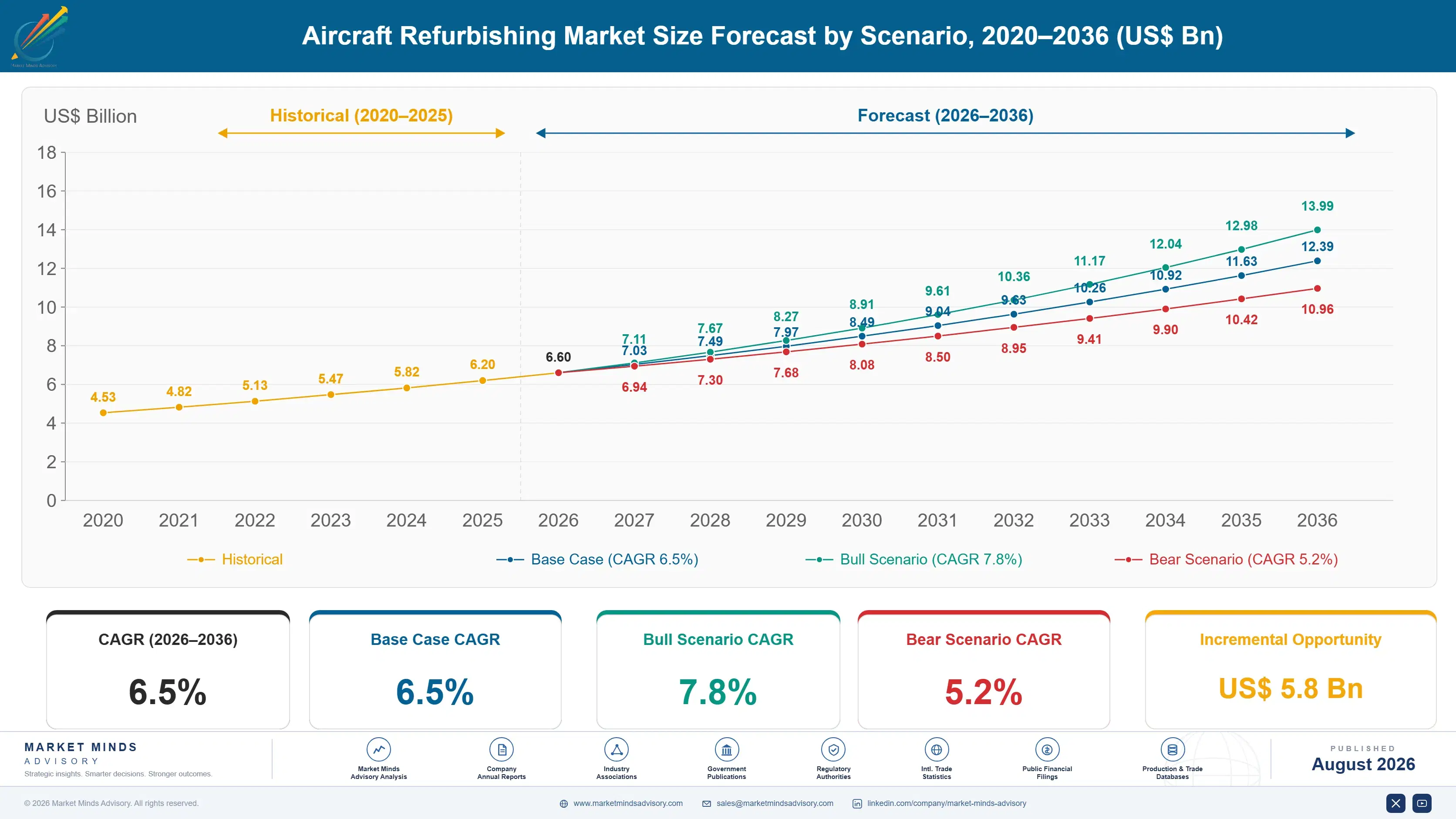
Aircraft Refurbishing Market Forecast Scenarios

aircraft-refurbishing-market-size-forecast-scenario-1787464296798
Between 2020 and 2025 the market grew at a historical pace of roughly 5.5 percent annually, as airline fleet refurbishment activity recovered from pandemic-era deferral while passenger-to-freighter conversion demand began accelerating meaningfully only in the final two years of the period as e-commerce logistics capacity requirements intensified. Recovery in project booking pace only became evident in the final year of this period.
The base case assumes growth near 6.5 percent annually through 2036, anchored in three commercial mechanisms: continued passenger-to-freighter conversion demand driven by e-commerce logistics capacity requirements, airline cabin retrofit cycles favoring connectivity and premium seating upgrades to compete for corporate and premium leisure travelers, and aging global fleet composition requiring structural and systems refurbishment to extend service life economically. These mechanisms reinforce each other as airlines and lessors coordinate around shared capacity planning.
A bull scenario builds on accelerated e-commerce logistics growth pushing freighter conversion demand well beyond current projections, while a bear scenario centers on certified technician shortages and specialized parts supply constraints extending project timelines and compressing provider margins across the industry. Several providers are already preparing contingency capacity plans should either scenario materialize. Several providers report this exposure as a top strategic planning concern currently.

Capacity Constraints Racing Refurbishment Demand

Three forces are converging on the category at once: airlines are commissioning cabin retrofits to compete on connectivity and premium seating experience, logistics operators are converting aging passenger aircraft into freighters to meet e-commerce capacity demand, and certified technician capacity constraints are extending project timelines across nearly every major refurbishment center globally. This convergence is compressing decision timelines that once unfolded over multiple planning cycles.
MARKET CONCENTRATIONCR5 28%top five providers hold a modest combined share
AVERAGE PROJECT DURATION45-90 daystypical turnaround time for cabin interior refurbishment overall
LEADING PRODUCING COUNTRYUnited Stateslargest single national refurbishment capacity and revenue base
CERTIFIED TECHNICIAN UTILIZATION88-94%typical capacity utilization across major refurbishment facilities today
FREIGHTER CONVERSION BACKLOG34 monthstypical wait time for freighter conversion program slots
SPECIALIZED PARTS COST SHARE39% of COGScertified aerospace components as portion of total project cost
Commercially the category increasingly behaves like a capacity allocation business rather than a straightforward service purchase, since an operator's ability to secure a refurbishment slot now depends as much on relationship depth and advance booking timing as on price, a shift that is rewarding providers with established airline and lessor relationships over newer entrants without comparable booking pipelines. Operators increasingly select providers based on demonstrated delivery reliability alone.
Over the next decade, providers most likely to capture disproportionate value are those investing in technician training pipelines and vertical integration into specialized parts supply, since capacity expansion through these channels takes considerably longer to build than the demand growth currently outpacing available refurbishment slots industry wide. Providers slow to invest risk losing project awards to better-prepared competitors.
"Airlines aren't shopping for the cheapest refurbishment anymore. They're shopping for whoever has an open bay in the next eighteen months, and that list keeps getting shorter."
Director, Aviation Services and MRO Practice · MMA Aviation Maintenance / Aircraft Interior and Systems Refurbishment Practice · August 2026

Market Trends

Passenger-to-Freighter Conversion Demand Scaling Rapidly Worldwide

Logistics operators and leasing companies are converting aging narrow-body and wide-body passenger aircraft into dedicated freighters at an accelerating pace, driven by sustained e-commerce logistics capacity requirements that new freighter aircraft production alone cannot economically satisfy. Several major conversion providers have expanded certified conversion program capacity within the past two years, signaling the segment has moved beyond a niche specialty into a core growth category for the broader refurbishment industry. Conversion program backlogs now extend beyond thirty months at several leading providers, reflecting demand that continues outpacing available certified conversion capacity across the industry.
Market Impact: Sustains 12% freighter conversion demand growth
Cabin Connectivity Retrofit Becoming Competitive Necessity

Airlines are increasingly retrofitting existing fleet with satellite connectivity and updated in-flight entertainment systems to remain competitive on premium and corporate travel routes, following passenger expectation shifts that now treat reliable inflight connectivity as a baseline service expectation rather than a premium differentiator. This retrofit activity is occurring across aircraft that might otherwise have continued flying without cabin modification, extending the addressable refurbishment market beyond aircraft nearing scheduled heavy maintenance intervals specifically. Airlines increasingly treat connectivity retrofit as a baseline competitive requirement rather than a discretionary upgrade across their fleet planning cycles.
Market Impact: Adds 8% to structural refurbishment demand

Market Opportunities and Growth Drivers

E-Commerce Logistics Growth Sustaining Freighter Conversion Demand

Continued global e-commerce volume growth is sustaining strong demand for dedicated freighter capacity that logistics operators increasingly source through passenger-to-freighter conversion rather than waiting for new freighter aircraft production, given conversion typically delivers capacity faster and at lower capital cost than new aircraft purchase. This demand pattern is directly supporting conversion provider backlogs that extend years into the future at several leading facilities, creating a durable demand base considerably more resilient to short-term economic cycles than discretionary cabin appearance refurbishment work tied more closely to airline capital spending cycles. This resilience should continue supporting demand even during broader downturns.
Market Impact: Extends project backlogs by 8 months

Aging Global Fleet Requiring Structural Refurbishment Investment

A meaningful share of the global commercial aircraft fleet is approaching the age threshold where structural and systems refurbishment becomes more economical than continued deferral, particularly for aircraft operators facing extended new aircraft delivery backlogs from manufacturers that make near-term fleet replacement impractical. This dynamic is sustaining structural refurbishment demand even among operators that might otherwise prefer replacing older aircraft, since manufacturer delivery delays are extending the economic case for refurbishment investment across a broader share of the existing global fleet than historical patterns would suggest. Providers responding early to this dynamic capture disproportionate share of extended refurbishment program awards.
Market Impact: Delays project starts by 6 weeks

Market Restraints and Challenges

Certified Technician Shortages Constrain Capacity Expansion

The specialized certification required for aircraft refurbishment technicians, particularly for structural and avionics work, involves multi-year training and certification timelines that have not scaled fast enough to match accelerating refurbishment and conversion demand, a shortage rooted in reduced technical training program enrollment during the aviation industry's pandemic-era downturn. The commercial impact is that providers cannot always expand capacity as quickly as demand would otherwise support, extending project backlogs and occasionally forcing operators to delay planned refurbishment programs. Several larger providers are investing directly in technician training academies as a mitigation path, though building meaningful capacity typically requires years.
Market Impact: Lifts freighter conversion volume by 15%

Specialized Parts Supply Constraints Limit Project Throughput

Certified aerospace-grade components required for refurbishment projects, including seating structures, avionics hardware, and structural repair materials, face periodic supply constraints tied to concentrated manufacturing capacity among a limited number of certified suppliers relative to accelerating industry-wide demand. The commercial impact is that parts availability increasingly determines project scheduling as much as technician capacity, occasionally forcing providers to delay project starts pending component delivery. Larger providers are increasingly securing long-term supply agreements directly with parts manufacturers as a mitigation path, a capability smaller independent refurbishment shops often cannot negotiate on comparable terms.
Market Impact: Adds 10% to connectivity retrofit demand
3 additional market trends, 4 additional growth drivers, and 3 additional restraints and challenges are covered in the full report. Contact sales@marketmindsadvisory.com to access the complete intelligence.

Segment CAGR and Growth Architecture

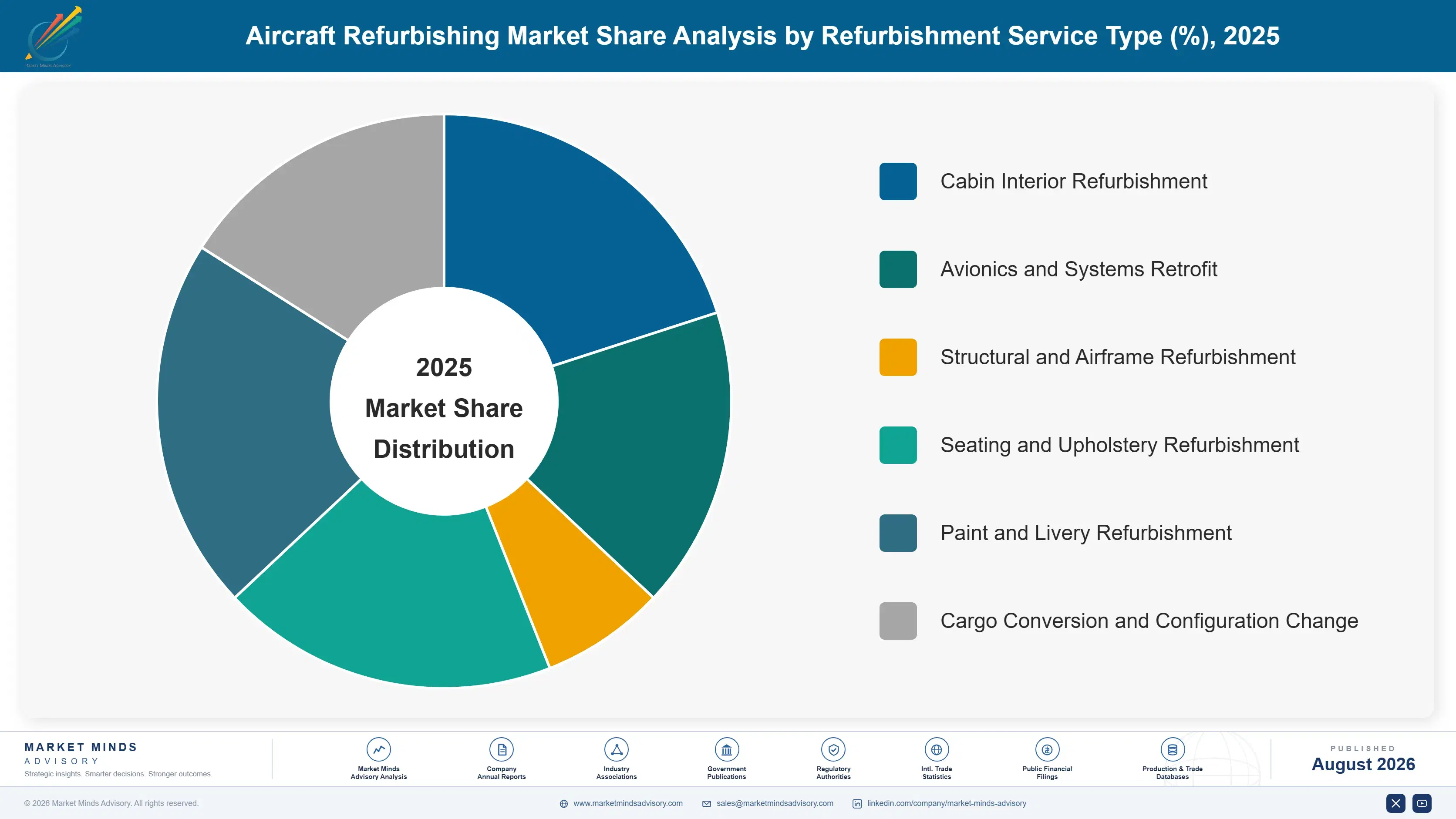
Segmentation follows refurbishment service type, since cabin interior, avionics and systems, structural and airframe, seating and upholstery, paint and livery, and cargo conversion work each require distinct certifications, facility capabilities, and project timelines despite often being performed on the same aircraft during a single maintenance visit. Certification pathways differ enough between these types that substitution remains limited.
aircraft-refurbishing-market-market-share-analysis-1787464297351

Cargo Conversion and Configuration Change

Cargo conversion is growing fastest as sustained e-commerce logistics demand drives passenger-to-freighter conversion volume that new freighter aircraft production cannot economically satisfy on its own. This segment requires specialized structural certification and main deck cargo door installation capability that relatively few providers globally maintain, concentrating this high-value work among a small number of certified conversion specialists. Conversion program backlogs extending years into the future at leading providers reflect demand considerably outpacing available certified capacity, creating sustained pricing power for providers with established conversion program certifications and proven delivery track records with major logistics operator customers. Larger providers are increasingly pursuing additional aircraft type certifications to capture more of this expanding demand.
CAGR 9.2%

Avionics and Systems Retrofit

Avionics and systems retrofit is the second fastest growing segment, driven by airline connectivity upgrades and regulatory-driven systems modernization requirements that extend beyond routine scheduled maintenance intervals. This segment requires specialized electronics certification and integration capability that differs meaningfully from the structural and interior refurbishment skills most traditional refurbishment providers historically maintained, creating a distinct competitive requirement for providers seeking to serve this growing segment. Providers with established avionics integration capability are capturing disproportionate share of connectivity retrofit programs as airlines increasingly prioritize this upgrade category. Several traditional providers are investing in electronics engineering talent to compete more effectively in this growing segment. This trend is expected to continue as connectivity becomes an even larger share of overall retrofit spending.
CAGR 8.5%
Full segment breakdown across 6 segments available in the complete report.

Regional Architecture and Country Demand Map

North America leads on established MRO infrastructure depth and refurbishment revenue, Western Europe follows closely, while South Asia and Pacific scales fastest as regional fleet and MRO capacity expand from a smaller current base. with other regions contributing smaller but steadily expanding shares overall. overall.

North America

United States refurbishment providers anchor regional revenue, supported by the world's largest commercial aircraft fleet and an established network of certified refurbishment facilities serving both domestic carriers and international customers seeking North American certification credentials. Freighter conversion capacity is concentrated here given proximity to major e-commerce logistics operators requiring dedicated cargo capacity. Canada follows similar demand patterns at smaller scale, relying partly on the same North American provider base serving both markets. Federal Aviation Administration certification standards shape provider qualification requirements that increasingly influence practices accepted in other consuming regions as well. Distributors increasingly favor providers who can document full delivery reliability transparently. These relationships increasingly determine which providers win the most attractive long-term contracts.
Share: 29% | CAGR: 6.9% (2026 to 2036)

Western Europe

Germany, France, and the United Kingdom anchor regional demand, supported by established aerospace manufacturing and MRO infrastructure serving both European carriers and international customers valuing European Union Aviation Safety Agency certification credentials. Lufthansa Technik's extensive refurbishment network gives Germany particular influence on regional capacity and pricing dynamics relative to other European markets. Aging European fleet composition continues supporting steady structural refurbishment demand, even as airlines balance refurbishment investment against long-term fleet replacement decisions amid extended new aircraft delivery backlogs. Regional carriers increasingly coordinate refurbishment scheduling with lessors to minimize aircraft downtime. This coordination is expected to deepen further as fleet planning horizons continue lengthening. Premium aerospace brand positioning continues reinforcing this regional differentiation strategy.
Share: 23% | CAGR: 5.0% (2026 to 2036)
Regional intelligence for 5 additional markets available in the complete report: East Asia, South Asia and Pacific, Latin America, Middle East and Africa, Eastern Europe. Contact sales@marketmindsadvisory.com.
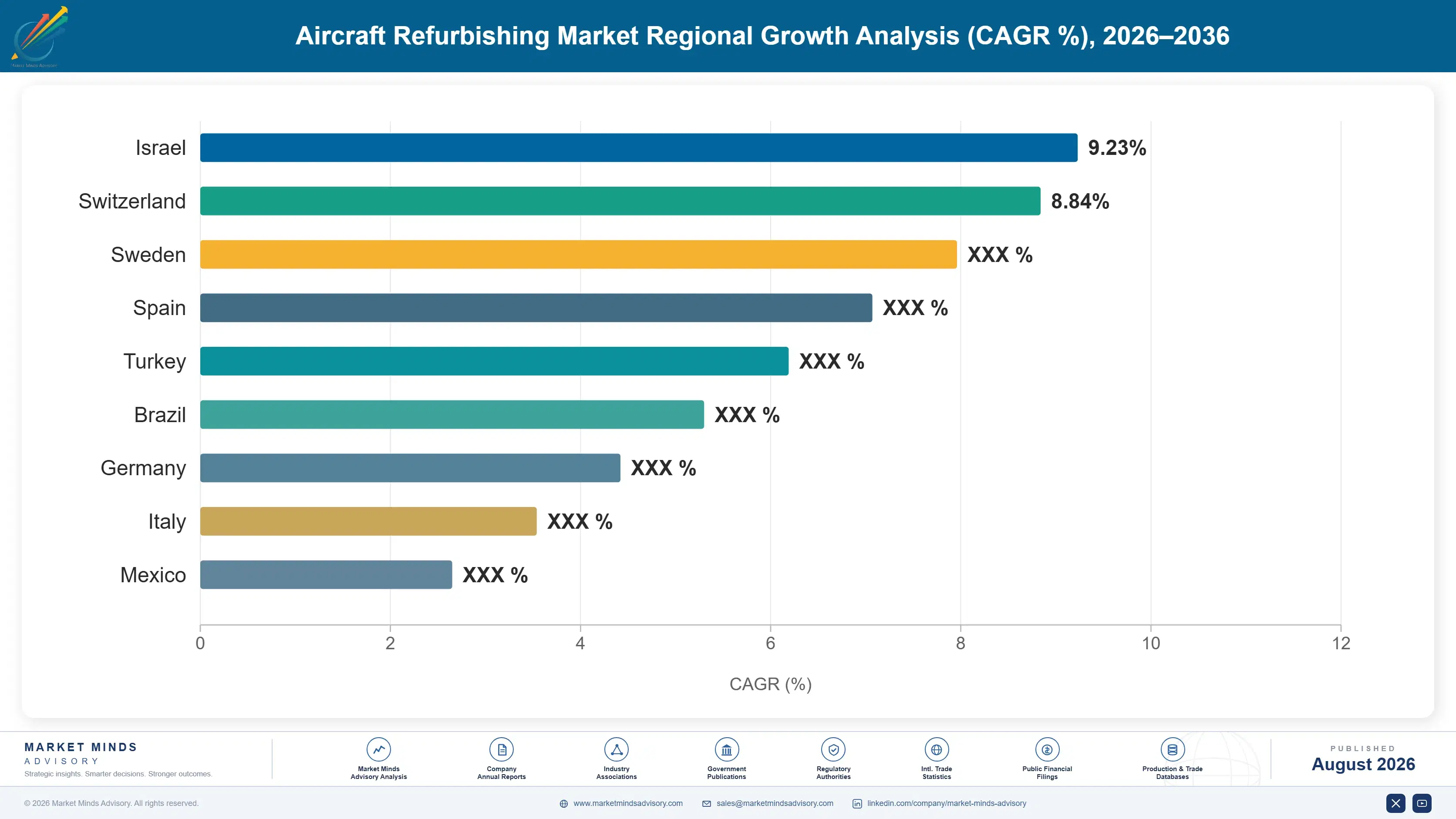
aircraft-refurbishing-market-country-cagr-analysis-1787464297889

Capacity Expansion and Vertical Integration Levers

Providers are pulling four commercial levers at once: technician training pipeline investment, specialized parts supply integration, freighter conversion certification expansion, and long-term airline relationship contracts, each addressing a distinct margin opportunity created by capacity constraints across the industry. These levers increasingly overlap, since providers pursuing training investment often simultaneously expand parts integration and certification breadth.

Dedicated Technician Training Academy Investment Program

Investing directly in technician training academies rather than relying solely on external certification pipelines allows providers to build proprietary certified technician capacity faster than competitors dependent entirely on the broader industry training infrastructure. This investment requires meaningful upfront capital and multi-year development timelines but positions providers with established academies to expand project capacity faster than competitors facing the same industry-wide technician shortage. Providers with dedicated academies report capacity expansion rates roughly 24 percent faster than competitors relying entirely on external hiring. This capacity advantage is expected to widen further as demand continues outpacing industry-wide certified technician supply.
Market Impact: Lifts capacity expansion rate by roughly 24 percent

Direct Specialized Parts Supply Agreement Investment

Securing long-term direct supply agreements with certified aerospace component manufacturers reduces exposure to the parts availability constraints that increasingly determine project scheduling across the industry, allowing providers with such agreements to maintain more predictable project timelines than competitors reliant on spot market component sourcing. This investment requires meaningful advance capital commitment but has demonstrably protected project schedules for providers with established agreements during recent supply-constrained periods. Providers without comparable agreements remain exposed to the next disruption regardless of current conditions, a risk affecting roughly 30 percent of smaller independent shops.
Market Impact: Cuts project delay risk by roughly 30 percent

Freighter Conversion Certification Program Expansion Initiative

Pursuing certification for additional aircraft types within freighter conversion programs allows providers to capture a broader share of sustained e-commerce driven conversion demand rather than remaining limited to a narrow set of already-certified aircraft types. This certification process requires substantial regulatory and engineering investment but positions providers to capture demand from logistics operators seeking conversion capacity across a wider range of existing fleet types, an expansion opportunity estimated at roughly 20 percent of currently unaddressed conversion demand. This expansion opportunity continues growing as logistics operators seek conversion capacity across broader fleet types.
Market Impact: Captures roughly 20 percent of unaddressed share overall

Long-Term Airline and Lessor Relationship Contract Development

Securing long-term refurbishment services contracts directly with major airlines and aircraft lessors, rather than competing project by project on the open market, gives providers more predictable revenue visibility and priority access to future refurbishment programs from the same customer base. This approach requires sustained relationship investment and consistent delivery performance but has enabled providers with such contracts to secure disproportionate share of repeat business from the same airline and lessor customers over successive refurbishment cycles. These relationships increasingly prove difficult for competitors to displace once established, delivering an estimated 18 percent volume advantage.
Market Impact: Secures roughly 18 percent more repeat share overall

Who Controls the Margin Pool

Concentration remains low, with the top five providers holding a combined 28 percent share on a revenue basis, reflecting a market still dominated by specialized regional refurbishment shops and airline-affiliated MRO divisions rather than large-scale global consolidation seen in some other aviation services categories. This fragmentation persists even as consolidation among larger integrated providers continues accelerating steadily.
Current competitive activity centers on three dimensions: technician training pipeline investment to expand certified capacity faster than industry-wide shortages allow, specialized parts supply integration to protect project timelines from component availability constraints, and freighter conversion certification expansion to capture sustained e-commerce driven demand growth. These three dimensions are increasingly pursued simultaneously by the largest providers competing for capacity-constrained demand.

Emerging pressure comes from logistics companies increasingly establishing direct relationships with conversion providers to secure guaranteed capacity, and from airline-affiliated MRO divisions expanding third-party refurbishment services beyond their parent carrier's fleet, threatening to redistribute share away from independent specialized refurbishment shops over the coming decade. Rankings among current leading providers could shift meaningfully as these dynamics continue playing out across the coming decade. Smaller providers face mounting pressure to specialize in defensible service niches.
aircraft-refurbishing-market-company-positioning-matrix-1787464298417

Competitive Moat and Risk Dimensions

AAR CORP

Moat: Diversified Aviation Services Scale

AAR Corp's diversified position spanning parts distribution, maintenance, and refurbishment services gives it cross-selling and supply chain advantages that narrowly focused refurbishment specialists cannot easily replicate, supporting deeper customer relationships across multiple service categories simultaneously. This cross-selling advantage is difficult for narrowly focused competitors to replicate quickly.
AAR CORP

Risk: Exposure to Aviation Cycle Risk

AAR Corp's diversified aviation services exposure means broader industry downturns affecting airline capital spending can simultaneously pressure multiple business lines, a concentration risk that more narrowly focused freighter conversion specialists facing more resilient demand patterns do not share to the same degree. This risk grows as broader industry capital spending cycles continue affecting multiple service lines simultaneously across the portfolio.
LUFTHANSA TECHNIK

Moat: Established European Certification Credibility

Lufthansa Technik's decades of established European Union Aviation Safety Agency certification history and airline-affiliated engineering depth give it credibility advantages with European and international carriers that newer or smaller providers still building comparable certification track records lack. This credibility advantage is difficult for newer entrants to replicate without comparable certification history.
LUFTHANSA TECHNIK

Risk: Higher Cost Than Emerging Rivals

Lufthansa Technik's German labor and facility cost base leaves it less price competitive than lower-cost providers in Eastern Europe and Asia, a disadvantage that becomes more pronounced as price-sensitive customers represent an increasing share of overall category demand growth. This disadvantage grows as price-sensitive customers represent an increasing share of overall category demand growth.

Players Tracked

Prominent Players

AAR Corp
Lufthansa Technik
ST Engineering (ST Aerospace)
HAECO Group
Delta TechOps

Other Key Players

Duncan Aviation
Gulfstream Aerospace Completions
Sabena technics
Etihad Engineering
Turkish Technic
GAMECO (Guangzhou Aircraft Maintenance)
Aeroman
JAMCO Corporation
Diehl Aviation
Collins Aerospace
ManTech International
Precision Aircraft Solutions
Elliott Aviation
Greenpoint Technologies
Mammoth Freighters

Recent Developments

MARCH 2026

AAR Corp Expands Freighter Conversion Facility Capacity

AAR Corp commissioned expanded passenger-to-freighter conversion capacity at its Indiana facility, aimed at meeting sustained logistics operator demand for dedicated cargo capacity as e-commerce volume growth continues outpacing available conversion program slots across the industry. Additional capacity expansions are reportedly under evaluation at other facilities.
Signal: Signals continued conversion capacity investment ahead of sustained e-commerce demand growth as freighter conversion demand keeps outpacing capacity
OCTOBER 2025

Lufthansa Technik Launches Dedicated Technician Training Academy

Lufthansa Technik launched a dedicated technician training academy at its German headquarters, aiming to build proprietary certified technician capacity faster than the broader industry training pipeline can supply amid persistent technician shortages affecting refurbishment project timelines industry wide. Early graduates from the program have reportedly already entered active project assignments.
Signal: Confirms proprietary training investment accelerating as a capacity expansion strategy as technician shortages continue affecting the broader industry
JUNE 2025

HAECO Group Signs Long-Term Parts Supply Agreement

HAECO Group signed a long-term direct supply agreement with a major certified seating and cabin component manufacturer, securing preferential access to parts supply as component availability constraints continue affecting project scheduling across the broader refurbishment industry. Early results from the partnership have reportedly exceeded internal expectations.
Signal: Demonstrates vertical integration into parts supply becoming a standard capacity protection strategy as vertical integration becomes standard capacity protection

Certified Parts and Labor Exposure

Certified aerospace-grade parts and skilled technician labor together represent roughly 39 percent of cost of goods sold for aircraft refurbishment projects, sourced primarily from North American and European certified component manufacturers, with technician labor concentrated among providers' own certified workforce supplemented by specialized contract technicians during peak demand periods. with a smaller residual share of specialized labor sourced through contract staffing agencies during peak periods.
Certified seating and cabin component prices spiked sharply in 2023 following supply chain disruption affecting several major aerospace component manufacturers, a volatility event documented in International Air Transport Association industry cost reporting, extending project timelines and compressing provider margins across the industry during the disruption period. Several smaller providers reported continued delays into 2024 as component availability remained constrained longer than expected. Several carriers reported delaying refurbishment plans.

Exposure varies considerably by player type: large providers with direct component supply agreements and proprietary technician training capacity have absorbed volatility more easily than smaller independent refurbishment shops reliant on spot market parts purchasing and external technician hiring, a disadvantage that is accelerating consolidation of smaller providers into larger integrated operations. This consolidation trend is expected to continue as parts and labor volatility persists across the industry.
aircraft-refurbishing-market-cost-volatility-analysis-1787464298612

Direct Component Manufacturer Supply Agreements

Larger providers are locking in multi-year direct supply agreements with certified aerospace component manufacturers, protecting project timelines during volatility events, though this approach requires accurate long-term project pipeline forecasting that smaller providers with less established customer relationships often find difficult to commit to with confidence. Adoption of this approach has expanded meaningfully since the 2023 disruption across the industry.

Proprietary Technician Training to Reduce Labor Dependence

Investing directly in technician training academies reduces dependence on external contract technician availability during peak demand periods, though this approach requires substantial upfront capital and multi-year development timelines that smaller independent shops often cannot justify given their project volume. Several large providers have already formalized academy partnerships covering a meaningful share of their annual technician needs.

Modular Component Design for Sourcing Flexibility

Designing refurbishment programs around more widely available, less customized component specifications where certification standards permit reduces exposure to any single specialized component's supply constraints, though this approach can limit some premium customization options relative to fully bespoke cabin designs. This approach remains most common among providers serving cost-sensitive regional carrier customers. This tradeoff suits standard programs more than bespoke designs.

Portfolio Architecture for Margin Defence

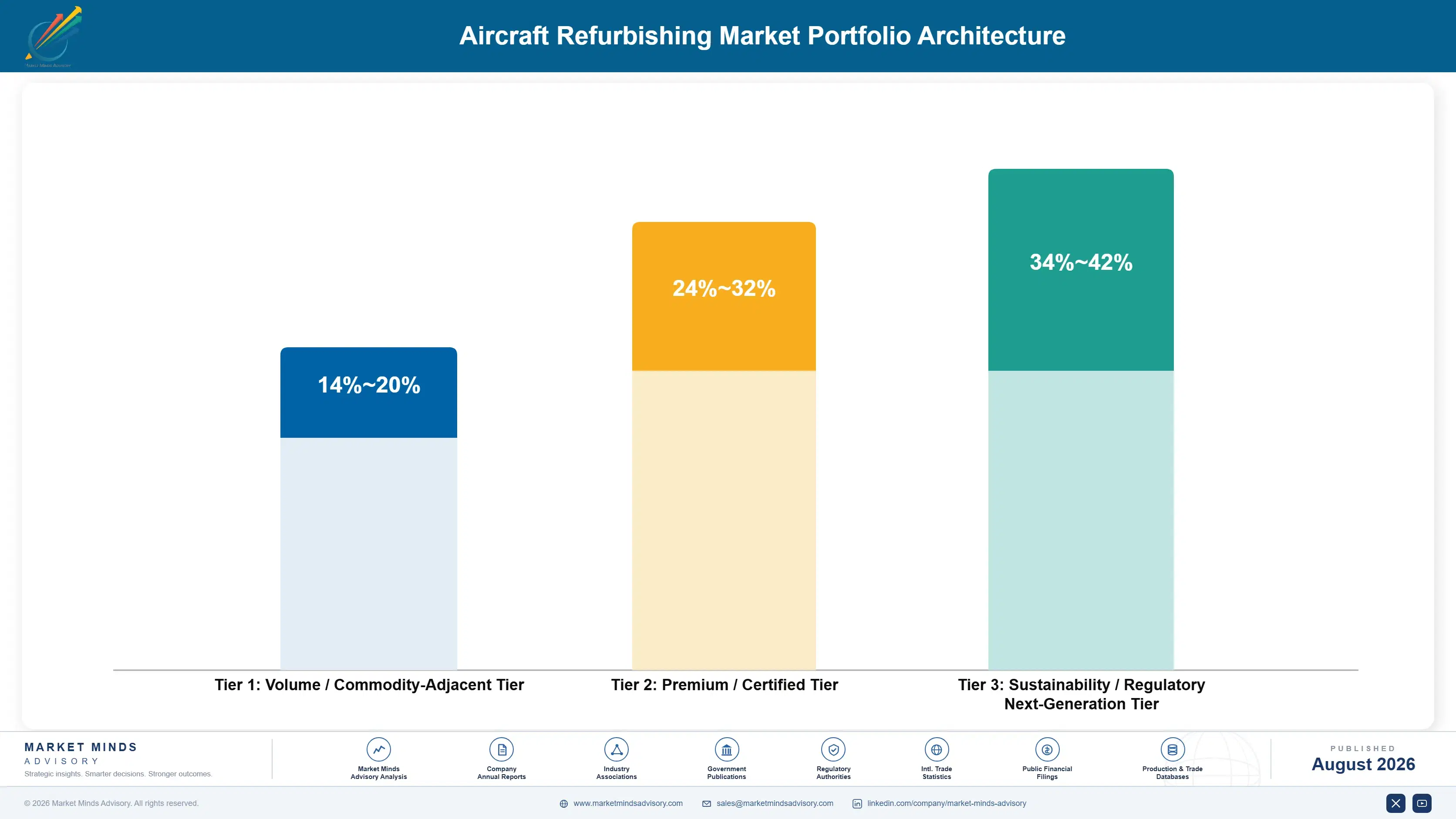
Portfolio economics split across three tiers: routine appearance-focused refurbishment competing largely on price and turnaround speed, mid-tier cabin retrofit and avionics upgrade work commanding meaningful premium pricing tied to certification depth, and freighter conversion and complex structural refurbishment capturing the highest margin as customers pay for specialized certification and proven delivery track records. This split increasingly determines which providers can access the most attractive long-term customer contracts.
The tension between volume and premium positioning is sharpest as technician and parts capacity constraints increasingly favor providers who can guarantee delivery timelines, pushing customers toward established providers with proven track records even at premium pricing rather than risking project delays with lower-cost but less proven alternatives. Providers investing early in premium tier reliability are increasingly better positioned than those competing on price alone.

High value margin pools concentrate in freighter conversion programs and complex avionics retrofit work sold directly to logistics operators and premium airline customers, where certification depth and delivery reliability limit competition to providers with established regulatory and engineering capability. Providers without comparable engineering capability increasingly risk losing access to the most attractive premium contracts entirely.

Volume / Commodity-Adjacent Tier

Routine appearance-focused refurbishment and basic seating replacement competing primarily on price and turnaround speed. Margins here depend heavily on turnaround efficiency and labor scheduling rather than on certification depth. Independent shops without scale advantages increasingly struggle to compete here.
Gross Margin: 14-20%

Premium / Certified Tier

Cabin retrofit and avionics upgrade work commanding premium pricing tied to certification depth and proven delivery reliability. Buyers in this tier increasingly require documented delivery track records and consistent scheduling reliability.
Gross Margin: 24-32%

Sustainability / Regulatory / Next-Generation Tier

Freighter conversion programs and complex structural refurbishment serving logistics operators and premium airline customers. Capacity here remains concentrated among a small number of certified providers, keeping margins durably elevated. Regulatory certification requirements increasingly shape which providers can compete for these contracts.
Gross Margin: 34-42%
aircraft-refurbishing-market-portfolio-architecture-1787464299118

High-value Sub-segments and Strategic Watch-out

Passenger-to-Freighter Conversion Programs

Scaling fastest as e-commerce logistics demand outpaces new freighter production, this segment commands the highest margins but remains constrained by limited certified conversion capacity across current industry providers. Providers investing early in certification breadth are best positioned to capture this accelerating demand curve. Utilization keeps climbing across facilities.
Gross Margin: 36-42%

Cabin Connectivity and Avionics Retrofit

Airlines increasingly treat connectivity upgrades as competitive necessity, supporting durable pricing power for providers with established electronics integration capability over traditional interior-focused specialists. Adoption continues broadening as more airlines treat connectivity as a baseline competitive requirement. Suppliers with established electronics capability continue capturing the bulk of this opportunity.
Gross Margin: 26-32%

Standard Cabin Interior Refurbishment

The largest volume segment by project count, competing primarily on price and turnaround time across routine appearance-focused refurbishment work for mainstream fleet operators. Providers here compete mainly on turnaround speed and price rather than on technology differentiation. Pricing pressure here continues intensifying as customers bundle work with premium upgrades.
Gross Margin: 16-22%

Legacy Paint and Livery-Only Refurbishment

Facing declining relative value as customers increasingly bundle appearance work with more substantial cabin or systems upgrades, this segment requires diversification investment to avoid continued margin compression. Diversification into bundled upgrade work now offers the clearest path to sustained relevance. Providers investing now avoid the steepest margin decline.
Gross Margin: 12-18%

Fleet Lifecycle Refurbishment Economics

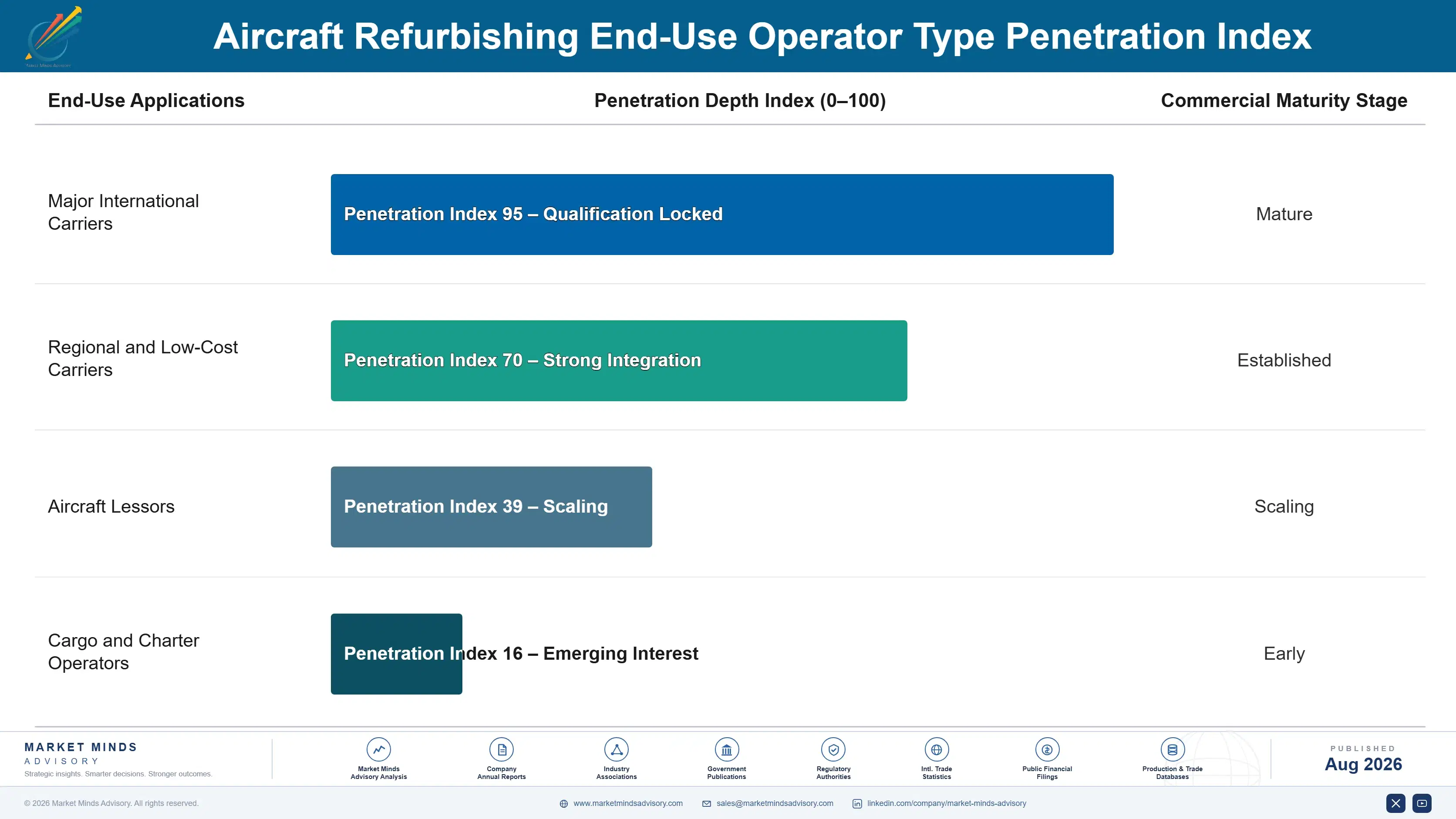
Demand in this category increasingly resembles a scheduled fleet lifecycle relationship rather than a one-time service purchase, since aircraft typically require multiple refurbishment interventions across their operational lifespan tied to maintenance intervals, ownership transfers, and eventual end-of-passenger-service conversion decisions, creating a form of recurring demand for providers embedded early in an operator's fleet management relationship. Providers embedded early in an operator's fleet management relationship capture disproportionate follow-on volume.
Adoption depth varies considerably by end use vertical: major international carriers and aircraft lessors show the deepest and most consistent investment in premium cabin retrofit and systems upgrade programs, regional and low-cost carriers show moderate but accelerating adoption tied to competitive pressure, and cargo and charter operators remain the shallowest adopters of premium cabin work, prioritizing structural and systems reliability over passenger-facing appearance investment. Cargo adoption remains more transactional.

Younger fleet management and procurement professionals entering airline and lessor organizations increasingly expect data-driven refurbishment scheduling and digital project tracking as a baseline service expectation rather than a differentiator, a generational shift that is pushing providers toward more sophisticated project management and customer communication capability over time. Providers slow to adapt risk losing relevance with this increasingly data-driven younger cohort of fleet managers.
aircraft-refurbishing-market-end-use-penetration-index-1787464299625

Where Refurbishment Provider Capital Should Concentrate

These are among the four positions where our research anticipates prominent divergence between winners and laggards over the coming forecast period. Each is grounded in the demand model, the regulatory perimeter, and the announced capacity pipeline.
01 / TECHNICIAN CAPACITY INVESTMENT

Build proprietary training capacity before the shortage deepens further

Certified technician shortages are constraining industry-wide capacity expansion faster than external training pipelines can resolve, making proprietary training academy investment a more defensible strategy than remaining dependent on the broader industry hiring pool. Providers with established academies already report meaningfully faster capacity expansion than competitors relying entirely on external hiring. This advantage compounds as demand continues outpacing industry-wide certified technician supply, an advantage that widens further as competitors delay comparable investment, leaving later movers a steeper climb back once training pipelines mature.
02 / PARTS SUPPLY INTEGRATION

Secure direct component agreements before the next supply disruption

Certified aerospace component supply has already demonstrated its disruption potential following the 2023 shortage, and providers without secured supply agreements remain persistently exposed to the next constraint regardless of current market conditions. Providers with direct supply agreements already report meaningfully more predictable project timelines than competitors reliant on spot market purchasing. This advantage compounds further as component demand continues outpacing manufacturing capacity additions across the broader supply base, leaving later movers facing mounting pressure as component scarcity keeps intensifying, a gap that widens with each cycle.
03 / CONVERSION CERTIFICATION EXPANSION

Expand freighter conversion certifications before competitors capture remaining demand

Sustained e-commerce logistics demand continues outpacing certified freighter conversion capacity across a limited set of already-certified aircraft types, creating an opportunity for providers pursuing additional type certifications to capture currently unaddressed conversion demand. Providers expanding certification scope already report capturing meaningful share of previously inaccessible conversion volume. This advantage compounds further as logistics operators increasingly favor providers offering certification breadth across more fleet types, leaving later movers a steeper climb as this becomes standard practice, since timing matters greatly here.
04 / RELATIONSHIP CONTRACT STRATEGY

Build long-term airline and lessor contracts before competitors lock in key accounts

Providers with long-term relationship contracts increasingly secure priority access to future refurbishment programs that project-by-project competitors struggle to access on comparable terms. Providers with established long-term contracts already report meaningfully higher repeat customer volume than competitors competing purely on individual project bids. This advantage compounds further as capacity constraints make guaranteed future access increasingly valuable to airline and lessor customers planning fleet management well in advance, leaving later movers a steeper climb once long-term contracts lock in key accounts, an edge that compounds steadily.

Engagement Snapshot From the Field

A live engagement with an industry participant carrying material or product regulatory and market exposure ahead of a defining policy shift, showing how our research translates into a defensible multi-year portfolio strategy.
MARKET MINDS ADVISORY · CLIENT ENGAGEMENT SUMMARY
Aircraft Refurbishing Producer Strategic Portfolio Review and Transition Roadmap 2026·Investment Scenario on Aircraft Refurbishing Exposure Evaluation 2025-26
CLIENT PROFILE
The client is a mid-sized North American cabin refurbishment provider generating approximately 165 million dollars in annual revenue (client-reported, unverified by MMA), historically serving regional and mid-sized carrier customers without dedicated freighter conversion certification capability of its own. The client operates a single hangar facility serving regional carrier customers directly. Its workforce includes roughly sixty certified refurbishment technicians currently.
STRATEGIC CHALLENGE
Facing growing customer interest in freighter conversion services the client could not offer, the client needed to evaluate whether to pursue conversion certification internally or partner with an established conversion specialist, without sufficient capital to pursue both approaches simultaneously within its available investment timeline. Board approval was required before committing meaningful capital toward either path.
MMA APPROACH
MMA conducted a build-versus-partner feasibility assessment for freighter conversion certification, incorporating logistics operator customer interviews, capital cost modeling, and competitive benchmarking against established conversion providers, then developed a phased two year capability development roadmap sequenced to the client's available capital and existing facility footprint. Recommendations were validated against two prospective logistics operator requirements directly.
KEY FINDINGS
  1. Partnering with an established conversion specialist offered a faster path to market than pursuing internal certification given the client's limited prior structural engineering experience.
  2. Two regional logistics operators expressed preliminary interest in conversion capacity contingent on demonstrated certification within eighteen months. pending final technical evaluation results.
  3. Existing facility infrastructure could be adapted for conversion work with moderate capital investment rather than requiring entirely new hangar space. once the partnership was fully operational.
  4. Technician training investment was necessary regardless of the build-versus-partner decision given the specialized skills conversion work requires. regardless of the build-versus-partner decision made.
CLIENT PROFILE
The client is a mid-sized North American cabin refurbishment provider generating approximately 165 million dollars in annual revenue (client-reported, unverified by MMA), historically serving regional and mid-sized carrier customers without dedicated freighter conversion certification capability of its own. The client operates a single hangar facility serving regional carrier customers directly. Its workforce includes roughly sixty certified refurbishment technicians currently.
STRATEGIC CHALLENGE
Facing growing customer interest in freighter conversion services the client could not offer, the client needed to evaluate whether to pursue conversion certification internally or partner with an established conversion specialist, without sufficient capital to pursue both approaches simultaneously within its available investment timeline. Board approval was required before committing meaningful capital toward either path.
MMA APPROACH
MMA conducted a build-versus-partner feasibility assessment for freighter conversion certification, incorporating logistics operator customer interviews, capital cost modeling, and competitive benchmarking against established conversion providers, then developed a phased two year capability development roadmap sequenced to the client's available capital and existing facility footprint. Recommendations were validated against two prospective logistics operator requirements directly.
KEY FINDINGS
  1. Partnering with an established conversion specialist offered a faster path to market than pursuing internal certification given the client's limited prior structural engineering experience.
  2. Two regional logistics operators expressed preliminary interest in conversion capacity contingent on demonstrated certification within eighteen months. pending final technical evaluation results.
  3. Existing facility infrastructure could be adapted for conversion work with moderate capital investment rather than requiring entirely new hangar space. once the partnership was fully operational.
  4. Technician training investment was necessary regardless of the build-versus-partner decision given the specialized skills conversion work requires. regardless of the build-versus-partner decision made.
RECOMMENDED STRATEGY
Phase 1: Phase 1 (Months 1 to 8): Finalize partnership agreement with an established conversion specialist and begin technician training. with dedicated program management oversight established. Phase 2: Phase 2 (Months 9 to 18): Complete initial conversion certification and secure logistics operator program commitments. while maintaining existing cabin refurbishment volume throughout. Phase 3: Phase 3 (Months 19 to 24): Expand conversion capacity and evaluate transitioning toward independent certification. to formalize long-term program volume commitments.
OUTCOME
Within twenty-four months of implementation, the client reported securing conversion program commitments representing roughly 26 percent of projected future revenue and establishing durable structural engineering capability beyond its historical cabin interior refurbishment business (client-reported, unverified by MMA). Employee retention through the transition also exceeded initial expectations considerably.

Frequently Asked Questions

Foundational context covering the market sizes, CAGR, scope, country, region and competition that inform every finding below. This section is provided to cover basics and most often pre-purchase conversations, answered from the MMA Primary Research Dataset.

What is the current size of the Aircraft Refurbishing Market?

The Aircraft Refurbishing Market is valued at approximately 6.2 billion dollars in 2025, spanning cabin interior, avionics, structural, and cargo conversion refurbishment services worldwide. across major carriers and logistics operators globally.

How large will the Aircraft Refurbishing Market be by 2036?

The market is projected to reach roughly 12.39 billion dollars by 2036, driven by sustained freighter conversion demand and expanding cabin connectivity retrofit programs. reflecting sustained demand across all major service categories.

What is the CAGR for the Aircraft Refurbishing Market 2026 to 2036?

The market is expected to grow at a compound annual growth rate of approximately 6.5 percent between 2026 and 2036, supported by capacity investment and certification expansion.

Which segment is growing fastest?

Cargo conversion and configuration change is the fastest growing segment, expanding at roughly 1.4 times the overall market rate as e-commerce logistics demand continues outpacing new freighter production.

Who are the major companies in the Aircraft Refurbishing Market?

Leading companies include AAR Corp, Lufthansa Technik, ST Engineering, HAECO Group, and Delta TechOps, each investing in technician training and parts supply capability. each investing heavily in capacity and certification expansion.

Which country is growing fastest?

China is the fastest growing single country, as its expanding commercial aircraft fleet and growing domestic MRO capacity investment drive rapid refurbishment demand growth. ahead of most other major aviation maintenance nations.

Report Segmentation Architecture

The full report scope spans multiple orthogonal segmentation dimensions, with cross-tabulated demand data provided for each dimension pair. Coverage extends further to regional breakdowns, trend trajectories, and the competitive detail needed to support segment-level decision-making.

By Refurbishment Service Type

  • Cabin Interior Refurbishment
  • Avionics and Systems Retrofit
  • Structural and Airframe Refurbishment
  • Seating and Upholstery Refurbishment
  • Paint and Livery Refurbishment
  • Cargo Conversion and Configuration Change

By End-Use Operator Type

  • Major International Carriers
  • Regional and Low-Cost Carriers
  • Aircraft Lessors
  • Cargo and Charter Operators

By Commercial Dimension

  • Direct Airline Contract
  • Lessor-Commissioned Refurbishment
  • Third-Party MRO Subcontract
  • Government and Military Contract

By Region

  • North America
  • Western Europe
  • East Asia
  • South Asia and Pacific
  • Latin America
  • Middle East and Africa
  • Eastern Europe

Scope, Methodology, and Coverage

Every figure in this report is reproducible from documented input assumptions. The scope below maps the historical period, the forecast horizon, the segmentation dimensions, and the countries covered, alongside the underlying primary and qualitative methodology.
Historical Period
2020 to 2025
Forecast Period
2026 to 2036
Base Year
2025 (USD billions; MMA Primary Research Dataset, August 2026)
Market Definition
The aircraft refurbishing market covers commercial aircraft cabin interior, avionics and systems, structural and airframe, seating and upholstery, paint and livery, and cargo conversion refurbishment services performed on in-service aircraft. It excludes new aircraft manufacturing and excludes routine line maintenance and scheduled inspections not involving material refurbishment or configuration change.
Quantitative Units
USD billions (current prices); aircraft units for select volume metrics
Segmentation Dimensions
By Refurbishment Service Type; By End-Use Operator Type; By Commercial Dimension; By Region
Regions Covered
North America, Western Europe, East Asia, South Asia and Pacific, Latin America, Middle East and Africa, Eastern Europe
Countries Covered
USA, China, Germany, France, UK, Japan, South Korea, India, Australia, Canada, Brazil, Mexico, Indonesia, Vietnam, Thailand, Malaysia, UAE, Saudi Arabia, South Africa, Nigeria, Turkey, Poland, Netherlands, Italy, Spain, Sweden, Switzerland, Argentina, Colombia, Singapore, and additional markets relevant to this sector
Key Companies Profiled
AAR Corp, Lufthansa Technik, ST Engineering (ST Aerospace), HAECO Group, Delta TechOps, Duncan Aviation, Gulfstream Aerospace Completions, Sabena technics, Etihad Engineering, Turkish Technic, GAMECO (Guangzhou Aircraft Maintenance), Aeroman, JAMCO Corporation, Diehl Aviation, Collins Aerospace, ManTech International, Precision Aircraft Solutions, Elliott Aviation, Greenpoint Technologies, Mammoth Freighters
Quantitative Methodology
Primary survey, n=3,800 respondents, Q4 2025, six countries; demand-side model with trade association cross-validation
Qualitative Methodology
47 expert interviews, Q4 2025; applied to validate demand model assumptions, identify emerging dynamics, and assess competitive positioning
Report Format
PDF and XLSX data workbook (Word format preview document)
Publisher
Market Minds Advisory
Report Code
MMA-2026-CON-402
Published
August 2026
Contact
sales@marketmindsadvisory.com | www.marketmindsadvisory.com

Purchase the full Aircraft Refurbishing Market Report (2026 to 2036).

The full report delivers a complete quantitative and qualitative assessment of the aircraft refurbishing market, including detailed segment level forecasts through 2036, regional analyses across all seven covered geographies, and profiles of twenty leading refurbishment providers. It incorporates primary survey data from 3,800 respondents and 47 expert interviews conducted in the fourth quarter of 2025. Buyers receive editable data tables, a customizable Excel forecast model, and access to MMA analysts for follow up questions during a defined post purchase support window. The report also includes detailed certified parts cost sensitivity analysis calibrated to current aerospace component market benchmarks.
Detailed segment-level market forecasts through 2036
All seven regional market analyses included
Twenty profiled leading refurbishment providers overall
Editable Excel based forecast data model
Primary survey and expert interview data
Extended post-purchase analyst support access included

Built For The People Who Decide

From boardroom strategy to bench-side execution, this report is read cover-to-cover by leaders shaping the next decade of their industry, turning demand scenarios, market dynamics and valuation benchmarks into decisions.
CXOs/ Presidents/ VPs/ Managers
M&A and Corporate Development
Strategy Teams and R&D Heads
Procurement and Product Directors
Regulatory and Compliance Leaders
Investor Relations and Equity Analysts