Market Minds Advisory
Aircraft Radome Market

Aircraft Radome Market: Aircraft Radomes: Invisible to Radar, Strong Enough for a Bird Strike, and Failing Where Nobody Looks

A radome must be transparent to its own radar and survive a bird strike at 350 knots, and the failure costing operators most is core moisture that leaves no visible damage at all.

Lead Analyst

Published

September 2026

Make Smarter Decisions with Customized Research Insights

Request a free sample report and evaluate market opportunities, growth trends, and competitive dynamics relevant to your business needs.

2025 MARKET VALUE$1.3BMarket Size 2025
2036 FORECAST VALUE$2.8BBase Case , 2026 to 2036
CAGR 2026 TO 20367.2 %Bull 8.4% / Bear 6.0%
INCREMENTAL OPPORTUNITY$1.4BNet 10- year value creation
EXPANSION MULTIPLE2.00x2036 value over 2026 base
Strategic Levers
M&A Pipeline
Regional Outlook
Country Rankings
Competitive Intelligence
Segmental Deep-dive
Call-Us : 91 93563 13602

Executive Snapshot and Market Trajectory.

Two requirements fight each other in every radome. It must be transparent to the radar behind it and strong enough to take a bird strike at cruise speed, and every design decision trades them off. That tension, not materials cost, keeps this a specialist business with few credible suppliers.
Connectivity is what is moving the market now. Fuselage-mounted satcom radomes are being retrofitted across airline fleets at a pace nobody forecast five years ago, and each installation is a certified airframe modification rather than an accessory fit. Military radar upgrades add a second stream, since wideband arrays need transmissivity that older radomes cannot deliver. Satcom radomes grow fastest at 10.8%, half again the market rate of 7.2%.
Five suppliers hold 47%, and the aftermarket matters more than new-build supply for most of them. Radomes get struck by lightning, hail and birds, so they are repaired continuously across a fleet's life. The commercial problem operators care about is quieter: moisture entering the honeycomb core changes the dielectric and degrades radar performance with no visible external damage, and suppliers who can detect and price that reliably are taking aftermarket share from those who cannot.
Market Definition
This market covers radomes for aircraft: the electromagnetically transparent structures protecting airborne radar and antenna installations. Scope includes nose weather radar radomes, fuselage-mounted satellite communication antenna radomes, military fire control radomes, airborne early warning and surveillance radomes, wingtip and tail-mounted sensor radomes, and rotorcraft and unmanned aircraft radomes, together with associated repair and overhaul work. Excluded are the radar and antenna systems themselves, ground and shipborne radomes, missile nose cones and seeker windows, sonar domes, and general composite aerostructures with no electromagnetic transmission requirement.
Base Year Value
$1.3B in 2025 (MMA Primary Research Dataset, September 2026)
Forecast Period
2026 to 2036, eleven discrete annual values
CAGR
7.2% base case. Bull 8.4%. Bear 6.0%.
Fastest Growth Segment
Fuselage Satcom Antenna Radomes: 10.8% CAGR
Fastest Growth Country
India: 10.4% CAGR
Fastest Growth Region
South Asia and Pacific: 9.5% CAGR
Largest Region
North America: 30% of 2025 global value
Market Leaders
Collins Aerospace, Saint-Gobain, General Dynamics Mission Systems, Parker Hannifin, The NORDAM Group. Source: MMA Analysis based on shipset deliveries and aftermarket overhaul volume, July 2026.
Primary Survey
n=3,800 procurement and R&D decision-makers, Q4 2025, six countries
Methodology
Demand-side build-up, cross-validated against public data, 47 expert interviews

Aircraft Radome Market Forecast Scenarios

aircraft-radome-market-size-forecast-scenario-1790025757737
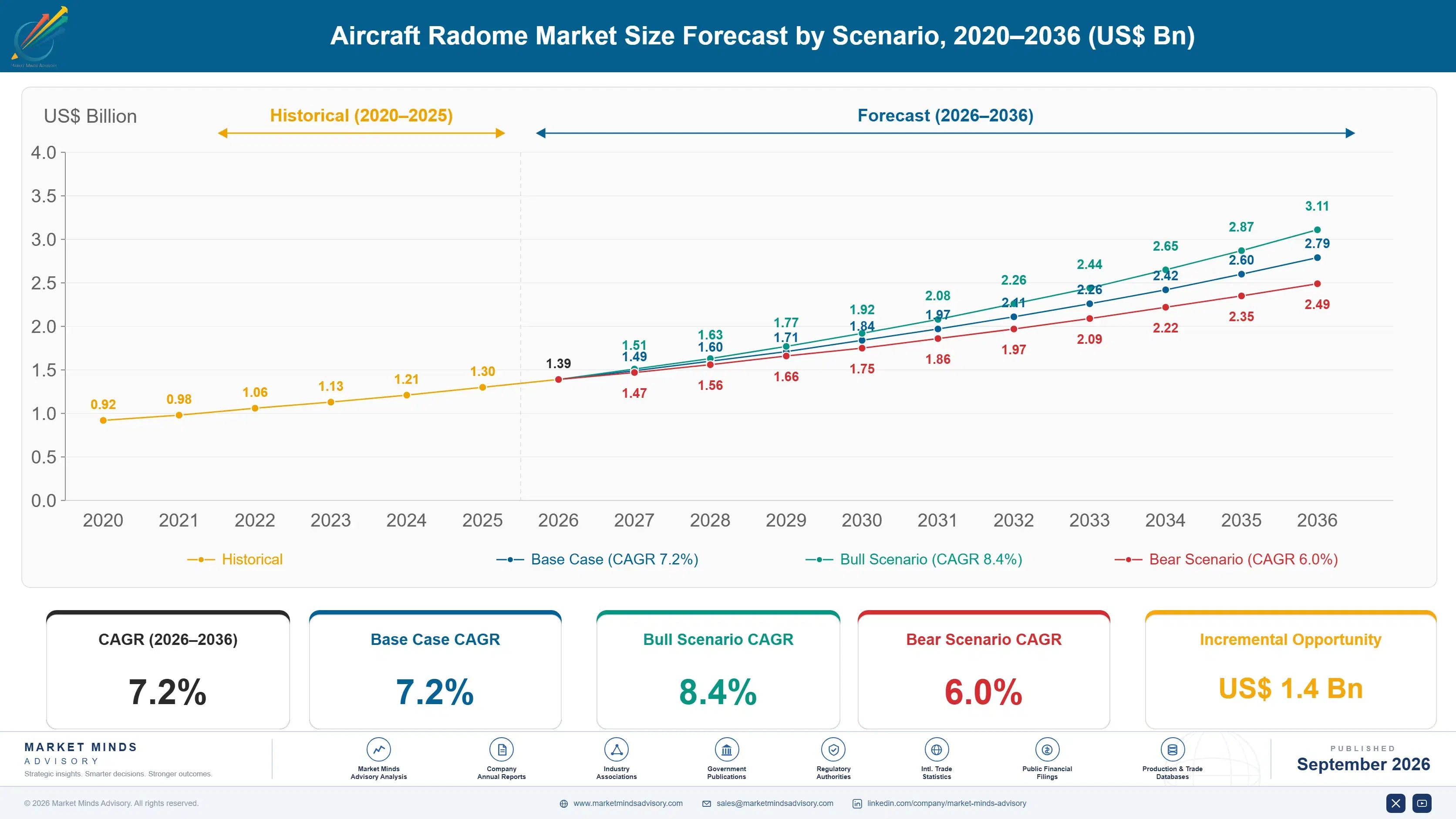
Growth averaged 6.1% across 2020 to 2025, and the composition shifted markedly inside that period. New-build radome demand collapsed with commercial aircraft production in 2020 and 2021, while aftermarket repair held far better than expected because parked aircraft still needed serviceable radomes to return to service. Satcom retrofit activity then accelerated from 2023 and has been the fastest-moving part of the market since.
Base case growth of 7.2% rests on three mechanisms. Airline connectivity programmes are driving fuselage radome retrofits across narrowbody and widebody fleets, and each installation requires certified airframe work rather than a simple part fit. Commercial production rate recovery restores new-build shipset demand through the forecast period. And military radar modernisation across allied air forces requires radomes with wideband transmissivity that the existing designs on those airframes simply cannot provide.
The bull case at 8.4% assumes connectivity retrofit penetration reaches the levels airlines are currently planning rather than the levels currently contracted, which would pull significant volume forward. The bear case at 6.0% follows from production rates: if commercial airframe deliveries continue slipping against announced schedules, new-build shipset demand stays suppressed and the aftermarket cannot compensate fully.

Transparency Against Impact, and the Aftermarket Underneath

The engineering compromise is unusually sharp. Radar transmissivity wants thin walls and low dielectric loss, while bird strike and hail resistance want thickness, and rain erosion attacks whatever coating sits outside. Nobody has solved it elegantly, which is why radome design stays a specialist discipline and the supplier field stays narrow.
FIVE-FIRM CONCENTRATION47%Specialist design capability limits the credible supplier field
AVERAGE SHIPSET PRICEUSD 62kBlended across commercial nose and military fire control units
AFTERMARKET REVENUE SHARE58%Portion of supplier revenue from repair and replacement
SERVICE LIFE BEFORE OVERHAUL4.2 yearsTypical interval before the first significant repair intervention
MOISTURE INGRESS REJECTION RATE31%Share of returned units failing on core moisture content
HONEYCOMB CORE COST SHARE26%Aramid core portion of delivered new unit cost
Most of the money is in the aftermarket, and most participants understate how much. Radomes are struck by lightning, hail and birds throughout a service life, and every strike means inspection or repair. Aftermarket work accounts for roughly 58% of supplier revenue, carries better margin than new-build shipsets, and is far less exposed to airframe production slippage. Suppliers with approved repair stations capture it; those selling only new units do not.
Moisture in the honeycomb core is the failure mode that decides aftermarket competition. Water entering through a coating breach or a damaged edge changes the core dielectric and degrades radar performance, and none of it is visible from outside. Around 31% of units returned for overhaul fail on core moisture content. Operators cannot see the problem, so they buy from whoever they trust to find it, which makes inspection a commercial position rather than a technical one.
"Operators think they are buying a composite nose cone. What they are actually buying is somebody's judgement about whether the core is wet, and almost nobody prices that judgement properly."
Director, Aerospace Structures and Materials Practice · MMA Technology / Aerospace Structures and Components Practice · September 2026

Market Trends

Connectivity Retrofit Turns Radomes Into Airframe Modifications

Fuselage-mounted satcom antennas need a radome, a reinforced mounting provision and a supplemental type certificate, which makes every installation a certified airframe modification rather than a parts fit. That changes who can supply it: the work requires design approval authority, not just composite manufacturing capability. Airlines have been installing across narrowbody and widebody fleets faster than anyone forecast, and each retrofit also creates future aftermarket demand on a component exposed to erosion and lightning. Roughly 4,100 aircraft have received fuselage radome installations since 2022. Certification authority decides who can supply this work.
Market Impact: Contracts 2,600 further aircraft installations

Wideband Military Arrays Obsolete Existing Radome Designs

Active electronically scanned arrays operate across wider frequency bands than the mechanically scanned radars they replace, and radomes tuned for a narrow band introduce boresight error and transmission loss at the edges. That makes the radome part of the radar upgrade rather than a component left in place, which most upgrade programmes initially underestimated and then funded separately once flight test results arrived. The commercial consequence is high-value radome work attached to every array retrofit, typically an order of magnitude above commercial nose radome pricing. Most upgrade programmes funded this only after flight test.
Market Impact: Reaches 1,450 annual shipsets by

Market Opportunities and Growth Drivers

Airline Connectivity Programmes Drive Fleet-Wide Radome Installation

Passenger connectivity has moved from a premium feature to a competitive requirement on most routes, and carriers are committing to fleet-wide installation rather than selective fits. Each aircraft needs an antenna radome, mounting reinforcement and certification work, and carriers want it done during scheduled maintenance visits to avoid extra downtime. That scheduling constraint concentrates demand into narrow windows and rewards suppliers who can support an airline's maintenance calendar. Around 2,600 further aircraft are contracted for installation over the next three years. Maintenance slot availability now constrains delivery more than manufacturing capacity does.
Market Impact: Fails 31% of returned units

Commercial Production Recovery Restores New-Build Shipset Demand

Narrowbody and widebody production rates are climbing back toward and beyond pre-2020 levels, and every airframe needs a nose radome plus sensor radomes at delivery. Supplier selection on these programmes was largely settled years ago, so the volume flows to incumbents on long-term agreements rather than being recompeted. What matters commercially is rate readiness: suppliers who invested in tooling and autoclave capacity through the downturn are capturing the ramp while others quote extended lead times. Roughly 1,450 shipsets annually by 2029 on current rate plans. Rate readiness, not price, is deciding this volume.
Market Impact: Delays retrofit slots 7 months

Market Restraints and Challenges

Core Moisture Ingress Cannot Be Detected Externally

Water entering a honeycomb core through a coating breach or damaged edge alters the dielectric and degrades radar performance, and none of that is visible on external inspection. The root cause is the sandwich construction itself: a closed core that keeps weight down also traps anything that gets inside. Commercially this creates dispute over warranty and repair scope, and roughly 31% of units returned for overhaul fail on moisture content. Participants are answering with improved edge sealing, embedded moisture sensing, and non-destructive inspection services sold as a separate capability. Operators buy judgement here, not product.
Market Impact: Covers 4,100 retrofitted aircraft since

Certification Burden Limits Retrofit Supply Capacity

A fuselage radome installation is an airframe modification requiring design approval and a supplemental type certificate for each airframe type and configuration. The root cause is that the modification affects primary structure and aerodynamic loads, so airworthiness authorities treat it accordingly. The commercial effect is a bottleneck: demand exceeds the number of suppliers holding design approval authority, and airlines wait rather than switch. Suppliers are mitigating through certification families covering multiple configurations, partnerships with approved design organisations, and pre-approved installation kits for common fleet types. Airlines wait for slots rather than change supplier.
Market Impact: Adds 11% to array upgrade value
3 additional market trends, 4 additional growth drivers, and 2 additional restraints and challenges are covered in the full report. Contact sales@marketmindsadvisory.com to access the complete intelligence.

Segment CAGR and Growth Architecture

Radomes are segmented here by installation type, because installation type sets the certification path, the buyer and the margin. Mixing installation type with material construction or airframe category creates categories that overlap on almost every programme. Six installation types cover the field from commercial nose radomes through to unmanned aircraft sensor covers, and the economics between them differ sharply.
aircraft-radome-market-market-share-analysis-1790025758298

Fuselage Satcom Antenna Radomes

Growing at 10.8%, half again the market rate of 7.2%, this segment barely existed at scale before airline connectivity became competitively necessary. Each installation is a certified airframe modification with a supplemental type certificate, not a parts fit, which means suppliers need design approval authority rather than only composite manufacturing capability. That requirement is the real barrier and the reason capacity lags demand. Pricing holds up well because airlines are scheduling around maintenance visits and value availability over unit cost. Every installed unit also creates future aftermarket exposure, since a fuselage-mounted radome takes erosion and lightning throughout its service life. Design approval authority, not plant capacity, sets the ceiling on supply.
CAGR 10.8%

Airborne Early Warning And Surveillance Radomes

These are the highest value units in the market and the fewest by count. A rotodome or fuselage-length surveillance radome is a large primary structure with demanding electromagnetic performance across a wide sector, and the engineering has almost nothing in common with a commercial nose radome. Growth of 8.9% follows allied airborne early warning recapitalisation, with several air forces replacing fleets that have been in service for decades. Programmes are long and unit counts small, so revenue is lumpy, but supplier positions are effectively permanent once a design is qualified onto an airframe. Qualification onto an airframe is effectively permanent, and losing a position is nearly impossible to reverse at all afterwards.
CAGR 8.9%
Full segment breakdown across 6 segments available in the complete report.

Regional Architecture and Country Demand Map

Demand follows fleet size and maintenance activity rather than aircraft manufacturing alone. North America leads because it combines the largest in-service fleet with the deepest approved repair station network, while East Asian growth reflects fleet expansion and maintenance capability being built at the same time.

North America

Fleet size and repair capacity together explain the position here. The United States operates the largest commercial and military aircraft fleet and hosts the deepest network of approved radome repair stations, which matters because roughly 58% of market revenue comes from aftermarket work rather than new units. Connectivity retrofit activity has been heaviest here as well, with major carriers committing to fleet-wide installation. Design approval authority is also concentrated in the region, so retrofit certification work flows to domestic suppliers. Growth of 6.8% sits below the market rate because the base is mature and much of the activity is replacement rather than expansion. Replacement, not fleet growth, funds most of it.
Share: 30% | CAGR: 6.8% (2026 to 2036)

Western Europe

Manufacturing and aftermarket sit in balance across this region. Airbus production drives steady new-build shipset demand, and the regional composite industry supplies much of it locally with short qualification chains. European carriers have been slower than North American ones to commit to fleet-wide connectivity retrofit, partly because short-haul route economics make the business case harder to close. Military radar modernisation on Eurofighter and other platforms adds high-value radome work tied to array upgrades. Growth of 5.7% trails the market rate, held back by connectivity retrofit caution and commercial production rates that have slipped repeatedly against plan. Array upgrade work is the most valuable radome content in the region by a wide margin.
Share: 23% | CAGR: 5.7% (2026 to 2036)
Regional intelligence for 5 additional markets available in the complete report: East Asia, South Asia and Pacific, Latin America, Middle East and Africa, Eastern Europe. Contact sales@marketmindsadvisory.com.
aircraft-radome-market-country-cagr-analysis-1790025758812

Where Radome Programmes Actually Make Money

New-build shipsets are the visible revenue in this market and consistently the least profitable. Aftermarket overhaul, inspection capability and certification authority set delivered margin instead. The four levers below reflect positions participants have used to improve economics measurably rather than to win volume. None of them turns on composite manufacturing cost. Aftermarket is where the argument settles.

Hold Approved Repair Station Status Near Fleets

Aftermarket work accounts for roughly 58% of market revenue, carries better margin than new-build shipsets, and is far less exposed to airframe production rate slippage. Holding approved repair station status close to major fleet bases captures it, because operators route radomes to whoever can turn them fastest. Suppliers with regional station networks report aftermarket revenue roughly 2.3 times that of suppliers relying on a single central facility. The investment is facility approval and trained technicians, which is unglamorous and durable. Turnaround time beats technical capability at the margin nearly every time.
Market Impact: Aftermarket revenue runs roughly 2.3 times higher overall

Sell Core Moisture Inspection As Separate Capability

Roughly 31% of units returned for overhaul fail on core moisture content, and operators cannot detect the condition themselves. Suppliers offering non-destructive moisture inspection as a priced service rather than as part of a quotation convert a dispute into a revenue line, and they win the repair that follows. Inspection services carry gross margin above 50% and typically generate repair work on 64% of units surveyed. The barrier is credibility: operators only accept findings from suppliers whose judgement they trust already. Trust, rather than equipment, is the barrier to entry.
Market Impact: Inspection work converts roughly 64% into follow-on repairs

Own Design Approval For Retrofit Certification

Fuselage satcom radome installation requires a supplemental type certificate per airframe type and configuration, and demand exceeds the number of suppliers holding design approval authority. Firms holding it price on availability rather than against competitors, and airlines wait for slots rather than switching suppliers. Certification families covering multiple configurations spread the approval cost across far more installations, and suppliers doing this have cut certification cost per installation by around 43%. Building the design organisation is the hard part. Airlines wait for certification slots rather than change supplier, which removes price comparison.
Market Impact: Certification cost per installation falls roughly 43% lower

Invest In Rate Capacity Before The Ramp

Commercial production rates are climbing toward roughly 1,450 shipsets annually by 2029, and radome supply is tooling and autoclave constrained rather than labour constrained. Suppliers who added capacity during the downturn are capturing the ramp while competitors quote extended lead times and lose position on long-term agreements. Capacity added counter-cyclically also costs materially less than capacity added into a ramp. Firms that invested through 2021 and 2022 have taken share worth roughly 18% of their shipset revenue from slower competitors. Capacity added into a ramp costs materially more and arrives too late.
Market Impact: Counter-cyclical capacity wins roughly 18% shipset share overall

Who Controls the Margin Pool

Concentration is moderate at 47% for the top five, measured on shipset deliveries and aftermarket overhaul volume, the basis used throughout this section. The field is narrower than composite manufacturing capability alone would suggest, because radome design requires electromagnetic performance engineering that most aerostructures firms simply do not hold, and the gap between the leaders and the next tier reflects design capability rather than plant capacity.
Competition currently turns on three dimensions. Approved repair station coverage decides who captures aftermarket revenue, which is the majority of the market. Design approval authority decides who can supply connectivity retrofit installations at all. And rate capacity decides who benefits from commercial production recovery. Suppliers strong on all three are rare, and most participants are conspicuously weak on at least one of them.

Rankings will move in the aftermarket rather than in new-build supply. Aftermarket revenue is larger, better margined and less contested by airframe agreements, and the entry route is a repair station approval rather than a decade-long supplier qualification. Regional maintenance providers building radome capability are the genuine threat to incumbent aftermarket positions, particularly across East Asia where fleets and repair capacity are growing together.
aircraft-radome-market-company-positioning-matrix-1790025759336

Competitive Moat and Risk Dimensions

COLLINS AEROSPACE

Moat: Integrated Radar And Radome Capability

Collins designs both airborne radar and the radomes in front of it, which lets it optimise transmissivity and boresight performance as one problem rather than two. That integration is difficult for a standalone radome supplier to match, and it gives early visibility of radar upgrade programmes carrying radome work. Its aftermarket network is among the widest in the market.
COLLINS AEROSPACE

Risk: Exposure To Production Rate Slippage

A large share of shipset revenue depends on commercial airframe delivery rates, which have slipped repeatedly against announced schedules. That exposure is difficult to hedge inside a portfolio weighted toward original equipment content, and it makes results move with an upstream schedule the company does not control, regardless of how strong the underlying demand for connectivity retrofit remains.
SAINT-GOBAIN

Moat: Materials Science Depth Upstream

Saint-Gobain's position rests on control of the composite and coating chemistry that determines rain erosion life and dielectric stability, which are the two properties operators actually experience over a service life. That materials depth is hard to replicate for firms that buy in prepreg and coatings, and it supports pricing on replacement units where erosion performance is the purchase criterion.
SAINT-GOBAIN

Risk: Limited Certification Design Authority

Materials and manufacturing strength does not confer supplemental type certificate authority, which is what retrofit connectivity installations require. Competing for that work means building or partnering for a design organisation approval, a capability with little in common with materials science and one that takes years to establish against firms already holding it.

Players Tracked

Prominent Players

Collins Aerospace
Saint-Gobain
General Dynamics Mission Systems
Parker Hannifin
The NORDAM Group

Other Key Players

Leonardo
Airbus Atlantic
Kaman Aerospace
Cobham
Royal Engineered Composites
Applied Aerospace Structures Corporation
Starwin Industries
Sekisui Aerospace
Hexcel
Toray Advanced Composites
Tata Advanced Systems
Hindustan Aeronautics Limited
Turkish Aerospace Industries
Aviation Industry Corporation of China
Hutchinson

Recent Developments

MARCH 2025

Major carrier commits to fleet-wide fuselage satcom radome installation

A large network carrier contracted fleet-wide installation of fuselage-mounted satcom antennas and radomes across narrowbody and widebody aircraft, scheduled around existing maintenance visits. The commitment was a supply and installation agreement rather than any equity transaction, and it locks up supplier capacity for several years ahead.
Signal: Fleet-wide commitments remove retrofit demand from competitive supply and expose how thin certification capacity really is
AUGUST 2024

Composite specialist adds regional radome repair station near Asian fleet base

A radome manufacturer opened an approved repair station in Southeast Asia to serve regional carrier fleets, reducing turnaround times previously dependent on shipping units to North America. This was organic facility investment rather than an acquisition, and it targets the aftermarket majority of market revenue.
Signal: Aftermarket localisation moves the most profitable revenue closer to fleets and away from incumbent central facilities
NOVEMBER 2024

Air force funds radome replacement alongside wideband array radar upgrade

An allied air force added radome replacement to a fighter radar modernisation programme after flight testing showed transmission loss and boresight error at band edges. The decision was a contract modification within an existing programme rather than a new competition, and it confirmed radomes as part of array upgrades.
Signal: Array upgrades now carry radome replacement as standard scope rather than as an optional later consideration

What Sets Delivered Radome Cost

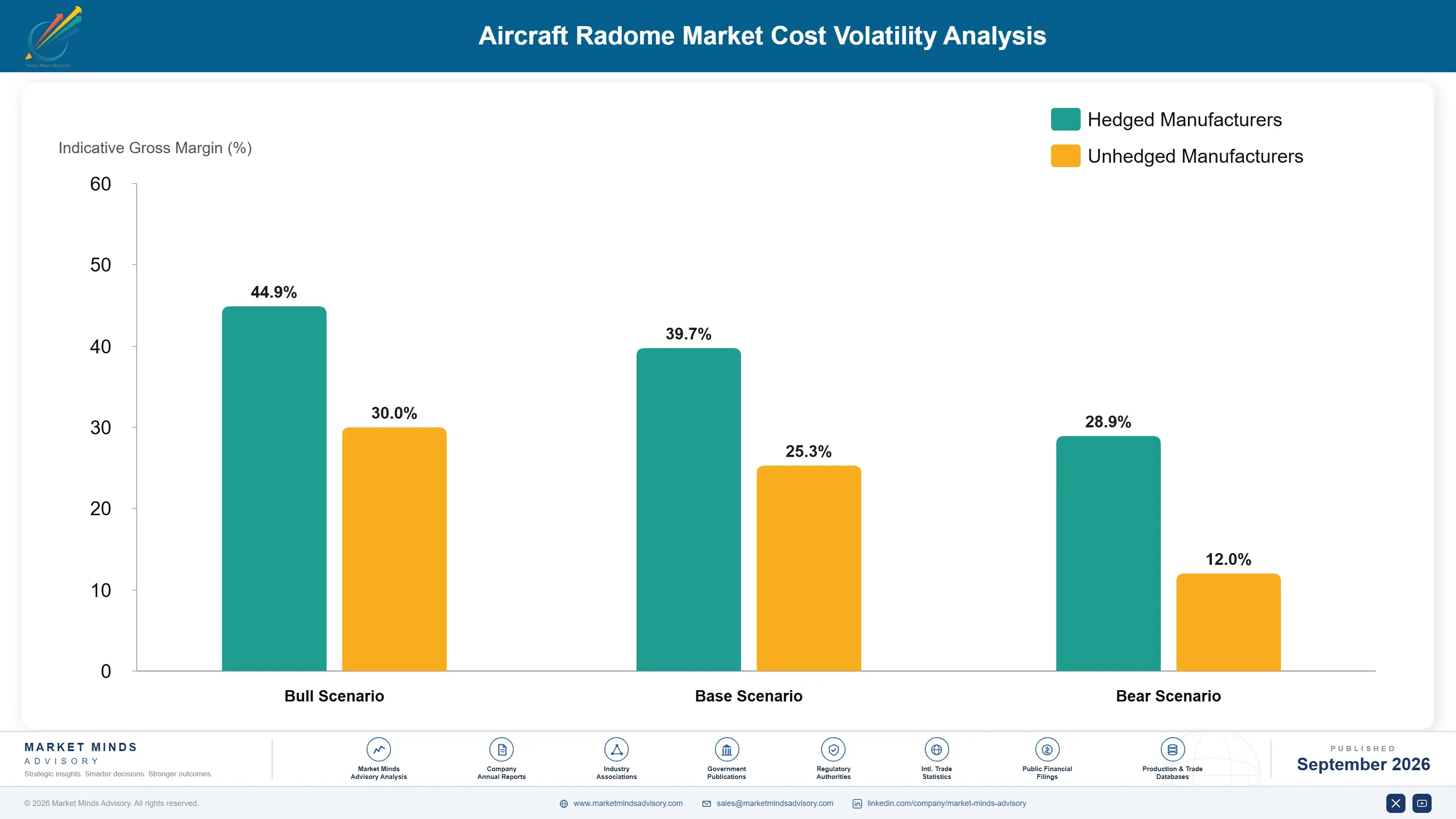
Four inputs dominate delivered cost. Aramid honeycomb core runs roughly 26% of cost of goods sold, quartz and glass reinforcement fabric with resin about 21%, erosion-resistant coatings and lightning diverter hardware close to 11%, and layup, cure and electromagnetic test labour the remaining 42%. Honeycomb and speciality fabric supply sits with a small number of Western and Japanese producers, with autoclave curing adding energy exposure.
Honeycomb core supply produced the clearest recent squeeze. Aerospace production recovery from 2022 tightened aramid honeycomb availability sharply while European industrial energy costs rose, and EIA data shows the scale of the energy movement through that period. Hexcel discussed capacity and demand conditions in its annual reporting for those years. Radome suppliers on long-term fixed-price agreements with airframers absorbed most of the increase and reported extended lead times instead.

Exposure divides by revenue mix, and that is the competitive point. Suppliers weighted toward new-build shipsets carry honeycomb, fabric and autoclave energy cost under fixed-price agreements with no pass-through. Those weighted toward aftermarket overhaul buy far less core material per revenue dollar, because repair consumes labour and coatings rather than full sandwich structure. European suppliers carry higher autoclave energy cost than North American or Asian competitors.
aircraft-radome-market-cost-volatility-analysis-1790025759530

Shift revenue mix toward aftermarket overhaul and inspection

Repair work consumes labour, coatings and patch material rather than full honeycomb sandwich, so it carries a fraction of the material exposure per revenue dollar. Moving mix toward overhaul hedges input cost and improves margin at the same time. The requirement is approved repair station coverage near fleet bases, which takes facility approval and trained technicians rather than capital-intensive plant.

Contract aramid honeycomb supply on multi-year volume terms

Honeycomb availability rather than price is the acute risk during production ramps, since a radome cannot substitute core construction without requalification. Multi-year volume agreements with core producers have kept deliveries on schedule where spot buyers were rationed. The cost is committed volume against uncertain airframe rates, which have slipped often enough to make the commitment genuinely uncomfortable.

Index airframer agreements to published material and energy inputs

Long-term agreements with airframers have traditionally been firm fixed price with productivity commitments, which places every input movement on the supplier across a decade. Indexation to published core, fabric and energy indices shifts that risk back. Airframers resist strongly, but the material squeeze since 2022 has made the conversation possible where it previously was not entertained at all.

Portfolio Architecture for Margin Defence

Margin architecture in this market runs opposite to revenue visibility. New-build shipsets under long-term airframer agreements sit at the bottom, price-committed with productivity clauses and full input cost exposure. Aftermarket overhaul and certified retrofit installation sit in the middle at considerably better economics. Inspection services and high-value surveillance radome programmes sit at the top, the first on scarcity of trust and the second on scarcity of capability.
The volume-versus-premium tension here is about which revenue a supplier organises around. Shipset volume requires autoclave capacity, tooling investment and rate discipline, and it delivers thin margins on schedules the supplier cannot control. Aftermarket requires distributed repair stations and technician depth, and it delivers better margins on demand driven by fleet utilisation. Very few participants are genuinely good at both, and several are quietly retreating from one.

High-value pools concentrate in three places: core moisture inspection services where operators buy judgement rather than product, retrofit certification capacity that demand currently exceeds, and airborne early warning radome programmes where qualified suppliers number very few. None of the three depends on winning a shipset agreement, which is exactly why the margins hold up.

Volume / Commodity-Adjacent Tier

New-build commercial nose and sensor radome shipsets under long-term airframer agreements. Price-committed with productivity clauses and full material exposure. The seven point range reflects whether the supplier holds tooling ownership and how far into an agreement term the pricing sits.
Gross Margin: 17-24%

Premium / Certified Tier

Aftermarket overhaul, certified retrofit installation and military fire control radomes. Repair station approval and design authority defend pricing here. The nine point range tracks how close a supplier's stations sit to major fleet bases, which changes turnaround competitiveness materially.
Gross Margin: 31-40%

Sustainability / Regulatory / Next-Generation Tier

Core moisture inspection services, embedded moisture sensing and airborne early warning radome programmes. Competition is limited by trust and by engineering capability rather than by price. The thirteen point range spans a service business and a large structures business with genuinely different economics.
Gross Margin: 45-58%
aircraft-radome-market-portfolio-architecture-1790025760030

High-value Sub-segments and Strategic Watch-out

Core Moisture Inspection Services

Highest margin line available and a genuine service business, addressing the roughly 31% of returned units that fail on core moisture. It converts into follow-on repair work on 64% of units surveyed. The ten point range reflects how differently suppliers price inspection when bundled against sold standalone.
Gross Margin: 48-58%

Fuselage Satcom Retrofit Installation

Fastest growing at 10.8% and supply-constrained by design approval authority rather than by manufacturing capacity anywhere. Airlines wait for certification slots instead of switching suppliers. The nine point range reflects whether certification cost is spread across a family of configurations or carried separately per individual installation.
Gross Margin: 36-45%

Commercial Nose Radome Aftermarket

The volume core of profitable revenue, growing at 5.8% on fleet utilisation and strike damage rather than on production rates. Demand is unusually predictable because lightning, hail and birds do not respond to economic cycles. Margin depends heavily on repair station proximity to the operating fleet.
Gross Margin: 30-38%

New-Build Shipset Supply Agreements

Thinnest margin in the market, committed on price with productivity clauses across agreement terms measured in a decade. Volume depends entirely on airframe delivery rates that have slipped repeatedly against plan. Several suppliers now manage this line purely for capacity utilisation rather than for any profit.
Gross Margin: 17-24%

What Keeps Recurring After Delivery

The annuity here is damage, and it is remarkably dependable. Radomes take lightning strikes, hail and bird impacts throughout a service life, and coating erosion at cruise speed proceeds regardless of the economic cycle. First significant repair typically arrives around 4.2 years into service, and aftermarket work across a radome's life usually exceeds the original unit price several times over. That revenue accrues to whoever holds repair station approval near the fleet, not to whoever supplied the unit.
Adoption depth varies sharply by operator type. Long-haul widebody operators run the deepest radome programmes, with connectivity retrofit, erosion-driven replacement and scheduled inspection all funded continuously because utilisation is high and downtime is expensive. Regional and low-cost narrowbody carriers repair reactively and defer everything possible. Military operators sit differently again: fewer units, far higher unit values, and replacement tied to radar upgrade programmes rather than to damage or erosion.

The purchasing decision has moved. Radomes were once bought by engineering staff assessing dielectric performance on a datasheet. They are increasingly bought by maintenance planners assessing turnaround time and by reliability engineers assessing removal rates, and neither reads a transmissivity curve.
aircraft-radome-market-end-use-penetration-index-1790025760523

Where The Real Margin Lives

These are among the four positions where our research anticipates prominent divergence between winners and laggards over the coming forecast period. Each is grounded in the demand model, the regulatory perimeter, and the announced capacity pipeline.
01 / AFTERMARKET NETWORK DEPTH

Build repair station coverage next to the fleets themselves

Aftermarket work accounts for roughly 58% of market revenue, carries better margin than new-build shipsets, and does not move with airframe delivery rates that suppliers cannot control anyway. Operators route radomes to whoever turns them fastest, so station proximity beats technical capability at the margin. Suppliers with regional station networks report aftermarket revenue roughly 2.3 times that of competitors relying on one central facility, and the investment required is facility approval and technician training rather than any heavy capital plant.
02 / INSPECTION TRUST POSITION

Sell moisture inspection judgement, then win the repair

Roughly 31% of units returned for overhaul fail on core moisture content, and operators cannot detect the condition from outside the structure at all. Selling non-destructive inspection as a priced service rather than burying it in a quotation converts what was a warranty dispute into a revenue line at gross margin above 50%. Inspection then generates repair work on about 64% of units surveyed, and the only real barrier is already being a supplier whose judgement the operator happens to trust.
03 / RETROFIT CERTIFICATION AUTHORITY

Own design approval or concede connectivity retrofit entirely

Satcom radomes grow at 10.8%, half again the market rate of 7.2%, and every single installation needs a supplemental type certificate for the specific airframe type and configuration. Demand already exceeds the supply of firms holding design approval authority, so those firms are able to price on availability rather than against competitors, and airlines wait for slots. Certification families covering several airframe configurations cut approval cost per installation by around 43%, which compounds the advantage considerably for whoever moves first.
04 / COUNTER-CYCLICAL RATE CAPACITY

Add autoclave and tooling capacity when nobody else will

Radome supply is constrained by tooling and autoclave availability rather than by labour, and commercial rates are climbing toward roughly 1,450 shipsets annually by 2029. Capacity added during a downturn costs materially less than the same capacity added into a ramp, and it arrives in time to matter at all. Suppliers that invested through 2021 and 2022 have taken share worth roughly 18% of their shipset revenue from competitors that are now quoting extended lead times and losing position on long-term agreements instead.

Engagement Snapshot From the Field

A live engagement with an industry participant carrying material or product regulatory and market exposure ahead of a defining policy shift, showing how our research translates into a defensible multi-year portfolio strategy.
MARKET MINDS ADVISORY · CLIENT ENGAGEMENT SUMMARY
Aircraft Radome Producer Strategic Portfolio Review and Transition Roadmap 2026·Investment Scenario on Aircraft Radome Exposure Evaluation 2025-26
CLIENT PROFILE
A North American radome manufacturer with roughly USD 290 million in annual revenue (client-reported, unverified by MMA), of which new-build shipsets contributed about 71% (client-reported, unverified by MMA). The company held long-term agreements with two airframers and operated a single central repair facility, and had watched aftermarket volume from Asian carriers decline steadily without understanding why it was happening.
STRATEGIC CHALLENGE
Management attributed the aftermarket decline to pricing and had authorised discounts that failed to recover volume. The actual cause was turnaround time: units shipped from Asia to a single North American facility took weeks longer than regional competitors needed. The board had to decide whether to invest in distributed repair stations or accept a shipset-weighted business with thin margins and slipping airframe rates.
MMA APPROACH
MMA modelled aftermarket demand by fleet base across Asia and the Middle East, costed repair station approval and staffing at four candidate locations, and quantified the turnaround time sensitivity through expert interviews with carrier maintenance planners. The work also assessed the client's exposure to airframe rate slippage under its existing long-term agreements.
KEY FINDINGS
  1. Turnaround time, not price, drove supplier selection in eleven of thirteen recent aftermarket decisions the analysis reconstructed with carrier maintenance planning staff.
  2. Two regional station locations captured roughly 78% of the addressable Asian aftermarket demand, meaning four stations were unnecessary and materially over-invested as originally planned.
  3. Core moisture inspection was being performed but never priced separately, giving away a service that competitors charged for and that generated most follow-on repair work.
  4. Shipset revenue under existing agreements carried price commitments and productivity clauses that made margin recovery impossible without volume the airframers could not deliver.
CLIENT PROFILE
A North American radome manufacturer with roughly USD 290 million in annual revenue (client-reported, unverified by MMA), of which new-build shipsets contributed about 71% (client-reported, unverified by MMA). The company held long-term agreements with two airframers and operated a single central repair facility, and had watched aftermarket volume from Asian carriers decline steadily without understanding why it was happening.
STRATEGIC CHALLENGE
Management attributed the aftermarket decline to pricing and had authorised discounts that failed to recover volume. The actual cause was turnaround time: units shipped from Asia to a single North American facility took weeks longer than regional competitors needed. The board had to decide whether to invest in distributed repair stations or accept a shipset-weighted business with thin margins and slipping airframe rates.
MMA APPROACH
MMA modelled aftermarket demand by fleet base across Asia and the Middle East, costed repair station approval and staffing at four candidate locations, and quantified the turnaround time sensitivity through expert interviews with carrier maintenance planners. The work also assessed the client's exposure to airframe rate slippage under its existing long-term agreements.
KEY FINDINGS
  1. Turnaround time, not price, drove supplier selection in eleven of thirteen recent aftermarket decisions the analysis reconstructed with carrier maintenance planning staff.
  2. Two regional station locations captured roughly 78% of the addressable Asian aftermarket demand, meaning four stations were unnecessary and materially over-invested as originally planned.
  3. Core moisture inspection was being performed but never priced separately, giving away a service that competitors charged for and that generated most follow-on repair work.
  4. Shipset revenue under existing agreements carried price commitments and productivity clauses that made margin recovery impossible without volume the airframers could not deliver.
RECOMMENDED STRATEGY
Phase 1: Phase 1 (nine months): Establish approved repair stations at the two highest-value Asian fleet bases and reverse the discounting programme immediately. Phase 2: Phase 2 (15 months): Price core moisture inspection as a standalone service and train carrier staff to request it during scheduled visits. Phase 3: Phase 3 (24 months): Renegotiate shipset agreements toward material and energy indexation, and cap further capacity commitment to those programmes.
OUTCOME
The client opened both stations and recovered Asian aftermarket volume within 13 months, with aftermarket rising to roughly 44% of revenue from 29% (client-reported, unverified by MMA). Priced inspection generated follow-on repair on most units surveyed, and one shipset agreement was renegotiated with partial material indexation at renewal.

Frequently Asked Questions

Foundational context covering the market sizes, CAGR, scope, country, region and competition that inform every finding below. This section is provided to cover basics and most often pre-purchase conversations, answered from the MMA Primary Research Dataset.

What is the current size of the Aircraft Radome Market?

The market was worth USD 1.3 billion in 2025 and reaches USD 1.4 billion in 2026. That covers new-build radomes and aftermarket overhaul across commercial, military, rotorcraft and unmanned applications.

How large will the Aircraft Radome Market be by 2036?

MMA forecasts USD 2.8 billion by 2036, an increase of USD 1.4 billion over the 2026 base. That represents an expansion multiple of 2.00 times across the forecast period.

What is the CAGR for the Aircraft Radome Market 2026 to 2036?

The base case CAGR is 7.2%, with a bull case of 8.4% if connectivity retrofit reaches currently planned rather than contracted levels. The bear case of 6.0% assumes continued airframe delivery slippage.

Which segment is growing fastest?

Fuselage satcom antenna radomes grow at 10.8%, half again the market rate of 7.2%. Each installation is a certified airframe modification, and supply is limited by design approval authority rather than manufacturing capacity.

Who are the major companies in the Aircraft Radome Market?

Collins Aerospace, Saint-Gobain, General Dynamics Mission Systems, Parker Hannifin and The NORDAM Group lead on shipset deliveries and aftermarket overhaul volume. Leonardo, Airbus Atlantic and Kaman Aerospace follow.

Which country is growing fastest?

India leads at 10.4%, driven by record commercial aircraft orders with connectivity specified at delivery rather than retrofitted later. Domestic composite manufacturers are positioning for both new-build and aftermarket work.

Report Segmentation Architecture

The full report scope spans multiple orthogonal segmentation dimensions, with cross-tabulated demand data provided for each dimension pair. Coverage extends further to regional breakdowns, trend trajectories, and the competitive detail needed to support segment-level decision-making.

By Radome Installation Type

  • Nose Weather Radar Radomes
  • Fuselage Satcom Antenna Radomes
  • Military Fire Control Radomes
  • Airborne Early Warning And Surveillance Radomes
  • Wingtip And Tail-Mounted Sensor Radomes
  • Rotorcraft And Unmanned Aircraft Radomes

By End-Use Industry

  • Commercial Passenger Airlines
  • Cargo And Freight Operators
  • Military Combat And Surveillance Aviation
  • Business And General Aviation
  • Rotorcraft And Unmanned Platform Operators

By Commercial Dimension

  • New-Build Shipset Supply
  • Aftermarket Overhaul And Repair
  • Certified Retrofit Installation
  • Inspection And Support Services

By Region

  • North America
  • Western Europe
  • East Asia
  • South Asia and Pacific
  • Latin America
  • Middle East and Africa
  • Eastern Europe

Scope, Methodology, and Coverage

Every figure in this report is reproducible from documented input assumptions. The scope below maps the historical period, the forecast horizon, the segmentation dimensions, and the countries covered, alongside the underlying primary and qualitative methodology.
Historical Period
2020 to 2025
Forecast Period
2026 to 2036
Base Year
2025 (USD billions; MMA Primary Research Dataset, September 2026)
Market Definition
This report covers aircraft radomes: the electromagnetically transparent structures protecting airborne radar and antenna installations. Scope includes nose weather radar radomes, fuselage-mounted satellite communication antenna radomes, military fire control radomes, airborne early warning and surveillance radomes, wingtip and tail-mounted sensor radomes, rotorcraft and unmanned aircraft radomes, and the associated repair, overhaul and inspection services. Excluded are radar and antenna systems themselves, ground and shipborne radomes, missile nose cones and seeker windows, sonar domes, and composite aerostructures with no electromagnetic transmission requirement.
Quantitative Units
USD billions (current prices); shipset deliveries; aftermarket overhaul volumes; average unit pricing by installation type
Segmentation Dimensions
By Radome Installation Type; By End-Use Industry; By Commercial Dimension; By Region
Regions Covered
North America, Western Europe, East Asia, South Asia and Pacific, Latin America, Middle East and Africa, Eastern Europe
Countries Covered
USA, China, Germany, France, UK, Japan, South Korea, India, Australia, Canada, Brazil, Mexico, Indonesia, Vietnam, Thailand, Malaysia, UAE, Saudi Arabia, South Africa, Nigeria, Turkey, Poland, Netherlands, Italy, Spain, Sweden, Switzerland, Argentina, Colombia, Singapore, and additional markets relevant to this sector
Key Companies Profiled
Collins Aerospace, Saint-Gobain, General Dynamics Mission Systems, Parker Hannifin, The NORDAM Group, Leonardo, Airbus Atlantic, Kaman Aerospace, Cobham, Royal Engineered Composites, Applied Aerospace Structures Corporation, Starwin Industries, Sekisui Aerospace, Hexcel, Toray Advanced Composites, Tata Advanced Systems, Hindustan Aeronautics Limited, Turkish Aerospace Industries, Aviation Industry Corporation of China, Hutchinson
Quantitative Methodology
Primary survey, n=3,800 respondents, Q4 2025, six countries; demand-side model with trade association cross-validation
Qualitative Methodology
47 expert interviews, Q4 2025; applied to validate demand model assumptions, identify emerging dynamics, and assess competitive positioning
Report Format
PDF and XLSX data workbook (Word format preview document)
Publisher
Market Minds Advisory
Report Code
MMA-2026-TEC-905
Published
September 2026
Contact
sales@marketmindsadvisory.com | www.marketmindsadvisory.com

Purchase the full Aircraft Radome Market Report (2026 to 2036).

The full report sizes the aircraft radome market across six installation types and all seven regions, with shipset deliveries and aftermarket overhaul volumes behind every figure. It separates aftermarket revenue from new-build supply throughout, because the two carry different margins, different demand drivers and different competitive fields entirely. Competitive analysis covers 20 participants on shipset deliveries and overhaul volume, including repair station coverage mapped against fleet bases. Design approval authority for retrofit certification is assessed by supplier, since that is the binding constraint on the fastest-growing segment. Core moisture inspection economics are modelled as a standalone service business rather than as part of overhaul.
Six-installation-type sizing with shipset and overhaul volumes
Aftermarket economics separated from new-build supply
Repair station coverage mapped against fleet bases
Retrofit certification authority assessed by supplier
Core moisture inspection service economics modelled
Twenty-participant competitive assessment on deliveries and overhaul

Built For The People Who Decide

From boardroom strategy to bench-side execution, this report is read cover-to-cover by leaders shaping the next decade of their industry, turning demand scenarios, market dynamics and valuation benchmarks into decisions.
CXOs/ Presidents/ VPs/ Managers
M&A and Corporate Development
Strategy Teams and R&D Heads
Procurement and Product Directors
Regulatory and Compliance Leaders
Investor Relations and Equity Analysts