Market Minds Advisory
Aircraft Interface Device Market

Aircraft Interface Device Market: Aircraft Interface Devices: The Certified Doorway Between Avionics And Everything Else

A few thousand dollars of ruggedised computer whose entire value is the certification saying data may cross an airworthiness boundary, and the question of whether that door opens both ways.

Lead Analyst

Published

September 2026

Make Smarter Decisions with Customized Research Insights

Request a free sample report and evaluate market opportunities, growth trends, and competitive dynamics relevant to your business needs.

2025 MARKET VALUE$0.4BMarket Size 2025
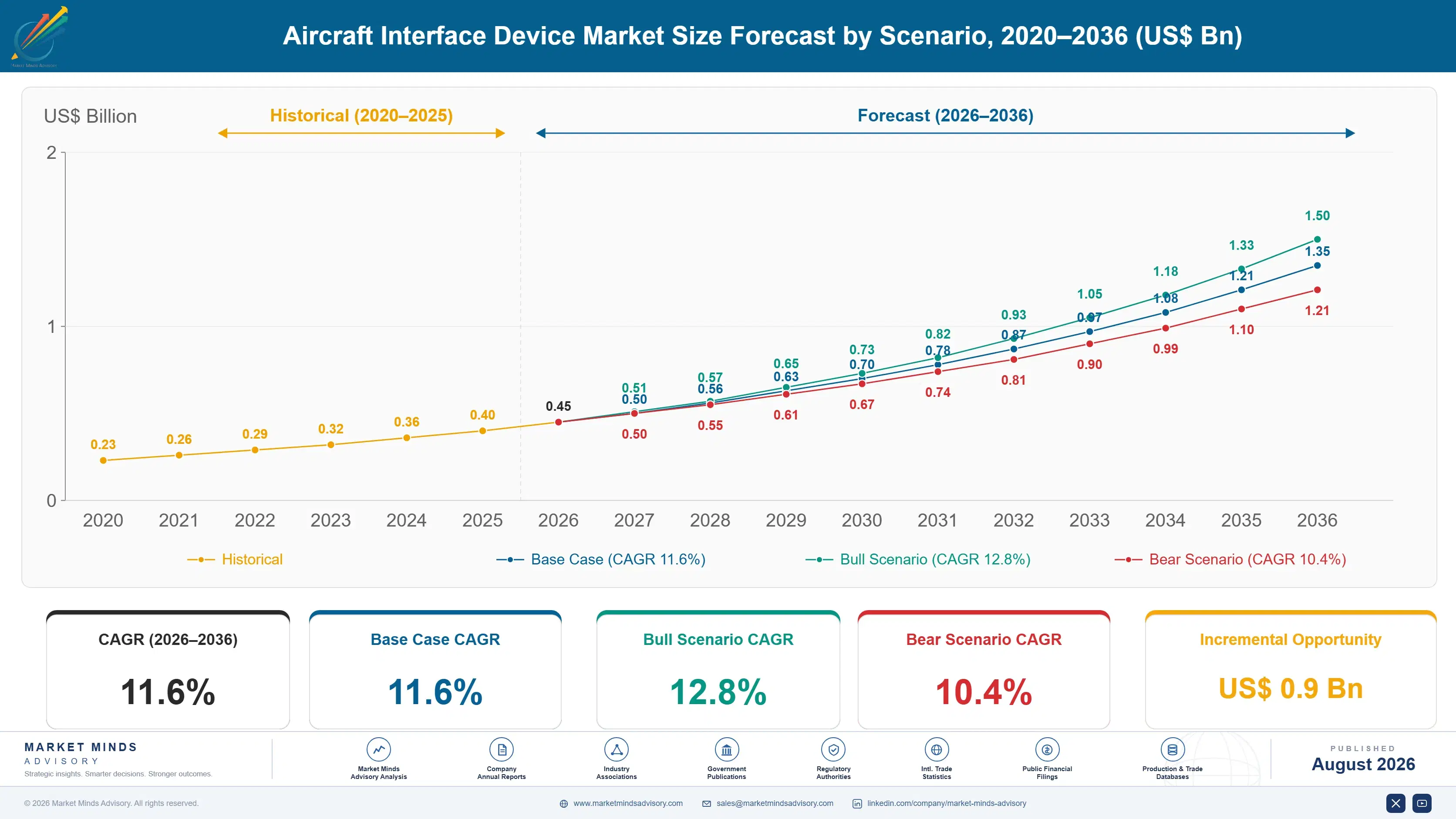
2036 FORECAST VALUE$1.4BBase Case , 2026 to 2036
CAGR 2026 TO 203611.6 %Bull 12.8% / Bear 10.4%
INCREMENTAL OPPORTUNITY$0.9BNet 10- year value creation
EXPANSION MULTIPLE3.00x2036 value over 2026 base
Strategic Levers
M&A Pipeline
Regional Outlook
Country Rankings
Competitive Intelligence
Segmental Deep-dive
Call-Us : 91 93563 13602

Executive Snapshot and Market Trajectory.

Certified avionics and the connected world are separated by an airworthiness boundary. Data may come off an aircraft bus; almost nothing may go back in without formal certification, because a corrupted write to a flight-critical bus is a safety event rather than an inconvenience.
The interface device is the certified doorway through that boundary, and its commercial value has almost nothing to do with the hardware. A ruggedised computer exposing around 1,900 aircraft parameters costs a few thousand dollars to build. What an airline pays for is the supplemental type certificate saying the connection is safe, and 71% of installations go onto aircraft already flying rather than onto any new deliveries. Hardware is almost incidental to that transaction.
Everything now turns on whether the door opens both ways. Read-only devices are commoditising steadily, while secure bidirectional uplink grows fastest at 17.4% because sending software parts and flight plans back into the aircraft is where the certification barrier is highest. Attached data services already produce 39% of revenue, which is where the hardware suppliers would very much rather compete. Nobody in this market wants to sell boxes any more.
Market Definition
Revenue from certified hardware bridging aircraft avionics data buses to cabin, connectivity and ground systems, together with the recurring data services delivered through those devices. Excludes cabin connectivity terminals and antennas, flight data recorders required by regulation, electronic flight bag tablets and their applications, and ground-based analytics platforms sold independently of any airborne device.
Base Year Value
$0.4B in 2025 (MMA Primary Research Dataset, August 2026)
Forecast Period
2026 to 2036, eleven discrete annual values
CAGR
11.6% base case. Bull 12.8%. Bear 10.4%.
Fastest Growth Segment
Secure Bidirectional Uplink: 17.4% CAGR
Fastest Growth Country
India: 13.6% CAGR
Fastest Growth Region
South Asia and Pacific: 13.6% CAGR
Largest Region
North America: 30% of 2025 global value
Market Leaders
Collins Aerospace, Honeywell Aerospace, Teledyne Controls, Astronautics Corporation of America and Boeing lead on certified device revenue. Source: company annual reports and MMA Primary Research Dataset, July 2026.
Primary Survey
n=3,800 procurement and R&D decision-makers, Q4 2025, six countries
Methodology
Demand-side build-up, cross-validated against public data, 47 expert interviews

Aircraft Interface Device Market Forecast Scenarios

aircraft-interface-devices-aid-market-size-forecast-scenario-1787997731404
The 2020 to 2025 period began badly and ended in an unexpected place. Airlines deferred every discretionary retrofit through 2020 and 2021, then restarted with connectivity and data programmes that had been shelved rather than cancelled. Cabin connectivity spread far faster than anybody had forecast, creating the pipe an interface device feeds. Revenue compounded near 10.2% across the period despite losing eighteen months entirely.
Three mechanisms carry the base case. Fleet penetration near 34% leaves most of the global commercial fleet unequipped, and retrofit remains the dominant installation route at 71% of units. Predictive maintenance programmes require parameter access that only a certified device provides, and airline engineering functions are now funding those directly. And the information security regulation applying from 2026 forces operators to formalise how data crosses that boundary at all anywhere.
The bull catalyst is regulatory acceptance of routine bidirectional uplink for loadable software parts, which would convert an occasional certified exception into standard airline practice and reprice the whole category. The bear risk is airframers integrating the function into baseline avionics on new aircraft, which would remove line fit opportunity and leave suppliers competing only for a shrinking retrofit population.

Selling Permission Rather Than Hardware

An aircraft data bus was designed decades ago to connect avionics to each other and to nothing else. Standards define how an interface device may expose those parameters outward without affecting the systems generating them, and the engineering discipline that matters is isolation rather than processing. A device that could conceivably corrupt a flight-critical bus is not certifiable at any price, so the architecture is built around guaranteeing that it cannot.
MARKET CONCENTRATION CR568%Share of device revenue held by leading suppliers
RETROFIT INSTALLATION SHARE71%Units fitted to aircraft already in service rather than new
CERTIFICATION CYCLE LENGTH26 monthsElapsed time from design freeze to supplemental type certificate
ATTACHED DATA SERVICE SHARE39%Revenue earned from recurring service rather than hardware
FLEET PENETRATION RATE34%Share of the global commercial fleet currently equipped
PARAMETER ACCESS COUNT1,900Aircraft data parameters exposed through a typical installation
That makes certification the product. Around 26 months separates design freeze from a supplemental type certificate, and each aircraft type requires its own approval, so a supplier's catalogue is really a list of type certificates rather than a list of hardware. Airlines with mixed fleets consolidate toward whoever holds approvals across the types they operate, which is why breadth of certification matters considerably more than any technical specification does.
Recurring service is where suppliers would prefer the business to sit. Attached data services already produce 39% of revenue, covering parameter streaming, maintenance data delivery and application hosting, and that share climbs as hardware pricing compresses. Fleet penetration near 34% means most aircraft flying today remain unequipped, so the addressable retrofit population is substantially larger than the installed base suggests.
"Nobody buys an interface device. They buy a supplemental type certificate that happens to arrive with a box attached, and the suppliers who understood that early priced accordingly."
Director, Avionics and Connected Aircraft Practice · MMA Aerospace and Defence Components Practice · August 2026

Market Trends

Information Security Rules Formalise The Boundary Crossing

European information security regulation applying to aviation organisations from 2026 requires operators to identify, assess and manage risks arising wherever data crosses into or out of aircraft systems. Airlines that had installed devices under individual approvals now need a documented position covering the whole arrangement. That favours suppliers able to supply security evidence alongside airworthiness evidence, and it disadvantages the improvised installations that proliferated while nobody was asking. Compliance work is generating retrofit and upgrade demand that has nothing to do with new capability. Compliance is generating orders that capability alone never would.
Market Impact: Exposes 1,900 aircraft parameters

Connectivity Spread Created The Pipe Devices Now Fill

Cabin connectivity adoption ran considerably faster than forecasts assumed, and an aircraft with a broadband link but no certified path to its own avionics data can send passengers video while telling its operator nothing about itself. That gap became obvious to airline engineering functions once connectivity was installed rather than planned. Interface device retrofit frequently follows connectivity retrofit by twelve to eighteen months for exactly that reason, which makes connectivity programmes the most reliable leading indicator available in this market. Connectivity programmes are the best leading indicator anybody in this market has.
Market Impact: Leaves 66% of fleet unequipped

Market Opportunities and Growth Drivers

Predictive Maintenance Requires Certified Parameter Access

Airline engineering functions running predictive maintenance need continuous access to around 1,900 aircraft parameters, and no route to that data exists except through a certified device on the bus. Recorder downloads at the gate arrive too late and cover too little. Once an engineering department has justified a programme on component removal savings, the device becomes an enabling purchase rather than a discretionary one, which changes who signs for it and how quickly the approval moves through an airline. That shift in who signs matters considerably more than any specification does.
Market Impact: Requires 26 months per type

Retrofit Population Dwarfs The Line Fit Opportunity

Fleet penetration near 34% means roughly two thirds of commercial aircraft flying today carry no certified interface device at all, and those aircraft have years of service life remaining. Retrofit accordingly represents 71% of installations and will keep doing so for most of the coming decade. That favours suppliers holding supplemental type certificates across many aircraft types over those positioned only for line fit, because an airline retrofitting a mixed fleet wants one supplier rather than four separate approval programmes. Retrofit will remain the dominant route for most of the coming decade.
Market Impact: Threatens 29% line fit share

Market Restraints and Challenges

Each Aircraft Type Demands Its Own Certification Programme

A supplemental type certificate covers one aircraft type, so a supplier serving a mixed fleet operator carries approval cost repeatedly across variants that share most of their engineering. The root cause is an airworthiness regime that approves installations rather than products, correctly, since installation is where the risk actually sits. Commercially it caps how quickly any supplier can widen coverage. Mitigation runs through certification families covering related variants, reusing test evidence where authorities permit, and prioritising types by installed fleet size. Approving installations rather than products is the correct regime and an expensive one.
Market Impact: Applies to 100% of operators

Airframers May Absorb The Function Into Baseline Avionics

Nothing prevents an airframer specifying interface capability inside its own baseline avionics on a new aircraft, removing the line fit opportunity entirely and leaving independent suppliers with retrofit alone. The root cause is that the function is genuinely useful and airframers increasingly want the data themselves. Suppliers mitigate by positioning as the airframer's chosen supplier rather than as a competitor, by concentrating on retrofit where airframer integration cannot reach, and by moving value toward recurring services no airframer wants to operate. Competing with a customer is an awkward position however good the product is.
Market Impact: Follows connectivity by 15 months
3 additional market trends, 4 additional growth drivers, and 2 additional restraints and challenges are covered in the full report. Contact sales@marketmindsadvisory.com to access the complete intelligence.

Segment CAGR and Growth Architecture

Segmentation follows the function the device delivers, since that determines the certification burden, the customer inside the airline who funds it and the price the installation commands. Six functions describe the market completely, from straightforward read-only provision through to the bidirectional uplink where the certification barrier is highest and has largely gone unbreached so far.
aircraft-interface-devices-aid-market-market-share-analysis-1787997731984

Secure Bidirectional Uplink

The fastest function grows at 17.4%, half again the market rate of 11.6%, from a base small enough that the percentage flatters it considerably. Sending data into the aircraft rather than merely reading it out crosses the airworthiness boundary in the direction regulators care about, so the certification burden rises sharply and the security evidence required rises with it. Loadable software part distribution, flight plan uplink and chart updating are the applications operators want most, because each removes a manual process that currently occupies engineers at the gate. Suppliers holding both airworthiness and security approval on the same device are extremely few, and that scarcity is exactly where the pricing sits.
CAGR 17.4%

Predictive Maintenance Data Capture

Predictive maintenance capture grows at 15.2% and has changed who inside an airline signs the purchase order. Where an interface device was once a flight operations item competing against seat covers for discretionary budget, an engineering department justifying component removal savings treats it as enabling equipment for a programme already approved. The parameter breadth required is considerable, and gate downloads from a recorder arrive far too late to support any predictive model worth running. Suppliers who positioned toward engineering rather than flight operations found budgets that were larger, decisions that moved faster and buyers who understood exactly what they were purchasing. Selling to the wrong department loses campaigns that should have been won.
CAGR 15.2%
Full segment breakdown across 6 segments available in the complete report.

Regional Architecture and Country Demand Map

Demand follows commercial fleets and the digital programmes airlines run against them, so it distributes broadly. North America leads on fleet size and programme maturity, with East Asia close behind on fleet growth and Western Europe holding a large installed base that is equipping steadily.

North America

The largest share sits here at 30%, resting on the world's biggest commercial fleet and on airline digital programmes that started earlier than anywhere else. American carriers ran electronic flight bag deployments a decade before most of their peers, which built organisational familiarity with certified data access that competitors elsewhere are still developing. The major device suppliers are headquartered here and hold the widest supplemental type certificate coverage. Cargo operators add a distinct demand pool, since freight fleets fly older aircraft where retrofit economics are considerably more attractive. Programme maturity rather than fleet size alone explains the position, and that maturity is not something a competing region can simply purchase.
Share: 30% | CAGR: 11.2% (2026 to 2036)

Western Europe

A large installed fleet equipping steadily anchors this region, and European information security regulation applying from 2026 is the single most consequential regulatory development affecting this market anywhere. Operators here must document how data crosses the aircraft boundary in a way that improvised installations cannot satisfy, which is generating upgrade demand disconnected from any new capability. Airbus programmes and European maintenance providers both hold positions in the installation and data service chain that suppliers must work through rather than around. A region writing regulation that obliges operators to document boundary crossings holds influence over this market well beyond its share of installations, and the compliance demand it creates has nothing to do with new capability at all.
Share: 22% | CAGR: 10.0% (2026 to 2036)
Regional intelligence for 5 additional markets available in the complete report: East Asia, South Asia and Pacific, Latin America, Middle East and Africa, Eastern Europe. Contact sales@marketmindsadvisory.com.
aircraft-interface-devices-aid-market-country-cagr-analysis-1787997732508

Where Interface Device Margin Sits

Four levers work on certification coverage, buyer selection and recurring revenue rather than on hardware specification, which airlines compare far less carefully than suppliers assume they do. Certificate breadth, engineering budget access, security approval and service attachment each address something a supplier controls before any tender appears at all. Hardware specification is rarely decisive here.

Widen Certificate Coverage Across Mixed Fleet Types

A supplemental type certificate covers one aircraft type, and an airline retrofitting a mixed fleet wants one supplier rather than four separate approval programmes running concurrently. Suppliers holding approvals across the five most common narrowbody and widebody types win mixed-fleet campaigns at roughly 2.6 times the rate of single-type competitors. Certification families covering related variants cut the 26 month cycle by 30% to 40% where authorities accept the reuse. The investment precedes any order and most suppliers decline it. Certificate coverage is the catalogue in this market, whatever the brochure says.
Market Impact: Wins campaigns at around 2.6 times the rate

Sell To Engineering Rather Than Flight Operations

Positioned as a flight operations item, an interface device competes for discretionary budget against everything else an airline might do. Positioned as enabling equipment for an approved predictive maintenance programme, it draws on an engineering budget already justified on component removal savings. The same device, the same price, and a decision cycle roughly 40% shorter with a considerably higher win rate. Suppliers selling to the wrong department lose campaigns they should win, and very few have restructured their sales organisations to reflect that. Same box, different signature, entirely different outcome.
Market Impact: Cuts the buying decision cycle by around 40%

Obtain Security Approval Alongside The Airworthiness Evidence

Information security regulation applying from 2026 requires operators to document how data crosses the aircraft boundary, and airworthiness approval alone no longer satisfies that. Suppliers holding both airworthiness and security evidence on the same device can be specified without further work, while competitors trigger an assessment the airline must fund itself. That difference is worth 15% to 20% on price and considerably more on win rate. Very few suppliers currently hold both, which is precisely why the advantage is available. Holding both approvals is rare enough to price against directly.
Market Impact: Adds around 18% to the realised selling price

Attach Recurring Service To Every Hardware Sale

Attached data services already produce 39% of market revenue and grow while hardware pricing compresses, which makes the box increasingly a delivery mechanism for a subscription. Suppliers attaching service at point of sale realise roughly 3.2 times the lifetime value of those selling hardware alone into the same installation. The service must be genuinely useful rather than a billing wrapper, which means parameter delivery, maintenance data formatting and application hosting the airline would otherwise build itself at considerable cost. A billing wrapper attached to hardware fools nobody and retains nobody either.
Market Impact: Realises around 3.2 times the lifetime customer value

Who Controls the Margin Pool

Concentration is high at around 68% across the five largest suppliers, and it reflects certification coverage rather than any manufacturing advantage. Collins Aerospace, Honeywell and Teledyne hold the widest supplemental type certificate positions, which is what mixed-fleet operators actually consolidate around. Airframers occupy an ambiguous place, supplying line fit while also buying retrofit data. Below them sit specialists in business aviation, cargo and regional work.
Competition runs on three dimensions and hardware specification is barely among them. Certificate breadth is first and decisive, since a supplier without approval on an operator's type cannot compete. Security evidence is second and newly important, since regulation now requires it alongside airworthiness approval. Service depth is third, determining whether a supplier captures the 39% sitting in recurring subscription.

Pressure is arriving from airframers rather than from other suppliers. Baseline avionics increasingly include interface capability, removing line fit opportunity and leaving independents competing for retrofit alone. Meanwhile connectivity providers are bundling data services that overlap what device suppliers sell. Rankings shift against suppliers holding neither broad certificate coverage nor genuine service capability, since retrofit at hardware margins is not a business.
aircraft-interface-devices-aid-market-company-positioning-matrix-1787997733034

Competitive Moat and Risk Dimensions

COLLINS AEROSPACE

Moat: Certificate breadth across aircraft types

Collins holds supplemental type certificates across a wider range of commercial aircraft types than any competitor, which is precisely what a mixed-fleet operator consolidates around when retrofitting. Each additional approved type raises the switching cost for that operator further. Building comparable coverage requires certification programmes across many types at 26 months each, which no competitor has undertaken at that scale.
COLLINS AEROSPACE

Risk: Airframer integration of the function

Interface capability appearing inside baseline avionics on new aircraft removes line fit opportunity that currently represents 29% of installations, and the airframer relationship makes competing against that awkward rather than impossible. Retrofit remains available and carries lower margins over time. Depending on a function that a customer could absorb is an uncomfortable position however wide the certificate coverage.
TELEDYNE CONTROLS

Moat: Service depth and installed base

Teledyne built recurring data services around its devices earlier than most competitors, capturing parameter delivery, maintenance data formatting and ground infrastructure that airlines would otherwise construct themselves. That service layer holds customers well beyond any hardware replacement cycle. Displacing it means migrating operational data flows that airline engineering departments have built processes around over many years.
TELEDYNE CONTROLS

Risk: Recorder replacement segment commoditising

Wireless recorder replacement, historically a strong position, has attracted competitors offering comparable function at lower price now that the certification path is well established and widely understood. Differentiation there has narrowed to service quality rather than capability. Defending the segment on price would damage the service margins that justify the wider position considerably.

Players Tracked

Prominent Players

Collins Aerospace
Honeywell Aerospace
Teledyne Controls
Astronautics Corporation of America
Boeing

Other Key Players

Airbus
Thales
GE Aerospace
Safran
CMC Electronics
Skytrac Systems
Latecoere
Viasat
Panasonic Avionics
SITA
Lufthansa Technik
Avionica
Flightcell International
TrueNorth Avionics
Air France Industries KLM Engineering and Maintenance

Recent Developments

FEBRUARY 2026

European information security regulation applied to aviation organisations

European rules requiring aviation organisations to identify and manage information security risks came into application, obliging operators to document how data crosses aircraft system boundaries. This was regulatory implementation by a European authority rather than any commercial arrangement between device suppliers and their airline customers.
Signal: Improvised installations that satisfied airworthiness alone stopped satisfying anybody once security evidence became genuinely mandatory everywhere.
JUNE 2024

Cabin connectivity adoption accelerated across narrowbody fleets

Airlines continued equipping narrowbody fleets with broadband cabin connectivity at rates well ahead of earlier forecasts, creating aircraft with external links but no certified path to their own avionics data. These were independent fleet investment decisions by many carriers rather than any coordinated commercial arrangement among them.
Signal: An aircraft that can stream video to passengers and nothing to its operator is an obvious gap.
OCTOBER 2025

Predictive maintenance programmes moved budgets to engineering

Airline engineering functions increasingly funded interface device installation directly from predictive maintenance programme budgets rather than from discretionary flight operations spending, changing who approves the purchase. This reflected internal budgeting decisions across many operators rather than any commercial agreement between any suppliers and their airline customers.
Signal: The same device stopped being discretionary the moment a different department started paying for it instead.

What A Certified Gateway Costs

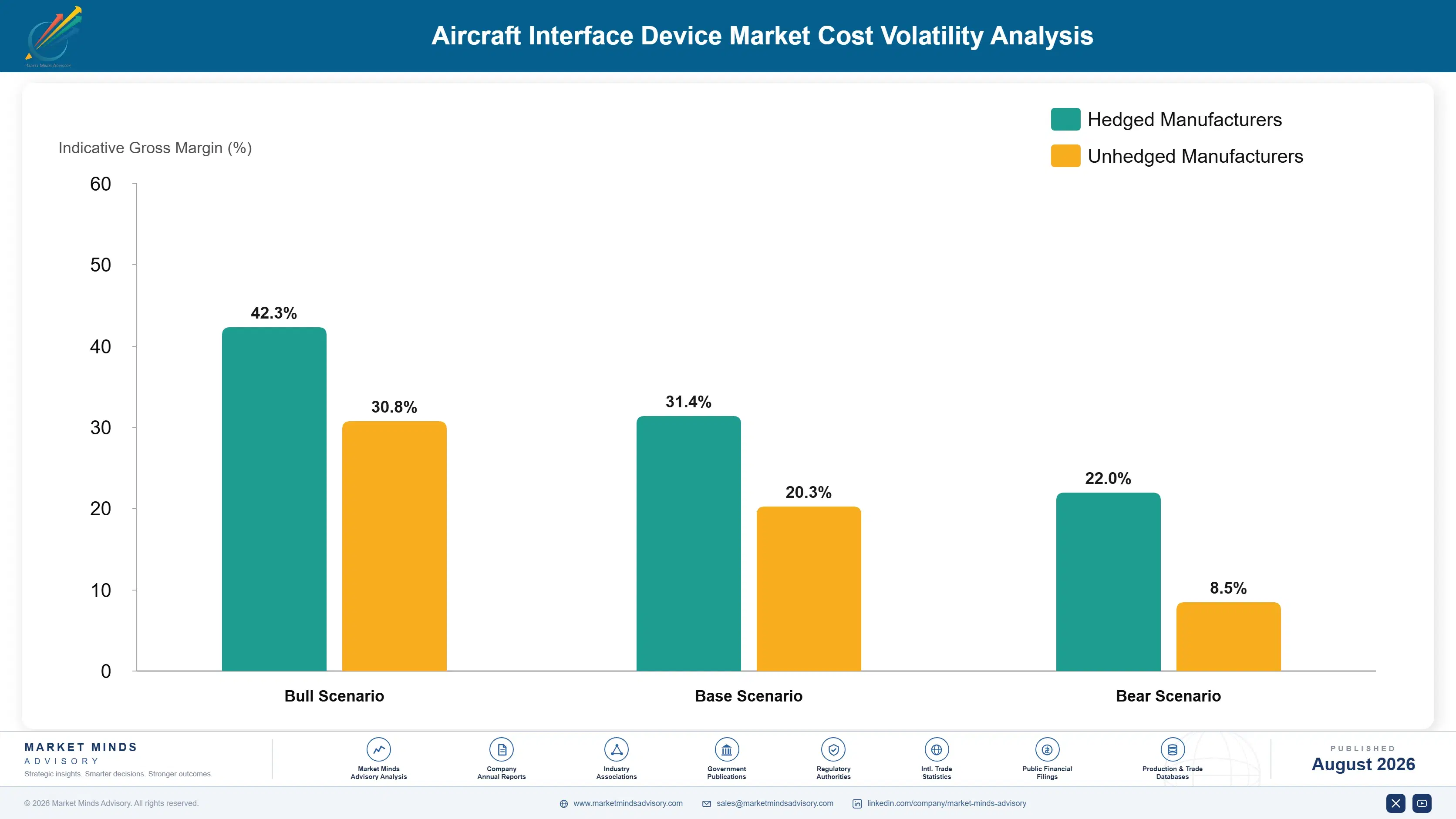
Programme cost divides into four components whose proportions surprise anybody expecting a hardware business. Certification, covering airworthiness approval, security evidence and documentation, absorbs roughly 41% of total programme cost. Hardware including the ruggedised enclosure, processing and bus interfaces runs near 22%, software development near 24%, and installation engineering with service infrastructure accounts for the remaining 13% across a typical programme.
The 2021 to 2023 component shortage demonstrated how a small hardware content can still stop a programme. Processors and bus interface devices specified in a certified design cannot be substituted without requalification, so suppliers waited rather than swapping parts out, and certified deliveries slipped while comparable uncertified electronics remained widely available. RTX and Honeywell both discussed component availability and supply chain pressure across that period in their annual reporting. Certification rigidity turned an ordinary shortage into a delivery problem.

Exposure varies by certificate strategy and by service capability. Suppliers approving certification families across related aircraft variants spread the 41% component widely, while those certifying each type separately carry it fully every time. Suppliers with service infrastructure recover cost across a subscription instead. Those selling hardware alone carry certification cost against one transaction at a price that cannot support it.
aircraft-interface-devices-aid-market-cost-volatility-analysis-1787997733230

Certification families covering related aircraft variants

Approving a family across related variants, rather than certifying each type independently, spreads the largest cost component across many installations and shortens the cycle considerably where authorities accept the reuse. The engineering delta must be documented rigorously for that acceptance. Suppliers who structured certification this way early now widen coverage faster than competitors can begin.

Security evidence generated alongside airworthiness approval

Producing security assessment evidence during the same programme that generates airworthiness approval costs far less than retrofitting it afterwards, and it is now required for operators to specify a device without further assessment. Suppliers treating security as a separate later activity pay twice. The regulation applying from 2026 removed any remaining argument for deferring it.

Service infrastructure recovering cost across subscription

Certification cost recovered through a single hardware sale demands a price the market resists, while the same cost recovered across a multi-year data subscription does not. Building parameter delivery, data formatting and hosting infrastructure requires capital before any recurring revenue exists. Suppliers without it compete on hardware price against a cost base that hardware pricing cannot cover.

Portfolio Architecture for Margin Defence

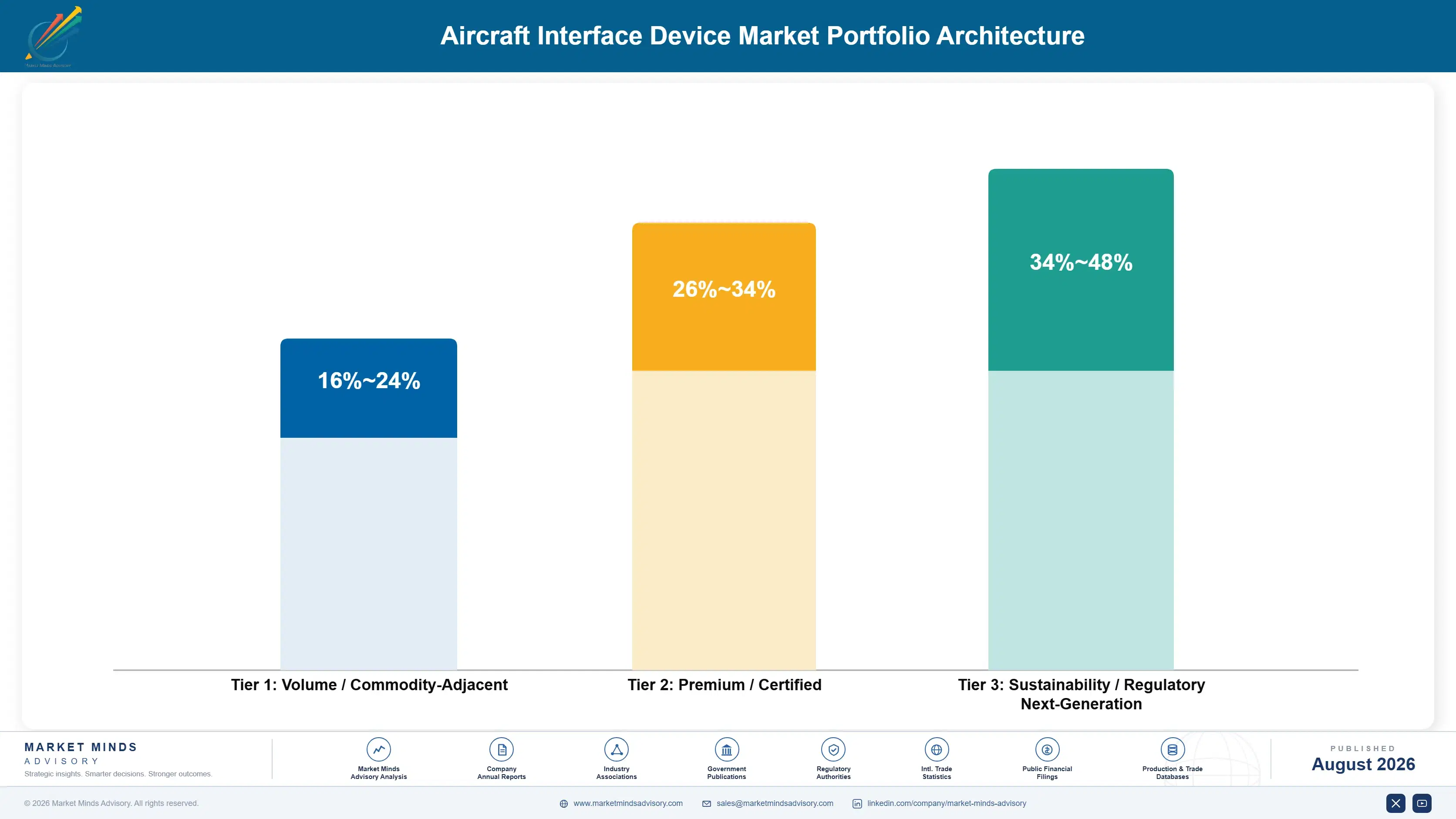
The portfolio separates by which direction data travels and how hard the certification is. Read-only functions supporting electronic flight bags and recorder replacement form the volume core: well understood certification paths, several capable suppliers and pricing that has compressed steadily as the approval route became familiar. Suppliers hold this work because it establishes the installation and because the recurring service attached to it outlives the hardware entirely.
Margin concentrates where the certification is genuinely difficult. Real-time streaming, connectivity gateway and predictive maintenance functions all demand parameter breadth, data integrity and service infrastructure that a simple read-only device does not, and airlines buying them are funding an operational programme rather than a piece of equipment. The tension is that these functions still depend on the same supplemental type certificate that the commodity work established.

The strongest position is bidirectional uplink, and almost nobody holds it. Writing data into the aircraft crosses the boundary in the direction regulators genuinely care about, which means airworthiness and security approval together on one device. Suppliers holding both are extremely few, and that scarcity rather than any technical difficulty is what supports the pricing.

Volume / Commodity-Adjacent

Read-only electronic flight bag provision and wireless recorder replacement. Range spans eight points because attached service capture differs enormously between suppliers selling subscriptions and those shipping hardware into an installation alone.
Gross Margin: 16-24%

Premium / Certified

Real-time streaming, connectivity gateway and predictive maintenance data capture. Range spans eight points because parameter breadth and service infrastructure vary considerably between genuine platform suppliers and much simpler hardware vendors.
Gross Margin: 26-34%

Sustainability / Regulatory / Next-Generation

Secure bidirectional uplink carrying airworthiness and security approval together. Range spans fourteen points because so few suppliers hold both approvals that pricing reflects scarcity rather than any comparable cost structure.
Gross Margin: 34-48%
aircraft-interface-devices-aid-market-portfolio-architecture-1787997733729

High-value Sub-segments and Strategic Watch-out

Secure Bidirectional Uplink

High value and high growth at 17.4%, requiring airworthiness and security approval together on a single certified device. The ten point range reflects how few suppliers hold both, which sets pricing by scarcity rather than by cost. Very few suppliers currently hold both approvals together.
Gross Margin: 38-48%

Predictive Maintenance Data Capture

High value with moderate growth at 15.2%, funded from engineering budgets rather than discretionary flight operations spending. The eight point range separates suppliers with genuine data service infrastructure from those delivering raw parameters only. Engineering budgets also move considerably faster than discretionary ones do here.
Gross Margin: 32-40%

Electronic Flight Bag Data Provision

The volume core establishing the installation that everything else is subsequently attached to. Certification paths are well understood, several suppliers compete capably, and pricing has compressed steadily as the approval route became familiar. Everything else in the market gets attached to this same installation later on.
Gross Margin: 16-24%

Wireless Recorder Replacement

The strategic watch-out rather than a growth pool. A once strong position has attracted competitors offering comparable function at lower price now the certification route is established, leaving service quality as the only remaining differentiation. Defending it on price alone would damage everything else attached.
Gross Margin: Variable

Why Installed Devices Stay Installed

An installed interface device produces annuity economics through certification and integration rather than through any contract. Removing it means a new supplemental type certificate, a new installation, and migrating the operational data flows an engineering department has built processes around across several years. Airlines undertake that rarely and essentially never for hardware pricing alone, which is why attached services at 39% of revenue persist long after the hardware is depreciated.
Stickiness varies sharply by what the device feeds. Predictive maintenance installations are the most permanent, since an engineering programme depends on continuous parameter history that a supplier change interrupts. Electronic flight bag provision is considerably more contestable, because the function is well understood and several suppliers hold the same approvals. Recorder replacement is the most exposed, having commoditised as its certification path became familiar.

The buyer has changed more than the product has. An interface device sold to flight operations competed for discretionary budget against everything else an airline might do that year. The same device sold to engineering draws on a programme budget already justified, moves through approval roughly 40% faster and faces almost no comparison shopping. Suppliers who noticed reorganised their sales functions, and most have not.
aircraft-interface-devices-aid-market-end-use-penetration-index-1787997734218

Where Interface Suppliers Should Commit

These are among the four positions where our research anticipates prominent divergence between winners and laggards over the coming forecast period. Each is grounded in the demand model, the regulatory perimeter, and the announced capacity pipeline.
01 / CERTIFICATE COVERAGE BREADTH

Mixed fleets consolidate toward whoever covers them all

A single supplemental type certificate covers exactly one aircraft type, and an airline retrofitting a mixed fleet wants one supplier rather than four separate approval programmes running concurrently alongside one another instead. Suppliers holding approvals across the five most common narrowbody and widebody aircraft types win mixed-fleet campaigns at roughly 2.6 times the rate that single-type competitors manage. Certification families covering related variants also cut the 26 month cycle by 30% to 40% wherever authorities accept the evidence reuse properly.
02 / BUDGET HOLDER TARGETING

Engineering pays faster than flight operations ever will

Positioned as a flight operations item, an interface device competes for discretionary budget against everything else an airline might otherwise choose to do that year instead. Positioned instead as enabling equipment for an approved predictive maintenance programme, it draws instead on an engineering budget already justified on component removal savings. Same device, same price, and a decision cycle roughly 40% shorter with a considerably higher win rate attached, yet very few suppliers have restructured their sales organisations to reflect any of that.
03 / SECURITY APPROVAL TIMING

Airworthiness alone stopped being sufficient in 2026

Information security regulation applying from 2026 now requires operators to document how data crosses the aircraft boundary, and airworthiness approval on its own no longer satisfies that obligation anywhere at all. Suppliers holding both airworthiness and security evidence on one certified device can be specified without any further work, while competitors trigger a separate assessment the airline must fund itself instead. That difference is worth some 15% to 20% on realised price and considerably more on the win rate itself.
04 / SERVICE ATTACHMENT DISCIPLINE

The box is a delivery mechanism for a subscription

Attached data services already produce 39% of market revenue and keep growing while hardware pricing compresses steadily against a certification cost base that it cannot cover. Suppliers attaching service at point of sale realise roughly 3.2 times the lifetime value of those selling hardware alone into an otherwise identical installation. The service must be genuinely useful rather than a billing wrapper, meaning genuine parameter delivery, data formatting and hosting the airline would otherwise have to build itself at considerable cost.

Engagement Snapshot From the Field

A live engagement with an industry participant carrying material or product regulatory and market exposure ahead of a defining policy shift, showing how our research translates into a defensible multi-year portfolio strategy.
MARKET MINDS ADVISORY · CLIENT ENGAGEMENT SUMMARY
Aircraft Interface Device Producer Strategic Portfolio Review and Transition Roadmap 2026·Investment Scenario on Aircraft Interface Device Exposure Evaluation 2025-26
CLIENT PROFILE
An avionics supplier holding certified interface device positions on three narrowbody aircraft types, selling hardware to airline flight operations departments through direct sales and maintenance provider channels. Unit volumes had grown steadily while margin fell each year, and management attributed the decline to competitive pricing pressure rather than to how the product was being sold or to what was being sold alongside it.
STRATEGIC CHALLENGE
The board needed to understand why margin fell as volumes rose, and whether extending certification to further aircraft types justified the cost given that each programme ran 26 months with no revenue attached. It also faced information security regulation applying from 2026 with no security evidence on any of its three certified devices at all.
MMA APPROACH
MMA rebuilt programme economics per certified type, separating hardware margin from attached service revenue and attributing certification cost across installations, then benchmarked win rates by buying department across the client's campaign history. Expert interviews with airline engineering and flight operations functions, maintenance providers and certification authorities established what buyers valued and what evidence they now required.
KEY FINDINGS
  1. Attached service revenue represented 9% of the client's total against a market pattern near 39%, and hardware alone could not cover certification cost on any of the three types.
  2. Campaigns sold to engineering departments closed at 2.9 times the rate of those sold to flight operations, and the client had directed 84% of its selling effort at flight operations.
  3. The three certified types shared enough installation architecture to have been approved as a single certification family, which would have cut the third programme by an estimated eleven months.
  4. No security assessment evidence existed on any device, and two prospective European customers had already deferred decisions pending exactly that documentation being produced.
CLIENT PROFILE
An avionics supplier holding certified interface device positions on three narrowbody aircraft types, selling hardware to airline flight operations departments through direct sales and maintenance provider channels. Unit volumes had grown steadily while margin fell each year, and management attributed the decline to competitive pricing pressure rather than to how the product was being sold or to what was being sold alongside it.
STRATEGIC CHALLENGE
The board needed to understand why margin fell as volumes rose, and whether extending certification to further aircraft types justified the cost given that each programme ran 26 months with no revenue attached. It also faced information security regulation applying from 2026 with no security evidence on any of its three certified devices at all.
MMA APPROACH
MMA rebuilt programme economics per certified type, separating hardware margin from attached service revenue and attributing certification cost across installations, then benchmarked win rates by buying department across the client's campaign history. Expert interviews with airline engineering and flight operations functions, maintenance providers and certification authorities established what buyers valued and what evidence they now required.
KEY FINDINGS
  1. Attached service revenue represented 9% of the client's total against a market pattern near 39%, and hardware alone could not cover certification cost on any of the three types.
  2. Campaigns sold to engineering departments closed at 2.9 times the rate of those sold to flight operations, and the client had directed 84% of its selling effort at flight operations.
  3. The three certified types shared enough installation architecture to have been approved as a single certification family, which would have cut the third programme by an estimated eleven months.
  4. No security assessment evidence existed on any device, and two prospective European customers had already deferred decisions pending exactly that documentation being produced.
RECOMMENDED STRATEGY
Phase 1: Phase one: build parameter delivery and data formatting service infrastructure, and attach a subscription to every hardware sale from the next campaign onward. Phase 2: Phase two: redirect selling effort toward airline engineering departments and rebuild the proposition around predictive maintenance enablement rather than flight operations convenience. Phase 3: Phase three: generate security assessment evidence across all three certified devices and pursue further approvals as a certification family rather than individually.
OUTCOME
The client reported attached service reaching 24% of revenue within six quarters (client-reported, unverified by MMA), with gross margin improving 6.1 points. Win rate rose after the selling effort was redirected toward engineering buyers. Security evidence was completed on two of three devices, and both deferred European customers returned to the campaign.

Frequently Asked Questions

Foundational context covering the market sizes, CAGR, scope, country, region and competition that inform every finding below. This section is provided to cover basics and most often pre-purchase conversations, answered from the MMA Primary Research Dataset.

What is the current size of the Aircraft Interface Device Market?

The market is valued at USD 0.4 billion in 2025, measured as revenue from certified devices bridging aircraft avionics buses to cabin and ground systems plus attached data services.

How large will the Aircraft Interface Device Market be by 2036?

MMA forecasts USD 1.35 billion by 2036, up from USD 0.45 billion in 2026. That represents incremental revenue of USD 0.90 billion and an expansion multiple of 3.00 times.

What is the CAGR for the Aircraft Interface Device Market 2026 to 2036?

The base case CAGR is 11.6%, with a bull case of 12.8% and a bear case of 10.4%. Retrofit volume and predictive maintenance programmes supply most of that growth.

Which segment is growing fastest?

Secure bidirectional uplink grows at 17.4%, half again the market rate of 11.6%. Writing data into an aircraft crosses the boundary regulators genuinely care about.

Who are the major companies in the Aircraft Interface Device Market?

Collins Aerospace, Honeywell Aerospace, Teledyne Controls, Astronautics Corporation of America and Boeing lead on certified device revenue, holding around 68% of device revenue between them.

Which country is growing fastest?

India grows fastest at 13.6%, driven by fleet expansion at a pace no other market matches and by aircraft delivered without interface capability specified initially.

Report Segmentation Architecture

The full report scope spans multiple orthogonal segmentation dimensions, with cross-tabulated demand data provided for each dimension pair. Coverage extends further to regional breakdowns, trend trajectories, and the competitive detail needed to support segment-level decision-making.

By Delivered Function

  • Electronic Flight Bag Data Provision
  • Real-Time Flight Data Streaming
  • Cabin and Connectivity Gateway
  • Predictive Maintenance Data Capture
  • Secure Bidirectional Uplink
  • Wireless Quick Access Recorder Replacement

By End-Use Industry

  • Network Carriers
  • Low Cost Carriers
  • Regional Airlines
  • Business Aviation Operators
  • Cargo Operators
  • Military Transport Fleets

By Commercial Dimension

  • Line Fit Airframer Supply
  • Retrofit Supplemental Type Certificate
  • Recurring Data Service Subscription
  • Maintenance Provider Installation
  • Connectivity Provider Bundling
  • Software Application Licensing

By Region

  • North America
  • Western Europe
  • East Asia
  • South Asia and Pacific
  • Latin America
  • Middle East and Africa
  • Eastern Europe

Scope, Methodology, and Coverage

Every figure in this report is reproducible from documented input assumptions. The scope below maps the historical period, the forecast horizon, the segmentation dimensions, and the countries covered, alongside the underlying primary and qualitative methodology.
Historical Period
2020 to 2025
Forecast Period
2026 to 2036
Base Year
2025 (USD billions; MMA Primary Research Dataset, August 2026)
Market Definition
Revenue from certified hardware bridging aircraft avionics data buses to cabin, connectivity and ground systems, spanning electronic flight bag data provision, real-time flight data streaming, cabin and connectivity gateway, predictive maintenance data capture, secure bidirectional uplink and wireless recorder replacement, together with the recurring data services delivered through those devices. Line fit supply, retrofit installation under supplemental type certificate and subscription services are included. Cabin connectivity terminals and antennas, regulatory flight data recorders, electronic flight bag tablets and applications, and independently sold ground analytics platforms are excluded.
Quantitative Units
USD billions, device and attached service revenue
Segmentation Dimensions
Delivered function, end-use operator industry, commercial supply dimension, region
Regions Covered
North America, Western Europe, East Asia, South Asia and Pacific, Latin America, Middle East and Africa, Eastern Europe
Countries Covered
United States, United Kingdom, France, Germany, China, Japan, South Korea, India, Australia, Brazil, Mexico, United Arab Emirates, Qatar, Poland
Key Companies Profiled
Collins Aerospace, Honeywell Aerospace, Teledyne Controls, Astronautics Corporation of America, Boeing, Airbus, Thales, GE Aerospace, Avionica, Lufthansa Technik
Quantitative Methodology
Primary survey, n=3,800 respondents, Q4 2025, six countries; demand-side model with trade association cross-validation
Qualitative Methodology
47 expert interviews, Q4 2025; applied to validate demand model assumptions, identify emerging dynamics, and assess competitive positioning
Report Format
PDF and XLSX data workbook (Word format preview document)
Publisher
Market Minds Advisory
Report Code
MMA-2026-CON-261
Published
August 2026
Contact
sales@marketmindsadvisory.com | www.marketmindsadvisory.com

Purchase the full Aircraft Interface Device Market Report (2026 to 2036).

The full report treats the aircraft interface device as a certification product rather than a piece of hardware, and shows where the value genuinely accrues. It quantifies attached service revenue against hardware margin, models certification family approval against per-type approval cost, and assesses which suppliers hold security evidence alongside airworthiness approval as the 2026 regulation applies. Segment analysis covers all six delivered functions, with particular attention to bidirectional uplink where the certification barrier is highest and largely unbreached. Competitive assessment ranks twenty suppliers on certified device and attached service revenue across every operating region.
Six delivered function segmentation with growth rates
Attached service revenue against hardware margin
Twenty supplier assessment on certified device revenue
Certification family cost against per-type approval
Win rate compared by airline buying department
Security evidence coverage across supplier device ranges

Built For The People Who Decide

From boardroom strategy to bench-side execution, this report is read cover-to-cover by leaders shaping the next decade of their industry, turning demand scenarios, market dynamics and valuation benchmarks into decisions.
CXOs/ Presidents/ VPs/ Managers
M&A and Corporate Development
Strategy Teams and R&D Heads
Procurement and Product Directors
Regulatory and Compliance Leaders
Investor Relations and Equity Analysts