Market Minds Advisory
Aircraft Ground Support Equipment Market

Aircraft Ground Support Equipment Market: Electrification Mandates and European Airport Density Through 2036

European airport emissions mandates are pulling ground support equipment fleets toward electric power faster than almost anywhere else, while established manufacturers headquartered across the region defend a technical lead built over decades.

Lead Analyst

David Horsley

Published

September 2026

Make Smarter Decisions with Customized Research Insights

Request a free sample report and evaluate market opportunities, growth trends, and competitive dynamics relevant to your business needs.

2025 MARKET VALUE$6.5BMarket Size 2025
2036 FORECAST VALUE$15.9BBase Case , 2026 to 2036
CAGR 2026 TO 20368.5 %Bull 9.8% / Bear 7.2%
INCREMENTAL OPPORTUNITY$8.9BNet 10- year value creation
EXPANSION MULTIPLE2.26x2036 value over 2026 base
Strategic Levers
M&A Pipeline
Regional Outlook
Country Rankings
Competitive Intelligence
Segmental Deep-dive
Call-Us : 91 93563 13602

Executive Snapshot and Market Trajectory

Ground support equipment is undergoing its most significant technology shift in decades, as airport emissions regulations push fleets of tow tractors, ground power units, and baggage loaders toward electric drivetrains that were a rare exception just a few years ago across most major hub airports, reshaping manufacturer investment priorities globally.
European manufacturers including TLD Group, Cavotec, and Mallaghan Engineering built their technical leadership serving a continent with unusually dense airport infrastructure and correspondingly early emissions regulation, giving them an electrification head start that North American and Asian competitors are still working to close. Ground power units and electric pushback tractors are capturing disproportionate investment attention as airports prioritize replacing the highest-emission equipment categories first.
Airlines and airport authorities increasingly specify total cost of ownership across equipment lifecycles rather than simple upfront purchase price, favoring electric equipment whose higher initial cost is offset by lower fuel and maintenance expenses over a typical decade-plus service life. Aftermarket parts and service contracts remain a meaningful revenue base for established manufacturers, since ground support equipment operates continuously under demanding conditions that require regular maintenance regardless of underlying powertrain technology.
Market Definition
The aircraft ground support equipment market covers tow tractors and pushback tractors, baggage and cargo handling equipment, ground power units and air start units, aircraft de-icing equipment, passenger and catering service vehicles, and lavatory and water service equipment sold to airports, airlines, and ground handling companies. It excludes aircraft maintenance hangar equipment and air traffic control infrastructure.
Base Year Value
$6.5B in 2025 (MMA Primary Research Dataset, August 2026)
Forecast Period
2026 to 2036, eleven discrete annual values
CAGR
8.5% base case. Bull 9.8%. Bear 7.2%.
Fastest Growth Segment
Ground Power Units and Air Start Units: 11.5% CAGR
Fastest Growth Country
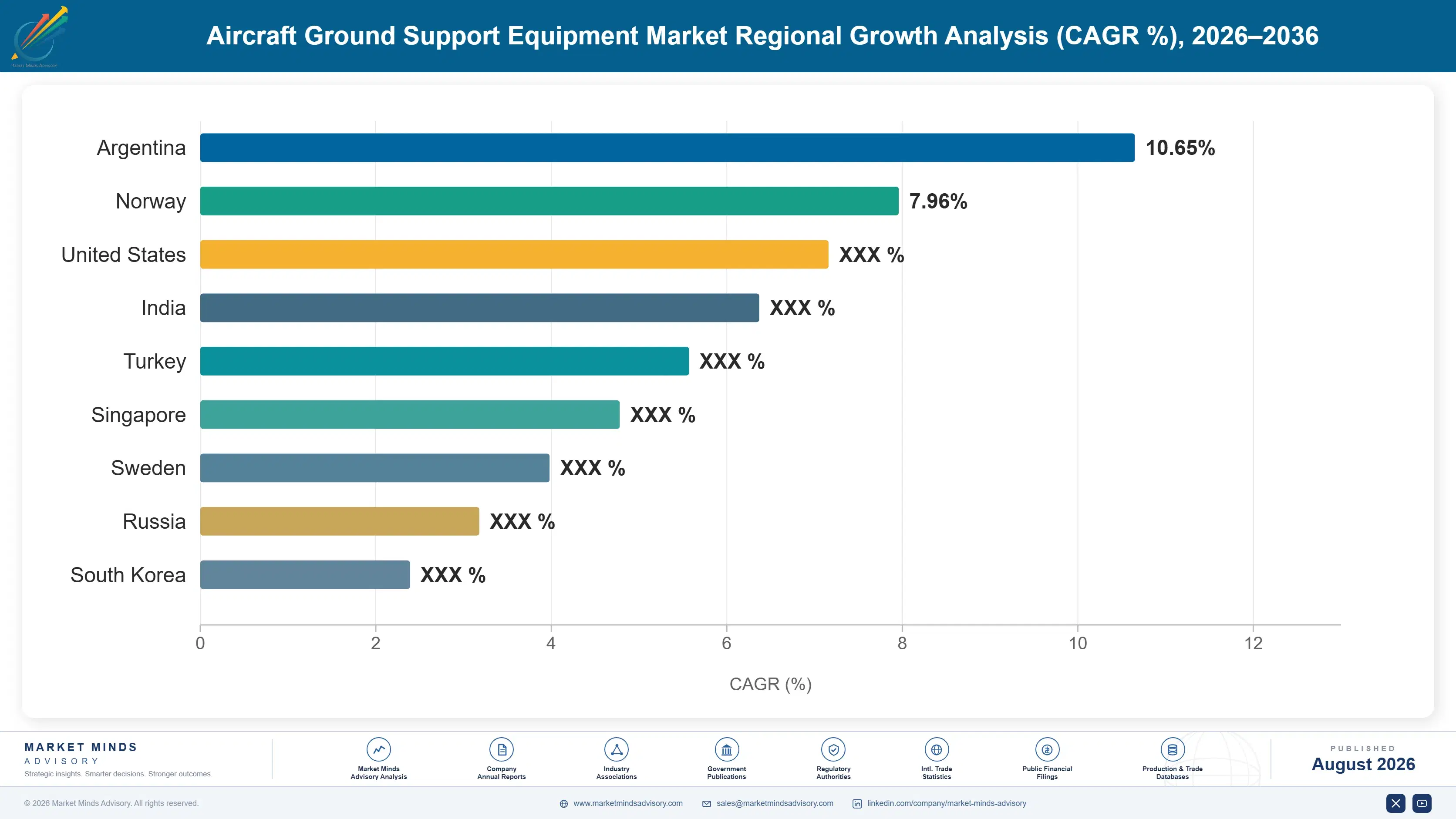
India: 11.0% CAGR
Fastest Growth Region
South Asia and Pacific: 10.5% CAGR
Largest Region
Western Europe: 26% of 2025 global value
Market Leaders
TLD Group, JBT Corporation, Textron GSE, Cavotec, Mallaghan Engineering. Source: MMA Analysis based on company annual reports.
Primary Survey
n=3,800 procurement and R&D decision-makers, Q4 2025, six countries
Methodology
Demand-side build-up, cross-validated against public data, 47 expert interviews

Aircraft Ground Support Equipment Market Forecast Scenarios

aircraft-ground-support-equipment-market-size-forecast-scenario-1787463573946
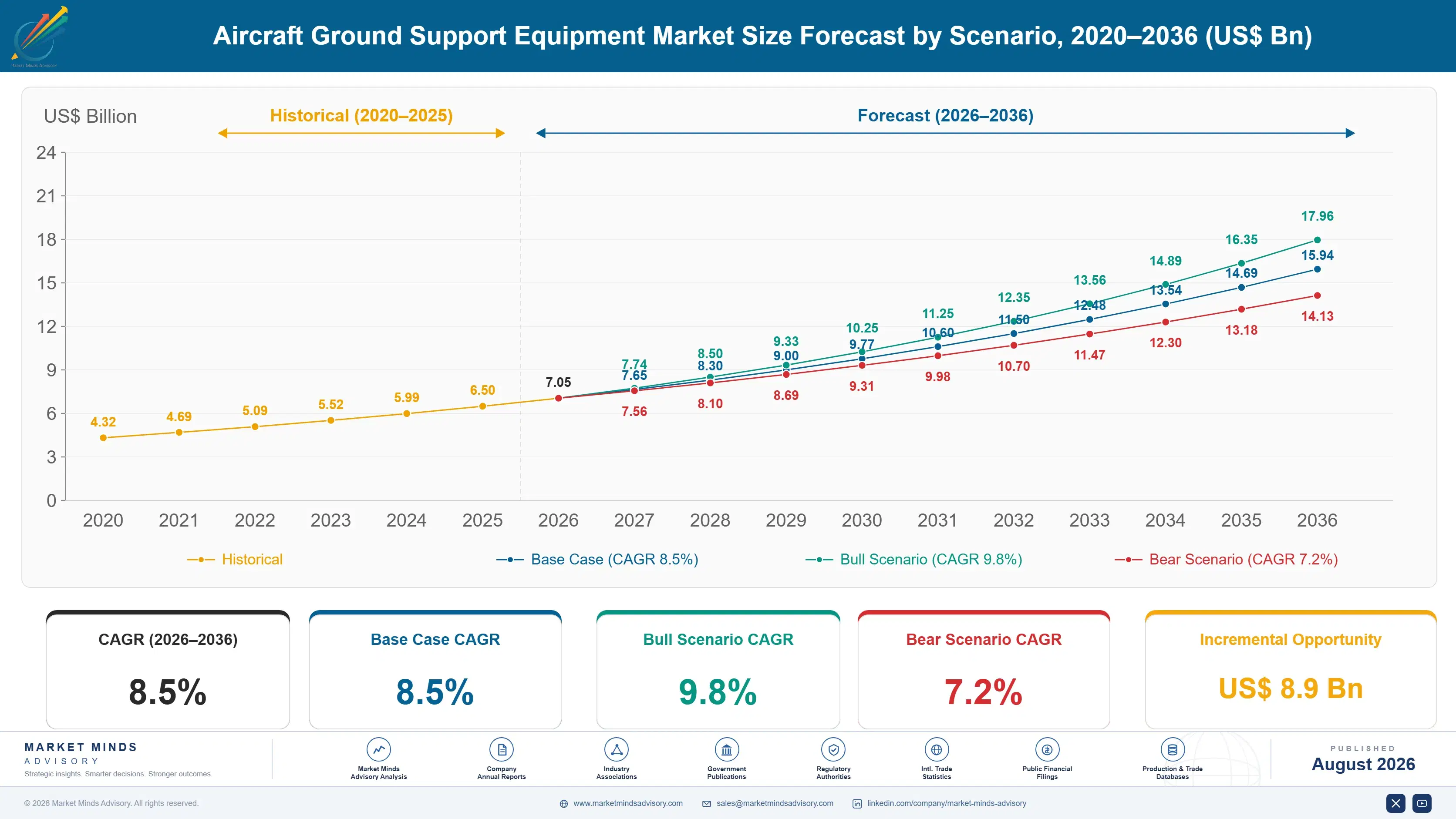
Between 2020 and 2025 the market grew at roughly 7.0 percent a year, with pandemic-era aviation traffic collapse briefly halting equipment orders before air travel recovery and electrification mandates accelerated demand through the back half of the period as airports resumed capital investment programs across major hub markets, and across every major hub airport tracked.
The base case assumes 8.5 percent annual growth to 2036, built on three mechanisms: accelerating electric equipment adoption as airport emissions regulations tighten across European and increasingly global markets, steady air traffic growth requiring proportional ground support equipment fleet expansion at both established and newly developed airports, and total cost of ownership economics that increasingly favor electric equipment despite higher upfront purchase prices. Together these three mechanisms sustain growth above simple air traffic volume trends.
A bull case near 9.8 percent depends on additional airport authorities adopting mandatory electric equipment requirements faster than currently planned across their ground handling operations. The bear case near 7.2 percent assumes air traffic growth slows in major markets enough that fleet expansion decisions get deferred toward simple equipment replacement levels, across their broader ground handling fleets.

Electrification Economics and Airport Fleet Renewal Cycles

Ground support equipment sits at an unusual intersection of heavy industrial machinery and airport-specific operating requirements, since equipment must withstand continuous outdoor duty cycles in extreme weather while meeting increasingly strict emissions and noise regulations that vary meaningfully across individual airport authorities and their specific local mandates, and safety certification standards imposed by aviation regulators.
PRODUCER CONCENTRATIONCR5 42%top five hold roughly two-fifths of global capacity
AVERAGE SELLING PRICE$85,000/unitblended price across major sold equipment categories today
EUROPE MANUFACTURING SHARE36%share of global equipment production originating from this region
ELECTRIC EQUIPMENT PENETRATION28%share of new equipment sold with electric drivetrains today
TRADE INTENSITY52%share of volume crossing a border before final airport deployment
BATTERY COST SHARE32% of COGSbattery pack and electric drivetrain cost burden within production
Commercially, the market splits between diesel-powered equipment still sold at volume for budget-constrained buyers and a faster-growing electric tier commanding a substantial premium reflecting battery and drivetrain technology cost. Margins concentrate in the electric segment, where technical differentiation and total cost of ownership documentation matter more than the largely commoditized diesel equipment competing primarily on price, as buyers increasingly demand documented lifecycle cost evidence before committing to any purchase.
Over the next decade, battery technology cost reduction and total cost of ownership documentation capability will matter more to competitive position than diesel equipment manufacturing scale, since basic mechanical ground support equipment technology itself is now widely accessible across multiple manufacturers competing primarily on price alone, particularly as buyers weigh service life economics carefully, which keeps competitive intensity high across the diesel equipment tier specifically.
"Nobody buys a pushback tractor because it looks impressive. Airports buy the one whose total cost of ownership spreadsheet looks best over a fifteen-year service life, and electric equipment increasingly wins that argument outright."
Director, Construction and Industrial Equipment Practice · MMA Construction and Industrial Equipment Practice · August 2026

Market Trends

Airport Emissions Regulations Accelerate Electric Fleet Conversion

European airport authorities have introduced increasingly strict emissions requirements for ground support equipment operating within terminal areas, and several major hub airports now require new equipment purchases to meet electric or near-zero emission standards before granting operating permits. TLD Group and Cavotec have both expanded electric equipment production capacity specifically to serve this regulatory-driven demand wave rather than relying on discretionary fleet upgrade decisions alone. This regulatory trend is spreading from pioneering European airports into North American and Asian markets as regulators there study the European experience closely, reflecting how quickly the regulatory model is scaling internationally.
Market Impact: Air traffic grows 4-5% annually worldwide
Total Cost of Ownership Analysis Shifts Purchasing Criteria

Airport authorities and ground handling companies increasingly evaluate equipment purchases using total cost of ownership models spanning a full decade-plus service life rather than simple upfront purchase price comparisons that historically favored cheaper diesel equipment. JBT Corporation and Textron GSE have both expanded total cost of ownership documentation and financing support specifically to help buyers justify electric equipment's higher initial cost against its lower fuel and maintenance expenses over time. This shift in purchasing methodology is accelerating electric adoption beyond what emissions regulations alone would achieve, reshaping how airport procurement teams evaluate competing supplier proposals.
Market Impact: Battery costs fell sharply, 5 years

Market Opportunities and Growth Drivers

Global Air Traffic Growth Sustains Equipment Fleet Expansion

Global air passenger traffic has grown steadily as travel demand recovers and expands beyond pre-pandemic levels across most major markets, and every additional flight requires proportional ground support equipment capacity at both origin and destination airports handling that traffic. This volume relationship gives equipment manufacturers a predictable demand floor tied directly to broader air traffic growth rather than depending on any single airline or airport authority's individual capital expenditure decisions within the competitive aviation infrastructure landscape shaping global travel, reinforcing manufacturer confidence in sustained long-term capacity investment plans, across both established hub airports and newer regional facilities alike.
Market Impact: Electric equipment costs 30-40% more upfront

Electric Equipment Cost Reduction Expands Addressable Market

Battery technology costs have fallen substantially over the past several years as broader electric vehicle manufacturing scale drove down component pricing across the entire supply chain, and that cost trajectory has expanded the addressable market for electric ground support equipment well beyond early premium adopters into mainstream airport procurement planning. TLD Group and Cavotec have both driven this cost curve through continuous manufacturing scale expansion, making electric equipment increasingly competitive against diesel alternatives on pure economics, reinforcing the case for continued capital investment across the supply chain, a trend expected to continue as manufacturing volume keeps expanding further.
Market Impact: Infrastructure gaps delay conversion 2-3 years

Market Restraints and Challenges

Higher Upfront Equipment Cost Limits Budget-Constrained Buyers

Electric ground support equipment still carries a substantial premium over diesel equivalents despite falling battery costs, and the underlying cause is that battery packs and electric drivetrain components remain more expensive to manufacture than established diesel engine technology built on decades of manufacturing scale. The commercial impact limits electric adoption among smaller regional airports and budget-constrained ground handling companies unable to justify the higher upfront capital outlay regardless of long-term savings. Mitigation efforts include manufacturers offering leasing and financing programs that spread electric equipment cost over its service life, particularly across smaller regional airport authorities operating under tighter capital constraints.
Market Impact: Electric penetration reached 28% of sales

Charging Infrastructure Gaps Slow Electric Fleet Transitions

Many airports lack sufficient charging infrastructure to support large-scale electric ground support equipment fleets, and the underlying cause is that retrofitting existing airport electrical infrastructure requires substantial capital investment and construction work that competes with other airport capital priorities for limited budget. The commercial impact delays electric fleet conversion timelines even at airports otherwise committed to electrification goals. Airport authorities are mitigating this through phased charging infrastructure buildout programs coordinated with equipment replacement cycles, particularly at older airports built long before electrification planning began, and total conversion timelines commonly extend well beyond original planning estimates.
Market Impact: Adoption favors electric by year 5
3 additional market trends, 3 additional growth drivers, and 3 additional restraints and challenges are covered in the full report. Contact sales@marketmindsadvisory.com to access the complete intelligence.

Segment CAGR and Growth Architecture

Ground support equipment splits into six categories by equipment function, each serving a distinct stage of aircraft turnaround operations. Ground power units and tow tractors are electrifying fastest as emissions mandates target the highest-usage equipment categories first, while baggage handling and service vehicles follow a slower but steady replacement cycle tied to fleet age.
aircraft-ground-support-equipment-market-market-share-analysis-1787463574478

Ground Power Units and Air Start Units

Ground power units and air start units are electrifying faster than any other equipment category because they are among the highest-usage machines on an airport ramp, running continuously during every aircraft turnaround to supply electrical power and engine start air without the aircraft's own engines running. That duty cycle makes their diesel emissions and noise output disproportionately visible to airport authorities setting electrification priorities, which is why regulators have targeted this category first for mandatory conversion in several major European hubs. Cavotec and TLD Group have both expanded electric ground power production to serve this demand, and total cost of ownership economics favor electric units given the operating hours each unit accumulates annually.
CAGR 11.5%

Tow Tractors and Pushback Tractors

Tow tractors and pushback tractors represent the largest single equipment category by revenue and are converting to electric drivetrains quickly as airports prioritize replacing their most visible diesel equipment operating directly beside aircraft during pushback and taxi assist operations. TLD Group, JBT Corporation, and Mallaghan Engineering compete most directly in this category, where towing capacity requirements for wide-body aircraft demand higher-torque drivetrains than smaller equipment categories require. Electric pushback tractors now match diesel towing performance for most aircraft types, removing what was until recently the main technical objection airports raised against electrification of this specific equipment category during procurement evaluation cycles, as regulators increasingly favor this equipment category for early mandatory conversion.
CAGR 10.0%
Full segment breakdown across 7 segments available in the complete report.

Regional Architecture and Country Demand Map

Western Europe leads global ground support equipment demand, reflecting the concentration of major manufacturers and Europe's unusually dense airport network operating under the world's earliest and strictest ground equipment emissions regulations. East Asia and North America follow closely, each anchored by large domestic aviation markets expanding fleet capacity steadily.

North America

US airports are replacing aging diesel ground support fleets under a mix of airport authority sustainability commitments and federal emissions incentive programs, with major hubs in California and the Northeast moving fastest given state-level air quality rules that specifically target airport ground operations. JBT Corporation and Textron GSE both maintain significant domestic manufacturing capacity serving this demand directly. Canada's smaller but growing airport network is following a similar trajectory, though on a slower timeline given fewer regulatory mandates currently in force. Cargo carrier expansion at major logistics hubs adds further equipment demand beyond passenger airport fleet renewal, particularly for baggage and cargo handling equipment serving overnight freight operations, and airport authorities in Texas and Florida are studying comparable rules closely.
Share: 24% | CAGR: 8.5% (2026 to 2036)

Western Europe

Five of the industry's most significant equipment manufacturers, including TLD Group, Cavotec, and Mallaghan Engineering, are headquartered within this region, giving European airports early access to electric equipment technology years before it reached other markets. Regulatory mandates in Germany, France, and the Nordic countries require new equipment purchases to meet electric or near-zero emission standards at many major hubs already, well ahead of comparable rules elsewhere. This share sits above the standard band because manufacturing concentration and first-mover regulatory pressure both originate here rather than reflecting fleet volume alone, a genuine and durable feature of this specific industry worth flagging explicitly. Dense intra-European air traffic sustains high equipment utilization rates across the region's airport network.
Share: 26% | CAGR: 7.0% (2026 to 2036)
Regional intelligence for 5 additional markets available in the complete report: East Asia, South Asia and Pacific, Latin America, Middle East and Africa, Eastern Europe. Contact sales@marketmindsadvisory.com.
aircraft-ground-support-equipment-market-country-cagr-analysis-1787463574986

Where Margin Concentrates as Fleets Electrify

Manufacturers capture the largest margin gains not from selling more equipment but from shifting what they sell: electric drivetrains, telematics-enabled service contracts, and financing structures that spread higher electric equipment cost over its service life. Each lever depends on capability incumbents already have and challengers must still build from scratch, The pattern favors incumbents with installed bases.

Convert Diesel Fleet Contracts to Electric Equipment

Manufacturers with mature electric drivetrain technology can convert existing diesel fleet customers to electric equipment at their next replacement cycle, capturing a price premium of roughly 25 to 30 percent over comparable diesel units while helping airport customers meet emissions mandates already in force at several major hubs. TLD Group and Cavotec have both prioritized this conversion strategy with existing customers rather than competing purely for new contracts, since incumbent suppliers already hold the relationship and qualification history needed to win the electric equipment upgrade without a competitive tender process in most cases.
Market Impact: Electric conversion adds a 25-30% price premium today

Bundle Predictive Maintenance Contracts With Hardware Sales

Equipment increasingly ships with telematics sensors that feed predictive maintenance platforms, letting manufacturers sell multi-year service contracts alongside hardware rather than one-time equipment sales alone. These contracts generate recurring revenue worth an estimated 15 to 20 percent of initial equipment value annually and create switching costs that competitors without comparable telematics capability cannot easily replicate. JBT Corporation has expanded this service offering specifically to capture recurring revenue from its installed base rather than depending solely on new equipment orders each year, and reinforces long-term customer loyalty across each equipment fleet renewal cycle.
Market Impact: Service contracts add 15-20% recurring annual revenue now

Offer Financing Structures for Electric Equipment

Financing and leasing programs that spread electric equipment's higher upfront cost across its service life help budget-constrained airport customers justify the purchase against comparable diesel alternatives, expanding the addressable customer base beyond buyers able to absorb the full capital outlay immediately. Manufacturers offering in-house financing capture roughly 10 to 15 percent higher win rates against competitors requiring upfront cash purchase, since many smaller regional airports and ground handling companies operate under tighter capital budgets than major international hub operators typically face, and this gap is widening as more airports adopt electrification targets.
Market Impact: Financing improves customer win rates by 10-15 percent

Who Controls the Margin Pool

Concentration sits moderate at a CR5 near 42 percent, with TLD Group holding the clearest leadership position given its broad equipment range and early electric technology investment. The gap between TLD Group and mid-tier challengers like Mallaghan Engineering is meaningful but not insurmountable, since electric drivetrain technology itself has become increasingly accessible across the industry, shifting competitive advantage toward service and financing capability rather than pure hardware differentiation alone.
Current competitive activity centers on electric equipment production capacity expansion and telematics platform development, as manufacturers race to meet airport electrification mandates while building the recurring service revenue that hardware sales alone cannot provide. JBT Corporation and Textron GSE have both expanded financing programs to help budget-constrained customers justify electric equipment's higher upfront cost, while Cavotec continues investing heavily in ground power unit production specifically.

Emerging pressure comes from Chinese manufacturers like Weihai Guangtai Airport Equipment scaling production capacity and technical capability rapidly within their large domestic market, a trajectory that could eventually support international expansion the way other Chinese industrial equipment categories have previously followed. Rankings could shift meaningfully over the next decade if domestic Chinese suppliers begin competing seriously outside their home market.
aircraft-ground-support-equipment-market-company-positioning-matrix-1787463575509

Competitive Moat and Risk Dimensions

TLD GROUP

Moat: Broad Electric Portfolio

TLD Group offers the industry's broadest electric equipment range spanning tow tractors, ground power units, and de-icing equipment, letting airports standardize on one supplier across multiple equipment categories rather than managing several vendor relationships with different parts and service requirements across their fleet, cutting procurement complexity and total lifecycle maintenance cost meaningfully.
TLD GROUP

Risk: European Regulatory Dependence

TLD Group's growth has leaned heavily on European electrification mandates, and slower regulatory adoption in other regions could leave its capacity investment ahead of demand if North American and Asian markets electrify more gradually than currently projected across the industry, leaving revenue growth more exposed to policy timing than diversified competitors.
JBT CORPORATION

Moat: Diversified Industrial Base

JBT Corporation's broader industrial equipment business gives it engineering and manufacturing scale that smaller pure-play ground support equipment competitors cannot match, supporting sustained research investment even during periods when airport capital spending slows temporarily, particularly valuable when airport capital budgets tighten unexpectedly during downturns, across market cycles.
JBT CORPORATION

Risk: Diluted Category Focus

JBT Corporation's ground support equipment business competes for internal capital allocation against the company's other industrial segments, potentially slowing electrification investment relative to focused specialists like TLD Group and Cavotec pursuing this category exclusively, a persistent disadvantage against specialists whose entire capital budget serves this single category.

Players Tracked

Prominent Players

TLD Group
JBT Corporation
Textron GSE
Cavotec
Mallaghan Engineering

Other Key Players

ITW GSE
Douglas Equipment
Tronair
Global Ground Support
Vestergaard Company
Weihai Guangtai Airport Equipment
Guinault
Aviogei Airport Equipment
Kalmar Motor
Trepel Airport Equipment
Eagle Tugs
Hobart Ground Power
LEKTRO
Charlatte America
AXA Power

Recent Developments

MARCH 2025

TLD Group announced an expansion of its electric ground power unit manufacturing capacity at its European production facility, adding capacity to serve growing demand from airports converting fleets ahead of tightening regional emissions mandates affecting ground equipment operations, and reinforcing its position as the leading electric ground power supplier.
Signal: Signals manufacturer confidence that European electrification demand will keep sustaining long-term capacity utilization rates across the industry
SEPTEMBER 2025

Cavotec entered a supply agreement with a major European airport operator to provide electric ground power units across several hub facilities over a multi-year period, replacing an aging diesel fleet as part of the airport's broader sustainability commitment program, part of the airport's broader multi-year sustainability investment roadmap.
Signal: Confirms airport operators increasingly commit to multi-year electric equipment procurement over incremental replacement purchases across the sector
JANUARY 2026

JBT Corporation launched an expanded telematics platform for its ground support equipment product line, adding predictive maintenance capability aimed at reducing unplanned equipment downtime for airline and ground handling company customers operating large fleets, a capability increasingly expected by large fleet customers evaluating competing equipment suppliers.
Signal: Signals a broader competitive shift toward recurring service revenue rather than one-time hardware sales across the industry

Battery Cells and Steel Chassis Exposure

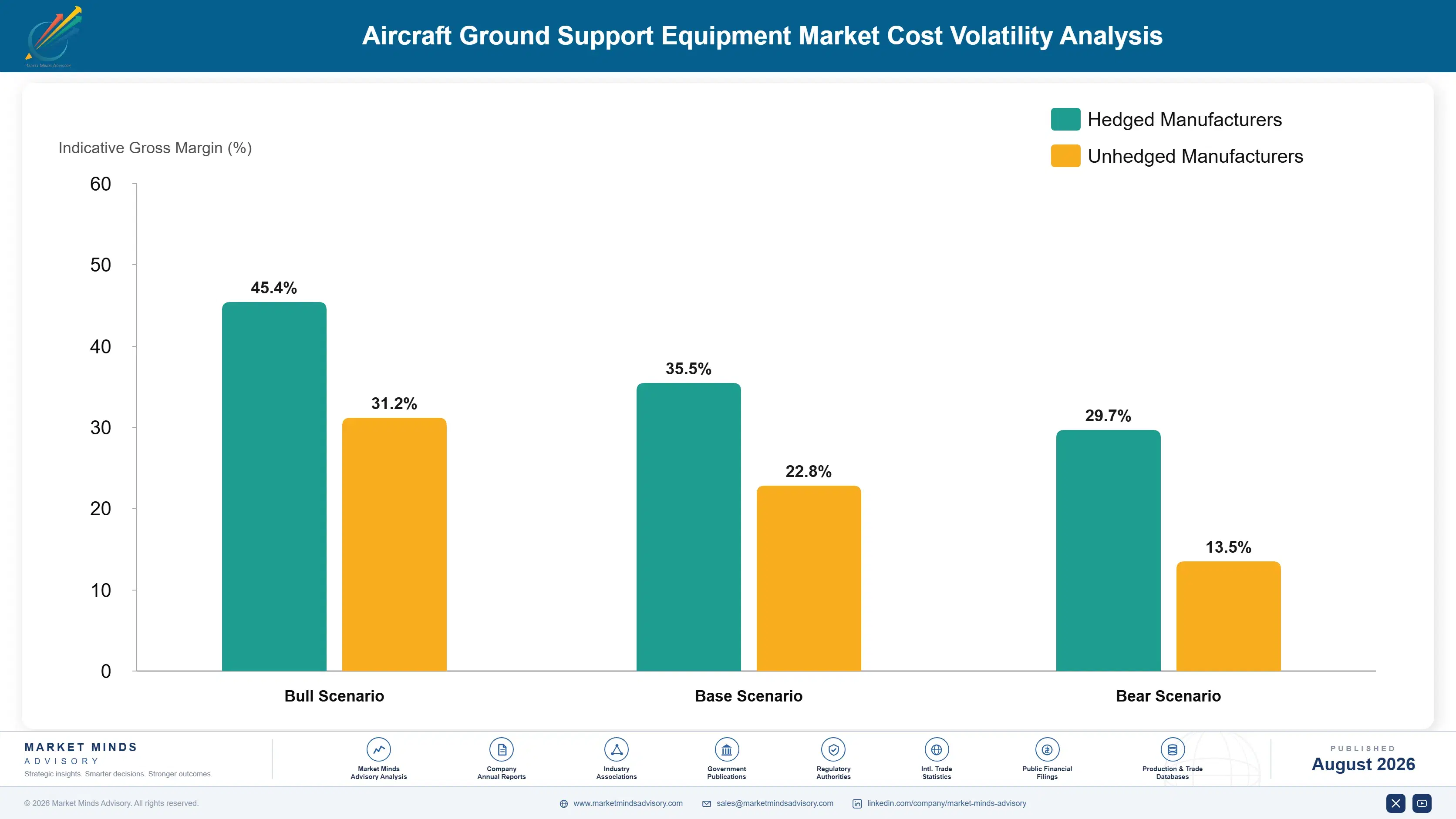
Battery cells and packs represent roughly 32 percent of cost of goods sold for electric ground support equipment, sourced predominantly from a concentrated group of Asian cell manufacturers, while steel for chassis and structural components makes up a further meaningful share sourced from a mix of domestic and imported mills depending on the manufacturer's home region and existing supplier relationships.
Battery-grade lithium and nickel prices spiked sharply during 2022 as electric vehicle manufacturing demand surged globally, according to IEA battery supply chain reporting, and that cost pressure passed through to ground support equipment manufacturers within roughly two to three quarters as component suppliers renegotiated contract pricing. Manufacturers without long-term cell supply agreements absorbed the sharpest margin pressure during that period, while those with locked-in contracts maintained steadier electric equipment pricing for their airport customers.

Smaller manufacturers without diversified battery cell sourcing or long-term supply agreements absorb price volatility directly in margin, while larger manufacturers with broader procurement relationships and greater purchasing scale can smooth pricing for their airport and airline customers instead. That resilience gap increasingly determines which suppliers can offer the multi-year fixed-price electric equipment contracts that large airport authorities now require.
aircraft-ground-support-equipment-market-cost-volatility-analysis-1787463575705

Long-Term Battery Cell Supply Agreements

Manufacturers are securing battery cell supply through multi-year contracts with cell producers rather than relying on spot-market purchases, smoothing cost volatility during periods when electric vehicle demand elsewhere in the economy pushes cell prices higher than budgeted across a given production cycle, helping preserve stable margins even when broader electric vehicle demand elsewhere tightens overall cell availability.

Diversified Steel Sourcing Across Multiple Mills

Manufacturers are securing chassis steel through multiple domestic and international mills rather than relying on a single source, smoothing cost volatility during regional supply disruptions that periodically affect specific steel producing regions and their surrounding markets, and helping manufacturers maintain delivery schedules even when a single mill faces unexpected capacity constraints or delays, across regions.

Modular Battery Design Enabling Supplier Flexibility

Some manufacturers are designing modular battery packs compatible with cells from multiple suppliers, reducing dependence on any single cell producer while preserving the flexibility to switch sourcing quickly whenever pricing or availability conditions shift meaningfully in the market, an approach increasingly valued by manufacturers seeking to avoid dependence on any single battery technology roadmap.

Portfolio Architecture for Margin Defence

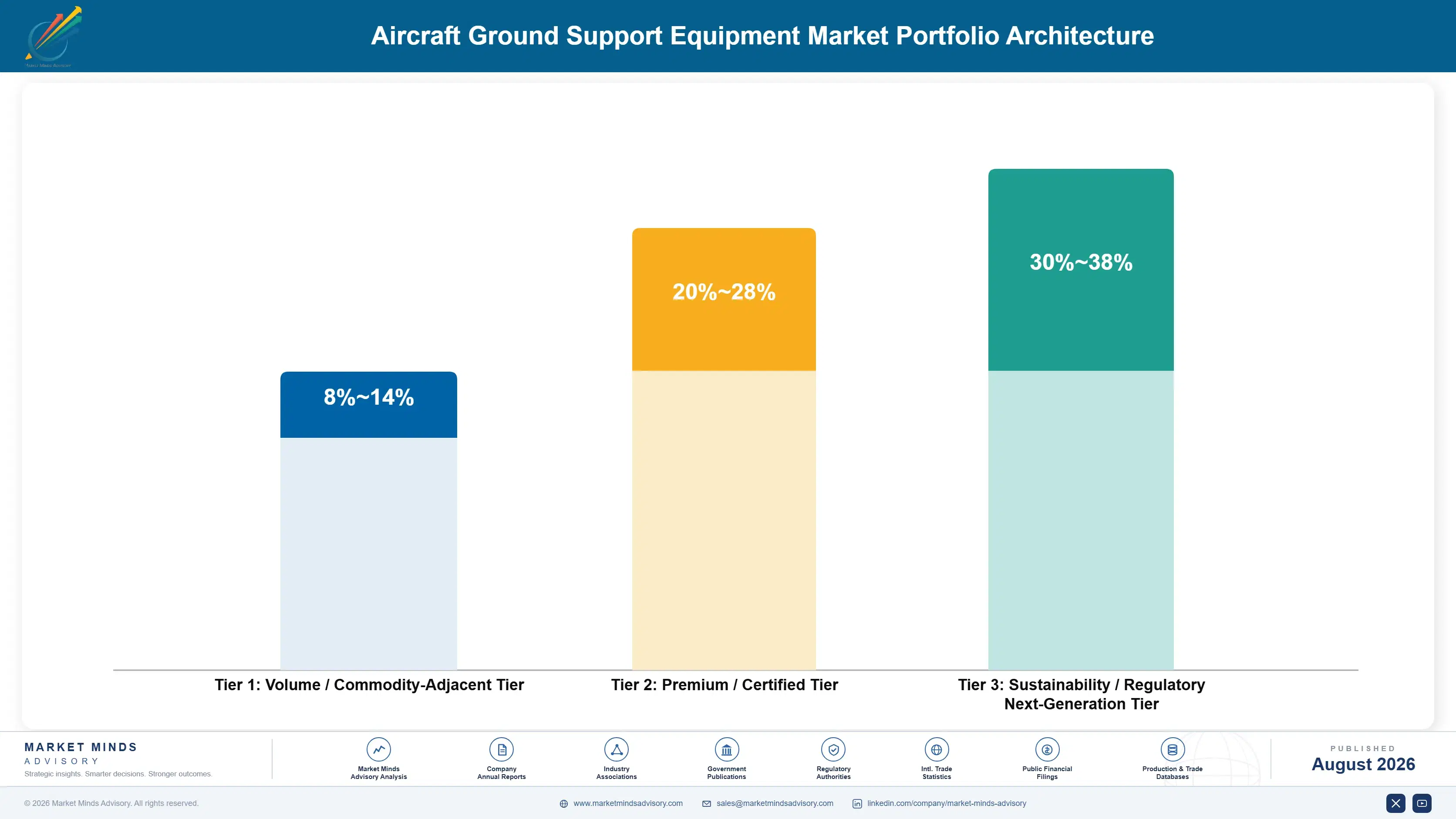
The market splits across three tiers: commodity diesel equipment sold on thin margins against price-sensitive regional airport budgets, certified electric equipment sold with emissions compliance and total cost of ownership documentation at a meaningful premium, and an emerging tier of bundled telematics and financing service contracts commanding the highest margins as airports seek data-driven fleet management, reflecting how quickly the underlying technology mix within the industry keeps shifting toward electrification.
Volume still sits meaningfully in diesel and basic mechanical equipment, where established manufacturers compete on price and delivery reliability against a wider field of regional competitors than the electric tier currently supports. Premium tension is sharpest in certified electric equipment, where regulatory compliance and total cost of ownership documentation capability earn substantially better margins, pulling manufacturer research investment toward this tier disproportionately each year.

High-value margin pools concentrate in electric ground power units and bundled telematics service contracts sold to major airport authorities and large ground handling companies, a category still smaller in absolute equipment volume than diesel hardware but growing considerably faster and attracting the bulk of manufacturer investment attention, a pattern likely to continue strengthening as more airport authorities finalize their electrification roadmaps over the coming years.

Volume / Commodity-Adjacent Tier

Standardized diesel and basic mechanical equipment sold on price and delivery reliability to budget-constrained regional airports and smaller ground handling companies across most markets, reflecting the intense price sensitivity these budget-constrained buyers bring to every procurement decision.
Gross Margin: 8%-14%

Premium / Certified Tier

Electric equipment sold with emissions compliance documentation and total cost of ownership analysis, commanding a meaningful premium over comparable diesel equipment across most major markets, as regulatory pressure continues building steadily across an expanding set of jurisdictions worldwide.
Gross Margin: 20%-28%

Sustainability / Regulatory / Next-Generation Tier

Bundled telematics, predictive maintenance, and financing service contracts tied to fleet electrification programs, sold into the industry's highest-margin recurring revenue arrangements available, as more operators seek predictable, data-backed maintenance planning over traditional reactive equipment servicing.
Gross Margin: 30%-38%
aircraft-ground-support-equipment-market-portfolio-architecture-1787463576198

High-value Sub-segments and Strategic Watch-out

Electric Ground Power Unit Contracts

Electric ground power unit contracts command the category's highest margins and fastest growth as regulators prioritize converting the highest-usage equipment first across every major airport electrification program underway today, and manufacturers with established production scale are capturing the bulk of this expanding demand, sustaining strong pricing power.

Telematics and Financing Service Bundles

Telematics-enabled service and financing bundles are growing steadily as airports seek both recurring maintenance visibility and manageable payment structures for higher-cost electric equipment purchases across multi-year budget cycles, a combination increasingly viewed as a competitive necessity rather than an optional differentiator, across most customer segments today.

Standardized Diesel Equipment

The largest volume pool by far, standardized diesel equipment generates scale revenue for established suppliers but offers little margin expansion room given intense multi-region price competition among manufacturers, leaving manufacturers to compete mainly on delivery reliability and established regional service networks, region by region consistently.

Domestic Chinese Equipment Manufacturers

Domestic Chinese manufacturers scaling electric equipment technical capability could challenge multinational suppliers on cost within Asian markets over the next decade, a shift worth monitoring closely going forward, particularly if domestic battery supply chains mature faster than currently anticipated by most industry observers, within the next several years.

Fleet Renewal Cycles and Airport Contracts

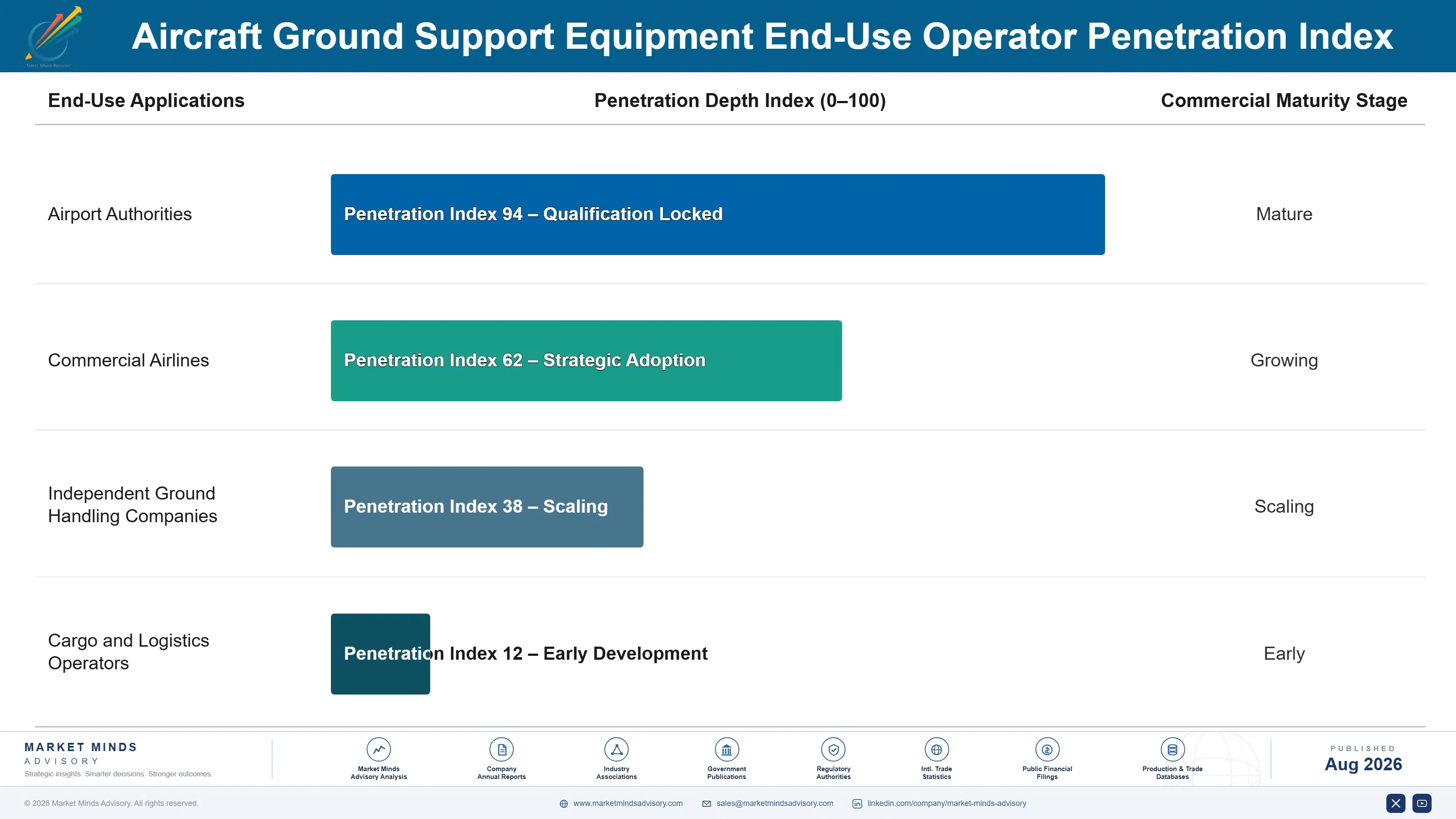
Original equipment demand behaves like an annuity once an airport authority qualifies a specific supplier's equipment against its own operational and maintenance requirements, since switching suppliers requires repeating extensive equipment trials and staff retraining that most airports avoid unless service quality deteriorates, giving incumbent suppliers durable multi-year volume once they win the initial fleet contract and pass the first renewal cycle.
Adoption depth varies meaningfully by end-use vertical: major international hub airports show the deepest supplier stickiness given the scale and complexity of their fleet management contracts, while smaller regional airports and independent ground handling companies switch suppliers more readily since their equipment fleets are smaller and requalification costs correspondingly lower relative to total procurement spend involved, particularly where equipment fleets rotate more frequently across shorter operating contracts.

A generational shift among younger airport operations managers toward treating equipment telematics data as essential fleet management infrastructure rather than an optional add-on is pulling supplier selection earlier into airport procurement decisions, giving technically differentiated manufacturers a seat at the table that legacy diesel-only vendors historically never had, reshaping how procurement teams weigh technical capability against simple purchase price.
aircraft-ground-support-equipment-market-end-use-penetration-index-1787463576689

Positioning as Fleets Electrify

These are among the four positions where our research anticipates prominent divergence between winners and laggards over the coming forecast period. Each is grounded in the demand model, the regulatory perimeter, and the announced capacity pipeline.
01 / ELECTRIC CONVERSION PRIORITY

Convert existing diesel customers to electric before new mandates hit

Electric equipment already captures 28 percent of new sales, and suppliers with mature drivetrain technology can capture a 25 to 30 percent price premium converting existing diesel customers before mandatory conversion rules force a competitive tender process across additional jurisdictions. Incumbent suppliers hold the relationship and qualification history needed to win this upgrade without competing openly for the business. Waiting risks losing that advantage once more airports formalize mandatory electrification timelines and open procurement to broader competitive bidding and open bidding to a wider field of competitors.
02 / TELEMATICS SERVICE BUILDOUT

Build telematics service capability to capture recurring revenue

Predictive maintenance service contracts already generate an estimated 15 to 20 percent of initial equipment value annually, creating switching costs that hardware-only competitors struggle to replicate once customers grow reliant on accumulated diagnostic history. JBT Corporation already demonstrates this model successfully with large airport and airline customers. Suppliers who build comparable telematics capability now will secure recurring revenue streams that smooth demand across future equipment order cycles spanning both new equipment purchases and existing fleet retrofits across every major customer segment.
03 / FINANCING PROGRAM EXPANSION

Offer in-house financing to reach budget-constrained regional airports

Financing programs that spread electric equipment's higher upfront cost across its service life improve win rates by an estimated 10 to 15 percent against competitors requiring full upfront cash purchase, since many smaller regional airports operate under tighter capital budgets than major international hubs. This gap is widening as more airports commit to electrification without correspondingly larger capital budgets. Suppliers building financing capability now will reach a broader customer base as electrification spreads beyond well-funded hub airports across every region where electrification programs are still expanding.
04 / CHINESE MARKET LOCALIZATION

Localize manufacturing in China before domestic suppliers mature further

China's airport construction program is driving substantial equipment orders as new facilities require full fleets from opening day, and domestic manufacturer Weihai Guangtai Airport Equipment is scaling technical capability rapidly within this large home market. Suppliers who build local manufacturing capacity now can compete on cost before domestic makers close the remaining technology gap entirely. Early localization secures long-term contracts before this fast-growing market matures and consolidates further around domestic champions around a small number of dominant domestic champions over time.

Engagement Snapshot From the Field

A live engagement with an industry participant carrying material or product regulatory and market exposure ahead of a defining policy shift, showing how our research translates into a defensible multi-year portfolio strategy.
MARKET MINDS ADVISORY · CLIENT ENGAGEMENT SUMMARY
Aircraft Ground Support Equipment Producer Strategic Portfolio Review and Transition Roadmap 2026·Investment Scenario on Aircraft Ground Support Equipment Exposure Evaluation 2025-26
CLIENT PROFILE
A regional airport authority operating three mid-sized facilities across the eastern United States engaged MMA to guide a ground support equipment electrification strategy after new state air quality rules began requiring emissions reductions across airport ground operations. The authority's annual ground support equipment procurement and maintenance budget exceeded 18 million dollars (client-reported, unverified by MMA), making the electrification timeline a material decision for its board and senior operations leadership.
STRATEGIC CHALLENGE
The authority operated an aging diesel fleet across all three facilities and faced a compressed regulatory timeline to convert a meaningful share of equipment to electric power, without clear internal expertise to evaluate competing suppliers' total cost of ownership claims or to sequence a fleet-wide conversion without disrupting daily flight operations.
MMA APPROACH
MMA benchmarked electric equipment suppliers against total cost of ownership and financing availability, modeled the return on investment of converting each equipment category, and structured a phased conversion plan sequenced by facility and equipment type to minimize operational disruption across the authority's three sites, drawing on comparable conversion programs at similarly sized regional authorities elsewhere in the country.
KEY FINDINGS
  1. Converting ground power units first delivered the fastest emissions compliance progress given their high daily utilization rates, cutting emissions exposure fastest per dollar invested across the program.
  2. Financing structures from two suppliers cut the authority's upfront capital requirement by roughly a third compared with outright purchase, freeing capital for other priority infrastructure projects at each facility.
  3. A facility-by-facility phased rollout avoided the operational disruption a simultaneous fleet-wide conversion would have created, keeping daily flight operations running smoothly throughout the transition.
  4. Telematics data from converted equipment helped the authority build a stronger business case for its next conversion phase, giving the board confidence to approve continued investment.
CLIENT PROFILE
A regional airport authority operating three mid-sized facilities across the eastern United States engaged MMA to guide a ground support equipment electrification strategy after new state air quality rules began requiring emissions reductions across airport ground operations. The authority's annual ground support equipment procurement and maintenance budget exceeded 18 million dollars (client-reported, unverified by MMA), making the electrification timeline a material decision for its board and senior operations leadership.
STRATEGIC CHALLENGE
The authority operated an aging diesel fleet across all three facilities and faced a compressed regulatory timeline to convert a meaningful share of equipment to electric power, without clear internal expertise to evaluate competing suppliers' total cost of ownership claims or to sequence a fleet-wide conversion without disrupting daily flight operations.
MMA APPROACH
MMA benchmarked electric equipment suppliers against total cost of ownership and financing availability, modeled the return on investment of converting each equipment category, and structured a phased conversion plan sequenced by facility and equipment type to minimize operational disruption across the authority's three sites, drawing on comparable conversion programs at similarly sized regional authorities elsewhere in the country.
KEY FINDINGS
  1. Converting ground power units first delivered the fastest emissions compliance progress given their high daily utilization rates, cutting emissions exposure fastest per dollar invested across the program.
  2. Financing structures from two suppliers cut the authority's upfront capital requirement by roughly a third compared with outright purchase, freeing capital for other priority infrastructure projects at each facility.
  3. A facility-by-facility phased rollout avoided the operational disruption a simultaneous fleet-wide conversion would have created, keeping daily flight operations running smoothly throughout the transition.
  4. Telematics data from converted equipment helped the authority build a stronger business case for its next conversion phase, giving the board confidence to approve continued investment.
RECOMMENDED STRATEGY
Phase 1: Phase 1 (Months 1-4): Convert ground power units and air start units at the largest facility first, the facility with the highest daily equipment utilization rates. Phase 2: Phase 2 (Months 5-10): Extend conversion to tow tractors across all three facilities using financing support, using supplier financing to manage capital outlay carefully. Phase 3: Phase 3 (Months 11-16): Complete remaining equipment categories and finalize telematics reporting integration, closing out the program on schedule and within budget.
OUTCOME
The authority completed its phased conversion within the recommended sixteen-month window and reported meeting its state emissions compliance target ahead of the regulatory deadline (client-reported, unverified by MMA), while financing support kept the program within its originally approved capital budget across all three facilities, strengthening its position ahead of the next regulatory compliance milestone.

Frequently Asked Questions

Foundational context covering the market sizes, CAGR, scope, country, region and competition that inform every finding below. This section is provided to cover basics and most often pre-purchase conversations, answered from the MMA Primary Research Dataset.

What is the current size of the Aircraft Ground Support Equipment Market?

The global aircraft ground support equipment market was valued at approximately $6.5 billion in 2025. Electric equipment already accounts for a meaningful and growing share of new sales.

How large will the Aircraft Ground Support Equipment Market be by 2036?

MMA projects the market will reach approximately $15.94 billion by 2036, roughly 2.26 times its 2026 value. Electric equipment adoption drives much of this expansion.

What is the CAGR for the Aircraft Ground Support Equipment Market 2026 to 2036?

The market is projected to grow at a 8.5 percent compound annual rate between 2026 and 2036. Bull and bear scenarios range from 7.2 to 9.8 percent.

Which segment is growing fastest?

Ground power units and air start units are the fastest-growing segment at an 11.5 percent CAGR, well above the overall market rate. Continuous duty cycles make them a priority for electrification.

Who are the major companies in the Aircraft Ground Support Equipment Market?

Leading suppliers include TLD Group, JBT Corporation, Textron GSE, Cavotec, and Mallaghan Engineering. Together they hold a CR5 near 42 percent of global capacity of global equipment capacity today.

Which country is growing fastest?

India posts the fastest national growth at roughly 11.0 percent, driven by a large greenfield airport construction program. Each new facility requires a full equipment fleet from opening day.

Report Segmentation Architecture

The full report scope spans multiple orthogonal segmentation dimensions, with cross-tabulated demand data provided for each dimension pair. Coverage extends further to regional breakdowns, trend trajectories, and the competitive detail needed to support segment-level decision-making.

By Equipment Type

  • Tow Tractors and Pushback Tractors
  • Baggage and Cargo Handling Equipment
  • Ground Power Units and Air Start Units
  • Aircraft De-Icing Equipment
  • Passenger and Catering Service Vehicles
  • Lavatory and Water Service Equipment

By End-Use Operator

  • Airport Authorities
  • Commercial Airlines
  • Independent Ground Handling Companies
  • Cargo and Logistics Operators

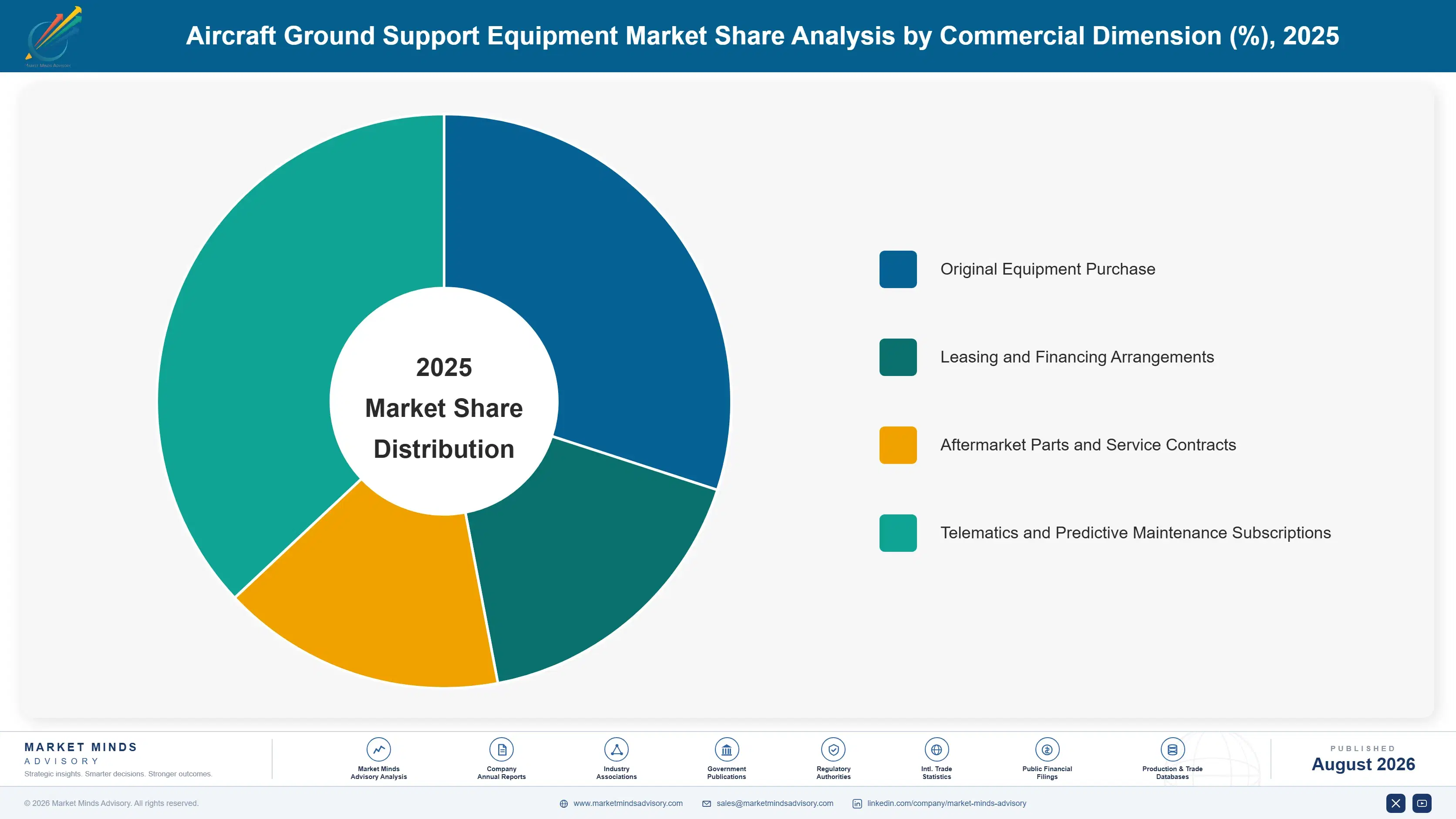
By Commercial Dimension

  • Original Equipment Purchase
  • Leasing and Financing Arrangements
  • Aftermarket Parts and Service Contracts
  • Telematics and Predictive Maintenance Subscriptions

By Region

  • North America
  • Western Europe
  • East Asia
  • South Asia and Pacific
  • Latin America
  • Middle East and Africa
  • Eastern Europe

Scope, Methodology, and Coverage

Every figure in this report is reproducible from documented input assumptions. The scope below maps the historical period, the forecast horizon, the segmentation dimensions, and the countries covered, alongside the underlying primary and qualitative methodology.
Historical Period
2020 to 2025
Forecast Period
2026 to 2036
Base Year
2025 (USD billions; MMA Primary Research Dataset, August 2026)
Market Definition
The aircraft ground support equipment market covers tow tractors and pushback tractors, baggage and cargo handling equipment, ground power units and air start units, aircraft de-icing equipment, passenger and catering service vehicles, and lavatory and water service equipment sold to airports, airlines, and ground handling companies. It excludes aircraft maintenance hangar equipment and air traffic control infrastructure.
Quantitative Units
USD billions (current prices); unit volume for equipment category detail
Segmentation Dimensions
By Equipment Type; By End-Use Operator; By Commercial Dimension; By Region
Regions Covered
North America, Western Europe, East Asia, South Asia and Pacific, Latin America, Middle East and Africa, Eastern Europe
Countries Covered
USA, China, Germany, France, UK, Netherlands, Japan, South Korea, India, Australia, Canada, Brazil, Mexico, Indonesia, Vietnam, Thailand, UAE, Qatar, Saudi Arabia, South Africa, Nigeria, Turkey, Poland, Czech Republic, Italy, Spain, Sweden, Switzerland, Singapore, and additional markets relevant to this sector
Key Companies Profiled
TLD Group, JBT Corporation, Textron GSE, Cavotec, Mallaghan Engineering, ITW GSE, Douglas Equipment, Tronair, Global Ground Support, Vestergaard Company, Weihai Guangtai Airport Equipment, Guinault, Aviogei Airport Equipment, Kalmar Motor, Trepel Airport Equipment, Eagle Tugs, Hobart Ground Power, LEKTRO, Charlatte America, AXA Power
Quantitative Methodology
Primary survey, n=3,800 respondents, Q4 2025, six countries; demand-side model with trade association cross-validation
Qualitative Methodology
47 expert interviews, Q4 2025; applied to validate demand model assumptions, identify emerging dynamics, and assess competitive positioning
Report Format
PDF and XLSX data workbook (Word format preview document)
Publisher
Market Minds Advisory
Report Code
MMA-2026-CON-101
Published
August 2026
Contact
sales@marketmindsadvisory.com | www.marketmindsadvisory.com

Purchase the full Aircraft Ground Support Equipment Market Report (2026 to 2036).

The full Aircraft Ground Support Equipment Market report delivers a comprehensive 2026 to 2036 forecast across six equipment categories, seven regions, and twenty profiled companies active in this sector. It includes detailed segmentation by end-use operator, battery and steel cost modeling, and competitive benchmarking measured against a single consistent revenue basis throughout. Analysts document the electrification and telematics trends reshaping supplier positioning across the industry. Buyers receive full access to the underlying data tables, regional breakouts, and a customizable Excel model built for scenario planning.
2026-2036 volume and value forecasts by segment
Six-category equipment type breakdown and detailed analysis
Seven-region market sizing and share detail
Twenty-company competitive profiles and full benchmarking
Battery and steel cost sensitivity modeling
Editable Excel forecast workbook with scenario toggles

Built For The People Who Decide

From boardroom strategy to bench-side execution, this report is read cover-to-cover by leaders shaping the next decade of their industry, turning demand scenarios, market dynamics and valuation benchmarks into decisions.
CXOs/ Presidents/ VPs/ Managers
M&A and Corporate Development
Strategy Teams and R&D Heads
Procurement and Product Directors
Regulatory and Compliance Leaders
Investor Relations and Equity Analysts