Market Minds Advisory
Aircraft Fuel Tanks Market

Aircraft Fuel Tanks Market: Aircraft Fuel Tanks: Two Unrelated Businesses, Five Qualified Elastomer Suppliers and A Crashworthiness Mandate

A fuel tank is either part of the aircraft's structure or a rubber bag inside it, and those are entirely different businesses that almost nobody bothers to separate properly anywhere in the trade.

Lead Analyst

Published

September 2026

Make Smarter Decisions with Customized Research Insights

Request a free sample report and evaluate market opportunities, growth trends, and competitive dynamics relevant to your business needs.

2025 MARKET VALUE$4.4BMarket Size 2025
2036 FORECAST VALUE$8.7BBase Case , 2026 to 2036
CAGR 2026 TO 20366.4 %Bull 7.6% / Bear 5.2%
INCREMENTAL OPPORTUNITY$4.0BNet 10- year value creation
EXPANSION MULTIPLE1.86x2036 value over 2026 base
Strategic Levers
M&A Pipeline
Regional Outlook
Country Rankings
Competitive Intelligence
Segmental Deep-dive
Call-Us : 91 93563 13602

Executive Snapshot and Market Trajectory.

Two businesses share this heading and have almost nothing in common. Integral wing tanks are aerostructures, sealed by the airframer and competed as structural work. Flexible and self-sealing tanks are a specialty elastomer business with roughly five qualified suppliers worldwide. The two overlap in nothing at all.
The growth sits entirely in the second. Crash resistant fuel systems became mandatory on newly manufactured rotorcraft regardless of when the type was certified, which converted a military speciality into a civil requirement across an entire aircraft category. Self-sealing crashworthy tanks grow at 9.6% and cost roughly 4.2 times a conventional tank of the same capacity, which buyers accept because the alternative is post-crash fire. That single rule reset the whole rotorcraft supply position.
The supply base underneath that is genuinely thin. Producing a certified flexible tank requires elastomer formulation, layup technique and qualification evidence accumulated across decades, and five firms worldwide hold it. Aftermarket at 41% of revenue arrives on the same narrow base, and nobody in this industry has an answer if one of those five stops. That concentration is easily the most important commercial fact in this entire market today.
Market Definition
Revenue from fuel tanks and fuel tank protection systems qualified for aircraft installation, covering integral wing and centre tanks, flexible bladder tanks, self-sealing crashworthy tanks, auxiliary and conformal tanks, external drop tanks, and inerting and flammability reduction systems. Excludes fuel pumps, valves, gauging and distribution plumbing, ground refuelling equipment, and airframe structure not performing any fuel containment function.
Base Year Value
$4.4B in 2025 (MMA Primary Research Dataset, August 2026)
Forecast Period
2026 to 2036, eleven discrete annual values
CAGR
6.4% base case. Bull 7.6%. Bear 5.2%.
Fastest Growth Segment
Self-Sealing Crashworthy Tanks: 9.6% CAGR
Fastest Growth Country
India: 8.4% CAGR
Fastest Growth Region
South Asia and Pacific: 8.4% CAGR
Largest Region
North America: 31% of 2025 global value
Market Leaders
Parker Aerospace, Safran, GKN Aerospace, TransDigm and Collins Aerospace lead on qualified fuel tank and protection system revenue. Source: company annual reports and MMA Primary Research Dataset, July 2026.
Primary Survey
n=3,800 procurement and R&D decision-makers, Q4 2025, six countries
Methodology
Demand-side build-up, cross-validated against public data, 47 expert interviews

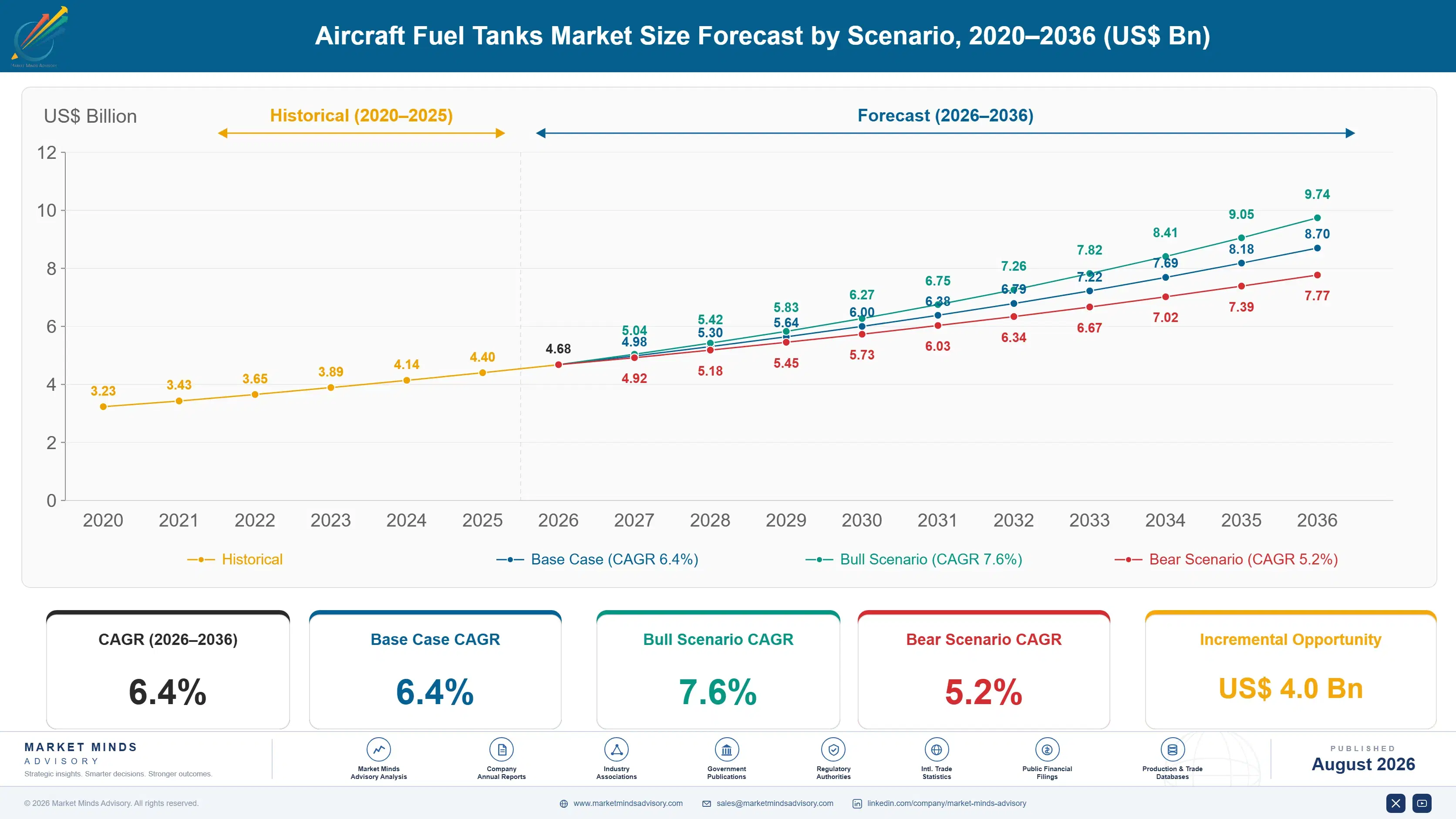
Aircraft Fuel Tanks Market Forecast Scenarios

aircraft-fuel-tanks-market-size-forecast-scenario-1788023691943
The 2020 to 2025 period was shaped by regulation more than by build rates. Commercial production collapsed and recovered while a crash resistant fuel system requirement applied to newly manufactured rotorcraft regardless of type certificate age, creating retrofit-scale demand inside new production. Consolidation continued, with two significant tank businesses changing owners. Revenue compounded near 5.4% across the period, carried substantially by the rotorcraft requirement.
Three mechanisms carry the base case. Rotorcraft crashworthiness obligations continue applying to every newly built aircraft in that category, and the premium over conventional tanks is roughly 4.2 times. Defence spending raises drop tank and self-sealing demand across allied nations. And sustainable fuel compatibility work obliges sealant and elastomer requalification across integral and flexible tanks alike, which is unglamorous and entirely unavoidable. None of the three depends on a new aircraft programme.
The bull catalyst is crash resistant requirements extending to existing rotorcraft rather than newly manufactured ones only, which would convert a production requirement into a retrofit programme across tens of thousands of airframes. The bear risk is elastomer supply: five qualified producers is not a supply base, and a single failure would halt several national rotorcraft programmes simultaneously. The exposure is genuine.

Sealed Wings And Rubber Bags

An integral tank is not really a tank. It is a wing box sealed to hold fuel, built by whoever builds the wing, and the commercial competition for it is a competition for structural work rather than for a component. Sealant application, cure cycles running around 72 hours and leak testing dominate the process. Nothing about that capability transfers to making a rubber bag that survives a helicopter hitting the ground.
MARKET CONCENTRATION CR558%Share of qualified tank revenue held by leading suppliers
QUALIFIED BLADDER SUPPLIERS5Firms worldwide able to produce certified flexible tanks
CRASHWORTHY TANK PREMIUM4.2 timesCost against a conventional tank of equivalent capacity
DROP TEST HEIGHT65 feetImpact qualification standard applied to crashworthy tank designs today
SEALANT CURE CYCLE72 hoursTime required before a sealed wing tank accepts fuel
AFTERMARKET REVENUE SHARE41%Sales into replacement and overhaul rather than new build
The flexible tank business is entirely separate and considerably smaller. Producing a certified bladder requires elastomer formulation, ply layup and qualification evidence built across decades, and roughly five firms worldwide hold that combination. A self-sealing crashworthy tank goes further, surviving a 65 foot drop while remaining fuel tight, which is a specification written after decades of post-crash fire fatalities rather than any engineering ambition.
Regulation moved that speciality into civil aviation. Crash resistant fuel systems became mandatory on newly manufactured rotorcraft regardless of when the type was originally certified, which put a requirement designed for military helicopters onto every new civil one. The tank costs roughly 4.2 times a conventional equivalent and operators pay it, because the accident record without it is the reason the rule exists.
"Half this market is a sealing operation inside a wing box and the other half is five companies who know how to make rubber that closes its own bullet holes. Nobody should be pricing them the same way."
Director, Aerospace Fuel Systems Practice · MMA Aerospace and Defence Components Practice · August 2026

Market Trends

Crash Resistance Moved From Military To Civil Rotorcraft

A requirement that newly manufactured rotorcraft meet crash resistant fuel standards regardless of type certificate age took a military speciality and applied it across civil helicopter production entirely. Manufacturers building decades-old designs suddenly needed tanks the original type certificate never contemplated, which meant engineering, qualification and supplier selection on aircraft already in production. The premium runs roughly 4.2 times a conventional tank. Operators accept it because the accident record that produced the rule is exactly the record they fly against. Regulation, not any engineering advance, created this entire demand line from nothing at all.
Market Impact: Costs 4.2 times conventional tanks

Sustainable Fuel Compatibility Forces Material Requalification

Fuels with different aromatic content behave differently against the sealants and elastomers holding fuel inside both integral and flexible tanks, because those materials were formulated to swell predictably against a fuel chemistry that is now changing. Requalification is required across sealant systems, bladder plies and every associated joint. The work is unglamorous, expensive and entirely unavoidable, and it applies to tanks already flying rather than only to new designs. Nobody in this market has treated it as a commercial opportunity yet. The supplier who builds that test evidence first will define everyone else's specifications.
Market Impact: Grows drop tanks 8.4% annually

Market Opportunities and Growth Drivers

Rotorcraft Crashworthiness Creates Production Scale Demand

Every newly manufactured rotorcraft now requires a crash resistant fuel system regardless of how old its type certificate is, which converts a niche military capability into production volume across an entire aircraft category. The tanks cost roughly 4.2 times conventional equivalents, so the revenue effect considerably exceeds the unit count. Self-sealing crashworthy tanks accordingly grow at 9.6% against a market rate of 6.4%. This is the clearest regulation-driven demand mechanism anywhere in aerospace components. Rotorcraft manufacturers building designs certified decades ago had to engineer, qualify and source tanks the original certificate never contemplated at all.
Market Impact: Relies on 5 qualified producers

Defence Spending Lifts Drop Tank And Self-Sealing Demand

External drop tanks are consumed rather than retained, being jettisoned in operations and expended in training, which makes their demand track activity rather than fleet size. Self-sealing tanks on combat aircraft and military rotorcraft follow platform production and attrition replacement together. Allied defence budgets rising across a sustained trajectory therefore raise both simultaneously, and neither depends on any new aircraft programme being launched. Consumable demand inside a defence buildup is unusually predictable revenue. Training expenditure and operational tempo therefore matter more to this demand line than any fleet count does.
Market Impact: Closes 36% of market entirely

Market Restraints and Challenges

Five Qualified Elastomer Suppliers Is Not A Supply Base

Roughly five firms worldwide can produce a certified flexible or self-sealing tank, because the capability combines elastomer formulation, ply layup technique and qualification evidence accumulated across decades. The root cause is that no commercial market justifies developing it, so nobody has entered in a generation. A single supplier failure would halt several national rotorcraft programmes at once. Mitigation runs through second source qualification taking three to four years, inventory holding, and airframers funding capability they would rather not have to. Every one of those pathways is slow, expensive and already overdue by any reasonable measure.
Market Impact: Applies to 100% of new rotorcraft

Integral Tank Work Is Competed As Structure Not Component

A sealed wing box is won as part of an aerostructures package, so a specialist fuel tank supplier is not in that competition at all and never has been. The root cause is that integral tanks are structure performing a containment function rather than components fitted into structure. Commercially it means half this market is inaccessible to tank specialists entirely. Mitigation runs through sealant and material supply into those packages, leak detection and repair services, and auxiliary tank work that sits outside the structural scope. None of that recovers the sealed wing box work itself.
Market Impact: Requalifies materials across 100% fleet
3 additional market trends, 4 additional growth drivers, and 2 additional restraints and challenges are covered in the full report. Contact sales@marketmindsadvisory.com to access the complete intelligence.

Segment CAGR and Growth Architecture

Segmentation follows tank type, because that determines who can make it, what qualification applies and whether the work is competed as structure or as a component. Six types describe the market completely, from integral wing tanks won inside aerostructures packages through to the crashworthy tanks that only a handful of firms can produce at all.
aircraft-fuel-tanks-market-market-share-analysis-1788023692497

Self-Sealing Crashworthy Tanks

The fastest type grows at 9.6%, half again the market rate of 6.4%, and regulation rather than technology explains all of it. Crash resistant fuel systems became mandatory on newly manufactured rotorcraft regardless of type certificate age, which put a military specification onto civil helicopter production overnight and obliged manufacturers of decades-old designs to engineer, qualify and source tanks the original certificate never contemplated. A tank surviving a 65 foot drop while remaining fuel tight costs roughly 4.2 times a conventional equivalent. Operators pay it without much argument, because the post-crash fire record that produced the rule is precisely the record they are flying against every day. The economics follow the regulation exactly.
CAGR 9.6%

External Drop Tanks

Drop tanks grow at 8.4% and behave unlike anything else in this market because they are consumed rather than retained. Jettisoned in operations and expended during training, their demand tracks flying activity and munitions expenditure rather than fleet size or production rate, which makes it unusually responsive to defence budgets actually being spent rather than merely appropriated. Manufacturing is comparatively simple against a self-sealing tank, and the qualification burden concerns separation behaviour and aerodynamic loads rather than fuel containment under impact. Competition is accordingly wider, prices are keener, and the volume is genuinely substantial during any period of sustained operational activity. Nothing else in this market gets consumed by the act of using it.
CAGR 8.4%
Full segment breakdown across 6 segments available in the complete report.

Regional Architecture and Country Demand Map

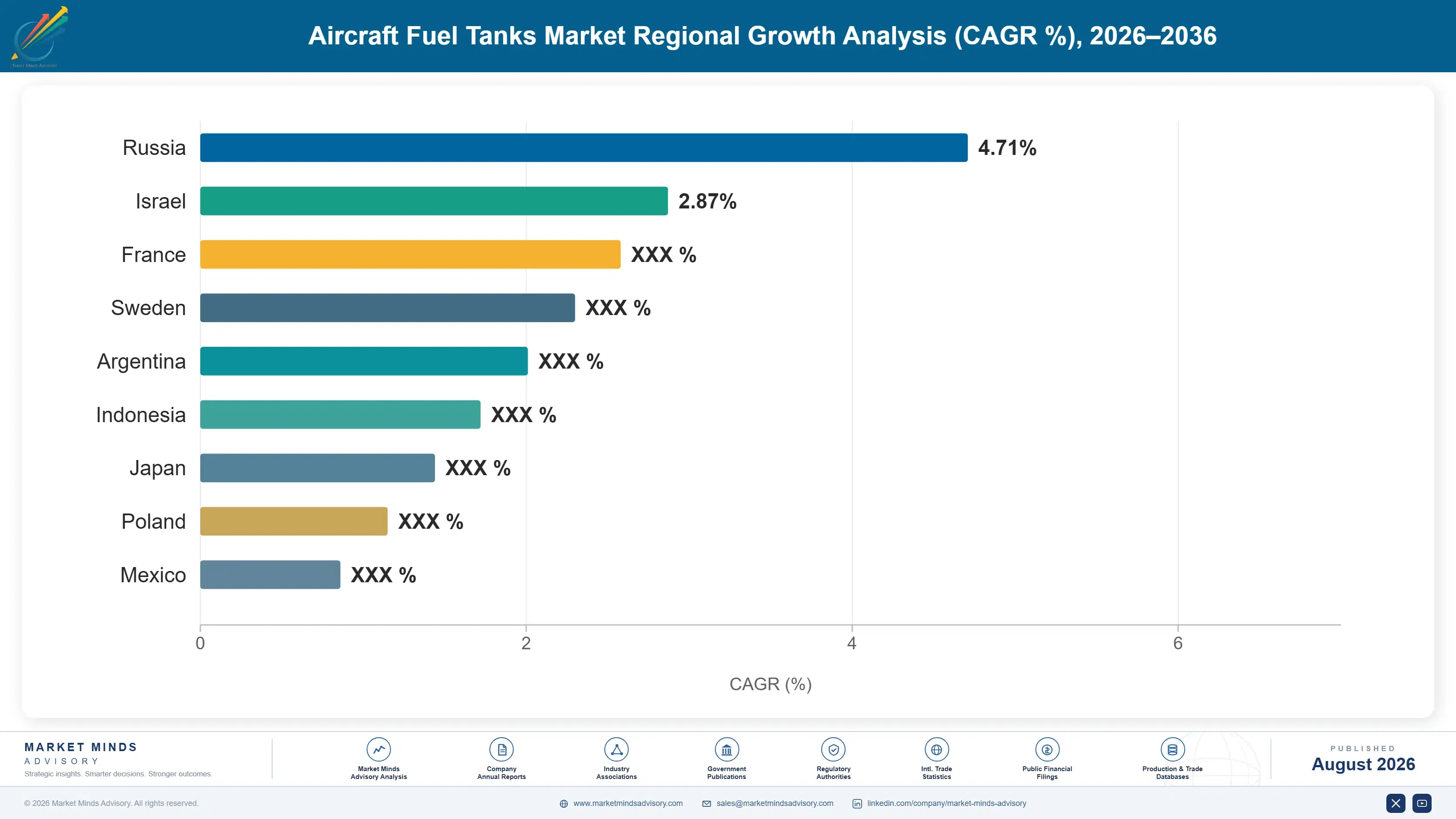
Fuel tank demand follows aircraft production and military fleets, so it distributes across every manufacturing region. North America leads on combined rotorcraft production, defence demand and specialist elastomer capability, with Western Europe and East Asia holding substantial positions in structures and manufacture respectively. Growth runs fastest elsewhere.

North America

The largest share sits here at 31%, resting on the deepest rotorcraft production base anywhere, substantial military demand for self-sealing and drop tanks, and several of the very few firms worldwide able to produce certified flexible tanks. The crash resistant fuel system requirement applying to newly manufactured rotorcraft originated here and set the standard others have followed. Military crashworthiness specifications developed decades earlier, following post-crash fire fatality analysis, remain the technical basis for civil requirements everywhere. Aftermarket demand across the largest installed rotorcraft fleet anywhere adds a further layer of revenue that no other region approaches, and it arrives on part numbers with a single qualified supplier and no alternative available to the operator at any price.
Share: 31% | CAGR: 6.2% (2026 to 2036)

Western Europe

Integral tank work dominates this region's position, won inside aerostructures packages by airframers and Tier One suppliers building sealed wing boxes rather than by any fuel tank specialist. Safran and GKN hold substantial positions through that route. European rotorcraft manufacturers have adopted crash resistant systems across new production, and defence rearmament is lifting drop tank and self-sealing demand alongside. Specialist elastomer capability here is narrow, and the region depends on a supply base it did not create. Sealed wing box work for large commercial programmes is substantial and stable here, and it moves at programme level rather than component level, so a tank specialist has no route into it whatever its technical merits happen to be.
Share: 24% | CAGR: 5.0% (2026 to 2036)
Regional intelligence for 5 additional markets available in the complete report: East Asia, South Asia and Pacific, Latin America, Middle East and Africa, Eastern Europe. Contact sales@marketmindsadvisory.com.
aircraft-fuel-tanks-market-country-cagr-analysis-1788023693014

Where Fuel Tank Margin Actually Sits

Four levers work on qualification position, regulatory timing and supply scarcity rather than on manufacturing cost, which matters far less than access does in this market. Crashworthy positioning, second source qualification, sustainable fuel material work and aftermarket capture each address something a supplier controls today. None of them requires new manufacturing capacity or capital expenditure at all.

Position For Crashworthy Requirements Before They Extend

Crash resistant fuel systems apply to newly manufactured rotorcraft now, and extending them to existing airframes would convert a production requirement into a retrofit programme across tens of thousands of aircraft. Suppliers holding qualified crashworthy designs across multiple rotorcraft types would capture that immediately, while those qualified on one type would not. Each additional type qualification costs perhaps 2 to 4 million dollars and takes eighteen months. The extension is widely expected and nobody can date it, which is precisely why the qualification should already exist. Waiting for the date is not a strategy.
Market Impact: Costs about 3 million dollars per type qualification

Qualify As A Second Elastomer Source Deliberately

Five qualified flexible tank producers worldwide is a supply position airframers describe privately as unacceptable and publicly not at all. Qualifying as an additional source takes three to four years and costs several million dollars, and airframers will part-fund it where a supplier makes the case properly because their alternative is genuine programme exposure. The commercial position afterwards is exceptional, since a sixth qualified supplier enters a market with 41% aftermarket revenue and essentially no price competition anywhere in it. Five is not a number any airframe programme should be resting on.
Market Impact: Enters a global market held by only 5 suppliers

Own The Sustainable Fuel Material Requalification

Changing fuel chemistry alters how sealants and elastomers swell, which obliges requalification across sealant systems, bladder plies and joints on tanks already flying rather than only on new designs. The work is unglamorous and entirely unavoidable, and no supplier has yet positioned it as a commercial offering rather than a compliance chore. Whoever builds the test evidence first becomes the reference for everybody else and captures material specification positions worth considerably more than the requalification itself ever costs. Requalification evidence takes 18 to 24 months to assemble properly, and no competitor has started.
Market Impact: Requalifies sealant materials across 100% of the fleet

Capture Aftermarket Rather Than Ceding It Downstream

Aftermarket replacement and overhaul produce 41% of market revenue at margins new build never approaches, because an operator replacing a bladder on a twenty year old rotorcraft has one qualified part and no alternative supplier. Manufacturers selling through uncontrolled distribution surrender much of that to intermediaries adding only inventory. Authorised distribution with pricing discipline typically recovers 14% to 20% of aftermarket value leaking outward. The work is commercial rather than technical, which is why engineering-led businesses so consistently neglect it. The gain shows up within 4 quarters of the change.
Market Impact: Recovers roughly 17% of leaking aftermarket value annually

Who Controls the Margin Pool

Concentration is moderate at around 58% across the five largest participants, and that figure hides two entirely separate competitive structures. Integral tank work is won inside aerostructures packages by airframers and Tier One structural suppliers. Flexible and self-sealing tanks are supplied by roughly five qualified firms worldwide, several of which have changed ownership recently as larger groups recognised what a five supplier market is worth.
Competition runs on three dimensions and price is barely one of them. Qualification position is the first and decisive, since an unqualified tank cannot be fitted regardless of merit. Type coverage is the second, because a rotorcraft manufacturer wants one supplier across its range rather than several. Material capability is the third and newly important, as changing fuel chemistry obliges requalification that only firms holding genuine elastomer formulation knowledge can perform.

Pressure arrives from consolidation rather than from new entrants, because there are none. Larger groups have acquired specialist tank businesses precisely because scarcity supports pricing that competition would otherwise erode. Airframers meanwhile are uncomfortable depending on five suppliers and have begun part-funding additional qualification. Rankings will shift toward whoever holds crashworthy type coverage and elastomer capability, which is what the scarcity consists of.
aircraft-fuel-tanks-market-company-positioning-matrix-1788023693530

Competitive Moat and Risk Dimensions

PARKER AEROSPACE

Moat: Breadth across qualified fuel systems

Parker Aerospace holds qualified positions across flexible tanks, inerting systems and wider fuel system components, letting an airframer consolidate rather than manage several specialist relationships across one aircraft. Acquisition has widened that position deliberately rather than adding manufacturing capacity. Assembling comparable qualified breadth organically would take a competitor decades of certification work nobody has undertaken.
PARKER AEROSPACE

Risk: Elastomer capability concentration risk

Specialist flexible tank capability rests on a small number of facilities and a workforce holding formulation and layup knowledge that is not written down anywhere comprehensively. Losing key people or a site would be genuinely difficult to recover from within any programme timescale. Scarcity that protects pricing also concentrates operational exposure considerably.
TRANSDIGM

Moat: Sole source aftermarket pricing power

TransDigm acquired specialist crashworthy tank capability precisely because sole source qualified parts with 41% aftermarket revenue suit its commercial model exactly, and it prices aftermarket accordingly without much competitive constraint. Qualification protects the position and the installed base extends it across decades. No competitor can enter without qualification work costing years and several million dollars per type.
TRANSDIGM

Risk: Customer resistance to aftermarket pricing

Aggressive aftermarket pricing on sole source parts attracts sustained attention from defence customers, airframers and occasionally legislators, and this market's scarcity makes the pricing unusually visible. Airframers part-funding second source qualification is a direct response to exactly that. A position built on scarcity invites the customer to fund its removal.

Players Tracked

Prominent Players

Parker Aerospace
Safran
GKN Aerospace
TransDigm
Collins Aerospace

Other Key Players

Amfuel
Cobham Mission Systems
ShinMaywa Industries
FPT Industries
Marvin Engineering
Sargent Aerospace and Defense
Aero Tec Laboratories
Kawasaki Heavy Industries
Mitsubishi Heavy Industries
Elbit Systems
Israel Aerospace Industries
Hindustan Aeronautics
Korea Aerospace Industries
Eaton
Woodward

Recent Developments

OCTOBER 2020

Crash resistant fuel systems became mandatory on new rotorcraft

A statutory requirement took effect obliging newly manufactured rotorcraft to incorporate crash resistant fuel systems regardless of when the type certificate was originally issued, applying a military derived standard across civil helicopter production. This was legislative and regulatory action rather than any commercial arrangement between tank suppliers.
Signal: A military specification became a civil production requirement without any type certificate anywhere being reopened first.
DECEMBER 2023

Specialist crashworthy tank producer acquired by a larger group

A substantial producer of crashworthy and self-sealing fuel tanks was acquired by a diversified aerospace components group, consolidating a scarce qualified capability into a business known for aftermarket pricing discipline. This was an acquisition rather than a merger or joint venture between the parties involved.
Signal: Scarcity in a five supplier market is precisely what makes these businesses worth acquiring at all.
JUNE 2025

Sustainable fuel compatibility testing extended to tank materials

Material compatibility assessment for fuels with altered aromatic content extended across sealant systems, bladder plies and tank joints, obliging requalification on designs already in service rather than only on new development. This reflected standards and certification work rather than any commercial arrangement between the suppliers operating in this market.
Signal: Requalifying materials on tanks already flying is unglamorous, unavoidable and commercially unclaimed by anybody so far.

What A Qualified Fuel Tank Costs

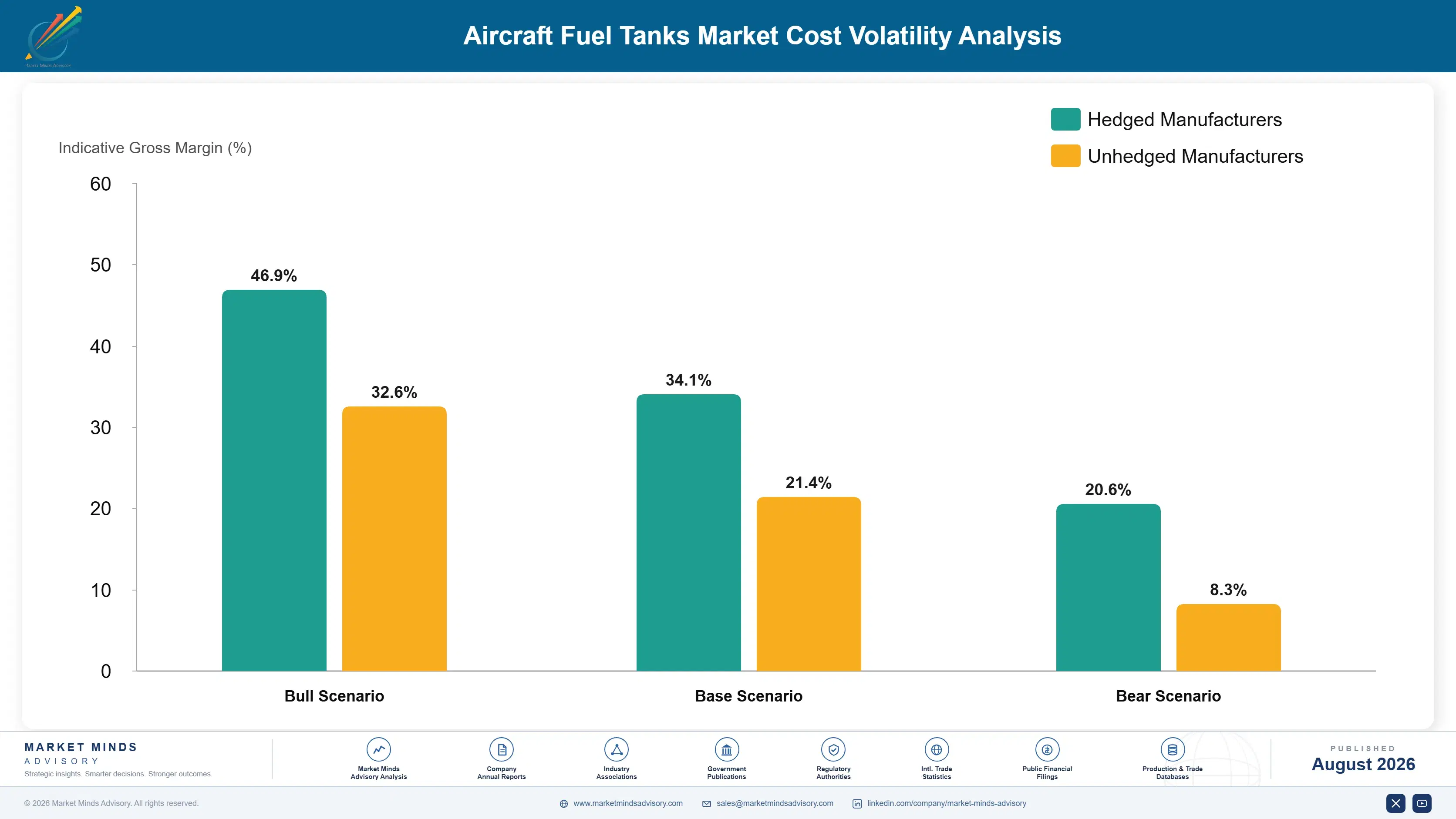
Cost divides into four components that differ completely between the two halves of this market. On a flexible tank, elastomer materials and ply construction absorb roughly 39% of build cost, skilled layup labour near 27%, qualification amortisation near 21%, and test with inspection the remaining 13%. On an integral tank the dominant cost is sealant application and cure time rather than any material.
The 72 hour sealant cure cycle is the constraint nobody can compress. A sealed wing box cannot accept fuel until curing completes, which sits directly on the assembly critical path and consumes floor space and tooling that no amount of labour addition frees. Safran and GKN both discussed production flow and assembly constraints across recent reporting periods. Sealant chemistry improvements shorten it marginally, and requalifying a sealant costs more than the time saved usually justifies.

Exposure varies by which half of the market a supplier occupies. Flexible tank producers carry elastomer material exposure and a workforce holding knowledge concentrated in very few people. Integral tank work carries cure cycle and floor space cost inside an aerostructures package. Suppliers qualified across several rotorcraft types spread qualification amortisation widely, while single-type suppliers carry it fully against one programme.
aircraft-fuel-tanks-market-cost-volatility-analysis-1788023693726

Type qualification families spreading certification cost

Qualifying a crashworthy tank design across related rotorcraft types rather than each independently spreads amortisation across several programmes and shortens each subsequent approval considerably. Authorities accept reuse where the installation delta is documented rigorously. Suppliers qualified on one type carry the full cost against one programme and price uncompetitively as a direct and entirely predictable result.

Elastomer knowledge capture beyond individual people

Formulation and layup capability resides substantially in experienced individuals rather than in documentation, which is how a five supplier market stays a five supplier market and also how a supplier loses capability unexpectedly. Structured knowledge capture and apprenticeship costs very little against the exposure. Almost nobody in this market has treated it as a genuine operational risk.

Sealant cure scheduling against assembly critical path

A 72 hour cure sits on the critical path and consumes tooling and floor space that cannot be freed by adding labour, so scheduling it against other assembly work rather than around it recovers flow time at no material cost. Sealant chemistry improvements help marginally. Requalifying a sealant to save cure hours usually costs more than the hours are worth.

Portfolio Architecture for Margin Defence

The portfolio separates by whether the work is structure or specialty. Integral wing and centre tanks form the volume core: enormous revenue, won inside aerostructures packages, and margins reflecting the structural work they actually are rather than any fuel containment premium. Tank specialists are not in that competition and never have been, which makes roughly a third of this market permanently inaccessible to them.
Margin concentrates where qualification and materials knowledge create genuine scarcity. Flexible, self-sealing and crashworthy tanks are produced by around five firms worldwide, priced accordingly, and protected by an entry barrier measured in years and millions rather than in any technical secret. The tension is that scarcity attracts both acquisition interest and customer resistance, and airframers have started part-funding the additional qualification that would erode it.

The overlooked pool is materials. Changing fuel chemistry obliges requalification of sealants and elastomers across tanks already flying, and nobody has claimed that work commercially. Whoever produces the reference test evidence first sets specifications everybody else must then satisfy, which is worth considerably more than the requalification itself. Nobody has produced that evidence yet, and the work is entirely unavoidable.

Volume / Commodity-Adjacent

Integral wing and centre tank sealing won inside aerostructures work packages. Range spans six points because cure cycle scheduling and floor space utilisation decide outcomes far more than sealant pricing ever does.
Gross Margin: 9-15%

Premium / Certified

Flexible bladder tanks, auxiliary and conformal tanks and inerting systems. Range spans eight points because aftermarket capture through authorised distribution differs enormously between suppliers holding it and those without. Aftermarket access decides it.
Gross Margin: 18-26%

Sustainability / Regulatory / Next-Generation

Self-sealing crashworthy tanks and sustainable fuel compatible material systems. Range spans twelve points because type qualification breadth spreads certification cost that single-type suppliers carry entirely alone. Few suppliers hold both capabilities together.
Gross Margin: 26-38%
aircraft-fuel-tanks-market-portfolio-architecture-1788023694228

High-value Sub-segments and Strategic Watch-out

Self-Sealing Crashworthy Tanks

High value and high growth at 9.6%, mandated across newly manufactured rotorcraft regardless of type certificate age. The ten point range separates suppliers qualified across several types from those carrying certification cost against one programme. Regulation rather than any technical advance supplies the whole growth rate here.
Gross Margin: 28-38%

External Drop Tanks

High value with moderate growth at 8.4%, consumed rather than retained so demand tracks operational activity directly. The eight point range reflects wider competition, since manufacturing is simpler and qualification concerns separation rather than impact containment. Demand responds to budgets actually spent rather than merely appropriated.
Gross Margin: 22-30%

Integral Wing and Centre Tanks

The volume core and the part of this market tank specialists cannot reach at all. Won inside aerostructures packages, priced as structural work, and dominated by cure cycle scheduling rather than by anything about fuel containment. Roughly a third of the market sits permanently out of reach.
Gross Margin: 9-15%

Qualified Elastomer Supply Base

The strategic watch-out rather than a growth pool. Five producers worldwide is not a supply base, the capability sits substantially in individual people, and a single failure would halt several national programmes at once. Nobody anywhere in this industry has a credible answer to that.
Gross Margin: Variable

Why Tank Positions Never Move

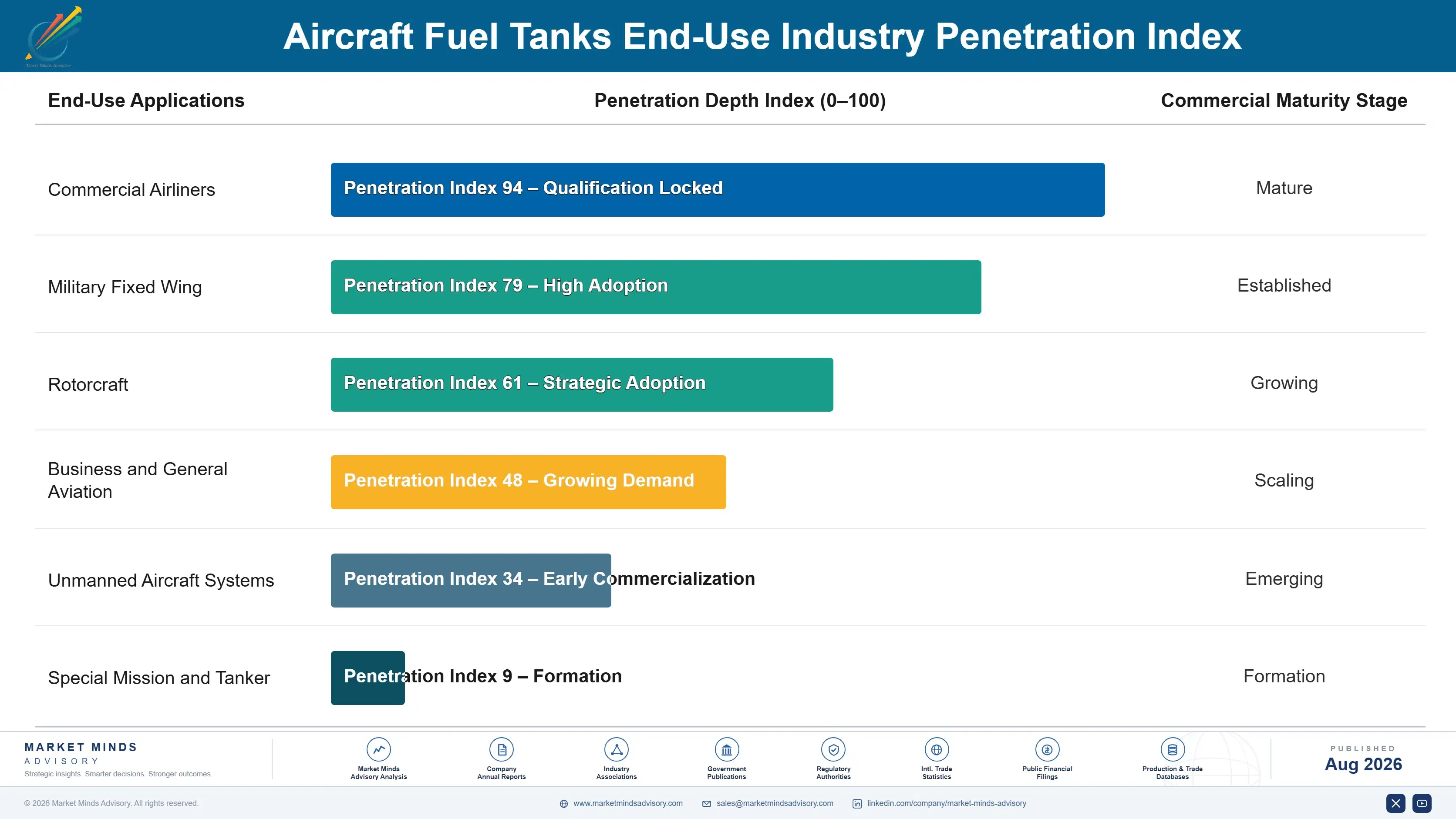
A qualified tank position produces annuity economics across an airframe's entire life. Once approved it ships with every aircraft built to that configuration and generates replacement demand for decades afterward, and substituting it means qualification work costing years and millions that no operator or airframer funds without a genuine technical reason. Aftermarket at 41% of revenue arrives on exactly that basis, from operators holding one qualified part number and no alternative.
Stickiness varies sharply between the two halves. Flexible and crashworthy tank positions are close to permanent, since roughly five firms worldwide could even attempt a replacement and qualification would take years. Integral tank work moves with aerostructures packages at programme level rather than component level. Drop tanks are the most contestable, being simpler to manufacture and qualified against separation behaviour rather than any containment specification.

The customer is changing in one specific way. Airframers uncomfortable with five qualified elastomer suppliers have begun part-funding second source qualification, which is a customer deliberately paying to reduce a supplier's pricing power. That is unusual behaviour and it reflects genuine programme exposure rather than any commercial grievance. Suppliers treating it as hostility rather than as a solvable risk are misreading it badly.
aircraft-fuel-tanks-market-end-use-penetration-index-1788023694714

Where Tank Makers Should Commit

These are among the four positions where our research anticipates prominent divergence between winners and laggards over the coming forecast period. Each is grounded in the demand model, the regulatory perimeter, and the announced capacity pipeline.
01 / CRASHWORTHY TYPE COVERAGE

Qualify across types before the mandate extends

Crash resistant fuel systems apply to newly manufactured rotorcraft today, and extending them to existing airframes would convert a production requirement into a retrofit programme across tens of thousands of aircraft almost overnight. Suppliers holding qualified crashworthy designs across several rotorcraft types would capture that immediately, while those qualified on one would not participate at all. Each additional type costs perhaps 2 to 4 million dollars and eighteen months, and the extension is widely expected without any date that anybody can attach to it.
02 / SECOND SOURCE QUALIFICATION

Airframers will pay you to become the sixth supplier

Five qualified flexible tank producers worldwide is a position airframers describe privately as unacceptable and publicly not at all, and several have begun part-funding additional qualification to reduce their own programme exposure. Qualifying takes three to four years and several million dollars of certification work, and the customer will contribute where a supplier makes the case properly. The commercial position afterwards is exceptional, entering a market with 41% aftermarket revenue and essentially no price competition operating anywhere inside it at present.
03 / FUEL MATERIAL REQUALIFICATION

Nobody has claimed the sustainable fuel test evidence

Changing fuel chemistry alters how sealants and elastomers swell, obliging requalification across sealant systems, bladder plies and joints on tanks already flying rather than only on new designs entering service anywhere. The work is unglamorous and entirely unavoidable, and no supplier has yet positioned it as a commercial offering rather than a compliance chore to be endured and quietly absorbed. Whoever produces the reference test evidence first ends up setting the specifications that everybody else must then satisfy for many years afterwards.
04 / AFTERMARKET CHANNEL CONTROL

Forty-one percent of revenue is leaking through distribution

Aftermarket replacement and overhaul produce 41% of market revenue at margins new build never approaches, because an operator replacing a bladder on a twenty year old rotorcraft holds one qualified part number and no alternative supplier anywhere at any price. Manufacturers selling through uncontrolled distribution surrender much of that premium to intermediaries who add nothing beyond inventory holding and a markup. Authorised distribution with pricing discipline typically recovers 14% to 20% of the value currently leaking outward in most comparable cases.

Engagement Snapshot From the Field

A live engagement with an industry participant carrying material or product regulatory and market exposure ahead of a defining policy shift, showing how our research translates into a defensible multi-year portfolio strategy.
MARKET MINDS ADVISORY · CLIENT ENGAGEMENT SUMMARY
Aircraft Fuel Tanks Producer Strategic Portfolio Review and Transition Roadmap 2026·Investment Scenario on Aircraft Fuel Tanks Exposure Evaluation 2025-26
CLIENT PROFILE
A specialist manufacturer of flexible and self-sealing aircraft fuel tanks holding qualified positions on two rotorcraft types and several fixed wing military applications, selling new build directly and aftermarket through independent distributors. Revenue had grown steadily since crash resistant requirements took effect while margin remained flat, and management had not isolated why growth was producing no operating leverage.
STRATEGIC CHALLENGE
The board needed to understand why a scarce capability in a five supplier market was not producing better margins, and whether qualifying on further rotorcraft types justified the cost and time involved. It also faced an airframer offering to part-fund second source qualification with a competitor, which management had interpreted as a hostile act rather than as a signal about its own pricing.
MMA APPROACH
MMA traced realised pricing from factory gate through distribution to operators across the highest volume part numbers, separating new build from aftermarket, and modelled the return on qualifying additional rotorcraft types under current and extended mandate scenarios. Expert interviews with airframers, operators, distributors and certification authorities established what qualification costs and what the customer was actually signalling.
KEY FINDINGS
  1. Aftermarket parts reached operators at an average 3.8 times factory price, and the client captured none of that uplift beyond its own gate price at all.
  2. Qualification cost was carried entirely against two rotorcraft types, so amortisation per unit ran well above competitors qualified across four or more airframes.
  3. Extending the crash resistant mandate to existing rotorcraft would produce demand the client could serve on two types only, against competitors positioned on five.
  4. The airframer offer to part-fund a second source reflected genuine programme exposure concerns rather than dissatisfaction, and had been declined without any discussion.
CLIENT PROFILE
A specialist manufacturer of flexible and self-sealing aircraft fuel tanks holding qualified positions on two rotorcraft types and several fixed wing military applications, selling new build directly and aftermarket through independent distributors. Revenue had grown steadily since crash resistant requirements took effect while margin remained flat, and management had not isolated why growth was producing no operating leverage.
STRATEGIC CHALLENGE
The board needed to understand why a scarce capability in a five supplier market was not producing better margins, and whether qualifying on further rotorcraft types justified the cost and time involved. It also faced an airframer offering to part-fund second source qualification with a competitor, which management had interpreted as a hostile act rather than as a signal about its own pricing.
MMA APPROACH
MMA traced realised pricing from factory gate through distribution to operators across the highest volume part numbers, separating new build from aftermarket, and modelled the return on qualifying additional rotorcraft types under current and extended mandate scenarios. Expert interviews with airframers, operators, distributors and certification authorities established what qualification costs and what the customer was actually signalling.
KEY FINDINGS
  1. Aftermarket parts reached operators at an average 3.8 times factory price, and the client captured none of that uplift beyond its own gate price at all.
  2. Qualification cost was carried entirely against two rotorcraft types, so amortisation per unit ran well above competitors qualified across four or more airframes.
  3. Extending the crash resistant mandate to existing rotorcraft would produce demand the client could serve on two types only, against competitors positioned on five.
  4. The airframer offer to part-fund a second source reflected genuine programme exposure concerns rather than dissatisfaction, and had been declined without any discussion.
RECOMMENDED STRATEGY
Phase 1: Phase one: establish authorised distribution with pricing discipline across the highest volume aftermarket part numbers currently sold through independent distributors today. Phase 2: Phase two: begin qualification on two further rotorcraft types, positioning for a mandate extension that is widely expected and cannot be dated. Phase 3: Phase three: re-engage the airframer on supply resilience, offering capacity and inventory commitments rather than resisting second source qualification by a rival.
OUTCOME
The client reported gross margin improving 4.9 points within five quarters (client-reported, unverified by MMA), with most of the gain from aftermarket channel control. One additional type qualification completed and a second entered testing. The airframer agreed a capacity and inventory arrangement in place of funding a competitor's qualification.

Frequently Asked Questions

Foundational context covering the market sizes, CAGR, scope, country, region and competition that inform every finding below. This section is provided to cover basics and most often pre-purchase conversations, answered from the MMA Primary Research Dataset.

What is the current size of the Aircraft Fuel Tanks Market?

The market is valued at USD 4.4 billion in 2025, measured as revenue from fuel tanks and tank protection systems qualified for aircraft installation across all types.

How large will the Aircraft Fuel Tanks Market be by 2036?

MMA forecasts USD 8.70 billion by 2036, up from USD 4.68 billion in 2026. That represents incremental revenue of USD 4.02 billion and an expansion multiple of 1.86 times.

What is the CAGR for the Aircraft Fuel Tanks Market 2026 to 2036?

The base case CAGR is 6.4%, with a bull case of 7.6% and a bear case of 5.2%. Rotorcraft crashworthiness requirements supply most of that growth.

Which segment is growing fastest?

Self-sealing crashworthy tanks grow at 9.6%, half again the market rate of 6.4%. Regulation rather than technology explains essentially all of that growth, since crash resistant systems became mandatory on new rotorcraft.

Who are the major companies in the Aircraft Fuel Tanks Market?

Parker Aerospace, Safran, GKN Aerospace, TransDigm and Collins Aerospace lead on qualified tank revenue, holding around 58% between them across the whole market, though the two halves of this market barely compete with each other.

Which country is growing fastest?

India grows fastest at 8.4%, driven by rotorcraft and combat aircraft production alongside indigenisation policy directing fuel system content toward domestic suppliers, with qualification rather than manufacturing capacity the binding constraint on that.

Report Segmentation Architecture

The full report scope spans multiple orthogonal segmentation dimensions, with cross-tabulated demand data provided for each dimension pair. Coverage extends further to regional breakdowns, trend trajectories, and the competitive detail needed to support segment-level decision-making.

By Tank Type

  • Integral Wing and Centre Tanks
  • Flexible Bladder Tanks
  • Self-Sealing Crashworthy Tanks
  • Auxiliary and Conformal Tanks
  • External Drop Tanks
  • Fuel Tank Inerting and Protection Systems

By End-Use Industry

  • Commercial Airliners
  • Military Fixed Wing
  • Rotorcraft
  • Business and General Aviation
  • Unmanned Aircraft Systems
  • Special Mission and Tanker

By Commercial Dimension

  • Airframer Direct Supply
  • Tier One Structural Integration
  • Aftermarket Replacement Supply
  • Military Programme Contracting
  • Retrofit and Modification
  • Material and Sealant Supply

By Region

  • North America
  • Western Europe
  • East Asia
  • South Asia and Pacific
  • Latin America
  • Middle East and Africa
  • Eastern Europe

Scope, Methodology, and Coverage

Every figure in this report is reproducible from documented input assumptions. The scope below maps the historical period, the forecast horizon, the segmentation dimensions, and the countries covered, alongside the underlying primary and qualitative methodology.
Historical Period
2020 to 2025
Forecast Period
2026 to 2036
Base Year
2025 (USD billions; MMA Primary Research Dataset, August 2026)
Market Definition
Revenue from fuel tanks and fuel tank protection systems qualified for aircraft installation, spanning integral wing and centre tanks, flexible bladder tanks, self-sealing crashworthy tanks, auxiliary and conformal tanks, external drop tanks, and inerting and flammability reduction systems. Airframer direct supply, Tier One structural integration, aftermarket replacement, military programme contracting, retrofit work and material and sealant supply are included. Fuel pumps, valves, gauging and distribution plumbing, ground refuelling equipment, and airframe structure performing no fuel containment function are excluded.
Quantitative Units
USD billions, qualified tank and system revenue
Segmentation Dimensions
Tank type, end-use aircraft category, commercial supply dimension, region
Regions Covered
North America, Western Europe, East Asia, South Asia and Pacific, Latin America, Middle East and Africa, Eastern Europe
Countries Covered
United States, United Kingdom, France, Germany, Italy, Israel, China, Japan, South Korea, India, Australia, Brazil, Poland, Czechia
Key Companies Profiled
Parker Aerospace, Safran, GKN Aerospace, TransDigm, Collins Aerospace, Amfuel, Cobham Mission Systems, ShinMaywa Industries, Marvin Engineering, Elbit Systems
Quantitative Methodology
Primary survey, n=3,800 respondents, Q4 2025, six countries; demand-side model with trade association cross-validation
Qualitative Methodology
47 expert interviews, Q4 2025; applied to validate demand model assumptions, identify emerging dynamics, and assess competitive positioning
Report Format
PDF and XLSX data workbook (Word format preview document)
Publisher
Market Minds Advisory
Report Code
MMA-2026-CON-341
Published
August 2026
Contact
sales@marketmindsadvisory.com | www.marketmindsadvisory.com

Purchase the full Aircraft Fuel Tanks Market Report (2026 to 2036).

The full report separates this market into the two unrelated businesses it actually contains and shows why pricing them alike misleads everybody. It quantifies the crashworthy tank premium and the regulatory mechanism creating it, maps the five qualified elastomer producers against the programmes depending on them, and assesses what sustainable fuel material requalification will oblige across tanks already flying. Segment analysis covers all six tank types, with particular attention to crashworthy systems where regulation rather than technology explains the entire growth rate. Competitive assessment ranks twenty participants on qualified tank and protection system revenue.
Six tank type segmentation with growth rates
Crashworthy premium against conventional tank cost
Twenty participant assessment on qualified revenue
Qualified elastomer supply mapped against dependent programmes
Sustainable fuel material requalification scope quantified
Aftermarket capture traced through the distribution chain

Built For The People Who Decide

From boardroom strategy to bench-side execution, this report is read cover-to-cover by leaders shaping the next decade of their industry, turning demand scenarios, market dynamics and valuation benchmarks into decisions.
CXOs/ Presidents/ VPs/ Managers
M&A and Corporate Development
Strategy Teams and R&D Heads
Procurement and Product Directors
Regulatory and Compliance Leaders
Investor Relations and Equity Analysts