Market Minds Advisory
Aircraft Flight Recorder Market

Aircraft Flight Recorder Market: Aircraft Flight Recorder Market. Streaming Data Mandates Reshape Black Box Technology

Regulators mandating real-time flight data streaming after high-profile search-and-recovery failures are colliding with airlines resisting costly avionics retrofits as recorder manufacturers race to certify next-generation deployable systems across global commercial fleets.

Lead Analyst

Published

September 2026

Make Smarter Decisions with Customized Research Insights

Request a free sample report and evaluate market opportunities, growth trends, and competitive dynamics relevant to your business needs.

2025 MARKET VALUE$1.6BMarket Size 2025
2036 FORECAST VALUE$3.2BBase Case , 2026 to 2036
CAGR 2026 TO 20366.5 %Bull 7.8% / Bear 5.2%
INCREMENTAL OPPORTUNITY$1.5BNet 10- year value creation
EXPANSION MULTIPLE1.88x2036 value over 2026 base
Strategic Levers
M&A Pipeline
Regional Outlook
Country Rankings
Competitive Intelligence
Segmental Deep-dive
Call-Us : 91 93563 13602

Executive Snapshot and Market Trajectory.

Aviation regulators are mandating deployable flight recorders that eject and float on impact after several high-profile ocean crashes took years to locate wreckage, forcing airlines to retrofit fleets that never anticipated this requirement. This shift is reshaping avionics procurement priorities across nearly every major commercial fleet operator worldwide.
International Civil Aviation Organization requirements for real-time flight data streaming during distress situations are pulling capital toward next-generation recorder systems as regulators set hard retrofit compliance deadlines, and South Asian carriers are adopting upgraded recorders fastest as fleet expansion programs bundle in modern avionics by default. Military and government aircraft operators are separately driving demand for ruggedized deployable recorders as defense budgets prioritize survivable data recovery following recent high-visibility search operations.
A small number of certified manufacturers still dominate flight recorder contracts given the extreme certification barriers involved, but specialist streaming technology firms are entering from the satellite communications side rather than the traditional avionics side, changing who counts as a credible competitor. Extended battery life and underwater locator beacon range requirements are forcing manufacturers to navigate a genuinely more complex certification landscape. Vendors combining both areas of expertise increasingly win the largest fleet retrofit contracts.
Market Definition
This report covers cockpit voice recorders, flight data recorders, and combined units used to capture and preserve flight data for accident investigation, measured on a global unit and revenue basis across commercial, military, and business aviation. It excludes quick-access recorders used purely for airline operational monitoring and ground-based flight data analysis software.
Base Year Value
$1.6B in 2025 (MMA Primary Research Dataset, September 2026)
Forecast Period
2026 to 2036, eleven discrete annual values
CAGR
6.5% base case. Bull 7.8%. Bear 5.2%.
Fastest Growth Segment
Deployable and Streaming-Enabled Recorders: 10.5% CAGR
Fastest Growth Country
India: 11.0% CAGR
Fastest Growth Region
South Asia and Pacific: 8.8% CAGR
Largest Region
North America: 32% of 2025 global value
Market Leaders
Honeywell, Curtiss-Wright, Safran, L3Harris, Leonardo
Primary Survey
n=3,800 procurement and R&D decision-makers, Q4 2025, six countries
Methodology
Demand-side build-up, cross-validated against public data, 47 expert interviews

Aircraft Flight Recorder Market Forecast Scenarios

aircraft-flight-recorder-market-size-forecast-scenario-1788417014370
Between 2020 and 2025 the flight recorder market grew at roughly 5.6 percent annually as pandemic-era fleet groundings temporarily depressed new aircraft deliveries and associated recorder demand before recovering as air travel rebounded. Growth accelerated once International Civil Aviation Organization deployable recorder and streaming mandates took formal effect, creating a defined multi-year retrofit compliance cycle.
The base case assumes continued steady expansion as three commercial mechanisms compound: regulatory bodies extend deployable recorder mandates to a wider tier of aircraft beyond the largest commercial fleets, military modernization programs prioritize survivable data recovery following recent high-visibility search operations, and satellite streaming technology matures enough to make real-time data transmission commercially viable across most commercial aircraft types. Manufacturers respond by building dedicated streaming-enabled recorder production lines rather than treating each order as bespoke certification work.
The bull case centers on a major aviation authority mandating accelerated retrofit timelines following a high-profile incident, forcing rapid fleet-wide adoption within a compressed window. The bear case centers on airline capital expenditure constraints during a broader industry downturn, delaying planned retrofit programs and extending waiver requests well beyond originally mandated compliance deadlines. Compliance timelines could stretch well past a decade in this scenario.

Black Boxes Become Streaming Survival Systems, Not Passive Recorders

Recorder manufacturers are no longer selling a passive black box, they are selling a survivable data recovery system, and that shift is rewriting who counts as a credible supplier to a major aircraft manufacturer or airline. A manufacturer without deployable ejection and satellite streaming capability cannot win a contract that now requires demonstrating data recovery even when the aircraft itself is never found.
MARKET CONCENTRATION68% CR5Top five manufacturers hold most global recorder revenue share
AVERAGE UNIT PRICE$45,000 per combined recorder unitPrice varies widely between commercial and military-grade units
TOP MANUFACTURING COUNTRY SHAREUnited States, 42% of outputSingle country dominates worldwide flight recorder manufacturing capacity
DEPLOYABLE RECORDER PENETRATION30% of new commercial aircraft ordersShare of new aircraft ordered with deployable recorder systems installed
STREAMING-CAPABLE FLEET COVERAGE20% of global commercial fleetPortion of commercial aircraft equipped with real-time data streaming
AVERAGE CERTIFICATION TIMELINEThree to five years per new designTypical duration required to certify a new flight recorder design
Manufacturers that historically built fixed, non-deployable recorders are being squeezed out unless they build deployable ejection and satellite streaming capability, since regulators increasingly mandate these features on new aircraft rather than accepting legacy fixed-mount designs alone. Several smaller avionics suppliers have already exited the recorder segment entirely, choosing instead to focus on adjacent avionics categories where certification barriers remain lower.
Satellite communications companies are moving directly into flight recorder-adjacent streaming technology, competing with traditional avionics manufacturers who never built satellite transmission capability, creating a market where neither pure avionics manufacturing nor pure satellite communications positioning is defensible alone anymore. Airlines increasingly evaluate suppliers on data recovery guarantee terms almost as closely as raw hardware reliability, a criterion that barely mattered in procurement decisions a decade ago when locating the recorder itself was considered the primary technical challenge.
"A recorder that sinks with the wreckage and takes two years to find has already failed at its one job. The box was never the point, getting the data back was."
Practice Lead, Aerospace Safety Systems · MMA Aerospace Safety and Avionics Recording Systems Practice · September 2026

Market Trends

ICAO Mandates Deployable Recorders and Streaming Capability

The International Civil Aviation Organization's Global Aeronautical Distress and Safety System framework requires new commercial aircraft to carry deployable flight recorders and stream position and basic flight data during an emergency, replacing the prior reliance purely on fixed recorders that must be physically recovered from wreckage. Airlines operating over 20,000 commercial aircraft worldwide must eventually comply with this framework as fleets retire and replace aging equipment, creating a predictable multi-year compliance-driven order book that manufacturers are building dedicated production capacity to serve. Manufacturers unable to meet deployable recorder certification requirements risk exclusion from new aircraft programs entirely.
Market Impact: Fleet grows past 40,000 aircraft
Satellite Connectivity Improvements Enable Real-Time Streaming

Advances in satellite communication bandwidth and coverage, driven substantially by low-Earth-orbit constellation expansion, are making continuous real-time flight data streaming commercially viable in a way that was prohibitively expensive just a decade ago. Streaming costs per flight hour have fallen from levels that made continuous transmission impractical to a small fraction of that figure today, crossing the threshold where airlines can justify equipping entire fleets rather than only oceanic routes. This cost decline is accelerating adoption well ahead of what regulatory mandates alone would require. Manufacturers integrating satellite modems directly into recorder units are capturing this new adoption wave first.
Market Impact: Searches cost over 150 million dollars

Market Opportunities and Growth Drivers

Aircraft Fleet Growth Expands Recorder Order Volume

Global commercial aircraft fleet size is projected to grow past 40,000 aircraft within the forecast period as air travel demand continues expanding across emerging markets, directly expanding the addressable population requiring flight recorder equipment. Each new aircraft delivery requires at least one combined recorder or separate cockpit voice and flight data recorder units, creating direct order volume growth tied to aircraft manufacturing rates rather than purely to retrofit compliance cycles. Manufacturers with strong original equipment manufacturer relationships benefit disproportionately from this baseline growth independent of any regulatory mandate. This trend holds regardless of regulatory outcomes.
Market Impact: Certification can take over 5 years

High-Profile Search Failures Drive Political Pressure

Several widely publicized incidents where wreckage and recorders took years or were never located at all have generated sustained political and public pressure on aviation authorities to mandate better data recovery technology. Search operations for lost aircraft have cost governments and airlines over 150 million dollars in documented cases, creating a strong financial argument for prevention alongside the humanitarian and investigative case. This pressure has accelerated regulatory timelines beyond what the industry's own voluntary adoption pace would have achieved. Governments increasingly view recorder mandates as a lower-cost alternative to funding expensive multi-year search efforts.
Market Impact: Retrofits can delay fleets 2 years

Market Restraints and Challenges

Extreme Certification Barriers Limit New Entrant Competition

Flight recorder certification requires surviving extreme crash, fire, and pressure test conditions that few manufacturers outside the established aerospace supplier base have the specialized testing infrastructure to demonstrate credibly. The root cause is that recorder survivability standards have tightened over decades of incident investigation, each revision adding new test conditions that raise the barrier for any new entrant attempting certification from scratch. This forces most new competitors to partner with or acquire an already-certified manufacturer. Some firms mitigate this by focusing narrowly on streaming and software add-ons to certified hardware rather than pursuing full certification.
Market Impact: Over 20,000 aircraft affected globally

Airline Retrofit Cost Resistance Slows Compliance Timelines

Airlines facing thin margins are resisting mandatory retrofit costs for existing fleets, since deployable recorder and streaming upgrades require both hardware installation and aircraft downtime that directly reduces revenue-generating flight hours. The underlying cause is that regulatory mandates impose compliance costs without a corresponding direct revenue benefit to the airline, unlike upgrades that improve fuel efficiency or passenger capacity. This forces regulators to negotiate extended compliance timelines and waiver provisions that slow overall market adoption below the pace mandates alone would suggest. Manufacturers are mitigating this by offering leasing and phased retrofit programs that spread cost across multiple maintenance cycles.
Market Impact: Streaming costs fell over 80 percent
3 additional market trends, 4 additional growth drivers, and 3 additional restraints and challenges are covered in the full report. Contact sales@marketmindsadvisory.com to access the complete intelligence.

Segment CAGR and Growth Architecture

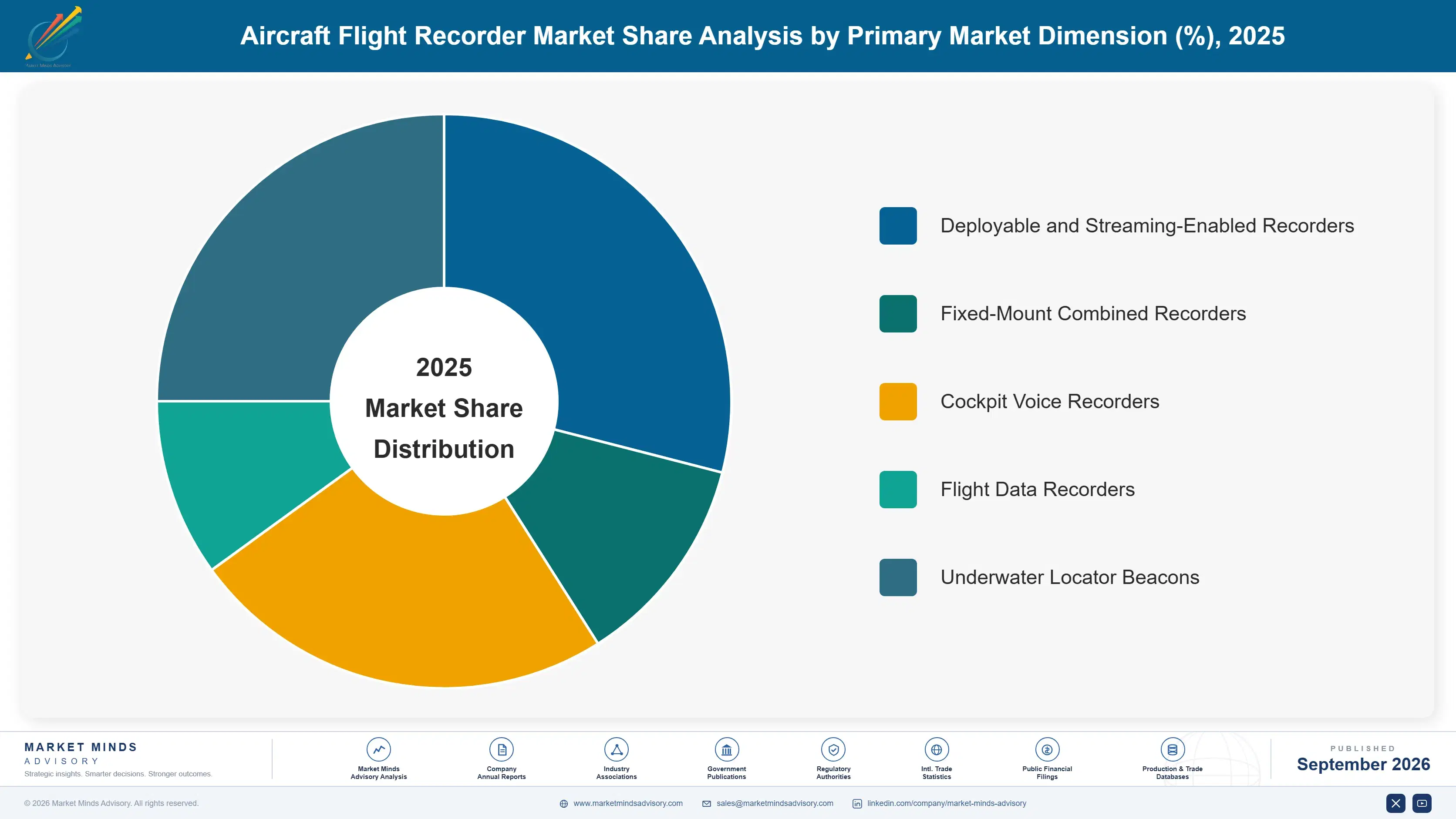
The flight recorder market splits across five technology-defined segments spanning deployment method, data type, and streaming capability used across global aviation. Deployable and streaming-enabled recorders lead growth as regulatory mandates spread across commercial fleets worldwide, while fixed-mount combined recorders still represent the largest installed base by unit count across the existing global commercial fleet.
aircraft-flight-recorder-market-market-share-analysis-1788417014912

Deployable and Streaming-Enabled Recorders

Deployable and streaming-enabled recorders eject from the aircraft on impact, float on water, and transmit position and basic flight data via satellite during a distress event, addressing the search-and-recovery failures that motivated recent regulatory mandates directly. This format combines survivability engineering with satellite communications integration, requiring manufacturers to master both disciplines simultaneously rather than either alone. Growth here outpaces every other segment because every new commercial aircraft delivery increasingly includes this capability as a baseline regulatory requirement rather than an optional upgrade purchased separately by cost-conscious airlines. Manufacturers with proven expertise in both crash survivability engineering and satellite integration are capturing the largest overall share of new mandate-driven contracts industry-wide.
CAGR 10.5%

Fixed-Mount Combined Recorders

Fixed-mount combined recorders remain the largest segment by installed unit count, covering the traditional cockpit voice and flight data recorder units mounted permanently in the aircraft tail section that must be physically recovered from wreckage after an incident. This format predates the current deployable recorder mandate and continues serving the large existing global fleet that has not yet reached its scheduled retrofit or replacement cycle. Growth here is comparatively modest since new mandates increasingly favor deployable alternatives, with most remaining fixed-mount demand tied to replacement of failed units rather than new aircraft equipping. Manufacturers serving this segment compete primarily on reliability track record and certification heritage rather than the streaming sophistication that differentiates deployable systems.
CAGR 3.5%
Full segment breakdown across 6 segments available in the complete report.

Regional Architecture and Country Demand Map

North America leads global recorder revenue on the strength of Boeing's manufacturing base and key supplier headquarters concentration, while East Asia holds a strong secondary share tied to expanding regional fleets and the emerging COMAC program. South Asia and Pacific grows fastest as India's aviation sector expands rapidly.

North America

Aerospace supplier headquarters concentration defines North America's share more than raw fleet size alone. Honeywell, Curtiss-Wright, and L3Harris all book the majority of their global recorder revenue through United States entities, reinforced by Boeing's substantial domestic aircraft manufacturing base requiring recorder equipment on every new delivery. The Federal Aviation Administration's regulatory leadership role has separately positioned American manufacturers advantageously in shaping global certification standards that other regulators frequently reference. Canada's smaller aerospace sector follows a similar adoption pattern, though concentrated among a handful of major national carriers and manufacturers. Insurance and leasing companies based in this region also increasingly require deployable recorder equipment as a condition of financing newer aircraft.
Share: 32% | CAGR: 7.5% (2026 to 2036)

Western Europe

Western Europe's growth trails the global rate mainly because the region's mature fleet replacement cycle means fewer new aircraft deliveries relative to fast-growing emerging markets, even as Airbus maintains substantial recorder-adjacent manufacturing activity domestically. France's Safran and Italy's Leonardo continue winning meaningful recorder and avionics contracts, sustaining the region's supplier base despite comparatively modest fleet growth. The United Kingdom's aviation safety authority continues pushing for accelerated deployable recorder adoption following high-profile search-and-recovery incidents involving European carriers. Spain and the Netherlands host smaller but meaningful aerospace supply chain operations tied to broader European recorder component manufacturing. Nordic carriers are also expanding regional fleets steadily, adding modest incremental recorder demand across the broader region.
Share: 19% | CAGR: 5.2% (2026 to 2036)
Regional intelligence for 5 additional markets available in the complete report: East Asia, South Asia and Pacific, Latin America, Middle East and Africa, Eastern Europe. Contact sales@marketmindsadvisory.com.
aircraft-flight-recorder-market-country-cagr-analysis-1788417015446

Where Recorder Manufacturers Can Still Add Margin

Extreme certification barriers protect hardware margins today, but thinning per-unit pricing on legacy fixed-mount recorders is pushing vendors toward adjacent revenue lines that ride on top of the same airline relationship rather than the recorder unit sale itself. Four levers stand out as genuinely additive to core hardware revenue, each drawing on capability the manufacturer already has.

Selling Streaming Data Subscription Services to Airlines

Manufacturers with satellite streaming infrastructure already built into recorder units can offer airlines an ongoing data subscription service covering flight monitoring beyond pure emergency distress transmission, capturing recurring revenue rather than a one-time hardware sale. Airlines value this because continuous streaming supports broader operational efficiency use cases beyond safety compliance alone, including fuel optimization and maintenance prediction. Manufacturers offering this capability command subscription fees running roughly 8 to 12 percent of the original hardware contract value annually. Building this subscription infrastructure requires ongoing data engineering investment most pure hardware manufacturers historically never developed.
Market Impact: Subscription fees add 8 to 12 percent yearly

Providing Certification Consulting Services to New Entrants

Established manufacturers with decades of certification experience can sell consulting services to newer aerospace companies attempting to enter the recorder market, monetizing regulatory expertise separately from hardware manufacturing itself. This model captures value from companies that want certification guidance without committing to a full manufacturing partnership immediately. Established manufacturers offering this service report consulting revenue reaching 4 to 7 percent of total company revenue within two years of launching the offering commercially. Export control regulations governing dual-use aerospace technology still apply to this consulting work, adding compliance overhead. This expertise helps smaller manufacturers avoid costly mistakes that delay entry.
Market Impact: Consulting revenue reaches 4 to 7 percent share

Offering Extended Warranty and Predictive Maintenance Programs

Recorder units carry sensitive electronics that benefit from predictive maintenance monitoring, creating a genuine market for extended warranty programs covering component failure beyond standard replacement cycles, a capability manufacturers increasingly package as a paid subscription layered on top of the base hardware contract. Airlines value this because unplanned recorder failures can ground an aircraft pending replacement. Subscription attach rates above 25 percent among airlines operating large modern fleets are now achievable for manufacturers with sufficient installed base data. Pricing this risk accurately requires actuarial expertise most manufacturers must build internally or acquire from insurance partners.
Market Impact: Attach rates now exceed a 25 percent mark

Selling Retrofit Installation and Integration Services

Manufacturers that build dedicated retrofit installation teams can charge a premium service fee for managing the aircraft downtime and integration work required to upgrade existing fleets, capturing value from a bottleneck that otherwise slows airline compliance timelines significantly. This service has proven especially valuable to airlines lacking in-house avionics installation capacity for large-scale fleet retrofits. Vendors offering this service report fees adding roughly 15 to 20 percent on top of standard hardware contract value. Building this installation capability requires certified technician training that most manufacturers previously left entirely to third-party maintenance providers.
Market Impact: Installation fees add 15 to 20 percent more

Who Controls the Margin Pool

Global recorder revenue concentrates heavily, with the top five manufacturers holding roughly 68 percent share on a unit revenue basis, the consistent yardstick applied throughout this assessment. Honeywell and Curtiss-Wright sit well ahead of the next tier, backed by decades of certification relationships and original equipment manufacturer partnerships newer entrants cannot easily replicate. The gap between leaders and mid-tier challengers remains wide enough that ranking changes look unlikely.
Current activity centers on deployable recorder and streaming technology integration rather than pure price competition on legacy fixed-mount hardware. Manufacturers are racing to certify satellite streaming capability across multiple aircraft platforms simultaneously, since missing a certification window can cost years of lost original equipment manufacturer contract eligibility. Several mid-tier players have pursued satellite communications company partnerships specifically to close the streaming technology gap with established leaders.

Emerging pressure comes from satellite communications specialists entering recorder-adjacent streaming technology directly, competing with traditional avionics manufacturers who never built satellite transmission capability. Ranking shifts are most likely in the mid-tier, where manufacturers lacking deployable and streaming product lines risk losing contracts to faster-moving specialists. The very top of the market remains comparatively stable, protected by scale and certification relationships built over decades.
aircraft-flight-recorder-market-company-positioning-matrix-1788417015999

Competitive Moat and Risk Dimensions

HONEYWELL

Moat: Deep Boeing Platform Integration

Honeywell's decades-long relationship supplying recorders and avionics across Boeing's commercial aircraft platforms gives it privileged access to new program contracts that competitors without similar original equipment manufacturer history cannot easily win. This trust, built over decades of reliable in-service performance, is difficult for any competitor to replicate quickly.
HONEYWELL

Risk: Slower Streaming Technology Pivot

Honeywell's manufacturing base grew up around fixed-mount recorder technology, leaving it less naturally positioned for the satellite streaming pivot than newer entrants and specialist satellite communications firms building streaming-first product architecture from scratch. Closing this gap requires substantial engineering investment in satellite integration capability built from the ground up.
CURTISS-WRIGHT

Moat: Ruggedized Military Recorder Expertise

Curtiss-Wright holds deep expertise in ruggedized recorder systems for military aircraft, a segment demanding survivability standards that exceed even commercial aviation requirements, giving it a defensible niche competitors struggle to enter credibly. Government defense customers value this proven survivability record highly when awarding sensitive modernization contracts.
CURTISS-WRIGHT

Risk: Limited Commercial Aviation Scale

Curtiss-Wright's commercial aviation recorder presence remains smaller than Honeywell's, limiting its exposure to the largest growth driver in this market, which is commercial fleet expansion and deployable recorder mandate compliance across major airlines. Expanding commercial presence would require building original equipment manufacturer relationships that take years to establish credibly.

Players Tracked

Prominent Players

Honeywell
Curtiss-Wright
Safran
L3Harris
Leonardo

Other Key Players

GE Aerospace
Universal Avionics
Teledyne Controls
Meggitt
Collins Aerospace
Thales Group
Cobham Aerospace Communications
Ultra Electronics
Latitude Technologies
Diehl Aerospace
Saab
DRS Technologies
Indra Sistemas
Avtech Corporation
Elbit Systems

Recent Developments

FEBRUARY 2026

Honeywell Certifies Streaming-Enabled Combined Recorder

Honeywell received certification for a new combined cockpit voice and flight data recorder featuring integrated satellite streaming capability, targeting the wave of regulatory-mandated deployable recorder orders expected across major airlines over the coming years. The certification covers both narrow-body and wide-body aircraft platforms currently in production.
Signal: Certification of streaming-enabled hardware is becoming the baseline requirement for winning new aircraft program contracts. widely.
SEPTEMBER 2025

Curtiss-Wright Wins Multi-Year Military Recorder Contract

Curtiss-Wright secured a multi-year contract to supply ruggedized flight recorders for a major military aircraft modernization program, expanding its defense sector footprint relative to competitors focused primarily on commercial aviation platforms. Financial terms of the multi-year contract were not disclosed publicly by either party in the deal.
Signal: Military modernization programs are becoming an increasingly important revenue channel alongside commercial fleet compliance cycles. broadly.
MAY 2025

Safran Acquires Satellite Streaming Technology Startup

Safran completed the acquisition of a smaller satellite streaming technology startup, adding specialized transmission capability to its existing avionics portfolio rather than relying solely on external satellite communications partnerships for this technology. The acquisition closed for an undisclosed sum earlier this year according to public filings.
Signal: Vertical integration into satellite streaming is becoming a defensive move against dependence on external technology partners.

Ruggedized Component and Certification Cost

Crash-survivable memory modules and ruggedized enclosures account for roughly 35 to 42 percent of a typical flight recorder manufacturer's cost of goods sold, sourced primarily from specialized aerospace-grade component suppliers in the United States and Europe. Certification testing and satellite communications hardware add a further 20 to 25 percent, sourced from accredited testing facilities and satellite equipment manufacturers.
A 2022 aerospace-grade memory component shortage, documented in Honeywell's 2022 annual report as a material supply constraint, delayed recorder production for several airline customers across multiple quarters. Curtiss-Wright's 2023 annual report similarly cited component sourcing challenges as a driver behind its decision to qualify additional memory suppliers rather than depending on a single source for critical crash-survivable components. These renegotiations became a recurring supply chain planning exercise across the broader recorder manufacturing category.

Smaller manufacturers face a genuine disadvantage here because they lack the purchasing volume to secure priority component allocation during shortage periods, unlike larger competitors with long-term supply agreements. Manufacturers based in countries without domestic aerospace-grade component fabrication face additional exposure, since export control rules can restrict their access to foreign-sourced components during periods of geopolitical tension.
aircraft-flight-recorder-market-cost-volatility-analysis-1788417016203

Dual-Sourcing Crash-Survivable Memory Modules

Manufacturers are increasingly qualifying two or more component suppliers for critical crash-survivable memory so a single-source shortage cannot halt production. This adds validation cost but has become close to standard practice among manufacturers shipping meaningful volume. Vendors serving government and defense contracts increasingly treat dual-sourcing as a contractual requirement rather than an optional engineering choice made independently.

Long-Term Component Purchase Agreements

Locking in multi-year purchase commitments with aerospace-grade component suppliers secures priority allocation during shortage periods and more predictable unit pricing, trading flexibility for supply security that smaller manufacturers without scale often cannot negotiate. This approach requires substantial upfront capital commitment years ahead of actual production need, a tradeoff favoring well-capitalized manufacturers over smaller rivals.

In-House Certification Testing Capability

Some larger manufacturers have built internal crash and fire survivability testing capability, reducing dependence on external accredited facilities and shortening certification timelines, though this requires substantial upfront capital investment most smaller vendors cannot justify. This capability also shortens lead times during industry-wide shortages, since internal testing capacity is not subject to external scheduling delays.

Portfolio Architecture for Margin Defence

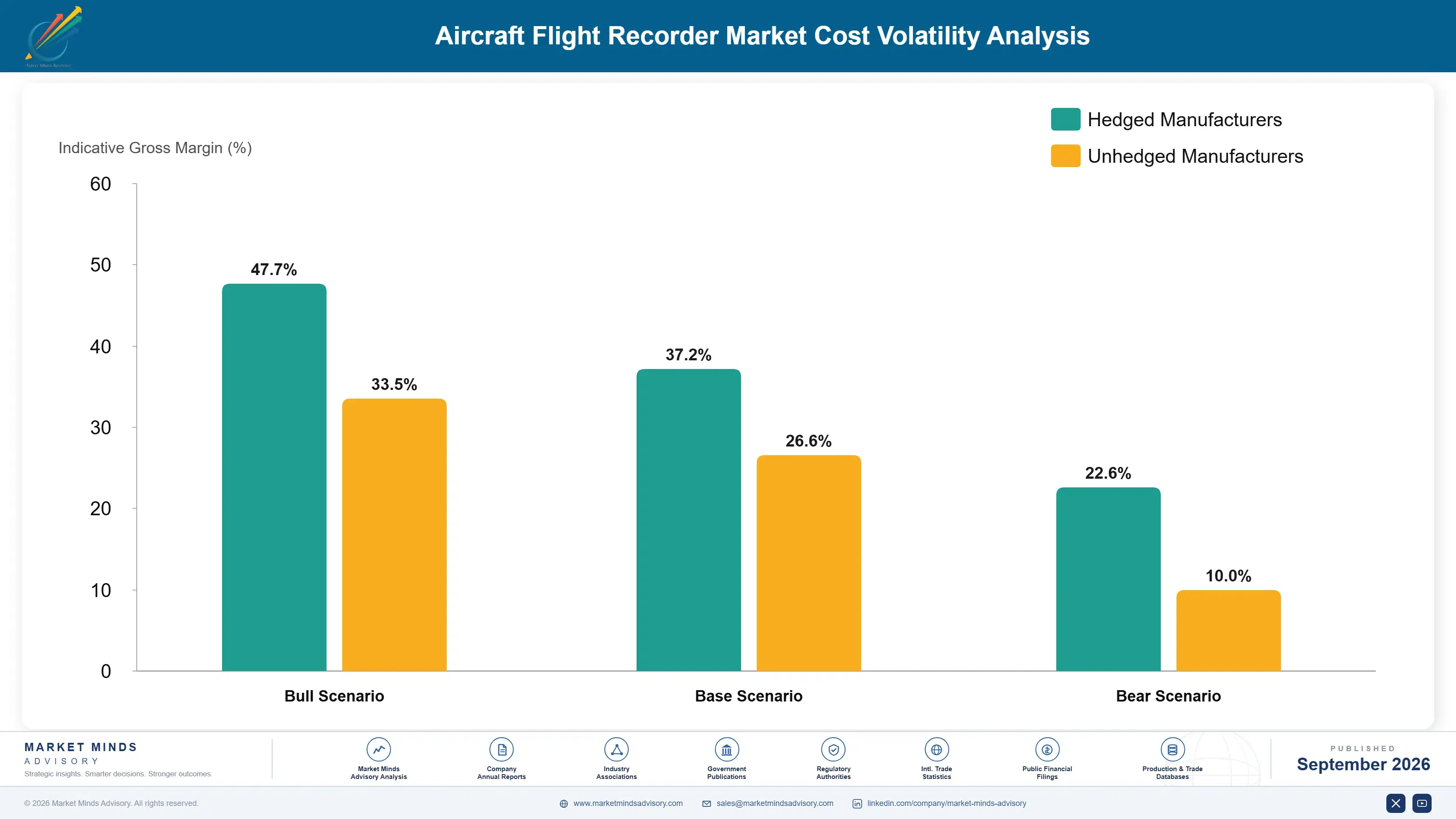
Flight recorder manufacturers operate across a widening tier structure as legacy fixed-mount hardware commoditizes and higher-margin streaming and certification services concentrate pricing power elsewhere in the stack. Volume-tier fixed-mount recorders now carry gross margins compressed by legacy replacement competition, while premium deployable and streaming-enabled systems retain meaningfully stronger pricing. Portfolio strategy increasingly determines profitability more than raw unit shipment volume.
The tension between chasing legacy replacement volume and defending premium streaming technology positioning defines strategic choice across the industry. Manufacturers competing purely on fixed-mount unit price find margin eroding faster than their cost base can adjust, while manufacturers segmenting customers by streaming and certification service uptake are protecting margin even as commodity pricing compresses. This divergence is reshaping how manufacturers allocate engineering and sales investment across their airline customer base.

High-value margin pools concentrate in streaming data subscriptions, certification consulting, and extended warranty programs sold as standalone offerings rather than bundled features. These pools grow faster than core hardware revenue because they scale with data and expertise a manufacturer already owns rather than requiring incremental unit shipments, making them the most defensible source of margin expansion available today. Manufacturers without such a plan risk the commodity tier over time.

Volume / Commodity-Adjacent

Fixed-mount combined recorders sold to price-sensitive smaller carriers and legacy fleet operators where certification compliance rather than differentiation drives purchase decisions. Carriers in this tier churn readily toward whichever manufacturer offers the lowest visible unit price available.
Gross Margin: 10 to 16%

Premium / Certified

Deployable recorders bundled with streaming subscriptions and dedicated account management for major carriers who value proven reliability and integration depth over marginal cost savings. These carriers typically sign multi-year contracts, reducing acquisition cost per dollar of recurring revenue generated.
Gross Margin: 24 to 34%

Sustainability / Regulatory / Next-Generation

Next-generation streaming-enabled systems, certification consulting, and predictive maintenance analytics built to meet emerging mandates ahead of competitors, commanding premium pricing while scarce. Manufacturers here often price on a subscription basis tied to service scope rather than pure unit count sold.
Gross Margin: 30 to 42%
aircraft-flight-recorder-market-portfolio-architecture-1788417016717

High-value Sub-segments and Strategic Watch-out

Streaming Data Subscription Services

High-value, high-growth pool as airlines pay premium pricing for continuous operational data beyond safety compliance, rewarding manufacturers who build reliable streaming infrastructure earliest with durable multi-year contracts locked in ahead of rivals. Manufacturers absent from this capability risk losing the largest airline contracts entirely to faster-moving specialists.

Certification Consulting for New Entrants

High-value, moderate-growth pool constrained by the limited number of engineers with genuine certification expertise, but delivering strong margin once a manufacturer has built a credible consulting practice and reputation. Expansion here depends heavily on how quickly a manufacturer can build a credible consulting reputation in a competitive field.

Legacy Fixed-Mount Recorder Replacement

Volume core segment carrying the bulk of the existing installed fleet but facing steady margin compression as deployable mandates and commoditized pricing erode differentiation across most legacy offerings. Consolidation among smaller legacy recorder makers is likely as scale becomes the primary way to defend thinning margin.

Military and Government Recorder Programs

Strategic watch-out segment where shifting defense budget priorities and modernization timelines could rapidly change the competitive map, rewarding manufacturers with flexible ruggedized production infrastructure already established. A sudden shift in defense procurement priorities in any single major program could reroute meaningful volume quickly. quite suddenly.

Recurring Revenue Across the Aircraft Lifecycle

Manufacturer revenue behaves like an annuity once an airline standardizes on a supplier's recorder platform across its fleet, since switching suppliers requires re-certifying with regulators and retraining maintenance staff, a cost most airlines avoid unless service quality deteriorates. This stickiness means manufacturers earn recurring maintenance and replacement revenue for years after the initial fleet order, with almost no incremental sales cost.
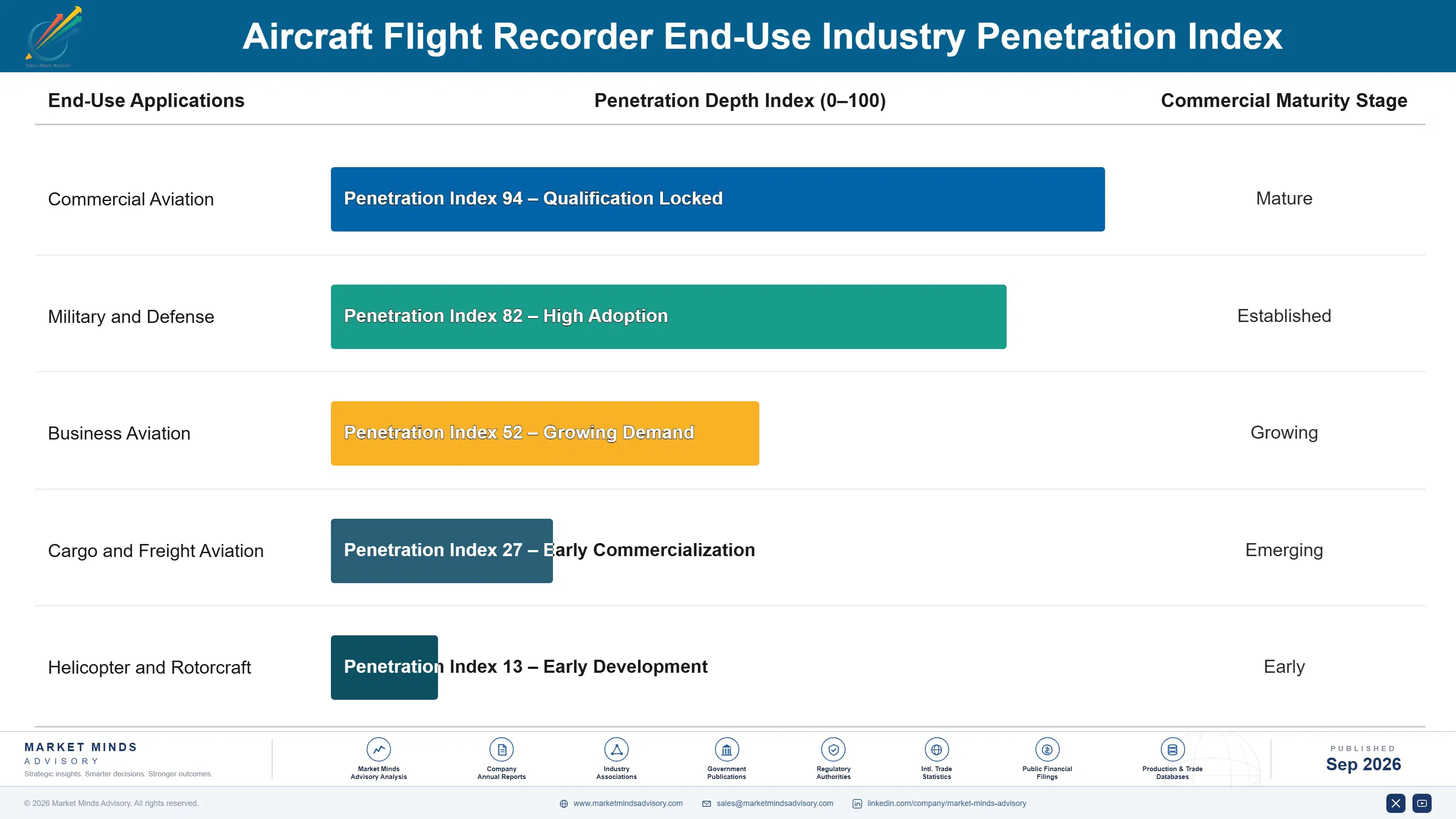
Adoption depth varies sharply by end-use vertical. Major international carriers adopt next-generation deployable and streaming recorders quickly since fleet modernization and regulatory compliance directly affect route certification, while smaller regional carriers integrate more slowly due to constrained capital budgets that can stretch replacement timelines past a decade. Military operators sit at a different pace entirely, since adoption depends on defense procurement cycles rather than commercial demand.

Buyer profiles are shifting generationally as newer airline fleet managers, trained on data-driven operations rather than pure compliance checklists, replace an older generation focused primarily on meeting minimum certification requirements. Younger fleet managers expect recorder systems to integrate directly with broader flight data analytics platforms from day one, treating a standalone recorder as an outdated concept. This turnover is accelerating adoption of connected, streaming-integrated recorder systems faster than pricing alone would predict.
aircraft-flight-recorder-market-end-use-penetration-index-1788417017222

Where MMA Sees the Real Bets

These are among the four positions where our research anticipates prominent divergence between winners and laggards over the coming forecast period. Each is grounded in the demand model, the regulatory perimeter, and the announced capacity pipeline.
01 / STREAMING CERTIFICATION PRIORITY

Certify satellite streaming capability before mandate deadlines concentrate

Manufacturers without certified streaming capability are already losing new aircraft program contracts to rivals who invested early and consistently. This gap widens every quarter a manufacturer delays certification, since original equipment manufacturers increasingly refuse to select suppliers who cannot demonstrate a complete, fully integrated deployable and streaming solution ready for immediate deployment. MMA firmly views streaming certification as the clearest predictor of which manufacturers win the largest program contracts over the next several years, more so than raw hardware reliability alone.
02 / RETROFIT SERVICE EXPANSION

Build dedicated retrofit installation capability for existing fleets

Airlines facing mandatory retrofit deadlines increasingly favor manufacturers who can manage the entire installation process end to end, rather than shipping hardware alone and leaving all integration work entirely to third-party contractors. Manufacturers clearly without this capability are steadily ceding retrofit contracts to rivals who can demonstrate faster turnaround and meaningfully less aircraft downtime during installation. MMA firmly expects the retrofit-service gap to widen further as more and more airlines gain real experience comparing vendor turnaround performance data across their fleets.
03 / SUBSCRIPTION REVENUE BUILD

Layer streaming data subscriptions onto existing hardware contracts

Recorder margins are compressing as legacy fixed-mount hardware commoditizes across nearly every fleet segment, making adjacent subscription revenue increasingly important to overall manufacturer profitability. Manufacturers with satellite streaming infrastructure already built can package operational data services that airlines are already, demonstrably willing to pay a meaningful premium for today, well before slower competitors have any chance to catch up at all. MMA advises treating this adjacent revenue as a standing product priority rather than an opportunistic afterthought bolted on once competitors already offer it.
04 / DEFENSE PROGRAM POSITIONING

Pursue military modernization contracts ahead of broader competition

Defense agencies are prioritizing survivable data recovery technology following recent high-visibility search operations, creating a durable new demand channel entirely distinct from commercial fleet compliance cycles and mandates. Manufacturers with both proven ruggedized engineering credentials and streaming capability are best positioned to win this business ahead of competitors lacking either credential entirely on their own. MMA firmly regards early defense positioning as a meaningfully lower risk than waiting for the entire procurement cycle to fully mature and competition to intensify.

Engagement Snapshot From the Field

A live engagement with an industry participant carrying material or product regulatory and market exposure ahead of a defining policy shift, showing how our research translates into a defensible multi-year portfolio strategy.
MARKET MINDS ADVISORY · CLIENT ENGAGEMENT SUMMARY
Aircraft Flight Recorder Producer Strategic Portfolio Review and Transition Roadmap 2026·Investment Scenario on Aircraft Flight Recorder Exposure Evaluation 2025-26
CLIENT PROFILE
The client is a mid-sized regional airline operating a fleet of 45 narrow-body aircraft across domestic and short-haul international routes, facing an approaching regulatory deadline requiring deployable recorder retrofit across its entire fleet. Its existing fixed-mount recorders met prior certification standards but did not include the streaming or deployable ejection capability the new mandate requires.
STRATEGIC CHALLENGE
The airline faced a compressed retrofit timeline and limited maintenance hangar capacity spread across its fleet, risking a waiver request that could jeopardize certain route certifications if compliance deadlines were missed entirely. Leadership needed a phased retrofit and financing strategy that could complete the transition within budget without grounding aircraft for extended periods.
MMA APPROACH
MMA conducted a fleet-by-fleet maintenance scheduling assessment alongside interviews with the airline's engineering and operations leadership, then benchmarked three recorder vendors against total cost of ownership including leasing options rather than upfront purchase. The engagement produced a phased retrofit plan prioritizing aircraft due for scheduled heavy maintenance first, minimizing additional downtime.
KEY FINDINGS
  1. Aligning retrofit work with scheduled heavy maintenance checks could eliminate over 80 percent of dedicated downtime otherwise required for the fleet. overall.
  2. An equipment leasing structure reduced upfront capital requirement by roughly 55 percent compared to outright purchase across the entire fleet. combined overall total.
  3. Two of three vendors evaluated offered installation teams that could work directly within the airline's existing maintenance hangar schedule fully. smoothly and efficiently.
  4. Regulatory waiver provisions allowed a modest timeline extension for aircraft already scheduled for retirement within the next eighteen months. total fleet timeline.
CLIENT PROFILE
The client is a mid-sized regional airline operating a fleet of 45 narrow-body aircraft across domestic and short-haul international routes, facing an approaching regulatory deadline requiring deployable recorder retrofit across its entire fleet. Its existing fixed-mount recorders met prior certification standards but did not include the streaming or deployable ejection capability the new mandate requires.
STRATEGIC CHALLENGE
The airline faced a compressed retrofit timeline and limited maintenance hangar capacity spread across its fleet, risking a waiver request that could jeopardize certain route certifications if compliance deadlines were missed entirely. Leadership needed a phased retrofit and financing strategy that could complete the transition within budget without grounding aircraft for extended periods.
MMA APPROACH
MMA conducted a fleet-by-fleet maintenance scheduling assessment alongside interviews with the airline's engineering and operations leadership, then benchmarked three recorder vendors against total cost of ownership including leasing options rather than upfront purchase. The engagement produced a phased retrofit plan prioritizing aircraft due for scheduled heavy maintenance first, minimizing additional downtime.
KEY FINDINGS
  1. Aligning retrofit work with scheduled heavy maintenance checks could eliminate over 80 percent of dedicated downtime otherwise required for the fleet. overall.
  2. An equipment leasing structure reduced upfront capital requirement by roughly 55 percent compared to outright purchase across the entire fleet. combined overall total.
  3. Two of three vendors evaluated offered installation teams that could work directly within the airline's existing maintenance hangar schedule fully. smoothly and efficiently.
  4. Regulatory waiver provisions allowed a modest timeline extension for aircraft already scheduled for retirement within the next eighteen months. total fleet timeline.
RECOMMENDED STRATEGY
Phase 1: Phase 1 (Months 1-6): retrofit aircraft due for scheduled heavy maintenance checks during this initial six-month window. promptly and efficiently. Phase 2: Phase 2 (Months 7-12): retrofit remaining active fleet aircraft during their next scheduled maintenance interval fully. completely and on schedule. Phase 3: Phase 3 (Months 13-15): complete documentation and file for waiver extension on aircraft nearing scheduled retirement soon. formally and completely.
OUTCOME
The airline completed retrofit across 90 percent of its fleet within fourteen months, ahead of the fifteen-month target (client-reported, unverified by MMA). The maintenance-aligned scheduling approach avoided an estimated multi-million dollar dedicated downtime cost (client-reported, unverified by MMA). The airline has since referenced this retrofit approach in discussions with regulators about future fleet upgrade timelines (client-reported, unverified by MMA).

Frequently Asked Questions

Foundational context covering the market sizes, CAGR, scope, country, region and competition that inform every finding below. This section is provided to cover basics and most often pre-purchase conversations, answered from the MMA Primary Research Dataset.

What is the current size of the Aircraft Flight Recorder Market?

The Aircraft Flight Recorder Market reached 1.6 billion dollars in 2025, the report's base year for all forecast calculations. This figure covers cockpit voice recorders, flight data recorders, and combined units globally.

How large will the Aircraft Flight Recorder Market be by 2036?

The market is projected to reach 3.19 billion dollars by 2036, roughly 1.88 times its 2026 starting value. That growth reflects deployable recorder mandates and expanding satellite streaming adoption.

What is the CAGR for the Aircraft Flight Recorder Market 2026 to 2036?

The market is forecast to grow at a 6.5 percent compound annual rate between 2026 and 2036. Bull and bear scenarios range from 7.8 percent to 5.2 percent respectively.

Which segment is growing fastest?

Deployable and streaming-enabled recorders lead growth at 10.5 percent CAGR, roughly 1.62 times the overall market rate. Regulatory mandates following search-and-recovery failures are driving this expansion.

Who are the major companies in the Aircraft Flight Recorder Market?

Honeywell, Curtiss-Wright, Safran, L3Harris, and Leonardo lead the market on a unit revenue basis. Together these five manufacturers hold roughly 68 percent combined market share.

Which country is growing fastest?

India leads country-level growth at 11.0 percent CAGR, driven by rapid passenger growth and substantial new aircraft order backlogs among domestic carriers. Fleet expansion is directly driving recorder demand.

Report Segmentation Architecture

The full report scope spans multiple orthogonal segmentation dimensions, with cross-tabulated demand data provided for each dimension pair. Coverage extends further to regional breakdowns, trend trajectories, and the competitive detail needed to support segment-level decision-making.

By Primary Market Dimension

  • Deployable and Streaming-Enabled Recorders
  • Fixed-Mount Combined Recorders
  • Cockpit Voice Recorders
  • Flight Data Recorders
  • Underwater Locator Beacons

By End-Use Industry

  • Commercial Aviation
  • Military and Defense
  • Business Aviation
  • Cargo and Freight Aviation
  • Helicopter and Rotorcraft

By Commercial Dimension

  • Major International Carriers
  • Regional and Low-Cost Carriers
  • Military and Government Operators
  • Aircraft Original Equipment Manufacturers

By Region

  • North America
  • Western Europe
  • East Asia
  • South Asia and Pacific
  • Latin America
  • Middle East and Africa
  • Eastern Europe

Scope, Methodology, and Coverage

Every figure in this report is reproducible from documented input assumptions. The scope below maps the historical period, the forecast horizon, the segmentation dimensions, and the countries covered, alongside the underlying primary and qualitative methodology.
Historical Period
2020 to 2025
Forecast Period
2026 to 2036
Base Year
2025 (USD billions; MMA Primary Research Dataset, September 2026)
Market Definition
This report covers cockpit voice recorders, flight data recorders, and combined units used to capture and preserve flight data for accident investigation, measured on a global unit and revenue basis across commercial, military, and business aviation. It excludes quick-access recorders used purely for airline operational monitoring and ground-based flight data analysis software.
Quantitative Units
USD billions, global market size and forecast
Segmentation Dimensions
Product/technology type, end-use industry, commercial/customer dimension, region
Regions Covered
North America, Western Europe, East Asia, South Asia and Pacific, Latin America, Middle East and Africa, Eastern Europe
Countries Covered
United States, China, Germany, France, United Kingdom, Japan, South Korea, India, Canada, Brazil, Mexico, Indonesia, Vietnam, Thailand, Malaysia, United Arab Emirates, Saudi Arabia, South Africa, Nigeria, Turkey, Poland, Netherlands, Italy, Spain, Sweden, Switzerland, Argentina, Colombia, Australia, Singapore, and additional markets relevant to this sector
Key Companies Profiled
Honeywell, Curtiss-Wright, Safran, L3Harris, Leonardo, GE Aerospace, Universal Avionics, Teledyne Controls, Meggitt, Collins Aerospace, Thales Group, Cobham Aerospace Communications, Ultra Electronics, Latitude Technologies, Diehl Aerospace, Saab, DRS Technologies, Indra Sistemas, Avtech Corporation, Elbit Systems
Quantitative Methodology
Primary survey, n=3,800 respondents, Q4 2025, six countries; demand-side model with trade association cross-validation
Qualitative Methodology
47 expert interviews, Q4 2025; applied to validate demand model assumptions, identify emerging dynamics, and assess competitive positioning
Report Format
PDF and XLSX data workbook (Word format preview document)
Publisher
Market Minds Advisory
Report Code
MMA-2026-AUT-630
Published
September 2026
Contact
sales@marketmindsadvisory.com | www.marketmindsadvisory.com

Purchase the full Aircraft Flight Recorder Market Report (2026 to 2036).

This report delivers a comprehensive analysis of the global Aircraft Flight Recorder Market, covering market sizing, segmentation, and regional dynamics through 2036. It profiles the competitive landscape across twenty leading manufacturers, benchmarked on a consistent unit revenue basis. Regional analysis spans all seven major world regions, quantifying share and growth rate differences driven by regulatory, fleet, and technology adoption factors. The report also examines revenue diversification strategies, input cost exposure, and portfolio economics shaping manufacturer profitability. A dedicated case study illustrates practical implementation lessons for airlines pursuing retrofit compliance.
Ten-year market size and CAGR forecast through 2036
Five-segment MECE market breakdown with growth rates
Seven-region share and growth rate analysis
Twenty-company competitive benchmarking on unit revenue basis
Revenue diversification strategy analysis across four commercial levers
Anonymized client implementation case study with outcomes

Built For The People Who Decide

From boardroom strategy to bench-side execution, this report is read cover-to-cover by leaders shaping the next decade of their industry, turning demand scenarios, market dynamics and valuation benchmarks into decisions.
CXOs/ Presidents/ VPs/ Managers
M&A and Corporate Development
Strategy Teams and R&D Heads
Procurement and Product Directors
Regulatory and Compliance Leaders
Investor Relations and Equity Analysts