Market Minds Advisory
Aircraft Flight Control System Market

Aircraft Flight Control System Market: More-Electric Aircraft and the Actuation Transition

Airframers moving toward more-electric aircraft architectures are pulling flight control demand away from hydro-mechanical actuation and toward electro-mechanical systems, forcing legacy hydraulic suppliers to requalify entire product lines or cede share to power electronics specialists.

Lead Analyst

David Horsley

Published

September 2026

Make Smarter Decisions with Customized Research Insights

Request a free sample report and evaluate market opportunities, growth trends, and competitive dynamics relevant to your business needs.

2025 MARKET VALUE$13.5BMarket Size 2025
2036 FORECAST VALUE$33.1BBase Case , 2026 to 2036
CAGR 2026 TO 20368.5 %Bull 9.8% / Bear 7.2%
INCREMENTAL OPPORTUNITY$18.5BNet 10- year value creation
EXPANSION MULTIPLE2.26x2036 value over 2026 base
Strategic Levers
M&A Pipeline
Regional Outlook
Country Rankings
Competitive Intelligence
Segmental Deep-dive
Call-Us : 91 93563 13602

Executive Snapshot and Market Trajectory

Flight control system demand is shifting decisively from hydraulic and hydro-mechanical actuation toward electro-mechanical and electro-hydrostatic systems as major airframers increasingly pursue more-electric aircraft architectures that cut weight, simplify maintenance, and reduce the parasitic power draw hydraulic pumps impose on modern high-bypass jet engines.
Electro-mechanical actuation systems are growing fastest, at roughly twelve percent annually, as new aircraft programs from Airbus and Boeing standardize on electric backup and secondary flight control actuators ahead of eventual primary control adoption. Western Europe holds the largest single regional share on the strength of Airbus final assembly and the concentration of Safran, Liebherr-Aerospace, and Thales in its supply base, while China's domestic aircraft program drives the fastest single-country growth rate overall.
Competitive intensity concentrates around qualification depth and program-specific design wins rather than component pricing alone, since flight control systems require years of certification testing before a supplier is even eligible to bid on a new aircraft platform. Incumbents defend entrenched positions on legacy programs through decades of flight-hour data, while new entrants compete almost exclusively for design-in positions on next-generation and clean-sheet aircraft programs still under active development.
Market Definition
The aircraft flight control system market covers primary and secondary flight control actuation, flight control computers, and associated sensors and software used to control aircraft attitude and trajectory across commercial, business, and military fixed-wing aircraft. It excludes autopilot software sold independently of actuation hardware and excludes rotorcraft-specific control systems.
Base Year Value
$13.5B in 2025 (MMA Primary Research Dataset, August 2026)
Forecast Period
2026 to 2036, eleven discrete annual values
CAGR
8.5% base case. Bull 9.8%. Bear 7.2%.
Fastest Growth Segment
Electro-Mechanical Actuation Systems: 12.0% CAGR
Fastest Growth Country
China: 11.5% CAGR
Fastest Growth Region
South Asia and Pacific: 10.7% CAGR
Largest Region
Western Europe: 26% of 2025 global value
Market Leaders
Honeywell Aerospace, Collins Aerospace, Safran S.A., Liebherr-Aerospace, Moog Inc. Source: MMA Analysis based on company annual reports and investor filings.
Primary Survey
n=3,800 procurement and R&D decision-makers, Q4 2025, six countries
Methodology
Demand-side build-up, cross-validated against public data, 47 expert interviews

Aircraft Flight Control System Market Forecast Scenarios

aircraft-flight-control-system-market-size-forecast-scenario-1787332993582
Flight control system demand collapsed in 2020 as commercial aircraft production halted amid the pandemic-driven travel downturn, then recovered unevenly through 2022 as narrowbody production rates began climbing again. Defense program demand remained comparatively stable throughout, providing a partial offset to the commercial downturn. The market grew at a historical rate of roughly 7.5% annually across the 2020 to 2025 period, gaining momentum as commercial production rates rose.
The base case assumes growth driven by three mechanisms: narrowbody production rate increases at Airbus and Boeing that require proportional flight control system deliveries across an expanding supplier backlog; more-electric aircraft architectures displacing hydraulic actuation with electro-mechanical alternatives carrying higher unit value; and China's domestic aircraft program building an entirely new qualified supplier base for its own requirements. Military modernization programs across multiple nations add a steady secondary demand layer independent of commercial cycles.
The bull case rests on faster narrowbody production rate increases pulling forward flight control deliveries across the full supplier backlog. The bear case centers on a renewed commercial aviation downturn, mirroring the pandemic disruption, that would defer new aircraft deliveries and stretch replacement cycles on existing flight control systems beyond typical fifteen to twenty year airframe service intervals.

Actuation Technology Becomes the Central Competitive Axis

Flight control systems sit among the most qualification-intensive components in the entire aircraft supply chain, and that barrier defines nearly every commercial dynamic in the category today. A supplier's realistic addressable market is not the full fleet in service but the specific aircraft programs it has already won design-in positions on, since switching suppliers mid-program is both prohibitively expensive and operationally disruptive for airframers.
MARKET CONCENTRATION62% (CR5)Highly concentrated supplier base reflects steep qualification barriers
AVERAGE SELLING PRICE$0.4M-$8.5MPrice spans single actuators to full ship-set control systems
TOP PRODUCING COUNTRYUSA, 28% shareLargest single manufacturing base for flight control components
CAPACITY UTILIZATION81%Manufacturing lines run near sustained maximum production capacity
REPLACEMENT CYCLE LENGTH15-20 yearsTypical airframe service life before major system overhaul
INPUT COST SHARE44% of COGSTitanium, power electronics, and precision castings dominate cost
Demand concentrates where new aircraft programs and more-electric architecture adoption intersect most directly across the industry. Narrowbody production increases at Airbus and Boeing generate the largest absolute volume, while China's domestic aircraft program is building an entirely parallel qualified supplier base that barely existed a decade ago in its current form. Military modernization programs add a steadier, less cyclical demand layer across multiple nations simultaneously worldwide.
Over the next decade, electro-mechanical and electro-hydrostatic actuation increasingly determine competitive position more than legacy hydraulic system pricing alone across nearly every program. Suppliers with proven power electronics and motor control expertise, not just traditional hydraulic engineering, will capture design-in positions on next-generation programs where established hydraulic incumbents lack comparable in-house electric actuation capability built up over a comparable number of years and investment cycles.
"Winning a flight control program isn't a sales cycle, it's a decade-long courtship that starts before the aircraft even has a name. Miss the design-in window and you're locked out until the next clean-sheet program, which might be fifteen years away."
Director, Aerospace and Defense Systems Practice · MMA Aerospace Avionics and Fl

Market Trends

More-Electric Aircraft Architectures Steadily Displace Hydraulics

Airframers are progressively reducing reliance on centralized hydraulic systems in favor of electro-mechanical and electro-hydrostatic actuation that eliminates the weight and complexity of hydraulic lines running throughout the airframe while cutting the parasitic power draw hydraulic pumps impose on modern jet engines. This shift began with secondary flight controls and backup actuation and is progressively extending toward primary flight control surfaces on newer programs still in development. Suppliers with proven power electronics expertise are capturing disproportionate share of new design-in positions, while traditional hydraulic manufacturers face a genuine requalification challenge some are addressing through acquisition rather than organic development.
Market Impact: Adds ship-set demand worth $2.4B an
China's Domestic Aircraft Program Builds Parallel Supply Chain

China's COMAC C919 program and planned successor aircraft are driving development of an entirely domestic flight control supplier base, reducing historical reliance on Western suppliers for a segment carrying significant strategic weight beyond pure commercial considerations. Chinese domestic suppliers are rapidly building qualification track records on the C919 program, gaining flight-hour data that positions them to compete more credibly for future domestic and eventually export aircraft programs. Western suppliers retaining current program positions face genuine long-term displacement risk as Chinese domestic capability matures, even though near-term demand remains a meaningful revenue contributor today.
Market Impact: Sustains defense demand worth $3.1B

Market Opportunities and Growth Drivers

Narrowbody Production Rate Increases at Airbus and Boeing

Airbus and Boeing are both targeting substantial narrowbody production rate increases over the coming several years to work through record order backlogs accumulated during the post-pandemic recovery, requiring proportional increases in flight control system deliveries across their qualified supplier base. Each incremental aircraft produced represents a full ship-set of flight control actuators, computers, and sensors, making production rate the single largest driver of near-term component volume regardless of longer-term technology transition dynamics. Suppliers with proven capacity to scale production without compromising exacting quality standards are capturing disproportionate share of this rate-driven demand relative to capacity-constrained competitors.
Market Impact: Delays adoption 5 to 8 years

Military Modernization Programs Sustain Defense Demand

Multiple nations are funding fighter aircraft modernization and next-generation platform development programs that require advanced flight control systems capable of supporting higher-performance maneuvering envelopes than legacy military aircraft demanded previously. These programs typically carry multi-decade production and sustainment tails once a system wins qualification, providing suppliers with unusually durable revenue visibility compared with commercial aircraft programs subject to airline order cyclicality. Suppliers with established defense program relationships and security clearances required for military work are capturing disproportionate share of this demand, since defense procurement processes generally favor incumbent suppliers with proven program performance over new entrants lacking comparable track records.
Market Impact: Limits bids to 2-3 new programs

Market Restraints and Challenges

Certification Timelines Delay New Technology Adoption

Flight control system certification under FAA and EASA airworthiness requirements typically takes five to eight years from initial design freeze to entry into service, a timeline that meaningfully slows how quickly proven electric actuation technology can reach production aircraft despite technical readiness. The root cause is that flight control systems are flight-critical, meaning any failure mode carries catastrophic safety consequences that regulators require extensive redundancy testing to rule out before certification. This constrains how fast suppliers capture technology-driven share gains even when systems are ready. Suppliers are mitigating this through early, continuous regulator engagement rather than waiting until formal submission.
Market Impact: Lifts electric actuation share towa

Design-In Lock-In Limits Addressable Market Per Cycle

Once an airframer selects a flight control system supplier for a given aircraft program, switching suppliers mid-program is prohibitively expensive and operationally disruptive, effectively locking in that relationship for the multi-decade production life of the platform regardless of subsequent competitive developments. The root cause is that flight control systems are deeply integrated into aircraft structural and electrical architecture in ways that make substitution far more complex than typical component replacement. This means addressable market is limited to genuinely new programs rather than the full global fleet. Suppliers are responding by pursuing broader platform diversification to reduce single-program dependence.
Market Impact: Builds parallel supply chain worth
3 additional market trends, 4 additional growth drivers, and 2 additional restraints and challenges are covered in the full report. Contact sales@marketmindsadvisory.com to access the complete intelligence.

Segment CAGR and Growth Architecture

MMA segments the aircraft flight control system market by actuation technology, the classification that most directly determines qualification pathway, weight and power characteristics, and which suppliers can realistically compete for a given program's design-in position across commercial, business, and military platforms currently in development, rather than an end-use or ownership-model split alone across the industry.
aircraft-flight-control-system-market-market-share-analysis-1787332994126

Electro-Mechanical Actuation Systems

Electro-mechanical actuation systems are growing fastest, at roughly 12.0% annually, as airframers pursue more-electric aircraft architectures that eliminate hydraulic lines and reduce the parasitic power draw hydraulic pumps impose on modern jet engines. Adoption concentrates initially on secondary flight controls and backup actuation, where certification risk is lower than primary flight control surfaces, before progressively extending toward primary control applications on newer clean-sheet programs. Suppliers with proven power electronics expertise are capturing disproportionate share of new design-in positions relative to traditional hydraulic manufacturers still building comparable in-house electric capability. Unit prices run higher than equivalent hydraulic actuators given the additional power electronics content, though weight and maintenance savings increasingly justify the premium.
CAGR 12.0%

Electro-Hydrostatic Actuators

Electro-hydrostatic actuators are growing at roughly 10.5% annually, offering a transitional technology that retains hydraulic actuation at the point of use while eliminating the centralized hydraulic distribution system that adds weight and maintenance complexity throughout the airframe. Demand concentrates among airframers seeking meaningful weight savings without the full technical and certification risk of pure electro-mechanical primary flight control adoption on a clean-sheet program. This segment serves as an important bridge technology for suppliers building toward full electro-mechanical capability, since electro-hydrostatic systems share meaningful engineering overlap with both legacy hydraulic expertise and emerging power electronics requirements. Suppliers here are well positioned to migrate customers toward fully electric systems as certification confidence builds.
CAGR 10.5%
Full segment breakdown across 6 segments available in the complete report.

Regional Architecture and Country Demand Map

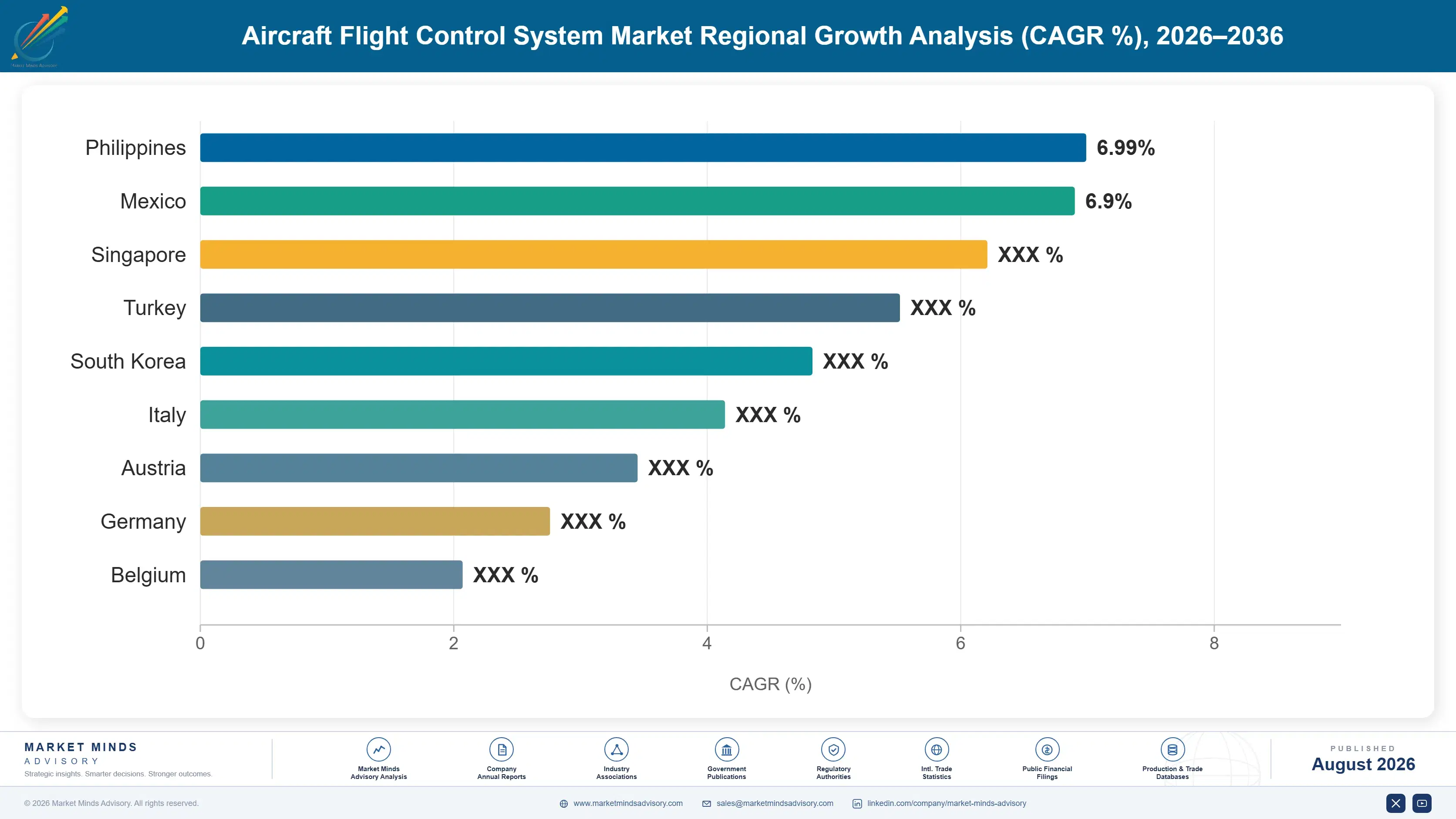
Western Europe holds the largest regional share on the strength of Airbus final assembly and its concentrated aerospace supply base, while South Asia and Pacific grows fastest as regional aircraft demand expands. China's domestic aircraft program drives the fastest single-country growth as it builds a parallel qualified supplier base.

North America

North America generates substantial flight control system demand anchored by Boeing's narrowbody and widebody production programs and a deep bench of established suppliers including Honeywell, Collins Aerospace, and Moog concentrated across the United States. Military modernization programs, including next-generation fighter development and existing platform upgrades, add a steady, less cyclical demand layer distinct from commercial aircraft production cycles. Canada's aerospace sector contributes specialized component manufacturing tied to both Bombardier business jet programs and supply relationships with US primes. Mexico's growing aerospace manufacturing cluster, supported by proximity to US final assembly and favorable trade terms, is increasingly capturing precision component and subassembly work rather than full system integration currently concentrated in the United States.
Share: 25% | CAGR: 9.5% (2026 to 2036)

Western Europe

Western Europe holds the largest regional share, anchored by Airbus final assembly lines in Toulouse and Hamburg and the dense concentration of Tier 1 flight control suppliers including Safran, Liebherr-Aerospace, and Thales headquartered across France, Germany, and the wider region. The region grows the slowest of the seven as narrowbody production rate increases, while substantial in absolute terms, represent a smaller percentage expansion against an already large and mature installed supplier base compared with faster-growing emerging aerospace markets elsewhere. German and French suppliers maintain deep, multi-decade relationships with Airbus that create durable revenue visibility extending across the full production life of current and next-generation aircraft programs already in development or planning.
Share: 26% | CAGR: 7.5% (2026 to 2036)
Regional intelligence for 5 additional markets available in the complete report: East Asia, South Asia and Pacific, Latin America, Middle East and Africa, Eastern Europe. Contact sales@marketmindsadvisory.com.
aircraft-flight-control-system-market-country-cagr-analysis-1787332994644

Capturing Value Beyond the Initial Program Win

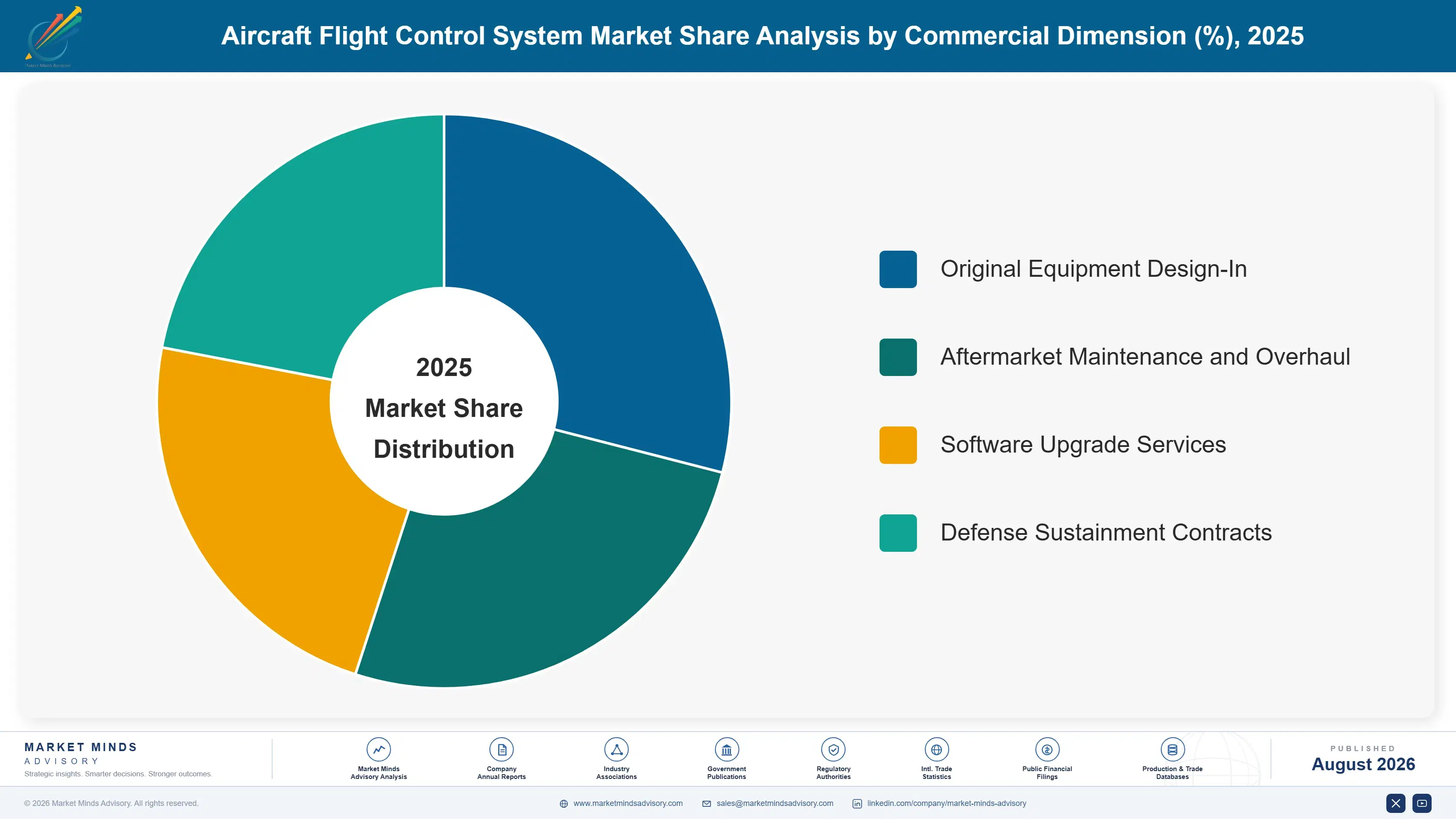
Flight control system pricing on new program wins faces intense competition given the multi-decade revenue stakes involved for every supplier bidding. Suppliers that build recurring revenue through aftermarket support, software upgrades, and adjacent platform expansion capture considerably better lifetime program value than those competing purely on initial design-in pricing alone across their program portfolios.

Expanding Aftermarket Maintenance and Overhaul Services

Suppliers building dedicated aftermarket maintenance, repair, and overhaul capability for their installed flight control systems capture recurring service revenue worth an estimated $4.2 billion industry-wide that typically exceeds the original equipment sale value across a system's fifteen to twenty year service life, given the safety-critical inspection and overhaul requirements these systems demand throughout an airframe's operational lifespan. Airlines and operators increasingly prefer original equipment manufacturers for this work given their unmatched access to detailed design data and failure mode history, creating a durable aftermarket advantage independent providers struggle to replicate for flight-critical systems requiring this depth of engineering knowledge.
Market Impact: Captures aftermarket service revenu

Building Software Upgrade and Retrofit Pathways

Manufacturers offering software-driven performance upgrades to existing flight control computers, rather than requiring full hardware replacement, create a recurring revenue pathway worth an estimated 8 to 12% of original system value that extends a program's commercial relationship well beyond the initial hardware sale, particularly as airlines seek incremental fuel efficiency and performance gains from existing fleets rather than committing to new aircraft purchases. This approach requires substantial software engineering investment but delivers considerably higher margin than comparable hardware sales, since software upgrades avoid the material and manufacturing cost embedded in physical actuator production.
Market Impact: Adds 8 to 12% in software upgrade r

Pursuing Adjacent Business Jet and Regional Platforms

Suppliers with established commercial narrowbody or widebody program positions increasingly pursue design wins on business jet and regional aircraft platforms, using existing certified technology and qualification data to reduce the incremental engineering investment required relative to a fully clean-sheet development effort worth an estimated $650 million in addressable annual demand across this adjacent segment currently underserved by dedicated specialist suppliers. This diversification strategy reduces dependence on any single aircraft program's production timing while building broader platform relationships that support future cross-selling of aftermarket and software upgrade services across a genuinely more diversified program portfolio over time.
Market Impact: Targets a fast-growing $650M adjace

Deepening Defense Program Long-Term Sustainment Contracts

Suppliers with existing defense program positions are pursuing long-term sustainment and performance-based logistics contracts worth an estimated $2.9 billion that guarantee multi-decade revenue visibility independent of new aircraft production cycles, converting what was once a one-time equipment sale into an ongoing government contractual relationship. These sustainment contracts typically carry favorable margin structures given the specialized nature of flight-critical military system maintenance and the genuine scarcity of qualified alternative suppliers capable of servicing these systems, a scarcity giving incumbent defense suppliers durable negotiating leverage in contract renewal cycles that persists for years.
Market Impact: Secures multi-decade sustainment re

Who Controls the Margin Pool

The aircraft flight control system market is highly concentrated, with a CR5 of roughly 62%, reflecting the steep qualification barriers and multi-decade program relationships that define this category far more than typical industrial component markets. Honeywell and Collins Aerospace lead a group of established Tier 1 suppliers with a substantial gap over smaller specialized competitors still building comparable program portfolios and flight-hour track records.
Competitive activity concentrates on three fronts: electro-mechanical actuation capability tied to more-electric aircraft architecture adoption, design-in positioning on next-generation clean-sheet aircraft programs still in development, and defense sustainment contract expansion that provides durable revenue independent of commercial production cycles. Established suppliers defend positions through decades of flight-hour data and certification track records that new entrants cannot quickly replicate.

Emerging pressure comes from Chinese domestic suppliers building genuine qualification credibility through the COMAC C919 program, a development that carries meaningful long-term displacement risk for Western suppliers currently holding program positions. Rankings could also shift if a traditionally hydraulic-focused supplier fails to build credible electro-mechanical actuation capability quickly enough, ceding design-in positions on next-generation programs to competitors with more advanced power electronics expertise already established.
aircraft-flight-control-system-market-company-positioning-matrix-1787332995174

Competitive Moat and Risk Dimensions

HONEYWELL AEROSPACE

Moat: Broad Multi-Platform Program Portfolio

Honeywell's flight control system positions span commercial, business jet, and military platforms simultaneously, providing revenue diversification across program cycles that reduces dependence on any single aircraft platform's production timing relative to more narrowly positioned competitors focused on fewer program relationships and platform types across the industry.
HONEYWELL AEROSPACE

Risk: Electric Actuation Capability Gap

Honeywell's historical strength in hydraulic and pneumatic systems creates a genuine requalification challenge as more-electric aircraft architectures gain share, requiring sustained investment in power electronics expertise that newer specialists have already built as their core competitive foundation from the very outset of their company founding.
COLLINS AEROSPACE

Moat: Deep Airbus and Boeing Relationships

Collins Aerospace's decades-long supplier relationships across both major commercial airframers give it design-in positions on the highest-volume narrowbody programs, generating substantial recurring ship-set revenue as production rates increase that smaller competitors without comparable dual-platform presence cannot access at similar scale or comparable consistency over time.
COLLINS AEROSPACE

Risk: Integration Complexity Across Legacy Units

Collins Aerospace's formation through multiple corporate combinations has created integration complexity across legacy product lines and engineering teams, potentially slowing decision-making and technology standardization relative to more organically structured competitors pursuing electric actuation development with considerably fewer internal coordination layers to manage day to day.

Players Tracked

Prominent Players

Honeywell Aerospace
Collins Aerospace
Safran S.A.
Liebherr-Aerospace
Moog Inc.

Other Key Players

Thales Group
Parker Aerospace
Woodward Inc
Curtiss-Wright Corporation
Eaton Aerospace
Triumph Group
GKN Aerospace
Leonardo S.p.A
Diehl Aerospace
Elbit Systems
Ultra Electronics Holdings
Meggitt PLC
Cobham Limited
BAE Systems
Aernnova Aerospace

Recent Developments

FEBRUARY 2025

Safran Wins Electro-Mechanical Actuation Position on New Program

Safran secured a design-in position supplying electro-mechanical secondary flight control actuators for a new narrowbody aircraft program currently in development, extending its electric actuation portfolio beyond its existing hydraulic and electro-hydrostatic system positions on current in-production aircraft platforms already in commercial passenger service across multiple airlines today.
Signal: Signals electro-mechanical actuation is wi
JUNE 2025

Moog Expands Power Electronics Manufacturing Capacity

Moog Inc. announced a significant expansion of its power electronics and motor control manufacturing capacity, aimed at meeting growing demand for electro-mechanical actuation systems across both commercial and military aircraft programs currently transitioning toward more-electric architectures across their entire platform roadmaps and future development plans.
Signal: Signals established suppliers are investin
SEPTEMBER 2025

Collins Aerospace Deepens China Supply Chain Partnership

Collins Aerospace announced an expanded technology partnership with a Chinese domestic supplier, aimed at maintaining program relevance as China builds its own qualified flight control supplier base for the COMAC C919 and planned successor aircraft programs currently under active development and ongoing flight testing phases.
Signal: Signals Western suppliers are choosing par

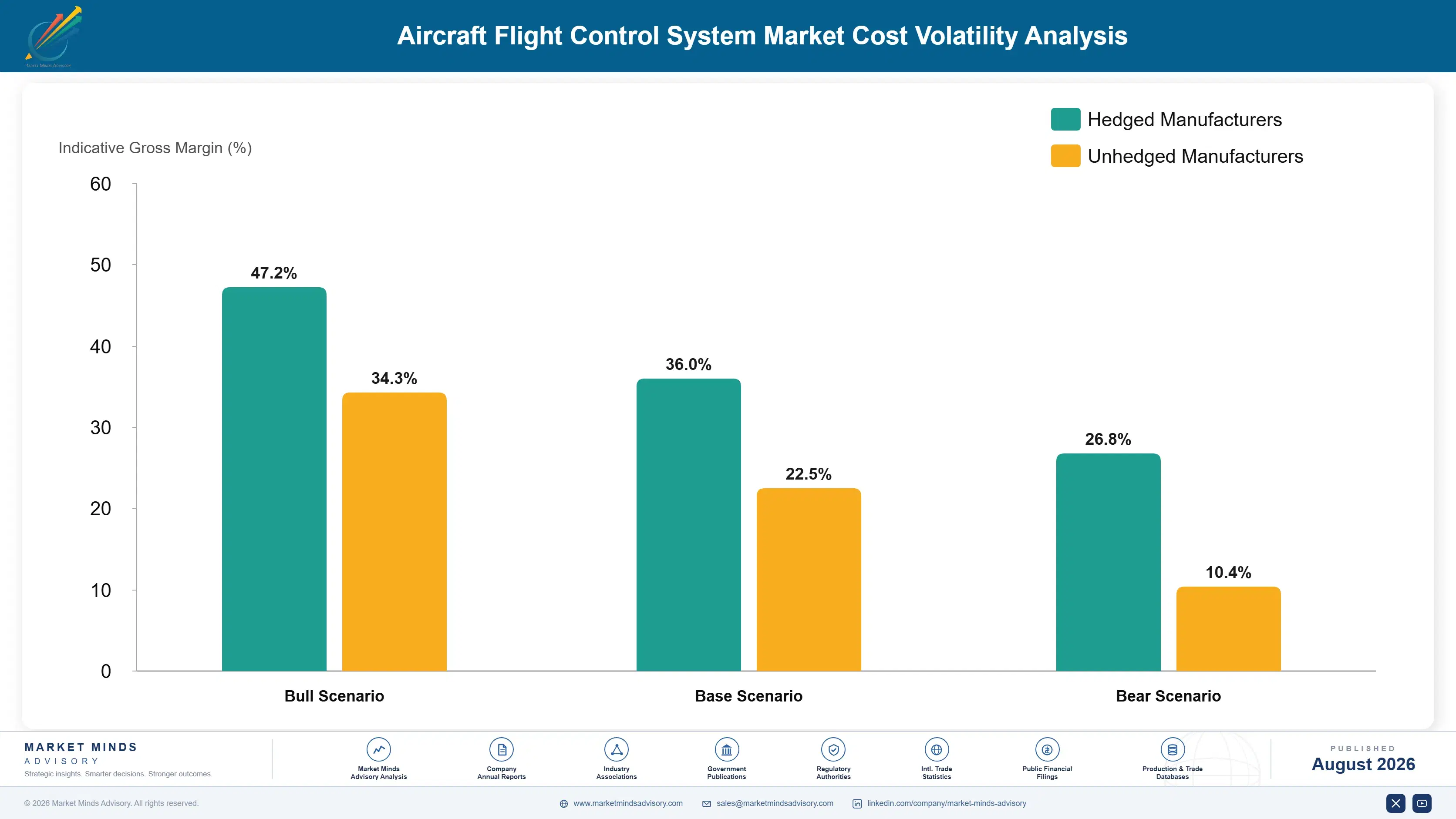
Titanium, Power Electronics, and Precision Castings

Titanium and specialized aerospace-grade metal alloys account for roughly 25 to 30% of manufacturing cost, sourced from a concentrated group of qualified aerospace metal suppliers given the extensive material certification flight-critical components require before use. Power electronics and precision casting components, requiring specialized manufacturing capability, contribute a further 15 to 20%, with production concentrated among a smaller group of qualified aerospace component manufacturers
Titanium prices rose sharply during 2022 amid supply constraints tied to reduced Russian titanium sponge exports following sanctions, pushing component costs up by more than 30% within several months for suppliers dependent on affected supply chains, according to material sourcing disclosures in Boeing's 2022 annual report. The disruption prompted several manufacturers to qualify alternative titanium suppliers and accelerate diversification away from Russian-linked material sources across their qualified supplier base.

Smaller specialized suppliers without long-term titanium and precision casting supply agreements face greater cost exposure than larger diversified players like Honeywell and Collins Aerospace, who negotiate volume-based contracts directly with qualified aerospace material producers. Suppliers dependent on Russian-linked titanium supply chains faced particularly acute exposure following 2022 sanctions, a vulnerability that suppliers with pre-established diversified sourcing did not share to the same degree.
aircraft-flight-control-system-market-cost-volatility-analysis-1787332995379

Diversifying Titanium Supply Away From Russian Sources

Manufacturers are actively qualifying alternative titanium sponge and mill product suppliers across the United States, Japan, and other allied nations to reduce dependence on Russian-linked supply chains, a multi-year qualification undertaking given the extensive material certification flight-critical aerospace components require before formal approval for use in flight-critical production applications across the broader aerospace industry as a whole.

Building Strategic Titanium Inventory Reserves

Several larger suppliers have expanded strategic inventory reserves of qualified titanium and precision casting materials to buffer against future supply disruption, absorbing additional working capital cost in exchange for more predictable production scheduling during periods of elevated material market volatility and geopolitical uncertainty affecting global titanium supply chains across multiple producing regions and geopolitical jurisdictions.

Qualifying Additional Precision Casting Suppliers

Manufacturers dependent on specialized precision casting components are qualifying secondary suppliers across multiple regions to reduce exposure to any single supplier's capacity constraints, an undertaking requiring extensive testing given the safety-critical tolerances these flight control components demand before any supplier receives formal production approval for genuinely flight-critical use cases in active aerospace production today.

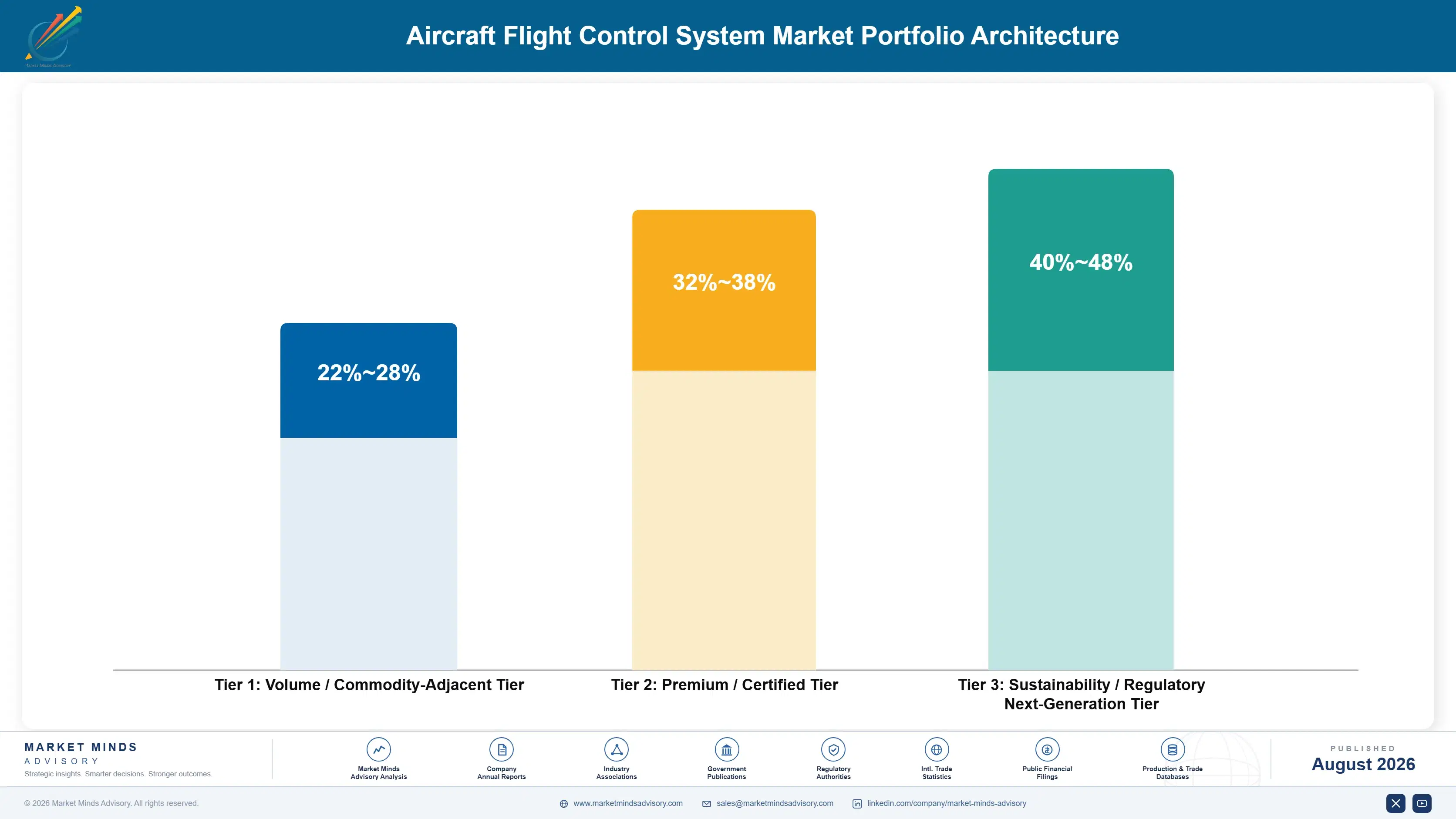
Portfolio Architecture for Margin Defence

The market splits into three tiers running from legacy hydraulic and hydro-mechanical systems to fully electric actuation bundled with software upgrade and sustainment services across long-term programs. Margin concentrates heavily at the top: electro-mechanical systems paired with software upgrade pathways earn gross margins 15 to 20 percentage points above legacy hydraulic equivalents, reflecting both engineering complexity and the recurring aftermarket revenue layered on top of the initial sy
Volume and premium tiers pull suppliers in different strategic directions simultaneously across the industry today. Chinese domestic suppliers are building capability across the full technology spectrum as they establish their qualified supplier base, while established Western suppliers defend premium electro-mechanical and sustainment-linked segments more aggressively through decades of accumulated flight-hour data and certification track records competitors cannot quickly replicate or match.

High-value margin pools concentrate among suppliers serving both commercial narrowbody programs at scale and long-duration defense sustainment contracts simultaneously, since these accounts generate recurring aftermarket and software revenue far exceeding the value of a single system sale, and remain the primary target of every major supplier's long-term program strategy and long-term capital allocation decisions today.

Volume / Commodity-Adjacent Tier

Legacy hydraulic and hydro-mechanical actuation systems sold primarily as replacement parts for in-service aircraft, competing on proven reliability and established qualification history rather than new technology differentiation across the broader supply base.
Gross Margin: 22-28%

Premium / Certified Tier

Electro-hydrostatic and mid-tier electro-mechanical systems sold with sustainment support into current-generation commercial and military programs, capturing better margin through proven qualification and demonstrated technical performance under real, sustained flight conditions.
Gross Margin: 32-38%

Sustainability / Regulatory / Next-Generation Tier

Fully electro-mechanical systems bundled with software upgrade pathways and long-term sustainment contracts, commanding the highest margin given intensive qualification barriers and durable multi-decade program relationships few competitors can easily match or replicate.
Gross Margin: 40-48%
aircraft-flight-control-system-market-portfolio-architecture-1787332995882

High-value Sub-segments and Strategic Watch-out

Electro-Mechanical Systems With Software Upgrade Pathways

Bundled hardware and software systems generating recurring revenue through performance upgrade subscriptions, growing fastest as more-electric aircraft architecture adoption makes electric actuation capability a baseline requirement for next-generation program design-in eligibility across multiple commercial and military platforms and airframers currently in active development or early flight testing.
Gross Margin: 42-48%

Defense Sustainment and Performance-Based Logistics Contracts

Long-term government sustainment contracts guaranteeing multi-decade revenue visibility independent of new aircraft production cycles, expanding steadily as defense modernization programs favor incumbent suppliers with established qualification track records and security clearances already firmly in place today across most allied nations and defense procurement authorities across each respective country.
Gross Margin: 36-42%

Standard Hydraulic and Electro-Hydrostatic Replacement Parts

The largest unit volume segment, serving the existing global in-service fleet requiring ongoing maintenance and replacement parts, forming the steady revenue backbone of most suppliers' current order books despite thin and stable commodity-tier margins across the broader industry and its full global supplier and maintenance base.
Gross Margin: 20-26%

Chinese Domestic Flight Control Supplier Development

China's rapidly maturing domestic supplier base for the COMAC C919 and successor programs, a segment strategic watchers should track closely as qualification credibility builds faster than some Western suppliers' displacement risk models currently anticipate or have adequately planned for across their own long-term strategic roadmaps and planning.
Gross Margin: 18-26%

From Sale to Program Relationship

Flight control system demand functions almost entirely as a multi-decade program relationship rather than a transactional equipment sale, since once a supplier wins a design-in position on an aircraft program, that relationship persists across the platform's entire production run and subsequent decades of in-service maintenance and sustainment, extending the commercial relationship far beyond the initial system sale itself across the platform's full operational lifespan.
Adoption depth varies sharply by platform type. Commercial narrowbody programs generate the largest absolute volume given production rates, while defense programs offer the deepest and most durable individual relationships given multi-decade sustainment contract structures that commercial programs typically do not carry to the same extent. Business jet and regional aircraft programs occupy a smaller but still meaningful middle tier, often serving as a proving ground for technology later adopted on larger commercial platforms.

A generational shift in buyer profile is underway as airframer engineering teams increasingly prioritize power electronics and software integration expertise alongside traditional mechanical and hydraulic engineering credentials, particularly for next-generation more-electric aircraft programs, a change reshaping which supplier capabilities actually win design-in positions across the industry's newest platform developments and upcoming program competitions.
aircraft-flight-control-system-market-end-use-penetration-index-1787332996376

Where Flight Control Suppliers Should Focus

These are among the four positions where our research anticipates prominent divergence between winners and laggards over the coming forecast period. Each is grounded in the demand model, the regulatory perimeter, and the announced capacity pipeline.
01 / ELECTRIC ACTUATION INVESTMENT

Build power electronics capability before the next clean-sheet program cycle

More-electric aircraft architectures are progressively displacing hydraulic actuation across secondary and eventually primary flight control applications on new aircraft programs currently in development. Suppliers still concentrated in legacy hydraulic technology risk losing design-in positions on the next generation of clean-sheet programs to competitors with proven power electronics and motor control expertise already established. Moving now, well ahead of the next major program cycle, allows suppliers to build the flight-hour qualification data needed before competition for these design-in positions intensifies meaningfully across the industry.
02 / CHINA PARTNERSHIP STRATEGY

Pursue technology partnership rather than pure competition with Chinese suppliers

China's domestic flight control supplier base is maturing rapidly through the COMAC C919 program, building genuine qualification credibility that will eventually support broader domestic and export platform ambitions beyond current scope. Western suppliers treating this purely as a competitive threat risk losing all Chinese program access, while those pursuing structured technology partnerships can maintain relevance and revenue as domestic capability matures over the coming decade. This requires careful navigation of export control and national security considerations that vary considerably by supplier home country and specific technology involved.
03 / AFTERMARKET REVENUE EXPANSION

Deepen aftermarket and software upgrade capability to extend program value

Flight control system aftermarket and sustainment revenue frequently exceeds original equipment sale value across a system's multi-decade service life, yet many suppliers still under-invest in dedicated aftermarket infrastructure relative to the genuine revenue opportunity available industry-wide today. Suppliers building software-driven upgrade pathways alongside traditional hardware maintenance capture considerably more lifetime program value than those treating aftermarket support as a secondary consideration behind new system sales. This requires sustained investment in software engineering capability many traditional hardware-focused suppliers currently lack internally.
04 / DEFENSE PROGRAM DIVERSIFICATION

Expand defense sustainment positions to reduce commercial cycle exposure

Defense sustainment contracts provide multi-decade revenue visibility considerably more durable than commercial aircraft production, which remains subject to airline order cyclicality and broader aviation demand fluctuations beyond any individual supplier's direct control. Suppliers with limited defense exposure face greater earnings volatility across commercial aviation cycles than more diversified competitors with established military sustainment relationships already generating steady recurring revenue today. Building credible defense positions requires security clearances and qualification processes that take considerable time, favoring suppliers that begin this effort well ahead of any anticipated downturn.

Engagement Snapshot From the Field

A live engagement with an industry participant carrying material or product regulatory and market exposure ahead of a defining policy shift, showing how our research translates into a defensible multi-year portfolio strategy.
MARKET MINDS ADVISORY · CLIENT ENGAGEMENT SUMMARY
Aircraft Flight Control System Producer Strategic Portfolio Review and Transition Roadmap 2026·Investment Scenario on Aircraft Flight Control System Exposure Evaluation 2025-26
CLIENT PROFILE
The client is an established Tier 1 flight control system supplier generating roughly $2.1 billion in annual revenue (client-reported, unverified by MMA) with a product portfolio historically concentrated in hydraulic and hydro-mechanical actuation systems across multiple commercial and military aircraft programs. The company had limited in-house power electronics and electro-mechanical actuation capability and was facing growing competitive pressure as more-electric aircraft architectures gained share on new program design-in competitions.
STRATEGIC CHALLENGE
Management needed to decide whether to build electro-mechanical actuation capability organically through sustained internal research investment or acquire an established power electronics specialist to accelerate market entry, given uncertainty about the capital required and the multi-year timeline before either pathway would generate credible design-in wins on new aircraft programs currently in early development.
MMA APPROACH
MMA benchmarked the client's technology gap against established electro-mechanical competitors, modeled the capital and timeline required for organic development versus acquisition, and assessed which upcoming aircraft program design-in competitions offered the strongest near-term opportunity given the client's existing customer relationships, program history, current financial position, and existing engineering talent base.
KEY FINDINGS
  1. Organic electro-mechanical capability development was projected to take six to eight years to reach credible qualification readiness, longer than the client's near-term competitive window on two upcoming program competitions.
  2. Three specialty power electronics acquisition targets were identified with complementary technology and existing aerospace qualification experience relevant to flight control applications specifically.
  3. The client's existing hydraulic program relationships with two major airframers offered meaningful cross-selling potential once credible electro-mechanical capability existed within the organization.
  4. Acquisition integration risk was assessed as manageable given the target companies' existing aerospace industry experience and comparable engineering culture to the client's own organization.
CLIENT PROFILE
The client is an established Tier 1 flight control system supplier generating roughly $2.1 billion in annual revenue (client-reported, unverified by MMA) with a product portfolio historically concentrated in hydraulic and hydro-mechanical actuation systems across multiple commercial and military aircraft programs. The company had limited in-house power electronics and electro-mechanical actuation capability and was facing growing competitive pressure as more-electric aircraft architectures gained share on new program design-in competitions.
STRATEGIC CHALLENGE
Management needed to decide whether to build electro-mechanical actuation capability organically through sustained internal research investment or acquire an established power electronics specialist to accelerate market entry, given uncertainty about the capital required and the multi-year timeline before either pathway would generate credible design-in wins on new aircraft programs currently in early development.
MMA APPROACH
MMA benchmarked the client's technology gap against established electro-mechanical competitors, modeled the capital and timeline required for organic development versus acquisition, and assessed which upcoming aircraft program design-in competitions offered the strongest near-term opportunity given the client's existing customer relationships, program history, current financial position, and existing engineering talent base.
KEY FINDINGS
  1. Organic electro-mechanical capability development was projected to take six to eight years to reach credible qualification readiness, longer than the client's near-term competitive window on two upcoming program competitions.
  2. Three specialty power electronics acquisition targets were identified with complementary technology and existing aerospace qualification experience relevant to flight control applications specifically.
  3. The client's existing hydraulic program relationships with two major airframers offered meaningful cross-selling potential once credible electro-mechanical capability existed within the organization.
  4. Acquisition integration risk was assessed as manageable given the target companies' existing aerospace industry experience and comparable engineering culture to the client's own organization.
RECOMMENDED STRATEGY
Phase 1: Phase 1 (Months 1 to 6): Complete due diligence and acquisition of the highest-fit power electronics specialist identified through the benchmarking process. Phase 2: Phase 2 (Months 7 to 18): Integrate acquired capability and begin joint development targeting the client's two identified near-term program competitions. Phase 3: Phase 3 (Months 19 to 36): Pursue design-in bids applying combined hydraulic relationships and newly acquired electro-mechanical capability across identified target programs.
OUTCOME
The client completed the acquisition within seven months of the engagement and began joint technology development immediately afterward (client-reported, unverified by MMA). The combined organization submitted a competitive bid for one of the two identified program competitions within eighteen months, marking its first electro-mechanical design-in pursuit.

Frequently Asked Questions

Foundational context covering the market sizes, CAGR, scope, country, region and competition that inform every finding below. This section is provided to cover basics and most often pre-purchase conversations, answered from the MMA Primary Research Dataset.

What is the current size of the Aircraft Flight Control System Market?

The global aircraft flight control system market was valued at approximately $13.5 billion in 2025. Growth is being driven by narrowbody production increases and the shift toward more-electric aircraft architectures.

How large will the Aircraft Flight Control System Market be by 2036?

The market is projected to reach approximately $33.11 billion by 2036, up from $14.65 billion in 2026. This represents more than a doubling of value over the ten-year forecast window.

What is the CAGR for the Aircraft Flight Control System Market 2026 to 2036?

The market is forecast to grow at a CAGR of 8.5% between 2026 and 2036. Bull and bear scenarios range from roughly 7.2% to 9.8%.

Which segment is growing fastest?

Electro-mechanical actuation systems are currently the fastest-growing segment, expanding at approximately 12.0% annually. This is roughly 1.4 times the overall market's growth rate of 8.5%.

Who are the major companies in the Aircraft Flight Control System Market?

Leading suppliers include Honeywell Aerospace, Collins Aerospace, Safran S.A., Liebherr-Aerospace, and Moog Inc. Together these five hold roughly 62% of global share on a revenue basis.

Which country is growing fastest?

China is currently the single fastest-growing country, expanding at approximately 11.5% annually. This reflects China's rapidly maturing domestic COMAC C919 aircraft program currently under way.

Report Segmentation Architecture

The full report scope spans multiple orthogonal segmentation dimensions, with cross-tabulated demand data provided for each dimension pair. Coverage extends further to regional breakdowns, trend trajectories, and the competitive detail needed to support segment-level decision-making.

By Actuation Technology

  • Mechanical and Hydro-Mechanical Systems
  • Fly-by-Wire Flight Control Systems
  • Electro-Mechanical Actuation Systems
  • Electro-Hydrostatic Actuators
  • Flight Control Computers and Software
  • Backup and Standby Control Systems

By End-Use Platform

  • Commercial Narrowbody Aircraft
  • Commercial Widebody Aircraft
  • Business and Regional Jets
  • Military Fixed-Wing Aircraft

By Commercial Dimension

  • Original Equipment Design-In
  • Aftermarket Maintenance and Overhaul
  • Software Upgrade Services
  • Defense Sustainment Contracts

By Region

  • North America
  • Western Europe
  • East Asia
  • South Asia and Pacific
  • Latin America
  • Middle East and Africa
  • Eastern Europe

Scope, Methodology, and Coverage

Every figure in this report is reproducible from documented input assumptions. The scope below maps the historical period, the forecast horizon, the segmentation dimensions, and the countries covered, alongside the underlying primary and qualitative methodology.
Historical Period
2020 to 2025
Forecast Period
2026 to 2036
Base Year
2025 (USD billions; MMA Primary Research Dataset, August 2026)
Market Definition
The aircraft flight control system market covers primary and secondary flight control actuation, flight control computers, and associated sensors and software used to control aircraft attitude and trajectory across commercial, business, and military fixed-wing aircraft. It excludes autopilot software sold independently of actuation hardware and excludes rotorcraft-specific control systems.
Quantitative Units
USD billions (current prices); ship-set unit deliveries where disclosed
Segmentation Dimensions
By Actuation Technology; By End-Use Platform; By Commercial Dimension; By Region
Regions Covered
North America, Western Europe, East Asia, South Asia and Pacific, Latin America, Middle East and Africa, Eastern Europe
Countries Covered
USA, China, Germany, France, UK, Japan, South Korea, India, Australia, Canada, Brazil, Mexico, Indonesia, Vietnam, Thailand, Malaysia, UAE, Saudi Arabia, South Africa, Nigeria, Turkey, Poland, Netherlands, Italy, Spain, Sweden, Switzerland, Argentina, Colombia, Singapore, and additional markets relevant to this sector
Key Companies Profiled
Honeywell Aerospace, Collins Aerospace, Safran S.A., Liebherr-Aerospace, Moog Inc., Thales Group, Parker Aerospace, Woodward Inc, Curtiss-Wright Corporation, Eaton Aerospace, Triumph Group, GKN Aerospace, Leonardo S.p.A, Diehl Aerospace, Elbit Systems, Ultra Electronics Holdings, Meggitt PLC, Cobham Limited, BAE Systems, Aernnova Aerospace
Quantitative Methodology
Primary survey, n=3,800 respondents, Q4 2025, six countries; demand-side model with trade association cross-validation
Qualitative Methodology
47 expert interviews, Q4 2025; applied to validate demand model assumptions, identify emerging dynamics, and assess competitive positioning
Report Format
PDF and XLSX data workbook (Word format preview document)
Publisher
Market Minds Advisory
Report Code
MMA-2026-TEC-313
Published
August 2026
Contact
sales@marketmindsadvisory.com | www.marketmindsadvisory.com

Purchase the full Aircraft Flight Control System Market Report (2026 to 2036).

The full report provides a comprehensive assessment of the global aircraft flight control system market, including detailed segmentation by actuation technology, end-use platform, and commercial dimension across all seven world regions. It profiles twenty leading and emerging system suppliers, benchmarking electric actuation capability, program portfolio depth, and defense sustainment positioning. The analysis includes ten-year forecasts through 2036 under base, bull, and bear scenarios, alongside primary research findings drawn from MMA's survey of 3,800 respondents and 47 expert interviews conducted in the fourth quarter of 2025. A dedicated input cost section examines titanium and power electronics exposure across major manufacturing regions.
Detailed segment-level ten-year forecasts through 2036
Profiles of twenty leading and emerging suppliers
Regional analysis spanning all seven world regions
Input cost and supply chain risk assessment
Competitive benchmarking on moats and vulnerabilities
Primary survey and expert interview data appendix

Built For The People Who Decide

From boardroom strategy to bench-side execution, this report is read cover-to-cover by leaders shaping the next decade of their industry, turning demand scenarios, market dynamics and valuation benchmarks into decisions.
CXOs/ Presidents/ VPs/ Managers
M&A and Corporate Development
Strategy Teams and R&D Heads
Procurement and Product Directors
Regulatory and Compliance Leaders
Investor Relations and Equity Analysts