Market Minds Advisory
Aircraft Engines Market

Aircraft Engines Market: Aftermarket Overhaul Contracts Redraw Manufacturer Profit Pools

Engine manufacturers are pricing new narrowbody engines near breakeven to win decades-long maintenance contracts, forcing the industry to rebuild profitability entirely around aftermarket overhaul revenue rather than original equipment sales.

Lead Analyst

Published

September 2026

Make Smarter Decisions with Customized Research Insights

Request a free sample report and evaluate market opportunities, growth trends, and competitive dynamics relevant to your business needs.

2025 MARKET VALUE$95.0BMarket Size 2025
2036 FORECAST VALUE$210.5BBase Case , 2026 to 2036
CAGR 2026 TO 20367.5 %Bull 8.7% / Bear 6.3%
INCREMENTAL OPPORTUNITY$108.4BNet 10- year value creation
EXPANSION MULTIPLE2.06x2036 value over 2026 base
Strategic Levers
M&A Pipeline
Regional Outlook
Country Rankings
Competitive Intelligence
Segmental Deep-dive
Call-Us : 91 93563 13602

Executive Snapshot and Market Trajectory

The aircraft engines industry is being reshaped by manufacturers pricing new narrowbody engines near breakeven to win decades-long maintenance contracts, forcing the entire industry to rebuild profitability around aftermarket overhaul revenue rather than original equipment sales. Few manufacturers had priced this shift into original program profitability assumptions across the industry.
Next-generation sustainable and hybrid-electric propulsion systems are expanding fastest, growing at roughly 1.87 times the market's overall pace as manufacturers race to demonstrate lower-emissions technology ahead of tightening aviation environmental regulations. Engine MRO and overhaul services follow closely behind, capturing recurring revenue from an aging global fleet. North America concentrates the largest share of this market's revenue, anchored by GE Aerospace's dominant engine programs.
Competitive intensity is rising as legacy Western primes, emerging Chinese domestic engine programs, and specialized MRO providers all compete for the same expanding fleet, while rising raw material costs and stringent certification timelines are simultaneously reshaping which manufacturers capture the most durable long-term aftermarket revenue streams. Manufacturers slow to adapt data protection strategy risk losing ground to faster-moving rivals across most major platforms. This dynamic reshapes supply chain investment priorities broadly.
Market Definition
This report covers the design, manufacture, sale, and aftermarket maintenance of turbofan, turbojet, and turboprop propulsion systems for commercial and military fixed-wing aircraft, including next-generation sustainable and hybrid-electric propulsion development programs. It excludes helicopter engines, rocket and space propulsion systems, and unmanned aerial vehicle propulsion, which fall outside the defined platform scope.
Base Year Value
$95.0B in 2025 (MMA Primary Research Dataset, August 2026)
Forecast Period
2026 to 2036, eleven discrete annual values
CAGR
7.5% base case. Bull 8.7%. Bear 6.3%.
Fastest Growth Segment
Next-Generation Sustainable and Hybrid-Electric Propulsion Systems: 14.0% CAGR
Fastest Growth Country
China: 9.5% CAGR
Fastest Growth Region
South Asia and Pacific: 9.5% CAGR
Largest Region
North America: 31% of 2025 global value
Market Leaders
GE Aerospace, Rolls-Royce, Pratt & Whitney, Safran Aircraft Engines, MTU Aero Engines. Source: MMA Primary Research Dataset, July 2026.
Primary Survey
n=3,800 procurement and R&D decision-makers, Q4 2025, six countries
Methodology
Demand-side build-up, cross-validated against public data, 47 expert interviews

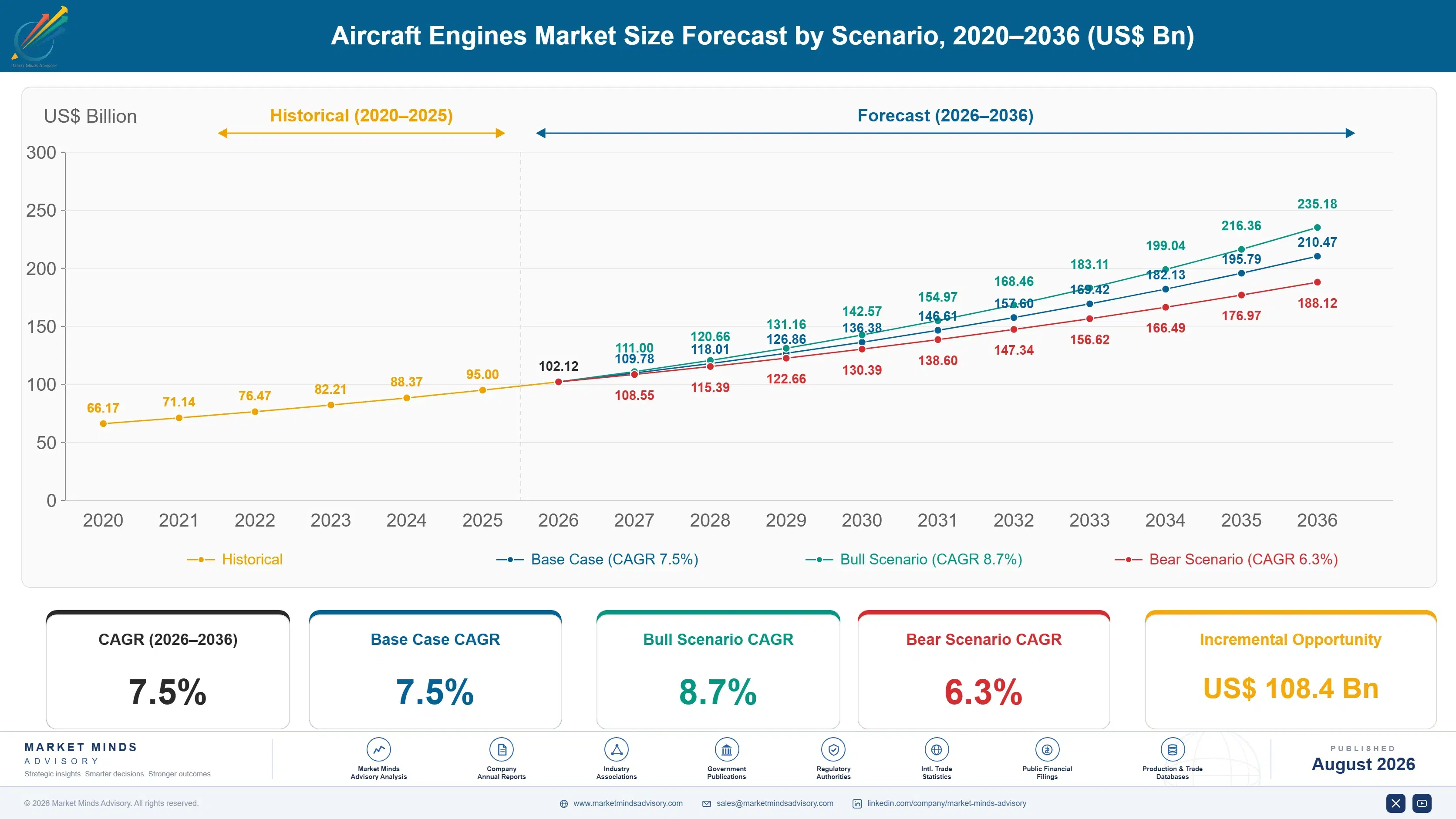
Aircraft Engines Market Forecast Scenarios

aircraft-engines-market-size-forecast-scenario-1787982363567
Aircraft engine market revenue grew at an estimated 6.5 percent historical pace between 2020 and 2025, propelled by post-pandemic commercial aviation traffic recovery and steady military engine replacement demand across allied air forces. Momentum was uneven, though, as pandemic-era fleet groundings briefly suppressed aftermarket overhaul demand before recovering fully by 2023. Several manufacturers also expanded production capacity commitments during this same period.
The base case assumes 7.5 percent annual growth through 2036, driven by three commercial mechanisms. First, expanding global commercial fleets are mechanically increasing total aftermarket overhaul and spare parts demand. Second, sustainable and hybrid-electric propulsion development programs are attracting substantial new research and certification investment ahead of tightening environmental regulations. Third, emerging Chinese domestic engine programs are adding new competitive capacity and expanding total addressable production volume. These three mechanisms increasingly reinforce one another across the broader industry.
The bull case centers on faster-than-expected commercial aviation traffic growth expanding fleet size well beyond current projections. The bear case centers on prolonged supply chain constraints limiting new engine delivery rates, which could meaningfully slow revenue growth across the newest engine platform generations specifically. Either scenario depends on how quickly supply chain bottlenecks affecting new engine deliveries ease.

Aftermarket Revenue Redraws Manufacturer Profit Pools

The aircraft engines industry sits at an unusual point where new equipment pricing and lifecycle economics have become deeply intertwined. Manufacturers pricing new narrowbody engines near breakeven to win long-term maintenance contracts is the single largest determinant of how profitability actually flows through this industry today. Manufacturers that misjudge this pricing dynamic risk building program economics around assumptions that no longer reflect actual industry profit distribution.
MARKET CONCENTRATION (CR5)68%Top five manufacturers hold well over half combined
AVERAGE AFTERMARKET REVENUE SHARE58%Total revenue originating from overhaul and spare parts
AVERAGE ENGINE TIME-ON-WING14 yearsTypical operating duration before major overhaul is required
PROGRAM DELIVERY DELAY18 monthsTypical schedule slippage across major new engine programs
FUEL EFFICIENCY IMPROVEMENT RATE12%Average efficiency gain across successive engine generations built
SUSTAINABLE FUEL COMPATIBILITY RATE46%Active fleet certified for high-blend sustainable aviation fuel
Beneath the pricing strategy story, the industry is absorbing genuine propulsion technology transformation. Sustainable aviation fuel compatibility and early hybrid-electric propulsion research are becoming genuine competitive differentiators as airlines and regulators push for measurable emissions reductions well ahead of previously expected industry timelines. Manufacturers slower to demonstrate proven sustainable propulsion technology risk losing airline preference to competitors already investing heavily in this transition.
Distribution economics are shifting too. Independent MRO providers are steadily capturing overhaul work that original equipment manufacturers once handled almost exclusively through proprietary service networks. Manufacturers slower to defend their aftermarket position risk losing meaningful recurring revenue to these increasingly capable independent competitors. Manufacturers slower to defend proprietary technical data risk losing meaningful recurring revenue to increasingly capable independent aftermarket competitors.
"Every engine maker talks about the power-by-the-hour model, but the ones actually protecting margins are the ones who locked in exclusive parts and data access early, not the ones just hoping loyalty alone keeps overhaul work in-house."
Director, Global Aerospace Propulsion Practice · MMA Construction and Industrial Equipment Practice · August 2026

Market Trends

Manufacturers Price New Engines Near Breakeven For Service Deals

Manufacturers are increasingly pricing new narrowbody engine sales near breakeven specifically to secure decades-long maintenance service agreements that deliver the substantial majority of program lifetime profitability. This strategy reflects a genuine recognition that aftermarket parts and overhaul revenue, protected by proprietary technical data and specialized parts access, delivers far more durable and predictable margins than one-time equipment sales subject to intense competitive bidding pressure. GE Aerospace and Pratt & Whitney have both structured recent engine program launches specifically around this long-term service agreement model, accepting thinner upfront margins in exchange for locking in exclusive decades-long aftermarket relationships with airline customers.
Market Impact: Adds 8% aftermarket volume annually

Sustainable Propulsion Investment Accelerates Ahead Of Regulation

Manufacturers are accelerating investment in sustainable aviation fuel compatibility and early hybrid-electric propulsion research well ahead of finalized regulatory mandates, positioning themselves competitively before environmental certification requirements become binding across major aviation markets. Rolls-Royce and Safran have both expanded dedicated sustainable propulsion research divisions specifically to demonstrate technology leadership to airline customers increasingly under pressure from their own corporate emissions reduction commitments and passenger sustainability expectations. Airlines increasingly weight this technology credential heavily when negotiating fleet-wide selection decisions with competing engine suppliers directly. This early positioning strategy is proving especially valuable as regulatory timelines continue accelerating across major global markets.
Market Impact: Adds 6% overhaul cycle frequency growth

Market Opportunities and Growth Drivers

Expanding Global Commercial Fleet Drives Aftermarket Volume

Continued expansion of the global commercial aircraft fleet, particularly across emerging Asian and Middle Eastern carriers, is mechanically increasing the installed base requiring routine overhaul and spare parts support. This fleet growth represents genuine incremental aftermarket demand that compounds over time as each new aircraft delivered today generates recurring service revenue for the manufacturer across decades of subsequent operational service life. Emerging carriers in these regions increasingly operate fleets comparable in scale to established Western airlines, sustaining durable long-term aftermarket demand across multiple engine platform families simultaneously. This durable demand base gives manufacturers meaningful confidence in long-term revenue planning.
Market Impact: Delays certification by 18 months average

Rising Flight Hour Utilization Accelerates Overhaul Cycles

Airlines recovering from pandemic-era capacity reductions are flying existing fleets at higher average utilization rates than before, accelerating the pace at which engines accumulate flight hours toward scheduled overhaul thresholds. This utilization increase directly compresses the calendar time between major overhaul events, mechanically increasing near-term aftermarket service revenue even without any corresponding growth in total fleet size. Manufacturers with strong predictive maintenance capability are capturing this accelerated overhaul demand more efficiently than competitors relying on traditional scheduled maintenance intervals alone. This capability increasingly determines which manufacturers customers trust for future fleet-wide maintenance program decisions.
Market Impact: Cuts manufacturer service share 7 points

Market Restraints and Challenges

Extended Certification Timelines Delay New Program Revenue

New engine programs, particularly those incorporating novel sustainable propulsion technology, continue experiencing extended certification timelines as regulators apply rigorous safety and performance testing requirements to unproven technology categories. The root cause is genuine regulatory caution given the safety-critical nature of propulsion systems combined with limited historical performance data for entirely new technology approaches. The commercial impact delays revenue recognition for manufacturers who invested heavily in these programs. Manufacturers are mitigating this through phased certification strategies that bring incremental improvements to market faster than fully novel platform designs. Some governments are exploring faster certification pathways for proven incremental improvements.
Market Impact: Grows aftermarket revenue to 58%

Independent MRO Competition Erodes Manufacturer Service Share

Independent maintenance, repair, and overhaul providers continue capturing service work that original equipment manufacturers once handled almost exclusively, particularly for older engine generations where proprietary technical data protection has weakened over time. The root cause is genuine cost competition from independent providers able to offer meaningfully lower overhaul pricing than manufacturer-affiliated service networks. The commercial impact falls hardest on manufacturers with aging engine families no longer protected by exclusive parts agreements. Manufacturers are mitigating this through tighter technical data licensing terms on newer engine platforms specifically. Some manufacturers now offer matching programs to retain customers tempted by independent provider pricing.
Market Impact: Grows sustainable fuel fleet share 46%
3 additional market trends, 2 additional growth drivers, and 3 additional restraints and challenges are covered in the full report. Contact sales@marketmindsadvisory.com to access the complete intelligence.

Segment CAGR and Growth Architecture

The aircraft engines market segments most usefully by platform category and service type, spanning narrowbody, widebody, military, turboprop, aftermarket, and next-generation propulsion categories, rather than by airframe manufacturer or customer country alone. This lens keeps upstream platform manufacturing distinct from downstream aftermarket sustainment and next-generation propulsion development entirely, consistently, and clearly across every reporting category.
aircraft-engines-market-market-share-analysis-1787982364107

Next-Generation Sustainable and Hybrid-Electric Propulsion Systems

Next-generation sustainable and hybrid-electric propulsion systems are growing fastest, expanding at roughly 1.87 times the market's overall pace as manufacturers race to demonstrate lower-emissions technology ahead of tightening aviation environmental regulations across major markets. Rolls-Royce and Safran have both expanded dedicated sustainable propulsion research divisions specifically to demonstrate technology leadership to airline customers increasingly under pressure from their own corporate emissions reduction commitments. This segment attracts substantial research investment even though commercial revenue remains comparatively modest today relative to legacy turbofan platforms, since manufacturers view early positioning as essential to capturing future replacement cycles. Rolls-Royce and Safran have both expanded dedicated propulsion research divisions to demonstrate technology leadership to customers under mounting emissions pressure.
CAGR 14.0%

Engine MRO and Overhaul Services

Engine MRO and overhaul services form the second-fastest growing segment, propelled by an expanding global fleet requiring routine overhaul and rising flight hour utilization accelerating overhaul cycle frequency across most major carriers. GE Aerospace and Pratt & Whitney have both structured recent engine program launches specifically around long-term service agreement models, accepting thinner upfront equipment margins in exchange for locking in exclusive decades-long aftermarket relationships with airline customers. Manufacturers with strong proprietary technical data protection and specialized parts access are capturing disproportionate share of this growing category, while independent MRO providers increasingly compete for older engine generations where exclusive licensing protection has weakened over time. This separates manufacturers building durable profitability from those reliant purely on new equipment sales.
CAGR 9.0%
Full segment breakdown across 6 segments available in the complete report.

Regional Architecture and Country Demand Map

North America holds the largest regional share, anchored by GE Aerospace and Pratt & Whitney's dominant commercial and military programs, while Western Europe and East Asia follow closely given Rolls-Royce, Safran, and expanding Asian commercial aviation fleets. South Asia and Pacific shows the fastest growth rate despite a smaller share.

North America

North America leads with a 31% share, sitting at the top of the standard 22 to 32% band, reflecting GE Aerospace and Pratt & Whitney's combined dominance across commercial narrowbody, widebody, and military engine programs serving both domestic and export customers worldwide. Boeing's substantial commercial aircraft production backlog directly sustains meaningful engine order volume tied to airframe delivery schedules across multiple platform families. The region's growth rate sits modestly above the global average, reflecting continued aftermarket revenue growth even as new program certification timelines extend due to increasingly rigorous safety testing requirements for novel propulsion technology categories. No other region approaches this scale of combined commercial and military engine program activity nationwide.
Share: 31% | CAGR: 8.5% (2026 to 2036)

Western Europe

Western Europe holds a substantial 25% share, anchored by Rolls-Royce and Safran's combined dominance across widebody and narrowbody engine programs serving Airbus's substantial commercial aircraft production backlog across multiple platform families. Germany's MTU Aero Engines contributes meaningful additional volume through both original equipment partnership arrangements and independent aftermarket service capability. The region's growth rate trails the global average modestly, reflecting a more mature aftermarket service cycle relative to still-accelerating fleet growth in South Asia and Pacific and East Asia markets specifically. Growth here should continue steadily as Airbus expands production rates across multiple platform families. Airbus's expanding order backlog continues to sustain multi-year engine production visibility for regional manufacturers. This pattern should persist steadily.
Share: 25% | CAGR: 6.0% (2026 to 2036)
Regional intelligence for 5 additional markets available in the complete report: East Asia, South Asia and Pacific, Middle East and Africa, Latin America, Eastern Europe. Contact sales@marketmindsadvisory.com.
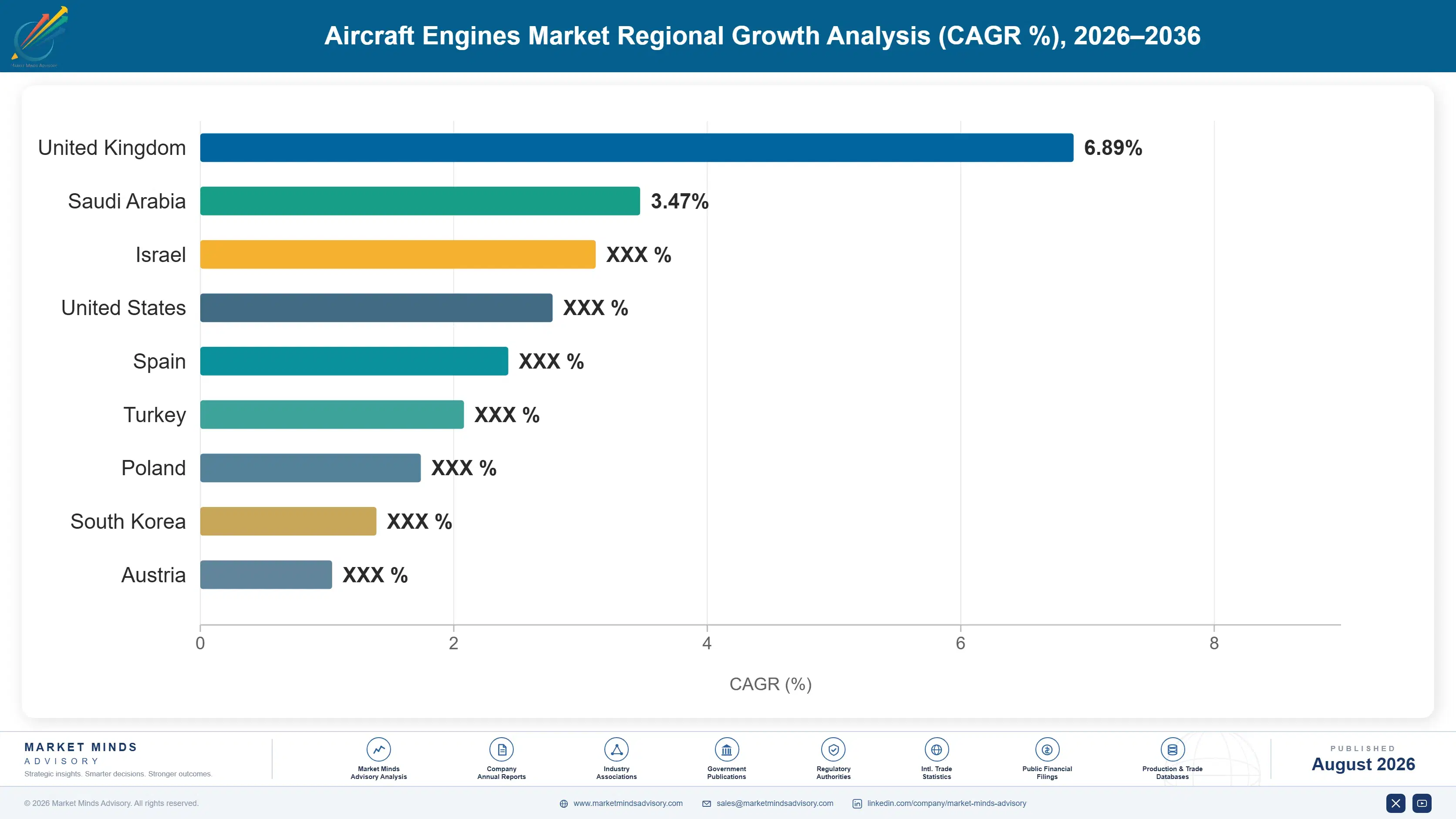
aircraft-engines-market-country-cagr-analysis-1787982364638

Capturing Margin Beyond New Engine Sales

Profitability for aircraft engine manufacturers increasingly depends on capturing margin beyond new equipment sales, since competitive bidding pressure keeps pushing new program pricing toward breakeven levels across most major commercial platform categories. Manufacturers that recognize this dynamic early are repositioning entire program strategies around long-term service revenue rather than upfront equipment sales pricing alone.

Structuring Long-Term Service Agreements At Launch

Manufacturers that structured long-term service agreements directly into new engine program launches are capturing decades-long aftermarket revenue that competitors negotiating service deals separately cannot easily replicate. GE Aerospace's bundled service agreement approach has reportedly captured 25 to 30 percent more lifetime program revenue per aircraft compared with programs sold without integrated service commitments. This approach requires accepting thinner upfront equipment margins in exchange for locking in exclusive long-term customer relationships from the very start of the program. This early positioning also builds specialized parts and technical data infrastructure competitors will need years to replicate credibly.
Market Impact: Captures 25 to 30 percent more program revenue

Protecting Proprietary Technical Data And Parts Access

Manufacturers that maintained tight technical data licensing and specialized parts access controls are defending aftermarket service share against independent MRO competition more effectively than manufacturers with looser licensing terms on legacy platforms. This protection reportedly preserves 15 to 20 percent more service revenue per engine over its operational lifetime compared with platforms where technical data protection weakened over time. Newer engine platforms increasingly embed this protection directly into original licensing terms from launch. Newer engine platforms increasingly embed this protection directly into original licensing terms from the very start of the program.
Market Impact: Preserves 15 to 20 percent more service revenue

Investing Early In Sustainable Propulsion Certification

Manufacturers that invested early in sustainable aviation fuel compatibility certification are capturing airline customer preference ahead of competitors still finalizing comparable certification programs. Early movers reportedly win 18 to 22 percent more competitive selection processes for airlines with binding corporate emissions reduction commitments. This early investment increasingly determines which manufacturers win fleet-wide selection decisions as sustainability criteria weigh more heavily in airline procurement processes overall. This early investment increasingly determines which manufacturers win fleet-wide selection decisions as sustainability criteria weigh more heavily overall. Manufacturers still finalizing comparable certification programs risk losing this competitive advantage entirely to earlier movers.
Market Impact: Wins 18 to 22 percent more airline selections

Who Controls the Margin Pool

The aircraft engines market is highly concentrated, with a CR5 of 68 percent on a revenue basis held across GE Aerospace, Rolls-Royce, Pratt & Whitney, Safran Aircraft Engines, and MTU Aero Engines. GE Aerospace and Pratt & Whitney lead in the commercial narrowbody segment specifically, while Rolls-Royce maintains a dominant position in widebody engines given its long-standing Airbus and Boeing partnership relationships.
Current competitive activity centers on long-term service agreement structuring, technical data protection strategy, and sustainable propulsion certification investment. Manufacturers are also racing to secure production capacity commitments from suppliers as new program delivery rates continue running behind original program planning targets. Manufacturers are also expanding joint venture partnerships and strategic supplier agreements to secure production capacity commitments ahead of competitors facing similar supply constraints.

Emerging pressure comes from two directions. Chinese domestic engine development programs are expanding steadily to reduce reliance on Western engines for future domestic aircraft platforms, while independent MRO providers continue capturing aftermarket share on older engine generations where manufacturer technical data protection has weakened over time. Manufacturers unable to demonstrate reliable delivery performance risk losing airline confidence entirely, ceding future platform selection decisions to competitors with stronger track records.
aircraft-engines-market-company-positioning-matrix-1787982365159

Competitive Moat and Risk Dimensions

GE AEROSPACE

Moat: Deepest Narrowbody Program Scale

GE Aerospace benefits from its CFM International joint venture's dominant position in narrowbody engines, giving it the largest active installed fleet base among commercial engine manufacturers and correspondingly the deepest aftermarket service revenue opportunity across the entire industry. Competitors with smaller installed fleet bases struggle to match this comprehensive aftermarket value proposition across comparable customer volume.
GE AEROSPACE

Risk: Exposure To Narrowbody Program Concentration

GE Aerospace's revenue remains heavily concentrated in narrowbody platform success, making it disproportionately exposed to any competitive disruption or technical issue affecting its dominant program relative to competitors with more diversified platform portfolios across multiple aircraft categories. Any technical issue or reliability concern affecting this dominant program could disproportionately damage GE Aerospace's overall revenue and reputation simultaneously.
ROLLS-ROYCE

Moat: Dominant Widebody Engine Position

Rolls-Royce benefits from a dominant position in widebody engines specifically, giving it privileged access to long-haul aftermarket service revenue from carriers operating some of the world's largest and most profitable aircraft fleet categories over decades of operational service life. This positioning gives Rolls-Royce durable pricing power that narrower, less specialized competitors cannot easily replicate across comparable customer relationships.
ROLLS-ROYCE

Risk: Exposure To Widebody Demand Cyclicality

Rolls-Royce's concentration in widebody engines makes it more exposed to long-haul travel demand cyclicality than narrowbody-focused competitors, since widebody aircraft orders and utilization rates tend to fluctuate more sharply with global economic and travel demand conditions. A prolonged downturn in international long-haul travel demand could disproportionately affect Rolls-Royce relative to more diversified engine manufacturer competitors.

Players Tracked

Prominent Players

GE Aerospace
Rolls-Royce
Pratt & Whitney
Safran Aircraft Engines
MTU Aero Engines

Other Key Players

CFM International
IAE International Aero Engines
Honeywell Aerospace
Williams International
Textron Lycoming
Continental Aerospace Technologies
United Engine Corporation
Ivchenko-Progress
PowerJet
Kawasaki Heavy Industries
Aviadvigatel
Xi'an Aero-Engine Corporation
ITP Aero
Avio Aero
Chromalloy

Recent Developments

FEBRUARY 2026

GE Aerospace Expands Long-Term Service Agreement Coverage

GE Aerospace expanded long-term service agreement coverage across additional narrowbody engine deliveries, bundling comprehensive maintenance commitments directly into new aircraft sales agreements rather than negotiating service contracts separately after initial engine delivery. The expansion reflects growing confidence that bundled agreements deliver more predictable revenue than separately negotiated service contracts.
Signal: Signals leading manufacturers are now formally bundling service agreements into every new program launch across the sector
DECEMBER 2025

Rolls-Royce Advances Sustainable Aviation Fuel Certification Program

Rolls-Royce advanced its sustainable aviation fuel compatibility certification program to cover a broader share of its widebody engine portfolio, responding to growing airline demand for demonstrated compatibility with higher-blend sustainable fuel formulations. The advancement reflects growing pressure to demonstrate proven sustainable technology ahead of finalized regulations.
Signal: Signals major manufacturers are racing hard to demonstrate sustainable propulsion technology leadership across the entire industry
SEPTEMBER 2025

Chinese Domestic Engine Program Achieves Testing Milestone

A major Chinese domestic engine development program achieved a significant flight testing milestone, advancing toward eventual certification for future domestic commercial aircraft platforms currently dependent on Western engine imports for propulsion. The milestone reinforces China's growing ambition to reduce long-term dependence on Western engine suppliers for domestic aircraft programs.
Signal: Signals Chinese domestic engine programs are steadily advancing toward eventual certification milestones across many platforms nationwide

Nickel Superalloy And Rare Earth Cost Exposure

Nickel-based superalloy components and rare earth magnet materials together represent the two largest cost inputs for aircraft engine manufacturers, running roughly 40 to 50 percent of engine production cost combined. Superalloys are sourced predominantly from a small number of qualified aerospace-grade metal producers, while rare earth materials required for advanced electric propulsion components depend heavily on concentrated Chinese mining and processing capacity.
The clearest recent volatility event was the 2023 nickel price spike driven by supply concerns following geopolitical tensions affecting major nickel-producing regions, which raised superalloy component costs meaningfully across the industry. Several manufacturers' 2025 annual reports disclosed materially higher raw material costs during the period, attributing much of the increase directly to nickel price volatility compounding already-elevated aerospace-grade material demand from expanding production rates. Manufacturers with diversified sourcing relationships weathered this spike meaningfully better than those dependent on single suppliers.

The competitive disadvantage mechanism falls disproportionately on smaller manufacturers without long-term supply agreements, since they must compete for constrained qualified superalloy capacity at spot market pricing rather than locked-in contract rates. This exposure varies by component type too, since rare earth-dependent electric propulsion components carry meaningfully higher geopolitical supply risk than traditional superalloy-based turbofan components.
aircraft-engines-market-cost-volatility-analysis-1787982365355

Securing Multi-Year Superalloy Supply Agreements

Larger manufacturers are securing multi-year superalloy supply agreements directly with qualified aerospace-grade producers, locking in predictable pricing that insulates production costs from short-term spot market volatility while guaranteeing suppliers stable long-term order commitments in return. This approach has already meaningfully stabilized production planning for several major manufacturers facing rising raw material cost pressure nationwide.

Diversifying Rare Earth Sourcing Beyond China

Manufacturers are diversifying rare earth material sourcing toward emerging non-Chinese producers in Australia and North America, reducing geopolitical supply concentration risk for advanced electric propulsion components even though this diversification remains at an early stage industry-wide. This diversification approach has already proven valuable for manufacturers navigating recent supply concentration risk more smoothly than concentrated competitors.

Investing In Alloy Recycling And Reclamation Programs

Some manufacturers are investing in superalloy recycling and material reclamation programs that recover valuable metal content from retired engine components, reducing dependence on newly mined material while building a more circular, cost-resilient material supply chain over time. Several manufacturers report meaningful progress in scaling these recycling programs across their broader component supply chains overall.

Portfolio Architecture for Margin Defence

Aircraft engine portfolios span three distinct economic tiers separated primarily by service agreement structure and technology sophistication rather than platform category alone. Standard new equipment sales without integrated service commitments carry thinner margins as competitive bidding pressure intensifies across most commercial platform categories. Manufacturers competing purely on unit price in this tier face shrinking margins as competitive tender processes increasingly commoditize new equipment delivery.
Certified and premium tiers, including long-term service agreements and protected aftermarket parts programs, command materially better economics because they require proprietary technical data and specialized parts infrastructure competitors cannot replicate quickly. The highest value pool concentrates in sustainable propulsion certification programs and exclusive decades-long service relationships, where genuine advantage through technology leadership and data protection drives the industry's widest margins.

Volume-tier equipment sales remain necessary for maintaining overall production scale and platform presence, even though margin contribution lags behind premium and next-generation tiers substantially, creating an ongoing tension between defending broad market share and reallocating investment toward higher-margin aftermarket and sustainable propulsion products. The manufacturers managing this balance most effectively will likely define industry leadership over the next several program cycles.

Volume / Commodity-Adjacent Tier

Standard new equipment sales without integrated service commitments sold primarily on competitive bidding, with limited differentiation beyond delivery timeline and unit pricing. Margins compress further as competitive bidding processes increasingly commoditize basic equipment delivery across most program categories.
Gross Margin: 6-12%

Premium / Certified Tier

Long-term service agreements and protected aftermarket parts programs requiring proprietary technical data and specialized parts infrastructure smaller competitors struggle to replicate. These programs carry lower price sensitivity given their embedded technical relationships and specialized parts access requirements.
Gross Margin: 24-32%

Sustainability / Regulatory / Next-Generation Tier

Sustainable propulsion certification programs and exclusive decades-long service relationships commanding the industry's highest margins through genuine technology and data differentiation. Manufacturers investing here early are building technology leadership and customer trust competitors will struggle to replicate quickly.
Gross Margin: 34-42%
aircraft-engines-market-portfolio-architecture-1787982365857

High-value Sub-segments and Strategic Watch-out

Long-Term Service Agreement Programs

Long-term service agreement programs combine strong margin economics with the fastest growth in the market, converting former upfront equipment pricing pressure into a genuine durable revenue opportunity for well-positioned manufacturers. Manufacturers still selling equipment separately risk missing this increasingly lucrative bundled revenue opportunity entirely. This gap widens further each cycle.
Gross Margin: 26-34%

Sustainable Propulsion Certification Programs

Sustainable propulsion certification programs pair solid margins with strong growth from tightening environmental regulation, offering a dependable combination without the volatility risk carried by earlier-stage hybrid-electric development. Early movers building this capability are establishing customer trust later competitors will struggle to displace. This advantage compounds steadily over time.
Gross Margin: 22-30%

Standard New Equipment Sales

Standard new equipment sales remain the volume core of the industry, generating dependable production revenue even as margins stay compressed by intensifying competitive bidding across most commercial platform categories. Manufacturers should defend this base carefully even while shifting investment toward higher-margin service and propulsion products.
Gross Margin: 6-11%

Legacy Engines Without Data Protection

Legacy engines without strong technical data protection represent the industry's clearest strategic watch-out, since independent MRO providers are steadily proving these older platforms cannot defend exclusive aftermarket service revenue indefinitely. Manufacturers should tighten data protection quickly rather than assume legacy platforms remain commercially defensible indefinitely.
Gross Margin: 8-14%

Lifecycle-Anchored Recurring Aftermarket Demand

Aircraft engine demand carries strong annuity characteristics because decades-long engine service life generates predictable recurring overhaul and parts revenue once a platform enters commercial service, giving original equipment manufacturers unusually stable recurring revenue streams tied to specialized parts access and proprietary technical data rights that competitors cannot easily replicate. This recurring pattern is reinforced further by specialized parts requirements that keep customers tied to the original manufacturer for decades.
Stickiness varies meaningfully by end-use vertical, though. Major airline fleet relationships show the deepest retention since switching engine suppliers requires costly requalification and new technical data licensing across an entire fleet, while smaller regional carriers show comparatively shallower loyalty, actively comparing competing lease and service offers before committing to a specific engine platform relationship. Smaller regional carriers also show meaningfully more price sensitivity before switching costs meaningfully increase over subsequent renewal cycles.

A generational buyer shift is also underway. Younger airline procurement executives increasingly prioritize sustainable propulsion credentials and data-driven predictive maintenance capability over the purely mechanical reliability metrics that dominated procurement decisions for prior generations of aviation buyers. Manufacturers slow to build comparable digital and predictive maintenance capability risk losing favor with this newer generation of airline procurement decision-makers.
aircraft-engines-market-end-use-penetration-index-1787982366344

Where Engine Manufacturers Should Focus

These are among the four positions where our research anticipates prominent divergence between winners and laggards over the coming forecast period. Each is grounded in the demand model, the regulatory perimeter, and the announced capacity pipeline.
01 / SERVICE AGREEMENT BUNDLING

Bundle service agreements into new launches before margins compress further

Manufacturers still negotiating service deals separately from equipment sales risk missing the fastest, most durable path to genuine long-term program profitability entirely, ceding ground steadily to more integrated, better-positioned rival competitors. GE Aerospace's bundled service approach already demonstrates meaningfully stronger lifetime program revenue than unbundled competitors still selling equipment and service separately. Manufacturers that delay this bundling risk permanently ceding the most valuable aftermarket relationships to earlier-moving, better-positioned competitors already locking in decades-long customer commitments across every major platform category.
02 / TECHNICAL DATA PROTECTION STRATEGY

Tighten data licensing before independent MRO share grows further

Manufacturers with looser technical data licensing on legacy platforms risk continuing to lose meaningful aftermarket service share to independent competitors offering lower overhaul pricing across nearly every major market. Manufacturers with tighter licensing terms already preserve meaningfully more service revenue per engine than those with weaker technical data protection currently in place. Manufacturers that delay tightening these licensing terms further on newer platforms risk repeating the same aftermarket erosion pattern across their entire next generation of engine programs and platforms.
03 / SUSTAINABLE PROPULSION INVESTMENT

Invest early in certification before airline preference solidifies

Manufacturers still finalizing sustainable propulsion certification programs risk steadily losing valuable airline customer preference to competitors already demonstrating proven, well-documented fuel compatibility credentials across their entire operating fleets today. Early movers already win meaningfully more competitive selection processes among major airlines carrying binding corporate emissions reduction commitments made publicly today. Manufacturers that keep delaying this investment risk permanently ceding sustainability-focused fleet selection decisions to competitors who invested much earlier in demonstrated, proven technology leadership across the entire global aviation industry.
04 / MATERIAL SUPPLY DIVERSIFICATION

Diversify superalloy sourcing before the next price disruption hits

Manufacturers concentrated heavily in narrow superalloy supply relationships face significantly amplified exposure when disruptions like the 2023 nickel price spike hit already-constrained aerospace-grade capacity simultaneously across the whole industry. Diversified sourcing across multiple qualified suppliers insulates manufacturers from this risk far more effectively than continued single-source dependence on any one region. Manufacturers that wait until the next disruption to diversify will likely face materially worse terms than those who prepared proactively well ahead of any visible warning signs in the market.

Engagement Snapshot From the Field

A live engagement with an industry participant carrying material or product regulatory and market exposure ahead of a defining policy shift, showing how our research translates into a defensible multi-year portfolio strategy.
MARKET MINDS ADVISORY · CLIENT ENGAGEMENT SUMMARY
Aircraft Engines Producer Strategic Portfolio Review and Transition Roadmap 2026·Investment Scenario on Aircraft Engines Exposure Evaluation 2025-26
CLIENT PROFILE
The client was a regional airline operator managing a growing narrowbody fleet expansion program, historically relying on a single incumbent engine supplier relationship without conducting a structured comparative evaluation of alternative platform and service agreement options. The operator served both domestic short-haul routes and select international markets from a single major hub airport. The fleet expansion program represented a significant capital commitment for the operator.
STRATEGIC CHALLENGE
Fleet leadership needed to determine whether continuing with the incumbent engine supplier or switching to an alternative platform offered better long-term value given differing service agreement terms, fuel efficiency characteristics, and sustainable fuel compatibility credentials across candidate options. Leadership also needed to weigh transition costs and pilot retraining requirements against the operational benefits either path would deliver.
MMA APPROACH
MMA benchmarked candidate engine platforms across total lifecycle cost, service agreement terms, and sustainable fuel compatibility credentials, drawing on primary interviews with fleet planning executives at comparable regional airlines that had recently completed similar engine selection processes. The assessment also incorporated published route network data and fuel consumption benchmarks specific to the operator's planned expansion profile.
KEY FINDINGS
  1. One candidate platform's bundled service agreement delivered meaningfully lower total lifecycle cost than the incumbent relationship despite a higher upfront list price (client-reported, unverified by MMA).
  2. Fuel efficiency differences across candidate platforms were narrower than expected once real-world route data was incorporated, directly informing how the airline weighted efficiency claims in its final decision.
  3. Sustainable fuel compatibility credentials varied substantially across candidates, directly affecting long-term regulatory compliance risk exposure for the fleet. This exposure difference proved especially relevant given tightening regional environmental regulations expected within the decade.
  4. Airlines that switched engine suppliers without adequate technical transition planning reported meaningfully higher near-term maintenance costs during the changeover period. This finding reinforced the importance of budgeting adequately for any eventual transition.
CLIENT PROFILE
The client was a regional airline operator managing a growing narrowbody fleet expansion program, historically relying on a single incumbent engine supplier relationship without conducting a structured comparative evaluation of alternative platform and service agreement options. The operator served both domestic short-haul routes and select international markets from a single major hub airport. The fleet expansion program represented a significant capital commitment for the operator.
STRATEGIC CHALLENGE
Fleet leadership needed to determine whether continuing with the incumbent engine supplier or switching to an alternative platform offered better long-term value given differing service agreement terms, fuel efficiency characteristics, and sustainable fuel compatibility credentials across candidate options. Leadership also needed to weigh transition costs and pilot retraining requirements against the operational benefits either path would deliver.
MMA APPROACH
MMA benchmarked candidate engine platforms across total lifecycle cost, service agreement terms, and sustainable fuel compatibility credentials, drawing on primary interviews with fleet planning executives at comparable regional airlines that had recently completed similar engine selection processes. The assessment also incorporated published route network data and fuel consumption benchmarks specific to the operator's planned expansion profile.
KEY FINDINGS
  1. One candidate platform's bundled service agreement delivered meaningfully lower total lifecycle cost than the incumbent relationship despite a higher upfront list price (client-reported, unverified by MMA).
  2. Fuel efficiency differences across candidate platforms were narrower than expected once real-world route data was incorporated, directly informing how the airline weighted efficiency claims in its final decision.
  3. Sustainable fuel compatibility credentials varied substantially across candidates, directly affecting long-term regulatory compliance risk exposure for the fleet. This exposure difference proved especially relevant given tightening regional environmental regulations expected within the decade.
  4. Airlines that switched engine suppliers without adequate technical transition planning reported meaningfully higher near-term maintenance costs during the changeover period. This finding reinforced the importance of budgeting adequately for any eventual transition.
RECOMMENDED STRATEGY
Phase 1: Phase one conducted a detailed total lifecycle cost comparison across all viable candidate engine platforms. to establish a credible baseline for negotiation. Phase 2: Phase two negotiated improved service agreement terms with the incumbent supplier before finalizing any switching decision. to capture immediate cost savings without a full platform switch. Phase 3: Phase three committed to the platform offering the strongest combination of cost, efficiency, and sustainability credentials. while preserving flexibility for future fleet decisions.
OUTCOME
The airline successfully negotiated improved service agreement terms with its incumbent supplier and reported meaningfully lower projected lifecycle costs across its expanding fleet within the first year of the revised agreement (client-reported, unverified by MMA). Leadership credited the structured comparison approach with avoiding a costly switch that would not have delivered proportional benefits.

Frequently Asked Questions

Foundational context covering the market sizes, CAGR, scope, country, region and competition that inform every finding below. This section is provided to cover basics and most often pre-purchase conversations, answered from the MMA Primary Research Dataset.

What is the current size of the Aircraft Engines Market?

The global aircraft engines market reached an estimated 95.0 billion dollars in 2025. Growth has been propelled by expanding commercial fleets and rising aftermarket overhaul demand worldwide.

How large will the Aircraft Engines Market be by 2036?

The market is projected to reach approximately 210.48 billion dollars by 2036. This reflects sustained fleet growth and sustainable propulsion investment through the forecast period.

What is the CAGR for the Aircraft Engines Market 2026 to 2036?

The base case CAGR is 7.5 percent annually. Bull and bear scenarios range between 6.3 and 8.7 percent depending on the pace of commercial aviation traffic growth.

Which segment is growing fastest?

Next-generation sustainable and hybrid-electric propulsion systems lead at 14.0 percent CAGR, roughly 1.87 times the overall market pace. Tightening environmental regulation is the primary driver behind this acceleration.

Who are the major companies in the Aircraft Engines Market?

Leading manufacturers include GE Aerospace, Rolls-Royce, Pratt & Whitney, Safran Aircraft Engines, and MTU Aero Engines. These five manufacturers hold a combined 68 percent share on a revenue basis.

Which country is growing fastest?

China leads at an estimated 9.5 percent CAGR. Rapidly expanding commercial aviation fleets and growing domestic engine development investment across state-affiliated manufacturers continue driving this above-average pace.

Report Segmentation Architecture

The full report scope spans multiple orthogonal segmentation dimensions, with cross-tabulated demand data provided for each dimension pair. Coverage extends further to regional breakdowns, trend trajectories, and the competitive detail needed to support segment-level decision-making.

By Primary Market Dimension

  • Commercial Narrowbody Turbofan Engines
  • Commercial Widebody Turbofan Engines
  • Military Turbofan and Turbojet Engines
  • Turboprop and Regional Aircraft Engines
  • Engine MRO and Overhaul Services
  • Next-Generation Sustainable and Hybrid-Electric Propulsion Systems

By End-Use Industry

  • Commercial Passenger Airlines
  • Air Cargo and Freight Carriers
  • Military Air Forces and Navies
  • Regional and Low-Cost Carriers
  • Business and General Aviation Operators
  • Aircraft Leasing Companies

By Commercial Dimension

  • Original Equipment Sales
  • Long-Term Service Agreements
  • Independent MRO Services
  • Spare Parts and Technical Data Licensing
  • Engine Leasing and Exchange Programs
  • Sustainable Propulsion Certification Services

By Region

  • North America
  • Western Europe
  • East Asia
  • South Asia and Pacific
  • Middle East and Africa
  • Latin America
  • Eastern Europe

Scope, Methodology, and Coverage

Every figure in this report is reproducible from documented input assumptions. The scope below maps the historical period, the forecast horizon, the segmentation dimensions, and the countries covered, alongside the underlying primary and qualitative methodology.
Historical Period
2020 to 2025
Forecast Period
2026 to 2036
Base Year
2025 (USD billions; MMA Primary Research Dataset, August 2026)
Market Definition
This report covers the design, manufacture, sale, and aftermarket maintenance of turbofan, turbojet, and turboprop propulsion systems for commercial and military fixed-wing aircraft, including next-generation sustainable and hybrid-electric propulsion development programs. It excludes helicopter engines, rocket and space propulsion systems, and unmanned aerial vehicle propulsion.
Quantitative Units
USD billions (program revenue, current prices); unit deliveries in thousands where cited.
Segmentation Dimensions
Primary Market Dimension (platform and service type); End-Use Industry; Commercial Dimension.
Regions Covered
North America, Western Europe, East Asia, South Asia and Pacific, Middle East and Africa, Latin America, Eastern Europe
Countries Covered
United States, France, Germany, United Kingdom, China, Japan, South Korea, India, Australia, Brazil, UAE, Qatar, Saudi Arabia, Poland, Mexico.
Key Companies Profiled
GE Aerospace, Rolls-Royce, Pratt & Whitney, Safran Aircraft Engines, MTU Aero Engines.
Quantitative Methodology
Primary survey, n=3,800 respondents, Q4 2025, six countries; demand-side model with trade association cross-validation
Qualitative Methodology
47 expert interviews, Q4 2025; applied to validate demand model assumptions, identify emerging dynamics, and assess competitive positioning
Report Format
PDF and XLSX data workbook (Word format preview document)
Publisher
Market Minds Advisory
Report Code
MMA-2026-CON-102
Published
August 2026
Contact
sales@marketmindsadvisory.com | www.marketmindsadvisory.com

Purchase the full Aircraft Engines Market Report (2026 to 2036).

This report delivers a complete strategic assessment of the global aircraft engines market through 2036. It combines primary survey data from 3,800 respondents across six countries with 47 expert interviews conducted in the fourth quarter of 2025. Coverage spans market sizing, six-segment MECE platform and service segmentation, competitive benchmarking across twenty profiled manufacturers, and regional analysis across all seven global regions. The analysis is designed to support program strategy, aftermarket investment, and sustainable propulsion decisions. Buyers gain a structured basis for evaluating service agreement strategy against continued sustainable propulsion certification investment.
Six-segment MECE engine platform and service breakdown
Seven-region market sizing with country-level detail
Twenty-company competitive benchmarking and moat analysis
Long-term service agreement impact quantification and scenarios
Sustainable propulsion and technical data strategy guidance
Anonymized client case study with recommended strategy phases

Built For The People Who Decide

From boardroom strategy to bench-side execution, this report is read cover-to-cover by leaders shaping the next decade of their industry, turning demand scenarios, market dynamics and valuation benchmarks into decisions.
CXOs/ Presidents/ VPs/ Managers
M&A and Corporate Development
Strategy Teams and R&D Heads
Procurement and Product Directors
Regulatory and Compliance Leaders
Investor Relations and Equity Analysts