Market Minds Advisory
Aircraft Electric Motors Market

Aircraft Electric Motors Market: Power Density, Qualification Cycles and Two Customers Pretending To Be One Market

Two entirely different customers buying what looks like the same product, where certification timelines rather than motor physics decide who earns revenue and magnet supply sits under one country's export licensing.

Lead Analyst

Published

September 2026

Make Smarter Decisions with Customized Research Insights

Request a free sample report and evaluate market opportunities, growth trends, and competitive dynamics relevant to your business needs.

2025 MARKET VALUE$1.6BMarket Size 2025
2036 FORECAST VALUE$7.8BBase Case , 2026 to 2036
CAGR 2026 TO 203615.4 %Bull 16.6% / Bear 14.2%
INCREMENTAL OPPORTUNITY$5.9BNet 10- year value creation
EXPANSION MULTIPLE4.19x2036 value over 2026 base
Strategic Levers
M&A Pipeline
Regional Outlook
Country Rankings
Competitive Intelligence
Segmental Deep-dive
Call-Us : 91 93563 13602

Executive Snapshot and Market Trajectory

This market contains two customers who want incompatible things and are counted as one. Propulsion buyers need power density above five kilowatts per kilogram and will accept a short overhaul interval. Airframe actuation buyers will not accept that at all, and never have.
Certification decides revenue, not engineering. A motor reaching design freeze needs roughly 34 months of environmental qualification, vibration testing and documentation before an airframer can fit it to anything carrying passengers, and that clock runs regardless of how good the machine is. Suppliers who treat qualification as a downstream formality consistently miss programme windows that then close for a decade behind them. Nobody ever recovers a missed slot by simply building a better motor.
Magnet supply is the exposure nobody advertises. High-temperature permanent magnets need dysprosium and terbium, both subject to Chinese export licensing since April 2025, and magnets carry roughly 22% of motor cost. Primary propulsion grows fastest at 23.1% on advanced air mobility programmes, and East Asia holds the largest regional share because the certified aircraft and the magnet supply chain both happen to sit there. That combination is not a coincidence.
Market Definition
Revenue from electric motors qualified for airborne use on certificated and developmental aircraft, spanning primary propulsion motors and non-propulsive motors driving flight control actuation, environmental control, fuel and hydraulic pumps, landing gear and utility functions. Excludes motor controllers and power electronics sold separately, generators and starter-generators producing rather than consuming power, batteries, fuel cells and ground support equipment motors.
Base Year Value
$1.6B in 2025 (MMA Primary Research Dataset, August 2026)
Forecast Period
2026 to 2036, eleven discrete annual values
CAGR
15.4% base case. Bull 16.6%. Bear 14.2%.
Fastest Growth Segment
Primary Propulsion Motors: 23.1% CAGR
Fastest Growth Country
India: 17.4% CAGR
Fastest Growth Region
South Asia and Pacific: 17.4% CAGR
Largest Region
East Asia: 30% of 2025 global value
Market Leaders
Safran, Honeywell Aerospace, Collins Aerospace, magniX and Nidec lead on qualified motor revenue and certified shipset content. Source: company annual reports and MMA Primary Research Dataset, July 2026.
Primary Survey
n=3,800 procurement and R&D decision-makers, Q4 2025, six countries
Methodology
Demand-side build-up, cross-validated against public data, 47 expert interviews

Aircraft Electric Motors Market Forecast Scenarios

aircraft-electric-motors-market-size-forecast-scenario-1787982818244
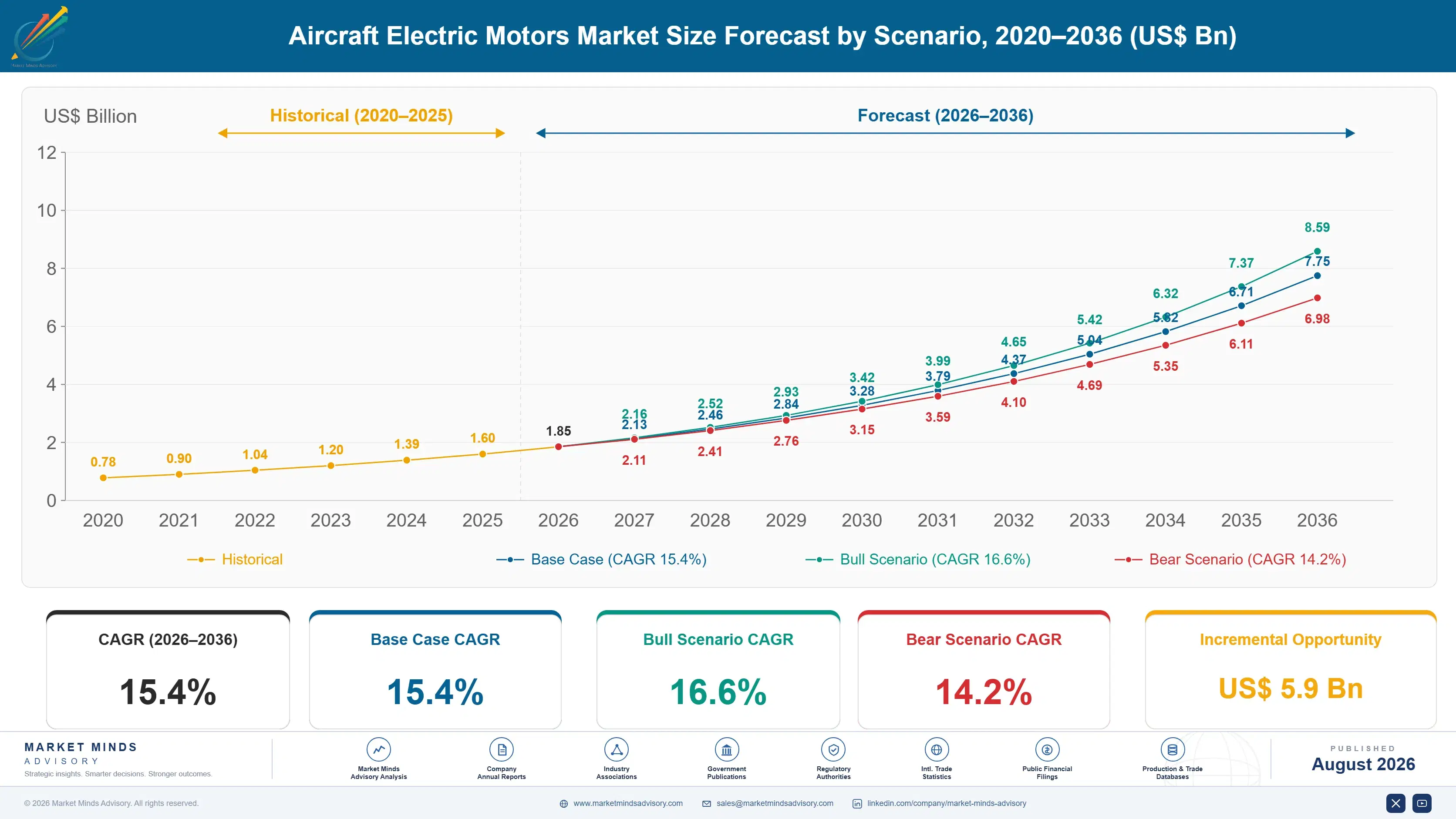
The 2020 to 2025 period was funded by expectation rather than delivery. Advanced air mobility capital arrived in volume through 2021, motor suppliers scaled engineering teams against programmes that had no certification basis yet, and several of those programmes then slipped by years. Revenue compounded near 13.9% anyway, carried by more-electric airframe content on aircraft already flying rather than by anything new.
Three mechanisms support the base case. Electromechanical actuation keeps displacing hydraulics on new airframe designs, which raises motor count per shipset without requiring any new aircraft type. Advanced air mobility reaches limited commercial service, converting development contracts into production rates. And military unmanned programmes adopt electric actuation and propulsion faster than commercial aviation does, because qualification standards there are set by the customer rather than by any civil authority at all.
The bull catalyst is a certified hybrid-electric regional aircraft entering service, which would move propulsion motors from demonstration into a production programme measured in hundreds of shipsets. The bear risk is magnet supply: licensing restrictions on heavy rare earths tightening further would raise cost and lead time across every motor in this market at once, with no qualified alternative available quickly.

Where Qualification Rather Than Physics Sets The Price

An aircraft electric motor is not a difficult machine to design and is a very difficult machine to certify. Environmental qualification alone covers temperature extremes, altitude, vibration, humidity, salt fog, lightning and electromagnetic interference, and the associated documentation frequently exceeds the engineering effort that produced the motor. Roughly 34 months separates design freeze from a part an airframer will fit, and no amount of capital compresses that meaningfully.
MARKET CONCENTRATION CR546%Share of qualified motor revenue held by leading suppliers
CONTINUOUS POWER DENSITY5.2 kW/kgSustained output achieved per unit of motor mass
QUALIFICATION CYCLE LENGTH34 monthsElapsed time from design freeze to certified release
RARE EARTH MAGNET SHARE22%Portion of motor cost carried by permanent magnets
SHIPSET MOTOR COUNT118Electric motors fitted across a modern widebody airframe
OVERHAUL INTERVAL18,000 hoursOperating period before scheduled removal and workshop inspection
The two customer groups pull in opposite directions and suppliers keep trying to serve both. Advanced air mobility wants the lightest possible machine and tolerates removal after a few thousand hours, because the aircraft itself is being replaced on a short cycle. Commercial airframe actuation wants an eighteen thousand hour overhaul interval and will accept considerable extra mass to get it. A design optimised for one is uncompetitive in the other.
Motor count per aircraft has risen quietly and substantially. A modern widebody carries around 118 electric motors across actuation, environmental control, pumps and utility functions, against a fraction of that on airframes designed in the 1990s. That growth came from replacing hydraulic and pneumatic systems rather than from electric flight, and it remains the revenue paying this industry's bills.
"Every investor conversation in this market is about power density. Every programme that failed, failed on documentation, magnet lead time or a vibration test nobody budgeted eleven months for."
Director, Aerospace Propulsion and Systems Practice · MMA Aerospace and Defence Components Practice · August 2026

Market Trends

Electromechanical Actuation Displaces Hydraulics On New Designs

Airframers designing new aircraft keep removing hydraulic circuits and replacing them with electromechanical actuators, because a hydraulic system carries pumps, reservoirs, pipework, fluid mass and a maintenance burden that a motor and a screw jack simply do not. Each substitution adds motors to the shipset. The transition began with secondary flight controls and spoilers and has moved steadily toward primary surfaces as reliability data accumulated. It is unglamorous, it requires no new aircraft category, and it produces most of the revenue this industry currently earns. Nobody writes press releases about spoiler actuators.
Market Impact: Unblocks 23.1% propulsion growth
Chinese Certification Established The First Regulatory Precedent

The Civil Aviation Administration of China issued a type certificate to a passenger-carrying electric vertical takeoff aircraft in October 2023, ahead of any European or American authority, and national policy has since placed low-altitude aviation among stated industrial priorities. That sequence matters commercially rather than symbolically: motor suppliers qualified against a completed certification basis hold evidence competitors working toward draft requirements do not. It also concentrated early production volume in a region already holding the deepest permanent magnet manufacturing capability anywhere. Evidence against a finished rule is worth more than evidence against a draft.
Market Impact: Cuts qualification to 14 months

Market Opportunities and Growth Drivers

Advanced Air Mobility Programmes Reach Certification Milestones

Powered-lift operational rules published by the Federal Aviation Administration in October 2024 gave American programmes a defined pathway for pilot certification and operations, removing an uncertainty that had made airframers reluctant to freeze propulsion specifications. European special conditions for vertical takeoff aircraft did comparable work earlier. Motor suppliers can now design against requirements that exist rather than against expectations, which is the difference between an engineering programme and a research project. Primary propulsion grows at 23.1% on that basis alone. Requirements that exist are worth considerably more than requirements that are coming.
Market Impact: Covers 22% of motor cost

Military Unmanned Programmes Qualify Faster Than Civil Aviation

Defence customers set their own airworthiness requirements and can accept risk a civil authority cannot, so electric actuation and propulsion reach service on unmanned military aircraft years before comparable civil adoption. Programme cycles run shorter, qualification evidence is negotiated rather than prescribed, and production quantities arrive sooner. For a motor supplier this is the fastest available route from prototype to recurring revenue. It also produces qualification data that later supports civil applications at considerably lower cost. A supplier reaching production on a military programme is funding its civil work rather than begging somebody else to.
Market Impact: Runs 34 months to certification

Market Restraints and Challenges

Heavy Rare Earth Magnet Supply Sits Under Export Licensing

High-temperature permanent magnets require dysprosium and terbium, and both fell under Chinese export licensing requirements introduced in April 2025 covering several medium and heavy rare earth elements. The root cause is processing capacity concentrated in one country over three decades, not any recent policy decision. Magnets carry roughly 22% of motor cost, so licensing delay affects price and lead time simultaneously. Suppliers mitigate through magnet-free machine architectures, dysprosium-reduced grain boundary diffusion magnets, multi-year inventory positions and qualification of non-Chinese magnet sources. None of those alternatives can be qualified inside a single year.
Market Impact: Adds 40 motors per shipset

Qualification Cycles Outlast Airframe Programme Decision Windows

Thirty-four months from design freeze to certified release means a supplier must commit engineering before an airframer selects anybody, and the selection window frequently closes first. The root cause is environmental qualification and documentation obligations that cannot be run in parallel with detailed design. Commercially this rewards suppliers with qualified building blocks and punishes those starting from a blank sheet. Mitigation runs through pre-qualified motor families, modular winding and housing designs, and qualification evidence reused across derivative applications wherever the authority permits it. Starting from a blank sheet is a schedule decision, not a technical one.
Market Impact: Certified 1 passenger eVTOL type
3 additional market trends, 4 additional growth drivers, and 2 additional restraints and challenges are covered in the full report. Contact sales@marketmindsadvisory.com to access the complete intelligence.

Segment CAGR and Growth Architecture

Segmentation follows the function the motor drives, since that determines the qualification standard applied, the reliability the customer demands and the price the part can command. Six driven functions describe the market completely, from primary propulsion at one extreme through to the utility motors that airframers treat very nearly as commodities and buy on price alone.
aircraft-electric-motors-market-market-share-analysis-1787982818861

Primary Propulsion Motors

The fastest function grows at 23.1%, half again the market rate of 15.4%, and every bit of that growth depends on advanced air mobility programmes converting from development into production. These machines run at power densities above five kilowatts per kilogram, use direct drive or single stage reduction, and accept overhaul intervals a fraction of what airframe actuation demands, because the airframe itself turns over quickly. Certification is the gate. A supplier holding qualification evidence against a completed regulatory basis holds something competitors working from draft requirements do not, and the Chinese type certificate issued in October 2023 was the first completed basis anywhere in the world at all. That mattered commercially.
CAGR 23.1%

Flight Control Actuation Motors

Actuation grows at 18.5% and produces far more revenue today than propulsion does, which most commentary on this market manages to obscure. Each hydraulic circuit an airframer removes gets replaced by electromechanical actuators, and each actuator carries a motor qualified to eighteen thousand hour overhaul intervals under full environmental testing. Reliability matters more than mass here, so designs carry margin that a propulsion engineer would consider wasteful. Adoption began on spoilers and secondary surfaces and has moved toward primary flight controls as service data accumulated. The barrier is qualification history rather than technology, which favours incumbents heavily and always has. Nothing about that arrangement is going to change quickly, and incumbents know it.
CAGR 18.5%
Full segment breakdown across 6 segments available in the complete report.

Regional Architecture and Country Demand Map

Manufacture and certification of aircraft electric motors are genuinely distributed, so no single region dominates the way country-scoped markets do. East Asia leads on combined magnet supply, certified electric aircraft and motor production capacity, with North America and Western Europe holding the certification-heavy airframe actuation content.

North America

The second largest pool sits here on airframe actuation content and advanced air mobility development. Honeywell, Collins Aerospace and magniX all hold qualified motor programmes, and the Federal Aviation Administration published powered-lift operational rules in October 2024 that unblocked propulsion specification decisions several airframers had deferred. Military unmanned programmes provide the fastest qualification route available anywhere, since defence customers negotiate airworthiness evidence rather than accepting a prescribed standard. Magnet supply remains the weak point, with essentially no domestic heavy rare earth separation capacity currently operating at commercial scale. Programme wins here therefore depend on qualification depth and defence access rather than on any cost position, which suits the established suppliers and nobody else at all.
Share: 28% | CAGR: 15.0% (2026 to 2036)

Western Europe

Airframe actuation content anchors this region, with Safran, Liebherr-Aerospace, Thales and Moog holding qualified positions across commercial and military platforms. European special conditions for vertical takeoff aircraft established a certification basis earlier than the American equivalent, and Safran obtained European type certification for a smaller propulsion motor during 2025. The region's advantage is qualification history rather than manufacturing cost, and its weakness is identical to North America's: no meaningful heavy rare earth processing exists inside it, so every magnet arrives through a supply chain nobody here controls. The region competes on evidence it accumulated over decades and on nothing else, which works until an airframer decides cost matters more than history does.
Share: 21% | CAGR: 14.0% (2026 to 2036)
Regional intelligence for 5 additional markets available in the complete report: East Asia, South Asia and Pacific, Latin America, Middle East and Africa, Eastern Europe. Contact sales@marketmindsadvisory.com.
aircraft-electric-motors-market-country-cagr-analysis-1787982819392

Where Motor Programme Margin Is Won

Four levers work on qualification cost, magnet exposure and programme selection rather than on motor performance, which is rarely what decides a competition. Pre-qualified building blocks, magnet architecture choice, defence-first qualification and aftermarket capture each address something a supplier genuinely controls before an airframer chooses anybody at all. Motor performance rarely settles a competition on its own.

Qualify Motor Families Rather Than Individual Applications

A supplier qualifying each motor from a blank sheet spends 34 months and misses selection windows that close first. Building a pre-qualified family, with shared winding designs, housings, bearings and environmental test evidence reused across derivatives, cuts application-specific qualification to roughly 11 to 14 months where the authority accepts the reuse. That difference decides competitions before any technical evaluation happens. The investment runs several million dollars ahead of any programme award, which is precisely why smaller suppliers keep declining it and keep losing on schedule instead. Schedule beats performance in almost every competition.
Market Impact: Cuts application qualification down to 12 months typically

Design Out Heavy Rare Earth Dependence Before Forced To

Dysprosium and terbium fell under Chinese export licensing in April 2025 and magnets carry roughly 22% of motor cost, so the exposure is both large and outside any supplier's control. Grain boundary diffusion magnets cut heavy rare earth content by 40% to 60% at comparable temperature performance, and wound field or reluctance architectures remove it entirely at some cost in power density. Qualifying an alternative takes two years. Suppliers starting after a supply interruption will be qualifying while competitors are already shipping. Two years is not a schedule anybody can compress by spending money.
Market Impact: Cuts heavy rare earth content by around 50%

Take Defence Qualification First And Civil Second

Military customers negotiate airworthiness evidence rather than applying a prescribed standard, so a motor reaching qualified status on an unmanned defence programme gets there in roughly 14 months against 34 for a civil equivalent. That evidence then supports the civil case at materially lower incremental cost, typically 30% to 40% below qualifying from nothing. The sequence also produces recurring revenue years earlier. Suppliers pursuing civil certification first are funding a longer programme from a smaller base, which is a harder position than it needs to be. The sequence matters more than the destination.
Market Impact: Reaches revenue some 20 months sooner than civil

Capture Overhaul Revenue Rather Than Ceding It

An actuation motor with an 18,000 hour overhaul interval generates spares and overhaul revenue across three decades of airframe life, frequently exceeding the original equipment value by 2 to 3 times. Suppliers that cede that work to independent shops or to the airframer collect once and never again. Retaining it requires approved repair capability, parts availability commitments and a service network, which costs real money to establish. The suppliers earning properly in this market established it before the fleet grew large enough to matter. Establishing it later costs considerably more than establishing it early.
Market Impact: Adds around 2.5 times the original equipment value

Who Controls the Margin Pool

Concentration is moderate at around 46% across the five largest suppliers, and leading positions rest on qualification history rather than performance. Safran, Honeywell and Collins hold decades of certified content across commercial airframes. magniX and Nidec occupy different positions, one in propulsion development and one in volume manufacture. Below them sit specialists in actuation, defence motors and air mobility propulsion.
Competition runs on three dimensions. Qualification evidence is first and most decisive, since an airframer selecting a motor selects a certification risk rather than a machine. Magnet supply security is second, and became genuinely material in April 2025. Power density is third, mattering enormously in propulsion and hardly at all in actuation, which is why suppliers optimised for one lose in the other.

Pressure is arriving from two directions. East Asian manufacturers hold cost and magnet access Western suppliers cannot match, and now hold certification precedent too. Advanced air mobility airframers meanwhile design motors in house rather than buying them, removing the highest-growth application from the merchant market. Rankings shift against suppliers holding neither qualified motor families nor secured magnet supply, since both take years.
aircraft-electric-motors-market-company-positioning-matrix-1787982819918

Competitive Moat and Risk Dimensions

SAFRAN

Moat: Certified content across airframe platforms

Safran holds qualified electrical and actuation content across a wide range of commercial and military airframes, which supplies recurring production revenue and the qualification history that airframers weigh most heavily when selecting suppliers. It also obtained European type certification for a propulsion motor during 2025, giving it certified evidence in both applications. Assembling comparable history from nothing would take decades.
SAFRAN

Risk: European magnet supply exposure

No meaningful heavy rare earth processing capacity exists within Europe, so magnet supply depends entirely on a chain subject to export licensing decisions taken elsewhere. Magnets carry roughly 22% of motor cost, making the exposure large in both price and lead time. Qualifying alternative magnet sources or architectures takes about two years, which a supply interruption would not allow.
NIDEC

Moat: Volume manufacturing and magnet access

Nidec combines precision motor manufacturing at volumes no aerospace specialist approaches with regional proximity to permanent magnet production, giving it cost and supply positions Western competitors cannot replicate. That scale also funds process capability across winding, balancing and thermal management. Building comparable manufacturing depth would require capital and time that aerospace volumes alone could never justify for anybody.
NIDEC

Risk: Aerospace qualification depth limited

Manufacturing capability is not the same thing as certified airborne content, and qualification history across Western commercial airframes remains thinner than the established aerospace suppliers hold. Airframers weigh that history heavily when selecting parts they cannot easily change afterwards. Building it requires programme wins that themselves depend on the history, which is a genuinely circular problem to escape.

Players Tracked

Prominent Players

Safran
Honeywell Aerospace
Collins Aerospace
magniX
Nidec

Other Key Players

Rolls-Royce Electrical
Liebherr-Aerospace
Thales
Moog
Parker Aerospace
Ametek
Kollmorgen
Evolito
EMRAX
H3X Technologies
MAGicALL
Denso
Yaskawa Electric
Meggitt
Woodward

Recent Developments

OCTOBER 2023

Chinese authority certified a passenger electric vertical takeoff aircraft

The Civil Aviation Administration of China issued a type certificate to a passenger-carrying electric vertical takeoff aircraft, the first such certificate granted anywhere. This was a regulatory approval by a national aviation authority rather than any merger, acquisition or commercial agreement between manufacturers or their suppliers.
Signal: A completed certification basis existed in one region while every other authority was still drafting requirements.
OCTOBER 2024

American regulator published powered-lift operational rules

The Federal Aviation Administration issued final rules covering pilot certification and operating requirements for powered-lift aircraft, resolving an uncertainty that had delayed propulsion specification decisions across several programmes. This was federal rulemaking rather than any transaction or agreement between airframers, motor suppliers or aircraft operators.
Signal: Airframers could finally freeze propulsion requirements against rules that actually existed rather than against expectations alone.
APRIL 2025

Export licensing extended to medium and heavy rare earth elements

Chinese authorities introduced export licensing requirements covering several medium and heavy rare earth elements including dysprosium and terbium, both essential to high-temperature permanent magnets used in aerospace motors. This was a national export control measure rather than any commercial arrangement between magnet producers and their customers.
Signal: Roughly a fifth of motor cost moved under licensing decisions no supplier in this market influences.

What A Certified Motor Costs

Motor cost divides into four components that behave very differently. Permanent magnets absorb roughly 22% of material and production cost and originate almost entirely from processing capacity concentrated in one country. Copper winding, laminations and bearings together account for near 29%, machining and assembly labour near 21%, and qualification amortisation with certification documentation carries the remaining 28% across a typical programme.
The April 2025 rare earth licensing measures showed how quickly the largest input moves. Dysprosium and terbium became subject to export approval, lead times extended from weeks to several months for some grades, and suppliers holding no inventory position found production schedules moving before any price change appeared. Safran and Honeywell both discussed supply chain and material availability pressures across that period in their annual reporting. Qualified alternatives were not available on any useful timescale.

Exposure varies sharply by architecture and by region, and it decides competitiveness directly. Suppliers using high grade sintered magnets without grain boundary diffusion carry the heaviest heavy rare earth content. East Asian manufacturers hold magnet proximity Western competitors do not. Pre-qualified motor families spread certification cost across many applications, while suppliers qualifying each design separately carry the full 28% every time.
aircraft-electric-motors-market-cost-volatility-analysis-1787982820114

Grain boundary diffusion magnets reducing heavy rare earth content

Diffusing dysprosium or terbium only into grain boundaries rather than throughout the magnet cuts heavy rare earth content by 40% to 60% at comparable temperature performance. Requalification takes about two years because thermal demagnetisation behaviour must be demonstrated again. Suppliers beginning that work after a supply interruption will still be testing while better prepared competitors continue shipping product.

Pre-qualified motor families spreading certification amortisation

Shared winding designs, housings, bearings and environmental test evidence reused across derivative applications spread the 28% certification component across many programmes rather than loading it onto each one separately. Authorities accept the reuse where the design delta is documented properly. The investment runs several million dollars before any award exists, which deters most smaller suppliers entirely.

Multi-year magnet inventory and dual source qualification

Holding eighteen to twenty-four months of magnet inventory converts a supply interruption from a production stoppage into a cost problem, which is a considerably better problem. Qualifying a second magnet source outside the dominant supply chain takes roughly two years and costs real money. Suppliers who did both before April 2025 kept delivering while competitors renegotiated schedules.

Portfolio Architecture for Margin Defence

The portfolio separates by what the qualification standard demands rather than by what the motor does. Auxiliary and utility motors form the volume layer: cabin systems, galley equipment, cargo handling and comfort functions, qualified to lighter standards, competed on price and frequently sourced from suppliers with no other aerospace content at all. They exist because airframers buy them in quantity and because they carry aftermarket volume worth having.
Margin concentrates in flight control actuation and environmental control, where qualification history creates a genuine barrier and where an airframer changing supplier accepts recertification risk it would rather avoid. These motors carry eighteen thousand hour overhaul intervals, full environmental qualification and decades of service data behind them. The tension is that this content grows with new airframe programmes, and new airframe programmes arrive perhaps twice a decade.

Primary propulsion is the highest-growth pool and the least certain margin in the market. Programme economics depend entirely on whether advanced air mobility reaches production rates, and several airframers are designing motors in house rather than buying them, which removes the application from the merchant market at exactly the point it becomes worth serving.

Volume / Commodity-Adjacent

Auxiliary and utility motors driving cabin, galley, cargo and comfort systems. Range spans six points because aftermarket capture differs enormously between suppliers holding approved repair capability and those selling original equipment only.
Gross Margin: 14-20%

Premium / Certified

Flight control actuation and environmental control motors carrying full environmental qualification. Range spans eight points because certification amortisation depends entirely on whether a supplier reuses qualified family evidence or requalifies each application separately.
Gross Margin: 26-34%

Sustainability / Regulatory / Next-Generation

Primary propulsion motors for advanced air mobility and hybrid-electric programmes. Range spans fourteen points because programmes still in development carry engineering cost against no production volume, while the few reaching rate earn very differently.
Gross Margin: 18-32%
aircraft-electric-motors-market-portfolio-architecture-1787982820632

High-value Sub-segments and Strategic Watch-out

Primary Propulsion Motors

High value and high growth at 23.1%, dependent entirely on advanced air mobility reaching production rates. The fourteen point range separates development programmes carrying engineering cost against no volume from the few now approaching genuine rate manufacture. Nobody yet knows which way that one resolves.
Gross Margin: 18-32%

Flight Control Actuation Motors

High value with moderate growth at 18.5%, protected by qualification history that airframers weigh above any performance claim. The eight point range reflects whether a supplier reuses qualified family evidence or requalifies each application from nothing. History is the real barrier here, not the technology.
Gross Margin: 28-36%

Auxiliary and Utility Motors

The volume core and the reason many suppliers hold aerospace scale at all. Qualified to lighter standards, competed purely on price, and worth holding mainly for the aftermarket volume that follows the fleet for decades afterwards. Airframers buy these through procurement rather than through engineering.
Gross Margin: 14-20%

Rare Earth Magnet Supply

The strategic watch-out rather than a growth pool. Magnets carry roughly 22% of motor cost, heavy rare earth processing sits in one country, and requalifying an alternative architecture takes about two years nobody has in reserve. No supplier in this market influences that decision at all.
Gross Margin: Variable

Why Shipset Content Never Leaves

Qualified shipset content produces annuity economics almost nothing else in manufacturing matches. Once a motor is certified onto an airframe, it ships with every aircraft built for the programme's entire production run, frequently twenty years or longer, and generates spares and overhaul revenue for three decades beyond that. Changing supplier means recertification the airframer must fund and justify, which happens rarely and almost never for cost reasons alone.
Depth varies enormously by application and the averages conceal it. Flight control actuation motors are effectively permanent, since the recertification burden is severe and the safety case rests on accumulated service data. Environmental control and pump motors move occasionally at programme derivative points. Auxiliary and utility motors change hands most readily, because qualification is lighter and airframers treat them as procurement rather than as engineering decisions.

Customer profiles are shifting in a way that threatens the merchant model. Advanced air mobility airframers increasingly design and build propulsion motors in house, treating the machine as core intellectual property rather than as a bought part, which removes the fastest-growing application from suppliers entirely. Established airframers continue buying. No motor supplier has yet found a convincing answer to that divergence.
aircraft-electric-motors-market-end-use-penetration-index-1787982821120

Where Motor Suppliers Should Commit

These are among the four positions where our research anticipates prominent divergence between winners and laggards over the coming forecast period. Each is grounded in the demand model, the regulatory perimeter, and the announced capacity pipeline.
01 / QUALIFICATION FAMILY STRATEGY

Qualify a family, never an individual application

A supplier qualifying each motor from a blank sheet needs 34 months and repeatedly misses selection windows that close well before the evidence exists. Shared winding designs, housings, bearings and reused environmental test evidence cut application-specific qualification to roughly 11 to 14 months wherever the certifying authority accepts that reuse properly. The investment runs several million dollars ahead of any programme award, which is exactly why smaller suppliers keep declining it and then keep losing competitions on schedule alone instead.
02 / MAGNET ARCHITECTURE CHOICE

Remove heavy rare earth dependence before somebody removes it

Dysprosium and terbium moved under Chinese export licensing in April 2025, and magnets carry roughly 22% of motor cost, so the exposure is large and sits entirely outside any supplier's control. Grain boundary diffusion magnets cut heavy rare earth content by 40% to 60% at comparable temperature performance, while wound field architectures remove it altogether at some cost in power density. Requalification takes about two years, so suppliers starting after an interruption will be testing while competitors are already shipping product.
03 / DEFENCE FIRST SEQUENCING

Take military qualification first, civil evidence follows cheaper

Defence customers negotiate airworthiness evidence rather than applying a prescribed civil standard, so a motor reaches qualified status on an unmanned military programme in roughly 14 months against roughly 34 months for a civil equivalent. That evidence then supports the civil case at some 30% to 40% below the cost of qualifying from nothing at all. The sequence also produces recurring revenue years earlier, which funds the civil programme rather than requiring somebody else to fund it for them instead.
04 / AFTERMARKET REVENUE RETENTION

Keep the overhaul work or collect the revenue once

An actuation motor carrying an eighteen thousand hour overhaul interval generates spares and overhaul revenue right across three decades of airframe life, frequently worth 2 to 3 times the original equipment value it was originally sold for. Suppliers ceding that work to independent repair shops or to the airframer collect once and then never again. Retaining it instead needs approved repair capability, parts availability commitments and a service network established before the installed fleet grows large enough to actually matter.

Engagement Snapshot From the Field

A live engagement with an industry participant carrying material or product regulatory and market exposure ahead of a defining policy shift, showing how our research translates into a defensible multi-year portfolio strategy.
MARKET MINDS ADVISORY · CLIENT ENGAGEMENT SUMMARY
Aircraft Electric Motors Producer Strategic Portfolio Review and Transition Roadmap 2026·Investment Scenario on Aircraft Electric Motors Exposure Evaluation 2025-26
CLIENT PROFILE
A European supplier of electromechanical actuation and environmental control motors holding qualified content across several commercial and military airframes, with a mid-market position by qualified motor revenue. The business had won engineering studies for advanced air mobility propulsion while its established actuation programmes funded everything, and management could not establish whether the propulsion work was building anything worth having.
STRATEGIC CHALLENGE
The board needed to decide whether to continue funding propulsion development against programmes that kept slipping, and faced a magnet supply position it had never quantified properly. Export licensing measures introduced during 2025 had already extended lead times on two grades, and nobody internally could say how many programmes depended on a single magnet source.
MMA APPROACH
MMA decomposed programme economics by application, separating qualification cost from recurring production and aftermarket revenue, and traced magnet specifications across every active motor design to identify single-source dependencies. Expert interviews with airframers, magnet producers and certification authorities established what qualification reuse would genuinely be accepted and what alternative magnet sources could realistically be qualified.
KEY FINDINGS
  1. Qualification cost was being carried separately on eleven motor designs that shared enough architecture to have been certified as three families, wasting roughly 19 months of engineering annually.
  2. Advanced air mobility propulsion work had consumed four years of engineering against programmes that had collectively slipped by more than seven years since the studies began.
  3. Fourteen of nineteen active motor designs specified a single magnet grade from one supplier, and no alternative had ever been qualified for any of them at any point.
  4. Aftermarket overhaul on actuation motors was being performed by independent repair shops, so the supplier collected original equipment revenue only across a thirty year fleet life.
CLIENT PROFILE
A European supplier of electromechanical actuation and environmental control motors holding qualified content across several commercial and military airframes, with a mid-market position by qualified motor revenue. The business had won engineering studies for advanced air mobility propulsion while its established actuation programmes funded everything, and management could not establish whether the propulsion work was building anything worth having.
STRATEGIC CHALLENGE
The board needed to decide whether to continue funding propulsion development against programmes that kept slipping, and faced a magnet supply position it had never quantified properly. Export licensing measures introduced during 2025 had already extended lead times on two grades, and nobody internally could say how many programmes depended on a single magnet source.
MMA APPROACH
MMA decomposed programme economics by application, separating qualification cost from recurring production and aftermarket revenue, and traced magnet specifications across every active motor design to identify single-source dependencies. Expert interviews with airframers, magnet producers and certification authorities established what qualification reuse would genuinely be accepted and what alternative magnet sources could realistically be qualified.
KEY FINDINGS
  1. Qualification cost was being carried separately on eleven motor designs that shared enough architecture to have been certified as three families, wasting roughly 19 months of engineering annually.
  2. Advanced air mobility propulsion work had consumed four years of engineering against programmes that had collectively slipped by more than seven years since the studies began.
  3. Fourteen of nineteen active motor designs specified a single magnet grade from one supplier, and no alternative had ever been qualified for any of them at any point.
  4. Aftermarket overhaul on actuation motors was being performed by independent repair shops, so the supplier collected original equipment revenue only across a thirty year fleet life.
RECOMMENDED STRATEGY
Phase 1: Phase one: consolidate the eleven separate qualifications into three motor families and negotiate reuse of environmental evidence with the certifying authority directly. Phase 2: Phase two: qualify grain boundary diffusion magnets and a second supplier across the highest volume designs before any further licensing tightening occurs. Phase 3: Phase three: establish approved repair capability for actuation motors and recover overhaul revenue currently flowing away to independent repair shops.
OUTCOME
The client reported qualification cost per new application falling 41% within six quarters (client-reported, unverified by MMA), with the family approach accepted for two of the three groupings. Alternative magnet qualification completed on six designs. Approved repair capability was established in the fifth quarter, with first overhaul revenue recognised shortly afterwards.

Frequently Asked Questions

Foundational context covering the market sizes, CAGR, scope, country, region and competition that inform every finding below. This section is provided to cover basics and most often pre-purchase conversations, answered from the MMA Primary Research Dataset.

What is the current size of the Aircraft Electric Motors Market?

The market is valued at USD 1.6 billion in 2025, measured as revenue from electric motors qualified for airborne use across propulsion and non-propulsive functions on certificated and developmental aircraft.

How large will the Aircraft Electric Motors Market be by 2036?

MMA forecasts USD 7.75 billion by 2036, up from USD 1.85 billion in 2026. That represents incremental revenue of USD 5.90 billion and an expansion multiple of 4.19 times.

What is the CAGR for the Aircraft Electric Motors Market 2026 to 2036?

The base case CAGR is 15.4%, with a bull case of 16.6% and a bear case of 14.2%. Electromechanical actuation displacing hydraulics supplies most of the near-term growth.

Which segment is growing fastest?

Primary propulsion motors grow at 23.1%, half again the market rate of 15.4%. That growth depends entirely on advanced air mobility programmes converting development work into production rates.

Who are the major companies in the Aircraft Electric Motors Market?

Safran, Honeywell Aerospace, Collins Aerospace, magniX and Nidec lead on qualified motor revenue and certified shipset content, holding around 46% between them across the market.

Which country is growing fastest?

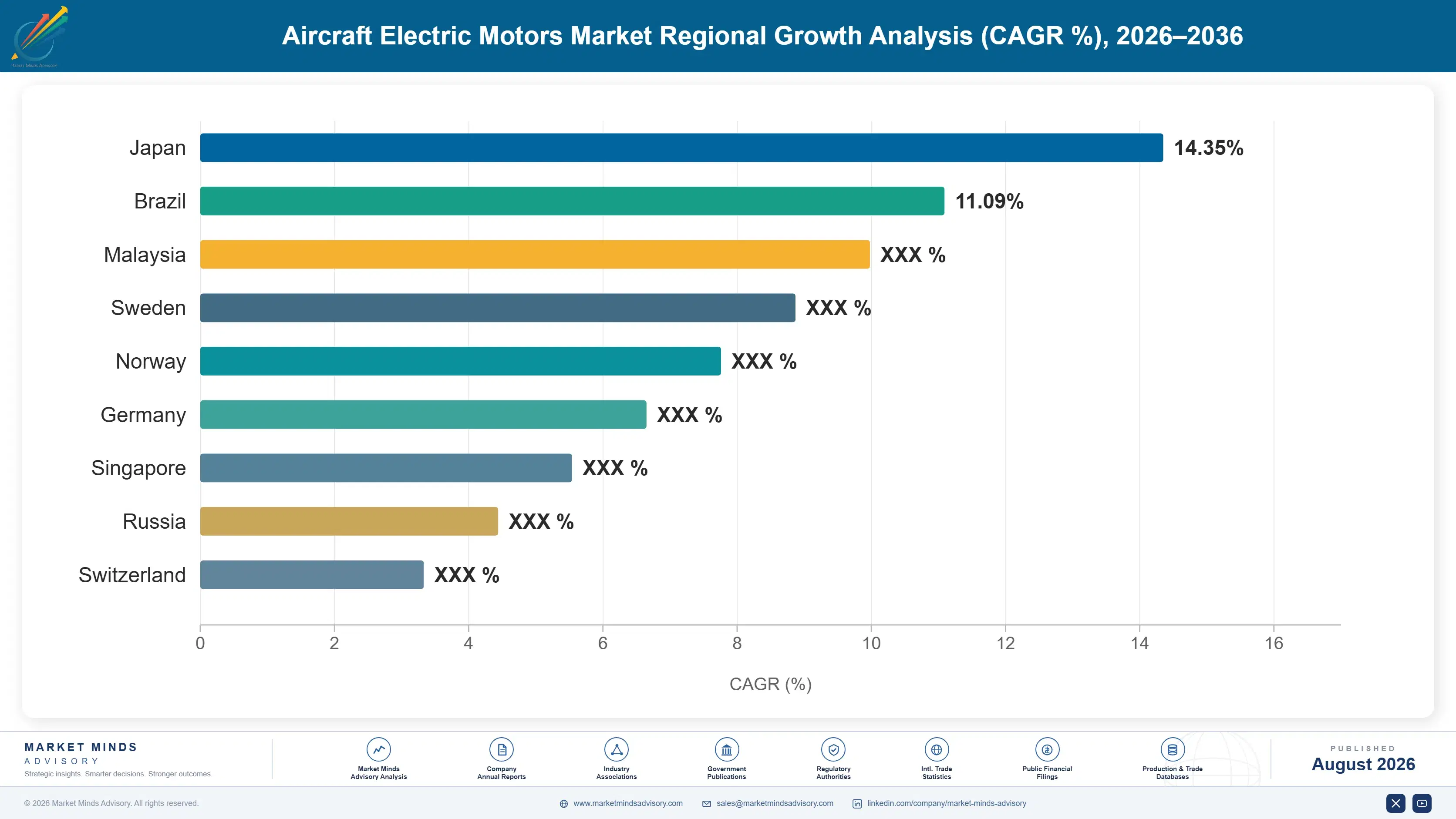
India grows fastest at 17.4%, driven by aerospace manufacturing expansion and by qualification engineering support run there for Western suppliers. East Asia holds the largest regional share overall.

Report Segmentation Architecture

The full report scope spans multiple orthogonal segmentation dimensions, with cross-tabulated demand data provided for each dimension pair. Coverage extends further to regional breakdowns, trend trajectories, and the competitive detail needed to support segment-level decision-making.

By Driven Function

  • Primary Propulsion Motors
  • Flight Control Actuation Motors
  • Environmental Control and Cabin Air Motors
  • Fuel and Hydraulic Pump Motors
  • Landing Gear and Braking Motors
  • Auxiliary and Utility Motors

By End-Use Industry

  • Commercial Airliners
  • Regional and Business Aviation
  • Advanced Air Mobility Operators
  • Military Fixed Wing
  • Rotorcraft
  • Unmanned Aircraft Systems

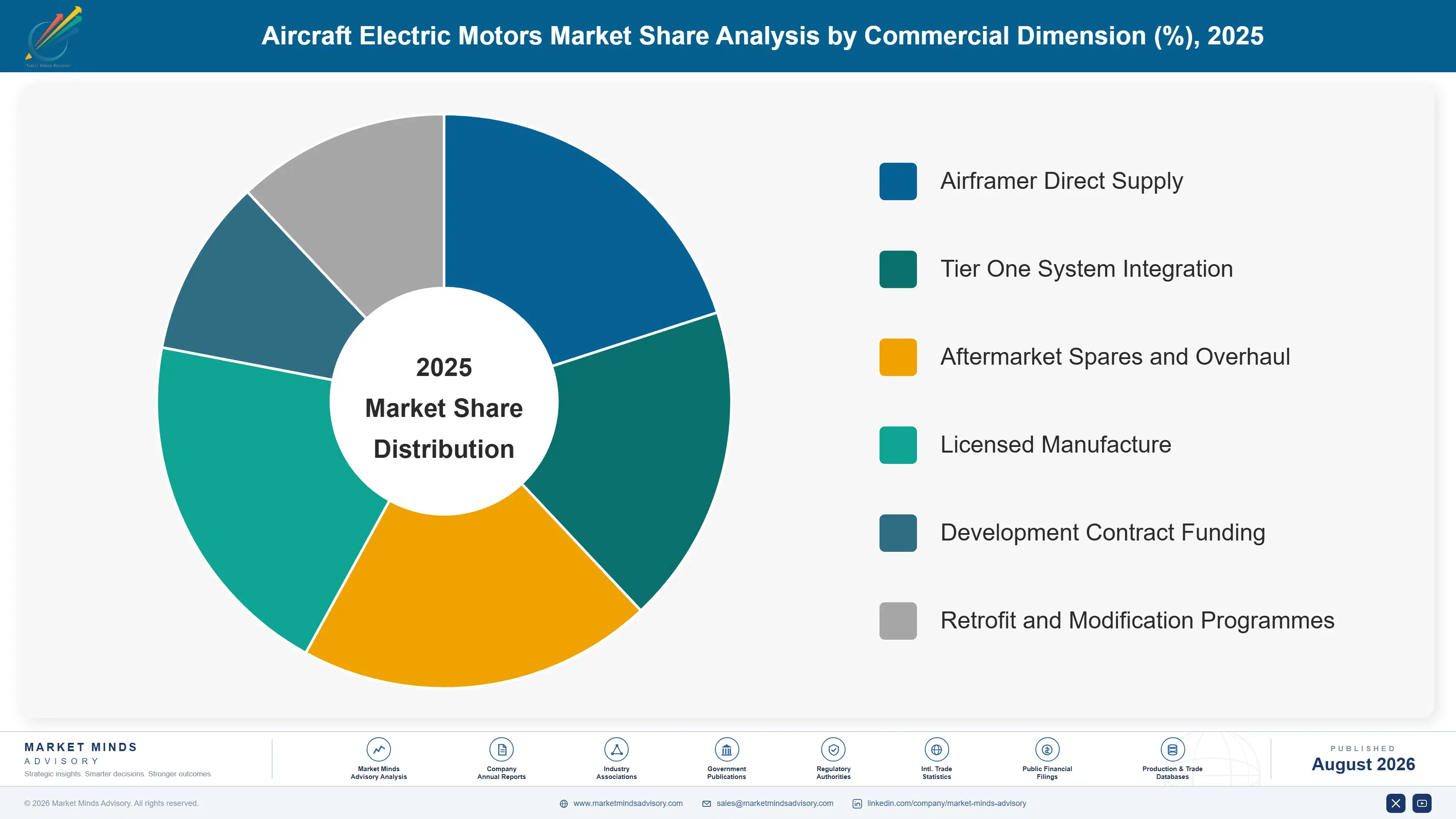
By Commercial Dimension

  • Airframer Direct Supply
  • Tier One System Integration
  • Aftermarket Spares and Overhaul
  • Licensed Manufacture
  • Development Contract Funding
  • Retrofit and Modification Programmes

By Region

  • North America
  • Western Europe
  • East Asia
  • South Asia and Pacific
  • Latin America
  • Middle East and Africa
  • Eastern Europe

Scope, Methodology, and Coverage

Every figure in this report is reproducible from documented input assumptions. The scope below maps the historical period, the forecast horizon, the segmentation dimensions, and the countries covered, alongside the underlying primary and qualitative methodology.
Historical Period
2020 to 2025
Forecast Period
2026 to 2036
Base Year
2025 (USD billions; MMA Primary Research Dataset, August 2026)
Market Definition
Revenue from electric motors qualified for airborne use on certificated and developmental aircraft, spanning primary propulsion, flight control actuation, environmental control and cabin air, fuel and hydraulic pumps, landing gear and braking, and auxiliary utility functions. Original equipment supply, aftermarket spares and overhaul, and development contract revenue are all included. Motor controllers and power electronics sold separately, generators and starter-generators, batteries, fuel cells and ground support equipment motors are excluded from scope.
Quantitative Units
USD billions, qualified motor revenue
Segmentation Dimensions
Driven function, end-use aircraft category, commercial supply dimension, region
Regions Covered
North America, Western Europe, East Asia, South Asia and Pacific, Latin America, Middle East and Africa, Eastern Europe
Countries Covered
United States, France, Germany, United Kingdom, China, Japan, South Korea, India, Brazil, Poland, Czechia, United Arab Emirates
Key Companies Profiled
Safran, Honeywell Aerospace, Collins Aerospace, magniX, Nidec, Rolls-Royce Electrical, Liebherr-Aerospace, Thales, Moog, Parker Aerospace
Quantitative Methodology
Primary survey, n=3,800 respondents, Q4 2025, six countries; demand-side model with trade association cross-validation
Qualitative Methodology
47 expert interviews, Q4 2025; applied to validate demand model assumptions, identify emerging dynamics, and assess competitive positioning
Report Format
PDF and XLSX data workbook (Word format preview document)
Publisher
Market Minds Advisory
Report Code
MMA-2026-CON-171
Published
August 2026
Contact
sales@marketmindsadvisory.com | www.marketmindsadvisory.com

Purchase the full Aircraft Electric Motors Market Report (2026 to 2036).

The full report treats aircraft electric motors as a certification business rather than an engineering one, and shows why suppliers optimised for propulsion keep losing actuation competitions. It quantifies qualification cost as a share of programme economics, models the saving available from pre-qualified motor families, and traces heavy rare earth magnet exposure across motor architectures following the April 2025 licensing measures. Segment analysis covers all six driven functions, with particular attention to why actuation produces more revenue today than propulsion despite receiving far less attention. Competitive assessment ranks twenty suppliers on qualified motor revenue and certified shipset content across every major region.
Six driven function segmentation with growth rates
Qualification cost as programme economics share
Twenty supplier assessment on qualified revenue
Heavy rare earth exposure mapped by motor architecture
Defence versus civil qualification timeline comparison
Aftermarket capture against original equipment value

Built For The People Who Decide

From boardroom strategy to bench-side execution, this report is read cover-to-cover by leaders shaping the next decade of their industry, turning demand scenarios, market dynamics and valuation benchmarks into decisions.
CXOs/ Presidents/ VPs/ Managers
M&A and Corporate Development
Strategy Teams and R&D Heads
Procurement and Product Directors
Regulatory and Compliance Leaders
Investor Relations and Equity Analysts